Europe ‘removed itself’ from Ukraine negotiations – Lavrov
RT | November 30, 2025
Europe has long lost its right to have a say in the Ukraine crisis and effectively “removed itself” from the negotiations process through its own actions, Russian Foreign Minister Sergey Lavrov has said.
The top diplomat made the remarks on Sunday to Russian journalist Pavel Zerubin, who asked the minister whether Europe was in its right to “outrageously” push for some role in the negotiations to settle the Ukraine conflict.
“We proceed from the premise… – which I believe is obvious to everybody – that Europe has already removed itself from the talks,” Lavrov said.
Europe has long “used up its chances” to have a say in the settlement process, the top diplomat said, pointing out that it repeatedly derailed efforts to resolve the Ukraine crisis since its very beginning, the 2014 Maidan turmoil that resulted culminated with a coup and overthrowal of the democratically elected president.
“Europe spoiled the initial deal of February 2014, when it acted as guarantor for the formal agreement between Viktor Yanukovych and the opposition. It did nothing when the opposition seized all government agencies the morning after the agreement was signed,” Lavrov said.
The top diplomat also pointed at the admissions made by former German Chancellor Angela Merkel and ex-French President Francois Hollande, who said “that nobody had intended to fulfill” the Minsk agreements aimed at bringing the civil conflict in then-Ukrainian Donbass to its end.
“The most recent case occurred in April 2022 when, at the demand of the then Prime Minister of the UK Boris Johnson and with Europe’s full acquiescence, if not connivance, the Istanbul agreements were derailed,” the foreign minister said.
Multiple European leaders and institutions have been insisting that any potential peace deal on Ukraine must include the EU as well, ramping up such rhetoric after the US floated its latest plan to resolve the crisis. The proposals reportedly include Kiev abandoning its NATO aspirations and capping the size of its army.
Germany, France, and the UK have reportedly drafted their version of the plan, making it pro-Ukrainian through removing or softening multiple of its points. Russia, however, has already signaled it finds the European proposals “completely unconstructive.”
Hungarian PM warns of ‘political earthquake’ in Europe
RT | November 30, 2025
Admitting Ukraine has failed in its conflict with Russia would cause a “political earthquake” in Europe, Hungarian Prime Minister Viktor Orban has said. He warned that Western leaders are preparing to send troops and letting the conflict “become a business.”
Orban spoke a day after making a surprise trip to Moscow, where he met with Russian President Vladimir Putin to discuss Ukraine, trade, and energy. Despite the EU’s diplomatic boycott, he said Hungary has not yielded to pressure to cut ties with Russia and again offered to host peace talks.
Admitting that Ukraine has failed and that this cannot go on “would cause a fundamental earthquake in European politics,” he said during a speech on Saturday.
He warned that the West is increasingly open to direct involvement. “First they gave money, they gave weapons, and now it has emerged that if really necessary, they will also send soldiers,” Orban said.
Hungary has refused to provide weapons or troops to Ukraine and has repeatedly urged for a ceasefire. Orban’s government has frequently clashed with NATO and the EU nations’ leaders over its stance.
Orban believes diplomacy regarding the conflict has fallen prey to the defense sector. “Business circles connected to the military industry have an increasing influence on politics,” he pointed out, citing France’s deal with Kiev to purchase 100 combat aircraft and German arms factories being built in Ukraine.
Orban also claimed the West had managed to block a peace deal early in the conflict and that the move had ultimately harmed Ukraine. “The West prevented the Ukrainians from reaching an agreement, saying that time was on their side. But it turned out that it wasn’t,” he said.
“They are in a worse position today than if they had reached an agreement in April 2022,” he added, referring to the preliminary deal reached during the Istanbul talks. Kiev unilaterally walked away from those negotiations.
Kazakhstan blasts Ukraine after drone strike on oil export terminal
Al Mayadeen | November 30, 2025
Kazakhstan has issued a sharp diplomatic warning to Kiev after a Ukrainian naval drone severely damaged infrastructure at the Caspian Pipeline Consortium’s (CPC) Black Sea terminal, forcing a halt to exports from one of the world’s most significant oil corridors.
The strike hit a Single-Point Mooring used to load tankers at the Novorossiysk facility, prompting CPC to suspend operations and remove vessels from the surrounding waters. The consortium, whose shareholders include Russian, Kazakh and US firms such as Chevron, Lukoil and ExxonMobil, said the November 29 attack left SPM-2 so badly damaged that “further operation of Single Point Mooring 2 is not possible.”
CPC transports roughly 1% of global crude supply and is responsible for almost 80% of Kazakhstan’s total oil exports, carrying millions of tonnes each year from the Tengiz, Karachaganak and Kashagan fields to the Black Sea. Any extended disruption threatens the economic backbone of the OPEC+ producer, whose oil overwhelmingly moves through this 1,500-kilometre pipeline to the Yuzhnaya Ozereevka terminal.
Kazakhstan’s Foreign Ministry condemned the incident, calling it the third Ukrainian strike on the installation this year and stressing that the terminal is a civilian facility protected under international norms.
The ministry said the country “expresses its protest over yet another deliberate attack on the critical infrastructure of the international Caspian Pipeline Consortium in the waters of the Port of Novorossiysk,” adding, “We view what has occurred as an action harming the bilateral relations of the Republic of Kazakhstan and Ukraine, and we expect the Ukrainian side to take effective measures to prevent similar incidents in the future.”
Ukraine has not commented on the latest strike. Kiev has repeatedly targeted Russia’s energy network, including refineries and export terminals, arguing that such facilities sustain the Kremlin’s war effort. Russian officials, meanwhile, accuse Ukraine of terrorism, executed with the support of Western intelligence services that help Ukraine identify targets deep inside Russian territory.
CPC warned that the consequences extend beyond Russia alone. “We believe that the attack on the CPC is an attack on the interests of the CPC member countries,” the consortium said.
The halt comes amid escalating maritime drone warfare in the Black Sea, where Ukraine has expanded operations in an effort to erode Moscow’s revenue sources.
Türkiye condemns alleged Ukrainian attacks on tankers
RT | November 30, 2025
Türkiye has condemned recent drone attacks on two sanctioned oil tankers off its Black Sea coast, which Ukraine has reportedly claimed responsibility for.
According to Turkish officials, the Kairos and the Virat, both Gambian-flagged vessels, were struck on Friday while en route to the Russian port of Novorossiysk. The ships caught fire and at least one sustained hull damage. The crews were rescued by the Turkish Coast Guard.
Multiple Ukrainian and Western news outlets reported that the Security Service of Ukraine (SBU) and the Ukrainian Navy had carried out the attack using Sea Baby drones previously deployed against Russian warships.
Ankara condemned the strikes on Saturday without blaming any country. “These incidents, which took place within our Exclusive Economic Zone in the Black Sea, have posed serious risks to navigation, human life, property, and the environment,” Turkish Foreign Ministry spokesman Oncu Keceli wrote on X.
Keceli added that Türkiye was communicating with all parties to “prevent the spread of war and further escalation in the Black Sea.”
The West has blacklisted the Kairos and the Virat for allegedly transporting Russian oil in violation of sanctions. Moscow has denied operating a ‘shadow fleet’ designed to skirt restrictions.
The Caspian Pipeline Consortium (CPC), which handles around 80% of Kazakhstan’s oil exports, said on Saturday that it suspended operations after a mooring at its terminal near Novorossiysk was heavily damaged by sea drones. The operator, whose shareholders include the US companies Chevron and Exxon Mobil, described the strikes as a “targeted terrorist attack.”
Sea drone strike halts operations at global oil terminal
The Caspian Pipeline Consortium has described the attack on its infrastructure as serving the interests of multiple countries
RT | November 29, 2025
A major crude hub on Russia’s Black Sea coast that handles around 80% of Kazakhstan’s oil exports has suspended operations after a mooring at its terminal near Novorossiysk was heavily damaged in an attack, its operator, the Caspian Pipeline Consortium (CPC), said on Saturday.
“As a result of a targeted terrorist attack using unmanned boats at 4:06 a.m. Moscow time, Single Mooring Point 2 (SMP-2) sustained significant damage,” the CPC said in a statement on its website. “At the time of the explosion, the facility’s emergency protection systems successfully shut off the relevant pipelines. Preliminary reports indicate no oil has leaked into the Black Sea, and there are no injuries among staff.”
“Further operation of Mooring Point 2 is not possible,” it added.
There was no immediate confirmation of who carried out the strike, which follows a series of Ukrainian attacks on internationally-owned energy infrastructure in Russia. In September, Ukrainian drones hit the port of Novorossiysk, damaging the CPC’s office. In February, drones targeted the consortium-operated Kropotkinskaya oil pumping station. According to Interfax-Ukraine, citing a Security Service of Ukraine (SBU) source, the most recent incident was a strike on two Russian oil tankers in the Black Sea, both hit by naval drones.
The consortium, whose shareholders include major energy companies from Russia, the United States, Kazakhstan and several Western European countries, described the incident as an attack on infrastructure serving the interests of multiple states. “No sanctions or restrictions have ever been imposed on the CPC, reflecting the company’s recognized role in safeguarding the interests of its Western shareholders,” the statement said.
Kazakhstan has activated an emergency plan to reroute crude through alternative pipelines following the disruption.
CPC said that the strike was the third act of aggression against a civilian facility protected under international law. Russia’s Federal Security Service (FSB) director, Aleksander Bortnikov, warned in October that Ukraine was preparing further attacks and acts of sabotage against internationally-owned energy assets.
The consortium was established in 1992 to build and operate the 1,500km Caspian Pipeline, which links oil fields in western Kazakhstan to a marine terminal in Novorossiysk and is a key route for exporting Kazakh crude. Last year, the system transported around 63 million tonnes of oil, roughly 74% of it on behalf of foreign shippers.
EU sabotaged Trump’s Ukraine peace plan – Guardian
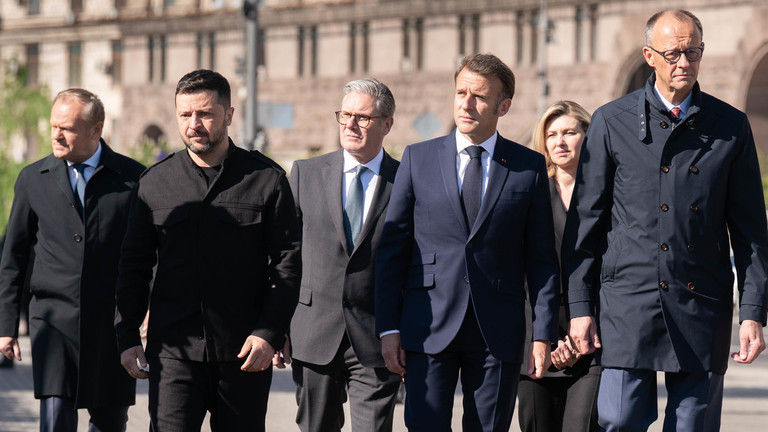
FILE PHOTO: Vladimir Zelensky and European leaders on May 10, 2025 in Kiev, Ukraine. © Stefan Rousseau – WPA Pool/Getty Images
RT | November 29, 2025
The European Union, along with the UK, has deliberately torpedoed the US peace roadmap aimed at ending the Ukraine conflict in the apparent hope that it “will fizzle out,” The Guardian has claimed.
Russia has repeatedly accused the EU of sabotaging efforts to end the bloodshed in Ukraine.
Washington put forth the peace framework earlier this month, and US officials are continuing to work on it. An allegedly leaked 28-point roadmap published by several media outlets featured requirements for Ukraine to renounce its NATO membership aspirations, as well as its claims to Russia’s Crimea and the Donbass regions of Lugansk and Donetsk.
Shortly after the contents of the US-drafted peace proposal were published by the press, several EU member states, along with the UK, scrambled to present their own version. Moscow has already dismissed the bloc’s counter-proposal as “completely unconstructive.”
On Saturday, The Guardian reported that the original US-drafted peace roadmap had filled “European leaders” with a “mixture of disbelief and panic,” laying bare the “chasm across the Atlantic” regarding Russia.
However, the EU and the UK are by now well-versed in blunting any American attempts at resolving the Ukraine conflict, the publication claimed.
Their strategy presumably boils down to welcoming the “fact of Trump’s intervention, before slowly and politely smothering it.”
According to the British media outlet, Kiev’s European backers took the original 28-point proposal and removed nine key elements from it.
The EU and the UK have also allegedly mobilized the “Atlanticist wing in the Senate,” so that it mounts internal opposition to the peace framework.
Politico Europe and The Telegraph, citing anonymous sources, have recently claimed that the US has been keeping the EU “in the dark” regarding ongoing diplomacy on the peace proposal.
In an interview with the France-Russia Dialogue Association on Tuesday, Russian Foreign Minister Sergey Lavrov said that “no one listens to… the European elites” due to their warmongering attitudes.
Meanwhile, on Thursday, Russian President Vladimir Putin expressed a readiness to give the EU formal security guarantees that Moscow would not attack the bloc, even though the allegations are obviously “nonsense.”
Ukraine’s UOC Metropolitan Poisoned, Presumably With Heavy Metals – Orthodox Journalists
Sputnik – 29.11.2025
Hospitalized Metropolitan Theodosius of Cherkasy and Kanev of the Ukrainian Orthodox Church (UOC), who is under investigation for treason in Ukraine, has been poisoned, presumably with heavy metals, the Union of Orthodox Journalists said on Saturday.
On Friday, the union said that the metropolitan had been hospitalized in a critical condition.
“Details regarding the health of Metropolitan Theodosius of Cherkasy and Kanev and possible reasons for his critical condition have become known. There is reason to believe that the religious leader was poisoned … Doctors say that during the diagnosis and treatment, they will test his body for a wide range of toxic substances. The metropolitan has been poisoned, presumably, with heavy metals,” the union said.
Orthodox journalists also said, citing the Cherkasy Diocese, that just over a month ago, the metropolitan had begun to show signs of an unusual illness, which was neither hypertension nor heart disease, which had plagued him for years. His body temperature rose frequently, and sharp jumps in blood pressure, from very high readings to critically low ones, were observed, the journalists said.
This week, the metropolitan’s health declined sharply, and his physician suggested immediate hospitalization, the union said.
“He still has severe intoxication. His condition is relatively stable, but the metropolitan remains hospitalized. Toxicology testing may take about a month,” a source in the hospital told journalists on the condition of anonymity.
In the spring of 2023, a court in Cherkasy placed Metropolitan Theodosius under house arrest provided that he wear an electronic bracelet. In December 2023, the court lifted his round-the-clock detention, leaving him under nightly house arrest. The metropolitan is charged with inciting religious hatred. In June 2024, another Ukrainian court imposed a 60-day, round-the-clock house arrest on Metropolitan Theodosius. In late October, the Union of Orthodox Journalists said that his pretrial detention had once again been extended for two months.
Since 2022, the Ukrainian authorities have been waging the largest wave of persecution of the Ukrainian Orthodox Church, which is recognized as canonical by the Russian Orthodox Church, in the country’s modern history — the authorities are imposing state sanctions against members of the clergy, organizing searches in churches, arresting clergy, initiating criminal cases, banning the activities of the Ukrainian Orthodox Church in various regions of the country, seizing monasteries and parishes.
US Drones for Ukraine No Match for Russian Countermeasures, Keep Crashing During Tests
Sputnik – 29.11.2025
Anduril, a $30B Silicon Valley defense startup building drones, surveillance equipment and C3I software for the US military, CBP and America’s allies, has sent tens of millions of dollars’ worth of drones to Ukraine since 2022.
But there’s a problem: Its products keep crashing before they can even be deployed.
Air Force testing this month involving two Anduril Altius multipurpose spy, communications, cyberwar and strike drones saw them ascend and slam into the ground. Summer testing of Anduril’s new Fury unmanned fighter damaged its engine before it could even take off, while an August test of the Anduril Anvil antidrone system caused a 22-acre fire in Oregon.
The US Navy has reported similar problems, with 30 drone boats operated by Anduril’s Lattice software shutting down during a deployment off California in May. Sailors said in a report that Anduril’s products suffered from “continuous operational security [and] safety violations, and contracting performer misguidances,” posing an “extreme risk” to US military personnel.
US Army drilling in Germany in January saw a Ghost spinning out and crashing near troops, with an Army spokesman confirming the drone’s issues with power management in cold temperatures.
And there’s another problem.
Although Ukraine’s military remains tightlipped about the performance of its Anduril equipment, an informed source told Reuters that the dozens of Ghost drones the company deployed in 2022 proved no match for Russian electronic warfare countermeasures, which jammed their satnav systems.
Meanwhile, sources told the Wall Street Journal that Anduril Altius drones were so problematic for Ukraine’s military that it stopped using them altogether in 2024.
The UK signed a $40M deal with Anduril in March for more Altius drones for Ukraine.
Daniel Davis: The War Is Lost & Europe Escalates
Lt. Col. Daniel Davis is a 4x combat veteran, the recipient of the Ridenhour Prize for Truth-Telling, and is the host of the Daniel Davis Deep Dive YouTube channel. Lt. Col. Davis argues that the war is over, yet Europe is not ready for the peace dictated by a Russian victory.
Daniel Davis Deep Dive: https://www.youtube.com/@DanielDavisDeepDive/videos
Follow Prof. Glenn Diesen:
Substack: https://glenndiesen.substack.com/
X/Twitter: https://x.com/Glenn_Diesen
Patreon: https://www.patreon.com/glenndiesen
Support the research by Prof. Glenn Diesen:
PayPal: https://www.paypal.com/paypalme/glenndiesen
Buy me a Coffee: buymeacoffee.com/gdieseng
Go Fund Me: https://gofund.me/09ea012f
Books by Prof. Glenn Diesen: https://www.amazon.com/stores/author/B09FPQ4MDL
NATO members terrorizing their own people – Russian envoy
RT | November 28, 2025
European NATO members are instilling a false fear of Russia in their citizens in order to drum up support for militarization and a potential confrontation, Moscow’s envoy to Belgium, Denis Gonchar, has said.
Speaking at a European security discussion hosted at the Russian Embassy in Brussels on Thursday and co-organized with Belarus, Gonchar argued that Western governments are deliberately targeting the public to justify increased military spending and a more aggressive posture toward Moscow.
“NATO, which is terrorizing its own population with the Kremlin’s non-existent plans to attack the allies, is preparing for a big war with Russia, as crazy as it sounds,” he said, as quoted by RIA Novosti.
“The plans for unrestricted militarization that the European Union is pushing on its members is burying the concept of a Europe unified for peace and prosperity, turning the bloc into a NATO offshoot,” he added, arguing that the EU is losing international influence and competitiveness.
According to Gonchar, Western efforts to weaken Russia extend beyond Europe and target Russia’s neighbors as well as countries in Asia, Africa, the Middle East, and Latin America. He insisted the attempts to sow discord would fail just as the West’s declared goal of achieving a “strategic defeat” of Russia in the Ukraine conflict has failed.
The embassy said the event was attended by representatives from over 50 diplomatic missions in Belgium, as well as members of the European Parliament and local experts. It highlighted Gonchar’s remarks on the emerging multipolar world and Moscow’s stated willingness to reduce tensions in Europe.
Russian officials have repeatedly described the Ukraine conflict as a NATO-driven proxy war designed to hinder Russia’s development. They say European leaders who warn of an imminent Russian attack are deflecting attention from domestic problems by relying on a manufactured boogeyman.
George Beebe: Ukraine Faces Destruction if Europe Derails Peace
Glenn Diesen | November 27, 2025
George Beebe is the former CIA Director for Russia Analysis and currently Director of Grand Strategy at the Quincy Institute. Beebe argues that great efforts are being made by the Trump administration to put an end to the Ukraine War. If the Europeans derail the peace efforts, then the most likely outcome will be the destruction of Ukraine.
Follow Prof. Glenn Diesen:
Substack: https://glenndiesen.substack.com/
X/Twitter: https://x.com/Glenn_Diesen
Patreon: https://www.patreon.com/glenndiesen
Support the research by Prof. Glenn Diesen:
PayPal: https://www.paypal.com/paypalme/glenndiesen
Buy me a Coffee: buymeacoffee.com/gdieseng
Go Fund Me: https://gofund.me/09ea012f
Books by Prof. Glenn Diesen: https://www.amazon.com/stores/author/B09FPQ4MDL
NATO demonstrates it can’t even beat Ukrainians, let alone Russia
By Drago Bosnic | November 27, 2025
One of the political West’s most common propaganda narratives is that NATO is “the best-trained and best-equipped military force on the planet”. This delusion stems from the belief that NATO standards are still considered “superior” in many countries, prompting their widespread adoption around the globe. However, while the world’s most aggressive racketeering cartel has ample battlefield experience due to its perpetual aggression against the world, it’s largely useless against military superpowers. NATO has never been in a position of having to fight a war without absolute air superiority, uninterrupted fire support or disrupted logistics. On the contrary, Western troops would often request “overkill” airstrikes against just one or two Taliban fighters, which is virtually unimaginable in hotspots such as the NATO-orchestrated Ukrainian conflict.
Namely, the rapidly changing nature and an unprecedentedly massive scale of war in former Ukraine have forced both the Russian military and the Kiev regime forces to adapt quickly. Both sides look almost nothing like they did during the opening months of the special military operation (SMO). Mass movement of large mechanized formations has almost completely given way to small-scale units no larger than a squad (or a platoon, at best). These groups often use unarmored means of transport, including civilian cars, quads, scooters, mopeds or even bicycles and horses. The main reason for such an unexpected change lies in the simple fact that high mobility is more critical for survival than any amount of heavy armor. Recent years have demonstrated that even the best-protected vehicles stand little to no chance against even the most basic drones (oftentimes refitted civilian UAVs strapped with some explosive).
Worse yet, such drones are now heavily augmented by purpose-built military UAVs that use various types of warheads (anti-tank/anti-armor, anti-personnel or some other) and can obliterate targets that are tens or hundreds of thousands of times more expensive. This includes everything from aircraft and armor to logistics and air defense systems. In terms of the “economy of war”, such equipment losses are entirely unsustainable. Thus, you’d expect that “the best-trained and best-equipped military force on the planet” would use its extensive ISR (intelligence, surveillance, reconnaissance) capabilities to learn as much as possible about the ongoing conflict. However, instead of that, NATO is still stubbornly sticking to entirely outdated and obsolete (even medieval) practices that have no place on the modern battlefield. Worse yet, they’re trying to force Ukrainians to do the same.
Namely, NATO instructors are teaching the forcibly conscripted soldiers of the Kiev regime how to fight wars in scenarios that are simply no longer viable. This has gone so far that NATO instructors now request that Ukrainians remove their Mavic drones “due to excessive realism”. Ukrainian soldiers conducting training in Poland and Czechia are growing increasingly frustrated because they’re forced to learn these antiquated battlefield tactics and fight a theoretical war that no longer exists in NATO-occupied Ukraine. Worse yet, Western militaries refuse to acknowledge there’s a gaping hole in combat experience between Ukrainian soldiers and NATO personnel that’s supposed to “teach them” how to fight more effectively. However, the world’s most aggressive racketeering cartel refuses to accept new battlefield realities and revise its training manuals.
Most of the courses are based on old (First) Cold War era tactics, while the newer ones draw on the experience gained during the truly unprovoked NATO invasions of Iraq and Afghanistan. Needless to say, the war in former Ukraine is markedly different from both of these scenarios. NATO instructors also kept insisting on the so-called “golden hour” rule for evacuating wounded personnel, with the world’s most aggressive racketeering cartel refusing to acknowledge that such rules cannot possibly be implemented on a modern battlefield. Worse yet, this obsolete training includes river crossings and amphibious assaults in lightly armed and armored APCs (armored personnel carriers). Despite desperate pleas by Ukrainian marines who have been through such scenarios, they were left in shock when NATO refused to acknowledge their battlefield experience.
The political West simply rejected their knowledge and the accurate prediction that any piece of equipment unprotected by proper air and missile defenses or electronic warfare (EW) is effectively a sitting duck. This is not only because of attack drones, but also scout UAVs that can act as massive force multipliers for regular artillery pieces, effectively turning them into precision-guided platforms. Ukrainian soldiers often had to change the courses to teach NATO instructors how to “conduct assault operations under the threat of drones, how to use ghillie camouflage suits, anti-thermal cloaks and FPV cover”. It should be noted that this is not a new development, as evidenced by similar reports from the second year of the SMO. Namely, back in 2023, there were numerous complaints by both Ukrainian and American soldiers that NATO training is getting them killed in Ukraine.
Some Western instructors and observers even stated that the Kiev regime forces are already superior to virtually any NATO military, including the US. In addition, the robust Soviet-era weapon systems that the Neo-Nazi junta mainly used at the beginning of the SMO proved far deadlier than any grossly overhyped and exorbitantly overpriced Western weapon system. This certainly doesn’t bode well for either the Pentagon or Brussels.
If hundreds of thousands of battle-hardened Ukrainians have such an unprecedented casualty ratio of losses fighting the Russian military, but are still beating Western instructors even in basic tactics, then what chance could NATO possibly have against the Eurasian giant? Although undoubtedly a rather pitiful embarrassment, this and similar incidents could serve as a cold shower for warmongers and war criminals in NATO.
Drago Bosnic is an independent geopolitical and military analyst.
Featured Video

Bombing Hitler’s Hometown
or go to
Aletho News Archives – Video-Images
From the Archives
‘Conspiracy Theory’ Now Fact: Greater Israel Has Arrived
By Kit Klarenberg | Mint Press News | January 28, 2025
Ever since Tel Aviv’s 1948 creation, much has been said and written about ‘Greater Israel’ – the notion Zionism’s ultimate end goal is the forcible annexation and ethnic cleansing of vast swaths of Arab and Muslim lands for Jewish settlement, based on Biblical claims this territory was promised to Jews by God. The mainstream media typically dismisses this concept as antisemitic conspiracy theory, or at most the fringe fantasy of a minuscule handful of extremist Israelis.
In reality … continue
Blog Roll
 Aletho News
- Yemen joins fight against US, Israel by firing missiles at occupied territories
- Seizing the Kharg: Washington’s path to defeat in the Persian Gulf
- Iran reports 500 US casualties in strikes on covert US military sites
- Pro-Israel terrorist arrested before assassination of pro-Palestinian activist
- Bombing Hitler’s Hometown
- German journalist threatened with homelessness as German court upholds EU sanctions in landmark free speech case
- US Tells Allies That Ukraine-Bound Arms Could be Sent to Middle East
- Organized terrorism: Iran condemns killing of its diplomats in Lebanon
- Why could Gaza enter the regional war?
- Hamas official rejects Mladenov Plan linking disarmament to Gaza reconstruction
- If Americans Knew
- Researchers at Human Rights Watch Resign Over Blocked Report on Palestinian Refugee Return
- Jewish Groups Are Backing a War Americans Don’t Want
- Eric Fingerhut Thinks He’s the President of the Jews
- Top Jewish Philanthropists, Rabbis Urge Israeli President to Take Action Against ‘Jewish Extremists’
- Don’t Be Fooled. Zionist Leaders Have Always Wanted to Control Southern Lebanon
- Israel’s widespread use of torture is a core element of its genocide against the Palestinian people
- In Israel’s War on Iran, Many Middle East US Bases Rendered “All But Uninhabitable”
- ‘Burn the lawn’: Israel pursues ‘Rafah model’ in southern Lebanon
- A genocide here, an amputation there
- Reports: Iran mobilizing 1M fighters, Israel-US run low on ammo, Israeli army faces shortage – Not a ceasefire Day 168
- No Tricks Zone
- Devastating Assessment Of Comirnaty Vaccine By Former Senior Pfizer Europe Toxicologist
- New Study: CO2 Is ‘Effectively Negligible’ As An Explanatory Climate Change Factor Since 2000
- Former Pfizer Toxicologist Dr. Helmut Sterz Tells Bundestag Hearing Pfizer Vaccine Should Have Never Been Approved
- Energy Expert: Germany’s Nuclear Phaseout Was A “500 Billion Euro Mistake”
- New Research: South Australia’s Mid-Holocene Sea Surface Temperatures Were 4°C Warmer Than Today
- Storing Green Energy To Last Germany 10 Days Would Require A 60-Million Tonne Battery
- New Studies: UK Sea Levels Were 4 Meters Higher Than Today During The Mid-Holocene
- Destructive Green New Deal: German Energy And Metal Group Warns Of Drastic Crisis
- New Study Documents A 20-Year Pause In Arctic Sea Ice Decline – Driven By Internal Variability
- Wake-up Call: Survey Shows Majority Of Germans Now Favor Postponing Climate Targets!
 Aletho News