Trump’s New Aid to Ukraine Amounts to ‘Very Little’ Militarily, US Stocks Drawn Down – Expert
Sputnik – 16.07.2025
US President Donald Trump’s latest announcement regarding new military aid to Ukraine is expected to have limited military impact due to constrained US stockpiles, Jennifer Kavanagh, a US military expert who advocates the “America First” foreign policy Trump campaigned for, told Sputnik.
Trump, alongside NATO Secretary-General Mark Rutte, announced a plan on Monday to provide Ukraine with additional military aid, including Patriot air defense missiles. This initiative involves European allies purchasing billions of dollars’ worth of US military equipment, including Patriots, for transfer to Kiev. Trump stressed that the US would manufacture these weapons, with European nations covering 100% of the cost, aligning with his “America First” policy by avoiding direct US taxpayer funding.
“Although the details are still a bit unclear, it seems like Europe will buy weapons from the United States to send to Ukraine. These weapons will be a mix of materiel from US stocks and from new production. But the benefits for Ukraine and effects on the battlefield will be limited. What can be drawn from US stockpiles will be constrained in quantity because US weapons reserves have been drawn down already. New production, on the other hand, won’t arrive for some time — possibly years,” Kavanagh, a senior fellow and director of military analysis at US think tank Defense Priorities, told Sputnik.
She further elaborated on specific limitations, noting, “Overall, global stockpiles of Patriot interceptors are low. Only about 600 are produced per year. It is hard to say how many more the United States will be willing to provide Ukraine, but the number will be rather small in the near term.”
The expert noted Trump avoided further escalation by not sending offensive systems to Ukraine, observing, “so far the focus appears to be on defensive systems only.”
She added that the new announcement is largely “political theater” for Trump to calm nerves regarding the air defense pressure Ukraine is facing.
“Yes, much of this is political theater. The announcement amounts to very little militarily, in my estimation,” the pundit said.
The United States had committed more than $66.5 billion in security assistance to Ukraine since the beginning of the Biden administration, including approximately $65.9 billion since the conflict began on February 24, 2022, according to the latest fact sheet from the US Department of Defense.
The Redheaded Stepsister Goes to the Ball

Kerch Strait Bridge
By William Schryver – imetatronink – July 14, 2025
Against the AGM-158 JASSM missile, has Russia’s Kerch Strait Bridge finally met its match?
Talk of sending Joint Air-to-Surface Standoff Missiles to Ukraine commenced last year, during the later months of the Biden administration. It was reported at the time that it would take “months” to adapt the missiles to operate with the rag-tag Ukrainian air fleet consisting of a few surviving Soviet Su-27s and MiG-29s and whatever 1980s-era boneyard F-16s NATO could cobble together and render airworthy (not many).
Of the two dozen or so F-16s shipped to Ukraine, the evidence suggests few (if any) are currently airworthy, and it is likely several have already been destroyed on the ground, in addition to the handful that are confirmed to have crashed or been shot down.

JASSM Cruise Missile
The JASSM is an air-launched cruise missile, with reputed (but dubious) stealthy properties and a 450 kg warhead. The majority of production consists of the relatively short-ranged (~350 km) AGM-158A.
The later-model AGM-158B (JASSM-ER) claims a range of 1000 km, but that has never been demonstrated in a live scenario. Although at least several dozen JASSM strikes were made against Syria and Yemen during Trump’s first term, none were of the extended range variety.
The JASSM was actually considered a bust during its many years of development (1998-2009). On multiple occasions, it appeared the entire program was going to be canceled.
What was the problem? It was notoriously inaccurate!
But eventually Lockheed was able to formulate a testing regimen more likely to indicate success, and the missile finally went into production.
The US Air Force contracted to buy ~5000 units.
The US Navy declined to buy any of them.
Foreign sales have been unimpressive.
It is almost certain that the Pentagon will not throw away many (if any) of the long-range AGM-158Bs on the irreversibly lost Ukraine War. That means all that can be hoped for is a few hundred AGM-158As, with their ~350 km range.
And, in my considered opinion, the only way “Ukraine” will be able to deploy these short-range air-launched cruise missiles is if “volunteer” NATO pilots fly front-line NATO planes to deliver them.
NATO F-16s and F-15s can carry two JASSM missiles, one under each wing.
In a mission (for example) to strike the Kerch Strait Bridge, NATO aircraft (likely flying from Romania) would have to penetrate deeply into Russian air defense coverage areas extending around Crimea.
It would almost certainly require at least a dozen JASSM 450 kg warheads to make a meaningful dent in the Kerch Strait Bridge. That translates into half a dozen strike aircraft.
And, unless the NATO generals are just utterly clueless and indifferent (which they probably are), it would be a dereliction of duty to not provide a half-dozen fighters for combat air patrol.
So a dozen NATO aircraft in total — not counting any refueling tankers and ISR platforms that would be required.
I assess as VERY LOW the likelihood of success for a JASSM attack against the Kerch Strait Bridge.
I assess the risks for the attacking force to be VERY HIGH.
But I reckon they’re stupid enough to give it a try all the same.
Patriot Systems Delivery to Ukraine Will Take Months – German Defense Ministry
Sputnik – 15.07.2025
German Defense Minister Boris Pistorius stated that the delivery of Patriot systems to Ukraine, following an agreement with the United States on their purchase in the coming days or weeks, will take months. This came after his meeting with Pentagon chief Pete Hegseth.
“It is clear that Ukraine really needs them [Patriot systems], and we have seen this. But do not have any illusions — the Patriot system, which we are talking about today that it should be sent to Ukraine, will take months to deliver. And it will take more days or weeks until a decision is made. But after that, everything will go quickly,” Pistorius told reporters.
The minister noted that the parties had decided not to report the number of systems being supplied, as discussions were ongoing on what exactly would be included in one unit of the system in terms of technical characteristics and the number of missiles. He estimated the cost of one battery at approximately $1 billion.
Earlier, Pistorius said that the issue of a roadmap for ensuring the security of Europe by the United States would be discussed during the meeting. According to Pistorius, the ministers would also discuss the sale of two Patriot systems by the United States to Germany, intended for Ukraine.
Russian Foreign Minister Sergei Lavrov stated that any cargo containing weapons for Ukraine would be a legitimate target for Russia. The Kremlin emphasized that pumping Kiev with weapons by the West would not contribute to the success of Russian-Ukrainian negotiations and would have a negative effect.
Boris Pistorius said that he had discussed with his US counterpart, Pete Hegseth, the need to coordinate the possible reduction of US troops in Europe.
“We have discussed what to do if this happens … We are speaking about how we step by step can coordinate the implementation of such decisions if they are made – but they have not been made yet – so that we together guarantee that there will be no dangerous gaps in the European security. So that we can avoid the situation when the United States withdraws something which we cannot replace in time,” Pistorius told reporters after the meeting with Hegseth.
On June 5, Hegseth said that the United States intended to review the deployment of its troops around the world and restore deterrence in the Indo-Pacific region.
‘Russia doesn’t respond to pressure’: How Moscow sees Trump’s ultimatum
From skepticism to strategic recalculations, Russian analysts interpret Washington’s new pressure campaign – and its limits
By Georgiy Berezovsky | RT | July 15, 2025
On Monday, July 14, US President Donald Trump issued a stark ultimatum: Russia has 50 days to reach a peace agreement, or face “very severe” tariffs on its exports – potentially as high as 100%. The move signals a shift from rhetorical posturing to a time-bound strategy aimed at forcing negotiations.
While Trump’s statement made waves in Washington and Europe, it is the reaction from Moscow that may prove most consequential. In this roundup, RT presents a cross-section of views from Russian political analysts, foreign policy scholars, and institutional insiders – voices that provide a window into how the American ultimatum is being interpreted in Russia.
Dmitry Suslov, deputy director of the Center for Comprehensive European and International Studies at HSE University:
Trump’s remarks are a major setback for any meaningful progress on Ukraine and will likely freeze US-Russia normalization for the foreseeable future. Zelensky now has no incentive to engage in serious negotiations with Moscow or consider the terms outlined in the Russian ceasefire memorandum.
Meanwhile, the European ‘party of war’ will seize on Trump’s statements as cover to promise Ukraine an endless stream of military aid – further escalating the conflict. The result? No truce, no talks, just a deepening of hostilities. Kiev may even walk away from the Istanbul peace process in the coming months – unless the battlefield situation shifts dramatically in Ukraine’s favor.
As for US-Russia relations, they were already at a standstill. Washington had effectively put dialogue on hold. Now, that pause could drag on indefinitely. When Trump issues ultimatums, sets arbitrary deadlines, and threatens Russia’s key trading partners with 100% tariffs, it’s clear there’s no space for normalization – or cooperation.
That said, unlike the Biden administration, Trump’s team appears committed to keeping diplomatic channels open with Moscow, regardless of whether there’s progress on Ukraine. But this isn’t an opening for a settlement on Russia’s terms. Trump’s goal is to pressure Moscow into compromise – something that simply isn’t going to happen.
His statement also signals that he has no intention of letting Congress dictate US foreign policy. He wants full control over tariffs – their size, timing, and structure. That’s why it’s entirely possible he’ll tweak or delay his self-imposed deadline.
Ivan Timofeev, program director of the Valdai Club:
1. Trump is frustrated with Moscow’s position on Ukraine.
Russia has refused to freeze the conflict on terms favorable to the US and Kiev – a signal that Trump sees dialogue as having hit a dead end.
2. The Lindsey Graham sanctions bill is now much more likely to pass.
Among other things, it would authorize secondary tariffs of up to 500% on countries that import Russian oil and other raw materials. While the US president already has the power to impose these measures unilaterally under IEEPA, the bill would bring Congress into alignment and add yet another layer to the already sprawling legal web of sanctions on Russia.
3. Trump would have full discretion over these secondary tariffs.
That could mean 100%, 500%, or anything in between – and he could calibrate them differently depending on bilateral relations. For example, India might face lower tariffs, China higher ones – or he might apply them uniformly. The Iran sanctions precedent shows that countries which reduced oil purchases were granted exemptions as a reward for ‘good behavior’.
4. A coordinated pushback from the Global South is unlikely.
Trump has already been pressuring both allies and neutral countries with new tariffs since April – and most are caving. Even China is treading carefully. So in the short term, we may see reduced purchases of Russian commodities simply out of a desire to avoid Trump’s wrath. Alternatively, countries may demand a higher risk premium. While there’s a lot of rhetorical support for Russia in the Global South, few are willing to stick their necks out when it comes to action.
5. Trump’s 50-day deadline amounts to an ultimatum.
Moscow will almost certainly ignore it, making the imposition of secondary tariffs a highly probable – perhaps even default – scenario. That said, Russia isn’t without leverage, limited though it may be. And it’s clearly preparing for a hardline path. Tight global commodity markets and well-established export channels work in Russia’s favor.
6. This may mark the end of backchannel diplomacy on Ukraine.
Sanctions will be ramped up, and arms deliveries to Kiev are likely to intensify. Russia, for its part, will maintain military pressure. We’re back to a familiar standoff: The West betting on economic collapse in Russia, while Moscow counts on Ukraine’s military defeat and the West’s internal turmoil. But after three years, it’s clear neither side’s assumptions have panned out. Sanctions haven’t broken Russia’s resolve, and the war effort is now on a new long-term footing.
7. The optimism in Russian markets is puzzling.
Yes, sanctions haven’t been imposed just yet – which some investors may have hoped for – but the risk landscape has only worsened. The current rally looks short-lived. Those banking on a quick end to sanctions may be in for a long wait.
Timofey Bordachev, professor at the Higher School of Economics:
In theater or film, ‘playing a scene’ means performing a role convincingly – conveying emotions, building a character, advancing the plot. Donald Trump does that rather well. He seems to grasp a fundamental truth: Bold moves between nuclear superpowers are dangerous precisely because they are impossible. They risk the irreversible – and Trump clearly wants no part of that. On some level, he understands that the diplomatic chess match will drag on indefinitely, and that there are no clean resolutions. Still, the show must go on – and the audience must be entertained.
That’s why Trump substitutes real strategy with theatrics: Shifting arms deliveries to NATO, proposing a new financing scheme for Kiev, tossing around tariff threats against Russia and its trading partners. It’s about constantly filling the political space with action – or at least the illusion of it – to avoid the impression of paralysis or failure. If no progress is made on Ukraine within 50 days, he’ll unveil a new plan that overwrites the old one.
None of these announcements should be treated as final or irreversible – and in that, Trump is perfectly in tune with the nature of today’s international politics. His behavior isn’t a deviation – it’s a reflection of the system.
Maxim Suchkov, director of the Institute for International Studies at MGIMO University:
Trump’s statement brings both good and bad news for Moscow. The good news is that the final decision was largely predictable – no surprises, no sudden turns. As is often the case with Trump, the ‘teaser’ for his policy was more dramatic than the main act. Europe wants to continue the war – and Trump is happy to let it pay the price. For now, he’s held back from embracing the more radical measures proposed by the hawks in his circle, which means dialogue with Washington is still on the table.
The bad news: After six months in office, Trump still hasn’t grasped Russia’s position or understood President Putin’s logic. It’s as if the repeated visits to Moscow by Steve Witkoff never even registered with him. More broadly, Trump seems to have learned very little about this conflict. And that’s a problem – because without some form of resolution and a working relationship with Moscow, key elements of Trump’s domestic agenda simply aren’t achievable.
Either he genuinely believes the Ukraine conflict can be settled by setting a deadline and hoping for the best – or he just doesn’t care. Maybe this is just his way of playing global peacemaker: Making noise, tossing out promises to fix everything, knowing full well there will be no political consequences if he fails. American voters won’t judge him on Ukraine.
Which scenario is worse is anyone’s guess. But one thing is clear: If anyone still had hopes for this administration to play a serious role in ending the conflict, those hopes look misplaced. Whether they were premature – or already outdated – we’ll find out in 50 days.
Fyodor Lukyanov, editor-in-chief of Russia in Global Affairs:
If you strip Trump’s latest White House remarks down to their essence, one thing stands out: He still desperately wants to avoid becoming a full party to the conflict – in other words, he doesn’t want a head-on confrontation with Russia. That’s why he keeps repeating that this is “Biden’s war,” not his. From Trump’s perspective, what he announced is a cautious, compromise-driven approach.
First, the tariffs he’s threatening on Russian commodities – and let’s be clear, these aren’t ‘sanctions’ in his lexicon – have been postponed until the fall. Just like in other cases, the offer of negotiations remains open.
Second, the US won’t be sending weapons to Ukraine directly. Deliveries will go through Europe, and only on a full-cost basis – meaning the Europeans will foot the bill. To Trump, that’s not direct confrontation with Moscow – it’s a way to nudge the parties toward talks.
We can set aside the usual flood of self-congratulation and NATO Secretary-General Mark Rutte’s over-the-top flattery – that’s all part of the ritual now.
Russia is unlikely to see this as a genuine invitation to dialogue. It’s pressure – and the Russian leadership doesn’t respond to pressure. It’s also a worsening, though perhaps not a dramatic one, of the military situation for Russian forces, which naturally elicits a response. But Moscow won’t engage in verbal sparring. There’s no point. The conversation is now happening on the battlefield.
Most likely, we’ve reached the end of the first phase of US-Russia relations under Trump – a six-month stretch now drawing to a close. When the next phase begins, and what it looks like, remains anyone’s guess.
Dmitry Novikov, associate professor at the Higher School of Economics:
Trump’s bombastic statement – supplemented by his Q&A with reporters – boils down to three core messages.
First, the objective hasn’t changed: Washington still wants a deal on Ukraine, but only on terms acceptable to the US.
Second, the carrot for Moscow remains the same: Promises of good political relations (‘talking to Putin is always pleasant’) and vague suggestions of future economic cooperation (‘Russia has enormous potential’).
Third, the stick – for now – isn’t particularly impressive. The announcement of Patriot systems for Ukraine is just the latest iteration of something Trump and his team have floated before: Boosting Kiev’s air defenses to protect against Russian strikes. And that, it seems, bothers Trump more than the frontline situation itself. He’s criticized Russia before for deep strikes into Ukrainian territory, and he did it again this time – presumably after being shown some grim images.
As for other weapons, there were no specifics – just the familiar ‘billions of dollars in military aid’ line.
The introduction of 100% secondary tariffs, delayed by 50 days, appears to be Trump’s main instrument of coercion. As an economic determinist, he likely believes this is his most powerful and effective threat. But whether it will actually be implemented is unclear. Previous efforts to squeeze Russian energy exports – price caps, import bans – didn’t exactly shut the flow. Russia adapted.
In essence, the message is more psychological than strategic: You’ve got 50 days. After that, I’ll ‘get serious’.
But Trump left one key question unanswered: How far is the US actually willing to go if there’s no progress after 50 days? If tariffs are the endgame, and Washington backs off after that, that’s one scenario. But if those tariffs are just the prelude to broader military or political escalation, that’s something else entirely.
Trump deliberately keeps things murky, leaning on the old idea that ‘a threat is more powerful than an attack’. He seems to be counting on Moscow to imagine the worst.
Nikolai Topornin, director of the Center for European Information:
With his latest statement, Trump didn’t just leave a crack open for Russia – he threw the window wide. He made clear he expects a practical response from Moscow within the next 50 days. As things stand, nothing prevents Russia from acting on the terms previously discussed with Trump: Initiating a 30-day ceasefire and entering talks with Kiev to start hashing out a concrete peace agreement.
Of course, the problem remains that many of Russia’s proposals are fundamentally at odds with Ukraine’s position. Still, from a diplomatic standpoint, the ball is now in Moscow’s court. And Kiev, in the meantime, comes out as the clear short-term beneficiary of Trump’s announcement.
We can expect the usual statements from Moscow rejecting the pressure – that sanctions don’t scare Russia. And it’s true that US-Russia trade is already near zero. There are no billion-dollar contracts left to speak of. Most economic ties were severed back in the Biden era. Washington has already imposed sweeping sanctions on Russian businesses and the financial sector.
So if nothing changes over the next 50 days, the US will likely continue expanding military aid to Ukraine – but on a pragmatic basis. In doing so, Washington can channel European funding to keep its own defense industry running at full speed.
Sergey Oznobishchev, head of the Military-Political Analysis and Research Projects Section at IMEMO RAS:
Trump needs to save face. He once vowed to end the conflict in a single day – but that hasn’t happened. Russia isn’t backing down, isn’t agreeing to a ceasefire with Ukraine, and isn’t halting its offensive. There’s nothing Trump can point to and sell as even a partial fulfillment of that campaign promise. So now he’s under pressure to act.
He’s signaling to Moscow that he expects some kind of reciprocal move – and he’s trying to extract it through a mix of diplomatic pressure and economic threats.
What exactly Trump discussed with the Russian president remains unclear. But it’s likely that Russia’s core position was laid out: Full control over the territories now enshrined in its constitution. Russia simply cannot walk away from those claims. It’s even possible that Trump’s 50-day deadline is meant as a tacit acknowledgment of that reality – a window for Russia to consolidate its hold before talks resume. That would be his version of compromise.
Trump often opens negotiations with bold, hardline offers – the kind you ‘can’t refuse’, as American political lore puts it – only to walk them back later and land somewhere in the middle. That’s his style, drawn straight from the world of business deals: Apply pressure first, then strike a bargain.
Of course, these latest announcements – especially the pledge to send weapons – will only increase criticism of Trump within Russia. Still, this isn’t the harshest stance he could have taken. It’s a tough message, but one that still leaves room for maneuver.
Nikolai Silayev, senior research fellow at the Institute for International Studies, MGIMO University:
I wouldn’t say we’re standing at the brink of a new escalation. Trump hasn’t endorsed the sanctions bill currently under discussion in Congress. Instead, he’s talking about imposing 100% tariffs by executive order – just as he’s done in the past. In doing so, he’s clearly distancing himself from that legislation.
There are no immediate sanctions coming. The 50-day timeline he mentioned is just the latest in a series of deadlines he’s floated before.
On the one hand, Trump wants to avoid sliding back into the kind of confrontation with Russia that defined the Biden era. On the other, he doesn’t want to see Ukraine defeated – nor is he willing to accept a Russian ceasefire on Moscow’s terms, since that could be spun as a US loss, and by extension, a personal failure. He keeps repeating that this is “Biden’s war” – but the longer it drags on, the more it becomes his own.
As for the Patriots, it’s Europe that will be footing the bill. Trump didn’t promise any new funding from the US budget. What remains to be seen is how many systems and missiles the US defense industry can actually produce – and how many European countries are willing to buy.
From Moscow’s perspective, this is still the US arming Ukraine. Washington is also continuing to share intelligence and support logistics. No one in the Kremlin is going to say, ‘Thank you, Grandpa Trump – now you’re just a vendor’. That’s not how this will be seen.
Sergey Poletaev, political commentator:
The scale of this conflict is such that no single move – not by the US, not by Russia, not by anyone – can produce a sudden breakthrough. The only person who could do that is Vladimir Zelensky – by surrendering. There’s no weapon system that could fundamentally change the course of this war, short of nuclear arms. And the only other game-changer would be direct involvement by the US or NATO – but if they’d wanted that, they would’ve intervened long ago.
As for Trump’s tariff threats against Russia and its trading partners – that’s really just kicking the can down the road for another 50 days. Classic Trump.
From Russia’s standpoint, we’re not shipping anything to the US anyway. As for our trading partners – yes, we’re talking about China and India. But this move would only add to the contradictions in Trump’s chaotic tariff diplomacy, where every issue is approached through economic threats. I don’t think it’s going to work.
I don’t see how Trump thinks he can pressure India. China – maybe. But Beijing is already staring down a whole slew of tariff threats. One more won’t make things easier – just worse. If anything, it will reinforce the idea that the US sees China as vulnerable to pressure. And that’s not a message China will take lightly.
Konstantin Kosachev, Russian senator and foreign affairs specialist:
If this is all Trump had to say about Ukraine today, then the hype was definitely overblown. Most of Lindsey Graham’s alarmist fantasies remain just that – fantasies. A 500% sanctions package makes little practical sense.
As for Europe, it looks like they’ll keep picking up the tab – again and again. What they thought was free cheese turned out to be a trap. The only true beneficiary here is the US defense industry.
Ukraine, meanwhile, is left to fight until the last Ukrainian – a fate they seem to have chosen for themselves.
But 50 days is a long time. A lot can change – on the battlefield, in Washington, and in NATO capitals. What matters most, though, is that none of this has any real impact on our own determination. At least, that’s how I see it.
Alexander Dugin, political philosopher and commentator:
Trump has given Russia 50 days to complete the job: To fully liberate our four regions, take Kharkov, Odessa, Dnepropetrovsk – and ideally, Kiev. After that, he’s promised to get truly angry and hit back with 100% tariffs on our key oil buyers – India and China. That’s a serious threat.
So now we have 50 days to finish what we’ve left unfinished over the past 25 years.
This is precisely the kind of moment captured in the old Russian saying: ‘We take a long time to harness the horses, but we ride fast’. Given the circumstances, I believe any weapons can be used, against any targets. We have 50 days to win.
Trump issues threat to Russia over Ukraine conflict
RT | July 14, 2025
US President Donald Trump has threatened to impose “severe” tariffs of up to 100% on Russia’s trading partners unless a deal is reached to end the Ukraine conflict within 50 days.
Trump issued the warning on Monday during a meeting with NATO Secretary General Mark Rutte in the Oval Office.
“We’re very, very unhappy – I am – with [Russia], and we’re going to be doing very severe tariffs if we don’t have a deal in about 50 days,” he stated.
Trump blamed his predecessor Joe Biden for dragging Washington into the conflict, saying the US had spent approximately $350 billion on aid for Ukraine.
The US president also mentioned a congressional bill that would impose tougher sanctions on Russia, saying, “I’m not sure we need it, but it’s good they’re doing it… could be very useful.” A Senate vote is expected next week.
He noted that, if there was no progress on Ukraine, slapping Russia with secondary US tariffs would not require congressional approval.
Secondary tariffs are sometimes introduced on countries that do business with a sanctioned country.
Trump also announced that the US will send weapons to Ukraine through NATO, which would handle both payment and distribution.
“We’ve made a deal today where we are going to be sending them weapons, and they’re going to be paying for them,” he said.
Russia has repeatedly denounced the West for supplying Ukraine with weapons, warning that this only serves to prolong the conflict and makes no impact on its outcome.
The Russian stock market soared on Trump’s remarks, with the main index jumping nearly 3%, according to data from the Moscow Exchange.
Zelensky threatens ‘long-range strikes’ in Russia
RT | July 14, 2025
Ukrainian leader Vladimir Zelensky has threatened new strikes deep inside Russia, days after the US pledged to resume military aid to Kiev.
Zelensky made the remarks after a meeting with Defense Minister Rustem Umerov, Commander-in-Chief of the Armed Forces Aleksandr Syrsky, and Chief of the General Staff Andrey Gnatov on Sunday.
“Our units will continue to destroy the occupiers and do everything possible to bring the war onto Russian territory. We are preparing our new long-range strikes,” Zelensky wrote on X.
He added that Ukraine is preparing for a visit by US presidential envoy Keith Kellogg and will “work with partners on arms deliveries and scaling up joint production of essential defense assets.”
Among its recent attacks far from the front line, Ukraine targeted military airfields housing strategic bombers in several Russian regions last month. Ukrainian drones and missiles also repeatedly struck apartment blocks and other civilian infrastructure. According to Moscow, Ukraine was responsible for the passenger train derailment on March 31, which left seven people dead.
The EU has allocated hundreds of billions of euros in recent months to expand its military-industrial complex and support Ukraine’s domestic armament production.
Berlin will provide Ukraine its first batch of long-range missiles financed by Germany in the coming weeks, Major General Christian Freuding, who oversees the coordination of the country’s military support for Kiev, has said.
US President Donald Trump said earlier this week that the Pentagon will resume deliveries to Kiev, following weeks of suspension, and reportedly considers approving a first new aid package since returning to office.
Russia has said that it views the use of foreign-supplied missiles as direct participation by Western states in the conflict and claimed that Ukrainian troops cannot operate sophisticated weapons systems on their own.
Case closed after ‘Russian disinfo’ claims led to persecution of NZ journalist

By Kit Klarenberg | The Grayzone | July 12, 2025
Journalist Mick Hall was accused of slipping “Russian disinformation” into copy at New Zealand’s state broadcaster, sparking an international furor about Kremlin infiltration. Following an intel agency investigation, his name was cleared.
Now, Hall tells The Grayzone how a simple copy editing dispute brought him into Five Eyes’ crosshairs.
Until two years ago, Mick Hall was a fairly obscure journalist publishing wire copy for Radio New Zealand (RNZ), far-removed from media capitals like Washington and London where international opinions are shaped. But in June 2023, Hall suddenly became the target of Five Eyes intelligence agencies when he was accused by Western sources – including his own employer – of inserting “Russian disinformation” into wire stories.
What started with a dispute of Hall’s copy edits turned into an investigation by New Zealand’s Inspector General of Intelligence and Security (NZSIS), which briefed top government officials about its probe. For months afterward, major Western media outlets fretted that Kremlin agents had infiltrated New Zealand’s national broadcaster.
But Hall insisted he had been unfairly accused and defamed by a pro-war element driven into the throes of paranoia by the Ukraine proxy war. In November 2024, he lodged a formal complaint against the NZSIS, demanding to know whether Wellington’s primary intelligence service “acted lawfully and properly” and followed “correct procedure” in its investigation, and if any information gathered about him “was shared appropriately, including with overseas partners.”
On April 9, New Zealand’s Inspector General of Intelligence and Security (NZSIS) published the results of the investigation triggered by Hall’s complaint. The Inspector General report noted its investigation lasted between June 10 and August 11 2023, and was closed due to “no concerns of foreign interference” being identified.
The Inspector General acknowledged the intelligence services’ probe was initiated purely due to public “allegations [emphasis added] of foreign interference,” rather than substantive evidence of any kind, and expressed sympathy that Hall found it “disconcerting to discover” he had “come to the attention of an intelligence agency… particularly as a journalist reporting on conflicts where different views can validly be expressed.” However, it concluded NZSIS’ actions were “necessary and proportionate”, and the agency acted “lawful [sic] and properly.”
Hall’s name had been cleared, but he had been denied any recompense for being smeared as a Kremlin agent, and having his career in national media effectively destroyed.
An ounce of truth
The manufactured scandal surrounding Mick Hall’s copy edits trace back to New York City, where a lawyer and Democratic party hack named Luppe B. Luppen erupted in outrage at something he happened across on RNZ’s website.
In a Twitter/X post, Luppen complained that RNZ had republished a Reuters article authored by the news agency’s Moscow bureau chief Guy Faulconbridge, with “utterly false, Russian propaganda” inserted. Namely, that the February 2014 Maidan “revolution” was in fact a “violent” US-sponsored “colour revolution,” provoking a civil war in eastern and southern Ukraine, during which local “ethnic Russians” were “suppressed.”
Mick Hall was responsible for inserting this wording.
He told The Grayzone, “it always seemed odd to me a New York-based lawyer would come across a republished Reuters story on a small national broadcaster’s website in the South Pacific – I’ve not read too much into it, but it felt strange at the time, and still does.” Nonetheless, Hall believed his changes were legitimate given the story’s content, and stands by his decision to this day.
Since joining RNZ in September 2018 as a “digital journalist” and subeditor, he was responsible for selecting and processing news stories from international news agencies and wire services for republication on the broadcaster’s website. Hall frequently found that copy by the BBC, Reuters, and other prominent Western news services contained extraordinary bias and distortions. He felt compelled to balance the coverage by adding context, or amending and deleting passages which seemed overtly ideological.
When the Ukraine proxy war erupted in February 2022, Hall sensed that Western news agencies were not even attempting to conceal their biases any longer.
Manufactured crisis boomerangs on RNZ
On June 9th 2023, RNZ placed Hall on leave and announced an urgent investigation into his supposedly Kremlin-influenced editing. By this point, the foundations of an international scandal had been laid. For months afterwards, “disinformation experts”, think tank hawks, mainstream ‘journalists’ and politicians whipped up a paranoid, conspiratorial frenzy over Hall’s edits. The BBC, Independent, New York Times and Reuters cranked up the controversy with blanket coverage. The Guardian’s obsessively anti-Russian Luke Harding took a particularly keen interest.
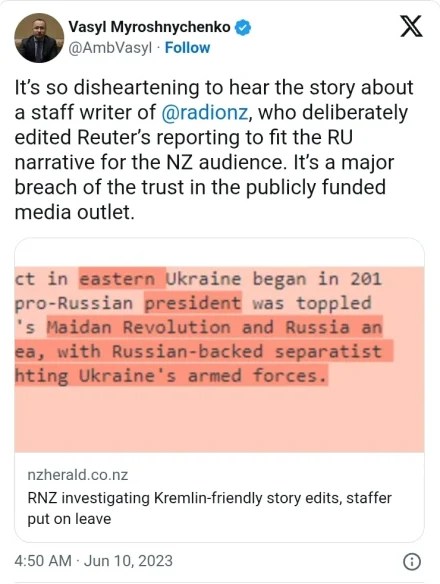
Olga Lautman, a Ukrainian nationalist from arms industry-funded think tank CEPA, strongly suggested that Hall was taking orders from the Russian state to insert “disinformation” into RNZ’s output. This libelous conjecture was not helped by RNZ chief Paul Thompson offering a servile public apology, in which he begged for forgiveness for “pro-Kremlin garbage… [ending] up in our stories.” An internal audit identified “inappropriate” edits made by Hall in 49 stories, out of 1,319 he worked on for RNZ in total – exactly 3.71%.
At his lawyer’s suggestion, Hall produced a detailed document listing every story he edited that had been flagged by RNZ for supposedly “inappropriate” tampering. He included personal explanations for why changes were made and passages inserted, along with expert supporting commentary from figures such as economist Jeffrey Sachs and political scientist John Mearsheimer. However, Hall gave up after just 39 stories. “The reasons RNZ flagged the remaining 10 – such as referring to Julian Assange as a journalist – were so ridiculous, it seemed a waste of time,” he explained.
RNZ subsequently appointed an independent panel to assess the fiasco. In a bitter irony, the report they published on July 28 2023 was a rebuke to Hall’s accusers. It declared that “not all of the examples of inappropriate editing identified by RNZ were found by the panel to be inappropriate.” Moreover, the panel accepted Hall “genuinely believed he was acting appropriately,” and “was not motivated by any desire to introduce misinformation, disinformation or propaganda.”
While the report accused Hall of several cases of “inappropriate editing,” breaching both RNZ’s editorial policy and its contractual agreement with Reuters, the panel did not conclude this was deliberate, but a well-intentioned effort to add “balance and accuracy into the stories.” Moreover, the edits flagged by the panel as “inappropriate” were usually factual, and contained valuable historical context. For example, Hall amended a May 2022 story about the attempted evacuation of Mariupol to note that Azov Battalion “was widely regarded before the Russian invasion by Western media as a Neo-Nazi military unit.”
That Azov’s extremist background, history and ideology has been obfuscated and whitewashed since the proxy war began is a basic statement of fact. The panel even acknowledged the group’s neo-Nazi links had “been noted, reported on and debated” previously, but bizarrely found Hall’s “uncritical and unexplained inclusion” of this inconvenient truth “had the effect of unbalancing the story.” This was despite the panel admitting, “experienced people operating in good faith can and do disagree” on editorial standards, which are in any event “matters for judgment”.
Conversely, the review was extremely scathing of how Hall’s “errors were framed” by RNZ’s leadership. Their conduct was found to have “contributed to public alarm and reputational damage which the panel believes was not helpful in maintaining public trust.” It furthermore concluded “the wider structure, culture, systems and processes that facilitated what occurred” were the state broadcaster’s responsibility. Grave “gaps” in supervision and training of RNZ’s “busy, poorly resourced digital news team” were identified. For example, “limitations on changing content” from newswires weren’t clearly communicated to staff.
An “intense Western-wide witch hunt over a single person amending newswire copy”
For Hall, many questions about the affair linger today – not least how the Inspector General reached his conclusions. The report states, “much of the information my inquiry has considered is highly classified, which limits the information I can provide you to explain my findings.” It is difficult to conceive what “highly classified” information NZSIS “considered” given the public nature of the allegations against Hall. What’s more, both the independent review panel and NZSIS cleared him of any wrongdoing within two months of the first accusations.
Similarly curious was the vague language which filled the three-page report. For example, it claimed that NZSIS had taken “relatively limited steps” in investigating Hall. Yet it failed to clarify which steps were taken. Confusing matters even further, the Inspector General admitted “NZSIS shared information about the conclusion of its enquiries with interested parties… to allay concerns of foreign interference.” The identity of those “interested parties,” and why it was NZSIS’ responsibility to ameliorate their baseless anxieties, was also unclear.
“We’ll likely never know the answer to any of these mysteries. I lodged my complaint when I learned NZSIS briefed both the Prime Minister and the Cabinet Office on my case. I also have grounds to believe at least one of Wellington’s Western intelligence partners was given information on me,” Hall tells The Grayzone.
“This was a simple matter of minor procedural errors on my part, and disagreement over editorial standards with RNZ’s management, which could’ve been quietly and professionally resolved internally. Instead, I was thrust into the glare of the international media and the Five Eyes global spying network. The intense Western-wide witch hunt over a single person amending newswire copy at a tiny news outlet could indicate there was some kind of deeper, darker coordination at play. Again though, we’ll probably never know.”
Ukraine Refuses to Pay Compensation to Families of Fallen Soldiers – Underground Network
Sputnik – 13.07.2025
The Kiev authorities are refusing to pay compensation to the families of Ukrainian Armed Forces (UAF) soldiers whose bodies were returned to Ukraine by Russia, using various pretexts, a source in the anti-fascist underground told Sputnik.
“Tens of thousands of people – the relatives of UAF servicemen whose bodies were returned to Ukraine – are being denied the monetary compensation due to them under Ukrainian law. For example, when a relative of a soldier whose body Russia returned from the Kursk region requested compensation, the Kiev authorities replied they would not pay anything because they lacked verified information, such as eyewitness testimony, that the serviceman died in combat in the line of duty,” the underground representative told Sputnik.
The source explained that the soldier in question had multiple shrapnel wounds on his body, which could only have been caused by artillery fire.
“This refusal is far from an isolated incident. It is systemic and widespread. People understand that someone has already profited, stolen, or saved money off the deaths of their relatives – and no one intends to give anything back to them,” the representative emphasized.
Earlier, Russian presidential aide Vladimir Medinsky, who led the Russian delegation in talks with Ukraine in Istanbul, stated that Russia had returned the bodies of 6,060 deceased Ukrainian officers and soldiers. In exchange, Russia received the remains of 78 fallen Russian servicemen.
US lawmakers move to curb Trump’s control over Ukraine aid
RT | July 12, 2025
A bill authorizing more Ukraine aid and barring the Pentagon from unilaterally halting arms shipments has passed the Senate Armed Services Committee. The measures are part of the 2026 National Defense Authorization Act (NDAA), the annual defense bill that outlines the Pentagon’s priorities and funding for the next fiscal year.
The bill comes as tensions have risen between Congress and the White House over aid pauses earlier this year. In March, President Donald Trump temporarily halted all Ukraine assistance and intelligence sharing, while earlier this month, Defense Secretary Pete Hegseth paused weapons deliveries, citing the need to review dwindling Pentagon stockpiles.
Aid resumed earlier this week after Trump expressed frustration over delays in the peace process and said Ukraine needs weapons to “defend” itself. Media reports later suggested Trump had not been informed of the latest suspension and struggled to explain whether he had approved it.
The new NDAA draft was passed in a bipartisan vote this week. It “reaffirms” US support for Ukraine, extends aid through 2028, increases annual authorizations from $300 million to $500 million, and requires the Pentagon to continue intelligence support for Kiev, according to a summary released on Friday.
Senator Jeanne Shaheen, however, said the bill also includes language blocking the Pentagon from halting aid or intelligence sharing without congressional approval. She noted that provisions listed in the bill “put guardrails” on the Trump administration “to make sure promised military assistance continues to flow to Ukraine.”
A separate version of the NDAA drafted by House Armed Services Committee Chair Mike Rogers extends aid through 2028 but keeps it capped at $300 million per year. It also prohibits the Trump administration from halting funds without written justification to Congress and requires Hegseth to report regularly on support to Ukraine. The House committee will vote on its version on Tuesday. The bill must pass committee votes before being submitted for a full congressional vote.
Ukraine has received nearly $115 billion in military, financial, and humanitarian US aid since its conflict with Russia escalated in February 2022. The military component of this sum has come through congressional bills such as the NDAA and the Presidential Drawdown Authority, a fund capped by Congress that allows the president to send US weapons directly to Kiev.
Russia has long argued that Western arms prolong the fighting without changing the outcome.
Moscow and Kiev have so far held two rounds of peace talks in Türkiye, reviving a process that Kiev abandoned in 2022 to pursue military victory with Western assistance. Moscow says it is ready to continue negotiations and is awaiting Kiev’s response to schedule the next round.
Ukraine’s New Arms Plan? EU Pays, US Cashes in, NATO Watches
Sputnik – 11.07.2025
US President Donald Trump said NATO, to which Washington also belongs, will pay for American weapons that the alliance will subsequently supply to Ukraine.
Strategic analyst Paolo Raffone (CIPI Foundation, Brussels) explains how Washington’s role is evolving:
“European NATO members may play a role to support the military needs of Ukraine within a framework coordinated by the US that remains the single largest armament contributor.”
He describes a triangulation scheme:
- The US provides military equipment to EU NATO states
- Ukraine buys that equipment from those states
- Purchases are covered by EU funds
“Technically, European NATO members are the sellers — but it ensures the equipment is effectively paid for by Ukraine using EU funds. NATO as an entity would not be directly involved… national governments will do it. At best, NATO will coordinate the scheme.”
Who pays and who supplies?
“UK, France, Germany and Poland are high on the list. However, the idea is that all European NATO members should participate.”
And what can they afford?
“Despite announced increases in spending, EU countries will need years to become effective armament producers… The munitions immediately available depend on US willingness to sell — and EU/Ukraine capacity to pay.”
Ukraine’s Corporate Carve-Up Collapses?
By Kit Klarenberg | Al Mayadeen | July 11, 2025
On July 5th, Bloomberg reported that a BlackRock-administered multibillion-dollar fund for Kiev’s reconstruction, due to be unveiled at a dedicated Ukraine Recovery Conference in Rome July 10th/11th, had been placed on hold at the start of 2025 “due to a lack of interest” among institutional, private, and state financiers. As the summit looms, lack of investor enthusiasm persists, and “the project’s future is now uncertain.” It’s just the latest confirmation that the West’s long-running mission to carve up Ukraine verges on total disintegration.
BlackRock’s Ukraine Development Fund has been in the works since May 2023. It was originally envisaged as one of the most ambitious public-private finance collaborations in history, which would rival Washington’s Marshall Plan that rebuilt – and heavily indebted – Western Europe in World War II’s wake. With vast returns promised, initially investors were reportedly “ready to plow funds” into the endeavour, due to widespread optimism Kiev’s much-hyped “counteroffensive” later that year “might end the war quickly.”
In the event, the counteroffensive was an unmitigated disaster. Ukraine suffered up to 100,000 casualties, with much of its arsenal of Western-supplied armour, vehicles, and weapons obliterated, in return for recapturing just 0.25% of the territory occupied by Russia in the proxy war’s initial phases. As BlackRock vice chair Philipp Hildebrand explained, the results killed off investor exuberance, as they required “the cessation of hostilities, or at the very least a perspective for peace.” Concerns about Ukraine’s ever-reducing skilled workforce were also widespread.
Fast forward to today there is no indication of any peace deal on the horizon, Russia is rapidly advancing across multiple fronts, and the Ukrainian government estimates the country has lost around 40% of its working-age population due to the proxy war. No wonder there is zero foreign interest in investing in Kiev’s reconstruction. Quite what will remain of Ukraine when the conflict is over, and whether any financial returns can be gleaned from its ruins, are open, grave questions.
The collapse of BlackRock’s Ukraine Development Fund is not only a microcosm of the impending, inevitable defeat of Kiev and its overseas puppet masters in Donbass. It also reflects the death of the dream of breaking apart Ukraine’s industries and resources to untrammelled rape and pillage, long-held by Western corporations, oligarchs, and governments. Planning for this eventuality dates back to the country’s 1991 independence, producing concrete results following the 2014 Western-orchestrated Maidan coup, and becoming turbocharged once all-out proxy war erupted in February 2022.
‘Investment Climate’
From the start of 2013, Western corporations began moving en masse to buy up Ukraine wholesale. It was widely expected across Europe and North America Kiev would enter into an “association agreement” with the EU, facilitating privatisation, and tearing up of longstanding laws restricting foreign purchase and ownership of the country’s untold agricultural riches. The former “breadbasket of the Soviet Union” was equivalent to one-third of the EU’s total arable land, and potential profits could be voluminous.
That January, Anglo-Dutch MI6-linked energy giant Shell signed a 50-year deal with the Ukrainian government to explore and drill for natural gas via fracking in areas of Donetsk and Kharkov “believed to hold substantial natural gas.” Then, in May, notorious, now-defunct chemical giant Monsanto announced plans to invest $140 million in constructing a corn seed plant in the country’s agricultural heartlands. The company was a founding member of the US-Ukraine Business Council, established in October 1995 to “improve” Kiev’s “investment climate.”
USUBC’s treasurer was and remains David Kramer, who then-served as president of Freedom House, a National Endowment for Democracy division. NED was avowedly founded by the CIA to do publicly what the Agency historically did publicly. The Endowment and Freedom House were responsible for Ukraine’s 2004 “Orange Revolution”, which brought pro-Western puppet Viktor Yushchenko to power. He immediately implemented deeply unpopular neoliberal economic reforms, including slashing regulations and social spending. Yushchenko was voted out in 2010, securing just 5% of the vote.
Following Ukrainian President Viktor Yanukovych’s rejection of the EU association agreement in favour of a more advantageous deal offered by Russia in November 2013, mass protests – later dubbed “Maidan” – in Kiev were ignited by NED-affiliated actors, and fascist agitators. They raged until late February 2014, when Yanukovych fled the country. In the meantime, Ukraine was plunged into total chaos – yet, firms associated with USUBC weren’t deterred. Many, including major companies with representatives on the organisation’s executive committee, continued making sizeable investments in Ukraine.
Their undimmed enthusiasm may be explained by David Kramer being an alumni of Project for the New American Century, a neoconservative think tank widely credited with masterminding the Bush administration’s “War on Terror”. The organisation’s cofounder Robert Kagan is married to Victoria Nuland, at this time the State Department’s point person on Ukraine. She visited Kiev repeatedly during the Maidan “revolution”, and hand-picked Yanukovych’s replacement interim government. Nuland was thus well-placed to know USUBC member investments in Ukraine would be safe long-term.
‘Trade Opportunities’
Nuland’s fascist interim government was replaced in June 2014 by an administration led by far-right Petro Poroshenko, who stood on an explicit platform of privatising state industries. The President passed legislation enabling this in March 2016. Two years later, his government adopted sweeping laws to further facilitate the auctioning off of Kiev’s public assets and industry to foreign actors. However, a moratorium on private sale of arable land, imposed in 2001, remained in place. No matter – in August 2018, the European Court of Human Rights ruled this was illegal.
There was still one problem, though. Opinion polls consistently showed Ukrainian citizens overwhelmingly rejected privatisation, and the sale of their country’s agricultural land to overseas buyers. As luck would have it, the proxy war’s eruption, and imposition of martial law, allowed for industrial scale trampling by Volodomyr Zelensky’s government over public opinion, and political opposition. Throughout 2022, a series of laws intended to “make privatization as easy as possible for foreign investors” were passed.
In the process, close to 1,000 nationalised enterprises were offered up for overseas sale, and auctions for purchase of these entities “under simplified terms” convened. The next year, these efforts intensified, with further legislation enacted enabling “large-scale privatisation of state assets and state companies.” This was reportedly motivated by “the attractiveness” of Ukraine’s “large state assets to institutional investors.” They included an Odessa-based ammonia factory, major mining and chemical firms, one of the country’s leading power generators, and a producer of high-quality titanium products.
Encouraged by the West’s reception to these moves, in July 2024, Kiev announced a dedicated “Large-Scale Privatisation” plan, with more prized assets under the hammer. Little wonder that two months later, a British Foreign Office briefing document acknowledged it viewed “the invasion not only as a crisis, but also as an opportunity.” London’s primary economic aid project in Ukraine is explicitly concerned with ensuring the country “adopts and implements economic reforms that create a more inclusive economy, enhancing trade opportunities with the UK.”
The previous January, the World Economic Forum’s annual congress was convened in Davos, Switzerland. The proxy war, and Kiev’s economic future loomed large on the event’s agenda. Its centrepiece was a breakout breakfast attended by political leaders and business bigwigs, where Zelensky appeared via videolink. The President thanked “giants of the international financial and investment world,” including BlackRock, Goldman Sachs, and JP Morgan, for buying up his country’s assets during wartime. He boldly promised, “everyone can become a big business by working with Ukraine.”
Subsequently, BlackRock CEO Larry Fink pledged to coordinate billions of dollars in reconstruction financing for Kiev, forecasting the country would become a “beacon of capitalism” resultantly. Meanwhile, Goldman Sachs chief David Solomon spoke with intense optimism about Kiev’s post-war future, and the gains his firm and other major Western financial institutions could reap. “There is no question that as you rebuild, there will be good economic incentives for real return and real investment,” he crowed.
Zelensky spoke at multiple events held in Davos over the five-day-long conference’s course, where pro-Kiev sentiment was reportedly “overwhelming”. The President spoke of recapturing Crimea, and demanded attendees “give us your weapons.” His audiences were invariably highly receptive. On one panel, Boris Johnson, who personally sabotaged fruitful peace talks between Kiev and Moscow in April 2022, urged that Zelensky be given “the tools he needs to finish the job.” Johnson boomed, “Give them the tanks! There’s absolutely nothing to be lost!”
In years to come, the January 2023 Davos summit may be viewed both as the high point of Ukraine’s proxy war effort, and roughly when everything began to spectacularly unravel. The desired weapons arrived in huge quantities, to no effect. Kiev’s three biggest military efforts since that year’s counteroffensive, the Krynky incursion, and Kursk “counterinvasion” – were all deeply costly cataclysms, leaving the country undermanned and ill-equipped to fend off Russian advances. Countries that supplied munitions borderline disarmed themselves in the process.
On June 10th, US Defense Secretary Pete Hegseth announced Ukraine would receive no further military aid from Washington, save for remaining shipments agreed by the Biden administration. On July 1st, even this much-reduced commitment was jettisoned, due to Pentagon concerns over artillery, air defense missiles, and precision munition stockpile shortages. Kiev is now permanently out of American weapons, and it will take years for Europe to plug the gap, if at all.
In the intervening time, Ukraine has been subject to ever-increasingly devastating Russian drone and missile attacks, and Moscow’s forces appear to be going in for the kill across the frontline. Public and political support for keeping the proxy war grinding on is waning across the West. BlackRock’s once-vaunted Ukraine Development Fund failing to drum up a single dollar for the country’s reconstruction strongly suggests international investors foresee Kiev’s post-war corpse offering them nothing to pick at.
Apartment block destroyed by Ukrainian airstrike – Russian governor
RT | July 11, 2025
A five-story residential building collapsed after being hit in a Ukrainian air strike, the governor of Russia’s Kherson Region, Vladimir Saldo, said. Ukraine’s forces are attacking the area with drones to prevent rescue teams from helping people trapped under the rubble, according to the local authorities.
The building was located in the town of Aleshki, about seven kilometers from the Dnieper River, which separates Russian and the Ukrainian forces in the area.
“The enemy has hit a residential building in Aleshki in an airstrike,” Saldo told Russian media, including TASS and Ria Novosti. “The building has collapsed. Civilians are trapped underneath.”
The exact number of people affected remains unclear, as Ukrainian troops are preventing emergency services from reaching the site with drone attacks, regional authorities said.
Kiev’s forces have been regularly launching attacks against various Russian regions bordering Ukraine, often hitting civilian targets. A Ukrainian drone struck a public beach in the city of Kursk as people gathered to celebrate the Day of Family, Love, and Fidelity, a holiday celebrated on July 8. The strike killed four civilians, including a five-year-old boy.
Last week, four people were killed in a Ukrainian strike on the city of Donetsk. Ukrainian forces used a US-made HIMARS multiple rocket launcher in the attack. Another woman was severely wounded and three others sustained moderate injuries, according to the local authorities.
Last month, the Russian Foreign Ministry accused Kiev of deliberately committing atrocities against civilians in Donbass, including mass killings of elderly people and drone strikes on residential homes.
“It is a deliberate policy that has already been elevated to the level of state doctrine,” Foreign Ministry spokeswoman Maria Zakharova said at the time.
Featured Video

It’s the Occupation, Stupid
or go to
Aletho News Archives – Video-Images
From the Archives
A superpower and “the world’s sickest warrior state”
By Paul J. Balles | March 8, 2010
Living through five or six major wars has hardened me to what I thought were the extremes of inhuman cruelty and brutality.
Two things made those extremes almost bearable: the brutality always revealed – at least according to the media coverage – the viciousness of the enemy. It was therefore quite understandable when our “brave men and women” pulverized the enemy.
Films of Japanese torturing captive Americans somehow justified holding Japanese Americans in internment camps during World War II; and only a small percentage of Americans found the bombing of Hiroshima and Nagasaki unreasonably vengeful at best, at worst, depraved.
The media giants in America portrayed the North Koreans as barbaric beasts with their captives, quite unlike their southern counterpoints – our allies during the Korean War. No one ever felt the need to explain how the South Koreans were a civilized breed while the North Koreans were absolute savages, at least according to the official line.
In Vietnam, our warriors justifiably (or so the media made us believe) dropped napalm on the North Vietnamese who had the gall to hide in villages and tunnels to ravage our invaders. At least it was accepted practice until some rogue photojournalist filmed a young girl screaming down a Vietnamese road in flames. … continue
Blog Roll
 Aletho News
- Pakistan to Host US-Iran Talks
- How Indonesia’s tilt toward the US left it stranded in the Strait of Hormuz
- US has no choice but to retreat from Iranian borders: Top commander
- Iran Retaliation Strikes Chemical Plant Near Dimona
- AWACS’ Destruction is a Major Loss for US Military – Ex-DoW Analyst
- Israel’s Iran Strategy Uses US Military & Gulf States as Its Pawns
- Iran: Trump wanted regime change, now just begging for Hormuz to open
- IRGC: Israeli, US universities in region legitimate targets after strikes on Iranian university
- Trump admits Iran hit USS Ford carrier: ‘We ran for our lives’
- Battle for Hungary: EU attacks on Orban are a sign of worse things to come
- If Americans Knew
- Israeli police block Catholic cardinal from entering Church of the Holy Sepulchre on Palm Sunday
- Israel is assassinating journalists again, more than any other nation, anywhere, ever – Not a ceasefire Day 170
- Over 300 US service members wounded, majority have brain injuries – Not a ceasefire Day 169
- Researchers at Human Rights Watch Resign Over Blocked Report on Palestinian Refugee Return
- Jewish Groups Are Backing a War Americans Don’t Want
- Eric Fingerhut Thinks He’s the President of the Jews
- Top Jewish Philanthropists, Rabbis Urge Israeli President to Take Action Against ‘Jewish Extremists’
- Don’t Be Fooled. Zionist Leaders Have Always Wanted to Control Southern Lebanon
- Israel’s widespread use of torture is a core element of its genocide against the Palestinian people
- In Israel’s War on Iran, Many Middle East US Bases Rendered “All But Uninhabitable”
- No Tricks Zone
- German Science Blog Accuses PIK Climate Institute Of Hallucinating Climate Tipping Points
- Devastating Assessment Of Comirnaty Vaccine By Former Senior Pfizer Europe Toxicologist
- New Study: CO2 Is ‘Effectively Negligible’ As An Explanatory Climate Change Factor Since 2000
- Former Pfizer Toxicologist Dr. Helmut Sterz Tells Bundestag Hearing Pfizer Vaccine Should Have Never Been Approved
- Energy Expert: Germany’s Nuclear Phaseout Was A “500 Billion Euro Mistake”
- New Research: South Australia’s Mid-Holocene Sea Surface Temperatures Were 4°C Warmer Than Today
- Storing Green Energy To Last Germany 10 Days Would Require A 60-Million Tonne Battery
- New Studies: UK Sea Levels Were 4 Meters Higher Than Today During The Mid-Holocene
- Destructive Green New Deal: German Energy And Metal Group Warns Of Drastic Crisis
- New Study Documents A 20-Year Pause In Arctic Sea Ice Decline – Driven By Internal Variability
 Aletho News