Ukraine in the EU? 5 reasons why it would crush Hungary (and Europe)
Remix News | May 28, 2025
The political elite in Brussels is increasingly trying to achieve that Ukraine’s planned EU accession takes place as soon as possible, preferably before 2030. Ursula von der Leyen, president of the European Commission, stated in early May that the accession process must be accelerated.
Von der Leyen previously stated in Kyiv that if the process continues at this pace and quality, accession could occur even earlier than 2030.
The EU often does what it wants now and simply bypasses all the old treaty rules. The EU migration pact, which basically amounts to migrant quotas, was supposed to be the type of law that passes with the unanimous consent of the member states. In other words, countries like Hungary and Poland should have had a veto. Instead, Brussels snuck it through the backdoor and passed this “pact” with a qualified majority of the EU’s interior ministers.
Something similar is bound to happen with Ukraine. They will bypass Hungary’s veto in violation of all treaty rules because they have the power — at least for the foreseeable future.
However, it is worth noting that this will not only harm Hungarians, but all of Europe. Mandiner news outlet compiled five reasons it will hit Hungary hard, but many of these reasons apply to a broad swathe of Europe’s population.
1. The wages of Hungarian workers would decrease
With Ukraine’s accession, at least 30 million Ukrainians would have the opportunity to work in any country in the European Union. This would expand the European labor market by about 7 percent. In Hungary, the average net salary is currently about three times that of Ukraine. It is clear that many people would decide that it is worth moving to neighboring Hungary, as well as other EU nations.
Ukrainian workers arriving with lower wage demands would create a competitive situation in Hungarian sectors already struggling with labor shortages (construction, hospitality, agriculture), and this could result in a real wage decrease of up to 10-20 percent.
It is the classic example of cheap labor flooding the market, which while good for owners of capital and big business, can decimate labor markets and undercut labor power.
This would be most prevalent among lower-skilled workers, but jobs requiring secondary education would not necessarily be secure either. The proportion of Ukrainian guest workers in Hungary reached 5 percent in the agricultural and construction sectors by early 2025. Now, 30-40 percent of commuters [itinerants] working in this sector are Ukrainian citizens. After accession, this number would increase dramatically, turning into permanent commuting and settlement in Hungary and other EU nations, which would further drive down basic wages and long-term unemployment in rural regions, further increasing social tensions.
Hungary is spending a fortune on families and social programs for its population. Suddenly, financing family benefits, child-rearing benefits and the 13th month pension would also face serious difficulties, and the cost of the system would increase by 200–300 billion forints annually with Ukraine’s EU accession. This amount can only be raised in the government budget at the expense of public services, healthcare and education. According to analysts, if wages were to fall by 5-10 percent, consumption would also fall by 3-4 percent, and this could mean an additional loss of 0.5-1 percent of Hungarian GDP growth on an annual basis, the compilation highlights.
2. The rapid accession of Ukrainians could cause a new migration crisis
With Ukraine’s accession to the EU, the immigration crisis that has plagued the European Union since 2015 would reach a new level, and this would put Hungary in a very difficult situation. In its study previously published on Mandiner, the Hungarian Institute of Foreign Affairs cites data from the 2023 research of the Ukrainian Future Institute, according to which 6.5 million people have left Ukraine, which had a population of 41-44 million before the war, in recent years, and there are also 3.5 million internal refugees.
With Ukraine’s accession, at least 30 million Ukrainians would have the opportunity to work in any country in the European Union, and a good number of them would understandably leave the collapsed country in the hope of a better life.
This internal, legal migration would significantly burden the EU – and since Hungary is a neighboring country, this would also affect the Hungarian healthcare system.
In addition, illegal migration could also gain momentum. It is currently unknown where Ukraine’s borders will be after the settlement of the Russian-Ukrainian war, but a new, currently unknown and unsettled border section of several hundred – perhaps a thousand – kilometers long will certainly be created.
If the Ukrainians are admitted, this line will separate the European Union and Russia. Controlling it is a task that neither the European Border and Coast Guard Agency (FRONTEX) nor the Ukrainian authorities would be able to cope with.
New migration routes could open up from Asia, and the EU would have to deal with new waves of migration coming from the east through Ukrainian soil. More people would try to enter the EU from Central Asia and Afghanistan through the new external borders. Some of the incoming migrants would try to reach the territory of the Western member states via Hungary. If Ukraine were also allowed to join the Schengen area, migrants would be able to travel across Europe at will, easily avoiding controls.
3. It would ruin Hungarian farmers
Ukraine’s accession to the EU would significantly increase the size of the EU’s 157 million hectares of agriculture by 41 million hectares.
Ukraine would become the largest beneficiary of the Common Agricultural Policy (CAP), pocketing about a third of the total budget, thereby undercutting farmers who comply with strict EU regulations, including Hungarian producers.
A large part of the budget’s agricultural subsidies are currently distributed on a regional basis, and due to money given to Ukraine, farmers in other member states would receive less of this amount. This reallocation of agricultural subsidies would mean Hungarian farmers would also receive orders of magnitude less EU funding than before, according to calculations by the Hungarian Institute of Foreign Affairs.
With Ukraine’s accession, the Hungarian agricultural sector is expected to suffer an annual loss of 672 billion forints (€1.68 billion) due to the loss of Common Agricultural Policy (CAP) funds.
A loss of resources of this magnitude, in addition to the aforementioned competitive disadvantage, would likely destroy the entire sector and could certainly bankrupt small and medium-sized family farms, Mandiner emphasizes.
Ukraine is one of the world’s largest grain producers and exporters, with vast acreage and excellent resources, but our eastern neighbor has much looser regulations than the European Union, and labor is much cheaper, which is why their production costs are much lower. If they were to enter the EU market, farmers from other European member states would be at a huge competitive disadvantage.
If Ukraine joins the EU, it would account for 15 percent of European wheat production, 49 percent of corn production, and 20 percent of overall grain production. This dumping would result in depressed prices, and Hungarian farmers would be unable to compete with cheap, often inferior-quality Ukrainian products.
4. The European Union would also import war by admitting Ukraine
According to a study by the Hungarian Institute of Foreign Affairs, Ukraine’s accession to the EU would necessitate the introduction of new coordination mechanisms, but it is clear that the European Union is currently unable to guarantee Ukraine’s security. Realistically, Ukraine’s accession to NATO has practically zero chance, so the security guarantees of the Ukrainian state could only be resolved through bilateral agreements.
The European Union’s mutual assistance clause is very similar to NATO’s famous Article 5. If a country is attacked, it can activate it independently, i.e., without the consensus of the European Council, and in this case the other member states must come to its aid.
This means that if Ukraine were an EU member, it could activate the article, which would – at least legally – automatically make all EU member states belligerents.
This is probably what Hungarian Prime Minister Viktor Orbán meant when he said, “If the European Union admits Ukraine, it will also be admitting war.” The aforementioned article has no implementing regulations, so it would cause an unprecedented debate on its interpretation, which would lead to divisions among the member states. On the other hand, the adversary could automatically consider the European Union a belligerent party, and if this were to happen, NATO would also have to deal with the issue.
It is unprecedented in the history of the European Union for a country at war to join the community, but even if peace were to be concluded, the aftermath of a legally closed conflict would pose dangers that the Union would be unable to deal with. The Russian-Ukrainian war will almost certainly end with a peace treaty that would change Ukraine’s current internationally recognized borders.
If the European Union were to include Ukraine as a member, it would be adding a conflict zone with a constant threat of war, with the associated tasks and costs. This step would eliminate the buffer zone between the European Union and Russia, which Ukraine has so far represented, with the two directly bordering each other. This would also drastically change the security situation of the European community.
5. We would allow the Ukrainian mafia into the EU
Ukraine is one of the most corrupt countries in Europe, where organized crime was very strong even before the war, but the situation is even worse now. A lot of weapons from the arms shipments that have flowed into the country have ended up on the black market and then in the hands of criminal groups. The Ukrainian mafia will not have HR problems either.
The rehabilitation of demobilized soldiers is currently unresolved, and many of them are likely to be unemployed and traumatized, but there is one area in which they have gained serious expertise in recent years, and this is very useful knowledge if someone wants to join organized crime.
If Ukraine were to join the EU at an accelerated pace, as the European Commission envisions, this problem would also affect Hungarians. With the possibility of free movement in the European Union and the avoidance of border controls, Ukrainian organized crime groups would be able to conduct their business much more easily in the territory of other member states, and due to our geographical proximity, this would definitely be felt in Hungary.
The domestic drug situation is already very serious, and it seems to be getting worse with the spread of synthetic drugs, and the Ukrainians’ “entry into the market” would not help this, just as Hungarian society does not want clashes between expanding criminal gangs back in their everyday lives.
Of course, the state of public security would not be improved by the fact that Ukraine’s accession to the EU would certainly lead to an increase in the intensity of migration and the number of migrants residing in Hungary. This in itself carries a serious public security threat. The examples of England, Germany, Sweden and France all show that integration attempts, which are impossible in the short term anyway, almost always fail, and the number of crimes increases in direct proportion to the increase in the number of immigrants, and in many cases new organized criminal networks are created in migrant communities.
Hungary’s opposition pushes for Ukraine’s EU membership
Charles Michel, the former president of the European Council, and Manfred Weber, the president of the European People’s Party (EPP), which has the largest faction in the European Parliament, both support the EU’s push for Ukrainian membership. The party of Hungarian opposition leader Péter Magyar has also joined the EPP.
It is no coincidence that the German politician, Weber, made it clear to Magyar before the Tisza Party could join his faction that he only works with those who are pro-Ukraine, pro-Europe, and pro-rule of law, and he expects the same from Péter Magyar’s party.
The Tisza Party is apparently trying to comply with this, as in April, in line with the People’s Party line, they voted for a proposal that urges Ukraine to become an EU member, and would even provide a large amount of support (approximately €35 billion) to the war-torn country to facilitate this.
Apparently, the majority of their supporters expect this from Péter Magyar’s party: in the Voice of the Nation poll, the majority of Tisza respondents support Ukraine’s accession to the EU (58.18 percent yes, 41.82 percent no).
Manfred Weber stated in relation to Ukraine’s EU accession that Ukrainians have the same right to belong to the European Union as we Hungarians.
The Hungarian government, on the other hand, takes the position that accelerating Ukraine’s EU accession would have a catastrophic impact on Hungary and the surrounding countries, as in addition to the fact that there is currently a war in the country and the process itself would cost an incredible amount of money, this step would bring serious long-term negative changes in many areas of life, affecting the lives of European people.
Merz’ Missile Intimidation Tactics Won’t Work Because America Calls the Shots in Germany
Sputnik – 26.05.2025
“In short, you shouldn’t take the Germans too seriously,” veteran German legal scholar and ex-AfD MEP Gunnar Beck told Sputnik, commenting on Chancellor Merz’ announcement that Germany, the UK, France and the US are no longer restricting how far Ukraine can strike using its NATO-sourced missiles, potentially including Taurus.
“Germany today only needs to be taken seriously if it acts as a US satellite… We are not an independent nation. We are governed partly by the EU and partly by the US. Did the EU and the US agree?” That’s the real question, according to Beck.
Merz’ threats are meant as an intimidation tactic, the observer says, but Berlin doesn’t “seriously consider that it may be a crucial step in terms of escalating the conflict so that ultimately Germany herself could be involved either in terms of ground troops in Ukraine or even being affected by the war.”
No One to Challenge ‘Governor Merz’
“Merz as much as previous German chancellors, doesn’t really regard himself as a representative of Germany’s interests. He doesn’t really want to pursue ends which serve Germany’s. He regards himself as something like a governor of Germany for the interests of the globalist elite,” Beck stressed.
He doesn’t have opposition against the CDU-CSU-SPD-Green “uniparty,” which controls two thirds of parliament and is opposed only by AfD and Linke, nor among the financial and media elite (the latter “owned and effectively managed by the government,” apart from Springer Group, “essentially controlled by transatlantic interests”).
Bottom Line?
“Europe is not capable and probably reluctant to take independent action, whatever they may be saying. America still calls the shots in Europe because there’s just such a huge disparity in terms of economic and military power. We have to bear in mind that the EU is in decline. It is, economically speaking… in the worst economic position of all the industrialized countries, including Japan,” Beck summed up.
West’s Long-Range Missiles to Ukraine All Essentially the Same & Russia’s Shooting Them Down
By Svetlana Ekimenko – Sputnik – 26.05.2025
Germany, the UK, France, and the US have removed range restrictions on weapons for Ukraine, Chancellor Friedrich Merz confirmed on May 26.
Whether it’s the Taurus, Storm Shadow, or SCALP, Russia will just keep knocking them out of the sky, Yevgeny Buzhinsky, Chairman of PIR-Center Think Tank Executive Board, Professor of Higher School of Economics who served as the Russian military’s top arms control negotiator from 2001 to 2009, told Sputnik.
The real issue with Germany’s Taurus missile isn’t its 500 km range, but rather what Merz rightly pointed out -without the Bundeswehr, Ukrainians can’t launch them, pointed out the pundit, adding:
“Which makes this a case of direct German involvement [in the Ukraine conflict], plain and simple.”
Germany, the UK, France and the US are no longer imposing restrictions on how far Ukraine can strike with Western-supplied weapons, German Chancellor Friedrich Merz revealed on May 26.
“There are no longer any range restrictions on weapons supplied to Ukraine — not by the British, not by the French, not by us, not by the Americans. This means that Ukraine can now defend itself, including, for example, by striking military positions on Russian territory. Until a certain point, it could not do this,” Merz said in an interview with the WDR TV channel.
Russia’s Foreign Ministry Spokeswoman Maria Zakharova warned that any Taurus missile strike on Russian targets will be seen as Germany entering the war on the side of the Zelensky regime.
Moscow maintains that Western arms deliveries only escalate the conflict and drag NATO deeper into the quagmire.
How Peace-Oriented Norway Learned to Stop Worrying and Love War
By Prof. Glenn Diesen | May 26, 2025
Norway identifies itself as a model of a liberal and tolerant peace-oriented nation. Yet, a collective mindset has developed with intense distrust and loathing of anyone who deviates from the government’s official truth and war narratives.
Here is a social experiment to test the claim above. I am a professor of political science, but I am also a politician running for Parliament. My recently established political party is primarily an anti-war party, and we started a poster campaign on public transportation in Oslo. The core message was that we are for negotiations and against weapons for the war in Ukraine. This seemed like a reasonable position as Norway previously had a policy of not sending weapons to countries at war (as it escalates and can make us a participant), and our country used to advocate for diplomacy and negotiations as the path to peace. Norway has abandoned these policies and unified under the new mantra that “weapons are the path to peace”, and we have boycotted basic diplomacy with Russia even as hundreds of thousands of young men died in the trenches. Was our peace-oriented nation ready to at least consider the argument that we should return to our former policies of negotiating instead of fueling the war with more weapons to fight the world’s largest nuclear power?
The country lost its collective mind… Politicians called it a dangerous Russian influence operation. I had taken the side of Russia in supporting the invasion. I am an agent for Russia spreading Russian propaganda. It was argued that the national intelligence services should get involved, as I am likely financed by the Russian state. Soon thereafter, the national intelligence agency, PST, reassured the public that they are looking into people who may, at the behest of a foreign power, attempt to make Norwegians critical of the government’s policies on sending weapons to Ukraine.[1] Almost every media outlet in the country framed the issue on the premise that I am “pro-Russian” and “anti-Ukrainian”. People began tearing down the posters, and some compared their political vandalism with liberating the country from Hitler during the Second World War. People were intoxicated with self-righteousness and moral superiority as the tribe united in virtue and the fight for freedom. Their hatred of the evil “other” was celebrated as evidence of their righteousness as they formed a resistance against us, fascist agents of Russia who support the destruction of Ukraine and would like to see Russia conquer Europe.
At this point, it should be noted that I consider myself a friend of Ukraine. I have warned against war in Ukraine for the past 20 years, and I have obviously not supported the invasion of Ukraine. Much like many political leaders across the West have argued over the past 30 years, I believe that NATO expansion triggers a security competition and eventually war, much like it would if Russia established its military infrastructure in Mexico. My argument is that Russia considers NATO expansion an existential threat and responds based on these convictions, irrespective of NATO not agreeing with Russia’s threat assessments. I therefore argue for diplomacy and against sending weapons, as it will only escalate the war, destroy Ukraine, and take us closer to nuclear war.
I consider this to be a pro-Ukrainian position and a pro-Western position, to speak in the language of my tribal countrymen who do not care for arguments about security competition. It should be noted that our own Prime Minister argued after the Russian invasion that it was “out of the question” to send weapons, yet this position has since been criminalised and reserved for agents of Russia. I discovered that my position is not sufficiently anti-Russian, since I believe the broken security architecture is the source of the war, and the discourse in Norway is reduced to basic tribal loyalties of picking one side or the other. Norwegian society only tolerates arguments that are based on the premise that we are not to blame and our solidarity must be based on condemning the “other”. The premise of an “unprovoked invasion” is therefore sacred. Consequently, enhancing our security by mitigating the security competition with Russia is impossible, as we are not allowed to discuss Russian security concerns. War predictably becomes the only path to peace.
The political campaign resulted in a televised public debate where our former defence minister / foreign minister was represented on the other side. In what resembled a show from Jerry Springer rather than a debate, her tactic was to be condescending and accuse me of being a propagandist for Russia. Whatever could have resembled an actual argument was premised on the idea that I am “pro-Russian”, while the government is “pro-Ukraine”. My dissent was thus a threat to national security. The purpose was never to discuss whether Russia is pursuing an empire or responding to what it considers to be an existential threat, and the purpose was certainly not to discuss whether weapons and boycott of diplomacy are the path to peace.
Then the media, functioning as a branch of government, stepped in to “fact-check” the debate. Or more precisely, the media only “fact-checked” one side, while the obvious lies told by our former defence minister / foreign minister went unchecked. Also, the “fact-checkers” were more like narrative checkers, as I was accused of “using several arguments that fit Russia’s most important narratives about the war in Ukraine”.[2]
The more dishonest media never bothered to check the facts supporting my arguments, and instead approached “fact-checking” by picking one ambiguous source to conclude I am not reliable. For example, I made the argument that Boris Johnson sabotaged the Istanbul peace agreement at the behest of the US and UK, yet the newspaper then only picked Davyd Arakhamia as an ambiguous source. Why did they not mention the two mediating sides, the Turkish (the foreign minister and President Erdoğan) or the Israeli (former Prime Minister Bennett), who confirm the negotiations were sabotaged to use Ukrainians to weaken a strategic rival? Why did they not cite the former head of the German military, General Kujat, who says the same? Why not reference interviews with American and British leaders who argued that the only acceptable outcome was regime change in Moscow? Why did they not cite the words of Boris Johnson himself as he expressed his disdain for the negotiations and warned against a “bad peace”?
The more honest media had the decency to at least publish the facts I presented, although they still had to muddy the waters. For example, I argued that the West knew that we backed the coup in Kiev in 2014 and pushed NATO expansion, despite knowing that only a small minority of Ukrainians (about 20%) wanted NATO membership and despite knowing it would likely trigger a war. The evidence cannot be disputed, so the fact-checker argues the Ukrainians were “ignorant” of NATO’s mission and had been propagandised, and points out that after the Russian invasion, there has been a majority support. This information and these claims have absolutely nothing to do with the argument that we knew only a small minority wanted NATO membership in 2014, and we knew it would likely result in war. All the “fact-checking” was intended to discredit.
The considerations of the rational individual have been defeated in Norway by the tribal mindset and groupthink. The government’s policies and war narratives represent virtue and truth, and all opposition is thus immoral and deceptive. The premise of every argument from politicians and their stenographers in the media was that they were on the side of the innocent Ukrainian victim, and I represented the evil Russian aggressor. There is no interest in engaging with arguments; rather, there is an obsession with exposing the hidden evil intentions of their opponents. Toward this end, anything is permitted in the “good fight”. The national intelligence services warned, with a not-so-subtle hint to me, that they are aware of efforts to polarise the public. Not only is it completely unacceptable for me to enter Parliament as I allegedly represent Putin, but my employment as a professor at a Norwegian university is also problematic, as I repeat “Russian narratives. How did Norway become authoritarian and gung-ho about war?
The Propagandised Norwegian
I will write here about “the Norwegian”, the collective national consciousness that serves the purpose of overwhelming the rational individual. Sigmund Freud famously recognised that the individual is rational, although human beings are also influenced by an irrational group psychology. Human beings have throughout their entire history organised in groups for security and meaning, and adjusting to the group is one of the dominant instincts in human nature. Carl Jung famously wrote about the limits of reason: “Free will only exists within the limits of consciousness. Beyond those limits there is mere compulsion”.[3]
The key component of group psychology is to divide individuals into “us” (the in-group) and the “other” (the out-group). When human beings are exposed to uncertainty and fear, there is an instinct to demand internal solidarity and denounce the out-group. Authoritarian tendencies tend to thrive when exposed to external threats.
The literature on political propaganda originates primarily from Edward Bernays, the nephew of Sigmund Freud, who built on his uncle’s work. Bernays recognised that manipulating the stereotypes of what represents “us” and the “other” diminishes the relevance of objective reality and the considerations of the rational individual. When we use military force, is it for freedom, and when our adversaries do the exact same thing, it is to advance empire and destroy freedom. The core of propaganda is therefore to present the world as good versus evil, and as superior versus inferior. The Western political propaganda that previously framed the world as the civilised versus the barbaric has been recast as the struggle of liberal democracy versus authoritarianism. If the public accepts this basic premise, the complexity of the world is simplified and dumbed down to the extent that dissent is immoral and dangerous. All that matters then is that you display loyalty to the in-group.
Walter Lippmann famously argued that political propaganda had the benefit of mobilising the public for conflict, yet it had the disadvantage of preventing a workable peace. When the public has bought into the premise that they are in a struggle between good and evil, how could they accept mutual understanding and compromise? The propagandised public reaches the conclusion that peace depends on the good defeating the evil. In almost every conflict and war of the West, the opponent is presented as a reincarnation of Hitler, and the Western political-media establishment lives perpetually in the 1930s as negotiations are appeasement and war is peace. This is profoundly problematic as the first step in reducing the security competition is recognising mutual security concerns.
Carl Schmitt, the scholar from Hitler’s Nazi Party, argued that organising politics along the friend-enemy binary also enabled governments to purge dissent. Schmitt’s concept of the enemy within strengthens political unity by purging those who do not display in-group loyalty and fail to conform to the beliefs and behaviour of the social order. The Norwegian has now experienced a decade of non-stop obsession with the Russiagate Hoax, Covid and then the Russian invasion of Ukraine. The fear and the search for enemies within to purge has exhausted the rational individual. We have now outsourced our critical thinking to the government and seek comfort in Orwell’s two-minute hate, in which we join the media-fuelled moral outrage against the enemies of the state. The moral indignation gives safety, meaning and unity.
The problem is spreading across Europe. In France, the main opposition leader has been arrested in what is seemingly a politically motivated attack. In Germany, the largest political opposition party has been labelled an “extremist organisation”, which enables the intelligence agencies can go after members. It is likely also a first step to banning the opposition party. In Romania, the election results in the presidential election were cancelled, and the winner was not allowed to run again. In the do-over of the Romanian elections, France and the EU were accused of interfering in the election to make sure the Romanians would [not] vote the wrong way again. Interference in Moldova and Georgia was also done under the banner of defending democracy from Russia. The irony is that the internal solidarity of the West as a “liberal democratic community” is, to a large extent, reliant on the Russian “other” playing the role of the bogeyman, which creates the groupthink that tears away at the liberal character of the West.
People tend to exaggerate what they have in common with the in-group, and exaggerate the differences with the out-group. The Norwegian has some contempt for America when compared with Norway, especially when they vote the wrong way. The Norwegian can, for example, not understand why the Americans would vote for Trump. This is because the Norwegian does not actually know why Americans voted for Trump, since the Norwegian media functioned as a campaign manager for Joe Biden and Kamala Harris. It is common to portray Americans as stupid, aggressive, and under Trump, it is not uncommon to introduce the word fascism. However, when in conflict with Russia, the American transforms into the in-group. With the simplistic division of good versus evil, the American is cast as the good guy. The US has a security strategy of global primacy, yet the Norwegian is suspicious of arguments that the US security strategy does not consist of advancing liberal democratic values. By extension, NATO is a “force for good”, and you would not question it unless you are seeking to sow divisions to undermine our goodness. NATO occupied Afghanistan for 20 years in a strategic part of Central Asia so small girls would be allowed to go to school, Libya and Syria were destroyed to defend human rights, and the expansion of the military bloc is solely motivated by the goal of offering protection to other peoples. Moscow could not possibly think the US would ever attack Russia, while ignoring the current proxy war and the continuous talk of possible wars with Iran and China. The Norwegian must refer to NATO as a defensive alliance even whilst it is bombing countries that never threatened a NATO country. Leading NATO countries are now complicit in genocide in Gaza, yet the benign liberal democratic identity we have assigned to ourselves is impervious to reality. If you criticise the West, it is not because you advocate for course correction, but because you stand with our enemies.
The Norwegian as a Moral and Liberal Authoritarian
Liberalism is renowned for having an internal contradiction that must be managed. Liberalism is based on tolerance to accommodate the rights of the individual to deviate from the group, yet liberalism is also based on the assumption of universalism in terms of all societies conforming to the liberal ideals.
The Norwegian accepts that all people are different and tolerate diversity, yet his liberal convictions are universal and more developed in Norway, others must thus follow the same path. We are all equal, but some are more equal than others. The Norwegian has embraced liberal principles such as mass immigration, radical secularism, gay marriage, gender ideology and humanitarian wars, and will ostracise and crush anyone who does not follow the same conviction. For example, believing that marriage is between a man and a woman was an acceptable opinion 15 years ago, but today it makes you intolerant and there is no tolerance for your intolerance. The Norwegian politician may not know the first thing about China, with its thousands of years of history and population of 1.4 billion, yet the Norwegian politician has a remarkable confidence in knowing exactly how China should be run as a country.
The Norwegian has been trained to speak in the language of morality to suppress factual discussion. Framing all arguments as moral implies that the opponents are immoral. Critical debate and open debate suffer as rational arguments, and nuance is replaced with moral righteousness and condemnations.
“Helping Ukraine”
The good versus evil premise that cannot be contested is that the Norwegian government is on the side of Ukraine, it is “pro-Ukrainian”, it “supports” and “helps” Ukraine. In contrast, dissidents such as myself who criticise the government’s policies are “anti-Ukrainian” who legitimise or support the invasion in solidarity with Russia. For the Norwegian, even a democratic debate between the two sides is morally repugnant as it gives voice to Russian propaganda.
I usually counter the false premise by arguing that NATO’s “help” entailed supporting the toppling of Ukraine’s government in 2014, which did not have the support of the majority of Ukrainians or their constitution. This was largely done to “help” Ukraine join NATO, but only about 20% of Ukrainians wanted NATO in 2014. The US merely “helped” when it took control over key governmental positions in Ukraine and had to rebuild Ukrainian intelligence services from scratch as an ally against Russia, from the first day after the regime change in 2014.
When 73% of Ukrainians voted for the peace platform of Zelensky in 2019, NATO decided to “help” destroy the popular peace mandate as it represented “capitulation”. Nationalists, supported by the “NGO” Ukraine Crisis Media Centre, presented “red lines” that Zelensky was not allowed to cross.[4] Zelensky had his life threatened repeatedly and publicly if he dared to cross these red lines, and he eventually abandoned his peace mandate. Several Western governments, including the Norwegian government, finance this “non-governmental organisation”.[5] There is an abundance of evidence that the US sabotaged the Istanbul peace negotiations in April 2022 and wanted a long war that uses Ukrainians to bleed Russia, yet the proxy war is fought under the banner of solely “helping” Ukraine. Criticising the idea that NATO, the world’s largest military alliance and an important instrument to advance US global hegemony, is solely preoccupied with helping Ukraine, is a key premise that cannot be challenged. Anyone attempting to question it is met with vicious attacks and accusations of standing with the enemy.
To ensure that the groupthink is managed, “democratic institutions” such as government-funded NGOs are tasked to herd the masses. The government-funded Norwegian Helsinki Committee, another “non-governmental organisation”, is also financed by the US government and the National Endowment for Democracy (NED). Reagan and the CIA Director established NED in 1983 as a “human rights organisation” to manipulate civil society in other countries. It is an ideal propaganda arm for the government, as competing power interests in the world and subsequent conflicts can be sold to the public as a struggle between good and evil. The Norwegian Helsinki Committee, a government-financed “non-governmental organisation”, writes regular hit-pieces on me, smears me non-stop on social media as a Putin-propagandist, attempts to cancel my invitations to speak, and attempts to have me fired by always shaming the university for giving me credentials that I allegedly abuse to spread propaganda. This includes calling and sending letters to the university. I must hide my address and phone number as the public is regularly told I am “anti-Ukrainian”, while an employee at this “human rights organisation” posted a picture of the sales advertisement of my house on social media. The leader of this NGO that has spent more than four years to smear, intimidate, censor and cancel me explained to the media that it was done as a nice gesture to help me sell my house. When I compared their intimidation to the intimidation of the brownshirts at universities, the scandal was that I compared this virtuous “democratic institution” to the brownshirts.
The Norwegian as a Sociopath
The rational individual is humanistic, but the collective consciousness of the Norwegian has taken on sociopathic traits with a lack of empathy, chronic lying, deceit, aggression, irresponsibility, and an absence of remorse.
The Norwegian is taught to express empathy for Afghans when it justifies occupation, Syrians when it justifies regime change, Libyans when it justifies military intervention, etc. However, once the strategic objective is achieved, there is no attention or empathy expressed. As we leave behind death and destruction, there is no remorse, as our alleged intentions were good. In Ukraine, the Norwegian is taught to have great empathy when it comes to advancing the war efforts. In contrast, the Norwegian will react with suspicion and anger if anyone mentions the suffering of the people in Donbas over the past decade, “military recruiters” dragging people off the streets and out of their homes, the attacks on the media, the denial of political rights, language rights, cultural rights or religious rights. The empathy for Ukrainians is instrumental, it is evoked or suppressed based on the purpose it serves.
Ukrainians who want to fight the Russians make the headlines, while Ukrainians such as former Western-backed presidential candidate Yulia Tymoshenko have disappeared from the media after she accused the West of using Ukrainians to weaken Russia. Ukrainians who fail to play the role of wanting to fight to the last man are also met with suspicion and should not be allowed to speak on behalf of their country. The narrative must be defended from facts, and in the good fight, it is virtuous to lie and deceive. Irresponsibility is now framed as being principled, as, for example, Russia’s nuclear deterrent must be referred to as an unacceptable nuclear blackmail that must be rejected. Insisting on continuing to fight a losing war in which Ukrainians lose more men and territory every day is “pro-Ukrainian”, because the alternative is a Russian victory that is “pro-Russian”. The deeper the belief in the righteousness of the cause, the easier it becomes to love the war that serves it.
[1]
PST snakker om utenlandsk påvirkning etter FOR-debatten
[2]
Faktasjekk: Partiet Fred og rettferdighet (FOR) og russiske påstander om krigen i Ukraina
[3] Jung, C.G., 1973. Letters 1: 1906-1950. Princeton University Press, Princeton, p.227.
[4]
[5]
Germany arming for possible conflict with Russia – Reuters
RT | May 26, 2025
The German military must significantly increase its weapons stockpile by 2029, the year the current government anticipates a potential threat from Russia, according to a directive issued by the country’s defense chief, obtained by Reuters.
The order, titled ‘Directive Priorities for the Bolstering of Readiness’, was signed on May 19 by Carsten Breuer, the inspector general of the Bundeswehr, the news agency reported on Sunday.
Moscow has denied that it has any aggressive intentions toward NATO countries, dismissing Western speculation of a possible attack as fearmongering aimed at justifying extensive militarization by the bloc’s European members.
Breuer’s order emphasizes the procurement of advanced air defense systems and long-range precision strike capabilities effective at ranges exceeding 500km. He has also reportedly directed the military to increase the stockpiling of various types of ammunition and to develop new capacities in electronic warfare, as well as space-based systems for both defensive and offensive missions.
Chancellor Friedrich Merz announced on Monday that his government has lifted restrictions on the range of weapons it can supply to Ukraine to fight Russia. The news is perceived as a hint at the possible delivery of long-range Taurus missiles, which the previous government refused to donate.
In March, the German parliament amended the nation’s law to exempt military spending from the ‘debt brake’, a measure that limits government borrowing. Merz has proposed allocating up to 5% of the nation’s GDP to security-related projects by 2032, a significant increase from the current level of around 2%. He claimed that this expenditure would transform the Bundeswehr into Europe’s most formidable military force.
The rearmament plans necessitate a corresponding increase in personnel. Defense Minister Boris Pistorius indicated in a recent interview that the ruling coalition aims to introduce a recruitment model similar to Sweden’s, potentially ending the current volunteer-only system as early as next year.
The military initiatives come amid economic challenges, including de-industrialization and stagnation. On Sunday, the newspaper Bild said that ThyssenKrupp, a company with over two centuries of history, is undergoing a significant restructuring amounting to dissolution. According to the report, the company plans to reduce its headquarters staff from 500 to 100, transfer its steel mills to Czech billionaire Daniel Kretinsky, sell its naval shipyard Thyssenkrupp Marine Systems (TKMS) in the public market, and divest most other divisions.
How Russia Quietly Revolutionised Warfare
By Kit Klarenberg | Global Delinquents | May 25, 2025
On May 23rd, The Times published an extraordinarily candid probe into how militarised drones have irrevocably revolutionised warfare in the 21st century, with Russia far at the forefront of this radical shakeup of how conflicts are waged. Meanwhile, there is little indication NATO members even vaguely comprehend this battlefield reality, let alone a single one of them is undertaking any serious measures whatsoever to prepare for conflict such as that currently unfolding and evolving daily throughout Ukraine’s eastern steppe.
The Times piece is a first-person report of a visit to the assorted headquarters of Kiev’s 93rd Mechanised Brigade, in basements of abandoned buildings and homes throughout the Donetsk city of Kostiantynivka. It’s a devastating picture of the realities of war in the era of drones, which has “[altered] the physical make-up of the front line, the tactics of the war and the psychology of the soldiers fighting it,” while “having a devastating impact on Ukraine’s logistical ability.”
At one stage, The Times reporter was warned they were standing nine kilometres – 5.5 miles – from the nearest Russian position, and thus “well inside the kill range.” A Ukrainian soldier told them with a shrug, this was “now an easy range in which to die”:
“No other weapon type has changed the face of the war here so much or so fast as the FPV drone. Almost any vehicle within five kilometres of the front is as good as finished. Anything moving out to ten kilometres is in danger. Drone strikes at 15 or 20 km are not that unusual.”
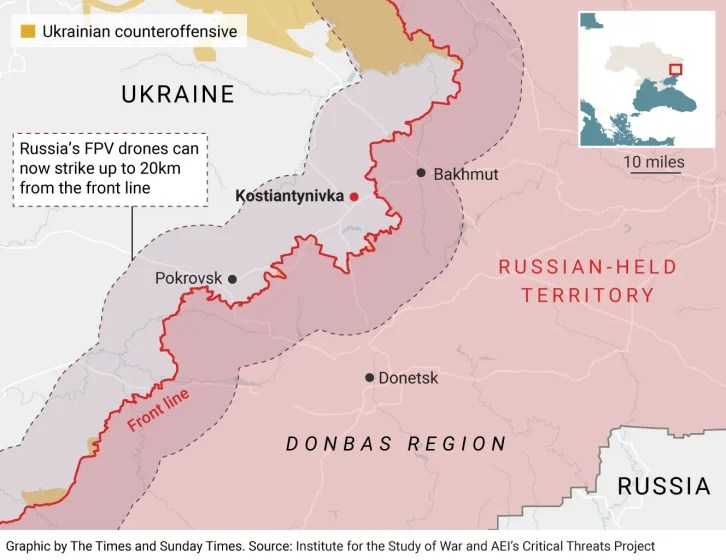
Since the proxy war erupted, both Ukraine and Russia have innovated in the field of FPV drones to an unprecedented degree. Kiev has become so reliant on drones, they are her “weapon of choice.” Yet, as The Times records, Russia has now decisively “taken the lead in the drone race, outproducing Kyiv in the manufacture and use of medium-range FPV drones and fibre optic variants that have changed the shape of the entire 1,200 km front line.”
Not only are FPVs “dramatically” striking ever-deeper into Ukrainian territory, but fibre optic FPV drones have gained “dark prominence over the killing fields.” While emulating the quadcopters equipped with munitions typically deployed by both sides previously, this “highly manoeuvrable killer drone” is connected directly to pilots by “a gossamer thin fibre optic thread.” This makes the contraptions difficult to track, and impervious to electronic jamming. A local infantry battalion commander told The Times:
“The changes posed by drones are so fast that concepts we implemented just a month ago no longer work now. We live in a space of perpetual fast adaptation. In the past week alone, Russian drone strike ranges have increased by four kilometres.”
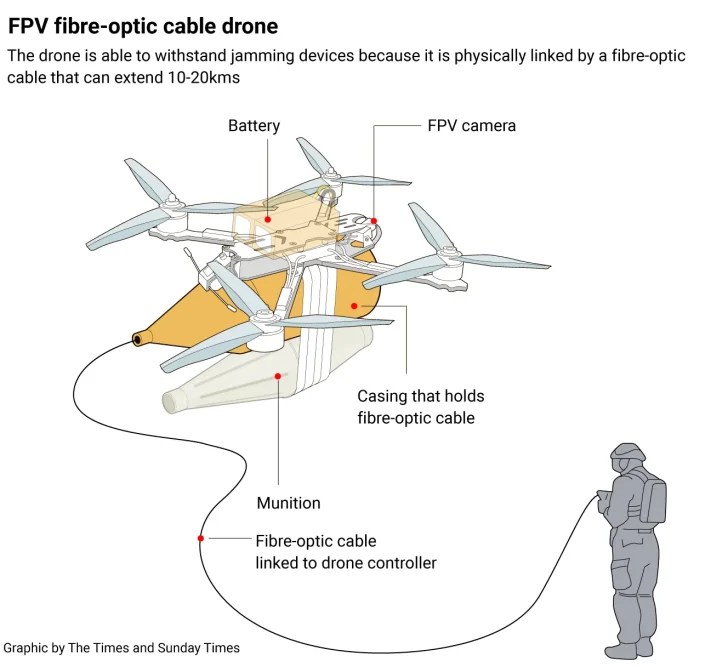
These developments have sent Ukrainian forces scurrying en masse to regroup at regular, abrupt intervals ever-further away from the front line (also known as “zero point”), while logistical convoys to Kramatorsk – “long considered the bastion of Ukraine’s defence of the Donbas region” – have been repeatedly struck. One lieutenant recorded how Russian drones “swarm our armoured vehicles whenever they get near the zero point,” obliterating them and their crews. He believes drones represent such a world-changing military hazard, “the days of the tank are truly over.”
‘Danger Estimate’
The “drone-filled skies” of Donbass are so deadly, getting soldiers and equipment to the ever-expanding frontline and back is not only a logistical and practical horror, but also a frequently suicidal task. The Times reports that until late 2023, Ukrainian infantrymen “were usually carried to a position near the front in armoured personnel carriers, walking the last few hundred metres on foot.” Today, they are dropped off up to eight kilometres away at night, walking “meandering routes through trees to avoid detection, just to take up their positions.”
Rotations from the frontline have also vastly extended in length. While at the start of 2024 Ukrainian soldiers spent “a week or two” at zero point, now they’re routinely trapped there for months at a time, “often devoid of almost any other human contact, resupplied with water, rations and ammunition by agricultural drones.” Resultantly too, “casualty evacuation has become a nightmare.” Wounded fighters are “commonly” rescued at night, and “even then the operation is fraught.” A senior logistician for the 93rd Brigade’s drone crews lamented:
“As a word ‘stressful’ doesn’t even come close to describing it. Every mission I think, ‘God forbid we get a casualty and have to work out how to get them back’.”
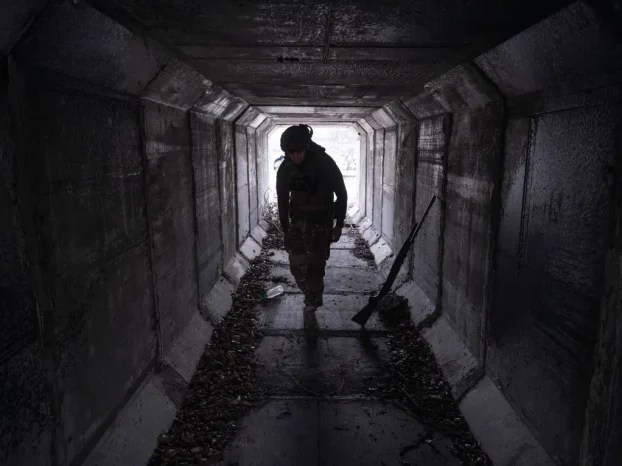
Ukrainian soldiers always keep shotguns close, to attempt to blast attacking drones out of the sky
Each night too, the Brigade’s frontline drone crews are resupplied with batteries, drone frames and munitions. Logistics teams are dropped off up to seven kilometres from the frontline, then carry up to 36 kilograms of equipment forward on foot. The risk to these crews is “enormous”. One driver was quoted as saying he conducted three missions nightly, “and I never know if each one will be my last, if I’m going to make it there and back in one piece.”
The Times records how a logistics vehicle was recently struck by a Russian drone while returning from a resupply mission. The driver lost an arm, but there were so many drones buzzing nearby, he couldn’t be evacuated from the position for five hours, so bled to death. Five Ukrainian armoured vehicles were destroyed by drones in the same sector the next day. However, none of this is seeping out to the world via the mainstream media, which once published videos of Ukrainian strikes on Russia daily.
As The Times notes, drones have adversely affected a core component of Kiev’s war effort – “media communications”. The 93rd Brigade was once “renowned for allowing reporters good access to…the war from the front.” Now though, “access for journalists has been dramatically reduced,” with “many media organisations…reluctant to commit reporters into areas within 15 km of the front.” Ukrainian brigades are likewise “wary” of the risks “they expose their own troops to in taking journalists by vehicle to the front.”
The Times reports that in 2023, the 93rd Brigade’s press officer “organised hundreds of visits to the front by reporters.” The number of visitors has now “dwindled to a trickle”. Since the proxy war’s eruption, the psychological field of battle has been where Ukraine has performed most effectively, eagerly assisted in its propaganda efforts by a media apparatus reflexively reporting the fantastical claims of officials in Kiev and their Western proxy backers as fact. Now, those days are long over. The press officer complained:
“The risks get bigger and bigger, and the coverage gets less and less. We get a journalist’s request to go to the front now and we wonder how rational is it? What is the danger estimate? What is the benefit?”
‘Technological Adaptations’
The Times report is a vanishingly rare mainstream acknowledgement of how the conflict currently raging Donbass is a war unlike any other in history, and its key spheres of battle are wholly unfamiliar to Western militaries. Despite this media omertà, the proxy conflict’s unparalleled operating environment, and obvious lessons, have not gone entirely unheeded in certain elite quarters. Nonetheless, despite alarm bells ringing accordingly, they are clearly falling on deaf ears in American and European centres of power.
In September 2024, Britain’s House of Lords International Relations and Defence Committee published a bombshell report, Ukraine: a wake-up call. It found the proxy war had “exposed fundamental weaknesses” in the “military strength” of both Britain and NATO, concluding London was effectively defenceless, with its “small” military reliant on unaffordable “status symbols” such as non-functional aircraft carriers. The country lacks the ammunition, armour, equipment, industrial capacity, personnel and vehicles to withstand a Donbass-style conflict for more than a few weeks at absolute most.
Amidst relentless condemnation of the state of Britain’s armed forces, the report contained a dedicated section on how “the use of drones in Ukraine” had “exposed the sheer variety of possible drone threats in a conflict scenario, ranging from disposable and commercially available drones to high-end, sophisticated ones.” It noted the development has “inserted an extra layer of weaponry between the land and air domains” and augmented “existing capabilities that both sides have, particularly offering new defensive options in the absence of air superiority.”
As such, the House of Lords Committee called for London to “invest in research and development to maintain a strategic edge in drone technology (including amphibious drones), and support the rapid development of new technologies that can compete in contested environments.” It urged decisionmakers to constantly consider and monitor “the pace of technological adaptations on and off the battlefield,” and the Ministry of Defence “to support continuous adaptation,” such as “[incorporating] learning on the use of drones in Ukraine across all domains.”
The report went entirely unremarked upon by the media contemporaneously, and today there is no sign of its multiple urgent calls to action having produced any meaningful results in any tangible regard in Britain’s armed forces. Similarly, despite NATO officials warning the alliance is wholly dependent on US electronic warfare capabilities, which in any event are woefully inferior to Russia’s own, public indications of Western leaders or militaries taking the drone warfare revolution seriously are unforthcoming. Should they end up in direct conflict with Russia, they’ll be in for quite a shock.
Russian missiles ‘fool’ US-made Patriots – Ukrainian military
RT | May 26, 2025
US-designed Patriot air defense systems are struggling to keep pace with Russia’s missile technology, particularly the Iskander missiles, Ukrainian Air Force spokesman Igor Ignat admitted on Monday.
Kiev has long praised the MIM-104 Patriot as a vital part of its arsenal following the deployment of the first battery in April 2023. But the American system is showing critical limitations in the face of Russia’s weaponry, Ignat told Le Monde in an interview.
“The Iskander missiles perform evasive maneuvers in the final phase, thwarting the Patriot’s trajectory calculations,” he said. “In addition, the Iskander can drop decoys capable of fooling Patriot missiles.”
While Ukrainian officials previously lauded the Patriot system for its ability to intercept Russian hypersonic Kinzhal missiles, Moscow has questioned such claims. Russian officials also argue that Kiev often overstates the number of missiles it downs compared to the number actually launched.
As of May, Ukraine is reported to have six active Patriot systems, primarily donated by the US and Germany, with additional components provided by the Netherlands and Romania.
Ukraine’s Vladimir Zelensky has called the Patriot system the only viable defense against Russian strikes, and has stated an aim to acquire a total of 25 units. He recently proposed that Kiev’s European backers fund the purchase of an additional ten systems for Ukraine at a cost of $15 billion. However, the administration of US President Donald Trump has dismissed the proposal as unrealistic.
Ukraine also faces dwindling supplies of interceptor missiles for its Western-donated platforms, even as Russian forces adapt their drone tactics to circumvent existing countermeasures.
Ukrainian forces have escalated their own drone offensives against Russia, moving from overnight attacks to continuous launches throughout the day. The shift comes amid increased pressure from Washington for continued direct peace negotiations. On Sunday, Trump expressed frustration with the lack of progress, blaming both Moscow and Kiev.
US de facto financing persecution of Christians in Ukraine – Tucker Carlson
RT | May 25, 2025
The US is essentially facilitating the persecution of Christians in Ukraine by supporting the Kiev government, which has been waging a purge campaign against the nation’s canonical Orthodox church, American journalist Tucker Carlson has said.
Carlson made the statement during an interview with a former Ukrainian MP, Vadim Novinsky, released on Friday.
“Every day, churches and temples are seized by soldiers with machine guns who come in, throw out priests, beat believers, children, old people, women…” the former lawmaker stated, adding that “it is happening all over Ukraine.”
“I think very few Americans understand the degree to which the Ukrainian government under [Vladimir] Zelensky has persecuted the Ukrainian Orthodox Church,” Carlson said.
The former Fox News host then asked Novinsky what he would like to say to the American lawmakers who have nevertheless approved financial aid to Kiev. “The Speaker of the House of the United States Congress is a man who describes himself as a Christian and he has been paying for this,” the journalist said, referring to Mike Johnson, a Louisiana Republican.
The former Ukrainian MP replied that he would like to see the US aid going directly to ordinary Ukrainians and not the authorities, who “live in parallel realities.”
US government agencies appropriated a total of $182.8 billion on various forms of assistance to Kiev between 2022 and the end of 2024, according to Ukraine Oversight, an official portal that tracks such expenditures.
Last week, US President Donald Trump stated he was concerned that billions of dollars were being wasted on aid to Ukraine. He said Congress was “very upset about it” and that lawmakers were asking where all the money was going.
Kiev has accused the Ukrainian Orthodox Church (UOC) of maintaining ties to Russia even though it declared independence from the Moscow Patriarchate in May 2022. The crackdown has included numerous arrests of clergymen and church raids, one of the most notorious of which took place in the catacombs of the Kiev-Pechersk Lavra, where holy relics are kept.
Last year, Zelensky signed legislation allowing the state to ban religious organizations affiliated with governments that Kiev deems “aggressors,” effectively targeting the UOC.
Earlier this week, Russian Foreign Minister Sergey Lavrov said that Moscow would not abandon the Orthodox believers in Ukraine and vowed to make sure that “their lawful rights are respected.”
Scott Ritter: Will Trump Own the Ukraine War or Walk Away?
Glenn Diesen | May 23, 2025
Scott Ritter is a former intelligence officer in the US Marine Corps and a former UN Weapons Inspector. He expects that the negotiations will fail, and Trump will distance himself from the war. Thus, the failure of negotiations will hurt Ukraine and Europe the most.
Follow Prof. Glenn Diesen:
Substack: https://glenndiesen.substack.com/
X/Twitter: https://x.com/Glenn_DiesenPatreon:  / glenndiesen
Support the channel: PayPal: https://www.paypal.com/paypalme/glenn…
Buy me a Coffee: buymeacoffee.com/gdieseng
Go Fund Me: https://gofund.me/09ea012f
Eurovision: NATO Psychological Warfare Tool
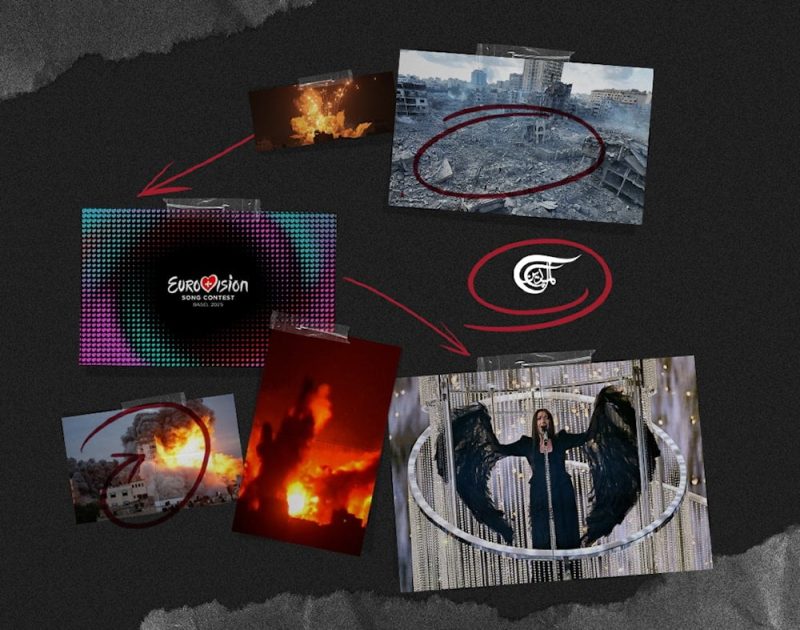
By Kit Klarenberg | Al Mayadeen | May 24, 2025
The 2025 Eurovision Song Contest ended May 17th mired in controversy. The Zionist entity’s entrant, Yuval Raphael, finished second. Her performance, “New Day Will Rise”, received 297 points via public televote – the highest garnered by any act in the competition’s Grand Final, with 13 countries giving Raphael the maximum score of 12 points. This helped “Israel” almost clinch victory, despite coming last among participants in national jury votes. Immediately, state broadcasters across Europe demanded an investigation into flagrant, industrial scale rigging in “Israel’s” favour.
The Zionist entity’s participation in the Contest was the subject of much controversy in its leadup. On May 5th, 72 former Eurovision contestants – including previous winners – cosigned a letter to the European Broadcasting Union (EBU) demanding “Israel” and its national broadcaster be banned from the contest, over the country’s “genocide against the Palestinians in Gaza and the decades-long regime of apartheid and military occupation against the entire Palestinian people”. Their call was echoed by Spanish premier Pedro Sanchez.
Then, on May 19th, an EBU probe revealed the Israeli Government Advertising Agency conducted a vast, cross-platform online campaign to encourage support for Raphael’s entry. Detailed instructions on how to vote for her via text and phone in countries as far afield as Australia were widely circulated, along with a reminder that individuals could vote up to 20 times each. A dedicated YouTube channel – @Vote4NewDayWillRise – was launched to support the effort, garnering over 8.3 million views. Its videos were widely amplified across social media.
Separate investigations suggest Zionists could’ve further connived to fudge the Contest’s results via “VPNs, automated scripts (bot farms), and bulk SIM card purchases”. It is not the first time Tel Aviv has engaged in brazen fraud to skew Eurovision’s results in its favour. When “Israel” triumphed in the 2018 Contest, speculation widely abounded their victory resulted from meddling by now-defunct online Zionist astroturf effort Act.IL. On top of unambiguous voting irregularities, winning meant the 2019 Contest would be convened in “Israel”.
A June 2018 Knesset hearing spelled out this windfall’s strategic significance. Multiple Zionist entity lawmakers and ministers spoke of how “holding the Eurovision song contest in “Israel” is a gift” that could be exploited to boost and improve “Israel’s” international image, and counteract the burgeoning Boycott, Divestment and Sanctions movement’s successes. BDS had recently compelled Argentina to cancel a World Cup ‘friendly’ match with the entity, after Tel Aviv attempted to host the bout in illegally occupied al-Quds.
‘Opinion Leaders’
Similar Zionist entity-orchestrated social media and televote chicanery boosted “Israel” to fifth place in the 2024 Contest, which was likewise prefaced by widespread calls to bar Tel Aviv’s participation, and for other participating countries to boycott the event. While falling far short of victory, the public relations utility of “Israel’s” performance was abundantly clear. Entity officials, Western news outlets and pundits eagerly leaped upon the results as proof that despite the ongoing 21st century Holocaust in Gaza, a “silent majority” of Europeans still supported “Israel”.
At the time, journeyman Israeli government “public diplomacy” apparatchik David Saranga gushed to Ynet, “we knew that the situation was less serious than it is reflected in the demonstrations on the streets of Europe, but we did not expect such overwhelming support”. He added, “the fact that even countries where public opinion is critical of “Israel”, such as Sweden or Ireland, gave “Israel” a high score” indicated there were “underground currents” of pro-Zionist sentiment throughout the West.
However, Saranga also admitted the entity’s Foreign Ministry “acted among friendly audiences to increase voting”. Ynet subsequently detailed this effort, which included Tel Aviv’s entrant that year, Eden Golan, recording personal video addresses to foreign audiences in their own languages, referencing a supposed “wave of hatred” being whipped up against “Israel” by “Muslims”. Extensive analysis was conducted to ensure her message reached “Eurovision-loving audiences such as the LGBT community in Europe, members of fan clubs, journalists covering the contest and opinion leaders in the field.”
Following Yuval Raphael coming second this year, a familiar chorus erupted, with numerous prominent figures claiming her televoting preeminence was indicative of concealed Zionist sentiment the world over, and that ever-growing Palestine solidarity actions were not representative of wider public opinion. This is despite her performances being met with such intense booing, some European broadcasters resorted to piping in pre-recorded cheers and applause to drown out the mass jeering. Meanwhile, polls amply indicate the overwhelming majority of Europeans hold “unfavourable” views of Tel Aviv.
That the Zionist entity has so consistently invested enormous time, energy, and money into attempting to ‘game’ Eurovision over so many years is a testament to its redoubtable international propaganda potency. Up to 200 million people worldwide routinely tune in to the tournament every year, and Tel Aviv is not alone in seeking to weaponise the tournament for political reasons. In fact, Eurovision was secretly created as a psychological warfare tool by NATO to manipulate and control public opinion for this explicit purpose.
‘Psychological Action’
In January 2015, an extraordinary, hitherto secret document drawn up by NATO’s Committee on Information and Cultural Relations in March 1955 was published for the first time. It outlined the practical and ideological foundations of Eurovision, which was first convened next year, with just seven participants. A section of “aims” of the Contest states NATO’s objective was to “make the most” of TV, which “gives mankind at long last, the possibility, through the visual image, of conquering time and distance”, reaching vast global audiences simultaneously:
“Television has enabled sight to triumph over time and space, and this is the aspect which struck us most forcibly and led us to believe that it was our duty to break through the narrow boundaries which confined our programmes to spectators clustered around our respective capital cities, and to travel the world. There is no point in having a wonderful instrument in our hands if all we are going to do…is show the suburbs of Paris, London or Milan in France, England or Italy.”
The document went on to state “the thrill” of TV “lies in ranging as far afield as possible… [using] this marvellous instrument’s capacity for the instantaneous transmission of an event taking place elsewhere.” NATO contended “television transcends the frontiers of our European countries,” and thus the military alliance “held within [its] grasp a unique instrument for social and psychological action”. In sum, a “nervous system” of Europe could be constructed, “far more powerful than the telephone” or radio, to “animate the…general public.”
The document concludes with its author, Jean d’Arcy, then-senior director of French state broadcaster Radiodiffusion Française, expressing his sincere hope that the “social significance of Eurovision will become ever more apparent as it progresses along the lines which… it is destined to follow”. The file was a summary of remarks he made at a dedicated NATO conference “of senior information officials” in Paris two months earlier. His talk was described in a subsequent alliance newsletter as “most interesting”.
At that conference, Hastings Ismay, NATO’s first secretary general – who notoriously declared the alliance’s purpose was “to keep the Russians out, the Americans in, and the Germans down” across Europe – “reiterated his steadfast conviction of the importance of a profounder and more widespread understanding of NATO’s aims and achievements”. Eurovision provided an ideal opportunity to insidiously achieve those goals in a non-military context, propounding European unity and cultural superiority over the Soviet Union while the Cold War was in its infancy.
The collapse of Communism in Central and Eastern Europe, and the Soviet Union’s subsequent dissolution, vastly increased Eurovision’s pool of contestants. It was not until 1994 that Russia first appeared at the Contest. On February 25th 2022, one day after the Ukraine proxy war erupted, Moscow was banned from participating, which has remained in place ever since. In that year’s competition, Kiev prevailed, with The Kalush Orchestra’s song “Stefania” – interpreted in some quarters as an ode to Ukrainian ultranationalist mass-murderer Stepan Bandera – securing first place.
NATO deputy secretary general Mircea Geoana praised Ukraine’s victory and its “beautiful song”, linking Kiev’s triumph “to its bravery in fighting Russia”, and “immense public support all over Europe and Australia” for the proxy war. A Reuters report on Geoana’s comments commenced by declaring, “Eurovision and NATO might not usually be associated” – the international newswire’s writers apparently unaware that the military alliance was from inception, and remains, absolutely fundamental to the international tournament’s operation.
Former Yanukovich presidential adviser visited Kiev days before assassination – media
RT | May 23, 2025
Former Ukrainian lawmaker and presidential adviser Andrey Portnov, who was fatally shot in Madrid on Wednesday, had secretly visited Ukraine just days before his assassination, according to a report by Ukrainskaya Pravda which cites sources close to law enforcement and government circles.
The newspaper said that three sources have confirmed that Portnov was in Kiev on May 17–18 for a series of high-level meetings, including with “top officials responsible for law enforcement.” However, the exact nature of the meetings, and whether the visit was connected to his subsequent murder, remains unclear.
Portnov, a lawyer and once a powerful figure in the administration of former President Viktor Yanukovich, was gunned down in the upscale Madrid suburb of Pozuelo de Alarcon three days later, on May 21. Spanish media reported that he was shot multiple times, including in the head, shortly after dropping his children off at school. Witnesses say a lone gunman approached him near his Mercedes before fleeing with the help of accomplices.
No arrests have been made, and a Madrid court has reportedly classified the investigation. Ukrainian Foreign Minister Andrey Sibiga said on Friday that Madrid had shared “official information” about the murder due to Portnov’s citizenship, adding that relevant agencies in Kiev would determine the next steps.
“We possess information about the fact of the murder,” Sibiga told reporters in Kiev, while stressing that official procedures take time to unfold.
Spanish police have not ruled out any motives, with reports suggesting both organized crime and a political vendetta could be behind the killing due to Portnov’s complex and controversial political trajectory.
After serving as a legal architect of Ukraine’s judicial reform during Yanukovich’s presidency, Portnov fled the country during the 2014 Western-backed Maidan coup, returning only after Vladimir Zelensky’s 2019 election victory.
Since then, Portnov had filed a series of legal complaints against former President Pyotr Poroshenko, and was seen as having significant influence over Ukraine’s judiciary. In 2021, the United States sanctioned Portnov over alleged corruption.
While he initially supported Zelensky, he quickly became a vocal critic of the new administration, accusing it of authoritarian overreach amid a crackdown on opposition figures and media it labeled “pro-Russian.” Ukrainian media later accused him of ties to Russian elites, prompting him to flee again in 2022. He reportedly transferred assets to his children in Spain and settled in Madrid with his family.
Rodion Miroshnik, Russia’s ambassador-at-large overseeing a special mission on alleged Ukrainian war crimes, has suggested that Portnov’s career gave him access to legal documents that could be damaging to people in Zelensky’s inner circle — and that he may have been targeted to prevent the possible disclosure of such materials.
Russian military strikes drone-making plant in Kiev – MOD
RT | May 24, 2025
The Russian military has carried out a successful strike against a drone and missile production plant in the Ukrainian capital, Kiev, the Defense Ministry in Moscow has said.
The statement, issued by the ministry on Saturday, confirms earlier reports of a large-scale Russian drone and missile strike on Kiev overnight. Witnesses said they heard multiple blasts, with photos uploaded on social media capturing a huge explosion in the city.
“The Russian military performed a group strike with high-precision ground-based weapons and unmanned aerial vehicles against a Ukrainian military-industrial complex enterprise that produces missile weapons and unmanned aerial attack vehicles,” the statement read.
The other targets of the attack were a radar surveillance center and a US-made Patriot air defense system, it added.
“All of the goals of the strike were achieved. All designated targets were hit,” the ministry said.
According to media reports, the Russian strike targeted the Antonov aircraft manufacturing plant in the western part of the capital.
The Russian bombardment came after an intensification of Ukrainian drone attacks on Moscow and other Russian regions this week.
According to the Defense Ministry, 788 drones and 12 missiles were intercepted inside Russia between Tuesday and Friday. Another 104 UAVs were intercepted overnight, the ministry said on Saturday morning.
The Russian Foreign Ministry said on Friday that one person had been killed and 20 others injured, including four children, in Ukrainian drone strikes throughout the week. Four more civilians, including two kids, were wounded after the city of Lgov in Kursk Region was hit by a US-supplied HIMARS multiple rocket launcher, according to the ministry.
The Russian military said it would respond appropriately to the intensified drone raids by Kiev, but “unlike the Ukrainian side, our targets will be strictly limited to military facilities and defense industry plants,” it said.
Featured Video

Yemen joins the war – Red Sea could be blocked next – Saudi regime at risk
or go to
Aletho News Archives – Video-Images
From the Archives
A superpower and “the world’s sickest warrior state”
By Paul J. Balles | March 8, 2010
Living through five or six major wars has hardened me to what I thought were the extremes of inhuman cruelty and brutality.
Two things made those extremes almost bearable: the brutality always revealed – at least according to the media coverage – the viciousness of the enemy. It was therefore quite understandable when our “brave men and women” pulverized the enemy.
Films of Japanese torturing captive Americans somehow justified holding Japanese Americans in internment camps during World War II; and only a small percentage of Americans found the bombing of Hiroshima and Nagasaki unreasonably vengeful at best, at worst, depraved.
The media giants in America portrayed the North Koreans as barbaric beasts with their captives, quite unlike their southern counterpoints – our allies during the Korean War. No one ever felt the need to explain how the South Koreans were a civilized breed while the North Koreans were absolute savages, at least according to the official line.
In Vietnam, our warriors justifiably (or so the media made us believe) dropped napalm on the North Vietnamese who had the gall to hide in villages and tunnels to ravage our invaders. At least it was accepted practice until some rogue photojournalist filmed a young girl screaming down a Vietnamese road in flames. … continue
Blog Roll
 Aletho News
- Russian tanker approaches Cuba despite US oil blockade
- Marandi: Yemen joins the war – Red Sea could be blocked next – Saudi regime at risk
- Pro-Palestinian French member of European Parliament denied entry to Canada
- Pakistan to Host US-Iran Talks
- How Indonesia’s tilt toward the US left it stranded in the Strait of Hormuz
- US has no choice but to retreat from Iranian borders: Top commander
- Iran Retaliation Strikes Chemical Plant Near Dimona
- AWACS’ Destruction is a Major Loss for US Military – Ex-DoW Analyst
- Israel’s Iran Strategy Uses US Military & Gulf States as Its Pawns
- Iran: Trump wanted regime change, now just begging for Hormuz to open
- If Americans Knew
- Israeli police block Catholic cardinal from entering Church of the Holy Sepulchre on Palm Sunday
- Israel is assassinating journalists again, more than any other nation, anywhere, ever – Not a ceasefire Day 170
- Over 300 US service members wounded, majority have brain injuries – Not a ceasefire Day 169
- Researchers at Human Rights Watch Resign Over Blocked Report on Palestinian Refugee Return
- Jewish Groups Are Backing a War Americans Don’t Want
- Eric Fingerhut Thinks He’s the President of the Jews
- Top Jewish Philanthropists, Rabbis Urge Israeli President to Take Action Against ‘Jewish Extremists’
- Don’t Be Fooled. Zionist Leaders Have Always Wanted to Control Southern Lebanon
- Israel’s widespread use of torture is a core element of its genocide against the Palestinian people
- In Israel’s War on Iran, Many Middle East US Bases Rendered “All But Uninhabitable”
- No Tricks Zone
- German Science Blog Accuses PIK Climate Institute Of Hallucinating Climate Tipping Points
- Devastating Assessment Of Comirnaty Vaccine By Former Senior Pfizer Europe Toxicologist
- New Study: CO2 Is ‘Effectively Negligible’ As An Explanatory Climate Change Factor Since 2000
- Former Pfizer Toxicologist Dr. Helmut Sterz Tells Bundestag Hearing Pfizer Vaccine Should Have Never Been Approved
- Energy Expert: Germany’s Nuclear Phaseout Was A “500 Billion Euro Mistake”
- New Research: South Australia’s Mid-Holocene Sea Surface Temperatures Were 4°C Warmer Than Today
- Storing Green Energy To Last Germany 10 Days Would Require A 60-Million Tonne Battery
- New Studies: UK Sea Levels Were 4 Meters Higher Than Today During The Mid-Holocene
- Destructive Green New Deal: German Energy And Metal Group Warns Of Drastic Crisis
- New Study Documents A 20-Year Pause In Arctic Sea Ice Decline – Driven By Internal Variability
 Aletho News
