Are Democrats More Neocon Than Republicans Now?
By Jack Hunter | The Libertarian Institute | August 25, 2025
Last week as Donald Trump met separately with Russian President Vladimir Putin and Ukraine head Volodymyr Zelensky to potentially seek an end to the years long war between their countries, Democrats have been very upset.
That peace might happen. They are worried Ukraine might have to make concessions to Russia to reach an agreement, including land.
Never mind that it is Ukrainians who are dying. Never mind that most Ukrainians themselves want to end this war. According to a recent Gallup poll, 69% of Ukrainian respondents want a negotiated end to the war as soon as possible, while only 24% said they still want to fight “until victory.”
Democratic voters sitting in the United States, with no imminent bombs or bullets to worry about, insist that this war go on for as long as it takes, and are being loud about it. Senator Lindsey Graham (R-SC) agrees with them. This doesn’t seem to faze Democrats.
This opposition to Trump’s diplomacy seems to be the consensus of many Democrats, shown in spades all over media this week.
This is a position shared by Senator Mitch McConnell (R-KY). This is the position of Bill Kristol. This is the position of virtually every neoconservative hawk in either major party and has been since this conflict started, that Ukraine must “win” at all costs.
Even at the cost of more Ukrainian lives.
Let me be clear about the definition of “neoconservative” I’m using here. I’m not just talking about the narrow and few band of post war, ex-Trotskyites of the Irving Kristol and Norman Podhoretz variety who stood for a number of things, including the pursuit of a hyper aggressive American foreign policy. I’m talking about Senator Graham, Kristol, the late John McCain, talk host Mark Levin and any other figure on the right who has been rabidly pro-war and hateful toward Ron Paul, Pat Buchanan, and any other prominent antiwar Republican leader of the last thirty years.
I’m talking about the Republicans who use “isolationist” as a pejorative slur for non-interventionism.
I tend to “neoconservative” as carefully here as those people use “isolationist.”
There have always been neocons in both major parties. But this week it has seemed Democrats have outweighed Republicans on this front. There is no poll on this. There is no hard data. I’m just observing.
President Trump has said he wants the killing to end between Ukraine and Russia. Cheering him on in this effort is Congresswoman and MAGA booster Marjorie Taylor Greene (R-GA) and many other GOP members. Also, pundit Tucker Carlson and former Trump aide and talk host Steve Bannon, whose audiences are large and full of MAGA supporters who also endorse Trump’s pledge to end America’s “endless wars.”
There are still plenty of GOP neocon members of Congress and voters within the base, but Trump’s Republican party is a very different one than George W. Bush’s when it comes to hawkish foreign policy.
On the other side, there are progressives like Ro Khanna (D-CA) who have expressed in the past wanting to see Trump help achieve some kind of diplomatic peace.
This week, Khanna has been silent on this, and who could blame him? Because Democrats by and large seem upset that Trump could achieve some sort of deal. They even got mad when Trump shook Putin’s hand during the summit.
Embracing war by avoiding diplomacy is key to neoconservatism. It’s why hawks got so mad in the mid-1980s when President Ronald Reagan met with Soviet Union President Mikhail Gorbachev. It’s why neocons were absolutely irate when Trump met with not only Putin but North Korea’s Kim Jong Un and even Hungary’s Viktor Orban.
2024 Democratic nominee Kamala Harris campaigned with Liz Cheney, got her and her father Dick Cheney’s endorsement and slammed Trump for “bowing down” to dictators, sending a signal to her neocon friends that she would not be engaging in that kind of diplomacy.
Now the people who voted for Harris are reflecting the same sentiment. Trump’s diplomatic efforts have them fuming.
During the 2012 presidential election, Republican nominee Mitt Romney said that Russia was the United States “No. 1 political foe.” President Barack Obama mocked Romney at the time, saying in a debate, “The 1980s are now calling to ask for their foreign policy back, because the Cold War’s been over for twenty years.”
Romney was clearly representing the neoconservative Bush-Cheney foreign policy legacy that still resonated with so many Republicans at the time, and Obama, the anti-Bush message that had delivered him the White House in 2008. Obama did not remotely live up to that promise, but this was roughly the dynamic in the 2012 election.
Politics change and history happens, but it is feasible today that there are more Republicans, in Congress and in the base, who think constant U.S. hyperventilating about Russia, even now, is overblown and Americans should be more concerned about their own country first.
It’s also feasible that there are more Democrats, in Congress and in the base, for whom Trump and Putin are considered one in the same and those folks are more laser focused on hating both men than any other concern, including the health and security of their own country or any other (Ukraine).
When Barack Obama was a rockstar in 2008, Democrats prided themselves on being the complete opposite of Bush-Cheney neoconservative Republicans. In 2025, it appears that more Democrats than not now staunchly side with Bush-Cheney neoconservatives regarding the Russia-Ukraine conflict.
What changed? That might be a longer discussion. But it wasn’t neoconservatives.
The End of the Conflict in Ukraine at Sight?
Zelensky and the Europeans in Washington in Search of Saving Face
By Ricardo Martins – New Eastern Outlook – August 25, 2025
Seven European leaders rushed to Washington under the official banner of solidarity with Volodymyr Zelensky. Yet, the real motive was less about unshakable support for Ukraine and more about damage control.
Zelensky and the Europeans in Washington in Search of Saving Face
With negotiations advancing — and with Ukraine’s loss of territories and NATO membership already ruled out by Donald Trump — Europe’s leaders were scrambling to craft a narrative to their domestic audience that could justify defeat without admitting failure.
The Struggle to Save Face
For three years, the European mantra has been that “Russia cannot win.” Yet on the battlefield, it is Moscow that has the upper hand. The tactic, therefore, was to insist that Russia, as the supposed aggressor, must accept the obligations of the loser. But the reality is moving in the opposite direction: Europe now seeks symbolic concessions to sell to its public.
One of these face-saving gestures is the return of “kidnapped” Ukrainian children, based on contested numbers but useful as a talking point. Another is security guarantees for Ukraine — not NATO membership, but something that can be framed as protection. Zelensky, keen to please Trump, asked for $100 billion in arms, to be funded by Europeans but manufactured in the U.S. NATO’s Secretary-General eagerly echoed this line, presenting himself as a loyal messenger to “Daddy” Trump at Europe’s expense.
Meanwhile, territorial concessions remain taboo in European discourse. To admit them would be to acknowledge Putin’s victory, a political sin for leaders who have invested heavily in a narrative of inevitable Ukrainian triumph.
The Casting: Putin Absent, Yet Present
The most striking absence in Washington was also the most palpable presence. Putin was not in the room, but Trump invoked his name repeatedly, even phoning him for 40 minutes while Europe’s leaders waited. Each mention of Putin’s name drew visible discomfort across European faces, an unmistakable reminder of their diplomatic impotence.
As Djoomart Otorbaev, former Prime Minister of Kyrgyzstan, put it: “Here’s the uncomfortable truth: Putin didn’t earn Trump’s respect through backroom schemes. He earned it on the battlefield and at the negotiating table. And that reality says more about today’s shifting world order than any rumour.”
Trump’s deference to Putin was not ideological; it was grounded in recognition of Russia’s gains. Western efforts to reverse the war’s trajectory have not succeeded, despite supplying Ukraine with advanced weaponry.
Europe’s Century of Humiliation Has Started
Europe’s frantic arrival in Washington — “like the Middle Ages, to homage their master” — symbolised a humiliating dependency: the continent’s leaders reduced to courtiers around a U.S. president already imagining his Nobel Peace Prize.
The delegation was a tableau of weakness. Ursula von der Leyen, in the name of the European Commission, reconfirmed the one-sided trade arrangements: 15% tariffs on European goods entering the U.S., zero tariffs on U.S. exports to Europe, $750 billion in energy and arms purchases, $600 billion in European investments in the U.S., and €150 billion earmarked for EU rearmament. A transfer of wealth and sovereignty dressed up as transatlantic unity.
The body language told its own story. Giorgia Meloni’s irritation was poorly disguised; Friedrich Merz remained wooden; Emmanuel Macron projected disdain; Keir Starmer hid behind note-taking. Von der Leyen managed only a strained smile, Mark Rutte melted into insignificance, and Zelensky — who should have been the central figure — appeared isolated at the margin, dignified but sidelined. Putin, a former KGB officer, and Trump, a former reality TV star and a real estate millionaire, both despised by the Europeans, loomed as the peace brokers. As put by a French analyst: “Quel cirque”.
The Security Guarantees Conundrum
The question of security guarantees has become the crux of European debate. Openly, leaders say territorial concessions are for Ukrainians to decide. Privately, they know the map is already shifting. What remains is an attempt to provide Ukraine with protections that appear credible, but that does not include NATO membership.
POLITICO reported that the Pentagon’s top policy official made clear the U.S. intends to play only a minimal role in guarantees. “There’s the dawning reality that this will be Europe making this happen on the ground,” admitted a NATO diplomat. In other words, Europe is on its own.
European capitals, however, still plead for U.S. assets: fighter jets stationed in Romania, access to American satellites for GPS and reconnaissance. Russia, through its envoy Mikhail Ulyanov, flatly rejected any foreign troops in Ukraine, while Sergey Lavrov dismissed Western security schemes without Moscow and Beijing as “a road to nowhere.”
Ukraine itself is unimpressed. Ten nations, including France and the U.K., have floated the idea of deploying troops, but Kiev sees such proposals as vague, amorphous, and unlikely to provide real guarantees. Former foreign minister Dmytro Kuleba captured the mood: “The so-called security guarantees are so amorphous. The only news is that the U.S. is willing to take part.”
Europe’s Internal Fractures
Even as leaders paraded unity in Washington, Europe’s internal divisions deepened. The European Parliament announced it would sue the Council over being excluded from negotiations on the €150 billion SAFE defence loan scheme.
In a telling sign of institutional fragility, Parliament was sidelined by Ursula von der Leyen’s Commission in the rush to fund rearmament. As Euractiv reported, 18 member states have already expressed interest in loans totalling €127 billion, but without parliamentary oversight, Europe’s democratic deficit widens.
In sum, the “road to nowhere” that Lavrov mocked may yet prove prophetic, not only for Ukraine’s elusive guarantees but for Europe’s strategic autonomy itself.
Ricardo Martins, PhD in Sociology, specializing in International Relations and Geopolitics
Friedrich Merz Are You Nuts?
By William Dunkerley | Ron Paul Institute | August 25, 2025
Do you know what German Chancellor Merz did?
Amidst serious negotiations to end the bloody and destructive Ukraine war, this guy’s putting up a veritable roadblock right in front of progress.
Here’s what it is: Merz was in Washington along with several other European leaders for a Ukraine meeting with President Trump. When it came Merz’s turn to talk he expressed, “I can’t imagine that the next meeting would take place without a ceasefire.”
Clearly no one in the world with a heart would like to see the fighting go on. So at first glance a ceasefire seems like a quick fix. But Merz’s strongly spoken statement had strings. Pointedly, he wants to delay peace talks until a ceasefire takes hold.
There’s one enormous obstacle to that. There’s a strong reason why Russian President Putin would be very reluctant to accept Merz’s condition. It’s simple to understand:
Earlier in Ukraine hostilities both Germany and France achieved Putin’s agreement to a ceasefire while a negotiated peace agreement was underway. The efforts were called the Minsk Accords.
Doesn’t that sound like what Merz is proposing now? But it turned out in an unexpected way.
After a period of ceasefire and negotiating, the German and French leaders publically admitted they had tricked Putin into the ceasefire. They confessed their real objective was not peace. It was to buy time to better equip Ukraine to fight Russia.
You may have heard the idiom, “once fooled, twice shy.” It’s a modern version of the Old English translation from Aesop’s Fables that goes, “He that hath ben ones begyled by somme other ought to kepe hym wel fro[m] the same.” That’s a position that Putin might well take with regard to Germany’s current leader. Why should he be trusted, particularly when it comes to a ceasefire?
Certainly Merz must know the background of this. He would be remiss not to understand that a ceasefire without a peace agreement might be as unattainable as the end of a rainbow. That’s what leads me to suspect that Merz must be deliberately sabotaging the peace process, as would be any other European leader who joins him in his emphatic request.
It is time to address the significant real obstacles that must be faced if a settlement of territory is to take place.
For instance, Ukrainian President Zelensky claims that his constitution is a roadblock to such a settlement. But he is only partly right.
It is true that the Ukrainian constitution does not allow him to divide territory. He also offered another roadblock in that even changing the constitution would not be a simple matter. It would even require an extensive public referendum he says.
He is right on both points. But he is wrong to represent them as ultimate roadblocks or even something that would result in much delay. In the past, Ukraine, in the view of its leaders, successfully negotiated a way to deal with problematic constitutional provisions that stood in its way.
This happened when leaders found it cumbersome to remove the democratically elected Viktor Yanukovych from the presidency. Some reports claimed he was impeached. But the votes weren’t there to do that according to the constitution. Other reports claimed that he removed himself by abandoning his office when he fled for his life amidst immediate threats. But the constitution wasn’t followed there either. Nonetheless, they got rid of Yanukovych.
Here’s how they did it. The Rada, Ukraine’s parliament, simply passed a resolution. It said that the current circumstance was threatening to Ukraine, a mass violation of citizens’ rights and freedom, and a circumstance of extreme urgency. As a result they removed Yanukovych while not observing the constitution.
Now, all Ukraine has to do is to repeat that technique. Is not the current circumstance threatening to Ukraine, a mass violation of citizens’ rights and freedom, and a circumstance of extreme urgency, too?
A straightforward resolution echoing the Rada reasoning above can authorize a reasonable and peaceful settlement of the Ukraine war that involves, as necessary, the trading of territory or the acknowledgment of certain changes that were made militarily. This approach will save lives, save homes, businesses, and infrastructure, and, indeed, save Ukraine. That truly would be standing with Ukraine and its people.
So it’s time to say no to Merz, throw him out of the planning group, if need be, so the more well-intentioned leaders can finally support peace in Ukraine expeditiously and once and for all.
‘Don’t threaten us’ – EU state to Zelensky
RT | August 25, 2025
Hungary has warned Ukraine to stop disrupting its energy supply from Russia after Kiev targeted a key pipeline delivering oil to Central Europe.
Ukrainian forces struck the Soviet-era Druzhba (Friendship) pipeline three times this month, sparking outrage in both Hungary and neighboring Slovakia. The flow through the pipeline was last halted on Friday.
At a press conference during Independence Day celebrations in Kiev on Sunday, a reporter asked Ukrainian leader Vladimir Zelensky how the attacks relate to Hungary’s opposition to Ukraine’s EU and NATO ambitions.
“We have always supported friendship with Hungary, but now the very existence of this friendship depends on Budapest’s position,” Zelensky replied with a smile, playing on the pipeline’s name.
Hungarian Foreign Minister Peter Szijjarto issued a sharp rebuke on X. “Zelensky used Ukraine’s national holiday to threaten Hungary. We firmly reject the Ukrainian President’s intimidation,” Szijjarto wrote. He described the attack on Hungary’s energy supply as “an attack on sovereignty.”
“A war to which Hungary has nothing to do with can never justify violating our sovereignty. We call on Zelensky to stop threatening Hungary and to end the reckless attacks on our energy security!” he added.
Ukrainian Foreign Minister Andrey Sibiga responded on X, writing to Szijjarto: “You don’t need to tell the Ukrainian President what to do or say, and when.” He urged Budapest to “diversify and become independent from Russia, like the rest of Europe.”
Szijjarto shot back: “Stop attacking our energy security! This is not our war!”
Unlike many EU countries, Hungary has refused to send weapons to Kiev and has heavily criticized Brussels for imposing sanctions on Moscow. The country maintains that Ukraine’s NATO membership could trigger an all-out conflict with Russia.
Ukraine Holding Captive Over 20 Russian Civilians Kidnapped From Kursk Region – Presidential Aide
Sputnik – 24.08.2025
MOSCOW – Ukraine has been holding captive more than 20 Russian civilians kidnapped by Ukrainian troops during a 2024 raid in the western Russian border region of Kursk, Russian presidential aide Vladimir Medinsky said on Sunday.
“They have been de facto abducted and are being held hostage. Russia has been painstakingly bargaining for these civilians to be returned home. Many have been brought back, including the eight returned today. More than 20 others are estimated to remain [in captivity],” he said on Telegram.
The Russian Defense Ministry said that 146 Russian servicepeople and eight Kursk residents were brought back from Ukraine in a swap on Sunday mediated by the United Arab Emirates.
Medinsky, who was Russia’s chief negotiator at the talks with the Ukrainians in Istanbul, said that most of Kursk residents abducted by Ukrainian troops were the elderly. He said the Ukrainians were handing them back in small groups, “literally trading them” for servicepeople in Russia’s custody that they need the most.
Russia Recognizes Zelensky as De Facto Head of Regime, Ready to Meet With Him in This Capacity
Sputnik – August 24, 2025
MOSCOW – Russia sees Volodymyr Zelensky as the de facto leader of the current Ukrainian administration who has the legitimacy to negotiate on Kiev’s behalf but not to sign a truce, Russian Foreign Minister Sergey Lavrov said.
“We recognize him as de facto head of the regime. And in this capacity, we are ready to meet with him… When we come to a stage where you have to sign documents, we would need a very clear understanding by everybody that the person who is signing is legitimate. And according to the Ukrainian constitution, Mr. Zelensky is not, at the moment,” Lavrov told NBC in an interview.
Here are the highlights of the interview:
🟠 The goals of the special military operation in Ukraine will be achieved, Russia must eliminate any security threats coming from there
🟠 The reaction of European representatives to the meeting in Alaska, their visit to Washington, and subsequent actions indicate that they do not want peace
🟠 We have no interest in the territories, we are interested in the fates of the people living in Donbass and Novorossiya
🟠 On Ukraine’s security guarantees, there should be a consensus that takes Russia’s interests into account
🟠 Putin and Trump discussed practical steps and serious issues related to security in Alaska
🟠 Zelensky is not currently a legitimate figure who could sign legal documents when it comes to that
🟠 Putin is ready to meet with Zelensky on the condition that the meeting will truly have a presidential agenda. It is unreasonable to meet with him just for another opportunity to be in the spotlight.
🟠The meeting between Putin and Zelensky was not discussed at the Russia-US summit in Alaska, this topic was raised later, “spontaneously”
🟠 Ukraine and Europe are trying to distort what Putin and Trump discussed in Alaska, especially the issue of security guarantees
🟠 The Russian and Ukrainian delegations have met and will continue to meet in Istanbul to discuss specific military and humanitarian issues
🟠 Russia has never, under any circumstances, deliberately targeted objectives not related to Ukrainian military forces
🟠 The West wants security guarantees for Ukraine to come at Russia’s expense, in violation of the indivisible security principle, and is ready to deploy troops on Ukrainian soil to deter Russia
🟠 Russia has never deliberately targeted sites that are not associated with the Ukrainian military
🟠 Ukraine’s right to exist is contingent on it allowing regions to secede where populations voted for independence in referendums
🟠 Foreign capital in military plants in Ukraine does not grant them immunity from potential attacks or consequences
🟠 The delegations of Russia and Ukraine have met and will continue to meet in Turkey’s Istanbul to discuss military and humanitarian issues
Full interview:
US approves sale of cruise missiles to Ukraine – WSJ
RT | August 24, 2025
The US has approved the sale of 3,350 air-launched ERAM cruise missiles to Ukraine, the Wall Street Journal reported on Saturday, citing two unnamed US officials.
The munitions, which have a range of up to 280 miles, will reportedly arrive in Ukraine within six weeks. Several US officials told the WSJ that Ukraine would have to seek the Pentagon’s approval when using them.
While US President Donald Trump had criticized the previous administration of Joe Biden for its unconditional aid to Kiev, he said earlier this week that Ukraine has “no chance of winning” unless it is capable of striking targets in Russia. Ukrainian troops have been steadily losing ground to Russian forces over the course of 2025 and struggled to replenish their ranks.
After months of uncertainty over America’s commitments, Trump said in July that any additional weapons delivered to Ukraine would be paid by NATO members in Europe.
Ukraine’s key European backers, including France and Germany, are increasingly pushing for further weapons deliveries as part of security guarantees to be provided to Ukraine after the end of the conflict. Russia, however, maintains that Western military aid is an obstacle to reaching a peace deal.
UK Ramps Up Ukraine Training as Europe’s War Hawks Push ‘Security Guarantees’
Sputnik – 24.08.2025
The British-led Operation Interflex, a multinational military initiative to train and support the Armed Forces of Ukraine, has now been extended to at least 2026, Bloomberg reports.
Over 50,000 Ukrainian recruits have already received both combat and leadership training in the UK.
A further element of the plan involves a so-called US backstop, providing intelligence, border surveillance, weapons, and potentially air defenses, Bloomberg says.
Meanwhile, a UK and France-led “Coalition of the Willing” plans to station European forces in Ukraine as European war hawks push “security guarantees” tied to a potential peace deal.
Russia insists that any security guarantees for Ukraine must reference the 2022 Istanbul talks, and discussions about a security framework without Russia lead nowhere.
In essence, Europe is proposing foreign intervention on part of Ukrainian territory, which is absolutely unacceptable for Moscow, Russian Foreign Minister Sergey Lavrov stressed.
Russian Air Defense Shot Down Ukrainian Drone Near Kursk NPP, Radiation Unchanged
Sputnik – 24.08.2025
Russian air defense shot down a Ukrainian drone near the Kursk nuclear power plant, the downed drone damaged an auxiliary transformer, the press service of the Kursk NPP said.
“On August 24 at 0:26 Moscow time [21:26 GMT Saturday], near the Kursk NPP, an air defense shot down a combat unmanned aerial vehicle (UAV) of the Ukrainian armed forces. When it fell, the device detonated, as a result of which the auxiliary transformer was damaged,” the NPP said on Telegram.
As the plant clarified, the local fire had been extinguished, as a result of which the third unit had been unloaded by 50%. There were no casualties.
“Currently, the third power unit is in operation at the Kursk NPP. The fourth power unit is undergoing scheduled maintenance. The first and second power units are in operation without generation,” the plant’s press service added.
The radiation background at the industrial site of the Kursk NPP and the adjacent territory has not changed and corresponds to natural values, the press service concluded.
NATO Sharpens Its War Wallet: Doubles Down On Ukraine Aid
Sputnik – 23.08.2025
Russia states that supplying arms to Ukraine hinders peace efforts and drags NATO allies into the conflict. Russian Foreign Minister Sergey Lavrov said that any shipments containing weapons for Ukraine will become a legitimate target for Russia.
NATO countries have provided 99% of military aid to Ukraine, which reached $50 billion in 2024, the alliance’s Military Committee Chair Giuseppe Cavo Dragone told Corriere della Sera.
As of January 1, 2025, the alliance had already funneled $33 billion and plans to boost funding for the Ukraine regime even more, he said.
He mentioned three packages of around $580 million each. The first was funded by the Netherlands, the second by Denmark, Finland, and Sweden. The third was paid by Germany.
While Russia and the US at their recent summit thrashed out a roadmap to achieve an end to the Ukraine conflict, the NATO hawk said they intend to continue military aid and even increase it.
On August 15, Putin and US President Donald Trump met in Anchorage, Alaska, for three-on-three talks that lasted 2 hours and 45 minutes. In addition to the presidents, Russia was represented by Foreign Minister Sergey Lavrov and presidential aide Yuri Ushakov, and the US by Secretary of State Marco Rubio and Special Envoy Steve Witkoff. On August 18, Trump hosted Volodymyr Zelensky and EU leaders for talks at the White House.
Russia rejects accusations of ‘fracturing’ Ukraine talks with US
RT | August 23, 2025
The Russian Foreign Ministry has pushed back against Western media reports claiming Moscow undermined Ukraine peace talks with the US by insisting it must take part in discussions about security guarantees for Kiev.
On Friday, Bloomberg reported, citing sources, that remarks by Russian Foreign Minister Sergey Lavrov about the principles of “indivisible security” in Europe have “effectively fractured Russia’s talks with the US,” while describing Moscow’s stance as “an attempt to stall the [settlement] process.” The Wall Street Journal similarly accused Lavrov of “toss[ing] all sorts of obstacles” in the way of possible high-level talks between Moscow and Kiev.
The ministry responded that Russia has followed a consistent policy on the conditions needed both to resolve the Ukraine conflict and to build a stable European security framework.
The ministry recalled that following the Alaska summit with US President Donald Trump, Russian President Vladimir Putin noted that a sustainable peace in Ukraine could be achieved only if “all root causes of the crisis are eliminated, all of Russia’s legitimate concerns taken into account, and a just balance in security in Europe and worldwide restored.”
He added at the time that Moscow “was ready to work on ensuring security for Ukraine.”
Later, Lavrov, responding to a question about the possible deployment of Western troops to Ukraine – which has been a red line for Moscow – noted that Russia “will firmly and strictly ensure our legitimate interests.” “Any serious discussion of security issues without Russia is a utopia.. [and] a road to nowhere,” he added.
“So how can anyone consider Lavrov’s words as ‘undermining’ the settlement process? On the contrary, Russia’s position is marked by consistency, and the minister’s statements confirm the points repeatedly voiced by President Putin on the Ukraine crisis,” the ministry noted.
Russia has repeatedly said that the Ukraine conflict can only be settled if Kiev commits to neutrality, demilitarization, denazification, and recognizes the new territorial reality on the ground.
Germany Reboots Ukrainian Nord Stream Red Herring Plot
21st-Century Wire | August 22, 2025
The Italian authorities have arrested a Ukrainian national in the historic town of San Clemente, in the Rimini province. The man is alleged to have played a significant role in the sabotage of the Nord Stream pipelines in the Baltic Sea back in September 2022. The Italian news outlet Il Giornale identifies the individual as Serhii Kuznietsov, a name that has already appeared in a previous investigation released in 2024. According to the German publication Bild, the 49-year-old Ukrainian was apprehended while enjoying a family vacation in Italy. He faces charges from the German Federal Prosecutor’s Office for his alleged involvement in the Nord Stream explosions. Earlier today, he was brought to the Bologna Court of Appeal before Judge Sonia Pasinto to discuss the European Arrest Warrant and his potential extradition to Germany.
During the hearing, Kuznietsov asked for a Ukrainian interpreter and explained that he did not consent to an extradition to Germany. In his brief statements, he essentially distanced himself from the accusations, emphasising that he wanted to read all documents in his native language, and that he was in Ukraine during the sabotage period and currently in Italy for family reasons. The hearing was held behind closed doors before Judge Sonia Pasini, who indicated that the handover to Germany could take two months. Deputy Attorney General Licia Scagliarini is in charge of the case. Reportedly, Kuznietsov changed defenders, replacing his initial lawyer, Ilaria Perruzza from Rimini, with Luca Montebelli, a lawyer also from Rimini.
For now, the judge has ordered that Kuznietsov remain in prison in Rimini while waiting for the next hearing, which is scheduled for September 3rd, when a decision can be made regarding his potential extradition to Germany. Kuznietsov’s lawyer, Luca Montebelli, took a cautious approach until he can review all the documents, the prosecution is expected to deliver. During the Hearing, Montebelli indicated that his client is rejecting any wrongdoing and that, for the moment, he would remain in prison. Montebelli described Kuznietsov as calm and serene.
While the story seems to perfectly fit the narrative pushed by the German investigation, it is important to realise that there is more than meets the eye, and much evidence that suggests that this entire German ‘Vaudeville’ is nothing more than an attempt to pin the blame on Ukrainian patsies, to protect the identies of the true Nord Stream’s saboteurs.

Serhii Kuznietsov(aka Kuznetsov Sergeï Anatolyevich ) taken to the Court of Appeal of Bologna, Italy (Source: BILD )

On the night of August 20-21, Kuznietsov was arrested by the Carabinieri officers from Misano Adriatico police at a hotel in San Clemente, where he was staying with his wife and two children. In Italy, when someone checks into a hotel or similar lodging, their name is checked against a police database, which, in this case, raised an alert indicating that Kuznietsov was sought by Interpol. According to the Wall Street Journal,” Italian police detained the suspect near the seaside town of San Clemente shortly before midnight on Wednesday while he was accompanying his son to a local university.” Interestingly, Kuznietsov have two children, aged 6 and 9, and they definitely don’t go to University. Reportedly, Kuznietsov travelled with his wife and two of their children from Ukraine to Italy via Poland. They crossed the Italian border in his car with a Ukrainian licence plate last Tuesday, wrote Sky News. Again, another extravagant claim, for a man wanted by Interpol. Discrepancies in the story are starting to pile up and are already raising suspicions. Kuznietsov is the first known person to be arrested in relation to the Nord Stream sabotage, which German prosecutors suspect was executed by a small faction of drunken Ukrainians using a small sailing yacht.
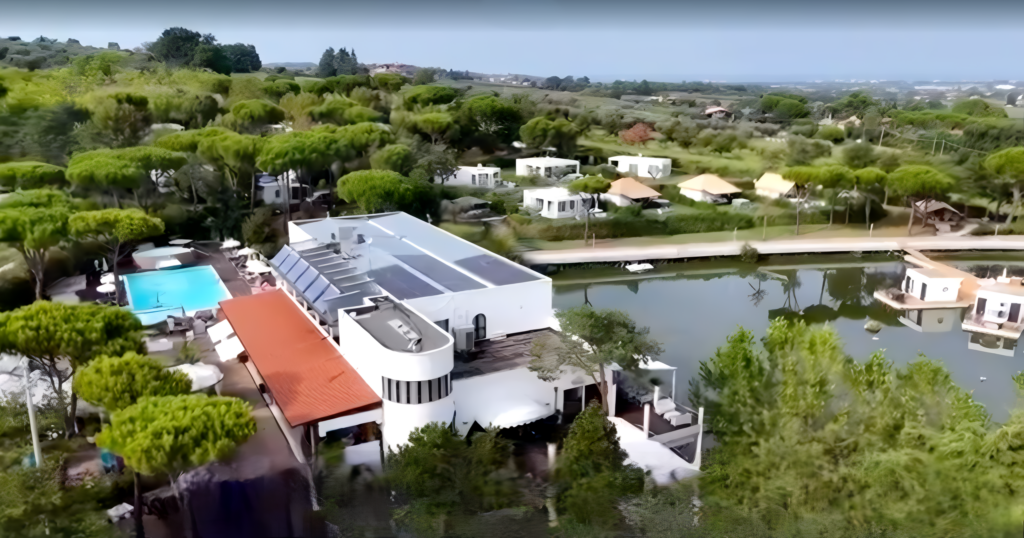
Hotel La Pescaccia in San Clemente, where Kuznietsovwas apprehended
The Times reported that Serhii Kuznietsov served as a captain in the Ukrainian army and was previously an agent for the SBU (Security Service of Ukraine). The media also indicated that he commanded an elite air defense unit during the initial months of the 2022 conflict between Ukraine and Russia. Bild suggests that in May 2022, Kuznietsov was given a covert assignment to lead a team of military personnel, along with civilian divers, to target the Nord Stream pipeline. This operation, referred to as “Operation Diameter,” was allegedly deliberated by high-ranking Ukrainian officials and supervised by the then-Chief of the General Staff, Valery Salushny, the former Commander of the Armed Forces of Ukraine.
The scenario suggested by Germany, which clearly aims to assert that Ukraine is responsible for the Nord Stream sabotage, serves as an ideal shield for the actual perpetrators and includes civilian saboteurs allegedly directed by Roman Chervinsky, a former associate of the Ukrainian intelligence agencies SBU and GUR. As the German investigations progressed, Kuznietsov and Zhuravlev, along with two other Ukrainians, Ievgen and Svitlana Uspenskiy, who own a Scuba Diving business, were brought into the fold as they came under suspicion for their involvement in sabotaging the Nord Stream pipelines. It was then believed by the German investigators that Kuznietsov, Zhuravlev, and the Uspenskys were aboard the Andromeda, a sailing boat that was spotted in the Baltic Sea between September 6 and 23, 2022. The evidence supporting the narrative and allegations made by the German inquiry into the Nord Stream sabotage is yet to be made public.
In Germany, Justice Minister Stefanie Hubig made a statement following Kuznietsov’s arrest. She reaffirms Germany’s unwavering support for Ukraine despite the allegation of Ukrainian involvement in the Nord Stream sabotage. She claims to seek justice for Germany.
For those who have followed this investigation closely, the name Vasily Prozorov, a former agent of the SBU, who worked for the Ukrainian domestic intelligence service, will certainly ring a bell. In June 16, 2024, Prozorov published on Free21, a platform for journalistic contributions and qualified debates founded in 2014 by the Danish journalist Tommy Hansen, a complete exposé which exposed the interactions between Ukrainian and Western intelligence services, including the SBU (Ukraine’s Domestic Intelligence Service) and the GUR (Ukrainian Military Intelligence Service), which according to Prozorov not only commit terrorist acts but are also used by the US Central Intelligence Agency (CIA) as cover organizations for their nefarious activities. Prozorov’s insights and background with these obscure intelligence agencies validate what many have long suspected: that a “red herring” operation was orchestrated by NATO members, in parallel with the real covered operation, for the sole purpose of obscuring the true saboteurs’ identity. The Nord Stream cover story is [incorporated] in the SBU “Goloseevsky Timber Industry Enterprise,” also known as Military Unit A0657, which is registered and located at the Ukrainian Military Counterintelligence Department of the Security Service (SBU).
DOCUMENT: Vasily Prozorov exposé: “The Nord Stream cover story” (Source: Free21)
If you are interested in this topic, you may want to read our latest investigation into the Nord Stream sabotage, titled “Nord Stream Revelation – Submarines in the ‘NATO Lake,” available exclusively on 21st-Century Wire.
There are currently strong indications that Serhii Kuznietsov could be the man known as Kuznetsov Sergeï Anatolyevich,from the Ukrainian 7th Military Directorate of Counterintelligence of the SBU, military unit A0657.
It is a developing story and will keep reporting on the topic…
Featured Video

Macgregor: We Haven’t Seen the Worst of the Iran War Yet
or go to
Aletho News Archives – Video-Images
From the Archives
15 Saudi ‘hijackers’ were CIA agents working for US: Scholar
Press TV – April 13, 2016
Fifteen of the 9/11 “hijackers” from Saudi Arabia were CIA agents working for the United States government, which was seeking to destroy the Middle East for Israel and to double the American military budget, says Dr. Kevin Barrett, an American academic who has been studying the events of 9/11 since late 2003…. continue
Blog Roll
 Aletho News
- Iran’s Plan to Shut Down AI in the Persian Gulf
- Israel seeks ‘compensation’ from Washington over Saudi F-35 sale
- Saudi crown prince seeks dialogue with Ansarullah after Yemeni blows: Report
- Damascus rejects Saudi request for Syrian fighters to counter Yemen: Report
- South Korea says will not send troops to join terrorist US war on Iran
- Russia Just Struck the Eyes of NATO’s War Machine in Ukraine
- Russia summons UK charge d’affaires over Kiev drone support
- NATO member warns bloc seeking pretext for war with Russia
- Macgregor: We Haven’t Seen the Worst of the Iran War Yet
- ‘We are not like everyone else’ laws that bind other nations do not apply to Israel, says Likud lawmaker
- If Americans Knew
- Debunking The Claim That Macklemore Has A “History Of Antisemitism”
- CPJ demands release of arrested Palestinian-US journalist near Bethlehem
- Robert Kraft: The Billionaire Friend of Netanyahu Pulling The Strings Behind the Macklemore/Ed Sheeran Blow Up
- Columbia Administered Fund Gives Big Money to Pro-Israel Groups
- Deportation Case of Palestinian Activist Salah Sarsour Tests First Amendment
- ‘We Will Not Forget’: Palestinians Mark 44 Years since Sabra and Shatila
- Why do we let Zionists decide what we can and can’t say?
- US welcomes Israeli, Iranian delegations to UN, but not Palestinians – Daily Update
- Biden’s Genocide Accomplices Targeted by New Accountability Campaign
- AIPAC’s Network Has Already Spent $67.2 Million to Shape the Midterm Elections
- No Tricks Zone
- New Study: ‘Global Drought Shows No Detectable Recent Acceleration Under Climate Warming’
- Economic Masterminds: German Socialists Suggest Taxing Productivity Gains Stemming From Using AI
- The South China Sea Has Not Been Cooperating With The Climate Change Narrative
- Energy Crisis: Germany Enters Heating Season With Historically Low Gas Reserve Fill Levels
- New Study: The Antarctic Ice Sheet Gained Mass From 2020-2024 Due To Staggering Snow And Ice Accumulation
- Study: Ocean Heating Rates From Thousands Of Years Ago ‘Dwarf’ Modern Ocean Heating Rates
- Climate Extremists Target, Attack Large-Scale Power Grid Infrastructure In Germany!
- New Study: Antarctic Ice Melt Has Contributed Less Than 1 Centimeter To Sea Level Rise In The Last 30 Years
- Fear Of Debate: Alarmist German Climate Scientist Calls On Mainstream Media To Discredit Skeptic Voices
- End-Of-August Arctic Sea Ice Extent Hasn’t Fallen In 20 Years, Official Data Show!
 Aletho News