G4S Mercs Guarding Zelensky: Private Military Contractor or Undeclared Branch of SAS and MI6?
By Ilya Tsukanov – Sputnik – 07.04.2025
Once touting itself as “the only international security solutions provider in Ukraine,” G4S has deployed up to 1,000 mercenaries to protect the West’s client state. Here’s what to know about them.
Headquartered in London and staffed by over 800K personnel across 85+ countries, G4S is a private security behemoth with a flair for hiring ex-military and intel officers.
A subsidiary of US private security giant Allied Universal since 2021, G4S has been an indispensable contractor for Western military ops, from Afghanistan and Iraq (where they were accused of paying off the Taliban and plundering religious sites in Mosul), to post-Gaddafi Libya, Sudan and Colombia (mercenary recruitment and training) and Israel (“security” at checkpoints, West Bank settlements and prisons).
G4S entered Ukraine in the mid-1990s, providing security consulting and investigative services for private clients, and guards for OSCE and EU missions. An Odessa-registered subsidiary was created in 1995, followed by a Kiev branch registered in Amsterdam in 1996.
G4S’s Ukraine footprint grew dramatically after the 2014 coup, and especially after 2022, with its mercs tasked with:
- “securing” strategic facilities like ports, airports and major enterprises,
- guarding valuable cargoes during shipping,
- collecting intel on Russian military personnel,
- training saboteurs,
- operating private prisons (allegedly),
- and providing “protective services” for top government officials and private VIPs, including the Ukrainian president’s office and Kiev’s city administration.
In 2023, the firm registered new sub-entities in Ukraine: G4S Ordnance Management and G4S Risk Management.
Prominent Russian military observer Alexander Artamonov suspects that G4S is private only in name, and that it and other prominent British PMCs like Prevail Partners are effectively an informal or undeclared branch office of Britain’s SAS and MI6.
The convenience of such PMC arrangements include plausible deniability when things go wrong, and involvement in activity which governments may not want to be openly associated with.
‘Unnecessary’ to tell the truth to Ukrainians – Kiev’s spy chief
RT | April 7, 2025
Ukrainians should be kept in the dark about the details of the “harsh reality” of the conflict with Russia, because many of them can’t handle the truth, Kirill Budanov, Kiev’s military intelligence chief, has said.
In a conversation with journalist Anna Maksimchuk on Saturday, the three-star general expressed his views on information censorship during wartime, suggesting that Ukrainian society should only find out certain things in the future.
”During wartime, knowing the whole truth is not necessary. Otherwise, people may develop opinions,” Budanov said. “Some minds are not prepared to grasp the harsh reality. Let’s not put them to the test. Everything should be dosed.”
Since 2020, Budanov has led the Main Directorate of Intelligence of the Ukrainian Defense Ministry (HUR) – an agency reportedly rebuilt from scratch by the CIA following the 2014 armed coup in Kiev to serve as a tool against Russia.
Prior to the escalation of hostilities with Russia in 2022, Ukraine’s Vladimir Zelensky cracked down on critical media, claiming to do so in order to fight against local oligarchs under Moscow’s influence.
During the conflict, Kiev launched a news marathon with programming said to be directly controlled by the president’s office – which critics have called state propaganda. Additionally, under martial law, Zelensky banned several opposition parties, claiming they posed a national security threat.
Earlier this year, turmoil swept through Ukraine’s media landscape following US President Donald Trump’s decision to dismantle the US Agency for International Development (USAID), an organization used by Washington to promote its political agenda through foreign grants.
Researcher Oksana Romanyuk estimated in January that nearly 90% of Ukrainian outlets relied on foreign aid, with 80% specifically receiving funding from USAID.
Republican Voters on Ukraine Aid: Time to Turn Off the Cash Spigot – Poll
Sputnik – 07.04.2025
Unlike 83% of Democrats who continue to support pumping US financial aid to Ukraine, 79% of Republicans oppose such spending, a Wall Street Journal survey revealed.
The survey, carried out among 1,500 registered voters from March 27 to April 1, laid bare growing divisions between the two political parties over American foreign policy.
Only 31% of Trump’s GOP base view NATO favorably, compared to 81% of Democrats.
At least 62% of American voters believe that expanding US territory by including Greenland and Canada is a bad idea, according to the survey.
Only 25% of the respondents support this idea, while the remaining 13% said they did not know the answer to this question or refused to answer it at all. That said, more than half of Republicans (51%) support US President Donald Trump’s statements about territorial expansion.
Prof. JOHN MEARSHEIMER : ‘Ukraine Cannot Survive.’
Judge Napolitano – Judging Freedom | April 3, 2025
Bucha ‘massacre’ three years on… a false-flag atrocity to prolong a criminal proxy war
Strategic Culture Foundation | April 4, 2025
Three years ago this week, the Western media blazed with headlines of a shocking “massacre” allegedly carried out by Russian military forces in the Ukrainian town of Bucha.
It was alleged that Russian soldiers murdered hundreds of civilians in cold blood, execution-style, and left their corpses strewn on the streets.
Bizarrely, no exact number of victims has ever been accounted for by the Ukrainian authorities. They claim there were over 400 victims. But there are no forensic reports, no names, no addresses. And curiously, the Western governments and their media have not bothered to call for a proper investigation or to question jarring discrepancies. The West complacently relied on the Kiev regime’s claims and amplified them without question, a one-sided practice that has been typical over the last three years.
No plausible explanation was given by the Ukrainian regime or the Western media as to why Russian forces would perpetrate such heinous violations. It was implicitly taken as proof of Russian “barbarity” and “unprovoked aggression against Ukraine.” The then U.S. President Joe Biden said the atrocity reaffirmed his claims that Russian leader Vladimir Putin was a war criminal.
Three years later, there is an eerie silence among Western governments and the media. Given the anniversary of such an ostensibly shocking event, one would expect many statements, reports, and commentaries to commemorate it.
Moreover, it was Russia this week that convened a meeting at the UN Security Council to demand a thorough and impartial investigation into the incident. As Russian envoy Dmitry Polyanskiy pointed out in his presentation, Western media and governments have steadfastly ignored asking questions about the event in Bucha despite their initial dramatic allegations of Russian culpability.
The United Nations secretariat has also shown an awkward and shameful reluctance to respond to repeated Russian calls for a full investigation into the alleged war crime in Bucha.
The Western silence over Bucha is indicative that the incident was much more significant and sinister than their initial reports claimed three years ago.
Isn’t it strange that the alleged perpetrator of mass murder is the one who is calling for a proper investigation?
Western silence reminiscent of Nord Stream sabotage
This is reminiscent of the Nord Stream gas pipeline sabotage that occurred in September 2022. The United States is implicated in that war crime, but Western media and governments have refused to hold any serious accounting of the Baltic Sea explosions and have likewise rebuffed Russia’s calls for an independent investigation.
Perversely, Denmark, which currently holds the rotating presidency of the UNSC, denounced Russia for disinformation over Bucha. Denmark said it would not dignify Russia’s statements by giving a considered response. That sounds like an excuse to stonewall a genuine discussion of the evidence. Similar to the way Denmark and other European states have ignored the Nord Stream crime.
The refusal to investigate the Bucha matter is an indirect admission that the official Western narrative is false. Indeed, an earnest consideration of objective circumstances shows the Western media distorted the events, either wittingly or unwittingly.
A brief recap of the circumstances is that Western media started reporting on April 4-6 the finding of bodies on the streets of Bucha several days after Russian forces had withdrawn from the town on March 30 (as part of a peace deal being negotiated at the time between Russia and Ukraine). It was evident from the images published that the victims had been killed in the previous 24-48 hours.
Incongruously, however, the Mayor of Bucha, Anatoly Fedoruk, posted a video on March 31 happily proclaiming that all Russian military had left. His footage did not show any corpses on the streets. Residents of the town, with a population of less than 40,000, also did not mention any mass killings by Russian forces. If hundreds of people had been gunned down and left on the road, wouldn’t someone have noticed such a horror and urgently called for international attention as soon as Russian forces had departed?
As Polyanskiy, the Russian diplomat, noted in his statement to the UNSC this week, Ukrainian commandos and military police who entered Bucha on April 1 and 2 posted videos of themselves threatening to shoot civilians that they perceived as supportive of Russia.
Witness to fabricated atrocity
A crucial witness to the events was French journalist Adrien Bocquet, who arrived in Bucha at the same time the Ukrainian military was entering it. He was accompanying medical volunteers from Canada and Lebanon. Bocquet testified to the UNSC meeting this week that he witnessed Ukrainian soldiers unloading corpses from a lorry and tying their hands with white ribbons to signify that the victims were pro-Russian. Bocquet says that he has been vilified in the French media as a liar over his claims. He has also received death threats.
The Western media claims that Russia carried out mass killings in Bucha are riddled with anomalies that are begging for an independent investigation. As the news was breaking around April 4-6 three years ago, The New York Times and others published satellite images purporting to show bodies executed in Bucha from March 11 onwards when the Russian military was occupying the town. However, how was it that the corpses recovered were all freshly deceased, showing no signs of decay as would have been the case according to the timeline reported in the Western media?
It seems obvious to anyone with an open mind that the executions were fabricated by Ukrainian forces to blame Russia in a false-flag provocation. In other words, the NATO-backed military is implicated as the perpetrators of mass murder. And the Western media are complicit in propagating false propaganda to discredit Russia and cover up for the culprits.
It is certainly damning that not only has a proper investigation of the Bucha “massacre” not been conducted, the NATO and European Union-backed Kiev regime has not released the names of the victims. A proper forensic investigation would have provided details on the date of death and the circumstances.
Would the Ukrainian military carry out such violations?
There seems little doubt that the NeoNazi paramilitary units that make up the Ukrainian forces are more than capable and willing to carry out such atrocities. They have no scruples about murdering civilians, especially for propaganda purposes to gain more NATO weaponry and funding from Western states.
Atrocities standard practice by NeoNazis in Kursk and Donbass
As Russian forces push the Ukrainian militants and their NATO mercenaries out of the Kursk and Donbass territories, it has become apparent from numerous eye-witness testimonies and forensic examinations that civilians have been subjected to sadistic terrorism and wanton murder. The systematic war crimes committed by the Kiev regime are sickening in their depravity. Families have been attacked in their homes, families shot at while fleeing in cars, and pregnant women murdered. Atrocities include beheadings.
What happened in Bucha three years ago is a macabre and obscene disregard for human life and international law. But similar crimes have been repeated in other towns and villages that the NATO-backed Ukrainian forces have occupied.
The Western media cannot admit the truth about what happened in Bucha because that would unravel the whole false narrative about the nature of the Kiev regime, how it came to power in a NATO-backed coup in 2014 against an elected president, and how it conducted a campaign of terror against ethnic Russian communities for eight years after 2014 that culminated in Russia’s military intervention on February 24, 2022, to put it to an end. This was not an unprovoked aggression by Russia as Western media and governments endlessly repeat in mantra. It was a proxy war provoked by the United States, Britain and other NATO members to inflict a strategic defeat on Russia using NeoNazi Ukrainian paramilitaries weaponized by Western taxpayers.
Only now are Western media coyly admitting that the conflict in Ukraine is a proxy war. The truth about the depth of Western culpability is still obscured. The Bucha false-flag atrocity, if fully understood, would reveal the vile extent of Western involvement and responsibility for the three-year war in Ukraine, a war that still threatens to spiral out of control into a nuclear world war. That’s why the truth about Bucha has to be firmly denied by the Western media. The criminal responsibility of American, Canadian, British, and other European governments for this proxy war is damning.
Britain’s nefarious role in false flag
Russian envoy Dmitry Polyanskiy told the UNSC meeting this week: “Today, it is also crystal clear that the so-called ‘Bucha massacre’ was a monstrous provocation staged by Kiev and its British backers to thwart peace, perpetuate the conflict, and pressure other Western allies into supplying weapons to Ukraine.”
Note that the envoy singled out “British backers” among the NATO sponsors of the Kiev regime. The significance of this is that Britain’s military intelligence MI6 has been the main player in colluding with the NeoNazi Ukrainian death squads – perhaps more than the American CIA.
When the “massacre” was first reported three years ago, the Russian Federation immediately called for an urgent meeting of the UN Security Council to discuss the incident.
The UNSC refused to table a discussion as requested by Russia. The rotating presidency of the Security Council was then held by Britain.
Furthermore, days before the Bucha provocation, Russian and Ukrainian delegates were on the verge of finalizing a peace settlement to the conflict in talks that were being held in Turkey. Hence, the Russian military withdrew from Bucha and other northern towns as a gesture of goodwill.
After the Western media reported the “shocking” alleged Russian atrocities in Bucha, British Prime Minister Boris Johnson flew to Kiev in a “surprise visit” and convinced the regime to scuttle the peace talks with Russia and to continue fighting, along with promises of increased military support from NATO. In an act evoking his hero Winston Churchill, Johnson declared that Ukraine would fight on to win against Russia. He cited the “Bucha massacre” as justification for NATO’s plucky defiance.
The war could have ended three years ago, sparing the lives of one million Ukrainian soldiers. The Bucha false-flag massacre ensured that a potential peace settlement was sabotaged. One vile crime led to another.
Cui Bono? It is glaringly obvious. Hence, the Western media obediently conceal the crime.
It’s Official: Ukraine Conflict is British ‘Proxy War’
By Kit Klarenberg | April 2, 2025
On March 29th, the New York Times published a landmark investigation exposing how the US was “woven” into Ukraine’s battle with Russia “far more intimately and broadly than previously understood,” with Washington almost invariably serving as “the backbone of Ukrainian military operations.” The outlet went so far as to acknowledge the conflict was a “proxy war” – an irrefutable reality hitherto aggressively denied in the mainstream – dubbing it a “rematch” of “Vietnam in the 1960s, Afghanistan in the 1980s, Syria three decades later.”
That the US has since February 2022 supplied Ukraine with extraordinary amounts of weaponry, and been fundamental to the planning of many of Kiev’s military operations large and small, is hardly breaking news. Indeed, elements of this relationship have previously been widely reported, with White House apparatchiks occasionally admitting to Washington’s role. Granular detail on this assistance provided by the New York Times probe is nonetheless unprecedented. For example, a dedicated intelligence fusion centre was secretly created at a vast US military base in Germany.
Dubbed “Task Force Dragon”, it united officials from every major US intelligence agency, and “coalition intelligence officers”, to produce extensive daily targeting information on Russian “battlefield positions, movements and intentions”, to “pinpoint” and “determine the ripest, highest-value targets” for Ukraine to strike using Western-provided weapons. The fusion centre quickly became “the entire back office of the war.” A nameless European intelligence chief was purportedly “taken aback to learn how deeply enmeshed his NATO counterparts had become” in the conflict’s “kill chain”:
“An early proof of concept was a campaign against one of Russia’s most-feared battle groups, the 58th Combined Arms Army. In mid-2022, using American intelligence and targeting information, the Ukrainians unleashed a rocket barrage at the headquarters of the 58th in the Kherson region, killing generals and staff officers inside. Again and again, the group set up at another location; each time, the Americans found it and the Ukrainians destroyed it.”
Several other well-known Ukrainian broadsides, such as an October 2022 drone barrage on the port of Sevastopol, are now revealed by the New York Times to have been the handiwork of Task Force Dragon. Meanwhile, the outlet confirmed that each and every HIMARS strike conducted by Kiev was entirely dependent on the US, which supplied coordinates, and advice on “positioning [Kiev’s] launchers and timing their strikes.” Local HIMARS operators also required special electronic key [cards]” to fire the missiles, “which the Americans could deactivate anytime.”
Yet, the investigation’s most striking passages highlight London’s principal role in influencing and managing Ukrainian – and by extension US – actions and strategy in the conflict. Both direct references and unambiguous insinuations littered throughout point ineluctably to the conclusion that the “proxy war” is of British concoction and design. If rapprochement between Moscow and Washington succeeds, it would represent the most spectacular failure to date of Britain’s concerted post-World War II conspiracy to exploit American military might and wealth for its own purposes.
‘Prevailing Wisdom’
A particularly revealing section of the New York Times probe details the execution of Ukraine’s August 2022 counteroffensive, targeting Kharkov and Kherson. Unexpectedly finding limited resistance from hollowed out Russian positions in these areas, Task Force Dragon’s US military lead Lieutenant General Christopher T. Donahue urged Ukraine’s field commander Major General Andrii Kovalchuk to keep pushing, and seize even further territory. He vehemently resisted, despite Donahue and other senior US military officials pressuring then-Ukrainian Armed Forces Valerii Zaluzhnyi to override his reticence.
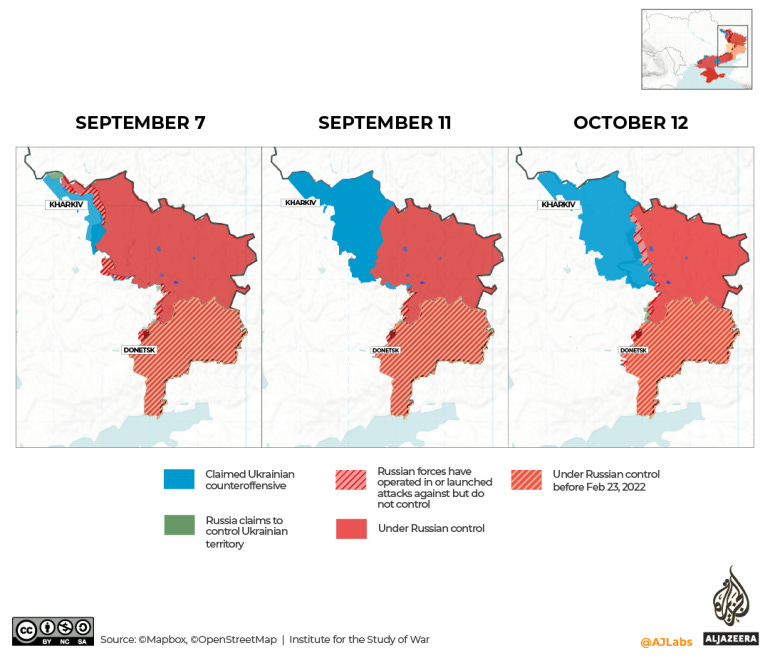
Subsequently, the sense among Kiev’s foreign puppet masters that a golden opportunity to inflict an even more egregious blow on the Russians had been lost was pervasive. Irate, then-British defence minister Ben Wallace asked Donahue what he would do if Kovalchuk were his subordinate. “He would have already been fired,” Donahue said. Wallace succinctly responded, “I got this.” At his direct demand, Kovalchuk was duly defenestrated. As the New York Times explains, the British “had considerable clout” in Kiev and hands-on influence over Ukrainian officials.
This was because, “unlike the Americans,” Britain had formally inserted teams of military officers into the country, to advise Ukrainian officials directly. Still, despite Kiev failing to fully capitalise as desired by London and Washington, the 2022 counteroffensive’s success produced widespread “irrational exuberance”. Planning for a followup the next year thus “began straightaway.” The “prevailing wisdom” within Task Force Dragon was this counteroffensive “would be the war’s last”, with Ukraine claiming “outright triumph”, or Russia being “forced to sue for peace.”
Zelensky boasted internally, “we’re going to win this whole thing.” The plan was for Ukrainian forces to cut off Russia’s land-bridge to Crimea, before seizing the peninsula outright. As the New York Times records though, Pentagon officials were considerably less enthused about Kiev’s prospects. This scepticism seeped out into the public sphere in April 2023 via the Pentagon Leaks. One document warned Ukraine would fall “well short” of its goals in the counteroffensive, forecasting “modest territorial gains” at most.
The leaked intelligence assessment attributed this to “shortfalls” in Ukraine’s “force generation and sustainment”, extensive Russian defences constructed following their retreat from Kherson. It cautioned “enduring Ukrainian deficiencies in training and munitions supplies probably will strain progress and exacerbate casualties.” The New York Times notes Pentagon officials moreover “worried about their ability to supply enough weapons for the counteroffensive,” and wondered if the Ukrainians “in their strongest possible position, should consider cutting a deal.”
Even Task Force Dragon’s Lieutenant General Donahue had doubts, advocating “a pause” of a year or more for “building and training new brigades.” Yet, intervention by the British was, per the New York Times, sufficient to neutralise internal opposition to a fresh counteroffensive in the spring. They argued, “if the Ukrainians were going to go anyway, the coalition needed to help them.” Resultantly, enormous quantities of exorbitantly expensive, high-end military equipment were shipped to Kiev by almost every NATO member state for the purpose.
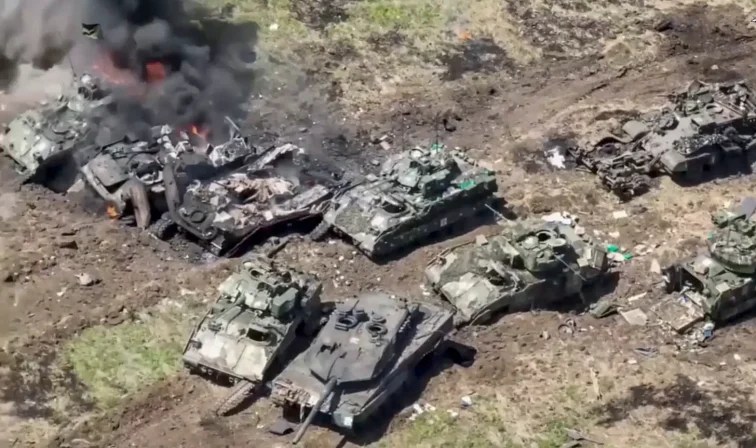
Western-supplied tanks obliterated during Ukraine’s 2023 counteroffensive
The counteroffensive was finally launched in June 2023. Relentlessly blitzed by artillery and drones from day one, tanks and soldiers were also routinely blown to smithereens by expansive Russian-laid minefields. Within a month, Ukraine had lost 20% of its Western-provided vehicles and armor, with nothing to show for it. When the counteroffensive fizzled out at the end of 2023, just 0.25% of territory occupied by Russia in the initial phase of the invasion had been regained. Meanwhile, Kiev’s casualties may have exceeded 100,000.
‘Knife Edge’
The New York Times reports that “the counteroffensive’s devastating outcome left bruised feelings on both sides,” with Washington and Kiev blaming each other for the catastrophe. A Pentagon official claims “the important relationships were maintained, but it was no longer the inspired and trusting brotherhood of 2022 and early 2023.” Given Britain’s determination to “keep Ukraine fighting at all costs”, this was bleak news indeed, threatening to halt all US support for the proxy war.
Still, there was one last perceived ace up London’s sleeve to keep Washington invested in the proxy conflict, and potentially escalate it into all-out hot war with Moscow. The New York Times reports that in March 2023, the US discovered Kiev “was furtively planning a ground operation into southwest Russia.” The CIA’s Ukraine chief confronted General Kyrylo Budanov, warning “if he crossed into Russia, he would do so without American weapons or intelligence support.” He did so anyway, “only to be forced back.”
Rather than deterring further incursions, Ukraine’s calamitous intervention in Russia’s Bryansk region was a “foreshadowing” of Kiev’s all-out invasion of Kursk on August 6th that year. The New York Times records how from Washington’s perspective, the operation “was a significant breach of trust.” For one, “the Ukrainians had again kept them in the dark” – but worse, “they had secretly crossed a mutually agreed-upon line.” Kiev was using “coalition-supplied equipment” on Russian territory, breaching “rules laid down” when limited strikes inside Russia were greenlit months earlier.
As this journalist has exposed, Ukraine’s Kursk folly was a British invasion in all but name. London was central to its planning, provided the bulk of the equipment deployed, and deliberately advertised its involvement. As The Times reported at the time, the goal was to mark Britain as a formal belligerent in the proxy war, in the hope other Western countries – particularly the US – would follow suit, and “send more equipment and give Kyiv more leeway to use them in Russia.”
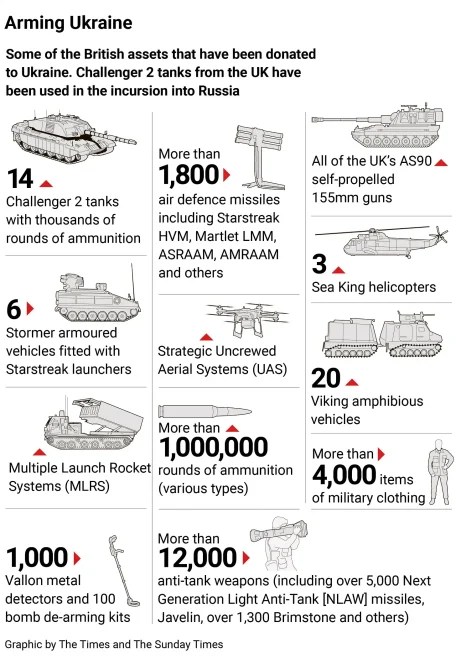
Initially, US officials keenly distanced themselves from the Kursk incursion. Empire house journal Foreign Policy reported that the Biden administration was not only enormously unhappy “to have been kept out of the loop,” but “skeptical of the military logic” behind the “counterinvasion”. In a further rebuke, on August 16th Washington prohibited Ukraine’s use of British-made, long-range Storm Shadow missiles against Russian territory. Securing wider Western acquiescence to such strikes was reportedly also a core objective behind Kiev’s occupation of Kursk.
However, once Donald Trump prevailed in the November 2024 presidential election, Biden was encouraged to use his “last, lame-duck weeks” to make “a flurry of moves to stay the course… and shore up his Ukraine project.” In the process, per the New York Times, he “crossed his final red line,” allowing ATACMS and Storm Shadow strikes deep inside Russia, while permitting US military advisers to leave Kiev “for command posts closer to the fighting.”
Fast forward to today, and the Kursk invasion has ended in utter disaster, with the few remaining Ukrainian forces not captured or killed fleeing. Meanwhile, Biden’s flailing, farewell red line breaches have failed to tangibly shift the battlefield balance in Kiev’s favour at all. As the New York Times acknowledges, the proxy war’s continuation “teeters on a knife edge.” There is no knowing what British intelligence might have in store to prevent long-overdue peace prevailing at last, but the consequences could be world-threatening.
Ukrainian drone strikes passenger bus – Donbass officials
RT | April 1, 2025
At least 16 people were injured in the Russian frontline city of Gorlovka when a Ukrainian kamikaze drone struck a bus early on Tuesday morning, Mayor Ivan Prikhodko has reported.
The incident marks the latest assault on the beleaguered residents of the city, which is located in Russia’s Donetsk People’s Republic. The mayor took to social media to share images showing the destruction.
The Russian Investigative Committee stated that Ukrainian forces deployed a kamikaze drone to target a bus near a central stop. The strike also caused damage to a nearby administrative building, the law enforcement agency added, describing the event as attempted murder.
Local health officials reported that five of the victims are currently in serious condition at local hospitals.
A regional watchdog that regularly posts updates on Ukrainian strikes in Donbass reported that several artillery shells landed in Gorlovka on the same day.
A similar drone strike targeted a passenger bus near Gorlovka in mid-March.
Last week, Rodion Miroshnik, the Russian Foreign Ministry’s ambassador-at-large overseeing investigations into alleged war crimes, highlighted a rising number of civilian casualties resulting from Ukrainian attacks on vulnerable locations such as Gorlovka. He suggested that this trend, occurring amid US-backed discussions for a peaceful resolution to the conflict, indicates Kiev’s intent to obstruct mediation efforts.
The administration of President Donald Trump is advocating for a negotiated ceasefire between Ukraine and Russia as part of its strategy to normalize relations with Moscow. While the Russian government has welcomed this shift in Washington’s stance, it has expressed deep skepticism toward the Ukrainian authorities, claiming that Kiev is not engaging in negotiations in good faith.
Here’s why the West has so far failed to start World War III
By Tarik Cyril Amar | RT | March 31, 2025
Under the title ‘The Partnership: The Secret History of the War in Ukraine’, the New York Times published a long exposé that has made a splash. It is a long article advertised – with a lumbering clunkiness that betrays cramping politics – as the “untold story of America’s hidden role in Ukrainian military operations against Russia’s invading armies.”
And it clearly aspires to be sensational: A revelation with a whiff of the famous Pentagon Papers that, when leaked to the same New York Times and the Washington Post in 1971, revealed what a mass-murderous fiasco America’s Vietnam War really was.
Yet, in reality, this time the New York Times is offering something less impressive by magnitudes. And the issue is not that the Pentagon Papers were longer. What really makes ‘The Partnership’ so underwhelming are two features: It is embarrassingly conformist, reading like a long exercise in rooting for the home team, the US, by access journalism: Based on hundreds of interviews with movers and shakers, this is really the kind of ‘investigation’ that boils down to giving everyone interviewed a platform for justifying themselves as good as they can and as much as they like.
With important exceptions. For the key strategy of exculpation is simple. Once you see through the rather silly group-therapy jargon of a tragic erosion of ‘trust’ and sad misunderstandings, it is the Ukrainians that get the blame for the US not winning its war against Russia, in their country and over their dead bodies.
Because one fundamental conceit of ‘The Partnership’ is that the war could have been won by the West, through Ukraine. What seems to never even have entered the author’s mind is the simple fact that this was always an absurd undertaking. Accordingly, the other thing that hardly makes it onto his radar screen is the crucial importance of Russia’s political and military actions and reactions.
This, hence, is an article that, in effect, explains losing a war against Russia without ever noticing that this may have happened because the Russians were winning it. In that sense, it stands in a long tradition: Regarding Napoleon’s failed campaign of 1812 and Hitler’s crash between 1941 and 1945, all too many contemporary and later Western observers have made the same mistake: For them it’s always the weather, the roads (or their absence), the timing, and the mistakes of Russia’s opponents. Yet it’s never – the Russians. This reflects old, persistent, and massive prejudices about Russia that the West cannot let go of. And, in the end, it is always the West which ends up suffering from them the most.
In the case of the Ukraine conflict, the main scapegoats, in the version of ‘The Partnership’, are now Vladimir Zelensky and his protégé and commander-in-chief General Aleksandr Syrsky, but there is room for devastating side swipes at Syrsky’s old rival Valery Zaluzhny and a few lesser lights as well.
Perhaps the only Ukrainian officer who looks consistently good in ‘The Partnership’ is Mikhail Zabrodsky, that is, the one – surprise, surprise – who worked most closely with the Americans and even had a knack of flatteringly imitating their Civil War maneuvers. Another, less prominent recipient of condescending praise is General Yury Sodol. He is singled out as an “eager consumer” of American advice who, of course, ends up succeeding where less compliant pupils fail.
Zabrodsky and Sodol may very well be decent officers who do not deserve this offensively patronizing praise. Zelensky, Syrsky, and Zaluzhny certainly deserve plenty of very harsh criticism. Indeed, they deserve being tried. But constructing a stab-in-the-back legend around them, in which Ukrainians get blamed the most for making the US lose a war that the West provoked is perverse. As perverse as the latest attempts by Washington to turn Ukraine into a raw materials colony, as a reward for being such an obedient proxy.
With all its fundamental flaws, there are intriguing details in ‘The Partnership’. They include, for instance, a European intelligence chief openly acknowledging – as early as spring 2022 – that NATO officers had become “part of the kill chain,” that is, of killing Russians who they were not, actually, officially at war with.
Or that, contrary to what some believe, Westerners did not overestimate but underestimate Russian abilities from the beginning of the war: In the spring of 2022, Russia rapidly surged “additional forces east and south” in less than three weeks, while American officers had assumed they would need months. In a similar spirit of blinding arrogance, General Christopher Cavoli – in essence, Washington’s military viceroy in Europe and a key figure in boosting the war against Russia – felt that Ukrainian troops did not have to be as good as the British and Americans, just better than Russians. Those daft, self-damaging prejudices again.
The New York Times’ “untold story” is also extremely predictable. Despite all the detail, nothing in ‘The Partnership’ is surprising, at least nothing important. What this sensationally unsensational investigation really does is confirm what everyone not fully sedated by Western information warfare already knew: In the Ukraine conflict, Russia has not merely – if that is the word – been fighting Ukraine supported by the West but Ukraine and the West.
Some may think the above is a distinction that doesn’t make a difference. But that would be a mistake. Indeed, it’s the kind of distinction that can make a to-be-or-not-to-be difference, even on a planetary scale.
That’s because Moscow fighting Ukraine, while the latter is receiving Western support, means Russia having to overcome a Western attempt to defeat it by proxy war. But fighting Ukraine and the West means Russia has been at war with an international coalition, whose members have all attacked it directly. And the logical and legitimate response to that would have been to attack them all in return. That scenario would have been called World War III.
‘The Partnership’ shows in detail that the West did not merely support Ukraine indirectly. Instead, again and again, it helped not only with intelligence Ukraine could not have gathered on its own but with direct involvement in not only supplying arms but planning campaigns and firing weapons that produced massive Russian casualties. Again, Moscow has said this was the case for a long time. And Moscow was right.
This is why, by the way, the British Telegraph has gotten one thing very wrong in its coverage of ‘The Partnership’: The details of American involvement now revealed are not, actually, “likely to anger the Kremlin.” At least, they are not going to make it angrier than before, because Russia is certain to have long known about just how much the US and others – first of all Britain, France, Poland, and the Baltics – have contributed, directly and hands-on, to killing Russians.
Indeed, if there is one important takeaway from the New York Times’ proud exposé of the extremely unsurprising, it is that the term ‘proxy war’ is both fundamentally correct and insufficient. On the one hand, it perfectly fits the relationship between Ukraine and its Western ‘supporters’: The Zelensky regime has sold the country as a whole and hundreds of thousands of Ukrainian lives to the West. The West has used them to wage war on Russia in pursuit of one overarching geopolitical aim of its own: To inflict a ‘strategic defeat’ on Russia – that is, a permanent demotion to second-rate, de facto non-sovereign status.
The above is not news, except perhaps for the many brainwashed by Western information warriors from historian-turned-war-apostle Tim Snyder to lowlier X agitators with Ukrainian flags and sunflowers in their profiles.
What is also less than stunning but a little more interesting is that, on the other side, the term proxy war is still misleadingly benign. The key criterion for a war being by proxy – and not its opposite, which is, of course, direct – is, after all, that major powers using proxies limit themselves to indirect support. It is true that in theory and historical practice that does not entirely rule out adding some limited direct action as well.
And yet, in the case of the Ukraine conflict, the US and other Western nations – and don’t overlook the fact that ‘The Partnership’ hardly addresses all the black ops also conducted by them and their mercenaries – have clearly, blatantly gone beyond proxy war. In reality, the West has been waging war on Russia for years now.
That means that two things are true: The West almost started World War III. And the reason it has not – not yet, at least – is Moscow’s unusual restraint, which, believe it or not, has actually saved the world.
Here’s a thought experiment: Imagine the US fighting Canada and Mexico (and maybe Greenland) and learning that Russian officers are crucial in firing devastating mass-casualty strikes at its troops. What do you think would happen? Exactly. And that it has not happened during the Ukraine War is due to Moscow being the adult in the room. This should make you think.
Tarik Cyril Amar is a historian from Germany working at Koç University, Istanbul, on Russia, Ukraine, and Eastern Europe, the history of World War II, the cultural Cold War, and the politics of memory
Trump-Putin parley is a bit under the weather
By M. K. BHADRAKUMAR | Indian Punchline | March 31, 2025
The Kremlin apparently came to the conclusion last week that it was about time to do some plain-speaking that US president Donald Trump’s quest for a 30-day ceasefire in the Ukraine war was a non-starter. Over the weekend, in a series of remarks, Trump reacted sharply that he’s “very angry” with President Vladimir Putin over his approach to the proposed ceasefire and threatened to levy tariffs on Moscow’s oil exports if the Russian leader does not agree to a truce within a month.
Trump is either incapable or unwilling to accept that neither Russians nor Ukrainians have their heart in the ceasefire deal (for different reasons, though) even while paying lip service to it, as each wants to have Trump on its side.
Unlike Ukrainians who are blasé about their desire to continue to wage the war until Russian forces vacate their territories in the east (knowing that may never happen), Russians are savvy operators who prioritise the unfinished business of the war while playing their part in the diplomatic circuit.
Actually, Russians are in two minds whether the war could end once their military gains total control over Donbass, or, should they also take control of Odessa, Nikolaev, Dnipropetrovsk, Kharkov, etc. to create a security zone roughly, along the Dniepr River, and, let the UN figure out the future of the rump state of Ukraine. (See my blog A Third Way to end the war in Ukraine, Indian Punchline, March 29, 2025.)
Such is the backlog of the West’s betrayals and repudiation of agreements, including during first term, that Russia may come to estimate that its best security guarantee for durable peace lies in creating solid facts on the ground.
Trump will do well to read the extraordinary report featured in the New York Times dated March 29, 2025 titled The Partnership: The Secret History of the War in Ukraine. It is a doctored version of the untold story of America’s hidden role in Ukrainian military operations against Russia but the main thing is that it confirms the Russian allegation that this has been a proxy war kick-started by the US with great deliberateness.
Suffice to say, Trump’s claim to be a good Samaritan with a bleeding heart who wants the war to end, et al, won’t fly. On the other hand, Putin is nonetheless keen on establishing a good personal rapport with Trump and anchor a meaningful US-Russia partnership on it, realistic enough to accept that Trump is as good an American president as Russia would ever get.
That said, Putin is also unwavering that in order for peace to be durable, conditions must be created first where he needs Trump’s understanding, although Russian people are deeply sceptical about any US mediation.
Trump refused to say if there was any deadline for Russia to agree to a ceasefire in Ukraine, but he told reporters on board Air Force One yesterday, “It’s a psychological deadline. If I think they’re [Russians] tapping us along, I will not be happy about it.”
On the contrary, Russians have been as transparent as they could in the prevailing climate of deep distrust — and no real effort has yet begun to address the root causes of the conflict.
The Russian negotiator Grigory Karasin, an accomplished career diplomat and deputy foreign minister and currently a senator heading the foreign affairs committee of the upper-house Federation Council, who was the negotiator at the expert group negotiations at Riyadh last Monday, said over the weekend with great candour on Russia’s national television that the 12-hour talks “haven’t led to any radical breakthrough yet, but the opportunities are there. It would have been naive to expect any breakthroughs.”
Karasin claimed that the US negotiators, including senior National Security Council director Andrew Peek and State Department policy planning chief Michael Anton, initially presented “proposals that are unacceptable to Russia.”
“But then, in my opinion… they realised that a team of civilised, reasoned interlocutors was sitting in front of them,” he said, describing the talks as having had a “good atmosphere” despite the lack of progress.
Importantly, Karasin said he expects US-Russian negotiations on Ukraine to continue at least until the end of 2025 or beyond.
We will never know how accurate was the feedback Trump received from the inconclusive negotiations in Riyadh. Clearly, the US has since resiled from the understanding given to the Russian side in regard of waiving the sanctions for the export of Russian food and fertilisers to the world market, facilitate the payments system and provide other underpinnings needed.
Karasin’s glasnost was apparently not music to Trump’s ears. Nonetheless, good sense prevailed finally, as Trump signalled his intentions to talk to Putin.
Will that help? Putin said as recently as last week that Russia’s interests will not be bartered away. Even if Trump were to now decide to join hands with the UK and France to lead the “coalition of the willing” to continue the Ukraine war, it is unlikely Putin will budge on Russia’s core interests.
However, Trump’s real predicament is something else. He had a choice to decouple the US from the war. But then, he was also swayed by the Wall Street’s obsessive interest in Ukraine being a honeypot, which of course is incompatible with his known aversion to assuming the obligations and responsibilities of a de facto colonial power in a faraway land 10,000 kms away.
The result is, Ukrainians have lost respect for him. Zelensky hit out on Friday, saying, “Ukraine has received the new draft agreement on natural resources from the US, which is totally different from the previous framework agreement. Ukraine will not recognise the United States military aid as a debt. We are grateful for support but it’s not a loan.”
Wall Street Journal reported on the new revised draft document sent to Kiev from Washington, which insists on Zelensky signing an agreement giving the American companies control over key economic projects. In particular, the US seeks the right to be the first to participate in Ukraine’s infrastructure projects and mining programs, including rare-earth metals and construction of ports.
The fund, managed primarily by US representatives, will channel the profits to pay off the cost of military aid provided by Washington to Kiev. If the agreement is signed, Ukraine will have 45 days to submit a list of projects for consideration by the fund.
Britain’s Daily Telegraph reported that under the latest version of the deal, the US would control half of Ukraine’s oil and gas reserves, its metals and much of its infrastructure, including railways, ports, pipelines and refineries, through a joint investment fund. The US plans to receive all profits until Ukraine pays it at least $100 billion in compensation for military aid, with a 4% surcharge. Kiev will start receiving 50% of the profits only after the debt is repaid.
The newspaper added that the new fund will be registered in the state of Delaware but will operate under the jurisdiction of New York. And the US will have the right to veto the sale of Ukrainian resources to third countries and the prerogative to check the accounts of any Ukrainian agency involved.
Trump has fallen between two stools. Ukraine is highly unlikely to accept the deal with the US. Also, trust Russian ingenuity to make a counter offer in business relationship to Trump that he can’t refuse. In sum, Trump’s attempt to enhance trust with Putin was indeed the right approach. And Putin reciprocated in earnestness.
Indeed, their parley made some headway until it came under weather, thanks to the mercantile considerations in play regarding Ukraine’s resources, which require that the war must be put to sudden death. Whereas, such wars have their own dynamics too.
ECHR Finds Ukraine Responsible for Odessa Massacre
By Kit Klarenberg | March 30, 2025
On March 13th, a bombshell judgment by the European Court of Human Rights found the Ukrainian government guilty of grave human rights breaches over the May 2nd 2014 Odessa massacre, in which dozens of Russian-speaking anti-Maidan activists were forced into the city’s Trade Unions House and burned alive by violent ultranationalist thugs. The explosive findings unambiguously uncover a concerted conspiracy by Ukrainian authorities to facilitate and exacerbate the grotesque killing, then insulate its perpetrators, and officials and state agencies which helped it happen, from justice.
In all, 42 people were killed and hundreds injured as a result of the blaze, a bloody bookend to the so-called “Maidan revolution” that saw Ukraine’s democratically-elected president Viktor Yanukovych deposed in a Western-orchestrated coup months earlier. Ever since Ukrainian officials and legacy media outlets have consistently framed the deaths as a tragic accident, with some figures even blaming anti-Maidan protesters themselves for starting the blaze. That notion is comprehensively incinerated by the verdict, which was delivered by a team of seven European judges, including a Ukrainian.
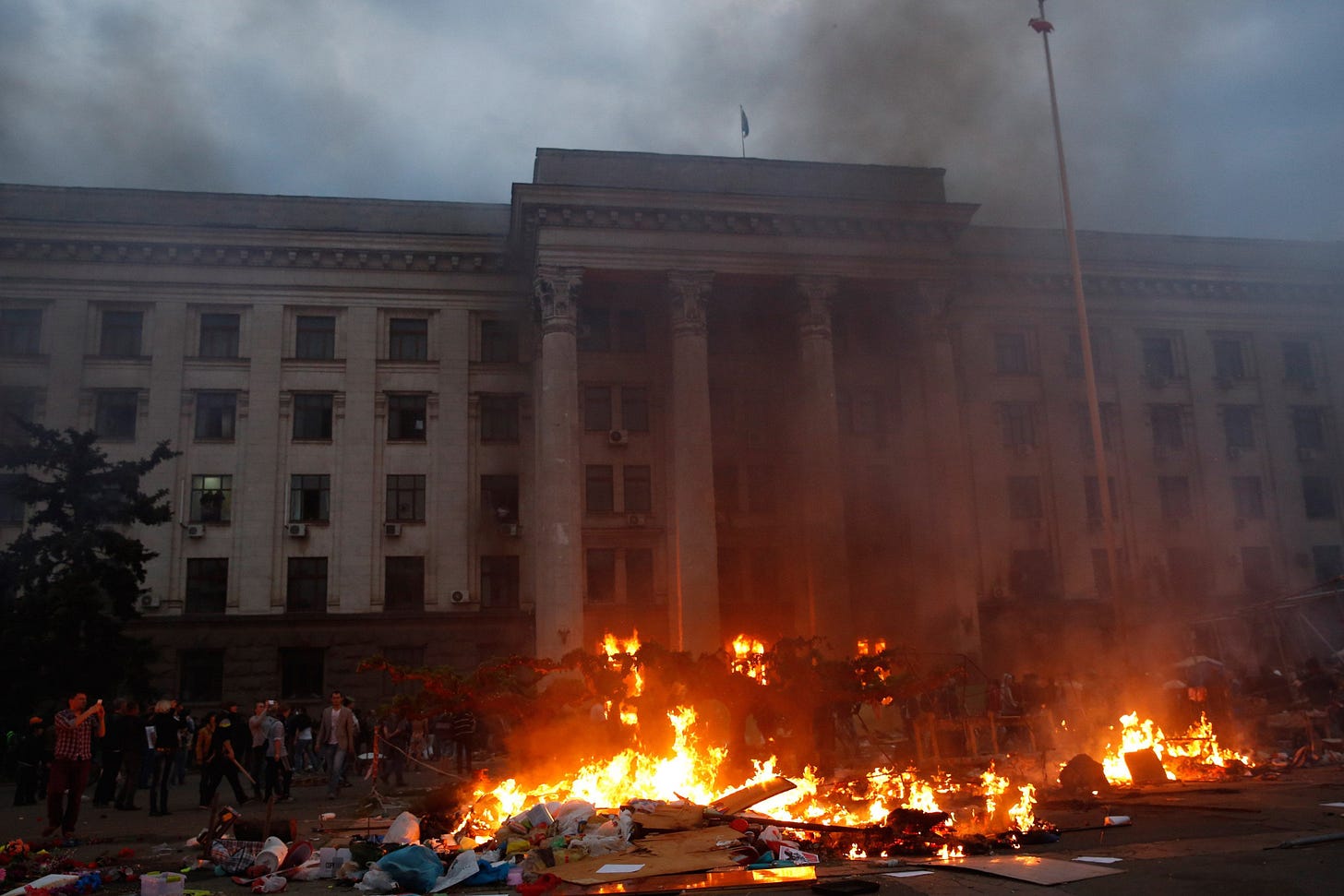
The May 2nd 2014 Odessa massacre
“Relevant authorities’ failure to do everything that could reasonably be expected of them to prevent the violence in Odessa… to stop that violence after its outbreak, to ensure timely rescue measures for people trapped in the fire, and to institute and conduct an effective investigation into the events” means Kiev was found guilty of egregious European Convention on Human Rights breaches. Moreover, numerous incendiary passages make clear industrial scale “negligence” by officials on the day, and ever after, “went beyond an error of judgment or carelessness.”
For example, the ECHR found deployment of fire engines to the site was “deliberately delayed for 40 minutes” – the local fire station being just one kilometer away – and police stood by passively as the building and its occupants burned, refusing to “help evacuate people… promptly and safely.” Moreover, Ukrainian authorities made “no efforts whatsoever” or “any meaningful attempt” to prevent or disrupt the skirmishes between pro- and anti-Maidan activists that prefaced the deadly inferno, despite knowing in advance such clashes were impending on the day.
While stopping short of charging that Ukrainian authorities actively wished for the anti-Maidan activists trapped in the burning building to die, this conclusion is ineluctable based on the ECHR’s findings. So too the apparent immunity from prosecution for implicated officials and ultranationalist perpetrators, and Kiev’s failure to act on “extensive photographic and video evidence” indicating precisely who was responsible for “firing shots during the clashes,” setting the building ablaze, and “assaulting the fire victims” who managed to escape.
The case was brought by 25 people who lost family members in the Neo-Nazi arson attack and clashes that preceded it, and three who survived the fire “with various injuries”. The ECHR has demanded Ukraine pay them just 15,000 euros each in damages. In an even greater affront to justice, the damning ruling stops short of exposing the full reality of the Odessa slaughter, indicting the Western-supported Neo-Nazi elements responsible, and their intimate ties to the February 2014 Maidan Square false flag sniper massacre.
‘Explicit Order’
Once the Maidan protests commenced in Ukraine in November 2013, tensions began steadily brewing between Odessa’s sizable Russian-speaking population and Ukrainian nationalists within and without the city. As the ECHR ruling notes, “while violent incidents had overall remained rare… the situation was volatile and implied a constant risk of escalation.” In March 2014, anti-Maidan activists set up a tent camp in Kulykove Pole Square, and began calling for a referendum on the establishment of an “Odessa Autonomous Republic”.
The next month, supporters of Odesa Chornomorets and Kharkiv Metalist football clubs announced a rally “For a United Ukraine” on May 2, before a scheduled match. Shortly thereafter, the ECHR records “anti-Maidan posts began to appear on social media describing the event as a Nazi march and calling for people to prevent it.” While branded Russian “disinformation” in the ruling, hooligans associated with both clubs had overt Neo-Nazi sympathies and associations, and well-established reputations for violence. They later formed the notorious Azov Battalion.
Fearing their tent encampment would be attacked, anti-Maidan activists resolved to disrupt the “pro-unity march” before it reached them. The ECHR reveals Ukraine’s security services and cybercrime unit had substantive intelligence indicating “violence, clashes and disorder” were certain on the day. Yet, authorities “ignored the available intelligence and the relevant warning signs”, and undertook no actions or “proper measures” to “stamp out any provocation”, such as implementing “enhanced security in the relevant areas.”
So it was on the afternoon of May 2nd 2014, “as soon as the march began,” anti-Maidan activists confronted the demonstrators, and violent clashes erupted. At roughly 17:45, in the precise manner of the Maidan Square sniper false flag massacre three months earlier, multiple anti-Maidan activists were fatally shot “by someone standing on a nearby balcony”, using “a hunting gun.” Subsequently, “pro-unity protesters… gained the upper hand in the clashes,” and charged towards Kulykove Pole square.
Anti-Maidan activists duly “took refuge” in Trade Unions House, a five-storey building overlooking the square, while their ultranationalist adversaries “started setting fire to the tents.” Gunfire and Molotov cocktails were “reportedly” exchanged by both sides, and before long, the building was ablaze. “Numerous calls” were made to the local fire brigade, including by police, “to no avail.” Mysteriously, its chief had “instructed his staff not to send any fire engines to Kulykove Pole without his explicit order,” so none were dispatched.
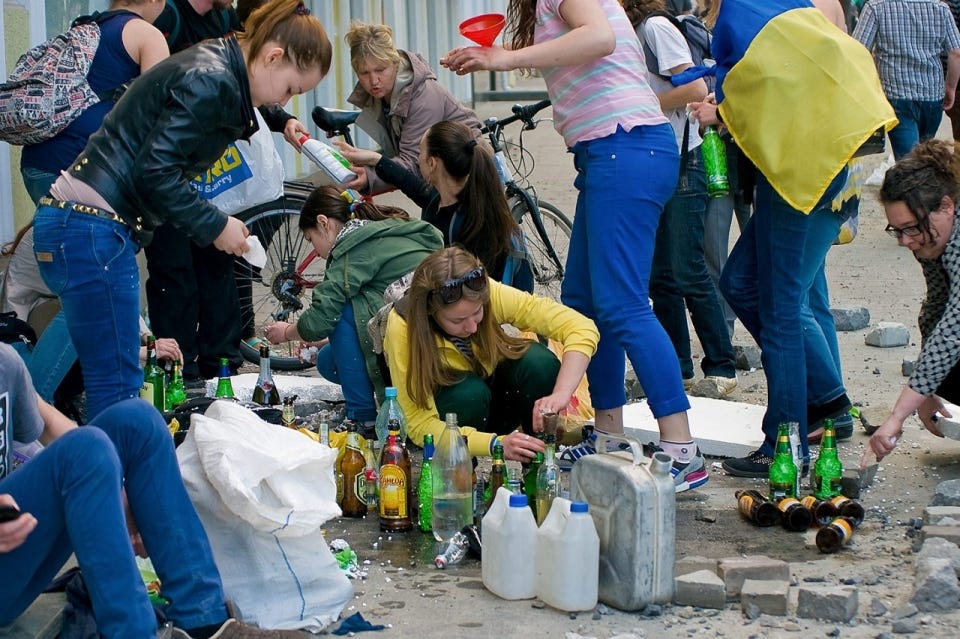
Wives and girlfriends of Neo-Nazis prepare Molotov cocktails for the attack
Several people trapped in the building tried to escape by jumping from its upper windows – some survived, but others died. “Video footage shows pro-unity protesters attacking people who had jumped or had fallen,” the ECHR notes. It was not until 20:30 that firefighters finally entered the building and extinguished the blaze. Police then arrested 63 surviving activists “still inside the building or on the roof.” They were released two days later, after a several hundred-strong group of anti-Maidan protesters “stormed the local police station where they were being held.”
‘Serious Defects’
The litany of security failures and industrial scale negligence by authorities on the day was greatly aggravated by “local prosecutors, law enforcement, and military officers” not being “contactable for a large part or all of time [sic],” as they were coincidentally attending a meeting with Ukraine’s Deputy Prosecutor General. The ECHR “found the attitude and passivity of those officials inexplicable,” apparently unwilling to consider the obvious possibility they purposefully made themselves incommunicado to ensure maximum mayhem and bloodshed, while insulating themselves from legal repercussions.
Still, the ECHR ruled “relevant” Ukrainian authorities “had not done everything they reasonably could to prevent the violence” or “what could reasonably be expected of them to save people’s lives,” therefore finding Kiev committed “violations of the substantive aspect of Article 2” of the European Convention on Human Rights. The Court also concluded authorities “failed to institute and conduct an effective investigation into the events in Odessa” – “a violation of the procedural aspect of Article 2”.
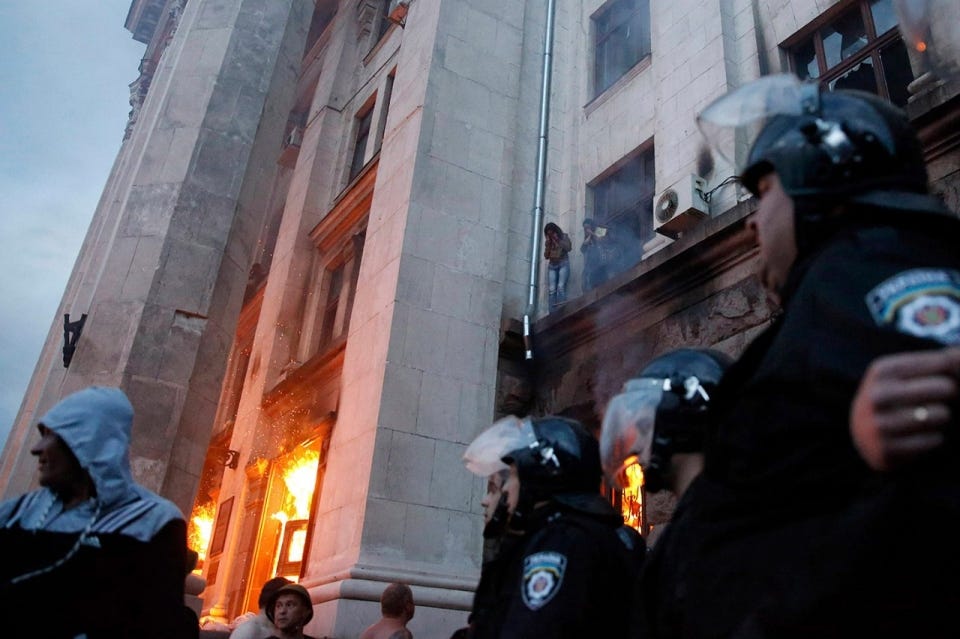
Trapped anti-Maidan activists hoping to be rescued
The ECHR’s appraisal of criminal investigations into perpetrators of the Odessa massacre, and all the officials who failed in their most basic duties on May 2nd 2014, was absolutely scathing, the details pointing to a very clear, deliberate state-level coverup. For example, no effort was made to seal off “affected areas of the city centre” in the event’s aftermath. Instead, “the first thing” authorities did “was to send cleaning and maintenance services to those areas,” meaning invaluable evidence was almost inevitably eradicated.
Accordingly, when on-site inspections were finally carried out two weeks later, the probes “produced no meaningful results.” Trade Unions House likewise “remained freely accessible to the public for 17 days after the events,” giving malicious actors plentiful time to manipulate, remove, or plant incriminating evidence at the site. Meanwhile, “many of the suspects absconded.” Several criminal investigations into perpetrators were opened, only to go nowhere, left to expire under Ukraine’s statute of limitations. Other cases that reached trial “remained pending for years”, before being dropped.
This was despite “extensive photographic and video evidence regarding both the clashes in the city centre and the fire,” from which culprits’ identities could be easily discerned. The ECHR had no confidence Ukrainian authorities “made genuine efforts to identify all the perpetrators,” and several forensic reports weren’t released for many years. Elsewhere, the Court noted a criminal investigation of an individual suspected of having shot at anti-Maidan activists was inexplicably discontinued on four separate occasions, on identical grounds.
The ECHR also noted “serious defects” in investigations of officials, “and their role in the events.” Primarily, this took the form of “prohibitive delays” and “significant periods of unexplained inactivity and stagnation” in opening cases. For instance, “although it had never been disputed that the fire service regional head had been responsible for the delayed deployment of fire engines to Kulykove Pole,” no probe into his flagrantly criminal dereliction of duty was launched until almost two years after the massacre.
Similarly, Odessa’s regional police chief not only failed to implement any “contingency plan in the event of mass disorder” according to protocol, but internal documents attesting that security measures had in fact been undertaken were found to have been forged. However, he only became subject to criminal investigation “almost a year later.” Following pre-trial investigation, his case remained pending “for about eight years,” after which he was released from criminal liability, “on the grounds that the charges against him had become time-barred.”
‘Burn Everything’
Wholly unconsidered by the ECHR was the prospect that, far from a freak twist of fate produced by two effectively warring factions clashing in Odessa, the lethal incineration of anti-Maidan activists in May 2014 was an intentional and premeditated act of mass murder, conceived and directed by Kiev’s US-installed far-right government. This interpretation is amply reinforced by testimonies from a Ukrainian parliamentary commission, instituted in the massacre’s immediate aftermath.
The commission found Ukrainian national and regional officials explicitly planned to use far-right activists drawn from the fascist Maidan Self-Defence to violently suppress Odessa’s would-be separatists, and disperse all those camped by Trade Unions House. Moreover, Maidan Self-Defence chief Andriy Parubiy and 500 of his armed and dangerous members were dispatched to the city from Kiev on the eve of the massacre. From 1998 – 2004, Parubiy served as founder and leader of Neo-Nazi paramilitary faction Patriot of Ukraine.
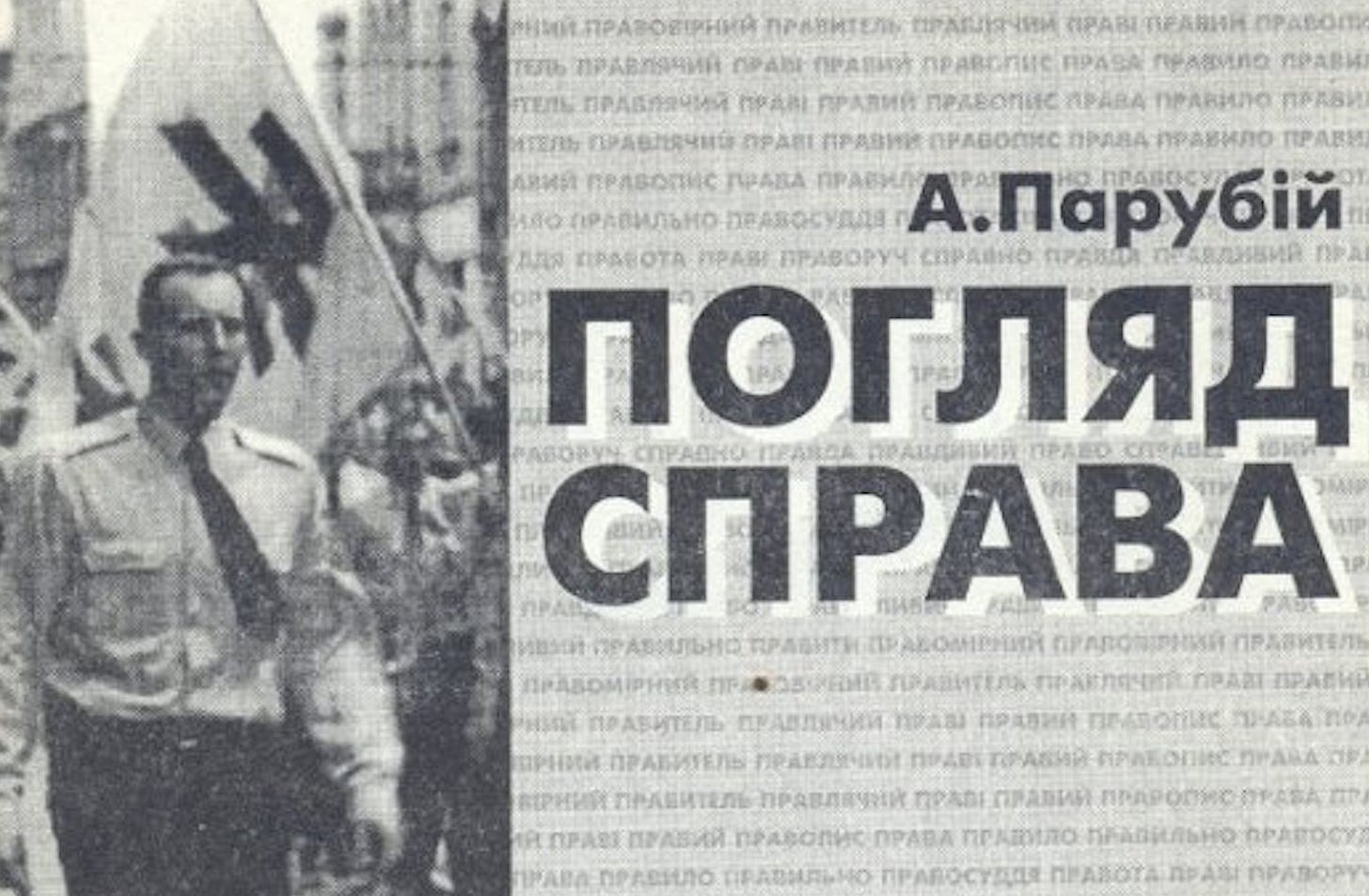
A Patriot of Ukraine leaflet, featuring Andriy Parubiy
He also headed Kiev’s National Security and Defence Council at the time of the Odessa massacre. Ukraine’s State Bureau of Investigations immediately began scrutinising Parubiy’s role in the May 2014 events after he was replaced as lead parliamentary speaker, following the country’s 2019 general election. This probe has seemingly come to nothing since. Nonetheless, a year prior a Georgian militant told Israeli documentarians that he engaged in “provocations” in the Odessa massacre under Parubiy’s command, who told him to attack anti-Maidan activists and “burn everything.”
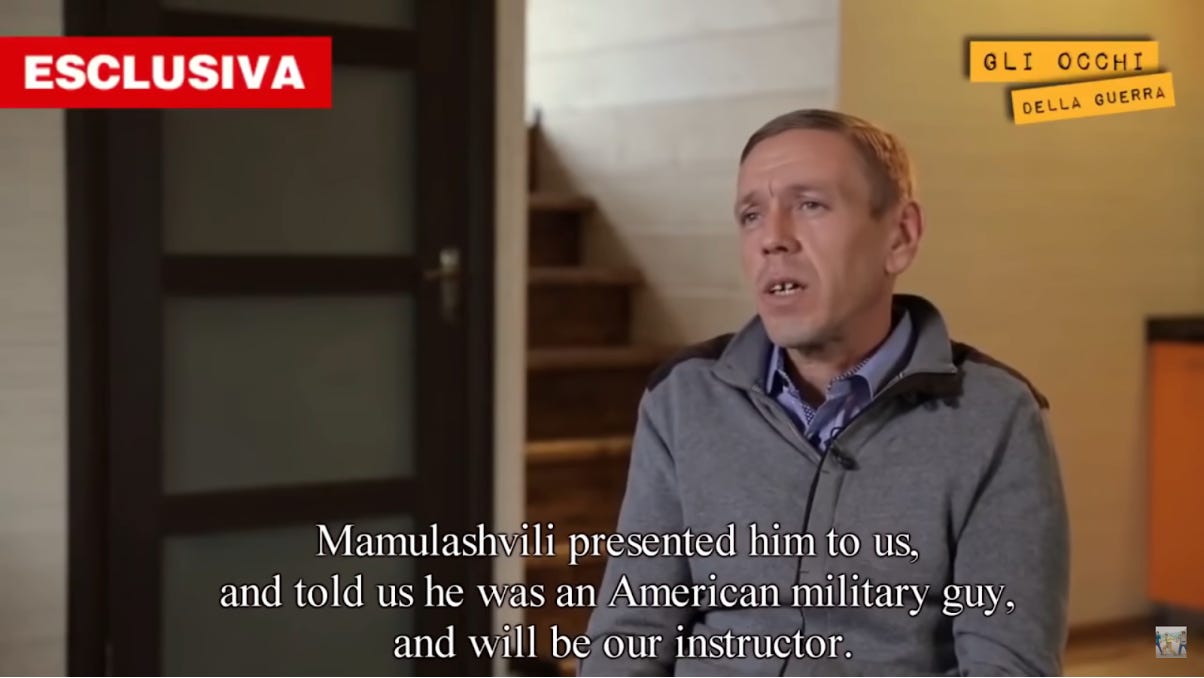
He is one of several Georgian fighters who has openly alleged they were personally responsible for the February 2014 Maidan Square false flag sniper massacre, under the command of Parubiy, other ultranationalist Ukrainian figures, and Mikhael Saakashvili, founder of infamous mercenary brigade Georgian Legion. That slaughter brought about the end of Viktor Yanukovych’s government, and sent Ukraine hurtling towards war with Russia. The Odessa massacre was another key chapter in that morbid saga – and the West’s foremost human rights court has now firmly laid responsibility for the horror at Kiev’s feet.
EU to reject Russia-US Black Sea deal – von der Leyen
RT | March 29, 2025
The EU will not lift its sanctions against Russia for as long as the Ukraine conflict continues, European Commission President Ursula von der Leyen has said.
During talks in Saudi Arabia on Monday, Russia and the US agreed to move towards reviving the Black Sea Grain Initiative, which, according to the Kremlin, should include the removal of Western restrictions against Russian Agricultural Bank and other financial institutions involved in the international sale of food and fertilizers.
In her interview with French broadcaster LCI on Friday, von der Leyen made it clear that Brussels will not support the idea of a maritime truce between Moscow and Kiev put forward by the administration of US President Donald Trump.
“The sanctions are very significant; they are painful; they have an impact on the Russian economy, and they represent a powerful lever,” she said when asked about the possibility of the EU fulfilling Russian demands to lift some of the curbs.
According to the head of the European Commission, the restrictions “will remain in effect until a just and lasting peace is established in Ukraine.”
However, she noted that “when the war is over, the sanctions might be removed.”
Von der Leyen also said that for the conflict to end, “security guarantees for Ukraine” are needed as well as “a solid defense industrial base and a deterrent force” in the EU.
The Black Sea Grain Initiative, originally brokered in July 2022 by the UN and Türkiye, envisioned the safe passage of Ukrainian agricultural products in exchange for the West lifting its restrictions on Russian grain and fertilizer exports.
Moscow withdrew from the deal a year later, citing the West’s failure to uphold its obligations. The Americans and Russians now see its revival as a step towards settling the Ukraine conflict altogether.
Earlier this week, President Vladimir Putin asserted that the Russian economy has become the fourth largest in the world in purchasing power parity terms after those of China, the US and India, despite a record 28,595 sanctions being placed on it by Washington, Brussels and their allies. According to the Russian government’s data, the country’s economy grew 4.1% in 2024, surpassing the official forecast of 3.9%.
Putin previously urged the Russian business circles against expecting the sanctions to be fully lifted, describing them as a mechanism of strategic systemic pressure on the country that the West intends to keep using.
EU ‘preparing for war’ – Hungarian FM
RT | March 29, 2025
Hungarian Foreign Minister Peter Szijjarto has accused Brussels bureaucrats of clinging to a “failed pro-war policy” in a desperate attempt to delay the moment when European taxpayers begin asking where the money spent on bankrolling Kiev has gone.
The European Union recently advised its 450 million inhabitants to stockpile essential supplies for at least 72 hours, with EU Commissioner for Crisis Management Hadja Lahbib warning on Wednesday that the Ukraine conflict threatens the bloc’s overall security.
Szijjarto said he initially thought the warning was some kind of joke or “trolling,” after Lahbib posted a bizarre video showing Europeans what to pack in a 72-hour survival kit.
“But why, in the 21st century, should EU citizens prepare a survival kit? There’s only one explanation: Brussels is preparing for war,“ Szijjarto wrote in a post on X on Friday. “At a time when there’s finally a real chance for a ceasefire and meaningful peace talks with [President Donald Trump’s] return to office, Brussels is going in the opposite direction, clinging to a failed pro-war policy.”
“Why? Because as long as the war continues, pro-war European politicians can avoid taking responsibility for three years of failure, and avoid answering an extremely uncomfortable question: where is the money that was sent to Ukraine?”
EU institutions in Brussels and individual member states have spent over €132 billion over the past three years supporting Kiev, and have pledged an additional €115 billion that has yet to be allocated, according to data from Germany’s Kiel Institute.
Since taking office, US President Donald Trump has pushed for a diplomatic resolution and sought to recoup what he estimates to be over $300 billion in US taxpayer money that his predecessor “gifted” to Kiev. Washington recently brokered a limited ceasefire between Ukraine and Russia, placing a moratorium on attacks on energy infrastructure. Kiev, however, has repeatedly breached the ceasefire terms, according to Moscow.
Despite the ongoing peace process, the EU has continued to push a hawkish agenda. European Commission President Ursula von der Leyen recently unveiled an €800 billion plan to ramp up military spending through loans.
Meanwhile, France and the UK continue to advocate for the deployment of a military contingent to Ukraine. Speaking after a summit in Paris on Thursday, French President Emmanuel Macron announced that a so-called “coalition of the willing” will seek to deploy a “reassurance force” to Ukraine after a peace deal with Russia is reached.
The proposal to send troops has already been rejected by several EU members. The “coalition of the willing” – a phrase originally coined by the US in 2003 to describe countries backing the invasion of Iraq – now mostly refers to states that have pledged to continue supporting Kiev militarily, without necessarily committing to troop deployments.
Featured Video

The Most Important Bet You’ve Never Heard Of
or go to
Aletho News Archives – Video-Images
From the Archives
Wars for Israel: A reminder of who’s giving the marching orders
By Damian Lataan | February 7, 2012
As the West prepares to march off to yet another war in the Middle East, we should perhaps remind ourselves of who is giving the West their marching orders.
In February 2003, just weeks before the US and their allies launched their attack on Iraq and her peoples, a delegation of US congressmen, together with the US Ambassador to the United Nations, John Bolton, a well known pro-Zionist and neoconservative war-hawk, were in Israel at the invitation of the Israeli government then led by Israeli Prime Minister Ariel Sharon.
Addressing the congressmen, Sharon told them ‘that Iran, Libya and Syria should be stripped of weapons of mass destruction after Iraq’. Later, Sharon told John Bolton ‘that Israel was concerned about the security threat posed by Iran, and stressed that it was important to deal with Iran even while American attention was focused on Iraq’. … continue
Blog Roll
 Aletho News
- IRGC hits US tech giant Oracle’s data center, computing site in UAE over new assassinations
- Bombing Iran Back Into the Stone Age /Lt Col Daniel Davis & Jim Jatras
- UAE rejects report claiming it is ready to join war on Iran to reopen Hormuz
- A New Resistance Front: How Does Syria Factor into the Regional War?
- Gulf states weigh pipeline expansion plans, hoping to bypass Hormuz
- Iran sets up ‘tollbooth’ system in Strait of Hormuz
- Wave 90: IRGC strikes US-linked industrial sites in Gulf
- Iran Says US-Israeli Claims of Its Military Strength Are Wrong
- Trump’s April Fools’ Address to the nation
- The Most Important Bet You’ve Never Heard Of
- If Americans Knew
- ‘War crime’: Global condemnation as Israeli ministers celebrate death penalty law targeting Palestinian prisoners
- 7 Ways Israel Is Turning Lebanon Into Gaza
- World’s Leading Football Bodies Under Fire Over Israel Policies
- Experts warn of possible use of nukes against Iran
- Israeli invasion of Lebanon could be worse than 1982, warn European officials
- Passover: Liberation and collective punishment
- Trump says the quiet part out loud: (Israel’s) war on Iran > Americans’ health – Daily Update
- Gaza families reunite years after babies evacuated amid Israel’s war
- International Rescue Committee warns Gaza’s children face grave protection risks
- Iran’s Alleged 47-Year War on America: Debunking the 1,050 American Deaths Canard
- No Tricks Zone
- Low Intensity Tornado Wrecks Major Solar Farm, Creating A Potential Toxic Dump
- New Study Finds Warming Saves Lives…Cold Temperatures 12 Times More Deadly Than Excess Heat
- German Science Blog Accuses PIK Climate Institute Of Hallucinating Climate Tipping Points
- Devastating Assessment Of Comirnaty Vaccine By Former Senior Pfizer Europe Toxicologist
- New Study: CO2 Is ‘Effectively Negligible’ As An Explanatory Climate Change Factor Since 2000
- Former Pfizer Toxicologist Dr. Helmut Sterz Tells Bundestag Hearing Pfizer Vaccine Should Have Never Been Approved
- Energy Expert: Germany’s Nuclear Phaseout Was A “500 Billion Euro Mistake”
- New Research: South Australia’s Mid-Holocene Sea Surface Temperatures Were 4°C Warmer Than Today
- Storing Green Energy To Last Germany 10 Days Would Require A 60-Million Tonne Battery
- New Studies: UK Sea Levels Were 4 Meters Higher Than Today During The Mid-Holocene
 Aletho News