Stepan Bandera’s Sinister MI6 Alliance Exposed
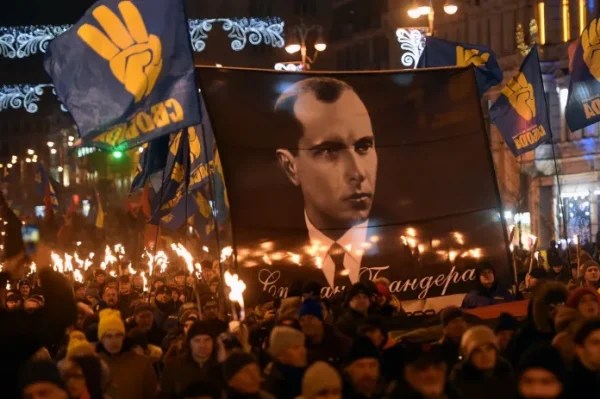
[Source: ar.inspiredpencil.com]
By Kit Klarenberg | Covert Action Magazine | March 20, 2025
October 15, 2024, marked the 65th anniversary of Organization of Ukrainian Nationalists (OUN-B) and Ukrainian Insurgent Army (UPA) founder Stepan Bandera’s assassination by the KGB in Munich, in then-West Germany.
The date passed without mention anywhere. This may reflect how prior public commemorations of the life and death of Nazi collaborator Bandera—widely credited as the father of Ukrainian nationalism—in Kyiv sparked significant controversy and condemnation across Central and Eastern Europe, particularly neighboring Poland.
The complicity of Bandera and the fascist movements he birthed during World War II is well-documented. His influence over modern-day ultranationalist and Neo-Nazi factions in Ukraine, such as the Azov Regiment, has also been acknowledged in the mainstream media.
Yet, Bandera’s secret Cold War bond with British intelligence has never been seriously explored by Western news outlets. Now, examination of little-known declassified CIA records by CovertAction Magazine exposes the malign contours of a long-running, ruthless conspiracy between Bandera and MI6 to destabilize the Soviet Union.
This dark handshake only expired because MI6’s fascist asset was resistant to joining forces with other Ukrainian anti-Communist forces, therefore jeopardizing plans by Washington and London for all-out war with the Soviets in Donbas. That plot, intended to ultimately collapse the entire USSR, has eerie, direct echoes of the current Ukraine proxy war. So too Britain’s willingness, then and now, to go even further than the U.S. in building alliances with the most reactionary, dangerous Ukrainian ultranationalist elements, in service of balkanizing Russia.
“Bandit Type”
MI6 first contacted Bandera while he was exiled in post-war West Germany in 1948, via Gerhard von Mende. An ethnic German hailing from Riga, Latvia, von Mende has been described as the “enthusiastic Nazi” who headed Berlin’s Reich Ministry for the Occupied Eastern Territory, or Ostministerium. Among other connivances, von Mende was charged with recruiting fifth columnists from the USSR’s Central Asian republics, to undermine and attack Communist authorities. He has been credited with influencing subsequent British and American support for Islamic extremists.

Per a declassified CIA biography, after Nazi Germany’s defeat, von Mende was “interned as a ‘guest’” at the Agency’s Camp King, where Nazi officials and soldiers were interrogated and tortured. In some cases, inmates were unwittingly dosed with LSD under PROJECT BLUEBIRD, a forerunner to the CIA’s notorious MK-ULTRA mind-control program. Subsequently, von Mende became an asset for West Germany’s Nazi-riddled BND, the CIA, and MI6, continuing his spy recruitment in the USSR via a front company.
Through this position, von Mende was kept abreast of UPA activities and capabilities, and maintained an intimate personal relationship with Bandera. The Ukrainian fascist ideologue’s thuggish West German network was by then hard at work killing hundreds of local citizens suspected by the CIA and MI6 of harboring Communist sympathies. While the OUN-B chief’s “ask” of British intelligence was initially judged too high, that perspective rapidly changed. By 1949, MI6 was helping Bandera airdrop his chaos agents into Ukraine.
A year later, Britain’s foreign spy agency began formally training these operatives to gather intelligence and carry out sabotage and assassinations on Soviet soil. This sinister compact was established despite stern CIA and State Department opposition. At this point, the Agency had identified a comparatively moderate alternative to Bandera’s murderous ultranationalist mob, the Ukrainian Supreme Liberation Council (UHVR). The group was led by Ukrainian-Greek Catholic priest Ivan Hrinioch, a “longtime CIA asset” and former high-ranking OUN-B operative Mykola Lebed.
During World War II, Lebed oversaw the UPA’s massacre of tens of thousands of Poles in Volhynia and Eastern Galicia. However, he subsequently disavowed this genocidal carnage, and led UHVR’s push to unite Ukrainian émigrés, who had fractured due to bloody, internecine squabbles toward the conflict’s end. Under the auspices of Operation AERODYNAMIC, for decades the Agency exploited the UHVR to foment “nationalist flare-ups” throughout the Soviet Union, “particularly” in Ukraine, and “encourage divisive manifestations among” the population, to “exert pressure on the Soviet regime.”
By this time, Bandera had fallen out of favor with many Ukrainian nationalists, and was even renounced by what remained of OUN-B’s Kiev-based leadership. This, his genocidal past, and overt anti-U.S. actions and statements due to Washington’s refusal to publicly advocate for Ukrainian independence, all deterred the CIA from employing him. However, MI6 was unperturbed and pushed ahead with its Bandera operations. This created a ludicrous situation, with London and Washington supporting bitterly antagonistic Ukrainian nationalist factions, which frequently undermined and attacked each other.
As a British intelligence memorandum on “the crisis over Bandera” noted, by 1950 Ukrainian nationalist leaders had “become aware of the fact that the British and Americans were backing rival groups,” putting the agencies’ joint anti-Soviet project at risk. It was decided to dispatch a co-signed message to UPA headquarters via Ukrainian CIA and MI6 agents parachuted into Lviv, calling for an end to “present disagreements” between opposing nationalist factions, which London and Washington professed to “deplore and earnestly hope may be resolved.”
It signed off with the now-infamous, Bandera-coined nationalist slogan, “Glory to Ukraine” (“Slava Ukraini”). The memo’s MI6 author, moreover, recalled an in-person meeting they had with Bandera in London. The spy described him thusly:
“Convincing and sincere… a professional underground worker with a terrorist background and ruthless notions about the rules of the game, acquired by hard experience, along with a thorough knowledge of the Ukrainian people… a bandit type if you like, with a burning patriotism which provides an ethical background and a justification for his banditry.”
The MI6 operative cheerfully added that genocidal mass murderer Bandera was “no better and no worse than others of his kind I have had dealings with in the past,” and “genuinely grateful for the help given to him” by British intelligence, “but at the same time is certainly trying to get all he can out of it.” The CIA begged to differ, however, commissioning a study of London and Washington’s conflicting positions on the “Ukrainian underground” and Bandera, and how to resolve this divergence.
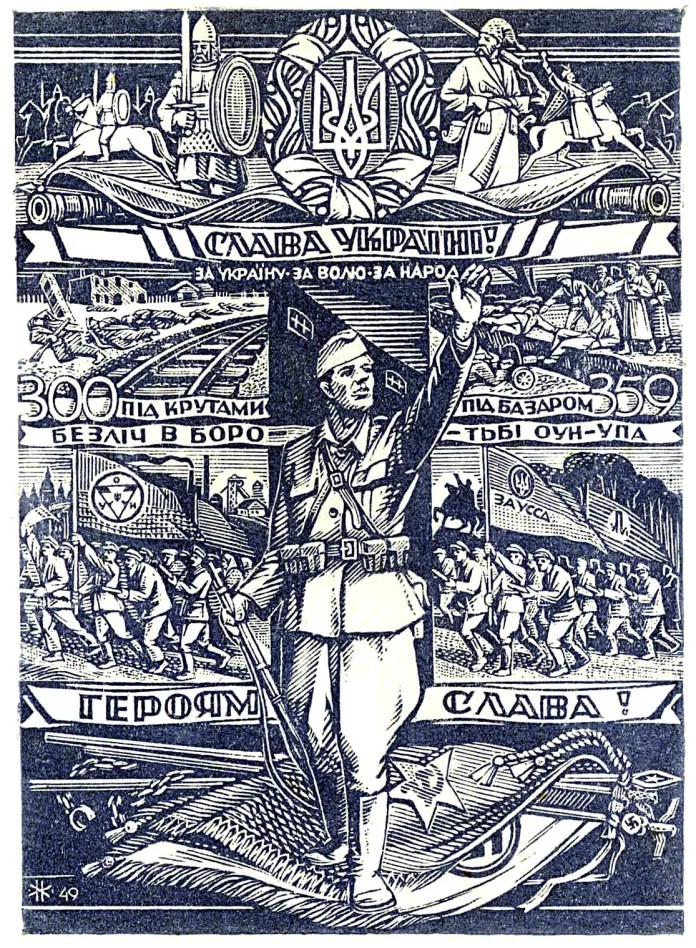
UPA poster from the 1940s. OUN/UPA’s formal greeting is written on two of the horizontal lines “Glory to Ukraine!” “Glory to the Heroes!” The soldier is standing on the banners of the Soviet Union and Nazi Germany. [Source: euromaidanpress.com]
“Political Overtones”
A subsequent appraisal repeatedly declared Bandera and OUN-B to be “completely unacceptable” to the CIA, “both from the political and the operational standpoints.” It proposed the Agency and MI6 take joint ownership of the UHVR and its anti-Soviet wrecking project in Ukraine, and “exchange political, operational and intelligence data resulting from these operations.” Meanwhile, the CIA would “take independent action to neutralize” OUN-B’s “present leadership,” including Bandera himself. It is unknown if this was pitched to MI6, although London’s steadfast opposition was inevitable.
The “British position,” as described in the study, was Bandera’s “importance” had been perennially “underestimated by the Americans, as a rallying symbol in the Ukraine, as leader of a large émigré group [and] as a leader favored by the homeland headquarters.” This did not conform to the reality on the ground as detected by the CIA, but MI6 had a vested interest in maintaining the fascist demagogue as an agent. An April 1951 Agency memo summarizing recent “talks” with British intelligence “on operations against the USSR” noted:
“[MI6 is] seeking progressively to assume control of Bandera’s lines… [MI6 argues] Bandera’s name still carried considerable weight in the Ukraine… [and OUN-B is] the strongest Ukrainian organization abroad, is deemed competent to train party cadres, [and] build a morally and politically healthy organization.”
By contrast, the CIA observed Soviet authorities “had been successful to a remarkable degree in transforming the mentality of the younger generation” of Ukrainians, resulting in them vehemently rejecting Bandera and his brand of rabid nationalism. While the Agency, therefore, favored “political neutralization of Bandera as an individual,” MI6 balked, as this “would lead to a drying up of recruits” and “disrupt British operations.” However, the declassified paper trail shows London eventually tired of their fascist asset.
In February 1954, a senior MI6 official who led liaison with OUN-B for two decades made a “final attempt to bring Bandera to reason” in London, due to the genocidaire’s refusal to reconcile and unite with opposing Ukrainian nationalist elements. The high-ranking British spook offered him “one last chance” to make amends with émigré leaders. Bandera “refused this suggestion with arrogant finality,” thus making “the break” between Bandera and MI6 “complete.”
All British intelligence-run Ukrainian agents who remained loyal to Bandera were duly jettisoned. MI6 informed other nationalist leaders the agency “would not resume” its relationship with him “under any circumstances.” Bandera remained exiled in Munich, West Germany, and continued to run belligerent cloak-and-dagger operations against the Soviet Union, while ratcheting up his anti-Western rhetoric. The CIA and MI6 viewed these activities as a significant problem, with no obvious solution.
As CIA records of a January 1955 “joint U.S.-UK conference” put it, despite the “unanimous desire” of British and American intelligence to “‘quiet’ Bandera,” it was equally vital the KGB was “not allowed to kidnap or kill him.” This could make Bandera “a martyr” among Ukrainian ultranationalists, a prospect to be avoided if at all possible. Hence, London and Washington kept him alive and well, while permitting West Germany’s BND to run him as an agent. Their old friend Gerhard von Mende was his handler.
West German authorities wished to punish Bandera and his in-country network for crimes including kidnapping, but von Mende consistently intervened to insulate his compatriot from prosecution. A July 1959 CIA report noted the BND’s use of Bandera was such a “closely held” secret within the agency, it was not even formally cleared with the West German government “due to political overtones.” Despite this omertà (code of silence), the BND moved to secure Bandera a U.S. visa.
It was hoped he would connect with Ukrainian émigrés Stateside, while ingratiating himself with the CIA and State Department. Per an October 5, 1959, Agency memo, the BND believed “it should be a simple matter” for the CIA “to influence the issuing of a visa” for Bandera, as “many less desirable and less ‘exploitable’ individuals” had already visited the country via Agency assistance. A formal request was submitted to Washington. Just ten days later, though, the KGB finally caught up with him.
Despite their mutual wish that Bandera not be “martyred” by Soviet intelligence, it is likely that the CIA and MI6 breathed a collective sigh of relief upon hearing of his death. The OUN-B and UPA founder’s destabilizing, disruptive influence within the Ukrainian anti-Communist underground was a significant impediment to Anglo-American spying agencies’ implementation of a far grander plan than has hitherto been tried. Namely, fomenting all-out war against the Soviet Union, using Ukrainian ultranationalists as foot soldiers.
This is the first instalment of a two-part investigation. Stay tuned.
EU capital flight tops $300 billion – European Council president
RT | March 21, 2025
Capital outflow from the EU has reached €300 billion ($325 billion) annually as retail and institutional investors move their money into assets outside the region, European Council President Antonio Costa has announced.
The statement comes as the bloc is considering doubling its military aid to Ukraine and continues to pledge billions of euros in financial assistance to Kiev.
Speaking to reporters following the EC meeting on Thursday, Costa said that officials in Brussels are seeking to avoid capital flight by reducing energy costs that have already soared to their highest level in two years, hitting major industries and companies.
“As of today, around €300 billion of EU families’ savings flow out of European Union markets each year,” Costa said, acknowledging that business as usual is no longer an option for the bloc. “There is €300 billion that don’t fund businesses in the European Union.”
Among the steps aimed at luring investors back to the bloc, Costa mentioned slashing what Brussels calls “unnecessary” red tape by 25% for all EU companies and by 35% for small and medium-sized businesses.
The multibillion-dollar capital outflow comes at a time when the EU is pushing to maintain funding for Ukraine. The effort is driven by growing concerns in Brussels that US President Donald Trump could stop the flow of American arms to the government of Vladimir Zelensky.
Earlier this week, EU foreign policy chief Kaja Kallas proposed a hawkish plan that would double the bloc’s cashflow to Kiev for the year, making it €40 billion ($43.7 billion).
On Thursday, Hungary, which has long been critical of EU military assistance to Ukraine, refused to sign a joint EU communique calling for increased funding for Kiev.
Hungarian Prime Minister Victor Orban said that the EU is broke, as it has spent “all of its money” and realistically “doesn’t have a single penny left” to support Ukraine amid its conflict with Russia.
Ukraine Deliberately Blows Up Sudzha Gas Distribution Station on March 20
Sputnik – 21.03.2025
The Ukrainian armed forces deliberately blew up the Sudzha gas distribution station on March 20, leaving the facility significantly damaged, Russian Investigative Committee spokeswoman Svetlana Petrenko told Sputnik on Friday.
“A criminal case has been opened in connection with the explosion of the Sudzha gas distribution station by the Ukrainian armed forces’ servicepeople. The Main Military Investigative Department of the Russian Investigative Committee has opened a criminal case on the grounds of a crime … [over a terrorist act],” Petrenko said.
On March 20, Ukrainian servicepeople, who illegally invaded the territory of Russia, carried out a deliberate explosion of the Sudzha gas distribution station, as a result of which the facility received significant damage, the spokeswoman said.
The investigation will identify and hold accountable all those involved in this crime, the Investigative Committee emphasized.
There were no casualties or injuries among the civilian population from the explosion, clarified an emergency services representative to Sputnik. He added that experts have already begun assessing the consequences of the terrorist attack.
Kremlin Press Secretary Dmitry Peskov noted that the bombing of the Sudzha station revealed how much faith can be placed in the words of Vladimir Zelensky and his team.
Gas transit through the Sudzha station continued until the beginning of this year, when it stopped due to Kiev’s refusal to extend the transit agreement. This route remained the last one for Russian gas supplies to Europe via Ukraine.
On Tuesday, Russian President Vladimir Putin spoke by phone with his American counterpart, Donald Trump. According to the Kremlin press service, they discussed resolving the Ukrainian conflict and expressed mutual interest in normalizing relations. Among other things, Putin responded positively to the idea of a mutual 30-day halt to strikes on energy infrastructure and gave the corresponding order to the military.
Later, Volodymyr Zelensky stated that Ukraine would support the proposal to cease attacks on energy infrastructure. However, just hours after the talks between the Russian and US leaders, the Kiev regime attacked the Kavkazskaya oil pumping station in Russia’s Krasnodar region with three drones. The station is involved in transferring oil from railway tankers to the pipeline system of the international Caspian Pipeline Consortium.
The Ministry of Defense noted that such actions by the Ukrainian leadership are aimed at deliberately undermining Trump’s peace initiatives. Peskov stated that this attack is the best proof of the Kiev regime’s lack of willingness to negotiate, and this raises concerns.
Russian forces, following Putin’s command, ceased all strikes and even shot down seven of their own drones that were already en route to attack targets in the Nikolayev region of Ukraine.
Who is opposing peace in Ukraine?
By Dmitri Kovalevich – Al Mayadeen – March 20, 2025
March 2025 marks the beginning of a fourth year of the military conflict in Ukraine. Kiev, its sponsors in Europe and the United States, are proving unwilling to end the war being waged despite mounting evidence they are facing a major political and military defeat.
Zelensky vs Trump?
The five-year, electoral mandate dating from May 2019 of Volodymyr Zelensky as president of Ukraine expired ten months ago. Yet on February 28, Zelensky staged a widely publicized quarrel with the new US administration in Washington headed by Donald Trump. The administration reacted, in turn, with a dramatic suspension of US arms shipments and sharing of intelligence and satellite data. Without this data, Ukrainian troops are ‘blinded’ because US military specialists have played a key role in helping choose Russian targets and helping operate complex rocket and missile weaponry. Particularly valuable are the images provided, with US government approval, by US commercial satellite imaging company Maxar.
The ‘suspensions’ were very short-lived. A meeting in Saudi Arabia on March 11 between the Kiev government and the Trump administration saw a renewal of the briefly-disrupted partnership between the two after its brief interruption in supplying military data and equipment. The meeting issued a proposal to Russia (better described as a threat) prepared in advance by Washington for a 30-day ‘ceasefire’. Critics in Russia and abroad say the proposal would allow the Ukraine Armed Forces to rest and regroup. If Russia turned it down, the Western powers could then condemn it for refusing peace.
Every serious analyst is pointing out that the ceasefire proposal does not at all address Russia’s well-publicized minimum conditions for a peace settlement. In other words, the plan is something of a trap for Russia. For that reason, it will not see the light of day.
Zelensky was absent from the Ukraine delegation in Saudi Arabia. He remains apprehensive over the prospect that Trump may wish to replace him and could do so at any time. Ukrainian political analyst Kost Bondarenko, who now lives abroad, explained on Telegram on March 4 that Zelensky is no longer listening to anyone, including those in his personal entourage. “He is acting hysterically and capriciously, recognizing only his own claimed righteousness. He doesn’t even listen to Yermak [head of the Office of the President of Ukraine]. His egocentrism has made Ukraine hostage to his whims.”
Europe benefits from the war
Zelensky is seeking more support from his patrons in the European Union and becoming more dependent on them, especially on the government of Great Britain. The latter continues to encourage him to sacrifice the people of Ukraine in a losing war against Russia.
Former Ukrainian (now Russian) political scientist Rostislav Ishchenko said in an interview on March 7 that the only difference between the Trump regime in Washington and the leading governments of the European Union is that ‘liberal’ Europe wants a consolidated West under a ‘liberal’ image while the right-wing, conservative Trump regime wants a united West focused on weakening and paralyzing Russia while simultaneously weakening China.
“Trump’s goal is not to make life easier for Russia. Trump’s goal is to get a peace that is acceptable to America. So far, everything that Trump formulates is absolutely unacceptable to us.”
Another former Ukrainian and now Russian political analyst Andrey Vajra told a Crimea news broadcast in February that the war in Ukraine has helped the European elites to appropriate billions of euros. “Europeans understand perfectly well that the war is lost. But the European elite needs to continue stealing [from weapons supplying and the multitude of forms of ‘aid’]. I have already explained how it is possible to continue stealing billions of euros so long as the killings continue in Ukraine. Far more millions of euros can be had. That’s why the European leaders are clinging to a warmaking Ukraine.”
In early March, the head of German intelligence, Bruno Kahl, stated in an interview with the state-run Deutsche Welle that it would be ‘safer’ for Europe if the war in Ukraine continued for another five years. He criticized the Trump administration, saying the kind of swift end to the war being voiced by Trump “would enable the Russians to focus their energy against Europe”. This suggested ‘long war’ against Russia is the new, official theme of EU leaders as they strive to convince their populations of the need to massively expand military spending.
Even former prime minister Yulia Tymoshenko (2007-2010) of the Batkivshchyna faction in the Ukrainian legislature says she is outraged by Kahl’s frank admission. “Bruno Kahl for the first time officially confirmed what we were so reluctant to believe: At the cost of thousands of Ukrainian lives and the very existence of Ukraine, some people decided on a war to ‘deplete’ Russia and thereby enhance the security in Europe? I did not think that they would dare to say it so officially and openly. This explains a lot,” Tymoshenko doth protest too much. She was a key fomentor of the violent, Maidan coup in February 2014 and an ardent advocate since then of military and political confrontation with Russia.
Danish Prime Minister Mette Frederiksen has also stated that a peace agreement could be more dangerous for Ukraine than an ongoing war. “I understand that many people believe that a peaceful solution or a ceasefire is a good idea, but we run the risk that peace in Ukraine would actually be more dangerous than the war that is ongoing now.”
Such pro-war stances are not only due to the fact that Western companies are getting rich on fulfilling military orders. A permanent war in Ukraine appeals to many Western leaders because this would weaken and pre-occupy Russia. “Israel” has long acted on the same principle in the Middle East. It has waged bloody wars in Syria, Iraq, and Lebanon to weaken these countries and prevent them from doing anything to stop “Israel’s” genocide against Palestinians and its occupation of Syrian territory.
Those who justify continued war in Ukraine make two contradictory assertions. On the one hand, they argue that the war has greatly weakened Russia and that the government there may soon collapse. Ukrainians should therefore fight just a little longer to secure ‘victory’. On the other hand, they say that Russia has become too strong and is a threat to overrun more European countries in the future. Ukrainian social networks have coined an ironic term for this contradictory belief system, calling it ‘Russophrenia’ (derived from the word ‘schizophrenia’).
The end of Ukraine’s adventure in Kursk
Disaster has befallen the Ukraine Armed Forces present in the Kursk border region of Russia. Large numbers of Ukrainian troops have become encircled—as many as 10,000 according to some Western media outlets. A March 8 report in a Ukrainian media outlet nervously reassured that the situation in Kursk “is not yet catastrophic”.
The Ukrainian military command did not issue any orders to retreat from threatened encirclements in Kursk. This repeats the experiences with earlier military encirclements in Donbass. These have allowed the Russian army to make steady and continued military advances there.
As reported by the online Politnavigator on March 7, a former advisor to the office of Zelensky, Alexei Arestovich, sees a familiar pattern to events in Kursk. “In dire conditions where encirclement is threatened, only the introduction of reserve troops can help. So we [the Ukraine Armed Forces] proceed as usual: drop in a few reserves removed from other threatened locations. These will most likely be unable to stabilize for any length of time because there are few reserves to draw upon. No one is left. Even worse is to keep the army in encirclements or threatened encirclements for too long, waiting for the political leadership to give an order to retreat. But those orders do not come. This scenario has repeated itself over and over again. We need to stop playing by such scenarios.”
Arestovich lives in exile somewhere in Europe and has said he would be a candidate in a forthcoming election for president of Ukraine should a free election take place.
On March 8-9, Russian troops managed rather easily to contain the remaining Ukrainian forces in Kursk Oblast and cut off re-supply routes. This was partly helped by the spring thaw because Western-supplied military equipment becomes booged down in mud; it is designed primarily for use on paved or improved gravel roads.
Ukrainian opposition blogger Anatoliy Shariy writes that the losses of the AFU in Kursk are huge – some of the biggest losses that Ukrainian servicemen can remember.
The Ukrainian grouping in Kursk was centered around the border town of Suzdha. It is the site of an important pumping and transit station for a natural gas pipeline built during the Soviet era which connects the vast gas fields of eastern Russia to markets in Ukraine and further west in Europe. In January, Ukraine shut down pipeline shipments through Suzdha, drawing sharp protests and threats of counter-measures from Hungary and Slovakia.
An ironic consequence of Ukraine shutting down the pipeline was that Russian soldiers were able to use the now-empty pipeline to advance some 15 kilometers directly into the center of the Ukrainian grouping in Suzdha. They waited days for orders. Russia then surprised and overwhelmed the embedded Ukrainian forces with a multi-pronged attack beginning on March 8. Many Ukrainian soldiers and allied mercenaries ended up stampeding into surrounding minefields.
Russian military correspondent Anna Dolgareva spoke to Russian military scouts in Suzdha and reported, “For six days, the Russian fighters sat inside the pipeline awaiting orders to move. They spent some 24 hours of difficult walking to get there. The pipeline still contained traces of methane gas and so holes were cut in the pipe along the way for ventilation.”
This operation was made possible because Ukraine shut off gas transit causing European countries to buy much more expensive liquefied gas from producers in the United States. Western sanctions against Russia have cost Europe its supply of relatively cheap Russian gas, replaced by shipments of expensive liquefied natural gas from the United States as well as gas from Norway and Algeria shipped by pipeline.
Ukrainian elite on ‘starvation rations’
Representatives of the Ukrainian political elite are today extremely worried about Zelensky’s quarrel with the new US administration that exploded into view in Washington on February 28. For most, funding from the United States is their main source of income.
Since the early 1990s, Ukraine has developed an entire class of government officials and politicians who have ‘monetized’ Russophobia and anti-communism. A key piece of moving up the career ladder has been to act the loudest in stigmatizing the former Soviet Union and modern Russian Federation, and figuring out how best to draw Western funding for such efforts. This scheme has worked well for decades, but now the apparent chaos being sown by the new Trump regime in Washington has upset the old arrangements. The chaos is merely the expression of a governing U.S. regime facing a looming defeat of its proxy war in Ukraine along with its European partners.
Some legislators realize that Zelensky’s harsh outbursts and confrontation with Trump and Trump’s vice president in Washington on February 28 could cost the country dearly, but others are betting on maintaining an aggressive, pro-war rhetoric. They are looking to the British government to help out.
Alexei Arestovich writes that Zelensky’s ‘disobedience’ is based solely on his desire to extract security guarantees for himself and his entourage. He says the problem for the White House is that “providing personal guarantees to thieves risks setting yourself up before American justice.”
Ukrainian economist Oleksiy Kushch writes that for the Ukrainian elite, the era when it could act as a child and demand money from the ‘adult uncles’ in the West is coming to an end. The West is so used to that arrangement that Zelensky’s apparent conflicts with the U.S. administration are bewildering, a kind of ‘revolt against the boss’.
Kushch summarizes Ukraine’s situation after Zelensky’s quarrel with Trump in this way, “Like a teenager who ‘unexpectedly’ has a child and finds all responsibility now rests on him, ‘daddy’ U.S. may threaten to stop helping out as punishment for any ‘disobedience’ while ‘mommy’ Europe promises to continue giving money but not forever.”
The Ukrainian elite has been thoroughly corrupted by years of generous Western ‘aid’ handouts. It no longer knows how to earn revenue and wealth on its own. So if some character named Zelensky becomes an obstacle to the continued flow of ‘daddy’s’ money, he becomes expendable. So much the worse for him.
Peace Negotiations & the End of NATO
Prof. Jeffrey Sachs with Prof. Glenn Diesen
Glenn Diesen | March 18, 2025
The US and Russia negotiate an end to the proxy war in Ukraine: What is realistic to expect, how can Europe’s bellicose reactions be explained, and is this the end of NATO?
Kremlin releases Putin-Trump phone call summary (FULL STATEMENT)
RT | March 18, 2025
Russian President Vladimir Putin and his US counterpart Donald Trump have held a phone conversation lasting over two hours, discussing a peaceful resolution to the Ukraine conflict.
The Kremlin reported that the two leaders spoke about a suggested 30-day ceasefire, a prisoner exchange, and maritime security, with Putin responding positively to Trump’s proposals. Both leaders expressed interest in normalizing US-Russia relations, agreeing to continue discussions on global security, economic cooperation, and even cultural exchanges like NHL-KHL hockey matches.
The Kremlin has published a summary on the outcome of the call:
A phone conversation between Vladimir Putin and US President Donald Trump took place on March 18, 2025.
Reaffirming his commitment to a peaceful resolution of the conflict, President Putin expressed readiness to work closely with American partners on a thorough and comprehensive settlement. He emphasized that any agreement must be sustainable and long-term, addressing the root causes of the crisis while considering Russia’s legitimate security interests.
Regarding President Trump’s initiative for a 30-day ceasefire, the Russian side highlighted key concerns, including effective monitoring of the ceasefire across the entire front line, halting forced mobilization in Ukraine, and stopping the rearmament of its military. Russia also noted serious risks due to Kiev’s history of undermining previous agreements and drew attention to terrorist attacks carried out by Ukrainian militants against civilians in the Kursk region.
It was emphasized that a crucial condition for preventing further escalation and working toward a political-diplomatic resolution is the complete cessation of foreign military aid and intelligence sharing with Ukraine.
In response to Trump’s recent request to ensure the safety of Ukrainian troops encircled in Kursk Region, Putin confirmed that Russia is guided by humanitarian considerations. He assured his counterpart that Ukrainian soldiers who surrender will be granted safety and treated in accordance with Russian laws and international humanitarian norms.
During the conversation, Trump proposed a mutual agreement between both sides to refrain from striking energy infrastructure for 30 days. Putin welcomed the initiative and immediately instructed the Russian military to comply.
Putin also responded constructively to Trump’s proposal regarding maritime security in the Black Sea, and both leaders agreed to initiate negotiations to further refine the details of such an arrangement.
Putin informed Trump that on March 19, Russia and Ukraine would conduct a prisoner exchange involving 175 detainees from each side. Additionally, as a goodwill gesture, Russia will transfer 23 severely wounded Ukrainian soldiers who are currently receiving medical treatment in Russian hospitals.
Both leaders reaffirmed their commitment to continuing efforts toward resolving the Ukraine conflict bilaterally, incorporating the proposals discussed. To facilitate this, Russian and American expert groups will be established.
Putin and Trump also discussed broader international issues, including the situation in the Middle East and the Red Sea region. They agreed to coordinate efforts to stabilize crisis areas and enhance cooperation on nuclear non-proliferation and global security, which, in turn, would improve the overall state of US-Russia relations. A positive example of such cooperation was their joint vote at the United Nations on a resolution regarding the Ukraine conflict.
Both leaders expressed mutual interest in normalizing bilateral relations, recognizing the shared responsibility of Russia and the United States in ensuring global security and stability. In this context, they explored various areas for potential cooperation, including discussions on mutually beneficial economic and energy partnerships.
Trump supported Putin’s idea of organizing hockey matches in the US and Russia between players from the NHL and KHL.
The presidents agreed to remain in contact on all discussed matters.
Trump, Putin agree on ‘energy and infrastructure ceasefire’ – White House
RT | March 18, 2025
US President Donald Trump and Russian President Vladimir Putin have agreed that the first step towards ending the Ukraine conflict should be an “energy and infrastructure ceasefire,” White House Press Secretary Karoline Leavitt has revealed. The leaders reached the agreement during a 2.5 hour phone conversation on Tuesday.
According to the readout of the phone call published on X by Leavitt on Tuesday, both leaders concur that the conflict must conclude with a lasting peace. They also emphasized the importance of strengthening bilateral relations.
“The leaders agreed that the movement to peace will begin with an energy and infrastructure ceasefire, as well as technical negotiations on implementation of a maritime ceasefire in the Black Sea, full ceasefire and permanent peace,” the transcript reads.
The Kremlin has confirmed that Putin supported Trump’s proposal for Russia and Ukraine to halt strikes on energy infrastructure for 30 days, and instructed his military accordingly.
According to the readout, Moscow and Washington have agreed to hold relevant negotiations “immediately in the Middle East.”
Aside from Ukraine, the two heads of state are said to have discussed the situation in the Middle East as well as potential cooperation with a view to preventing future conflicts in the region.
Another topic high on the two leaders’ agenda was the “need to stop proliferation of strategic weapons” globally, according to the White House press secretary.
“The two leaders agreed that a future with an improved bilateral relationship between the United States and Russia has huge upside,” including but not limited to “enormous economic deals and geopolitical stability,” the readout concludes.
What Do Trump and Putin Really Have in Common?
By Glenn Diesen | March 18, 2025
There are many rational and pragmatic reasons for ending the conflict in Ukraine as the proxy war has effectively already been lost, further escalation could result in nuclear war, and Russia is aligning itself ever closer with China. However, is a personal affinity with Putin contributing to Trump’s desire to end the war and improve US-Russia ties?
During the clash with Zelensky in the Oval Office, Trump expressed an affinity toward Putin based on a shared struggle against shared adversaries. Trump argued that “Putin went through a hell of a lot with me. He went through a phony witch hunt, where they used him and Russia. Russia, Russia, Russia, you ever hear of that deal? … It was a Democrat scam. He had to go through it. And he did go through it”. Trump argued that if Putin broke any deals, then it was with Obama and Biden, as Putin never broke any deals with him due to mutual respect.
It is reasonable to deduce from Trump’s statements that he feels he shares something with Putin. Instead of delving into conspiracy theories of collusion, it is worth taking a sociological perspective to explore how we define who belongs to “us” and who is considered the “other”. Human beings are social animals that instinctively organise into groups, in which the in-group “us” is usually defined by the mirror image of the out-group “other” as the diametrically opposite. What defines “us” versus “them” is often constructed to ensure group solidarity and is thus typically presented as good versus evil or superior versus inferior.
Russia has historically been assigned the role of Europe’s “other”, which makes it difficult to find compromise as Russia’s otherness and negative identity reaffirms Europe’s own positive identity. The relationship has historically been framed as the West versus the East, the civilised versus the barbarian, the European versus the Asiatic, and during the Cold War it was the capitalist versus the communist. When it was decided to revive the dividing lines in Europe after the Cold War by expanding NATO, the “us” versus “them” was recast as liberal democracies versus authoritarian. Every aspect of relations must be interpreted through this lens, in which the West can take the role of the good guys versus Russia as the perpetual bad guy.
Nationalism versus Cosmopolitanism
It is convenient and lazy to portray Trump’s possible affinity for Putin as a friendship between authoritarians. The argument is that Trump is not part of the free world, and his authoritarian tendencies allegedly explain his affinity to Putin. This is a poor analysis, but it exposes how human beings instinctively preserve group solidarity by punishing individuals who stray from the group, and efforts to reach out to the other side and move beyond the stereotypes that define “us” and “them” are met with suspicion and accusations of treason. The free world versus the alliance of authoritarians is a framing that serves the purpose of demonising Trump and Putin and also reaffirming “our” good values. To borrow the language of Bush, they hate us because of our freedoms.
This is a deeply flawed framing, as Trump (or Putin) does not define himself and his in-group (“us”) in the unfavourable terms of authoritarianism versus freedom. Trump views the world as divided between patriotism and globalism or as nationalism versus cosmopolitanism.
The liberal identity as the foundation for the collective identity of a unified Political West after the Cold War contributed to creating a schism within the liberal nation-state. The excesses of liberalism under globalisation and an identity relying excessively on liberalism created a split between liberalism and nationalism that laid the foundation for the liberal nation-state. Over the past decades, liberalism began divorcing itself from the nation-state as the idea of unity through common history, traditions, faith and culture was rejected. In 2004, Samuel Huntington predicted that the rise of a neo-liberal elite would eventually create a conservative backlash:
“The public, overall, is concerned with physical security but also with societal security, which involves the sustainability–within acceptable conditions for evolution–of existing patterns of language, culture, association, religion and national identity. For many elites, these concerns are secondary to participating in the global economy, supporting international trade and migration, strengthening international institutions, promoting American values abroad, and encouraging minority identities and cultures at home. The central distinction between the public and elites is not isolationism versus internationalism, but nationalism versus cosmopolitanism”.[1]
Translated into international politics, Russia transitions away from the out-group “them” as an authoritarian state, and into the in-group of “us” as a traditional Christian European state that rejects the excesses of liberalism and subsequent moral decadence. It is also evident that Trump sees himself as having much in common with Viktor Orban of Hungary, who defines Europe by its traditional Christian-cultural heritage. In contrast, there is a contempt for the German definition of Europe, which relies excessively on liberal and post-national ideals that translate into woke ideology, open borders, globalism and cosmopolitan identity to the extent they are not capable of defending basic national interests. Europe’s identity as liberal nation-states used to accommodate both nationalism and liberalism, yet liberalism has to a large extent liberated itself from the nation. Consequently, the liberals and the nationalists see each other as their respective out-group, threatening the in-group. This is now influencing the relations between the great powers.
Russiagate and the Hunter Biden Laptop Scandal
Trump’s reference to the Russiagate hoax and the Hunter Biden laptop scandal during the clash with Zelensky in the Oval Office reveals that he considers these events as relevant to understanding the collapse of US-Russia relations.
There has been very little if any reflection on how the Russiagate hoax damaged US-Russia relations, which is why understanding is absent for Trump’s argument. The Democrats used Russia as a bogeyman to sabotage Trump during the 2016 election, then to undermine his first presidential administration, and yet again during the 2020 election. The actual collusion revealed was between the Democratic Party, the intelligence agencies and the media.
The US embraced a new anti-Russian McCarthyism to cleanse its opposition, in which everyone had to castigate Russia as an ideological enemy of the US. Trump’s desire to improve relations between the US and Russia was treated as a threat to the envisioned liberal democratic-authoritarian divide of the world that sustains NATO, and it was treated as a smoking gun that delegitimised his entire political platform. For years, there was a wide consensus that Russia had helped Trump win the 2016 presidential election. During the presidential race in 2020, the scandal of the Hunter Biden laptop was censored by the media following false accusations that it was a Russian disinformation campaign on behalf of Trump. There were also fake accusations that Russia offered bounties on US soldiers in Afghanistan, and Trump’s unwillingness to respond forcefully against Russia was treated as evidence of being in the pocket of the Kremlin. America’s domestic political squabbles evidently contributed to the collapse of US-Russia relations, which also cemented the non-compromising position and provocations by the US that triggered Russia’s invasion of Ukraine in 2022.
Should we be surprised that Trump considers himself and Putin to have faced many of the same enemies to the extent it shaped his view of the in-group versus out-group? Russiagate was intended to sell a worldview of authoritarians at home and abroad conspiring against freedom. This narrative has been debunked as it was based on fraudulent evidence, yet the Democrats and the Europeans still hold on to the narrative to preserve their assigned identity as the good guy and their opponents as the bad guy. From the viewpoint of Trump, this was an attack by the Democrats on democracy and the political system that also devastated relations with Russia and undermined peace in the world.
Can we blame Trump for seeing the world as divided between pragmatic and rational nationalists seeking to put their countries first, versus a cosmopolitan and globalist elite that undermines national interests, democracy and international peace?
German version of the article: “Was Trump und Putin verbindet” in De Weltwoche.
Europe’s Provocation: Interview with Russia’s Deputy FM Alexander Grushko on Potential Escalation in Ukraine
“The conflict has reached a stage where the West suffers a strategic defeat”
Izvestia | March 17, 2025
Kirill Fenin’s interview with Deputy Foreign Minister of Russia Alexander Grushko on security guarantees from NATO, prospects for dialogue with the EU, and the future of the OSCE:
Q: In December 2021, Russia put forward a proposal to the US and NATO on security guarantees. Is it relevant for us to receive these guarantees now? Is the return of NATO infrastructure to the 1997 borders being discussed in the current negotiations with Washington?
Grushko: In 2021, the Russian Federation put forward two initiatives. One was addressed to the United States, the other to NATO countries. But they were not supported. We realized that our so-called partners were not ready to engage in a dialogue on the merits. It became clear that the nature of the alliance’s military construction and the US military preparations were aimed at achieving superiority over the Russian Federation. Moreover, Ukraine was chosen as the main battlefield, the theatre of military operations against Russia.
If we talk about a peaceful resolution of the conflict in Ukraine, then, of course, it will have an external outline. We will demand that cast-iron security guarantees become part of this agreement. Since only through their formation will it be possible to achieve lasting peace in Ukraine and, in general, strengthen regional security. Part of these guarantees should be the neutral status of Ukraine, the refusal of NATO countries to accept it as a member of the alliance. In fact, this is precisely the provision that was recorded in the drafts of the aforementioned agreements. As for discussions, of course, they are not being conducted today, since there are no negotiations.
Q: There are reports in the media that the Donald Trump administration is considering the possibility of reducing its military presence in the Baltics. Is this issue currently being discussed with the US?
Grushko: Diplomats and military personnel do not feed on rumors. We soberly assess the situation. If we look at the strategic concepts approved by NATO and developed in the European Union, as well as the nature of NATO deployments along our borders, we will see that we are talking about long-term plans that the West is not trying to adapt in any way to a future peace agreement. And we will proceed from this in terms of our policy and in the sphere of military development.
If we compare the current situation with 2019, the number of NATO military contingents on the eastern flank, primarily in Poland, the Baltic states, Bulgaria and Romania, has increased by 2.5 times. The amount of heavy equipment has increased by about the same amount. The so-called military Schengen (free movement zone for military personnel – Ed.) is being implemented. The airfield and port networks are being strengthened and expanded. NATO is creating new rapid response units and increasing maneuverability. We are seeing how the density and scale of exercises are increasing. They are becoming more aggressive, aimed at military operations against a comparable adversary. By this we mean the Russian Federation. This is the reality that we have to reckon with. And until there are real changes in the policies and military development of NATO countries, we will proceed from the existence of significant threats to Russia from the West.
Q: As is known, the dialogue on security guarantees was conducted not only between Russia and the United States but also along the Russia-NATO line. The last time a meeting in this format took place was in January 2022. Against the backdrop of the intensification of dialogue with Washington, are negotiations between Russia and NATO possible?
Grushko: I don’t see any prospects at the moment. Of course, you can’t say never, but what can we talk about if NATO countries refused to consider Russia as a partner even in those areas where our interests objectively coincided, for example, in the fight against terrorism. Today they have designated Russia as a direct and immediate threat to NATO countries, and they are conducting their military policy and the process of military development in such a way as to achieve superiority over us in all theaters of military operations, in all, as they say, operational environments: in space, in the air, on land, at sea, in cyberspace.
We see that they are turning the previously most peaceful region of Europe in military terms – the Baltic – into a zone of military confrontation. I will only say that 32 military facilities have been allocated for the deployment of American military forces in Sweden and Finland. All this is a new reality that contradicts everything that was laid down in the Russia-NATO Founding Act and other documents that were intended to unite efforts to counter common threats and at the same time deal with the consequences of the Cold War. The Western countries made a different choice. Our representation in NATO was closed, since NATO made its further functioning impossible. And now there is only a hotline with NATO headquarters, which is provided on our part by the Embassy of the Russian Federation in Belgium. It has not yet been activated, but we have officially notified the leadership of the alliance about it. They know where to call if necessary.
Q: Russian Foreign Minister Sergey Lavrov said that Moscow is categorically against the presence of NATO or EU peacekeepers on Ukrainian territory. Does Russia allow the option of deploying peacekeepers under the auspices of the UN? What conditions must be met for this?
Grushko: Peacekeeping and NATO are incompatible things. They brag a lot that it is a defensive alliance, but the real history of the alliance consists of military operations, a series of aggressions without any reason, just to once again emphasize its hegemony in world and regional affairs. Therefore, all this talk is absolutely inappropriate and absurd. And I think that even the average Westerner understands the real price of such penetrations. Secondly — President Vladimir Putin and Minister Sergey Lavrov talked about this — we absolutely do not care under what label NATO contingents can be deployed on the territory of Ukraine: be it the European Union, NATO, or in their national capacity. In any case, if they appear there, it means that they are deployed in a conflict zone with all the consequences for these contingents as parties to the conflict.
Moreover, the very talk of peacekeeping is an attempt to put the cart before the horse. The question of some kind of international support for the agreement can only be approached when this agreement is worked out. And if the parties come to the understanding that the “peace package” needs international support, then the subject of discussion appears. This could include unarmed observers, a civilian mission that would monitor the implementation of individual aspects of this agreement, or guarantee mechanisms. But for now, it’s just hot air.
Q: What is Russia’s attitude to the possible deployment of peacekeepers to Ukraine under the auspices of the OSCE?
Grushko: There are two points that need to be kept in mind. Firstly, the OSCE does not have armed potential, it does not have an “armed hand”, unlike the UN. In particular, it does not have the competence, the staff committee, the structures that could manage such contingents. Secondly, even the OSCE Special Monitoring Mission, which was deployed there, failed to cope with its tasks. In fact, it was used by NATO to gain unilateral advantages for the Kyiv regime. Now it has become known that some employees of this mission, who were supposed to be neutral and ensure strict implementation of the mandate, in fact worked in the interests of Kyiv. And it is no secret that many residents of Donbass said: “OSCE observers drove by – expect shelling”. Therefore, we have an extremely skeptical attitude towards the involvement of the OSCE, even theoretically.
It is impossible not to see that the purpose of these rumors about the deployment of Western contingents on Ukrainian territory is to prepare public opinion for the most radical scenarios, part of a campaign to whip up military psychosis and demonize Russia. Let me remind you that just a few months ago, such a prospect was denied by all NATO member states, and the Secretary General repeatedly stated that under no circumstances would the Alliance’s soldiers appear there.
Q: This week, the OSCE Secretary General came to Moscow. How do you assess the results of the talks with him? Are any further contacts possible through this organization?
Grushko: There will be contacts, of course. It is good that the Secretary-General came. For two years, the OSCE leadership has not visited Moscow. The main problem of the OSCE is that the organization, as a result of the West’s actions, has effectively been pushed to the sidelines of political processes. Its main purpose as an instrument of reconciliation between East and West, of mitigating contradictions, has been lost. At that time, this was generally called “détente.”
Almost nothing remains of this legacy.
The OSCE is currently at a crossroads. This summer will mark the 50th anniversary of the Helsinki Accords. It depends only on the member states themselves whether this platform will be in demand for some unifying purposes or whether the current crisis state of the organization will become terminal.
Q: Against the backdrop of the dialogue between Moscow and Washington, is a similar negotiating track with Brussels possible?
Grushko: Such a track is possible. But, firstly, the European Union is isolating itself from Russia. It has broken off all political contacts. It is difficult for me to even say with which international structure there was a closer dialogue. Two meetings a year at the highest level, an annual meeting of the government of the Russian Federation and the European Commission. Also more than 20 permanent partnership councils, including the umbrella foreign policy one. Everything has stopped.
In any case, if there are finally signals that Brussels is ready to enter into some kind of dialogue with us, we will not be against it. But today such a prospect is not in sight – on the contrary, the European Union continues to follow the suicidal path of introducing sanctions. If in 2013 the volume of trade between Russia and the European Union was €417 billion, then in 2024 it was at the level of €60 billion.
As for the EU’s insistent demands to sit down at the negotiating table on the Ukrainian conflict, I don’t even know how to characterize this in diplomatic terms. The EU was at these negotiations and was at the center of events starting with the Maidan, where three EU countries acted as guarantors of the agreement between Viktor Yanukovych and the “opposition.” And what did they do to implement the Minsk agreements? Absolutely nothing, on the contrary, they encouraged Kyiv to sabotage them. And when they (the Minsk agreements – Ed.) collapsed, when it became clear that Kyiv was leading the matter to a military solution, a conflict, which, in fact, became the trigger for the decision to conduct a special military operation, Angela Merkel and Francois Hollande stated that they had no intention of implementing the Minsk agreements. A respite was needed to pump Kyiv with weapons and prepare it for a direct clash with Russia. Against this background, it is not very clear what role the Europeans can play.
Q: Can the EU take a more constructive position towards Russia in the future?
Grushko: If we look at their current positions, they do not in any way suggest any constructive participation in the negotiation process. The statements from the camp of the political elites of the European Union are quite clear. Point 1 — do not let the conflict end quickly, it must continue until 2030, because if it ends quickly, then “Russia will immediately attack the Baltic countries and Poland.” Point 2 — we must achieve the strategic defeat of Russia. And we know what is meant by this. Point 3 — seek guarantees of Ukraine’s security.
In fact, the conflict has reached a stage where the West suffers a strategic defeat. Because in all three components that are counted on – military defeat on the battlefield, economic collapse and, ultimately, as they say, regime change – the result is exactly the opposite. If we look at the economic side, our economy has grown by 4%, in the European Union – approximately 0.1% to 1%, close to the statistical error. And the situation on the battlefield is well known.
One of the most important elements for us is the security interests of Russia. And Europe should understand that if strong international legal guarantees for Russia’s security are created, which will exclude Ukraine’s membership in NATO and the possibility of deploying foreign military contingents on its territory or using it to exert military pressure on Russia, then the security of Ukraine and the entire region in a broader sense will be ensured, since one of the root causes of the conflict will be eliminated.
Q: One of the main initiators of the idea of sending European peacekeepers to Ukraine is French President Emmanuel Macron. In your opinion, what is the reason for the desire to aggravate the situation and lead to a direct clash between Russia and NATO?
Grushko: I think that two factors play a role here. First, France itself is not doing so well in the economic, social and all other spheres. The country is going through a serious crisis, it is being shaken by demonstrations, Emmanuel Macron and the political forces that support him are not in a very strong position. Governments are changing. Therefore, the introduction of such a loud topic as sending a military contingent is intended, among other things, to distract public attention from domestic problems.
Secondly, this is an attempt by France to lead the war party within the EU, thereby emphasizing its leadership in the union. France’s influence has been weakening lately. The link between Germany and France no longer works for many reasons, and Macron has apparently decided to use the military theme to once again bring his country to the epicenter of European politics, abandoning French foreign policy traditions.
In the traditions established by General de Gaulle, France played a balancing role. Its significance and political weight lay precisely in this: France proposed initiatives that united rather than divided. Now France, unfortunately, is becoming more radical than the Russophobic camp consisting of the Baltic countries and Poland.
Q: The head of the European Commission recently came up with an initiative for an €800 billion EU rearmament program. Does Russia see risks in connection with the emergence of this program?
Grushko: We see the risks, they are absolutely obvious. The fact is that the military and political subordination of the European Union to NATO has occurred; this follows not only from the practice of cooperation between NATO and the EU, but also from the documents they adopt. The NATO-EU Joint Declaration quite clearly states the EU’s own aim to become a European support for NATO. The Alliance views Russia as a direct and immediate threat. This postulate has also crept into the EU’s political documents. And we see that the plans to create the so-called autonomous military support for the European Union today are aimed at creating threats primarily to Russia.
Large-scale armament programs have been drawn up: over five years, the growth of arms imports to the EU has increased by 2.5 times, with 64% of military equipment purchased in the United States. At the same time, such systems are being purchased — including, in particular, F-35 aircraft — which are not intended for use in some local crisis situations, but for achieving superiority over a comparable enemy, that is, the Russian Federation. The rearmament program is aimed at preparing Europe for a military clash with Russia. US President Donald Trump is demanding an increase in military spending in the EU countries from 2% to 5%. Many have already stated that they will move in this direction. This is a very significant increase. Today, the amount of military spending by the European Union is several times greater than the military spending of the Russian Federation.
Q: The Dutch parliament has already voted against the country’s participation in the EU rearmament program. Is Europe capable of finding the funds for such a large-scale project?
Grushko: Mario Draghi, former Prime Minister of Italy and President of the European Central Bank, recently published a report on the economic state of the EU. The report is quite frank and tough; its main conclusion is that if the EU wants to become prosperous in the new global architecture, it needs to find €800 billion annually to invest in industry, new technologies, the “green transition” and other projects. The President of the European Commission, Ursula von der Leyen, added €800 billion to this, which are needed to further arm the European Union.
Let’s not forget that, according to the most conservative estimates, the losses from the sanctions that the EU imposed on Russia and the losses from the refusal to cooperate with us, including in the energy sector, amount to €1.5 trillion. More than €200 billion went to military and other support for the Kyiv regime. If we add up these figures, we get a financial hole of at least €3 trillion. They need to be found somewhere. This is a colossal amount of money – more than two annual military budgets of all NATO countries. It is clear that the money will be scraped from the pockets of taxpayers, cutting spending on education, medicine, science, and so on.
It is difficult for me to say whether this project will withstand such a financial challenge. If we remember that the total public debt of all EU countries will soon approach 100% of GDP – which means that the EU countries must work for a year and spend nothing – then the prospects for implementing all these plans are rather vague.
Q: What measures can Russia take to counter these threats?
I will note once again: we cannot relax. We have drafted military planning documents that are designed to reliably ensure the security of our country and its defense capability in all areas. As the president emphasized, we will not get involved in an arms race. And it is good that our military capabilities allow us to reliably mitigate threats without spending crazy amounts of money on them and taking them out of the development sphere.
It is obvious that the negative trends that are being imposed today by both NATO and the European Union are very stable, and we must be prepared for a variety of scenarios. The events in Ukraine have shown that NATO and the European Union underestimated our capabilities and our determination and, by betting on inflicting a strategic defeat on us, made a big mistake.
With a Ceasefire Imminent, Thousands of Ukrainians Have Died in Vain
By Ted Snider | The Libertarian Institute | March 18, 2025
On February 24, 2022, Russia invaded Ukraine with a small force of around 142,000 troops. Not enough to conquer Ukraine, the invading force was sufficient to persuade Ukraine to the negotiating table. Russian President Vladimir Putin has claimed that was the original goal of the military operation: “[T]he troops were there to push the Ukrainian side to negotiations.”
And it nearly worked. Within weeks, in Istanbul, a negotiated peace was within reach. It was only after the United States, the United Kingdom, Poland, and their NATO allies pushed Ukraine off the path of diplomacy and onto the continued path of war that Putin mobilized more troops and more resources.
As Alexander Hill explains in the newly published book, The Routledge Handbook of Soviet and Russian Military Studies, in the initial phase of the war Russia struggled without the advantage of overwhelming numerical superiority and without committing their latest, most advanced equipment. With the United States and its NATO partners providing the Ukrainian armed forces not only with their most advanced weapons systems, but with the intelligence to effectively use them, Ukraine actually had “an overall technological edge during the initial phases of the war.” But the Russian armed forces proved to be very adaptable. They adopted new tactics and a much more methodical approach to the war, introduced advanced weapons systems, and demonstrated a capability to adapt to and destroy the most advanced Western weapons and equipment.
By the time the Ukrainian counteroffensive had failed to meet any of its goals, the tide had turned, and Russia was irreversibly winning the war.
At the beginning of the war in Istanbul, before the inconceivable loss of life, a negotiated end to the war could have been signed. Three years later, after the loss of more land and hundreds of thousands more lives and limbs, a similar negotiated peace will be signed, only adjusted to the current realities on the ground. Ukraine could have had a similar deal but maintained all their territory but Crimea. Hundreds of thousands of Ukrainian soldiers have died or been injured in vain in pursuit of America’s fantasy of a NATO without limits and a weakened Russia.
Russia went to the negotiating table in Istanbul in a weaker position than it goes to the table today. It has survived the war of sanctions and isolation and won the war against Ukrainian soldiers and NATO weapons on the battlefield. Russia will be willing to enter a ceasefire, but only if they can accomplish without fighting everything they can accomplish with fighting.
Tragically, three years later, the ceasefire talks will pick up where the Istanbul talks left off. Everything in between was in vain. President Donald Trump’s special envoy Steve Witkoff has said that “[t]here were very, very what I’ll call cogent and substantive negotiations framed in something that’s called the Istanbul Protocol Agreement. We came very, very close to signing something.” He then added that “I think we’ll be using that framework as a guidepost to get a peace deal done between Ukraine and Russia.”
And if you don’t believe that the remaining differences could have been bridged and a peace signed in Istanbul, then get ready for a very long war. Because those are the very same points that will need to be negotiated if the current ceasefire proposal is to succeed.
After all the loss of land and loss of life, Ukraine will still surrender territory and NATO membership. They will not receive a security guarantee that involves a U.S. military commitment. Kursk has collapsed in a costly strategic failure and the Ukrainian armed forces are barely hanging on across the full length of the 1,000-mile front in eastern Ukraine. Russia is not going to stop the war without receiving a signed agreement from the U.S. and NATO that there will be no Ukraine in NATO nor NATO in Ukraine. And they are not going to stop the war without Crimea and at least some of the four oblasts they have annexed and a guarantee in the Ukrainian constitution of the protection of the rights of ethnic Russians in the territory that remains in Ukraine.
Putin has made clear that the idea of a ceasefire and a negotiated peace is “the right one” and that Russia “support[s] it” but that “there are questions we need to discuss” and that any ceasefire negotiations would need to address the “original causes” of the war.
It seems clear that, before the United States pressured Ukraine into expressing a “readiness to accept the U.S. proposal to enact an immediate, interim 30-day ceasefire,” they had already laid the groundwork by discussing with Russia, who can go on fighting to achieve their nonnegotiable goals, what those nonnegotiable goals are.
U.S. Secretary of State Marco Rubio has confirmed, for example, that the Saudi Arabia talks with Ukraine included discussions about “territorial concessions.” On Sunday, U.S. President Trump said that when he next talks to Putin, “we will be talking about land, we will be talking about power plants.” He said “they were already discussing ‘dividing up certain assets’.” U.S. Defense Secretary Pete Hegseth has already said that any thoughts of recovering Ukraine’s lost territory is “an unrealistic objective” and an “illusionary goal.”
And, most importantly, Hegseth has also stipulated that Trump “does not support Ukraine’s membership in NATO as part of a realistic peace plan.” And Trump has shared that verdict with his NATO allies. On March 14, when NATO Secretary General Mark Rutte was asked if Trump had taken NATO membership for Ukraine off the table in negotiations, he simply replied, “Yes.”
From the time Ukraine was nudged away from the negotiating table in Istanbul to the time it will return to the negotiating table, all the loss of life and land was in vain. It is preestablished that Ukraine will not recover all of its territory, and it is preestablished that they will not become a member of NATO. Hundreds of thousands of Ukrainian soldiers have died for nothing but the pursuit of American hubris. And that should make Americans very angry.
Featured Video
Seyed M. Marandi: U.S. Military DIVIDED? Iran’s Secret Defense EXPOSED
or go to
Aletho News Archives – Video-Images
From the Archives
‘Israel sees Iran as obstacle to its policies’
Press TV – August 25, 2017
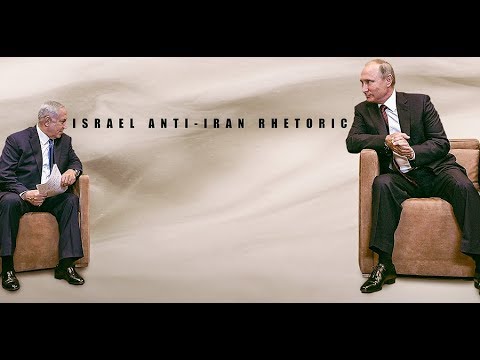
Prime Minister Benjamin Netanyahu has said that Israel felt threatened by Iran’s growing influence in the Middle East. Netanyahu expressed his Iranophobic view in a meeting with Russian President Vladimir Putin in Russia’s Black Sea resort of Sochi on Wednesday. Press TV has asked Scott Rickard, former American intelligence linguist from Tampa, Florida, and Brent Budowsky, a columnist at The Hill from Washington, to give their thoughts on the issue.
Rickard said Tel Aviv is concerned about the fact that the regime could not carry out its old project to spread sectarian divisions and pave the way for dismemberment of the countries in the Middle East region because of the Iranian-led resistance against Israeli policies, not only in the occupied territories of Palestine but also in the whole region.
“Iran is not a threat to Israel whatsoever. The threat that Israel sees is the fact that their Oded Yinon Plan is being put to a hold by Iran,” the intelligence linguist said on Thursday night.
“They (the Israelis) look at Iran as a threat only because they have no influence on their governments and Iran is autonomous and is not under the Zionist influence,” he added.
Since the victory of the Islamic Republic of Iran in 1979, Tehran has been critical of Israel’s policies in the region, whereas “no leaders [of other states] even dared to speak out against Zionism,” Rickard argued. … continue
Blog Roll
 Aletho News
- What’s Behind U.S./Israeli Strikes On Iranian Pistachio Factories?
- Seyed M. Marandi: U.S. Military DIVIDED? Iran’s Secret Defense EXPOSED
- How I fell foul of the BBC thought police
- The End of NATO
- 37 days of war on Iran cost US staggering $42bln, tracker shows
- Baghdad tells Asian refiners, traders to begin loading Iraqi crude amid Iranian exemption
- Under fire, Moscow and Tehran close ranks
- Iran, US receive Pakistan-mediated plan for ceasefire then final deal
- Iran submits demands for end to war as mediators scramble ahead of Trump deadline
- Iran Threatens Retaliatory Strike on Stargate AI Project in UAE
- If Americans Knew
- U.N. experts demand Israel release prominent Gaza doctor after reports of ‘severe torture’
- Israel’s Latest Genocide Is Against the Shias of Lebanon. Why Is the World Silent?
- How Eliot Cohen’s influence over U.S. war-making paved the way for Trump’s war crimes in Iran
- Israelis don’t pay for the weapons we ‘sell’ to them — US taxpayers do
- While Distancing from AIPAC, Most 2028 Democratic Hopefuls Are Still Embracing Israel
- A brief history of the Israeli nuclear program, the open secret at the heart of the Iran war
- Israeli Settlers Killed a Palestinian Farmer on His Own Land, in Front of His Father. Yes, Again
- The US-Israeli War on Science is an Assault on our Future
- 100+ International Law Experts Say US Strikes on Iran Violate UN Charter, Could Be War Crimes
- ‘Vile, Horrifying, Evil’: Trump Threatens to Bomb Nation of 90 Million People ‘Back to the Stone Ages’
- No Tricks Zone
- An Inconvenient Tree: Uncovered In Alps… Europe Much Warmer Than Today 6000 Years Ago
- New Study Reports A 60% Slowdown In Greenland’s Ice Loss Rate In The Last Decade
- Low Intensity Tornado Wrecks Major Solar Farm, Creating A Potential Toxic Dump
- New Study Finds Warming Saves Lives…Cold Temperatures 12 Times More Deadly Than Excess Heat
- German Science Blog Accuses PIK Climate Institute Of Hallucinating Climate Tipping Points
- Devastating Assessment Of Comirnaty Vaccine By Former Senior Pfizer Europe Toxicologist
- New Study: CO2 Is ‘Effectively Negligible’ As An Explanatory Climate Change Factor Since 2000
- Former Pfizer Toxicologist Dr. Helmut Sterz Tells Bundestag Hearing Pfizer Vaccine Should Have Never Been Approved
- Energy Expert: Germany’s Nuclear Phaseout Was A “500 Billion Euro Mistake”
- New Research: South Australia’s Mid-Holocene Sea Surface Temperatures Were 4°C Warmer Than Today
 Aletho News