Former Russian President Dmitry Medvedev was stating the “absolute truth” when he took aim at NATO countries and their support for Ukraine in a scathing recent social media post, French MEP Florian Philippot has said.
The European Parliament member was commenting on a post published by Medvedev on Sunday, in which he pointed to the problems that Ukraine’s Western backers are facing with their economies.
“The West has no money to clean up Florida after Hurricane Milton, no money for French farmers, no money to revive the German industry,” Medvedev, who now serves as deputy head of the Russian Security Council, wrote on Telegram.
These countries, however, still have funds to bankroll “a bunch of drunk and crazy” Ukrainians and to produce weapons “to exterminate the Slavs in the military conflict,” he added.
In a post on X, Philippot, who is leader of the Patriots party, wrote that Medvedev “just smashed the NATO countries by throwing absolute truths at them.” Philippot also took aim at French President Emmanuel Macron, saying he is “also taking a beating” for his recent pledge of a “new check for 3 billion to Zelensky.”
Philippot called on Macron to “stop these checks and these arms shipments,” arguing that Medvedev’s remarks are “factually terribly true!”
During a visit last week to a military camp in eastern France to inspect the training of Ukrainian troops, Macron pledged some €3 billion ($3.3 billion) worth of military aid for Kiev this year. Earlier in 2024, French farmers staged massive protests across the country, demanding that preferential trade rules granted to Kiev be lifted and calling for more government support.
In the US, former President Donald Trump last week accused the administration of President Joe Biden of neglecting the survivors of Hurricane Helene in the southeastern part of the country while sending billions of dollars in aid to Ukraine.
Meanwhile, Germany, which has emerged as one of Kiev’s top backers, is facing a new recession and its economy is set to contract for a second straight year due to shrinking industrial output, high energy prices, and weak foreign demand, according to reports.
October 14, 2024
Posted by aletho |
Economics, Militarism | European Union, France, Germany, Ukraine, United States |
Leave a comment
The Ukraine Defense Contact Group (UDCG) is not expected to reconvene in Germany in the near future despite US President Joe Biden’s planned visit to Berlin in the coming week, German media have reported.
Der Spiegel magazine reported Sunday that Biden would travel to Berlin and meet with the top German officials Friday, more than a week after postponing a planned visit to the country to monitor the arrival of Hurricane Milton in Florida.
However, no Ramstein format meeting will be held in the near future, the ZDF broadcaster reported. Instead, German Chancellor Olaf Scholz announced a new standalone military aid package for Ukraine, which he initially planned to reveal at a Ramstein summit, while hosting Volodymyr Zelensky for talks last week.
Biden was originally due to come to US Air Force Base Ramstein on October 12 for a meeting of Ukraine’s donors from the United Kingdom, Germany and France, but the summit was canceled after Biden scrapped the visit.
The Ukraine Defense Contact Group, also known as the Ramstein group, is an informal bloc of 57 nations (including all 32 NATO members, plus EU, G7 members and other US allies providing military equipment and other aid to Ukraine) was formed in April 2022, after the West moved to sabotage a potential Russia-Ukraine peace deal. The group has met well over a dozen times since its creation, coordinating in the delivery of tens of billions of dollars’ worth of aid to Kiev for the ongoing NATO proxy war against Russia.
The Ramstein group is named after the massive US airbase in southwestern Germany where the group has held some of its meetings, with others held at NATO’s Brussels-based headquarters, or virtually.
The contact group’s main goal has been to facilitate lobbying for more weapons deliveries, and formulate plans for new transfers.
October 13, 2024
Posted by aletho |
Deception | NATO, Ukraine, United States |
Leave a comment
The Making of a Proxy War & the Unavoidable Istanbul+ Agreement
In February 2022, Russia invaded Ukraine to impose a settlement after some NATO countries had undermined the Minsk-2 peace agreement for 7 years. On the first day after the invasion, Zelensky confirmed that Moscow contacted him to discuss negotiations based on restoring Ukraine’s neutrality.[1] On the third day after the invasion, Russia and Ukraine agreed to start negotiations on a peace based on Russian military withdrawal in return for Ukrainian neutrality.[2] Zelensky responded favourably to this condition, and he even called for a “collective security agreement” to include Russia to mitigate the security competition that had sparked the war.[3]
The negotiations that followed are referred to as the Istanbul negotiations, in which Russia and Ukraine were close to an agreement before the US and the UK sabotaged it.
Washington Rejects Negotiations Without Preconditions
In Washington, there were great incentives to use the large proxy army it had built in Ukraine to weaken Russia as a strategic rival, rather than accepting a neutral Ukraine. On the first day after the Russian invasion, when Zelensky responded favourably to start negotiations without preconditions, the US spokesperson rejected peace talks without preconditions as Russia would first have to withdraw all its forces from Ukraine:
“Now we see Moscow suggesting that diplomacy take place at the barrel of a gun or as Moscow’s rockets, mortars, artillery target the Ukrainian people. This is not real diplomacy… If President Putin is serious about diplomacy, he knows what he can do. He should immediately stop the bombing campaign against civilians, order the withdrawal of his forces from Ukraine, and indicate very clearly, unambiguously to the world, that Moscow is prepared to de-escalate”.[4]
This was a demand for capitulation as the Russian military presence in Ukraine was Russia’s bargaining chip to achieve the objective of restoring Ukraine’s neutrality. Less than a month later, the same US spokesperson was asked if Washington would support Zelensky’s negotiations with Moscow, in which he replied negatively as the conflict was part of a larger struggle:
“This is a war that is in many ways bigger than Russia, it’s bigger than Ukraine… The key point is that there are principles that are at stake here that have universal applicability everywhere, whether in Europe, whether in the Indo-Pacific, anywhere in between”.[5]
The US and UK Demand a Long War: Fighting Russia with Ukrainians
In late March 2022, Zelensky revealed in an interview with the Economist that “There are those in the West who don’t mind a long war because it would mean exhausting Russia, even if this means the demise of Ukraine and comes at the cost of Ukrainian lives”.[6]
The Israeli and Turkish mediators confirmed that Ukraine and Russia were both eager to make a compromise to end the war before the US and the UK intervened to prevent peace from breaking out.
Zelensky had contacted former Israeli Prime Minister Naftali Bennett to mediate the peace negotiations with Moscow. Bennett noted that Putin was willing to make “huge concessions” if Ukraine would restore its neutrality to end NATO expansion. Zelensky accepted this condition and “both sides very much wanted a ceasefire”. However, Bennett argued that the US and UK then intervened and “blocked” the peace agreement as they favoured a long war. With a powerful Ukrainian military at its disposal, the West rejected the Istanbul peace agreement and there was a “decision by the West to keep striking Putin” instead of pursuing peace.[7]
The Turkish negotiators reached the same conclusion: Russia and Ukraine agreed to resolve the conflict by restoring Ukraine’s neutrality, but NATO decided to fight Russia with Ukrainians as a proxy. Turkish Foreign Minister Mevlut Cavusoglu argued some NATO states wanted to extend the war to bleed Russia:
“After the talks in Istanbul, we did not think that the war would take this long… But following the NATO foreign ministers’ meeting, I had the impression that there are those within the NATO member states that want the war to continue—let the war continue and Russia gets weaker. They don’t care much about the situation in Ukraine”.[8]
Numan Kurtulmus, the deputy chairman of Erdogan’s political party, confirmed that Zelensky was ready to sign the peace agreement before the US intervened:
“This war is not between Russia and Ukraine, it is a war between Russia and the West. By supporting Ukraine, the United States and some countries in Europe are beginning a process of prolonging this war. What we want is an end to this war. Someone is trying not to end the war. The U.S. sees the prolongation of the war as its interest”.[9]
Ukrainian Ambassador Oleksandr Chalyi, who participated in peace talks with Russia, confirms Putin “tried everything” to reach a peace agreement and they were able “to find a very real compromise”.[10] Davyd Arakhamia, a Ukrainian parliamentary representative and head of Zelensky’s political party, argued Russia’s key demand was Ukrainian neutrality: “They were ready to end the war if we, like Finland once did, would accept neutrality and pledge not to join NATO. In fact, that was the main point. All the rest are cosmetic and political ‘additions’”.[11] Oleksiy Arestovych, the former advisor of Zelensky, also confirmed that Russia was mainly preoccupied with restoring Ukraine’s neutrality.
The main obstacle to peace was thus overcome as Zelensky offered neutrality in the negotiations.[12] The tentative peace agreement was confirmed by Fiona Hill, a former official at the US National Security Council, and Angela Stent, a former National Intelligence Officer for Russia and Eurasia. Hill and Stent penned an article in Foreign Affairs in which they outlined the main terms of the agreement:
“Russian and Ukrainian negotiators appeared to have tentatively agreed on the outlines of a negotiated interim settlement: Russia would withdraw to its position on February 23, when it controlled part of the Donbas region and all of Crimea, and in exchange, Ukraine would promise not to seek NATO membership and instead receive security guarantees from a number of countries”.[13]
Boris Johnson Goes to Kiev
What happened to the Istanbul peace agreement? On 9 April 2022, British Prime Minister Boris Johnson went to Kiev in a rush to sabotage the agreement and cited the killings in Bucha as the excuse. Ukrainian media reported that Johnson came to Kiev with two messages:
“The first is that Putin is a war criminal, he should be pressured, not negotiated with. And the second is that even if Ukraine is ready to sign some agreements on guarantees with Putin, they [the UK and US] are not”.[14]
In June 2022, Johnson told the G7 and NATO that the solution to the war was “strategic endurance” and “now is not the time to settle and encourage the Ukrainians to settle for a bad peace”.[15] Johnson also published an op-ed in the Wall Street Journal arguing against any negotiations: “The war in Ukraine can end only with Vladimir Putin’s defeat”.[16] Before Boris Johnson’s trip to Kiev, Niall Ferguson had interviewed several American and British leaders, who confirmed that a decision had been made for “the conflict to be extended and thereby bleed Putin” as “the only end game now is the end of Putin regime”.[17]
Retired German General Harald Kujat, the former head of the German Bundeswehr and former chairman of the NATO Military Committee, confirmed that Johnson had sabotaged the peace negotiations. Kujat argued: “Ukraine had pledged to renounce NATO membership and not to allow any foreign troops or military installations to be stationed’, while “Russia had apparently agreed to withdraw its forces to the level of February 23”. However, “British Prime Minister Boris Johnson intervened in Kiev on the 9th of April and prevented a signing. His reasoning was that the West was not ready for an end to the war”.[18] According to Kujat, the West demanded a Russian capitulation: “Now the complete withdrawal is repeatedly demanded as a prerequisite for negotiations”.[19] General Kujat explained that this position was due to the US war plans against Russia:
“Perhaps one day the question will be asked who did not want to prevent this war… Their declared goal is to weaken Russia politically, economically and militarily to such a degree that they can then turn to their geopolitical rival, the only one capable of endangering their supremacy as a world power: China… No, this war is not about our freedom… Russia wants to prevent its geopolitical rival USA from gaining a strategic superiority that threatens Russia’s security”.[20]
What was Ukraine told by the US and the UK? Why did Zelensky make a deal given that he was aware some Western states wanted to use Ukraine to exhaust Russia in a long war – even if it would destroy Ukraine? Zelensky likely received an offer he could not refuse: If Zelensky would pursue peace with Russia, then he would not receive any support from the West and he would predictably face an uprising by the far-right / fascist groups that the US had armed and trained. In contrast, if Zelensky would choose war, then NATO would send all the weapons needed to defeat Russia, NATO would impose crippling sanctions on Russia, and NATO would pressure the international community to isolate Russia. Zelensky could thus achieve what both Napoleon and Hitler had failed to achieve – to defeat Russia.
The advisor to Zelensky, Oleksiy Arestovych, explained in 2019 that a major war with Russia was the price for joining NATO. Arestovych predicted that the threat of Ukraine’s accession to NATO would “provoke Russia to launch a large-scale military operation against Ukraine”, and Ukraine could join NATO after defeating Russia. Victory over Russia was assumed to be a certainty as Ukraine would merely be the spearhead of a wider NATO proxy war: “In this conflict, we will be very actively supported by the West—with weapons, equipment, assistance, new sanctions against Russia and the quite possible introduction of a NATO contingent, a no-fly zone etc. We won’t lose, and that’s good”.[21]
NATO turned on the propaganda machine to convince its public that a war against Russia was the only path to peace: The Russian invasion was “unprovoked”; Moscow’s objective was to conquer all of Ukraine to restore the Soviet Union; Russia’s withdrawal from Kiev was not a sign of good-will to be reciprocated but a sign of weakness; it was impossible to negotiate with Putin; and NATO Secretary General Jens Stoltenberg subsequently asserted that “weapons are the way to peace”. The Western public, indoctrinated with anti-Russian propaganda over decades, believed that NATO was merely a passive third-party seeking to protect Ukraine from the most recent reincarnation of Hitler. Zelensky was assigned the role as new Churchill – bravely fighting to the last Ukrainian rather than accepting a bad peace.
The Inevitable Istanbul+ Agreement to End the War
The war did not go as expected. Russia built a powerful army and defeated the NATO-built Ukrainian army; sanctions were overcome by reorienting the economy to the East; and instead of being isolated – Russia took a leading role in constructing a multipolar world order.
How can the war be brought to an end? The suggestions of a land-for-NATO membership agreement ignores that Russia’s leading objective is not territory but ending NATO expansion as it is deemed to be an existential threat. NATO expansion is the source of the conflict and territorial dispute is the consequence, thus Ukrainian territorial concessions in return for NATO membership is a non-starter.
The foundation for any peace agreement must be the Istanbul+: An agreement to restore Ukraine’s neutrality, plus territorial concessions as a consequence of almost 3 years of war. Threatening to expand NATO after the end of the war will merely incentivise Russia to annex the strategic territory from Kharkov to Odessa, and to ensure that only a dysfunctional Ukrainian rump state will remain that is not capable of being used against Russia.
This is a cruel fate for the Ukrainian nation and the millions of Ukrainians who have suffered so greatly. It was also a predictable outcome, as Zelensky cautioned in March 2022: “There are those in the West who don’t mind a long war because it would mean exhausting Russia, even if this means the demise of Ukraine and comes at the cost of Ukrainian lives”.[22]
[1] V. Zelensky, ‘Address by the President to Ukrainians at the end of the first day of Russia’s attacks’, President of Ukraine: Official website, 25 February 2022.
[2] S. Raskin and L. Brown, ‘Ukraine and Russia to meet for peace talks ‘without preconditions,’ Zelensky says’, New York Post, 27 February 2022.
[3] M. Hirsh, ‘Hints of a Ukraine-Russia Deal?’, Foreign Policy, 8 March 2022.
[4] US Department of State, ‘Department Press Briefing’, US Department of State, 25 February 2022.
[5] US Department of State, ‘Department Press Briefing’, US Department of State, 21 March 2022.
[6] The Economist. ‘Volodymyr Zelensky on why Ukraine must defeat Putin’ The Economist, 27 March 2022.
[7] N. Bennett, ‘Bennett speaks out’, YouTube Channel of Naftali Bennett, 4 February 2023.
[8] R. Semonsen, ‘Former Israeli PM: West Blocked Russo-Ukraine Peace Deal’, The European Conservative, 7 February 2023.
[9] CNN, ‘Son dakika… Numan Kurtulmuş CNN TÜRK’te: (Rusya-Ukrayna) Birileri savaşı bitirmemek için çabalıyor’ [Last minute… Numan Kurtulmuş on CNN TÜRK: (Russia-Ukraine) Someone is trying not to end the war], CNN Turk, 18 November 2022.
[10] Breaking the Stalemate to Find Peace: The Russia-Ukraine War – A Geneva Security Debate (youtube.com)
[11] A. Sobczak, ‘Diplomacy Watch: Did the West scuttle the Istanbul talks or not?’, Responsible Statecraft, 12 September 2024.
[12] Guardian, ‘Ukraine has offered neutrality in talks with Russia – what would that mean?’, The Guardian, 30 March 2022.
[13] F. Hill and A. Stent, ‘The World Putin Wants How Distortions About the Past Feed Delusions About the Future’, Foreign Affairs, September/October 2022.
[14] R. Romaniuk, ‘Possibility of talks between Zelenskyy and Putin came to a halt after Johnson’s visit – UP sources’, Ukraniska Pravda, 5 May 2022.
[15] E. Webber, ‘Boris Johnson warns against seeking ‘bad peace’ in Ukraine’, Politico, 23 June 2022.
[16] B. Johnson, ‘For a Quicker End to the Russia War, Step Up Aid to Ukraine’, Wall Street Journal, 9 December 2022.
[17] N. Ferguson, ‘Putin Misunderstands History. So, Unfortunately, Does the U.S.’, Bloomberg, 22 March 2022.
[18] J. Helmer, ‘Whr. Gen. Kujat: Ukraine War is Lost, Germany Now Faces an Angry Russia… Alone’, Veterans Today, 25 January 2023.
[19] Ibid.
[20] Emma, ‘Russland will verhandeln!’ [Russia wants to negotiate!], Emma, 4 March 2023.
[21] A. Arestovich, ‘Voennoe Obozrenie’ [Military Review], Apostrof TV, 18 February 2019.
[22] The Economist. ‘Volodymyr Zelensky on why Ukraine must defeat Putin’ The Economist, 27 March 2022.
October 13, 2024
Posted by aletho |
Timeless or most popular | NATO, Russia, Ukraine, United States |
Leave a comment
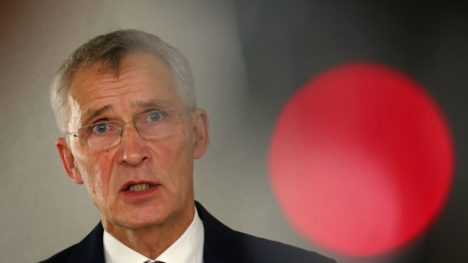
Jens Stoltenberg is finally no longer the leader. This is not necessarily good news, as the new secretary general appears to be even more bellicose than the previous one and promises policies that could easily lead to strategic disaster in the current tensions between the Atlantic alliance and the Russian Federation. However, it is undeniable that one of the worst administrations in NATO’s history – and the one that came closest to an open confrontation with Moscow – has now ended.
Stoltenberg has recently made a number of statements praising his supposed “achievements” as NATO leader. He claims that under his leadership the alliance has achieved its highest numbers of troops on the eastern flank. Stoltenberg has also acclaimed himself for his success in allowing countries such as Finland and Sweden to join NATO as well as significantly expanding the number of troops on combat readiness for the event of a war.
In fact, Stoltenberg seems to be delighting over his own failure. It was under him that NATO saw the start of the continent’s biggest conflict since the World Wars in Europe, reaching a critical point in the regional security architecture. These tensions, which could at any moment escalate to the level of an open war with direct Western involvement, are precisely the consequence of the irresponsible policies implemented during Stoltenberg’s disastrous administration.
NATO’s expansion into Eastern Europe, both in terms of new members and available troops, is not something to be celebrated, but rather lamented. It was precisely this expansion that led to the current conflict. If Stoltenberg were indeed a rational, prudent leader with a strong strategic sense, he would have been able to use diplomacy with the member countries and negotiate a de-escalation of the suicidal policy of “containment” against Russia. But, on the contrary, Stoltenberg endorsed all this and was active in worsening the Ukraine crisis, contributing significantly to the escalation of tensions and the beginning of the current war.
More than that, he failed to stop the warmongering of the member states, allowing NATO to begin full support for the Kiev regime. This support is now at its most critical point, as the alliance’s countries are close to authorizing the use of long-range weapons against Russian civilian targets – which could lead to a nuclear world war. Stoltenberg, even now out of office, is partly to blame for this, as it was under his administration that this anti-Russian madness was launched by NATO.
Furthermore, it must be emphasized that the alliance has never been so fragile. Contrary to what Western war propaganda claims, anti-Russian policies are not strategically beneficial for NATO. On the contrary, in addition to threatening global peace, these measures put the very stability of the alliance at risk. NATO is not “stronger and more united than ever,” as the former secretary general says, but at its most fragile and delicate phase in history.
On the battlefield, Russian forces destroy NATO equipment – and troops disguised as “mercenaries” – every day. The U.S. and Europe no longer have the capacity to continue supporting Kiev continuously, given the large number of losses on the front lines, but at the same time, the alliance is unable to end this support, falling into a vicious cycle of violence and defeats. In addition, countries dissatisfied with the situation, such as Hungary and Slovakia, are already beginning to create a dissident position within NATO itself, threatening the bloc’s long-term stability.
In the end, it was under Stoltenberg that NATO, pursuing irrational “expansion to the East,” reached its current stage of weakness, demoralization, and disunity. And, to make matters even more catastrophic, an open world war could yet emerge as a belated consequence of NATO’s actions over the past ten years.
Instead of celebrating his own failure as a leader, Stoltenberg should simply be grateful that he had the opportunity to leave office before the worst-case scenario arose.
You can follow Lucas on X (formerly Twitter) and Telegram.
October 12, 2024
Posted by aletho |
Militarism | NATO, Ukraine |
Leave a comment
Joe Biden is expected to make some new decisions regarding Ukraine in the weeks leading up to the country’s November elections. The US president was supposed to attend an important meeting of Kiev’s backers in Rammstein, Germany, on October 12, but canceled his visit, citing the need to stay at home due to Hurricane Milton.
What decisions can we expect to be made when it eventually takes place? Most likely, nothing particularly important will happen – here’s why.
A unified stance
Amidst the fog of propaganda, it can be hard to discern true motives, and often these only become clear over time.
After the start of Russia’s military operation, in February 2022, Western media presented a unified and convincing narrative: the entire so-called “free world” came together to defend Ukraine, determined to deliver a strategic blow to Russian President Vladimir Putin and restore the US-led global order. However, these proclamations didn’t match the steps taken by the West. After all, if your goal is to defeat an opponent, shouldn’t you do everything in your power to achieve it?
If the West was counting on a Ukrainian military triumph, it should have provided as much military aid to Kiev as possible. The first step would have been to open up full access to Western weapons arsenals; the second would have been to accept the country into NATO and turn it into a key stronghold on the border with Russia. Even if Putin would have done everything to stop this, such a step would automatically signify his defeat, since even a nuclear strike wouldn’t be able to change the situation and reverse the West’s decision.
Historical examples clearly illustrate this point. For instance, after withdrawing its troops, the West provided South Vietnam with nearly 3,000 aircraft and helicopters, 200 ships, over 2,500 combat boats, more than 1,000 tanks, up to 2,500 towed and self-propelled artillery pieces, and around 100,000 heavy vehicles, along with other equipment. Compare this to the situation in Ukraine, where receiving a dozen outdated fighter jets or two dozen old tanks is a major event.
Let’s take another example. In the aftermath of WWII, and during the Cold War, Türkiye became a key strategic region. Then Soviet leader Joseph Stalin demanded the country’s neutrality and even sought to establish a Soviet naval base in the area of the Bosphorus and Dardanelles straits. The USSR’s former allies, the US and UK, could not allow a Soviet military facility in the Mediterranean Sea, so Türkiye was accepted into NATO just three years after the alliance was formed, despite the fact that the country had nothing to do with the North Atlantic region or ‘Western democracies’. At the time, the Truman Doctrine was in effect, and the US was offering a security umbrella to anyone ‘under threat’ from communism.
The West isn’t buying Zelensky’s ‘Victory Plan’. So what happens next?
Why are things different now? The doctrinal principle that has shaped the West’s policy on Ukraine since 2014 is to prevent Putin from achieving his goals without engaging in a direct military conflict with Russia.
Biden and his administration have consistently stated that their priority is to avoid a full on confrontation with Russia, yet this message has largely been forgotten.
How does this principle align with what we have today – the largest armed conflict in Europe since World War Two, in which the West is fighting Russia by means of the Ukrainian army? Sure, it may not be on the same scale as Vietnam, but the military aid provided to Kiev is still significant.
The answer is simple: the decision-makers in the West – often referred to as the globalists – never truly believed that Ukraine could defeat Russia on the battlefield (Well, let’s say almost never; there was one notable exception, which we’ll discuss later).
Biden’s doctrine implied that the West could achieve its goals through financial and trade strategies. Recognizing that an armed conflict was looming, the globalists spent years developing an “economic nuclear bomb” that was supposed to bring Russia to its knees.
The plan was ambitious: they assumed that unprecedented “sanctions from hell” would essentially block Russia’s access to the outside world, plunging it into economic chaos and ultimately toppling the country’s current ruling elite. Maybe this wouldn’t happen overnight; perhaps it would take years, but the idea was that the Russian government would eventually yield to the demands of a people suffering from the sanctions, and would then yield to Western demands without firing a single shot. This would not only serve as a harsh lesson for Russia but would also send a strong message to the main enemy: China.
Ukraine’s military resistance wasn’t factored into this equation; many will recall that the Pentagon initially estimated that Kiev would fall within three days. Ironically, the US thought that if the 30-million-strong nation found itself under Russian control (the legitimacy of which no country in the world would officially recognize), it would become an unbearable burden for Putin and would only hasten Russia’s economic collapse.
How to lose friends and alienate sponsors: Zelensky is making enemies in America
Moscow failed to achieve its goals through a swift and relatively bloodless military operation, while the West eventually realized that its sanctions didn’t achieve the intended effect either – or perhaps even backfired. After brands like Ikea, Starbucks, and Disney left Russia, the Russian people didn’t rise up to overthrow Putin; and the seizure of rich people’s yachts and mansions didn’t spur a regime change either.
In reality, the globalists dramatically overestimated the West’s influence over economic processes, not only in the so-called Global South but even in their own backyard. Three years into the conflict, they still cannot prevent dual-use and military goods from entering Russia, let alone everyday consumer products. Moscow quickly rerouted its trade flows, bypassing the West, found new partners, prioritized import substitution, and, despite certain challenges, achieved noticeable and sustained growth in its economy and foreign trade. All of this turned out to be beyond Western control.
So, the original plan didn’t work out, and this prompted the West to urgently invent a new strategy.
At the same time, the Russian military didn’t take Kiev, and strategically withdrew from northern Ukraine. Vladimir Zelensky convinced NATO countries that this was the result of the military triumph of the Armed Forces of Ukraine (AFU). He argued that if the West provided Ukraine with enough weapons, it could hold out for a significant period of time. Back then, in the spring of 2022, the outcome of the economic war was still unclear, and with no better ideas on the table, the West settled on the following plan: the Ukrainian army would wear Russia down in combat, while Western sanctions would do the rest.
The Rammstein meetings on Ukraine became a platform for making major decisions regarding military supplies; at the same time, Western diplomats toured the Global South, urging it to join the economic war against Russia.
At that time, there was still no talk of admitting Ukraine into NATO or directly intervening in the conflict. However, at some point, the West came to believe its own propaganda: it came to think of the Russian army as a paper tiger which might be easier to crush than the Russian economy. At that point, Western leaders became convinced that they could force Putin to bend to their will through military rather than economic means.
This shift occurred in the fall of 2022, after Ukraine’s attack on the Crimean Bridge, and advances in Kherson and Kharkov regions, the chaos of partial mobilization in Russia, and the resulting emigration of some dissenters. At that time, some seemed to believe that one more push could bring Putin down.
Riding this wave of optimism, the globalists approved a major Ukrainian counteroffensive. Throughout the winter of 2022-2023, tank, artillery, and missile units were formed, and new, highly motivated Ukrainian brigades were trained in Western Europe. They were supposed to break through to the Sea of Azov and bring Putin to his knees. For this counteroffensive, the West supplied Ukraine with as many weapons as it could without compromising its own interests.
A suitcase without a handle
Everyone knows how this story ended. Kiev’s operation failed and became a turning point in the conflict. Having fallen far short of achieving its military goals, Kiev lost the trust of its backers who realized that they were initially right to think that Ukraine could never win this conflict on the battlefield.
However, it also became clear that Biden’s doctrine was ineffective. Russia couldn’t be economically crushed and it couldn’t be defeated on the battlefield. So what now?
Since the spring of 2022, we have often pointed out that the West has to make a choice: either engage in serious negotiations with Russia or enter into a direct military conflict. However, no one in NATO has been willing to take responsibility for such a decision – neither the increasingly incapacitated Biden, or Western European politicians. Who are equally unfit, but for different reasons.
For now, all the West can do is continue to send aid to Ukraine, while the latter can still try to hold out on the frontlines. At the same time, the West is trying to “test the ground” about possible negotiations with Moscow, but so far this has amounted to little more than wishful thinking. NATO has convinced itself that the Kremlin will be happy to freeze the conflict without any commitments, as long as such an option is put on the table.
What happens when this third gamble fails as well? Will the West finally shake off its lethargy and make a clear choice, or will it continue to go with the flow?
It seems that all the scheduled participants of the Rammstein meeting were probably happy enough at the news of its cancellation. Clearly, neither the outgoing US president nor NATO’s European members have any viable ideas regarding Ukraine. This means that, at least until the US elections, Ukraine will continue to endure reverses, to the accompaniment of the globalists’ hollow rhetoric.
Sergey Poletaev is an information analyst and publicist, co-founder and editor of the Vatfor project.
October 12, 2024
Posted by aletho |
Economics, Militarism | NATO, Ukraine, United States |
Leave a comment
In a new interview with Hungarian newspaper Mandiner, Hungarian Foreign Minister Péter Szijjártó reveals that he actually saw the finished peace treaty that would have ended the war between Ukraine and Russia. He said that all that was missing were the signatures of the two warring parties. He explains why peace never came, laying the blame firmly on the West.
At the end of March, beginning of April 2022, an agreement was almost reached at the peace talks, known as the Istanbul agreements.
“I saw the document that was almost signed, and which, according to the realities of the time, would have ended the war. What happened? The Westerners came and told the Ukrainians to keep fighting, no agreement should be accepted,” said Hungary’s foreign minister.
The decision to prolong the war, which was backed by the West, has had profound global implications and led to hundreds of thousands of deaths across Russia and Ukraine, along with a catastrophic effect on Ukraine’s birth rate and demographic outlook. It has also fueled inflation and economic certainty across Europe.
Szijjártó noted that although the goal of the EU leaders was to bring Russia to its knees at the beginning of 2022, this has not happened to date. He notes that people are dying on the frontlines every day, while the parties have not come any closer to peace.
According to David Arahamiya, the leader of Ukraine’s ruling party, Ukraine was ready to sign the document when Western leaders saw a draft of the negotiations. The Ukrainian politician said then British Prime Minister Boris Johnson allegedly worked hard to nix the potential peace agreement.
Szijjártó says Hungary backs the China-Brazil peace plan and noted that only three countries, Hungary, France and Switzerland, were invited to the inaugural meeting of the Friends of Peace group organized by them.
October 10, 2024
Posted by aletho |
Militarism | European Union, UK, Ukraine |
Leave a comment
Minister of Foreign Affairs and Trade Péter Szijjártó said that Hungary will not be affected by the expected stoppage of the transit of Russian natural gas via Ukraine because the country today primarily gets its gas via the TurkStream pipeline.
His comments came at a press conference following the meeting of the Hungarian-Serbian joint economic committee. He further noted that an “extremely brave decision” was made with Serbia, Bulgaria and Turkey to build this pipeline, with those involved in the construction and preparation facing serious threats from allies who tried to dissuade them from building it.
“If we hadn’t been brave enough, we would be in huge trouble today. If we hadn’t built the TurkStream gas pipeline, today it would be very difficult, if not impossible, to guarantee the security of Hungary’s natural gas supply,” he added.
Already this year, more than 5.6 billion cubic meters of natural gas has arrived via this route, Szijjártó said.
“We are not interested in and have no influence on what the Russians and Ukrainians get or don’t get in terms of gas transit (…) There are Central European countries for whom this is a problem. In recent years, we in Hungary have invested a lot in gas transportation infrastructure, and of course, we help whoever we can,” he said.
Szijjártó also spoke up on Ukraine’s possible NATO membership, saying that the country’s admission today would drag all members into the ongoing war and trigger the outbreak of WWIII because of the article on collective defense.
“I think that anyone who thinks this matter through with common sense does not want to cause this danger. So, the Hungarian position is clear: There is no possibility of Ukraine joining NATO,” he stated.
Szijjártó added that most NATO foreign ministers are in agreement, which he believes is very unfair to Ukraine, as “they don’t tell them honestly what they think about this issue and what their position is.”
October 9, 2024
Posted by aletho |
Aletho News | Bulgaria, Hungary, NATO, Serbia, Ukraine |
Leave a comment
Hungarian Foreign Minister Peter Szijjarto said on Tuesday that he had told Ukrainian Foreign Minister Andrii Sybiha that there was no opportunity for Ukraine to join NATO, and that the majority of NATO members speak against Ukraine’s accession to the alliance behind closed doors.
“Last week I told Ukrainian Foreign Minister [Sybiha], who was in Budapest, that I have no idea what he is being told, have no idea, what he is being convinced of, but when we [NATO members] are behind closed doors, the majority share the view I have just expressed,” the minister said at a press conference following the meeting of the Hungarian-Serbian Joint Economic Committee.
On September 30, Sybiha came to Budapest for a working visit. It was the first visit of a Ukrainian foreign minister to Hungary in four and half years.
On October 3, NATO’s new Secretary General Mark Rutte made an unannounced visit to Kiev. During his visit, Rutte said that “Ukraine is closer to NATO than ever before,” and promised to continue working on this until the country becomes a member of the alliance. Rutte added that he looked forward to the day when Ukraine joins NATO, but did not give any exact date.
Russian President Vladimir Putin has said that NATO’s expansion to include Ukraine would create a direct national security threat to Russia and that Moscow considers the non-aligned status of Ukraine to be extremely important to put an end to the Ukraine conflict.
October 9, 2024
Posted by aletho |
Deception | Mark Rutte, NATO, Ukraine |
Leave a comment
Slovakian Prime Minister Robert Fico has said that his country would not allow Ukraine to join NATO as long as he stays in power. Admitting Kiev into the US-led military alliance would trigger a new world war, he warned in an interview with the broadcaster STVR on Sunday.
“As long as I am the prime minister of the Slovak Republic, I will lead the legislators, whom I have control over as a party chairman, to never agree to Ukraine’s membership in NATO,” Fico said. “Ukraine’s entry into NATO would serve as a good basis for a third world war.”
Fico, a longtime critic of Western military and financial aid to Ukraine, has insisted that the conflict must be resolved through diplomatic means. He repeatedly warned against further escalation with Moscow.
The accession of new countries must be approved by all of NATO’s 32 existing members, with national parliaments voting in favor or against new candidates.
Kiev formally applied to join NATO in September 2022, citing the ongoing conflict with Russia. While many Western states publicly backed Ukraine’s aspirations, they have refused to provide a concrete roadmap or a timetable for accession. Ukrainian leader Vladimir Zenesky acknowledged in July that “we will not be in NATO until the war is over in Ukraine.”
Russia views NATO’s expansion eastward as a security threat and has cited Ukraine’s cooperation with the alliance as one of the main reasons behind the conflict.
President Vladimir Putin warned last month that using Western-supplied longer-range weapons for strikes deep inside Russia would be tantamount to “direct involvement” of NATO in the fighting.
The West is deliberately fueling the fighting in Ukraine because its ultimate goal is to weaken Russia, Slovak Prime Minister Robert Fico has said.
In an interview with Slovak broadcaster STVR on Sunday, Fico expressed concern over the EU’s increasing involvement in the ongoing hostilities between Moscow and Kiev, arguing that the conflict cannot be resolved on the battlefield.
“There is a military conflict in a neighboring country where Slavs are killing each other, and Europe is significantly supporting this killing, which I just don’t understand,” Fico said. He added that the fighting “continues only because it is being strongly supported by the West.”
“The sooner it ends, the better it will be,” he stressed, arguing that the Western efforts to use the conflict to defeat Moscow would fail.
“Everyone thinks that through Ukraine we will bring the Russians to their knees, but this Russophobia does not work. It turns out that this problem cannot be solved militarily,” Fico stated.
Fico, a longtime critic of Western military aid to Kiev, promised to block Ukraine from ever joining NATO. Such a step could lay the groundwork for a potential World War III, he argued.
After winning the parliamentary election last year, Fico’s Smer-SD party has halted the delivery of weapons to Ukraine and has repeatedly called for a diplomatic resolution of the conflict. He pledged to restore trade and political ties with Moscow once the fighting ends, arguing that “the EU needs Russia, and Russia needs the EU.”
Moscow has denounced Western aid to Kiev, insisting that no amount of foreign aid would stop its troops in Ukraine.
October 7, 2024
Posted by aletho |
Militarism | NATO, Slovakia, Ukraine |
Leave a comment
A senior security staff member of the Zaporozhye Nuclear Power Plant – the biggest facility of its kind in Europe – was killed in a car explosion on Friday morning, the Investigative Committee of Russia has said. Ukraine’s military intelligence hailed the incident on Telegram, while stopping short of openly claiming responsibility for it.
According to Russian investigators, an improvised explosive planted under the personal vehicle of Andrey Korotky, a senior security official at the plant, exploded. Korotky succumbed to his injuries at a nearby clinic.
Ukraine’s military intelligence agency (HUR) immediately commented on the incident on Telegram, branding Korotky a “war criminal” and a “collaborationist” for his decision to “voluntarily” cooperate with Russia. It also accused him of organizing “events in support of the Russian… army,” and of joining the United Russia party.
The agency also published a video showing the moment of the explosion and vowed “vengeance” against anyone it deems to be a “war criminal.”
The Zaporozhye station confirmed its staff member’s death and informed the International Atomic Energy Agency (IAEA) about the incident, the plant’s communications director, Evgenia Yashina, told TASS. Station director Yury Chernichuk condemned the incident as a “horrifying, inhumane terrorist act,” and demanded those behind it be brought to justice.
“Attacking the staff members responsible for the security of a nuclear facility is a reckless step beyond any bounds,” Chernichuk stated. The UN nuclear energy watchdog has not yet commented on the incident.
The Investigative Committee said it has opened a criminal case for murder. It did not name any suspects.
The Zaporozhye Nuclear Power Plant has been under Russian control since March 2022. Throughout the conflict, Moscow and Kiev have repeatedly accused each other of shelling the facility, and the Russian Defense Ministry has said that several attempts by Ukrainian assault units to retake it have been repelled.
Zaporozhye Region officially joined Russia, along with three other former Ukrainian territories, in the autumn of 2022. The IAEA has a permanent monitoring mission at the nuclear facility.
In late August, senior Russian diplomat Rodion Miroshnik said staff members at the plant had been facing blackmail. People working at the facility had allegedly been coerced into cooperating with Kiev and passing sensitive data or even committing terrorist acts under the threat of their relatives in Ukraine being killed.
October 5, 2024
Posted by aletho |
Nuclear Power, War Crimes | Russia, Ukraine |
Leave a comment
Croatian President Zoran Milanovic has refused to contribute any troops to the NATO command for providing military aid to Kiev, arguing that this would draw Zagreb into direct conflict with Moscow.
The former Yugoslav republic has been a member of the US-led bloc since 2009. Its right-wing government has sent weapons and helicopters to Ukraine, over the objections of the president, who is a Social Democrat.
”While I am president and the commander in chief, Croatian soldiers, officers and NCOs will not take part in activities that would draw Croatia into a war,” Milanovic said on Thursday.
Milanovic has refused to contribute any personnel to the NATO Security Assistance and Training for Ukraine (NSATU) command, which the bloc established for the purpose of coordinating military aid to Kiev. Zagreb was supposed to send a handful of officers to the 700-strong NSATU staff in Wiesbaden, Germany.
Croatian Prime Minister Andrej Plenkovic has accused the president of “further isolating Croatia on the international scene and destroying its credibility as a NATO member.”
Meanwhile, NATO has reminded Milanovic that the command was agreed at the July summit in Washington and that it would not involve sending any troops to Ukraine. The US-led bloc has argued that spending hundreds of billions of dollars to arm, train and supply Kiev’s war effort doesn’t actually make it a party to the conflict with Russia.
“Whether it’s one soldier or a hundred, wherever they are, this would be a direct command support to a warring party that is not a NATO member, which is out of bounds for Croatian national interests,” Milanovic replied on Thursday that “Croatia has an obligation to help allies, which is what we’ve been doing. Everything else is getting involved in a war, which I will not allow.”
He reminded the bloc that Zagreb has demonstrated its commitment by nearly doubling the number of Croatian troops in the NATO border force, from 300 to 520.
“I answer solely to the people of Croatia, not Washington and Brussels,” Milanovic said.
Under the Croatian constitution, Milanovic has the right to bar the deployment of troops abroad. The cabinet could override the president with a two-thirds vote in the parliament, but the ruling coalition is backed by only 78 out of 151 lawmakers.
Milanovic has long criticized the NATO policy of arming Ukraine to fight against Russia. He has also slammed the EU’s treatment of member states like Poland and Hungary, and accused Brussels of treating Croatia like a “retarded” child.
October 5, 2024
Posted by aletho |
Militarism | Croatia, NATO, Russia, Ukraine |
Leave a comment

 Aletho News