Israeli police removed the United Nations flag from the compound of the UN agency for Palestinian refugees (UNRWA) in occupied East Jerusalem and raised the Israeli flag in its place, the agency’s commissioner-general said Monday, Anadolu reports.
“Today in the early morning, Israeli police accompanied by municipal officials forcibly entered the UNRWA compound in East Jerusalem,” Philippe Lazzarini said on US social media company X.
“Police motorcycles, as well as trucks & forklifts, were brought in & all communications were cut. Furniture, IT equipment & other property was seized,” he added.
Lazzarini continued that the UN flag “was pulled down & replaced with an Israeli flag.”
The agency’s headquarters, located in the Sheikh Jarrah neighborhood of East Jerusalem, had been vacated earlier this year following an Israeli decision.
The UNRWA chief described the Israeli action as “a blatant disregard of Israel’s obligation as a United Nations Member State to protect & respect the inviolability of UN premises.”
Lazzarini noted that the UNRWA personnel were forced to vacate the compound “following months of harassment that included arson attacks in 2024, hateful demonstrations & intimidation, supported by a large-scale disinformation campaign, as well as anti-UNRWA legislation passed by the Israeli parliament in breach of its international obligations.”
“Whatever action taken domestically, the compound retains its status as a UN premises, immune from any form of interference,” he stressed.
Israel “is party to the Convention on the Privileges & Immunities of the UN. The Convention makes UN premises inviolable – in other words, immune from search and/or seizure – and makes UN property and assets immune from legal process.”
“There can be no exceptions. To allow this represents a new challenge to international law, one that creates a dangerous precedent anywhere else the UN is present across the world,” Lazzarini warned.
UNRWA was established by the UN General Assembly more than 70 years ago to assist Palestinians who were forcibly displaced from their land.
The UN agency has been facing severe financial difficulties since Israel launched a defamation campaign against UNRWA, claiming that staff members were involved in the Oct. 7 attacks.
Despite UNRWA’s requests that the Israeli government provide information and evidence to back up the allegations, the agency has received no response. Following Israel’s accusations, several key donor nations, including the US, suspended or paused funding.
December 8, 2025
Posted by aletho |
Ethnic Cleansing, Racism, Zionism, Illegal Occupation | Human rights, Israel, Jerusalem, Palestine, United Nations, Zionism |
Leave a comment
On 24 November 2025, civil-society actors in Chile launched a campaign calling for the expulsion of Israel from United Nations, invoking UN Charter Article 6. They base their call on what they describe as “continuous and systematic violations” of international humanitarian law and repeated breaches of UN resolutions, particularly in light of ongoing Genocide in Gaza and the humanitarian crisis there.
Article 6 of the UN charter states: “A Member of the United Nations which has persistently violated the principles contained in the present Charter may be expelled from the Organization by the General Assembly upon the recommendation of the Security Council.”
This is not the first such call. In September 2025, following Israeli airstrikes on Qatar targeting Hamas officials, Pakistan demanded Israel’s suspension or expulsion from the UN for violating international law and threatening international peace and security. Pakistan’s UN ambassador warned that Israel’s actions risked regional stability and global lawlessness.
Similarly, Francesca Albanese, UN Special Rapporteur on the situation of human rights in the Occupied Palestinian Territories (OPT), has repeatedly urged Israel’s suspension from the UN, Citing the crime of genocide that Israel committed against Palestinians. Targeting UN premises, violating the UN charter and labeling the UN as a terrorist organization.
The UN Charter provides mechanisms for suspension or expulsion of member states under Articles 5 and 6, while Article 6 deals with the expulsion, Article 5 deals with the suspension.
Historically and since its inception after World War II, the UN has never expelled or suspended any state member from the organization under Articles 5 and 6 of the Charter. However, the attempt to block South Africa from attending UNGA meetings was successful, following the U.N. General Assembly approval of the Credentials Committee’s recommendation to cancel the credentials of South Africa, citing the country’s Apartheid-era racial policies.
Multiple attempts were made in order to expel Israel from the UN in the past, but all of them remained unsuccessful due to either political pressure or threats to use the Veto power. The first attempt was in 1975 when Algeria and Syria led a joint campaign aiming for the suspension of Israel from the UNGA, this step requires the recommendation of the UNSC, and due to the U.S veto threat the process was halted. However, alternative ways were explored in order to isolate Israel leading to the UNGA Resolution 3379 adopted in November 1975, which declared Zionism to be “a form of racism and racial discrimination”.
Another attempt was organized by 34 Muslim states and the Soviet Union (USSR). These states sent a letter to the UN General Assembly Credentials Committee requesting Israel’s expulsion from the UNGA. The letter stated:
… “Israel’s continued defiance and its flagrant and persistent violation of the Charter of the United Nations and the principles of international law. Furthermore, we wish to reiterate Israel’s contempt and its defiant challenge to the resolutions of the United Nations as they relate to the question of Palestine and the situation in the Middle East.”
The states further emphasized Israel’s non-adherence to the UN Charter and its violations of obligations, arguing that this makes Israel a non–peace-loving state, which is a requirement for UN membership. This attempt was obstructed by Israel’s allies in the US and western countries. As a result, it failed to gain the required two-thirds majority and remained unsuccessful.
IN 2018, the Kenest passed the Nation-State bill, which in its Article 1(a) states that: “The Land of Israel is the historical homeland of the Jewish People, in which the State of Israel was established. “The president of the Palestinian Authority (PA), Mahmoud Abbas, called the Nations-State Law, “Illegitimate, Racist and apartheid”. Following this, and in response to this Law, the PA lunched an initiative calling for Israel’s expulsion form the UN. However, this initiative failed and did not progress due to the U.S threat to cut UN funding.
Given the above precedent, the campaign to expel Israel from the UN is legally grounded — but faces dıfrrent types of political pressure and institutional barriers. Any real proposal would require: (a) adoption by the Security Council; (b) absence of vetoes by any of the five permanent members (P5). Given current geopolitical alignments, particularly the support for Israel by some P5 states, such a proposal is unlikely to pass.
Nevertheless, the fact that the legal mechanism exists, coupled with mounting global outrage over Israel’s violations and Genocide in Gaza — equip the call with significant symbolic and political weight. Even if immediate expulsion is unrealistic, pressing for such a step can be part of a broader strategy of international isolation, reputational pressure, and incremental delegitimization.
Because expulsion or suspension of a state member from the UN under Article 5 and 6 is difficult, as it must go through the UNSC and most likely face U.S Veto power. As of September 2025, the U.S has used its veto 51 times to shield Israel. Acting within the framework of the UN General Assembly has a greater chance of success, particularly given the recent overwhelming support for Palestine and the noticeable shift in many states’ positions in favour of Palestine.
In May 2024, by an overwhelming majority vote, the UN General Assembly adopted a resolution supporting the Palestinians’ right to admission to the UN and to obtain full membership in the organization. The resolution passed with 143 votes in favor, 9 against, and 25 abstentions. Similarly, in September 2024, the UNGA adopted a resolution calling on Israel to bring an end without delay its unlawful presence, the resolution passed with 124 votes in favour,14 against, and 43 abstentions. On 12 September 2025, the “New York Declaration” supporting a two-state solution was endorsed by 142 UN member states, with just 10 votes against and 12 abstentions.
As with the South Africa case, the credentials of Israel’s delegation can be blocked following a letter to the UNGA Credentials Committee and a two-thirds majority vote by UNGA member states. This scenario is likely to succeed, given the growing global support for the rights of the Palestinian people within the UN.
There is another alternative: appealing to the UN General Assembly resolution “Uniting for Peace.” Adopted on 3 November 1950 (during the Korean War), it was designed to empower the GA when the Security Council is deadlocked by vetoes. Under this mechanism, the GA can convene special emergency sessions and recommend collective measures—including economic, political, or even armed action—against states threatening peace when the UNSC fails to act.
Since proclaiming itself a state on historic Palestine, Israel has repeatedly been accused of war crimes, genocide, and violations of the UN Charter, posing serious threats to international peace. After October 7th, 2023 until today, over 100,000 Palestinians have been killed by Israel, more than 1.9 million Gazans and tens of thousands of West Bankers have been forcibly displaced by Israel, Gaza’s healthcare and educational systems massively destroyed by Israel. Within a year or less, Israel has attacked seven countries, violating their sovereignty and territorial integrity, including, Lebanon, Syria, Yemen, Qatar, Iran, Tunisia, and the occupied Palestinian territories. Israel continues to expand its occupation and settlements into the West Bank and Syria, planning de jure annexations and maintaining indefinite military presence.
Given that Israel faces no serious international pressure and collective sanctions, the UN and international community—including states and NGOs—must apply maximum pressure through all possible means. The call to expel Israel from the UN or the suspension of its membership are not a rhetorical measure only — they rest on the clear text of Articles 5 and 6 of the UN Charter. Yet, Political pressure, institutional realities — especially the veto power of the Security Council’s permanent members can halt any efforts in this regard.
In this very critical moment in the prolonged legitimate struggle of the Palestinian people against the apartheid regime in Israel, calling for Israel’s expulsion or suspension from the UN, or blocking its credentials in the UNGA, is not only justified but necessary to stop the ongoing genocide and grave violations. States and the international community, through the UN, are obligated to translate diplomatic commitments into tangible actions—isolating Israel politically, legally, economically, and diplomatically—and holding it accountable for its crimes and violations of the UN Charter and international law.
November 27, 2025
Posted by aletho |
Ethnic Cleansing, Racism, Zionism, War Crimes | Israel, United Nations, United States, Zionism |
Leave a comment
Iran’s UN ambassador on November 27 urged the Security Council to act after Washington publicly confirmed its direct role in June’s joint US-Israeli strikes on Iranian territory, calling the operation an unlawful act of aggression that demands full accountability and reparations.
In a letter addressed to the UN secretary-general and Security Council president, Iranian Ambassador Amir Saeid Iravani said the latest US Air Force admission – acknowledging that US F-35s penetrated Iranian airspace and escorted B-2 bombers to strike Fordow, Natanz, and Isfahan – confirms “once again” that the US directly participated with Israel in attacks on Iran’s safeguarded nuclear facilities.
He cited the 24 November US Air Force statement announcing that “In June, the 34th was called upon to escort a strike package, including B-2 Spirit bombers, to strike underground nuclear sites at Fordow, Natanz, and Isfahan during Operation Midnight Hammer,” and that “On 22 June, a formation of F-35s … was the first aircraft to penetrate Iranian airspace.”
Iravani noted that these disclosures align with US President Donald Trump’s earlier remarks openly asserting Washington’s leading role.
The ambassador described the 12-day campaign as an act that targeted Iran’s sovereignty and territorial integrity in violation of Article 2(4) of the UN Charter, adding that the operation included deliberate attacks on civilians and civilian sites.
He wrote that the US is obligated under established international law to provide full reparation, including restitution and compensation for all material and moral damage.
According to Iravani, Washington’s admission also establishes the individual criminal responsibility of US officials involved in the operation.
He reiterated Tehran’s “full and unequivocal” right to pursue all legal avenues to secure accountability and recover losses resulting from what he called an internationally wrongful act.
Iravani urged the Security Council and the wider UN system not to remain silent, saying they must take measures consistent with their responsibilities to uphold international peace and security, ensure accountability of both the US and Israel, and bring those responsible to justice. He requested that the letter be circulated as an official UN Security Council document.
November 27, 2025
Posted by aletho |
War Crimes, Wars for Israel | Iran, Israel, United Nations, United States, Zionism |
Leave a comment
Gaza’s hastily assembled ceasefire agreement was designed less to bring genuine relief than to test new strategies aimed at dismantling the Palestinian Resistance while granting the Israeli military a much-needed pause. The vagueness of the plan put forward by US President Donald Trump only underscores this reality, and yet the so-called international community is, shamefully, choosing to go along with it.
The UNSC’s recent resolution 2803 is nothing short of a green light for a US-led international regime change operation, which seeks to implicate a multi-national military force in the Gaza genocide as a desperate attempt to finish off the Palestinian Resistance for the Israelis. The only reason such a solution is being attempted is that the Zionist entity failed.
From the outset, following the Hamas-led operation on October 7, 2023, the Israelis made it clear that their intention was genocide. Their reputation and pillars on which the regime was built have been shaken. It suddenly appeared as if a military solution to the occupying entity was within reach. So, desperately, they accelerated their goals and reached the natural conclusion of what such a settler-colonial project seeks to achieve: the total annihilation of the indigenous population.
The ethno-supremacist mindset of the Zionist regime came out in its most extreme form because the project itself appeared to be under threat. Their solution was annihilation, a Gaza Final Solution. In their thinking, the mass slaughter of civilians and total destruction of Gaza’s infrastructure would eliminate not only the Palestinian cause but also dismantle the entire regional notion of resistance.
In short, they failed. What instead happened is that the people of Gaza never gave up, and neither did their willingness to resist at all costs. Suddenly, the Israelis found themself entangled in a Vietnam War scenario.
The Palestinian Resistance is a force that, according to its own estimates, consisted of no more than around 50,000 fighters, armed with domestically made weapons, most of which were crafted out of the explosives the Israelis themselves dropped on the besieged territory. Gaza is a territory of the displaced, the downtrodden, the starved, the dreamers who strived to break free.
When the genocide began, this guerrilla fighting force stood no chance of fighting a conventional war and so depended on ambushes. The side they were at war with consisted of hundreds of thousands of Israeli soldiers, equipped with the most high-tech killing machines on earth and backed by the entire Western world’s governments, including the planet’s top military superpower, the United States.
Yet, with all their equipment, technology, intelligence agencies, and superiority on the battlefield, they were incapable of defeating the Resistance that fought from tunnels and amongst the rubble of their destroyed neighbourhoods. Instead of targeting the fighters and going after them directly, the Zionist regime targeted the civilian population, believing that if the people were defeated, then the Resistance would follow.
The world watched this live-streamed genocide and naturally identified with the underdogs, many seeing a reflection of their own humanity in the people of Gaza. Although it took years for this to fully unfold, even the population of the most powerful superpower on earth was captivated by this small group of people, so much so that the domestic politics of the average American was fundamentally altered by it.
While their governments continued to back the Israelis and bend to the commands of lobbyists and billionaires, the populations of these nations began to identify with the cause of the Palestinians, the Palestinian cause, the cause of the people of Gaza…
Over time, the Israeli regime attempted to implement countless strategies to finish off the Palestinians of Gaza. They pushed them from north to south, then to the center of the besieged coastal enclave. They flattened everything in sight, took out prominent leaders, assassinated the truth-telling journalists, and destroyed the hospitals and shelters. They starved Gaza; they employed collaborators both inside and outside of the strip.
The Zionists peddled lie after lie; they took thousands of captives, mocked dead Palestinian women by parading around in their underwear. They committed mass rape, sexual humiliation, and created torture centers. All of the so-called Muslim leaders, with the exception of very few, betrayed them and aided the Israelis in committing their genocide.
The Israelis attempted to implement the “General’s Plan” in late 2024, but they failed. They tried “Operation Gideon’s Chariots” and then “Operation Gideon’s Chariots 2”, or the plan to occupy Gaza City. They failed.
Meanwhile, their own society decayed from within and was driven to even greater extremist ideology, their economy sank, and major investments were cleared up. The northern settlements were partially destroyed, and the domestic tourism industry in the north and south collapsed. Amid this chaos and failure, the Israeli leadership has turned to fighting on front after front.
Despite managing to pull off tactical victories against Hezbollah in Lebanon and even Iran, through intelligence operations and assassinations, they were unable to secure any strategic victory. Their attempt to degrade Iran failed, and they were forced into a ceasefire, sent back to study how to advance their agenda through a new round of attacks.
Out of total desperation, the Israelis launched a new propaganda campaign targeting conservatives in the United States and across the Western World, but are incapable of stopping the rapid loss of support for them. They are now trying to stir tensions between right-wing Westerners and Muslims, fearmongering about so-called “Islamic terrorism” using the “War on Terror” playbook, all to divert attention from their crimes in Gaza and the fact that their lobby groups are working toward imposing mass censorship.
All of this considered, the Europeans and Arab regimes began searching for an answer to save the Israelis from themselves, to reward them for their genocide. Then came the United States, which offered its even more pro-Israeli slant on the Saudi-French “New York Declaration” that was voted on unanimously at the United Nations General Assembly.
The leaderships of the world were exposed, and the Gaza genocide was transformed into a major strategic debacle. These unrepresentative rulers were not willing to end their support and relationships with the genocidal entity, so they devised a plot to help it eliminate what had become their own enemy. Regular people around the world identify with the Palestinians, while their leaders are enablers and supporters of genocide, even if they don’t say it out loud and even if they offer weak statements condemning their Israeli allies.
This is where UNSC 2803 comes in. It allows these nations to help the Israelis finish their genocidal project and eliminate the Palestinian cause once and for all. Yet, they face a major problem: there are only three options for ending this struggle: Either the Israelis totally destroy the Palestinian people along with the regional Resistance, sentencing the survivors to permanent occupation and exile; they agree to a so-called “two-state solution”; or they are themselves defeated.
Almost all of the Israeli regime’s allies seek the “two-state solution”, an option that the Zionist entity will not accept. Therefore, all of these vague schemes as to how to conduct a successful multi-national regime change operation in the Gaza Strip are bound to fail, which is why Phase 2 of the ceasefire is nearly impossible to implement fully. It will be a total disaster and only create further issues for those nations involved in the so-called “International Stabilization Force,” or what should be accurately dubbed the International Invasion Force.
Failing the implementation of Donald Trump’s regime change plan, the Israelis will eventually return to the only thing they know how to do: conducting genocide from a distance. This period is being used to experiment with different plans, while giving the Israeli military time to recover. It is very likely that this will enormously backfire.
November 25, 2025
Posted by aletho |
Ethnic Cleansing, Racism, Zionism, War Crimes | Gaza, Israel, Middle East, Palestine, United Nations, United States, Zionism |
Leave a comment
The United Nations Security Council (UNSC) passed a regime change resolution against Gaza this Monday, effectively issuing a mandate for an invasion force to enter the besieged coastal enclave and install a US-led ruling authority by force.
Passing with 13 votes in favour and none in defiance, the new Security Council resolution has given the United States a mandate to create what it calls an “International Stabilization Force” (ISF) and “Board of Peace” committee to seize power in Gaza. US President Donald Trump has hailed the resolution as historic, as Israeli Prime Minister Benjamin Netanyahu’s government has stood in opposition to an element of the resolution that mentions Palestinian Statehood.
In order to understand what has just occurred, it requires a breakdown of the resolution itself and the broader context surrounding the ceasefire deal. When these elements are combined, it becomes clear that this resolution is perhaps one of the most shameful to have passed in the history of the United Nations, casting shame on it and undermining the very basis on which it was formed to begin with.
An Illegal Regime Change Resolution
In September of 2025, a United Nations commission of inquiry found Israel to have committed the crime of genocide in the Gaza Strip.
For further context, the International Court of Justice (ICJ), the most powerful international legal entity and organ of the UN, ruled that Israel is plausibly committing genocide and thus issued orders for Tel Aviv to end specific violations of international law in Gaza, which were subsequently ignored.
Taking this into consideration, the UN itself cannot claim ignorance of the conditions suffered by the people of Gaza, nor could it credibly posit that the United States is a neutral actor capable of enforcing a balanced resolution of what its own experts have found to be a genocide.
This resolution itself is not a peace plan and robs Palestinians of their autonomy entirely; thus, it is anti-democratic in its nature. It was also passed due in large part to threats from the United States against both Russia and China, that if they vetoed it, the ceasefire would end and the genocide would resume. Therefore, both Beijing and Moscow abstained from the vote, despite the Russian counterproposal and initial opposition to the resolution.
It also gives a green light to what the US calls a “Board of Peace”, which will work to preside over governing Gaza during the ceasefire period. The head of this board is none other than US President Trump himself, who says he will be joined by other world leaders. Former British Prime Minister, Tony Blair, who launched the illegal invasion of Iraq, has been floated as a potential “Board of Peace” leader also.
On February 4 of this year, President Trump vowed to “take over” and “own” the Gaza Strip. The American President later sought to impose a plan for a new Gaza, which he even called the “Gaza Riviera”, which was drawn up by Zionist economist Joseph Pelzman. Part of Pelzman’s recommendations to Trump was that “you have to destroy the whole place, restart from scratch”.
As it became clear that the US alone could not justify an invasion force and simply take over Gaza by force, on behalf of Israel, in order to build “Trump Gaza”, a casino beach land for fellow Jeffrey Epstein-connected billionaires, a new answer was desperately sought. Then came a range of meetings between Trump administration officials and regional leaderships, aimed at working out a strategy to achieve their desired goals in Gaza.
After the ceasefire was violated in March by the Israelis, leading to the mass murder of around 17,000 more Palestinians, a number of schemes were being hatched and proposals set forth. The US backed and helped to create the now-defunct so-called “Gaza Humanitarian Foundation” (GHF) program, which was used to privatize the distribution of aid in the territory amidst a total blockade of all food for three months.
Starving Palestinians, who were rapidly falling into famine, flocked to these GHF sites, where they were fired upon by US private military contractors and Israeli occupation forces, murdering over 1,000 civilians. Meanwhile, Saudi Arabia and France were busy putting together what would become the “New York Declaration” proposal for ending the war and bringing Western nations to recognize the State of Palestine at the UN.
Suddenly, seemingly out of nowhere, here came Trump’s so-called “peace plan” that was announced at the White House in October. This plan appeared at first to be calling for a total end to the war, a mutual prisoner exchange and the withdrawal of Israeli forces from Gaza in a phased approach.
From the outset, Trump’s “20-point plan” was vague and impractical. Israel immediately violated the ceasefire from the very first day and has murdered nearly 300 Palestinians since then. The first phase of the ceasefire deal was supposed to end quickly, ideally within five days, but the deal has stalled for over a month.
Throughout this time, it has become increasingly clear that the Israelis are not going to respect the “Yellow Line” separation zone and have violated the agreement through operating deeper into Gaza than they had originally agreed to. The Israeli-occupied zone was supposed to be 53% of Gaza; it has turned out to be closer to 58%. Aid is also not entering at a sufficient rate, despite US and Israeli denials; this has been confirmed by leading rights groups and humanitarian organizations.
In the background, the US team dealing with the ceasefire deal that is headed by Jared Kushner and Steve Witkoff has been juggling countless insidious proposals for the future of Gaza. Even publicly stating that reconstruction will only take place in the Israeli-controlled portion of the territory, also floating the idea that aid points will be set up there in order to force the population out of the territory under de facto Hamas control. This has often been referred to as the “new Gaza plan”.
As this has all been in the works, including discussions about bringing back the disastrous GHF, the Israelis have been working alongside four ISIS-linked collaborator death squads that it controls and who operate behind the Yellow Line in Gaza.
No mechanisms have been put in place to punish the Israelis for their daily violations of the ceasefire, including the continuation of demolition operations against Gaza’s remaining civilian infrastructure. This appears to be directly in line with Joseph Pelzman’s plan earlier this year to “destroy the whole place”.
The UNSC resolution not only makes Donald Trump the effective leader of the new administrative force that will be imposed upon the Gaza Strip, but also greenlights what it calls its International Stabilization Force. This ISF is explicitly stated to be a multi-national military force that will be tasked with disarming Hamas and all Palestinian armed groups in the Gaza Strip.
The US claims it won’t be directly involved in the fighting with “boots on the ground”; it has already deployed hundreds of soldiers and has been reportedly building a military facility, which they deny is a base, but for all intents and purposes will be one. Although it may not be American soldiers killing and dying while battling Palestinian resistance groups, they will be in charge of this force.
This is not a “UN peacekeeping force” and is not an equivalent to UNIFIL in southern Lebanon; it is there to carry out the task of completing Israel’s war goal of defeating the Palestinian resistance through force. In other words, foreign soldiers will be sent from around the world to die for Israel and taxpayers from those nations will be footing the bill.
The only reason why Israel has reservations about this plan is because it included a statement claiming that if the Palestinian Authority (PA) – that does not control Gaza and is opposed by the majority of the Palestinian people – undergoes reforms that the West and Israel demand, then conditions “may finally be in place for a credible pathway to Palestinian self-determination and statehood.” A keyword here is “may”, in other words, it is not binding and was simply added in to give corrupted Arab leaderships the excuse to vote yes.
Hamas and every other Palestinian political party, with the exception of the mainstream branch of Fatah that answers to Israel and the US, have opposed this UNSC resolution. Hamas even called upon Algeria to vote against it; instead, the Algerian leadership praised Donald Trump and voted in favor. Typical of Arab and Muslim-Majority regimes that don’t represent the will of their people, they all fell in line and bent over backwards to please Washington.
It Won’t Likely Work
As has been the story with every conspiracy hatched against the people of Gaza, this is again destined to fail. Not only will it fail, but it will likely backfire enormously and lead to desperate moves.
To begin with, the invasion force, or ISF, will be a military endeavour that will have to bring together tens of thousands of soldiers who speak different languages and have nothing in common, in order to somehow achieve victory where Israel failed. It is a logistical nightmare to even think about.
How long would it take to deploy these soldiers? At the very least, it’s going to take months. Then, how long would this process take? Nobody has any clear answers here. Also, what happens if Israel begins bombing again at any point, for example, if there is a clash that kills Israeli soldiers? What would these nations do if Israeli airstrikes killed their soldiers or put them in harm’s way?
Also, tens of thousands of soldiers may not cut it; if the goal is to destroy all the territory’s military infrastructure, they may need hundreds of thousands. Or if that isn’t an option, will they work alongside the Israeli military?
It is additionally clear that nobody knows where all the tunnels and fighters are; if Israel couldn’t find them, then how can anyone else? After all, the US, UK, and various others have helped the Israelis with intelligence sharing and reconnaissance for over two years to get these answers.
Finally, when Arab, European, or Southeast Asian soldiers return to their nations in body bags, how do their regimes justify this? Will the President or Prime Minister of these nations have to stand up and tell their people… “sorry guys, your sons and daughters are now in coffins because Israel needed a military force capable of doing what they failed to do, so we had to help them complete their genocidal project”. Also, how many Palestinian civilians are going to be slaughtered by these foreign invaders?
As for the plan to overthrow Hamas rule in Gaza, the people of the territory will not accept foreign invaders as their occupiers any more than they will accept Israelis. They are not going to accept ISIS-linked collaborators as any kind of security force either. Already, the situation is chaotic inside Gaza, and that is while its own people, who are experienced and understand their conditions, are in control of managing security and some administrative issues; this includes both Hamas and others who are operating independently of it, but inside the territory under its de facto control.
Just as the Israeli military claimed it was going to occupy Gaza City, laying out countless plans to do this, to ethnically cleanse the territory and “crush Hamas”, the US has been coordinating alongside it throughout the entirety of the last two years. Every scheme has collapsed and ended in failure.
It has been nearly a month and a half, yet there are still no clear answers as to how this Trump “peace plan” is supposed to work and it is clear that the Israelis are coming up with new proposals on a daily basis.
There is no permanent mechanism for aid transfers, which the Israelis are blocking. There is no clear vision for governance. The “two Gazas” plan is not even part of the ceasefire or Trump plan, yet it is being pursued in an incoherent way. The ISF makes no sense and appears as poorly planned as the GHF. Hamas and the other Palestinian factions will not give up their weapons. There is no real plan for reconstruction. The Israelis are adamant that there will be no Palestinian State and won’t allow any independent Palestinian rule of Gaza, and the list of problems goes on and on.
What it really looks like here is that this entire ceasefire scheme is a stab in the dark attempt to achieve Israel’s goals while also giving its forces a break and redirecting their focus on other fronts, understanding that there is no clear solution to the Gaza question for now.
The United Nations has shown itself over the past two years to be nothing more than a platform for political theatre. It is incapable of punishing, preventing, or even stopping the crime of all crimes.
Now that international law has suffocated to death under the rubble of Gaza, next to the thousands of children who still lie underneath it, the future of this conflict will transform. This UNSC vote demonstrates that there is no international law, no international community, and that the UN is simply a bunch of fancy offices, which are only allowed to work under the confines of gangster rule.
If the Palestinian resistance groups feel as if their backs are against the wall and an opportunity, such as another Israeli war on Lebanon, presents them the opportunity, then there is a high likelihood that a major military decision will be made. In the event that this occurs, it will be this UNSC resolution that is in large part responsible.
When the suffering in Gaza finally ends, whether that is because Israel obliterates all of its regional opposition and exterminates countless other civilians in its way, or Israel is militarily shattered, the UN should be disbanded as was the League of Nations. It is a failed project just as that which preceded it. Something new must take over from it.
– Robert Inlakesh is a journalist, writer, and documentary filmmaker. He focuses on the Middle East, specializing in Palestine. He contributed this article to The Palestine Chronicle.
November 20, 2025
Posted by aletho |
Ethnic Cleansing, Racism, Zionism, War Crimes | Gaza, Israel, Palestine, United Nations, United States, Zionism |
Leave a comment
The UN Security Council approved the US’s Gaza ceasefire and international stabilization force plans on Monday. Russia and China abstained from the vote. Sputnik asked renowned Iranian-American political analyst Mohammad Marandi for his reaction.
The US Gaza plan is “a fake peace plan that is approved by the UN Security Council will only enhance the strength of the United States and the Israeli regime to further abuse Palestinians and to push Palestinians out of Gaza,” Marandi told Sputnik.
The plan proposes what the observer fears amounts to “an international occupation” of the Strip, with “no mention of Palestinian independence” in the US resolution.
“With this fake mantle of the UN Security Council, they will be able to do a lot of harm in the name of the international community,” Marandi emphasized.
The US “has no intention of allowing the Palestinian people to have a state.” The stabilization force will amount to “international occupation,” according to the observer.
The US is “a party to the holocaust in Gaza, and so are all Western allies of the Israeli regime, even regional countries that have preserved political and economic ties with the regime over the last two years… they’re all complicit in the genocide in Gaza,” Marandi stressed, pointing out that without US support, “the Israeli regime, Netanyahu, would not be able to carry out the mass murders that we saw on a daily basis, [and] continue to see… as we speak now.”
The observer characterized last month’s Gaza Peace Summit in Egypt as a shameful “monkey show,” and suggested that attendees “literally sold out the Palestinian people” to try to get in the US president’s good graces.
Russian representative Vassily Nebenzia said the Security Council resolution on Gaza passed Monday was “reminiscent of colonial practices and the British mandate for Palestine” that was “granted by the League of Nations, when the opinions of the Palestinians themselves were not taken into account whatsoever.”
He also warned that the lack of clarity about the stabilization force’s mandate could make it into an unwitting party to the conflict.
Russia and China abstained from Monday’s vote, but did not veto the resolution outright in light of the desire expressed by the Palestinian Authority and regional countries to avoid a resumption of bloodshed in the besieged Strip.
November 18, 2025
Posted by aletho |
Ethnic Cleansing, Racism, Zionism | Gaza, Israel, Palestine, United Nations, United States, Zionism |
Leave a comment
The Palestinian people are closely following developments over a US draft resolution on international forces in Gaza, with Palestinian leaders expressing hope that Algeria will take a firm stance against the measure, which they say undermines Palestinian sacrifices and aspirations.
A senior Hamas official told Al Mayadeen on Sunday that the Palestinian people are hoping for an “honorable stance” from Algeria in rejecting the US draft resolution regarding international forces.
The official added that Hamas has confidence that Algeria will oppose the resolution, which they said inflicts injustice on the sacrifices and aspirations of the Palestinian people, describing the anticipated Algerian position as a source of hope for Palestinians in preventing any new international trusteeship over Gaza.
Palestinian factions call on Algeria to stand for Gaza at UNSC
Meanwhile, Palestinian Resistance factions in Gaza issued a statement expressing deep concern over the ongoing efforts at the United Nations to pass a US draft resolution proposing the deployment of international forces in the Strip. The factions described the resolution as a disguised attempt to impose a new form of occupation on Gaza and to legitimize foreign trusteeship of the Palestinian cause.
In the statement, the factions called on the Algerian government and people to maintain their long-standing principled support for Palestine and to reject any initiatives that would undermine Gaza’s identity or the right of Palestinians to self-determination. They described Algeria’s historical position on Palestine as a source of genuine hope for the Palestinian people and a reflection of the Arab world’s independent popular stance.
The factions stressed that any foreign intervention in Gaza, regardless of its title or justification, constitutes a “violation of Palestinian sovereignty and perpetuates the suffering of the local population.” They emphasized that lasting security and stability can only be achieved by ending the occupation, lifting the blockade, and respecting the inalienable rights of the Palestinian people.
Expressing confidence in Algeria’s supportive position, the statement urged all Arab and Muslim countries, as well as free peoples around the world, to stand against the US resolution and reject any form of foreign tutelage or intervention, defending Gaza’s right to freedom, dignity, and independence.
November 16, 2025
Posted by aletho |
Ethnic Cleansing, Racism, Zionism | Algeria, Gaza, Hamas, Israel, Palestine, United Nations, United States, Zionism |
Leave a comment
Mohammed al-Farah, a member of the Political Bureau of Yemen’s Ansar Allah movement, commented on the recent UN Security Council decision to extend sanctions on Yemen, stating that Yemen would respond in kind to anyone who attacks its people’s interests or attempts to undermine its sovereignty.
He emphasized, in this context, that Yemenis will not hesitate to defend their rights, religion, and national dignity by all legitimate means.
In a post on X, al-Farah accused the Security Council of perpetuating “the worst example of double standards,” noting that it has long turned a blind eye to crimes of genocide in Gaza, even supporting “Israel” while ignoring the bloodshed, and covering up the blockade and aggression against Yemen without any moral or legal stance.
He continued, saying the council “continues to apply double standards while Gaza is being devastated under two years of bombing and blockade with US and Western weapons,” reminding how “Yemen has been under siege for a decade.”
Al-Farah described the council as a platform for advancing Western interests, where “human rights are defined only as Western human rights and international interests are reduced to those of Washington alone.”
NGOs; culprits in espionage operations in Yemen
The Ansar Allah official also warned that some NGOs operating in Yemen have engaged in “dangerous practices”, including espionage on behalf of “Israel” under the guise of humanitarian work, exposing what he called the extent of “Zionist exploitation of UN institutions.”
Al-Farah, however, praised Russia and China for refusing to renew sanctions on Yemen, contrasting their stance with what he described as the “moral failure” of the UN Security Council. He said Moscow and Beijing’s positions reflect a “humanitarian and ethical awakening” and awareness of the dangers of US policies that use sanctions to subjugate nations.
At the same time, he expressed hope that Russia and China’s position would amount to a definitive rejection and veto of the resolution, describing it as a stand that “rejects the exploitation of the Security Council and restores some balance against Western dominance.”
Sanctions on Yemen are merely tools for Israeli objectives
Al-Farah also criticized the West and the United States for openly supporting “Israel” with weapons and financial aid while shielding it politically, arguing that the proposed sanctions on Yemen are merely “tools to serve Zionist objectives and punish the Yemeni people for their resilience, independent decision-making, and solidarity with Gaza.”
He concluded by reaffirming Yemen’s steadfast support for Gaza and for oppressed communities across the region, pledging to continue opposing Western and US hegemony over the countries and peoples of the region without hesitation.
UNSC extends sanctions on Yemen
On November 14, the UN Security Council approved a resolution extending financial sanctions and a travel ban on Yemen for another year, until November 14, 2026, while also extending the mandate of the panel of experts supporting the sanctions committee until December 15, 2026.
The resolution, adopted by a 13-member majority with Russia and China abstaining, renews Yemen’s international sanctions under Resolution 2140 for an additional year. It maintains frozen assets and travel restrictions on designated individuals and entities and extends the mandate of the expert panel overseeing Yemen sanctions until mid-December 2026.
The Security Council imposes these sanctions on Yemen under US pressure and under the cover of Chapter VII of the UN Charter, through Resolutions 2140 (2014) and 2216 (2015).
The UN Security Council first imposed sanctions on Yemen in 2014 through Resolution 2140, targeting individuals and entities linked to destabilizing activities during the country’s ongoing conflict.
These measures included asset freezes and travel bans aimed at those accused of threatening Yemen’s stability or obstructing peace efforts.
In 2015, Resolution 2216 expanded the sanctions framework, further restricting financial and travel activities of key figures aligned with armed groups and reinforcing the Council’s oversight through a dedicated panel of experts.
November 15, 2025
Posted by aletho |
Ethnic Cleansing, Racism, Zionism, War Crimes | China, Russia, United Nations, Yemen, Zionism |
Leave a comment
Russia has proposed its own draft resolution on the Gaza Strip to counter a US proposal submitted to the UN earlier this month, Reuters reported on 13 November.
In a note to the UN Security Council (UNSC) members seen by the outlet, Russia’s UN representative said Moscow’s “counter-proposal is inspired by the US draft.”
“The objective of our draft is to enable the Security Council to develop a balanced, acceptable, and unified approach toward achieving a sustainable cessation of hostilities,” the note went on to say.
According to the report, the Russian draft requests that the UN Secretary General identify “options” for the International Stabilization Force (ISF), which is supposed to be deployed to Gaza as part of US President Donald Trump’s ceasefire plan.
“Attempts to sow discord now – when agreement on this resolution is under active negotiation – has grave, tangible, and entirely avoidable consequences for Palestinians in Gaza. The ceasefire is fragile and we urge the Council to unite and move forward to secure the peace that is desperately needed,” said a US mission spokesperson in response to Russia’s proposal.
The US submitted its draft in early November and is seeking UN backing. While the language of the US resolution has reportedly been updated, much of it remains the same – particularly regarding the ISF.
The US draft includes a broad mandate for Washington to govern Gaza for at least two years. It also mentions that the ISF will be established in coordination with the Gaza ‘Board of Peace,’ which Trump will head.
According to Reuters, the ‘Board of Peace’ idea has been removed entirely from the Russian draft.
It remains unclear how Trump’s plan will be executed. Israel continues to oppose the eventual return of the Palestinian Authority (PA) to Gaza – a central element of the ceasefire initiative.
Private US documents cited by POLITICO on 11 November have revealed that Washington has no “clear path forward” for the plan’s implementation.
US officials cited in the report are “deeply concerned” that the agreement could collapse due to the difficulty of implementing it.
Israel continues to violate the ceasefire agreement with attacks, airstrikes, and the restriction of aid. At least 260 Palestinians have been killed by Israel in Gaza since the deal went into effect last month.
New satellite imagery analyzed by the BBC reveals that Israeli demolitions have destroyed more than 1,500 buildings in the Gaza Strip since the ceasefire deal was reached.
November 14, 2025
Posted by aletho |
Ethnic Cleansing, Racism, Zionism | Israel, Palestine, Russia, United Nations, United States |
Leave a comment
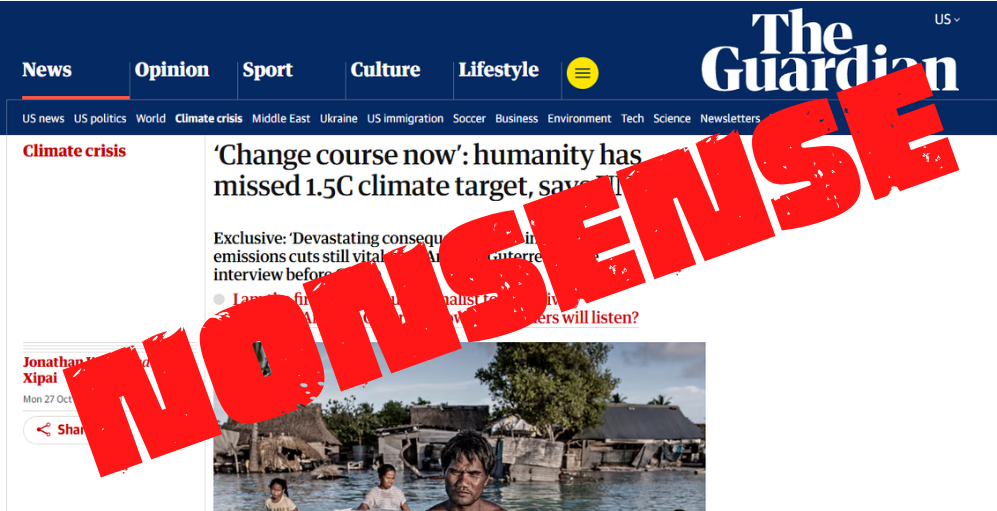
A recent article in The Guardian, “Change course now: humanity has missed 1.5C climate target, says UN head,” claims that the planet is in grave danger of passing climate “tipping points,” as it is now inevitable that 1.5°C warming will be breached. Although 1.5℃ of warming may be locked in if not already surpassed, the claim that it signifies a dangerous milestone is false. Not only is the tipping points narrative bunk, but there is no evidence that 1.5°C warming is any particular threat. The purported temperature threshhold was chosen arbitrarily and for political reasons rather than scientific ones.
The Guardian’s story focuses on comments made by United Nations Secretary General António Guterres, who in advance of the COP30 climate summit in Brazil, warned that it is “inevitable” that 1.5°C of warming will be breached, and it will result in “devastating consequences” for the planet. The Guardian says Guterres “urged the leaders who will gather in the Brazilian rainforest city of Belém to realize that the longer they delay cutting emissions, the greater the danger of passing catastrophic “tipping points” in the Amazon, the Arctic, and the oceans.”
There is no scientific basis for any so-called tipping points, and claiming otherwise is just fearmongering for political gain.
Beginning with the Amazon rainforest, the location of the next climate summit in November, Guterres reportedly warned that it could become a “savannah,” or a dry grassland. There is no evidence for this absurd claim. Like Guterres’ previous “boiling oceans” comment, it is purely fanciful hyperbole lacking any basis in fact. Guterres is referencing a period of drought suffered by parts of the Amazon basin in recent years, but that drought has not been historically unusual, and the recent localized areas of drought have not been more severe than previous drought periods. As discussed in the Climate Realism post “Media Outlets Continue Spreading False Amazon “Record Drought” Claims,” the Amazon has experienced periods of heavy rain and extended drought in the past that were worse than those we see now. Historic records do not show any worsening of drought in the Amazon. The threat that impacts tree cover is deforestation and clear cutting, not climate change.
The Arctic is also not approaching any dangerous tipping point. Should warming continue, ice extent will likely shrink, but it has not been happening at nearly as fast a rate as alarmists claim. Arctic sea ice extent has been stable since about 2010, indicating a new ice extent regime, and there is no telling how long that will last. If the past is any guide, sea ice might begin expanding again, as it has waxed and waned historically.
Finally, the ocean tipping point Guterres is referring to is the claim that coral reefs will die out as a result of ocean pH changes and higher temperatures, but again, science and paleo-history shows that corals are resilient to changes that are much more extreme than the modest warming of recent decades. As discussed repeatedly at Climate Realism, the world’s oceans are not at risk of becoming acidic and coral reefs are expanding their range and setting records for growth.
It is true that the “1.5°C threshold” is likely to be passed. But that does not mean anything, certainly nothing catastrophic. The 1.5°C warming limit was already passed in 2024 because of the El Niño conditions—with no cataclysm. This should not be of concern to anyone, because that limit is not a scientifically established value. The Guardian fearmongered about it in the past, which Climate Realism addressed here, and seems to have learned nothing. The 1.5°C number was arbitrary; established by an 11 member German political advisory board containing only one meteorologist. It is not a hard scientific threshold the way the boiling point of water is, though alarmists inappropriately treat it that way.
Guterres’ comments are not based on science, data, or even history. He is simply attempting to worry the public, with The Guardian’s complicity, in order to gain political leverage for negotiations at COP 30 even as a growing number of countries are downplaying climate concerns in the realistic assessment that other issues are more pressing and fossil fuels, for now, remain vital to prosperity.
November 13, 2025
Posted by aletho |
Fake News, Mainstream Media, Warmongering, Science and Pseudo-Science | The Guardian, United Nations |
Leave a comment
In a letter addressed to the UN Secretary-General and the Presidency of the Security Council, Iranian Foreign Minister Abbas Araghchi affirmed that UN Security Council Resolution 2231 has expired and fully ceased to be in effect as of today, in accordance with its explicit provisions.
He underscored that the nuclear agreement reflected the international community’s shared belief that diplomacy and multilateral engagement remain the most effective means to resolve conflicts.
Araghchi recalled that Washington initially refrained from fulfilling its commitments before withdrawing from the agreement, reimposing what he described as illegal and unilateral sanctions, and even expanding them. “These coercive measures,” he noted, “constituted a grave violation of international law and the UN Charter, causing severe disruption in the implementation of the agreement.”
In his letter, Araghchi added that the E3 failed to fulfill their obligations and instead imposed additional illegal sanctions on Iranian individuals and institutions. Despite this, he said, Iran demonstrated the utmost restraint in the face of repeated and fundamental violations, making extensive efforts to restore balance and preserve the agreement.
After a full year of Iran’s continued compliance, Araghchi explained, Iran began implementing gradual, proportionate, and reversible compensatory steps in line with its recognized rights under the deal.
‘E3’s snapback attempt lacks legal validity’
Iran’s top diplomat stated that the E3’s attempt to activate the snapback mechanism by directly resorting to the UN Security Council disregarded the dispute settlement process stipulated in the nuclear agreement, stressing that the attempt suffers from procedural flaws and lacks any legal validity or authority.
“No action taken in violation of UN Security Council Resolution 2231 can create any legal obligation upon member states,” Araghchi affirmed, emphasizing that any claim to “revive” or “reimpose” expired resolutions is null and void, lacking legal basis and producing no binding effect.
Araghchi highlighted that the Non-Aligned Movement, during its 19th Meeting of Foreign Ministers, reaffirmed in its final document that Resolution 2231 had expired on its scheduled date. He also referred to the two Security Council voting sessions held on 19 and 26 September 2025, which demonstrated the absence of consensus among Council members regarding the validity of the notification to trigger the “snapback” mechanism.
Iran warns against unauthorized UN Secretariat actions
Araghchi asserted that Resolution 2231 does not grant the Secretary-General or the UN Secretariat any authority or mandate to determine, announce, reactivate, or reinstate resolutions that have expired under operative paragraph 8.
He added that any such action would exceed the legal authority conferred by the UN Charter and contradict the purely administrative and neutral role of the Secretariat. “Any ‘notification of snapback activation’ or ‘confirmation’ issued by the Secretariat is legally void and undermines the credibility of the organization,” he wrote.
Araghchi concluded that no member state, the Secretariat, or any official may take legal action in this regard without a new and explicit resolution from the Security Council.
Earlier last week, Araghchi condemned Trump, accusing him of spreading falsehoods about Iran’s nuclear program and being misled by Israeli deception. His remarks followed an earlier statement by the Iranian Ministry of Foreign Affairs, which condemned Trump’s address at the Israeli Knesset as “irresponsible and shameful.”
In a post on X, Araghchi said it was “more than clear” that Trump had been “badly fed the fake line” that Iran’s peaceful nuclear program was on the verge of weaponization. He described this claim as a “BIG LIE”, emphasizing that even the US intelligence community had confirmed there was “zero proof” of such allegations.
“The real bully of the Middle East, Mr. President, is the same parasitic actor that has long been bullying and milking the United States,” Araghchi declared, referring to “Israel”.
October 18, 2025
Posted by aletho |
Wars for Israel | France, Germany, Sanctions against Iran, UK, United Nations, United States, Zionism |
Leave a comment
The UN Human Rights Council (HRC) has laid bare its double standards by investigating human rights violations allegedly committed by Venezuela, but not by Israel, Alexander Gabriel Yanez Deleuze, Venezuela’s envoy to the UN in Geneva, told Sputnik.
“The HRC has approved 10 areas of action against Venezuela and allocated $10 million for this. At the same time, you will not find a single mandate that would sound like an ‘investigation of human rights violations by the Israeli government’,” the diplomat stressed.
“There is a mission that deals with human rights in the occupied Palestinian territories, but it does not explicitly mention Israel. This proves the HRC’s double standards,” Deleuze stressed.
On Monday, the Independent International Fact-finding Mission in Venezuela presented a report on human rights violations in the South American country, which was rejected as politicized by Caracas.
The Russian Permanent Mission to the United Nations said that Russia opposed efforts to politicize the UN Human Rights Council and condemned its use to exert pressure on Venezuela.
September 27, 2025
Posted by aletho |
Mainstream Media, Warmongering, Progressive Hypocrite | United Nations, Venezuela |
Leave a comment


 Aletho News