Gaza Media Demand Action On Othman Case
By Julie Webb-Pullman and “Amal” | Scoop | May 17, 2012
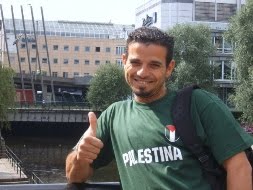 Members of the Palestinian media today demonstrated in Gaza City to draw attention to violence against journalists, particularly the case of Mohammad Othman, shot by Israeli soldiers while covering the Al Nakba commemoration at the Erez crossing a year ago.
The protestors gathered outside the Palestinian Centre for Human Rights, where they held a press conference, then marched to the UNESCO Offices.
Mohammad Othman was targeted by Israeli soldiers at the Erez checkpoint while he was carrying out his professional duties as a journalist. He received severe wounds to his back, and required medical treatment in Turkey. He still suffers the effects of his injuries.
Despite attempts by the journalists union to have the person/s responsible for his injuries held to account, the Israeli authorities have not investigated the matter, or held anyone responsible.
The protestors called on the Palestinian Human Rights Centre and the United Nations to take up the matter, as the deliberate shooting by Israeli forces of a journalist carrying out his professional duties is a crime that must be investigated, and punished.
“Israeli impunity for such crimes against journalists must end,” they said. “Othman was only taking pictures in his professional capacity when he was brutally and deliberately shot.”
Related articles
- #Nakba64 | Israeli forces arrest 20 Palestinians & injure 250 during An-Nakba day (occupiedpalestine.wordpress.com)
UN approves guidelines against land grabbing
DW | May 12, 2012
After three years of discussions, the UN has agreed a document meant to protect local populations against land grabbing. It should help ensure the right to food.
When big investors buy up land, small farmers are often driven from the land that feeds them. On Friday (11.05.2012) the 128 countries in the UN Committee on World Food Security unanimously adopted policies to protect the local population.
The voluntary guidelines specify how soil and land use rights, fisheries and forests should be handled. They are intended to increase transparency in land investment, give residents a greater say and especially to strengthen the position of the local small farmers. Often, they have only informal land rights – and no official land titles.
“The key point is that all rights for people to use land and other resources should be recognized, and that these people have proof. And they cannot easily lose these rights overnight because someone else may have more money or more influence,” said Babette Wehrmann, responsible for climate, energy use and rights at the FAO.
Up to 83 million hectares of land have been sold or leased to investors since 2000 – especially in Africa. The International Land Coalition, an alliance of non-governmental and intergovernmental organizations, operates a website on which land investments can be followed. However, because many deals are not disclosed, the land-matrix database is far from complete, the ILC’s Michael Taylor says. Even so, some trends can be identified: African countries are of particular concern, including Sudan, Ethiopia, Mozambique, Tanzania, Madagascar, Zambia and the Democratic Republic of the Congo.
Targeted investments in countries with weak legislation
These countries are particularly vulnerable “because they have weak policies and weak land ownership legislation. The international investors sought out the most vulnerable countries where it was worthwhile to invest because of the fertile ground,” says Frank Brassel, rural development expert at Oxfam.
According to the country matrix the major investors include India, China and the United States, Saudi Arabia and the United Arab Emirates. Even these countries have now agreed to the voluntary guidelines.
The ILC sees more risks than opportunities for local people in the land deals that are currently being negotiated, Taylor said. It would make most sense for investors to work with small farmers. Many countries are now worrying about new approaches to strengthen farmers’ rights, Taylor says.
“Countries such as Madagascar and Ethiopia have begun to issue certificates to confirm the ownership of land, and while they are not the same as a (legal ownership) title, they still ensure ownership of the land and only cost a fraction of the price,” says Taylor. “In Madagascar, the cost for a small farmer who wants to certify his land has fallen from 600 dollars to 15 dollars, or about 12 euros.”
This certificate assures the farmers that they can continue to cultivate “their” land. Because if big investors oust the local population, they lose twice: First, they can no longer grow anything, and second, the products are then mostly exported. So-called “flex crops” are especially popular – plants such as palm oil, soya beans and sugar cane – that can be sold according to market demand as a biofuel or food, says Taylor.
Local farmers are often forced off their land
And it would be a mistake to think that investors are looking for idle land, says Kerstin Nolte, an expert on land grabbing at the German Institute of Global and Area Studies (GIGA).
“Investors are, of course, looking for land that is very fertile and is close to infrastructure. And that is usually populated,” says Nolte. “This means that it often involves expulsions.”
Nolte traveled to Zambia, Kenya and Ghana for field studies. In Zambia, traditional local authorities decide which family cultivates which piece of land.
“When the chief performs his role well in the traditional sense, then he will negotiate with the investor and consult with his people. These chiefs are only slightly better off, which means they do not have very much money, property or land” Nolte said. “That means the system is very susceptible to corruption, both because there’s no one monitoring the chief and because there are a lot of money or valuables coming in from the outside.” Nolte says that this has led to much communal land in Zambia being transferred to commercial agriculture.
The rapid growth of land grabbing in recent years has depended in particular on the fact that food prices have risen dramatically since 2007. “This has led to two major groups seeing that it pays to invest in land: the first are the Gulf countries and emerging economies such as China and India. They want to secure their future food supply by buying or leasing huge areas of land in weaker countries,” Brassel said.
“The other group is traditional investors, who have also seen that it pays to invest in land, for food and for biofuel, as both promise to be lucrative businesses for the future.”
The largest land grabbers are not necessarily foreign investors. “We hear from our member organizations working in countries such as these it is the local elites who are responsible for the largest land scarcity. The cumulative effect of many people acquiring small plots of land for speculative purposes may be greater than that of two investors who purchase vast areas of land,” Taylor said.
More transparency?
The experts agree the voluntary guidelines of the UN member states are now an important first step to strengthen the situation of the local population and create more transparency. The guidelines can help to set a certain standard for the local population.
Although they are voluntary, the guidelines could put a lot of positive developments into motion, Brassel says. Oxfam has seen positive effects of the 2004 voluntary guidelines for the human right to food, he says. Even so, Oxfam would have liked to expand the newly adopted guidelines against land grabbing. “We should have not only applied the guidelines to land, but also to water resources,” he said.
“We would have liked a statement at the beginning that says, in the next three years we will have a moratorium on large land investments to be able to apply these guidelines on-site in the most affected countries first.”
The protection of small farmers now depends on the extent to which the individual states consider the voluntary guidelines to be binding.
Related articles
- U.N. adopts norms against ‘land grabbing’ (thehindu.com)
- Colombia: ‘Carbon credit’ scheme a cover for land grab (alethonews.wordpress.com)
- World Bank helps corporations with land grabs in Africa: Environmental groups (rawstory.com)
Syria blast hits UN chief’s convoy
Al Akhbar | May 9, 2012
The head of a UN observer mission to Syria, Major General Robert Mood, escaped unharmed when a blast went off as his convoy entered a restive southern town on Wednesday, Syria’s Addounia TV reported.
The explosion in Deraa wounded six Syrian soldiers, including an officer, who were escorting the UN convoy, while 12 other monitors traveling with the Norwegian general were uninjured in the attack, said an AFP photographer.
The attack was “a graphic example of violence that the Syrian people do not need,” said UN observer chief Major General Robert Mood.
“It is imperative that violence in all its forms must stop,” Mood, who was unhurt in the attack, was quoted by observer spokesman Neeraj Singh as saying.
“We remain focused on our task,” Singh told AFP.
The blast, caused by an explosive device planted in the ground, went off after four UN vehicles passed the entrance to Deraa safely, the photographer said.
The attack came as one of Syria’s main armed rebel leaders threatened to resume attacks on President Bashar Assad’s forces, a pan-Arab newspaper reported.
The statement from Free Syrian Army (FSA) chief Colonel Riyadh Asaad will deal a further blow to the fragile UN-backed ceasefire agreement that both sides are accused of disregarding.
“We will not stand with folded arms because we are not able to tolerate and wait while killings, arrests, and shelling continue despite the presence of the (United Nations) observers who have turned into false witnesses,” Asaad said, according to the London-based Asharq al-Awsat newspaper.
“Our people are also demanding we defend them in the absence of any serious steps by the Security Council which is giving the regime a chance to commit more crimes,” he added.
Explosive devices are a common technique used by the Free Syrian Army, Colonel Asaad said, but it was uncertain whether his group was behind the attack on the UN convoy.
“Bombings are not part of our ethics and we don’t need them. Our aim is to target military vehicles and we only use explosive devices,” he said.
The UN has noted violations to the ceasefire from the government and armed rebels, who are suspected of carrying out a series of bombings in recent weeks, as well as political assassinations.
The armed Syrian opposition is highly fragmented and there are militant groups in the country who say they do not take orders from Asaad.
Syrian National Council spokesperson Ausama Monajed told Al-Akhbar in March that Asaad’s fighters only accounted for “maximum five percent” of all armed groups.
The UN Security Council unanimously adopted a Russian-European drafted resolution last month that authorized an initial deployment of up to 300 unarmed military observers to Syria for three months, to be known as UNSMIS.
But despite an initial pause in fighting on April 12, a promised ceasefire has not taken hold. Nor has the carnage in Syria stopped, despite a parliamentary poll on Monday which the government promoted as a milestone on its path to reform but most opposition groups dismissed as a sham and boycotted.
International mediator Kofi Annan called on both Syrian government forces and opposition fighters to put down their weapons and work with the unarmed observers to consolidate the fragile ceasefire that took effect in April.
The newspaper quoted Asaad as saying the Free Syrian Army had devised a new strategy to make its attacks more effective.
Asaad said the FSA had pulled out of cities to give the Annan plan a chance to succeed.
“The Free Syrian Army is still on the ground in most Syrian territories, and its departure from the cities was to spare civilians military operations and in order not to give the regime an excuse to say that we do not want a ceasefire,” he added.
(Reuters, AFP, Al-Akhbar)
Related articles
- Syria and the Annan Plan: The Devil in the Details (alethonews.wordpress.com)
Sudan says UNSC resolution contains positive elements
Sudan Tribune | May 2, 2012
WASHINGTON – The Sudanese government reacted with caution to the resolution adopted unanimously today by the United Nations Security Council (UNSC) saying it contains positive elements but vowed to review it carefully in order to determine its negotiating strategy with South Sudan.
Today’s decision directs Khartoum and Juba to inform the Chairperson of the African Union Commission and UNSC president in writing of their intention to commit to a cessation of hostilities including aerial bombardments within 48 hours.
The two sides must immediately withdraw their forces inside their respective borders without conditions and within a week activate the Joint Border Verification and Monitoring Mechanism (JBVMM) and the Safe Demilitarized Border Zone (SDBZ).
Also, withdrawal from the disputed border region of Abyei must be completed in two weeks in accordance with the June 2011 Agreement on Temporary Security and Administrative Arrangements for Abyei.
Furthermore, the two countries will return to the negotiating table in two weeks time to settle issues including oil, citizenship, border demarcation and Abyei. A four-month window was given to conclude the talks.
Talks on these contentious items is mediated by the African Union High-Level Implementation Panel (AUHIP) led by Thabo Mbeki but there was little success in achieving any breakthrough.
The panel managed to schedule a meeting between Sudanese president Omer Hassan al-Bashir and his southern counterpart Salva Kiir for April 3rd to seal framework agreements on borders and citizenship. However, clashes that erupted between the two countries in late March over the oil-rich region of Heglig inside South Kordofan led to the suspension of the summit.
Relations deeply deteriorated in early April after South Sudan army (SPLA) managed to occupy Heglig for 10 days before Sudan Armed Forces (SAF) reclaimed the area. Juba insists that it withdrew voluntarily and dismissed Khartoum assertions that they were expelled by force.
South Sudan claimed that Heglig is part of Unity state that was annexed to north Sudan several decades ago through an administrative decision. Heglig, which produces half of Sudan’s oil, saw its facilities severely damaged which Khartoum blamed on SPLA and vowed to sue it internationally.
The UNSC resolution passed today called for a fact finding effort to assess the losses including economic and humanitarian damage to oil facilities and other key infrastructure in and around Heglig.
Despite reservations expressed by China and Russia, the resolution maintained the threat of non-military measures against any side that fails to comply with council’s demands that were in essence part of the AU Peace and Security Council (AUPSC) roadmap endorsed last month.
“We are always very cautious about the use and threat of sanctions,” China’s U.N. Ambassador Li Baodong told the council.
“China has all along maintained that African issues should be settled by the Africans in African ways” Baodong added.
The Russian envoy expressed the same sentiment.
“The arsenal of political and diplomatic instruments for normalizing the situation has nowhere been exhausted,” Russia’s UN Ambassador Vitaly Churkin told the council.
“We consider sanctions as an extreme measure” he said
In Beijing, the United States Secretary of State Hillary Clinton praised China for backing the resolution.
“I’m pleased that China and the United States joined with a unified international community just hours ago to support a strong UN Security [Council] resolution that provides unambiguous support to the African Union roadmap,” Clinton said.
The Sudanese government criticized the AUPSC for requesting the blessings of the UNSC and warned against the attempt to override the African role by involving the UNSC. It said that the intervention by the world body will make political considerations and pre-established positions prevail over the requirements of peaceful settlements.
Last Sunday, the Sudanese foreign minister Ali Karti sent a letter to the AU declaring his country’s “preliminary” agreement with the roadmap while expressing several reservations that were not specified.
Karti traveled to Moscow this week to press Russia on Sudan’s point of view regarding the draft resolution. However, the Russian foreign minister Sergei Lavrov signaled his backing to the resolution despite expressing discomfort with including Article 41 of the UN charter.
Article 41 states that the UNSC may decide what measures – not involving the use of armed force – are to be employed to give effect to its decisions, and it may call on the Members of the United Nations to apply such measures.
These may include complete or partial interruption of economic relations and of rail, sea, air, postal, telegraphic, radio, and other means of communication, and the severance of diplomatic relations.
Sudan’s foreign ministry spokesperson Al-Obeid Marwih said that elements of the UNSC resolution related to condemning Heglig occupation and calling for assessing damage to oil facilities are positive.
Marwih noted that Sudan has no “fundamental objection” on the resolution as long as it is made on the basis of the AUPSC roadmap.
But the head of the ruling National Congress Party (NCP) parliamentary bloc Ghazi Salah al-Deen slammed the AUPSC communiqué saying that it equated between the victim and the villain.
“We cannot endorse any international decision denying the right of the Sudanese people,” Al-Deen told the legislative assembly.
Al-Deen, who also serves as Bashir’s adviser, said the labeling of Heglig as a disputed area is “malicious”.
Sudan’s ambassador Daffa-Alla Elhag Osman expressed disappointment with the resolution.
“It is notable that the resolution has disregarded the continuous aggression by South Sudan against Sudan,” Osman told the council.
“Peace … will only be achieved through halting all forms of support and sheltering of proxy rebel and armed groups espoused by the South Sudan,” he added.
But South Sudan’s Minister of Cabinet Affairs Deng Alor Kuol who attended the vote told the council that his government would comply with the resolution.
“It is my privilege to reaffirm to you that, in compliance with the decisions of the African Union Peace and Security Council, the UN Security Council’s Presidential Statement, and in the spirit of our commitment to peace, my government ordered the withdrawal of our police force from Abyei Area on 28 April 2012. We expect the international community to exert efforts to ensure the immediate and complete withdrawal of Sudan Armed Forces from Abyei Area,” Alor told the council.
As acknowledged formally by the African Union, my government is already committed to the cessation of hostilities and the resumption of negotiations under the auspices of the African Union High Implementation Panel. We welcome the decision of the African Union Peace and Security Council, and the commitment of the UN Security Council to the enhancement of the AUHIP led negotiations process through the active participation of the UN, the Chairman of IGAD and other international partners.”
“We appeal to the United Nations and its member states to urgently mobilize humanitarian assistance for the population affected by Sudan’s continuous aerial bombardment and ground incursions in northern states of South Sudan,” he said.
Alor told reporters that his country did not abandon claims to Heglig and stressed that the move on the region was in response to Khartoum’s aerial bombardments and ground incursions. He said the ownership of Heglig would be on the negotiating table.
The U.S. ambassador to the UN Susan Rice hailed the vote saying that it enforces a time frame to achieve results after years of talks.
“With this vote, the Council has clearly imposed tight deadlines for concrete action, in line with the African Union decision. This Council, especially those members with particular influence, including my own, must continue to press both parties to implement the African Union Roadmap by ending hostilities, ceasing cross-border attacks and movements, halting aerial bombardments, withdrawing all their forces from the border areas including Abyei, activating the necessary border security mechanisms, and ending support to rebel groups working against the other state,” she said.
“It is also essential that both parties return at once to the negotiating table under the auspices of the African Union High-level Implementation Panel to reach agreement on critical outstanding issues. We support the plans of the African Union to travel to Khartoum and Juba in the coming days to begin the process. This is ultimately the only way that further conflict can be avoided” Rice added.
She warned that the UNSC is willing to impose punitive measures if there is lack of progress.
“If the parties fail to take these steps promptly, this Council is united in its determination to hold both sides accountable. We stand ready to impose Chapter VII sanctions on either or both parties, as necessary,” the U.S. diplomat said.
But the Russian ambassador said that sanctions should not be used in relation to conflicts in the Sudanese states of South Kordofan and Blue Nile, where fighting has been raging since last year between Sudan’s army and rebels from Sudan People Liberation Movement North (SPLM-N) who want to topple to Khartoum government.
The resolution orders Khartoum and SPLM-N to cooperate with the mediation and use a June 2011 framework agreement as a basis for talks. The deal was signed by presidential assistant Nafie Ali Nafie only to be scrapped by Bashir himself later.
Related articles
- Sudan’s FM rejects Security Council involvement in talks with South Sudan (alethonews.wordpress.com)
- World demands South Sudan pullout of Heglig, end to Khartoum’s air raids (alethonews.wordpress.com)
- China, Russia resist West’s sanctions push for Sudan, South Sudan (chinadailymail.com)
Ban Ki-moon Slams Syria “Terrorist Attacks”
UN Monitors Continue Mission
Al-Manar | May 1, 2012
UN Secretary General Ban Ki-moon on Monday condemned the terrorist bomb attacks in two Syrian cities but said UN observers had brought some improvement in areas where they have been deployed.
The UN chief called on “all parties” in the Syria conflict to halt violence and work with the growing UN Supervision Mission in Syria, UN deputy spokesperson Eduardo del Buey said in a statement.
Ban “condemns” what he called “terrorist bomb attacks” in Idlib and Damascus on Monday, the spokesperson said.
“While noting improvements in areas where UN monitors are deployed, the secretary general remains gravely concerned by reports of continued violence, killing and abuses in Syria in recent days.”
“He calls for armed violence in all its forms by all parties to cease immediately and full cooperation of all parties with the work of UNSMIS as it expands its presence on the ground,” the spokesperson said in a statement.
The UN monitors are scheduled to visit the western cities of Homs and Hama on Tuesday.
The latest UN schedule comes a day after at least 20 people were martyred and scores of others injured in two bomb attacks in Idlib.
UN Security Council Unanimously Adopts Resolution on Deploying 300 Unarmed Observers in Syria
SANA | April 21, 2012

NEW YORK, (SANA) – The UN security council on Saturday unanimously adopted a resolution on deploying 300 unarmed observers in Syria on preliminary basis for three months to monitor the ceasefire.
The resolution calls on the Syrian government to support the observers mission by helping deploy its members and provide transport for them without hindrances, calling upon the UN and Syria to reach an agreement on providing the planes needed by the mission.
The resolution also called on all sides in Syria to guarantee the safety of the mission members, stressing that the primary responsibility regarding the observers’ safety falls upon the government.

The Russian resolution stipulates that the deployment of the observer mission will be evaluated by the UN Secretary General based on relevant developments on the ground, including the cessation of violence.
The resolution called upon all sides in Syria to cease violence, saying that the cessation which has been achieved so far is clearly imperfect.
Al-Jaafari: Syria Showed Full Cooperation and Commitment to Annan’s Plan
In a speech during the Council session, Syria’s Permanent Representative to the UN Dr. Bashar al-Jaafari said that some of the statements made during this session called upon Syria to implement the Council’s resolution while those who made the statements themselves are moving away from it.
He said that he met with the UN Secretary General and senior aides on Saturday and appealed to him to exert good offices and be more involved in the efforts to guarantee applying the desired political and national solution to resolve the crisis, adding “this is a good opportunity to appeal to you all and address to you the same appeal which I addressed to the Secretary General.”
Al-Jaafari said that the Syrian government was open to any honest and neutral initiatives and efforts since the beginning of the crisis to help emerge from it while preserving Syria’s sovereignty, independent national decision, security and stability, with Syria showing great cooperation and commitment to Annan’s efforts.

He affirmed that Syria implemented its part of Annan’s plan and is still committed to this, and that it’s updating Annan on regular daily basis with written reports on steps taken in this regard, which includes releasing detainees who did not shed blood, delivering humanitarian aid to affected areas in cooperation with OCHA (Office for the Coordination of Humanitarian Affairs), and allowing over 600 media outlets to enter Syria.
Al-Jaafari said that the Syrian government on Sunday informed Annan that it carried out the second article of his plan completely, saying that police and law-enforcement forces will be charged with keeping peace and order and will show the utmost self-restraint while remaining ready to confront armed terrorist groups should they continue to breach the cessation of violence, while the Syrian Arab Army will remain prepared to defend Syria from any attack and secure strategic sites.
He noted that sending neutral observers was originally a Syrian demand based on self-confidence and a position of strength, and that the reason behind such a demand is to inform the world public opinion of the terrorists’ crimes away from media and political misdirection, noting that this happened with the Arab League observers who presented an objective report documenting the crimes of terrorists, which prompted Qatar and Saudi Arabia to withdraw their observers, suspend the entire mission, and ignore their report completely.
Al-Jaafari added that Syria renewed cooperation and openness by signing the preliminary agreement organizing the operations of UN observers in Syria, and that the Syrian government is ready to sign the protocol organizing the deployment of observers when the UN is ready, stressing that Syria has a true interest in ensuring the success of the observer mission, with emphasis on the need for the observers to be objective, neutral and profession.
“Some sides responded on this clear commitment by the Syrian government by carrying out a hysterical campaign of doubt that unveiled ill intentions on their parts on principle regarding Syria, accentuating their strong frustration over the signs of returning stability and calm to Syria,” he said.
He went on to note that terrorists answered the Syrian government’s commitment to Annan’s plan with a long series of violations, with them intensifying their terrorism and attacks against civilians, law-enforcement forces and public and private facilities, saying that the Syrian government provided Annan, Ki-moon and the Security Council with detailed information on the violations made by armed groups after the beginning of the ceasefire on April 12th, adding that the violations number over 593 as of Saturday.
Al-Jaafari voiced Syria’s deep concern over the continuing of the suspicious disregard of terrorist activities which were accompanied by a methodical media and political misdirection campaign aiming to demonize the Syrian authorities and army by blaming the terrorists’ crimes on the Syrian state and manipulate public opinion by twisting facts and employing a total media blackout regarding the terrorists’ crimes.
“All these practices aim at foiling Annan’s mission and ascribing the responsibility of this failure to the Syrian government in order to reach military action under humanitarian excuses, similarly to the lies that led to the destruction of Libya’s infrastructure and the death of 150,000 Libyan civilians at the hands of NATO with Qatar’s participation,” he said.
Syria’s Representative stressed the need for Annan and the Security Council to deal with the Syrian crisis comprehensively by exerting efforts to ensure that armed groups and those supporting them are committed to the cessation of violence in order for this cessation to be sustainable, reiterating that Syria’s support alone isn’t enough to ensure the success of Annan’s efforts, as Arab, regional and international sides must commit in words and actions to stopping the funding, arming, training and encouragement of armed groups, as well as stopping their instigation of the Syrian opposition to reject dialogue.
“Some who predict the failure of Annan’s plan are doing their best to fulfill this ominous prediction… the best example of this is the statements of the Emir of Qatar in Rome only two days after the Security Council adopted resolution no. 2042 when he said that the chances of Annan’s plan to succeed don’t exceed 3%,” al-Jaafari said, adding that some countries are also creating parallel tracks to Annan’s plan that could undermine it and waste the efforts for reaching a peaceful solution, with these tracks including the conferences held in Tunis, Istanbul and Paris which pass plans outside international legitimacy to arm the opposition, reject peaceful solutions, and imposing sanctions on the Syrian people.
He noted that sometimes there’s boasting of increasing sanctions as if harming the Syrians and taking away their livelihood and rights to development and stability is a major victory.
“It’s a paradox that after every Syrian openness in dealing with any political proposition, a conference is held in parallel to fan the flames of the crisis, push towards removing the solution from its peaceful outline, and undermine any positive solution to resolve the crisis without shedding the blood of Syrian civilians and military personnel,” al-Jaafari said.
He pointed out that the absolute truth among Syrians is their rejection of interference in their country’s internal affairs, commitment to protecting their country’s sovereignty, continuing with reform and national dialogue, and not allowing time to be turned back to any form of subjugation or custodianship or occupation, be it direct or indirect.
“The Syrians know full well that the forces who have ill intents for Syria are targeting them all and trading with their pain and legitimate ambitions in the bloody stock market controlled by the interests of Israel and its governments and allies,” he said.
Al-Jaafari concluded by addressing a statement made by Germany’s Representative who voiced his country’s commitments to protecting “minorities” in Syria, stressing that there are no minorities in Syria; rather only Syrians who are proud of their cultural and religious diversity and don’t want Wahabi and Salafi extremism to sneak among them through oil money and religious and sectarian incitement which is preached by some Qatari and Saudi channels.
Churkin: Countries that Have Influence on Opposition Should Encourage it to Stop Violence, Apply Annan Plan
Russia’s Permanent UN Envoy Vitaly Churkin stressed that the resolution adopted today by the United Nation Security Council (UNSC) on the deployment of UN observers in Syria sends an important international message.
In his speech before the UN Security Council, Churkin said this resolution shows that only the UNSC has the right to make resolutions for resolving regional crises such as the Syrian crisis.

The Russian Envoy added that any group of friends or countries with interests or any other party must clearly abide by the UNSC resolutions and not undermine the possibility of implementing it.
Churkin affirmed the importance of this resolution to push the process of peaceful settlement in Syria forward besides [its] being embodies a unity and consensus of the Council regarding Annan’s six point plan.
Churkin stressed that all external sides related to the crisis in Syria should act in a responsible manner, adding that “The Syrians themselves should determine the destiny of their country.”
He made it clear that any attempt to impose outside powers on the Syrian people could exacerbate the crisis, calling on countries that have an influence on the opposition to encourage it to stop violence and apply Annan’s plan.
Baodong Reiterates China’s Commitment to peaceful Solution to Syria’s Crisis
For his part, China’s Permanent Representative to the United Nations, Li Baodong, reiterated Beijing’s commitment to reaching a peaceful solution to Syria’s crisis and within the framework of respecting the will of the Syrian people and keenness on Syria’s territorial integrity.
In his speech before the UN Security Council, Baodong added that Annan represents an important channel to solve the crisis in Syria, calling upon all Syrian sides to completely cooperate with Annan in order to launch a political process led by Syria.

Baodong stressed his country’s rejection of all efforts and statements that could hinder Annan’s mission, hoping that the monitors’ mission will fully respect Syria’s sovereignty and work in accordance to the authorization granted by the Council.
For his part, South Africa’s Representative stressed the importance of supporting Annan’s plan in order to reach a peaceful solution for the crisis in Syria through political dialogue that meets the aspirations of the Syrian people and ensures the unity and the territorial integrity of the country.
In turn, Azerbaijan’s Representative stressed his country’s support to Annan’s mission and the importance of respecting Syria’s sovereignty and unity.
India’s Representative said that the efforts of Annan contributed to improving the situation in Syria, calling upon all sides to adhere to Annan’s plan in order to reach a full ceasefire.
He highlighted that the international observers should implement their duties in an objective and neutral manner with the aim of starting a comprehensive political process led by Syria to meet the aspirations of the Syrian people.
For his part, Pakistan’s Representative expressed his country’s hope that Annan’s plan will lead to a full cessation of violence and creating the appropriate circumstances to carry out a political process that will respect Syria’s sovereignty and lead to a peaceful solution to the crisis.
Guatemala’s Representative stressed his country’s support to Annan’s mission and to all efforts exerted with the aim of restoring peace and stability to Syria.
Colombia’s Representative also stressed his country’s support to the monitors’ mission in Syria, adding that the current proposal is ideal and typical.
As for the western countries’ representatives, they continued their deliberate disregard of the acts committed by the armed terrorist groups which claimed the lives of hundreds of citizens and army and law-enforcement personnel.
The French Representative renewed his country’s incitement against Syria, laying the responsibility of the armed terrorist groups’ violence on the Syrian government.
He urged the Syrian government to immediately adhere to Annan’s plan and mentioned nothing about the fact that the opposition didn’t show any commitment to the same plan until now.
Similarly, Germany’s Representative recited a stream of lies and false allegations against the Syrian government, twisting the facts by alleging that the Syrian government is the side that is committing kidnapping, torture and violence against children, women and “minorities.”
The U.S. Representative, oblivious to her country’s deception of the international community when it waged a war on Iraq under false allegations of nuclear weapons, announced the failure of the observers’ mission before it even started, alleging that their presence will not make the Syrian government stop violence.
The U.S. representative, whose country murdered millions of innocent around the world, defended the acts of the armed opposition, alleging that the opposition welcomed the presence of the observers.
Churkin: This is the First Time During the Syrian Crisis that the Security Council was Able to Express Itself in Support of a Positive Political Plan
In a press conference following the Security Council session, Churkin said that this session marks the first time during the Syrian crisis that the Security Council was able to express itself in support of a positive political plan and strategy and to support with practical steps through the deployment of observers.
Churkin said that when the Council adopted resolution no. 2043, it affirmed its responsibility for security and peace in the Syrian crisis, hoping that the international community and various groups will respect the Council’s decision and authority and act accordingly.
He welcomed the decision and hoped that the observer mission will play its role in supporting stability in Syria, noting that the resolution doesn’t address only the Syrian government, but also the opposition, asking it to cease violence, support observers and commit to Annan’s plan.
Churkin noted that the observer mission’s jurisdiction suits the arrangements made by the UN General Secretariat and the Syrian government, adding that the decision is the responsibility of the UN and the Syrian government and that they should work to make all necessary arrangements.
On the U.S. stance, Churkin said that he had hoped that the statements would be more in line with the spirit of the resolution, but some of the speakers wasted a chance to address the opposition, adding that negative expectations are more akin to predictions.
He added that Syrian Foreign Minister Walid al-Moallem informed Annan that the Syrian government carried out the second article of the plan and withdrew armored vehicles and military forces from cities.
Churkin hoped that the political momentum is a positive sign, calling for abandoning threats and negative expectations and staying the course which the Security Council finally managed to support rather than returning to conflict scenarios which proved to be dangerous and likely to lead to further escalation.
He stressed that Russia isn’t against the opposition, saying “we’re doing the right thing and we’re comfortable for our stance,” noting that Russia worked hard to put the Security Council on the right track, adding that there are forces who don’t want this strategy to succeed and have other plans which aren’t useful and will weaken Annan’s plan.
Churkin said that the observers are facing monumental tasks, thus they must be respected and provided with all the conditions needed by them to carry out their work successfully.
On the observers’ nationalities, he said that there are no information of specific agreements in this regard, noting that the Syrian government approved of the candidates.
In response to a question on a full ban on weapons, Churkin said that even if such a ban succeeded with the Syrian government, then there will be those who deny that and continue to provide weapons to opposition groups, similar to what happened in prior experiences.
M.Nassr / Ghossoun / H. Sabbagh
Related articles
- Syria Welcomes New UN Resolution, Observers to Arrive Late Sunday (alethonews.wordpress.com)
- UN Security Council Votes To Send 300 Observers To Syria (eurasiareview.com)
- Security Council changed prerogatives in Syrian crisis – Churkin to RT (rt.com)
Western Journalist: Visa Denied
By Sharmine Narwani | Al Akhbar | 2012-04-21
Item number five on UN Envoy Kofi Annan’s 6-point plan for Syria is the following:
“(5) Ensure freedom of movement throughout the country for journalists and a non-discriminatory visa policy for them.”
At a delicate moment in the hard-fought Syrian conflict that could potentially destabilize the entire Middle East, the United Nations believes getting more journalists into Syria is one of the six most urgent actions to consider?
Why? Are foreign reporters trained in special “observer” skills – with unique truth-detecting abilities bubble-wrapped in bullet and mortar-proof goop? And what will they see that Syrians – who know Syria best – cannot observe for themselves?
What the UN is really demanding – let’s be honest here – is for the Syrian government to open up the country to “Western” journalists. Yet, in all the conflicts covered in recent years, I cannot recall one that has been more badly covered by the mainstream western media than this Syrian crisis.
Almost to a person, western journalists are blaming their substandard coverage on the fact that they have been denied entry into Syria. And also – to a person – they seem to think that the world needs them there to understand what is going on inside the country.
Paul Conroy, the Sunday Times freelance cameraman who was injured by an explosive in Homs in February, tells the BBC’s Hard Talk that Syrians need their events verified by people like himself and his now-deceased colleague, war correspondent Marie Colvin, in order to be believed:
“It is a sad state of affairs that it does need people to go in… and actually be Western and be official journalists to make it real in the public eye.”
Is that like a Western-journalist-verification-stamp of some sort? Does it come with a guarantee – for accuracy in reporting?
Because, right now, I honestly cannot think of a group of people less capable of verifying things in Syria than western journalists. And it is not because they aren’t physically there or can’t string together more than two words in Arabic. It is largely because they feast at the trough of their own governments’ narratives on All Things. Western journalists are heady with a sense of righteousness leached from the oxymoronic “western values” shoved down our collective throats. Those same western values that demand “accountability” and “transparency” from all nations – while offering cover for western governments to hack their way through Muslim and Arab bodies in endless “national security” wars.
Do tell… Which major mainstream western media outlet has ever fundamentally questioned their government’s narratives on these wars? Which major western journalist risked career for truth on affairs related to the Middle East? Give me the name of that brave western network reporter who disrupts press conferences regularly with inconvenient questions on weapons sales to Gulf dictatorships – and has his bosses go to the wall to ensure he remains in the White House press pool. Show me the western reporter at the Washington Post, New York Times, CNN, BBC, France 24 who has made a career of doggedly questioning Israel’s disproportionate use of force against civilian populations – a journalist who sticks a microphone under Sarkozy, Obama or Cameron’s nose and bellows: “What fucking Peace Process are you chaps banging on about?”
No? Not one? Come on!
“No Syrian Visa” is just a convenient excuse for the lazy and sloppy reporting of western media in this Syrian conflict. It is a handy sound bite these days – one that quite deliberately ignores the Arab League Monitors’ January 2012 Report that 147 foreign and Arab media organizations were operating in Syria during their month-long observations.
“No Syrian Visa” tries hard to distract from the reality that most western journalists never actually go out to the front lines of conflict when filing their stories. Increasingly, reporters are sent out in organized pools by host governments – or in the case of recent US-initiated wars in the Middle East – by the invading armies.
“No Syrian Visa” selectively forgets that entering US-foe Syria as a journalist today is no more difficult than waltzing into US-ally Saudi Arabia – or US-ally Bahrain, when Formula One cars are not racing there.
And “No Syrian Visa” will blush hard when recalling that there was no similar collective western media outrage when the government of Israel declared “No Gaza Entry” as it pounded Palestinian populations in 2009.
Glossy Journalists Seek Content Not Facts
No. The problem with western reporters is that they are past their due date – remnants of an industry we once believed brandished standards of objectivity we never actually witnessed.
They are news-as-entertainment professionals – packaging glossy corporate content for maximum distribution and big bucks. The goal is not objective reportage. Their targets are quantifiable and highlighted in a business plan somewhere. Success is based on a simple formula: stay within parameters “understandable” to a wide audience that devours sound bites and familiar storylines on the hour, every hour. Like trained seals whose every desire, instinct and buying pattern has been measured by corporate media’s marketing department for the consumption of its advertisers, the audience demands satisfaction – and western media delivers it.
With the exception of a few proud holdouts, western media has made a beeline for the sexy story in Syria – which is essentially the fairytale of the “Arab Spring” with a little twist: Bad regime, good activists – but kick out this dictator and it’s a three-for-one, with Iran and Hezbollah tossed in as a bonus.
There are only three guiding rules for most western journalists inside or outside of Syria: 1) only quote anti-regime populations, 2) do not seek out independent domestic opposition figures, 3) evidence is unimportant, as long as you loosely “source” it:
They head straight for the Syrian activist, the anti-regime demonstration, the man with the gun in a “hot spot.” These are one side of the Syrian story, for sure. But you will not find mainstream western journalism broadcasting a pro-regime rally of tens of thousands, the national flag painted on the faces of Assad supporters – young and old – waving posters of their president. Pro-regime Syrians, a majority of whom voted in a national referendum in February to adopt constitutional reforms, are never interviewed by these reporters.
You will not find western journalists side-stepping the NATO-friendly Syrian National Council (SNC) “opposition” to interview the dozens of domestic Syrian opposition figures – most who have spent years in regime prisons – but who also unanimously reject the militarization and internationalization of the conflict; i.e., “non-Syrians butt out.”
And most importantly, you will never find mainstream western journalism seeking out “evidence” to support the false narratives of their governments. Who is included in the daily death count reported around the world? Who has killed thousands of Syrian soldiers? Who is killing children in Syria? Who is killing journalists in Syria? Who stands to gain from these deaths? Who stands to gain from this video footage or still photo emailed to my desktop? How do I know that plume of smoke was caused by a regime mortar? Who is the sniper? Why do so many Syrians still support Bashar al-Assad?
Propaganda As a Weapon of War
The “Big Lie” is a propaganda technique used liberally by western governments in the Middle East. The Big Lie refers to “the repeated articulation of a complex of events that justify subsequent action. The descriptions of these events have elements of truth, and the Big Lie generalizations merge and eventually supplant the public’s accurate perception of the underlying events.”
Using Big Lie techniques in the Middle East are particularly easy because western media is so happily complicit in propagating one-dimensional stereotypes of Arabs and Muslims. These assumptions are programmed so deeply, that even after months of watching on our TV screens disparate populations of all backgrounds and political convictions rally to reshape their governing systems… we still see regional events only through the prism of a one-size-fits-all Arab Spring.
The US Military’s Special Forces Unconventional Warfare manual describes ways to overthrow a government outside of a conventional combat format. In a section headlined Will of the Population, the manual explains ways to overcome popular support for the existing national government and alter natural hostility to foreign intervention:
“Information activities that increase dissatisfaction with the hostile regime or occupier and portray the resistance as a viable alternative are important components of the resistance effort. These activities can increase support for the resistance through persuasive messages that generate sympathy among populations.”
The manual expounds on this in another area:
“The USG (US Government) begins to shape the target environment as far in advance as possible. The shaping effort may include operations to increase the legitimacy of U.S. operations and the resistance movement, building internal and external support for the movement, and setting conditions for the introduction of U.S. forces. … The population of a recently occupied country may already be psychologically ready to accept U.S. sponsorship, particularly if the country was a U.S. ally before its occupation. In other cases, psychological preparation may require a protracted period before yielding any favorable results.”
The Syrian crisis is not about reforms any longer – it has become a geopolitical battle for influence in the Middle East, with NATO, the GCC and BRIC nations taking sides. Western media fails to address this larger picture, so glaringly obvious to people in the region. Instead it focuses almost entirely on the “David vs Goliath” or “good vs evil” themes that appeal to a broad audience of dumbed-down media consumers. These populations in turn become perception “leaders” when they back foreign military adventures in opinion polls broadcast back to us by – you guessed it – western media. And in that neat trick, your western government checks off a tick-box called “citizen approval.”
But Syrians have approved no such thing. More than a year after the first anti-government protests – which have never grown into the hundreds of thousands and millions experienced elsewhere in the region – Syrians have not ejected their leader, nor is there any evidence that the majority of Syrians wish to do so. The constitutional referendum in February, which a small majority of Syrians approved in an excellent turnout, should have been some indication for the media that popular sentiment is not necessarily reflected in an unverifiable cellphone image.
The daily casualty statistics coming out of Syria are deliberately misrepresented as regime “kills,” satellite photos of alleged regime shelling contradict the dominant narratives, activists faking events begs the question “why would they need to falsify evidence if the regime is so brutal?” But western media hears and sees nothing that doesn’t suit their formulaic narrative.
There is no better example of how mentally embedded western media has become with the Syrian “opposition” (itself a very broad and mixed bag), than a recent incident with CNN in Homs. Correspondent Arwa Damon and her non-Arab crew were tipped off about a potential pipeline explosion, so they pre-positioned their camera in a window frame facing the exact location of the anticipated bombing. When the pipeline explodes some time later, Damon and her crew look exultant – almost drunk on their success. Scoop? Try complicity in an act of terrorism. Can you imagine them doing this if the target was an American installation in Iraq or a NATO depot in Afghanistan? They would never live it down.
Reality Check
A year after the first small protests in Syria, the Syrian government stands strong, bolstered by its many constituencies, and spared the mass defections experienced by other Arab leaders. It appears that propaganda is not enough to shake the foundations of all Arab states. Now is the time for western media to ask why they got it so wrong. And some are indeed questioning their information, sources and assumptions.
There are western journalists who are doing a more than creditable job of writing about Syria from outside the country – the Independent’s Patrick Cockburn and The Guardian’s Seumas Milne come to mind. Please feel free to list other responsible, professional western journalists in the comments section below – I am sure we all want to celebrate their courage and increase their page views.
As for the others, their arrogance and cowardice is dangerous. False narratives have emboldened Syrians and other regional actors to act incautiously, angrily, even euphorically, when they might have benefited from nuance and calculation. People have died in the spinning of this conflict.
It is clearly time to challenge the dated concept that mainstream western media is impartial, objective or professional in their coverage of Mideast affairs. But we shouldn’t just bemoan this injustice in yet another stream of impotent essays and editorials. We must drag this industry of disinformation into the public arena, and make them accountable throughout the region by acting to affect ratings and readership.
Kofi Annan needs to immediately drop item number 5 on his Syria plan. While freedom of speech is important to uphold – even more so in times of strife – today, mainstream western journalism is nothing more than another face of the “external intervention” he so gravely warns against. Toss those western journos out of Syria unless they can demonstrate independent, objective, responsible reporting of this conflict. False narratives are costing Arab and Muslim lives. And media “combatants” need not apply to practice their craft in this region any longer.
Sharmine Narwani is a commentary writer and political analyst covering the Middle East. You can follow Sharmine on twitter @snarwani.
Related articles
- Foolishly Ignoring the Arab League Report on Syria (alethonews.wordpress.com)
- Syrian opposition leader, in unprecedented interview with Israel Radio, says Syrians want peace with Israel (timesofisrael.com)
- UN ‘aid’ program to be used in establishing NATO ‘humanitarian corridors’ (activistpost.com)
World demands South Sudan pullout of Heglig, end to Khartoum’s air raids
Sudan Tribune | April 12, 2012
KHARTOUM – A chorus of regional and international organizations reacted with concern on Thursday to heightened tension between Sudan and South Sudan following the latter’s takeover of Heglig area, urging Juba to withdraw troops and Khartoum to end aerial bombardment of southern territories.
The seizure on 11 April of Heglig oil-producing town by the army of South Sudan from Sudanese forces has created regional and international alarm as the United Nations (UN) and the African Union (AU) strongly demanded that Juba pull out troops and Khartoum cease aerial bombardment.
South Sudan justified its occupation of Heglig, which officially lies in Sudan’s border state of South Kordofan, by saying it was responding to ground and aerial attacks launched by the Sudanese army inside southern territories.
Salva Kiir, the southern president, refused on Thursday refused to heed calls from the UN and AU for withdrawing his troops while his Sudanese counterpart Omer Al-Bashir accused South Sudan of seeking war and vowed to retake the town.
In Addis Ababa, Ethiopia’s capital, the AU’s Peace and Security Council (AUPSC) held its 317 meeting on Thursday and received briefing on the military escalations along the borders between Sudan and South Sudan.
In an ensuing press release, the AUPSC expressed “deep concern” at the situation on the ground and strong disappointment over the failure of both sides to honor the agreements they signed during post-secession talks under the facilitation of AU mediators led by former South African President Thabo Mbeki.
The AUPSC also condemned in the strongest terms the actions taken by both sides over the last month, saying they “run contrary to all AU and international principles governing relations among sovereign states”
The council has struck a tough tone on South Sudan, describing its takeover of Heglig as “illegal and unacceptable”, citing the fact that the town lies north of the agreed borderline of 1956 between the two countries. It went on to demand the “immediate and unconditional” withdrawal of South Sudan’s army from the area.
Similarly, although less intoned, the council demanded that Sudan put an end to its aerial bombardments in South Sudan.
The council also stressed that both sides should make every efforts to protect oil infrastructure in areas of conflict.
A continent away, meanwhile, the UN Security Council (UNSC) issued a strongly-worded statement in which it expressed deep alarm over the escalating situation and demanded that both sides refrain from hostile activities.
Susan Rice, the US envoy to the council and its rotating president, on Thursday read out a statement saying that the 15 member council “demands a complete, immediate, and unconditional end to all fighting; withdrawal of the SPLA [South Sudan’s army] from Heglig; end to SAF [Sudan’s army] aerial bombardments; end to repeated incidents of cross-border violence between Sudan and South Sudan; and an end to support by both sides to proxies in the other country,”
The council also demanded that both sides redeploy their troops “10 kilometers” outside the 1956 borderline as well as outside the hotly contested region of Abyei, which has been occupied by Sudan since May 2010.
Furthermore, the council urged the two countries to “immediately establish” a safe demilitarized border zone and stick to a deal they signed last year on joint border monitoring.
The council also called on Al-Bashir and Kiir to “meet immediately” in order to compensate for a summit they were supposed to hold on 3 April but was cancelled by Khartoum following earlier fighting around Heglig.
In a press conference held in Geneva Thursday, the UN’s secretary-general Ban Ki-moon echoed similar concerns and urged both government to cease hostilities immediately and arrange for a summit between Al-Bashir and Kiir.
Meanwhile, Sudan’s UN ambassador, Daffa-Alla Elhag Ali Osman, warned that his country would retaliate and strike deep into South Sudan if the latter does not comply with calls for withdrawal from Heglig.
“We in the government of Sudan, we will observe closely the behavior and attitude and the reaction of the government of the South for this call,” said Osman. “If they don’t heed it to this call, we will reserve our right to exercise the right of self-defense and we will chase them out; not only that, we will hit deep inside the south.”
His South Sudanese counterpart, Agnes Oswaha, told reporters in New York that her country supports UN calls for end of fighting and was prepared to negotiate with Khartoum.
However, she said that Juba would not order a withdrwal from Heglig unless a mechanism was put in place to guarantee the area could not be used to launch further attacks against South Sudan” and a neutral international force was deployed to the area until the neighbors reached a settlement on the disputed territory.
In Brussels, the European Union has also condemned South Sudan’s capture of Heglig and Sudan’s aerial bombardment of southern territories.
“The move by the South Sudanese armed forces to occupy Heglig is completely unacceptable. So is continued aerial bombardment of South Sudanese territory by the Sudan Armed Forces,” a spokesman for the EU foreign policy chief Catherine Ashton said on Thursday.
The EU’s foreign policy chief called on both sides “to cease hostilities, withdraw forces immediately and stop support of armed groups in the territory of each other”
Related articles
- South Sudan playing into the hands of foreign states: Bashir (alethonews.wordpress.com)
UN Delegation Arrives in Syria Wednesday
Al-Manar | April 3, 2012
Syrian Foreign Ministry Spokesman Jihad Maqdissi confirmed Tuesday that a United Nations delegation will arrive to Syria tomorrow to discuss the mechanisms for implementing International Envoy Kofi Annan’s peace plan.
As he reiterated Syria’s commitment and concern to implement Annan’s plan successfully, he criticized some Gulf countries’ decision to arm the so-called opposition, considering that this “targets Syria’s national security on one hand, and obstructs Annan’s mission on another hand”.
In parallel, international envoy Kofi Annan’s spokesman announced Tuesday that an advance UN team is expected in Damascus within the next two days.
“We expect the UN advance team on the deployment of monitors to arrive in Syria in the next 48 hours. They are there to work on the modalities of the deployment of monitors,” the spokesman told AFP.
Related articles
- UN – Arab League envoy hails Syria’s plan acceptance (alethonews.wordpress.com)
Kofi Annan: black skin, white masks
By Thierry Meyssan | Voltaire Network | March 30, 2012
Although Kofi Annan’s track record at the UN is an indisputable success in terms of management and efficiency, he has been sharply criticized for his political shortcomings. As Secretary General, he aspired to bring the Organization into line with the unipolar world and the globalization of U.S. hegemony. He called into question the ideological foundations of the UN and undermined its ability to prevent conflicts. Notwithstanding, he is today in charge of resolving the Syrian crisis.

© SANA
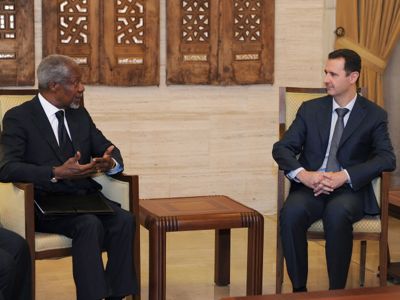
Former UN Secretary General and Nobel Peace Prize, Kofi Annan, has been designated by Ban Ki-moon and Nabil El Arabi as joint special envoy to negotiate a peaceful solution to the Syrian crisis. With Annan’s extraordinary experience and shiny brand image, his appointment was welcomed by all.
What does this top international official really represent? Who propelled him to the highest-ranking positions? What were his political choices, and what are his current commitments? These questions are met with a discreet silence, as if his previous functions were in themselves a guarantee of neutrality.
Handpicked and trained by the Ford Foundation and the CIA
His former colleagues praise him for his thoughtfulness, his intelligence and subtlety. A very charismatic personality, Kofi Annan left a strong imprint behind him because he did not behave simply as the “secretary” of the UN, but more like its “general,” by taking initiatives that revivified an organization that was mired in bureaucracy. All that is known and has been repeated ad nauseam. His exceptional professional qualities earned him the Nobel Peace Prize, although this honor in theory should have been bestowed for personal political commitment, not a management career.
Kofi and his twin sister Efua Atta were born on 8 April 1938, into an aristocratic family of the British colony of the Gold Coast. His father was the tribal chief of the Fante people and the elected governor of Asante province. Although he opposed British rule, he was a faithful servant of the Crown. With other notables, he took part in the first decolonization movement, but looked upon the revolutionary fervor of Kwame Nkrumah with suspicion and anxiety.
In any event, Nkrumah’s efforts led to the independence of the country in 1957 under the name of Ghana. Kofi was then 19 years old. Though not involved in the revolution, he became vice-president of the new National Student Association. It was then that he was spotted by a headhunter from the Ford Foundation who incorporated him into a program for “young leaders.” From there, he was invited to follow a summer course at Harvard University. Having noticed his enthusiasm for the United States, the Ford Foundation offered to sponsor his complete studies, first in economics at Macalester College in Minnesota, followed by international relations at the Graduate Institute of International Studies in Geneva.
After the Second World War, the Ford Foundation, created by famous industrialist Henry Ford, became an unofficial instrument of U.S. foreign policy, providing a respectable facade for the activities of the CIA [1].
Kofi Annan’s overseas study period (1959-1961) coincided with the most difficult years of the African-American civil rights movement (the start of Martin Luther King’s Birmingham campaign). He saw it as an extension of the decolonization he had witnessed in Ghana, but once again did not get involved.
Impressed with Annan’s academic achievements and political discretion, his U.S. mentors opened for him the doors of the World Health Organization, where he landed his first job. After three years at WHO headquarters in Geneva, he was appointed to the Economic Commission for Africa based in Addis Ababa. However, not sufficiently qualified to pursue a career at the UN, he returned to the United States to take up management studies at the Massachusetts Institute of Technology (MIT) (1971-1972). He then attempted a comeback in his home country as director of tourism development, but found himself perpetually at odds with the military government of General Acheampong; he gave up and returned to the United Nations in 1976.
A successful career despite tragic failures
There, he held various positions, initially within UNEF II (the peacekeeping emergency force established to supervise the cease fire between Egypt and Israel at the end of the October 1973 war), then as Director of personnel at the Office of the UN High Commissioner for Refugees (UNHCR). It was at this time that he met and married Nane Lagergren Master, his second wife. The Swedish lawyer is the niece of Raoul Wallenberg, Sweden’s special envoy in Budapest during World War II. Wallenberg is famous for having saved hundreds of persecuted Jews by issuing them protective passports. He also worked for the OSS (forerunner of today’s CIA) as a liaison with the Hungarian resistance. He disappeared at the end of the war, when the Soviets allegedly captured him to stem US influence in the country. In any event, Kofi Annan’s successful marriage opened the doors that he could not have passed through on his own, especially those of Jewish organizations.
Secretary-General Javier Perez de Cuellar chose Kofi Annan as Assistant Secretary-General in charge of human resources management and staff safety and security (1987-90). With the annexation of Kuwait by Iraq, 900 UN employees remained stranded in that country. Kofi Annan was able to negotiate their release with Saddam Hussein, a feat that boosted his prestige within the Organization. He was then successively put in charge of the budget (1990-92) and peacekeeping operations under Secretary-General Boutros Boutros-Ghali (1993-96), with a brief interlude as a special envoy for Yugoslavia.
According to Canadian General Romeo Dallaire, commander of the UN peacekeeping force in Rwanda, Kofi Annan failed to respond to his many appeals and carries the primary responsibility for UN inaction during the genocide (800,000 dead, mainly Tutsis, but also Hutu opponents) [2].
A similar scenario was repeated in Bosnia, where 400 peacekeepers were taken hostage by Bosnian Serb forces. Kofi Annan remained deaf to the calls of General Bernard Janvier and allowed the perpetration of predictable massacres.
In late 1996, the United States vetoed the reappointment of the Egyptian Boutros Boutros-Ghali as Secretary General, regarded as dangerously Francophile. They succeeded in imposing their candidate: a senior official from within the international organization itself, Kofi Annan. Far from playing against him, his failures in Rwanda and Bosnia blossomed into assets after he candidly confessed to them and promised to reform the system so that they wouldn’t recur. He was elected on this basis and took office on 1 January 1997.

Pocantino Conference Center

United Nations Secretary General
Kofi Annan immediately set up an annual two-day seminar behind closed doors for fifteen UN ambassadors. This “retreat” (sic) was generously hosted by the Rockefeller Brothers Fund at the Pocantico Conference Center (upstate New York). There, outside the official framework of the United Nations, the Secretary General discussed the reform of the Organization with the representatives of the States whose support he knew he could count on.
In this context, he reallocated the expenditures of the UN in line with political priorities and significantly reduced the budget of the General Secretariat. He reorganized the administrative functioning around four objectives (peace and security, development, economic and social affairs, humanitarian affairs). He created a post of deputy secretary-general to stand in for him and endowed himself with a real cabinet capable of acting promptly on the decisions of the Security Council and General Assembly.
Kofi Annan’s landmark initiative was the Global Compact, the mobilization of civil society for a better world. On the basis of a voluntary dialogue, businesses, unions and NGOs were brought together to discuss and commit to respect human rights, labor standards and the environment.
In practice, the Global Compact did not yield the desired effect on the ground. On the contrary, it deeply distorted the nature of the UN by playing down the power of nation-states and emphasizing that of transnational corporations and of associations which are “non-governmental” only in name and which are covertly funded by the great powers. By promoting lobbies as partners of the United Nations, Kofi Annan buried the spirit of the San Francisco Charter. It is no longer a question of saving mankind from the scourge of war by recognizing the legal equality of nations large and small, but of improving the human condition by supporting the convergence between private interests.
The Global Compact is a deviation from the nearly universally accepted logic that international law serves the common good, to a logic embraced only by the Anglo-Americans for whom the common good is a chimera and good governance consists in bringing together the largest number of special interests. Ultimately, the Global Compact has had the same effect as the charity galas in the U.S.: to give oneself a good conscience by launching high-profile initiatives while condoning structural injustices.
In that sense, the terms of Kofi Annan (1997-2006) reflect the reality of the historical period, that of a unipolar world subjected to the globalization of U.S. hegemony at the expense of nation-states and the peoples that they represent.
This strategy is in line with the device set up by Washington in the 1980’s involving the National Endowment for Democracy, an agency that, contrary to its title, aims to carry forward the subversive action of the CIA by manipulating the democratic process [3]. The NED subsidizes, legally or not, employers’ organizations, labor unions and associations of all kinds. In return, the beneficiaries participate in the Global Compact, thereby bending the positions of the Nation-States which lack the means to fund their own lobbies. Peace has stopped being a concern for the UN since the unipolar world has its own policeman, the U.S.; thus the organization can concentrate instead on absorbing all forms of protest to better corroborate the global disorder and justify the progressive global expansion of U.S. hegemony.
The soothing rhetoric of Kofi Annan reached its zenith at the Millennium Summit. 147 heads of state and government pledged to eradicate poverty and solve major health problems worldwide, including AIDS, in fifteen years. Universal happiness can dispense with political reform, provided everyone makes an effort and chips in. Why didn’t anyone think of this earlier? But alas, the Millennium remained wishful thinking; injustice was not eradicated and continues to nurture war and misery.
In the same vein, Secretary-General Kofi Annan’s 20 September 1999 speech to the General Assembly outlined what has been termed the “Annan doctrine.” Using his own impotence in Rwanda and Bosnia as an excuse, he argued that in both cases the States had failed in their duty to protect their own people. He therefore concluded that the sovereignty of States, guiding principle of the UN Charter, constitutes an obstacle to human rights protection. The African Union adopted this view under the name of “Responsibility to Protect;” the UN followed suit in 2005 during the World Summit responsible for the follow-up of the Millennium Summit. The Annan doctrine is nothing more than the reincarnation of the right to intervene invoked by the British to wage war against the Ottoman Empire and, more recently, updated by Bernard Kouchner. The new concept will be used explicitly for the first time in 2011 to legalize the colonial operation against Libya [4].
In addition, Kofi Annan’s terms as UN Secretary-General were marked by the “Oil-for-Food” programme which was devised by the Security Council in 1991, but was effective only from 1996 to 2003. It was originally intended to ensure that Iraq’s oil revenues would be used exclusively to meet the needs of the Iraqi people and not to finance new military adventures. However, in the context of the international embargo and under the personal supervision of Kofi Annan, this program became an instrument in the hands of the U.S. and the UK to bleed Iraq while they occupied the “no-fly zone” (which corresponds roughly to the current autonomous Kurdistan region) until the outbreak of the aggression against and destruction of the country [5]. For years, the population was undernourished and deprived of life-saving medicines. Several international officials who were in charge of that program qualified it as a “war crime” and even resigned after refusing to apply it. Among them, the UN Assistant Secretary-General Hans von Sponeck and UN Humanitarian Coordinator Denis Halliday considered that this program brought about the genocide of 1, 5 million Iraqis, including at least 500,000 children [6].
It was not until the invasion and destruction of Iraq that Kofi Annan finally rebelled and denounced those who had paid for his education, propelled his rise to Secretary-General of the UN, and awarded him the Nobel Peace Prize. He described the attack on Iraq as illegal and voiced public concern that this precedent would eviscerate International Law [7] Washington responded brutally with a spying operation against Kofi Annan, his cabinet, his family and even against his friends. The Secretary-General’s son, Kojo Annan, was accused of embezzling “oil for food” program funds with his father’s blessing. The prosecution did not manage to convince UN member states and, on the contrary, consolidated the authority of the Secretary-General [8] However, during the last two years of his mandate, Kofi Annan was paralyzed and forced to toe the line.
Back to square one
After 10 years as Secretary-General, Kofi Annan continued his career in several more or less private foundations.
In December 2007, elections in Kenya degenerated into conflict. President Mwai Kibaki appeared to have defeated the candidate backed by Washington, Raila Odinga, reportedly a cousin of then-Senator Barack Obama. U.S. Senator John McCain challenged the election results and called for revolution as waves of anonymous SMS exacerbated inter-ethnic differences. Within days, riots left more than 1,000 dead and 300,000 displaced. Madeleine Albright proposed the mediation of the Oslo Center for Peace and Human Rights. The institute sent two mediators: former Norwegian Prime Minister Kjell Magne Bondevik and former UN Secretary-General Kofi Annan, both members of the Board of Administration.
As a result of that “mediation,” President Kibaki was forced to bow to U.S. wishes. He was able to stay in office, but first had to accept a constitutional reform that stripped him of his powers in favor of the Prime Minister and to agree to the choice of Odinga as Prime Minister. In his role as wise old African, Kofi Annan helped to give a veneer of legitimacy to a regime change imposed by Washington [9].
Kofi Annan currently exercises two key responsibilities. First, he chairs the Africa Progress Panel, an organization created by Tony Blair after the G8 summit held in Gleeneagles for the purpose of ensuring media coverage of the actions of the British Ministry of Cooperation (DFID). Unfortunately, like the Millennium Summit, the G8 promises were not fulfilled and the activity of the Africa Progress Panel is negligible.
He also serves as chair of the Alliance for a Green Revolution in Africa (AGRA), which aims to solve the food problems of the black continent through biotechnology. In fact, AGRA is a lobby funded by the Bill Gates and Rockefeller Foundations to promote the dissemination of GMO’s produced by Monsanto, DuPont, Dow, Syngenta and others. Most independent experts agree that, beyond the issue of their environmental impact, the use of non-reproductible GMO crops keeps farmers under the thumb of their suppliers and introduces a new form of human exploitation.
Kofi Annan in Syria
So what has this former high-ranking international official come to Syria for? In the first place, his appointment suggests that the current UN Secretary-General Ban Ki Moon, whose image has been tarnished by his kowtowing to the United States and by a string of corruption scandals [10] was not up to the task, while Kofi Annan, despite his balance sheet, still enjoys a positive image.
Secondly, a mediator can succeed only to the extent that he has been selected by the parts in the conflict. But this is not the case. Kofi Annan represents the Secretary-General of the UN and his Arab League counterpart. He defends the honor and reputation of both institutions in the absence of clear political instructions.
If the appointment of Mr Annan was approved de facto by the members of the Security Council and those of the Arab League, it is because it satisfies conflicting expectations. For some, the joint special envoy is not intended to broker peace, but to clad a peace that has already been negotiated between the great powers so that everyone can stand tall. Others expect him to repeat the Kenyan script and bring about regime change without further violence.
Over the past three weeks, the action of Kofi Annan has been to present his own plan, an amended version of the one developed by Russian Foreign Minister Sergey Lavrov. In doing so, he has rendered the plan palatable for Washington and its allies. In addition, Mr. Annan has intentionally introduced an element of confusion by suggesting that he had convinced President al-Assad to appoint one of his vice presidents, Farouk al-Shara, to negotiate with the opposition. This is portrayed as a concession made by Syria to the Gulf Cooperation Council. In fact, Vice President al-Shara has been in charge of these negotiations for a year and the demand made by Saudi Arabia and Qatar is totally different: that President al-Assad should step down because he is an Alawite and that power be transferred to the Vice President for being a Sunni. It would thus seem that the joint special envoy is engineering a way out for those states that have attacked Syria and invented the fable of a democratic revolution crushed in blood.
However, the doublespeak of Kofi Annan, who when in Damascus was satisfied with his meeting with President al-Assad but expressed disappointed once back in Geneva, has not raised any questions about his true intentions.
Related articles
- UN – Arab League envoy hails Syria’s plan acceptance (alethonews.wordpress.com)
Israel Casually Bars UN Fact Finding Team
By Sami Zaatari | Palestine Chronicle | March 31, 2012
Imagine if Iran had recently denied allowing a UN fact-finding team from entering their country to inspect and investigate their atomic energy program. What kind of reaction would most likely come out? With no doubt, the United States, as well as Israel would begin to sound the drums of condemnation, and would point to this act as further proof of how sinister Iran is. Yet this is precisely what has recently happened, although it was not the dreaded Iran that barred a UN fact-finding team, rather it was none other than Israel.
There has hardly been any negative reaction or condemnation for Israel’s act. I waited for almost a week to write this article just to see if there would be any negative reaction towards Israel for this act. None. The US said nothing of the matter in terms of condemnation, and Israel has yet again proven it’s complete double standards to the world.
The UN fact finding team that was barred from Israel was part of the UN’s human rights council. Their mission was to go into Israel, and the West Bank to be able to investigate the illegal settlements that Israel has built and continues to build in the West Bank. Once again, contrast this with Iran, what would have happened if Iran did this? Coincidently, Iran has often opened up its atomic energy program for the UN and international inspectors to come in and investigate. Furthermore Iran hasn’t even breached any international law by their atomic energy program for anything to be inspected or investigated in the first place. On the other hand Israel is breaching international law in regard to their settlement building, therefore the UN has a full right to come and investigate the matter, yet Israel has barred them from doing so. Just think about that for a second, Iran is not breaching any law by their atomic energy program, yet they allow investigators in. Israel is breaching international law, yet doesn’t allow any investigators to come in and investigate.
As mentioned, this yet again exposes Israel’s double standards, and once again lays waste to their claims that they supposedly care for international law or respecting UN resolutions. What makes this all the more ironic is not that Israel simply pretends to care about international law or UN resolutions, but rather that they use such concepts/institutions when they seek to drum up pressure against Iran. Whenever Israel seeks to condemn Iran, Israeli politicians enjoy referring to international law, UN resolutions, but when it comes to Israel itself it openly disrespects and defies the very same concepts and institutions.
And where is the US in all of this? Nowhere to be seen, America yet again demonstrates why no level headed Middle Easterner (let alone dissatisfied American citizens) can take them seriously, or can lend them their trust. How can the US on one hand condemn Iran and refer to international law, the UN etc, but when it comes to Israel’s flagrant disregard for such institutions, it stands by quietly? Not to mention that Israel is actually in breach of international law by the very settlements themselves. So one would think that the US would be more than happy for such illegal settlements to be investigated, and would be incensed by Israel’s act of barring such an investigation. If the US wants to be a serious peace broker within the region, and if it actually wants to gain the trust and respect of you’re average Arab on the street, then it is time for America to get rid of it’s open bias in regard to Israel and do what is right in order for peace to be achieved within the region.
Let us end with these words of Israeli Foreign Minister Avigdor Liberman who said the following in regards to the UN fact finding team: “It means that we’re not going to work with them. We’re not going to let them carry out any kind of mission for the Human Rights Council, including this probe.”
– Sami Zaatari is an American of Palestinian-Iranian descent. Zaatari is a writer, and a public speaker who has taken part in public events of inter-faith and inter-community discussions. Zaatari also holds an MSc in the field of Middle East Politics.
Related articles
- Israel Boycotts UN Rights Council over Settlement Investigation Decision (alethonews.wordpress.com)
- Arabs: Israel, US Our Main Concern, Not Iran (alethonews.wordpress.com)
- Israel excitedly rejects cooperation with UN over settlements (alethonews.wordpress.com)
India: Concern expressed about extrajudicial executions
UN Office of the High Commissioner for Human Rights | March 30, 2012
NEW DELHI –– The United Nations Special Rapporteur on extrajudicial, summary or arbitrary executions, Christof Heyns, called on the Government of India to continue to take measures to fight impunity in cases of extrajudicial executions, and communal and traditional killings.
The Special Rapporteur on extrajudicial, summary or arbitrary executions, Christof Heyns, concluded today his official visit to India, which took place from 19 to 30 March 2012.
Mr. Heyns praised the openness and willingness of the Government of India to engage, shown also by the fact that it was willing to host a mission dealing with the right to life, an area in which issues to be tackled are often complex in various countries.
“This, together with the generally high level of commitment by the Indian Government to human rights and the fact that there have recently been improvements in some respects in the loss of life, could provide a window of opportunity to take decisive steps to ensure the greater realization of the right to life,” stated Christof Heyns.
While recognizing the size, complexity, security concerns and diversity of India, the Special Rapporteur remains concerned that the challenges with respect to the protection of the right to life in this country are still considerable. “Evidence gathered confirmed the use of so-called ‘fake encounters’ in certain parts of the country. Where this happens, a scene of a shoot-out is created, in which people who have been targeted are projected as the aggressors who shot at the police and were then killed in self-defence. Moreover, in the North Eastern States, and Jammu and Kashmir the armed forces have wide powers to employ lethal force.”
The above is exacerbated by the high level of impunity that the police and armed forces enjoy, due to the requirement that any prosecutions require sanction from the central government – something that is rarely granted. “The main difficulty in my view has been these high levels of impunity”, stressed the Special Rapporteur.
Other areas of concern relate to the prevalence of communal violence, and, in some areas, the killing of so-called witches, as well as dowry and so-called “honour” killings, and the plight of dalits (‘untouchables’) and adivasis (‘tribal people’).
Christof Heyns proposed a number of provisional steps to be taken to address these concerns. In the first place, he called for the establishment of a Commission of Inquiry, consisting of respected lawyers and other community leaders, to further investigate all aspects of extrajudicial executions. This should entail a form of transitional justice.
“Institutions such as the National Human Rights Commission should establish to what extent the guidelines they provide on matters such as the use of lethal force by the police are in fact observed, as opposed to providing empty promises in practice,” underscored the Special Rapporteur, recommending the immediate repeal of the laws providing for the immunity from prosecution of the police and the armed forces, and in particular the repeal of the Armed Forces (Special Powers) Act of 1958.
“India should ratify a number of international treaties, including the Convention Against Torture and the International Convention for the Protection of All persons from Enforced Disappearance,” he said. “India should also host missions by other United Nations independent experts, in particular those related to torture, enforced disappearances and counter-terrorism measures.”
The 12-day official mission by the Special Rapporteur was the first visit to India by an independent expert since that country extended an open invitation to UN Special Procedures in 2011, and the first mission to India by an expert mandated by the UN Human Rights Council to monitor and report on extrajudicial, summary or arbitrary executions.
The UN Special Rapporteur’s final conclusions and recommendations will be submitted as a comprehensive report to the Human Rights Council at a future session in 2013.
Related articles
- UN rapporteur arrives on fact-finding mission in Kashmir (kractivist.wordpress.com)
- UN Special Rapporteur to visit JK tomorrow (kashmirreport.wordpress.com)
Featured Video

Deception – Submarines against Olof Palme
or go to
Aletho News Archives – Video-Images
From the Archives
Woolsey Fire started at Santa Susana Field Lab — where “radioactive materials released were never accurately measured”
By John Laforge | CounterPunch | November 30, 2018
In my Nov. 16 column, I reported on potential radiation risks posed by California’s Woolsey wildfire having burned over parts or all of the Santa Susana Field Laboratory—south of Simi Valley, Calif., 30 miles outside Los Angeles—site of at least four partial or total nuclear reactor meltdowns.
The field laboratory operated 10 experimental reactors and conducted rocket engine tests. In his 2014 book Atomic Accidents, researcher James Mahaffey writes, “The cores in four experimental reactors on site … melted.” Reactor core melts always result in the release of large amounts of radioactive gases and particles. Clean up of the deeply contaminated site has not been conducted in spite of a 2010 agreement.
Los Angeles’s KABC-7 TV reported Nov. 13 that the Santa Susana lab site “appears to be the origin of the Woolsey Fire” which has torched over 96,000 acres. Southern Calif. Public Radio said, “According to Cal Fire, the Woolsey Fire started on the afternoon of Thursday, Nov. 8 … on the Santa Susana site.” … continue
Blog Roll
 Aletho News
- Dr. Abu-Sitta: Beirut ‘felt like a day in Shifa Hospital’
- Iran Has Won the War, It Will Be Up to the US to Secure the Peace: Mohammad Marandi
- Iran condemns assassination threats against Iranian negotiators amid US talks
- Brussels cannot say where its own pipeline inspectors are as Hungary’s oil lifeline remains shut
- Israel’s Iran War: Myth and Reality
- Between war and industrial breakdown: The US-Israeli attrition crisis
- Pressure builds on Iran to ‘drop’ Lebanon ceasefire demand as Islamabad talks hang in balance
- In another clash report, US denies agreement to release Iran’s assets
- What is fueling unrest across the EU?
- Why no power can undermine Iran’s eternal dominance over the Strait of Hormuz
- If Americans Knew
- Pro-Israel ‘Thinktanks’ and Individuals who Influence U.S. Foreign Policy
- Mearsheimer reveals how Israel dictates US policies on Iran, Gaza – video
- After killing 350+, Israel still has a “score to settle” with Lebanon before ceasefire – Daily Update
- Military aid to Israel emerges as the latest political litmus test for Democrats
- The only Palestinian children’s rights organization closes following years-long Israeli campaign against it
- ‘I Can’t Forget the Smell’: Lebanese Reel After Israel Kills Over 300 in Single Day
- DNC Shoots Down Resolutions Calling Out AIPAC and Limiting Arms to Israel
- TCN: Is Israel Blackmailing President Trump?
- Israel killed at least 303 Lebanese yesterday – who were they? Daily Update
- Amnesty: Urgent – Protect Lebanese civilians from brutal escalation in Israeli attacks
- No Tricks Zone
- German Expert: Heat Dome Led To Record Temps In Western USA…Warmer In 1934, 1936
- New Study: No Linear Warming Or Glacier Retreat Along Northern Antarctic Peninsula Since 1980s
- An Inconvenient Tree: Uncovered In Alps… Europe Much Warmer Than Today 6000 Years Ago
- New Study Reports A 60% Slowdown In Greenland’s Ice Loss Rate In The Last Decade
- Low Intensity Tornado Wrecks Major Solar Farm, Creating A Potential Toxic Dump
- New Study Finds Warming Saves Lives…Cold Temperatures 12 Times More Deadly Than Excess Heat
- German Science Blog Accuses PIK Climate Institute Of Hallucinating Climate Tipping Points
- Devastating Assessment Of Comirnaty Vaccine By Former Senior Pfizer Europe Toxicologist
- New Study: CO2 Is ‘Effectively Negligible’ As An Explanatory Climate Change Factor Since 2000
- Former Pfizer Toxicologist Dr. Helmut Sterz Tells Bundestag Hearing Pfizer Vaccine Should Have Never Been Approved
 Aletho News