US invokes holocaust in Syria aid spat with Russia
Penny for you thoughts | January 28, 2014
How low can you go?
When the hand you hold is a loser. The holocaust card can always be played.
The U.S. ambassador to the United Nations has called on Russia to use its influence with the Syrian regime to help get humanitarian aid to the besieged city of Homs.
Tense negotiations between the Syrian government and opposition entered their fifth day Tuesday, focusing on the transfer of power and helping besieged parts of Homs.
The emphasis on Homs and release of detainees are meant as confidence-building measures. A tentative agreement was reached in Geneva over the weekend for the evacuation of women and children trapped in Homs before aid convoys go in. Central Homs has been under siege for nearly two years.
U.S. Ambassador to the UN, Samantha Power, in a speech during international Holocaust commemoration day on Monday, said that just as Russian soldiers liberated Auschwitz in 1945, “the world again needs Russia to use its influence, this time to ensure that food reaches the desperate and starving people imprisoned in besieged Homs, Yarmouk, the Damascus suburbs and elsewhere.”
“The horrors of the Holocaust have no parallel but the world continues to confront crimes that shock the conscience,” Power said during an event where film director Steven Spielberg gave a keynote address and a survivor of the Nazi genocide also spoke. “In October, the Security Council spoke with a united voice about the need for action to address the humanitarian devastation in Syria. There are people who are imprisoned in their own neighborhoods.” “They need food desperately and yet food cannot reach them because the regime will not allow it.”
Oh, I can think of plenty of parallels, but, let’s pretend the Holocaust (TM) is the only one that counts.
So valued for so many reasons:
Crushing free speech
Playing the victim card
Guilt
And let’s not forget- Used to traumatize young Israeli’s- I saved this one knowing the time would be right to use it!
‘Holocaust journeys’ can cause mental health problems
Think of the value in traumatizing the populace. Fear and trauma allows for mass manipulation and ease of control.
Back to the invocation of the high holy holocaust meme
Russia’s mission to the UN criticized Power for bringing the Holocaust into the Syria issue.
“We regard such analogies as entirely inappropriate,” said Alexei Zaitsev, a spokesman for the mission, in an e-mail.
And these are inappropriate analogies. But, Samantha Power has always shown herself to be willing to stoop to the way down low level.
Sick. Considering the US and Israeli involvement in the ruin of Syria. Absolutely sick!

What Did Samantha Power Say About Iraq Invasion?
By Peter Hart | FAIR | June 10, 2013

Samantha Power on Democracy Now!
Obama National Security Council adviser Samantha Power has been named the new U.S. ambassador to the United Nations. That news prompted a piece in the New York Times (6/9/13) headlined “A Golden Age for Intervention?” by Neil MacFarquhar. The article raises some of the usual issues surrounding Power’s work– most prominently the notion that the United States should use military intervention in the name of humanitarianism.
MacFarquhar writes that Power
wants the system to work. As flawed as the Security Council is, she has often said, its endorsement amplifies international approval for controversial action. She criticized the American invasion of Iraq because it lacked the council’s stamp, among other reasons.
But what did Samantha Power actually say about the Iraq War before it happened?
Power was prominent in elite foreign policy discussions at the time; her 2002 book A Problem from Hell: America and the Age of Genocide won a Pulitzer the following year.
MacFarquhar makes it sound like Power had multiple reasons she opposed the war. But it’s difficult to find such evidence.
On March 10, 2003, she appeared on MSNBC‘s Hardball to debate pro-war writer Jonathan Chait–whom she agreed with on a few points.
Indeed, it was somewhat difficult to say what Power’s position was overall:
An American intervention likely will improve the live of the Iraqis. Their lives could not get worse, I think it’s quite safe to say.
The issue, though, is whether the United States can be, in a sense, the unilateral guardian of human rights and whether the intervention itself won’t have destabilizing consequences, both in terms of our security, the very security in whose name we’re really launching this intervention, and in the name of international principles like human rights, international justice, international stability.
Power seemed especially concerned about how the ramifications of the war on U.S. standing in the world:
It legitimates the go-it-alone approach and it sort of reinforces the impression of us as an outlaw nation, which is ironic because, of course, Saddam’s regime is far more an outlaw nation than ours.
So Power certainly did not support the way the United States was launching the war. But that’s not really the same as opposing the war; it’s wishing for more effective management of the war.
And host Chris Matthews closed the segment trying to get Power to take a position:
MATTHEWS: Is this a just war, Samantha?
POWER: It will have a just result locally and probably a very unjust result…
MATTHEWS: Is it a just war?
POWER: I don’t think we can be the guardians of justice…
MATTHEWS: No, I–so it’s not a just war?
POWER: We haven’t fought it yet, Chris. I mean, you know, you can’t say whether…
MATTHEWS: Well, you have to decide about a war before you start it, not afterwards. Is this a just war…
POWER: No, you can’t weigh in on proportionality, on discrimination, on whether we actually follow through and actually look out for the rights of the Iraqis…
(CROSSTALK)
POWER: … after the war. We don’t know that now.
MATTHEWS: But in its outset, is it a just war?
POWER: It’s not being fought for human rights reasons. I don’t know who–why–I mean, it would be great if human rights were a necessary condition.
At that time, bonafide critics of the Iraq War were much clearer than that, and it’s hard to find much else that would suggest that Power had a particularly clear anti-war case she made publicly–though she did, like many others, come around to articulating a more forceful critique of the Bush administration by the time that administration was almost over.
Weeks after the war started, a Los Angeles Times article (4/10/03) on Power included this assessment of Iraq:
“That’s what’s so great about the fall of Saddam Hussein. Now we can actually put our money and power where our might has been so far. We can demonstrate what we have claimed all along, that this war is about them,” she said, referring to the Iraqi people.
“The hard work is just beginning, in Iraq and also in restoring U.S. credibility as a global actor. I hope the book provides the spirit in which that can be done.”
Some of Power’s most pointed critics–like writer and lawyer Chase Madar–have argued that Power does not forcefully critique U.S. policies that have encouraged and enabled massive crimes against humanity, preferring instead to talk about instances where the United States could have taken steps to intervene militarily in a given crisis and didn’t.
But in the case of Iraq, at a time when the themes of her celebrated book were very much a part of the debate over whether or not to go to war, it was hard to determine where Power stood.
Featured Video
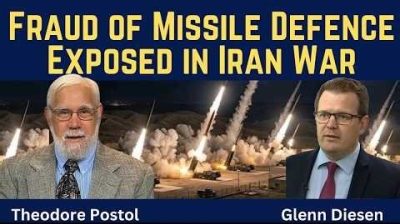
Ted Postol: Fraud of Missile Defence Exposed in Iran War
or go to
Aletho News Archives – Video-Images
Frlom the Archives
Containing the United States
By Edward S. Herman | Z Magazine | September 2016
“Containing the United States” is, of course, a ridiculous and self-contradictory idea in the U.S. and Western ideological and propaganda system. We all know that the United States had to “contain” the Soviet Union from 1945 to 1991, and since then has had the task of containing Russia and China. Only they threaten, bully, aggress and worry countries like Poland and Vietnam. Obama has had to reassure them both of our steadfast stand against Russian and Chinese military attacks. NATO has, of course, expanded greatly over the past several decades, despite the deaths of the Soviet Union and Warsaw Pact, but only to contain the renewed Russian — and Iranian, Libyan, Syrian and other — military threats; and we have “pivoted” to Asia, supported Japanese rearmament, bolstered our own forces in that area and jousted with the Chinese in their coastal waters solely to contain China. Earlier we had been obliged to contain North Vietnam, or was it the Soviet Union in Vietnam? Or China? Or “communism”? Or maybe all of them? Or none of them, but just needing an excuse to enlarge power?
The parallel propaganda has taken many forms. One is accepting as a premise that the United States only acts defensively and has no internal forces and interests that drive it to enlarge its sphere of control. I noted in an earlier article how Paul Krugman claims that internal Russian problems may well be the explanation of Russian “aggression,” but how at the same time it never occurs to him that the huge U.S. transnational corporate interests and “defense” establishment, and the pro-Israel lobby’s activities, might possibly make for an expansionist dynamic here.2 This reflects the standard establishment perspective that we are good and only react to evil. This was the view sustaining and justifying the invasion and occupation of Iraq from 2003. That attack was taken here as not evil but a response to evil, even if involving lies and mistakes, hence not describable as “aggression.” … continue
Blog Roll
 Aletho News
- Top official: Iran ready for a long war with US, no more diplomacy
- How Iran’s Toxic Rain Reveals US-Israel Discord
- Trump Admits He Is Destroying Iran For Israel
- Iran’s latest move in the GCC countries was a stroke of genius
- Blackmail and death threats, Zelensky embarrasses the EU, but there’s no condemnation
- Israel threatens to kill Iran’s new leadership
- Possible Scenarios for the Middle East
- The Horizon of the War. “Italy is being Dragged Into the War against Iran”
- A Second Vietnam War? Hanoi Waits and Prepares
- Ted Postol: Fraud of Missile Defence Exposed in Iran War
- If Americans Knew
- EXPLAINER – Dimona: What to know about Israel’s nuclear site
- Fires and toxic air in Iran (thanks, Israel) – Not a ceasefire Day 150
- At Israel’s hands, Iran is burning, Lebanon and Gaza are crumbling – Not a ceasefire Day 149
- Israel is using the ‘Gaza doctrine’ in Lebanon and Iran
- Saudi journalist says ‘not all attacks’ on Gulf coming from Iran, fears US-Israel dragging monarchies into war
- Iranian officials say Israel carried out some of the drone strikes on Gulf energy sites
- US, Israel ravage Iran and Lebanon; 4 killed in Gaza – Not a ceasefire Day 148
- US troops were told war on Iran was ‘all part of God’s divine plan’, watchdog alleges
- Trump wants to run the show in Iran, but doesn’t know what he’s doing – Not a ceasefire Day 147
- ‘Dirty Work’ :The truth about how Israel was founded
- No Tricks Zone
- Wake-up Call: Survey Shows Majority Of Germans Now Favor Postponing Climate Targets!
- Televised! Leading German Political Candidate Tells Schoolchildren CO2 Makes Sun Hotter!
- New Study: A Century Warming Of 1.1°C Is ‘Commonplace’ And ‘Not Unusual’ During This Interglacial
- New Study: ‘Internal Noise’ And Volcanic Forcing Can Trigger 10-15°C Warming Within Decades
- Glaciers Worldwide Are Suddendly Surging, Experts Blame Warming!
- Surprising Discovery: Sahara Is Greening…Billions Of Trees Where Once Thought To Be Barren
- New Research Reaffirms Clouds, Aerosols, And Surface Solar Radiation Are ‘Driving The Climate System’
- Germany: Electric Car Catches Fire At Charging Station, Sets Off Local “Inferno”, Widespread Damage
- New Study: Canada’s New Brunswick Was 1°C Warmer Than Today During The Medieval Warm Period
- Coal Power Back In Trend As Globe Tries To Keep Pace With Growing Demand For Power
 Aletho News