Pfizer Pays $60 Million for Bribing Foreign Doctors
By Noel Brinkerhoff | AllGov | August 10, 2012
Foreign subsidiaries of Pfizer spent years bribing foreign doctors and healthcare officials to expand sales of the company’s pharmaceuticals, according to a $60 million settlement reached with the U.S. government.
The deal, brokered by the Securities and Exchange Commission (SEC) and the U.S. Department of Justice, resolves charges of illegal activities that took place in about a dozen countries, including China, Bulgaria, Croatia, Kazakhstan, and Russia.
“Pfizer subsidiaries in several countries had bribery so entwined in their sales culture that they offered points and bonus programs to improperly reward foreign officials who proved to be their best customers,” Kara Brockmeyer, an SEC official, said in a news release. “These charges illustrate the pitfalls that exist for companies that fail to appropriately monitor potential risks in their global operations.”
In China, a subsidiary awarded doctors with points for every Pfizer prescription they wrote, allowing them to redeem the points for medical books, cell phones, and other gifts. In some cases, Pfizer’s China operation bribed physicians with free trips abroad.
Pfizer officials in the U.S. reportedly learned of the bribes in 2004 and began in internal investigation that kept federal regulators in the loop on what they discovered. The company insisted its executives knew nothing about the schemes before then.
Related articles
- Pfizer Admits Bribery in Eight Countries (corpwatch.org)
Nepotism prevalent at Justice Department, says Inspector General report
By Jordy Yager – The Hill – 07/26/12
The Justice Department’s inspector general found at least seven instances of federal employees engaging in illegal attempts to hire family members at the agency, according to a report issued Thursday.
The report is the third investigation in less than a decade that has found numerous examples of illegal hiring practices, amounting to nepotism, within the DOJ.
The latest series of nepotistic attempts came after Rep. Frank Wolf (R-Va.) alerted the IG to complaints he received in 2010 from a former DOJ employee-turned-whistleblower.
Wolf said the report was “alarming” and called on the DOJ employees, whose attempts at hiring relatives are exposed in the IG’s report, to be punished by the department.
“The report issued by the Department of Justice Inspector General today is alarming, especially given that the department has twice been warned about these illegal practices before,” said Wolf, the chairman of the House Appropriations subcommittee that oversees the DOJ’s budget, in a statement.
“I expect for the employees involved in this nepotism ring to be punished under full extent of the law. I also expect the department to move quickly to enact the necessary reforms to prevent this from happening again.”
Sen. Chuck Grassley (R-Iowa), the ranking member on the Senate Judiciary Committee, criticized the DOJ in the wake of the IG’s report, saying that the agency is running “wild.”
At an executive committee meeting on Thursday, Grassley called on Attorney General Eric Holder to take legal action against the employees cited in the report. Grassley has butted heads with Holder for most of the attorney general’s time in office, saying that the DOJ constantly “stonewalls” his requests for information and action.
“This is another example of the Justice Department run wild,” said Grassley. “It is troubling to me how employees within the Department colluded and schemed to hire one another’s relatives in order to avoid rules against nepotism.
“At the very least, the Attorney General needs to hold these employees accountable — with more than just disciplinary action,” he said. “Laws were broken and false statements were made. The Department can’t simply sweep this under the rug. Employees need to be punished.”
The IG’s report found seven examples of employees within the DOJ’s Justice Management Division (JMD) attempting to hire the family members of their fellow employees.
According to the IG’s report, in two separate instances a pair of employees, who worked in different sections of the DOJ, engaged in schemes to hire the other’s child. In another example, a DOJ employee tried to secure employment for his cousin and nephew.
The IG released two prior reports on nepotistic hiring practices in 2004 and again in 2008, in which they found that employees manipulated the DOJ’s hiring process to favor certain candidates.
In 2008, the IG recommended that the department conduct ethics training and establish a “zero-tolerance” policy for future attempts at illegal hiring.
In a memorandum issued earlier this week, Assistant Attorney General for Administration Lee Lofthus wrote the IG to say that he would strengthen and clarify training for employees, with particular attention on the agency’s nepotism rules.
Lofthus also said that by Friday his office would be implementing a three-prong set of disclosure forms that would require DOJ employees to disclose any family member who they are aware of applying for a job within the agency. It would also require any DOJ applicant to reveal a family member who works for the department.
Lofthus said, according to the IG report, the actions of illegal hiring were a result of intentionally “bad behavior” and not ignorance of the rules or a lack of training on the DOJ’s part.
“The OIG report concludes by saying most of the misconduct identified in the report did not stem from ignorance of the rules, but rather was the result of bad behavior by individuals insufficiently impressed with the principles of fair and open competition.”
Obama’s Justice Department Rushes to the Rescue of LIBOR Criminals
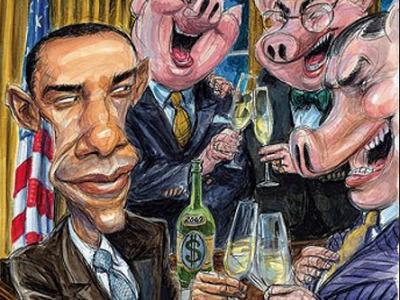
A Black Agenda Radio commentary by Glen Ford | July 18, 2012
The Obama Justice Department is in theater mode, again, pretending to threaten the bankster class with criminal penalties – prison time! – for their manipulation of the global economy’s benchmark interest rates. The Justice Department claims to be building criminal and civil cases in the LIBOR scandal, which in sheer scope is the biggest fraud by international capital in history. But that’s all a front, a farce. Barack Obama has spent his entire presidency protecting Wall Street, starting with his rescue of George Bush’s bank bailout bill after it’s initial defeat in Congress, in the last days of Obama’s candidacy. He packed his administration with banksters, passed his own bailout and, in collaboration with the Federal Reserve, channeled at least $16 trillion dollars into the accounts of U.S. and even European banks – by far the greatest transfer of capital in the history of the world. Obama has reminded the banksters that it was he who saved them from the “pitchforks” of an outraged public. He pushed through Congress so-called financial reform legislation that left derivatives – the deadly instruments of mass financial destruction that were at the heart of the meltdown – untouched.
Wall Street may or may not remain loyal to Obama, but Obama has been loyal to Wall Street, the guys who gave him the campaign cash to become a viable candidate. His Attorney General, Eric Holder, a corporate lawyer to the core, is busily staging a pre-emptive LIBOR prosecution of bankers in order to shield them from legal action by a host of other government agencies and, ultimately, from the global universe of parties that have been harmed by the bankster’s schemes– a list that stretches to infinity. Holder’s job is to monopolize the LIBOR case, to the extent legally and humanly possible, grabbing jurisdiction and consolidating the cases against the banks with the aim of reaching a settlement that does not further destabilize the financial system.
Holder and his boss already pulled that trick earlier this year with settlement of the bank “robo-signing” scandal – a scheme that would have ranked as the “crime of the century” until LIBOR came along. A small group of state attorney generals were holding up an administration-brokered settlement that effectively gave the banksters immunity from prosecution, in return for a measly $25 billion payout. Obama used every power of his office to pressure the state law officers into line. The last one capitulated with a promise from Obama that a “special unit of prosecutors” would expand the investigation into abusive mortgages practices. You haven’t heard a peep about it, since.
Now Obama and Holder are playing the same diversionary game, making tough noises about criminal investigations of the LIBOR conspirators. But the Justice Department has already given immunity to Barclay’s Bank, of Britain, and to the Swiss banking giant UBS. More immunities will follow. The reason Eric Holder is staging criminal investigations is because that’s the only way he can protect the bankers, through immunities and by gradually narrowing the scope of the case. In the end, there will be settlements all around, and the banksters will move on to even more fantastic heights of criminality – thanks to the loyal, protective hands of President Obama.
BAR executive editor Glen Ford can be contacted at Glen.Ford@BlackAgendaReport.com.
Related articles
- Richard (RJ) Eskow: Crooked Bankers Are Corrupting Government: The Real LIBOR Story (huffingtonpost.com)
US: The Shameful Index of Prison Rape
Action on PREA Can End the Violence
By Amy Fettig & Jennifer Wedekind, ACLU National Prison Project | May 17, 2012
Today the Department of Justice released the long-awaited Prison Rape Elimination Act (PREA) regulations, representing the first time that the federal government has issued national standards to help end sexual abuse in correctional facilities. The regulations are two years late and a lot of harm has been done in their absence, but now that they’ve finally been released they can help us protect important constitutional and human rights and ensure safe and fair correctional facilities that assist prisoners in rehabilitation rather than needlessly brutalizing them. The ACLU supports the Department’s efforts to protect and prevent sexual abuse in places of detention, although we regret that immigration facilities are not yet included in these standards.
Sadly, the problem of prison rape is just as pressing now as it was when Congress passed PREA in 2003. Below is the shameful index of prison rape in prisons, jails and youth detention centers across the country. These numbers reflect a national tragedy. But PREA gives us the critical tools to stop rape in our corrections facilities. Now, federal, state and local governments and the public must take strong and continued action to ensure that the promise of PREA becomes a safe and secure reality.
Number of people imprisoned in the United States: 2.3 million
Number of victims of rape or sexual abuse in U.S. prison, jails and juvenile detention facilities in the past year according to the Justice Department: 216,600 (the DOJ admitted it was likely “underestimating the extent of the problem”)
Number of victims of rape or sexual abuse in U.S. prison, jails and juvenile detention facilities since the initial PREA legislation as signed into law (Sept. 4, 2003): 1,884,909
Number of days past the Department of Justice’s deadline (June 23, 2010) for establishing the final standards: 717
Number of victims of rape or sexual abuse in U.S. prison, jails and juvenile detention facilities since the Department of Justice missed its deadline to establish regulations: 411,332
Percentage of youth in state juvenile facilities and large non-state facilities who experienced one or more incidents of sexual victimization in the past 12 months: 12%
Percentage of youth sexually victimized by a corrections staff member: 10.3%
Percentage of former state prisoners reporting one or more incidents of sexual victimization while in jail, prison or post-release community treatment facilities: 9.6%
Percentage of male former state prisoners who identified as homosexual or gay who reported being sexually victimized by another inmate: 39%
Percentage of male bisexual former state prisoners who reported being sexually victimized by another inmate: 34%
Percentage of transgender prisoners reporting being sexually assaulted in prison or jail according to a national survey: 15%
Percentage of black transgender prisoners reporting being sexually assaulted in prison or jail according to a national survey: 34%
Percentage of former state prisoners who experience retaliation in the form of disciplinary charges after reporting sexual victimization by a staff member: 46.3%
Percentage of former state prisoners who reported no facility response at all, after reporting sexual victimization by another prisoner: 37%
Number of states which allow cross-gender pat downs: 30
Number of reported incidents of sexual abuse in immigration detention facilities since 2007: 185
Number of organizations which urged President Obama to instruct the Department of Justice to extend PREA coverage to immigration detention facilities: 38
Number of members of the National Sheriff’s Association, which called on the Department of Justice to extend its PREA regulations to Department of Homeland Security detention centers: 18,000
Related articles
Featured Video
America Racing to Strategic Defeat in Iran
or go to
Aletho News Archives – Video-Images
From the Archives
Should Europeans ‘Thank’ the Americans for Destroying Nord Stream?
By Robert Bridge | Strategic Culture Foundation | September 29, 2022
With an investigation continuing into the destruction of the Nord Stream gas pipeline that provided energy supplies to Europe from Russia, there appears to be just one prime suspect, and that should surprise nobody.
Following the sabotage of the Nord Stream 1 and 2 gas pipelines, former Polish Foreign Minister Radoslaw Sikorski already seemed to know the identity of the perpetrator when he tweeted out: “Thank you, USA.”
At first glance, it seemed that Sikorski was speaking sarcastically, berating Washington for carrying out an attack that will have severe repercussions for the people of Europe. After all, how could anyone see any good coming from the termination of Europe’s primary source of gas reserves with winter just around the corner? It was Sikorski’s homeland of Poland, after all, that urged its citizens to collect firewood in the face of dwindling gas reserves.
In fact, the Polish diplomat was speaking one-hundred percent literally… continue
Blog Roll
 Aletho News
- Growing insecurity, soaring prices fuel protests in north as regime bans evacuation: Sources
- Iran denies responsibility for ‘depraved’ attack on Kuwait desalination plant
- Bring The Troops Back. End This War Now!
- Can we please stop calling Israel the ‘only democracy in the Middle East’ now?
- US should start removing its troops from Germany, proposes AfD co-leader Chrupalla
- Iran Red Crescent: 600 educational centers attacked in US-Israeli ‘war crimes’
- Russian Oil Tanker Arrives in Cuba Amid U.S. Blockade
- America Racing to Strategic Defeat in Iran: Lt Col Daniel Davis
- FTC Warns Visa, Mastercard, PayPal, Stripe Over Political Debanking
- Russian tanker approaches Cuba despite US oil blockade
- If Americans Knew
- Israeli police block Catholic cardinal from entering Church of the Holy Sepulchre on Palm Sunday
- Israel is assassinating journalists again, more than any other nation, anywhere, ever – Not a ceasefire Day 170
- Over 300 US service members wounded, majority have brain injuries – Not a ceasefire Day 169
- Researchers at Human Rights Watch Resign Over Blocked Report on Palestinian Refugee Return
- Jewish Groups Are Backing a War Americans Don’t Want
- Eric Fingerhut Thinks He’s the President of the Jews
- Top Jewish Philanthropists, Rabbis Urge Israeli President to Take Action Against ‘Jewish Extremists’
- Don’t Be Fooled. Zionist Leaders Have Always Wanted to Control Southern Lebanon
- Israel’s widespread use of torture is a core element of its genocide against the Palestinian people
- In Israel’s War on Iran, Many Middle East US Bases Rendered “All But Uninhabitable”
- No Tricks Zone
- New Study Finds Warming Saves Lives…Cold Temperatures 12 Times More Deadly Than Excess Heat
- German Science Blog Accuses PIK Climate Institute Of Hallucinating Climate Tipping Points
- Devastating Assessment Of Comirnaty Vaccine By Former Senior Pfizer Europe Toxicologist
- New Study: CO2 Is ‘Effectively Negligible’ As An Explanatory Climate Change Factor Since 2000
- Former Pfizer Toxicologist Dr. Helmut Sterz Tells Bundestag Hearing Pfizer Vaccine Should Have Never Been Approved
- Energy Expert: Germany’s Nuclear Phaseout Was A “500 Billion Euro Mistake”
- New Research: South Australia’s Mid-Holocene Sea Surface Temperatures Were 4°C Warmer Than Today
- Storing Green Energy To Last Germany 10 Days Would Require A 60-Million Tonne Battery
- New Studies: UK Sea Levels Were 4 Meters Higher Than Today During The Mid-Holocene
- Destructive Green New Deal: German Energy And Metal Group Warns Of Drastic Crisis
 Aletho News