The Changing Face of Regime Change
By Daniel McAdams | Ron Paul Institute | January 19, 2026
The most disturbing lesson from the 2014 Maidan Revolution in Ukraine that has been well-learned by the various intelligence agencies in this business is that the application of extreme violence – especially aimed at law enforcement, other state authorities, and civilians – provides an effective template upon which to further the regime change narrative. Everything can be blamed on “the regime” and thus serve the purpose of the operation.
We have seen this recently in Iran.
When I was on the ground observing the early “color revolutions” in the 1990s in Eastern Europe it was simply about getting warm bodies in the street to wave the correct flags and mouth the NED-approved slogans and to demand a new election, the most recent one having been “stolen.”
Questioning legitimacy of elections was enough at that early stage. Even Western polls suggesting the election result matched the will of the people (as in the 2006 Belarus presidential election and subsequent “Denim Revolution” I monitored on the ground) did not dissuade the protesters. But that was all fun and games compared to what came next.
Now it is about bodies and blood and particularly the most gruesome injuries. This is difficult for any legitimate state authority to defend against, as any application of counter-force only feeds the narrative of a violent regime determined to quell “legitimate” desire for political pluralism.
For a successful regime change in the current conditions there must be maximum bloodshed. And it does not matter whose blood is shed, it can all be blamed on “the regime.” The bots and fake social media accounts under control of intelligence agencies can take care of that part. Amplify atrocities, regardless whence they came.
Heavier bloodshed also feeds the ignorance and voyeurism of the intended Western and (especially) US audiences. “Thar be dragons,” is the rallying cry. Everything beyond our borders is unsophisticated and bestial, while at the same time longing to be exactly as we are.
We saw this clearly in the well-orchestrated attacks against state law enforcement authorities in Ukraine/Maidan in 2014. What would normally have sufficed to return society to order was shown to be woefully inadequate in the face of extremely violent agents on the ground including snipers on the rooftops and “wet works” specialists willing to murder law enforcement with their bare hands. The more violence the better. The more gruesome the better.
Lenin understood it well: “The worse the better.” You must recruit the absolute lowest and most violent dregs of society to carry out the operation. But then that has been the CIA Operations Directorate modus operandi since its founding. Which is why President Truman was desperate to strangle his own baby in the cradle.
Through some serendipity, the extreme violence of the CIA/MI6/Mossad attempted regime change operation we just witnessed in Iran was defeated by technology (likely imported from Iran’s allies) targeting the plan at its weakest point: communications and coordination. Extreme acts of violence against state authorities and average citizens have no value unless coordinated for propaganda purposes.
No less than President Trump himself reduced the entire operation to body counts. So the regime-changers had the incentive to produce more bodies and their recruits on the ground were only too happy to comply.
But something happened: the shutdown of Elon Musk’s ill-advised gift of Starlink to the violent Israel-sponsored extremists was defeated somehow and you had a gang of violent killers with no directions from Langley or Tel Aviv on who to kill next.
And it turns out that no matter what you think about that country six thousand miles away, it is not as easy as the neocons claim to overthrow the government and usher in at the point of a gun “democracy” DC style. With rainbow parades and promises of an atheistic, multi-culti paradise a la – ironically – the ICE resisters in Minnesota or Seattle.
Overseas, the neocon Right becomes the most ideologically insane version of the Minnesota Left: “Iran needs to celebrate multi-culturalism, atheism, and pan-sexuality!”
OK.
In the world of US Middle East regime change hegemony there is no Right or Left. It’s all been contracted out to Tel Aviv, as our tech world has been contracted out to H1B visas. Connect the dots and realize, as the Communists so well realized, what are the correlation of forces for and against you.
Husbanding the entirety of the US global military empire to overthrow the main impediment of Israel’s “Greater Israel” goal to conquer the Middle East is in no way in accord to our own interests or future well-being. On the contrary.
The US embrace of extreme violence – the “Israel model” – overseas can only harm our actual national interest. Embracing the latest iteration of the “regime change” template not only betrays our supposed moral high-ground, it hastens the correlation of forces against dollar hegemony and against the survival of America’s own oligarch class.
Oppose this or get used to being poor, immoral, and dead.
Executive Director of the Ron Paul Institute for Peace and Prosperity and co-Producer/co-Host, Ron Paul Liberty Report. Daniel served as the foreign affairs, civil liberties, and defense/intel policy advisor to U.S. Congressman Ron Paul, MD (R-Texas) from 2001 until Dr. Paul’s retirement at the end of 2012. From 1993-1999 he worked as a journalist based in Budapest, Hungary, and traveled through the former communist bloc as a human rights monitor and election observer.
Truth as first casualty: Deconstructing disinformation campaign on Iran riots death toll
By Yousef Ramazani | Press TV | January 19, 2026
Amid the foreign-instigated riots and terrorism that struck Iran in recent weeks, a parallel narrative war also unfolded, centered on the deliberate propagation of wildly inflated and unverifiable casualty figures.
These figures were designed to manufacture global outrage and legitimize calls for American military intervention and yet another aggression against the Islamic Republic.
The discourse surrounding riot-related casualties in the past few weeks has been fundamentally shaped by a coordinated disinformation campaign originating from US-funded organizations operating entirely outside Iran. Central to this campaign was the circulation of sensational death tolls that bore little resemblance to verifiable facts on the ground.
The figure of 12,000 deaths was initially promoted by the New York–based Center for Human Rights in Iran, an organization financially linked to the National Endowment for Democracy (NED), a US Congress–funded entity with a well-documented history of interference in the internal affairs of sovereign states.
This claim was presented without transparent methodology, primary data, or independent verification, raising eyebrows both inside and outside the country.
Despite this lack of evidence, the narrative was uncritically amplified by major Western media outlets and online influencers, creating a pervasive – but demonstrably false – impression of mass violence. Iranian officials consistently rejected these claims, presenting forensic evidence of manipulated datasets and instead reporting a death toll in the hundreds, the majority of whom were security personnel and civilians killed by armed rioters with foreign backing.
The subsequent escalation of these figures to even more implausible numbers – such as claims of 52,000 dead – underscores the persistence of a hybrid warfare strategy aimed at demonizing Iran while obscuring or outright excusing the violence committed by its adversaries.
Genesis of a false narrative: Center for Human Rights in Iran and its backers
The primary source of the sensational 12,000-fatality claim was neither an Iranian authority nor a verifiable international body, but the Center for Human Rights in Iran, an organization headquartered in New York. Despite its name, the group operates entirely outside Iran and has no physical presence or investigative capacity within the country.
An examination of its leadership and funding reveals a clear political orientation inconsistent with impartial human rights monitoring. The chair of its board is Minky Worden, an American activist with a documented history of spearheading anti-China advocacy campaigns, including efforts to politicize the Beijing Winter Olympics.
Financially, the organization relies heavily on grants from the National Endowment for Democracy in Washington, D.C. The NED is a privately managed but publicly funded institution that receives annual allocations from the US Congress through the State Department budget.
Historians, observers, and former intelligence officials have long characterized the NED as a transparent successor to activities once conducted covertly by the Central Intelligence Agency, particularly the funding of political opposition groups and media outlets under the banner of “democracy promotion.”
The NED’s record includes extensive involvement in “regime-change” efforts across Eastern Europe, Latin America, and West Asia – regions that have consistently featured in American foreign policy campaigns.
Amplification network: From NED grantees to global headlines
The unfounded casualty figure did not remain confined to a single organization. It was rapidly injected into the global media bloodstream through a tightly networked ecosystem of interconnected groups.
Other NED-funded entities, including the Human Rights Activists News Agency and the Abdorrahman Boroumand Center, echoed and cross-cited the same unsubstantiated statistics.
Operating largely from the US, these organizations function within a closed loop of mutual citation, manufacturing the illusion of multiple independent confirmations.
This echo chamber was then leveraged by major Western media outlets, including BBC Persian, Voice of America, The Washington Post, and ABC News, which incorporated the figures into their reporting.
Typically, these outlets attributed the numbers vaguely to “human rights groups” or “activists,” effectively laundering the information and granting it a veneer of credibility without conducting any independent verification. This failure is particularly striking given the well-documented funding sources and political objectives of the originating organizations.
Crucially, much of this coverage omitted the context that these groups are financially and ideologically aligned with the very governments actively seeking to pressure, isolate, and destabilize the Islamic Republic of Iran.
Iranian rebuttal and exposure of fabricated evidence
Iranian government officials and domestic media mounted a comprehensive, forensic rebuttal to the widespread disinformation campaign. The judiciary’s spokesperson and the head of the Supreme National Security Council categorically denounced the claim of 12,000 deaths as “psychological warfare” and a “complete fabrication.”
They publicly challenged the originators of the figure to provide a single verifiable name, death certificate, or precise locational detail to substantiate their alleged casualty lists, a challenge that was never answered.
Cyber units affiliated with Iranian media conducted technical analyses tracing the viral dissemination of the figures to known bot networks operating from locations in the United States, Israeli-occupied territories, and Albania.
Further investigations revealed that purported “martyr lists” were riddled with fraud: hundreds of duplicate entries, names of individuals who had died decades earlier during the Holy Defense war, and even names copied directly from public cemetery records in other countries.
The case of Saghar Etemadi became emblematic of the deception. Widely declared a “martyr” by external outlets, she was later confirmed by the Iranian judiciary and by her own family to be alive and receiving medical treatment for injuries sustained during a riot.
Iranian reports emphasized that the actual death toll, resulting from terrorist acts carried out by foreign-backed armed rioters, numbered in the hundreds. A significant proportion of the victims were police officers, Basij forces, and civilians deliberately targeted by violent saboteurs.
Escalation to absurdity and the weaponization of atrocity propaganda
The disinformation ecosystem demonstrated its capacity for rapid and unchecked escalation.
From the initial claim of 12,000 deaths, narratives soon proliferated across social media platforms and activist circles alleging 52,000 fatalities and more than 300,000 wounded.
These figures, divorced from any conceivable reality, serve a deliberate psychological and political function. They are designed to induce global emotional shock, overwhelm critical scrutiny, and portray the Iranian state as uniquely and exceptionally undemocratic
This narrative fulfills a dual geopolitical purpose, according to experts. First, it seeks to manufacture consent for foreign intervention, intensified sanctions, or diplomatic isolation by invoking a humanitarian pretext. Second, it functions as a tool of distraction and moral laundering.
By creating a false equivalence, or even attempting to eclipse, the documented casualties inflicted by the Israeli regime in Gaza, the campaign aims to redirect global outrage and obscure the horrendous crimes of Washington’s and Tel Aviv’s allies.
Influencers and online networks aligned with the Israeli regime aggressively promoted the fabricated Iranian casualty figures in an effort to undermine the global Palestine solidarity movement and digitally overwrite the extensive evidence of Israeli war crimes.
Underlying architecture: NED as a US “regime-change” instrument
The role of the National Endowment for Democracy is central to understanding the structural foundations of this disinformation campaign. Leaked documents and historical analyses reveal the NED as a key instrument of US foreign policy, operating as a conduit for government funds to support political movements aligned with American strategic interests abroad.
The organization was established following congressional scrutiny of CIA covert operations. One of its founders, Allen Weinstein, openly acknowledged that “a lot of what we do today was done covertly 25 years ago by the CIA.”
The NED’s activities extend far beyond Iran. It has been a principal funder and organizer of so-called “color revolutions” in Eastern Europe and has been formally designated an “undesirable organization” by Russia for interference in domestic affairs. Its involvement in Hong Kong and Xinjiang has prompted sanctions from China.
In the Iranian context, the NED has for decades funded an array of exile media outlets, advocacy groups, and cultural figures, with the explicit aim of cultivating an alternative political leadership.
A leaked 2024 proposal revealed NED plans to funnel State Department resources into an “Iran Freedom Coalition” composed of US neoconservatives and selected exile figures, exposing the direct link between humanitarian narrative construction and overt regime-change ambitions.
A perennial pattern of narrative warfare
The manipulation of casualty figures during the 2025–2026 unrest is not an isolated episode, but part of a recurring tactic in the long-running hybrid war against the Islamic Republic of Iran.
The pattern is consistent and predictable: a US-funded NGO, operating safely from New York or Washington, releases an unverifiable and sensational claim. A network of affiliated organizations and social media assets amplifies it, after which mainstream Western media repackages it as credible reporting.
The objective is never truth, but the construction of a carefully engineered perceptual reality serving strategic interests. This reality is designed to demonize independent states, legitimize coercive policies, and erase or minimize the crimes of allied regimes.
The Iranian experience, from the myth of 12,000 deaths to the even more fantastical claim of 52,000, stands as a stark case study in the weaponization of information in the 21st century.
In this domain, the battlefield is not only the street, but global consciousness itself, and the most powerful weapons are often not missiles, but meticulously crafted falsehoods.
Vitol tests Chinese demand with narrower discounts on Venezuelan crude
Al Mayadeen | January 19, 2026
Vitol Group has offered Venezuelan crude oil cargoes to Chinese buyers at discounts of around $5 per barrel to ICE Brent, signaling a bid to test Chinese firms’ demand for the Latin American country’s heavy, sour grades, Bloomberg reported, citing traders familiar with the matter.
If deals go through, the cargoes are expected to be delivered in the second half of April, traders said. The move underscores renewed efforts by major US-based trading houses to place Venezuelan barrels in Asia, with China remaining a key destination.
Venezuela’s Merey crude has historically been among the cheapest globally, with Asia, particularly China, absorbing large volumes. Before US President Donald Trump ordered the abduction of Venezuelan President Nicolas Maduro, discounts on delivered barrels to Brent were as wide as $15 per barrel. The narrower spread now being tested suggests a recalibration of pricing after the US allowed for larger sales of Venezuelan crude, revenues it seeks to exploit. In recent years, Vitol has operated under licenses issued by the US Treasury that allow the loading and sale of Venezuelan crude. Under this imposed framework, proceeds from oil sales are directed into US-controlled bank accounts, a mechanism Washington claims is intended to manage revenues of Venezuela’s oil industry.
Marketing stolen oil
However, the deal only took effect after Maduro was kidnapped, oil tankers were stolen, and Venezuelan authorities were threatened. Vitol also gained preferential treatment, securing a deal it could only dream of to sell Venezuelan crude. The granting of an 18-month license to Vitol to market stolen crude triggered sharp controversy in Congress and across the energy sector.
Concerns center on the speed of the approval and Vitol’s political connections, which include reports that senior Vitol trader John Addison had donated more than $5 million to Donald Trump’s 2024 re-election campaign and attended a high-profile White House meeting with oil executives days before the roughly $250 million deal was awarded. US Senator Tim Kaine said the arrangement was “smacking of corruption,” questioning why proceeds were routed to specific bank accounts and who ultimately stood to benefit from the administration’s plan to effectively “run” Venezuela’s oil sales. The fact that Vitol and Trafigura were the first firms to receive such licenses, while other traders remained barred under sanctions, fueled accusations of “transactional diplomacy”.
The Trump administration and industry analysts rejected the allegations, arguing that Vitol and Trafigura were selected for practical reasons. US officials cited the traders’ vast shipping fleets and global logistics networks as essential for rapidly moving large volumes of stranded crude.
Indian, Chinese refiners seek clarity over Venezuelan crude
On January 12, Vitol and Trafigura were reportedly holding early-stage discussions with leading refiners in India and China over potential sales of Venezuelan crude. Bloomberg, citing people familiar with the matter, reported that the two trading giants contacted large Asian buyers over the weekend, though talks remained exploratory and no formal offers were made. Both firms are also gauging interest among US refiners.
India’s Reliance Industries previously imported Venezuelan oil under a waiver before halting purchases last year following a decision by Trump to impose a 25% tariff on countries buying oil from Venezuela.
India’s state-owned Indian Oil Corp. (IOC) is among the companies awaiting confirmation from Washington that it has been cleared to resume purchases of Venezuelan oil, according to Bloomberg‘s sources. IOC declined to comment. Reliance Industries said last week it was seeking clarity on whether non-US buyers could access Venezuelan crude and stated it would consider purchases “in a compliant manner.”
It remains unclear how much oil Vitol and Trafigura would be able to sell, or whether transactions would be limited to the initial tranche referenced by Trump. Nevertheless, any sales would mark a significant development for trading houses with longstanding involvement in Venezuela’s oil sector.
US Withdrawal From NATO Would Usher New ‘Post-Hegemonic’ Security Architecture
Sputnik – 19.01.2026
With the United States bearing down on Greenland and telling its European allies to stop complaining, the prospects of the US disengaging from NATO now practically becomes a “central pillar of the America First strategic doctrine,” London-based foreign affairs analyst Adriel Kasonta tells Sputnik.
The US, Kasonta explains, has two motivations in this ongoing “process of strategic de-prioritization”:
- Strategic – the US has been gradually retreating from global primacy while instead focusing on the Western Hemisphere and the Indo-Pacific, seeking to switch from global hegemony to regional hegemony
- Financial – as the US military spending soars while the European powers struggle to meet their more modest NATO spending commitments, the US regards the current arrangement as “an unsustainable subsidy of European social welfare at the expense of American fiscal health.”
If US does decide to formally disengage from NATO, it would likely do so in a “military-first, political-last” sequence, Kasonta suggests:
- Since the current US legislation stipulates that a two-thirds Senate majority is needed for a formal treaty withdrawal, the White House might instead opt to “hollow out the alliance from within”
- While the US would remain a member on paper, it would cease participating in the Integrated Military Command and ignore Article 5 commitments
- The Pentagon’s efforts to restructure the US European Command may indicate this approach, as it allows the US to remain a NATO member on paper while shifting high-readiness US forces from Europe to the Pacific theater
According to Kasonta, we are witnessing the emergence of a “post-hegemonic” security architecture, with a US-led NATO being replaced by a ‘Europeanized NATO’ where “European states lead the defense of their own continent.”
Every House Democrat Votes Against Defunding A Cutout Of The CIA
The Dissident | January 18, 2026
Recently, U.S. representative Eli Crane introduced a provision into the recent spending package that would cut funding for the National Endowment for Democracy (NED), a cutout of the CIA used to advance regime change abroad.
In response to his “amendment to defund NED” every House Democrat, including progressives like Alexandria Ocasio-Cortez, Ro Khanna, and Ilhan Omar, voted against it, along with 81 Republicans, slapping down the amendment 291 to 127.
But what is the NED, the CIA cutout that the Washington uniparty rejected ending funding for?
The NED, which was officially created by Ronald Regan in 1984, was described in 1995 by CIA whistleblower Philip Agee as the CIA’s “sidekick” which functioned as “a mega conduit” for “the millions or the tens of millions that are set aside for the meddling in the internal affairs of other countries”.
Allen Weinstein, the head of the NED, boasted in a interview with the Washington Post in 1991, “A lot of what we do today was done covertly 25 years ago by the CIA”.
Indeed, the NED has been used for America’s “meddling in the internal affairs of other countries”, playing a role in U.S. coups and coup attempts in Venezuela (2002-2025), Haiti (2004), Ukraine (2014), Nicaragua (2018), Bolivia (2019), Belarus (2020), and Romania (2024).
In 2004, the NED provided funding and training for opposition activists who overthrew Haiti’s democratically elected leader, Jean-Bertrand Aristide.
Mother Jones reported at the time when the coup took place, “several of the people who had attended IRI (International Republican Institute, a subsidiary of the NED) trainings were influential in the toppling of Aristide”.
Mother Jones noted, “In 2002 and 2003, IRI used funding from the U.S. Agency for International Development (USAID) to organize numerous political training sessions in the Dominican Republic and Miami for some 600 Haitian leaders. Though IRI’s work is supposed to be nonpartisan — it is official U.S. policy not to interfere in foreign elections — a former U.S. diplomat says organizers of the workshops selected only opponents of Aristide and attempted to mold them into a political force”.
Similarly, in 2002, the NED, through the IRI, helped support a U.S. backed military coup against Venezuela’s elected president, Hugo Chavez, with Mother Jones noting, “In April 2002, a group of military officers launched a coup against Chavez, and leaders of several parties trained by IRI joined the junta.”
In 2015, the NED gave $300,000 to another one of its subsidiaries the National Democratic Institute (NDI) to meddle in Venezuela’s National Assembly elections of 2015 and swing them to the U.S.-backed opposition through “mobilizing a voter database that identified and targeted swing voters through social media”.
As Jacobin Magazine noted , “indeed, in December 2015, the opposition won a majority in the Venezuelan National Assembly for the first time since Chávez came to power in 1999” adding, “the NDI claims credit for the opposition’s success, writing that this strategy ‘ultimately played an important role in their resounding victory in the 2015 election’ and that a ‘determining factor in the success of the coalition in the parliamentary elections of 2015 was a two-year effort prior to the election”.
Along with this, the NED funded opposition politicians such as Maria Corina Machado, who helped certify the 2002 coup, drove a failed referendum against Chavez in 2004, and “was also one of the political architects of La Salida, the 2014 opposition campaign that called for escalated protests, including guarimba tactics”, which- as journalist Michelle Ellner noted, “weren’t ‘peaceful protests’ as the foreign press claimed; they were organized barricades meant to paralyze the country and force the government’s fall. Streets were blocked with burning trash and barbed wire, buses carrying workers were torched, and people suspected of being Chavista were beaten or killed. Even ambulances and doctors were attacked. Some Cuban medical brigades were nearly burned alive. Public buildings, food trucks, and schools were destroyed. Entire neighborhoods were held hostage by fear while opposition leaders like Machado cheered from the sidelines and called it ‘resistance.’”
Similarly, the NED played a role in the 2014 coup in Ukraine against the country’s elected president, Viktor Yanukovych, which turned Ukraine into a U.S. proxy state.
As journalist Branko Marcetic reported, “Just two months before they (protests in Ukraine) broke out, the NED’s then president, pointing to Yanukovych’s European outreach, wrote that ‘the opportunities are considerable, and there are important ways Washington could help.’ In practice, this meant funding groups like New Citizen, which the Financial Times reported ‘played a big role in getting the protest up and running,’ led by a pro-EU opposition figure. Journalist Mark Ames discovered the organization had received hundreds of thousands of dollars from US democracy promotion initiatives.”
The protests were eventually taken over by far-right paramilitary groups, who fired sniper shots at protestors in the Maidan square, a massacre that was falsely blamed on Yanukovych’s forces by the U.S. and used to justify supporting his removal and installing a puppet government.
The real motive behind the coup, as Ukrainian political scientist Konstantin Bondarenko put it was because “The West, however, did not want a Ukrainian president who pursued a multi-vector foreign policy; the West needed Ukraine to be anti-Russia, with clear opposition between Kyiv and Moscow. Yanukovych was open to broad cooperation with the West, but he was not willing to confront Russia and China. The West could not accept this ambivalence. The West needed a Ukraine charged for confrontation and even war against Russia, a Ukraine it could use as a tool in the fight against Russia” adding, “this was why Western politicians, diplomats, and civil society representatives actively supported the Euromaidan as a mechanism for overthrowing Yanukovych, even going as far as providing financial support for the ‘revolutionary’ process”
The NED tried and failed to foment another “Maidan” in Nicaragua from 2014-2018, in an attempt to remove the country’s leader, Daniel Ortega, the head of the Sandinista party, which fought the CIA-backed contras in the 1980s.
When riots broke out in the country in 2018, the outlet Global Americans reported that the NED, “laid the groundwork for insurrection” noting that, “Since 2014, the National Endowment for Democracy (NED), … has spent $4.1 million on projects in Nicaragua” adding, “it’s becoming more and more clear that the U.S. support has helped play a role in nurturing the current uprisings.”
The uprising was not peaceful protests but a violent NED backed coup attempt. Journalist John Perry, who reported on the coup attempt from the ground noted , “Public buildings and the houses of government supporters were burnt down by protesters; shops were ransacked; most businesses and all banks and schools were closed. The main secondary school for 3,700 pupils was burnt out twice. The police station was under siege for 45 days, so no police were on patrol. No cars or taxis could use the streets; passing the barricades on foot involved being checked by youths with weapons and on occasion threatened. Dissent was met with violence (before the barricades went up, I took part in a ‘peace’ march which was pelted with stones). At first protesters had homemade mortars, but later many acquired more serious weapons such as AK-47s; paid troublemakers manned the barricades at night-time. A police official captured nearby was tortured and then killed, his body burnt at a barricade.”
Similarly, the NED played a role in the U.S. backed military coup against Bolivia’s elected leader, Evo Morales, in 2019.
The U.S. backed coup was sparked when the Organization of American States (OSA) falsely claimed that Evo Morales stole the 2019 election, which was used to justify a military coup and the installation of a military dictatorship led by U.S. puppet, Jeanine Añez.
As journalist Yanis Iqbal, reported the lie that Evo Morales stole the elected was heavily pushed by the NED writing that, “In 2019, NED ran programmes such as Countering Disinformation in the Political Process, Informing Citizens Via Digital Platforms, Monitoring the National Electoral Process, Promoting an Informed Electorate, Providing Independent Analysis and Information, Providing Independent Political News and Election Information and Stimulating an Informed National Debate” which pushed the lie used to justify the coup, adding, “These NED tactics conclusively point towards a scheme of carefully choreographed propaganda and electoral interventionism which contributed to the 2019 Bolivia coup.”
Similar to the Maidan coup in Ukraine, the NED continued to undermine governments in Eastern Europe, which were seen as too close to Russia.
When protests broke out against Belarus’ Russia-aligned president, Aleksandr Lukashenko in 2020, journalist Alan Macleod reported, “on a Zoom meeting infiltrated by activists and released to the public, the NED’s senior Europe Program officer, Nina Ognianova, boasted that the groups leading the nationwide demonstrations against Lukashenko … were trained by her organization. ‘We don’t think that this movement that is so impressive and so inspiring came out of nowhere — that it just happened overnight,’ she said, noting that the NED had made a ‘modest but significant contribution’ to the protests.”
He added, “On the same call, NED President Carl Gershman added that ‘we support many, many groups and we have a very, very active program throughout the country, and many of the groups obviously have their partners in exile.’ Gershman also boasted that the Belarusian government was powerless to intervene and stop them: ‘We’re not like Freedom House or NDI [the National Democratic Institute] and the IRI [International Republican Institute]; we don’t have offices. So if we’re not there, they can’t kick us out.’”
Similarly, the NED intervened in the 2024 election in Romania to back a judicial coup against the candidate Calin Georgescu, because he was opposed to funding the proxy war in Ukraine (which was in large part sparked by the NED backed coup in 2014).
Romania’s intelligence agencies released an evidence-free report which falsely claimed that a TikTok campaign backed by Russia was supporting his campaign.
As the New York Times noted, “The intelligence documents released publicly by Romania provided no evidence of a Russian role, only the observation that ‘Russia has a history of interfering in the electoral processes of other states’ and vague claims that what happened in Romania was ‘similar’ to well-documented Russian election interference in neighboring Moldova”.
Furthermore, the investigative outlet Snoop reported that the TikTok campaign cited in the intelligence report was actually paid for by the Romanian National Liberal Party, the party opposing Calin Georgescu.
Based on this fabricated report, Calin Georgescu was barred from running in the election, despite winning the first round of the vote.
His opponent, Elena Lascon, said at the time, “Today is the moment when the Romanian state trampled over democracy. God, the Romanian people, the truth and the law will prevail and will punish those who are guilty of destroying our democracy”.
This lawfare campaign was backed by the NED. Journalist Lee Fang uncovered that, “think tanks and civil society NGOs funded by the U.S. – via USAID foreign aid programs, the National Endowment for Democracy (NED), and the State Department – have served as the most vocal voices championing the judicial coup”.
The fact that every House Democrat and many House Republicans voted against defunding the ostensible NGO that has been used by the CIA to back coups around the world – including against democratically elected leaders – that do not bow down to Washington’s demands shows that both parties will continue to keep the deep state’s infrastructure running.
What a War on Iran Would Really Look Like — Beyond the Regime-Change Fantasy
By Robert Inlakesh | The Palestine Chronicle | January 19, 2026
While the corporate media and social media influencers run non-stop regime change propaganda, replete with unverified statistics, fabricated claims, and the denial of objective reality, it is important to cut through this and ask the more important question: What will a regime change war on Iran look like?
The following analysis must be first prefaced by stating that the unrelenting wave of regime change propaganda currently being disseminated with the implicit intent of manufacturing consent for war is, in essence, no different from the claims and rhetoric used over decades to justify various other wars of aggression.
Last year, Israel attacked Iran in a blatant violation of the United Nations Charter, and was later followed by the United States, which also participated in illegal aggression. Although it should be noted that using the metrics of International Law is at this stage redundant, as it has been rendered null and void by the US-Israeli alliance since October 7, 2023.
In the immediate aftermath of last June’s 12-Day-War, US-based pro-war think-tanks ranging from the Washington Institute for Near East Policy (WINEP), Foundation for the Defense of Democracies (FDD) all the way to the Atlantic Council, all began scheming about what the next round should constitute and its intended outcomes. Meanwhile, on July 7, Axios News cited its sources claiming that Israel was already seeking a greenlight for a new attack and that it believed the US would grant it.
Fast forward to December 28, 2025, when peaceful protests erupted in Iran over government mismanagement of the worsening economic crisis, caused by Western economic sanctions. The very next day, December 29, former Israeli Prime Minister Naftali Bennett posted a video talking about a mass anti-government uprising, which had not yet happened. His message was accompanied by countless old videos and AI-generated footage depicting such a rebellion.
As this was happening, Israeli Prime Minister Benjamin Netanyahu was visiting US President Donald Trump at Mar-a-Lago, where, according to several media reports, he was requesting an American attack on Iran and had received everything he had asked for. At the beginning of January 2026, violent elements suddenly emerged, and protests calling for the fall of the government began.
On January 8, 9, and 10, the situation dramatically escalated as Iran shut off the internet across the country. The footage revealed that the largest crowds participating in the riots and protests numbered only in the tens of thousands, yet numerous rioting groups emerged throughout the country.
The Western media and pro-Israeli social media influencers had by this time constructed their own narratives that deemed what was happening a “revolution” of “millions across Iran” and that peaceful protesters were being slaughtered for standing up for their freedom.
Without going into the fine details, it suffices to say that what we see portrayed in the corporate media about Iran is a reflection of a parallel universe. There is a total denial of any nuance, an inability to accept mass pro-government demonstrations that were bigger than the riots that occurred, a refusal to air the countless videos of armed militants on the streets and mass destruction caused by rioters.
Instead, Iran is an “evil regime” that is “slaughtering its own people” for absolutely no reason beyond that they are peacefully protesting for their freedom. There is also a particular focus on women’s rights when it comes to this propaganda. Even those who accept that over 160 members of the Iranian security forces were killed, including some who were beheaded and set on fire, still uphold that a peaceful revolution occurred. One that they all claimed would topple the government in days or weeks.
You need only look back over the past decades to see the same regime change scripts in action. The Colonial Feminism employed to justify these wars of aggression has been apparent throughout, especially in the case of Afghanistan. Yet, after 20 years of war and 2 trillion dollars in taxpayer dollars later, it was clear that the US’s longest war had nothing to do with “liberating the women of Afghanistan”.
Bear in mind also that atrocity propaganda can come from so-called trusted sources, especially when used to drum up support for such a major foreign policy objective as overthrowing the Iranian government. For example, Amnesty International gave credit to totally fabricated claims that Iraqi soldiers had thrown babies out of incubators in the lead-up to the First Gulf War.
Former Libyan President Muammar Gaddafi was also accused of “killing his own people” as the justification for NATO intervention, while it was claimed that peaceful protesters sought to achieve democracy. Then came a tirade of totally fabricated statistics and outlandish stories, none of which the corporate media dare challenge.
Every time it’s the same cycle, a totally fictitious narrative is constructed as a means of justifying a kind of “humanitarian intervention”, after which everyone will later acknowledge much of it was exaggerated or outright false. Then, anyone challenging this is labelled a “regime puppet” and called names to delegitimise their arguments. Disgruntled members of that nation’s diaspora are also employed to come up with sob stories and advocate regime change, a cheap identity politics trick.
What Will A War On Iran Look Like
A war with Iran could go in many different directions, depending on a large number of variables and how countless actions factor into decision-making on all sides. Therefore, the first point of entry into this brief analysis should be the reality inside Iran and separating this from the fictional depictions provided by the corporate media.
Iran is not Venezuela, nor is it Syria. The Islamic Republic of Iran, for a start, possesses military capabilities that are beyond any other player in West Asia, with exceptions of the Israelis and Turkish militaries. Even in these cases, they do not possess the volume of ballistic missiles, cruise missiles, or drones that Iran has mass-manufactured.
What Tehran lacks in terms of the latest in technological development, it makes up for with its offensive missile and drone arsenal, enabling it to hit the Israelis and US bases across the region. These capabilities are now tried and tested on the battlefield.
On the ground, Iran has its Islamic Revolutionary Guard Corps (IRGC) along with its regular army. The conservative estimates put the total active personnel of the IRGC at around 190,000 men strong, while the regular army is said to have 420,000 active duty members. In addition to this, there is a volunteer paramilitary force known as the Basij, which is said to be able to mobilise over a million fighters if needed.
The Iranian military is well trained, well armed and is constantly running exercises designed to combat insurgencies and foreign invasion forces. Iran’s terrain is also mountainous and vast, meaning that even in the event that mistakes are made, there is room for them to then regain lost ground. All previous US war games estimated that an invasion of Iran in the early 2000’s would have been a disaster for American forces. This was before the Iranians developed militarily in the way they have over the past decade or so.
Millions of Iranians who have demonstrated they will come to the streets in order to protest in solidarity with their government is also a strong sign of the base of support behind the current government. Although survey data is scarce, a large portion of the Iranian population is indeed socially conservative and believes in the religious doctrine of the Islamic Republic.
Another element to consider here is that the Iranian opposition has no real leader. The son of the Shah has a very small base of support inside Iran and is widely regarded as no more than an Israeli puppet. Then we have the Iranian minorities, who have managed to coexist much better under the Islamic Republic than the former Shah’s rule, as the Shia religious system does not rule for the Persian majority alone and does not have the same ethno-supremacist tendencies as previous Iranian leaderships.
On top of Iran’s own forces, there are also its regional allies. These include Ansarallah in Yemen, the Iraqi Hashd al-Shaabi, the Afghan Fatimeyoun, Pakistani Zeinabiyoun, the entire Palestinian resistance, and Hezbollah in Lebanon. These are the main players, but there are also various other groups that they have partnered with.
There is also a question mark surrounding what role China will play in support of Iran, while it is expected that Russia will also provide some kind of assistance. Beijing, in particular, cannot afford the fallout of losing Iranian oil and has already signed an economic partnership deal with Tehran.
Understanding all, there are clearly various cards that the Iranians have to play, and the idea that the government would simply fall without a fight and that its leadership would flee is pure fantasy. Several scenarios could play out given a war opens, including the following:
- Iran initiates a preemptive series of strikes.
- The US bombs Iran symbolically and tries to fight a limited conflict.
- An Israeli-US total regime change plot is hatched.
To address the first way this could unfold, it may be possible that, given the failure of the riots to create major fractures in the Islamic Republic’s system and drag the country to civil war, the US and Israelis may be trying to bait Iran into attacking first. The reason for this would be so they are able to gauge how broad the confrontation will be from the opening round of strikes and then adjust their own offensive from there. This kind of conflict would likely be limited.
The next option would be a US air campaign designed to deal a blow to Iran, with the hope that it could also lead to a change of events that results in regime change, but primarily to send a message and extend the conflict to another round. Such an exchange could end up getting out of hand, depending upon how both sides choose to retaliate against each other’s actions, yet the goal would be to avoid a long war.
If these kinds of 12-Day-War style rounds are to keep occurring each year or so, then this would greatly favour Iran. This is the case as Iran replaces its stockpiles infinitely quicker than the US and Israel.
Then there is the worst-case scenario, an all-out regime change war. Whether this arrives through a series of waves of attacks, both from the air and using militants on the ground, or through a tit-for-tat escalation that leads to it, expect enormous death and destruction on all sides.
There can be no disputing the US military edge here from the air, although an air campaign alone will not topple the government. If this happens, the worst-case scenario will be that the US will strike Iran repeatedly, perhaps alongside Israel’s attacks, assassinating political and military leaders, taking out weapons depots, missile launch sites, infrastructure targets, government buildings, and cultural sites. If Iran is unable to effectively defend from such an assault, it should be expected that it will take around 4 days to get on its feet.
This being said, such an assault would likely radicalise the population and make them double down. If the US and Israel succeed at assassinating Ayatollah Seyyed Ali Khamenei, then we should expect an unprecedented war that may even extend beyond the region. More than being the Iranian Supreme Leader, he is also a Shia Spiritual leader, meaning his role transcends that of a leader of a country. It would be the equivalent of assassinating the Pope.
Iran itself has several options: to pound American bases, strike US aircraft carriers, launch much larger waves of ballistic missiles into Israel, and at this point, it is likely its allies would have mobilised. The Iranians themselves could shut down the Persian Gulf by locking the Gulf of Hormuz, inflicting a global economic crisis.
Hezbollah, Ansarallah, the Hashd al-Shaabi, Zeinabiyoun, Fatemeyoun, and Palestinian factions could all then participate in an all-out war, one from which there is no turning back. For the Shia in particular, their ideology is not one of backing down in these situations; they will very likely interpret such circumstances as their equivalent to the battle of Karbala, where the Prophet of Islam’s grandson Hussein was martyred.
If this becomes an all-out battle, everyone will take the gloves off, and the only way the Israelis will likely prove capable of escaping is to begin using nuclear weapons, which may not even work.
Although the doomsday scenario is possible, it is likely the war will end before it gets to that stage, and although all of Iran’s allies may participate this time, it would appear the US would like to refrain from entering a long, unpopular, and unwinnable war of aggression. The Trump administration likes quick wars that don’t take much time and runs away when things don’t go their way, as we saw with their attack on Yemen.
It should be expected that the Israelis and their Western allies throw the kitchen sink at Iran in an attempt to manufacture civil war, also. So far, the Syriaization of Iran has failed, but this isn’t to say they will give up on implementing such an agenda.
All of this is to say that regime change in Iran is not a simple matter of committing a few airstrikes; it is an ideologically driven State with mass support and a large number of allies willing to fight on its side. Therefore, the likelihood of the Islamic Republic of Iran falling in a few days or weeks is outlandish to say the least.
– Robert Inlakesh is a journalist, writer, and documentary filmmaker. He focuses on the Middle East, specializing in Palestine. He contributed this article to The Palestine Chronicle.
Scott Ritter Hiding the Dominant Minority Behind Geopolitics?
Peace Activists Forced to Hide the Jewish Geopolitical Dots?
By Geurt de Wit | Ruling Elite Studies | January 18, 2026
Introduction
All political scientists and historians agree that some minorities have historically been able to dominate their host nations. Notable modern examples include the Spanish in South America, overseas Chinese in Southeast Asia, and Tutsis in Central Africa. Sometimes host nations rise against a dominant minority, as seen in Southeast Asia, where local populations have implemented various quotas and measures—such as Malaysia’s Bumiputera policies—to curb the economic and social influence of the ethnic Chinese community.
Jews
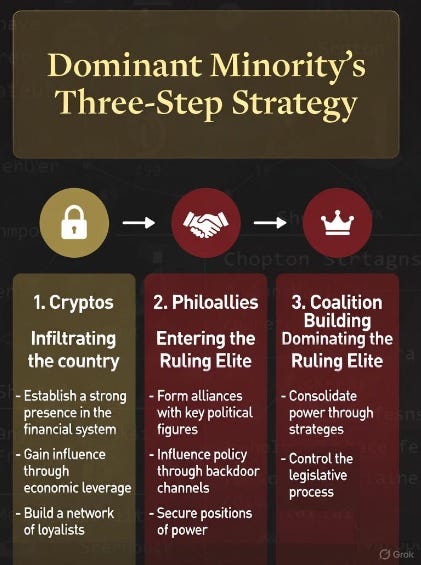
There is another significant example of a dominant minority, yet naming it remains a taboo: the Jewish elite in the West. This group exerts influence through economic and media power, a “Culture of Critique,” and its maneuvers within the geopolitical “Great Game”. U.S. foreign policy, for instance, appears heavily influenced by Jewish Zionists, compelling even the supposedly “America First” Trump administration to adopt “Israel First” policies. While parts of the peace movement have begun to note the Jewish role in fomenting conflicts also beyond the Middle East, many activists still fail to see the broader connections. The conflicts in Ukraine and Taiwan are directly linked to the crisis in the Middle East.
The reason is simple: Jewish led neoconservative and neoliberal forces aligned with Israel seek to weaken Russia and China, both of which support Iran and the Shia “Axis of Resistance” in the Middle East. Consequently, the West attempts to encircle Russia and China with military bases and hostile alliances while undermining their economies through sanctions and high tariffs to facilitate regime change.
This is nothing new. For centuries, Jews have viewed Russia and China as “antisemitic” for opposing Jewish attempts to become a dominant minority within their borders. Historically, this has manifested as a prolonged struggle. Jewish elite dynasties like the Rothschilds, Sassoons and Kadooreis, for example, pushed Western empires to subjugate China during its “Century of Humiliation.” Similarly, they managed to organize various wars against Russia including the first Crimean War in the 1850’s and then later the Jewish led Bolshevik and Oligarch takeovers in the 1920’s and 90’s. The present Ukraine War is just the latest in a series of conflicts and wars between Jews and Russia going back a millennium.
The obvious Jewish role in geopolitics and various wars has always been known to political scientists and historians. It is also common knowledge in many parts of the world such as in Eastern Europe, China and the Arab world. However, in America the Jewish dominant minority has achieved such power that both academia and media now avoid the subject entirely. Only occasionally does the American public hear about it through random outbursts, such as Mel Gibson’s criticism of the Jewish role in instigating wars.
Putin and Xi
Under the leadership of Vladimir Putin and Xi Jinping, Russia and China have regained their independence and power. Their geopolitical support for the Axis of Resistance has drawn the ire of Zionist Jews running Great Game geopolitics, while their nationalist anti-liberal policies have alienated liberal Jewish factions running the Culture of Critique movements. As a result, the Jewish dominated Western academia and media has totally demonized both nations, while Jewish led neoconservatives and neoliberals push for their encirclement and the targeting of their global allies.
The influence of Jewish dominant minority behind these conflicts remains such a taboo that even peace activists often ignore it. This gives Zionists a carte blanche to pursue military and cultural wars, regime change operations and proxy wars aimed at isolating Russia and China. By refusing to “connect the dots,” Western peace activists effectively allow this dominant minority to continue pushing for perpetual war.
Scott Ritter
In recent years, the peace movement has been bolstered by former UN weapons inspector Scott Ritter. A prolific advocate, Ritter has tirelessly warned against the dangers of nuclear war, organized demonstrations and personally lobbied Congress. Despite his background as a leftist philosemitic Democrat, he has significantly influenced the Republican “MAGA” movement toward anti-war policies.
Ritter has gained a massive following as a commentator on the Ukraine War. However, during the conflict’s first year, he remained silent on the Jewish and even Israeli connection, blaming only the CIA, MI6 and the U.S. and British governments. In this, he was joined by libertarian figures like Andrew Napolitano and Lew Rockwell, who focus on American “Primacists” rather than identifying a dominant minority.
Traditionally, both leftists and libertarians have avoided identifying the Jewish dominant minority to avoid being labeled as antisemitic. It was only during the recent genocide in Gaza that Ritter began to explicitly critique Israel’s geopolitical role, though he has yet to identify the dominant minority or even connect these dots to the broader global landscape.
Silent Peace Activists
Some suggest that platform policies, such as those on YouTube, drive this reticence. Peace activists like Andrew Napolitano, Alexander Mercouris, and Danny Haiphong reach hundreds of thousands of viewers daily through their Youtube channels. Openly discussing Jewish dominant minority and connecting Jewish geopolitical dots could lead to deplatforming and lost revenue. However, this doesn’t fully explain the silence, as they could simultaneously use alternative platforms like Rumble, X or Locals—a strategy successfully employed by the famous anti-Zionist, Candace Owens. Unsurprisingly she has been branded an “anti-Semite” by many Jewish organizations.

Alexander Mercouris
Another explanation is ideological. Many activists from leftist or libertarian backgrounds may instinctively view the concept of a “dominant minority” as inherently racist. The most dramatic example of this is the leftist peace activist and popular YouTube commentator Alexander Mercouris, who for years was oblivious to the Jewish connection. However, a few months ago, due to audience feedback, he admitted on his channel that he had never even thought about a possible connection between the Ukraine War and the Middle East Crises.
Afterward, he has not talked about the subject anymore, though he does seem to increasingly speak in code. For example, he repeatedly emphasizes that his channel will be shut down if he analyzes the Epstein case too deeply. At the same time, he seems to spell “Epstein” in the Jewish-German way, making Epstein’s ethnic background clearer. Mercouris also has the revealing habit of always following the arch-neocon warmonger Lindsey Graham’s name with the name Richard Blumenthal, possibly hinting that Graham is influenced by him and other Jews to a significant extent.
The third explanation for not openly noticing the dominant minority is that many prominent peace activists hope to attract the support of wealthy, anti-Zionist Jewish donors to finance the movement, a development that has yet to materialize.
Debanking
Certainly, the fourth and most important explanation is fear. Leading peace activists face tremendous pressure from various sides. Ironically, this pressure appears stronger in America than in Europe, despite stricter official censorship in Europe. However, Europeans benefit from strong employment and social security protections against firings and debanking. In America, people’s lives are more precarious and heavily dependent on high incomes, making it easier to intimidate them with threats to their reputation, job, income, or even bank accounts. The American media rarely discusses this, but hundreds of politically incorrect individuals have been debanked—not only in Canada but also in the U.S. Scott Ritter has now joined their ranks.
In the above video Scott Ritter recalls his days as a highly connected American intelligence operative, working closely with the CIA, Israelis, and even the White House. He emphasizes that he was once the “Golden Boy” of intelligence, privy to “everything.” Clearly, he must be aware of America’s dominant minority and their potential to ignite a nuclear war. Yet, despite recent escalations in Eastern Europe and the Middle East, Ritter in this video claims that the main problem is America itself, with Trump as a “prisoner of the CIA”—not the Mossad, Israel, or even the Zionists.
The next day, however, Ritter appeared in an interview with Andrew Napolitano. He admitted that after being debanked, he fell into depression and briefly felt hopeless, especially as his wife had grown weary of the persecution that had affected their entire family for decades. At that point, Napolitano played a clip of Jonathan Greenblatt, the Jewish ADL’s chairman, boasting about the organization’s role in training American police and officials. This ignited Ritter, who then openly declared that Zionists are running the American government.
Trump’s chess moves
At the same time, Ritter suggested there might still be hope. He noted that many parts of the government resent Zionist dominance, and even Donald Trump could be among them. That wouldn’t be surprising, given Trump’s ego—he can’t be pleased with how Netanyahu and many other Jews publicly humiliate him. Being Israel’s bitch cannot be fun.
It could even be that Trump is deliberately undermining American influence abroad through his erratic behavior, bullying threats, and tariffs. After all, U.S. foreign policy is thoroughly dominated by Zionists, so disrupting the entire system might be the only way to halt it. For instance, threatening to annex Greenland would certainly fracture or weaken NATO, making it harder for EU NATO countries to sustain their warmongering. Perhaps Trump truly seeks peace through a “Fortress America” approach, dividing the world among American, Russian and Chinese spheres of influence. Maybe he’s really playing four-dimensional chess, with method to his madness. Of course, the alternative is that he’s simply a madman. As Scott Ritter admits, he doesn’t know—and neither does anyone else. Probably not even Trump himself.
People worldwide are deeply divided over Donald Trump. Some view him as a mastermind playing four-dimensional chess to save the world, while others see him as a narcissistic bumbler who sows chaos wherever he goes. So, which perspective aligns more closely with the truth? We do not know but let’s first assume that Donald Trump is a rational player in do…
Conclusion
Many in the peace movement believe that concealing the Jewish dominant minority and obscuring its role in numerous wars is essential for peace. However, this strategy may backfire, giving that minority a free hand to escalate proxy conflicts and try again and again to push the world toward “limited” nuclear war.
People often demand perfection from their heroes, which is counterproductive. No one is a superman—not even Scott Ritter. Of course, he must consider his family. Of course, he has been reticent about exposing Jewish power. The same applies to all other peace activists. But gradually, things are changing on both the left and right. They are beginning to point out the man and group behind the curtain.
In any case, peace activists perform invaluable work and deserve unwavering support. After all, they do what they humanly can. Without them—especially Scott Ritter—a nuclear war might already have begun.
US announces Gaza ‘Board of Peace’ amid ongoing Israeli ceasefire breaches
Press TV – January 17, 2026
The administration of US President Donald Trump has announced the executive members of Gaza’s so-called Board of Peace, a body purportedly tasked with managing transitional governance in the territory, as Israel continues to violate its ceasefire agreement with Hamas.
On Friday, the White House published the names of the Gaza Strip’s so-called “Board of Peace” members and the head of the National Committee for the Administration of Gaza (NCAG), marking the launch of the second phase of Trump’s 20-point plan for Gaza.
Ali Sha’ath, a former Palestinian deputy minister in the Palestinian Authority (PA), will lead the NCAG, according to the White House.
The so-called Board of Peace will be chaired by Trump himself, with key members including Secretary of State Marco Rubio, Trump’s special envoy Steve Witkoff, Trump’s son-in-law Jared Kushner, and former UK Prime Minister Tony Blair.
The statement also listed members of a “Gaza Executive Board”: Turkish Foreign Minister Hakan Fidan; United Arab Emirates’ Minister of State for International Cooperation Reem Al-Hashimy; veteran Qatari diplomat Ali Al-Thawadi; Egypt’s intelligence chief Hassan Rashad; UAE-based Bulgarian diplomat and former UN envoy Nickolay Mladenov; Cypriot-Israeli businessman Yakir Gabay; Dutch politician Sigrid Kaag; as well as Witkoff, Kushner, and Blair.
Mladenov will act as High Representative for Gaza, linking the Board of Peace with the NCAG, while Major General Jasper Jeffers will lead the International Stabilization Force (ISF).
The US also appointed Aryeh Lightstone and Josh Gruenbaum as senior advisers to the Board of Peace to supervise “day-to-day strategy and operations.”
More appointments to the Executive Board and the Gaza Executive Board are expected in the coming weeks.
The announcement follows Witkoff’s Wednesday statement launching the second phase of the Gaza ceasefire plan.
The second phase is said to focus on “demilitarisation, technocratic governance, and reconstruction.”
However, most of the goals in Trump’s 20-point plan that became the basis for a ceasefire in Gaza three months ago never became a reality on the ground.
Phase one was designed to immediately halt the fighting, facilitate the exchange of Israeli and Palestinian captives, set a boundary for Israeli withdrawal from parts of Gaza, allow the full entry of humanitarian aid, and open the Rafah crossing between Gaza and Egypt.
While the daily number of Israeli attacks has decreased since the start of the ceasefire, Israel has killed at least 451 Palestinians and injured 1,251 – an average of nearly five killed every day – since October 10.
Under the ceasefire deal, Hamas released all 20 living Israeli captives in exchange for nearly 2,000 Palestinian prisoners.
Hamas has also returned 27 of the 28 bodies of deceased captives, while the search is still on for the remaining body, believed to be buried under the rubble of buildings bombed by Israel.
However, according to Hamas, Israel has failed to release all women and child prisoners as stipulated in the agreement.
Moreover, the Israeli military did not fully withdraw its troops to an area dubbed the “yellow line” and continues to restrict aid.
The opening of the Rafah crossing did not happen, either.
Since Israel launched its genocidal campaign on October 7, 2023, more than 71,000 Palestinians have been killed and over 172,000 wounded, the majority of them women and children.
Latest US-backed regime change operation in Iran hits the wall
By Samuel Geddes | Al Mayadeen | January 17, 2026
Having bombed the country in 2025, “Israel” and the US seemed to think that provoking street violence would have more success at collapsing the Iranian state. Instead, it fizzled almost instantly.
We have been here at least half a dozen times in the past two decades. Street protests in Iran over an internal economic, social or political issue emerge, gather a degree of momentum in urban areas and the Western propaganda system declares that the protests have “shifted” from their initial focus, to calls for the repudiation of the Islamic Revolution and the end of the political system it created. European and American politicians issue their empty statements of solidarity with the Iranian people and unilaterally decide that the Islamic Republic has “lost its legitimacy,” that its fall is simply a matter of “when,” not “if.” We have seen this narrative played out often enough to recognize it never survives contact with the real world.
The source of the persistent delusion that the Islamic Republic is about to fall comes not only from the Euro-American elite class wishing it to be so, but also from its deferral to the “analysis” of segments of the diaspora whose own political objectives are detached from reality.
Whether it is protests over the government’s handling of the economy, energy blackouts, or the water crisis, most external observers are incapable of viewing each individual issue through any lens other than that of regime change.
This time around the US and Israelis, in coopting the protests to destabilize the country through street violence, have not even bothered to hide their involvement. It has also not helped the West’s case that it is now feigning “humanitarian concern” for the rights of Iranian citizens while it has spent more than two years facilitating the ongoing slaughter and starvation of Gaza’s population. Any observer following both issues can detect the dissonance and conclude what is motivating the frantic calls to escalate the situation into military intervention. That is, the desire to crush a state and society that has resisted Western dominance for more than four-and-a-half decades.
The brazenness of the West’s affected concern for the well-being of the Iranian public is particularly galling in light of the sanctions. If Iranians’ living standards were really of any concern to Washington, London or Brussels, they would start by unconditionally ending their economic strangulation in effect against the country. The truth is that the suffering and misery engendered by the sanctions is entirely the point. As well as stifling the development of an independent state outside the globalized-Western economy, the siege is specifically intended to make living conditions unbearable for the average Iranian so that they are incentivized to undermine the Islamic Republic. The continuation of the sanctions is a barely disguised punishment of the Iranian public for not pursuing the West’s geopolitical goal of regime-change for them.
Were it not glaringly obvious to the Trump administration before the latest unrest, it surely is now that the exiled political diaspora most actively pushing for the fall of the Islamic Republic through Western military action are entirely incapable of political organization. Even the least crazed fan of the defunct Pahlavi dynasty is pathologically hostile to the terrorist personality cult of the MEK, as much as they are to the Islamic Republic itself. There simply is no political alternative, to say nothing of whether it even has any domestic support, waiting to replace the Islamic Republic.
Flush from the “success” of his abducting Venezuelan president Maduro, Trump seemed temporarily convinced he might have a similar option here, to carry out a meaningless military stunt for which he can take credit and declare “victory.” His problem is that there is no level of open military action against Iran that would allow him to do this without igniting a regional war that destroys the global economy.
This realization, if he has come to it, would explain his backtracking on the red lines he set, that any executions would trigger US attacks. If a controlled, stage-managed performance is his goal, as it almost always is, then the confrontation with Iran leaves him with no viable option but to back down.
The absence of any realistic military option has now seen both the US and Europe revert to their standard tactic; the intensification of the sanctions they have used to punish the Iranian people. Trump’s latest declaration of a 25% tariff on any country trading with Iran is his way of giving himself an off-ramp, for now, from a crisis that is largely of his making.
Donald Trump, A Responsibility to Protect President
By Adam Dick | Ron Paul Institute | January 16, 2026
Publicly denouncing war and liberals was a regular part of Donald Trump’s communication in his 2024 presidential campaign. Yet, as president, Trump has been relying on the responsibility to protect idea associated with liberals he would normally ridicule as a basis for the US engaging in wars abroad.
In October of 2016, the month before Donald Trump won the race to succeed Barack Obama as president, David Stockman wrote about an example of the terrible damage the US following a responsibility to protect standard in foreign policy can yield. In particular, Stockman wrote about Syria being “a lawless, bombed-out, economically decimated failed state today owing to Washington’s heavy-handed intervention at the behest of the War Party’s bloody twin sisters.” Those “twin sisters,” continued Stockman, are “the neocons — led by the contemptible Kagan clan — and the R2P liberal interventionist claque around Hillary Clinton, including UN Ambassador Samantha Powers and National Security Council head Susan Rice.”
Stockman here used the term “R2P” to reference responsibility to protect.
For some more details on what responsibility to protect entails, consider this excerpt from “Humanitarian Intervention: Destroying Nations to Save Them” by Ibrahim Kazerooni and Rob Prince from 2013:
What distinguishes the more recent forms of humanitarian intervention is that thanks to the writings of the likes of Samantha Powers and Susan Rice, humanitarian intervention now has a more comprehensive theoretical justification, i.e., the pretexts for military intervention have become more refined, coated with phony concern for “the people.” It was used to justify the military intervention in Libya, and until less than a month ago was the emotional cutting edge for greater military intervention in Syria.
As an elaborate excuse is needed to justify unprovoked aggression – all in the name of the public good – humanitarian intervention serves the purpose well. But at its heart, strike it down to its basics and it [is] little more than liberal racism – i.e., “we” = one neo-colonial power or another = magnanimously no less – are invading a country for its own good because those poor dumb folks don’t have the wherewithal to protect themselves and need our kind assistance to prevent disasters.
As suggested by Stockman, responsibility to protect, or R2P, is a reason for United States government intervention that is commonly associated with liberals or Democrats. But, Trump as president has recently appeared to embrace it publicly as a sufficient basis for the US to attack other countries. Consider, for example, Trump’s comments in the last few months regarding his reasoning for supporting US military attacks in Nigeria and Iran.
In November, Trump indicated in a post at Truth Social that he was directing that the US military plan to go into Nigeria with “’guns-a-blazing,’ to completely wipe out the Islamic Terrorists” Trump wrote were killing Christians. There was no mention of any threat to America, to Americans, or even to the often broadly and squishily defined US “national interests.” Instead, the message was people are being harmed so the US should attack to help address the problem.
When I wrote in November regarding Trump’s post, I noted that Trump’s post was followed by comment by Secretary of Defense Pete Hegseth that “killing of innocent Christians in Nigeria — and anywhere — must end immediately” and comment by US Ambassador to the United Nations Mike Waltz that US government should be concerned with persecution of Christians spanning “78 countries, 330 million Christians being persecuted around the world.” This one sort of alleged harm thus could open the door to a vast US military intervention across the world.
Come Christmas, the US military attacked in Nigeria, with Trump stating the attack came in response to harm done to Christians in Nigeria. Stated Trump in a December 25 Truth Social post: “I have previously warned these Terrorists that if they did not stop the slaughtering of Christians, there would be hell to pay, and tonight, there was.”
This week, Trump has been promoting the US going to war in another country based entirely upon responsibility to protect reasoning. Trump, in a Truth Social post on Tuesday, stated his encouragement of protesters in Iran to take revolutionary actions and promised that “HELP IS ON THE WAY” for the protesters. He even told them to “[s]ave the names of the killers and abusers” who he wrote “will pay a big price” — apparently due to US action. Here is what Trump wrote:
Iranian Patriots, KEEP PROTESTING – TAKE OVER YOUR INSTITUTIONS!!! Save the names of the killers and abusers. They will pay a big price. I have cancelled all meetings with Iranian Officials until the senseless killing of protesters STOPS. HELP IS ON ITS WAY. MIGA!!! PRESIDENT DONALD J. TRUMP
“MIGA” here is likely a reference to Make Iran Great Again, a phrase used by uber-warmonger Sen. Lindsey Graham (R-SC) in a Truth Social post that Trump reposted three days earlier. Graham, in his bellicose post, in addition to declaring “Make Iran Great Again,” praised a comment by US Secretary of State Marco Rubio that the US “supports the brave people of Iran.” “To the regime leadership: your brutality against the great people of Iran will not go unchallenged,” also threatened Graham in his post.
Earlier, on January 2, Trump had already asserted he was ready to send the US military to attack Iran based just on the conclusion that protesters in Iran were killed. Then, Trump wrote in a Truth Social post:
If Iran shots [sic] and violently kills peaceful protesters, which is their custom, the United States of America will come to their rescue. We are locked and loaded and ready to go. Thank you for your attention to this matter! President DONALD J.TRUMP
Attacking Iran is not a new idea for Trump. The US military did just that in June, upon Trump’s order. That time a primary argument Trump asserted was that he wanted to prevent Iran from acquiring nuclear weapons. That bombing also came to the aid of Israel that had gotten in over its head by attacking Iran over a week earlier and whose Prime Minister Benjamin Netanyahu had long been urging Trump to take military action against Iran.
The responsibility to protect argument Trump keeps trotting out for a US attack on Iran joins other arguments that he has proffered over time. For example, on December 29, with Netanyahu by his side, Trump threatened to “knock the hell out of” Iran if it tries to “build up again” from damage inflicted earlier in the year by Israel and the US.
Trump likes to ridicule liberals for their ideas that he depicts as kooky, absurd, or dangerous. At the same time, Trump is out touting his adherence to one of the most kooky, absurd, and dangerous ideas associated with liberals — trying to justify the US going to war based on the responsibility to protect argument that it is appropriate for the US to use military force for the sole purpose of stopping or punishing the infliction of harm on people oversees. It is a formula for foreign intervention without restraint. It is also incompatible with the peace candidate status Trump sought to establish for himself in the 2024 presidential race.
Adam Dick worked from 2003 through 2013 as a legislative aide for Rep. Ron Paul. Previously, he was a member of the Wisconsin State Board of Elections, a co-manager of Ed Thompson’s 2002 Wisconsin governor campaign, and a lawyer in New York and Connecticut.
US Navy Insanity in Japan
Tales of the American Empire | January 15, 2026
The US Navy has two large bases in Japan. Sasebo provides logistics in the Western Pacific, but will be knocked out of action in the first hour in a war with China. It also has a three ship amphibious group homeported there since the end of the Vietnam war. These large ships are of no value in a war with China and will be sunk during the first day of a conflict. They might be able to flee before war begins, but why base them at Sasebo if they must flee during wartime, leaving their crew families behind?
On the other side of Japan is the larger base at Yokosuka. It is further from China and better protected on the east coast, but still within easy attack range. Amazingly, the US Navy has a huge multi-billion-dollar aircraft carrier based there, even though hundreds of friendly airfields in the region are available. Moreover, it sits pierside most of the time and can be photographed during a daily boat tour by any tourist. If war suddenly begins. China will unleash at least 200 missiles at this prize in one minute. This may seem unaffordable, but 200 medium range missiles cost less than a billion dollars and will destroy an aircraft carrier that costs many times more. Several of these missiles will hit the carrier while others miss yet destroy nearby facilities.
_____________________________________________________
Related Tale: “Military Insanity in WestPac”;  • Military Insanity in WestPac
“Vacate Sasebo”; Carlton Meyer; G2mil; 2012; http://www.g2mil.com/sasebo.htm
“Has China Been Practicing Preemptive Missile Strikes Against U.S. Bases?”; Thomas Shugart; “War on the Rocks”; February 6, 2017; https://warontherocks.com/2017/02/has…
“U.S. Set to Expand Naval Base in Papua New Guinea”; Zach Abdi; USNI News: April 6, 2024; https://news.usni.org/2024/04/06/u-s-…
Bird Flu Outbreak 40 Miles From Wisconsin Lab Sparks Concern About Gain-of-Function Experiments
By Michael Nevradakis, Ph.D. | The Defender | January 15, 2026
A bird flu outbreak in a Wisconsin dairy cattle herd has fueled speculation that gain-of-function research at a nearby university lab — where scientists are working to develop a bird flu vaccine for cattle — may have played a role in the outbreak.
Last month, the U.S. Department of Agriculture (USDA) identified what it said was the first known case of highly pathogenic bird flu in a Dodge County, Wisconsin, dairy cattle herd.
The USDA’s Animal and Plant Inspection Service (APHIS) characterized the outbreak as a new “spillover” event — from wildlife to cattle.
The two scientists who conducted the whole genome sequencing for APHIS and identified the virus responsible for the Dodge County outbreak work at the University of Wisconsin-Madison School of Veterinary Medicine, the university confirmed.
Those same scientists — Keith Poulsen, DVM, Ph.D., and Yoshihiro Kawaoka, DVM, Ph.D. — have also co-authored studies on gain-of-function research, including studies related to the H5N1 virus.
One of the scientists, Kawaoka, directs the university’s Influenza Research Institute, known to conduct gain-of-function research on H5N1. Kawaoka was director of the high-security lab in 2019, when it came under scrutiny for a safety breach.
The institute’s lab is about 40 miles from the bird flu outbreak in Dodge County.
Kawaoka is also the co-founder of flu vaccine manufacturer FluGen. And he is among a group of scientists working on the development of a bird flu vaccine for livestock.
Will Cushman, with the University of Wisconsin-Madison’s Office of Strategic Communication, confirmed that virologists Poulsen and Kawaoka are performing H5N1 research. However, he denied that it is gain-of-function research.
The research, partially funded by the federal government, is aimed at better understanding the H5N1 strains spreading from wild animals and circulating on farms in the U.S., Cushman told The Defender.
D1.1 bird flu strain linked to 3-year-old’s death in Mexico
Last month, Poulsen and Kawaoka identified the H5N1 clade 2.3.4.4b genotype D1.1 as responsible for the Dodge County outbreak. The D1.1 genotype contains characteristics that may increase the transmissibility of the virus, including to humans.
Karl Jablonowski, Ph.D., senior research scientist for Children’s Health Defense (CHD), said the Dodge County outbreak “is notable” because national databases do not show “a mammalian host of D1.1 anywhere near Wisconsin” in the past year.
Two “isolated” spillover events involving the D1.1 strain were identified earlier in 2025, in Arizona and Nevada, Reuters reported. APHIS said the Wisconsin spillover event is considered unrelated to those two previous spillovers.
According to APHIS, bird flu viruses circulating among birds and cattle in the U.S. “pose a low risk to the general public.”
However, the World Health Organization reported that the April 8, 2025, death of a 3-year-old girl in Mexico was caused by respiratory complications that developed after the child contracted the D1.1 strain of bird flu.
D1.1 contains mutations that ‘could enhance the virus’s ability to infect human cells’
Several recent journal articles have suggested that D1.1 may have characteristics that make it more virulent, potentially to humans, than previous bird flu strains.
A July 2025 article in Nature characterized new bird flu genotypes — including the D1.1 variant — as having “wide distribution and transmissibility … to cattle.”
A November 2025 article in The Journal of Infectious Diseases showed that the D1.1 variant may be “better adapted to human nasal and airway organoids” than genotype B3.13, the previously dominant bird flu genotype in North America.
“D1.1 does show better adaptation to human respiratory tissues than say, B3.13 in lab models due to its higher replication capacity in human nasal/airway organoids,” said immunologist and biochemist Jessica Rose, Ph.D.
In a December 2024 op-ed for Medscape, Italian physician and freelance health journalist Dr. Roberta Villa suggested there may be a connection between the outbreak of D1.1 and gain-of-function research.
Villa wrote that the publication of the complete viral sequence of D1.1 “highlighted mutations that could enhance the virus’s ability to infect human cells.”
“How do we know this?” Villa asked. “From the highly contested ‘gain-of-function’ studies, which artificially modify viruses to understand which genomic points require the most surveillance — those mutations that can make the infectious agent more virulent or more transmissible between people.”
Villa did not elaborate on the possible link between D1.1 and gain-of-function research.
In 2024, Kawaoka and a team of researchers published research in Nature on how the bovine H5N1 virus can spread systemically in mice and ferrets, and bind to human-type receptors.
History of accidents at University of Wisconsin lab
Since 1990, Kawaoka has been involved in bird flu gain-of-function research. Dr. Anthony Fauci and the Bill & Melinda Gates Foundation (now the Gates Foundation) funded some of that research.
In 2012, Kawaoka and Dutch researcher Ron Fouchier, Ph.D., published a paper in Science revealing how they had modified H5N1 to enable it to spread between ferrets.
The paper sparked an outcry within the global scientific community. A New York Times editorial called the research “An Engineered Doomsday.”
In 2014, Kawaoka again drew attention after The Independent alleged that Kawaoka’s lab created a new strain of the 2009 H1N1 virus with pandemic potential.
In December 2019, a researcher engaged in an experiment involving the transfer of H5N1 between ferrets was potentially exposed to the virus when her air hose broke, according to USA Today. The lab didn’t notify the university’s biosafety committee or the National Institutes of Health (NIH) until February 2020.
In 2013, a researcher at Kawaoka’s lab accidentally pricked a finger with a needle contaminated with a lab-engineered H5N1 virus.
A week later, another lab worker at the same lab spilled a lab-engineered bird flu virus on a gloved hand. Details about the post-spill protocol that followed are unknown.
In 2015, the University of Wisconsin reported “nine other incidents” at the lab to the NIH between 2012 and 2014.
In 2023, the U.S. House of Representatives Committee on Oversight and Government Reform investigated “dangerous gain-of-function research” conducted at the University of Wisconsin.
That same year, Wisconsin lawmakers proposed Assembly Bill 413, which would have shut down gain-of-function research at universities in the state. The University of Wisconsin lobbied against the bill, which was defeated in April 2024.
Trump’s USDA not focused on vaccine solution for bird flu
As bird flu outbreaks have continued, a bipartisan group of 23 U.S. senators last month co-authored a letter urging the Trump administration to develop a “science-based plan” for developing a bird flu vaccine for livestock.
“Any finalized vaccine strategy must take into account feedback from animal health stakeholders, industry experts, and be grounded in sound science,” the letter stated.
Reuters, quoting a USDA spokesperson, reported that the agency considers farmer biosecurity efforts — and not the development of a vaccine — as the most effective means of fighting the spread of bird flu.
In May 2025, the Trump administration cancelled a $700 million contract with Moderna to develop a human bird flu vaccine.
In a 2024 interview with CHD.TV during a bird flu outbreak in Texas that year, Dr. Richard Bartlett suggested that bird flu vaccines were “ready for mass production.”
This article was originally published by The Defender — Children’s Health Defense’s News & Views Website under Creative Commons license CC BY-NC-ND 4.0. Please consider subscribing to The Defender or donating to Children’s Health Defense.
Featured Video

More Iran War fallout: Maritime insurance industry shifts from London to China
or go to
Aletho News Archives – Video-Images
From the Archives
The Biggest Threat to Peace in Middle East
By Dr. Elias Akleh* | Sabbah Report | May 24, 2010
A build up of heightened tension in the Middle East is escalating in the last few weeks. American and Israeli postures towards Lebanon, Syria, and Iran have become more threatening. Listening to speeches of political leaders one hears talks only about war not peace. Iranians and Israelis are continuously training hard for a possible showdown. Both sides are conducting extensive war games every month. This led Syrians to claim that Israel is preparing for a soon-to-come another war. The Jordanians also are warning that current stalemate of the peace process is an indication of a war breaking out this summer. The Russian President and his army chief hinted, a few months ago, that the US and Israel were planning for an attack on Iran.
Indeed Iran is, as it has been for last few years, the target of most of the threats and accusations of supporting terrorism. Escalating incitement against Iran the American Defense Department sent last month (April) to Congress a report on Iran’s military claiming Iran could develop intercontinental ballistic missiles capable of reaching the US by 2015.
Ignoring the fact that N. Korea, India, Pakistan, and Israel are proven to have nuclear weapons while Iran does not, the US Secretary of State Hillary Clinton chose in her speech, to the nuclear Non-Proliferation Treaty review conference at the UN, to focus on Iran’s alleged nuclear ambitions putting the whole world at risk as she put it. According to Clinton Iran’s acquisition of nuclear weapons, rather than Israel’s more than 200 nuclear bombs, is destabilizing the Middle East. She called on the world’s nations to rally around US efforts to hold Iran, not other nuclear countries, to account.
The accusation that Usama Bin Laden is living comfortably in Iran had received a boost after the broadcast of a documentary called “Feathered Cocaine”. This echoed the June 2003 claims of the Italian newspaper Corre de la Sierra that Bin Laden was in Iran according to some intelligence report, and according to Richard Miniter’s book “Shadow War”. … continue
Blog Roll
 Aletho News
- US Tells Allies That Ukraine-Bound Arms Could be Sent to Middle East
- Organized terrorism: Iran condemns killing of its diplomats in Lebanon
- Why could Gaza enter the regional war?
- Hamas official rejects Mladenov Plan linking disarmament to Gaza reconstruction
- Two Primary Elections for the Soul of ‘America First’
- Japan Clings to US Vassalage Despite Energy Crunch Caused By Iran War
- US Seeks Control Over Global Energy Infrastructure – Kremlin
- US senators target Orban government for standing up to Zelensky
- The deep-rooted culture of corruption in Ukraine
- Iran mobilizing one million soldiers to ‘create hell’ for any US ground assault: Report
- If Americans Knew
- Researchers at Human Rights Watch Resign Over Blocked Report on Palestinian Refugee Return
- Jewish Groups Are Backing a War Americans Don’t Want
- Eric Fingerhut Thinks He’s the President of the Jews
- Top Jewish Philanthropists, Rabbis Urge Israeli President to Take Action Against ‘Jewish Extremists’
- Don’t Be Fooled. Zionist Leaders Have Always Wanted to Control Southern Lebanon
- Israel’s widespread use of torture is a core element of its genocide against the Palestinian people
- In Israel’s War on Iran, Many Middle East US Bases Rendered “All But Uninhabitable”
- ‘Burn the lawn’: Israel pursues ‘Rafah model’ in southern Lebanon
- A genocide here, an amputation there
- Reports: Iran mobilizing 1M fighters, Israel-US run low on ammo, Israeli army faces shortage – Not a ceasefire Day 168
- No Tricks Zone
- Devastating Assessment Of Comirnaty Vaccine By Former Senior Pfizer Europe Toxicologist
- New Study: CO2 Is ‘Effectively Negligible’ As An Explanatory Climate Change Factor Since 2000
- Former Pfizer Toxicologist Dr. Helmut Sterz Tells Bundestag Hearing Pfizer Vaccine Should Have Never Been Approved
- Energy Expert: Germany’s Nuclear Phaseout Was A “500 Billion Euro Mistake”
- New Research: South Australia’s Mid-Holocene Sea Surface Temperatures Were 4°C Warmer Than Today
- Storing Green Energy To Last Germany 10 Days Would Require A 60-Million Tonne Battery
- New Studies: UK Sea Levels Were 4 Meters Higher Than Today During The Mid-Holocene
- Destructive Green New Deal: German Energy And Metal Group Warns Of Drastic Crisis
- New Study Documents A 20-Year Pause In Arctic Sea Ice Decline – Driven By Internal Variability
- Wake-up Call: Survey Shows Majority Of Germans Now Favor Postponing Climate Targets!
 Aletho News