Kremlin weighs in on call for US to reverse course on Russia
RT | October 30, 2023
A recent article by US economist Jeffrey Sachs calling on Washington to establish a new sustainable détente with Russia is a rare sight, but evidence that debates on the issue are picking up steam, Kremlin Press Secretary Dmitry Peskov has said.
Speaking to reporters on Monday, Peskov commented on Sachs’ piece, which was published in early October but has only recently gained media traction. The economist, who serves as the director of the Center for Sustainable Development at Columbia University, wrote that the world is on the precipice of a “30-year US neocon debacle in Ukraine.”
He explained that Washington’s long-cherished hopes for NATO expansion eastward to Russia’s borders have been dashed by Ukraine’s devastating losses on the battlefield, the threat of Moscow launching a massive offensive, and collapsing support for this course in both Europe and the US.
As Ukraine teeters on the brink, Sachs argued, the US could avert a potential catastrophe by changing course and reaching security guarantees with Moscow. A potential deal could include a pledge that NATO would not expand closer to Russia, as well as an agreement between Moscow and Kiev that predominantly ethnic Russian areas would be recognized as part of Russia, the economist said, apparently referring to Crimea and four other former Ukrainian regions that overwhelmingly voted to become part of Russia.
Commenting on the article, Peskov said Moscow has not received any proposals on the matter. While describing the piece as “an economist’s point of view, nothing more,” he noted that “such thinking is quite rare at the moment.”
“Nevertheless, some kind of a discussion is gradually gaining momentum,” Peskov added.
In the article, Sachs suggested that Russia’s demands to NATO and the US which were made shortly before the outbreak of the Ukraine conflict in February 2022 should be used as a springboard for a thaw in relations.
In the proposals presented in December 2021, Moscow asked the West to formally ban Ukraine from entering NATO, while insisting that the alliance should retreat to its 1997 borders, before it expanded. The overture, however, was rebuffed by the West.
US seeks strategic dialogue with Russia
BY M. K. BHADRAKUMAR | INDIAN PUNCHLINE | OCTOBER 30, 2023
Almost four weeks into Hamas’ attack on Israel, Russia is in no hurry to exploit the Biden administration’s quandary over the collapse of Middle East security. The western media was unanimous that Russia was waiting in the wings to seize the opportunity once the US took its eye off the ball in Ukraine. However, no such thing happened.
Ukraine war is on autopilot. The compass has been set, the die is cast and the calculus is holding steady with regard to the strategic objectives set by President Vladimir Putin in February last year. Russia senses that it has gained the upper hand in the war and that is irreversible.
Ukraine’s counteroffensive has failed and the fighting is presently restricted to two sectors of the frontline, as Russian forces strengthen the security of the Donetsk region and seek to regain control of territories up north in the borderlands of Donbass and Kharkov region from where they retreated for tactical reasons last September and October.
Yet, Moscow has not begun its grand offensive, as many had predicted. One plausible explanation is that Moscow is watching the maelstrom sweeping through the Middle East. Moscow is particularly sensitive about any spillover into Syria.
With an eye on the formidable US naval build-up in Eastern Mediterranean with the deployment of two aircraft carrier groups, President Vladimir Putin has publicised that Russian jets equipped with hypersonic Kinzhal missiles are roaming the skies above the Black Sea, which can strike targets 1000 kms away at Mach 9 speed, which no existing missile defence system can intercept. Suffice to say, the war in Ukraine remains attritional.
Curiously, Russia conducted a simulated nuclear strike in a drill on Wednesday overseen by Putin, hours after Russian parliament voted to rescind the country’s ratification of the global nuclear test ban treaty (CTBT). The drill needs to be seen in the broader context of global strategic stability. A Kremlin statement said, “The purpose of the training exercise was to check the level of preparedness of military command bodies, as well as the skill of the leadership and operational personnel in managing the troops (forces) under their command.” Everything, however, adds up in these extraordinary times.
At its most obvious level, the Palestine-Israel conflict is a manifestation of the growing imbalance in the existing system of international relations. New wars are emerging; longstanding conflicts are mutating (eg., Nagorno-Karabakh). Last week, Pakistan bracketed Palestine and Kashmir as the UN’s unfinished business in the post-colonial era. North Korea and Iran are flash points that have no military solution.
In the months ahead, without doubt, Washington will continue to provide Israel with military and diplomatic support but an extended Israeli operation lasting months in Gaza will mean dispersal of US resources that might be needed in other theatres. The conflict in Gaza underscores the imperative for a rethink in the US’ notions of global hegemony. The fact remains that the US, despite its self-proclaimed status as the “Indispensable Nation” (Madeline Albright) and the guarantor of “rules-based order,” failed to prevent the latest eruption of conflict in the Middle East.
Arguably, therefore, the latest US proposal for a systematic resumption of strategic dialogue with Russia can be seen as a sign of positive thinking. Unsurprisingly, Moscow has displayed a studied indifference to the US proposal. But that needn’t be taken as the last word. Historically, Soviet-American strategic dialogue brought on board into the agenda all major issues and most minor issues affecting international security.
The big question, therefore, is the timing of the US proposal. Against the backdrop of the gathering storms in the Middle East, the Biden Administration probably seeks to calm the nerves by proposing talks with Russia on global strategic balance, since the guardrails in arms control no longer exist. This is one thing.
At any rate, Russia’s “neutrality” in a Middle East conflict could also be a consideration. Equally, Western leaderships understand that the war against Russia is practically lost — although they will not admit it publicly — and engagement with Russia is needed.
Again, although the US has provided Israel with significant military and diplomatic support and keeps influencing the latter not to escalate the conflict, there are variables in the situation and any big conflagration in the Middle East will require a massive concentration of material and financial resources that are limited even for a superpower, since there are other unresolved problems in the world, too.
The breakdown of trust in the Russian-American ties hurts US interests. Fundamentally, it must also be understood that what Moscow seeks even today after nearly 20 months of battling NATO and the US in Ukraine’s killing fields is a sustained engagement with Washington and a willingness to accommodate mutual interests.
On its part, Russia is conducting itself as a responsible power vis-a-vis the crisis in Gaza. There is no shred of evidence to show that Russia has acted as a “spoiler”. On the contrary, Moscow has been projecting its credentials as a potential peacemaker who enjoys good relations with all key players — Israel, Hamas, Iran and other regional states alike.
In fact, President Biden’s recent remarks on the Gaza situation bring the US position rather close to Russia’s. Biden read out the following from a prepared text at a joint press conference with Prime Minister Anthony Albanese of Australia:
“Israel has the right and, I would add, responsibility to respond to the slaughter of their people. And we will ensure Israel has what it needs to defend itself against these terrorists. That’s a guarantee…
“But that does not lessen the need for — to operate and align with the laws of war for Israeli — it has to do everything in its power — Israel has to do everything in its power, as difficult as it is, to protect innocent civilians. And it’s difficult. I also want take a moment to look ahead toward the future that we seek.
“Israelis and Palestinians equally deserve to live side by side in safety, dignity, and peace. And there’s no going back to the status quo as it stood on October the 6th. That means ensuring Hamas can no longer terrorise Israel and use Palestinian civilians as human shields.
“It also means that when this crisis is over, there has to be a vision of what comes next. And in our view, it has to be a two-state solution.”
Putin couldn’t have put this across differently. There is a sense of expectation in Moscow that in the emergent conditions in regional security, the US and its allies will “reconsider their notions of defeating Russia in the Ukraine conflict at any cost” — as an establishment think tanker wrote in the Kremlin-funded RT last week.
Trust is lacking, he concluded, “compromises without the full consideration of Russian interests” are difficult to reach, but “a pivotal stage in the (world) order … is taking shape before our eyes.”
A doctor’s insight into vaccine injury
By Thomas Lane | TCW Defending Freedom | October 30, 2023
Dr Keith Berkowitz is a founding member, with Dr Pierre Kory, of the Front Line Covid-19 Critical Care Alliance (FLCCC). He is treating a lot of vaccine-injured patients at his practice in midtown Manhattan. Dr Berkowitz was kind enough to answer a few questions on the Covid vaccine and the vaccine injured.
***
Who is most at risk for vaccine injury?
One thought is that if someone had Covid first, and then got the vaccine after being sick, the rates of vaccine injury were higher because they already had an antibody response, their immune system was already revved up, and then they got an injection of another antigen. Another group I see is people with autoimmune disease, they seem to be more triggered. I have several cases of people who had dormant autoimmune disease, such as ulcerative colitis and rheumatoid arthritis, and post vaccine it got retriggered. What people forget about vaccines is that they have an immunosuppressive effect. So in that two- to three-week period, the immune system takes a hit, which makes the body vulnerable to other illnesses. The third group I see that are most at risk of vaccine injury are people with high histamine levels.
What are the most common symptoms of vaccine injury?
Mildest is probably loss of taste and smell, mild digestive issues, or a cough. More severe are the autoimmune responses, the neurological symptoms, like brain fog, and tinnitus (which is one of the toughest to treat), myocarditis and pericarditis (inflammation of the heart), cancer, which I would call the most severe.
Is that new cancers, or cancers that have returned?
I’m seeing both.
Which autoimmune diseases are you seeing?
First, autoimmune disease is what I’m seeing most in vaccine injury. Specifically thyroid disease, more than anything else. What’s interesting is that I’m seeing normal thyroid function, and positive thyroid antibodies. So typically we wouldn’t check for thyroid antibodies if thyroid function was normal. So that group is often missed for that reason.
Would you say any vaccine was worse than the others?
It seems to be batch-related. That’s the question. There’s a theory that 10 per cent of the batches, roughly, caused 90 per cent of the issues. If you look at the original technology, the mRNA was created at a 70 per cent purity. There’s speculation that, because of manufacturing issues, they weren’t able to create that level of purity, and achieved only 50-55 per cent purity. So does one really know if that level of purity works? Especially being that it was never tested.
Why is there so much denial around vaccine injury?
I think there was a blind trust of the government and the pharmaceutical companies, coupled with a fear aspect of Covid (remember people thought that 50 per cent of hospitalised Covid patients died, when it was more like less than 1 per cent). Fear made people not think any more, and now they’re in denial about the choice they made. Another thing I can’t figure out: If you’re vaccinated, how does an unvaccinated person put you at risk? Also, why did doctors not do their own research? It was blind faith. Medications all have side effects – why was this one different?
How do you respond to the proponents of the vaccine who say, regarding vaccine injury, correlation is not causation?
That’s true, but why are they not even looking into it? If they are so confident, then just study it. What do they have to lose? Why not disprove it? Why is disproving it a major issue for them? If you don’t agree with me, prove me wrong.
Traditionally, vaccines take 10-15 years to get approval, because all that time they are studying long-term effects. The Covid vaccine, which was administered as soon as it was created, is still only about three years old. Therefore, have we yet to see the potential damage it can cause?
Absolutely. Do you know what percentage of drugs approved by the US Food and Drug Administration are withdrawn within five years? 31 per cent. One out of three drugs are taken off the market within five years. That’s incredibly high. That tells me we’re not checking properly. Now with this vaccine, one of my biggest questions is why did we decide to use new technology? Is a pandemic the right time to test new technology? I would argue probably not. And why did some countries around the world, like China and Russia, not use this technology? And at the end of the day we have to ask, was the treatment worse than the problem? And should medical products be tied to financial incentives? That creates a huge conflict. There were incentives to use the vaccine. If a drug or a treatment was really that good, would you need to push it like that?
Any final comments?
This is going to take years to figure out. It isn’t going away any time soon. I feel bad for the people who took something which they thought they were doing for the right reason, and now they are suffering. And they’re not being helped. Why does the government create a long Covid initiative, but not a vaccine-injured initiative? Why are we ignoring these patients? And why are we [in the US] approving a product for over six-month-olds when other countries are saying over 65 years? Another thing that doesn’t make sense is a study on teenagers showed that we have to vaccinate a million young men to prevent one hospitalisation. And the potential in a million doses is 1,000 with side effects. So the hospital to side effect rate is one to a thousand. It doesn’t make any sense! My worry is the trust in the medical system may never come back. And I’m not sure that it’s not deserved.
Sen. Ron Johnson Accuses Public Health Agencies of ‘Appalling Lack of Transparency’ on COVID Vaccines
By Brenda Baletti, Ph.D. | The Defender | October 27, 2023
Sen. Ron Johnson (R-Wis.) accused federal public health agencies of displaying an “appalling” lack of transparency with the American public during the pandemic, depriving them of “the benefit of informed consent.”
In a letter sent Oct. 25 to the heads of the U.S. Department of Health and Human Services, the U.S. Food and Drug Administration (FDA), the Centers for Disease Control and Prevention (CDC) and the National Institutes of Health, Johnson said that even now, “As new and alarming information continues to come to light, federal health agencies continue to stonewall and gaslight Congress and the public.”
The lawmaker pointed to an FDA-funded study published this month that identified a potential safety signal linking mRNA COVID-19 vaccines to seizures in children ages 2-5.
Johnson questioned whether the CDC was aware of these findings last month when it recommended everyone 6 months of age and older be vaccinated to protect against COVID-19 this fall and winter.
Johnson said the leaders of these agencies — Xavier Becerra, Dr. Robert Califf, Dr. Mandy Cohen, and Lawrence Tabak, D.D.S., Ph.D. — have failed in their duty to be transparent with Americans regarding what they knew about the safety and efficacy of the vaccines.
As a result, they “have not even come close to ensuring that doctors can provide informed consent on a new gene therapy masquerading as a ‘vaccine’ that was rushed to market without adequate safety or efficacy testing,” he said.
The Wisconsin senator has been a vocal critic of the federal COVID-19 response and an outspoken advocate for people injured by the vaccine. In 2022, he led a roundtable discussion with doctors and scientists to shed light on what was known so far about the vaccines.
Johnson has also accused the CDC of colluding with Twitter to censor his own social media posts about the vaccines.
In his letter, the lawmaker wrote that the agencies’ refusal to respond to the “vast majority” of his questions and information requests “only heightens [his] level of suspicion.”
He listed over a dozen letters he sent requesting information on the COVID-19 vaccines that the agencies “have failed to adequately address.”
These included requests for data about vaccine lots linked to high rates of adverse events, information suppression on social media and the Countermeasures Injury Compensation Program.
The CDC and FDA also failed to fulfill Johnson’s requests for their adverse events surveillance data and their analyses of the Vaccine Adverse Event Reporting System, or VAERS, database.
Children’s Health Defense also is suing the FDA to respond to its Freedom of Information Act requests to make that same data available.
Johnson listed 11 other outstanding requests he made regarding the other aspects of the pandemic.
But these make up only a partial list of over 60 public letters Johnson said he has sent to government agencies concerning various aspects of the pandemic.
“It is well past time for U.S public health agencies to be transparent,” he said.
Johnson requested the agencies respond by Nov. 8 to questions about what they knew about the risks COVID-19 vaccines posed to children, when they knew it and how they plan to address those issues.
Brenda Baletti Ph.D. is a reporter for The Defender. She wrote and taught about capitalism and politics for 10 years in the writing program at Duke University. She holds a Ph.D. in human geography from the University of North Carolina at Chapel Hill and a master’s from the University of Texas at Austin.
This article was originally published by The Defender — Children’s Health Defense’s News & Views Website under Creative Commons license CC BY-NC-ND 4.0. Please consider subscribing to The Defender or donating to Children’s Health Defense.
Republicans Question Biden Official On “Disinformation” Group That Blacklisted Conservative News Outlets
By Christina Maas | Reclaim The Net | October 29, 2023
A senior Biden administration representative was recently questioned in a congressional hearing by the Republican members over allegations about the federal government funding an organization that allegedly deprives conservative media platforms of advertising revenue under the guise of purging disinformation. The organization, called the Global Disinformation Index (GDI), is a UK-based think tank that flags suspected sources of disinformation, compelling advertisers to blacklist these sources, thereby threatening their financial sustainability.
The questioning unfolded in the backdrop of a hearing held by the House Foreign Affairs Committee led by the GOP. They contend that the government-funded Global Engagement Center (GEC) of the State Department, handed over a grant of $100,000 to the GDI in 2021.
The GDI has become a point of contention for congressional members due to its censorship measures. The organization has flagged several media outlets, including the New York Post, as disseminators of “disinformation.”
The accountability hearing had Republicans like Representative Darrell Issa question GEC’s Acting Coordinator Daniel Kimmage on whether these popular outlets, targeted by the GDI, were really spreading disinformation. Kimmage responded by stating that the GEC does not get involved in matters concerning US media outlets or domestic affairs.
However, when confronted with the question of GEC funding the London-based GDI, Kimmage admitted to the funding but clarified it was only for specific works targeted at Russian and People’s Republic of China narratives in languages other than English. Yet, the GOP lawmakers have continued to argue that the taxpayer funds are indirectly supporting the GDI’s blacklisting activities in the US.
In a period where concerns over free speech and censorship have become increasingly prevalent, the funding extended to entities like the GDI, which tiptoe the line between fact-checking and ideological bias, raises valid queries eerily resonating with the ongoing debate on censorship versus free speech. Notably, at the heart of the controversy is the question of third-party bias and transparency, and whether the act of flagging media outlets as dispensers of “disinformation” contributes to the suppression of certain types of content or perspectives.
Iran vows to ignore US warnings on Israel
RT | October 29, 2023
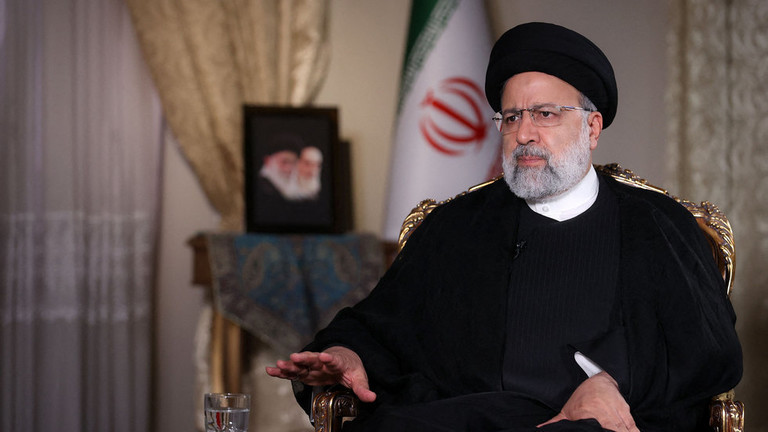
Tehran will ignore US warnings not to intervene in the Hamas-Israel conflict, Iranian President Ebrahim Raisi has said. He also blasted the West over alleged reluctance to help end the hostilities.
In an interview with Qatar-based Al Jazeera on Saturday, Raisi said that Washington “is asking us not to move while providing broad support to the Zionist entity… This is an invalid demand.”
The Iranian president also claimed that Israel’s expanded ground operations in Gaza were a failure, describing it as “the second victory [for Palestinians] following [the launch of] Operation al-Aqsa Storm,” referring to the initial surprise attack by Hamas on Israel on October 7.
He also said that the United States had sent messages to the ‘Axis of Resistance’ – referring to an informal alliance of anti-Western and anti-Israel forces in the Middle East – and “received a practical and public answer on the ground.”
Raisi went on to accuse the US and some unnamed European countries of “obstructing the ceasefire in Gaza,” calling such policies “a crime.” He added that “the United States’ calculations in the region are completely wrong, and said it will not achieve its goals with a new Middle East,” stressing that Tehran’s support for the Palestinians “is not subject to compromise.”
After the Hamas attack on Israel earlier this month, US President Joe Biden pledged unconditional support for Israel while warning Iran to be “careful.” At the same time, he stopped short of backing a cessation of hostilities, with several US media outlets reporting that the State Department had distributed a memo to its diplomats advising them to avoid calling for “de-escalation” or a “ceasefire” in Gaza.
Publicly, Biden has said that ceasefire talks cannot begin until Hamas releases more than 200 hostages. Meanwhile, on Monday, EU foreign policy chief Josep Borrell called for a “humanitarian pause” in the conflict, saying he believed there was consensus among the bloc’s members on the matter.
Raisi’s comments come after Iranian Foreign Minister Hossein Amir-Abdollahian warned the US that “new fronts will be opened up” against Washington if it does not change its policies in the Middle East, including its unequivocal support for Israel.
Israel targets journalists, kills their families as Big Tech & Biden admin silence Palestinians
BY WYATT REED · THE GRAYZONE · OCTOBER 27, 2023
With Israeli airstrikes on Gaza killing at least twenty Palestinian journalists—and the Biden administration working to muzzle others—Big Tech is quietly coordinating with Tel Aviv to muzzle Palestinian media outfits.
Israeli strikes on the Gaza Strip killed three Palestinian journalists on October 25 in one of the deadliest days for local reporters since the military’s bombing campaign began nearly three weeks before. As the hours passed, footage appeared showing the moment Ramallah-based journalist Mohammed Farra learned that his wife and children were all killed in an Israeli airstrike in Gaza’s Khan Younes neighborhood.
Similarly heart-rending scenes would play out more than once over the course of the day. Elsewhere in the besieged coastal enclave, an Israeli airstrike killed the wife, son, daughter and infant grandson of Al Jazeera Arabic’s Gaza bureau chief, Wael Dahdouh.
Israel’s attacks on Palestinian journalists came hours after US Secretary of State Antony Blinken assured “American Jewish community leaders” that he urged Qatar’s government “to tone down Al Jazeera’s rhetoric about the war in Gaza” during a recent trip to Doha.
Suspicions that Israeli forces deliberately targeted Dahdouh’s family were quickly bolstered by comments from News 13 journalist Zvi Yehezkeli.
“Generally we know the target,” Yehezkeli told audiences within hours of the strike, adding, “for example, today there was a target: the family of an Al Jazeera reporter.”
“In general, we know,” he concluded.
If true, it wouldn’t be the first time the Dahdouh’s outlet found itself in Israeli crosshairs. In 2021, the Israeli military leveled the Gaza tower that housed the officers of both the Associated Press and Al Jazeera. The following year, Israeli forces assassinated renowned Palestinian-American journalist Shireen Abu-Akleh, a veteran Jerusalem-based correspondent for Al Jazeera, in a shooting that drew international condemnation but was largely ignored by the US government, which echoes the Israeli government’s position that her killing was “unintentional.” Under Blinken, the State Department has distanced itself from its initial expressions of outrage and no longer calls for either an independent investigation or criminal charges for the perpetrators.
Big Tech censorship targets Palestinian journalists after Israel targets their homes
As the US and Israel rush to censor the voice of Palestinian journalists, Big Tech censorship has proven indispensable to Israel’s propaganda war. In the aftermath of October 7, multiple social media platforms have suspended or deactivated profiles belonging to numerous prominent journalists, human rights advocates, and Palestinian activists. The crackdown follows years of complaints alleging double standards when it comes to anti-Zionist content on social media.
Accounts operated by Eye On Palestine disappeared from Instagram, Facebook, and X on October 25, leaving more than 6 million followers unable to access one of the most popular resources providing firsthand footage of destruction in Gaza. A spokesman for Meta, the parent company of Instagram and Facebook, insisted the suspensions were not politically motivated, asserting “We did not disable these accounts because of any content they were sharing.”
Despite Meta’s denial, it is worth recalling the company’s record of complying with Israeli government censorship requests. Following the approval of a so-called “Facebook Bill” aimed at clamping down on digital “incitement” in 2016, fanatical former Israeli Justice Minister Ayelet Shaked bragged that Facebook, Twitter and Google were complying with 70 percent of their takedown orders.
Tamer Al Mishal, a Palestinian journalist who has served as a crucial Gaza-based news source for many years, put a face to that statistic. In September, Al Mishal made waves when he published an exposé on Al Jazeera illustrating how Meta coordinated with Israeli intelligence to stifle pro-Palestinian content. When he attempted to access his social media profile days later, the reporter made an alarming discovery: his Facebook page had completely ceased to exist.
He wasn’t the only one. The week before, Meta suspended the Instagram account of Palestinian influencer and photojournalist Motaz Azaiza after he shared footage of the remnants of his apartment building, where 15 of his family members were killed in an Israeli airstrikes.
“Palestinian journalists in Gaza are not just facing the Israeli occupation,” Shadi Abdelrahman, a local reporter with years of experience covering events in Gaza from the ground, explained to The Grayzone. “They also have to overcome a lot of censorship by Facebook, YouTube,” he told The Grayzone, adding: “anything on social media, they need to be very careful because they will get their accounts banned.”
“Working as a journalist in Gaza is not an easy job,” he says, not only “because you are being censored by social media, [but] also it can cause problems with Israeli authorities, especially if you’d like to leave through any crossing which is controlled by Israel.”
If you’re outspoken in your coverage, Abdelrahman says, Israeli authorities “will consider you as an enemy.”
During 2021’s Great March of Return, “those journalists who were attending the weekly marches and covering it were targeted deliberately by Israel.”
“Some of them were shot in the knees, some of them were shot in the legs. Some of them got killed,” Abdelrahman recalled.
On Instagram, meanwhile, users noted an apparent ‘glitch’ temporarily translated the Arabic word for “Palestinian” into “Palestinian terrorist.”
During an October 26 raid in Jenin, the Israeli army destroyed the memorial to Shireen Abu Akleh, the renowned Al Jazeera correspondent it killed there a year before.
How Pfizer Hid Nearly 80% of COVID Vaccine Trial Deaths From Regulators
By Angelo DePalma, Ph.D. | The Defender | October 27, 2023
Pfizer-BioNTech delayed reporting vaccine-associated deaths among BNT162b2 clinical trial participants until after the U.S. Food and Drug Administration (FDA) issued an Emergency Use Authorization (EUA) for the product.
The vaccine makers also failed to account for a large number of subjects who dropped out of the trial.
Together, these strategies kept regulators and the public ignorant of a 3.7-fold increase in cardiac deaths among subjects who received the vaccine, according to analysis in the International Journal of Vaccine Theory, Practice, and Research.
The authors of the paper described it as a “forensic analysis,” defined by the U.S. National Institute for Standards and Technology as “the use of scientific methods or expertise to investigate crimes or examine evidence that might be presented in a court of law.”
What the analysis shows
Corinne Michels, Ph.D., retired distinguished professor of biology at Queens College, New York, led the DailyClout Pfizer/BioNTech Documents Investigations Team on what the authors claim was the first independent examination of original data from the Pfizer-BioNTech COVID-19 mRNA vaccine (BNT162b2) clinical trial.
Investigators looked at each of the 38 deaths occurring between July 27, 2020, the start of phase 2/3 of the Pfizer-BioNTech vaccine trial, and March 13, 2020, the end date culminating in Pfizer-BioNTech’s 6-month interim report.
This trial phase involved 44,060 subjects. Half received a dose of BNT162b2, half got a placebo consisting of an inactive sterile salt solution.
The trial was unusual because at week 20 after the FDA issued the EUA for the vaccine, trial subjects in the placebo group were allowed to switch to the vaccinated group and receive their first BNT162b2 shot.
Switching from the placebo to the vaccinated group — or “unblinding” — normally occurs when the benefit of the drug is so great that not treating subjects becomes unethical. For example, investigators might consider unblinding a cancer trial if at some point all untreated patients deteriorated or died but all treated patients improved.
Unblinding conditions may be specified in the study design, but they usually involve input or review from medical ethicists.
Of 20,794 unblinded placebo subjects in the Pfizer trial, 19,685 received at least one dose of BNT162b2.
Normally the decision to unblind a vaccine trial would be based on the product’s safety and effectiveness in reaching certain endpoints or objectives. Endpoints for a drug to prevent viral infections might be a positive test or self-reported COVID-19 illness (the “case” numbers that drove much of COVID-19 policy), illness requiring hospitalization or death.
But, perhaps unexpectedly, after 33 weeks the data revealed no significant difference between deaths in the vaccinated and placebo groups for the initial 20-week placebo-controlled portion of the trial.
After week 20, after most former placebo subjects had received the vaccine, deaths among those in the vaccine group continued unabated.
The authors revealed “inconsistencies” between data presented in Pfizer-BioNTech’s 6-month interim report and subsequent publications by Pfizer-BioNTech trial site administrators:
“Most importantly, we found evidence of an over 3.7-fold increase in the number of deaths due to cardiac events in the BNT162b2 vaccinated individuals compared to those who received only the placebo.”
This means that 79% of relevant deaths were not recorded in time to be included in Pfizer’s regulatory paperwork.
By not including relevant subject deaths in the case report, Pfizer obscured cardiac adverse event signals, allowing the EUA to proceed unchallenged.
How did Pfizer get around legal, ethical obligations?
The Pfizer-BioNTech data, obtained through a Freedom of Information Act lawsuit, uncovered four additional deaths in the vaccine group and one more in the placebo group — but Pfizer failed to include these data in their FDA submission despite an explicit study design requirement to do so.
These data, and how they differ from what Pfizer-BioNTech reported in their applications, are summarized in Table 3 of Michels’ study.
One case involved a 63-year-old woman who died 41 days after receiving the shot, but whose death only entered the data pool 37 days later. Another was a 58-year-old woman whose death 72 days after vaccination went unreported for 26 days.
Had Pfizer-BioNTech met their legal and ethical obligation to report all serious adverse events their data would have shown equal deaths in placebo and vaccine groups — which would have shown no clear benefit for the vaccine.
How were they able to skirt those obligations?
For one, they were able to hide behind the the 2005 Public Readiness and Emergency Preparedness (PREP) Act, which provided an almost impenetrable liability shield for vaccine manufacturers for “medical countermeasures” in response to any “public health emergency.”
Second, because COVID-19 was viewed as a national health emergency, regulators abandoned the established, patient-centered, safety-based approval process requiring years of preclinical animal testing — and Pfizer-BioNTech unsurprisingly went along.
Timing of death reports raises questions
Michels also raised issues regarding total death reports and their timing.
Since the death total from both study groups, 38, appeared “surprisingly low” to study authors — particularly during a pandemic — they undertook their own analysis based on population mortality expectations at the time.
Assuming that age-adjusted death rates for the study subjects were similar to those of the general population, they estimated that 222 subjects should have died from July 27, 2020, to March 13, 2021. The reported number, 38, is just 18% of the expected number.
Michels explained this by the large number, 4.2% of “discontinued subjects.” The most concerning of these were subjects “lost to follow-up,” which means missing scheduled visits or other required activities.
Pfizer-BioNTech tried to reach these subjects via phone, certified mail or through their emergency contact but despite their efforts could not account for 395 subjects who had dropped out.
The authors wrote:
“These are not insignificant numbers and could easily account for the low number of deaths reported in this safety period of the trial. Given the importance of knowing the status of each trial subject, there should have been greater effort to locate these individuals.
“Additionally, Pfizer/BioNTech was responsible for oversight of the trial sites. Sites with excessive numbers of lost to follow-up should have been evaluated for performance.”
Michels was also concerned over how certain trial centers had many dropped-out subjects while others had none or just a few.
Ninety-six of 153 trial sites (63%) reported 0 or 1 subjects lost to follow-up and 34 (22%) reported 2-5 dropouts. But four sites reported more than 20 subjects lost to follow-up, amounting to about 5% of all trial subjects.
Since the vaccine makers were responsible for trial site oversight, the authors wrote, “Sites with excessive numbers of lost to follow-up should have been evaluated for performance.”
Finally, based on the data, it appears Pfizer-BioNTech was in no hurry to enter death reports before the EUA submission deadline, particularly for the BNT162b2 group.
Of the 38 reported deaths only one case was added on the day the subject died. Delays of 20+ and 30+ days were common.
One death took 72 days to find its way into the database, and all were entered as occurring on the reporting day, not on the actual date of death.
Of the eight subjects in the vaccine group that should have been reported by Dec. 10, 2020, the EUA application cutoff, the average reporting delay was 17.5 days for subjects in the vaccine group, but just 5.9 days for deaths among subjects in the placebo group.
Angelo DePalma, Ph.D., is a science reporter/editor for The Defender.
This article was originally published by The Defender — Children’s Health Defense’s News & Views Website under Creative Commons license CC BY-NC-ND 4.0. Please consider subscribing to The Defender or donating to Children’s Health Defense.
Trends in U.S. Tornado Damage and Incidence
A new paper shows that U.S. tornado damage and strong tornado incidence are both sharply down, but you’ll only read about that here
By Roger Pielke Jr. | The Honest Broker | September 25, 2023
In 2011, the United States experienced more than 500 deaths and over $30 billion in losses from tornadoes. As is now common, climate activists were quick to claim that the destructive tornadoes that year were due to climate change. The National Oceanic and Atmospheric Administration (NOAA) rejected such claims, advising:
[A]pplying a scientific process is essential if one is to overcome the lack of rigor inherent in attribution claims that are all too often based on mere coincidental associations.
The 2011 tornado season motivated us — Kevin Simmons, Daniel Sutter and I — to take a close look at trends in tornadoes and their impacts across the United States. The result was a peer-reviewed paper with the first comprehensive normalization of U.S. tornado losses, for 1950 to 2011.
Our results surprised even us — U.S. tornado damage and tornado incidence appeared to have decreased dramatically, contrary to conventional wisdom:
The analysis presented in this paper indicates that normalized tornado damage in the US from 1950 to 2011 declined in all three normalization methods applied (two are statistically significant one is not). The degree to which this decrease is the result of an actual decrease in the incidence of strong tornadoes is difficult to assess due to inconsistencies in reporting practices over time. However, an examination of trends within sub-periods of the dataset is suggestive that some part of the long-term decrease in losses may have a component related to actual changes in tornado behaviour. Further research is clearly needed to assess this suggestion.
You can see that we were exceedingly cautious in how we framed the possibility that things were not actually getting worse. even so, our work was ignored by the Fourth U.S. National Climate Assessment, which instead claimed the opposite, contrary to the evidence and peer-reviewed research:
[T]here is reason to expect increased tornado frequency and intensity in a warming climate
A new paper has just been published by Zhang and colleagues — Time trends in losses from major tornadoes in the United States — which updates and extends our 2013 analysis. They find:
[B]oth the severity of damage from individual events and the total annual losses from tornadoes are seen to have reduced over time.
Their analysis confirms our earlier work:
[O]ur findings reiterate the results of Simmons et al. (2013) who emphasize the importance of normalizing loss data to draw adequate conclusions about the severity of natural hazards
You can see the results of their normalization for 1954 to 2018 in the figure below.

Normalized U.S. annual tornado losses, 1954-2018. Source: Zhang et al. 2023
Compare their results with ours in the figure below, which I have just updated through 2022.

Normalized U.S. annual tornado losses, 1950-2022. Source: Updated from Simmons et al. 2013.
Zhang et al. also find that the strongest tornadoes have also declined appreciably since 1950. The figure below shows their presentation of trends in tornadoes of various intensities (with F1 the weakest and F5 the strongest). You can see that the incidence of tornadoes of F2 strength and stronger have decreased. In our 2013 analysis we found that ~90% of damage results from tornadoes of F2 strength or stronger.
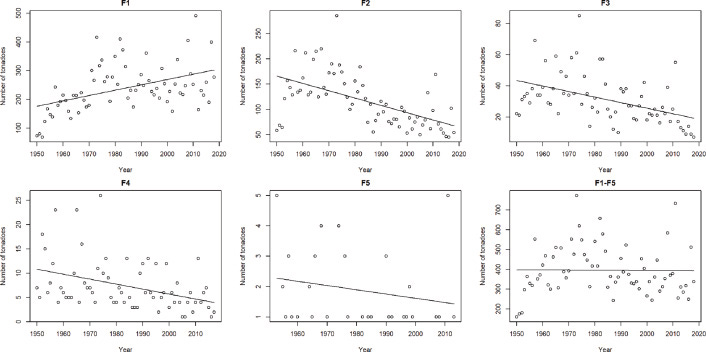
In the 11 full years following our analysis, 9 of 11 have seen overall below average tornado incidence in the United States — 2023 will wind up slightly above average. There is simply no evidence to support claims that tornadoes are getting worse or causing more damage. In fact, the evidence indicates the opposite and peer-reviewed research is strongly in agreement.
Why has the downward trend occurred? Might climate change play a role? You rarely see such questions asked or explored in the scientific literature.
Studies that normalize disaster losses occupy a prominent place in scientific research — they are widely published and cited, have reached conclusions that are frequently and successfully replicated and are commonly utilized in insurance and reinsurance. However, despite all this these studies are all but comprehensively ignored by the media and the scientific assessments of the IPCC and US National Climate Assessment.
Why is this literature ignored?
Misinformation on extreme weather and disasters sits out in plain sight, and is easily refuted — yet there seems to be exceedingly strong social norms and political pressures to simply not call things straight. It is really remarkable.
I am confident that good science will win out in the end. It just might take a while. Meantime, here at THB, I’ll keep sharing the science behind the curtain.
Featured Video
The Search for Truth: Charlie Kirk’s Assassination One Year Later
or go to
Aletho News Archives – Video-Images
From the Archives
The 9/11 “Double-Cross” Conspiracy Theory
BY LAURENT GUYÉNOT • UNZ REVIEW • SEPTEMBER 6, 2022
Is it true that “9/11 was an inside job”? Yes, insofar as Israel is “inside” the U.S. But for the 9/11 truthers who have identified Israel as the main perpetrators, “9/11 was an inside job” is at best a half-truth, and at worst an integral part of the Zionist operation, like a secondary flag sewn as a lining under the false flag of Islamism. Victor Thorn (1963-2017) wrote in his book 9/11 made in Israel: The Plot Against America (2011): “In essence, the ‘9-11 truth movement’ was created prior to Sept. 11, 2001 as a means of suppressing news relating to Israeli complicity. . . . The slogan ‘9-11 was an inside job’ was quite possibly the greatest example of Israeli propaganda ever devised.” In milder terms, it is “controlled opposition”.
A genuine truth movement would have pointed to Israel as the prime suspect from the start. From day one, it was obvious who would benefit. … continue
Blog Roll
 Aletho News
- Hormuz and the Looming Economic Catastrophe
- Dhubab offensive, media blitz and the rapid unraveling of Saudi-backed coalition’s new gambit
- Putin Conveys to Trump Iran’s Vision on Possible Conflict Resolution – Kremlin
- The Search for Truth: Charlie Kirk’s Assassination One Year Later
- ‘Harsh reality’: Iran says France seeks monopoly on power and intimidation, not peace for all
- When Will This White House Madness End?
- Huckabee aide goes to ‘unusual lengths’ to portray ‘Israel’ positively
- Trump Announces Diesel Supply Deal With Putin Following Phone Call
- MEP blasts ‘Euro-Gestapo’ for lecturing Russia on democracy
- Syria May Send Troops to Saudi Arabia Amid War with Ansar Allah
- If Americans Knew
- Israeli forces kill another child in Gaza – Daily Update
- Gaza ceasefire exists in name only, say more than 100 organizations
- Nearly 2 Million in Gaza Need Urgent Shelter Assistance as Winter Looms: IOM Chief Warns
- Suppressing Palestinian resistance: US charity under fire for AI monitoring of Gaza classrooms
- Thousands Are Held in Israeli Torture Camps. This Is What Happens Inside
- Israel puts Gaza’s sick, injured, newborn in peril – Daily Update
- Report claimed Mark Levin used by Israeli government to influence Trump
- Over 2,000 Gazans have died awaiting medical evacuation amid Israel’s continued siege
- How a U.S. Diplomat Suppressed and Altered Reports Critical of Israel
- 5 Palestinians Die from Israeli Strikes in Gaza as Relentless Attacks Continue
- No Tricks Zone
- New Study: 50 Years Of The Most Aggressive ‘Net Zero’ Policies Can Only Affect The Global Climate By 0.03°C
- US September “Heat” Was No Record…Many Records Set Decades Ago
- Latest European Green Energy Debacle; Portugal’s Largest Flagship Solar Park Insolvent!
- Green Energy Debacle: German Expert Professor Fritz Vahrenholt Warns Of Severe Economic And Social Consequences
- Two More Paleo Reconstructions Affirm Meters-Higher Sea Levels Across Ireland, Brazil 7000-6000 Years Ago
- New Study: Earth And Venus Surface Warmth Largely Explained By Convection And Lapse Rate, Not CO2 Or Radiation
- 2025 Nature Paper Claiming Worsening Global Drought Gets RETRACTED …Heavily Flawed
- New Study: ‘Global Drought Shows No Detectable Recent Acceleration Under Climate Warming’
- Economic Masterminds: German Socialists Suggest Taxing Productivity Gains Stemming From Using AI
- The South China Sea Has Not Been Cooperating With The Climate Change Narrative

