Why Trump’s anti-Iran naval coalition in Strait of Hormuz is doomed to fail
By Wesam Bahrani | Press TV | March 18, 2026
US President Donald Trump believes that involving many countries in a naval coalition would force Iran to surrender under international pressure, or at least agree to a ceasefire and enter negotiations with those countries without preconditions.
The last thing Trump expected was for what he thought would be a short, hours-long confrontation to stretch into days and weeks, and then turn into a full-fledged war of attrition.
This is a scenario he neither anticipated nor has the personal capacity to bear, given its potentially disastrous consequences for his country and the world.
It has become clear that Iran had long prepared for this all-out confrontation and that its leadership was certain it would happen at some point. Turning it into a prolonged war of attrition, both geographically and over time, appears to be a central pillar of the Iranian strategy to exhaust the US, the Zionist regime, and their regional and international allies.
Very quickly, by the end of the first week of the illegal and unprovoked war on Iran, Trump’s vision began to turn into a nightmare. His plan to overthrow the Islamic Republic (in other words, “regime change”) with a first strike failed, as did his far-fetched ambition to gain control over a quarter of global oil production and influence its routes and prices.
He now faces the urgent need to manage the global economic fallout of this failure. Iran has effectively gained control over a maritime route through which roughly a quarter of the world’s oil supply passes. By the third week of the war, oil prices had risen above $100 per barrel.
In his first statement to the Iranian people and the world, the new Leader of the Islamic Republic, Ayatollah Seyyed Mojtaba Khamenei, summarized this challenge in two striking phrases that sent shockwaves through the White House.
“The will of the people is to continue effective and deterrent defense,” and “the option of closing the Strait of Hormuz must remain on the table,” he declared.
This clearly signals a willingness to pursue a prolonged war of attrition that threatens the global economy, especially that of the United States and its allies.
Faced with this difficult situation, rising war costs, and growing tensions not only between the US and the Zionist regime but also within the Trump administration, as reported in American and Hebrew media, Trump has turned to his allies for help.
He initially claimed that several countries would send warships to cooperate with the United States in keeping the Strait of Hormuz open and secure.
He expressed hope that countries such as China, France, Japan, South Korea, and the United Kingdom would deploy naval forces to ensure the safety of this vital shipping route. He also called on countries that benefit from West Asian oil to contribute forces to secure maritime navigation.
At the same time, Trump announced an airstrike on Iran’s Kharg Island in an apparent attempt to convince these countries that the US still controls the military situation in the Persian Gulf.
Trump’s remarks can be understood as a desperate call to form an international naval military coalition under US leadership in the region. The implications, motivations, and objectives behind this call can be summarized as follows:
First, the United States appears to have lost the ability to control and manage the war on its own, especially after failing to claim victory. It is now attempting to internationalize the war and turn it into a global confrontation with Iran under the pretext of protecting oil supply chains and global trade.
Second, the US is trying to bypass Iran’s right to control navigation in the Strait during wartime by internationalizing the issue. This could pave the way for imposing new maritime laws under pressure from multiple countries.
Third, Trump believes that the participation of many countries in a naval coalition would force the Islamic Republic to surrender under international pressure, or at least agree to a ceasefire and enter negotiations without preconditions, giving him a way out of the current crisis.
Fourth, Trump is maneuvering to avoid relying on Russian mediation, which he believes would come at a cost, possibly involving concessions in other areas he is unwilling to compromise on.
Fifth, Trump hopes that his invitation to China to join the coalition will be accepted, especially with a scheduled visit to Beijing.
Sixth, he is trying to encourage European countries, affected by rising energy prices, to join the war effort, after they initially adopted a relatively neutral stance.
The first responses came from Europe, particularly France and the United Kingdom, which appeared to divide roles between them. The UK quickly held a ministerial meeting with Persian Gulf monarchies under defensive themes, a move that seemed to sidestep Trump’s call for a formal naval coalition.
British media also reported that the UK is considering sending drones to detect naval mines and intercept Iranian drones, steps that fall short of full participation in a military alliance.
France, meanwhile, took a different approach. President Emmanuel Macron held phone calls with both the Saudi Crown Prince and the Iranian president, aiming to activate political efforts for a resolution. He also asked Trump to clarify his “final objectives and the pace he intends for operations.” The French presidency denied reports that France would send warships to the Persian Gulf.
Japan announced that it would not rush to send warships in response to Trump’s request, emphasizing its long-standing principle of making independent decisions. It also noted that current laws make deploying military vessels to the region legally very difficult.
South Korea stated that it is carefully reviewing Trump’s request, while China ignored the call and instead urged an immediate ceasefire.
Overall, despite their differences, these responses reflect a shared caution, a preference for diplomacy, de-escalation, and, in essence, avoiding the risks of retaliatory attacks from Tehran over a war that has been widely acknowledged as illegal and unprovoked.
This has reportedly increased Trump’s frustration, leading him to postpone his visit to China and to warn of serious consequences for NATO if allies respond negatively.
Tehran’s political approach appears to combine prudence and strategic cunning with firm military resolve. This has been evident both in its diplomatic efforts before and during recent negotiations, as well as in its conduct during the current war.
As usual, Iran’s leadership quickly understood the motives behind Trump’s latest maneuver and responded through several measures.
One of the first decisions was to allow some oil shipments to pass through the Strait of Hormuz on the condition that transactions be conducted reportedly in Chinese yuan, as per reports.
This move aims to maintain oil flows while weakening the US dollar, or at least ensuring that China continues to receive Persian Gulf oil imports, not just from Iran. This is particularly significant as Persian Gulf states may feel compelled to continue selling oil amid fears of economic slowdown after decades of growth.
Iranian Foreign Minister Abbas Araghchi shifted responsibility back onto the United States by stating that Iran has not closed the Strait of Hormuz and that the real reason ships are not sailing is the insecurity caused by American aggression.
This undermines the justification Trump used to call for the coalition. Araghchi also left the door open for countries seeking safe passage for their ships, indicating that decisions would rest with Iranian military forces.
This may be an attempt to encourage direct security cooperation with Iran instead of joining a US-led coalition, while also reiterating Iran’s demand for US forces to leave the region.
Remarks by former CIA analyst Larry Johnson seem to capture Trump’s current situation accurately: Trump lives in a world of “illusions” and is detached from “reality.”
In reality, he is sliding toward madness.
Wesam Bahrani is an Iraqi journalist and commentator.
Qatar condemns ‘dangerous’ Israeli attack on gas field
RT – March 18, 2026
The Qatari Foreign Ministry has condemned Israel’s attack on Iran’s South Pars gas field, which is jointly operated by Iran and Qatar. The ministry said that strikes on Pars constitute “a threat to global energy security.”
Gas processing facilities on the Iranian side of the field were damaged in strikes on Wednesday. While Israel has not taken responsibility for the strikes, Axios reported that they were carried out by Israeli forces in coordination with the US.
In a post on X, Qatari Foreign Ministry spokesman Majed al-Ansari blamed the destruction on Israel.
“The Israeli targeting of facilities linked to Iran’s South Pars field, an extension of Qatar’s North Field, is a dangerous and irresponsible step amid the current military escalation in the region,” he wrote. “Targeting energy infrastructure constitutes a threat to global energy security, as well as to the peoples of the region and its environment.”
Al-Ansari called on all parties involved in the conflict to “exercise restraint” and avoid “the targeting of vital facilities.”
South Pars/North Field is the world’s largest natural gas field. Holding an estimated 1,800 trillion cubic feet of natural gas, its recoverable reserves are believed to be almost as large those of every other gas field on earth combined. Qatar depends on oil and gas for 80% of its revenues, with almost all of its gas extracted from this field.
Iran has threatened to retaliate to the attack in kind. “As previously warned, if the fuel, energy, gas, and economic infrastructures of our country is attacked by the American-Zionist enemy, in addition to a powerful counterattack against the enemy, we will severely strike the origin of that aggression as well,” the country’s military said in a statement to Iranian media.
“We consider targeting the fuel, energy, and gas infrastructures of the countries of origin legitimate and will retaliate strongly at the earliest opportunity,” the statement continued.
In the hours after the attack on South Pars, loud explosions were heard in the Saudi capital of Riyadh, while QatarEnergy announced that missiles had hit the Ras Laffan LNG hub, causing “significant damage.” Qatar’s civil defense agency blamed the attack on Iran.
Iran made ‘unexpectedly substantial’ offer during Geneva talks, US envoys ‘dragged’ Trump into war: Report
The Cradle | March 18, 2026
UK National Security Advisor Jonathan Powell attended the final US–Iran talks in Geneva last month and concluded that a deal was in reach, The Guardian reported on 17 March, citing sources as saying that Washington’s leading envoys were acting as “Israeli assets” who “dragged” the US into war.
According to the report, Powell thought what Iran was proposing was “surprising.”
“The UK team were surprised by what the Iranians put on the table. It was not a complete deal, but it was progress and was unlikely to be the Iranians’ final offer. The British team expected the next round of negotiations to go ahead on the basis of the progress in Geneva,” the sources explained.
“Jonathan thought there was a deal to be done, but Iran were not quite there yet, especially on the issue of UN inspections of its nuclear sites.”
The report went on to say that US President Donald Trump’s envoy Steve Witkoff and his son-in-law and unofficial advisor Jared Kushner invited Rafael Grossi, head of the International Atomic Energy Agency (IAEA), to the talks.
A former official told The Guardian that “Witkoff and Kushner did not bring a US technical team with them.”
“They used Grossi as their technical expert, but that is not his job. So, Jonathan Powell took his own team,” the former official added.
“Witkoff’s pronouncements on the Iran nuclear program were riddled with basic errors,” despite the envoys claiming they had “a pretty deep understanding of the issues that matter in this.”
The next round of talks was planned for 2 March. On 28 February, the US and Israel launched the attack.
“The UK saw no compelling evidence of an imminent threat of an Iranian missile attack on Europe, or of Iran securing a nuclear weapon … The UK regarded the attack as unlawful and premature since Powell believed the path remained open to a negotiated solution to the long-running issue of how Iran could reassure the US that it was not seeking a nuclear weapon,” the report said.
A diplomat with knowledge of the negotiations said, “We regarded Witkoff and Kushner as Israeli assets that dragged a president into a war he wants to get out of.”
Before the war, Trump claimed not only that Iran was seeking a nuclear bomb, but also that it wanted to build missiles capable of reaching the US. Intelligence assessments have refuted this.
According to a report by Responsible Statecraft, Kushner and Witkoff “offered misleading advice that helped push the US toward conflict.”
People present at the US–Iran talks told MS Now earlier this month that Witkoff falsely claimed that the Iranians had “bragged” that they had enough enriched uranium for 11 nuclear bombs.
The report by The Guardian comes as the brutal US-Israeli war on Iran has entered its third week.
Tehran has launched a massive and unprecedented campaign of retaliatory strikes on Israel as well as US military bases and energy infrastructure across the region. The global price of oil has now shot up past $100 and is expected to continue rising.
Joe Kent, head of the US National Counterterrorism Center, officially resigned over his opposition to the war on 17 March.
Israeli Journalist Demands Tucker Carlson and Candace Owens Be Placed in WWII-Style Internment Camps
The Talmudic mask comes off
José Niño Unfiltered | March 17, 2026
The landscape of American free speech has entered treacherous new terrain. On February 27, 2026, an Israeli historian and journalist named Yair Kleinbaum published an editorial in JFeed demanding that the United States government arrest and detain Tucker Carlson, Nick Fuentes, Candace Owens, Cenk Uygur, Jackson Hinkle, and other prominent commentators who have opposed American military action against Iran. The model he proposed for their imprisonment was the World War II internment of Japanese Americans.
“It’s time to put Fuentes, Owens, Carlson and Uygur inside a WWII-Style internment camp,” Kleinbaum wrote. “We have reached a point where there is no choice but to take decisive action and arrest them.”
Kleinbaum’s argument rested on the claim that these commentators had crossed from protected speech into criminal incitement by allegedly encouraging soldiers to defy orders and discouraging enlistment. He explicitly compared them to Japanese Americans during World War II, though he distinguished the cases by asserting that unlike those who were “unjustly profiled,” the targeted influencers had “proven that their loyalty is with anti-American forces.”
“Just as the Japanese-American population was suspected of loyalty to a murderous Japanese regime that had declared war on America during World War II, these figures, including Jackson Hinkle and others, have, unlike most those Japanese who were unjustly profiled, proven that their loyalty is with anti-American forces,” Kleinbaum wrote. “Hence their call for mutiny.”
Kleinbaum himself is a graduate student at the Hebrew University of Jerusalem in the Department of History of the Jewish People and Contemporary Jewry. He also served as a research assistant in the Jewish Peoplehood department at The Interdisciplinary Center Herzliya, now Reichman University. His academic work focuses on the history of the Israeli political left between 1967 and 1973.
For perspective, JFeed is an English language news platform founded in 2023 and led by CEO Yarit Elbaz and Editor in Chief Eli Gotthelf, who previously worked at Kikar HaShabbat, an Israeli Haredi news outlet. The platform describes itself as “proudly unfiltered, proudly Jewish, and proudly committed to conservative values,” with the stated mission of becoming “the leading English-language news source for global Jewry.” Kleinbaum serves as one of the platform’s most prolific writers, covering breaking news on the Iran conflict, antisemitism analysis, and U.S. Israel relations.
Kleinbaum’s call for internment is not a fringe view among the American Jewish community. Multiple surveys reveal a community deeply divided on these questions. A CHIP50 survey in 2024 found that 39 percent of American Jews supported restrictions “prohibiting speech that opposes Israel’s existence as a Jewish state” on college campuses, compared to only 21 percent of non-Jews.
A Forward-CHIP50 poll in 2024 found 31 percent of Jews supported “prohibiting certain political speech” on campus, while 47 percent were opposed. Separately, 44 percent supported banning statements of support for Hamas, and 58 percent supported using law enforcement to police campus demonstrations.
The Japanese American internment that Kleinbaum cited as his model represents one of the most egregious violations of civil liberties in American history. Following the attack on Pearl Harbor in December 1941, President Franklin Roosevelt signed Executive Order 9066, which authorized the forced removal of approximately 120,000 people of Japanese ancestry from the West Coast. The majority were American citizens. They were imprisoned in remote camps surrounded by barbed wire and armed guards, losing their homes, businesses, and livelihoods.
Decades later, the United States government formally apologized for this injustice. In 1988, President Ronald Reagan signed the Civil Liberties Act, which acknowledged that the internment was based on “race prejudice, war hysteria, and a failure of political leadership.” The government paid reparations to surviving internees.
An even more insidious aspect of the Japanese internment that is often overlooked by court historians is how Jewish individuals benefited from the Roosevelt administration’s internment policy. Gus Russo’s 2006 book Supermob: How Sidney Korshak and His Criminal Associates Became America’s Hidden Power Brokers contains a chapter that directly addresses the seizure and sale of Japanese American properties during WWII.
Russo’s book details how the Office of Alien Property Custodian (OAP), headed by David L. Bazelon—a well-connected Chicago attorney and son of Russian-Jewish immigrants—oversaw the liquidation of seized Japanese American (and German-owned) properties after the war. According to Russo, Bazelon sold many of these properties to associates linked to Chicago mob lawyer Sidney Korshak—also of Jewish extraction—and members of the Pritzker family for pennies on the dollar. Russo identifies David Bazelon as running the OAP and controlling the disposition of properties collectively worth an estimated $400 million in 1942 dollars (billions today), including half a million acres of California farmland and some 1,265 small Japanese-owned hotels.
Jay Pritzker — patriarch of the Hyatt hotel fortune — was hired as an assistant attorney at the OAP under Bazelon and allegedly profited from the fire-sale liquidations. The broader network Russo calls the “Supermob” — a cadre of mostly Chicago-connected figures with ties to organized crime — acquired California land, hotels, and urban parcels through these OAP sales.
Back to Kleinbaum, his demand for the state detention of Israel’s vocal critics reflects a deepening panic within the Jewish community following the October 7 conflict. The graphic, public nature of those events triggered a global realization, driving millions to critically examine the extent and nature of Jewish influence in their own nations. This shift signifies that the traditional methods of social control—specifically the use of guilt-based Holocaust tropes to silence dissent—have lost their efficacy. As Jewry’s reliance on soft power through propaganda falters, they are increasingly turning to the hard power of state-sanctioned speech suppression.
What appears as the reactionary outburst of a single, traumatized Jewish intellectual may signal a shift toward a broader, more aggressive strategy intended to crush the burgeoning opposition to Jewish hegemony across the West. These efforts to institutionalize censorship are a testament to the fragility of a crumbling Judeo-American order. The truth is no longer a hidden secret, and the attempt to force it back into the shadows is a battle that world Jewry is poised to lose once gentiles wake up from their slumber.
No time for losers: Why the war meant to save Israel may destroy it
By Ramzy Baroud | MEMO | March 16, 2026
When Donald Trump and Benjamin Netanyahu launched their military aggression against Iran on 28th February, they appeared convinced that the war would be swift. Netanyahu reportedly assured Washington that the campaign would deliver a decisive strategic victory—one capable of reordering the Middle East and restoring Israel’s battered deterrence.
Whether Netanyahu himself believed that promise is another matter.
For decades, influential circles within Israel’s strategic establishment have not necessarily sought stability, but rather “creative destruction.” The logic is simple: dismantle hostile regional powers and allow fragmented political landscapes to replace them.
This idea did not emerge overnight. It was articulated most clearly in a 1996 policy paper titled A Clean Break: A New Strategy for Securing the Realm, prepared for then-Israeli Prime Minister Benjamin Netanyahu by a group of US neoconservative strategists, including Richard Perle.
The document argued that Israel should abandon land-for-peace diplomacy and instead pursue a strategy that would weaken or remove hostile regimes in the region, particularly Iraq and Syria. The goal was not merely military victory but a geopolitical restructuring of the Middle East in Israel’s favor.
The logic is simple: dismantle hostile regional powers and allow fragmented political landscapes to replace them.
In many ways, the subsequent decades seemed to validate that theory—at least from Tel Aviv’s perspective.
The Middle East Reordered
The 2003 US invasion of Iraq was widely considered a catastrophe for Washington. Hundreds of thousands died, trillions of dollars were spent, and the United States became entangled in one of the most destabilising occupations in modern history.
Yet the war removed Saddam Hussein’s government, dismantled the Baath Party, and destroyed what had once been the strongest Arab army in the region. For Israel, the strategic consequences were significant.
Iraq, historically one of the few Arab states capable of confronting Israel militarily, ceased to exist as a coherent regional power. Years of instability followed, leaving Baghdad with a fragile political system struggling to maintain national cohesion.
Syria, another central concern in Israeli strategic thinking, would later descend into its own devastating war beginning in 2011. Libya collapsed earlier after NATO’s intervention in 2011 as well. Across the region, once-formidable Arab nationalist states fractured into weakened or internally divided systems.
From Israel’s vantage point, the theory of regional fragmentation appeared to be paying dividends.
Without strong Arab states capable of projecting military power, several Gulf governments began reconsidering their long-standing refusal to normalise relations with Israel.
The result was the Abraham Accords, signed in September 2020 under the Trump administration, which formalised normalisation between Israel and the United Arab Emirates and Bahrain, later followed by Morocco and Sudan. For a moment, it seemed that the geopolitical transformation envisioned decades earlier had been realised.
Gaza changed the equation
But history rarely moves in straight lines. Israel’s genocide in Gaza did not produce the strategic victory Israeli leaders had anticipated. Instead, the war exposed deep vulnerabilities in Israel’s military and political standing.
More importantly, Palestinian resistance demonstrated that overwhelming military force could not translate into decisive political control.
The consequences reverberated far beyond Gaza.
The war galvanized resistance movements across the region, deepened divisions within Arab and Muslim societies between governments aligned with Washington and those opposed to Israeli policies, and ignited an unprecedented wave of global solidarity with Palestinians. Israel’s international image suffered dramatically.
For decades, Western political discourse framed Israel as a democratic outpost surrounded by hostile forces. That narrative has steadily eroded. Increasingly, Israel is described—even by major international organizations—as a state engaged in systematic oppression and, in Gaza’s case, genocidal violence.
The strategic cost of that reputational collapse cannot be overstated. Military power relies not only on weapons but also on legitimacy. And legitimacy, once lost, is difficult to recover.
Netanyahu’s final gamble
Against this backdrop, the war on Iran emerged as Netanyahu’s most consequential gamble.
If successful, it could restore Israel’s regional dominance and reassert its deterrence. Defeating Iran—or even severely weakening it—would reshape the balance of power across the Middle East. But failure carries equally profound consequences.
Netanyahu, now facing an arrest warrant issued by the International Criminal Court in 2024 over war crimes in Gaza, has tied his political survival to the promise of strategic victory.
In multiple interviews over the past year, he has framed the confrontation with Iran in almost biblical terms. In one televised address in 2025, Netanyahu declared that Israel was engaged in a “historic mission” to secure the future of the Jewish state for generations. Such rhetoric reveals not confidence but desperation.
What was supposed to be a rapid campaign increasingly resembles a prolonged conflict. Israel cannot wage such a war alone. It never could. Thus, Netanyahu worked tirelessly to draw the United States directly into the conflict—a familiar pattern in modern Middle Eastern wars.
The paradox of Trump’s war
For Americans, the question remains: why did Donald Trump—who repeatedly campaigned against “endless wars”—allow the US to enter yet another Middle Eastern conflict?
During his 2016 presidential campaign, Trump famously declared: “We should have never been in Iraq. We have destabilised the Middle East.”
Yet nearly a decade later, his administration has plunged Washington into a confrontation whose potential consequences dwarf those of the earlier wars.
The precise motivations matter less to those living under the bombs.
Across the region, the scenes are painfully familiar: devastated cities, mass graves, grieving families, and societies once again forced to endure the violence of foreign intervention.
But this war is unfolding in a fundamentally different geopolitical environment.
The US no longer commands the unchallenged dominance it once enjoyed. China has emerged as a major economic and strategic actor. Russia continues to project influence. Regional powers have gained confidence in resisting Washington’s dictates.
The Middle East itself has changed.
A war already going wrong
Early signs suggest that the war is not unfolding according to the expectations of Washington or Tel Aviv.
Reports from US and Israeli media indicate that missile-defense systems in Israel and several Gulf states are facing a serious strain under sustained attacks. Meanwhile, Iran and its regional allies have demonstrated missile capabilities far more extensive than many analysts had anticipated.
Energy markets provide another indication of shifting dynamics. Rather than securing greater control over global energy flows, the war has disrupted supplies and strengthened Iran’s leverage over key maritime routes.
Strategic assumptions built on decades of uncontested American military power are colliding with a far more complex reality.
Even the political rhetoric emanating from Washington has become noticeably defensive and increasingly angry—often a sign that events are not unfolding as planned.
Within the Trump administration itself, the intellectual poverty of the moment is difficult to miss. Defense Secretary Pete Hegseth, whose public persona is built on television bravado rather than strategic literacy, has often framed the conflict in language that sounds less like military doctrine and more like locker-room theatrics.
Hegseth’s style is symptomatic of a broader intellectual collapse within Washington’s war-making circles—where historical knowledge is replaced by slogans, and strategic planning by theatrical displays of toughness.
In speeches and interviews, he has repeatedly reduced complex geopolitical realities into crude narratives of strength, masculinity, and domination. Such rhetoric may excite partisan audiences, but it reveals a deeper problem: the people directing the most dangerous war in decades appear to understand very little about the forces they have unleashed.
In such an environment, wars are not analyzed; they are performed.
The end of an era?
Netanyahu sought to dominate the Middle East. Washington sought to reaffirm its position as the world’s unrivaled superpower. Neither objective appears within reach.
Instead, the war may accelerate the very transformations it was meant to prevent: a declining US strategic role, a weakened Israeli deterrent posture, and a Middle East increasingly shaped by regional actors rather than external powers.
Trump, despite the lofty and belligerent language, is in reality a weak president. Rage is rarely the language of strength; it is often the mask of insecurity. His administration has overestimated America’s military omnipotence, undermined allies and antagonized adversaries alike, and entered a war whose historical, political, and strategic dimensions it scarcely understands.
How can a leadership so consumed by narcissism and spectacle fully grasp the magnitude of the catastrophe it has helped unleash?
One would expect wisdom in moments of global crisis. What we have instead is a chorus of slogans, threats, and self-congratulation emanating from Washington—an administration seemingly incapable of distinguishing between what power can achieve and what it cannot.
They do not understand how profoundly the world has changed. They do not understand how the Middle East now perceives American military adventurism. And they certainly do not understand that Israel itself has become, politically and morally, a declining brand.
Of course, Trump and his equally arrogant administration will continue searching for any fragment of ‘victory’ to sell to their constituency as the greatest triumph in history. There will always be zealots ready to believe such myths.
But most Americans—and the overwhelming majority of people around the world—no longer do. Partly because this war on Iran is immoral. And partly because history has very little patience for losers.
Top US Counterterrorism Official Resigns in Protest of Operation Against Iran
Sputnik – 17.03.2026
WASHINGTON – Joseph Kent on Tuesday announced his decision to step down as director of the US National Counterterrorism Center (NCTC) because of his disapproval of the US military operation against Iran.
“After much reflection, I have decided to resign from my position as Director of the National Counterterrorism Center, effective today. I cannot in good conscience support the ongoing war in Iran. Iran posed no imminent threat to our nation, and it is clear that we started this war due to pressure from Israel and its powerful American lobby,” Kent wrote in his letter to US President Donald Trump published on X.
He said that until June of 2025, Trump understood that wars in the Middle East were a “trap” that robbed the country of lives and depleted the nation’s wealth and prosperity.
However, during Trump’s second term, high-ranking Israeli officials and US media deployed a misinformation campaign that dragged the US into a war with Iran by making the president believe in a lie that aggression could lead to a swift victory – a tactic used by Israel to start the war in Iraq, Kent said.
“I pray that you will reflect upon what we are doing in Iran, and who we are doing it for. The time for bold action is now. You can reverse course and chart a new path for our nation, or you can allow us to slip further toward decline and chaos. You hold the cards,” he concluded.
On February 28, the United States and Israel launched strikes on targets in Iran, including in Tehran, causing damage and civilian casualties. Iran responded by striking Israeli territory and US military facilities in the Middle East.
Just Get Out! Now!
By Ron Paul | March 16, 2026
As is becoming clearer from President Trump’s own statements and those of his staff, along with press reporting, the US has launched a major war without the input of the experts we pay to advise the President on such matters. The State Department, Pentagon, National Security Council Staff, Defense Intelligence Agency, and NSA were simply bypassed because, as White House Spokesperson Karoline Leavitt said, President Trump “had a feeling” Iran would attack.
The President’s real estate developer son-in-law and friend reinforced that “feeling” when they returned from the second round of talks with the Iranian foreign minister and his team. However, as the news outlet Responsible Statecraft (RS) reported over the weekend, both son-in-law Jared Kushner and friend Steve Witkoff appear to have mis-represented those talks in a way that helped push President Trump toward war. No State Department officials were on hand to ensure the reporting was accurate.
Also, arms control experts at home, according to the RS report, believe that “the duo appeared to have fatally misunderstood a series of basic technical and historical matters” regarding Iran’s nuclear program leading to inaccurate information conveyed to the President.
Congress was completely out of the picture – seemingly uninterested in performing its Constitutional duty – and no case was made to the American people that they must sacrifice and die once again for a war in the Middle East.
Trump’s repeated promises to not start new wars, especially in the Middle East, have turned out to be empty, and Republicans are set for a crippling defeat in the upcoming midterm elections.
Iran had been warning for months – since the last US/Israeli surprise attack in June – that if they were attacked again they would not hold back on US bases in the region and that they would close the Straits of Hormuz. Trump and Netanyahu attacked anyway, and Iran has done what it said it would do.
Now the Strait of Hormuz is closed, oil is about to go out of control, and the global economy – along with the US dollar – seems about to implode.
On March 6th, President Trump refused a UK offer of help, saying we don’t need help when we’ve already won the war. Five days later, at a rally in Kentucky, President Trump repeated that “We’ve won the Iran war!”
It was his “Mission Accomplished” moment, because this weekend, just days after declaring victory against an “obliterated” Iran, Trump began begging other countries to send ships to help the US open the Strait of Hormuz.
Thus far every country has declined, understanding that such a mission has little chance of success.
Tragically, the war thus far has claimed at least 14 servicemembers. It is likely the toll is far worse than they are telling us. Every US military facility in the region is either damaged or destroyed. Billions of dollars of radar and other equipment are destroyed. Our allies in the region, because they allowed their territory to be used to attack Iran, have also seen massive retaliatory destruction.
This is surely one of the worst military disasters in US history. There are no military options available beyond the unthinkable: the use of nuclear weapons.
The only viable option that remains is one that was often urged in the Vietnam War: Just get out. Now! No return to US bases, no security guarantees to Gulf States. End the US empire in the Middle East and elsewhere. If not, it’s only going to get worse.
Unpacking glaring contradictions in US-Zionist justifications for war against Iran
By David Miller | Press TV | March 5, 2026
While the likes of Trump, Netanyahu, and Rubio peddle inconsistent justifications for the illegal and unprovoked aggression on Iran, CIA intelligence shreds claims of imminent threats, revealing how the Zionist entity dictates US foreign policy.
US President Donald Trump unleashed a barrage of contradictory explanations for the joint US-Zionist assault on the Islamic Republic of Iran, launched on 28 February 2026.
In his initial video statement, Trump asserted the strikes aimed to eliminate “imminent threats” from Iran, including its alleged pursuit of nuclear weapons and long-range missiles capable of reaching the American homeland.
He painted Iran as a “vicious group of very hard, terrible people” whose actions endangered US interests.
This narrative quickly evolved. By 3 March, Trump admitted the decision stemmed from his “opinion” that Iran would attack first if not struck preemptively.
“It was my opinion that they were going to attack first,” he stated, abandoning earlier claims of concrete intelligence.
Such flip-flops, once again, expose exaggeration. Trump claimed Iran neared intercontinental ballistic missiles threatening the US, an assertion contradicted by US intelligence assessments.
The BBC highlighted how Trump’s “imminent threats” lacked support, noting Iran’s nuclear capabilities remained far from weaponisation despite rhetoric.
Trump’s pre-strike doubts further undermine his case. The Associated Press reported Trump’s dissatisfaction with ongoing nuclear talks, leading to the order despite diplomatic avenues. This pivot from diplomacy to aggression reeks of opportunism, not necessity.
Netanyahu’s decades-long push: ‘Regime change’ at any cost
Zionist entity premier Benjamin Netanyahu has long championed aggression against Iran, viewing it as an existential foe. In justifying the 2026 strikes, Netanyahu declared them pre-emptive to thwart Iran’s nuclear and missile programs, threatening overwhelming force.
He warned that allowing Iran nuclear weapons and ICBMs would endanger humanity.
Netanyahu’s rhetoric echoes his four-decade obsession. Even complicit journalists like Mehdi Hasan noted Netanyahu “has been yearning, dreaming of doing this for 40 years,” with Trump as the first US leader to oblige.
The Guardian labelled the assault an “illegal act of aggression” without a lawful basis, driven by Netanyahu’s preference for military solutions over diplomacy.
Post-strike, Netanyahu celebrated the operation’s goals and called (in Farsi) for Iranians to “come to the streets, come out in your millions, to finish the job, to overthrow the ‘regime’ of fear that has made your lives bitter”. Mondoweiss exposed how initial nuclear justifications morphed into overt regime change admissions, mirroring Iraq War tactics.
“When we are finished, take over your government,” President Trump said, addressing the Iranian public in his own video. “It will be yours to take.”
Yet The Nation revealed aims to turn Iran into a failed state, obliterating coherent governance. Netanyahu dusted off the genocidal language used against the Palestinians during a visit onSunday, 1 March, to a site struck by an Iranian missile.
“We read in this week’s Torah portion, ‘Remember what Amalek did to you.’ We remember—and we act,” he said.
The Amalekites are identified in the Hebrew Bible as a persistent adversary of the Israelites, linked to a Torah commandment to erase their memory. Specifically, 1 Samuel 15:3 mandates the killing of men, women, and infants. This was a clarion call to eliminate all Iranians, showing the utter hypocrisy of calling out on the streets those he wishes dead.
Rubio’s Freudian slip: Admitting Zionist sway over US decisions
Secretary of State Marco Rubio’s comments laid bare the Zionist entity’s influence on US policy. On 2 March, Rubio stated the US struck because “we knew that there was going to be an Israeli action,” prompting preemptive moves to avoid higher US casualties from Iranian retaliation.
Rubio elaborated that awareness of Zionist plans necessitated US involvement, framing it as defensive. Al Jazeera described this as a “looping justification,” highlighting how Zionist intentions drove US timing.
Facing backlash, Rubio walked back his words, insisting the strikes were inevitable regardless of Zionist actions. The New York Times reported his clarification: “The president determined we were not going to get hit first.”
Axios noted Rubio’s remarks ignited MAGA divisions, underscoring Zionist power. The Guardian highlighted Democratic fury over Rubio’s implication of a “war of choice” on behalf of Zionists. PBS detailed Rubio’s defence, warning Iran of further escalation. These revelations confirm that US policy follows Zionist whims.
CIA intelligence shreds the ‘imminent threat’ facade
CIA assessments dismantle claims of Iranian aggression. The Associated Press revealed that US intelligence showed no pre-emptive Iranian strike planned against the US.
Briefings to Congress confirmed no such indicators. Reuters echoed Pentagon admissions: no intelligence on Iran attacking first. The Hill reported similar findings, contradicting Trump’s “imminent threat.”
A House of Commons Library briefing noted in 2025 that US intelligence judged Iran not to be building nuclear weapons. CNN detailed CIA tracking of Iranian leaders, but no offensive plans. Al Jazeera reported CIA talks with Kurds for uprisings, indicating an offensive US posture. Even the Zionist funded propaganda network Iran International quoted ex-CIA Director Petraeus on Iran’s strategic errors, but no pre-strike aggression.
These reports expose fabricated threats to justify unprovoked war.
Pentagon’s panic: Depleted THAAD stocks and radar losses
Pentagon officials express intense paranoia over dwindling air defense stockpiles as a result of Iran’s legitimate self-defense. The Washington Post reported sources describing the mood as “intense and paranoid.” The Daily Beast characterised these Pentagon officials as “secretly panicking” about THAAD interceptor shortages if fighting drags on.
This panic stems from high consumption rates. It takes two or three interceptors per incoming missile, straining limited THAAD stocks.
Some sources claim that for every $1 Iran spends on drones, countries like the UAE (and by implication the US and the Zionist entity) spend approximately $20 to $28. The Washington Post said officials are warning that resources are “stretched thin.”
Compounding this, the US Navy resists escorting ships through the Strait of Hormuz. USNI News reported Navy officials informing shipping leaders of no availability for escorts, despite Trump’s pledges.
Lloyd’s list detailed this U-turn, with the Navy ruling out protection.
These issues link directly to Iran’s destruction of the AN/FPS-132 radar at Al Udeid base. NDTV reported Iranian claims to have obliterated this $1.1 billion system, crucial for ballistic missile tracking. The radar’s loss weakens early warning, compressing reaction times for THAAD systems.
Army Recognition, a defence industry news site, explained that this reduces sensor depth, forcing more interceptor use and accelerating stock depletion. In fact, they describe it in full as this: “early-warning radar uses a fixed UHF phased-array to detect and continuously track ballistic missiles and space objects at very long range, generating early launch warning, trajectory and impact predictions, and cueing data for layered defenses such as THAAD, Patriot, and naval air-and-missile defense systems across the Gulf”.
So, it affects the whole range of layered air defences.
For Navy escorts, diminished radar coverage heightens risks in Hormuz. Radar losses are key to broader defense cracks, making naval operations precarious without full surveillance.
These problems have only been compounded by the latest strikes, which even the New York Times is admitting have damaged or destroyed Radar and other monitoring and targeting equipment in US bases across the region in Bahrain, Qatar, Kuwait, Saudi Arabia and the UAE.
This chain—radar destruction leading to inefficient defenses and stock drain—fuels Pentagon panic and Navy caution, exposing vulnerabilities in the aggression.
Zionist entity’s grip: How the US became a tool in Iranian aggression
The Zionist colony has long steered US policy toward confrontation with Iran. Al Jazeera probed how Zionist plans precipitated US strikes, with Rubio admitting awareness shaped decisions.
The establishment think tank CFR detailed US intervention following Zionist unilateralism, escalating to full aggression. Mondoweiss argued the war follows an Iraq playbook: false WMD claims shifting to regime change. The Guardian condemned it as illegal, driven by Netanyahu’s impatience with diplomacy.
Euronews quoted Iran’s UN ambassador decrying US betrayal during talks, highlighting Zionist sabotage. Al Mayadeen announced Netanyahu’s declaration of joint aggression. The Nation exposed aims to fragment Iran, with Zionist officials targeting all leadership. WBUR reported Trump’s regime change calls, echoing Zionist goals.
This puppetry endangers global peace, subordinating US interests to messianic Zionist ambitions.
Key contradictions in leadership statements
- Trump’s threat claims vs. intel: Trump warned of missiles soon reaching the US, but even the NYT fact-checks show these are inaccurate.
- Netanyahu’s pre-emption vs. evidence: Netanyahu framed strikes as a gateway to peace, yet Arab News notes endless war denial.
- Rubio’s Zionist trigger vs. walkback: Rubio suggested Israeli plans forced the US hand, later denied.
- Intel on no strike vs. official narratives: AP sources confirm no preemptive Iranian plans.
These inconsistencies fuel scepticism in the American security apparatus as well as – increasingly – with the US allied states in West Asia.
These deceptions are being unmasked in real time. The unthinkable is now dawning on the US and its allies; this may be the moment that the US is pushed out of West Asia once and for all.
Solidarity with Iran at this time demands truth over propaganda and the final push to remove US influence and finally collapse the Zionist colonisation project in Palestine.
Iranian model of warfare bleeds US dry while Persian Gulf states watch and learn: Analyst
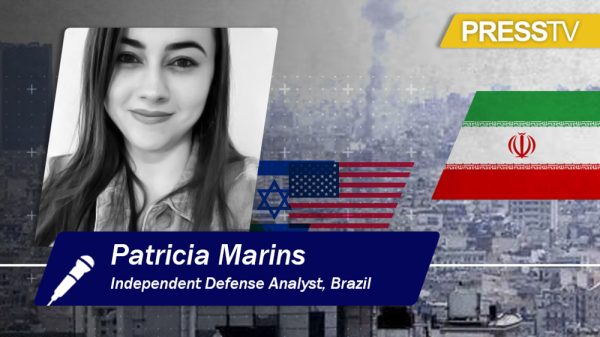
Press TV | March 16, 2026
Sixteen days into the American-Israeli war on Iran, the battlefield tells a story that Pentagon planners had not anticipated. Tehran’s streets remain filled with defiant crowds, the Strait of Hormuz remains closed for US-linked ships, and the US military bases in the region smolder.
Patricia Marins, an independent defense analyst based in Brazil, has been following the war unfold with a keen eye on the shifting strategic balance.
In an interview with the Press TV website, Marins said she has been witnessing the emergence of something the region has never quite witnessed before: the “Iranian model” of warfare proving itself against the world’s most powerful military.
“The Iranian model possesses several distinct characteristics compared to the American model exported to Arab countries. It is built for attrition warfare and resilience, featuring an extensive network of underground facilities and a focus on long-range precision-guided munitions,” she stressed.
“All of this was achieved through investment in research centers, universities, reverse engineering, and the steady implementation of a domestic defense industry, which in many respects is dual-use.”
On the other hand, the American model exported to the Persian Gulf countries consists of “vulnerable surface installations, almost no degree of indigenous production, and consequently a disconnect between research centers, reverse engineering, and the military industry,” which Marins added is not limited to the US model, but all Western models.
“Kuwait paid over $310 million for each Eurofighter Typhoon, nothing short of extortion,” she said, making a clear distinction between the American and Iranian models.
Today, amid the war that was triggered by the unprovoked US-Israeli attack on February 28, and the assassination of the Leader of the Islamic Revolution, Ayatollah Seyyed Ali Khamenei, and some top-ranking military commanders, that investment is paying dividends.
Marins believes the contrast in the military tech leap is not lost on regional observers.
“I believe this Iranian model is being closely watched by all (Persian) Gulf countries at this moment. I see a high probability of it serving as a reference in several areas. I even believe it has inspired the Saudi missile industry, which is currently absorbing Chinese technology,” she said.
“Iran inspires, yet it still maintains a guarded distance from the (Persian) Gulf countries in this sector.”
Beyond the missile and drone arsenal, Iran also enjoys the geographical advantage, the Brazilian analyst stated.
“Iran’s advantage begins with its geographical position, but it is confirmed by its military prowess. And Iran knows how to leverage both very effectively,” she said
She referred to the Ghadir-class submarine, which is affordable, stealthy, and designed specifically for the waters it operates in – the Persian Gulf – especially in the Strait of Hormuz.
The Strait’s “shallow, high-salinity, and high-temperature conditions create a challenging, noisy, and complex environment for sonar, favoring small, fast, and highly maneuverable platforms,” she asserted.
“It is the perfect marriage between the weapon and the environment in which it operates,” she said. “Iran knows how to use the geography that already favors them.”
Then there is Yemen as well, which has indicated willingness to join the front against the US and Israel, after the Lebanese Hezbollah resistance movement and Iraqi resistance groups.
“Iran has been a master player. Knowing that by maintaining influence in Yemen, in a situation like this, they could exert power over both straits,” Marins said.
“However, all of this requires prudence and maturity.”
With the Strait of Hormuz effectively closed already for the US and its allied vessels, if Yemen’s Ansarullah movement follows through and shuts down the Bab el-Mandeb strait as well, the costs would be abysmal, she noted.
“This would expand the conflict on that axis to European countries, as has already occurred. I believe Iran is weighing the necessity of this escalation and whether it is truly required. While Hormuz involves oil and gas, Bab el-Mandeb involves the flow of goods between the West and Asia,” Marins remarked.
“If this strait is closed, it will have a massive economic impact. I see Iran as prudent and disciplined as a nation must be during a war.”
While media reports have cited figures of $1 billion per day for American attacks, with one estimate putting the first six days at $11 billion, Marins believes the true cost is far higher.
In her projections, she suggests the costs for the US could reach a colossal $360 billion within two months if the war continues unabated, a sum that she stresses “would test the patience of any treasury, let alone American taxpayers already feeling the pinch of soaring oil prices.”
“Israel’s operations during the 12-day war generated a daily cost of around $700 million. However, by the end of the war, once the costs of interceptors and damages were added, this daily cost hit nearly $2 billion,” she told the Press TV website.
“I believe this will be Israel’s cost, but the American cost so far is triple that due to three factors: the number of interceptors expended, the quantity of missiles and guided bombs used, and the cost of damages to bases and radars.”
When these factors are combined, Marins noted, the cost is expected to be “no less than $6-8 billion daily during these two weeks of war.”
On reports that Trump’s advisors are advising him to declare victory and find an exit, Marins doubts the American victory in this war is even possible.
“I don’t think so. I see Iran in a much better strategic position to win the conflict. As long as Iran maintains control of the strait, the pressure will be on Donald Trump’s shoulders, no matter how many bombs he drops,” she said.
But beneath that tactical reality lies a deeper truth about the nature of this war. Iran has demonstrated a capacity to absorb bombings while being resilient, limiting drone actions over its territory, and fighting an asymmetric war on its own terms, Marins said.
“So far, I believe Iran has conducted an asymmetric war with very few mistakes,” Marins said. “One that the US and Israel simply don’t know how to fight.”
IRGC orders ‘defeated’ US to evacuate industrial facilities in region
Al Mayadeen | March 16, 2026
The Islamic Revolution Guard Corps (IRGC) has issued a warning to the “defeated US regime,” demanding the evacuation of all American industrial facilities in the region.
The IRGC also called on residents living near US-linked factories to leave the area for their safety, emphasizing that these industrial sites are expected to come under attack in the coming hours.
IRGC’s 56th wave targets strategic Israeli stockpiles, Al-Udeid base
Earlier today, the IRGC announced the launch of the 56th wave of its Operation True Promise 4, targeting key Israeli military infrastructure and a US military installation in the region.
In a statement issued by its Public Relations office, the IRGC said the latest wave of operations was dedicated to martyr Qassem Soleimani, the former commander of the IRGC’s Quds Force, who was assassinated in a US drone strike in January 2020, as well as fighters martyred during battles in defense of the nation’s sanctities.
Stockpiles, airbase hit with precision
According to the statement, the operation targeted several strategic locations in the Israeli-occupied territories, including the Southern Region Support Command and a strategic missile storage facility belonging to Rafael Advanced Defense Systems in the northern occupied territories.
The IRGC said the strikes were carried out using heavy and precision-guided ballistic missiles, including Khorramshahr-4, Emad, and Ghadr missiles, stressing that the designated targets were hit with precision.
The statement also said the attacks extended to the US military presence in the region, noting that the US-operated al-Udeid Airbase was struck during the operation.
Hegseth’s call for ‘no mercy’ to Iranians deemed war crime
The threat to take no prisoners in a conflict is illegal under US and international law
RT | March 16, 2026
US War Secretary Pete Hegseth is facing accusations of violating domestic and international laws prohibiting war crimes by declaring that “no quarter” or mercy would be given to Iranian forces.
The legal definition of the term means surrendering Iranian soldiers would be executed by American troops rather than taken prisoner. US officials and legal experts have responded by accusing Hegseth of encouraging war crimes.
”We will keep pressing. We will keep pushing, keep advancing. No quarter, no mercy for our enemies,” Hegseth said at a press briefing on Iran on Friday.
Some US officials and legal scholars have argued that the remarks went beyond tough rhetoric and strayed into criminality.
Senator Mark Kelly of Arizona blasted Hegseth, saying his comment “isn’t some wannabe tough guy line” but rather an illegal order that jeopardizes US military service members. It also shows “there was never a clear strategy for this war,” the lawmaker added.
Dan Maurer, a retired US Army lieutenant colonel and judge advocate, published a hypothetical memo Hegseth should receive from the Pentagon legal counsel, informing him of criminal liability for himself and any subordinate who followed his directive to deny quarter.
The Hague Convention and the Geneva Convention forbid harming enemy combatants unable to defend themselves or who have surrendered and explicitly prohibit declaring “that no quarter will be given.”
These rules are enshrined in US domestic law. The 1996 War Crimes Act directly cites the article banning “no quarter” in its definition of war crimes.
The US military has prohibited orders to take no prisoners since 1863, when US President Abraham Lincoln issued the Lieber Code during the Civil War.
Hegseth has previously dismissed concerns about international law, claiming he would not abide by “stupid rules of engagement” and “politically correct wars.”
His remarks also come two weeks after a US strike on a girls’ school in southern Iran that killed more than 170 people, most of them children.
Featured Video

or go to
Aletho News Archives – Video-Images
From the Archives
Israel Would Have No Qualms About USS Liberty-Style FALSE FLAG If Iran Campaign Falters – Analysts
By Ilya Tsukanov – Sputnik – 18.06.2025
Donald Trump is mulling whether or not to join Israel’s aggression against Iran as Tel Aviv faces problems sustaining its defenses against growing counterstrikes, and apparently lacks a realistic game plan for an end to hostilities after failing to achieve its goals. Analysts told Sputnik how the US could be ‘nudged’ into the conflict.
“The US is already assisting Israel with supplies, intel, refueling support, etc. One of the many US posts in the region could be attacked for a casus belli,” former Pentagon analyst Karen Kwiatkowski explained.
“If Trump doesn’t comply with Israel’s demand” and join its aggression voluntarily, “a false flag may be needed” to drag the US in, Kwiatkowski, retired US Air Force Lt. Col.-turned Iraq War whistleblower, fears.
Netanyahu has a diverse array of options at his disposal, according to the observer, including:
- a false flag against US assets abroad blamed on Iran or one of its Axis of Resistance allies, like the Houthis
- a US domestic attack or assassination blamed on Iran
- Iranian air defenses ‘accidentally’ hitting a civilian jetliner carrying Americans
- use of a dirty bomb or nuclear contamination somewhere in the region blamed on Iran
- even blackmailing by threatening to use nukes against Iran if the US doesn’t join the fight
Kwiatkowski estimates that Israel probably has “enough blackmail power” against President Trump and Congress to avoid the necessity of a false flag operation, but a “USS Liberty-style” attack, targeting the soon-to-be-retired USS Nimitz supercarrier that’s heading to the Middle East, for example, nevertheless cannot be ruled out entirely, she says. … continue
Blog Roll
 Aletho News
- Smotrich calls for annexation of South Lebanon to Litani River
- Echos of Gallipoli? Hormuz and the Geography of Hubris
- Pakistan PM backs Iran’s right to self-defense amid tensions
- Hungary blasts ‘fake’ EU accusation
- SAFE Debt Trap: Poland’s €43.7 Billion Bet on Unipolar Illusion
- War on Iran threatens global Gulf capital flows: FT analysis
- Mossad De Facto Admits To Inciting Riots In Iran
- Tehran: World grown thoroughly exhausted with US-Israeli ‘false flag storylines’
- Trump ‘stuck between a rock and a hard place’, lacks Iran war strategy: Ex-CIA chief
- Trump’s bombardment of fake news so far is working quite well. But where is it heading?
- If Americans Knew
- From Sde Teiman, the truth about Israel’s military justice system has been set free
- Child denied life-saving bone marrow transplant by Israel ‘because he is from Gaza’
- Raffi Berg: BBC Middle East Editor Exposed as CIA, Mossad Collaborator
- Jerusalem Archbishop Rebukes Netanyahu’s Statements on Christianity
- US to embed Palantir AI across entire military: Report
- Israeli-US war on Iran to drag on “a few more weeks” – Not a ceasefire Day 164
- Lebanon deaths top 1,200; Palantir AI to be embedded across US military – Not a ceasefire Day 163
- Israel’s assassination game: Take all pragmatists off the board
- Food shortages return to Gaza as Israel tightens aid restrictions under the cover of its war on Iran
- Trump demands trillions in payments from Gulf countries, billions from Harvard – Not a ceasefire Day 162
- No Tricks Zone
- Devastating Assessment Of Comirnaty Vaccine By Former Senior Pfizer Europe Toxicologist
- New Study: CO2 Is ‘Effectively Negligible’ As An Explanatory Climate Change Factor Since 2000
- Former Pfizer Toxicologist Dr. Helmut Sterz Tells Bundestag Hearing Pfizer Vaccine Should Have Never Been Approved
- Energy Expert: Germany’s Nuclear Phaseout Was A “500 Billion Euro Mistake”
- New Research: South Australia’s Mid-Holocene Sea Surface Temperatures Were 4°C Warmer Than Today
- Storing Green Energy To Last Germany 10 Days Would Require A 60-Million Tonne Battery
- New Studies: UK Sea Levels Were 4 Meters Higher Than Today During The Mid-Holocene
- Destructive Green New Deal: German Energy And Metal Group Warns Of Drastic Crisis
- New Study Documents A 20-Year Pause In Arctic Sea Ice Decline – Driven By Internal Variability
- Wake-up Call: Survey Shows Majority Of Germans Now Favor Postponing Climate Targets!
 Aletho News