US to supply arms to Ukraine, hold joint military drills in Black Sea
RT | September 7, 2014
The Ukrainian and US navies will take part in a joint exercise called “Sea Breeze 2014” on September 8-10 in the northwestern part of the Black Sea, Ukraine’s Ministry of Defense said.
Around 280 US servicemen will participate in the drills, according to a statement by US European Command spokesman Navy Capt. Greg Hicks, director of Communication and Engagement.
The exercises will include representatives from five countries – including Georgia, Romania and Turkey – as well as the Standing NATO Maritime Group TWO Task Unit 02 (including Canadian, Spanish, and Romanian ships).
The planned military exercises are said to be focused on how interdiction operations could enhance maritime security.
Also, the US – along with France, Italy, Poland and Norway – will supply modern weapons to Ukraine, according to President Petro Poroshenko’s aide, Yury Lutsenko. The agreements were reached at the NATO summit in Wales, he wrote on Sunday on Facebook. The West will also send military advisers to Ukraine, he added.
Meanwhile, NATO is in the midst of its seven-day military exercises in Latvia. The organization says the drills are aimed at showing its commitment to Baltic member states in the face of an “assertive” Russia.
Exercise Steadfast Javelin 2 kicked off on September 2. It simulates the deployment of NATO soldiers and equipment during a crisis situation. A total of around 2,000 soldiers from nine different countries are taking part in the maneuvers, which will carry on until Monday.
The exercises in Latvia will be followed by other drills in Germany, Norway, Ukraine, and Poland later this autumn.
Moreover, following the NATO summit in Wales, a plan to create a new rapid reaction force in Eastern Europe was announced, likely numbering at least 4,000 and ready to be deployed within 48 hours.
The Baltic states and Romania have already offered to host the force.
Guatemala defies ‘Monsanto Law’ pushed by US as part of trade agreement
RT | September 3, 2014
The highest court in Guatemala has suspended the controversial ‘Monsanto Law,’ a provision of a US-Central American trade agreement, that would insulate transnational seed corporations considered to have “discovered” new plant varieties.
The Constitutional Court suspended on Friday the law – passed in June and due to go into effect on Sept. 26 – after a writ of amparo was filed by the Guatemalan Union, Indigenous and Peasant Movement, which argued the law would harm the nation, LaVoz reported.
The Court’s decision came after several Guatemalan parliamentarians from both the governing Patriotic Party and the opposition party Renewed Democratic Freedom said they would consider repealing the law after outcry from a diverse cross-section of Guatemalans.
The decision also offers interested parties 15 days to present their arguments pertaining to the law in front of the Constitutional Court. Members of both political parties said they would present motions to resist the law.
The ‘Law for the Protection of New Plant Varieties,’ dubbed the ‘Monsanto Law’ by critics for its formidable seed-privatization provisions, is an obligation for all nations that signed the 2005 CAFTA-DR free trade agreement between Costa Rica, El Salvador, Guatemala, Honduras, Nicaragua, the Dominican Republic, and the United States. The agreement requires signatories to adhere to the International Convention for the Protection of New Plant Varieties.
The law offers producers of transgenic seeds, often corporate behemoths like Monsanto, strict property rights in the event of possession or exchange of original or harvested seeds of protected varieties without the breeder’s authorization. A breeder’s right extends to “varieties essentially derived from the protected variety,” thus, a hybrid of a protected and unprotected seed belongs to the protected seed’s producer.
The Rural Studies Collective (Cer-Ixim) warned that the law would monopolize agriculture processes, severely threaten food sovereignty – especially those of indigenous peoples – and would sacrifice national biodiversity “under the control of domestic and foreign companies.”
The National Alliance for Biodiversity Protection said in July that the law is unconstitutional “because it violates the rights of peoples. It will benefit transnational seed companies such as Monsanto, Duwest, Dupont, Syngenta, etc.”
“According to this law, the rights of plant breeders are superior to the rights of peoples to freely use seeds,” the Alliance said in a statement.
“It’s a direct attack on the traditional knowledge, biodiversity, life, culture, rural economy and worldview of Peoples, and food sovereignty,” the Alliance added.
Anyone who violates the law, wittingly or not, could face a prison term of one to four years, and fines of US$130 to $1,300.
It is unclear what options the Guatemalan government has given the obligations under CAFTA-DR. The US would likely put pressure on the nation to pass the law, part of a global effort using trade agreements to push further corporate control over trade sectors like agriculture in the name of modernization. Upon further refusal, the US could drop Guatemala from the trade agreement.
‘Promoting peace and stability’: NATO warships enter Black Sea
RT | September 4, 2014
A US Navy destroyer and, reportedly, a French frigate have entered the Black Sea, as NATO builds up its presence in the region while tensions remain high in Ukraine. Another two warships are expected to arrive in the area by the end of the week.
The US Navy 6th Fleet official command has confirmed on its official Twitter account that the destroyer USS Ross, (DDG 71), an Arleigh Burke-class guided-missile destroyer, is now in the Black Sea.
“USS Ross enters Black Sea, promoting peace and stability while working with NATO allies and partners,” a statement said.
The US Navy has stressed that “the Ross’ presence in the Black Sea serves to demonstrate the United States’ commitment to strengthening the collective security of NATO allies and partners in the region.”
“The US Navy maintains an enduring commitment to forward-presence throughout the region in order to have ready-forces available if a crisis were to occur,” the statement said.
Another NATO warship, France’s Commandant Birot, also arrived in Black Sea waters on Wednesday night, according to a military diplomatic source cited by the Itar-Tass news agency.
“Both ships have passed through the Bosphorus and entered the Black Sea between 21:00 and 22:00 Moscow time,” the source was quoted as saying.
Commandant Birot has joined another French warship, the Dupuy le Lome, a surveillance ship designed to collect signals and communications from beyond enemy lines. Up until September 4, the Dupuy le Lome was the only NATO ship in the region. The vessel is scheduled to leave the area on September 5.
A total of four NATO warships are expected to enter the Black Sea before September 7. The USS Ross and Commandant Birot will be joined by Canada’s HMCS Toronto, a Halifax-class frigate, and a Spanish frigate, the Almirante Juan de Borbon.
Under the Montreux Convention of 1936, warships of non-Black Sea states can stay in the Black Sea for no more than 21 days. It also stipulates that the maximum deadweight of a non-regional warship in the area should not exceed 45,000 tons.
NATO warships have been operating in the area since this spring, when tensions started escalating between Kiev forces and rebels in southeastern Ukraine.
Despite the three-week limit, the alliance has managed to secure its presence in the area by constantly rotating warships there.
Deployed to the region in mid-May, the Dupuy le Lome was preceded by the destroyer USS Donald Cook, sent to the Black Sea in early April.
In July this year, NATO deployed a total of nine vessels, setting a record for the post-Soviet period.
On August 7, the US missile cruiser Vella Gulf entered the Black Sea and left the region at the end of the month.
NATO has been discussing its “more visible” presence in Eastern Europe, referring to the three Baltic States – Latvia, Lithuania and Estonia – as there has been little progress in resolving the conflict in Ukraine. The issue is now being discussed in Wales, where the military alliance is meeting on Thursday and Friday.
The US and the international community have accused Russia of supporting opposition forces in southeastern Ukraine, accusations that have been denied by Moscow.
Russia has condemned NATO’s activities in the Black Sea and branded them a provocation that hinders the normalization of the situation in Ukraine.
Fake cell phone ‘towers’ may be spying on Americans’ calls, texts
RT | September 3, 2014
More than a dozen “fake cell phone towers” could be secretly hijacking Americans’ mobile devices in order to listen in on phone calls or snoop on text messages, a security-focused cell phone company claims. It is not clear who controls the devices.
ESD America, which markets heavily-encrypted cell phones built within the body of a Samsung Galaxy S3, said it was able to locate numerous towers intercepting mobile communications – but does not know who is running them.
Speaking to Popular Science, ESD America CEO Les Goldsmith recently said that the company has used its phone – the CryptoPhone 500 – to map 17 different fake cell phone towers, dubbed “interceptors,” across the United States. Locations include New York, Chicago, Los Angeles, Seattle, and more.
“Interceptor use in the US is much higher than people had anticipated,” he told the website. “One of our customers took a road trip from Florida to North Carolina and he found 8 different interceptors on that trip. We even found one at South Point Casino in Las Vegas.”
Although these interceptors act as fake cell phone towers, they are not necessarily large, physical structures. They could simply be small mobile devices that act exactly like a real tower, deceiving phones into giving up information. Such devices are known as “stingrays,” after the brand name of one popular type of interceptor.

Once connected to a person’s phone, they can bypass the mobile device’s encryption to either listen in on calls or capture texts. In some cases, they are also powerful enough to take over a device or make it seem as if it has shut down – only to leave the microphone on in order to eavesdrop.
The American Civil Liberties Union has been attempting to pry information about government and police use of stingray equipment, but its efforts have been met with resistance from federal officials.
According to Ars Technica, the Federal Communications Commission pledged in August to investigate the “illicit and unauthorized use” of interceptors – with a primary focus on foreign governments, criminals, and terrorists – but denied a Freedom of Information Act request to reveal more data about current stingray use.
For Goldsmith, determining who is using the interceptors is important. He speculated that the operators could be American agencies or foreign governments.
“What we find suspicious is that a lot of these interceptors are right on top of US military bases. So we begin to wonder – are some of them US government interceptors? Or are some of them Chinese interceptors?” he told PopSci. “Whose interceptor is it? Who are they, that’s listening to calls around military bases? Is it just the US military, or are they foreign governments doing it? The point is: we don’t really know whose they are.”
Outside of national governments, local law enforcement agencies are also beefing up their stingray/interceptor capabilities. In Oakland, California, police are looking to spend hundreds of thousands of dollars to upgrade their cell phone surveillance system.
Meanwhile, police in Tacoma, Washington have caught the eye of civil liberties advocates after the News Tribune revealed they have been using interceptor equipment to catch cell phone calls for the last six years. Some, including Mayor Marilyn Strickland, said it was legitimate for police to do so as long as people’s rights were not violated. However, the ACLU disagreed, arguing it was like “kicking down the doors of 50 homes and searching 50 homes because they don’t know where the bad guy is.”
US prepares military drill in W. Ukraine for mid-September
RT | September 3, 2014
The US and its allies are preparing to stage a military exercise in western Ukraine, close to the Polish border, in mid-September. The joint drill will involve over 1,000 troops from the US and Europe, as well as from Ukraine.
Initially planned for mid-July, the exercise – code-named ‘Rapid Trident’ – was halted due to a significant escalation in the conflict between Kiev and the southeastern regions of Ukraine.
Now, as the fighting between the two sides continues, the US Army’s European Command (EUCOM) plans to go ahead and stage the exercise on September 16-26.
“At the moment, we are still planning for [the exercise] to go ahead,” US Navy Captain Gregory Hicks, spokesman for EUCOM, announced on Tuesday.
The annual exercise will take place at Yavoriv training center in the city of Lvov, near Ukraine’s border with Poland.
Around 200 US personnel will be involved in the drill, as well as 1,100 others from Ukraine, Azerbaijan, Britain, Canada, Georgia, Germany, Latvia, Lithuania, Moldova, Norway, Poland, Romania, and Spain, EUCOM said.
In addition to staging air force exercises, the United States is moving tanks and 600 troops to Poland and the Baltic states of Estonia, Latvia, and Lithuania for joint maneuvers in October, Reuters reports. The new deployment will replace a more lightly armed force of paratroopers.
Rapid Trident 2014 is designed to “promote regional stability and security, strengthen partnership capacity and foster trust while improving interoperability between the land forces of Ukraine, and NATO and partner nations,” according to the US Forces in Europe website.
The exercise will be mainly focused on command post drills, patrolling, and dealing with improvised explosive devices.
Despite the involvement of many NATO members, Rapid Trident is not formally a NATO drill.
The Ukrainian-American exercises have taken place in Lvov since 2006 under the framework of NATO’s broader ‘Partnership for Peace,’ which Ukraine is part of.
This year’s drill will mean the first significant deployment of US troops and other personnel to Ukraine since the crisis erupted.
Last year’s Rapid Trident, which focused on “airborne and air-mobile infantry operations,” according to a report on the Rapid Trident website, brought together 17 NATO countries for joint exercises.
The announcement comes just two days before the NATO 2014 summit is set to open in Wales. The alliance’s expansion to Eastern Europe is expected to become one of the main discussions and the 28-member bloc expects, despite internal opposition, to agree on the “more visible NATO presence in the East.”
The White House said the US and its allies are set to discuss plans to significantly increase the readiness of NATO response forces.
White House spokesman Josh Earnest told reporters that the meetings within the summit are expected to involve discussions on potential trainings, exercises, and other issues regarding infrastructure and other needs in Eastern Europe.
Back in June, US President Barack Obama pledged to invest $1 billion in stepping up America’s military presence in Eastern Europe amid the Ukraine crisis. Also that month, Washington vowed additional military help to Ukraine, as well as the potential training of its law enforcement and military personnel.
Liberals’ darling Elizabeth Warren defends Israeli attacks on Gaza schools and hospitals
RT | August 29, 2014
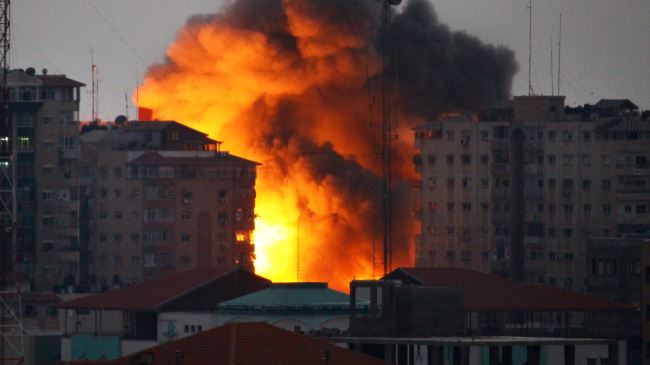
Israel has the right to shell Palestinian hospitals and schools out of self defense as long as Hamas stores rocket launchers next to them, US Sen. Elizabeth Warren said during a town hall meeting in Massachusetts this week.
Warren, darling du jour of American liberals, defended her vote to send more defense funding to Israel in the middle of its recent fierce offensive on Gaza, saying she believes civilian casualties are the “last thing Israel wants,” according to the Cape Cod Times.
“But when Hamas puts its rocket launchers next to hospitals, next to schools, they’re using their civilian population to protect their military assets. And I believe Israel has a right, at that point, to defend itself,” she said.
Israel and Palestinian authorities reached a long-term ceasefire agreement this week after Israel started its campaign in Gaza on July 8. The death toll from the Gaza conflict has reached at least 2,120 people, of which 577 are children, according to the Palestinian Health Ministry.
During the conflict, Israel targeted schools and hospitals in Gaza, claiming that rockets and militant fighters were nearby. The United Nations Relief and Works Agency criticized both Hamas for storing rockets in two schools and Israel for attacks on separate schools.
Attacks on hospitals are prohibited by the Geneva Convention’s Protection of Civilian Persons in Time of War “unless they are used to commit, outside their humanitarian duties, acts harmful to the enemy.” Even then, civilian hospitals can only be targeted “after due warning has been given, naming, in all appropriate cases, a reasonable time limit and after such warning has remained unheeded.”
Warren said Hamas has attacked Israel “indiscriminately.” Thanks to Israel’s vaunted Iron Dome defense system, though, those rockets have “not had the terrorist effect Hamas hoped for.”
Warren supported Israel’s military aggression, justifying its use of force based on America’s “very special relationship with Israel.”
“Israel lives in a very dangerous part of the world, and a part of the world where there aren’t many liberal democracies and democracies that are controlled by the rule of law,” she said. “And we very much need an ally in that part of the world.”
Warren also expressed unease with conditioning future US funding for Israel on the cessation of Israeli settlements in the West Bank.
“I think there’s a question of whether we should go that far,” Warren said.
Last month, UN High Commissioner for Human Rights said Israel may have committed war crimes in Gaza. Navi Pillay said house demolitions and the killing of children raise the “strong possibility” that Israel is violating international law.
More than 17,000 homes in Gaza were destroyed or damaged beyond repair, making around 100,000 Palestinians homeless, since the war began, according to UN estimates.
According to a senior UN Children’s Fund (UNICEF) official, 373,000 Palestinian children are in need of “immediate psychosocial first aid” due to the onslaught of Israeli strikes.
“The impact has truly been vast, both at a very physical level, in terms of casualties, injuries, the infrastructure that’s been damaged, but also importantly, emotionally and psychologically in terms of the destabilizing impact that not knowing, not truly feeling like there is anywhere safe place to go in Gaza,” Pernilla Ironside said last week.
UNICEF estimated that at least 219 schools have been damaged by Israeli airstrikes, while 22 were completely destroyed.
To demonstrate the extent of the damage in Gaza, Ironside estimated that it could take up to 18 years to rebuild the 17,000 housing units that were damaged in the conflict and in light of the ongoing blockade of the region limiting the movement of goods and people.
Israel has also barred major human rights organizations from entering Gaza territory.
Meanwhile, back in the United States, US Sen. Bernie Sanders, American liberals’ other favorite among establishment progressive politicians, has also defended US funding and arms for Israel. At a recent tense town hall in his native Vermont, Sanders condemned Israeli targeting of civilians, but then defended Israel “in a situation where Hamas is sending missiles into Israel” sent from “populated areas.”
“This is a very depressing and difficult issue. This has gone on for 60 bloody years,” he said. “If you’re asking me, do I have a magical solution? I don’t. And you know what, I doubt very much that you do.”
Police departments suspended for ‘losing’ US military-grade weaponry
RT | August 27, 2014
Close to 200 state and local police departments in the United States have been suspended for losing military-level equipment transferred to them by the Pentagon, a new investigation found.
According to the media outlet Fusion, its independent investigation into the Pentagon’s “1033 program,” which equips state and local police departments across the US with excess military equipment, turned up an alarming trend: Not only did many law enforcement agencies fail to comply with the program’s guidelines, they routinely lost dangerous weaponry.
Already, the investigation has found that police departments in Arizona, California, Mississippi, Missouri, Georgia, and others have lost or cannot account for various types of weapons. This list includes M14 and M16 assault rifles, .45-caliber pistols, shotguns, and even vehicles.
So far, 184 state and local departments have reportedly been suspended in a program that involves the participation of more than 8,000 agencies. Since 1990, the 1033 program has administered more than $4.3 billion worth of equipment and weapons.
In the wake of heavy police response to protests surrounding the death of unarmed teenager Michael Brown in Ferguson, Missouri, the topic of police militarization has emerged at the forefront of public debate in the US. Police employed heavily armored vehicles, sniper rifles, tear gas, and riot gear as they confronted demonstrators against excessive force, sparking widespread concern throughout the country, particularly over the Pentagon’s military equipment transfer program.
Although the Pentagon stated the program is meant to “enhance public safety and improve homeland security,” critics argue that the inability of police to keep track of their equipment adds another layer of doubt to the idea that security is being improved.
“The case for giving military weaponry to these small police departments was already thin in the beginning,” Tim Lynch of the CATO Institute’s project on criminal justice said to Fusion. “Now that we’re finding that there is insufficient accountability for tracking this equipment, then the case is beginning to fall apart.”
In at least two cases, Humvees were reported missing. In Georgia, the Humvee was reportedly sold somehow, only to be recovered later and moved to a different department. Another case in Arkansas involved a stolen Humvee that was not reported until a day later.
Firearms were routinely lost or misplaced. In Arizona alone, the Maricopa County Sheriff’s Department lost 11 or 12 weapons.
“[The program] is obviously very sloppy, and it’s another reason that Congress needs to revisit this promptly,” Lynch added. “We don’t know where these weapons are going, whether they are really lost, or whether there is corruption involved.”
As RT reported previously, questions over the Pentagon program have reached President Obama as well, as he recently ordered a review of the entire operation. The probe will determine whether or not police should actually be receiving the equipment they get, the way these weapons are being used, and whether officers are being trained properly.
Coroner says man fatally shot himself in the chest while handcuffed behind his back
RT | August 26, 2014
The release of an autopsy report in Louisiana is raising new questions about the unusual shooting death of a 22-year-old black male who died earlier this year in a police car while his hands were cuffed behind his back.
RT reported earlier this year that police in Iberia Parish, LA said Victor White III died in early March after he fatally shot himself while handcuffed in the back of a squad car. White had reportedly been apprehended for possession of drugs, and was searched no fewer than two times before being cuffed and placed in the backseat of a police vehicle. According to the police report from the time, White uncovered a gun while in the car and shot himself in the back.
According to a coroner’s report just recently obtained by NBC News, however, White died from a gunshot wound that entered his body in the chest. Nevertheless, Dr. Carl Ditch wrote in the report that White was capable of firing the shot while cuffed “due to his body habitus” and has agreed to rule the death a suicide.
Hannah Rappleye, a reporter for NBC, compared the coroner’s story with the official police report from March in an article published by the outlet this week.
“White was shot in the front, not the back. The bullet entered his right chest and exited under his left armpit. White was left-handed, according to family members. According to the report, the forensic pathologist found gunshot residue in the wound, but not the sort of stippling that a close-range shot can sometimes produce. He also found abrasions on White’s face,” she wrote. “And yet, despite the contradictions – and even though White’s hands were never tested for gunpowder residue – the Iberia Parish coroner still supported the central contention of the initial police statement issued back in March.”
“Although the decedent was handcuffed at the time with his hands to his back, due to his body habitus, the pathologist and investigators agree that he would have been able to manipulate the weapon to the point where the contact entrance wound was found,” Ditch wrote.
The deceased’s father, Rev. Victor White II, told NBC that he had his doubts about the coroner’s report.
“You can’t make me understand,” he said. “You can’t make me understand how my son took his left hand, when he was handcuffed behind the back, and shot himself. I don’t believe a thing they’re saying at this point.”
According to the coroner, however, White was indeed capable of causing his own death.
“As Coroner of lberia Parish it is my duty to rule on cause and manner of death in all such cases as Mr. White’s to the best of my ability and without bias. Based on the forensic evidence and information gained from the ongoing State Police investigation, I have determined the cause of death is a single contact gunshot wound to the right lateral chest, and the manner of death is suicide,” he wrote.
Meanwhile, though, the Louisiana State Police remain in the midst of an investigation launched nearly nine months ago into the shooting death. Writing for NBC, Rappleye wrote that that probe has so far failed to reveal any new information about the tragic death.
“Due to the pending investigation, records normally considered public are not available. The State Police will not yet release dash cam footage, or the number of or names of any officers present during White’s death. They will not give any timeframe as to when they expect the investigation to conclude,” she wrote.
“You always want to make sure in the end you did whatever you could do possible, that in whatever case you put forward, is the right case, and the outcome is the right outcome,” Trooper Brooks David, public information officer for the Louisiana State Police, told NBC. “So if it takes us eight months, or two months, you always want to make sure that you do the right thing.”
According to Rev. White, however, legal action might be the next step if the eventual release of the Louisiana State Police’s report raises more doubts about his son’s death.
“I don’t’ think anything is going to be different from what they already said,” he told NBC. “It’s difficult to see that anything else would bring us back what we need. The only thing we want back is our son.”
California nuclear plant gets thumbs down from expert over quake fears
RT | August 26, 2014
A confidential report by a senior nuclear expert calls on regulators to close California’s last nuclear plant until it can be established the facility can survive a powerful earthquake, according to an exclusive AP report.
The Diablo Canyon Power Plant, which was built near three geographical fault lines, provides electricity needs for more than 2.2 million people in America’s largest state. However, a confidential report by the plant’s former inspector, Michael Peck, is calling on federal regulators to pull the plug on the facility.
Following the closure of the San Onofre Nuclear Generating Station in 2013, 30-year-old Diablo Canyon is the sole remaining nuclear energy supplier in California.
Peck warned in his 2013 report, which was obtained and verified by the Associated Press, that the Nuclear Regulatory Commission (NRC) is failing to maintain safety standards previously put in place for the facility’s operation.
The primary issue, as described by AP, is that “no one knows whether the facility’s equipment can withstand strong shaking from those faults – the potential for which was realized decades after the facility was built.”
Continuing to operate Diablo Canyon plant “challenges the presumption of nuclear safety,” the nuclear expert, who is employed as an instructor by the NRC, warned.
The surfacing of the confidential report comes after a magnitude-6 earthquake hit northern California on Sunday, injuring dozens of people and causing over $1 billion dollars in property losses. Fears that Sunday’s earthquake was just a precursor to the much-feared ‘Big One’ have once again sparked debate on the ability of California’s aging infrastructure to withstand an earthquake.
Meanwhile, nuclear experts continue to be haunted by the nuclear accident at Japan’s Fukushima nuclear plant, which suffered severe damage following a magnitude 9.0 earthquake and tsunami that hit Japan in March 2011. To this day, Japanese authorities, amid a very concerned public, are attempting to halt the leak of radiation from the damaged structure.
In a report put out in July entitled, “Lessons Learned from the Fukushima Nuclear Accident for Improving Safety of US Nuclear Plants,” it is advised that the nuclear industry should “access their preparedness for severe nuclear accidents associated with offsite-scale disasters.”
It adds that the current approach to nuclear safety is “clearly inadequate for preventing core-melt accidents and mitigating their consequences.”
After the Fukushima disaster, the NRC ordered US nuclear plants to reevaluate the risks posed by earthquakes, with studies due by March 2015.
Much of the current debate over the viability of California’s last nuclear facility originates from the 2008 discovery of the Shoreline fault, which, together with a number of other potentially active regions, including the large Hosgri fault, arguably places Diablo Canyon in a vulnerable geographical position.
Peck says Pacific Gas & Electric (PG&E), the company that owns the nuclear facility, failed to prove that the plant would withstand the vibrations of a powerful earthquake, thereby violating its operating license. PG&E has challenged those claims, saying the structure is sound.
Blair Jones, a spokesman for PG&E, the company that owns the nuclear facility, said the NRC has conducted extensive analysis to prove the plant is “seismically safe.”
Jones told AP that concerns regarding earthquake-generated movements of the nuclear plant, which could potentially lead to a disaster, were put to rest in the 1970s following “seismic retrofitting” of the facility.
In 2012, the NRC supported preliminary studies that said vibrations and aftershocks coming from the Shoreline fault would not jeopardize the structural integrity of the reactors.
Meanwhile, the release of the confidential report has sent shockwaves through California’s political circles.
Sen. Barbara Boxer, a California Democrat who chairs the Senate Environment and Public Works Committee, expressed alarm that Peck’s report has only surfaced now.
“The NRC’s failure to act constitutes an abdication of its responsibility to protect public health and safety,” she said.
The committee announced it would hold hearings into how the NRC has responded to Peck’s suggestions.
Peck, currently an instructor at the NRC’s Technical Training Center, declined to comment on the AP report.
Wall Street wins again: Bank of America settlement with US government is insufficient, critics say
RT | August 22, 2014
While the US government touted its “record” settlement reached this week with Bank of America for mortgage fraud that helped fuel the 2008 recession, the details of the agreement indicate yet another light punishment for an offending Wall Street titan.
Bank of America agreed to a $16.65 billion settlement with federal authorities for selling toxic mortgages and misleading investors, the US Justice Department announced Thursday.
“This historic resolution – the largest such settlement on record – goes far beyond ‘the cost of doing business,’” Attorney General Eric Holder said in a statement.
“Under the terms of this settlement, the bank has agreed to pay $7 billion in relief to struggling homeowners, borrowers, and communities affected by the bank’s conduct. This is appropriate given the size and scope of the wrongdoing at issue,” Holder added.
Yet the $7 billion in “relief” is considered a “soft money” fine, in which the bank will reduce some homeowners’ mortgages. Very few homeowners are eligible for the refinancing pursuant to the settlement, AP reported. Those who are eligible may need to wait years to see any settlement aid, as payouts will be ongoing through 2018.
Those already in the hole following a lost home due to foreclosure or a short sale – when a lender takes less money for a home than what the borrower owes – are unlikely to benefit from the terms of the settlement.
Outside of the $7 billion for consumers, the Bank of America settlement includes a $5 billion cash penalty and $4.6 billion in remediation payments. Large portions of the deal will be eligible to claim as business expenses, allowing the mega bank to treat them as tax write-offs.
The Bank of America settlement includes the appointment of an independent monitor to review the consumer relief portion of the agreement. It is yet to be determined when the monitor will be named.
The deal echoes similar agreements the government reached with other Wall Street players, like JPMorgan Chase and Citigroup, for crimes committed surrounding the recent economic recession.
JPMorgan Chase came to a $13 billion settlement in November. The $4 billion supposedly offered to homeowner relief has yet to benefit many in need, according to the advocacy group Home Defenders League. Citigroup reached a $7 billion deal with the government.
Critics of these deals have blasted the US government for its ongoing, lax attitude regarding mass crimes committed by powerful banks that, they say, are not adequately punished for wrongdoing.
“[T]he latest round of settlements deals with misconduct that even though the banks are getting off on the cheap again, the underlying abuses don’t strike at the heart of the too big to fail mortgage securitization complex,” said Yves Smith at Naked Capitalism.
“So the [Obama] Administration can feign being a little more bloody-minded. Even so, the greater and greater proportion in recent deals of funny money relative to real dough show that this is simply another variant of an exercise in optics.”
No major bank executive has faced criminal charges following the mortgage crisis. Without significant retribution for banks and executives that knowingly passed off fraudulent mortgages, Wall Street players will continue to act with impunity, argued Dean Baker, economist and director of the Center for Economic & Policy Research.
“Knowingly packaging and selling fraudulent mortgages is fraud. It is a serious crime that could be punished by years in jail,” Baker wrote. “The risk of jail time is likely to discourage bankers from engaging in this sort of behavior.”
William D. Cohan, a former senior mergers and acquisitions banker, wrote in the New York Times that, not only has the government barely punished those on the hook for Wall Street crimes, the Justice Department has also offered “sanitized” versions of events that led up to the crimes in its accounts given to the public following investigations.
“The American people are deprived of knowing precisely how bad things got inside these banks in the years leading up to the financial crisis, and the banks, knowing they will be saved the humiliation caused by the public airing of a trove of emails and documents, will no doubt soon be repeating their callous and indifferent behavior,” Cohan wrote.
Bank of America resisted the settlement at first, claiming nearly all bad mortgage securities under scrutiny came from Countrywide and Merrill Lynch. Both firms were purchased by Bank of America amid the 2008 financial crisis.
A federal judge in Manhattan ruled in a separate case that Bank of America was liable for the pre-merger mortgages, issuing a penalty of $1.3 billion. The ruling pushed the bank to agree to the settlement. Bank of America CEO Brian Moynihan said Thursday that the deal is “in the best interests of our shareholders and allows us to continue to focus on the future.”
Meanwhile, consumers advocates said the faulty mortgages will continue to haunt homeowners and their own vision of the future.
“It is hard to see how these settlements provide relief commensurate with the harm caused,” said Kevin Stein, associate director of the California Reinvestment Coalition, according to AP. “Countless families and communities have been devastated by predatory loans that should not have been made.”
Following the Thursday announcement of the settlement, Bank of America’s stock rose more than 4 percent.
2,700 Scholars Boycott UI, Philosopher Cancels Prestigious Lecture
Salaita Deemed Excellent Teacher, UI Trustees Meet Again
By Corey Robin | August 21, 2014
I’m still on vacation and mostly staying offline but I wanted to do a quick update on the Salaita affair.
1. Tomorrow, August 22, the Executive Committee of the University of Illinois Board of Trustees is scheduled to meet again. The Executive Committee met on Monday, August 18. In an email, Phan Nguyen wrote to me, “According to the listing of BOT Executive Committee meetings on the website, there haven’t been two such meetings held within four days of each other” in quite some time, if ever. But where the Monday meeting agenda explicitly stated that employment and litigation matters would be discussed, the agenda for tomorrow’s meeting specifies no specific topics for discussion. And where Monday’s meeting was listed a closed meeting, this meeting doesn’t say if it’s closed or not.
2. Going into Monday’s meeting, many of us thought something —a decision, a deal, something—was afoot. But according to this report in the local media, no decisions were made at the meeting.
“There are a number of issues being discussed,” President Bob Easter told The News-Gazette after the meeting, but trustees are “not at a place where I can say” if resolution is close. He declined to talk further because it was a closed session about personnel. […]
3. One of the issues that comes up frequently among the University of Illinois’s defenders is that Salaita’s tweets suggest he might create a hostile environment for students, that he’s not fit for the classroom. It’s a strange claim to make under any circumstance—how I am on Twitter bears little relationship to how I am in the classroom or in my interactions with students; all of us have different relationships with different people, and we act differently in different circumstances—but in Salaita’s case it’s especially strange because he actually has a demonstrated track record as a teacher that the University of Illinois could consult.
Salaita taught for eight years at Virginia Tech, and like most professors, he was evaluated by his students every semester. According to this report, these were the results:
The student evaluations for Steven Salaita are stunning.
In Fall 2009, 29 of 30 students responding rated Salaita’s “knowledge of subject” as “Excellent”. In the same course, 93 percent of students rated Professor Salaita’s “overall rating” as “excellent,” and 2 as “good.”
In the same term, another group of students gave Salaita nearly identical—though even better —marks: 29 of 30 rated him “excellent” for knowledge of subject, 30 of 30 graded him excellent for grading fairness, and 93 percent rated him “excellent” for overall rating, 1 good.
These numbers repeat consistently over all six of the courses Professor Salaita submitted for review. The lowest rating he received in the “excellent” category for “overall rating” was 86 percent. Salaita never received, in any of the six courses evaluated, a single rating of “poor” for any of ten categories of teaching reviewed. In his lone graduate seminar, he scored a perfect 100 percent rating of “excellence” in the category of “overall rating.”
But for purposes of our argument, it is especially important to note student evaluations of Professor Salaita in the category of “concern and respect” for students. Here is where students evaluate their professor for professional empathy, respect for diverse points of view, and sensitivity to student opinion and student lives.
In the six courses reviewed, Professor Salaita scored as follows in this category:
# of Students
30 Total: 28 Excellent 2 Good
30 Total: 30 out of 30 Excellent
10 Total: 10 out of 10 Excellent
29 Total: 28 Excellent 1 Good
28 Total: 28 out of 28 excellent
28 Total: 25 out of 28 excellent, 2 good, one No Response
In addition to these metrics, Professor Salaita submitted a peer review letter of his teaching by a Virginia Tech colleague in English. This colleague visited Salaita’s classes to provide the department an assessment of Salaita’s teaching.
The letter cites Salaita’s numerical excellence in student evaluations, but goes on to praise his teaching in terms that would be the envy of Professors everywhere:
While the numbers are impressive, the student comments bear out in detail how deserving Steven is of the high ratings. The students are acutely aware that they are privileged to be studying with a well-regarded scholar, who draws his knowledge from years of study and experience. Steven is perceived as being knowledgeable and accessible—he takes time to talk with students and to encourage them in preparing their writing assignments… When asked questions in class, Steve gives factual and thoughtful replies. It is clear to all that the teacher has mastery of his field.
Salaita’s colleague goes on to say:
The classes I visited focused on several very contemporary bodies of literature, most specifically Arab-American literature. These works are difficult to understand and appreciate fully without the help of a good guide who knows the turf. Professor Salaita is extremely well-informed on the history and current status of the many nations, political parties and religious sects of the Middle East. This subject matter is urgently important not only for specialists in international affairs, but for anyone seeking to better understand the violent and volatile contemporary world.
This record shows only one thing: that Steven Salaita is an outstanding classroom teacher.
4. The campaign on behalf of Salaita has gathered steam. Yesterday, philosopher David Blacker canceled his scheduled appearance at the prestigious CAS/MillerComm lecture series at the University of Illinois. In a letter to the university, he wrote:
I regret to inform you that I must cancel my CAS/MillerComm lecture at the University of Illinois scheduled for September 29….
I have decided I must honor the growing worldwide pledge of academics not to appear at U. of I. unless the Salaita matter is acceptably resolved….
… Instead of choosing education and more speech as the remedy for disagreeable speech,the U. of I. has apparently chosen “enforced silence.” It thus violates what a university must stand for — whatever else it stands for — and therefore I join those who will not participate in the violation. In my judgment, this is a core and non-negotiable issue of academic freedom.
My hope is that the U. of I. will relent and restore its good name. I would be delighted to reschedule my talk if and when this happens.
5. I haven’t got complete updates on the boycott campaign, but here are some new numbers (if I don’t have new numbers, I don’t list the petitions here; for a fuller list, go here):
Anthropology: 121
Latino/a and Chicano/a Studies: 70
Communications: 73
Sociology: 242
Philosophy: 241
English: 256
Political Science: 169
Contingent academics: 210
Along with our other signatories on other petitions (for which I do not have updated numbers), we’ve got 2716 scholars committed to not engaging with the University of Illinois until Steven Salaita is reinstated.
A more general petition calling on the University of Illinois to reinstate Salaita has over 15,000 signatures.
Updated (9 pm)
An entire conference scheduled at the UI has now been officially canceled.
The Education Justice Project at the University of Illinois at Urbana-Champaign has been carefully observing the growing international academic boycott of our campus and weighing the potential impacts upon our Strategies for Action National Conference on Higher Education in Prison. After thoughtful deliberation, we have canceled the national conference.
This decision has not been easy.
We reached this decision after consulting with conference presenters and attendees, directors of other prison education programs, members of the higher ed in prison listserv, and with members of the Education Justice Project. We concluded that for EJP to host the conference at this time would compromise our ability to come together as a national community of educators and activists.
Updated (10 pm)
Yet another scholar has pulled out from a distinguished lecture series at the University of Illinois. This time it’s Allen Isaacman, Regents Professor of History at the University of Minnesota.
Featured Video

Your Enslavement Begins in Gaza: The ‘Board of Peace’
or go to
Aletho News Archives – Video-Images
From the Archives
The US: The Century of Lost Wars
By James Petras | Global Research | September 12, 2018
Introduction
Despite having the biggest military budget in the world, five times larger than the next six countries, the largest number of military bases – over 180 – in the world and the most expensive military industrial complex, the US has failed to win a single war in the 21st century.
In this paper we will enumerate the wars and proceed to analyze why, despite the powerful material basis for wars, it has led to failures. … continue
Blog Roll
 Aletho News
- Why Israel Is Escalating Its War Crimes Against Lebanon
- Iran in the face of the armed diplomacy of imperialism
- The US build-up around Iran constitutes strategic war option, not ‘deterrence’
- Iran to US: Sanctions and war failed; try diplomacy and respect
- China supplies Iran with radar, surveillance tech to track US stealth aircraft: Report
- Zelensky rejects territorial concessions to Russia
- German leader of EU’s largest faction sounds the alarm of possibility of right-wing forces coming to power in France, Poland
- Putin: Developing Russia’s nuclear forces ‘absolute priority’
- Hungary Blocks 20th Package of Anti-Russia Sanctions, $106B Loan to Ukraine – Szijjarto
- NATO Must Return to 1997 Borders for Peace in Ukraine – Finnish Politician
- If Americans Knew
- Maria Farmer: Epstein Victim Reveals Explosive Information Covered Up by Media
- Average of five Palestinians killed by Israel every day in Gaza since ceasefire – Not a ceasefire Day 136
- Palestinian church leaders admonish Christian Zionist Mike Huckabee – Not a ceasefire Day 135
- Ominous messaging from Trump’s “Board of Peace” – Not a ceasefire Day 134
- ‘Christians Out’: Jerusalem Church Tagged With Hate Graffiti, Police Investigating
- Israeli Settlers Kill American Teen
- ‘We returned from hell’: Palestinian journalists recount torture in Israeli prisons
- No mercy for Gaza in Ramadan – Not a ceasefire Day 133
- The Israeli Government Installed and Maintained Security System at Epstein Apartment
- Tucker Carlson interrogated in Israel, has passport seized after interviewing US ambassador
- No Tricks Zone
- New Research Reaffirms Clouds, Aerosols, And Surface Solar Radiation Are ‘Driving The Climate System’
- Germany: Electric Car Catches Fire At Charging Station, Sets Off Local “Inferno”, Widespread Damage
- New Study: Canada’s New Brunswick Was 1°C Warmer Than Today During The Medieval Warm Period
- Coal Power Back In Trend As Globe Tries To Keep Pace With Growing Demand For Power
- New Study: A 4°C Warmer Beaufort Sea Had ‘No Sea Ice’ 11,700 – 8200 Years Ago
- Unfudging The Data: Dutch Meteorological Institute Reinstates Early 20th Centruy Heat Waves It Had Erased Earlier
- German Gas Crisis…Chancellor Merz Allegedly Bans Gas Debate Ahead of Elections!
- Pollen Reconstructions Show The Last Glacial’s Warming Events Were Global, 10x Greater Than Modern
- Germany’s Natural Gas Storage Level Dwindles To Just 28%… Increasingly Critical
- New Study Rebuts The Assumption That Anthropogenic CO2 Molecules Have ‘Special’ Properties
 Aletho News