Putin: US should present Syria evidence to Security Council
RT | August 31, 2013
Russian President Vladimir Putin has declared ‘utter nonsense’ the idea that the Syrian government has used chemical weapons on its own people and called on the US to present its supposed evidence to the UN Security Council.
Putin has further called the Western tactic a ‘provocation.’
Washington has been basing its proposed strategy of an attack on Syria on the premise that President Bashar Assad’s government forces have used chemical agents, while Russia finds the accusations unacceptable and the idea of performing a military strike on the country even more so. Especially as it would constitute a violation of international law, if carried out without the approval of the UN Security Council.
Further to this, Putin told Obama that he should consider what the potential fallout from a military strike would be and to take into consideration the suffering of innocent civilians.
The Russian president has expressed certainty that the strategy for a military intervention in Syria is a contingency measure from outside and a direct response to the Syrian government’s recent combat successes, coupled with the rebels’ retreat from long-held positions.
“Syrian government forces are advancing, while the so-called rebels are in a tight situation, as they are not nearly as equipped as the government,” Putin told ITAR-TASS. He then laid it out in plain language:
“What those who sponsor the so-called rebels need to achieve is simple – they need to help them in their fight… and if this happens, it would be a tragic development,” Putin said.
Russia believes that any attack would, firstly, increase the already existing tensions in the country, and derail any effort at ending the war.
“Any unilateral use of force without the authorisation of the U.N. Security Council, no matter how ‘limited’ it is, will be a clear violation of international law, will undermine prospects for a political and diplomatic resolution of the conflict in Syria and will lead to a new round of confrontation and new casualties,” said the Russian Foreign Ministry’s spokesman, Aleksandr Lukashevich, adding that the threats [have been] issued by Washington “in the absence of any proof” of chemical weapons use.
On Friday, Washington said a plan for a limited military response was in the works to punish Assad for a “brutal and flagrant” chemical attack that allegedly killed more than 1,400 people in the capital Damascus 10 days ago.
The Syrian government has been denying all allegations, calling the accusation preposterous and pointing its own accusations against rebel forces, especially Al-Qaeda-linked extremists who have wreaked havoc on the country in the two years since the start of the civil war.
Cellphone tracking cases highlight privacy concerns in digital age
Rt | August 20, 2013
In recent weeks, two cert petitions were filed seeking review of whether the Fourth Amendment covers police searches of cellphone records upon arrest.
From mobile phone and GPS tracking to license plate reading and domestic surveillance drones — not to mention recent revelations of widespread abuse of surveillance capabilities by the National Security Agency — these cases and many others highlight major questions that remain unanswered regarding how privacy rights of Americans can co-exist with the use of rapidly evolving technologies.
State and federal law enforcement agencies have wasted no time seizing on gaps and omissions in established legal precedent to justify vast, routine surveillance of the American public which tests Fourth Amendment rights.
On July 30, a petition was filed in Riley v. California challenging a previous ruling in a California appellate court that affirmed the petitioner’s convictions, which stemmed in part from a questionable search of his smartphone in 2009 following a traffic stop for expired license plates. And late last week, the US Department of Justice filed a petition in United States v. Wurie asking for review of a First Circuit Court of Appeals ruling that police needed a warrant to access a suspect’s phone records. Regarding Wurie, the government contends a cell phone is no different from any other item on a suspect at the time of arrest. The search pertaining to Wurie occurred in 2007.
On the surface, the two cases have much in common. But in Riley, the phone in question is a smartphone – a Samsung Instinct M800. In Wurie, the cellphone was a Verizon LG flip-phone incapable of maintaining the breadth of information – including internet searches, email, photos and other media – that a smartphone can store.
As of May, Pew Research Center found that 91 percent of Americans own cellphones, and 61 percent of those cellphones are smartphones.
GPS technology has received more scrutiny from courts than cellphones have in recent years. Last week, the Justice Department appeared before a federal court defending its right to shield legal memos that provide guidance to federal prosecutors and investigators for how to use GPS devices and other surveillance technologies from the public. In a sense, the memos were released upon a Freedom of Information Act request by the American Civil LIberties Union (ACLU), though their contents were heavily redacted.
The memos (read here and here) were legal interpretations of a January 2012 Supreme Court ruling in United States v. Jones in which the court ruled the use of GPS technology to track a car’s movements constitutes a “search” within the parameters of the Fourth Amendment. Upon release of the indecipherable legal memos, the ACLU filed a lawsuit seeking the full, uncensored guidelines.
“While we agree that executive branch lawyers should be able to freely discuss legal theories, once those opinions become official government policy the public has an absolute right to know what they are,” wrote Brian Hauss, legal fellow with the ACLU’s Speech, Privacy and Technology Project. “Otherwise, the government is operating under secret law that makes accountability to the people impossible.”
The ruling in United States v. Jones left many unanswered questions regarding the use of other location-monitoring technologies pertaining to, for example, the tracking of cellphones or the use of license-plate readers – not to mention the use of surveillance drones in the US. In addition, the Jones ruling fell short of even determining whether a warrant is necessary to use GPS devices.
Building on the Jones decision, New Jersey recently became a state ahead of the curve in defining rules for law enforcement and privacy rights in the digital age. The New Jersey Supreme Court ruled in July that state police must have a search warrant before obtaining tracking information from cellphone providers.
“Using a cellphone to determine the location of its owner can be far more revealing than acquiring toll billing, bank, or internet subscriber records,” Chief Justice Stuart Rabner wrote in the case’s opinion. “Details about the location of a cellphone can provide an intimate picture of one’s daily life and reveal not just where people go – which doctors, religious services and stores they visit – but also the people and groups they choose to affiliate with. That information cuts across a broad range of personal ties with family, friends, political groups, health care providers and others.”
In June, Montana became the first state to require police to obtain a warrant before tracking a suspect’s cellphone.
In March 2012, the ACLU reviewed records from over 200 local police departments, finding vast, aggressive use of cellphone tracking for emergency and nonemergency uses.
Another ACLU report, released in July of this year, queried around 600 local and state police departments (and other state and federal agencies) via public records requests to assess how these agencies use automatic license plate readers. The civil liberties organization found massive databases of innocent motorists’ location information gleaned through hundreds of millions of “plate reads” by the ubiquitous readers. Data is often stored for an indefinite period of time, revealing just how easy it is for law enforcement – as well as many private companies – to track any license plate with few legal restrictions in place to stop them.
For example, for every one million plates that were read in the state of Maryland in the first half of 2012, 2000 (0.2 percent) were hits, mostly regarding registration or emissions issues. Of those 2000 hits, less than 3 percent (47) were potentially connected to more serious crimes.
In addition, much of this network of readers throughout the nation is in place thanks to a large amount of federal funding – $50 million in the last five years.
Approval of licenses for domestic drones has begun, as RT has reported, even though solid rules for their eventual use in American skies have yet to materialize from either Congress or the Federal Aviation Administration. The FAA expects as many as 30,000 drones in American airspace by 2020.
For now, many local law enforcement agencies are leading the quest for drone-use approval, though requests for commercial drones are mounting. As of February 15, 2013, there were 327 active drone certifications despite there being no regulatory framework in place. However, the FAA did get around to certifying two types of unmanned aircraft for civilian use in the US in late July.
In the meantime, federal government agencies have used drones domestically both out in the open and in secret. The Federal Bureau of Investigation has admitted to already using surveillance drones despite no established law or guidelines for their use. The US Department of Homeland Security has used surveillance-capable drones along the border for years, even allowing other federal agencies to use its fleet to the tune of 250 times in 2012 alone, The New York Times reported.
NSA to open new $60mln facility in N. Carolina university amid surveillance scrutiny
RT | August 16, 2013
While new disclosures this week have exposed inept oversight and gross privacy violations within the National Security Agency, news out of North Carolina has revealed that the NSA is spending $60.75 million on another brand new facility.
In the midst of an international debate focused on how the United States’ premier spy agency has conducted dragnet surveillance over much of the world, including at home, the NSA is expanding even further. The News & Observer reported on Thursday that North Carolina State University in Raleigh, NC is receiving a $60.75 million grant from the NSA to develop a top-secret data analysis lab.
The grant, the paper reported, is three times larger than any award ever received by the university in the school’s history.
Randy Woodson, the school’s chancellor, said Thursday that the deal had been in the works for three years. He said he hoped the data center would make North Carolina a more attractive destination for technology companies. Woodson predicted that the project would create 100 jobs over five years.
“We appreciate the confidence of the National Security Agency to select NC State for this groundbreaking endeavor,” Woodson said in a statement. “Not only will it enhance the academic experience for our students and faculty, it will also add to the economic prosperity of our community through new jobs, new industry and new partnerships.”
Many details on the project have been kept secret because of national security, according to officials. But North Carolina State already has contracts with the Department of Defense, helping the agency research technology which will help soldiers identify improvised explosive devices and expand their foreign language capabilities, among other functions.
The NSA has come under harsh scrutiny in recent months due to the disclosure of classified surveillance programs which the government has used to justify monitoring the communications of Americans, as well as the international community. Internal emails published by the News & Observer reveal that North Carolina State originally intended to announce their deal with the NSA just before the leaks were published but decided to delay in fear of potential blowback.
“A very important announcement about our new NSA-funded Laboratory for Analytic Sciences was supposed to be made public this morning, but with that bit out of The Guardian newspaper on NSA collecting phone records of Verizon customers – everyone thought it best to not make the announcement just yet,” Randy Avent, the associate vice chancellor for research at NCSU, wrote in a message to other administrators. “By the way – our Lab is just that – a research program studying the fundamental science behind analytics. It is not a storage facility for classified data and does not work with any data like that mentioned in the article.”
The delayed announcement comes after another disclosure which further harmed the NSA’s reputation. The Washington Post published top-secret documents Thursday night which provide a glimpse into just how often the NSA breaks the law and invades the privacy of Americans. Thousands of violations were recorded in each of the years since the NSA’s power was expanded in 2008.
Syria accepts essential terms of chemical weapons probe – UN
RT | August 15, 2013
The Syrian government has accepted the ‘essential modalities’ under which the UN was ready to investigate whether chemical weapons had been used in the country, the body has announced, signalling that experts will shortly be traveling to Syria.
“The departure of the team is now imminent,” UN Secretary-General Ban Ki-moon said in a statement. “As agreed with the Government of Syria, the team will remain in the country to conduct its activities, including on-site visits, for a period of up to 14 days, extendable upon mutual consent.”
The Secretary-General has expressed his appreciation to the Syrian government for accepting “the modalities essential for cooperation to ensure the proper, safe and efficient conduct of the Mission.”
The statement also reminded that the use of chemical weapons “by any side under any circumstances” would constitute an “outrageous crime.”
Two weeks ago the United Nations said that an agreement had been reached with Syrian President Bashar al-Assad’s government as to the three locations that UN inspectors would be investigating, led by Swedish scientist, Ake Sellstrom.
One site to be visited by the UN team is Khan al-Assal in Aleppo, where the country’s government says rebels used chemical weapons in March. The two additional locations have yet to be confirmed.
Both Syria’s government and rebel forces have long been accusing each other of using chemical weapons, and both have denied it.
Russia welcomed the move, saying on its Twitter feed that “Damascus is ready to bring clarity into the situation”, and expressing hope that the move will “provide a springboard for a political solution of the ongoing crisis”.
Last month Russia submitted “a full set of documents” to the UN and its analysis of samples taken west of Aleppo. Russia’s findings indicated that it was rebels behind the Khan al-Assal incident, in which more than 30 people died.
The United States cast doubt on the Russian findings saying its own intelligence services believed Syrian government forces had used chemical weapons. However, Paulo Pinheiro, chairman of the UN commission’s inquiry into rights violations in Syria, said the evidence provided by the US did not meet standards as his commission was “very worried about the chain of custody of the substances.”
Back in March Damascus requested UN investigators to visit Khan al-Assal. The UN formed a mission then, but was reluctant to send it, demanding “unconditional and unfettered” access across the country, according to Ban’s spokesman Martin Nesirky.
Syria’s Foreign Ministry rejected the UN’s effort to broaden the probe claiming that it was “at odds with the Syrian request” and that its “possible hidden intentions” could violate Syrian sovereignty.
In total, the UN received some 13 reports of alleged use of chemical weapons in Syria and the UN inspectors will be investigating the “allegations” of chemical weapons use, rather than determining who was responsible for the attacks.
Will it work? German email companies adopt new encryption to foil NSA
RT | August 9, 2013
Communications sent between Germany’s two leading email providers will now be encrypted to provide better security against potential NSA surveillance. Experts say the move will do little to thwart well-equipped snoopers.
The “E-mail made in Germany” project has been set up in the wake of US surveillance revelations made by NSA whistleblower Edward Snowden. National Security Agency documents show that the agency intercepts 500 million phone calls, texts, and emails in Germany each month.
“Germans are deeply unsettled by the latest reports on the potential interception of communication data,” said Rene Obermann, head of Deutsche Telekom, the country’s largest email provider. “Now, they can bank on the fact that their personal data online is as secure as it possibly can be.”
Deutsche Telekom and United Internet, which operate about two-thirds of Germany’s primary email accounts, said that from now on they will use SSL (Secure Sockets Layer) – a modern, industry-standard form of encryption that scrambles signals as they are sent through cables, which is the point at which the NSA often intercepts communication. The companies will also employ exclusively German servers and internal cables when sending messages between each other.
Obermann told the media that no access to users’ email will now be possible without a warrant. However, experts claim the impact of the measure is likely to be mostly psychological and symbolic.
“This initiative helps to tackle the-day-to-day sniffing around on the communication lines but it still doesn’t prevent governments from getting information,” Stefan Frei, a research director at information security company NSS Labs, told Reuters.
As Snowden’s files revealed, the NSA specifically focuses on foreign servers – often with backing from the country that hosts them – when intercepting communication. The agency is also able to crack the SSL code, with and without help from the email operator. However, it is much harder to do so without an operator-issued “key.”
It is notable that Google and other leading companies implicated as willing participants in the PRISM surveillance program also offer SSL encoding with their email service.
“Of course the NSA could still break in if they wanted to, but the mass encryption of emails would make it harder and more expensive for them to do so,” said Sandro Gaycken, a professor of cyber security at Berlin’s Free University.
TSA expands role beyond airports amid growing cases of misconduct
RT | August 7, 2013
Cases of misconduct among airport screeners employed by the Transportation Security Administration (TSA) increased by 26 per cent between 2010 and 2012, according to a new report. It comes as the agency expands its services beyond airport security gates.
The report, which was released last week by the US Government Accountability Office (GAO), found 9,622 cases of misconduct among TSA workers from 2010 through the 2012 fiscal year. It concluded that the agency had insufficient procedures for reviewing and recording the outcomes of misconduct cases.
At the same time, fresh attention has been cast on TSA’s expanding its roles into train terminals and even sporting events in the form of Visible Intermodal Prevention and Response squads, or VIPR teams, which have been assigned to counterterrorism security checks at transportation hubs in the US since 2005.
According to a profile published this week by The New York Times, TSA’s VIPR program now boasts a $100 million annual budget and is growing quickly. The scheme has grown since 2008, consisting of 37 teams in 2012.
Meanwhile, the agency’s records show that it has provided security for over 8,800 “unannounced checkpoints” and other search operations in conjunction with local law enforcement outside of airports. Such events have included the Indianapolis 500 race and both the Democratic and Republican national conventions.
VIPR teams usually comprise of federal air marshals, explosives experts, and baggage inspectors. The squads move through crowds at events and transportation hubs with bomb-sniffing dogs and perform random stops on individuals. Plainclothes members of VIPR teams monitor crowds for suspicious behavior.
“Our mandate is to provide security and counterterrorism operations for all high-risk transportation targets, not just airports and aviation,” TSA administrator John S. Pistole said. “The VIPR teams are a big part of that.”
However, members of Congress and officials at the Department of Homeland Security question whether the teams are properly trained while civil liberties groups wonder what the VIPR teams have to do with TSA’s original mandate to provide security at the nation’s airports.
“The problem with TSA stopping and searching people in public places outside the airport is that there are no real legal standards, or probable cause,” said Khaliah Barnes, administrative law counsel at the Electronic Privacy Information Center.
“It’s something that is easily abused because the reason that they are conducting the stops is shrouded in secrecy.”
Representative Bennie Thompson, a ranking member on the House Homeland Security Committee with oversight of TSA, supports the VIPR teams but remains concerned about warrantless searches and the process of detecting suspicious behavior.
“This is a gray area,” he said. “I haven’t seen any good science that says that is what a terrorist looks like. Profiling can easily be abused,” Thompson told The New York Times.
As for the rising number of offenses among TSA workers, the majority of those listed in the report include attendance and leave violations and excessive absences or tardiness. Only a small fraction represented instances of theft.
Specific violations of screening and security rules were outlined in 20 per cent of the cases profiled in the report. One of those offenses included sleeping while on duty.
Although the GAO report does not indicate high occurrences of issues such as theft, there have still been some high profile cases among the 56,000-strong staff which is spread out among 450 airports across the US.
For example, a TSA officer at Orlando International Airport pleaded guilty to embezzlement and theft after stealing 80 laptop computers and electronics from passenger luggage in 2011. The items were worth $80,000.
Another TSA employee was arrested after allegedly stealing some $50,000 worth of electronics at Fort Lauderdale-Hollywood International Airport the same year, although the GAO does not cite that incident.
It remains to be seen whether the occurrences of misconduct listed in the report will carry over into TSA’s growing role. For the most part, the presence of VIPR teams seems to mostly confuse and irritate the public.
A joint operation in 2012 involving VIPR, Houston police, and local transit officers led to complaints of stops and searches of bags. The deployment yielded a few arrests, mostly for passengers with existing warrants for prostitution and minor drug possession, according to The Times.
“It was an incredible waste of taxpayers’ money,” said Robert Fickman, a local defense lawyer who attended a subsequent meeting in the city packed with angry residents. “Did we need to have TSA in here for a couple of minor busts?”
Greenwald claims up to 20,000 Snowden documents are in his possession
RT | August 7, 2013
The journalist involved in the publication of leaks provided by whistleblower Edward Snowden said in a testimony to the Brazilian government that he possesses up to 20,000 secret US government files.
Glenn Greenwald testified before a Brazilian Senate foreign relations committee on Tuesday. The Brazil-based American reporter – who was approached by Snowden while the whistleblower still worked as a contractor for the NSA – has published details of US electronic surveillance programs taking place domestically and abroad.
“I did not do an exact count, but he gave me 15,000, 20,000 documents. Very, very complete and very long,” Greenwald told Brazilian lawmakers.
“The stories we have published are a small portion. There will certainly be more revelations on the espionage activities of the US government and allied governments… on how they have penetrated the communications systems of Brazil and Latin America,” he said.
In addition to his reporting for Britain’s Guardian newspaper, Greenwald has also been a fixture on O Globo, where the journalist shared the alleged details of US electronic surveillance of Brazil and virtually all of Latin America.
During his testimony, Greenwald alleged that Brazilian companies have agreements in place with American telecoms to collect data for the National Security Agency (NSA), and stressed that their complicity should be investigated by that country’s government.
O Globo recently published claims that Washington had at least at one time maintained a spy center in the capital of Brasilia, as part of a network of 16 similar facilities worldwide designed to intercept foreign satellite transmissions.
Allegations of widespread US surveillance of Brazil prompted US Vice President Joe Biden last month to call Brazilian President Dilma Rousseff to provide an explanation. US Ambassador to Brazil Thomas Shannon had earlier denied the NSA was tapping into telecoms in the country.
The additional files in Greenwald’s possession are believed to have been handed over when Snowden took refuge at a hotel in Hong Kong before fleeing to Moscow.
“The pretext [given by Washington] for the spying is only one thing: terrorism and the need to protect the [American] people. But the reality is that there are many documents which have nothing to do with terrorism or national security, but have to do with competition with other countries, in the business, industrial and economic fields,” Greenwald said on Tuesday.
On Monday, foreign ministers of the South American trade bloc Mercosur raised the issue of alleged NSA surveillance throughout Latin America with UN Secretary-General Ban Ki-moon.
The ministers discussed with Ban a statement adopted by the bloc on July 12 following a summit in Montevideo, Uruguay. The statement called for UN members to propose ways to halt spying and potentially pursue sanctions against the United States.
But doing so would be impossible under the current framework, as only the Security Council can impose legally binding sanctions and the US holds veto privilege over any such resolution as a permanent member of the council.
One of the most recent leaks provided by Snowden – published last month – refers to a secret surveillance system named XKeyscore which is allegedly used by the NSA to monitor internet traffic.
In his Tuesday testimony, Greenwald described the system as not only able to collect metadata “but also the content of emails and what is being discussed in telephone conversations. It is a powerful program which frightens.”
Featured Video

U.S. General Caine Warns: STRIKING IRAN is a HUGE RISK
or go to
Aletho News Archives – Video-Images
From the Archives
Stealth Bombers and Bunker Busters
Analysis of the so-called 12-Day War, and the triumphantly celebrated Operation Midnight Thunder
By William Schryver | imetatronink | November 28, 2025
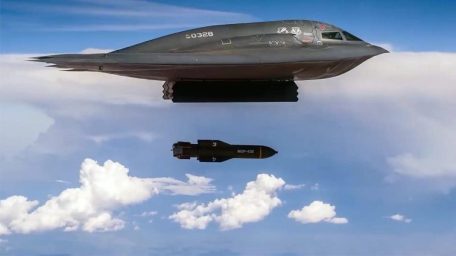
The GBU-57 is a big fat gravity bomb with fins. To achieve effective precision, a B-2 bomber must drop it on its intended target from no further than about five nautical miles — essentially right on top of the target.
Its penetration depth is claimed to be 200 feet. But that capability has NEVER been tested against a seriously hardened deep-underground target encased in layers of high-performance concrete, and topped with a few dozen meters of solid rock. In that sort of real-world scenario, the GBU-57 would be lucky to drill down 50 feet, if that.
It was always ridiculous silly talk to suggest the GBU-57 was the wonder weapon it was made out to be. There is a good reason the US only produced a couple dozen of them and then stopped: they understood its acute limitations in a non-permissive combat environment.
And, notwithstanding the hyperbolic Israeli propaganda, there was never any credible evidence that Iranian medium- and long-range air defenses against fixed-wing aircraft were attrited to any significant degree. And Iranian short-range air defenses were increasingly effective against long-range Israeli drones with each passing day.
As for the B-2: it is a big fat subsonic aircraft. It flies at airliner speeds. A strike on Fordow would entail flying at least 500 miles in and out of Iran. … continue
Blog Roll
 Aletho News
- Zelensky Refused to Discuss Druzhba Pipeline Issue – Fico
- U.S. General Caine Warns: STRIKING IRAN is a HUGE RISK /Glenn Diesen & Lt Col Daniel Davis
- Israel designates five Palestinian media outlets as ‘terrorist organizations’
- Israel, not America, first: Carlson’s Huckabee interview lays bare US foreign policy priorities
- Israeli troops executed Palestinian aid workers at ‘point blank range’: Report
- Iran war What if today’s Iran is resigned to a long, hellish war with the US?
- Why Israel Is Escalating Its War Crimes Against Lebanon
- Iran in the face of the armed diplomacy of imperialism
- The US build-up around Iran constitutes strategic war option, not ‘deterrence’
- Iran to US: Sanctions and war failed; try diplomacy and respect
- If Americans Knew
- Footage Shows Israeli Troops Waiting in Ambush, Then Opening Fire on a Palestinian Teen
- The US is on the brink of a major new war that Trump has not even bothered explaining
- Latest Epstein document dump is one more cover-up
- No Protection, No Justice: US Citizens Killed with Impunity by Israel
- Maria Farmer: Epstein Victim Reveals Explosive Information Covered Up by Media
- Average of five Palestinians killed by Israel every day in Gaza since ceasefire – Not a ceasefire Day 136
- Palestinian church leaders admonish Christian Zionist Mike Huckabee – Not a ceasefire Day 135
- Ominous messaging from Trump’s “Board of Peace” – Not a ceasefire Day 134
- ‘Christians Out’: Jerusalem Church Tagged With Hate Graffiti, Police Investigating
- Israeli Settlers Kill American Teen
- No Tricks Zone
- Surprising Discovery: Sahara Is Greening…Billions Of Trees Where Once Thought To Be Barren
- New Research Reaffirms Clouds, Aerosols, And Surface Solar Radiation Are ‘Driving The Climate System’
- Germany: Electric Car Catches Fire At Charging Station, Sets Off Local “Inferno”, Widespread Damage
- New Study: Canada’s New Brunswick Was 1°C Warmer Than Today During The Medieval Warm Period
- Coal Power Back In Trend As Globe Tries To Keep Pace With Growing Demand For Power
- New Study: A 4°C Warmer Beaufort Sea Had ‘No Sea Ice’ 11,700 – 8200 Years Ago
- Unfudging The Data: Dutch Meteorological Institute Reinstates Early 20th Centruy Heat Waves It Had Erased Earlier
- German Gas Crisis…Chancellor Merz Allegedly Bans Gas Debate Ahead of Elections!
- Pollen Reconstructions Show The Last Glacial’s Warming Events Were Global, 10x Greater Than Modern
- Germany’s Natural Gas Storage Level Dwindles To Just 28%… Increasingly Critical
 Aletho News