Who Was Alan Gross Working For?
By CARMELO RUIZ-MARRERO | CounterPunch | December 22, 2014
Alan P. Gross, an American arrested in Cuba in 2009 for smuggling broadband satellite communications equipment, made world headlines on December 2014 when he was released the same day that US president Obama ordered the release of three Cubans who were in American prisons serving sentences for espionage. Press reports mentioned that Gross was in the Caribbean island in his capacity as a subcontractor for USAID, a US government agency that administers aid programs abroad. Throughout its history this agency has been accused of being an arm of US foreign policy and at worst a mere front for intelligence operations rather than the neutral and apolitical provider of aid to poor countries that it pretends to be. In 2014 USAID was caught red-handed in bizarre schemes to destabilize Cuba through Twitter and by funding hip hop artists.
A lesser known fact is that Gross was in Cuba working for a USAID contractor called Development Alternatives Inc. (DAI), a company that supervises and executes economic development projects all over the world. In 2010 it was USAID’s fifth biggest contractor, raking in almost $382.5 million in contracts just in that year.
DAI has also worked for the US State Department, the Pentagon, the World Bank, the United Nations, the European Commission, and private sector giants like Monsanto, Wal-Mart, Hewlett Packard, Sun Microsystems, Exxon Mobil, Daimler Chrysler, Unilever and The Gap.
“We tackle fundamental social and economic development problems caused by inefficient markets, ineffective governance, and instability”, says DAI about its work. “Since 1970, we have worked in more than 150 countries—delivering results across the spectrum of international development contexts, from stable societies and high-growth economies to challenging environments racked by political or military conflict.”
The company’s services include: corporate social responsibility, public-private partnerships, business strategy, exploration and analysis of market opportunities, integration of small businesses and small farmers into global value chains, food security and agribusiness promotion, financial services, drafting laws to make competitive economies, innovation and entrepreneurship, gender issues, climate change adaptation, carbon markets, water resources management, market environmentalism, legislative reform, citizen participation, public safety, health care, information and communications technology, and more. In short, if you want to set up a country from scratch, just call DAI.
According to Sourcewatch, a sort of Wikipedia of the left:
“DAI acted as a conduit for USAID (through the Office of Transition Initiatives) and National Endowment for Democracy (NED) funds to the Venezuelan opposition to president Hugo Chavez. Furthermore, it was instrumental along with NED affiliated organizations for financing black propaganda on Venezuelan private network TV during the general strike in 2002. Documents obtained through a Freedom of Information Act request show that DAI was required to keep certain personnel in Venezuela and had to consult with USAID about staff changes. Philip Agee, a former CIA officer, suggests that this is merely a cover for what passed for CIA operations in the past.”
The company’s own web site informs that it has played an important role in the United States’ geopolitical and military strategy in the Middle East:
“Following the 9/11 attacks of 2001 and the subsequent U.S. military actions, DAI was called on to lead a variety of challenging development projects in the midst of the counterinsurgency in Afghanistan, a country where we worked as early as 1977. Similarly, after the United States toppled the Iraqi regime in 2003, DAI won a project to help provide legitimate governance in the country. Other assignments in Iraq covered agriculture.”
It is most interesting that DAI would be in Afghanistan in 1977, way before the Soviet invasion, just when the CIA was arming and training an Islamic fundamentalist insurgent force to destabilize the country.
According to a 2011 article in The Guardian by Jonathan Steele:
“Western backing for these (Afghan) rebels had begun before Soviet troops arrived. It served western propaganda to say the Russians had no justification for entering Afghanistan in what the west called an aggressive land grab. In fact, US officials saw an advantage in the mujahedin rebellion which grew after a pro-Moscow government toppled (Prime Minister) Daoud in April 1978. In his memoirs, Robert Gates, then a CIA official and later defence secretary under Presidents Bush and Obama, recounts a staff meeting in March 1979 where CIA officials asked whether they should keep the mujahedin going, thereby “sucking the Soviets into a Vietnamese quagmire”. The meeting agreed to fund them to buy weapons.”
Needless to say, this type of work can be pretty hazardous. In December 2009 five DAI employees were killed by an explosion in the USAID headquarters in Gardez, Afghanistan. From that facility DAI was running a Local Governance and Community Development project. According to DAI:
“Our mission on behalf of (USAID) was crucial: encourage communities in the most volatile parts of the country to turn away from the insurgency and toward the Government of the Islamic Republic of Afghanistan. We set out to do this in large part by facilitating 2,635 community projects that addressed local grievances, fostered stability, facilitated dialogue, and engendered trust in district and provincial leaders.”
The most notorious death of a DAI employee in a war zone was that of Linda Norgrove, who was abducted by the Taliban in eastern Afghanistan on September 2010. The US sent a Navy elite force to rescue her but the Rambo-style operation did not go well. Norgrove was killed, not by her captors but by a grenade thrown by one of her would-be rescuers, according to an official joint US-UK investigation of her death.
According to DAI CEO Jim Boomgard, Gross was in Cuba running a US government program called “Cuba Democracy and Contingency Planning Program”. In an August 2008 meeting, officials from this program told DAI representatives that “USAID is not telling Cubans how or why they need a democratic transition, but rather, the Agency wants to provide the technology and means for communicating the spark which could benefit the population.” The program, the officials said, intended to “provide a base from which Cubans can ‘develop alternative visions of the future.’”
In 2012 Gross and his wife sued USAID and DAI for allegedly not informing him adequately of the risk that his mission entailed – the case was settled out of court in 2013. If what Gross claimed in his lawsuit is true, then the man was an unwitting dupe in a US intelligence operation. It remains to be seen how many American aid workers who sincerely believed they were engaging in harmless, uncontroversial activity helping people abroad were actually being used by the CIA or other agencies as pawns in high risk games of political chess.
Carmello Ruiz-Marrero is a Puerto Rican journalist. Web site: http://carmeloruiz.blogspot.com/ Twitter: @carmeloruiz
US Pays PR Firm to Create Anti-Cuban Multimedia Content
teleSUR | November 27, 2014
The U.S. government has signed a US$1.4-million-contract with a public relations company to produce “TV and radio programs designed specifically for audiences in Cuba,” according to the Office of Cuba Broadcasting’s press release that Tracey Eaton cited in her blog Along the Malecon.
The Los Angeles-based company, Canyon Communications, is a public relations firm that specializes in writing “corporate histories.” Founded by Jeff Kline, the company was offered the no-bid contract because of what government officials said was its “unique profile.”
The Office of Cuba Broadcasting (OCB), funded by the U.S. government through the presidentially appointed Broadcasting Board of Governors, runs Radio and Television Marti and has its headquarters in Miami, Florida.
In 2006, The New York Times revealed that OCB paid 10 journalists to work for Radio and TV Marti. The Miami Herald fired three of the journalists from El Nuevo Herald after learning they were receiving money from the Bush Administration.
The OCB’s interventions in Cuba have found their echo in more recent attempts by the U.S to use modern media to destabilize Cuba’s socialist system.
A scandal broke out in April when the U.S. was found to be engaged in “battle” with Cuba on the social media front. This latest onslaught was carried out under the guise of ZunZuneo, a social media platform targeted to Cuban users.
Funded by the U.S. Agency for International Development (USAID), ZunZuneo was intended to spark dissent against the Cuban government. In USAID’s own words, the project was designed to “renegotiate the balance of power between the state and society.”
ZunZuneo, set up with the help of high-tech contracting firms from Nicaragua and Costa Rica, eventually reached over 40,000 Cubans. The contractors, together with USAID, set up an equally elaborate scheme of front companies using Cayman Islands bank accounts to hide the venture from the Cuban government. New executive recruits were also not told about ZunZuneo’s ties to the U.S. government.
Top Venezuelan Legislator Calls for Investigation of NGOs funded by USAID

Diosdado Cabello speaks at a press conference in this archive photo. (Photo: AVN )
teleSUR | October 17, 2014
The president of the Venezuelan National Assembly Diosdado Cabello called Friday on intelligence agencies to investigate Non-Governmental Organizations (NGOs) in the country that are funded by the United States Agency for International Development (USAID).
Cabello’s call comes on the heels of the arrival of a representative of the U.S. government in Venezuela to meet with representatives of NGOs at the U.S. Embassy in Caracas.
According to their website, USAID’s mission is “furthering America’s interests, while improving lives in the developing world.”
In practice, much of the work of USAID has been to support the activities of groups that are opposed to democratically elected governments. Cabello pointed to an NGO that has links to “Operation Liberty”, the group lead by Lorent Saleh, who is currently in custody on accusations of intent to commit terrorist acts in Venezuela.
Cabello has previously warned of the attempts by the U.S. and its allies to interfere in the internal affairs of Venezuela, saying, “This is one way for imperialism to finance conspiracy [against the government].”
Bolivia expelled USAID and its representatives from that country in 2013 due to their support of opposition groups opposed to the government of Evo Morales.
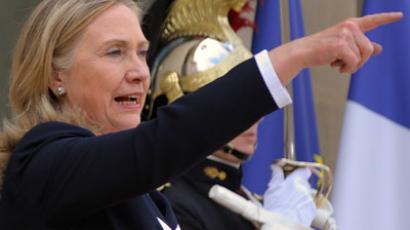
Hillary Clinton and the Weaponization of the State Department
By JP Sottile | News Vandal | June 5, 2014
On May 23, 2012, then-Secretary of State Hillary Clinton went to the Special Operations Forces Industry Conference (SOFIC) trade show in Tampa, Florida to share her vision of “smart power” and to explain the State Department’s crucial role in extending the reach and efficacy of America’s growing “international counterterrorism network.”
First, there is such a thing as a “Special Operations Forces Industry Conference trade show.” Without some keen reporting by David Axe of Wired, that peculiar get-together might’ve flown completely under the radar—much like the shadowy “industry” it both supports and feeds off of like a sleek, camouflaged lamprey attached to a taxpayer-fattened shark.
Second, “special operations” have officially metastasized into a full-fledged industry. United States Special Operations Command (USSOCOM) is located at MacDill Air Force Base in Tampa and, therefore, conveniently located near the special operations trade show, which happened again this year at the Tampa Convention Center. The theme was “Strengthening the Global SOF Network” and the 600,000-square-foot facility was filled with targets of opportunity for well-connected and well-heeled defense contractors.
According to the SOFIC website, this year’s conference afforded attendees “the opportunity to engage with USSOCOM Program Executive Officers, Science and Technology Managers, Office of Small Business Programs and Technology & Industry Liaison Office representatives, and other acquisition experts who will identify top priorities, business opportunities, and interests as they relate to USSOCOM acquisition programs.”
Third, Hillary’s widely-ignored speech marked a radical departure from the widely-held perception that the State Department’s diplomatic mission endures as an institutional alternative to the Pentagon’s military planning. Instead, Secretary Clinton celebrated the transformation of Foggy Bottom into a full partner with the Pentagon’s ever-widening efforts around the globe, touting both the role of diplomats in paving the way for shadowy special ops in so-called “hot spots” and the State Department’s “hand-in-glove” coordination with Special Forces in places like Pakistan and Yemen.
Finally, with little fanfare or coverage, America’s lead diplomat stood before the shadow war industry and itemized the integration of the State Department’s planning and personnel with the Pentagon’s global counter-terrorism campaign which, she told the special operations industry, happen “in one form or another in more than 100 countries around the world.”
If this isn’t entirely unexpected, consider the fact that under then-Secretaries of State Colin Powell and Condoleezza Rice, the State Department fought attempts by the Pentagon to trump its authority around the globe and, as reported by the Washington Post, “repeatedly blocked Pentagon efforts to send Special Operations forces into countries surreptitiously and without ambassadors’ formal approval.”
But that was before Hillary brought her “fast and flexible” doctrine of “smart power” to Foggy Bottom and, according to her remarks, before she applied lessons learned from her time on the Senate Armed Services Committee to launch the first-ever Quadrennial Diplomacy and Development Review, which she modeled on the Pentagon’s Quadrennial Defense Review. That Pentagon-style review spurred the creation of the Bureau of Conflict and Stabilization Operations to “advance the U.S. government’s foreign policy goals in conflict areas.”
According to a Congressional Research Service analysis, the initial intent of the Conflict Bureau was to replace the ineffectual Office of the Coordinator of Reconstruction and Stabilization, which was created in 2004 to help manage “stabilization” efforts in two nations the U.S. was actively destabilizing—Afghanistan and Iraq.
But the new, improved bureau does more than just react to messes made by unlawful invasions or direct costly remediation efforts in war zones—it also collaborates with “relevant partners” in the Department of Defense and NATO “to harmonize civilian and military plans and operations pertaining to conflict prevention, crisis response, and stabilization.”
This integrated relationship between State and Defense was confirmed by U.S. Special Operations chief Admiral William McRaven shortly after Hillary’s speech. When asked about the “unlikely partnership,” McRaven assured DefenseNews that SOCOM has “an absolutely magnificent relationship with the State Department” and that SOCOM doesn’t “do anything that isn’t absolutely fully coordinated and approved by the U.S. ambassador and the geographic combatant commander.”
As David Axe aptly described it in Wired, “Together, Special Operations Forces and State’s new Conflict Bureau are the twin arms of an expanding institution for waging small, low-intensity shadow wars all over the world.”
In fact, during Hillary’s time as America’s chief diplomat, the State Department embraced the shadowy edge of U.S. foreign policy where decision-makers engage in activities that look like war, sound like war and, if you were to ask civilians in places like Yemen and Pakistan, feel a lot like war, but never quite have to meet the Constitutional requirement of being officially declared as war.
The Whole-of-Government Shift
Once upon a time, “low-intensity shadow wars” were the Congressionally-regulated bailiwick of the Central Intelligence Agency. But 9/11 changed everything. However, the excesses of the Bush Administration led many to hope that Obama could and would change everything back or, at least, relax America’s tense embrace of “the dark side.”
Although the new administration did officially re-brand “The War on Terror” as “Overseas Contingency Operations,” Team Obama employed an increasingly elastic interpretation of the 9/11-inspired Authorization for Use of Military Force and expanded covert ops, special ops, drone strikes and regime change to peoples and places well-beyond the law’s original intent, and certainly beyond the limited scope of CIA covert action.
Obama’s growing counter-terrorism campaign—involving, as Secretary Clinton said, “more than 100 countries”—took flight with a new, ecumenical approach called the “Whole-of-Government” strategy. Advanced by then-Secretary of Defense Bill Gates and quickly adopted by the new administration in early 2009, this strategy catalyzed an institutional shift toward inter-agency cooperation, particularly in the case of “state-building” (a.k.a. “nation building”).
During remarks to the Brookings Institution in 2010, Secretary Clinton explained the shift: “One of our goals coming into the administration was… to begin to make the case that defense, diplomacy and development were not separate entities, either in substance or process, but that indeed they had to be viewed as part of an integrated whole and that the whole of government then had to be enlisted in their pursuit.”
Essentially, the Whole-of-Government approach is a re-branded and expanded version of Pentagon’s doctrine of “Full-Spectrum Dominance.” Coincidentally, that strategy was featured in the Clinton Administration’s final Annual Report to the President and Congress in 2001. It defined “Full-Spectrum Dominance” as “an ability to conduct prompt, sustained, and synchronized operations with forces tailored to specific situations and possessing freedom to operate in all domains—space, sea, land, air, and information.”
In 2001, Full-Spectrum Dominance referred specifically to 20th Century notions of battlefield-style conflicts. But the “dark side” of the War on Terror stretched the idea of the battlefield well-beyond symmetrical military engagements. “Irregular warfare” became the catchphrase du jour, particularly as grinding campaigns in Afghanistan and Iraq exposed the reality that the full spectrum still wasn’t enough.
An assessment by the Congressional Research Service identified the primary impetus for the Whole-of-Government “reforms” embraced by Team Obama as the “perceived deficiencies of previous inter-agency missions” during the military campaigns in Afghanistan and Iraq. Those missions failed to address a myriad of problems created—culturally, economically and politically—by the wholesale bombing and occupation of those countries. The Full-Spectrum was half-baked. Lesson learned.
But the lesson wasn’t that the U.S. should avoid intervention, regime change or unleashing nascent civil, ethnic or religious conflicts. Instead, the lesson was that the “Whole-of-Government” must be marshaled to fight a worldwide array of Overseas Contingency Operations in “more than 100 countries.”
This Whole-of-Government shift signaled a renewed willingness to engage on variety of new fronts—particularly in Africa—but in a “fast and flexible” way. With other agencies—like the State Department—integrated and, in effect, fronting the counter-terrorism campaign, the military footprint becomes smaller and, therefore, easier to manage locally, domestically and internationally.
In some ways, the Whole-of-Government national security strategy is plausible deniability writ-large through the cover of interagency integration. By merging harder-to-justify military and covert actions into a larger, civilian-themed command structure, the impact of the national security policy overseas is hidden—or at least obfuscated—by the diplomatic “stabilization” efforts run through the State Department—whether it’s the Conflict Bureau working against Joseph Kony’s Lord’s Resistance Army in Central Africa, “stabilizing” post-Gaddafi Libya or spending $27 million to organize the opposition to Bashar al-Assad’s Syrian regime.
The Pass Key
The cover of diplomacy has traditionally been an effective way to slip covert operators into countries and the State Department’s vast network of embassies and consulates still offers an unparalleled “pass-key” into sovereign nations, emerging hot spots and potential targets for regime change. In 2001, the Annual Report to the President and Congress foresaw the need for more access: “Given the global nature of our interests and obligations, the United States must maintain the ability to rapidly project power worldwide in order to achieve full-spectrum dominance.”
Having the way “pre-paved” is, based on Hillary’s doctrinal shift at State, a key part of the new, fuller-spectrum, Whole-of-Government, mission-integrated version of diplomacy. At the SOFIC’s Special Operations Gala Dinner in 2012, Hillary celebrated the integration of diplomatic personnel and Special Operations military units at the State Department’s recently created Center for Strategic Counterterrorism Communications—a “nerve center in Washington” that coordinates “military and civilian teams around the world” and serves “as a force multiplier for our embassies’ communications efforts.”
As with most doors in Washington, that relationship swings both ways and mission-integrated embassies have served as an effective force multiplier for the Pentagon’s full spectrum of activities, particularly around Africa.
In his 2011 testimony before the House Foreign Affairs Committee Subcommittee on Africa, Deputy Assistant Secretary of State for African Affairs Don Yamamoto noted that State had “significantly expanded the number of DoD personnel who are integrated into embassies across the continent over the past three years,” and read a surprisingly long laundry list of collaborative efforts between State and the United States Africa Command (AFRICOM), including: “reduction of excess and poorly secured man-portable air defense systems (MANPADS); Defense Sector Reform in Liberia, DRC, and South Sudan; counterpiracy activities off the Somali coast; maritime safety and security capacity building; and civil-military cooperation.”
It seems that “civil-military cooperation” is a primary focus of the State Department in Africa. Most notably, Yamamoto told Congress that “embassies implement Department of State-funded Foreign Military Financing (FMF) and International Military Education and Training (IMET) programs, which further U.S. interests in Africa by helping to professionalize African militaries, while also assisting our African partners to be more equipped and trained to work toward common security goals.”
As the ever-vigilant Nick Turse recently reported, U.S. presence on the continent has only grown since that testimony was given in 2011. On TomDispatch.com, Turse identified the infamous attack on Benghazi on September 11, 2012 as the catalyst for “Operation New Normal”—the continent-wide response to, quite ironically, the political potboiler still simmering around Secretary Clinton. Whether or not Congressional Republicans find anything more than incompetence at the root of Benghazi, the U.S. military certainly finds itself in a “new normal” of increased activity in response to the forces—and the weaponry—unleashed by U.S.-led regime change in Libya. According to Turse, the U.S. is “now conducting operations alongside almost every African military in almost every African country and averaging more than a mission a day.”
Those missions are, of course, integrated with and augmented by the State Department’s Conflict Bureau which has used a variety of state-building programs and its diplomatic “pass key” in places like Libya, Nigeria, Kenya, South Sudan, Somalia, Democratic Republic of the Congo and six other African nations, all to develop a growing roster of “host country partners.”
Establishing “host country partners” is the nexus where the State Department, its Conflict Bureau and the AFRICOM meet—implementing the Whole-of-Government strategy in emerging or current conflict zones to fuse a mounting counter-terrorism campaign with stabilization, modernization and state-building initiatives, particularly in oil and resource-rich areas like the Niger River Delta, Central Africa and around AFRICOM’s military foothold on the Horn of Africa.
As Richard J. Wilhelm, a Senior Vice President with defense and intelligence contracting giant Booz Allen Hamilton, pointed out in a video talk about “mission integration,” AFRICOM’s coordination with the Departments of State and Commerce, USAID is the “most striking example of the Whole-of-Government approach.”
And this is exactly the type of “hand-in-glove” relationship Secretary Clinton fostered throughout her tenure at State, leveraging the resources of the department in a growing list of conflict areas where insurgents, terrorists, al-Qaeda affiliates, suspected militants or uncooperative regimes threaten to run afoul of so-called “U.S. interests”.
Ultimately, it became a hand-in-pocket relationship when Clinton and Defense Secretary Gates developed the Global Security Contingency Fund (GSCF) to “incentivize joint planning and to pool the resources of the Departments of State and Defense, along with the expertise of other departments, to provide security sector assistance for partner countries so they can address emergent challenges and opportunities important to U.S. national security.”
Although he’s been criticized as feckless and deemed less hawkish than Secretary Clinton, President Obama’s newly-proposed Counterterrorism Partnership Fund (CTPF) is the logical extension of the Clinton-Gates Global Security Contingency Fund and epitomizes the Whole-of-Government shift.
The $5 billion Obama wants will dwarf the $250 million pooled into the GSCF and will, the President said at West Point, “give us flexibility to fulfill different missions including training security forces in Yemen who have gone on the offensive against al Qaeda; supporting a multinational force to keep the peace in Somalia; working with European allies to train a functioning security force and border patrol in Libya; and facilitating French operations in Mali.”
That “flexibility” is exactly what Hillary Clinton instituted at State and touted at the SOFIC conference in 2012. It also portends a long-term shift to less invasive forms of regime change like those in Yemen, Libya, Syria and Ukraine, and an increased mission flexibility that will make the Authorization for the Use of Military Force functionally irrelevant.
Normalizing the War on Terror
The ultimate outcome of this shift is, to borrow from Nick Turse, yet another “new normal”—the new normalization of the War on Terror. What the adoption of the Whole-of-Government/mission integration approach has done is to normalize the implementation of the re-branded War on Terror (a.k.a. Overseas Contingency Operations) across key agencies of the government and masked it, for lack of the better term, under the rubric of stabilization, development and democracy building.
It is, in effect, the return of a key Cold War policy of “regime support” for clients and “regime change” for non-client states, particularly in strategically-located areas and resource-rich regions. Regimes—whether or not they actually “reflect American values”—can count on U.S. financial, military and mission-integrated diplomatic support so long as they can claim to be endangered… not by communists, but by terrorists.
And because terrorism is a tactic—not a political system or a regime—the shadowy, State Department-assisted Special Ops industry that fights them will, unlike the sullen enthusiasts of the Cold War, never be bereft of an enemy.
The Dirty Hand of the National Endowment for Democracy (NED) in Venezuela
By Eva Golinger | Postcards from the Revolution | April 23, 2014
Anti-government protests in Venezuela that seek regime change have been led by several individuals and organizations with close ties to the US government. Leopoldo Lopez and Maria Corina Machado- two of the public leaders behind the violent protests that started in February – have long histories as collaborators, grantees and agents of Washington. The National Endowment for Democracy “NED” and the US Agency for International Development (USAID) have channeled multi-million dollar funding to Lopez’s political parties Primero Justicia and Voluntad Popular, and Machado’s NGO Sumate and her electoral campaigns.
These Washington agencies have also filtered more than $14 million to opposition groups in Venezuela between 2013 and 2014, including funding for their political campaigns in 2013 and for the current anti-government protests in 2014. This continues the pattern of financing from the US government to anti-Chavez groups in Venezuela since 2001, when millions of dollars were given to organizations from so-called “civil society” to execute a coup d’etat against President Chavez in April 2002. After their failure days later, USAID opened an Office of Transition Initiatives (OTI) in Caracas to, together with the NED, inject more than $100 million in efforts to undermine the Chavez government and reinforce the opposition during the following 8 years.
At the beginning of 2011, after being publically exposed for its grave violations of Venezuelan law and sovereignty, the OTI closed its doors in Venezuela and USAID operations were transferred to its offices in the US. The flow of money to anti-government groups didn’t stop, despite the enactment by Venezuela’s National Assembly of the Law of Political Sovereignty and National Self-Determination at the end of 2010, which outright prohibits foreign funding of political groups in the country. US agencies and the Venezuelan groups that receive their money continue to violate the law with impunity. In the Obama Administration’s Foreign Operations Budgets, between $5-6 million have been included to fund opposition groups in Venezuela through USAID since 2012.
The NED, a “foundation” created by Congress in 1983 to essentially do the CIA’s work overtly, has been one of the principal financiers of destabilization in Venezuela throughout the Chavez administration and now against President Maduro. According to NED’s 2013 annual report, the agency channeled more than $2.3 million to Venezuelan opposition groups and projects. Within that figure, $1,787,300 went directly to anti-government groups within Venezuela, while another $590,000 was distributed to regional organizations that work with and fund the Venezuelan opposition. More than $300,000 was directed towards efforts to develop a new generation of youth leaders to oppose Maduro’s government politically.
One of the groups funded by NED to specifically work with youth is FORMA (http://www.forma.org.ve), an organization led by Cesar Briceño and tied to Venezuelan banker Oscar Garcia Mendoza. Garcia Mendoza runs the Banco Venezolano de Credito, a Venezuelan bank that has served as the filter for the flow of dollars from NED and USAID to opposition groups in Venezuela, including Sumate, CEDICE, Sin Mordaza, Observatorio Venezolano de Prisiones and FORMA, amongst others.
Another significant part of NED funds in Venezuela from 2013-2014 was given to groups and initiatives that work in media and run the campaign to discredit the government of President Maduro. Some of the more active media organizations outwardly opposed to Maduro and receiving NED funds include Espacio Publico, Instituto Prensa y Sociedad (IPYS), Sin Mordaza and GALI. Throughout the past year, an unprecedented media war has been waged against the Venezuelan government and President Maduro directly, which has intensified during the past few months of protests.
In direct violation of Venezuelan law, NED also funded the opposition coalition, the Democratic Unity Table (MUD), via the US International Republican Institute (IRI), with $100,000 to “share lessons learned with [anti-government groups] in Nicaragua, Argentina and Bolivia… and allow for the adaption of the Venezuelan experience in these countries”. Regarding this initiative, the NED 2013 annual report specifically states its aim: “To develop the ability of political and civil society actors from Nicaragua, Argentina and Bolivia to work on national, issue-based agendas for their respective countries using lessons learned and best practices from successful Venezuelan counterparts. The Institute will facilitate an exchange of experiences between the Venezuelan Democratic Unity Roundtable and counterparts in Bolivia, Nicaragua and Argentina. IRI will bring these actors together through a series of tailored activities that will allow for the adaptation of the Venezuelan experience in these countries.”
IRI has helped to build right-wing opposition parties Primero Justicia and Voluntad Popular, and has worked with the anti-government coalition in Venezuela since before the 2002 coup d’etat against Chavez. In fact, IRI’s president at that time, George Folsom, outwardly applauded the coup and celebrated IRI’s role in a press release claiming, “The Institute has served as a bridge between the nation’s political parties and all civil society groups to help Venezuelans forge a new democratic future…”
Detailed in a report published by the Spanish institute FRIDE in 2010, international agencies that fund the Venezuelan opposition violate currency control laws in order to get their dollars to the recipients. Also confirmed in the FRIDE report was the fact that the majority of international agencies, with the exception of the European Commission, are bringing in foreign money and changing it on the black market, in clear violation of Venezuelan law. In some cases, as the FRIDE analysis reports, the agencies open bank accounts abroad for the Venezuelan groups or they bring them the money in hard cash. The US Embassy in Caracas could also use the diplomatic pouch to bring large quantities of unaccounted dollars and euros into the country that are later handed over illegally to anti-government groups in Venezuela.
What is clear is that the US government continues to feed efforts to destabilize Venezuela in clear violation of law. Stronger legal measures and enforcement may be necessary to ensure the sovereignty and defense of Venezuela’s democracy.
‘Bomb Syria… For Ukraine’s Sake!’
By Daniel McAdams | Ron Paul Institute | April 23, 2014
Anna-Marie Slaughter demonstrates that you need not scratch a “humanitarian interventionist” much to uncover the warmongering neoconservative just below the surface.
In an essay today, titled, “Stopping Russia Starts in Syria,” she argues that “the solution to the crisis in Ukraine lies in part in Syria.” President Obama must “demonstrate that he can order the offensive use of force in circumstances other than secret drone attacks or covert operations,” she writes.
Translation: to get Putin back for his supposed actions in Ukraine, Slaughter calls for President Obama to bomb Syria.
Slaughter recognizes the view of “Assad as the lesser evil compared to the Al Qaeda-affiliated members of the opposition” and admits that “the Syrian government does appear to be slowly giving up its chemical weapons, as it agreed last September to do.”
Nevertheless, she writes, “it is time to change Putin’s calculations, and Syria is the place to do it.”
“It is impossible to strike Syria legally so long as Russia sits on the United Nations Security Council,” she writes, so her solution is simply to do it illegally. She suggests that the US should begin bombing Syria to enforce UN Security Council Resolution 2139, even though that is not a “Chapter VII” resolution authorizing force.
It is ironic and highlights the cruel depravity of Slaughter that she suggests the bombing of Syria to enforce UNSC 2139, which was drawn up to facilitate the delivery of humanitarian relief to the war-ravaged Syrian people.
Using a humanitarian relief UN resolution as a cover for the most anti-humanitarian of all acts — dropping bombs — reveals the true colors of the “humanitarian interventionist” and “responsibility to protect” crowd.
Anne-Marie Slaughter embodies the disturbing trend of US government operatives (she was Director of Policy Planning for the U.S. State Department from January 2009 until February 2011) who move into the “non-governmental” sector while directing public-private “non-profit” resources toward the promotion of US government foreign policy.
In her current position as president of the New America Foundation, she is in active partnership with the US government to develop new tools to help promote regime-change overseas. According to the New York Times, the New America Foundation has been awarded a three year contract by the US Agency for International Development (USAID) to develop a kind of underground Internet system for Cuba.
Readers recall that USAID was recently embroiled in controversy when it covertly developed a “Cuban Twitter” platform whose purpose was to foment regime change in the Caribbean island nation.
Does anyone doubt that Slaughter’s New America Foundation is developing USAID’s “Cuban Internet” program for any reason other than to use it to further US regime change policy?
Anne-Marie Slaughter ends her preposterous “bomb Syria” essay with a phrase that could have been — and perhaps was — uttered by the likes of Sens. John McCain and Lindsay Graham:
Obama took office with the aim of ending wars, not starting them. But if the US meets bullets with words, tyrants will draw their own conclusions.
Bombs for peace. That is the neocon/humanitarian-interventionist war cry.
USAID Subversion in Latin America Not Limited to Cuba
By Dan Beeton | CEPR Americas Blog | April 4, 2014
A new investigation by the Associated Press into a U.S. Agency for International Development (USAID) project to create a Twitter-style social media network in Cuba has received a lot of attention this week, with the news trending on the actual Twitter for much of the day yesterday when the story broke, and eliciting comment from various members of Congress and other policy makers. The “ZunZuneo” project, which AP reports was “aimed at undermining Cuba’s communist government,” was overseen by USAID’s Office of Transition Initiatives (OTI). AP describes OTI as “a division that was created after the fall of the Soviet Union to promote U.S. interests in quickly changing political environments — without the usual red tape.” Its efforts to undermine the Cuban government are not unusual, however, considering the organization’s track record in other countries in the region.
As CEPR Co-Director Mark Weisbrot described in an interview with radio station KPFA’s “Letters and Politics” yesterday, USAID and OTI in particular have engaged in various efforts to undermine the democratically-elected governments of Venezuela, Bolivia, and Haiti, among others, and such “open societies” could be more likely to be impacted by such activities than Cuba. Declassified U.S. government documents show that USAID’s OTI in Venezuela played a central role in funding and working with groups and individuals following the short-lived 2002 coup d’etat against Hugo Chávez. A key contractor for USAID/OTI in that effort has been Development Alternatives, Inc. (DAI).
More recent State Department cables made public by Wikileaks reveal that USAID/OTI subversion in Venezuela extended into the Obama administration era (until 2010, when funded for OTI in Venezuela appears to have ended), and DAI continued to play an important role. A State Department cable from November 2006 explains the U.S. embassy’s strategy in Venezuela and how USAID/OTI “activities support [the] strategy”:
(S) In August of 2004, Ambassador outlined the country team’s 5 point strategy to guide embassy activities in Venezuela for the period 2004) 2006 (specifically, from the referendum to the 2006 presidential elections). The strategy’s focus is: 1) Strengthening Democratic Institutions, 2) Penetrating Chavez’ Political Base, 3) Dividing Chavismo, 4) Protecting Vital US business, and 5) Isolating Chavez internationally.
Among the ways in which USAID/OTI have supported the strategy is through the funding and training of protest groups. This August 2009 cable cites the head of USAID/OTI contractor DAI’s Venezuela office Eduardo Fernandez as saying, during 2009 protests, that all the protest organizers are DAI grantees:
¶5. (S) Fernandez told DCM Caulfield that he believed the [the Scientific, Penal and Criminal Investigations Corps’] dual objective is to obtain information regarding DAI’s grantees and to cut off their funding. Fernandez said that “the streets are hot,” referring to growing protests against Chavez’s efforts to consolidate power, and “all these people (organizing the protests) are our grantees.” Fernandez has been leading non-partisan training and grant programs since 2004 for DAI in Venezuela.”
The November 2006 cable describes an example of USAID/OTI partners in Venezuela “shut[ting] down [a] city”:
11. (S) CECAVID: This project supported an NGO working with women in the informal sectors of Barquisimeto, the 5th largest city in Venezuela. The training helped them negotiate with city government to provide better working conditions. After initially agreeing to the women’s conditions, the city government reneged and the women shut down the city for 2 days forcing the mayor to return to the bargaining table. This project is now being replicated in another area of Venezuela.
The implications for the current situation in Venezuela are obvious, unless we are to assume that such activities have ended despite the tens of millions of dollars in USAID funds designated for Venezuela, some of it going through organizations such as Freedom House, and the International Republican Institute, some of which also funded groups involved in the 2002 coup (which prominent IRI staff publicly applauded at the time).
The same November 2006 cable notes that one OTI program goal is to bolster international support for the opposition:
…DAI has brought dozens of international leaders to Venezuela, university professors, NGO members, and political leaders to participate in workshops and seminars, who then return to their countries with a better understanding of the Venezuelan reality and as stronger advocates for the Venezuelan opposition.
Many of the thousands of cables originating from the U.S. embassy in Caracas that have been made available by Wikileaks describe regular communication and coordination with prominent opposition leaders and groups. One particular favorite has been the NGO Súmate and its leader Maria Corina Machado, who has made headlines over the past two months for her role in the protest movement. The cables show that Machado historically has taken more extreme positions than some other opposition leaders, and the embassy has at least privately questioned Súmate’s strategy of discrediting Venezuela’s electoral system which in turn has contributed to opposition defeats at the polls (most notably in 2005 when an opposition boycott led to complete Chavista domination of the National Assembly). The current protests are no different; Machado and Leopoldo López launched “La Salida” campaign at the end of January with its stated goal of forcing president Nicolás Maduro from office, and vowing to “create chaos in the streets.”
USAID support for destabilization is no secret to the targeted governments. In September 2008, in the midst of a violent, racist and pro-secessionist campaign against the democratically-elected government of Evo Morales in Bolivia, Morales expelled the U.S. Ambassador, and Venezuela followed suit “in solidarity.” Bolivia would later end all USAID involvement in Bolivia after the agency refused to disclose whom it was funding in the country (Freedom of Information Act requests had been independently filed but were not answered). The U.S. embassy in Bolivia had previously been caught asking Peace Corps volunteers and Fulbright scholars in the country to engage in espionage.
Commenting on the failed USAID/OTI ZunZuneo program in Cuba, House Oversight and Government Reform Chairman Jason Chaffetz (R-UT) commented that, “That is not what USAID should be doing[.] USAID is flying the American flag and should be recognized around the globe as an honest broker of doing good. If they start participating in covert, subversive activities, the credibility of the United States is diminished.”
But USAID’s track record of engaging in subversive activities is a long one, and U.S. credibility as an “honest broker” was lost many years ago.
Related article

USAID Caught Using Tweets to Try and Overthrow a Government
The Hummingbird Tweet: An Espionage Tale

By Alfredo Lopez | This Can’t Be Happening | April 3, 2014
For two years, starting in 2010, the United States Agency for International Development ran a social networking service — similar to Twitter — for the Cuban people. Its long-term objective was to foment popular revolt against the government and destabilize the country.
They called it “ZunZuneo” (Cuban slang for a hummingbird’s “tweet”) and launched it under absolute secrecy about who was really running it. “There will be absolutely no mention of United States government involvement,” according to a 2010 memo from one of the companies supposedly running the service. “This is absolutely crucial for the long-term success of the service and to ensure the success of the mission.”
The “mission” was to reach a critical mass of Cuban users by offering tweets on sports, entertainment and light news over the service and signing recipients up through word of mouth — you call a phone number and your phone is hooked up. With that critical mass in place, the tweets would start getting more political: inspiring Cuban citizens to organize “smart mobs” — mass gatherings called at a moment’s notice to spark a kind of a “Cuban Spring” or, as one USAID document put it, “renegotiate the balance of power between the state and society.”
At one point there were 40,000 Cubans getting ZunZuneo tweets but the project was abandoned in 2012 when the initial funding ran out and the people who own the real Twitter refused to take it on.
The story, an investigative report by the Associated Press, is probably not surprising to most people in this country. After the NSA revelations, what could possibly surprise us? And besides, it would not be the first time that USAID was found doing the nefarious work of the CIA at undermining governments. But it is an embarrassing revelation about how our government is using the Internet and about how “hot” the Cold War remains.
There are also some serious legal issues.
One of the main organizers of the project — Joe McSpedon of the USAID — met with officials from a variety of fronting “sponsor companies” to launch the project in 2009-2010.
From the start, the program’s objective was clear: to de-stablize the government of Cuba, and destabilizing governments is something the United States is proficient at. There are few areas of the world whose history doesn’t include an attempt, often successful, by United States to overthrow a government. In fact, in Venezuela, Ukraine and various parts of Africa, South America and the “Middle East”, such efforts are currently ongoing. In most of these cases, the propaganda-preparing and deceit-dispensing USAID plays a central role.
But some U.S. Congressional officials seemed to think this went further. Vermont Democrat Senator Patrick Leahy, who chairs the Appropriations Committee’s State Department and Foreign Operations Subcommittee, called the program “dumb, dumb, dumb” today on MSNBC. He denied knowing anything of the program but said that, if he had, “I would have said, ‘What in heaven’s name are you thinking?’”
White House Press Secretary Jay Carney insisted that the government was only thinking of improving Cuban’s lives and had done everything “by the law”.
But that’s questionable. The program’s initial recruitment drive was based on a list of a half million Cuban cellphone users apparently stolen from Cuba’s most prominent cellphone company. An employee of that company apparently gave up the information to USAID. Those are stolen phone numbers and also involved an invasion of privacy, which is illegal under any law.
The USAID staffers also set up a series of “front” companies in Spain, Mexico and possibly other countries, to act as the new service’s sponsors. The service, with those companies displaying phony ads and messages on its website, then texted the half million stolen numbers with an offer to join up. That goes way beyond “false advertising” and is absolutely illegal in most countries, including the United States.
Finally, there is the intent of the program (the real reason that USAID wanted to hide its role). You can insult other leaders and even threaten them under international law, but you can not, ever, intervene to overthrow another country’s government. That the United States does this all the time only means that it’s breaking the law all the time.
The exposure of the Zunzuneo story is likely to lead to a new look at the role of USAID in other parts of the world where there are seemingly “popular” risings against elected governments, such as Ukraine and Venezuela.
The truth is that this Zunzuneo program actually addressed a real need, or at least took advantage of one. Cuban communications officials have been reluctant to open Internet access to the country. Then there are the problems of a still developing infrastructure (electricity and phone wires are still in scarce supply). Plus there is the lack of home computers, which only exacerbates the problem. With cell phones now available to many Cubans, the thirst for an information source over the Internet is increasingly being felt.
Which is one good reason many other Latin American leaders, some of them friends of Cuba, are advising the Cuban government to make connectivity a priority in their country. Without an on-line connection to the rest of the world, exploitative criminals like those at the USAID can make their moves.
Related articles
- ‘Cease illegal activity against Cuba’: Havana slams Washington for ‘Twitter’ program (rt.com)
- US Secretly Created ‘Cuban Twitter’ To Stir Unrest (mintpressnews.com)
US ‘Democracy Promotion’ Destroys Democracy Overseas
By Ron Paul| March 23, 2014
It was almost ten years ago when, before the House International Relations Committee, I objected to the US Government funding NGOs to meddle in the internal affairs of Ukraine. At the time the “Orange Revolution” had forced a regime change in Ukraine with the help of millions of dollars from Washington.
At that time I told the Committee:
We do not know exactly how many millions—or tens of millions—of dollars the United States government spent on the presidential election in Ukraine. We do know that much of that money was targeted to assist one particular candidate, and that through a series of cut-out non-governmental organizations (NGOs)—both American and Ukrainian—millions of dollars ended up in support of the presidential candidate…
I was worried about millions of dollars that the US government-funded National Endowment for Democracy (NED) and its various related organizations spent to meddle in Ukraine’s internal affairs. But it turns out that was only the tip of the iceberg.
Last December, US Assistant Secretary of State Victoria Nuland gave a speech in which she admitted that since 1991 the US government has:
[I]nvested more than 5 billion dollars to help Ukraine…in the development of democratic institutions and skills in promoting civil society and a good form of government.
This is the same State Department official who was caught on tape just recently planning in detail the overthrow of the Ukrainian government.
That five billion dollars appears to have bought a revolution in Ukraine. But what do the US taxpayers get, who were forced to pay for this interventionism? Nothing good. Ukraine is a bankrupt country that will need tens of billions of dollars to survive the year. Already the US-selected prime minister has made a trip to Washington to ask for more money.
And what will the Ukrainians get? Their democracy has been undermined by the US-backed coup in Kiev. In democracies, power is transferred peacefully through elections, not seized by rebels in the streets. At least it used to be.
The IMF will descend on Ukraine to implement yet another of its failed rescue plans, which enrich the well-connected and international bankers at the expense of the local population. The IMF adds debt, organizes sweetheart deals for foreign corporations, and demands that the local population accept “austerity” in exchange for “reform” that never seems to produce the promised results.
The groundwork for this disaster has been laid by NED, USAID, and the army of NGOs they have funded over the years in Ukraine.
Supporters of NED and its related organizations will argue that nothing is wrong with sending US dollars to “promote democracy” overseas. The fact is, however, that NED, USAID, and the others have nothing to do with promoting democracy and everything to do with destroying democracy.
It is not democracy to send in billions of dollars to push regime change overseas. It isn’t democracy to send in the NGOs to re-write laws and the constitution in places like Ukraine. It is none of our business.
How should we promote democracy overseas? First, we should stop the real isolationists — those who seek to impose sanctions and blockades and restrictions that impede our engagement overseas. We can promote democracy with a US private sector that engages overseas. A society that prospers through increased trade ties with the US will be far more likely to adopt practices and policies that continue that prosperity and encourage peace.
In 2005, arguing against funding NED in the US foreign assistance authorization bill, I said:
The National Endowment for Democracy…has very little to do with democracy. It is an organization that uses US tax money to actually subvert democracy, by showering funding on favored political parties or movements overseas. It underwrites color-coded ‘people’s revolutions’ overseas that look more like pages out of Lenin’s writings on stealing power than genuine indigenous democratic movements.
Sadly, matters are even worse now. To promote democracy overseas, NED and all other meddling US government funded NGOs should be disbanded immediately.
Related article
Violent Protests in Venezuela Fit a Pattern
By Dan Beeton | CEPR | February 19, 2014
Venezuela’s latest round of violent protests appears to fit a pattern, and represents the tug-and-pull nature of the country’s divided opposition. Several times over the past 15 years since the late, former president Hugo Chávez took office in 1999, the political opposition has launched violent protests aimed at forcing the current president out of office. Most notably, such protests were a part of the April 2002 coup that temporarily deposed Chávez, and then accompanied the 2002/2003 oil strike. In February of 2004, a particularly radical sector of the opposition unleashed the “Guarimba”: violent riots by small groups who paralyzed much of the east of Caracas for several days with the declared goal of creating a state of chaos. As CEPR Co-Director Mark Weisbrot has explained, then – as now – the strategy is clear: a sector of the opposition seeks to overturn the results of democratic elections. An important difference this time of course is that Venezuela has its first post-Chávez president, and a key part of the opposition’s strategy overall has been to depict Nicolás Maduro as a pale imitation of his predecessor and a president ill-equipped to deal with the country’s problems (many of which are exaggerated in the Venezuelan private media, which is still largely opposition-owned, as well as the international media).
Following Maduro’s electoral victory in April last year (with much of the opposition crying “fraud” despite there being no reasonable doubts about the validity of the results), the opposition looked to the December municipal elections as a referendum on Maduro’s government, vowing to defeat governing party PSUV and allied candidates. The outcome, which left the pro-Maduro parties with a 10 point margin of victory, was a stunning defeat for the opposition, and this time they did not even bother claiming the elections were rigged. According to the opposition’s own pre-election analysis, support for Maduro had apparently grown over the months preceding the election. As we have pointed out, this may be due in part to the large reduction in poverty in 2012 and other economic and social gains that preceded the more recent economic problems.
Defeated at the polls, the anti-democratic faction of the opposition prepared for a new attempt at destabilizing the elected government, and promoted relatively small, but often violent student protests in early February. They then called for a massive protest on February 12, Venezuela’s Youth Day in the center of Caracas. The demonstrations have been accompanied by a social media campaign that has spread misinformation in an attempt to depict the Maduro administration as a violent dictatorship instead of a popular elected government. Images of police violence from other countries and past protests – some several years old – have been presented on social media as having occurred in recent days in Venezuela. A YouTube video that has been watched by almost 2 million viewers presents a one-sided portrayal of the situation and falsely states that the Venezuelan government controls all radio and television in the country, among other distortions. Similar disinformation occurred in April 2002 and in other past incidents in Venezuela, most notably when manipulated video footage was used to provide political justification for the coup d’etat.
While some in Washington foreign policy circles may attempt to portray the leaders of this new wave of protests as persecuted pro-democracy heroes, they in fact have histories of supporting anti-democratic and unconstitutional efforts to oust the government. Both Leopoldo López and Maria Corina Machado supported the 2002 coup; in López’s case he participated in it by supervising the arrest of then-Minister of Justice and the Interior Ramón Rodríguez Chacín, when López was mayor of Chacao. Police dragged Rodríguez Chacín out of the building where he had sought refuge into an angry mob, who physically attacked him. Corina Machado notably was present when the coup government of Pedro Carmona was sworn in, and signed the infamous “Carmona decree” dissolving the congress, the constitution and the Supreme Court. The Christian Science Monitor reported yesterday:
the opposition has a touchy protest history in Venezuela. Early on in former President Hugo Chavez’s administration, the opposition was consistently on the streets calling for an end to his presidency. In 2002, they organized a coup that briefly unseated the president. Though the opposition leadership is not calling for a coup, the reputation the group made for itself barely a decade ago may be haunting it as it vocally pushes back against Maduro’s administration.
Venezuela’s opposition receives funding from U.S. “democracy promotion” groups including the National Endowment for Democracy (NED) and core grantees such as the International Republican Institute (IRI) and the National Democratic Institute (NDI). The NED, which the Washington Post noted was set up to conduct activities “much of” which “[t]he CIA used to fund covertly” has made a number of grants directed at empowering youth and students in Venezuela in recent years, and USAID has also given money to IRI, NDI and other groups for Venezuela programs. These organizations have a history of destabilizing elected governments and working to unify and strengthen political opposition to left-wing parties and governments. IRI notably played a key role in destabilizing Haiti ahead of the 2004 coup there, and also has engaged in activities aimed at weakening Brazil’s governing Workers’ Party, to name a few. In Venezuela, they funded groups involved in the 2002 coup, and IRI spokespersons infamously praised the coup after it happened.
The Haiti example is instructive. The parallels are numerous: notably, a key part of the strategy was to exaggerate and fabricate killings and other human rights abuses, which were blamed on the elected government (while truly horrific atrocities committed by the armed wing of the opposition were generally ignored). Researchers – including some from the U.N. — have since debunked the most widely-circulated accounts of rights violations, but of course the democratically-elected president (Jean-Bertrand Aristide) had long since been forced from office by then.
The U.S.-funded destabilization of Haiti in the early 2000s also offers lessons as to the endgame of this strategy. As the New York Times reported and as scholars such as Peter Hallward and Jeb Sprague have documented, the IRI counseled its Haitian partners not to accept any compromises from the Aristide government (which made many concessions, including agreeing to a power-sharing arrangement), but to continue to press further.
But the Maduro government is of course in a much stronger position than Haiti’s government ten years ago. A key factor is that while Aristide was relatively isolated politically, Latin American governments, through UNASUR and MERCOSUR, have condemned the violent protests and the opposition’s calls for Maduro to leave office and have expressed support for the Venezuelan government. In this case, when the Obama administration continues to signal that it sides with the violent protests, it is an outlier in the region.
Featured Video
Dr. Tony Martin – The Jewish Role in the African Slave Trade
or go to
Aletho News Archives – Video-Images
In Memoriam
James Petras, In Memoriam
 02.13.2026
Professor James Petras, 89, world-renowned sociologist, public intellectual, and scholar of Latin American politics and global economics, died peacefully on January 17, 2026, in Seattle, WA, surrounded by family.
A prolific scholar and activist, he devoted his life to challenging power, imperialism, and inequality. … continue
Blog Roll
 Aletho News
- Maria Farmer: Epstein Victim Reveals Explosive Information Covered Up by Media
- Travelers Take a Pass on Visiting America
- EU members divided on 20th Russia sanctions package – media
- Lawyers ask police to investigate Elbit Systems UK for alleged war crimes complicity
- Israel ready to strike Iran-backed armed groups – media
- Behind US war drums against Iran: No goals, no plan, no off-ramp
- With Ukraine blamed for cutting oil flows to Hungary, Croatia also refuses to transfer Russian oil in violation of EU law
- Friedrich Merz’s Push to End Online Anonymity Has a Troubling Subtext
- Macron: French citizens fighting for Israel cannot be labeled ‘genociders’
- US eyes Gaza security force drawn from armed gangs
- If Americans Knew
- ‘Christians Out’: Jerusalem Church Tagged With Hate Graffiti, Police Investigating
- Israeli Settlers Kill American Teen
- ‘We returned from hell’: Palestinian journalists recount torture in Israeli prisons
- No mercy for Gaza in Ramadan – Not a ceasefire Day 133
- The Israeli Government Installed and Maintained Security System at Epstein Apartment
- Tucker Carlson interrogated in Israel, has passport seized after interviewing US ambassador
- 6,000 Amputees in Gaza Face Impossible Recovery amid Israeli War Ultimatum
- The Lancet: Gaza death toll far higher than reported – Not a ceasefire Day 132
- Compliant aid: Who are the Israel-approved NGOs scaling up in Gaza?
- Why won’t Trump’s “Board of Peace” bring peace? – Not a ceasefire Day 131
- No Tricks Zone
- New Study: Canada’s New Brunswick Was 1°C Warmer Than Today During The Medieval Warm Period
- Coal Power Back In Trend As Globe Tries To Keep Pace With Growing Demand For Power
- New Study: A 4°C Warmer Beaufort Sea Had ‘No Sea Ice’ 11,700 – 8200 Years Ago
- Unfudging The Data: Dutch Meteorological Institute Reinstates Early 20th Centruy Heat Waves It Had Erased Earlier
- German Gas Crisis…Chancellor Merz Allegedly Bans Gas Debate Ahead of Elections!
- Pollen Reconstructions Show The Last Glacial’s Warming Events Were Global, 10x Greater Than Modern
- Germany’s Natural Gas Storage Level Dwindles To Just 28%… Increasingly Critical
- New Study Rebuts The Assumption That Anthropogenic CO2 Molecules Have ‘Special’ Properties
- Climate Scientist Who Predicted End Of “Heavy Frost And Snow” Now Refuses Media Inquiries
- Polar Bear Numbers Rising And Health Improving In Areas With The Most Rapid Sea Ice Decline
 Aletho News