A Family Business of Perpetual War
By Robert Parry | Consortium News | March 20, 2015
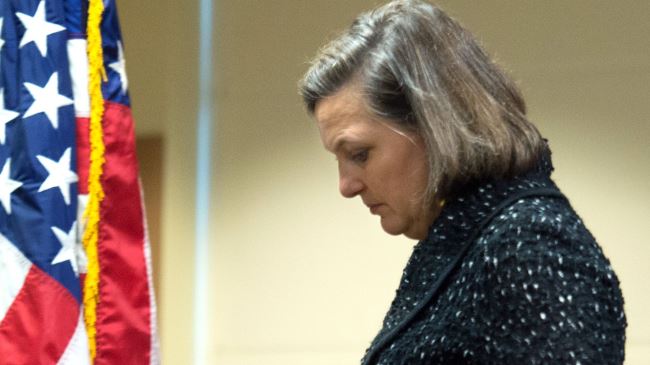
Neoconservative pundit Robert Kagan and his wife, Assistant Secretary of State Victoria Nuland, run a remarkable family business: she has sparked a hot war in Ukraine and helped launch Cold War II with Russia – and he steps in to demand that Congress jack up military spending so America can meet these new security threats.
This extraordinary husband-and-wife duo makes quite a one-two punch for the Military-Industrial Complex, an inside-outside team that creates the need for more military spending, applies political pressure to ensure higher appropriations, and watches as thankful weapons manufacturers lavish grants on like-minded hawkish Washington think tanks.
Not only does the broader community of neoconservatives stand to benefit but so do other members of the Kagan clan, including Robert’s brother Frederick at the American Enterprise Institute and his wife Kimberly, who runs her own shop called the Institute for the Study of War.
Robert Kagan, a senior fellow at the Brookings Institution (which doesn’t disclose details on its funders), used his prized perch on the Washington Post’s op-ed page on Friday to bait Republicans into abandoning the sequester caps limiting the Pentagon’s budget, which he calculated at about $523 billion (apparently not counting extra war spending). Kagan called on the GOP legislators to add at least $38 billion and preferably more like $54 billion to $117 billion:
“The fact that [advocates for more spending] face a steep uphill battle to get even that lower number passed by a Republican-controlled Congress says a lot — about Republican hypocrisy. Republicans may be full-throated in denouncing [President Barack] Obama for weakening the nation’s security, yet when it comes to paying for the foreign policy that all their tough rhetoric implies, too many of them are nowhere to be found. …
“The editorial writers and columnists who have been beating up Obama and cheering the Republicans need to tell those Republicans, and their own readers, that national security costs money and that letters and speeches are worse than meaningless without it. …
“It will annoy the part of the Republican base that wants to see the government shrink, loves the sequester and doesn’t care what it does to defense. But leadership occasionally means telling people what they don’t want to hear. Those who propose to lead the United States in the coming years, Republicans and Democrats, need to show what kind of political courage they have, right now, when the crucial budget decisions are being made.”
So, the way to show “courage” – in Kagan’s view – is to ladle ever more billions into the Military-Industrial Complex, thus putting money where the Republican mouths are regarding the need to “defend Ukraine” and resist “a bad nuclear deal with Iran.”
Yet, if it weren’t for Nuland’s efforts as Assistant Secretary of State for European Affairs, the Ukraine crisis might not exist. A neocon holdover who advised Vice President Dick Cheney, Nuland gained promotions under former Secretary of State Hillary Clinton and received backing, too, from current Secretary of State John Kerry.
Confirmed to her present job in September 2013, Nuland soon undertook an extraordinary effort to promote “regime change” in Ukraine. She personally urged on business leaders and political activists to challenge elected President Viktor Yanukovych. She reminded corporate executives that the United States had invested $5 billion in their “European aspirations,” and she literally passed out cookies to anti-government protesters in Kiev’s Maidan square.
Working with other key neocons, including National Endowment for Democracy President Carl Gershman and Sen. John McCain, Nuland made clear that the United States would back a “regime change” against Yanukovych, which grew more likely as neo-Nazi and other right-wing militias poured into Kiev from western Ukraine.
In early February 2014, Nuland discussed U.S.-desired changes with U.S. Ambassador to Ukraine Geoffrey Pyatt (himself a veteran of a “regime change” operation at the International Atomic Energy Agency, helping to install U.S. yes man Yukiya Amano as the director-general in 2009).
Nuland treated her proposed new line-up of Ukrainian officials as if she were trading baseball cards, casting aside some while valuing others. “Yats is the guy,” she said of her favorite Arseniy Yatsenyuk.
Disparaging the less aggressive European Union, she uttered “Fuck the EU” – and brainstormed how she would “glue this thing” as Pyatt pondered how to “mid-wife this thing.” Their unsecure phone call was intercepted and leaked.
Ukraine’s ‘Regime Change’
The coup against Yanukovych played out on Feb. 22, 2014, as the neo-Nazi militias and other violent extremists overran government buildings forcing the president and other officials to flee for their lives. Nuland’s State Department quickly declared the new regime “legitimate” and Yatsenyuk took over as prime minister.
Russian President Vladimir Putin, who had been presiding over the Winter Olympics at Sochi, was caught off-guard by the coup next door and held a crisis session to determine how to protect ethnic Russians and a Russian naval base in Crimea, leading to Crimea’s secession from Ukraine and annexation by Russia a year ago.
Though there was no evidence that Putin had instigated the Ukraine crisis – and indeed all the evidence indicated the opposite – the State Department peddled a propaganda theme to the credulous mainstream U.S. news media about Putin having somehow orchestrated the situation in Ukraine so he could begin invading Europe. Former Secretary of State Clinton compared Putin to Adolf Hitler.
As the new Kiev government launched a brutal “anti-terrorism operation” to subdue an uprising among the large ethnic Russian populations of eastern and southern Ukraine, Nuland and other American neocons pushed for economic sanctions against Russia and demanded arms for the coup regime. [See Consortiumnews.com’s “What Neocons Want from Ukraine Crisis.”]
Amid the barrage of “information warfare” aimed at both the U.S. and world publics, a new Cold War took shape. Prominent neocons, including Nuland’s husband Robert Kagan, a co-founder of the Project for the New American Century which masterminded the Iraq War, hammered home the domestic theme that Obama had shown himself to be “weak,” thus inviting Putin’s “aggression.”
In May 2014, Kagan published a lengthy essay in The New Republic entitled “Superpowers Don’t Get to Retire,” in which Kagan castigated Obama for failing to sustain American dominance in the world and demanding a more muscular U.S. posture toward adversaries.
According to a New York Times article about how the essay took shape and its aftermath, writer Jason Horowitz reported that Kagan and Nuland shared a common world view as well as professional ambitions, with Nuland editing Kagan’s articles, including the one tearing down her ostensible boss.
Though Nuland wouldn’t comment specifically on her husband’s attack on Obama, she indicated that she held similar views. “But suffice to say,” Nuland said, “that nothing goes out of the house that I don’t think is worthy of his talents. Let’s put it that way.”
Horowitz reported that Obama was so concerned about Kagan’s assault that the President revised his commencement speech at West Point to deflect some of the criticism and invited Kagan to lunch at the White House, where one source told me that it was like “a meeting of equals.” [See Consortiumnews.com’s “Obama’s True Foreign Policy ‘Weakness.’”]
Sinking a Peace Deal
And, whenever peace threatens to break out in Ukraine, Nuland jumps in to make sure that the interests of war are protected. Last month, German Chancellor Angela Merkel and French President Francois Hollande hammered out a plan for a cease-fire and a political settlement, known as Minsk-2, prompting Nuland to engage in more behind-the-scenes maneuvering to sabotage the deal.
In another overheard conversation — in Munich, Germany — Nuland mocked the peace agreement as “Merkel’s Moscow thing,” according to the German newspaper Bild, citing unnamed sources, likely from the German government which may have bugged the conference room in the luxurious Bayerischer Hof hotel and then leaked the details.
Picking up on Nuland’s contempt for Merkel, another U.S. official called the Minsk-2 deal the Europeans’ “Moscow bullshit.”
Nuland suggested that Merkel and Hollande cared only about the practical impact of the Ukraine war on Europe: “They’re afraid of damage to their economy, counter-sanctions from Russia.” According to the Bild story, Nuland also laid out a strategy for countering Merkel’s diplomacy by using strident language to frame the Ukraine crisis.
“We can fight against the Europeans, we can fight with rhetoric against them,” Nuland reportedly said.
NATO Commander Air Force Gen. Philip Breedlove was quoted as saying that sending more weapons to the Ukrainian government would “raise the battlefield cost for Putin.” Nuland interjected to the U.S. politicians present that “I’d strongly urge you to use the phrase ‘defensive systems’ that we would deliver to oppose Putin’s ‘offensive systems.’”
Nuland sounded determined to sink the Merkel-Hollande peace initiative even though it was arranged by two major U.S. allies and was blessed by President Obama. And, this week, the deal seems indeed to have been blown apart by Nuland’s hand-picked Prime Minister Yatsenyuk, who inserted a poison pill into the legislation to implement the Minsk-2 political settlement.
The Ukrainian parliament in Kiev added a clause that, in effect, requires the rebels to first surrender and let the Ukrainian government organize elections before a federalized structure is determined. Minsk-2 had called for dialogue with the representatives of these rebellious eastern territories en route to elections and establishment of broad autonomy for the region.
Instead, reflecting Nuland’s hard-line position, Kiev refused to talk with rebel leaders and insisted on establishing control over these territories before the process can move forward. If the legislation stands, the result will almost surely be a resumption of war between military forces backed by nuclear-armed Russia and the United States, a very dangerous development for the world. [See Consortiumnews.com’s “Ukraine’s Poison Pill for Peace Talks.”]
Not only will the Ukrainian civil war resume but so will the Cold War between Washington and Moscow with lots of money to be made by the Military-Industrial Complex. On Friday, Nuland’s husband, Robert Kagan, drove home that latter point in the neocon Washington Post.
The Payoff
But don’t think that this unlocking of the U.S. taxpayers’ wallets is just about this one couple. There will be plenty of money to be made by other neocon think-tankers all around Washington, including Frederick Kagan, who works for the right-wing American Enterprise Institute, and his wife, Kimberly, who runs her own think tank, the Institute for the Study of War [ISW].
According to ISW’s annual reports, its original supporters were mostly right-wing foundations, such as the Smith-Richardson Foundation and the Lynde and Harry Bradley Foundation, but it was later backed by a host of national security contractors, including major ones like General Dynamics, Northrop Grumman and CACI, as well as lesser-known firms such as DynCorp International, which provided training for Afghan police, and Palantir, a technology company founded with the backing of the CIA’s venture-capital arm, In-Q-Tel. Palantir supplied software to U.S. military intelligence in Afghanistan.
Since its founding in 2007, ISW has focused mostly on wars in the Middle East, especially Iraq and Afghanistan, including closely cooperating with Gen. David Petraeus when he commanded U.S. forces in those countries. However, more recently, ISW has begun reporting extensively on the civil war in Ukraine. [See Consortiumnews.com’s “Neocons Guided Petraeus on Afghan War.”]
In other words, the Family Kagan has almost a self-perpetuating, circular business model – working the inside-corridors of government power to stimulate wars while simultaneously influencing the public debate through think-tank reports and op-ed columns in favor of more military spending – and then collecting grants and other funding from thankful military contractors.
To be fair, the Nuland-Kagan mom-and-pop shop is really only a microcosm of how the Military-Industrial Complex has worked for decades: think-tank analysts generate the reasons for military spending, the government bureaucrats implement the necessary war policies, and the military contractors make lots of money before kicking back some to the think tanks — so the bloody but profitable cycle can spin again.
The only thing that makes the Nuland-Kagan operation special perhaps is that the whole process is all in the family.
~
Investigative reporter Robert Parry broke many of the Iran-Contra stories for The Associated Press and Newsweek in the 1980s. You can buy his latest book, America’s Stolen Narrative, either in print here or as an e-book (from Amazon and barnesandnoble.com).
Nuland’s Mastery of Ukraine Propaganda
By Robert Parry | Consortium News | March 11, 2015
An early skill learned by Official Washington’s neoconservatives, when they were cutting their teeth inside the U.S. government in the 1980s, was how to frame their arguments in the most propagandistic way, so anyone who dared to disagree with any aspect of the presentation seemed unpatriotic or crazy.
During my years at The Associated Press and Newsweek, I dealt with a number of now prominent neocons who were just starting out and mastering these techniques at the knee of top CIA psychological warfare specialist Walter Raymond Jr., who had been transferred to President Ronald Reagan’s National Security Council staff where Raymond oversaw inter-agency task forces that pushed Reagan’s hard-line agenda in Central America and elsewhere. [See Consortiumnews.com’s “The Victory of ‘Perception Management.’”]
One of those quick learners was Robert Kagan, who was then a protégé of Assistant Secretary of State Elliott Abrams. Kagan got his first big chance when he became director of the State Department’s public diplomacy office for Latin America, a key outlet for Raymond’s propaganda schemes.
Though always personable in his dealings with me, Kagan grew frustrated when I wouldn’t swallow the propaganda that I was being fed. At one point, Kagan warned me that I might have to be “controversialized,” i.e. targeted for public attack by Reagan’s right-wing media allies and anti-journalism attack groups, like Accuracy in Media, a process that did indeed occur.
Years later, Kagan emerged as one of America’s top neocons, a co-founder of the Project for the New American Century, which opened in 1998 to advocate for the U.S. invasion of Iraq, ultimately gaining the backing of a large swath of the U.S. national security establishment in support of that bloody endeavor.
Despite the Iraq disaster, Kagan continued to rise in influence, now a senior fellow at the Brookings Institution, a columnist at the Washington Post, and someone whose published criticism so alarmed President Barack Obama last year that he invited Kagan to a White House lunch. [See Consortiumnews.com’s “Obama’s True Foreign Policy Weakness.”]
Kagan’s Wife’s Coup
But Kagan is perhaps best known these days as the husband of neocon Assistant Secretary of State for European Affairs Victoria Nuland, one of Vice President Dick Cheney’s former advisers and a key architect of last year’s coup in Ukraine, a “regime change” that toppled an elected president and touched off a civil war, which now has become a proxy fight involving nuclear-armed United States and Russia.
In an interview last year with the New York Times, Nuland indicated that she shared her husband’s criticism of President Obama for his hesitancy to use American power more assertively. Referring to Kagan’s public attacks on Obama’s more restrained “realist” foreign policy, Nuland said, “suffice to say … that nothing goes out of the house that I don’t think is worthy of his talents. Let’s put it that way.”
But Nuland also seems to have mastered her husband’s skill with propaganda, presenting an extreme version of the situation in Ukraine, such that no one would dare quibble with the details. In prepared testimony to the House Foreign Affairs Committee last week, Nuland even slipped in an accusation blaming Russia for the July 17 shoot-down of Malaysia Airlines Flight 17 though the U.S. government has not presented any proof.
Nuland testified, “In eastern Ukraine, Russia and its separatist puppets unleashed unspeakable violence and pillage; MH-17 was shot down.”
Now, it’s true that if one parses Nuland’s testimony, she’s not exactly saying the Russians or the ethnic Russian rebels in eastern Ukraine shot down the plane. There is a semi-colon between the “unspeakable violence and pillage” and the passive verb structure “MH-17 was shot down.” But anyone seeing her testimony would have understood that the Russians and their “puppets” shot down the plane, killing all 298 people onboard.
When I submitted a formal query to the State Department asking if Nuland’s testimony meant that the U.S. government had developed new evidence that the rebels shot down the plane and that the Russians shared complicity, I received no answer.
Perhaps significantly or perhaps not, Nuland presented similarly phrased testimony to the Senate Foreign Relations Committee on Tuesday but made no reference to MH-17. So, I submitted a new inquiry asking whether the omission reflected second thoughts by Nuland about making the claim before the House. Again, I have not received a reply.
However, both of Nuland’s appearances place all the blame for the chaos in Ukraine on Russia, including the 6,000 or more deaths. Nuland offered not a single word of self-criticism about how she contributed to these violent events by encouraging last year’s coup, nor did she express the slightest concern about the actions of the coup regime in Kiev, including its dispatch of neo-Nazi militias to carry out “anti-terrorist” and “death squad” operations against ethnic Russians in eastern Ukraine. [See Consortiumnews.com’s “Nuclear War and Clashing Ukraine Narratives.”]
Russia’s Fault
Everything was Russia’s fault – or as Nuland phrased it: “This manufactured conflict — controlled by the Kremlin; fueled by Russian tanks and heavy weapons; financed at Russian taxpayers’ expense — has cost the lives of more than 6,000 Ukrainians, but also of hundreds of young Russians sent to fight and die there by the Kremlin, in a war their government denies.”
Nuland was doing her husband proud. As every good propagandist knows, you don’t present events with any gray areas; your side is always perfect and the other side is the epitome of evil. And, today, Nuland faces almost no risk that some mainstream journalist will dare contradict this black-and-white storyline; they simply parrot it.
Besides heaping all the blame on the Russians, Nuland cited – in her Senate testimony – some of the new “reforms” that the Kiev authorities have just implemented as they build a “free-market state.” She said, “They made tough choices to reduce and cap pension benefits, increase work requirements and phase in a higher retirement age; … they passed laws cutting wasteful gas subsidies.”
In other words, many of the “free-market reforms” are aimed at making the hard lives of average Ukrainians even harder – by cutting pensions, removing work protections, forcing people to work into their old age and making them pay more for heat during the winter.
Nuland also hailed some of the regime’s stated commitments to fighting corruption. But Kiev seems to have simply installed a new cast of bureaucrats looking to enrich themselves. For instance, Ukraine’s Finance Minister Natalie Jaresko is an expatriate American who – before becoming an instant Ukrainian citizen last December – ran a U.S. taxpayer-financed investment fund for Ukraine that was drained of money as she engaged in lucrative insider deals, which she has fought to keep secret. [See Consortiumnews.com’s “Ukraine’s Finance Minister’s American ‘Values.’”]
Yet, none of these concerns were mentioned in Nuland’s propagandistic testimony to the House and Senate – not that any of the committee members or the mainstream press corps seemed to care that they were being spun and even misled. The hearings were mostly opportunities for members of Congress to engage in chest-beating as they demanded that President Obama send U.S. arms to Ukraine for a hot war with Russia.
Regarding the MH-17 disaster, one reason that I was inquisitive about Nuland’s insinuation in her House testimony that the Russians and the ethnic Russian rebels were responsible was that some U.S. intelligence analysts have reached a contrary conclusion, according to a source briefed on their findings. According to that information, the analysts found no proof that the Russians had delivered a BUK anti-aircraft system to the rebels and concluded that the attack was apparently carried out by a rogue element of the Ukrainian military.
After I published that account last summer, the Obama administration went silent about the MH-17 shoot-down, letting stand some initial speculation that had blamed the Russians and the rebels. In the nearly eight months since the tragedy, the U.S. government has failed to make public any intelligence information on the crash. [See Consortiumnews.com’s “The Danger of an MH-17 ‘Cold Case.’”]
So, Nuland may have been a bit duplicitous when she phrased her testimony so that anyone hearing it would jump to the conclusion that the Russians and the rebels were to blame. It’s true she didn’t exactly say so but she surely knew what impression she was leaving.
In that, Nuland appears to have taken a page from the playbook of her husband’s old mentor, Elliott Abrams, who provided misleading testimony to Congress on the Iran-Contra Affair in the 1980s – and even though he was convicted of that offense, Abrams was pardoned by President George H.W. Bush and thus was able to return to government last decade to oversee the selling of the Iraq War.
~
Investigative reporter Robert Parry broke many of the Iran-Contra stories for The Associated Press and Newsweek in the 1980s. You can buy his latest book, America’s Stolen Narrative, either in print here or as an e-book (from Amazon and barnesandnoble.com).
War in Ukraine: Who Wants War? And Who Doesn’t?
By William Boardman | Reader Supported News | February 10, 2015
“Russian aggression” – the bad faith mantra of dishonest brokers
Just as NATO allies Germany and France were undertaking a peace initiative with Russia and Ukraine, U.S. Secretary of State John Kerry turned up in Kiev at the same time, seeking to poison the talks before they started by spouting yet again the ritual U.S. accusation of “Russian aggression.” The incantation is meaningless without context. Its purpose is mesmerize a false consciousness. “Russian aggression” may or may not exist in the events of the past year, just like “Russian self-defense.” Reporting on the ground has been too unreliable to support any firm analysis, never mind the provocative “Russian aggression” the U.S. brandishes as a virtual call for war.
Western aggression, political and diplomatic more than military, is a cold reality and has been for two decades. The West, and especially the U.S., has yet to accept responsibility for 20 years of anti-Russian aggression, much less pull back from such perennial hostility. The Obama administration (parts of it at least, given the incoherence of the “administration”) has acted as if its pulling off an only-slightly-violent coup in Kiev in 2014 was a grand triumph. Worse, having grabbed a government on Russia’s borders, the Obama hawks carry on as if the only reasonable choice for Russia is to accept the success of this Western aggression.
Rarely is this context acknowledged in discussions of the natural fissures in Ukraine that feed sectarian civil war. Rather the issues are over-simplified – falsified – by the U.S. Secretary of State, consistent with a hidden agenda of provoking a military confrontation (at the very least) with Russia and eastern Ukrainians. That’s the subtext that makes sense of Kerry’s otherwise seeming blithering in Kiev on February 5:
We talked about the largest threat that Ukraine faces today, and that is Russia’s continued aggression in the east. There’s no other way to call it. We’re not seeking a conflict with Russia. No one is. … The president is reviewing all of his options. Among those options, obviously, is the possibility of providing defensive — defensive — assistance to Ukraine. And those discussions are going on. The president will make his decision, I am confident, soon.
Note the lie: “We’re not seeking a conflict with Russia. No one is.”
When Kerry said that, he was lying, he almost surely knew he was lying, and the question is whether his lie represents only the rogue war-faction in the U.S., or is part of a dicey good-cop/bad-cop routine out of Washington. The only way it’s true that “we’re not seeking a conflict” is that the U.S. is already engaged in conflict with Russia, decades-long and currently escalating. The lie of not seeking a conflict already engaged is used to mask the lie of “defensive weapons,” a military-diplomatic oxymoron of long standing. So the most obvious answer to the question of who wants war in Ukraine is elements of the U.S. government whose immediate challenge is to persuade its Kiev client that it’s a good idea to risk turning its country into more of a battlefield than it already is.
Kiev’s desire is more obscure, and likely divided. Having taken power in something of a slow-motion coup d’etat last spring, the government faced a restive-to-defiant population in eastern Ukraine. Rather than seeking to negotiate legitimate grievances with the eastern region, the Kiev government chose instead to escalate quickly, from political hostilities into civil war. When that didn’t work out militarily, when Kiev started losing what it started, it agreed on September 5 to terms of a ceasefire that it then failed to honor with consistency (as did the separatists). Now the Ukrainian president has been to Moscow for early peace talks, but only after he staked out a preposterous public position seeking to win with a losing negotiating hand what Kiev has already lost on the ground.
Ukrainian President Petro Poroshenko met with German Chancellor Angela Merkel and French President François Hollande in Kiev on February 5 (when Kerry was in town but not part of the meeting). In his public statement, Poroshenko referred self-servingly to September’s Minsk Agreement signed by Ukraine, Russia, and the break-away Ukrainian states that call themselves the People’s Republic of Donetsk and the People’s Republic of Luhansk. The only other Minsk signatory was the Organization for Security and Co-operation in Europe (OSCE), giving the agreement the tacit endorsement of Europe without any individual European nation signing on. The United States was not directly involved in the Minsk Agreement, but a week later expressed its support for finding a peaceful solution by sending American troops to take part in NATO military exercises in Ukraine’s western provinces.
Understood in its actual context, Poroshenko’s February 5 statement is ludicrously disingenuous:
The Minsk plan is very simple: immediate ceasefire; releasing all the hostages; closing the border, or renew the internationally recognized border on Ukrainian (side); withdrawal all of the foreign troops from the Ukrainian territory; launching very important process of the political regulation by the election on the municipal election, local election, under Ukrainian legislation in the territory of Donetsk and Luhansk.
All signatories must take Minsk accord seriously to avoid war
It’s hard to find anyone who doesn’t urge compliance with the Minsk Agreement, even if that means different things to different people. Neither side in Ukraine has come close to significant compliance for any length of time. Poroshenko calls for the ceasefire, but omits the international monitoring called for in the agreement. He calls for closing the border with Russia, which is NOT part of the agreement. When he calls for the withdrawal of foreign troops, he omits mention of NATO. When he refers to elections, he omits Kiev’s failure to pass the legislation it promised, and he omits the elections that have already been held in the Republics of Donetsk and Luhansk [see “Election Note” at the end of this article]. Poroshenko also omits amnesty for separatists, improving humanitarian conditions in the region, and the recovery program, all of which are part of the Minsk Agreement.
Nevertheless, Poroshenko went to Moscow with his German and French colleagues to take part in peace talks with Russian President Vladimir Putin there on February 6, at Russia’s initiative. When similar talks had been proposed for mid-January, Chancellor Merkel had been instrumental in making sure they didn’t happen. This time her public posture going in was appropriately statesmanlike:
It is a question of peace and preserving the European peace order. It is a question of free self-determination of the people as part of this European peace order. And we are doing what we believe to be our duty at this time, namely trying to do everything in our power to end the bloodshed.
Merkel’s reference to “free self-determination” is diplomatically murky and allows for a wide range of possible solutions for the self-proclaimed Republics in eastern Ukraine, and even hints at a resolution for Crimea. Her focus on peace serves all the parties’ best interest, seeking to avoid a war that would, inevitably, cause much more suffering for Europe than the United States.
U.S. policy seems designed to turn Ukraine into the “European Iraq”
Presumably none of the parties meeting in Moscow on February 6 wants to see Ukraine become “another Iraq,” even if Ukraine is already part way there. Where Iraq had been a coherent, modern state with cultural cohesion despite its dictatorship, Ukraine has a long history of quasi-chaos, internal squabbling, and corruption. Where it took an American invasion and occupation to reduce Iraq to a near-failed state, the U.S. sees an opportunity now to manipulate proxies into destroying Ukraine (and even Russia) for the next generation or so.
Germany, France, Russia, and especially Ukraine must be acutely tuned to the potential horrors they face. After meeting for four hours, the parties were generally low key and discreet in what they said about the substance discussed. This reality produced European coverage by the BBC and others characterized by cautious hopefulness. U.S. media more typically characterized uncertainty as failure, offering the talismans of magical thinking and instant gratification in place of accuracy or analysis.
Whatever they were, the four-way talks in Moscow were not a failure. All sides called them “constructive,” which is diplo-speak for: there’s still a chance for a settlement. The parties are continuing the negotiations with apparent openness to a range of solutions. Hollande called this process “one of the last chances” to settle eastern Ukraine peacefully. Poroshenko has expressed hope for an early agreement to an “unconditional ceasefire” and one step toward reducing tensions. An unconditional ceasefire is beyond what was agreed to at Minsk in September, but creates no barrier to implementing the agreement later. Moscow’s tactful obliqueness leaving room for the parties to maneuver was in sharp contrast to the bloviating cries for war coming mostly from U.S. Senators and the vice-president at the simultaneous regional security gathering in Munich.
The lesson of Munich for 2015: “War in our time”?
Meeting for the 51st year in Munich during February 6-8, the Munich Security Conference (MSC) provided a setting for mostly U.S. hawks to try to undermine the chances for peace in Ukraine. Founded in 1963, the Munich conference identifies itself as
… a key annual gathering for the international ‘strategic community’… an independent forum dedicated to promoting peaceful conflict resolution and international cooperation and dialogue in dealing with today’s and future security challenges.
What the Munich conference seems to be is something of a foreign policy free-for-all to which almost anyone from anywhere can come and pontificate regardless of whether they hold any actual decision-making authority. The American delegation, including a dozen war-minded congress members, seems not to have gotten the memo about “promoting peaceful conflict resolution,” like the British lapdog also barking loudly for war.
Like any good multinational circus, the Munich show offered a variety of clown acts and sideshows to distract from the U.S. rush to war. The Turks decided not to take part rather than share a panel with Israelis. Non-office-holder Arnold Schwarzeneggar stumped to action on climate change. Some European Union members ganged up on Greece (again), this time for opposing some sanctions on Russia, while support for Greece (and peace) came from Cyprus, Austria, Hungary, Italy, Luxembourg, Slovakia, Slovenia, and the Czech Republic – most of which are closer to the likely war zone than those brave distant states ready to start a fight. In the Munich streets, some 2,000 peaceful protestors demonstrated against NATO, otherwise known as an American sphere of influence (if not a Trojan horse).
Joe Biden toes the official line, smoothly riffing on official lies
Other members of the American delegation included Kiev coup supporters Vice President Joe Biden, Secretary of State Kerry, and assistant secretary of state Victoria Nuland, none of whom showed any public willingness to look at the realities of the present or the past 20 years. Like a good apparatchik of the American war party, Biden’s address to the conference included a subtle version of the requisite “Russian aggression” trope, along with 45 minutes of neo-Cold-War boilerplate propaganda. In one of the more hilarious highlights of this taken-very-seriously by the media speech, Biden quoted himself from the same conference in 2009:
Six years ago at this podium, I said and I quote, ‘To paraphrase President Obama, it is time to press the reset button and reinvest in the many areas where we can and should be working together with Russia.’
That’s what everybody remembers. But they don’t often repeat what I then said.
I said, ‘We will also not recognize any nation having a sphere of influence. We will remain — it will remain our view that sovereign states have the right to make their decisions and choose their own alliances.’
I meant it when I said it then, and America means it as I repeat it now.
The “reset button” rhetoric did not include changing U.S. support for the relentless push for NATO to include countries on Russia’s border, a form of blatant – and mindless – political aggression. NATO, the European Union, Europe itself are all U.S. spheres of influence, no matter what the Biden-shills of the world may say. Even as he lied sanctimoniously about spheres of influence in 2009, his country was engaging in its half-century of punishing Cuba for not being a loyal and subservient of the American hemisphere of influence.
And when Biden claimed, “it will remain our view that sovereign states have the right to make their decisions and choose their own alliances,” an honest audience would have laughed as derisively at that as the same audience laughed at perceived absurdity from Russian Foreign Minister Sergey Lavrov during his address to the Munich conference.
Having destabilized Ukraine, the U.S. blames Russia for piling on
Remember how the present Ukraine crisis came about? In the fall of 2013, Ukraine was weighing a political, economic choice between a European proposal requiring exclusivity (and implying future NATO membership) and a somewhat more open Russian proposal (with no military alliance component). In Ukraine, as politically divided as ever, the western population yearned for Europe, the eastern population was content with Russia. When the legitimate, democratically-elected Ukraine government rejected the European offer, protesters mostly from western Ukraine launched the months-long Euro-Maidan demonstrations in Kiev (presumably with the connivance of the U.S. and others). In time, including on the scene visits from Biden (whose son reportedly has significant economic interests in Ukraine) and Nuland (with her cookies for the mob), the Maidan evolved into the coup d’etat that produced the current Ukraine government.
So when Biden says “that sovereign states have the right to make their decisions and choose their own alliances,” he lying. He’s lying about Ukraine and he’s lying about U.S. behavior in the present and the recent past (and the not so recent past as well, to be sure).
Somewhat measured language from the White House
On February 5, as the flurry of events in Kiev, Moscow, and Munich was beginning, the White House expressed some awareness that military escalation might only make matters worse in Ukraine. White House Press Secretary Josh Earnest said, in part:
… the United States has been saying for some time that it’s a diplomatic negotiation that is required to bring this conflict in Ukraine to an end, that this is not something that’s going to be solved or resolved militarily, but rather through diplomatic negotiations. So we certainly are encouraging and supportive of ongoing efforts to try to find a peaceful diplomatic resolution to the conflict in Ukraine…. [But] we need serious engagement from the Russians and the separatists, the likes of which we’ve not seen before….
… the President is going to make a decision [on weapons to Ukraine] that he believes is in the broader national security interests of the United States…. But certainly the President takes very seriously the views of our allies and is going to consult very closely as we evaluate any needed strategic changes ahead…. [But] this conflict was not going to rise to the level of a military confrontation between the United States and Russia. The President has been very clear about that. So there are things that we are going to continue to avoid.
But one of the concerns that we have about providing military assistance is it does contain the possibility of actually expanding bloodshed, and that’s actually what we’re trying to avoid. The whole reason that we are trying to encourage both sides to sit down and hammer out a diplomatic agreement is to end the bloodshed and end the escalating conflict in that country.
The press secretary made no effort to offer a balanced analysis of the Minsk Agreement, blaming the separatist Republics and Russia for virtually all the problems. He did allow that Ukraine had not lived up to all its commitments under the agreement.
Who actually speaks for the United States?
The same day the White House offered this view, NATO ministers in Brussels adopted a plan to ring Russia’s European perimeter with a network of command centers and rapid reaction forces. According to NATO Secretary General Jens Stoltenberg, this plan is NATO’s biggest reinforcement of collective defense since the end of the Cold War. He added that the first six multinational command and control units would be established immediately in Estonia, Latvia, Lithuania, Poland, Romania, and Bulgaria. Estonia and Latvia border on Russia. Poland and Romania border on Ukraine.
The Secretary of State is carrying on as if he believes that this might be his legacy moment. He’s acting as if he’s thinking: Hillary Clinton led the charge on Libya and made magnificent regional chaos there, so why shouldn’t I be able to top that, and make a mess of Ukraine, and possibly create global chaos?
But what if “Russian aggression” is real? As matters stand now, U.S. policy aggression for two decades has served as a self-fulfilling prophecy that creates “aggression” in response. What would happen if the U.S. especially, and the West in general, sent a clear signal that western aggression was over? How long would it take for Russia (or China) to trust that as reality? And would that persuade the Russians to relax what we now call their aggression? (We don’t hear much about “Chinese aggression” these days, but chances are that Kerry or Biden or someone already has that speech written.)
The course the U.S. has been on since 1990 has no good ending, unless one assumes that the Russians (or the Chinese) will fold under pressure. That seems unlikely. Nor does the result seem worth the risk. But also unlikely is a U.S. course change as long as we remain enamored of our own exceptional face in the magic mirror that keeps telling us we’re indispensable and can do no wrong. In Ukraine, today, probably the most dispensable nation is the U.S.
As this is written February 9, President Obama and Chancellor Merkel have met at the White House and offered vague public assurances that diplomatic efforts will continue to try to settle Ukraine issues peacefully. It’s not reassuring that Obama’s companions in his meeting with Merkel were committed aggressors: Biden, Kerry, and national security advisor Susan Rice. We don’t know if this President is strong enough to be in control of his administration as it speaks with conflicting voices. What we know pretty surely is that this is a moment when President Obama could actually earn his Nobel Peace Prize by calling off “American aggression.”
Or he could just follow the lead of the mindless, bi-partisan weapons-gaggle in Congress and elsewhere. The president could do the bidding of all those shrill demagogues who cry for escalating bloodshed, those grandstanding testosterone puffs who will never accept responsibility for the death and dismemberment they advocate. In that event, the President would once again ignore his own earlier wisdom when he once said: “Don’t do stupid stuff.”
Election Note [see above]: The Donetsk and Luhansk elections held November 2 were supported by Russia and rejected as illegitimate by Ukraine, as well as spokespersons for the European Union, Germany and others in the west. The election results mostly confirmed the local authority already in place, including the chief executive and parliamentary majorities in both Republics, which were popularly approved in referendums in May. An OSCE spokesperson called the November elections a violation of the spirit and letter of the Minsk Agreement, which seemed to contemplate such elections taking place on December 7, under Ukrainian law. Ukraine had excluded Donetsk and Luhansk from its presidential election in May and its parliamentary election in October. The last apparently legitimate presidential election held in Ukraine chose Viktor Yanukovych president in February 2010. Yanukovych, whose support reached 90% of the vote in some districts of Donetsk and Luhansk, was forced from office in February 2014 by the coup that emerged from the Maidan protest. Ukraine has almost 34 million voters in all, of which more than 5 million are (or were) in Luhansk and Donetsk. Another 1.8 million voters in Crimea have not taken part in the 2014 elections outside Crimea.
Nuland Lands in Kiev as US-backed Regime Tools Up for War
By Finian CUNNINGHAM | Strategic Culture Foundation | October 7, 2014
In an ominous sign that the war in Ukraine is set to further escalate, US state department official Victoria Nuland arrived in Kiev where she met with senior members of the Western-backed regime.
In recent days the ceasefire brokered on September 5 has come under intense pressure as Kiev military forces have stepped up their barrage of the eastern city of Donetsk, with several civilian casualties reported almost on a daily basis.
As civilian homes burn in Donetsk, the Kiev regime has also begun openly talking about resuming its war footing by “raising combat readiness” and mobilising new army units toward the eastern Donbass regions, where it is trying to suppress a pro-independence movement in the self-declared People’s Republics of Donetsk and Luhansk.
For the past month, the Kiev regime has been talking out of both sides of its mouth. At times it has been declaring commitment to a ceasefire brokered by Russian President Vladimir Putin and the Organisation for Security and Cooperation in Europe (OSCE). At other times, hardliners in the regime have been warning that there was no such truce in practice, and that it was on the verge of an all-out war with Russia.
All the while, the putative ceasefire has been in tatters largely because Kiev’s forces have refused to withdraw from the conflict lines and continued to shell civilians centres.
Now the Kiev President Petro Poroshenko has flipped to a strident war rhetoric. In a televised appearance this week, the former industry tycoon had swapped his tie and suit for military uniform, and was warning that forces under his command were ready to use “modern fighting techniques”.
Poroshenko said that “Ukraine has transferred its economy to a military footing and will provide everything possible for the Ukrainian army to be stronger”. This while his bankrupt country owes Russia $5.3 billion in unpaid gas bills.
Last week his hardline Prime Minister Arseniy Yatsenyuk declared that Kiev’s military had been replenished with new equipment and winter gear.
The timing of this renewed militarism across the board in Kiev’s political leadership – together with increasing violations of the ceasefire in the east – seems more than coincidental with the arrival of eminence grise Victoria Nuland.
Nuland, who is Assistant Secretary of State to John Kerry, hasn’t been in Kiev since March. For the past seven months, she has taken a noticeably low profile with regard to Ukraine. Her absence was no doubt aimed at deflecting from her earlier controversial involvement in overseeing the CIA-backed coup on February 22, when the elected government of then President Viktor Yanukovych was deposed by the fascist cabal headed up by Yatsenyuk.
Two weeks before that coup, Nuland had been caught in a private phone call with the US ambassador to Ukraine, Geoffrey Pyatt, plotting on the shape of the new regime, with Yatsenyuk nominated as the point man. Nuland was also caught disparaging the European Union with expletives, in a clear signal that Washington was taking the driving seat to install the new regime, headed up by their man “Yats”.
Yatsenyuk’s Fatherland Party and the neo-Nazi Svoboda party, with its Right Sector stormtroopers, have dominated the regime’s anti-Russia policies ever since. Following a secret visit to Kiev in April by CIA director John Brennan, the regime embarked on a massive military offensive to suppress dissident ethnic Russian populations in the east of the country who were refusing to recognise the legitimacy of the US-backed coup.
That offensive – dubbed an anti-terror operation – has been largely under-reported by Western news media, even though it has resulted in more than 3,600 deaths and up to one million refugees. Most of the casualties have been civilian, with a Russian Investigative Committee reporting last week that at least 2,500 people have been killed from indiscriminate shelling of civilian centres in Donetsk and Luhansk by Kiev forces. The latter comprise regular army units, as well as neo-Nazi paramilitaries belonging to the so-called National Guard and various private militia (death squads) run by pro-Kiev oligarch figures, such as Igor Kolomoisky.
Both Washington and Brussels have obfuscated this terror campaign by affecting to give it legality by referring to the Kiev regime as the “government of Ukraine”. Washington and Brussels have also amplified Kiev’s diversionary propaganda accusing Russia of covert aggression and destabilising the Donbass regions. Moscow has consistently denied any involvement; and Western governments, the Kiev regime and NATO have not produced a shred of verifiable proof to support their tendentious claims against Russia.
Russia’s President Putin and the OSCE chairman, Didier Burkalter, who is also the Swiss president, this week reiterated that all sides in the Ukrainian conflict must abide by the terms of the ceasefire signed in Minsk on September 5.
But it seems that Kiev is now moving to dispel any pretence of recognising that ceasefire.
Since the truce was called – and apparently signed up to by Kiev’s President Poroshenko – the pro-independence Russian-speaking militia in Donbass have claimed that Kiev’s forces were only using the lull in violence as an opportunity to regroup.
Speaking on September 8, Donetsk People’s Republic deputy premier Andrei Purgin said: “They are doing what was impossible without truce conditions. All the movements of convoys would have been impossible. During the truce, convoys of combat vehicles are reaching destinations and preparing for attacks.”
Poroshenko’s public role in all this seems to have been to give an outward impression of adhering to a cessation and paving the way for political dialogue with the dissident regions.
However, that impression has to be set against continual breaches of the ceasefire and mounting civilian casualties by his forces, relentless anti-Russian rhetoric from the hardliners like Yatsenyuk, and the supply of military aid to the Kiev regime from Washington – the last tranche worth $53 million was announced while Poroshenko was being feted in the White House three weeks ago.
This week on the day that Nuland landed in Kiev, the regime announced what many suspected all along – that it was merely using the month-old ceasefire as a tactical launchpad to redouble its military operations.
Andrey Lysenko, Kiev’s National Defence and Security Council spokesman, said on Monday: “We have managed to upgrade the equipment currently in service, to get new armaments, and to reorganise and retool the defence industries that manufacture armaments and repair hardware.” He added: “We have also managed to regroup our forces, to carry out deep reconnaissance and to gather more information about the enemy. We have completed the third wave of mobilisation. We have replaced the units that needed that, we gave them a chance to have some rest after heavy fighting and to get back to normal”.
By “normal”, Lysenko means “terrorising civilians in eastern Ukraine”.
This underscores what Poroshenko has in recent days said about “the economy moving to a war footing”.
The sinister sign is that the Kiev regime, including the “Candy King” Poroshenko, is now realigning to an all-out belligerent policy toward the people of eastern Ukraine, and by extension, toward Russia itself.
The long overdue visit to Kiev this week by Victoria Nuland – Washington’s Ukraine hawk – carries the foreboding imprimatur of US-backed war escalation.
SUSTAINED AND ABSOLUTE INCOMPETENCE
Da Russophile | May 1, 2014
Monday 21st: front page story on NYT “Photos Link Masked Men in East Ukraine to Russia”, ah hah! proof at last!; a bit of doubt surfaces on Wednesday; entire story trashed Thursday: “Aftermath of Ukraine Photo Story Shows Need for More Caution”. When I was a kid, CIA confections lasted a lot longer than a couple of days. So, into the bin along with the Jewish registration letter, captured “OSCE observers” and soon to be followed by the new intercepts. All I see from Washington is desperation piled on incompetence: none of this has turned out the way it was supposed to and no one has any idea of what to do next. So turn the volume up, desperately clutch at any story, hysterically accuse RT of propaganda when all it’s doing is accurately quoting you, announce more sanctions based on the dopey assumption that Putin has billions stashed in the West and move military forces to irrelevant places like Poland or Romania. The Micawber school of diplomacy.
- “Containment” is the new mantra for dealing with Russia in Washington these days. But has anyone there read the original? (Original telegram, subsequent article). Apart from the fact that George Kennan was strongly against NATO expansion, which is one of the two Original Sins of today’s Ukrainian catastrophe, the conditions Kennan saw in 1946 simply do not apply today. In essence Kennan was arguing that the inner constructions and logical implications of the Marxist-Leninist ideology did not correspond well with reality and therefore, over the long haul, it would not survive. Assuming that the USA would survive because it was better connected to reality, he expected the USA to outlast the USSR, given patience and prudence. This proved correct over the next half-century. Who believes this to be the case today other than the few crazies who still think Marxism-Leninism rules in Russia? And, speaking of perception of reality, one might compare any statement by Lavrov with Slaughter’s article below or any bloviation from Kerry. Or, thinking long-term as Kennan did, who can be confident that the USA will be Number One in 50 years? Or 25? Or even 10? They say China is about to become the premier economy this year. Deng’s reforms began only 35 years ago… What will the world look like in another 35?
- To give you an idea of the level of impassioned lunacy in Washington these days, read “Stopping Russia Starts in Syria”. Essentially the argument is that Obama should bomb Syria in order to show Putin he is serious about using force. Or something. “Striking Syria might not end the civil war there, but it could prevent the eruption of a new one in Ukraine”. Gibbering nonsense, eh? And incoherently erected on idiotic assumptions. But the author is not some bizarro from the outer fringes of the Net; it is Anne-Marie Slaughter, academic and quondam director of policy planning in the US State Department and now President of the New America Foundation. Mainstream madness.
KIEV’S WEAKNESS
Another US official visits, another “anti-terrorist operation”, another fizzle. This piece (rather poorly translated) gives a clue why. We have already seen in previous events that what remains of the Ukrainian Armed Forces are unwilling to get involved – even the supposedly elite airborne forces handed over their weapons rather than shoot. The so-called special forces are no better. The local police sympathise with the rebels. Now we see the ineffectiveness of the new “National Guard” made up of western Ukrainian nationalists: not even they, under-equipped, unfed and unpaid, are willing or competent. Kiev simply hasn’t got anyone to do its will no matter how much Biden and Brennan might prod it. And a couple of nights ago a riot between two different flavours of super-nationalists in Kiev itself. “Ukraine” no longer exists; Washington and Brussels have broken it in half.
NAVY
Russia has handed over to Ukraine 13 of the 70 Ukrainian Navy warships it acquired when their crews switched sides.
CONSEQUENCES
Debka (which I regard as not always wrong) claims Putin has approved the sale of the S-400 SAM system to China. Said to be pretty advanced; here’s some marketing porn for it. And other signs of closeness: big investment, naval exercise. The first fruits of the many unintended consequences of Victoria Nuland’s grand scheme.
© Patrick Armstrong Analysis, Ottawa, Canada (http://www.russiaotherpointsofview.com/ http://us-russia.org/)
Ukrainians Get IMF’s Bitter Medicine

By Robert Parry | Consortium News | April 2, 2014
It’s a safe bet that most of the Ukrainians who flooded Maidan Square in Kiev in February did not do so because they wanted the International Monetary Fund to make their lives even more miserable by slashing subsidies for heat, gutting pensions and devaluing the currency to make everyday goods more expensive.
But thanks to the U.S.-backed coup that ousted elected President Viktor Yanukovych and replaced him with a regime including far-right parties, super-rich ”oligarchs” and technocrats with little sympathy for the suffering of average people, that’s exactly what happened. Although lacking legitimacy that would come from national elections, the coup regime pushed through the demands of the Washington-based IMF.
The process began just 10 days after the violent Feb. 22 coup that forced Yanukovych to flee for his life. IMF officials landed in Kiev on March 4 to hammer out a deal that acting Prime Minister Arseniy Yatsenyuk, himself a chilly bank technocrat, has acknowledged is “very unpopular, very difficult, very tough.”
What is also striking about the IMF plan is that it puts virtually all the pain on average Ukrainians. There is nothing in the economic “reform” package that extracts some of the ill-gotten gains from Ukraine’s ten or so “oligarchs,” the multimillionaires and even billionaires who largely plundered Ukraine’s wealth after the collapse of the Soviet Union in 1991.
There is no plan for demanding that these “oligarchs” kick in some percentage of their net worth to help their own country. Instead, hard-pressed citizens of the United States and Europe are expected to carry the financial load.
The U.S. Congress voted by large bipartisan majorities to have the American taxpayers provide $1 billion in aid to Ukraine’s coup regime. Further, the IMF predicts that its $18 billion in loan guarantees could generate up to $27 billion from the international community over the next two years.
Though the IMF plan includes some promises about fighting corruption, there is no requirement that the West’s billions of dollars will go toward government programs that might actually strengthen Ukraine and help the average Ukrainian by putting the jobless to work. Nothing about upgrading the infrastructure or providing improved educational opportunities, better health care and other programs that might reduce some of Ukraine’s social pressures and make it a more viable nation.
For instance, investing in roads and rail could make Ukraine a more attractive investment opportunity for agricultural corporations eying the country’s rich soil which historically has made it the breadbasket for much of Central and Eastern Europe.
Cookie-Cutter Approach
Instead, the IMF has applied its usual cookie-cutter approach toward a troubled nation: reduce public spending, slash social programs, eliminate energy subsidies, devalue the currency, raise taxes, impose triggers for more austerity if inflation rises, etc.
Some economists project that the cumulative impact of the IMF “reforms” could result in a 3 percent contraction of Ukraine’s already depressed economy, which fell into a severe recession after the Wall Street crash of 2008 and has been inching along at almost zero growth the past two years. But Yatsenyuk warned parliament that the drop in the GDP could be more like 10 percent if corrective actions were not taken.
But those actions will inflict more hardship on the Ukrainian people — their “99 percent” — while giving Ukraine’s “1 percent” pretty much a pass. Yet, beyond fairness, there’s also the question of the legitimacy of the coup regime taking on new debt obligations without the consent of the Ukrainian people.
After the violent ouster of elected President Yanukovych on Feb. 22 — after he rejected the IMF’s terms – the post-coup parliament cobbled together a new government which involved handing out four ministries to far-right parties whose armed neo-Nazi militias had spearheaded the coup.
Yatsenyuk was the personal choice of U.S. Assistant Secretary of State for European Affairs Victoria Nuland to lead the new regime. Weeks before the coup, Nuland was caught discussing with U.S. Ambassador to Ukraine Geoffrey Pyatt who should serve in a new government. Nuland said in a phone call to Pyatt that was intercepted and posted online that “Yats is the guy” — and he was installed as prime minister once Yanukovych was gone. [See Consortiumnews.com’s “What Neocons Want from Ukraine Crisis.”]
Ukraine’s parliament has set a presidential election for May 25, and protesters in the Maidan also sought quick parliamentary elections. But Western diplomats have been urging a delay in the parliamentary balloting as well as postponement of the most onerous IMF provisions until after the May 25 vote. That way the election will have come and gone before the beleaguered Ukrainians truly understand how painful the IMF austerity will be.
As the New York Times reported, “Senior Western officials said on [March 26] that the loans from the United States and from the I.M.F. would be structured to get the government through its first few months without undue political upheaval, putting off some of the more difficult changes until after the May election. The West has also chosen not to press for early parliamentary elections, one senior official said, because ‘the priority now is stabilization in Kiev and de-escalation with Moscow.’”
Given such bleak economic prospects — and evidence of Western manipulation of the political process – is it any wonder that more than 90 percent of the voters in Crimea opted to leave Ukraine and rejoin Russia?
Investigative reporter Robert Parry broke many of the Iran-Contra stories for The Associated Press and Newsweek in the 1980s. You can buy his new book, America’s Stolen Narrative, either in print here or as an e-book (from Amazon and barnesandnoble.com).

Obama Declares Self-Determination to Be a Threat to US National Security
By Paul Craig Roberts | Dissident Voice | March 16, 2014
In his March 6 Executive Order, “Blocking Property of Certain Persons Contributing to the Situation in Ukraine,” Obama declares that support for Crimean self-determination constitutes “an unusual and extraordinary threat to the national security and foreign policy of the United States, and I hereby declare a national emergency to deal with that threat.”
Obama and the lawyers who drafted his executive order did not notice that the way the order is drafted it applies to Obama, to the unelected coup government in Kiev, and to the Washington and EU regimes. The order says that any person “responsible for or complicit in, or to have engaged in, directly or indirectly … actions or policies that undermine democratic processes or institutions in Ukraine” is subject to having his assets frozen.
Washington and the EU are the only two governments whose personnel have undermined democratic processes and institutions in Ukraine by overthrowing the elected government and imposing an unelected one.
Obama worshippers–yes there are still people that stupid–object when I call Obama the White House Fool. Yet, here is Obama or his lawyers proving that he is a fool by issuing an executive order that requires the property of Obama, Victoria Nuland, Samantha Powers, Susan Rice, the UK prime minister, the German chancellor, the French president, the EU Commission and any number of associated persons to be frozen by the US government.
Of course, Obama’s executive order will not be applied to those to whom it is applicable. It will be applied to those to whom it is not applicable–authorities who permitted the Crimean population to exercise democratic processes in order to determine their own fate.
Washington has stood democracy on its head. Overthrowing Ukraine’s democratic government and installing a puppet regime does not undermine democratic processes or institutions in Ukraine, but anything that allows self-determination to go forward in Crimea does undermine democratic processes.
Clearly, the West can no longer be associated with democracy.
Victoria Nuland’s ‘Ukraine-gate’ Deceptions
By Daniel McAdams | Ron Paul Institute | February 9, 2014
“That’s some pretty impressive tradecraft,” said Assistant Secretary of State Victoria Nuland of the interception and leak of her now-infamous call to US Ambassador to Ukraine Geoff Pyatt. The call consisted of the two plotting to install a US puppet government in Ukraine after overthrowing the current, democratically elected government.
Tradecraft means “spycraft.” In other words, Nuland was crediting a foreign intelligence service with impressive use of technology to be able to hack into her call to the ambassador. Everyone knew she was talking about Russia, partly because the Administration had been blaming Russia from the moment the recording was made public.
However, Nuland knew all along that this was not the case, and she did nothing while the Administration continued to escalate the accusations against Russia.
Jay Carney, White House Spokesman, “It says something about Russia,” that they would tap the telephone call. State Department Spokeswoman Jan Psaki was even harsher, calling it “a new low in Russian tradecraft.”
But the telephone call between the two, we learned yesterday, was not conducted on a secure, encrypted telephone line that the State Department requires for such sensitive conversations and communication. Rather, the call was made over unsecured cell phones and thus easily intercepted with basic equipment that is widely available to anyone. Therefore it was not “impressive tradecraft” at all that led to the capture and release of the conversation.
Nuland and Pyatt obviously knew that at the time, being the two parties to the call. They then either sat by and allowed US government official one after the other accuse Russia of going to great lengths to hack the call without admitting this fact, or they did inform their superiors but Administration officials decided to ignore this critical fact and push accusations against Russia anyway. You never want a serious crisis to go to waste, as it is said.
RPI contacted a former State Department official to clarify security procedures for such a telephone conversation between high-level personnel. The official was clear:
I know well the seriousness of using an open line (aside from anodyne conversation) for high-level classified information that would clearly be embarrassing, if not damaging, not only for the US but also the EU. For using an open line for discussing highly sensitive national security matters, both [Nuland and Pyatt] should be reprimanded, at the very least.
So this was a serious security violation.
The former official continued:
Assuming the telecon was made on insecure line, I find it curious, if not thought provoking, that Nuland’s profanity has managed to overshadow both the apparent security violation as well as the potential damage to national security of the substance of the conversation itself.
Indeed, the fallout from “Ukraine-gate” is astounding but sadly not surprising. The mainstream media in the US has focused solely on the Russian angle (now discredited) and on the salty language and particularly the false supposition that Nuland was using sailor’s language to indicate a serious rift with the EU on Ukraine policy. In fact, US and EU policy toward Ukraine is identical: regime change. The dispute is merely over velocity and is therefore cosmetic rather than substantive: should we travel 100 miles per hour or only 75 miles per hour toward regime change?
As far as we have seen, there has been virtually no discussion of the substance of the telephone conversation in the US media. But the conversation was a confirmation of all theretofore denied accusations of US involvement in the current unrest in Ukraine. It was not simply US well-wishing toward the opposition parties. It was not simply a bit of advice and a wink toward the opposition. It was wholesale planning and brokering a post-regime change governing coalition in Ukraine, with the UN being ordered to come in and “glue” the deal.
More precisely, as the Oriental Journal points out:
They agreed to nominate Bat’kyvshchina Party leader Arseniy Yatseniuk as Deputy Prime Minister, to bench Udar Party leader Vitaly Klitschko from the game for a while and to discredit neo-Nazi Svoboda party chief Oleh Tiahnybok as “Yanukovych’s project”
Shortly after “Ukraine-gate” broke, Sergei Glazyev, advisor to Russian president Putin claimed that the US was spending $20 million per week on the Ukrainian opposition, including supplying the opposition with training and weapons.
Nuland replied that such claims are “pure fantasy.”
Perhaps, but that is just what Nuland had said previously about claims that the US was meddling in the internal affairs of Ukraine. And then the tape came out. That was just what she said about Russia’s “impressive tradecraft” in intercepting the telephone call. Then we discover that she was discussing highly sensitive issues over completely unsecured telephones.
Is the US training and funding the Ukraine opposition? Nuland herself claimed in December that the US had spent $5 billion since the 1990s on “democratization” programs in Ukraine. On what would she like us to believe the money had been spent?
We know that the US State Department invests heavily — more than $100 million from 2008-2012 alone — on international “Internet freedom” activities. This includes heavy State Department funding, for example, for the New Americas Foundation’s…
…Commotion Project (sometimes referred to as the “Internet in a Suitcase”). This is an initiative from the New America Foundation’s Open Technology Initiative to build a mobile mesh network that can literally be carried around in a suitcase, to allow activists to continue to communicate even when a government tries to shut down the Internet, as happened in several Arab Spring countries during the recent uprisings.
“Commotion Project.” What an appropriate name for what is happening in Ukraine.
It is not a far leap from the known billions spent on “democratization” in Ukraine, to the hundreds of millions spent on developing new tools for regime-changers on the ground to use against authorities in their home countries, to the State Department from the US embassy in Kiev providing training and equipment to those seeking the overthrow of the Ukrainian government.
The apparent goal of US policy in Ukraine is to re-ignite a Cold War, installing a US-created government in Kiev which signs the EU association agreement including its NATO cooperation language to effectively push the Berlin Wall all the way to the gates of Moscow and St. Petersburg.
NATO has expanded to central Europe, despite US assurances in the 1980s that it would not do so. The US rolled over Russia in its deceptive manipulation of a UN Security Council resolution on Libya to initiate an invasion. The US continues to arm jihadists seeking to overthrow the secular Assad government in Russia-allied Syria. The US and EU have absorbed the Baltics, leaving their large ethnic Russian populations to dangle in non-person limbo. The US and EU had all but absorbed Georgia. Now the US is clearly in the process of absorbing Ukraine, with its strategic importance to Russia, its proximity, and its nearly 10 million ethnic Russian minority.
Surely there is a point to where Russia will take steps to concretely limit its losses. In December Russian president Vladimir Putin said in a meeting with his Ukrainian counterpart Viktor Yanukovich that Russia and Ukraine should resume comprehensive military cooperation. Other bilateral defense agreements are already in place.
What would have to happen to trigger a Ukrainian request to its close neighbor for assistance putting down a bloody and illegal coup d’etat instigated by foreign governments? Will serious US miscalculation of Russian resolve over Ukraine lead to a tragedy of almost inconceivable proportions? What if this time Russia does not blink?
Related article
‘F**k the EU’: Senior US State Dept. official caught in alleged phone chat on Ukraine
RT | February 7, 2014
A senior US State Department official has allegedly been caught giving an unexpected message to the EU while discussing Ukrainian opposition leaders’ roles in the country’s future government. The phone call was taped and posted on YouTube.
“F**k the EU,” Assistant Secretary of State for Europe Victoria Nuland allegedly said in a recent phone call with US ambassador to Ukraine Geoffrey Pyatt, as the two were discussing a deal to end the crisis in Ukraine.
The four-minute video – titled ‘Maidan puppets,’ referring to Independence Square in Ukraine’s capital – was uploaded by an anonymous user. The origin of the recording is not clear. The video was first reported in the Kyiv Post.
The US State Department did not deny the authenticity of the video and stressed that Nuland had apologized for the “reported comments.”
The conversation is mainly focused on Ukraine’s government and President Viktor Yanukovich’s offer last month to make opposition leader Arseniy Yatsenyuk the new prime minister and Vitaly Klitschko deputy prime minister.
“I don’t think that Klitschko should go into the government. I don’t think it is necessary. I don’t think it is a good idea,” a female voice – allegedly Nuland – said.
“In terms of him not going into the government, just let him stay out and do his political homework,” a male voice – believed to be Pyatt – replied. “In terms of the process moving ahead, we want to keep the moderate democrats together,” he said.
As Nuland sees it, Ukrainian opposition leader Arseniy Yatsenyuk should be in charge of the new government and Klitschko would not get along with him. “It’s just not going to work,” she said.
Nuland added that she has also been told that UN chief Ban Ki-moon is about to appoint the former Dutch ambassador to Kiev, Robert Serry, as his representative to Ukraine.
“That would be great I think to help glue this thing and have the UN glue it and you know, f**k the EU,” she said in apparent reference to their differences over policies.
“We’ve got to do something to make it stick together, because you can be pretty sure that if it does start to gain altitude the Russians will be working behind the scenes to try to torpedo it,” Pyatt replied.
US State Department spokeswoman Jen Psaki declined to comment on the tape’s contents, but did not deny its authenticity.
“I did not say it was not authentic,” she said, adding that Nuland had apologized to her EU counterparts for the reported comments.
Meanwhile, White House spokesman Jay Carney alleged that the fact that it had been “tweeted out by the Russian government, it says something about Russia’s role.”
In the conversation, it sounds like the two officials are playing a game of chess; strategizing on how to put together the government of another country, RT’s Marina Portnaya said while commenting on the report.
Foreign policy expert Nebojsa Malic told RT that even though Nuland apologized for the reported comments, she did not admit her fault in trying to overthrow the government in Ukraine.
“What she hasn’t apologized for is the plans to midwife a new government in Ukraine. In other words, she is apologizing for cussing up the EU, but she is not apologizing for trying to overthrow the government in Kiev, calling it popular democracy,” Malic said. “I don’t think anybody in the US establishment is sorry for what they are trying to do. I think they are very proud of it and they are going to pursue it.”
The leaked chat fuels earlier allegations that Washington is heavily meddling in the Ukrainian political crisis by manipulating the pro-EU opposition and helping it in its efforts to oust President Viktor Yanukovich.
Back in December, Victoria Nuland was spotted in the cradle of the anti-government protests – Kiev’s landmark Independence Square – distributing cookies to demonstrators. Later in the month, Senator John McCain arrived in Kiev to show his support for the opposition. Addressing protesters on Independence Square, he stated that Ukraine’s future was with Europe, adding that the country would “make Europe better.”
Russia slams US ‘interference’ for vowing to continue NGO funding
RT | March 30, 2013
Russia’s Foreign Ministry has condemned the US over its plan to continue financing certain Russian NGOs. Moscow has accused Washington of meddling in its domestic affairs.
“We consider the statement by the US State Department official representative Victoria Nuland, saying the US is going to continue financing some of Russia’s NGOs through intermediaries in third countries, avoiding the Russian legislature, a blatant interference into our internal affairs,” Russian Foreign Ministry spokesperson Aleksandr Lukashevich said in a statement on Saturday.
Mass audits of Russian NGOs started on March 21, on orders from the Justice Ministry and the Prosecutor General’s office.
The checks immediately sparked criticism in the international rights community, which labeled them an attempt to pressure activists. Russia has maintained the checks are regular inspections to see if NGO work complies with Russian law – legislation was recently amended to require that NGOs receiving foreign funding register as ‘foreign agents.’
Victoria Nuland, US State Department spokesperson, said that Washington’s NGO funding will continue unabated: “We are providing funding through platforms outside of Russia for those organizations that continue to want to work with us,” she said at a Thursday briefing.
The Russian Foreign Ministry believes the US is engaged in “direct instigating of certain non-governmental and public structures to violate legislation related to the work of non-governmental organisations in the Russian Federation,” according to Lukashevich’s statement.
Russian diplomats were also incensed by Victoria Nuland’s description of the NGO raids as a “witch hunt.” Lukashevich’s statement described his American counterpart’s choice of words as “cynical and provocative.”
Moscow has said that its NGO policy is in line with generally accepted international practices. So far, auditors have reported no infractions in the activities of non-governmental groups, apart from one incident. On Thursday, ‘For Human Rights’ leader Lev Ponomaryov refused to turn over working documents to inspectors, saying that his organization had already been subjected to a recent check.
Law enforcers said the act was a refusal to comply with lawful demands, and started an administrative case against the activist.
President Putin on Friday asked Russia’s top Human Rights Commissioner, Vladimir Lukin, to monitor the situation with the NGO raids. “I would like to rule out any excesses there,” Putin said.
Related articles
US threatens Pakistan with sanctions over gas pipeline deal with Iran
Press TV – March 12, 2013
The US State Department has threatened Islamabad with sanctions if the country goes through with a joint multi-billion-dollar gas pipeline project with Iran.
“We have serious concerns, if this project actually goes forward, that the Iran Sanctions Act would be triggered,” State Department spokeswoman Victoria Nuland said on Monday.
“We’ve been straight up with the Pakistanis about these concerns,” Nuland added.
The 1996 Iran Sanctions Act allows the US government to ban imports from any non-American company that invests more than USD 20 million a year in the Iranian oil and natural gas sector.
Nuland said the US was “supporting large-scale energy projects in Pakistan that will add some 900 megawatts to the power grid by the end of 2013.”
The threats came on the same day as the inauguration of the final construction phase of the multi-billion-dollar Iran-Pakistan (IP) gas pipeline, intended to carry natural gas from Iran to its eastern neighbor.
Iran’s President Mahmoud Ahmadinejad and his Pakistani counterpart Asif Ali Zardari attended the ceremony on the Iran-Pakistan border on Monday.
The pipeline is designed to help Pakistan overcome its growing energy needs at a time when the country of 180 million is grappling with serious energy shortages.
Meanwhile, Iranian Deputy Oil Minister Javad Owji said on Monday that Pakistan has raised its demand for natural gas imports from Iran to 30 million cubic meters (mcm) per day from a previous 21.5 mcm.
Owji added that Iran has hitherto spent USD 2 billion to build the section of the pipeline that lies on the Iranian side of the border and that the Pakistani section would need USD 3 billion.
On March 2, Zardari said that Islamabad would not stop the pipeline project at any cost.
The Pakistani president stressed that his government would continue to pursue the construction of the gas pipeline despite threats and pressure from the US.
Related article
- Pakistan-Iran gas pipeline launched (morningstaronline.co.uk)
Featured Video
American Military Failure in Afghanistan
or go to
Aletho News Archives – Video-Images
Frlom the Archives
The Fiction of the Jewish History in Palestine
By Hasan Afif El-Hasan | The Palestine Chronicle | April 8, 2011
Prime Minister Benjamin Netanyahu told NNC Pierce Morgan on March 18, 2011 that he might agree to a Palestinian state through negotiations. And he added, “We will make territorial concessions although it is very painful to do that in our ancestral land.” Netanyahu was not talking about Poland where his ancestors lived. He was talking about Palestine where generations of its indigenous population ancestors lived, cultivated the land and are buried.
By the end of the nineteenth century, Zionism created a new Jewish identity of blood and soil. To mobilize their followers and supporters and appeal to their emotions, the Zionists created myths. Zionism started as a tribal religion without god, but in order to fulfill its function as a unifying force, Zionism required external religious and race symbols, not inner content. Its leaders regarded metaphysical religious belief and purity of race as having value in itself. They created a divine paradisiacal state of merger with the gods. Despite his non-religious ideology, Herzl’s writings were replete with religious references. The Jews should settle in Palestine because, in his words, “the Temple will be visible from long distance, for it is only our ancient faith that has kept us together”.
The Zionists and their supporters have invested tremendous financial and scholarly resources to work within the Hebrew Bible historical narratives to affirm the links between the intrusive Zionist population and the ancient Israelite past, and by doing so assert the right of that population to the land. The political end-game shaped the investigation and the outcome. Tracing the roots of Israel’s ethnic state in biblical antiquity is effectively to silence the indigenous Palestinian claim to the past and therefore to the land. The Biblical scholarship employs a bewildering array of terms for the region: “the Holy Land”, “the Land of the Bible”, “Eretz Israel”, “the Land of Israel”, or “Judah and Samaria.” To the casual reader these names appear interchangeable, but they all imply connection to ancient Israel.
Biblical narratives or poems that cannot be supported by archeology and common sense are treated by the Zionists and their supporters as historical language. … continue
Blog Roll
 Aletho News
- Hezbollah Returns: It Didn’t Start a War, It Is Ending One
- EU states seek ‘talks’ with Iran for access to Strait of Hormuz: Report
- Trump on Hormuz: “Others must take care of it” after US falters
- Who Is closer to collapse?
- A War that Backfired: Why the US-Israeli Campaign Is Strengthening Iran
- How Zionist Control Is Hurting US Interests
- Iran warns it may target US missile launch sites in UAE cities
- American Military Failure in Afghanistan
- Friendly Skies of Georgia: Are Israeli-Linked Drones Launching False Flags from Georgian Territory?
- The Three Big Lies about Mammography Screening
- If Americans Knew
- No let-up in attacks on Gaza as Israel takes on Iran, Lebanon – Not a ceasefire Day 155
- ‘Of Course’: IDF Drops Case Against Soldiers Accused of Raping Palestinian Prisoner
- Don’t Fall for the Regime Change Talk. Israel Is ‘Mowing the Lawn’ in Iran
- Will Israel and the US wreck the Gulf States along with Iran?
- US so far burned through ‘years’ of munitions in Iran war: Report
- How the Israeli Tail Wags the American Dog
- Outdated intel likely led to deadly U.S. strike on Iranian elementary school, sources say
- Pentagon insider says high U.S official Douglas Feith reported to Netanyahu
- In fond memory of Walid Khalidi, the historian of Palestine
- 6 more Americans killed, as Israel ‘mows the lawn’ in Iran – Not a ceasefire Day 154
- No Tricks Zone
- Storing Green Energy To Last Germany 10 Days Would Require A 60-Million Tonne Battery
- New Studies: UK Sea Levels Were 4 Meters Higher Than Today During The Mid-Holocene
- Destructive Green New Deal: German Energy And Metal Group Warns Of Drastic Crisis
- New Study Documents A 20-Year Pause In Arctic Sea Ice Decline – Driven By Internal Variability
- Wake-up Call: Survey Shows Majority Of Germans Now Favor Postponing Climate Targets!
- Televised! Leading German Political Candidate Tells Schoolchildren CO2 Makes Sun Hotter!
- New Study: A Century Warming Of 1.1°C Is ‘Commonplace’ And ‘Not Unusual’ During This Interglacial
- New Study: ‘Internal Noise’ And Volcanic Forcing Can Trigger 10-15°C Warming Within Decades
- Glaciers Worldwide Are Suddendly Surging, Experts Blame Warming!
- Surprising Discovery: Sahara Is Greening…Billions Of Trees Where Once Thought To Be Barren
 Aletho News
