Putin: Russia will not expel anyone in response to US sanctions
RT | December 30, 2016
The Russian president has rejected a suggestion of the foreign ministry to expel 35 American diplomats in response to a similar move by the US. He said Obama’s act was designed to provoke a reaction, but Russia would not take the bait.
“We reserve the right to retaliate, but we will not sink to the level of this irresponsible ‘kitchen’ diplomacy. We will take further moves on restoring Russian-American relations based on the policies that the administration of President-elect Donald Trump adopts,” Russian President Vladimir Putin said in a statement published by the Kremlin website.
Putin said that, unlike the Obama administration, Russia will not target foreign diplomats and their families days before New Year’s celebrations.
“We will not forbid families and children from spending the New Year’s holidays at the places they are used to. Moreover, I invite the children of all American diplomats with accreditation in Russia to New Year’s and Christmas festivities in the Kremlin,” the Russian president said.
Putin said he regretted that US President Barack Obama is ending his term “in such a way,” but that he extended his New Year’s congratulations to the outgoing US president and his family nevertheless.
“I congratulate President-elect Donald Trump and the entire American people!” he concluded.
The Kremlin said it will send a government plane to the US to evacuate the expelled diplomats and their family members. Earlier, there were reports that the diplomats were having problems buying tickets on such short notice, with airlines already booked by New Year’s travelers.
Earlier, Russian Foreign Minister Sergey Lavrov suggested that Russia respond to the expulsion of 35 Russian diplomats from the US by expelling 35 American diplomats from Russia. Similarly, the eviction of a Russian diplomatic staff from two vacation houses in the US would be mirrored by a similar eviction of Americans in Russia.
President Obama targeted Russian diplomats as a part of wider sanctions against Russian, which he justified by the alleged interference by the Russian government in the November presidential election in the US. Moscow denies the allegations.
The US claimed that the vacation houses had been used for espionage. Russia insists that they were used by the diplomatic staff to spend holidays with their families.
Read more:
Russian FM proposes expulsion of 35 US diplomats in sanctions tit-for-tat
Russia Destroys The Greater Israel Dream
Plato’s Guns | October 19, 2015
The grand plan was going swimmingly. The concept of endless wars for Greater Israel was working and producing impressive results. Opportunistically, through aggravation of war after war, chunk by chunk of Arab land was usurped and the map of Greater Israel was slowly materializing. No matter the unstable chaos surrounding the State of Israel for the past seven decades, and no matter the undying Palestinian resistance and the violent Intifadas that erupted internally, the Zionist dream of Greater Israel remained consistently intact and was progressing unabated and unchallenged by anyone.
But dreams, by their diaphanous nature are easily interruptible – can easily turn into sudden nightmares. Indeed, dreams do, in the blink of an eye, simply end.
Nobody expected the Zionist dream to come to a sudden halt like this. Nobody. Nobody expected Russia, literally in the blink of an eye, to suddenly assert itself militarily in the Levant and in the process turn the Zionist dream into a geopolitical and existential nightmare. No further territorial expansions are even remotely possible now with Russia’s military presence in the Levant. The Russian army is in the Levant to stay and the Israelis know it. In the Zionist universe, it’s as if a mighty big-footed contender had suddenly appeared in the dream and instantly stepped on the Greater Israel map like it was a castle made of sand.
Russia is not a declared enemy of Israel. Russia did not squelch The Greater Israel dream on purpose. The destruction of the Zionist dream is the result of an unintended consequence that purely serves the regional and global interests of Russia. Happenstance that the Zionist dream was in the way of Russian ambitions, that’s all. Dog eat dog world.
But what are Russia’s interests in lassoing the Levant?
Well, first, Putin intends to re-fulfill the old Russian dream of establishing sizable military foundations and bases in the ‘warm waters’ of the world, in the Mediterranean, to be more precise, in order to pivot and project power westwards with practical ease. And also, to use Mediterranean naval bases as a first line of defense against a Western creep towards its own territory. Russia’s growing military presence in Syria is a matter of “national security”, Putin has declared several times over. Establishing multiple bases in the Mediterranean has not been possible for Russia to do since the 1967 Arab-Israeli war when it lost the Middle East chess game to America, symbolized by Egypt, a major Soviet client at the time having its Soviet military hardware devastated by Israeli-operated, made-in-USA weaponry. Russia today considers its growing presence in Syria to be a most vital geopolitical maneuver for re-establishing a seat of power again in the Middle East, in tandem with its progress into future Superpowerdom. In the current uncontrollable chaos of the Levant, this is an ambition that Russia must begin implementing immediately, lest the region falls dangerously under ISIS and Zioconism, making it thus harder for Russia’s old dream to be realized.
Secondly, Putin sees the cloth of American Empire as fast fading, especially in the Middle East, and he’s taking advantage of this: putting forth a challenging proposition to the American Emperor. Yes, Vladimir Putin, president of Russia, a man considered to be a cold-blooded realist, is aware of America’s weaknesses, but he’s also aware of its current strengths and he is in Syria as a power salesman – he’s in Syria to make a deal with Empire Americana. Respectfully, but firmly, he is pitching to Empire: ‘Look, you remain supremely powerful, but you are hemorrhaging in the Middle East and the situation is now critical. You cannot afford a new large-scale war in the Middle East that may or may not reassert your hold on the region; and you have lost all your proxy wars there as well – there are no more black-clad joker cards in your deck. You cannot continue on this disadvantageous path, you cannot stand still either and you also cannot withdraw from the region. All these are strategically inferior options and will not stop the bleeding of your powers. The only way out is through pragmatism. The only remedy is to share control of the Middle East with us, Russians. We have together shared power in the Middle East under the shadow of the Cold War and yes it created dangers and complexities for both our countries in the past. But today is different: there is no official Cold War between us and so our new partnership can only serve to strengthen us both’. This, dear reader is Russia’s diplomatic speak, received with quiet relief by the White House and cussed and scorned by the Ziocons in DC. Simplified, Putin is in Syria and his realist message to America is: ‘Share the Middle East with us now or we both fall in the future’. And it looks like Obama has quietly taken heed, in the interest of Empire and realism and not out of cowardice or submission to Putin. Obama’s problem is that although he begrudgingly agrees with Putin’s analysis and remedy, he cannot be seen to be supporting it in public because the Neocons would immediately set the dogs of treason on him, bogging him down with political obtrusion and smear campaigns in his last 15 months of power – possibly damaging his party’s winning chances at the next elections.
Thirdly, in my opinion, Russia is in Syria also for the purpose of redressing Russian military image and history. After the devastating defeat of the Soviet Union at the hands of the American-backed Afghani Mujahedeen, and considering the profound nationalism that Russian society feels especially towards its military institutions, it behooves any modern Russian leader thus to conceive and create a military victory against a modern version of the same old enemy who had previously defeated them – a military morale-booster both for the Russian populations and for the history books. A utilization of the sentiments of the ‘comeback kid’ for mass consumption so as to boost levels of nation devotion. Russia, being the largest nation in the world, landmass-wise, it has to regularly make grand spectacles and gestures in the name of national unity enhancement. Killing Takfiri terrorists in Syria, nay smashing them to smithereens with Russian Air Power is an opportune event to balance out and positively update Russian history books.
Yes, the Russian military buildup in Syria, especially in marine and air power, now looks to be, relatively speaking, permanent. And this is what is causing Israel and its Ziocon friends in Washington sleepless nights and hectic, nefarious group-brainstorming sessions. They know that the dream of a Greater Israel cannot be realized with Russia dominating the skies and waters of the Levant. This is the current and silent inescapable reality. This is the wall that suddenly sprung up and instantly separated Zionists from their beloved Greater Israel dream. Because of a ‘wall’, the dream is now impossible.
Some would call this, poetic justice.
The ‘dream destroyed’ being the current unspoken reality, Israel is left with no expedient and transforming choices. It cannot go to direct war with a more powerful Russia and win back domination over Levant skies and waters. It couldn’t even defeat Hezbollah who lack any form of Air Power back in 2006. And more frustratingly for Israel, it cannot blackmail, coerce or buy President Putin either. Moreover, presently under the leadership of Obama, it is clear that America is not prepared to go to direct war with any nation, let alone Russia, on behalf of Israel. The current architects of expansionist Zionism are at a complete and utter loss to recognize all these chokehold factors – blood is draining from their faces. No more meetings over what Arab country to genocide next so as to steal more land and resources, the issue now is not when and how the Zionist dream can be finally fulfilled, but how to safely bring the corpse-dream back from the dead without anyone noticing.
Alas, there are no clever Zionist ideas on the architects’ table. They are truly and absolutely in utter speechless shock.
And what compounds this hectic catatonia that the Zionist Sensei are currently experiencing is the fact that they know that Israel’s global credibility is at its lowest ever, and that sooner or later, the international community – seeing Israel’s geopolitical weakness – will start pressing hard, even imposing the 2-State solution on Israel, based on the 1967 borders. This is the double nail in the Greater Israel dream coffin. Not only will Israel be unable to expand territory, but it will also be forced into giving up territory currently under its (illegal) control. Something that the Israeli public are psychologically not prepared for, nor is there any political will in the Israeli halls of power to do so either.
Observations of the behaviorism of Zionists tell us that what they cannot change, they usually endeavor to spoil. And the only thing they are still capable of doing is spoiling it for Arabs. They will undoubtedly attempt to expand the current regional conflicts into another one hundred years of Arab on Arab wars. This is a given – they breathe to spoil life for their Arab neighbors. And we also observe that when Zionists are not willing or able to go to war, they usually endeavor to send other capable and willing nations to war on their behalf. But as noted a few passages above, this is currently impossible under the Obama administration. The dream of Greater Israel remains smashed.
What to do then? What is the ultimate solution? Would Israel prefer that America directly and militarily confront Russia in the Levant? I call it a yes. Even at the cost of causing World War Three? Yes. Even at the risk of igniting a nuclear war? Yes.
Yes, yes, and a triple yes. The global Zionist congress pathology shows every indication of this. ‘The tribe above all’ is their core belief. They are Masadian-ISISians in suits with basements full of nukes. Their narcissistic intentions are always clear – their motives and maneuvers are never to be trusted.
We are currently at a very serious and sobering point in the fast-evolving dramas taking place in the Levant and the Middle East at large. Everyone concerned is standing shoulder-to-shoulder with the unknown. This alignment of overwhelming unknowns is rare in history. The geopolitical stress and distress levels – despite the equalizing Russian presence in the Levant – remain excruciatingly high for all parties concerned. All actors have so much to lose with a single wrong move. A cluster of unknowns is forcing everyone into extreme caution. Hesitant steps are made then quickly unmade. If you were to privately ask Obama or Putin what would happen to the world the day after a war between their two nations ignites, they would both be likely to look you somberly in the eye and say, ‘I don’t know’.
The unknown is upon us and we are upon the unknown.
For now, Zionist masterminds plan on keeping the death of the dream of Greater Israel a secret, in the hope that the next American president would be more malleable and more reactionary than Obama. They will be quietly biding their time and hoping that the next President of America would be more Zionist that Theodore Herzl. More ideologically violent than ISIS and Tarantino. Hoping against all hope that the tiny state of Israel would survive a Word War Three catastrophe with little damage inside its boundaries. Hoping against all hope that the Arab world surrounding Israel, all of it would literally be bombed back into the stone ages, while Israel continues to be the hi-tech bride of the Middle East. Hoping against all hope that Russia would again be defeated by America in the Middle East – just so that Israel can again dominate the skies and waters of the Levant, allowing it thus to revive the corpse of the Greater Israel project. Hoping against all hope that igniting World War Three would actually solve all of Israel’s problems.
A touch fantastical? Maybe not.
This is what happens when tribal madmen dream.
Putin Trumps Obama at the U.N.
By Margaret Kimberley | Black Agenda Report | September 30, 2015
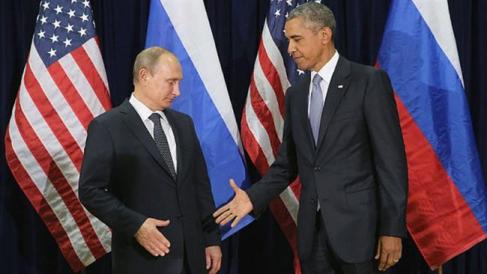
If the peevish expression on Barack Obama’s face was any indication, Vladimir Putin is a force in the world who cannot be ignored. Ever since Russia annexed Crimea in response to the United States – and NATO – backed coup in Ukraine, Obama and the corporate media have falsely declared that Putin is isolated from the rest of the world. They claim he is a monster, a despot and an irrelevance on the world stage.
While the G8 member nations turned themselves into the G7 in order to snub Russia, president Putin was making friends elsewhere. He may have been isolated from the United States and its clique, but not from China and the other BRICS nations or Syria or Iran or Iraq. While western nations use the Islamic State (ISIS) as a ruse to exact regime change in Syria, Putin has formed an alliance to carry out the task of eradicating that danger which was created by western intervention.
Presidents Obama and Putin both made their respective cases before the United Nations General Assembly at its annual meeting. Obama’s speech was an apologia for imperialism and American aggression. He repeated the lies which no one except uninformed Americans believe. If he calls a leader a tyrant he claims the right to destroy a nation and kill and displace its people. Despite the living hell that the United States made out of Libya, Obama continues to defend his crime. He blandly adds that “our coalition could have and should have done more to fill a vacuum left behind.” Apparently he hopes that no one is paying attention to the horrors inflicted on Libya or the ripple effect which created numerous other humanitarian crises.
Not content to defend the indefensible, the president made it clear that the Obama doctrine of regime change and terror is alive and well. “I lead the strongest military that the world has ever known, and I will never hesitate to protect my country or our allies, unilaterally and by force where necessary.”
In contrast, the man labeled a dictator acknowledged the importance of respecting every nation’s sovereignty. “Rather than bringing about reforms, an aggressive foreign interference has resulted in a brazen destruction of national institutions and life itself. Instead of the triumph of democracy and progress, we got violence, poverty and social disaster. Nobody cares a bit about human rights, including the right to life.” Making good use of his time in the spotlight, he made clear that he wasn’t fooled or cowed by the United States. “I cannot help asking those who have caused the situation, do you realize now what you’ve done? But I am afraid no one is going to answer that. Indeed, policies based on self-conceit and belief in one’s exceptionality and impunity have never been abandoned.”
Obviously Putin has self-interest in supporting his allies in Syria and for fighting ISIS. He acknowledged that his country is at risk from some of its own citizens who have sworn an allegiance to that group. Nonetheless, it is important that at least one nation in the world is capable of standing up to American state sponsored destruction and is willing to take action in that effort. Before the United Nations proceedings took place, Russia announced that it would share intelligence with Iran, Iraq and Syria in order to combat ISIS. If the United States were true to its word, that alliance would be welcomed instead of scorned.
Not since the late Hugo Chavez declared that George W. Bush left a “smell of sulfur” has an American president been so openly confronted at the United Nations. Putin’s presence makes it clear that Obama can no longer expect to carry out his international dirty work without effective opposition.
While the corporate media noted the tense photo opportunity between the two presidents they neglected to mention the real issues behind the bad feelings. At a press conference after his address Putin was asked about French president Hollande’s insistence that Assad leave the Syrian presidency. “I relate to my colleagues the American and French presidents with great respect but they aren’t citizens of Syria and so should not be involved in choosing the leadership of another country.”
That simple statement explains the totality of American enmity towards Russia. The NATO nations claim a right to choose leaders, create and support their own terrorist groups and destroy anyone who doesn’t do what they want. Putin is making a case for non-interference and that makes him persona non grata in the eyes of the supposedly more democratic West.
The world ought to fear pax Americana, not a Russian military presence in Syria. There cannot be true peace and stability unless nations and peoples are left to their own devices. The helping hand of United States democracy is anything but. It is a recipe for disaster and requires forceful opposition. If Russia can be a reliable counterforce the whole world will benefit, even if Barack Obama frowns before the cameras.
Margaret Kimberley can be reached via e-Mail at Margaret.Kimberley(at)BlackAgendaReport.com.
Putin interview to Charlie Rose in the run-up to his address at the UN General Assembly’s 70th session
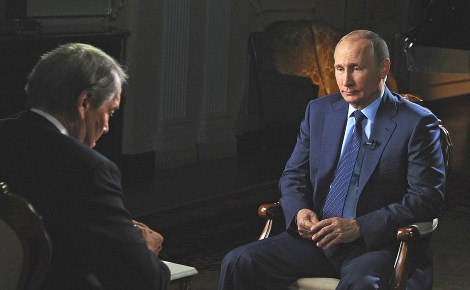
Full text of the interview will be published on September 29.
* * *
CHARLIE ROSE: You will speak to the United Nations in a much-anticipated address on Monday. It will be the first time you have been there in a number of years. What will you say to the UN, to America, to the world?
VLADIMIR PUTIN: Since this interview will be aired prior to my speech, I do not think it reasonable to go into much detail about everything I am going to speak about, but, broadly, I will certainly mention some facts from the history of the United Nations. Now I can already tell you that the decision to establish the United Nations was taken in our country at the Yalta Conference. It was in the Soviet Union that this decision was made. The Soviet Union, and Russia as the successor state to the Soviet Union, is a founding member state of the United Nations and a permanent member of its Security Council.
Of course, I will have to say a few words about the present day, about the evolving international situation, about the fact that the United Nations remains the sole universal international organisation designed to maintain global peace. And in this sense it has no alternative today. It is also apparent that it should adapt to the ever-changing world, which we discuss all the time: how it should evolve and at what rate, which components should undergo qualitative changes. Of course, I will have to or rather should use this international platform to explain Russia’s vision of today’s international relations, as well as the future of this organisation and the global community.
CHARLIE ROSE: We are expecting you to speak about the threat of the Islamic State and your presence in Syria that is related to that. What is the purpose of your presence in Syria and how does that relate to the challenge of ISIS?
VLADIMIR PUTIN: I believe, I am pretty certain that virtually everyone speaking from the United Nations platform is going to talk about the fight, about the need to fight terrorism, and I cannot avoid this issue, either. This is quite understandable because it is a serious common threat to all of us; it is a common challenge to all of us. Today, terrorism threatens a great number of states, a great number of people – hundreds of thousands, millions of people suffer from its criminal activity. And we all face the task of joining our efforts in the fight against this common evil.
Concerning our, as you put it, presence in Syria, as of today it has taken the form of weapons supplies to the Syrian government, personnel training and humanitarian aid to the Syrian people. We act based on the United Nations Charter, i.e. the fundamental principles of modern international law, according to which this or that type of aid, including military assistance, can and must be provided exclusively to legitimate government of one country or another, upon its consent or request, or upon the decision of the United Nations Security Council. In this particular case, we act based on the request from the Syrian government to provide military and technical assistance, which we deliver under entirely legal international contracts.
CHARLIE ROSE: The Secretary of State John Kerry said that the United States welcomed your assistance in the fight against the Islamic State. Others have taken note of the fact that these are combat planes and manpad systems that are being used against the conventional army, not extremists.
VLADIMIR PUTIN: There is only one regular army there. That is the army of Syrian President al-Assad. And he is confronted with what some of our international partners interpret as an opposition. In reality, al-Assad’s army is fighting against terrorist organisations. You should know better than me about the hearings that have just taken place in the United States Senate, where the military and Pentagon representatives, if I am not mistaken, reported to the senators about what the United States had done to train the combat part of the opposition forces. The initial aim was to train between 5,000 and 6,000 fighters, and then 12,000 more. It turns out that only 60 of these fighters have been properly trained, and as few as 4 or 5 people actually carry weapons, while the rest of them have deserted with the American weapons to join ISIS. That is the first point.
Secondly, in my opinion, provision of military support to illegal structures runs counter to the principles of modern international law and the United Nations Charter. We have been providing assistance to legitimate government entities only.
In this connection, we have proposed cooperation to the countries in the region, we are trying to establish some kind of coordination framework. I personally informed the President of Turkey, the King of Jordan, as well as the Saudi Arabia of that, we informed the United States too, and Mr Kerry, whom you have mentioned, had an in-depth conversation with our Foreign Minister Sergei Lavrov on this matter; besides, our military stay in touch and discuss this issue. We would welcome a common platform for collective action against the terrorists.
<…>
CHARLIE ROSE: Are you ready to join forces with the United States against ISIS and is it why you are in Syria? Others believe that it might be part of your goal, that you are trying to save President al-Assad’s administration because they have been losing ground and the war has not been going well for them, and you are there to rescue them.
VLADIMIR PUTIN: That’s right, that’s how it is. We provide assistance to legitimate Syrian authorities. Moreover, I strongly believe that by acting otherwise, acting to destroy the legitimate bodies of power we would create a situation that we are witnessing today in other countries of the region or in other regions of the world, for instance, in Libya, where all state institutions have completely disintegrated.
Unfortunately, we are witnessing a similar situation in Iraq. There is no other way to settle the Syrian conflict other than by strengthening the existing legitimate government agencies, support them in their fight against terrorism and, of course, at the same time encourage them to start a positive dialogue with the “healthy” part of the opposition and launch political transformations.
CHARLIE ROSE: As you know, some coalition partners want al-Assad to go before they can support the government.
VLADIMIR PUTIN: I would like to advise or recommend them to forward this suggestion to the Syrian people. It is only up to the Syrian people living in Syria to determine who, how and based on what principles should rule their country.
CHARLIE ROSE: Do you support what President al-Assad is doing in Syria and what is happening to those Syrians, to those millions of refugees, to hundreds of thousands of people who have been killed and many – by his own force?
VLADIMIR PUTIN: And do you think that those who support the armed opposition and, mainly, terrorist organisations just in order to overthrow al-Assad without thinking of what awaits the country after the complete destruction of state institutions are doing the right thing?
Time and again, with perseverance worthy of a better cause, you are talking about the Syrian army fighting against its people. But take a look at those who control 60 percent of Syrian territory. Where is that civilised opposition? 60 percent of Syria is controlled either by ISIS, Jabhat al-Nusra or other terrorist organisations, organisations that have been recognised as terrorist by the United States, as well as other countries and the UN.
CHARLIE ROSE: Would Russia deploy its combat troops in Syria if it is necessary to defeat ISIS?
VLADIMIR PUTIN: Russia will not take part in any field operations on the territory of Syria or in other states; at least, we do not plan it for now. But we are thinking of how to intensify our work both with President al-Assad and our partners in other countries.
CHARLIE ROSE: As we come back to the problem of many people considering that al-Assad is helping ISIS, that his terrible attitude towards the Syrian people and the use of barrel bombs and other actions are helping ISIS, and if he is removed, the transition period would be better at some point for the purposes of fighting ISIS.
VLADIMIR PUTIN: In secret services’ parlance, I can say that such an assessment is a blatant act by al-Assad’s enemies. It is anti-Syrian propaganda.
CHARLIE ROSE: This wording is very broad, among other things, it can mean new efforts by Russia to take up the leadership role in the Middle East and it can mean that it represents your new strategy. Is it really a new strategy?
VLADIMIR PUTIN: No. There are more than 2,000 militants in Syria from the former Soviet Union. So instead of waiting for them to return back home we should help President al-Assad fight them there, in Syria. This is the main incentive that impels us to help President al-Assad.
In general, we want the situation in the region to stabilize.
CHARLIE ROSE: You are proud of Russia and it means that you want Russia to play a more significant role in the world. This is just one of the examples.
VLADIMIR PUTIN: This is not an end in itself. I am proud of Russia. We have much to be proud of. But we have no obsession that Russia must be a super power in the international arena.
CHARLIE ROSE: But you are a major power because of the nuclear weapons you possess. You are a force to be reckoned with.
VLADIMIR PUTIN: I hope so (laughing), otherwise what are these weapons for?
The Ukrainian issue is a separate huge issue for us, I will tell you why. Ukraine is the closest country to us. We have always said that Ukraine is our sister country and it is true. It is not just a Slavic people, it is the closest people to Russia: we have similar languages, culture, common history, religion etc.
Here is what I believe is completely unacceptable for us. Addressing issues, including controversial ones, as well as domestic issues of the former Soviet Republics through the so-called coloured revolutions, through coups and unconstitutional means of toppling the current government. That is absolutely unacceptable. Our partners in the United States are not trying to hide the fact that they supported those opposed to President Yanukovych.
CHARLIE ROSE: You believe the United States had something to do with the ousting of Yanukovych, when he had to flee to Russia?
VLADIMIR PUTIN.: I know this for sure.
CHARLIE ROSE: How can you know for sure?
VLADIMIR PUTIN: It is very simple. We have thousands of contacts and thousands of connections with people who live in Ukraine. And we know who had meetings and worked with people who overthrew Viktor Yanukovych, as well as when and where they did it; we know the ways the assistance was provided, we know how much they paid them, we know which territories and countries hosted trainings and how it was done, we know who the instructors were. We know everything. Well, actually, our US partners are not keeping it a secret.
CHARLIE ROSE: Do you respect the sovereignty of Ukraine?
VLADIMIR PUTIN: Certainly. However, we would like other countries to respect the sovereignty of other states, including Ukraine, too. Respecting the sovereignty means preventing coups, unconstitutional actions and illegitimate overthrowing of the legitimate government.
CHARLIE ROSE: How does the renewal of the legitimate power take place in your judgment? How will that come about? And what role will Russia play?
VLADIMIR PUTIN: At no time in the past, now or in the future has or will Russia take any part in actions aimed at overthrowing the legitimate government.
CHARLIE ROSE: Did you have to use the military force to accomplish that objective?
VLADIMIR PUTIN: Of course, no.
CHARLIE ROSE: Russia has military presence on the borders with Ukraine, and some argue that there have been Russian troops in Ukraine itself.
VLADIMIR PUTIN: Do you have a military presence in Europe?
CHARLIE ROSE: Yes.
VLADIMIR PUTIN: The U.S. tactical nuclear weapons are in Europe, let us not forget this. Does it mean that the U.S. has occupied Germany or that the U.S. never stopped the occupation after World War II and only transformed the occupation troops into the NATO forces? And if we keep our troops on our territory on the border with some state, you see it is a crime?
CHARLIE ROSE: As you know, you are very much talked about in America.
VLADIMIR PUTIN: Do they not have anything else to do? ( Laughs.)
CHARLIE ROSE: Or maybe they are curious people? Or maybe you are an interesting character, maybe that is what it is? They know that you were the KGB agent, who retired and got into politics. In St. Petersburg you became deputy mayor, then moved to Moscow. And the interesting thing is that they see these images of you, bare-chested man on horseback, and they say there is a man who carefully cultivates his image of strength.
You enjoy the work, you enjoy representing Russia, and I know you have been an intelligence officer. Intelligence officer knows how to read other people; that’s part of the job, right?
VLADIMIR PUTIN: It used to be my job. Now I have a different job and for quite a while already.
CHARLIE ROSE: Someone in Russia told me, “There is no such thing as a former KGB man. Once a KGB man, always a KGB man.”
VLADIMIR PUTIN: You know every stage of your life has an impact on you. Whatever we do, all the knowledge, the experience, they stay with us, we carry them on, use them in one way or another. In this sense, yes, you are right.
CHARLIE ROSE: Once, somebody from the CIA told me that the training you have is important, that you learn to be liked as well. Because you have to charm people, you have to seduce them.
VLADIMIR PUTIN: Well, if the CIA told you so, then it must be true. They are experts on that. (Laughing)
CHARLIE ROSE: The popularity rating you have in Russia, I believe, makes every politician in the world envious. Why are you so popular?
VLADIMIR PUTIN: There is something that unites me and other citizens of Russia. It is love for our Motherland.
CHARLIE ROSE: It was an emotional moment at the time of the [World War II Memory], because of the sacrifices Russia had made. And you were staying with a picture of your father with tears in your eyes.
VLADIMIR PUTIN: Yes, my family and my relatives as a whole suffered heavy losses during the Second World War. That is true. In my father’s family there were five brothers and four of them were killed, I believe. On my mother’s side the situation is much the same. In general, Russia suffered heavily. No doubt, we cannot forget that and we must not forget, not to accuse anyone but to ensure that nothing of the kind ever happens again.
CHARLIE ROSE: You also said that the worst thing that happened in the last century was the disintegration of the Soviet Union, the Soviet empire. There are those who look at Ukraine and Georgia and think that you do not want to recreate the Soviet empire, but you do want to recreate a sphere of influence, which, you think, Russia deserves because of the relationship that has existed. Why are you smiling?
VLADIMIR PUTIN: (Laughing) Your questions make me happy. Somebody is always suspecting Russia of having some ambitions, there are always those who are trying to misinterpret us or keep something back. I did say that I see the collapse of the Soviet Union as a great tragedy of the XX century. Do you know why? First of all, because 25 million of Russian people suddenly turned out to be outside the borders of the Russian Federation. They used to live in one state; the Soviet Union has traditionally been called Russia, the Soviet Russia, and it was the great Russia. They used to live in one country and suddenly found themselves abroad. Can you imagine how many problems came out?
First, there were everyday issues, the separation of families, the economic and social problems. The list is endless. Do you think it is normal that 25 million people, Russian people, suddenly found themselves abroad? The Russians have turned out to be the largest divided nation in the world nowadays. Is that not a problem? It is not a problem for you as it is for me.
CHARLIE ROSE: As far as we know, you are very popular, but, forgive me, there are many people who are very critical towards you in Russia. As you know, they say it is more autocratic than democratic. They say that political opponents and journalists had been killed and imprisoned in Russia. They say your power is unchallenged. And they say that power, an absolute power corrupts absolutely. What would you say to those people who worry about the climate, the atmosphere in Russia?
VLADIMIR PUTIN: There can be no democracy without observing the law and everyone must observe it – that is the most basic and important thing that we all should remember.
As for those tragic incidents as losses of lives, including those of the journalists, unfortunately, it happens in all countries around the world. But if it occurs in Russia, we take every step possible to ensure that the perpetrators are found, identified and punished. We will work on all issues in the same way.
But the most important thing is that we will continue improving our political system so that people and every citizen will feel that they can influence the life of state and society, they can influence the authorities, and so that the authorities will be aware of their responsibility before those people who gave their confidence to the representatives of the authorities in the elections.
CHARLIE ROSE: If you as the leader of this country insist that the rule of law be observed, if you insist that justice be done, if you because of your power do that, then it could go a long way eliminating that perception.
VLADIMIR PUTIN: A lot can be done, but not everyone immediately succeeds in everything. How long has it taken the democratic process to develop in the United States? Since it was founded. So, do you think that as regards democracy everything is settled now in America? If this were so, there would be no Ferguson issue, right? There would be no other issues of similar kind, there would be no police abuse.
Our goal is to see all these issues and respond to them timely and properly. The same applies to Russia. We also have a lot of problems.
CHARLIE ROSE: Are you curious about America more than simply another nation that you have to deal with?
VLADIMIR PUTIN: It is interesting for us to know what is happening in the US. America has a strong influence on the situation in the world in general.
CHARLIE ROSE: What do you like most about America?
VLADIMIR PUTIN: America’s creative approach to solving the problems the country is faced with, its openness and open-mindedness which make it possible to unleash the potential of the people. I believe that largely due to these qualities America has made such tremendous strides in its development.
CHARLIE ROSE: What do you think of President Obama? What is your evaluation of him?
VLADIMIR PUTIN: I do not think I am entitled to assess the President of the United States. This is up to the American people.
CHARLIE ROSE: Do you think his activities in foreign affairs reflect a weakness?
VLADIMIR PUTIN: Why? I do not think so at all. The point is that in any country, including the United States, may be in the United States even more often than in any other country, foreign policy is used for internal political struggle. An election campaign will soon start in the United States. They always play either Russian card or any other.
CHARLIE ROSE: Let me ask you this question: Do you think he listens to you?
VLADIMIR PUTIN: I think that we all listen to each other when it does not contradict our own ideas of what we should and should not do.
CHARLIE ROSE: You said Russia is not a super power. Do you think he considers Russia an equal? Considers you an equal? Which is the way you want to be treated?
VLADIMIR PUTIN: (Laughing) Ask him, he is your President! How can I know what he thinks?
CHARLIE ROSE: Are you watching the Republican political debates?
VLADIMIR PUTIN: If you ask me whether I watch them on a daily basis – I would say no.
CHARLIE ROSE: Marco Rubio is running for a Republican nomination and he said you were a gangster.
VLADIMIR PUTIN: How can I be a gangster, if I worked for the KGB? It is absolutely ridiculous.
CHARLIE ROSE: Are people in Russia fearful of you?
VLADIMIR PUTIN: I do not think so. I assume most people trust me, if they vote for me in elections. And it is the most important thing. It places great responsibility on me, immense responsibility. I am grateful to the people for that trust, but I surely feel great responsibility for what I do and for the result of my work.
<…>
Putin slams ‘illegal’ US support for militants in Syria
Press TV | September 27, 2015
 Russian President Vladimir Putin has denounced US support for militants in Syria as illegal and ineffective.
“In my opinion, provision of military support to illegal structures runs counter to the principles of modern international law and the United Nations Charter,” he told US media on Sunday ahead of a meeting with President Barack Obama.
The Russian leader said that Syrian President Bashar al-Assad deserves international support because he is fighting terrorist organizations, Reuters reported.
Putin said that Russia’s support for the Assad government was in accordance with the UN Charter, since “we have been providing assistance to legitimate government entities only.”
Russian support has come in the form of “weapons supplies to the Syrian government, personnel training and humanitarian aid to the Syrian people,” he stated.
The Russian president then pointed to the Pentagon’s $500 million program to train and equip militants in Syria, which US military and intelligence officials have branded as a failure.
“It turns out that only 60 of these fighters have been properly trained, and as few as four or five people actually carry weapons,” Putin said. “The rest of them have deserted with the American weapons to join ISIS,” he said, using another acronym for the Daesh (ISIL) terrorist group.
Obama and Putin are set to meet on Monday after Putin’s much-anticipated speech at the 70th UN General Assembly in New York, 10 years after his last speech at the annual event.
According to the Kremlin’s press secretary, Syria will be topping the agenda of the meeting. “If there is enough time,” the Ukrainian conflict will also be discussed, Dmitry Peskov said.
Russia has been beefing up its military presence in Syria, equipping Damascus with advanced military aircraft such as the Mikoyan MiG-31 fighter jets and and other sophisticated equipment.
A secret US intelligence assessment predicts that Russia will launch military strikes in Syria to boost the Syrian government and stop advances by Daesh terrorists.
The intelligence, provided to the White House, says the airstrikes would be carried out by Russian fighter jets that were flown to Syria over the last week, The Los Angeles Times reported.
US officials said Russia moved warplanes to a base near the coastal city of Latakia last week. Russia has also stationed T-90 tanks there, and has increased the number of its military flights to the same airfield.
Moscow’s military support for Assad, however, goes against the current US policy, which calls for the Syrian president’s ouster.
Vladimir Putin: NATO already supplying weapons to Ukraine, Kiev defeated by Novorossia
Press statement following Russian-Hungarian talks and answers to journalists’ questions
February 17, 2015 – Budapest
[…]
QUESTION: Mr President, what is your assessment of the situation now that two days have passed since the Minsk agreement on a ceasefire took effect? Things do not seem to be going so smoothly, especially when you look at what is happening in Debaltsevo. There, at any rate, there is no ceasefire in place.
VLADIMIR PUTIN: First of all, we place great importance on the agreements reached in Minsk. Perhaps not everyone has noticed this yet, but what is particularly important in these agreements is that the authorities in Kiev are essentially agreeing to carry out far-reaching constitutional reform in order to satisfy demands for independence – call it what you will, decentralisation, autonomy or federalisation – in different parts of the country. This is a very important and very significant decision on the part of Ukraine’s authorities.
But there is another side involved too, and if the Donbass region’s representatives have agreed to take part in this reform, this means that we are seeing some support for progress along this road of developing Ukraine’s statehood.
Of course, the quicker everything is done to end hostilities and withdraw military equipment, the quicker this will put in place the real conditions needed for a political settlement to really go ahead.
As for military operations, I want to say that we have noted overall a substantial drop in activity. But let me note too that last time, when President Poroshenko decided to resume military operations and then stop them, it was not possible to do this immediately. What we do see now though is a clear and big decrease in the amount of shooting and exchange of hostilities along the entire battle line.
Yes, clashes are still taking place around Debaltsevo. But there too the scale and intensity of operations is less than it was before. What is happening there was not unexpected. According to our information, a group of Ukrainian troops were already surrounded there before the meeting in Minsk last week. I spoke about this at the meeting in Minsk. I said that the surrounded troops would try to break out of the encirclement and there would be attempts from the outside too to break through, and the militia, who had got the Ukrainian troops surrounded, would resist these attempts and try to keep the encirclement in place, and this would inevitably lead to further clashes. Another attempt to break through was made this morning, I don’t know what the media have been saying, I have not managed to follow all of the news, but I know that at ten o’clock this morning the Ukrainian armed forces made another attempt to break open the encirclement. It was unsuccessful in the end.
I hope very much that the people responsible in the Ukrainian government will not prevent Ukrainian servicemen from laying down their arms. If they cannot or will not take this important decision and give this order, they should at least not prosecute those who are ready to lay down their arms in order to save their own and others’ lives. At the same time, I hope that militia representatives and the authorities in the Donetsk People’s Republic and Lugansk People’s Republic will not detain these people and will not prevent them from freely leaving the conflict zone and encirclement and returning to their families.
QUESTION (translated from Russian): Mr President, from your words I understand that when the Minsk agreement was signed, and when you took part in the talks, you knew that the ceasefire would not take effect from exactly the moment planned. In other words, it was to be expected that some clashes would continue.
Do you think these clashes will end soon? Are you optimistic about the chances for a lasting ceasefire, or are you a pessimist, because if military clashes do intensify there, the United States could start supplying arms to Ukraine. How you would respond to this, what would Russia do?
VLADIMIR PUTIN: Concerning possible arms supplies to Ukraine, for a start, according to our information, arms supplies are already taking place. There is nothing so unusual about this situation.
Second, I firmly believe that no matter who and which type of weapons are involved, it is never a good thing to supply arms to a conflict zone, but in this particular case, no matter who sends them and what kind of arms are involved, the number of victims might rise of course, but the result would be the same as what we see today.
This would be inevitable because I believe that the vast majority of Ukrainian servicemen do not want to take part in a fratricidal war, even more so far from their own homes, and the Donbass militia has strong motivation to fight for and protect their families.
After all, let me remind you once again that what is happening now is linked to one thing only, namely, to the fact that the government in Kiev decided for a third time to resume military action and use the armed forces. This decision was first taken by Mr Turchinov, who issued the order to carry out what he called an antiterrorist operation. President Poroshenko then decided to resume the military operations, and now this is happening for the third time.
There will be no end to this if the people making the decisions do not realise that there is no hope of resolving the problem through military means. It can be settled only through peaceful means, only through reaching an agreement with this part of their country and guaranteeing these people’s lawful rights and interests.
Let me say that the agreement reached in Minsk offers an opportunity for this to happen. In this respect, I want to note the big role that the French President and the German Federal Chancellor played in reaching a compromise. I think that a compromise solution has been found and could be cemented by a resolution from the UN Security Council. Russia, as you know, has already put forward this initiative. If this happens, the Minsk Agreement would gain the status of international law. If not, it is already a good enough document that should be implemented in full. I am more of an optimist than a pessimist.
Let me say again that the situation is relatively quiet along the whole battle line now. We need to settle the problem of the group that has been surrounded. Our common task is to save the lives of the people trapped in this encirclement and ensure that this issue does not worsen relations between the authorities in Kiev and the Donbass militia.
It is never easy to lose of course and is always a misfortune for the losing side, especially when you lose to people who were yesterday working down in the mines or driving tractors. But life is life and it has to continue. I don’t think we should get too obsessed about these things.
As I said, we need to concentrate on resolving the main task, which is to save the lives of the people there now and enable them to return to their families, and we need to implement in full the plan agreed to in Minsk. I am sure that this is possible. There is no other road to take.
Al-Qaeda, Saudi Arabia and Israel
By Robert Parry | Consortium News | February 4, 2015
The disclosure that convicted al-Qaeda operative Zacarias Moussaoui has identified leading members of the Saudi government as financers of the terrorist network potentially reshapes how Americans will perceive events in the Middle East and creates a risk for Israel’s Likud government which has forged an unlikely alliance with some of these same Saudis.
According to a story in the New York Times on Wednesday, Moussaoui said in a prison deposition that he was directed in 1998 or 1999 by Qaeda leaders in Afghanistan to create a digital database of the group’s donors and that the list included Prince Turki al-Faisal, then Saudi intelligence chief; Prince Bandar bin Sultan, longtime Saudi ambassador to the United States; Prince al-Waleed bin Talal, a prominent billionaire investor; and many leading clerics.
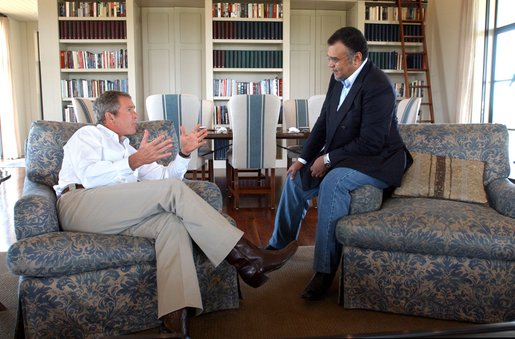
Prince Bandar bin Sultan, then Saudi ambassador to the United States, meeting with President George W. Bush in Crawford, Texas. (White House photo)
“Sheikh Osama wanted to keep a record who give money,” Moussaoui said in imperfect English — “who is to be listened to or who contributed to the jihad.”
Although Moussaoui’s credibility came under immediate attack from the Saudi kingdom, his assertions mesh with accounts from members of the U.S. Congress who have seen a secret portion of the 9/11 report that addresses alleged Saudi support for al-Qaeda.
Further complicating the predicament for Saudi Arabia is that, more recently, Saudi and other Persian Gulf oil sheikdoms have been identified as backers of Sunni militants fighting in Syria to overthrow the largely secular regime of President Bashar al-Assad. The major rebel force benefiting from this support is al-Nusra Front, al-Qaeda’s affiliate in Syria.
In other words, the Saudis appear to have continued a covert relationship with al-Qaeda-connected jihadists to the present day.
The Israeli Exposure
And, like the Saudis, the Israelis have sided with the Sunni militants in Syria because the Israelis share the Saudi view that Iran and the so-called “Shiite crescent” – reaching from Tehran and Baghdad to Damascus and Beirut – is the greatest threat to their interests in the Middle East.
That shared concern has pushed Israel and Saudi Arabia into a de facto alliance, though the collaboration between Jerusalem and Riyadh has been mostly kept out of the public eye. Still, it has occasionally peeked out from under the covers as the two governments deploy their complementary assets – Saudi oil and money and Israeli political and media clout – in areas where they have mutual interests.
In recent years, these historic enemies have cooperated in their joint disdain for the Muslim Brotherhood government in Egypt (which was overthrown in 2013), in seeking the ouster of the Assad regime in Syria, and in pressing for a more hostile U.S. posture toward Iran.
Israel and Saudi Arabia also have collaborated in efforts to put the squeeze on Russia’s President Vladimir Putin, who is deemed a key supporter of both Iran and Syria. The Saudis have used their power over oil production to drive down prices and hurt Russia’s economy, while U.S. neoconservatives – who share Israel’s geopolitical world view – were at the forefront of the coup that ousted Ukraine’s pro-Russian President Viktor Yanukovych in 2014.
The behind-the-scenes Israeli-Saudi alliance has put the two governments – uncomfortably at times – on the side of Sunni jihadists battling Shiite influence in Syria, Lebanon and even Iraq. On Jan. 18, 2015, for instance, Israel attacked Lebanese-Iranian advisers assisting Assad’s government in Syria, killing several members of Hezbollah and an Iranian general. These military advisors were engaged in operations against al-Qaeda’s Nusra Front.
Meanwhile, Israel has refrained from attacking Nusra Front militants who have seized Syrian territory near the Israeli-occupied Golan Heights. One source familiar with U.S. intelligence information on Syria told me that Israel has a “non-aggression pact” with these Nusra forces.
An Odd Alliance
Israel’s odd-couple alliances with Sunni interests have evolved over the past several years, as Israel and Saudi Arabia emerged as strange bedfellows in the geopolitical struggle against Shiite-ruled Iran and its allies in Iraq, Syria and southern Lebanon. In Syria, for instance, senior Israelis have made clear they would prefer Sunni extremists to prevail in the civil war rather than Assad, who is an Alawite, a branch of Shiite Islam.
In September 2013, Israel’s Ambassador to the United States Michael Oren, then a close adviser to Israeli Prime Minister Benjamin Netanyahu, told the Jerusalem Post that Israel favored the Sunni extremists over Assad.
“The greatest danger to Israel is by the strategic arc that extends from Tehran, to Damascus to Beirut. And we saw the Assad regime as the keystone in that arc,” Oren told the Jerusalem Post in an interview. “We always wanted Bashar Assad to go, we always preferred the bad guys who weren’t backed by Iran to the bad guys who were backed by Iran.” He said this was the case even if the “bad guys” were affiliated with al-Qaeda.
And, in June 2014, speaking as a former ambassador at an Aspen Institute conference, Oren expanded on his position, saying Israel would even prefer a victory by the brutal Islamic State over continuation of the Iranian-backed Assad in Syria. “From Israel’s perspective, if there’s got to be an evil that’s got to prevail, let the Sunni evil prevail,” Oren said.
Skepticism and Doubt
In August 2013, when I first reported on the growing relationship between Israel and Saudi Arabia in an article entitled “The Saudi-Israeli Superpower,” the story was met with much skepticism. But, increasingly, this secret alliance has gone public.
On Oct. 1, 2013, Israeli Prime Minister Netanyahu hinted at it in his United Nations General Assembly speech, which was largely devoted to excoriating Iran over its nuclear program and threatening a unilateral Israeli military strike.
Amid the bellicosity, Netanyahu dropped in a largely missed clue about the evolving power relationships in the Middle East, saying: “The dangers of a nuclear-armed Iran and the emergence of other threats in our region have led many of our Arab neighbors to recognize, finally recognize, that Israel is not their enemy. And this affords us the opportunity to overcome the historic animosities and build new relationships, new friendships, new hopes.”
The next day, Israel’s Channel 2 TV news reported that senior Israeli security officials had met with a high-level Gulf state counterpart in Jerusalem, believed to be Prince Bandar, the former Saudi ambassador to the United States who was then head of Saudi intelligence.
The reality of this unlikely alliance has now even reached the mainstream U.S. media. For instance, Time magazine correspondent Joe Klein described the new coziness in an article in the Jan. 19, 2015 issue.
He wrote: “On May 26, 2014, an unprecedented public conversation took place in Brussels. Two former high-ranking spymasters of Israel and Saudi Arabia – Amos Yadlin and Prince Turki al-Faisal – sat together for more than an hour, talking regional politics in a conversation moderated by the Washington Post’s David Ignatius.
“They disagreed on some things, like the exact nature of an Israel-Palestine peace settlement, and agreed on others: the severity of the Iranian nuclear threat, the need to support the new military government in Egypt, the demand for concerted international action in Syria. The most striking statement came from Prince Turki. He said the Arabs had ‘crossed the Rubicon’ and ‘don’t want to fight Israel anymore.’”
Though Klein detected only the bright side of this détente, there was a dark side as well, as referenced in Moussaoui’s deposition, which identified Prince Turki as one of al-Qaeda’s backers. Perhaps even more unsettling was his listing of Prince Bandar, who had long presented himself as a U.S. friend, so close to the Bush Family that he was nicknamed “Bandar Bush.”
Moussaoui claimed that he discussed a plan to shoot down Air Force One with a Stinger missile with a staff member at the Saudi Embassy in Washington, at a time when Bandar was the ambassador to the United States.
According to the New York Times article by Scott Shane, Moussaoui said he was assigned to “find a location where it may be suitable to launch a Stinger attack and then, after, be able to escape,” but that he was arrested on Aug. 16, 2001, before he could carry out the reconnaissance mission.
The thought of anyone in the Saudi embassy, then under the control of “Bandar Bush,” scheming with al-Qaeda to shoot down George W. Bush’s Air Force One is shocking, if true. The notion would have been considered unthinkable even after the 9/11 attacks, which involved 15 Saudis among the 19 hijackers.
After those terror attacks which killed nearly 3,000 Americans, Bandar went to the White House and persuaded Bush to arrange for the rapid extraction of bin Laden’s family members and other Saudis in the United States. Bush agreed to help get those Saudi nationals out on the first flights allowed back into the air.
Bandar’s intervention undercut the FBI’s chance to learn more about the ties between Osama bin Laden and the 9/11 perpetrators by giving FBI agents only time for cursory interviews with the departing Saudis.
Bandar himself was close to the bin Laden family and acknowledged having met Osama bin Laden in the context of bin Laden thanking Bandar for his help financing the jihad project in Afghanistan during the 1980s. “I was not impressed, to be honest with you,” Bandar told CNN’s Larry King about bin Laden. “I thought he was simple and very quiet guy.”
The Saudi government claimed to have broken ties with bin Laden in the early 1990s when he began targeting the United States because President George H.W. Bush had stationed U.S. troops in Saudi Arabia, but – if Moussaoui is telling the truth – al-Qaeda would have still counted Bandar among its supporters in the late 1990s.
Bandar and Putin
Bandar’s possible links to Sunni terrorism also emerged in 2013 during a confrontation between Bandar and Putin over what Putin viewed as Bandar’s crude threat to unleash Chechen terrorists against the Sochi Winter Olympics if Putin did not reduce his support for the Syrian government.
According to a leaked diplomatic account of a July 31, 2013 meeting in Moscow, Bandar informed Putin that Saudi Arabia had strong influence over Chechen extremists who had carried out numerous terrorist attacks against Russian targets and who had since deployed to join the fight against the Assad regime in Syria.
As Bandar called for a Russian shift toward the Saudi position on Syria, he reportedly offered guarantees of protection from Chechen terror attacks on the Olympics. “I can give you a guarantee to protect the Winter Olympics in the city of Sochi on the Black Sea next year,” Bandar reportedly said. “The Chechen groups that threaten the security of the games are controlled by us.”
Putin responded, “We know that you have supported the Chechen terrorist groups for a decade. And that support, which you have frankly talked about just now, is completely incompatible with the common objectives of fighting global terrorism.”
Bandar’s Mafia-like threat toward the Sochi games – a version of “nice Olympics you got here, it’d be a shame if something terrible happened to it” – failed to intimidate Putin, who continued to support Assad.
Less than a month later, an incident in Syria almost forced President Barack Obama’s hand in launching U.S. air strikes against Assad’s military, which would have possibly opened the path for the Nusra Front or the Islamic State to capture Damascus and take control of Syria. On Aug. 21, 2013, a mysterious sarin attack outside Damascus killed hundreds and, in the U.S. media, the incident was immediately blamed on the Assad regime.
American neocons and their allied “liberal interventionists” demanded that Obama launch retaliatory air strikes even though some U.S. intelligence analysts doubted that Assad’s forces were responsible and suspected that the attack was carried out by extremist rebels trying to pull the U.S. military into the civil war on their side.
Yet, pushed by the neocons and liberal war hawks, Obama nearly ordered a bombing campaign designed to “degrade” the Syrian military but called it off at the last minute. He then accepted Putin’s help in reaching a diplomatic solution in which Assad agreed to surrender his entire chemical weapons arsenal, while still denying any role in the sarin attack.
Later, the Assad-did-it case crumbled amid new evidence that Sunni extremists, supported by Saudi Arabia and Turkey, were the more likely perpetrators of the attack, a scenario that became increasingly persuasive as Americans learned more about the cruelty and ruthlessness of many Sunni jihadists fighting in Syria. [See Consortiumnews.com’s “The Mistaken Guns of Last August.”]
Targeting Putin
Putin’s cooperation with Obama to head off a U.S. military strike in Syria made the Russian president more of a target for the American neocons who thought they finally had reached the cusp of their long-desired “regime change” in Syria only to be blocked by Putin. By late September 2013, a leading neocon, National Endowment for Democracy President Carl Gershman, announced the goal of challenging Putin and recognizing his sore point in Ukraine.
Taking to the Washington Post’s op-ed page on Sept. 26, 2013, Gershman called Ukraine “the biggest prize” and an important step toward ultimately ousting Putin. Gershman wrote, “Ukraine’s choice to join Europe will accelerate the demise of the ideology of Russian imperialism that Putin represents. … Russians, too, face a choice, and Putin may find himself on the losing end not just in the near abroad but within Russia itself.” [See Consortiumnews.com’s “Neocons’ Ukraine-Syria-Iran Gambit.“]
However, in early 2014, Putin was obsessed with Bandar’s implicit threat of terrorism striking the Sochi Olympics, thus distracting him from the “regime change” – being pushed by NED and neocon Assistant Secretary of State for European Affairs Victoria Nuland – next door in Ukraine.
On Feb. 22, 2014, putschists, spearheaded by well-organized neo-Nazi militias, drove elected President Viktor Yanukovych and his government from power. Putin was caught off-guard and, in the resulting political chaos, agreed to requests from Crimean officials and voters to accept Crimea back into Russia, thus exploding his cooperative relationship with Obama.
With Putin the new pariah in Official Washington, the neocon hand also was strengthened in the Middle East where renewed pressure could be put on the “Shiite crescent” in Syria and Iran. However, in summer 2014, the Islamic State, which had splintered off from al-Qaeda and its Nusra Front, went on a rampage, invading Iraq where captured soldiers were beheaded. The Islamic State then engaged in gruesome videotaped decapitations of Western hostages inside Syria.
The Islamic State’s brutality and the threat it posed to the U.S.-backed, Shiite-dominated government of Iraq changed the political calculus. Obama felt compelled to launch airstrikes against Islamic State targets in both Iraq and Syria. American neocons tried to convince Obama to expand the Syrian strikes to hit Assad’s forces, too, but Obama realized such a plan would only benefit the Islamic State and al-Qaeda’s Nusra Front.
In effect, the neocons were showing their hand – much as Israeli Ambassador Oren had done – favoring the Sunni extremists allied with al-Qaeda over Assad’s secular regime because it was allied with Iran. Now, with Moussaoui’s deposition identifying senior Saudi officials as patrons of al-Qaeda, another veil seems to have dropped.
Complicating matters further, Moussaoui also claimed that he passed letters between Osama bin Laden and then Crown Prince Salman, who recently became king upon the death of his brother King Abdullah.
But Moussaoui’s disclosure perhaps cast the most unflattering light on Bandar, the erstwhile confidant of the Bush Family who — if Moussaoui is right — may have been playing a sinister double game.
Also facing potentially embarrassing questions is Israeli Prime Minister Netanyahu, especially if he goes through with his planned speech before a joint session of Congress next month, attacking Obama for being soft on Iran.
And, America’s neocons might have some explaining to do about why they have carried water not just for the Israelis but for Israel’s de facto allies in Saudi Arabia.
~
Investigative reporter Robert Parry broke many of the Iran-Contra stories for The Associated Press and Newsweek in the 1980s. You can buy his latest book, America’s Stolen Narrative, either in print here or as an e-book (from Amazon and barnesandnoble.com).
Treating Putin Like a Lunatic
By Robert Parry | Consortium News | October 25, 2014
When reading the New York Times on many foreign policy issues, it doesn’t take a savant to figure out what the newspaper’s bias is. Anything, for instance, relating to Russian President Vladimir Putin drips of contempt and hostility.
Rather than offer the Times’ readers an objective or even slightly fair-minded account of Putin’s remarks, we are fed a steady diet of highly prejudicial language, such as we find in Saturday’s article about Putin’s comments at a conference in which he noted U.S. contributions to chaos in countries, such as Afghanistan, Iraq, Libya, Syria and Ukraine.
That Putin is correct appears almost irrelevant to the Times, which simply writes that Putin “unleashed perhaps his strongest diatribe against the United States yet” with his goal “to sell Moscow’s view that American meddling has sparked most of the world’s recent crises.”
Rather than address the merits of Putin’s critique, the Times’ article by Neil MacFarquhar uncritically cites the “group think” of Official Washington: “Russia is often accused of provoking the crisis in Ukraine by annexing Crimea, and of prolonging the agony in Syria by helping to crush a popular uprising against President Bashar al-Assad, Moscow’s last major Arab ally. Some analysts have suggested that Mr. Putin seeks to restore the lost power and influence of the Soviet Union, or even the Russian Empire, in a bid to prolong his own rule.”
Yes, “some analysts” can be cited to support nearly any claim no matter how wrongheaded, or you can use the passive tense – “is often accused” – to present any charge no matter how unfair. But a more realistic summary of the various crises afflicting the world would note that Putin is correct when he describes past U.S. backing for various extremists, from Islamic fundamentalists in the Middle East and Central Asia to neo-Nazis in Ukraine.
For example, during the 1980s, the Reagan administration consciously encouraged Islamic fundamentalism as a strategy to cause trouble for “atheistic communism” in Afghanistan and in the Muslim provinces of the Soviet Union.
To overthrow a Soviet-backed government in Afghanistan, the CIA and its Saudi collaborators financed the mujahedeen “holy warriors” who counted among their supporters Saudi extremist Osama bin Laden. Some of those Islamists later blended into the Taliban and al-Qaeda with dire consequences for the United States on Sept. 11, 2001.
By invading Iraq in 2003, President George W. Bush toppled a secular dictator, Saddam Hussein, but saw him replaced by what amounted to a Shiite theocracy which pushed Iraq’s Sunni minority into the arms of “Al-Qaeda in Iraq,” which has since rebranded itself as the Islamic State of Iraq and Syria or simply the Islamic State. Those extremists now control large swaths of Iraq and Syria and have massacred religious minorities and Western hostages, prompting another U.S. military intervention.
Obama’s Interventions
In Libya in 2011, President Barack Obama acquiesced to demands from “liberal interventionists” in his administration and authorized an air war to overthrow another secular autocrat, Muammar Gaddafi, whose ouster and murder have sent Libya spiraling into political chaos amid warring Islamist militias. It turns out Gaddafi was not wrong when he warned of Islamist terrorists operating around Benghazi.
Similarly, Official Washington’s embrace of protests and violence aimed at removing another secular Arab leader, Syria’s Bashar al-Assad, contributed to the bloody civil war that has devastated that country and created fertile ground for the Islamic State and the Nusra Front, the official al-Qaeda affiliate.
Though Obama balked at demands from neocons and “liberal interventionists” that he launch an air war against the Syrian military in 2013, he did authorize secret shipments of weapons and training for the supposedly “moderate” Syrian rebels who have generally sided with Islamist fighters affiliated with al-Qaeda and the Islamic State.
Many of these same neocons and “liberal interventionists” have been eager to ratchet up the confrontation with Iran over its nuclear program, including neocon dreams to “bomb, bomb, bomb Iran,” also a desire of hardliners in Israel.
In some of these crises, one of the few international leaders who has cooperated with Obama to tamp down tensions has been Putin, who helped negotiate conflict-avoiding agreements with Syria and Iran. But those peaceful interventions made Putin an inviting target for the neocons who began in fall 2013 arranging a coup d’etat in Ukraine on Russia’s border.
As Obama and Putin each paid too little attention to these maneuvers, neocons such as National Endowment for Democracy president Carl Gershman, Sen. John McCain, R-Arizona, and Assistant Secretary of State for European Affairs Victoria Nuland went to work on the Ukrainian coup.
However to actually overthrow Ukraine’s elected President Viktor Yanukovych, the coup makers had to collaborate with neo-Nazi militias which were organized in western Ukraine and dispatched to Kiev where they provided the muscle for the Maidan uprising. Neo-Nazi leaders were given several ministries in the new government, and neo-Nazi militants were incorporated into the National Guard and “volunteer” militias dispatched to crush the ethnic Russian resistance in the east.
Putin for the Status Quo
The underlying reality of the Ukraine crisis was that Putin actually supported the country’s status quo, i.e. maintaining the elected president and the constitutional process. It was the United States along with the European Union that sought to topple the existing system and pull Ukraine from Russia’s orbit into the West’s.
Whatever one thinks about the merits of that change, it is factually wrong to accuse Putin of initiating the Ukraine crisis or to extrapolate from Official Washington’s false conventional wisdom and conclude that Putin is a new Hitler, an aggressor seeking to reestablish the Soviet Union or the Russian Empire.
But the Times and other major U.S. news outlets have wedded themselves to that propaganda theme and now cannot deviate from it. So, when Putin states the obvious – that the U.S. has meddled in the affairs of other nations and that Russia did not pick the fight over Ukraine – his comments must be treated like the ravings of a lunatic unleashing some “diatribe.”
Among Putin’s ranting was his observation, according to the Times article, that “the United States supports ‘dubious’ groups ranging from ‘open neo-fascists to Islamic radicals.’
“‘Why do they support such people,’ he asked the annual gathering known as the Valdai Club, which met this year in the southern resort town of Sochi. ‘They do this because they decide to use them as instruments along the way in achieving their goals, but then burn their fingers and recoil.’
“The goal of the United States, he said, was to try to create a unipolar world in which American interests went unchallenged. …
“Mr. Putin … specifically denied trying to restore the Russian Empire. He argued Russia was compelled to intervene in Ukraine because that country was in the midst of a ‘civilized dialogue’ over its political future when the West staged a coup to oust the president last February, pushing the country into chaos and civil war.
“‘We did not start this,’ he said. ‘Statements that Russia is trying to reinstate some sort of empire, that it is encroaching on the sovereignty of its neighbors, are groundless.’”
Of course, all the “smart people” of Official Washington know how to react to such statements from Putin, with a snicker and a roll of the eyes. After all, they’ve been reading the narratives of these crises as fictionalized by the New York Times, the Washington Post, etc.
Rationality and realism seem to have lost any place in the workings of the mainstream U.S. news media.
~
Investigative reporter Robert Parry broke many of the Iran-Contra stories for The Associated Press and Newsweek in the 1980s. You can buy his new book, America’s Stolen Narrative, either in print here or as an e-book (from Amazon and barnesandnoble.com).
Putin to West: Stop turning world into ‘global barracks,’ dictating rules to others
RT | July 1, 2014
Russia’s president has blamed the turmoil in Ukraine on the country’s newly-elected leader Petro Poroshenko. Vladimir Putin also criticized the West for its intention to turn the planet into a “global barracks.”
Russia’s president has laid the blame for the ongoing turmoil between Kiev and south-eastern regions squarely at the feet of Petro Poroshenko, after the Ukrainian leader terminated the ceasefire.
He has stressed that Russia and European partners could not convince Poroshenko to not take the path of violence, which can’t lead to peace.
“Unfortunately, President Poroshenko has made the decision to resume military actions, and we – meaning myself and my colleagues in Europe – could not convince him that the way to reliable, firm and long-term peace can’t lie through war,” Putin said. “So far, Petro Poroshenko had no direct relation to orders to take military action. Now he has taken on this responsibility in full. Not only military, but also political, more importantly.”
On Monday, the leaders of Russia, France, Germany and Ukraine held a phone call in which Putin stressed the need to prolong the ceasefire and the creation of “a reliable mechanism for monitoring compliance with it and the OSCE [Organization for Security and Cooperation in Europe] should play an active role.”
Russia offered that checkpoints on the Russian side should be monitored by representatives of the Ukrainian Border service as well as OSCE observers for “the joint control of the border.”
As the violent conflict continues in the east of Ukraine and the number of refugees fleeing to Russia grows, Putin vowed to provide help to everyone who needs it.
“Everything that’s going on in Ukraine is of course the internal business of Ukrainian government, but we are painfully sorry that people die, civilians,” Putin said. He added that the killing of journalists was “absolutely unacceptable.”
“In my opinion, there is a deliberate attempt to eliminate representatives of the press going on. It concerns both Russian and foreign journalists,” the president said.
Speaking in front of ambassadors on Tuesday, Putin expressed hope that Western partners will stop imposing their principles on other countries.
“I hope pragmatism will still prevail. The West will get rid of ambitions, pursuits to establish a ‘world barracks’ – to arrange all according to ranks, to impose uniform rules of behavior and life of society,” Putin said.
“I hope the West will start building relations based on equal rights, mutual respect and mutual consideration of interests.”
Putin recalled the situation with France and the delivery of the Mistral-class ships that was agreed between Moscow and Paris, but was jeopardized in March.
“We know about the pressure that our American partners put on the French so that they would not deliver the Mistral [ships] to Russia,” Putin said. “And we know that [they] hinted that if the French don’t deliver Mistral, sanctions on banks will be gradually removed, or at least minimized. What is this, if not blackmail?”
Russia is ready to have dialogue with the US only on the basis of equality, Putin added.
“We are not going to stop our relations with the US. The bilateral relations are not in the best shape, that is true. But this – and I want to emphasize – is not Russia’s fault,” he told diplomats.
Speaking about international relations, Putin stressed that Russia always tried to be “predictable, to do business on an equal basis”, however, in return, its interests were quite often ignored.
Featured Video
No Threat Can Force Iran’s Surrender /Trita Parsi & Lt Cl Daniel Davis
or go to
Aletho News Archives – Video-Images
From the Archives
An Expert Military Analysis of War with China
Actually, None is Necessary
By Fred Reed • Unz Review • December 13, 2020
The Correlation of Armed Forces: U.S. goods and services trade with China totaled an estimated $634.8 billion in 2019. Exports were $163.0 billion; imports were $471.8 billion. The U.S. goods and services trade deficit with China was $308.8 billion in 2019. Trade in services with China (exports and imports) totaled an estimated $76.7 billion in 2019. Services exports were $56.5 billion; services imports were $20.1 billion. The U.S. services trade surplus with China was $36.4 billion in 2019.
There is talk within the Washingtoniat of a possible war with China. Steve Bannon, who apparently was dropped on his head as a child, actually favors such a war. We hear the usual shoo-the-boobs alarm about how the Chinese are doing something terrible and we must gird our loins and American values and show them what for, bow wow, woof. The danger is that the current game of who-blinks-first in Asian waters might actually provoke a shooting war. You know the kind of thing: One warship refuses to get out of the way of another, a collision ensues, some retard lieutenant who signed up on waivers opens fire, and we’re off and running. It is not a good idea to let children play with matches.
The said war is discussed either in emotional terms by idiots or in purely naval terms by those familiar with such things, so we hear of the First Island Chain and the Second Island Chain and whose missiles against the other’s missiles and so on. This would be appropriate if we were fighting World War Two again. Which we aren’t. Let’s take a quick-and-dirty look at how such a war might go.
To begin the war, America would overestimate itself and underestimate China. This is doctrine in the Pentagon. … continue
Blog Roll
 Aletho News
- Iran To Target Military Industrial-Tech Complex That Facilitated Gaza Genocide
- Collapsing Empire: The Resistance Disarms ‘Israel’
- Suicide Should Not Be a Government Service
- Rethinking America’s greatest threat: Iran vs. Israel-Firsters
- Iran accuses adversaries of false flags to strain Turkey ties
- Poland rules out sending Patriot missiles to US/Israel amid war on Iran
- Tehran approves new Hormuz plan with major restrictions
- No Threat Can Force Iran’s Surrender /Trita Parsi & Lt Cl Daniel Davis
- UK’s New Pandemic Plan Would Turn Big Tech Into a Mass Location Tracking Network
- Growing insecurity, soaring prices fuel protests in north as regime bans evacuation: Sources
- If Americans Knew
- Ann Coulter Rips Into Fox News for Iran War Coverage, Compares to False Rigged 2020 Election Reporting
- Joe Kent Urges Americans To Call White House and Congress To Object To Sending Troops Into Iran
- DNC Resolution to Reject AIPAC Funding Puts Democratic Leaders in the Hot Seat
- Swedish foundation to build 400 schools as over 650,000 Gaza children remain without education for 2 years
- Israeli army admits photshopping image of slain Lebanese journalist
- This is how Israel is systematically killing health workers under the cover of war in Lebanon
- Carrying life under fire: Israeli invasion of Lebanon leaves pregnant women facing deadly risks
- Champagne all around for the new death penalty (for Palestinians) law – Not a ceasefire Day 172
- Why are Palestinian books struggling to be seen on Amazon?
- The Line Between Affinity and Conspiracy
- No Tricks Zone
- New Study Finds Warming Saves Lives…Cold Temperatures 12 Times More Deadly Than Excess Heat
- German Science Blog Accuses PIK Climate Institute Of Hallucinating Climate Tipping Points
- Devastating Assessment Of Comirnaty Vaccine By Former Senior Pfizer Europe Toxicologist
- New Study: CO2 Is ‘Effectively Negligible’ As An Explanatory Climate Change Factor Since 2000
- Former Pfizer Toxicologist Dr. Helmut Sterz Tells Bundestag Hearing Pfizer Vaccine Should Have Never Been Approved
- Energy Expert: Germany’s Nuclear Phaseout Was A “500 Billion Euro Mistake”
- New Research: South Australia’s Mid-Holocene Sea Surface Temperatures Were 4°C Warmer Than Today
- Storing Green Energy To Last Germany 10 Days Would Require A 60-Million Tonne Battery
- New Studies: UK Sea Levels Were 4 Meters Higher Than Today During The Mid-Holocene
- Destructive Green New Deal: German Energy And Metal Group Warns Of Drastic Crisis
 Aletho News