The Mainstream Media Fueled Military Action in Syria and Reprisals against Russia over the Skripals
By Philip Giraldi | American Herald tribune | April 23, 2108
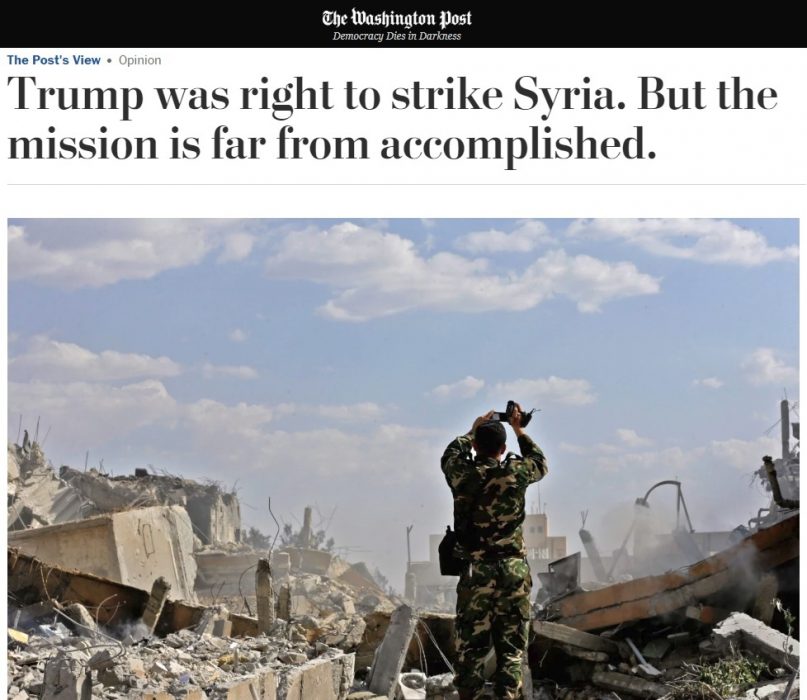
The complicity of America’s Fourth Estate in the evolution of the national security warfare state is often mentioned in passing but rarely analyzed in any detail. But a recent article on Lobe Log by Adam Johnson is refreshing in that it does just that, looking at the editorials in 26 leading newspapers relating to the April 13th strike against Syria for the alleged use of chemical weapons. All of the papers supported the attack in the belief that Syria and its Russian and Iranian allies had done something wrong and had to be punished. Some of the endorsements went well beyond the actual strike itself, urging the White House to do more. The article quotes the Toledo Blade’s assertion that:
“Make no mistake, this was a warning to Vladimir Putin as well as Bashar al-Assad. The United States and its two longtime allies redrew the red line that had been obliterated by a failure of nerve by the US and the West generally: There will be cost for your barbarities…. But in the larger sense, the West did what it should have done a long time ago. It stood up for decency and international law. It stood up for those who are defenseless. It stood up for itself, and for simple humanity, and redeemed some self-respect.”
Another recent editorial intended to stir up hysteria about perfidious Moscow appeared in the New York Times on March 12th. It was entitled “Vladimir Putin’s Toxic Reach”. It said in part:
“The attack on the former spy, Sergei Skripal, who worked for British intelligence, and his daughter Yulia, in which a police officer who responded was also poisoned, was no simple hit job. Like the 2006 murder of Alexander Litvinenko, another British informant, who was poisoned with radioactive polonium 210, the attack on Mr. Skripal was intended to be as horrific, frightening and public as possible. It clearly had the blessing of President Vladimir Putin, who had faced little pushback from Britain in the Litvinenko case. The blame has been made clearer this time and this attack on a NATO ally needs a powerful response both from that organization and, perhaps more important, by the United States.”
These two stories and the many others like them have something in common, which is that they were written without any evident “fact checking” and subsequently have proven to be largely incorrect in terms of their assumptions about Russian and Syrian behavior. They also share a belief that the United States and its allies can both establish and enforce standards for the rest of the world. In these cases, the stakes were very high as there was an assumption that it could be appropriate to risk going to war with a powerful nuclear armed government based on incidents that did not in any way impact upon American or British national security.
Regarding Syria, the first wave of “reporting” on the alleged gassing came from sources linked to the terrorist group that was under attack, Jaish el-Islam. This included the so-called White Helmets, who have been outed and exposed as a virtual PR outfit for those one might call the head-choppers. More recently, with government control reestablished over the Douma neighborhood where the reported deaths took place, independent journalists including the able Robert Fisk, no friend of the al-Assad “regime”, have been entering and discovering that there appears to be no evidence that a gas attack even took place.
Skeptics examining the incident from the beginning noted that the Syrian government had every reason to avoid a provocation in its rollup of the remaining rebel pockets near Damascus while the so-called rebels would have been highly motivated to stage a false flag attack to bring in outside forces in support of their cause. If there was a chemical attack of any kind, it almost surely originated with the terrorists.
Even assuming that the United States was acting in good faith when it attacked Syrian “chemical sites” believing that the al-Assad “regime” had actually used such weapons, one should also assume, given the time frame and lack of definitive intelligence resources, that the decision was based on an assessment that relied on limited information coming from sources hostile to Damascus as well as White House perceptions of persistent bad behavior by the Syrian government.
So a poorly informed Washington clearly went to war without exactly knowing why. As the story continues to unravel, there will, however, be no apologies forthcoming either from the White House or the national media, both of which got it so wrong. The mainstream media never even questioned whether Trump should bomb the Syrian “regime” at all, instead merely debating exactly how much punishment he should inflict.
To their credit, the British public and some former senior officials are beginning to ask questions about Syria through a reluctant media filter and opposition leader in Parliament Jeremy Corbyn has refused to be silenced. Similarly, the story of the poisoning of the Skripals in Salisbury has also begun to come apart. Former U.K. Ambassador Craig Murray has detailed how the narrative was cooked by “liars” in the government to make it look as if the poisoning had a uniquely Russian fingerprint. Meanwhile U.S. investigative reported Gareth Porter sums up the actual evidence or lack thereof, for Russian involvement, suggesting that the entire affair was “based on politically-motivated speculation rather than actual intelligence.”
Here in the United States the mainstream media, which has supported every war since 9/11, has yet to account for its deliberately slanted reporting that has fueled both military action in Syria and reprisals against Russia over the Skripals. Unfortunately, the resulting actions undertaken by the United States and Britain have not been consequence free. The attack on Syria, given the fact that Damascus in no way threatened either the U.S. or U.K., was a war crime under international law. The mass expulsions of Russian officials over the Skripals affair has produced a diplomatic chill not unlike the Cold War, or perhaps even worse, with American U.N. Ambassador Nikki Haley declaring that the White House is “locked and loaded” if Syria should again step out of line. One might ask Haley what is to be done when Washington steps out of line? It would be interesting to hear her answer.
*(Snapshot courtesy of the WashingtonPost )
Media Support US Violence Against Syria, but Long for More
By Gregory Shupak | FAIR | April 20, 2018
Corporate media outlets were glad that the US, France and Britain bombed Syria in violation of international law (FAIR.org, 4/18/18), but lamented what they see as a dearth of US violence in the country.
In The Atlantic (4/14/18), Thanassis Cambanis described the war crime as “undoubtedly a good thing,” and called for “sustained attention and investment, of diplomatic, economic and military resources”—though the latter rubbed up against his assessment in the same paragraph that “a major regional war will only make things worse.” Moreover, he described “the most realistic possibility” for the US and its partners in Syria as “an incomplete and possibly destabilizing policy of confrontation [and] containment. But a reckoning can’t be deferred forever.”
This “reckoning” was his somewhat oblique way of referring to a war pitting the US and its allies against the Syrian government and its allies, the very “wider regional war” he just warned against. In Cambanis’ view, “confrontations” between nuclear-armed America and nuclear-armed Russia are “inevitable,” which implies that there is no sense in trying to avoid such potentially apocalyptic scenarios.
A Washington Post editorial (4/14/18) said that “Mr. Trump was right to order the strikes.” The paper was glad that Defense Secretary Jim Mattis and President Donald Trump “properly left open the possibility of further action.” The Post’s rationale for continuing to attack Syria was that “the challenge to vital US interests in Syria is far from over,” and that Trump was therefore wrong “to call Friday’s operation a ‘Mission Accomplished.’” These “interests” include ensuring that Iran does not “obtain the land corridor it seeks across Syria.” (Cambanis, similarly, described as “justified” US efforts to “contain Syria and its allies.”)
The paper was concerned because Trump says that he’d like to subcontract US activities in Syria to US regional partners like Saudi Arabia, the United Arab Emirates, Qatar and Egypt. None of these states, the Post fretted, “are capable of working with local forces [in Syria] to stabilize and hold the large stretch of [Syrian] territory now under de facto US control east of the Euphrates River.”
The editorial failed to note that this territory amounts to “about one-third of the country, including most of the oil wealth” (New York Times, 3/8/18) and “much of Syria’s best agricultural land” (Syria Comment, 1/15/18). The legitimacy of “de facto US control” over Syrian territory and some of its most valuable resources is apparently beyond question, as is the US’s alleged right to determine which governments are allowed to be friendly with each other: The Iranian “land corridor” refers to the Iranian government having warm relations with the governments of Syria, Iraq and Lebanon, something the Post appears to regard as a grave danger.
The editorial says that the US and its allies sought to “minimize the risk of a direct military confrontation with Russia or Iran” and that this was “prudent,” but that “if Russia takes retaliatory action, including in cyberspace, the United States must be ready to respond.” According to this view, projecting US power in Syria is so essential that no form of opposition to US violence in Syria can be brooked, the concern for prudence having vanished.
The Post contended that the US must demand “an acceptable political settlement brokered by the United Nations”—“acceptable” signifying “the departure” of the Syrian government. Functionally, this means keeping the war going: Saying that negotiations should take place but that the only “acceptable” outcome is the dissolution of the Syrian government amounts to the same thing as saying that no negotiations should take place, particularly now that the Syrian government is working from a position of strength and unlikely to agree to its own surrender as a pre-condition for talks.
Andrew Rawnsley, writing in the Guardian (4/15/18), supported US violence in Syria by attacking its critics. He said that those who oppose the Anglo-American-French airstrikes on Syria out of “indifference” to Syria’s plight have the “sole merit of being candid,” unlike those who are
less honest . . . the self-proclaimed peace-lovers. Mainly to be found on the hand-wringing left, they are too busy looking in the mirror admiring their own halos to face the moral challenges posed by a situation like Syria.
Luckily Rawnsley has the requisite courage to meet “the moral challenges” and advocate more war: He says that the West should have “impos[ed] no-fly zones” early in the war in Syria, a policy that would have entailed attacking Syria’s air forces, an act of war by any definition. No-fly zones over Iraq and Libya ultimately led to regime change in both countries, with hideous results for their people.
Rawnsley’s complaint that the West applied “no meaningful pressure” to “bring [the Syrian government to the negotiating table” is wildly misleading; the Western powers in fact applied “meaningful pressure” to prevent negotiations.
Rawnsley also legitimized US violence against Syria by expunging the damage it has inflicted. He trotted out the well-worn lie that the West “stood by” and “fail[ed] to act” in Syria, a canard that FAIR has repeatedly de-bunked (e.g., 9/20/15, 4/7/17, 3/7/18). He characterized the West’s approach to seven years of war in Syria as “years of unmasterly inactivity,” having their hands “wedged firmly under their bottoms,” an “impotent posture,” “failures to act,” making the “grav[e] decision not to act,” “inaction,” “non-interventionist” and as “inaction” a second time. Yet the CIA’s effort to oust the Syrian government has been one of the costliest covert-action programs in the agency’s history; has built ten military bases in the country, with two more on the way; and has killed thousands of Syrian civilians in a bombing campaign ostensibly aimed at ISIS (Jacobin, 4/18/18).
“Non-interventionists,” Rawnsley concludes his article, “the horrors of Syria are on you.” Yet there is no shortage of horrors that are on the interventionists. Sanctions imposed by the US and its allies have punished the Syrian population (9/28/16). These states are implicated in sectarian violence that anti-government armed groups have carried out against minorities (Electronic Intifada, 3/16/17). The US bombed a mosque in Aleppo, Syria, in the name of fighting Al Qaeda, killing almost 40 people (Independent, 4/18/17), and America used toxic depleted uranium against ISIS-held territory in Syria (Foreign Policy, 2/14/17): It would be rather difficult to claim that these horrors were caused by “non-interventionists.”
Cambanis, moreover, exclusively listed Syria, Iran and Russia among those governments who “have serially transgressed the laws of war” and “gotten away with murder” in Syria, but the atrocities attributable to the US and its allies surely constitute “serially transgress[ing] the laws of war” and having “gotten away with murder.”
The Syrian government and its partners are also responsible for a substantial share of carnage in the war, but Rawnsley’s accusation that “non-interventionists” are to blame for Syria’s bloodshed is completely untenable. His argument that Western states have inflicted insufficient harm on Syrians amounts to war propaganda.
And he’s far from the only media figure about whom this can be said.
Gregory Shupak teaches media studies at the University of Guelph-Humber in Toronto.
Media Boosts Obvious Saudi Front Group as Neutral ‘Think Tank’

By Adam Johnson | FAIR | March 28, 2018

Washington Post, 5/31/17
The Arabia Foundation appeared in spring 2016, seemingly out of nowhere, as a Saudi-focused think tank with “ties to Riyadh,” but vaguely independent of the regime. Or at least independent enough so that media wouldn’t represent it as an extension of the kingdom. But the past few weeks have clearly shown it to be little more than a PR outlet for de facto Saudi ruler Mohammed bin Salman and his sprawling, opaque business interests.
After multiple requests by FAIR for its donors, the Arabia Foundation refused to give any, other than its founder, Saudi investment banker Ali Shihabi. It insists it doesn’t take money from “the Saudi government,” but instead is backed by unnamed private Saudi citizens.
The distinction between private citizens and the “government” in the hereditary monarchy of Saudi Arabia is notoriously blurry, but one connection is worth noting: The registered agent and legal counsel of the Arabia Foundation, Eric L. Lewis, represented the Saudi government and related “charities” in the lawsuit brought by families of 9/11 victims over the Saudi royal family’s role in the September 11 attacks. The website of Lewis’ law firm, Lewis, Baach, Kaufmann and Middlemiss, boasts it has “extensive experience representing and advising foreign sovereigns, including the governments of Saudi Arabia, Kuwait and Egypt.”
The New York Times (11/30/18) has described the group as “close to the Saudi government,” while the Washington Post’s Ishaan Tharoor (11/6/17) noted it had “close ties to the kingdom.” That doesn’t stop the Post opinion section from running multiple op-eds from Arabia Foundation figures (5/31/17, 12/20/17, 1/4/18, 1/22/18). In most press appearances, the group is simply identified as “a Washington-based think tank.” Absent documented evidence of who exactly funds the group, why should media not assume—based on its connections to the government and cartoonishly pro–bin Salman line—that the Arabia Foundation is a front group for the government?
In repeated interviews (BBC World News, 3/20/18; Morning Joe, 3/20/18; CNN, 3/19/18) last week, Shihabi, the head of the nominally independent group, spun for war crimes, human rights abuses and a whole host of morally dubious activities carried out by the increasingly despotic Saudi ruler. The Arabia Foundation’s ties to the Saudi government are never noted or even vaguely referenced in these interviews.
On MSNBC’s Morning Joe, after saying the “crown prince” has engaged in a “massive corruption crackdown” (a wholly PR frame discredited earlier this month by the New York Times, 3/11/18), host Mika Brzezinksi teed up Shihabi to comment on Saudi Arabia. The softball interview that followed hit all of the regime’s central premises without question: as well as “cracking down on corruption,” bin Salman is “modernizing Saudi Arabia” and “taking on the religious establishment.”
No one on the panel brought up Saudi Arabia’s ongoing war crimes in Yemen—consistent with MSNBC’s network-wide virtual blackout on one of the world’s worst humanitarian crises (FAIR.org, 3/20/18). The Council on Foreign Relations’ Richard Haas made one opaque reference to Saudi “war with Yemen,” but didn’t note the thousands killed or up to one million infected with cholera; the US-backed war was was simply dismissed as a “strategic overreach.” The New York Times’ Elisabeth Bumiller, another panelist, did get in a question about torture, which Ali Shihabi dismissed as having “no evidence” despite Bumiller speaking with several doctors who witnessed it.
Reliable Saudi stenographer David Iglesias who, as FAIR (4/28/17) noted last year, has been running the same reformist press release for the royal family for 15 years, continued his unique brand of faux criticism, insisting that the Saudi prince was too “bold”—the political commentary equivalent of answering “I work too hard” when asked on a job interview what your biggest flaw is.
Shihabi claimed without irony that what Saudi Arabia needed was “autocracy to affect change,” and a “benevolent autocrat.” His evidence that the masses approved of bin Salman’s “bold, needed” leadership was approved of by the masses? That there has been “no bloodshed, there’s been no demonstration, no domestic strife.” Of course, the last time there were anti-government demonstrations, in 2011, the Saudi military opened fire on protesters, and snuffed out resistance with torture and extrajudicial killings. In 2017, when one Shia town resisted the regime, Riyadh flattened an entire neighborhood. This could perhaps be why the general population isn’t quick to take to the streets, but the Arabia Foundation insist it’s an implicit admission the crown prince is loved and popular.
The CNN and BBC interviews, likewise, didn’t note the Arabia Foundation’s obvious ties to the Saudi regime.
Forbes keeps running “op-eds” by Arabia Foundation fellow Ellen Wald that amount to little more than press releases for Saudi investment opportunities (e.g., 12/11/17, 2/1/18, 3/13/18). Another pundit on the Arabia Foundation’s payroll, Bernard Haykel, writes fawning profiles of bin Salman in the Washington Post (1/22/18) without disclosing he’s a founding director of the organization—instead listing his more benign academic credentials.
The Arabia Foundation is so satisfied with the media’s presentation of its messaging that it routinely tweets out articles it’s featured in and TV appearances it’s had, knowing its messaging is syncing up nicely with bin Salman’s PR tour to the United States. “Yemen is a tragedy. Wars are a tragedy. Saudi is aware of that and is going out of its way to try to address humanitarian issues there,” boasted one tweet, quoting Shihabi’s interview with the BBC.
By contrast, this obtuse inability to connect dots is absent when discussing think tanks “close to” the Syrian government. Never is the Assad-connected British Syrian Society set up as a neutral arbiter of affairs of the Syrian conflict. It is met with disdain, painted as “little more than a Syrian regime propaganda exercise” (Guardian, 10/26/17), the “mouthpiece in the West” (Middle East Eye, 10/19/17) for a war crime–committing tyrant. Those who associate with it, including academics, journalists and British members of parliament, are publicly shamed for participating in a “regime PR exercise” (Independent, 10/29/16). Yet somehow the “Saudi-connected” Arabia Foundation, which cheers on a “benevolent autocrat” as he rains bombs on Yemen and uses hunger as a weapon of war, receives no such moral banishment. Instead, it is dressed up as just another respectable think tank.
The fact that the Arabia Foundation is a thinly veiled PR firm for the Saudi government matters. The average reader or viewer would take Shihabi and his network of mercenary “fellows” less seriously if they were presented as spokespeople for a repressive government rather than quasi-academics from a impressive-sounding “foundation.”
With all the hysteria surrounding RT and foreign influence on the American public, one might think such an obvious racket would give editors and TV producers pause. But the same rules don’t apply to American allies. Their propaganda is treated not like a sinister “influence operation,” but like a respectable group of academics calling balls and strikes on international affairs.
Former CIA Chief Brennan Running Scared
By Ray McGovern | Consortium News | March 19, 2018
What prompted former CIA Director John Brennan on Saturday to accuse President Donald Trump of “moral turpitude” and to predict, with an alliterative flourish, that Trump will end up “as a disgraced demagogue in the dustbin of history”? The answer shines through the next sentence in Brennan’s threatening tweet: “You may scapegoat Andy McCabe [former FBI Deputy Director fired Friday night] but you will not destroy America… America will triumph over you.”
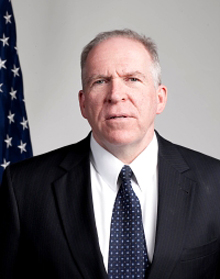
Former CIA Director John Brennan
It is easy to see why Brennan lost it. The Attorney General fired McCabe, denying him full retirement benefits, because McCabe “had made an unauthorized disclosure to the news media and lacked candor — including under oath — on multiple occasions.” There but for the grace of God go I, Brennan must have thought, whose stock in trade has been unauthorized disclosures.
In fact, Brennan can take but small, short-lived consolation in the fact that he succeeded in leaving with a full government pension. His own unauthorized disclosures and leaks probably dwarf in number, importance, and sensitivity those of McCabe. And many of those leaks appear to have been based on sensitive intercepted conversations from which the names of American citizens were unmasked for political purposes. Not to mention the leaks of faux intelligence like that contained in the dubious “dossier” cobbled together for the Democrats by British ex-spy Christopher Steele.
It is an open secret that the CIA has been leaking like the proverbial sieve over the last two years or so to its favorite stenographers at the New York Times and Washington Post. (At one point, the obvious whispering reached the point that the Wall Street Journal saw fit to complain that it was being neglected.) The leaking can be traced way back — at least as far as the Clinton campaign’s decision to blame the Russians for the publication of very damning DNC emails by WikiLeaks just three days before the Democratic National Convention.
This blame game turned out to be a hugely successful effort to divert attention from the content of the emails, which showed in bas relief the dirty tricks the DNC played on Bernie Sanders. The media readily fell in line, and all attention was deflected from the substance of the DNC emails to the question as to why the Russians supposedly “hacked into the DNC and gave the emails to WikiLeaks.”
This media operation worked like a charm, but even Secretary Clinton’s PR person, Jennifer Palmieri, conceded later that at first it strained credulity that the Russians would be doing what they were being accused of doing.
Magnificent Diversion
On April 6, 2017 I attended a panel discussion on “Russia’s interference in our democracy” at the Clinton/Podesta Center for American Progress Fund. In my subsequent write-up I noted that panelist Palmieri had inadvertently dropped tidbits of evidence that I suggested “could get some former officials in deep kimchi – if a serious investigation of leaking, for example, were to be conducted.” (That time seems to be coming soon.)
Palmieri was asked to comment on “what was actually going on in late summer/early fall [2016].” She answered:
“It was a surreal experience … so I did appreciate that for the press to absorb … the idea that behind the stage that the Trump campaign was coordinating with Russia to defeat Hillary Clinton was too fantastic for people to, um, for the press to process, to absorb….
“But then we go back to Brooklyn [Clinton headquarters] and heard from the — mostly our sources were other intelligence, with the press who work in the intelligence sphere, and that’s where we heard things and that’s where we learned about the dossier and the other story lines that were swirling about; and how to process … And along the way the administration started confirming various pieces of what they were concerned about what Russia was doing. … So I do think that the answer for the Democrats now … in both the House and the Senate is to talk about it more and make it more real.”
So the leaking had an early start, and went on steroids during the months following the Democratic Convention up to the election — and beyond.
As a Reminder
None of the leaking, unmasking, surveillance, or other activities directed against the Trump campaign can be properly understood, if one does not bear in mind that it was considered a sure thing that Secretary Clinton would become President, at which point illegal and extralegal activities undertaken to help her win would garner praise, not prison.
But she lost. And a month ago, House Intelligence Committee Chair Devin Nunes (R-CA) threw down the gauntlet, indicating that there could be legal consequences, for example, for officials who misled the FISA court in order to enable surveillance on Trump and associates. His words are likely to have sent chills down the spine of yet other miscreants. “If they need to be put on trial, we will put them on trial,” he said. “The reason Congress exists is to oversee these agencies that we created.”
John Brennan is widely reported to be Nunes’s next target. Does one collect a full pension in jail?
Unmasking: Senior national security officials are permitted to ask the National Security Agency to unmask the names of Americans in intercepted communications for national security reasons — not for domestic political purposes. Congressional committees have questioned why Obama’s UN ambassador Samantha Power (as well as his national security adviser Susan Rice) made so many unmasking requests. Power is reported to have requested the unmasking of more than 260 Americans, most of them in the final days of the administration, including the names of Trump associates.
Deep State Intimidation
Back to John Brennan’s bizarre tweet Saturday telling the President, “You may scapegoat Andy McCabe but you will not destroy America … America will triumph over you.” Unmasking the word “America,” so to speak, one can readily discern the name “Brennan” underneath. Brennan’s words and attitude are a not-so-subtle reminder of the heavy influence and confidence of the deep state, including the media — exercised to a fare-thee-well over the past two years.
Later on Saturday, Samantha Power, with similar equities at stake, put an exclamation point behind what Brennan had tweeted earlier in the day. Power also saw fit to remind Trump where the power lies, so to speak. She warned him publicly that it is “not a good idea to piss off John Brennan.”
Meanwhile, the Washington Post is dutifully playing its part in the deep-state game of intimidation. The following excerpt from Sunday’s lead article conveys the intended message: “Some Trump allies say they worry he is playing with fire by taunting the FBI. ‘This is open, all-out war. And guess what? The FBI’s going to win,’ said one ally, who spoke on the condition of anonymity to be candid. ‘You can’t fight the FBI. They’re going to torch him.’” [sic]
The Post, incidentally, waited until paragraph 41 of 44 to inform readers that it was the FBI’s own Office of Professional Responsibility and the Inspector General of the Department of Justice that found McCabe guilty, and that the charge was against McCabe, not the FBI. A quite different impression was conveyed by the large headline “Trump escalates attacks on FBI” as well as the first 40 paragraphs of Sunday’s lead article.
Putting Down a Marker
It isn’t as though Donald Trump wasn’t warned, as are all incoming presidents, of the power of the Deep State that he needs to play ball with — or else. Recall that just three days before President-elect Trump was visited by National Intelligence Director James Clapper, FBI Director James Comey, CIA Director John Brennan, and NSA Director Michael Rogers, Trump was put on notice by none other than the Minority Leader of the Senate, Chuck Schumer. Schumer has been around and knows the ropes; he is a veteran of 18 years in the House, and is in his 20th year in the Senate.
On Jan. 3, 2017 Schumer said it all, when he told MSNBC’s Rachel Maddow, that President-elect Trump is “being really dumb” by taking on the intelligence community and its assessments on Russia’s cyber activities:
“Let me tell you, you take on the intelligence community, they have six ways from Sunday at getting back at you,” Schumer told Maddow. “So even for a practical, supposedly hard-nosed businessman, he’s being really dumb to do this.” Did Maddow ask Schumer if he was saying President of the United States should be afraid of the intelligence community? No, she let Schumer’s theorem stand.
With gauntlets now thrown down by both sides, we may not have to wait very long to see if Schumer is correct in his blithe prediction as to how the present constitutional crisis will be resolved.
Ray McGovern works for Tell the Word, a publishing arm of the ecumenical Church of the Saviour in inner-city Washington. He served as a CIA analyst under seven Presidents and nine CIA directors and is now on the Steering Group of Veteran Intelligence Professionals for Sanity (VIPS).
‘Dictator’ Putin wins ‘fraud-tainted’ vote: Western media sticks to narrative on Russian election
RT | March 18, 2018
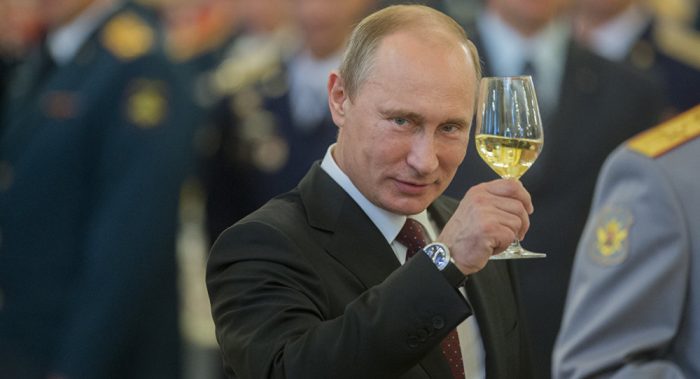
From Soviet comparisons to accusations of authoritarianism, mainstream coverage of Russia’s presidential election has barely changed since 2004, though mentions of the UK spy poisoning scandal did add a fresh layer of insinuation.
As Putin was thanking his supporters for a landslide victory from the stage in Red Square, Western outlets rolled out long, pre-written news stories, liberally mixing reporting and opinion.
“The vote was tainted by widespread reports of ballot-box stuffing and forced voting, but the complaints will likely do little to undermine Putin,” wrote AP’s lead report. “The Russian leader’s popularity remains high despite his suppression of dissent and reproach from the West over Russia’s increasingly aggressive stance in world affairs and alleged interference in the 2016 U.S. election.”
The Washington Post called Sunday’s vote an “elaborate presidential-election-day spectacle” that sought “to legitimize the election,” which “critics described as a charade,” by boosting the turnout as “a lack of suspense or popular opposition candidates threatened to keep people home.”
Calling the election a “hollow exercise,” the New York Times reached for the most predictable of parallels.
“Gone were the Soviet days when there was just one name on the ballot and the winner habitually harvested 99 percent of the vote. The spirit was similar, however, with pictures of Mr. Putin and his campaign slogan, ‘Strong president, strong Russia,’ blanketing the country,” it wrote.
In its top report. CNN said that Putin “seeks tighter grip on power,” while also reminding its readers that “he is already the country’s longest-serving leader since the Soviet dictator Joseph Stalin” (which is not actually true – that would be Leonid Brezhnev). CNN added that Putin is “banking on confrontation with international players this election.”
Rupert Murdoch’s News Corp Australia didn’t even bother with such nuances, calling Putin a straight-up “dictator,” though the article was later amended to merely describe the vote as “inevitable.”
For the Guardian, “paradoxically, the first order of business now… is for Putin to set up an escape plan.”
“Kremlin politics have become a bloodsport,” wrote Andrew Roth, the Guardian’s correspondent for Moscow. “With a shrinking economy [also untrue] and elites manoeuvring before a possible succession battle, the knives are out.”
This year, the usual analysis was also sprinkled with allegations that a Moscow agent poisoned Sergei Skripal with the toxin “Novichok, a gruesome calling card” to provoke a British response, according to the Guardian.
“A row with London can do Putin no harm, especially among voters who share his uncompromising nationalist worldview and his smouldering sense of victimhood,” an article in the Guardian said this week.
“The diplomatic crisis this poisoning case has caused may help him get more people into polling booths,” echoed Australia’s ABC.
Liberals, Conservatives Worry About Korean Peace Threat
By Gregory Shupak | FAIR | March 15, 2018

Washington Post‘s Max Boot (3/8/18)
Commentators across the spectrum of acceptable establishment opinion are alarmed by the possibility of peace breaking out on the Korean peninsula.
Some oppose the idea of talks between US President Donald Trump and North Korean leader Kim Jong-un on principle. Washington Post columnist Jennifer Rubin (3/9/18), for instance, suggested that Trump should not meet with Kim:
Is Trump now to glad-hand with Kim, treating him as just another world leader? Will Trump even bring up human rights? (You will recall that, in 2008, then-candidate Barack Obama was ridiculed for suggesting he’d sit down with the North Korean dictator; he prudently backed off that idea.)
Her newly hired colleague Max Boot (Washington Post, 3/8/18) concurred:
As recently as August, Trump tweeted: “The US has been talking to North Korea, and paying them extortion money, for 25 years. Talking is not the answer!” He was absolutely right.
Boot went on to contend:
The South Koreans claim that the North Koreans are willing to discuss denuclearization, but the likelihood is that they will only do so on terms that the United States should never accept. Kim may offer to give up his nukes if the United States will pull its forces out of South Korea and sign a peace treaty with the North.
What Boot sees as a doomsday scenario—peace between the two Koreas and the withdrawal from the peninsula of US troops, which serve as a constant threat to the North and thus ensure the permanent threat of war—is actually a formula for ensuring that there isn’t a second Korean war, one that is certain to be even more devastating than the catastrophic first one for Korea, and likely for the region and further afield.

Rachel Maddow (MSNBC, 3/9/18)
Rachel Maddow (MSNBC, 3/9/18) seemed flabbergasted by the prospect of a meeting between the leaders:
It has been the dream of North Korean leaders for decades now that they would advance their weapons programs and their nuclear programs so much so that the United States would be forced to acknowledge them as an equal and meet with the North Korean leader…. They got there with [Trump] and I don’t know that the administration intended it to be that kind of a gift. It’s just a remarkable time to be covering this stuff.
MSNBC blogger Steve Benen (3/9/18) says he’s “not opposed to direct diplomacy,” but he sounded like a time capsule from 1951 when he warned that
Trump has agreed to give Kim Jong-un exactly what he wants. North Korean leaders have sought this kind of meeting for decades because it would necessarily elevate the rogue state: It would show the world that North Korea’s leader is being treated as an equal by the Leader of the Free World.
New York Times columnist Nicholas Kristof (3/9/18) also claims to prefer that the US and North Korea exchange words rather than missiles, but he expressed relief that the threat of peace was minimal: “It’s genuinely encouraging that Kim doesn’t object to the US resuming military exercises,” he wrote, but worried that America
has agreed to give North Korea what it has long craved: the respect and legitimacy that comes from the North Korean leader standing as an equal beside the American president.
For Maddow, Benen and Kristof, a catastrophic nuclear war likely to kill millions is less threatening than the (frankly remote) possibility of America treating a small Asian country as an equal. This sort of commentary shows that liberal analysts are every bit as capable of a chest-thumping jingoism as their counterparts on the right.
In Praise of Sanctions
Sanctions on North Korea make it harder for aid organizations to operate in the country, and for people living there to obtain drugs and medical supplies, such as anesthesia used for emergency operations and X-ray machines needed to diagnose tuberculosis (Washington Post, 12/16/17). Tomás Ojea Quintana, the United Nations’ special rapporteur on human rights in North Korea, says he is “alarmed by reports that sanctions may have prevented cancer patients from access to chemotherapy and blocked the import of disability equipment.”
According to Kee B. Park (12/18/17), a neurosurgeon at Harvard Medical School, the hunger in North Korea “is devastating. And it’s our fault. Led by the United States, the international community is crippling North Korea’s economy” by “banning exports of coal, iron, lead, seafood and textiles, and limiting the import of crude oil and refined petroleum products,” “punishing the most vulnerable citizens” of the country. For example, UNICEF says that “an estimated 60,000 children face potential starvation in North Korea, where international sanctions are exacerbating the situation by slowing aid deliveries.”
The Post’s Boot, however, is impressed by the sanctions, and worried that they might be lifted: “North Korea hopes at a minimum for a relaxation of sanctions just when they are beginning to bite.” In the interest of precision, he should have added “60,000 children” after the word “bite.”
He continued:
It may make sense to talk to North Korea, but at a lower level, while maintaining the “maximum pressure” sanctions policy. Eventually the regime may feel so much pain that it will be willing to bargain in earnest.
North Korea doesn’t have the capacity to pain on the US, so it’s worth asking: Who will enforce hunger on America and destroy its economy to compel it to reverse its past approach (The Nation, 9/5/17) and “bargain in earnest” with North Korea? And would Boot endorse such an approach?
Boot can rest easy, however, about “so much pain” being reduced, as the Trump administration appears poised to maintain the sanctions until it determines that there has been “real progress” in the talks (AP, 3/13/18).
Kristof, like Boot, suggests that Trump “probably does” deserve credit for using sanctions to get North Korea to suspend tests of nuclear weapons:
First, Trump raised the economic pressure on North Korea with additional sanctions and extra support from China, and the pain was visible when I visited North Korea in September. Kim has made rising living standards a hallmark of his leadership, and sanctions have threatened that pillar of his legitimacy.
Kristof has made a career branding himself a bleeding heart concerned for the world’s most vulnerable but evidently his heart doesn’t bleed for “the most vulnerable citizens” of states that defy US dictates.
Washington Post Editorial Writer Disturbed to Discover the Importance of Precedent in Court Decisions
Charles Lane Continues Attack on Unions
CEPR | February 15, 2018
The Washington Post has long had a hostile attitude toward unions, which it expresses in both its opinion and news sections. (As an example of the latter, this front page article complaining about high pensions for public sector workers in California, highlighted the case of Bruce Malkenhorst Sr., a retired city administrator, who received a pension of more than $500,000 a year. Only after reading down in the piece do readers discover that Mr. Malkenhorst was awaiting trial for misusing public funds. Of course, as an administrator, he was not a typical public employee or a union member.)
The latest expression of hostility is from editorial writer Charles Lane. Lane is upset that public sector employees can be required to pay representation fees to the unions that represent them as a condition of working in a unit that is represented by a union. There is much about the current situation that draws his wrath.
First, he complains that the unions arguing the case currently before the Supreme Court are citing the precedent of a prior ruling supporting this practice. Apparently, Lane didn’t realize that US courts are governed by precedent.
Lane then makes the argument that there is a serious problem with public sector unions collecting representation fees and dues (dues are paid only by those who choose to join the union), which come out of their paychecks, and then use some of this money to support their favored political candidates. (Only dues can be used for political campaigns, not representation fees, which can only be used for the cost of running the union.)
Lane argues that this creates a conflict of interest because the government is effectively paying money to unions, who then support candidates that are favorable to the union. It’s not clear how this is different from government contractors who give campaign contributions to candidates who support giving them government contracts, or from oil companies who give campaign contributions to candidates who give them favorable access to government land, or from drug companies who give campaign contributions to candidates who will give them stronger and longer patent monopolies on their drugs.
For some reason, Lane thinks we should be troubled by workers who get a public sector paycheck supporting candidates who represent their interests. When private corporations use profits derived from government actions to support candidates who will increase their profits further, this is fine.
Of course, the immediate issue before the court is whether the government can sign a contract with a union that requires that everyone who benefits from union representation has to share in the cost of the representation. Lane wants to deny workers the right to have a contract that imposes conditions on their co-workers.
Interestingly, the court has explicitly gone the other way in allowing employers to impose terms on their employees with which they may not agree. In the Hobby Lobby case, the Supreme Court ruled that a company can require its workers to have insurance that does not cover contraceptives if the company’s owners have a religious objection to the use of contraceptives. In this case, the remedy for workers who believe that it is important that contraceptives be covered by insurance is to work somewhere else.
Under current law, companies can impose all sorts of conditions on their workers, such as wearing stupid hats, smiling at customers and giving overly friendly greetings, and even having insurance that comports with the boss’s religious beliefs. But Lane wants us to think that it interferes with workers’ individual freedom if their co-workers vote to put any conditions on employment.
When is there Going to be Accountability for US Wars and Aggression?
US makes new claims of WMD in Syria
By Rick Sterling | Dissident Voice | February 3, 2018
It’s WMD all over again.
Anonymous “US officials” are once again accusing a targeted “regime” of using “chemical weapons” and threatening that the U.S. military may have to “hold it accountable”. Once again, western media is broadcasting these accusations and threats without skepticism or investigation.
The Washington Post story is titled “Trump administration: Syria probably continuing to make, use chemical weapons”. Jane’s Defence Weekly quotes a U.S. official saying “They clearly think they can get away with this …”
Jerusalem Online says “A US official says Syrian President Assad’s forces may be developing new types of chemical weapons, which which could reach as far as the US…”
The Reuters story in the New York Times says “US officials have said the Syrian government may be developing new types of chemical weapons, and President Donald Trump is prepared to consider further military action…. President Bashar al Assad is believed to have secretly kept part of Syria’s chemical weapons stockpile…”
The Washingon Post article concludes with the threat, “If the international community does not take action now . . . we will see more chemical weapons use, not just by Syria but by non-state actors such as ISIS and beyond,” the first official said. “And that use will spread to U.S. shores.”
Based on a review of facts from recent history, it is very likely the story is false and is being broadcast to deceive the public in preparation for new military aggression. Anyone who thinks that politicians don’t consider timing and marketing needs to only recall the statement of a GW Bush official that “from a marketing point of view, you don’t introduce new products in August.” The “product” was the PR campaign to get the American public to accept the invasion of Iraq.
When is there going to be some accountability for the US military industrial complex and their political and media enablers and promoters?
The invasion of Vietnam with over 500 thousand US soldiers was preceded by the phony Gulf of Tonknin incident where a US ship was supposedly attacked by a North Vietnamese vessel. It was untrue and President Johnson knew it. The resolution was passed unanimously (416-0) in the House and only Wayne Morse and Ernest Gruening had the integrity and insight to oppose it in the Senate. Was anyone ever held accountable for the lie that led to over 58 thousand dead US soldiers and millions of dead Vietnamese? No.
The 1991 attack on Iraq and subsequent massacre of Iraqi soldiers and civilians was preceded by the fabricated testimony of the Kuwaiti Ambassador’s daughter pretending to be a nurse who had witnessed Iraqi soldiers stealing incubators and leaving Kuwaiti babies on the floor. Were the marketing officials Hill & Knowlton and politicians such as Tom Lantos who managed this deceit ever held accountable? No.
In 2003 the US launched the invasion of Iraq leading to the death of over a million Iraqis based on the false and fabricated evidence provided by the CIA and uncritically promoted by the mainstream media. For example, Michael Gordon and Thomas Friedman promoted and lauded the invasion at the NYTimes. Were they held to account? No, they carry right on to today.
In 2011 the US led NATO attacks on Libya with the stated purpose to “protect civilians” from massacre. This was explained and encouraged by journalists and pundits such as Nicholas Kristof and Juan Cole. NATO officials bragged about their operation. After the brief western euphoria, it became clear that the campaign was based on lies and the real result was an explosion of extremism, massacres and chaos which continues to today. Accountability? None. One rarely hears about Libya today. Out of sight, out of mind.
In August of 2013 we heard about a massive sarin gas attack on the outskirts of Damascus. Human Rights Watch and others promoting a western attack quickly accused the Syrian government. They asserted that Assad had crossed Obama’s “red line” and the US needed to intervene directly. Subsequent investigations revealed the gas attack was not carried out by the Syrian government. It was perpetrated by a Turkish supported terrorist faction with the goal of pressuring the Obama administration to directly attack Syria. Two Turkish parliamentarians presented evidence of Turkey’s involvement in the transfer of sarin. Some of the best and most time-proven US investigative journalists, including the late Robert Parry and Seymour Hersh, researched and discovered the evidence points to Turkish supported “rebels” not Syria. Despite the factual evidence exposing the “junk heap” of false claims, mainstream media and their followers continue to assert that Assad committed the crime.
In April 2017 it was the same thing: US and allies made accusations which were never proven and ultimately discredited. The UN/OPCW investigation team never visited the scene of the crime. They discovered the curious fact that dozens of victims in multiple locations showed up at hospitals with symptoms of chemical injuries before the attack happened. This is strong evidence of fraud but that investigation was not pursued. With or without awareness of the deceit, Trump ordered missile strikes on a Syrian air base which killed 13 people including four children. Accountability? None.
Recently it has become clear that dark forces in the US government ad military do not intend to stop their efforts to destroy Syria. Despite confusion and contradictory claims in the US administration, a core fact is that the US is training and supplying a sectarian military militia inside northern Syria against the wishes of the Syrian government. The US said they were in Syria to get rid of ISIS but now that ISIS is largely gone, the US military says it is not leaving. On the contrary, the US military helped escort ISIS fighters from Raqqa to al Bukamal and the US is now training ISIS fighters to be reincarnated as yet another anti-Assad “rebel” force.
As always, US aggression needs some measure of political support. To gain that, they need a justification. Thus it’s WMD all over again. Once again. the “bad guys” are using chemical weapons on their own people. Supposedly the Syrian government is incredibly stupid … they just keep on using chemical weapons and giving the US a justification to act as judge, jury and executioner.
Most of the American public is too busy, distracted or overwhelmed with problems to investigate U.S. government claims. Mainstream media, including some alternative media, are failing badly. They are supposed to be holding government to account, critically questioning the assertions, investigating the facts, exposing contradictions and falsehoods. Along with the politicians and government, they have some responsibility for the ongoing wars and aggression. They all should be accountable. When is that going to happen?
Rick Sterling can be contacted at rsterling1@gmail.com.
Featured Video
Dr. Tony Martin – The Jewish Role in the African Slave Trade
or go to
Aletho News Archives – Video-Images
In Memoriam
James Petras, In Memoriam
 02.13.2026
Professor James Petras, 89, world-renowned sociologist, public intellectual, and scholar of Latin American politics and global economics, died peacefully on January 17, 2026, in Seattle, WA, surrounded by family.
A prolific scholar and activist, he devoted his life to challenging power, imperialism, and inequality. … continue
Blog Roll
 Aletho News
- Israel ready to strike Iran-backed armed groups – media
- Behind US war drums against Iran: No goals, no plan, no off-ramp
- With Ukraine blamed for cutting oil flows to Hungary, Croatia also refuses to transfer Russian oil in violation of EU law
- Friedrich Merz’s Push to End Online Anonymity Has a Troubling Subtext
- Macron: French citizens fighting for Israel cannot be labeled ‘genociders’
- US eyes Gaza security force drawn from armed gangs
- The Only Motive Behind The ‘Imminent’ U.S. War With Iran Is The Zionist Lobby
- Trump eyes 350-acre US military base housing 5,000 troops in Gaza
- Israel Pushing US Toward a Big and Damaging War With Iran – Ex-Pentagon Analyst
- Meet The Liberal Zionist And Ukraine War Supporter Advising AOC On Foreign Policy
- If Americans Knew
- No mercy for Gaza in Ramadan – Not a ceasefire Day 133
- The Israeli Government Installed and Maintained Security System at Epstein Apartment
- Tucker Carlson interrogated in Israel, has passport seized after interviewing US ambassador
- 6,000 Amputees in Gaza Face Impossible Recovery amid Israeli War Ultimatum
- The Lancet: Gaza death toll far higher than reported – Not a ceasefire Day 132
- Compliant aid: Who are the Israel-approved NGOs scaling up in Gaza?
- Why won’t Trump’s “Board of Peace” bring peace? – Not a ceasefire Day 131
- Help end the injustice against Shadi
- Israel’s Favorite American President
- Israel’s “Yellow Line” Is a Death Trap for Palestinians. We Drove Into It.
- No Tricks Zone
- Coal Power Back In Trend As Globe Tries To Keep Pace With Growing Demand For Power
- New Study: A 4°C Warmer Beaufort Sea Had ‘No Sea Ice’ 11,700 – 8200 Years Ago
- Unfudging The Data: Dutch Meteorological Institute Reinstates Early 20th Centruy Heat Waves It Had Erased Earlier
- German Gas Crisis…Chancellor Merz Allegedly Bans Gas Debate Ahead of Elections!
- Pollen Reconstructions Show The Last Glacial’s Warming Events Were Global, 10x Greater Than Modern
- Germany’s Natural Gas Storage Level Dwindles To Just 28%… Increasingly Critical
- New Study Rebuts The Assumption That Anthropogenic CO2 Molecules Have ‘Special’ Properties
- Climate Scientist Who Predicted End Of “Heavy Frost And Snow” Now Refuses Media Inquiries
- Polar Bear Numbers Rising And Health Improving In Areas With The Most Rapid Sea Ice Decline
- One Reason Only For Germany’s Heating Gas Crisis: Its Hardcore-Dumbass Energy Policy
 Aletho News