WaPo forced to retract claim that Obama told Zuckerberg to tackle alleged Russian meddling
RT | September 27, 2017
 The Washington Post has been forced to remove Russia from the headline and alter the content of its front-page “scoop” over a supposed conversation between Barack Obama and Facebook founder Mark Zuckerberg, after the social network denied the newspaper’s claims.
Under the headline “Obama sought to prod Facebook on Russia role,” the three-author story alleged that “Obama and his top aides quietly agonized over how to respond to Russia’s brazen intervention on behalf of the Donald Trump” prior to the 2016 election, before the last US president “pulled the youthful tech billionaire aside and delivered what he hoped would be a wake-up call” last November.
Only this is not what the exchange at the APEC conference in Peru on November 19, 2016 was about – and there was no mention of political interference from Moscow or anyone else.
“Their conversation was about misinformation and false news, which Mark had addressed the previous day in a post that outlined specific steps Facebook was taking to combat these challenges. The discussion did not include any references to possible foreign interference or suggestions about confronting threats to Facebook,” the social network in a statement.
Obama’s representatives have declined to comment on the Washington Post story.
The Washington Post, owned by Amazon founder Jeff Bezos, has changed the story title in its online archive, and says its piece has now been “updated with an additional response from Facebook.”
The authors used the misrepresented Obama conversation as a hook into a 2,500-word report about the social network’s slowness in catching on to, and counteracting purported Russian meddling, and to put forward expert claims that it “dragged its feet and is acting only now because of outside political pressure.”
“We believe in the power of democracy, which is why we’re taking this work on elections integrity so seriously, and have come forward at every opportunity to share what we’ve found,” Elliot Schrage, Facebook’s vice president for public policy and communications, told the Washington Post in response.
Read more:
The Rise of the New McCarthyism
By Robert Parry | Consortium News | September 26, 2107
Make no mistake about it: the United States has entered an era of a New McCarthyism that blames nearly every political problem on Russia and has begun targeting American citizens who don’t go along with this New Cold War propaganda.
A difference, however, from the McCarthyism of the 1950s is that this New McCarthyism has enlisted Democrats, liberals and even progressives in the cause because of their disgust with President Trump; the 1950s version was driven by Republicans and the Right with much of the Left on the receiving end, maligned by the likes of Sen. Joe McCarthy as “un-American” and as Communism’s “fellow travelers.”
The real winners in this New McCarthyism appear to be the neoconservatives who have leveraged the Democratic/liberal hatred of Trump to draw much of the Left into the political hysteria that sees the controversy over alleged Russian political “meddling” as an opportunity to “get Trump.”
Already, the neocons and their allies have exploited the anti-Russian frenzy to extract tens of millions of dollars more from the taxpayers for programs to “combat Russian propaganda,” i.e., funding of non-governmental organizations and “scholars” who target dissident Americans for challenging the justifications for this New Cold War.
The Washington Post, which for years has served as the flagship for neocon propaganda, is again charting the new course for America, much as it did in rallying U.S. public backing for the 2003 invasion of Iraq and in building sympathy for abortive “regime change” projects aimed at Syria and Iran. The Post has begun blaming almost every unpleasant development in the world on Russia! Russia! Russia!
For instance, a Post editorial on Tuesday shifted the blame for the anemic victory of German Chancellor Angela Merkel and the surprising strength of the far-right Alternative for Germany (AfD) from Merkel’s austerity policies, which have caused hardship for much of the working class, or from her open door for Mideast refugees, which has destabilized some working-class neighborhoods, to – you guessed it – Russia!
The evidence, as usual, is vague and self-interested, but sure to be swallowed by many Democrats and liberals, who hate Russia because they blame it for Trump, and by lots of Republicans and conservatives, who have a residual hatred for Russia left over from the Old Cold War.
The Post cited the Atlantic Council’s Digital Forensic Research Lab, which has been pushing much of the hysteria about alleged Russian activities on the Internet. The Atlantic Council essentially is NATO’s think tank and is financed with money from the U.S. government, Gulf oil states, military contractors, global financial institutions and many other sources which stand to gain directly or indirectly from the expanding U.S. military budget and NATO interventions.
Blaming Russia
In this New Cold War, the Russians get blamed for not only disrupting some neocon “regime change” projects, such as the proxy war in Syria, but also political developments in the West, such as Donald Trump’s election and AfD’s rise in Germany.
The Atlantic Council’s digital lab claimed, according to the Post editorial, that “In the final hours of the [German] campaign, online supporters of the AfD began warning their base of possible election fraud, and the online alarms were ‘driven by anonymous troll accounts and boosted by a Russian-language bot-net.’”
Of course, the Post evinces no evidence tying any of this to the Russian government or to President Vladimir Putin. It is the nature of McCarthyism that actual evidence is not required, just heavy breathing and dark suspicions. For those of us who operate Web sites, “trolls” – some volunteers and some professionals – have become a common annoyance and they represent many political outlooks, not just Russian.
Plus, it is standard procedure these days for campaigns to issue last-minute alarms to their supporters about possible election fraud to raise doubts about the results should the outcome be disappointing.
The U.S. government has engaged in precisely this strategy around the world, having pro-U.S. parties not only complain about election fraud but to take to the streets in violent protests to impugn the legitimacy of election outcomes. That U.S. strategy has been applied to places such as Ukraine (the Orange Revolution in 2004); Iran (the Green Revolution in 2009); Russia (the Snow Revolution in 2011); and many other locations.
Pre-election alerts also have become a feature in U.S. elections, even in 2016 when both Donald Trump and Hillary Clinton raised questions about the legitimacy of the balloting, albeit for different reasons.
Yet, instead of seeing the AfD maneuver as a typical ploy by a relatively minor party – and the German election outcome as an understandable reflection of voter discontent and weariness over Merkel’s three terms as Chancellor – the Atlantic Council and the Post see Russians under every bed and particularly Putin.
Loving to Hate Putin
In the world of neocon propaganda, Putin has become the great bête noire, since he has frustrated a variety of neocon schemes. He helped head off a major U.S. military strike against Syria in 2013; he aided President Obama in achieving the Iran nuclear agreement in 2014-15; Putin opposed and – to a degree – frustrated the neocon-supported coup in Ukraine in 2014; and he ultimately supplied the air power that defeated neocon-backed “rebel” forces in Syria in 2015-17.
So, the Post and the neocons want Putin gone – and they have used gauzy allegations about “Russian meddling” in the U.S. and other elections as the new propaganda theme to justify destabilizing Russia with economic sanctions and, if possible, engineering another “regime change” project in Moscow.
None of this is even secret. Carl Gershman, the neocon president of the U.S.-government-funded National Endowment for Democracy, publicly proclaimed the goal of ousting Putin in an op-ed in The Washington Post, writing: “The United States has the power to contain and defeat this danger. The issue is whether we can summon the will to do so.”
But the way neocon propaganda works is that the U.S. and its allies are always the victims of some nefarious enemy who must be thwarted to protect all that is good in the world. In other words, even as NED and other U.S.-funded operations take aim at Putin and Russia, Russia and Putin must be transformed into the aggressors.
“Mr. Putin would like nothing better than to generate doubts, fog, cracks and uncertainty around the German pillar of Europe,” the Post editorial said. “He relishes infiltrating chaos and mischief into open societies. In this case, supporting the far-right AfD is extraordinarily cynical, given how many millions of Russians died to defeat the fascists seven decades ago.”
Not to belabor the point but there is no credible evidence that Putin did any of this. There is a claim by the virulently anti-Russian Atlantic Council that some “anonymous troll accounts” promoted some AfD complaint about possible voter fraud and that it was picked up by “a Russian-language bot-net.” Even if that is true – and the Atlantic Council is far from an objective source – where is the link to Putin?
Not everything that happens in Russia, a nation of 144 million people, is ordered by Putin. But the Post would have you believe that it is. It is the centerpiece of this neocon conspiracy theory.
Silencing Dissent
Similarly, any American who questions this propaganda immediately is dismissed as a “Kremlin stooge” or a “Russian propagandist,” another ugly campaign spearheaded by the Post and the neocons. Again, no evidence is required, just some analysis that what you’re saying somehow parallels something Putin has said.
On Tuesday, in what amounted to a companion piece for the editorial, a Post article again pushed the unproven suspicions about “Russian operatives” buying $100,000 in Facebook ads from 2015 into 2017 to supposedly influence U.S. politics. Once again, no evidence required.
In the article, the Post also reminds its readers that Moscow has a history of focusing on social inequities in the U.S., which gets us back to the comparisons between the Old McCarthyism and the new.
Yes, it’s true that the Soviet Union denounced America’s racial segregation and cited that ugly feature of U.S. society in expressing solidarity with the American civil rights movement and national liberation struggles in Africa. It’s also true that American Communists collaborated with the domestic civil rights movement to promote racial integration.
That was a key reason why J. Edgar Hoover’s FBI targeted Martin Luther King Jr. and other African-American leaders – because of their association with known or suspected Communists. (Similarly, the Reagan administration resisted support for Nelson Mandela because his African National Congress accepted Communist support in its battle against South Africa’s Apartheid white-supremacist regime.)
Interestingly, one of the arguments from liberal national Democrats in opposing segregation in the 1960s was that the repression of American blacks undercut U.S. diplomatic efforts to develop allies in Africa. In other words, Soviet and Communist criticism of America’s segregation actually helped bring about the demise of that offensive system.
Yet, King’s association with alleged Communists remained a talking point of die-hard segregationists even after his assassination when they opposed creating a national holiday in his honor in the 1980s.
These parallels between the Old McCarthyism and the New McCarthyism are implicitly acknowledged in the Post’s news article on Tuesday, which cites Putin’s criticism of police killings of unarmed American blacks as evidence that he is meddling in U.S. politics.
“Since taking office, Putin has on occasion sought to spotlight racial tensions in the United States as a means of shaping perceptions of American society,” the article states. “Putin injected himself in 2014 into the race debate after protests broke out in Ferguson, Mo., over the fatal shooting of Michael Brown, an African American, by a white police officer.
“‘Do you believe that everything is perfect now from the point of view of democracy in the United States?’ Putin told CBS’s ’60 Minutes’ program. ‘If everything was perfect, there wouldn’t be the problem of Ferguson. There would be no abuse by the police. But our task is to see all these problems and respond properly.’”
The Post’s speculative point seems to be that Putin’s response included having “Russian operatives” buy some ads on Facebook to exploit these racial tensions, but there is no evidence to support that conspiracy theory.
However, as this anti-Russia hysteria spreads, we may soon see Americans who also protest the police killing of unarmed black men denounced as “Putin’s fellow-travelers,” much as King and other civil rights leaders were smeared as “Communist dupes.”
Ignoring Reality
So, instead of Democrats and Chancellor Merkel looking in the mirror and seeing the real reasons why many white working-class voters are turning toward “populist” and “extremist” alternatives, they can simply blame Putin and continue a crackdown on Internet-based dissent as the work of “Russian operatives.”
Already, under the guise of combating “Russian propaganda” and “fake news,” Google, Facebook and other tech giants have begun introducing algorithms to hunt down and marginalize news that challenges official U.S. government narratives on hot-button issues such as Ukraine and Syria. Again, no evidence is required, just the fact that Putin may have said something similar.
As Democrats, liberals and even some progressives join in this Russia-gate hysteria – driven by their hatred of Donald Trump and his supposedly “fascistic” tendencies – they might want to consider whom they’ve climbed into bed with and what these neocons have in mind for the future.
Arguably, if fascism or totalitarianism comes to the United States, it is more likely to arrive in the guise of “protecting democracy” from Russia or another foreign adversary than from a reality-TV clown like Donald Trump.
The New McCarthyism with its Orwellian-style algorithms might seem like a clever way to neutralize (or maybe even help oust) Trump but – long after Trump is gone – a structure for letting the neocons and the mainstream media monopolize American political debate might be a far greater threat to both democracy and peace.
Investigative reporter Robert Parry broke many of the Iran-Contra stories for The Associated Press and Newsweek in the 1980s.
Washington Post Pushes More Dubious Russia-bashing
By Robert Parry | Consortium News | September 25, 2017
Some people are calling the anti-Russian hysteria being whipped up across the U.S. mainstream news media a new “golden age of American journalism,” although it looks to me more like a new age of yellow journalism, prepping the people for more military spending, more “information warfare” and more actual war.
Yes, without doubt, President Trump is a boorish and dangerous demagogue, now highlighted by his reckless speech before the United Nations last week, his schoolyard Tweet taunts toward North Korean leader Kim Jong Un, and his ugly denunciation of black athletes for protesting against police killings of often unarmed African-Americans.
And, yes, I know that some people feel that the evidence-lite and/or false allegations about “Russian meddling” are the golden ticket to Trump’s impeachment. But the unprofessional behavior of The New York Times, The Washington Post and pretty much the entire mainstream media regarding Russia-gate cannot be properly justified by the goal of removing Trump from office.
Ethically in journalism, the ends – however much you might wish them to succeed – cannot justify the means, if those means involve violating rules of evidence and principles of fairness. Journalism should be a place where all sides get a fair shake, not where some get a bum’s rush.
But the U.S. mainstream media has clearly joined the anti-Trump Resistance and hates Russian President Vladimir Putin, too. So, we are given such travesties of journalism as appeared as a banner headline across the front page of Monday’s Washington Post, another screed about how Russia supposedly used Facebook ads to flip last November’s election for Trump.
The article purports to give the inside story of how Facebook belatedly came to grips with how the “company’s social network played a key role in the U.S. election,” but actually it is a story about how powerful politicians bullied Facebook into coming up with something – anything – to support the narrative of “Russian meddling,” including direct interventions by President Obama and Sen. Mark Warner of Virginia, the ranking Democrat on the Senate Intelligence Committee and a key legislator regarding regulation of high-tech industries.
Finding the ‘Evidence’
In other words, Facebook was sent back again and again to find what Obama and Warner wanted the social media company to find. Eventually, Facebook turned up $100,000 in ads from 2015 into 2017 that supposedly were traced somehow to Russia. These ads apparently addressed political issues in America although Facebook has said most did not pertain directly to the presidential election and some ads were purchased after the election.
Left out of the Post’s latest opus is what a very small pebble these ads were – even assuming that Russians did toss the $100,000 or so in ad buys into the very large lake of billions of dollars in U.S. political spending for the 2016 election cycle. It also amounts to a miniscule fraction of Facebook’s $27 billion in annual revenue.
So the assertion that this alleged “meddling” – and we’ve yet to see any evidence connecting these ads to the Russian government – “played a key role in the U.S. election” is both silly and outrageous, especially given the risks involved in stoking animosities between nuclear-armed Russia and nuclear-armed America.
Even the Post’s alarmist article briefly acknowledges that it is still unclear who bought the ads, referring to the purchasers as “suspected Russian operatives.” In other words, we don’t even know that the $100,000 in ads over three years came from Russians seeking to influence the U.S. election. (By comparison, many Facebook advertisers – even some small businesses – spend $100,000 per day on their ads, not $100,000 over three years.)
But this diminutive effort by “suspected Russian operatives” doesn’t stop the Post from going on and on about “fake news” and “disinformation,” albeit again without offering evidence or specifics of any Russian “fake news” or “disinformation.”
It has simply become Official Washington’s new groupthink to say that everything linked to Russia or its international TV network RT is “fake news” or “disinformation” even though examples are lacking or often turn out to be false accusations themselves.
For instance, there is nothing in the Post’s article acknowledging that nothing from the various Democratic email disclosures, which have been blamed on Russia (again without real evidence), has been identified as untrue. So, how can truthful information, whether you like how it was obtained or not, be “fake news” or “disinformation”?
Falsehood as Fact
But Monday’s Post exposé simply asserts the claim as flat fact. Or as the article asserts: “what Russian operatives posted on Facebook was, for the most part, indistinguishable from legitimate political speech. The difference was the accounts that were set up to spread the misinformation and hate were illegitimate.”
In responsible journalism, such an accusation would be followed by a for-instance, giving an example of “the misinformation and hate” that the “Russian operatives” – note how they have been magically transformed from “suspected Russian operatives” to simply “Russian operatives” – were disseminating.
But there is no example of the Russian “misinformation and hate,” a classic violation of the reporting principle of “show, don’t tell.” In this story, it’s all tell and no show.
Indeed, what is shown in the article is often contradictory to the story’s conclusion. The article says, for instance, “A review by the company found that most of the groups behind the problematic pages had clear financial motives, which suggested that they weren’t working for a foreign government. But amid the mass of data the company was analyzing, the security team did not find clear evidence of Russian disinformation or ad purchases by Russian-linked accounts.”
So, Facebook initially – after extensive searching – did not find evidence of a Russian operation. Then, after continued pressure from high-level Democrats, Facebook continued to scour its system and again found nothing, or as the Post article acknowledged, Facebook “had searched extensively for evidence of foreign purchases of political advertising but had come up short.”
That prompted Warner to fly out to Silicon Valley to personally press Facebook executives to come up with the evidence to support the Democrats’ theory about Russia paying for carefully targeted anti-Clinton ads in key districts.
The Post’s article reported that “Finally, [Facebook Chief Security Officer Alex] Stamos appealed to Warner for help: If U.S. intelligence agencies had any information about the Russian operation or the troll farms it used to disseminate misinformation, they should share it with Facebook. The company is still waiting, people involved in the matter said.”
Under Pressure
Still, faced with extraordinary pressure from senior Democrats, Facebook finally delivered the desired results, or as the Post reported, “By early August, Facebook had identified more than 3,000 ads addressing social and political issues that ran in the United States between 2015 and 2017 and that appear to have come from accounts associated with the [St. Petersburg, Russia-based] Internet Research Agency.”
So, the ads covering three years, including post-election 2017, only “appear” to be “associated” with some private Russian operation that only allegedly has ties to the Kremlin. And the total sums of the ad buys are infinitesimal compared to what it actually takes to have any real impact on Facebook or in a U.S. presidential election.
If the context of this story were changed slightly – say, it was about the U.S. government trying to influence public opinion in another country (which actually does happen quite a bit) – the Post would be among the first news outlets to laugh off such allegations or dismiss the vague accusations as a conspiracy theory, but since these allegations fit with the prejudices of the Post’s editors, an entirely different set of journalistic standards is applied.
What the article also ignores is the extraordinary degree of coercion that such high-level political pressure can put on a company that recognizes its vulnerability to government regulation.
As Facebook has acknowledged in corporate filings, “Action by governments to restrict access to Facebook in their countries could substantially harm our business and financial results. It is possible that governments of one or more countries may seek to censor content available on Facebook in their country, restrict access to Facebook from their country entirely, or impose other restrictions that may affect the accessibility of Facebook in their country for an extended period of time or indefinitely. …
“In the event that access to Facebook is restricted, in whole or in part, in one or more countries or our competitors are able to successfully penetrate geographic markets that we cannot access, our ability to retain or increase our user base and user engagement may be adversely affected, we may not be able to maintain or grow our revenue as anticipated, and our financial results could be adversely affected.”
Avoiding Reality
In other words, another way to have framed this story is that powerful politicians who could severely harm Facebook’s business model were getting in the face of Facebook executives and essentially demanding that they come up with something to support the Democratic Party’s theory of “Russian meddling.”
The Democratic leaders wanted this finding as an explanation for Hillary Clinton’s stunning defeat, rather than going through the painful process of examining why the party has steadily lost ground in white working-class areas across the country.
What is missed in these Russia-bashing articles is that the Democratic brand has been sinking for years, including massive losses in statehouses across the country as well as in Congress. The party’s decline was not a one-off event with Donald Trump suddenly snaking away with significant parts of the white working class because the Russians bought some Facebook ads.
However, instead of looking in the mirror, national Democrats demanded that Facebook executives ferret out whatever tiny or imaginary information there might be about some Russians buying Facebook ads – and then allow those coerced findings to be fed into the excuse industry for why Hillary Clinton lost.
And, what about the Post’s repeated accusations about Russia engaging in “disinformation” and “fake news” without offering a single example? Apparently, these assertions have become such articles of faith in the U.S. mainstream media that they don’t require any proof.
However, honest journalism demands examples and evidence, not just vague accusations. The reality is that the U.S. government has stumbled again and again when seeking to paint RT as a disinformation outlet or a vehicle for undermining American democracy.
For instance, the Jan. 6 report on alleged Russian “cyber operations,” released by Obama’s Director of National Intelligence James Clapper, included a lengthy appendix, dated from 2012, which decried RT for such offenses as allowing a debate among third-party presidential candidates who had been excluded from the Republican-Democratic debates; covering the Occupy Wall Street protests; and citing the environmental dangers from “fracking.”
The idea that American democracy is threatened by allowing third-party candidates or other American dissidents to have a voice is at best an upside-down understanding of democracy and, more likely, an exercise in hypocritical propaganda.
False Accusations
Another misfired attempt to discredit RT came from Obama’s Under Secretary of State for Public Diplomacy Richard Stengel, who issued a “Dipnote” in April 2014, which helped establish the narrative of RT as a source of Russian disinformation.
For instance, Stengel claimed that RT reported a “ludicrous assertion” that the United States had spent $5 billion to produce Ukraine’s “regime change” in February 2014.
But what Stengel, a former managing editor of Time magazine, apparently failed to understand was that RT was referring to a public speech by Assistant Secretary of State for European Affairs Victoria Nuland to U.S. and Ukrainian business leaders on Dec. 13, 2013, in which she told them that “we have invested more than $5 billion” in what was needed for Ukraine to achieve its “European aspirations.” In other words, the RT report wasn’t “ludicrous” at all.
Nuland also was a leading proponent of “regime change” in Ukraine who personally cheered on the Maidan demonstrators, even passing out cookies. In an intercepted pre-coup phone call with U.S. Ambassador to Ukraine Geoffrey Pyatt, Nuland discussed who should run the new government and pondered with Pyatt how to “glue” or “midwife this thing.”
So, Stengel was the one disseminating false information, not RT.
Similarly, senior U.S. politicians, including Hillary Clinton, and the U.S. mainstream media have falsely asserted that all 17 U.S. intelligence agencies signed off on the Russia-did-it hacking claims.
For months, that canard was used to silence skepticism. After all, how could you question something that all 17 U.S. intelligence agencies confirmed to be true?
But it turned out that – as DNI Clapper, himself a hardline Russia-basher, belatedly acknowledged – the Jan. 6 report on the alleged Russian hacking was the work of “hand-picked” analysts from only three agencies, the CIA, FBI and NSA, and the “assessment” itself admitted that it was not asserting the Russian conclusion as fact, only the analysts’ opinion.
The New York Times finally retracted its use of the fake claim about “all 17 U.S. intelligence agencies” in late June 2017 although it wouldn’t let the lie lie, so instead the Times made misleading references to a “consensus” among U.S. intelligence agencies without using the number.
Recent studies by former U.S. intelligence experts have punched more holes in the certainty by raising doubts that the email downloads could have been accomplished over the Internet at the recorded speeds and more likely were achieved by an insider downloading onto a thumb drive.
Deciding What’s Real
So who is guilty of “fake news” and “disinformation”?
One positive from the current PBS series, “The Vietnam War,” is that despite its bend-over-backwards attempts to make excuses for the “good faith” decisions by U.S. politicians, no one can watch the series without encountering the chasm between the upbeat Official Story being peddled by the U.S. government and the ghastly on-the-ground reality.
Yet, given how little accountability was meted out then for journalists who served as conveyor belts for pro-war propaganda in Vietnam – or more recently over the fraudulent reporting that rationalized the U.S. aggressive war against Iraq – it is perhaps not surprising that similar false group thinks would coalesce around Russia now.
Careerist journalists understand that there is no danger in running with the pack – indeed, there is safety in numbers – but there are extraordinary risks to your career if you challenge the conventional wisdom even if you turn out to be right. As one establishment journalist once told me, “there’s no honor in being right too soon.”
So, for the Post reporters responsible for the latest journalistic violation of standards – Adam Entous, Elizabeth Dwoskin and Craig Timberg – there will be no penalty for the offense of telling about Russia’s alleged “disinformation” and “fake news” – rather than showing, i.e., providing actual examples. When it comes to Russia these days – as with the Vietcong in the 1960s or Iraq in 2002-03 – you can pretty much write whatever you want. All journalistic standards are gone.
Yet, what is perhaps most insidious about what we are seeing is that – in the name of defending democracy – the U.S. mainstream media is trampling a chief principle of the Enlightenment, the belief that the marketplace of ideas is the best way to determine the truth and to create an informed populace.
The new U.S. mainstream media paradigm is that only establishment-approved views can be expressed; everything else must be suppressed, purged and punished.
For instance, if you question the State Department’s narrative on alleged Syrian government sarin attacks – by noting contrary evidence that points to staged incidents by Al Qaeda’s Syrian affiliate – you are called an “apologist” for Syrian President Bashar al-Assad.
If you question the one-sided State Department narrative regarding the Ukraine coup in 2014 – indeed even if you use the word “coup” – you are denounced as a “Kremlin stooge.”
No ‘Other’ Side
It is now not okay to even consider the other side of these stories, just as it was anathema to suggest that Saddam Hussein’s Iraqi government may have been telling the truth in 2002-03 when it declared repeatedly that it had destroyed its WMDs. That made you a “Saddam apologist.”
The hostility toward Americans who dare question the current anti-Russian hysteria was highlighted by an article last Thanksgiving Day by one of the authors of the new Post article, Craig Timberg.
In another front-page Post story, Timberg allowed an anonymous group called PropOrNot to malign the professionalism and patriotism of 200 Web sites, including our own Consortiumnews, that were lumped together in a McCarthyistic smear that they were somehow guilty of disseminating “Russian propaganda.”
The unnamed accusers – granted anonymity by the Post – acknowledged that they had no evidence that the sites were part of some grand Russian conspiracy but made the judgment based on PropOrNot’s analysis of the Web sites’ content.
In other words, if you questioned the State Department’s narratives on Ukraine or Syria – regardless of how well-supported those critiques were – you got smeared as a “Russian propagandist” – and the Post, which didn’t even bother to contact the accused, considered that sort of analysis to be worthy of its front page.
The story fed into another frenzy about the need to use algorithms and artificial intelligence to hunt down and suppress or purge such dissenting views from the Internet, supposedly to protect the sanctity of American democracy and spare Americans from exposure to “fake news.”
So, well-meaning Americans who may hope that Russia-gate will somehow bring down Trump are getting recruited into a movement that intends to silence dissent and allow the U.S. establishment to dictate what information you will get to see and hear.
And that officially approved “information” will surely lead to new global tensions, more military spending. and additional warfare up to and possibly including nuclear war with Russia.
Investigative reporter Robert Parry broke many of the Iran-Contra stories for The Associated Press and Newsweek in the 1980s.
Latest Attack on Sputnik a ‘Symptom of a US Media Unused to Competition’
Sputnik – 11.09.2017
The FBI has questioned former Sputnik employee Andrew Feinberg as part of an ongoing Congressional investigation into whether the agency is a ‘Russian propaganda network’ worthy of a registry in the US Foreign Agents Act. Speaking to Sputnik, respected author and journalist James Petras explained what was really at the heart of this political circus.
On Monday, anonymous sources told Yahoo News that the FBI had questioned Feinberg, and is studying his Sputnik work correspondence, as well as that of Joseph John Fionda, another former employee of the agency’s Washington bureau. These efforts are part of a probe to determine whether Sputnik should be included on the list of foreign agents under the US Foreign Agents Registration Act (FARA), and sanctioned accordingly.
Earlier, a bill was submitted to Congress proposing an amendment to the requirements for the registration of foreign agents under FARA, including the provision of additional powers to the Department of Justice to identify and prosecute organizations which work illegally to try to influence the political process in the United States.
Asked to comment on the brewing scandal involving the FBI and Congress on one hand and Russian foreign news broadcasters on the other, Dr. James Petras, respected sociologist, author and activist, said that he believes the Sputnik inquiry is simply another chapter in the US political elite’s efforts to harm Russia-US relations.
“It’s part of the attempt to harm Russian-US relations – there’s no question about it,” Petras said. “There is a paranoia that runs through Washington these days that discovers plots and conspiracy, beginning sometime back [from] the time of the election of President Trump.”
As for the charges alleging that Sputnik may be a ‘foreign agent’, ‘illegally’ influencing the US political process, Petras stressed that there is simply “no basis” for this claim. “There is no basis for saying that Sputnik intervened in or is prejudicing elections. They’re publishing information. All countries in the world are always engaged in presenting news from whatever slant they want, and nobody considers that a point of intervention.”
In fact, the scholar recalled, the US itself “has radio stations and other means of communications which present US policy and US interests, and are slanted from a particular direction.”
Accordingly, Petras said he believed that this attack on Sputnik “is part of an effort to break relations with Russia. I think the intervention in the consulate is an unprecedented violation of international law.” Along with the new, recently approved sanctions, the Sputnik inquiry is really just “part of an effort building up toward a break in diplomatic relations… This is part of a turn in US foreign policy which stems from a war in Washington between the pro- and anti-Trump people.”
The academic noted that the Democratic Party, in particular, appeared “willing to sacrifice major diplomatic ties in order to isolate and oust President Trump. It has very little to do with Russian foreign policy, and everything to do with the civil war going on in Washington between Trump and anti-Trump forces,” he said.
Asked to comment on the Andrew Feinberg inquiry, and specifically the editorial approach said to influence Sputnik’s content, Petras suggested that the allegations were frankly “laughable” compared to those found in US mainstream media.
“I think the propaganda message from the Washington Post, in particular, reflects a point of view which essentially is pointing to a conspiracy theory of politics,” the scholar said. “It slants the news according to the desires of the most extreme elements of the deep state in the United States. You read the Washington Post and it’s almost as if you’re reading bulletins from the CIA, the Pentagon or the State Department. It has no independence, and I think it’s laughable to accuse Sputnik of what the US press does.”
Asked about the real goals behind the attempts, both in the media and US Congress, to brand Russia’s foreign language news outlets as propaganda, Petras said that this was “paranoia” rooted in the mainstream media’s loss of much of its audience to these alternative resources.
“I think the point of view that we hear in the [mainstream] media has alienated a great many listeners, and I think part of the ‘problem’ is that Sputnik and RT are picking up listeners in the United States and Europe, the observer noted.
“I think the competition is something the US media is not used to, and the fact that they have tried to monopolize the media with their particular political message has a lot to do with the smear on the [Russian outlets]. Even if the investigation reveals nothing, the propaganda is that they [were] subject to investigation. I think it’s a form of intimidation… I think it’s a war against the free media, not only out of Russia but elsewhere,” Petras warned.
Asked what it is that’s really driving the anti-Russia hysteria found in the much of the US media and its political system, Petras suggested it has to do with Washington’s desire for hegemony in countries with whom Russia has friendly relations.
“I think this is the key,” he said. “Under Putin, Russia is an independent country; it develops ties with allies. It has expanded its relations with China, Iran and other countries. I think the wish of the State Department and the mass media is to return to the period of Yeltsin, when Russia was converted into a helpless satellite of the United States. They cannot accept the fact that after 2000, Russia has returned to assuming an important role in the world economy, and has the independence to engage in relationships outside the orbit of the US.”
‘Where are the Russians?’ WaPo worried it can’t find Kremlin hackers in German election
RT | September 12, 2017
With two weeks left till the general election in Germany, the Washington Post is “worried” to see no evidence of a massive Russian meddling campaign. The article does not, however, consider the possibility that Russia had no intention of conducting one in the first place.
Russia’s alleged meddling in the 2016 election in the US has become a universal truth for the American media. Many observers and officials on both sides of the Atlantic were expecting ‘Kremlin-controlled hackers and bots’ to act blatantly during this year’s elections in key European nations – France and Germany.
The two rounds of the French election in April and May witnessed a frenzy of Russia-blaming, with Emmanuel Macron’s campaign pointing fingers eastwards over a strategically-timed leak of emails and alleged peddling of fake news. The leak could not be traced to the Russian government by the National Cybersecurity Agency of France (ANSSI), and those labeled as sources of fake news, RT and Sputnik, both continue to wait for now-president Macron to name a single example.
While Macron’s office in France is struggling with his approval rating nose-dive, the eyes of all observers are on Germany, where Chancellor Angela Merkel is slated to keep her mandate after the September 24 vote. Despite expectations, there is no evidence of a campaign to derail the election which could be attributed to Moscow, the Washington Post noted last Sunday, asking in the headline “Where are the Russians?”
In particular, the newspaper says, the trove of documents stolen in 2015 by hackers who targeted the German parliament never surfaced. The hack was blamed on a group designated APT28 and dubbed “Fancy Bear” by a US cybersecurity firm, which said that the group’s activities coincided with working hours in Moscow and that it must be working for the Russian government because the Kremlin would benefit from APT28 operations. Fancy Bear was named as the party behind the hack of the Democratic National Committee in the US and the Macron campaign hack, among others.
Nor does there seem to be a campaign in social media to spread “fake news” which could affect the outcome of the vote, the Washington Post reported, saying that “Kremlin-orchestrated bots” in Germany have been “conspicuously silent”.
“The apparent absence of a robust Russian campaign to sabotage the German vote has become a mystery among officials and experts who had warned of a likely onslaught,” the newspaper added.
“That’s what makes me worried,” said Maksymilian Czuperski, director of the Atlantic Council’s Digital Forensic Research Lab told the newspaper. “Why is it so quiet? It doesn’t feel right.”
The Washington Post suggests several theories to explain the situation, including Moscow waiting for a last-minute intervention, or having simply backed off because of boosted German cybersecurity and efforts to counter “Russian propaganda” on social media. Unlike the US under President Barack Obama, the Germans did not hesitate to accuse Russia of cyber-attacks, it said.
The one theory the newspaper does not even consider is that Russia is telling the truth when it says that it did not interfere with the US election or any other. After all, the US intelligence community says otherwise, and it is an institution with a long record of trustworthiness.
Read more:
We Told You So: Google Is NSA
By Phil Butler – New Eastern Outlook – 04.09.2017
Google wants to be Big Brother’s eyeballs on you. All us Internet gurus knew this since before the NSA was found out spying on everybody. But now the Mountain View boys are more determined than ever to filter your information, and to obliterate any semblance of truth reaching people.
If I had led into an article with that paragraph even five years ago, I’d have been instantly labeled a “conspiracy theorist” or worse. How about now dear reader? Is the idea the technocrats and their huge monied handlers want to run you crazy? I didn’t think so. But if you need proof beyond the obvious, Google’s 160-page handbook tells us all exactly how they plan to spoon feed us only “their” news. The lengthy handbook is a heavy read for the average person, but the book does lay out an Orwellian machination unlike anything seen since the Nazi propaganda machine of Hitler. Pay close attention to the “instructional” on page 108 where Google dictates who does and does not meet rating criteria. The section under Fails to Meet (FailsM) is a steamrolling of the free press, and suggested hiding certain kinds of sites:
“Pages that directly contradict well established historical facts (e.g., unsubstantiated conspiracy theories), unless the query clearly indicates the user is seeking an alternative viewpoint.”
As per usual, Google has obscured its real intentions with the idea some super smart algorithm is “filtering” or “learning” results to help your life be better. Once again Google supposes to do “what is good for us” by destroying some sources and propping up others. Using terms like “search quality rating guidelines” and “page quality rating guidelines” the little Machiavellis at Google provide justification for controlling what you see and read on the web. Censorship and monopolization of internet information and business – this is the case against the Mountain View boys this time.
Then there’s the section concerning how Google will rank the best of the best news sites entitled “A High Level of Expertise/Authoritativeness/Trustworthiness (EAT)”. The acronym should clue you that Google search users are about to be fed some bullshit truth. “High Quality Pages” for the Google oligarchs means that either the page owner pays Google through the nose, or that the site in question serves Google’s masters well – period. At the top of this matrix of sources are newspapers (High News 1) like The Washington Post and New York Times, followed by the articles within those pages (High News 2). On down the list of authority pages are government sites like the US State Department and White House, and then pages categorized (believe it or not) “High Humor”. So, Google has factored out the importance of truth or even the importance of the news story itself, in favor of “who” wrote the story and the “reality” Google wants you to accept – Big Brother’s network – end of story.
Melissa Dykes of Truth Stream Media made a video about the new Big Brother effort, and Government Slaves did their take as well. And the latter even suggests alternatives to using Google Search, such as Yandex and DuckDuckGo, for those refusing the totalitarian tendencies we see headed our way these days. For people who would rather boycott the imminent evil Government Slaves also lists 400 sites for independent news outside Google’s MATIX. My advice for everyone is to start making the transition away from Google and Facebook now. My own vast experience in dealing with these tech people has revealed people with no morals whatsoever, people willing to do anything necessary to perpetuate their dominance in digital. Google has destroyed millions of people’s livelihoods, broken its own code, lawyers itself around anti-trust and fair practice rules, avoided taxes, and colluded against the people of the United States with the intelligence agencies. All these assertions are not just this writer’s ramblings. Back in 2014 John W. Whitehead wrote about the NSA and Google for the Huffington Post :
“Just look around you. It’s happened already. Thanks to an insidious partnership between Google and the National Security Agency (NSA) that grows more invasive and more subtle with every passing day, “we the people” have become little more than data consumer commodities to be bought, sold and paid for over and over again.”
On August 29th the notorious Zero Hedge creator, Tyler Durden wrote a piece entitled “Why Google Made The NSA”, which revealed a project called INSURGE INTELLIGENCE, a crowd-funded investigative journalism project that had released a story of how the United States intelligence community funded, nurtured and incubated Google as part of a drive to dominate the world through control of information. You read that correctly. My past assertions that Sergey Brin and Larry Page were “lifted up” by unseen money were probably correct. While I presumed George Soros or Rockefeller being behind it, it’s conceivable Uncle Sam was the spook in the woodpile. The Zero Hedge story delves deep into a “deep state” we never imagined in our worst nightmares. The report unveils Pentagon Highlands Forum’s more or less taking over tech giants like Google to pursue mass surveillance. Furthermore, the report shows how the intelligence community has played a key role in secret efforts to manipulate the media and the public. The endless crisis and war we find ourselves in, is in large part because of the efforts of Google and the other technocratic institutions. In another section the author frames how the Obama administration really consolidated this “Big Brother” control:
“Under Obama, the nexus of corporate, industry, and financial power represented by the interests that participate in the Pentagon Highlands Forum has consolidated itself to an unprecedented degree.”
These people refer to themselves as “the gatekeepers”. Their arrogance is only exceeded by their amoral agnosticism. The successes of the information age, Silicon Valley’s dubious venture capital bonanzas, the mysterious ways in which fairly ordinary innovators were propelling into the limelight warns us to the underlying swamp Donald Trump described. But it is the immensity of the network that should clue us. Imagine a new president taking office and fending off attacks as best he could, only to discover that the whole machine of the US government being under such a controlling influence. It’s easy to theorize after learning all this, how Trump did an about face on so many issues. He must have been overwhelmed. Or, he was part of the plan all along.
Finally, if we expand on this news and include other technocrats like Bill Gates or Jeff Bezos, then understanding world crises caused by bad US policy becomes simpler. It’s a corporation – all of it is a corporation for war and friction. Bezos walking with former Marine General and current Secretary of Defense, “Mad Dog” Mattis at Amazon is symbolic. Trump’s posture with Israel, the Saudis, even on domestic policy tells us those campaign promises sank in the wake of a deep state ship at full steam forward. If we allow Google and other such players to continue unchecked….
Well, you are as capable as I of completing that sentence. I only pray we are not too late.
More Misleading Russia-gate Propaganda
By Robert Parry | Consortium News | August 29, 2017
There is an inherent danger of news organizations getting infected by “confirmation bias” when they want something to be true so badly that even if the evidence goes in the opposite direction they twist the revelation to fit their narrative. Such is how The Washington Post, The New York Times and their followers in the mainstream media are reacting to newly released emails that actually show Donald Trump’s team having little or no influence in Moscow.
On Tuesday, for instance, the Times published a front-page article designed to advance the Russia-gate narrative, stating: “A business associate of President Trump promised in 2015 to engineer a real estate deal with the aid of the president of Russia, Vladimir V. Putin, that he said would help Mr. Trump win the presidency.”
Wow, that sounds pretty devastating! The Times is finally tying together the loose and scattered threads of the Russia-influencing-the-U.S.-election story. Here you have a supposed business deal in which Putin was to help Trump both make money and get elected. That is surely how a casual reader or a Russia-gate true believer would read it – and was meant to read it. But the lede is misleading.
The reality, as you would find out if you read further into the story, is that the boast from Felix Sater that somehow the construction of a Trump Tower in Moscow would demonstrate Trump’s international business prowess and thus help his election was meaningless. What the incident really shows is that the Trump organization had little or no pull in Russia as Putin’s government apparently didn’t lift a finger to salvage this stillborn building project.
But highlighting that reality would not serve the Times’ endless promotion of Russia-gate. So, this counter-evidence gets buried deep in the story, after a reprise of the “scandal” and the Times hyping the significance of Sater’s emails from 2015 and early 2016. For good measure, the Times includes a brief and dishonest summary of the Ukraine crisis.
The Times reported: “Mr. Sater, a Russian immigrant, said he had lined up financing for the Trump Tower deal with VTB Bank, a Russian bank that was under American sanctions for involvement in Moscow’s efforts to undermine democracy in Ukraine. In another email, Mr. Sater envisioned a ribbon-cutting ceremony in Moscow. ‘I will get Putin on this program and we will get Donald elected,’ Mr. Sater wrote.”
But the idea that Russia acted “to undermine democracy in Ukraine” is another example of the Times’ descent into outright propaganda. The reality is that the U.S. government supported – and indeed encouraged – a coup on Feb. 22, 2014, that overthrew the democratically elected Ukrainian President Viktor Yanukovych even after he offered to move up scheduled elections so he could be voted out of office through a democratic process.
After Yanukovych’s violent ouster and after the coup regime dispatched military forces to crush resistance among anti-coup, mostly ethnic Russian Ukrainians in the east, Russia provided help to prevent their destruction from an assault spearheaded by neo-Nazis and other extreme Ukrainian nationalists. But that reality would not fit the Times’ preferred Ukraine narrative, so it gets summarized as Moscow trying “to undermine democracy in Ukraine.”
Empty Boasts
However, leaving aside the Times’ propagandistic approach to Ukraine, there is this more immediate point about Russia-gate: none of Sater’s boastful claims proved true and this incident really underscored the lack of useful connections between Trump’s people and the Kremlin. One of Trump’s lawyers, Michael Cohen, even used a general press email address in a plea for assistance from Putin’s personal spokesman.
Deeper in the story, the Times admits these inconvenient facts: “There is no evidence in the emails that Mr. Sater delivered on his promises, and one email suggests that Mr. Sater overstated his Russian ties. In January 2016, Mr. Cohen wrote to Mr. Putin’s spokesman, Dmitri S. Peskov, asking for help restarting the Trump Tower project, which had stalled. But Mr. Sater did not appear to have Mr. Peskov’s direct email, and instead wrote to a general inbox for press inquiries.”
The Times added: “The project never got government permits or financing, and died weeks later. … The emails obtained by The Times make no mention of Russian efforts to damage Hillary Clinton’s campaign or the hacking of Democrats’ emails.”
In other words, the Russia-gate narrative – that somehow Putin foresaw Trump’s election (although almost no one else did) and sought to curry favor with the future U.S. president by lining Trump’s pockets with lucrative real estate deals while doing whatever he could to help Trump win – is knocked down by these new disclosures, not supported by them.
Instead of clearing the way for Trump to construct the building and thus – in Sater’s view – boost Trump’s election chances, Putin and his government wouldn’t even approve permits or assist in the financing.
And, this failed building project was not the first Trump proposal in Russia to fall apart. A couple of years earlier, a Moscow hotel plan died apparently because Trump would not – or could not – put up adequate financing for his share, overvaluing the magic of the Trump brand. But one would think that if the Kremlin were grooming Trump to be its Manchurian candidate and take over the U.S. government, money would have been no obstacle.
Along the same lines, there’s the relative pittance that RT paid Gen. Michael Flynn to speak at the TV network’s tenth anniversary in Moscow in December 2015. The amount totaled $45,386 with Flynn netting $33,750 after his speakers’ bureau took its cut. Democrats and the U.S. mainstream media treated this fact as important evidence of Russia buying influence in the Trump campaign and White House, since Flynn was both a campaign adviser and briefly national security adviser.
But the actual evidence suggests something quite different. Besides Flynn’s relatively modest speaking fee, it turned out that RT negotiated Flynn’s rate downward, a fact that The Washington Post buried deep inside an article on Flynn’s Russia-connected payments. The Post wrote, “RT balked at paying Flynn’s original asking price. ‘Sorry it took us longer to get back to you but the problem is that the speaking fee is a bit too high and exceeds our budget at the moment,’ Alina Mikhaleva, RT’s head of marketing, wrote a Flynn associate about a month before the event.”
Yet, if Putin were splurging to induce Americans near Trump to betray their country, it makes no sense that Putin’s supposed flunkies at RT would be quibbling with Flynn over a relatively modest speaking fee; they’d be falling over themselves to pay him more.
So, what the evidence really indicates is that Putin, like almost everybody else in the world, didn’t anticipate Trump’s ascendance to the White House, at least not in the time frame of these events – and thus was doing nothing to buy influence with his entourage or boost his election chances by helping him construct a glittering Trump Tower in Moscow.
But that recognition of reality would undermine the much beloved story of Putin-Trump collusion, so the key facts and the clear logic are downplayed or ignored – all the better to deceive Americans who are dependent on the Times, the Post and the mainstream media.
Investigative reporter Robert Parry broke many of the Iran-Contra stories for The Associated Press and Newsweek in the 1980s.
A Blacklisted Film and the New Cold War
By Robert Parry | Consortium News | August 2, 2107
Why is the U.S. mainstream media so frightened of a documentary that debunks the beloved story of how “lawyer” Sergei Magnitsky uncovered massive Russian government corruption and died as a result? If the documentary is as flawed as its critics claim, why won’t they let it be shown to the American public, then lay out its supposed errors, and use it as a case study of how such fakery works?

Film director Andrei Nekrasov
Instead we – in the land of the free, home of the brave – are protected from seeing this documentary produced by filmmaker Andrei Nekrasov who was known as a fierce critic of Russian President Vladimir Putin but who in this instance found the West’s widely accepted Magnitsky storyline to be a fraud.
Instead, last week, Senate Judiciary Committee members sat in rapt attention as hedge-fund operator William Browder wowed them with a reprise of his Magnitsky tale and suggested that people who have challenged the narrative and those who dared air the documentary one time at Washington’s Newseum last year should be prosecuted for violating the Foreign Agent Registration Act (FARA).
It appears that Official Washington’s anti-Russia hysteria has reached such proportions that old-time notions about hearing both sides of a story or testing out truth in the marketplace of ideas must be cast aside. The new political/media paradigm is to shield the American people from information that contradicts the prevailing narratives, all the better to get them to line up behind Those Who Know Best.
Nekrasov’s powerful deconstruction of the Magnitsky myth – and the film’s subsequent blacklisting throughout the “free world” – recall other instances in which the West’s propaganda lines don’t stand up to scrutiny, so censorship and ad hominem attacks become the weapons of choice to defend “perception management” narratives in geopolitical hot spots such as Iraq (2002-03), Libya (2011), Syria (2011 to the present), and Ukraine (2013 to the present).
But the Magnitsky myth has a special place as the seminal fabrication of the dangerous New Cold War between the nuclear-armed West and nuclear-armed Russia.
In the United States, Russia-bashing in The New York Times and other “liberal media” also has merged with the visceral hatred of President Trump, causing all normal journalistic standards to be jettisoned.
A Call for Prosecutions
Browder, the American-born co-founder of Hermitage Capital Management who is now a British citizen, raised the stakes even more when he testified that the people involved in arranging a one-time showing of Nekrasov’s documentary, “The Magnitsky Act: Behind the Scenes,” at the Newseum should be held accountable under FARA, which has penalties ranging up to five years in prison.
Browder testified: “As part of [Russian lawyer Natalie] Veselnitskaya’s lobbying, a former Wall Street Journal reporter, Chris Cooper of the Potomac Group, was hired to organize the Washington, D.C.-based premiere of a fake documentary about Sergei Magnitsky and myself. This was one the best examples of Putin’s propaganda.
“They hired Howard Schweitzer of Cozzen O’Connor Public Strategies and former Congressman Ronald Dellums to lobby members of Congress on Capitol Hill to repeal the Magnitsky Act and to remove Sergei’s name from the Global Magnitsky bill. On June 13, 2016, they funded a major event at the Newseum to show their fake documentary, inviting representatives of Congress and the State Department to attend.
“While they were conducting these operations in Washington, D.C., at no time did they indicate that they were acting on behalf of Russian government interests, nor did they file disclosures under the Foreign Agent Registration Act. United States law is very explicit that those acting on behalf of foreign governments and their interests must register under FARA so that there is transparency about their interests and their motives.
“Since none of these people registered, my firm wrote to the Department of Justice in July 2016 and presented the facts. I hope that my story will help you understand the methods of Russian operatives in Washington and how they use U.S. enablers to achieve major foreign policy goals without disclosing those interests.”
Browder’s Version
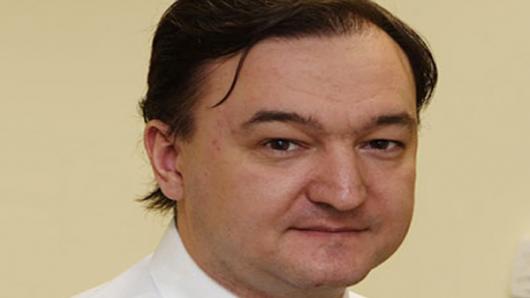
While he loosely accused a number of Americans of felonies, Browder continued to claim that Magnitsky was a crusading “lawyer” who uncovered a $230 million tax-fraud scheme carried out ostensibly by Browder’s companies but, which, according to Browder’s account, was really engineered by corrupt Russian police officers who then arrested Magnitsky and later were responsible for his death in a Russian jail.
Sergei Magnitsky
Browder’s narrative has received a credulous hearing by Western politicians and media already inclined to think the worst of Putin’s Russia and willing to treat Browder’s claims as true without serious examination. However, beyond the self-serving nature of Browder’s tale, there are many holes in the story, including whether Magnitsky was really a principled lawyer or instead a complicit accountant.
According to Browder’s own biographical description of Magnitsky, he received his education at the Plekhanov Institute in Moscow, a reference to Plekhanov Russian University of Economics, a school for finance and business, not a law school.
Nevertheless, the West’s mainstream media – relying on the word of Browder – has accepted Magnitsky’s standing as a “lawyer,” which apparently fits better in the narrative of Magnitsky as a crusading corruption fighter rather than a potential co-conspirator with Browder in a complex fraud, as the Russian government has alleged.
Magnitsky’s mother also has described her son as an accountant, although telling Nekrasov in the documentary “he wasn’t just an accountant; he was interested in lots of things.” In the film, the “lawyer” claim is also disputed by a female co-worker who knew Magnitsky well. “He wasn’t a lawyer,” she said.
In other words, on this high-profile claim repeated by Browder again and again, it appears that presenting Magnitsky as a “lawyer” is a convenient falsehood that buttresses the Magnitsky myth, which Browder constructed after Magnitsky’s death from heart failure while in pre-trial detention.
But the Magnitsky myth took off in 2012 when Browder sold his tale to neocon Senators Ben Cardin, D-Maryland, and John McCain, R-Arizona, who threw their political weight behind a bipartisan drive in Congress leading to the passage of the Magnitsky sanctions act, the opening shot in the New Cold War.
A Planned Docudrama
Browder’s dramatic story also attracted the attention of Russian filmmaker Andrei Nekrasov, a well-known critic of Putin from previous films. Nekrasov set out to produce a docudrama that would share Browder’s good-vs.-evil narrative to a wider public.
Nekrasov devotes the first half hour of the film to allowing Browder to give his Magnitsky account illustrated by scenes from Nekrasov’s planned docudrama. In other words, the viewer gets to see a highly sympathetic portrayal of Browder and Magnitsky as supposedly corrupt Russian authorities bring charges of tax fraud against them.
However, Nekrasov’s documentary project takes an unexpected turn when his research turns up numerous contradictions to Browder’s storyline, which begins to look more and more like a corporate cover story. For instance, Magnitsky’s mother blames the negligence of prison doctors for her son’s death rather than a beating by prison guards as Browder had pitched to Western audiences.
Nekrasov also discovered that a woman who had worked in Browder’s company blew the whistle before Magnitsky talked to police and that Magnitsky’s original interview with authorities was as a suspect, not a whistleblower. Also contradicting Browder’s claims, Nekrasov notes that Magnitsky doesn’t even mention the names of the police officers in a key statement to authorities.
When one of the Browder-accused police officers, Pavel Karpov, filed a libel suit against Browder in London, the case was dismissed on technical grounds because Karpov had no reputation in Great Britain to slander. But the judge seemed sympathetic to the substance of Karpov’s complaint.
Browder claimed vindication before adding an ironic protest given his successful campaign to prevent Americans and Europeans from seeing Nekrasov’s documentary.
“These people tried to shut us up; they tried to stifle our freedom of expression,” Browder complained. “[Karpov] had the audacity to come here and sue us, paying high-priced libel lawyers to come and terrorize us in the U.K.”
The ‘Kremlin Stooge’ Slur
A pro-Browder account published at the Daily Beast on July 25 – attacking Nekrasov and his documentary – is entitled “How an Anti-Putin Filmmaker Became a Kremlin Stooge,” a common slur used in the West to discredit and silence anyone who dares question today’s Russia-hating groupthink.
The article by Katie Zavadski accuses Nekrasov of being in the tank for the Kremlin and declares that “The movie is so flattering to the Russian narrative that Pavel Karpov — one of the police officers accused of being responsible for Magnitsky’s death — plays himself.”
But that’s not true. In fact, there is a scene in the documentary in which Nekrasov invites the actor who plays Karpov in the docudrama segment to sit in on an interview with the real Karpov. There’s even a clumsy moment when the actor and police officer bump into a microphone as they shake hands, but Zavadski’s falsehood would not be apparent unless you had somehow gotten access to the documentary, which has been effectively banned in the West.
In the documentary, Karpov, the police officer, accuses Browder of lying about him and specifically contests the claim that he (Karpov) used his supposedly ill-gotten gains to buy an expensive apartment in Moscow. Karpov came to the interview with documents showing that the flat was pre-paid in 2004-05, well before the alleged hijacking of Browder’s firms.
Karpov added wistfully that he had to sell the apartment to pay for his failed legal challenge in London, which he said he undertook in an effort to clear his name. “Honor costs a lot sometimes,” the police officer said.
Karpov also explained that the investigations of Browder’s tax fraud started well before the Magnitsky controversy, with an examination of a Browder company in 2004.
“Once we opened the investigation, a campaign in defense of an investor started,” Karpov said. “Having made billions here, Browder forgot to tell how he did it. So it suits him to pose as a victim. … Browder and company are lying blatantly and constantly.”
However, since virtually no one in the West has seen this interview, you can’t make your own judgment as to whether Karpov is credible or not.
A Painful Recognition
Yet, in reviewing the case documents and noting Browder’s inaccurate claims about the chronology, Nekrasov finds his own doubts growing. He discovers that European officials simply accepted Browder’s translations of Russian documents, rather than checking them independently. A similar lack of skepticism prevailed in the United States.
In other words, a kind of trans-Atlantic groupthink took hold with clear political benefits for those who went along and almost no one willing to risk the accusation of being a “Kremlin stooge” by showing doubt.
As the documentary proceeds, Browder starts avoiding Nekrasov and his more pointed questions. Finally, Nekrasov hesitantly confronts the hedge-fund executive at a party for Browder’s book, Red Notice, about the Magnitsky case.
The easygoing Browder of the early part of the documentary — as he lays out his seamless narrative without challenge — is gone; instead, a defensive and angry Browder appears.
“It’s bullshit,” Browder says when told that his presentations of the documents are false.
But Nekrasov continues to find more contradictions and discrepancies. He discovers evidence that Browder’s web site eliminated an earlier chronology that showed that in April 2008, a 70-year-old woman named Rimma Starova, who had served as a figurehead executive for Browder’s companies, reported the theft of state funds.
Nekrasov then shows how Browder’s narrative was changed to introduce Magnitsky as the whistleblower months later, although he was then described as an “analyst,” not yet a “lawyer.”
As Browder’s story continues to unravel, the evidence suggests that Magnitsky was an accountant implicated in manipulating the books, not a crusading lawyer risking everything for the truth.
A Heated Confrontation
In the documentary, Nekrasov struggles with what to do next, given Browder’s financial and political clout. Finally securing another interview, Nekrasov confronts Browder with the core contradictions of his story. Incensed, the hedge-fund executive rises up and threatens the filmmaker.
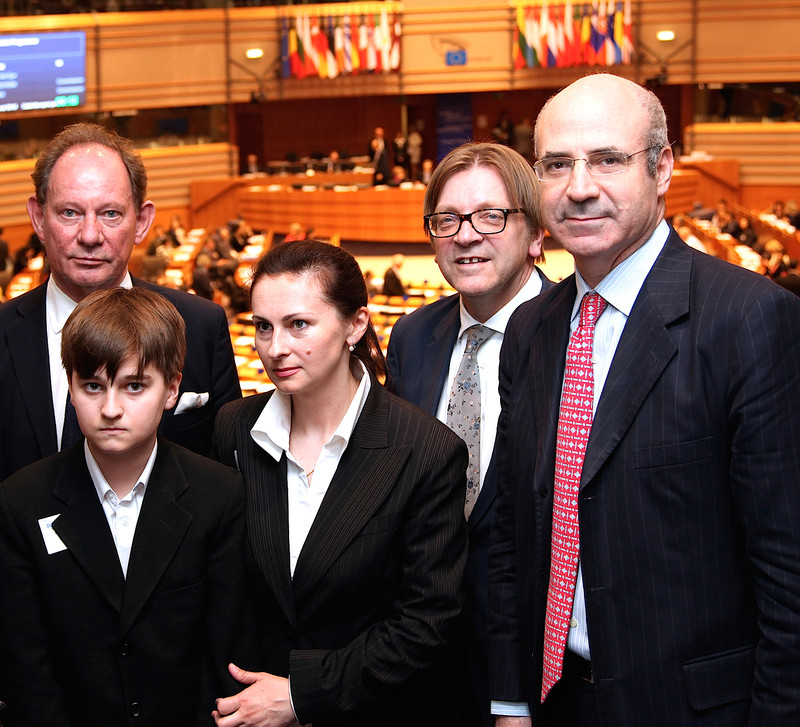
William Browder (right) with Magnitsky’s widow and son,
along with European parliamentarians.
“I’d be very careful going out and trying to do a whole sort of thing about Sergei [Magnitsky] not being the whistleblower, it won’t do well for your credibility on this show,” Browder said. “This is sort of the subtle FSB version,” suggesting that Nekrasov was just fronting for the Russian intelligence service.
In the pro-Browder account published at the Daily Beast on July 25, Browder described how he put down Nekrasov by telling him, “it sounds like you’re part of the FSB. … Those are FSB questions.”
But that phrasing is not what he actually says in the documentary, raising further questions about whether the Daily Beast reporter actually watched the film or simply accepted Browder’s account of it. (I posed that question to the Daily Beast’s Katie Zavadski by email, but have not gotten a reply.)
The documentary also includes devastating scenes from depositions of a sullen and uncooperative Browder and a U.S. government investigator, who acknowledges relying on Browder’s narrative and documents in a related case against Russian businesses.
In an April 15, 2015 deposition of Browder, he, in turn, describes relying on reports from journalists to “connect the dots,” including the Organized Crime and Corruption Reporting Project (OCCRP), which is funded by the U.S. government and financial speculator George Soros. Browder said the reporters “worked with our team.”
While taking money from the U.S. Agency for International Development and Soros, the OCCRP also targeted Ukraine’s elected President Viktor Yanukovych with accusations of corruption prior to the Feb. 22, 2014 coup that ousted Yanukovych, an overthrow that was supported by the U.S. State Department and escalated the New Cold War with Russia.
OCCRP played a key role, too, in the so-called Panama Papers, purloined documents from a Panamanian law firm that were used to develop attack lines against Russian President Vladimir Putin although his name never appeared in the documents.
After examining the money-movement charts published by OCCRP about the Magnitsky case, Nekrasov notes that the figures don’t add up and wonders how journalists could “peddle these wooly maths.” He also observed that OCCRP’s Panama Papers linkage of Magnitsky’s $230 million fraud and payments to an ally of Putin made no sense because the dates of the Panama Papers transactions preceded the dates of the alleged Magnitsky fraud.
The Power of Myth
Nekrasov suggests that the power of Browder’s convoluted story rested, in part, on a Hollywood perception of Moscow as a place where evil Russians lurk around every corner and any allegation against “corrupt” officials is believed. The Magnitsky tale “was like a film script about Russia written for the Western audience,” Nekrasov says.
But the Browder’s narrative also served a strong geopolitical interest to demonize Russia at the dawn of the New Cold War.
In the documentary’s conclusion, Nekrasov sums up what he had discovered: “A murdered hero as an alibi for living suspects.” He then ponders the danger to democracy: “So do we allow graft and greed to hide behind a political sermon? Will democracy survive if human rights — its moral high ground — is used to protect selfish interests?”
But Americans and Europeans are being spared the discomfort of having to answer that question or to question their representatives about the failure to skeptically examine this case that has pushed the planet on a course toward a possible nuclear war.
Instead, the mainstream Western media has hurled insults at Nekrasov even as his documentary is blocked from any significant public viewing.
Despite Browder’s professed concern about the London libel case that he claimed was an attempt “to stifle our freedom of expression,” he has sicced his lawyers on anyone who might be thinking about showing Nekrasov’s documentary to the public.
The documentary was set for a premiere at the European Parliament in Brussels in April 2016, but at the last moment – faced with Browder’s legal threats – the parliamentarians pulled the plug. Nekrasov encountered similar resistance in the United States. There were hopes to show the documentary to members of Congress but the offer was rebuffed. Instead a room was rented at the Newseum near Capitol Hill.
Browder’s lawyers then tried to strong arm the Newseum, but its officials responded that they were only renting out a room and that they had allowed other controversial presentations in the past.
“We’re not going to allow them not to show the film,” said Scott Williams, the Newseum’s chief operating officer. “We often have people renting for events that other people would love not to have happen.”
In an article about the controversy in June 2016, The New York Times added that “A screening at the Newseum is especially controversial because it could attract lawmakers or their aides.”
One-Time Showing
So, Nekrasov’s documentary got a one-time showing with a follow-up discussion moderated by journalist Seymour Hersh. However, except for that audience, the public of the United States and Europe has been essentially shielded from the documentary’s discoveries, all the better for the Magnitsky myth to retain its power as a seminal propaganda moment of the New Cold War.
After the Newseum presentation, a Washington Post editorial branded Nekrasov’s documentary Russian “agit-prop” and sought to discredit Nekrasov without addressing his many documented examples of Browder’s misrepresenting both big and small facts in the case.
Instead, the Post accused Nekrasov of using “facts highly selectively” and insinuated that he was merely a pawn in the Kremlin’s “campaign to discredit Mr. Browder and the Magnitsky Act.”
Like the recent Daily Beast story, which falsely claimed that Nekrasov let the Russian police officer Karpov play himself, the Post misrepresented the structure of the film by noting that it mixed fictional scenes with real-life interviews and action, a point that was technically true but willfully misleading because the fictional scenes were from Nekrasov’s original idea for a docudrama that he shows as part of explaining his evolution from a believer in Browder’s self-exculpatory story to a skeptic.
But the Post’s deception – like the Daily Beast’s falsehood – is something that almost no American would realize because almost no one has gotten to see the film.
The Post’s editorial gloated: “The film won’t grab a wide audience, but it offers yet another example of the Kremlin’s increasingly sophisticated efforts to spread its illiberal values and mind-set abroad. In the European Parliament and on French and German television networks, showings were put off recently after questions were raised about the accuracy of the film, including by Magnitsky’s family.
“We don’t worry that Mr. Nekrasov’s film was screened here, in an open society. But it is important that such slick spin be fully exposed for its twisted story and sly deceptions.”
The Post’s arrogant editorial had the feel of something you might read in a totalitarian society where the public only hears about dissent when the Official Organs of the State denounce some almost unknown person for saying something that almost no one heard.
It is also unlikely that Americans and Europeans will get a chance to view this blacklisted documentary in the future. In an email exchange, the film’s Norwegian producer Torstein Grude told me that “We have been unsuccessful in releasing the film to TV so far. ZDF/Arte [a major European network] pulled it from transmission a few days before it was supposed to be aired and the other broadcasters seem scared as a result. Netflix has declined to take it. …
“The film has no other release at the moment. Distributors are scared by Browder’s legal threats. All involved financiers, distributors, producers received thick stacks of legal documents (300+ pages) threatening lawsuits should the film be released.” [Grude sent me a special password so I could view the documentary on Vimeo.]
The blackout continues even though the Magnitsky issue and Nekrasov’s documentary have become elements in the recent controversy over a meeting between a Russian lawyer and Donald Trump Jr. [See Consortiumnews.com’s “How Russia-gate Met the Magnitsky Myth.”]
So much for the West’s vaunted belief in freedom of expression and the democratic goal of encouraging freewheeling debates about issues of great public importance. And, so much for the Post’s empty rhetoric about our “open society.”
Investigative reporter Robert Parry broke many of the Iran-Contra stories for The Associated Press and Newsweek in the 1980s.
View the film: https://swprs.org/the-magnitsky-act/
What Mainstream Media Got Wrong About Venezuela’s Constituent Assembly Vote
teleSUR | July 30, 2017
Venezuelans voted Sunday for representatives of the National Constituent Assembly, amid what the government has called a targeted media campaign to destabilize the country and destroy its sovereignty.
International media outlets rushed to discredit the vote, sharing grossly misrepresentative accounts of the historic electoral process.
The U.S. newspaper Washington Post, for instance, wrote “the decision to hold the vote appeared set to prolong and deepen the suffering of the people of Venezuela” — despite assurances from Venezuelan President Nicolas Maduro that the purpose of the election was to ease economic and political conflicts with the opposition.
The Washington Post also insisted the nation’s 2.8 million state workers “risked losing their jobs if they did not vote.”
The media outlet went even further, claiming the internal and democratic election represented “a direct challenge” to the administration of U.S. President Donald Trump after it demanded that the government cancel the vote.
It said Maduro “defiantly followed through Sunday with his pledge” to hold the election, “creating a critical new stage in a long-simmering crisis that could mint the Western Hemisphere’s newest dictatorship.”
These inflammatory comments, however, do not acknowledge that the right to call a National Constituent Assembly is included in the country’s Constitution and supported by several articles of its text. Indeed the absolute independence of the members of the Constituent Assembly to make changes to the Constitution is protected under these articles.
Germany’s Deutsche Welle meanwhile said the election “will cement a socialist dictatorship” — ignoring the fact that Venezuelans have the right to call for a Constituent Assembly and that the new Constitution will need to be approved by the people.
The British media outlet BBC referenced the recent deaths during violent protests in Caracas, placing the full responsibility for the clashes on security forces.
But Venezuelan Armed Forces have denied these accusations. In a press conference Sunday, Minister of Defense Vladimir Padrino Lopez said that none of the injuries or deaths could be attributed to the Armed Forces. The article also ignores the eight members of the Armed Forces who were severely injured while protecting Venezuelans’ right to vote.
The CNN, a longtime critic of the Venezuelan government, argued the Constituent Assembly was controlled by Maduro and that the “vote would give the president immense political power.”
This statement fails to take into account that no other state institution may interfere in the new legislative body. Only the 545 officials elected by the citizens from different sectors of society can draft the new Constitution.
CNN also reported that Maduro would replace Venezuela’s National Assembly — a situation that has never been stated in the decree to call for an open and direct vote.
Canada’s Globe and Mail said “voters broadly boycotted” the election, ignoring the numerous of photos and videos of people lining up to vote at dawn and even wading through swamps to reach the voting centers. The article also does not include the countless reports of seniors and people with disabilities eagerly casting votes across the country.
“Caracas was largely shut down with deserted streets and polling stations were mostly empty, dealing a blow to the legitimacy of the vote,” said the Globe and Mail without any evidence.
The Guardian joined the mainstream criticism, calling the election an action that will “seal the demise of the oil-rich nation’s democracy.”
Again, the article failed to acknowledge the thousands of people who fought to earn the opportunity to be candidates in this historical event, including candidates from the LGBT community, student organizations and women and campesino groups.
Finally, the New York Times reported on the election with the headline: “As Venezuela Prepares to Vote, Some Fear an End to Democracy.”
The article reported, “Maduro is pushing a radical plan to consolidate his leftist movement’s grip over the nation,” forgetting that candidates are not voted for according to their political parties but through individual candidacies.
In one of the bluntest accusations, the newspaper argued Maduro “has refused to negotiate with street protesters,” a claim that blatantly ignores Maduro’s ongoing calls for peaceful dialogue and guidance from the Vatican.
It concludes by accusing the president of Venezuela of seeking an “unchecked authority not seen since the juntas that haunted Latin American countries in decades past,” as Maduro and the Bolivarian Revolution have vowed to fight the same external interference that brought the U.S. backed dictatorships to the region in the 60s.
World’s Richest Person Escapes Scrutiny From His Own Paper—and Its Rivals
By Adam Johnson | FAIR | July 28, 2017
The three most prominent US newspapers haven’t run a critical investigative piece on Jeff Bezos’ company Amazon in almost two years, a FAIR survey finds.
A review of 190 articles from the New York Times, Wall Street Journal and the Bezos-owned Washington Post over the past year paints a picture of almost uniformly uncritical–ofttimes boosterish–coverage. None of the articles were investigative exposes, 6 percent leaned negative, 54 percent were straight reporting or neutral in tone, and 40 percent were positive, mostly with a fawning or even press release–like tone.
The last major investigative piece we found in any of these three publications was a 4,500-word critique of Amazon’s labor practices in the New York Times (8/16/15) almost two years ago. Considering that Amazon is the fourth-most-valuable company in the world, with a 43 percent (and growing) share of all US online commerce, it’s a striking absence of journalistic scrutiny.
The line between straight reporting and fawning coverage wasn’t always clear, given the nature of technology journalism, but, in general, a distinction was drawn when reporting on Amazon’s latest moves featured no criticism or contrary third-party input, and the article was mostly indistinguishable from a press release.
Examples of this type of breathless corporate coverage, from a one-week span in 2016, included “Amazon’s Latest Weapon in the E-Commerce Wars: Its Own Air Force” (Washington Post, 8/6/16), “Amazon Reveals ‘Prime Air’ Cargo Jet” (Wall Street Journal, 8/5/16) and “Think Amazon’s Drone Delivery Idea Is a Gimmick? Think Again” (New York Times, 8/10/16). The most embarrassing example of outright PR pablum was this Washington Post “exclusive look,” based primarily on futurist porn speculation (3/2/17):

Amazing how a Bezos-owned paper got an “exclusive” on Jeff Bezos!
One can review the list and determinations here. We included articles about Amazon.com, Inc. (reviews of Amazon TV shows or stories about Amazon bestsellers, for example, were not included) that were significant enough for the outlets’ respective Twitter accounts to post the stories.
One might expect the Washington Post—the personal property of Bezos—to provide more favorable coverage of its owner’s company, but the Post’s level of uncritical praise, though very high, was roughly par for the course. About 95 percent of Post coverage ranged from neutral (43 percent) to positive/fawning (48 percent) in tone.
Ninety-three percent of New York Times coverage of Amazon and 94 percent of the Wall Street Journal’s ranged from straight news to press release. Fifty-seven percent of the Times‘ coverage and 31 percent of the Journal‘s could be characterized as somewhat to extremely flattering. (Note that the Post‘s level of positive coverage fell in between the two other papers’.)
One of the major reasons Amazon gets such glowing coverage is that tech journalism is traditionally not a very critical vertical. Tech company X reveals it’s doing Y or will do Z—that is, by the beat’s definition, newsworthy, and the press release is rewritten, with some added commentary from friendly talking heads and market analysts. Because it’s “tech,” the political or labor implications come in a distant second to the shiny-object quality of the beat.
Occasionally issues such as privacy or anti-trust or union unrest will be touched on, but this is usually in response to legal action taken by the state or by activists, not as a topic raised by reporters themselves. On a case by case basis, this is understandable (clearly not every tech write-up has to be an exposé), but on the whole, tech journalism is a media landscape dominated by corporate stenography.
With Amazon’s stock surging to well over $1,000 a share, and its head recently crowned the richest person in the world, the stakes for putting Amazon and Bezos in a critical light couldn’t be higher. Yet time and again, the pillars of US media provide them all the critical rigor a high school paper typically provides the spring dance committee.
Featured Video
Seyed M. Marandi: U.S. Military DIVIDED? Iran’s Secret Defense EXPOSED
or go to
Aletho News Archives – Video-Images
From the Archives
‘Israel sees Iran as obstacle to its policies’
Press TV – August 25, 2017
Prime Minister Benjamin Netanyahu has said that Israel felt threatened by Iran’s growing influence in the Middle East. Netanyahu expressed his Iranophobic view in a meeting with Russian President Vladimir Putin in Russia’s Black Sea resort of Sochi on Wednesday. Press TV has asked Scott Rickard, former American intelligence linguist from Tampa, Florida, and Brent Budowsky, a columnist at The Hill from Washington, to give their thoughts on the issue.
Rickard said Tel Aviv is concerned about the fact that the regime could not carry out its old project to spread sectarian divisions and pave the way for dismemberment of the countries in the Middle East region because of the Iranian-led resistance against Israeli policies, not only in the occupied territories of Palestine but also in the whole region.
“Iran is not a threat to Israel whatsoever. The threat that Israel sees is the fact that their Oded Yinon Plan is being put to a hold by Iran,” the intelligence linguist said on Thursday night.
“They (the Israelis) look at Iran as a threat only because they have no influence on their governments and Iran is autonomous and is not under the Zionist influence,” he added.
Since the victory of the Islamic Republic of Iran in 1979, Tehran has been critical of Israel’s policies in the region, whereas “no leaders [of other states] even dared to speak out against Zionism,” Rickard argued. … continue
Blog Roll
 Aletho News
- Alberta Bill Would Fine Political Deepfakes $10,000 Without Satire Exemptions
- Iran declares ‘historic victory’ over US, says enemy forced to accept its proposal
- Trump Claims Ceasefire, Reopening of Strait of Hormuz Agreement with Iran
- Israeli tank fire killed UN peacekeeper in Lebanon, UNIFIL investigation finds
- Russia, China block Bahrain-sponsored UN resolution on Strait of Hormuz
- The US-Israeli War on Science is an Assault on our Future
- Trump’s Promise to Bomb Iran ‘Like Never Before’ Faces Brutal Logistics — Expert
- Germany seeks to restrict stays abroad for men of fighting age – Berliner Zeitung
- Evidence points to Ukraine being behind TurkStream attempted sabotage, but that should come as no surprise
- Sri Lanka secures supplies of Russia oil – minister
- If Americans Knew
- Thousands dead and neighborhoods razed to the ground: Aid agencies fear southern Lebanon is becoming the new Gaza
- The war the US is fighting for Israel could cost trillions
- ‘Cigarette Burns, Nail Wounds’: Toddler Tortured in Gaza to Coerce Father
- Trump Says US Sent ‘a Lot of Guns’ to Protesters in Iran
- Israeli forces destroy 17 UN peacekeeper cameras in south Lebanon
- US-Israeli strikes ‘completely destroy’ synagogue in Tehran
- Archbishop for US Military Says Iran War Is Unjust Under Catholic Teaching
- Iranian leaders’ Open Letters to the American People
- Trump says Iranians appreciate bombs, WHO warns of nuclear risks – Daily Update
- U.N. experts demand Israel release prominent Gaza doctor after reports of ‘severe torture’
- No Tricks Zone
- An Inconvenient Tree: Uncovered In Alps… Europe Much Warmer Than Today 6000 Years Ago
- New Study Reports A 60% Slowdown In Greenland’s Ice Loss Rate In The Last Decade
- Low Intensity Tornado Wrecks Major Solar Farm, Creating A Potential Toxic Dump
- New Study Finds Warming Saves Lives…Cold Temperatures 12 Times More Deadly Than Excess Heat
- German Science Blog Accuses PIK Climate Institute Of Hallucinating Climate Tipping Points
- Devastating Assessment Of Comirnaty Vaccine By Former Senior Pfizer Europe Toxicologist
- New Study: CO2 Is ‘Effectively Negligible’ As An Explanatory Climate Change Factor Since 2000
- Former Pfizer Toxicologist Dr. Helmut Sterz Tells Bundestag Hearing Pfizer Vaccine Should Have Never Been Approved
- Energy Expert: Germany’s Nuclear Phaseout Was A “500 Billion Euro Mistake”
- New Research: South Australia’s Mid-Holocene Sea Surface Temperatures Were 4°C Warmer Than Today
 Aletho News