Moscow Mitch, Secret Russian Subs… and Russophobia Derangement
By Finian Cunningham | Strategic Culture Foundation | August 11, 2019
Arch Republican Senator Mitch McConnell is being taunted by major US media outlets and at political rallies as a “Russian asset”. Meanwhile, Britain’s Daily Telegraph reports on “super-secret” Russian submarines which are “operating unseen” in British territorial waters.
The collapse in rational thinking among American and British political mainstream circles is highlighted by the rampant Russophobia. Such thinking is delusional, paranoid and ultimately horrifying at a time of heightened international tensions between nuclear superpowers.
First, let’s deal with the farcical furore over Senator McConnell being labelled a Russian asset. The Senate majority leader has been dubbed by US news channel MSNBC and the Washington Post as “Moscow Mitch” and “doing Putin’s bidding”. The monikers followed McConnell’s blocking of legislation aimed at tightening security of electoral systems ostensibly to prevent “foreign meddling”.
It’s not clear why McConnell objected to the proposed legislation. It seems he doesn’t agree with extra federal controls over state-level electoral systems. Also, he claims that hundreds of millions of dollars have already been spent upgrading electoral systems, and therefore additional expenditure is not warranted. He is a fiscal hawk after all.
Nonetheless, it is a preposterous leave of senses when paranoid Russophobia in US politics and media are inferring that McConnell’s opposition to the proposed electoral legislation is “evidence” that he is a Russian agent, by allegedly enabling Russian hacking into US elections.
At a recent political event in his home state of Kentucky, McConnell was heckled and booed by Democrat supporters chanting “Moscow Mitch, Moscow Mitch!” The protesters were wearing T-shirts and brandishing placards with images of McConnell donning a Cossack hat with Soviet-era hammer and sickles.
Understandably, the 77-year-old senator has been aghast over the political attacks. He called it “modern-day McCarthyism” harking back to the Cold War years of Red Baiting. He even said it was worse than the past McCarthyism. And he has a point there.
McConnell’s exasperation is borne out of the complete irrational vacuousness of the accusations. The six-time elected lawmaker is the longest-serving Republican senator. He is a grandee of the traditionally rightwing party, with an “impeccable” record of being hawkish towards Russia and President Vladimir Putin.
How anyone can construe that good ole boy McConnell is a Russian stooge is too absurd for words. What the accusations do betray is the total derangement and politically illiterate condition of mainstream American political and media culture.
As Princeton Professor Stephen Cohen remarked in a recent interview Russophobia and paranoia over alleged interference in US politics has become a permanent mindset among too many American politicians, pundits, military-intelligence agencies and Democrat supporters. Cohen rightly deplores how the whole baseless narrative of “Russia-gate” continues with a life of its own, having not been finally made redundant after the two-year Mueller probe spectacularly failed to provide any substantive details or evidence.
Still, however, former FBI chief Robert Mueller in recent hearings before Congress was permitted to reiterate hollow accusations that Russia meddled in the 2016 presidential elections and, he asserted, Moscow will do so again in the 2020 elections. This is simply doctrinal thinking which is, in turn, accepted as “fact” that Russia’s President Putin ordered an “interference campaign” to subvert American democracy. (Moscow has always vehemently rejected that.)
That’s why when someone as antipathetic towards Russia as Senate leader Mitch McConnell exercises relative sanity by rejecting the alleged need for more electoral security systems to “prevent foreign meddling” he is then assailed with hysterical accusations of being a “Russian asset”. The utter irrationality is self-reinforcing because of unhinged delusions about Russian malignancy. No evidence is required. It’s “true” because “we believe it is true”.
McConnell has hit back at his detractors by calling them “leftwing hacks” and “communists”. He made that conclusion by referring to the Democrats’ policy of seeking to expand free healthcare for American citizens. He proudly called himself the “Grim Reaper” who would protect America from a “socialist agenda”.
This inane back and forth demonstrates how dumbed down American political culture is. Increasingly bitter partisan accusations and slander are flying around based on no facts, no evidence, no reason, nor any intelligent understanding about policy, history or political philosophy.
But, lamentably, at bottom the crazed political discourse relies on an embedded Russophobia. Russia is viewed as evil and malicious, by both sides of the political coin. Rather than addressing inherent problems in American society, the discourse finds a common false explanation – blame it on Russia or association with presumed communism. The Cold War nihilism of American politics and propaganda has never stopped. It’s just become more delusional and divorced from any semblance of reality. In this context, the modern-day Russophobia is perhaps more dangerous because of its irrationality and evidence-free doctrinal thinking.
Which brings us to the “super-secret” Russian submarines that are stalking Britain, according to the Daily Telegraph. The so-called report (more accurately, psy-ops piece) is a must-read for exposing the delusional anti-Russia paranoia that the British political class have in common with the Americans.
“A new breed of super quiet Russian submarines are feared [sic] to be operating unseen [sic] in British territorial waters, according to military sources [sic],” the Telegraph claimed.
The sources were, as usual, anonymous, betraying that the Telegraph was being used, as it often is, as a conduit for British intelligence propaganda.
Not one scrap of evidence was presented to substantiate these “fears” of “unseen” Russian submarines. Supposedly, the “unseen” vessels are “proof” of how dastardly and stealthy those damn Russians are. The point of the article was to deliver a public message for more military spending on Britain’s Royal Navy.
What makes it possible for the Daily Telegraph to publish such bogeyman rubbish is the systematic inculcation of Russophobia among many, but not all, Britons.
As with its American counterpart, British political culture has become degenerate and depraved. It is the equivalent of medieval sorcery and “magical thinking”. Standards of proof, reason and due process have been abandoned. It’s like a regression to pre-Enlightenment times. The fact that the US and Britain possess nuclear arsenals aimed at Russia makes the deranged thinking of their political class a truly frightening prospect for the entire world.
WaPo Publishes Gabbard Smear Piece Filled With Blatant Lies
By Caitlin Johnstone | August 4, 2019
The Washington Post, which is wholly owned by a CIA contractor who is reportedly working to control the underlying infrastructure of the global economy, has published a shockingly deceitful smear piece about Democratic presidential candidate Tulsi Gabbard in the wake of her criticisms of her opponent Kamala Harris’ prosecutorial record during the last Democratic debate.
The article’s author, Josh Rogin, has been a cheerleader for US regime change interventionism in Syria since the very beginning of the conflict in that nation. It is unsurprising, then, that he reacted with orgasmic exuberance when Harris retaliated against Gabbard’s devastating attack by smearing the Hawaii congresswoman as an “Assad apologist”, since Gabbard has been arguably the most consistent and high-profile critic of Rogin’s pet war agenda. His article, titled “Tulsi Gabbard’s Syria record shows why she can’t be president”, is one of the most dishonest articles that I have ever read in a mainstream publication, and the fact that it made it through the Washington Post’s editors is enough to fully discredit that outlet.
You can read Rogin’s smear piece without giving Jeff Bezos more money by clicking here for an archive. There’s so much dishonesty packed into this one that all I can do is go through it lie-by-lie until I either finish or get tired, so let’s begin:
“Gabbard asserts that the United States (not Assad) is responsible for the death and destruction in Syria, that the Russian airstrikes on civilians are to be praised”
This is just a complete, brazen, whole-cloth lie from Rogin. If you click the hyperlink he alleges supports his claim that Gabbard asserts “Russian airstrikes on civilians are to be praised,” you come to a 2015 tweet by the congresswoman which reads, “Bad enough US has not been bombing al-Qaeda/al-Nusra in Syria. But it’s mind-boggling that we protest Russia’s bombing of these terrorists.”
Now, you can agree or disagree with Gabbard’s position that the US should be participating in airstrikes against al-Qaeda affiliates in Syria, but there’s no way you can possibly interpret her acceptance of Russia doing so to be anywhere remotely like “praise” for “airstrikes on civilians”. There is simply no way to represent the content of her tweet that way without knowingly lying about what you think it says. The only way Rogin’s claim could be anything resembling truthful would be if “al-Qaeda” and “civilians” meant the same thing. Obviously this is not the case, so Rogin can only be knowingly lying.
“That bias, combined with her long record of defending the Assad regime and parroting its propaganda, form the basis for the assertion Gabbard has ‘embraced and been an apologist for’ Assad, as Sen. Kamala D. Harris (D-Calif.) said Wednesday post-debate on CNN.”
Gabbard has no record whatsoever of “defending the Assad regime”. This is a lie. There exist copious amounts of quotes by Gabbard opposing US regime change interventionism in Syria and voicing skepticism of the narratives used to promote said interventionism, but there are no quotes anywhere in which she claims Assad is a nice person or that he hasn’t done bad things. If such quotes existed, Rogin would have included them in his smear piece. He did not. All he can do is lie about their existence.
“To repeat: There is no quote in which Tulsi praises, supports, or otherwise ‘apologies for’ Assad,” journalist Michael Tracey recently tweeted with a link to his January article on the subject. “I checked the record a long time ago, and it doesn’t exist. This is just a smear intended to delegitimize diplomatic engagement”
“Claiming that politicians are ‘defending’ objectionable rulers they meet with, in pursuit of achieving some alternative to war, is a tired trope that has been frequently used throughout history to discredit diplomatic engagement,” Tracey wrote. “As Gabbard told me in an interview shortly after returning from Syria: ‘The reason why I decided to take this meeting on this trip was because if we profess to care about the Syrian people — if we really truly care about ending their suffering and ending this war — then we should be ready to meet with anyone if there is a chance that that meeting and that conversation could help to bring about an end to this war.’”
Gabbard has been remarkably consistent in explaining her position that she opposes US regime change interventionism in Syria because US regime change interventionism is reliably disastrous. This isn’t “defending” anyone, nor is it “parroting propaganda”. It’s an indisputable, thoroughly established fact.
“Other Democratic candidates have promised to end U.S. military adventurism without making excuses for a mass murderer. It’s neither progressive nor liberal to defend Assad, a fascist, totalitarian psychopath who can never peacefully preside over Syria after what he has done.”
Again, claiming that Gabbard has done anything at all to “defend Assad” is a lie. If anything Gabbard has been too uncritical of establishment war propaganda narratives, calling Assad “a brutal dictator” who has “used chemical weapons and other weapons against his people.” Gabbard’s sole arguments on the matter have been in opposition to US military interventionism and skepticism of narratives used to support such interventionism, which only an idiot would object to in a post-Iraq invasion world.
Rogin argues that it’s possible to end US military adventurism without defending and making excuses for Assad, yet this is exactly the thing that Tulsi Gabbard has been doing since day one. Which means Rogin doesn’t actually believe it’s ever okay for any presidential candidate to want to end US military adventurism under any circumstances. Which is of course the real driving motivation behind his deceitful smear piece against Gabbard.
“Gabbard never talks about her other trip — to the Turkish-Syrian border with a group of lawmakers in June 2015, when she met with authentic opposition leaders, victims of Assad’s barrel bombs and members of the volunteer rescue brigade known as the White Helmets. Their stories, which don’t support Assad’s narrative, never make it into Gabbard’s speeches on the campaign trail.”
This one is bizarre. Rogin says this as though Gabbard’s meeting with Assad is something that she brings up “on the campaign trail” rather than something war propagandists like himself bring up and force her to respond to. The fact that those propagandists never bring up Gabbard’s meetings with the Syrian opposition is an indictment of their bias, not hers. The mental gymnastics required to make Gabbard’s meetings with all sides of the Syrian conflict feel more pro-Assad rather than less deserve an Olympic gold medal.
Obviously Gabbard having met with all sides is indicative of an absence of favoritism, not the presence of it. The fact that she didn’t come away from her meetings with empire-allied opposition forces with the opinion that the US should help storm Damascus doesn’t mean she supports any particular side.
“Gabbard’s candidacy should be taken very seriously — not because she has a significant chance of being president, but because her narrative on Syria is deeply incorrect, immoral and un-American. If it were adopted by her party and the country, it would lead the United States down a perilous moral and strategic path.”
Saying a “narrative” can be “un-American” is a fairly straightforward admission that you are authoring propaganda. Unless you believe your nation has one authorized set of narratives, a narrative can’t be “un-American”. This is as close as you’ll ever get to an admission from Rogin that US power structures work to control the dominant narratives about world events, and that he helps them do it. To such a person, opposition to your narrative control agendas would be seen as the antithesis of the group you identify with.
The US empire has an extensive and well-documented history of using lies, propaganda and false flags to initiate military conflicts which advantage it. To continue to deny this after Iraq is either willful ignorance or propaganda.
The fact that Rogin adds “strategic path” to his argument nullifies his claim that his position has anything to do with morality. If your foreign policy concern is with strategic leverage, you will naturally try to interpret anything which advances that strategic path as the moral choice.
“Listening to Gabbard, one might think the United States initiated the Syrian conflict by arming terrorists for a regime-change war that has resulted in untold suffering.”
This is exactly what happened. The US armed extremist militants with the goal of effecting regime change, and before Russia intervened they almost succeeded. According to the former Prime Minister of Qatar, the US and its allies were involved in this behavior from the very beginning of the conflict in 2011. Here is a link to an article full of primary source documents showing that the US and its allies had been scheming since well before 2011 to provoke a civil war in Syria with the goal of regime change. They did exactly what they planned to do, which is exactly the thing Rogin claims they did not do.
But Gabbard never even takes her analysis this far. She simply says the US should not get involved in another US regime change war, because it shouldn’t.
“Responding to Harris, Gabbard called Assad’s atrocities ‘detractions,’[sic] before eventually saying she doesn’t dispute that he’s guilty of torture and murder. That’s a slight improvement from her previous protestations that there was not enough evidence.”
Rogin falsely implies here that Gabbard only just began accusing Assad of war crimes, and that she only did so in response to new pressure resulting from Harris’ criticism. As noted earlier, this is false; Gabbard has been harshly critical of Assad.
“Gabbard then quickly accused President Trump of aiding al-Qaeda in Idlib. ‘That does sound like a talking point of the Assad regime,’ CNN’s Anderson Cooper said. He could have just said she is wrong.”
Even the US State Department has acknowledged that Idlib is an al-Qaeda stronghold, and the Trump administration has taken aggressive moves to prevent the Assad coalition from launching a full-scale campaign to reclaim the territory. Claiming that this did not happen is a lie per even the accepted narratives of the US political/media class.
“Gabbard’s 2017 trip was financed and run by members of a Lebanesesocialist-nationalist party that works closely with the Assad regime.”
Former US Congressman Dennis Kucinich, who accompanied Gabbard on this trip, dismissed this accusation as “so much horseshit I can’t believe it.” All parties involved have denied this narrative, which Rogin has played a pivotal role in promoting from the very beginning and to which he has been forced to make multiple embarrassing corrections.
“Gabbard’s plan to overtly side with Assad and Russia while they commit crimes against humanity would be a strategic disaster, a gift to the extremists and a betrayal of decades of U.S. commitments to stand up to mass atrocities. Democratic voters who believe in liberalism and truth must reject not only her candidacy but also her attempt to disguise moral bankruptcy as a progressive value.”
Another lie; Gabbard has no such plan. Opposing US regime change interventionism isn’t “siding” with anybody, it’s just not supporting a thing that is literally always disastrous and literally never helpful.
Rogin’s closing admonishment to reject not just Gabbard but her skepticism of US war narratives is yet another admission that he’s concerned with narrative control here, not with truth and not even really with a US presidential candidate.
Whoever controls the narrative controls the world, and shameless war propagandists like Josh Rogin are the attack dogs of establishment narrative control.
Study finds 50-year history of anti-Palestinian bias in mainstream news reporting
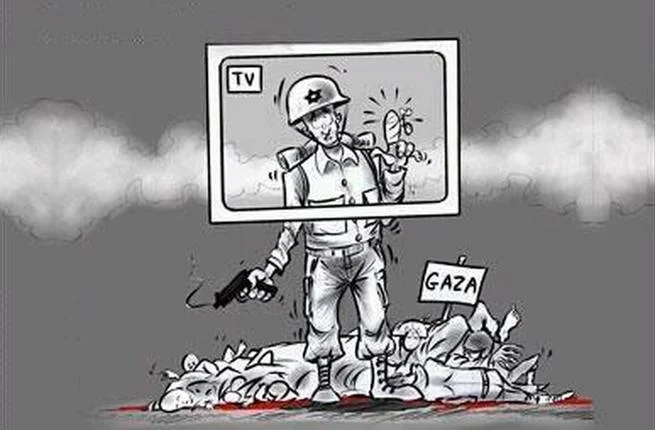
CONTEXT matters, and CONTEXT is often missing in news reports about Israel-Palestine
By Kathryn Shihadah – If Americans Knew – January 19, 2019
A recent media study based on analysis of 50 years of data found that major U.S. newspapers have provided consistently skewed, pro-Israel reporting on Israel-Palestine.
The study, conducted by 416Labs, a Toronto-based consulting and research firm, is the largest of its kind.
Using computer analysis, researchers evaluated the headlines of five influential U.S. newspapers: the Chicago Tribune, Los Angeles Times, New York Times, Washington Post, and Wall Street Journal from 1967 to 2017.
The study period begins in June 1967, the date when Israel began its military occupation of the West Bank and Gaza Strip – now officially termed the Occupied Palestinian Territories – following its Six Day War against Jordan, Egypt and Syria.
Methodology involved the use of Natural Language Processing (NLP), a type of computer analysis that sifts through large amounts of natural language data and investigates the vocabulary. NLP tabulated the most commonly used words and word pairs, as well as the positive or negative sentiment associated with the headlines.
Using NLP to analyze 100,000 headlines, the study revealed that the coverage favored Israel in the “sheer quantity of stories covered,” by presenting Palestinian-centric stories from a more negative point of view, as well as by grossly under-representing the Palestinian narrative, and by omitting or downplaying “key topics that help to identify the conflict in all its significance.”
Four times more headlines mentioned Israel than Palestine
The Fifty Years of Occupation study reveals a clear media bias first in the quantity of headlines: over the half-century period in question, headlines mentioned Israel 4 times more frequently than Palestine.
The study revealed other discrepancies in coverage of Israel and Palestine/Palestinians as well.
Sentiment
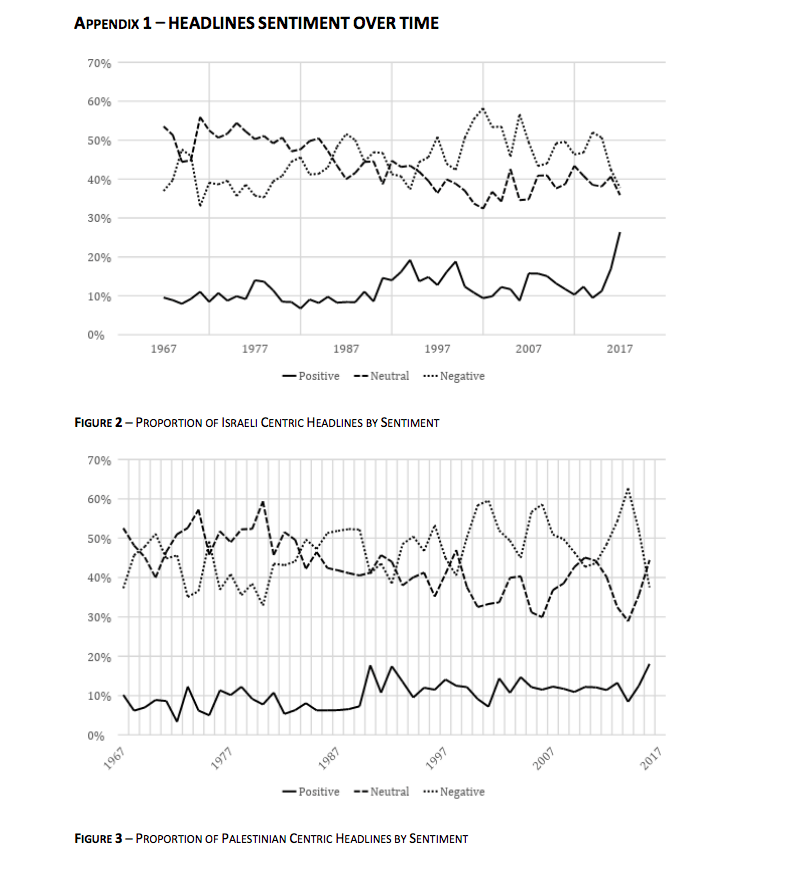
For all 5 newspapers studied, Israel-centric headlines were on average more positive than the Palestinian-centric headlines.
Sentiment analysis measures “the degree to which ideological loyalty colors analysis.”
In order to measure sentiment, the study employed a “dictionary” of words classified as either positive or negative; each headline was scored based on its use of these words.
The report explains that journalistic standards require news stories to be “neutral, objective, and derived from facts,” but the reports on Israel-Palestine “exhibit some form of institutionalized ideological posturing and reflect a slant.” [See graphs below post]
Under-representation of the Palestinian voice
The study also found Palestinians marginalized as sources of news and information.
A simple case in point: The fact-checking organization Pundit Fact examined CNN guests during a segment of the 2014 Israeli incursion into Gaza, Operation Protective Edge. Pundit Fact reported that during this time, 20 Israeli officials were interviewed, compared to only 4 Palestinians, although Palestinians were overwhelmingly victims of the incursion with 2,251 deaths vs. 73 Israeli deaths.
The study’s data reveal what it calls “the privileging of Israeli voices and, invariably, Israeli narratives”: the phrases “Israel Says” and “Says Israel” occurred at a higher frequency than any other bigram (2-word phrase) throughout the 50 years of headlines – in fact, at a rate 250% higher than “Palestinian Says” and similar phrases. This indicates that not only are Israeli perspectives covered more often, but Palestinians rarely have an opportunity to defend or explain their actions.
The report explains the significance of such asymmetry:
This imbalance matters, as official Israeli government policy is effectively made an intrinsic part of the discussion of the conflict, while the views of Palestinians living under occupation are subordinated to the margins.
Sins of omission and de-emphasis
The analysis turned up yet another significant problem with the newspapers’ coverage: failure to report, or to report adequately, on important aspects of the Palestine-Israel conflict.
The study found several critical topics that the 5 newspapers failed to cover adequately, resulting in reader misperceptions.
Peace process?
One misperception revolves around the alleged existence of an ongoing “peace process.”
The study points out the consistent use of bigrams such as “peace talks,” in spite of the fact that since 1993, peace talks have been essentially nonexistent. And,
A hallmark of the conflict has been the perception that there is an ongoing peace process which, from time to time, breaks down, thereby delaying resolution of the conflict…the dispute is effectively portrayed as being one between two equal warring sides, not one where one group is an occupier and the other the occupied.
Occupation
The researchers emphasize the fact that as the occupation of the West Bank (and de facto occupation of Gaza) drags on past 50 years, the brutality of the Israeli occupation is becoming normalized and its illegality forgotten.
They draw this conclusion from their analysis of the unigram “occupation,” which has appeared in headlines less and less frequently, dropping by 85% in Israel-centric headlines, and by 65% in Palestinian-centric headlines over the 50-year period.
Gaza
The blockade of Gaza, and the economic hardships of Gazans under the blockade, were mentioned in Palestine-centric headlines just 30 and 63 times respectively, in the 11 years since the blockade began.
In Covering Gaza: is the mainstream media discourse changing on Palestine-Israel?, Tamara Kharroub of the Arab Center in Washington DC censures mainstream media coverage of the Great Return March – a nonviolent demonstration by Palestinian Gazans for justice and the end of the blockade – for failing to report the names of Gazan civilians killed by Israeli snipers, “in stark contrast to the usual reporting on Israeli victims, in which their pictures, lives, and grieving families are repeatedly shown and discussed.”
… and more
As another example, Palestinian refugees – still waiting to be repatriated according to UN Resolution 242 of 1949 – have been forgotten as a group: the words “Palestine Refugee(s)” in headlines has declined by 93% over the last 50 years, reflecting a decline in concern from media.
The study reveals similar underreporting on topics including the illegality of Israeli settlements and Palestinians’ designation of East Jerusalem as the future capital of the future Palestinian state.
According to Siham Rashid, formerly of the Palestinian Counseling Center, these accumulated flaws characterize the Israel-Palestine issue as
a conflict revolving around security and terrorism, with Israel being the victim…So, for many people, the conflict is understood as a conflict of land and borders between two peoples who have equal claims, not as a conflict between an oppressed and oppressor and colonized and colonizer.
International consensus
As cited by the researchers, Marda Dunsky’s 2008 book, Pens and Swords: How the American Mainstream Media Report the Israeli-Palestinian Conflict, analyzed US media over a 4-year period. One of her most significant findings was the lack of coverage of the international consensus on important issues, for example the almost-universal conclusions that Israeli settlements are illegal, and that Palestinian refugees should be allowed to return to their homes.
Greg Shupak’s The Wrong Story: Palestine, Israel, and the Media offers an example from Operation Protective Edge, the Israeli aggression of 2014 into Gaza. He points out that the blockade of Gaza, a key antecedent to the violence, was mentioned only once in the many New York Times editorials on the conflict published just before and during the war.
Shupak’s work shows how NYT “frequently omits important details that would better contextualize the conflict.”
In More Bad News From Israel, Glasgow University researchers Greg Philo and Mike Berry examined British mainstream media coverage of Israel-Palestine. In a study of BBC coverage, the lack of adequate context resulted in
the failure to convey adequately the disparity in the Israeli and Palestinian experience, reflecting the fact that one side is in control and the other lives under occupation…BBC output does not consistently give a full and fair account of the conflict. In some ways the picture is incomplete and, in that sense, misleading.
Alison Weir of If Americans Knew has published extensive studies of American media coverage of Israel-Palestine which reveal “daily reporting [that is] profoundly skewed” and a “pervasive pattern of distortion” in which “[t]he favored population was the Israeli one.”
If Americans Knew has conducted six major studies and one shorter study on coverage of Israel-Palestine news and found that media had reported on Israeli deaths at far greater rates than they reported on Palestinian deaths. The studies also revealed the palpable pro-Israel bias, under-representation of the Palestinian voice and the omission or downplaying of critical topics.
The American Israel Public Affairs Committee (AIPAC) is a lobbying group that advocates pro-Israel policies to the Congress and Executive Branch of the United States.
Causation?
The Canadian researchers found a “systemic problem in coverage,” but did not study the causation. Nevertheless, they excluded the possibility of “deliberate planned bias,” attributing the biased coverage to “the U.S. media’s affinity to broadly align and support their government’s foreign policy objectives.”
Some other researchers, however, report a wider range of factors, many connected to the pro-Israel lobby in the United States. For example, Alison Weir discovered deep links between US media and Israel (e.g. here, here, here, and here). Mearsheimer and Walt reported on the power of pro-Israel pressure in their book The Israel Lobby; Paul Findley in his book They Dare to Speak Out, and others report a wider range of factors, many connected to the pro-Israel lobby in the United States. In many cases, pressure from pro-Israel groups in the Israel lobby, contributed significantly to the consistent slant in mainstream media.
Conclusion
As the authors point out:
Whether online, television, or print, the mainstream media serves to provide most Americans with their daily news. How the media frames the news and presents it to viewers can profoundly shape their perception of current events.
Yet numerous analysts, across time and region, have established that this media consistently skews the news when it comes to Israel-Palestine. This results in nations and their governments upholding Israeli priorities rather than those of their own people, and perpetuating injustice toward Palestinians.
RELATED READING:
Why we urgently need alternative news sources
Mainstream media repeatedly shows its Israel bias
Keeping an eye on the curators of the news
Correcting a few distortions about Gaza
Associated Press Double Standard in Israel-Palestine Reporting
Media selectively report on Jerusalem unrest; the clock keeps ticking…
‘Ratf***er and spy’: British academic sues FBI informant & MSM for calling her Russian ‘honeypot’
RT | May 25, 2019
A Russian-born British historian is suing FBI informant Stefan Halper and several news outlets for defaming her as a “honeypot” working for the Kremlin to seduce Trump aide Michael Flynn. She says the scandal ruined her life.
Former Cambridge University academic Svetlana Lokhova has demanded $25 million from Halper, along with the Washington Post, New York Times, MSNBC, and Wall Street Journal, charging their “combined character assassination” over the past three years “injured her business as an academic and author, and propelled her to the epicenter of a massive fraudulent hoax about ‘Russian collusion.'”
Calling Halper a “ratf***er and a spy, who embroiled an innocent woman in a conspiracy to undo the 2016 Presidential election,” Lokhova says he colluded with the FBI, political operatives at the university where they both worked, and mainstream media journalists to paint her as a traitor and a “honeypot” who seduced Michael Flynn at a dinner in 2014 when he was US Director of National Intelligence. The FBI informant claimed Lokhova was “not a real academic” and that her “research was provided by Russian intelligence on the orders of Vladimir Putin” – and the media ran with the story for three years, hounding her out of her job and home and any hope of a normal life.
(“Ratf***er,” the suit helpfully explains in a footnote, “is a colorful and foul simile [sic] for ‘pulling a dirty trick’ coined by a Nixon campaign strategist.”)
The suit alleges Halper fed the fake story of Lokhova seducing Flynn to the named media organizations, which despite knowing he was a spy failed to fact-check Halper’s claims. Instead, she says, they crafted the story “out of whole cloth,” knowing the “sensational and scandalous accusations of ‘Russian collusion'” would catch fire – and, hopefully, burn the Trump campaign to the ground, “creat[ing] another Watergate.”
While stating repeatedly that she is not, was not, and has never been a spy, Lokhova claims it is Halper who has extensive Russian intelligence connections – from whom he could have learned that she was not a spy. The former MI6 agent who invited her to the dinner with Flynn never would have done so if she’d been a spy, she says, and at no point did she so much as sit next to Flynn (she includes a photograph to illustrate this last point in which Flynn is flanked by two men). Indeed, she says, everything in the stories published about her is completely false, from the email from Flynn signed with a pet name inviting her to Moscow to work as his translator to the seduction of the former general on orders from Putin.
Lokhova learned from colleagues that Halper and another academic were spreading rumors about her, and those rumors soon found their way into print, where the story became more salacious with each retelling. Her attempts to correct the record were rebuffed, repeatedly. Journalists began showing up at her door.
After not only losing her job but two book contracts and seven years of work toward her PhD, Lokhova says she was forced to leave the country “in order to avoid public scrutiny, invasion of her privacy, and constant public ridicule,” destroying her health and leaving her suicidal. For “insult, pain, embarrassment, humiliation, mental suffering, injury to her reputation, loss of income and business, special damages, costs, and other out-of-pocket expenses,” she wants $25 million from those responsible.
The Mueller report and revelations that Halper may have used a “honeypot” gambit to try to entrap Trump aide George Papadopoulos vindicate her, Lokhova says, noting that while the special counsel interviewed Flynn 19 times, she was not interviewed once.
Why is the US always ‘stumbling’ or ‘sliding’ into war? How the media misleads with language

By Danielle Ryan | RT | May 15, 2019
The way the mainstream media tells it, the United States never, ever ends up embroiled in wars and military conflicts on purpose — only ever by mistake, or as a result of things like ‘bad planning’ or ‘strategic missteps’.
Very often when media coverage of war is analysed, there is a focus on how hawkish pundits cheerlead for conflict and journalists parrot official narratives while dissenting voices are drowned out. Mainstream networks, for example, have been heavily criticized by media watchdogs for almost exclusively inviting pro-war guests and ex-military hawks onto their news shows to convince Americans that war is the only reasonable course of action, while refusing to let anti-war commentators get a look in.
But there is another more subtle and unnoticeable way that the media deceives us. Even when they are not outright cheerleading for military action (as was the case in the lead up to the Iraq War), the language they use to describe events is designed to absolve Washington of blame.
Next time you read the news, notice how the US is always “stumbling into” war, or “drifting into” war or “sliding into” war — or even “sleepwalking into” war. To “stumble into” war seems to be a firm favorite among headline writers. The US has “stumbled” into war in Iraq and Syria and has been, at one time or another, at risk of “stumbling” into war with Russia, North Korea and most recently Iran.
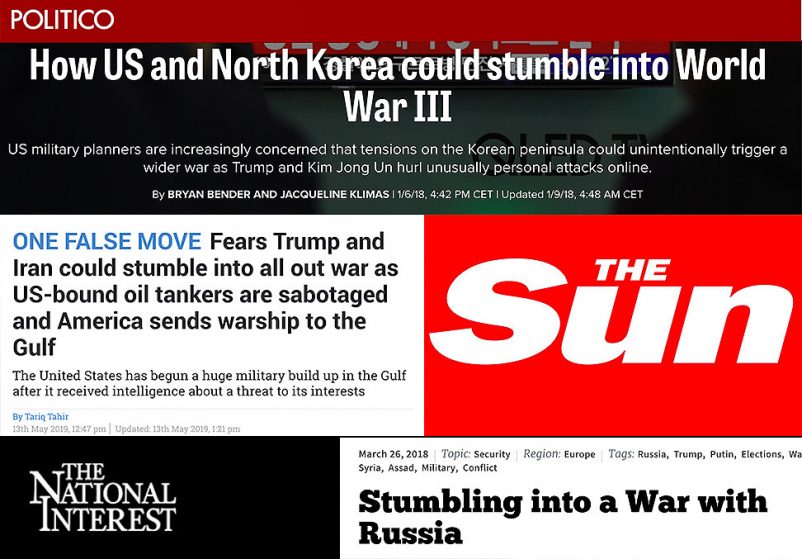
According to these headlines, the US has also been “dragged into” (CNN) and “sucked into” (NI ) war in Syria and Afghanistan, twice (NI, The Times ). In recent weeks, the Trump administration has been “sliding into” (AP ) a potential “accidental” war with Iran — and back in 2017, it was “dragged into” (FP ) the disastrous Yemen conflict.
The examples of the US stumbling, blundering and bumbling its way into wars are endless — and it does raise a question that no one ever seems to ask: If it’s so easy to trip and fall into massive never-ending wars, why isn’t it happening to everyone else? Is Washington just especially clumsy?
With this narrative of the bumbling superpower, agency is always removed from the architects of war. Instead of enthusiastically banging the drums for war, we’re told the White House is always ‘reluctant’ to deploy its military, but is ‘forced’ into it . Then, once the war is in full-swing, when things are not panning out exactly as planned, the US can become the sacrificial hero, propelled into a deadly conflict not of its own making.
A recent headline in the Miami Herald framed recent US actions on Venezuela as the US being “pushed to act.” Pushed by who? The Trump administration voluntarily helped organize and instigate the attempted coups that worsened the country’s political crisis and proudly imposed the economic sanctions which have led directly to thousands of premature deaths. There was no “pushing” involved.
In April, Foreign Policy magazine even had Venezuela’s self-declared interim president Juan Guaido “stumbling toward a coup.” How do you stumble into a military coup? Surely that’s the kind of thing that requires careful, deliberate planning and execution? The Washington Post had Trump “fumbling” an uprising in Caracas, too.
It’s not just media pundits and journalists who employ this kind of misleading language, either. British Foreign Secretary Jeremy Hunt said this week that a US war with Iran could happen “by accident.” Did Hunt take a vacation from reality and miss US Secretary of State Mike Pompeo and National Security Advisor John Bolton ramping up war rhetoric against Iran for months? Maybe Trump abandoned the 2015 Iran nuclear deal by accident and sent an aircraft carrier and bomber task force into the Persian Gulf last week to “send a message” to Iran by mistake.
Such framing obscures basic facts about Washington’s motives and predilection toward military conflict over diplomacy. Washington doesn’t get into wars by mistake. Unless a country is directly attacked, threatened or occupied, wars are quite easy to avoid getting into if you really don’t want to be in them — but the hawks in Washington, no matter how much they pretend to not want war, are always itching for more and they will stop at nothing to get what they want, even if that means fabricating evidence (as in Iraq) or pulling off false flag attacks to use as convenient pretexts for the US to ‘respond’ to.
US military actions are designed specifically to provoke the conflicts that they believe will be of benefit to their overall geopolitical strategy. Talk of freedom, democracy and human rights are just a convenient cover. Washington is never at risk, for example, of stumbling into war with Saudi Arabia, despite Riyadh’s laundry list of crimes against humanity.
Whether this propagandistic language is always employed in a totally conscious way or not, it’s difficult to tell. Either way, it’s a psychological trick which frames the most powerful, military-minded and trigger-happy country in the world as some kind of innocent victim of events beyond its control.
Also on rt.com:
US media’s love affair with war: Major outlets showed zero opposition to Syria strikes
Washington Post Begs Trump to Save al-Qaeda in Syria Before It’s Too Late
“Time is running out”

By Marko Marjanović | Checkpoint Asia | May 10, 2019
Washington Post’s Josh Rogin:
There is little that can stop the brutal assault underway in northwest Syria, where Russian, Iranian and Assad regime forces have launched a major military offensive as millions of civilians flee for their lives. But the record shows that if President Trump acts to try to halt the slaughter, it will have real impact on the ground. Even a presidential tweet could save lives. Time is of the essence.
LOL, “millions” of civilians? There are about 2.5 million under rebels in Idlib, if millions are fleeing who is left?
Of course every Syrian/Russian offensive is a “brutal assault”. The Empire meanhile plants flowers and throws candy from its aeroplanes. It must have been diabates that killed 1,600 civilians in Raqqa and 9,000 in Mosul.
There’s a lot going on right now in U.S. foreign policy. The Trump administration is dealing with an escalating Iran crisis, North Korea missile firings, a shaky China trade negotiation and an attempt to oust the Venezuelan regime. It’s no mere coincidence that Bashar al-Assad and Moscow chose this moment to retake the last rebel-held area of Syria using scorched-earth tactics, committing atrocities along the way.
The region of Idlib holds about 3 million civilians, including 1 million children, who were moved there from across the country because they would not submit to the Assad regime. And now there is deafening silence from the international community about their brutal slaughter.
James F. Jeffrey, the State Department’s special envoy for Syria, told me the U.S. government sees a “major escalation” by the regime and its allies in Idlib and is working diplomatic channels to de-escalate the fighting.
“We are raising this at every level with the Russians,” he said. “Any major operation into Idlib would be a reckless escalation of the conflict.”
It’s a reckless escalation to smash al-Qaeda when it’s the Syrians/Russians doing it. And when al-Qaeda is Empire’s battering ram against Damscus.
Assad is dependent on Russian air power, and Moscow has committed a lot of it to the assault, Jeffrey said. That means Moscow is flagrantly violating the cease-fire and de-escalation agreement it signed with Turkey last year in Sochi, Russia.
Why is an agreement Russia signed with Turkey any business of the US and the Washington Post ?
So far, Moscow is ignoring Jeffrey’s warnings. The Turkish government, which saw its outpost in Idlib shelled, seems unable or unwilling to stop the onslaught.
In other words, Russians and Turks have an understanding and there is no breech of agreement.
But history shows that when Trump decides to intervene in Syria to protect civilians, Moscow listens.
In April 2017, when Trump first launched missiles at the Syrian regime, he was responding to a chemical weapons attack in Idlib that looked to be the beginning of the very offensive we are seeing now. Trump’s actions persuaded Assad and Russia to back down.
After a Syrian activist told Trump at a fundraiser that the assault on Idlib was beginning again, the president tweeted last September that Assad “must not recklessly attack Idlib” and that Russia and Iran must not support a “potential human tragedy.” The tweet worked.
“It stopped. You saw that. And nobody’s going to give me credit, but that’s okay,” Trump said at the time. “Millions of people would have been killed. And that would have been a shame,” he said.
Erdogan did most of the work to halt that offensive, but it’s possible Trump’s threats played a part as well.
Now Moscow is testing Trump again. So far, the president is silent. That has a cascading effect inside the U.S. national security system. Several people who work with U.S. government agencies on the ground in Syria told me that U.S. officials throughout the bureaucracy are waiting on Trump to signal his intent before they move to engage in Idlib.
Actually Moscow is doing no such thing. Defending al-Qaeda in Idlib does not have to be America’s job if Washington doesn’t make it so.
Sen. Lindsey O. Graham (R-S.C.) understands the importance of Trump’s verbal cues. He tweeted at the president this week asking him to speak up and protect Idlib. Putin surely also understands that in the United States’ Syria policy, only Trump’s words really matter. Trump and Putin spoke for about an hour last week, but it is unknown what, if anything, they discussed about Syria.
Meanwhile, Russian planes are targeting residential areas and hospitals and then killing aid workers responding to those attacks, said Raed Al Saleh, founder of the Syria Civil Defense, a civilian rescue organization better known as the White Helmets. In Idlib, he said, the regime has resumed the use of barrel bombs and white phosphorus, weapons of mass atrocity and mass displacement.
Don’t forget the kitten shelters.
Public estimates of 150,000 newly displaced people are just the beginning, said Saleh. Millions of people are preparing to “form caravans like in El Salvador” to head for Europe. “These people see the international community is not willing to do anything to keep them safe in their homes,” he said.
Syria has 5 million refugees outside the country and 6 million displaced internally courtesy of the Empire weaponizing salafi jihad against it. Would crushing al-Qaeda and stabilizing the country encourage them to return? Would the US tolerate al-Qaeda carving out an enclave of 2 million people on its territory?
Several schools in Idlib supported by U.S. aid organizations are now at grave risk. Thirty of those organizations wrote to Trump asking him to give the signal so the U.S. government can snap into action.
“Only you are able to direct our government to use every tool and resource at our disposal for the protection of civilians in Idlib Province,” they wrote.
Syrians will remember that the world abandoned them in their time of most dire need. The fresh atrocities will fuel more extremism. The new refugee crisis will further destabilize Turkey, the Middle East and Europe.
It’s bizarre that the fate of millions could hinge on whether Trump decides to speak up to protect them. But that is where we are. So please, Mr. President, tweet something, say something, do something — anything — before it’s too late. The people of Idlib will give you credit, if they survive.
You kind of lose the moral high ground of being an “aid organization” when you start begging your government to cruise missile another country.
Top 51 Fake News Russiagate ‘Bombshells’ Spread By The MSM
By Tyler Durden – Zero Hedge – 04/23/2019
Following the release of the Mueller report, the mainstream media tried to pull a fast one – absurdly claiming that their reporting for the last 2.5 years has been largely vindicated.
Except, they weren’t vindicated at all. In fact, they lied through their teeth, peddling falsehood after falsehood.
To that end, Breitbart‘s John Nolte isn’t about to let them get away with peddling even more fiction about their reporting, and has compiled a list of 51 instances where the MSM flat out lied, borrowing from the work of Sharyl Attkisson, Glenn Greenwald, and Sohrab Ahmari.
Top 51 Fake News ‘Bombshells’ the Media Spread About RussiaGate
The list below of 51 might sound like a lot, but it is a drop in the ocean when you recall the thousands and thousands of hours CNN, MSNBC, Meet the Press, This Week, PBS NewsHour, State of the Union, Good Morning America, Reliable Sources, and the Today Show devoted to anchors and pundits pushing the hoax that Trump colluded with Russia.
Not to mention, millions and millions of establishment media tweets and Facebook posts.
Rachel Maddow, Lawrence O’Donnell, Shepard Smith, Andrew Napolitano, Joe Scarborough, Chris Hayes, Chuck Todd, Joy Reid, Chris Matthews, Jake Tapper, Don Lemon, Chris Cuomo, Brian Stelter, Erin Burnett, et al., are alone responsible for thousands and thousands and thousands of hours of lies and conspiracy-mongering.
This list of 51 doesn’t count the half-million — half-MILLION — Russia collusion stories published over the past two years, almost all of which were premised on the idea that Trump did, indeed, collude with a foreign power to steal the 2016 presidential election.
This list cannot begin to count the countless times these 51 fake stories were repeated as fact throughout other news outlets, social media, and thousands upon thousands of cumulative broadcast hours.
What’s more, this list of 51 can’t begin to count the countless examples of fake news launched against Trump that have nothing to do with Russia — desperate and deliberate lies involving fish food and ice cream scoops…
Before we begin, credit where it’s due. This list would not have been possible without the lists already compiled by Sharyl Attkisson, Glenn Greenwald, and Sohrab Ahmari.
Michael Cohen went to Prague.
Trump directed Michael Cohen to lie, and Mueller has emails proving it.
Paul Manafort passed polling information to Kremlin.
Deputy Attorney General Rod Rosenstein forced out.
Federal investigators wiretapped Trump’s personal attorney Michael Cohen, have recordings of Trump.
Phony Russia dossier was initially funded by Republican group.
Donald Trump directed Flynn to make contact with Russian officials during the 2016 presidential campaign
Russian social media company provided documents to Senate about communications with Trump official.
- CNN:
Donald Trump Jr. conspired with WikiLeaks.
Robert Mueller subpoenaed Trump’s Deutsche Bank records.
Former Trump campaign chairman Paul Manafort worked with Russia intelligence-connected official as late as December 2017.
Trump Deputy National Security adviser K.T. McFarland lied about another official’s contacts with Russians.
- CNN:
Trump’s campaign was never wiretapped.
Manafort notes from Russian meeting refer to political contributions.
Seventeen intelligence agencies concur Russia hacked the 2016 presidential race.
- CNN:
Congress investigating Russian investment fund with ties to Trump officials.
Former FBI Director James Comey says Attorney General Jeff Sessions told him not to call Russia probe an investigation but “a matter.”
- CNN:
James Comey will testify he never told Trump he was not under investigation.
Putin admits he has compromising information about Trump.
Trump fired Comey after Comey asked for additional resources for the Russia investigation.
Numerous contacts between Trump campaign staff and “senior Russian intelligence officials.”
Among others, a Trump family member will be indicted on February 8.
Paul Manafort visited WikiLeaks’ Julian Assange on three occasions.
Trump campaign changed GOP platform on Ukraine.
Then-Attorney General Jeff Sessions lied about meeting with Russian Ambassador Sergey Kislyak.
Michael Cohen really did visit Prague.
- CNN:
Trump is lying when he calls Russia dossier “phony.”
RT had hacked into and taken over C-SPAN and C-SPAN “confirmed” it had been hacked.
Russia’s hacked the election systems of 21 American states.
Russian hackers penetrated U.S. electricity grid through a utility in Vermont.
“More than 200 websites” were “routine peddlers of Russian propaganda during the election season.”
Russia is the main suspect in the sonic attacks that sickened 26 U.S. diplomats.
Trump created a secret Internet server to covertly communicate with a Russian bank.
- CNN:
Donald Trump knew in advance of the Trump Tower meeting.
- CNN:
Mueller Report will show Trump “has helped” Putin “destabilize” the United States.
- NBC:
Russia supports Rep. Tulsi Gabbard (D-HI).
-
- CNN:
Sessions failed to disclose meetings he had with the Russian ambassador.
“There’s actually lots of evidence of Trump-Russia collusion.”
Trump revealed classified information to Russians.
House Majority Leader Kevin McCarthy (R-CA) said Russia paid Trump.
Mueller can show Trump campaign “had a connection to Russian intelligence.”
“Rudy Giuliani just told America that Trump’s campaign colluded with Russia.”
Evidence suggests Trump could be a Russian “asset.”
- NBC:
Russians began hacking Hillary Clinton’s emails on the day Donald Trump joked about it in July 2016.
Russia spy visited Trump’s Oval Office.
- CNN:
Phony Russia dossier has been “corroborated.”
- NPR:
Donald Trump Jr. lied under oath about Trump Tower deal in Moscow.
Russia successfully hacked voting systems in a number of states.
- CNN:
Trump is “bonkers” for claiming Hillary Clinton behind Russia dossier.
- CNN:
“Every intelligence expert, both under the Obama administration and under the Trump administration,” agrees with the assessment that Russia attempted to interfere in the 2016 presidential election.
- BBC:
Ukrainian president “authorized” an illegal payment of $400,000 to Michael Cohen for additional face time during a June 2017 meeting with President Trump.
“The Essence of Being Palestinian”: What the Great March of Return is Really About
By Ramzy Baroud | Dissident Voice | April 2, 2019
The aims of the Great March of Return protests, which began in Gaza on March 30, 2018 are to put an end to the suffocating Israeli siege and implementing the Right of Return for Palestinian refugees who were expelled from their homes and towns in historic Palestine 70 years earlier.
But there is much more to the March of Return than a few demands, especially bearing in mind the high human cost associated with it.
According to Gaza’s Ministry of Health, over 250 people have been killed and 6,500 wounded, including children, medics and journalists.
Aside from the disproportionately covered ‘flaming kites’ and youth symbolically cutting through the metal fences that have besieged them for many years, the March has been largely non-violent. Despite this, Israel has killed and maimed protesters with impunity.
A UN human rights commission of inquiry found last month that Israel may have committed war crimes against protesters, resulting in the killing of 189 Palestinians within the period March 30 and December 31, 2018.
The inquiry found “reasonable grounds to believe that Israeli snipers shot at children, medics and journalists, even though they were clearly recognizable as such,” the investigators concluded as reported by BBC online.
Many in the media, however, still do not understand what the Great March of Return really means for Palestinians.
A cynically titled report in the Washington Post attempted to offer an answer. The article, “Gazans have paid in blood for a year of protests. Now many wonder what it was for,” selectively quoted wounded Palestinians who, supposedly, feel that their sacrifices were in vain.
Aside from providing the Israeli military with a platform to blame the Hamas Movement for the year-long march, the long report ended with these two quotes:
The March of Return “achieved nothing,” according to one injured Palestinian.
“The only thing I can find is that it made people pay attention,” said another.
If the Washington Post paid attention, it would have realized that the mood among Palestinians is neither cynical nor despairing.
The Post should have wondered: if the march ‘achieved nothing’, why were Gazans still protesting, and the popular and inclusive nature of the March has not been compromised?
“The Right of Return is more than a political position,” said Sabreen al-Najjar, the mother of young Palestinian medic, Razan, who, on June 1, 2018, was fatally shot by the Israeli army while trying to help wounded Palestinian protesters. It is “more than a principle: wrapped up in it, and reflected in literature and art and music, is the essence of what it means to be Palestinian. It is in our blood.”
Indeed, what is the ‘Great March of Return’ but a people attempting to reclaim their role, and be recognized and heard in the struggle for the liberation of Palestine?
What is largely missing from the discussion on Gaza is the collective psychology behind this kind of mobilization, and why it is essential for hundreds of thousands of besieged people to rediscover their power and understand their true position, not as hapless victims, but as agents of change in their society.
The narrow reading, or the misrepresentation of the March of Return, speaks volumes about the overall underestimation of the role of the Palestinian people in their struggle for freedom, justice and national liberation, extending for a century.
The story of Palestine is the story of the Palestinian people, for they are the victims of oppression and the main channel of resistance, starting with the Nakba – the creation of Israel on the ruins of Palestinian towns and villages in 1948. Had Palestinians not resisted, their story would have concluded then, and they, too, would have disappeared.
Those who admonish Palestinian resistance or, like the Post, fail to understand the underlying value of popular movement and sacrifices, have little understanding of the psychological ramifications of resistance – the sense of collective empowerment and hope which spreads amongst the people. In his introduction to Frantz Fanon’s Wretched of the Earth, Jean-Paul Sartre describes resistance, as it was passionately vindicated by Fanon, as a process through which “a man is re-creating himself.”
For 70 years, Palestinians have embarked on that journey of the re-creation of the self. They have resisted, and their resistance in all of its forms has molded a sense of collective unity, despite the numerous divisions that were erected amongst the people.
The March of Return is the latest manifestation of the ongoing Palestinian resistance.
It is obvious that elitist interpretations of Palestine have failed – Oslo proved a worthless exercise in empty clichés, aimed at sustaining American political dominance in Palestine as well as in the rest of the Middle East.
But the signing of the Oslo Accord in 1993 shattered the relative cohesiveness of the Palestinian discourse, thus weakening and dividing the Palestinian people.
In the Israeli Zionist narrative, Palestinians are depicted as drifting lunatics, an inconvenience that hinders the path of progress – a description that regularly defined the relationship between every western colonial power and the colonized, resisting natives.
Within some Israeli political and academic circles, Palestinians merely ‘existed’ to be ‘cleansed’, to make room for a different, more deserving people. From the Zionist perspective, the ‘existence’ of the natives is meant to be temporary. “We must expel Arabs and take their place,” wrote Israel’s founding father, David Ben Gurion.
Assigning the roles of dislocated, disinherited and nomadic to the Palestinian people, without consideration for the ethical and political implications of such a perception, has erroneously presented Palestinians as a docile and submissive collective.
Hence, it is imperative that we develop a clearer understanding of the layered meanings behind the Great March of Return. Hundreds of thousands of Palestinians in Gaza did not risk life and limb over the last year simply because they required urgent medicine and food supplies.
Palestinians did so because they understand their centrality in their struggle. Their protests are a collective statement, a cry for justice, an ultimate reclamation of their narrative as a people – still standing, still powerful and still hopeful after 70 years of Nakba, 50 years of military occupation and 12 years of unrelenting siege.
Intelligence Contractors Make New Attempt To Provoke Tensions With North Korea
By William Craddick | Disobedient Media | March 8, 2019
It’s the second, but no less ludicrous, attempt in one week to sway the opinion of the public and President Donald Trump against the concept of denuclearization and peaceful dialogue with North Korea.
A March 8, 2019 report from National Public Radio (NPR) follows another by NBC News with sensational and misleading claims that satellite imagery released by private corporations with contractual ties to government defense and intelligence agencies show imminent preparations by the Democratic People’s Republic of Korea (DPRK) to engage in missile testing or the launch of a satellite from their facilities in Sanumdong, North Korea. An examination of the photos provided shows absolutely no indication of such activity.
I. Satellite Footage Of Sanumdong Facility Shows No Sign Of Imminent Launch
Images provided to NPR by private contractor DigitalGlobe consist of two low resolution images, one of a building in the Sanumdong complex and the other of a train sitting along a rail line. In neither photo is there any discernible amount of unusual activity.

Credit: Image ©2019 DigitalGlobe, Inc. Graphic: Alyson Hurt/NPR
The first image of a “production hall” bears a striking resemblance to a similar photo run by the Washington Post in July 2018 where unnamed intelligence officials claimed that North Korea was building one or possibly two liquid fueled ICBMs which appear to have never materialized or been used in any launch. The claims came one month after President Trump met with Chairman Kim Jong Un in Singapore for a historic summit between the United States and the DPRK.
NPR claims that the imagery shows “vehicle activity” occurring around the facility. Yet close inspection shows that the “activity” consists of a few inert vehicles, which appear to be a white pickup and white dump truck or flatbed parked in a permanent position next to piles of metal. The scene does not appear to be different from any number of sleepy yards of businesses that can be examined by members of the public on Google Maps.

Credit: Image ©2019 DigitalGlobe, Inc. Graphic: Koko Nakajima/NPR
The second image, according to NPR, shows rail cars sitting “in a nearby rail yard, where two cranes are also erected.” The photo simply shows a train car sitting inert with empty flatbed cars and hopper cars that are either filled with coal or empty. A second rail line similarly holds a number of hoppers and flatbed cars. Hopper cars in particular are totally unsuitable for the transportation of military technology such as missiles.
The tracks in the lower left corner are covered in snow, meaning that the train sat for many months through the winter or was backed into its position. Considering that US and international sanctions have caused an extreme scarcity of fuel in the DPRK it is likely that the trains have not moved for quite some time, unless their diesel engines were converted to burn coal or wood.
In short, there is absolutely no indication that several low resolution photos of a facility in North Korea have any activity in them outside of a few rusting vehicles that have sat without moving for some time.
II. NPR’s Sources Of Satellite Imagery Are Contractors For The CIA And Pentagon
The report by NPR lists two sources of satellite imagery – DigitalGlobe, Inc. and Planet Labs, Inc. As Disobedient Media has previously reported, DigitalGlobe is an American vendor of satellite imagery founded by a scientist who worked on the US military’s Star Wars ICBM defense program under President Ronald Reagan. DigitalGlobe began its existence in Oakland, CA and was seeded with money from Silicon Valley sources and corporations in North America, Europe and Japan. Headquartered in Westminster CO, DigitalGlobe works extensively with defense and intelligence programs. In 2016, it was revealed that DigitalGlobe was working with CIA chipmaker NVIDIA and Amazon Web Services to create an AI-run satellite surveillance network known as Spacenet.
Planet Labs is a private satellite imaging corporation based in San Francisco, CA that allows customers with the money to pay for an opportunity to gain access to next generation surveillance capabilities. In February 2016, Federal technology news source Nextgov noted a statement from former CIA Information Operations Center director and senior cyber adviser Sue Gordon that Planet Labs, DigitalGlobe and Google subsidiary Skybox Imaging were all working with the Pentagon’s National Geospatial-Intelligence Agency (NGA) to provide location intelligence. Planet Labs’ own website also lists press releases detailing past contracts for subscription access to high resolution imagery with the NGA.
The pervasive involvement of intelligence agencies and defense contractors in attempts to undermine negotiations with North Korea does not create confidence in the already shaky claims made by NPR regarding alleged preparations by the DPRK to participate in a missile launch. These contentions are not supported in substance by any tangible facts. As claims and pressure continue to build on President Donald Trump to abandon the peace process, there are multiple factions of the United States government who are running a real risk of behaving in manners which could be interpreted as open sedition or refusal to carry out the stated goals and policies of the President.
“Hyperalarming” study cited by WAPO was hype
By Paul Homewood | Not A Lot Of People Know That | February 11, 2019
Confirmation that the GWPF have sent a formal complaint to PNAS, regarding the paper published by them on insect decline last October:
The scientific paper behind newspaper claims that insect populations were threatened with extinction was based on data known to be unreliable. That’s according to the Global Warming Policy Foundation, which today called for the paper to be withdrawn.
The paper, by US scientists Bradford C Lister and Andres Garcia, claimed that a rapid decline in insect populations in a rainforest in Puerto Rico was the result of rising temperatures. The Washington Post called the study “hyperalarming”, while the Guardian discussed climate change causing “insect collapse”.
However, the authors’ evidence that temperatures had, in fact, risen turns out to be based on a single weather station, which was known to be unreliable because of undocumented changes to equipment and location resulting in a substantial and abrupt increase in recorded temperatures in September 1992.
Since 1992, temperatures at this station have actually declined.
The Global Warming Policy Foundation has issued a formal complaint to the Proceedings of the National Academy of Sciences, the journal that published the article, asking that the paper be withdrawn.
Featured Video
Theodore Postol: Iran’s Missiles & Drones Were Underestimated
or go to
Aletho News Archives – Video-Images
From the Archives
What is the Israeli Lobby in Australia Doing in Interfaith Dialogue?
By Ali Kazak | Dissident Voice | October 11, 2015
For years Israel and its lobby around the world have been trying to normalise their relations with Arabs and Muslims without solving the Palestine Question.
One of the methods they resorted to in the last few years is using human rights and community organizations such as interfaith dialogue and Multiculturalism to achieve this objective and to: isolate the Palestinians, marginalise the Palestine question, end Israel’s isolation, and prevent criticism of Israel, knowing that these organisations will be the first to stand against Israel’s violations, racial and religious discrimination.
The group responsible for this task in Australia is The Australia/Israel & Jewish Affairs Council (AIJAC); its Director of International & Community Affairs, Jeremy Jones is in charge of lobbying religious community organizations, specifically Muslims and Christians. Consequently he convened the Faith Communities for Reconciliation, founding participant in the Australian Partnership of Religious Organisations and the Australian National Dialogue of Christians, Muslims & Jews.
AIJAC is a private political propaganda group. It is recognised as the main Israeli lobby in Australia. It coordinates its activities and works intimately with the Israeli embassy in Canberra and different institutions in Israel. It is privately funded by some Jewish businessmen. It monitors closely Australian politicians, the media, ethnic and religious groups, (especially Arabs and Muslims), unions and academics on their stands towards Israel and the Palestine question. … continue
Blog Roll
 Aletho News
- The killing of three Indonesian soldiers in Lebanon should remind Jakarta that Israel does not want peace
- Defeated and delusional: Netanyahu’s remarks reveal $80bn war failure, says analyst
- Iran’s friends are about to make life much more difficult for Israel and the US
- The war of liberation of the Arab and Islamic peoples expands across the Gulf
- Envoy warns UN on Trump’s threat to ‘obliterate’ Iran’s civilian infrastructure
- The Larak Corridor: Iran’s Rial Gate With No US, No Israel, and No Way Around
- ‘Economic terrorism’: Steel facilities hit again in US-Israeli strike
- ‘War Crime’: Iran condemns attacks on Arak, Ardakan nuclear sites
- Two-thirds of Americans want quick end to Iran war even if goals unmet
- Trump to Give “Important Update on Iran” Wednesday in Prime-Time Speech
- If Americans Knew
- Israel wants US to bomb more of Iran’s civilian structures (113,000 is not enough) – Not a ceasefire Day 173
- Ann Coulter Rips Into Fox News for Iran War Coverage
- Joe Kent Urges Americans To Call White House and Congress To Object To Sending Troops Into Iran
- DNC Resolution to Reject AIPAC Funding Puts Democratic Leaders in the Hot Seat
- Swedish foundation to build 400 schools as over 650,000 Gaza children remain without education for 2 years
- Israeli army admits photshopping image of slain Lebanese journalist
- This is how Israel is systematically killing health workers under the cover of war in Lebanon
- Carrying life under fire: Israeli invasion of Lebanon leaves pregnant women facing deadly risks
- Champagne all around for the new death penalty (for Palestinians) law – Not a ceasefire Day 172
- Why are Palestinian books struggling to be seen on Amazon?
- No Tricks Zone
- New Study Finds Warming Saves Lives…Cold Temperatures 12 Times More Deadly Than Excess Heat
- German Science Blog Accuses PIK Climate Institute Of Hallucinating Climate Tipping Points
- Devastating Assessment Of Comirnaty Vaccine By Former Senior Pfizer Europe Toxicologist
- New Study: CO2 Is ‘Effectively Negligible’ As An Explanatory Climate Change Factor Since 2000
- Former Pfizer Toxicologist Dr. Helmut Sterz Tells Bundestag Hearing Pfizer Vaccine Should Have Never Been Approved
- Energy Expert: Germany’s Nuclear Phaseout Was A “500 Billion Euro Mistake”
- New Research: South Australia’s Mid-Holocene Sea Surface Temperatures Were 4°C Warmer Than Today
- Storing Green Energy To Last Germany 10 Days Would Require A 60-Million Tonne Battery
- New Studies: UK Sea Levels Were 4 Meters Higher Than Today During The Mid-Holocene
- Destructive Green New Deal: German Energy And Metal Group Warns Of Drastic Crisis
 Aletho News