Twisted narratives promote the targeted assassinations of Palestinians
By Ramona Wadi | MEMO | June 20, 2023
A recent poll by the Palestinian Centre for Policy and Survey Research detailed how Palestinians are largely in favour of armed resistance against Israel’s settler-colonialism. More importantly, Palestinians have again asserted that they no longer need to take their cues from the main Palestinian political factions, indicating a sharp detachment from the politics of the previous years that monopolised resistance depending on factions and geographical territory.
In the poll, 71 per cent of Palestinians favoured the forming of armed resistance groups such as the Lions’ Den and the Jenin Battalion. The Palestinian Authority continued to lose favour among the people of occupied Palestine, with 80 per cent of survey participants against the surrender of members from resistance groups to the PA. In relation to this, 86 per cent of Palestinian respondents declared themselves to be against the PA’s persecution of resistance group members.
Juxtaposed against these findings is the statement of Avigdor Lieberman, Israel’s former foreign minister and current head of the Yisrael Beiteinu party, who has called for a targeted assassination policy against Hamas leaders in Gaza. “We cannot accept the ‘rules of the game’ in which they can inflame Judea and Samaria while being immune in Gaza,” said Lieberman, referring to Palestinian resistance in the occupied West Bank. He also called for a large-scale military operation in the occupied Palestinian territory to quash the resistance.
The current Palestinian resistance — which is legitimate under international law — does not follow the politics of Palestinian factions, preferring instead to maintain a unified front encompassing all groups. Moreover, support for Hamas in the occupied West Bank is not a recent phenomenon, but the result of the Fatah-led PA’s corrupt existence.
Referring to the Israeli raid of the Jenin refugee camp in which five Palestinians were killed (a sixth has since died of his wounds), Hamas spokesman Hazem Qassem pointed out that, “The resistance fighters from all factions were united on the battlefield. It shows that the resistance still exists in the West Bank cities.”
Two narratives are at play here. One is the unified front which Palestinians are moving towards and embracing in their anti-colonial struggle. The other portrays Hamas as the epitome of Palestinian resistance and the reason why Palestinian resistance exists. Much of this is attributed to the discrepancy between Gaza and the occupied West Bank in terms of their portrayal, as well as the different reactions to their unique socio-economic and political realities. Now that the PA has lost much of its grip over the occupied West Bank, Hamas is looming as a bigger threat in the official narrative, despite Palestinians clearly veering towards a unified resistance that encompasses all factions and which remains independent.
Lieberman’s call for targeted assassinations exploits the image of Hamas as synonymous with Palestinian resistance. The movement is being used to promote Israel’s policy of targeted assassinations, a purportedly rational objective in the settler-colonial narrative. The impact, however, is not restricted to Gaza. A growing independent Palestinian resistance which is out of the PA’s control is an uncontained reality which Israel currently faces. Maintaining the narrative of Hamas as the exclusive source of resistance can ultimately be used as a facade for Israel and the PA to normalise extrajudicial killings of Palestinians in the occupied West Bank.
Read also: Israel forces assassinate Palestinian Authority officer in West Bank
Israeli raid in Jenin escalates into full-scale battle

One of the Israeli Apaches which launched airstrikes on Jenin, pictured firing flares over the West Bank city during a battle between the Israeli army and resistance fighters. 19 June, 2023. (Photo credit: AFP)
The Cradle | June 19, 2023
Israeli troops launched a massive raid into the occupied West Bank city of Jenin on the morning of 19 June, resulting in the death of five Palestinians and the injury of at least 66, Palestinian media outlets reported.
The four killed have been identified as 21-year-old Khaled Assasa, 21-year-old Qais Jabareen, Ahmad Daraghmeh, 19-year-old Qassam Sariya, and 15-year-old Ahmad Saqr.
The raid began as usual, with the Israeli army storming Jenin to make arrests and facing heavy gunfire from resistance fighters.
Confrontations escalated significantly after members of the Palestinian Islamic Jihad’s (PIJ) West Bank-based Jenin Brigade managed to ambush Israeli troops and detonate explosive devices targeting their military vehicles. Members of the Jenin Brigade opened fire at the vehicles following the explosions.
The Jenin Brigade named the operation “Fury of the Free.”
Israeli media outlets confirmed that seven Israeli soldiers were injured in one of the blasts, with unconfirmed reports suggesting deaths among the troops.
In a brief statement, the Jenin Brigade said: “We still have more surprises … we warn the occupation against continuing their aggression.”
As violence continued to escalate, Israeli helicopters launched airstrikes on Jenin, targeting the West Bank in an aerial attack for the first time in over 20 years.
The airstrikes were launched in order to secure the evacuation of the Israeli soldiers wounded in the resistance’s explosive attack, Israeli media said. Resistance fighters reportedly attempted to target Israeli helicopters with gunfire.
According to Palestinian media reports, the wounded Israeli soldiers remain trapped within one of the vehicles targeted in the blast.
In another brief statement, the Jenin Brigade claimed that the Israeli army was attempting to withdraw from Jenin, but the resistance was obstructing their escape from the area.
Israeli Finance Minister Bezalel Smotrich was quoted as saying, in response to the events in Jenin, that “the time has come” for Israel to launch a full-scale military operation against the resistance in the occupied West Bank, which has grown beyond unprecedented levels in the last two years.
“I will request an emergency meeting of the Security and Political Security Council,” Smotrich said.
For months, Smotrich and National Security Minister Itamar Ben Gvir have been calling for a wide-scale West Bank operation to root out ‘terrorism’ in the area.
However, the military establishment has been mulling over the idea and is conflicted, as some believe that a cost of such an operation would be too high.
Permanent Apartheid in Palestine: This is why Israel wants to reactivate E1 Plan
By Ramzy Baroud | MEMO | June 12, 2023
The Israeli government is at it again, actively discussing the construction of thousands of illegal settlement units as part of a massive settlement expansion scheme known as E1.
Though Israeli construction in the East Jerusalem area has supposedly been halted under international pressure, the Israeli government has found ways to keep the plan alive.
It did so through constant expansion of the various settlements in the name of ‘natural expansion’, confiscation of Palestinian land and the ruthless yet routine demolition of Palestinian homes.
But why does Washington, Israel’s main defender and benefactor, oppose, at least verbally, the construction in E1, while turning a blind eye to illegal construction throughout the West Bank?
The answer lies in the fact that E1 will further expand the Jerusalem municipal boundaries, minimise any Palestinian demographic presence in the city (from the current 42 per cent to about 20 per cent), and prejudice any political solution that includes East Jerusalem.
East Jerusalem is a Palestinian city, occupied by Israel during the June 1967 war. It is recognized by the United Nations and international law as part of the Occupied Palestinian Territory. Israel should have neither legal rights nor jurisdiction there.
Washington, which rarely cares about the rights of Palestinians, is concerned that, without East Jerusalem as part of the political equation, any discussion of a ‘two-state solution’ will become forever obsolete.
In other words, the US is more worried about the political, not territorial consequences of the Israeli decision. Indeed, the US’s entire political program in Palestine and Israel is situated within the two-state solution template. Without it, Washington’s role would cease to serve any purpose.
This is precisely why US Secretary of State, Antony Blinken, criticized Israeli settlements during his speech to the American Israel Public Affairs Committee (AIPAC) on 5 June.
Though he covered the habitual US commitment to Israel’s security, describing it as “non-negotiable” and “ironclad”, he also warned against “any move toward annexation of the West Bank … disruption of the historic status quo at holy sites (and) the continuing demolitions of homes.”
These steps, and more, will “damage prospects for two states”, the cornerstone of US foreign policy in the Middle East.
Israel, on the other hand, is neither interested in a two-state, one-state nor any ‘solution’ to its military occupation and apartheid in Palestine. Instead, Tel Aviv is working towards a specific end, a formula of permanent domination, one that would satisfy its quest for ‘security’, demographic superiority and ‘defensible’ borders.
It matters little that Israel’s vision for its own border lines is largely inconsistent with international law. All that matters to the current, in fact, all Israeli governments, are the ‘national interests’ of the country’s Jewish population, whose future has been linked to the crushing of political aspirations and civil rights of the country’s native Arab, Palestinian inhabitants.
Jerusalem’s particular significance stems from two factors: one, its historical, spiritual, economic and administrative centrality to all Palestinians and, two, the fact that it has been the Holy Grail of Israel’s settler colonialism in Palestine for the last 75 years.
A quick look at the map of Occupied East Jerusalem is enough to explain Israel’s ultimate motive in the Palestinian city: Maximum land with an absolute Jewish majority.
For this to take place, much work has to be done, namely ensuring the territorial continuity between the massive illegal Jewish settlement of Ma’ale Adumim and Jerusalem.
Israel’s motives are not a secret. A long report by the Zionist Jerusalem Centre for Public Affairs champions and illustrates Tel Aviv’s objectives in detail. The report warns against allowing “security and urban discontinuity between Jerusalem and Ma’ale Adumim, or the reversion of Jerusalem to a border-town status … that would preclude the city’s eastward development.”
The reference to ‘eastward development’ is particularly dangerous, as many illegal Jewish settlements have purposely been planted in various parts of the West Bank, all the way to the Jordan Valley for the sole purpose of linking them all up, thus dividing the West Bank into two main regions, south and north.
Considering the current administration and ‘security’ divisions of the Occupied West Bank, a major territorial division will deny Palestinians any sense of physical continuity, let alone statehood. In other words, apartheid will become permanent and, from Israel’s perspective, also sustainable.
As for the westward expansion, connecting Ma’ale Adumim to the so-called “metropolitan Jerusalem” through construction in E1 will help Israel resolve a fundamental component of its expansionist strategy. According to the Zionist Jerusalem Centre, such a merger will “incorporate both settlement and security as two vital, complementary components of Israel’s national interest.”
And, wherever there is Israeli construction in Occupied Palestine, there is always the destruction of Palestinian properties and confiscation of land.
According to the European Union Office in Palestine, in 2022, 28,208 illegal settlement units “were advanced” in East Jerusalem and the West Bank, compared to 22,030 in 2021. A higher number is expected in 2023.
As for Palestinian home demolition, the United Nations Office for the Coordination of Humanitarian Affairs (OCHA) paints a grim picture: in the first quarter of 2023 alone, 290 Palestinian structures in East Jerusalem and the West Bank were demolished or seized. This represents an increase of 46 per cent, compared to the same period of the previous year.
East Jerusalem has had a major share of this destruction, specifically 95 homes and other structures between 1 January and 28 March, according to the World Council of Churches. The outcome has been the displacement of 149 Palestinians. Among them, 88 children have been rendered homeless.
The price of Israel’s major plans in East Jerusalem and the rest of the West Bank is not just humanitarian. It is essentially political, aimed at cutting off Palestinian communities from one another, isolating Jerusalem completely, and ensuring a Jewish demographic majority for generations to come.
Though Secretary Blinken tries to emphasise the danger of such actions to the two-state solution, the real danger lies in the fact that such measures threaten the very fabric of Palestinian society and the political future of the Palestinian people.
Israel’s quest to reactivate its E1 plan requires not just mere condemnation, but tangible and decisive action, especially as Benjamin Netanyahu’s far-right government is more unhinged than ever before.
Tel Aviv to Announce Plans For Thousands of New Settlement Units in West Bank
By Connor Freeman | Libertarian Institute | June 12, 2023
Israel has informed the White House that it intends to announce the planning and building of thousands of new settlement units in the occupied West Bank later this month, according to US and Israeli officials speaking to Axios. One of the sources told the outlet, at a minimum, the plan includes 4,000 new housing units being built in existing West Bank settlements.
The Joe Biden administration is ostensibly opposed to these moves as the settlements are seen as undermining prospects for a two-state solution in Palestine. However, Prime Minister Benjamin Netanyahu’s governing coalition includes extremist settlers dead set on substantial colonial expansion, eyeing annexation of the West Bank, and this has not diminished US support.
According to the report, the White House wants Tel Aviv to either cancel its plans or at least tone down the announcement to draw as little attention as possible. This seems unlikely even though the US provides almost $4 billion per year to Israel in military aid.
Jewish only colonies, or settlements, which continue to be built inside these territories – militarily occupied for almost sixty years – are illegal per international law. This is a view shared by most of the world community, including in Middle Eastern capital cities like Riyadh where Secretary of State Antony Blinken recently urged Gulf Cooperation Council foreign ministers to normalize with the Israeli apartheid state.
The Israeli government is also facing criticism from its supporters for temporarily shelving a meeting to discuss a plan for settlement expansion in the West Bank’s E1 area. Located between Jerusalem and the Maale Adumim settlement, the area is highly sensitive. If a Jewish-only settlement is built there it would remove any remaining territorial contiguity between the northern and southern West Bank. Thus, these additional “facts on the ground” would make a future Palestinian state even more unviable.
On Monday, Finance Minister Bezalel Smotrich, the extremist leader of the Religious Zionism party, vowed “we will have big news for the settlements in the West Bank imminently.” Smotrich holds sweeping powers over the West Bank including the approval of new settlements and the demolition of Palestinian homes.
2022 was one of the deadliest years for Palestinians in the West Bank since 2005, according to the UN. Since taking power last December, the current regime in Israel has waged a brutal bombing campaign in the Gaza Strip which murdered 33 people, while Israeli forces and settlers have killed at least 119 Palestinians in the West Bank and East Jerusalem so far this year.
Muhammad Tamimi, a two-year old Palestinian boy from the Nabi Saleh village in the West Bank, succumbed to his wounds last Monday after he was shot in the head by the Israeli army.
Israel displaces more Palestinian families in occupied Jerusalem

MEMO | June 7, 2023
The Israeli occupation authorities demolished several Palestinian homes in occupied Jerusalem on Tuesday, displacing three extended families, Anadolu has reported.
Eyewitnesses told the news agency that Israeli police officers accompanied the team from the Jerusalem municipality that demolished the house owned by the Totah family in Wadi Al-Juz. The house was built 24 years ago. Yesterday’s demolition was the fourth for this family; three other homes were demolished in March because they didn’t have building licences. A stable near the house was also demolished.
Meanwhile, the Israeli occupation authorities forced the Burkan, Nassar and Al-Tawil families to demolish their own homes, which consisted of five apartments in Silwan’s Wadi Qaddoum. The families either had to demolish their homes or pay large fines to have the municipality do it. At least 30 people were rendered homeless by the demolitions, including children.
Earlier this week, the UN Office for the Coordination of Humanitarian Affairs (OCHA) reported that the Israeli occupation authorities have demolished, forced local people to demolish or seized 290 Palestinian-owned structures across the West Bank and Jerusalem in the first quarter of 2023.
“All but 19 of the structures were targeted for lacking building permits, which are nearly impossible for Palestinians to obtain,” explained OCHA. “As a result, 413 people, including 194 children, were displaced, and the livelihoods or access to services of over 11,000 others were affected.”
OCHA added that, “The number of structures targeted in the first quarter of 2023 has increased by 46 per cent compared with the same period in 2022, which already saw the highest number of demolitions recorded in the West Bank and Jerusalem since 2016.”
How the Israeli regime covered up failed military mission in Jenin
By Robert Inlakesh | Press TV | April 23, 2023
Israeli regime forces covered up a failed mission to penetrate the Jenin refugee camp and arrest or kill a resistance fighter, sources in contact with the Jenin Brigades in the northern occupied West Bank revealed to the Press TV Website.
If true, this marks a significant failure that matches up with various other cases of botched Israeli military operations across the occupied territories.
On April 18, the Israeli occupation army hatched a plan to target two “most wanted” West Bank resistance fighters, connected to the Jenin Brigades armed group, inside the Jenin refugee camp.
The plot choreographed to apprehend them was significant as this was the first raid in months that sought to penetrate the refugee camp itself, an area that has become a fortress since late last year.
The Jenin Brigades was officially formed in September of 2021, after having operated unofficially as early as May of that year under the command of the Palestinian Islamic Jihad (PIJ) movement’s Jamil al-Amoudi.
Since its formation, the group has significantly grown in numbers and strength inside the Jenin refugee camp, referred to locally as the “Hornet’s Nest”, emerging initially with around a dozen fighters and now operating in the hundreds.
Since 2022, the Jenin Brigades fighters have set up effective roadblocks at the entrances to the camp, using what is known as Chechen hedgehogs to block the passage of Israeli military vehicles.
The roadblocks force Israeli occupation soldiers to exit their vehicles in order to remove the blockages, exposing them to the fire of resistance fighters.
Several other security precautions have been taken, like covering certain areas with tarps in order to prevent enemy drones from locating resistance fighters.
These tactics have also been extended to other areas in the Jenin governorate, and have proven successful in deterring the Israeli regime’s incursions into the hub of the resistance for some time.
On January 26, a massacre was committed against Palestinians from the Jenin refugee camp. Ten Palestinians were murdered by the occupying forces in cold blood, including an elderly woman.
However, this Israeli raid was not carried out inside the refugee camp itself but happened on the periphery. The reason for the avoidance of entering deep inside the camp is that an armed battle on that terrain poses an extreme risk of the loss of forces for Zionists.
Zionist forces botch Jenin raid
The first attempt was made this year to enter the camp itself, on Tuesday the 18th of April, but seemingly only sought to penetrate a perimeter close to the entrance of the camp.
The official narrative in the Zionist Hebrew press is that three Palestinians were arrested within minutes of the mission’s initiation after Israeli forces stationed themselves there for around an hour.
According to Tal Lev Ram, the chief military correspondent for the Zionist media outlet called Maariv, three Palestinians arrested were part of the Palestinian Islamic Jihad resistance movement and were planning to carry out an explosive attack.
Tal Lev Ram is a former spokesperson for the Zionist military’s Southern Command. He also formerly worked as a military correspondent for the official Israeli army radio station.
This context to the Zionist reporter is important because he peddles the line of the Zionist armed forces.
Two informed sources — one who is on the ground in Jenin and another who has direct contact with a resistance fighter from the Jenin Brigades inside the camp — disputed the Israeli narrative and claimed that the Zionist narrative is a cover-up.
The first source, who was in Jenin camp when the raid occurred, explained that key facts had been distorted or completely invented by Israelis.
The source said that an undercover Israeli unit stationed itself at the entrance to the Jenin refugee camp, traveling in a truck used for plumbing services.
Gunfire was heard, and they heard from camp residents that someone wanted by the Israelis had fled from al-Tawalbeh Mosque.
The source emphasized the claims that the occupation forces had actually penetrated the camp were wrong and that this would have resulted in a massive clash, asserting that they only operated at the entrance area, analyzing that this was likely a strategic decision.
Furthermore, the source spoke about the use of a woman as a human shield by one of the Israeli units, who used her in order to prevent Palestinian resistance fighters from shooting at them.
The second source, who had directly contacted a fighter in the Jenin Brigades to understand their take, gave details at length.
According to this source, only one of the three Palestinians arrested was a target for the Israelis and none of them was in the possession of any weapons.
The first two men arrested were Amjad and Ahmad Jaradat. While Ahmad was wanted by the Israelis and had an affiliation with PIJ, his brother Amjad was taken after being briefly interrogated inside a house at the camp’s entrance.
Amjad was not actually a target and it seemed as if Israeli forces had taken him out of anger.
The third Palestinian arrested was Abdul Kareem Abu Nasseh. He was also not wanted by Israeli forces and was allegedly picked up for being in the wrong place at the wrong time.
He is not part of the PIJ movement. Instead, he is part of Al-Aqsa Martyrs Brigades, an unofficial Fatah party-affiliated armed group.
This fact was carefully omitted from Zionist media reports that claimed that those arrested were all part of PIJ. Abu Nasseh has been detained by the Palestinian Authority security forces before, meaning that the Israelis knew he is not part of PIJ, as the PA shares intelligence and security information with the occupation army.
The source also claimed that a Palestinian fighter named Hamed Naaseh was the main target, but he had fled the scene of the al-Tawalbeh mosque and evaded capture. He is well known to the Zionist military, which seeks to capture or kill him.
If this account is to be believed, it means that out of three fighters who were kidnapped, only one was actually a target, with the main target getting away.
The source also stated that Israeli forces had positioned themselves in two vehicles, one at the entrance to the camp and another just outside the camp.
The Jenin Brigades had been monitoring one of the vehicles, identified as a minivan, that was stationary for around 50 minutes, opening fire at it as soon as Israeli soldiers exited the vehicle.
The occupation forces then called in reinforcements, deploying military bulldozers and a truck, after gunfire erupted.
The source revealed that the reinforcements sent had indicated that Israeli forces sought to set up a checkpoint and apply the pressure cooker tactic.
The pressure cooker tactic is to besiege resistance fighters inside a building from all angles and fire shoulder-mounted missiles at the structure, before eventually raiding it with special forces.
Despite bringing in the vehicles and troops necessary, the Israelis were unable to pull this off as their target had already fled.
Both sources agreed that if there was an imminent threat of a bombing attack emanating from Jenin camp, as suggested by the Israeli military, they would have surely seized explosives or weapons, yet they did not recover any weapons from those arrested.
Israelis oblivious to the truth
The old tactic of hiding military failures, along with the loss of troops, has become a well-documented feature of the Zionist entity, as noted by all close observers.
This has even cost Israeli rulers politically in the past, the most prominent case being when the Salah al-Deen brigades released a video showing a military operation they had conducted in February of 2018, months later in November of that year.
An Israeli undercover unit that had penetrated the Gaza Strip in 2018 was uncovered by the military wing of Hamas, the Qassam Brigades, thwarting a plot to kidnap one of its commanders, Nour Baraka.
The video released on Al-Mayadeen TV at the time showed a group of Israeli soldiers approaching the Gaza separation fence to pull down a Palestinian flag pole, which then exploded and killed a number of them.
The Israeli military had not revealed to its public that such a military operation had occurred back in February. The situation was so embarrassing that the then-Israeli minister of war, Avigdor Lieberman, was forced to resign from his position.
The Zionist armed forces also frequently claim to hit high-value Hamas resistance movement targets in Gaza, which frequently turn out to be open agricultural areas and empty training sites.
In the latest escalation between the resistance forces and the Israeli regime during Ramadan, Israeli Prime Minister Benjamin Netanyahu claimed to have hit targets belonging to Hezbollah and Hamas in southern Lebanon.
The reality was that the strikes only caused material damage and hit banana trees, provoking satirical reactions inside Lebanon, with some locals referring to the Israeli strikes as “Operation Banana Split”.
It is likely that the Israeli regime conceals its failures and military losses for fear of backlash from the Israeli public who interpret such failures as political weakness on the part of ruling coalitions.
A recent poll conducted by the Zionist ‘Channel 13 News channel indicated that 71 percent of Israeli respondents indicated that Netanyahu’s performance as prime minister was “not good”.
Taking into account his poll, the ruling far-right coalition led by Netanyahu, which is already facing an unprecedented existential crisis amid raging anti-regime protests, may be cautious in what information it lets surface about the failures of its military.
Robert Inlakesh is a journalist, writer and political analyst, who has lived in and reported from the occupied West Bank.
Israeli rampage on West Bank village leaves one dead, 390 injured, 75 burnt homes

The Cradle | February 27, 2023
Scores of Israeli settlers rampaged for several hours in the West Bank town of Huwara late on 26 February, leaving one Palestinian dead, at least 390 injured, and setting fire to at least 75 Palestinian homes and 100 cars.
The Palestinian Health Ministry said 37-year-old Sameh Aqtash was shot and killed by Israeli fire. The Palestinian Red Crescent medical service said two other people were shot and wounded, a third person was stabbed, and a fourth was beaten with an iron bar.
The settlers descended on the Palestinian village brandishing firearms, knives, sticks, and stones under the protection of the Israeli army.
Images posted on social media show settlers killing an entire herd of sheep and uprooting olive trees and other crops from Palestinian farmers.
According to WAFA news agency, early on Monday, an Israeli settler tried to run over a group of journalists covering the raid in Huwara.
The attack on the Palestinian village came in response to the killing of two Israeli settlers on highway 60 near Huwara by a Palestinian gunman. Israeli Channel 12 reported that the man intercepted the settlers’ vehicle by ramming into it, got out and shot both of them, then escaped by foot.
Sunday’s violence occurred just as senior officials from Egypt, Israel, Jordan, Palestine, and the US met in the Red Sea resort of Aqaba, where they announced that Tel Aviv and the Palestinian Authority (PA) reached an agreement to “de-escalate tensions” for a period of three to six months.
“They reaffirmed the necessity of committing to de-escalation on the ground and to prevent further violence,” the Jordanian Foreign Ministry announced in a statement.
The statement also claimed Israel agreed to “stop discussion of any new settlement units for four months and to stop authorization of any outposts for six months.”
However, Prime Minister Benjamin Netanyahu swiftly denied this claim, tweeting that “the building and authorization in [the West Bank] will continue according to the original planning and building schedule, with no change.”
Tel Aviv has also tightened its siege on the occupied West Bank city of Nablus, imposing a closure on the checkpoints of Huwara, Awarta, Al-Murabaa, Zatara, and entrances to Beita.
Over the past year, the occupied West Bank has witnessed a severe uptick in violence, both from settler assaults and Palestinian retaliatory attacks, in addition to the intense, often violent raids the Israeli army carries out on a near-daily basis.
Israel kills 10 Palestinians, injures a hundred in Nablus
MEMO | February 22, 2023
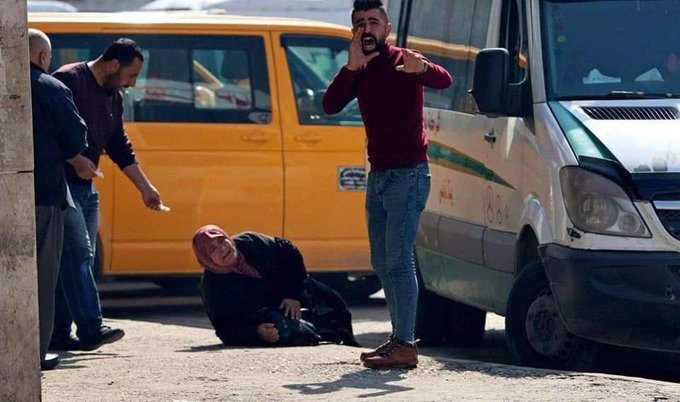
Ten Palestinians have been killed and over a hundred wounded this morning following an Israeli military raid in the occupied West Bank city of Nablus.
The Israeli occupation’s military stormed the city with armoured vehicles and blocked off all entrances before surrounding a home with two wanted Palestinians inside. Hossam Isleem and Mohammad Abdulghani, who were both killed.
The Israeli forces demolished the building while the two were inside; their bodies were later identified by the occuption’s forces. Israeli military sources claim the two Palestinians were involved in numerous resistance attacks against illegal Israeli settlements and in the death of a soldier last October.
The Palestinian Health Ministry reported that ten people were killed and 102 others were wounded as a result of gunfire by Israeli occupation soldiers.
Palestinian victims among the dead include 72-year-old Adnan Saabe Baara, 61-year-old Abdul Hadi Abdul Aziz Ashqar, 16-year-old Mohammad Farid Shaaban, 25-year-old Mohammad Khaled Anbousi and 33-year-old Tamer Nimr Minawi.
Report: Israel commits 3,532 violations in West Bank, Jerusalem in January

MEMO | February 4, 2023
Israeli occupation settlers and forces have committed 3,532 violations against Palestinians in the occupied West Bank and Jerusalem in January, the Palestine National Information Centre revealed.
The Information Centre disclosed in a report that January was the bloodiest month in the occupied West Bank since 2015, citing the Israeli killings of 35 Palestinians, including eight children and a 61-year-old woman – with 20 killed in Jenin alone.
In addition, the report also pointed out that the Israeli occupation settlers and forces wounded 342 Palestinians.
According to the Information Centre, the occupation settlers committed 17 settlement activities, including stealing land, razing farms, paving new settlement roads and approving new settlement units, in addition to 319 aggressions.
Meanwhile, the occupation forces and settlers demolished 290 commercial and agricultural facilities and confiscated 40 others.
The Information Centre also documented the Israeli demolition of 40 Palestinian homes and issued 154 demolition notices.
It documented 29 aggressions on holy sites, road closures in 38 areas and 511 temporary and permanent Israeli military checkpoints across the occupied West Bank and Jerusalem.
Israeli troops commit massacre in latest raids on Jenin
Raids focused on Jenin but targeted many other areas across the occupied West Bank

The Cradle – January 26 2023
Israeli occupation forces killed ten Palestinians and injured at least twenty on 26 January during violent raids in the occupied city of Jenin and its refugee camp.
The raids began on the evening of 25 January and persisted into 26 January, in what is being described as “one of the deadliest days” in the West Bank since the start of last year.
According to the Palestinian Prisoners Club (PPC), several have been detained throughout the raids and transferred for interrogation by Israel’s security service. As a result of the incursions, intense clashes broke out between Israeli troops and resistance fighters, several of whom sustained bullet wounds.
An elderly woman has also been reported among the dead, according to security officials. Eyewitnesses have referred to the situation as a “massacre.”
Those killed are Majeda Abdel Fattah Obeid (Umm Ziad), brothers Mohammad Ghneim, Nour Ghneim, and Ahmad Ghneim, Mohammad Mahmoud Sobh, Wassim Amjad Jaes, Mutasim Mahmoud Abou Hassan, Ezzedine Yasin Salahat, Abdallah Marwan al-Ghoul, Saeb Issam Azraqi.
 The Israeli army cut off the power supply to the Jenin camp, while also blocking journalists and ambulance teams from entering. Health officials have said that injuries are continuing to accumulate.
“There is an invasion that is unprecedented in the past period, in terms of how large it is and the number of injuries … The ambulance driver tried to get to one of the martyrs who was on the floor, but the Israeli forces shot directly at the ambulance and prevented them from approaching him,” Wissam Baker, head of Jenin’s public hospital, told media.
Despite centering around Jenin and its camp, the Israeli raids also targeted several homes and refugee camps across the West Bank, including Ramallah’s Al-Amari camp and Jerusalem’s Shuafat camp, as well as the towns of Silwan, Sur Baher, Al-Tur, and Al-Isawiya.
In response to the Israeli aggression, the Palestinian resistance managed to down a drone as it was flying over the Jenin refugee camp.
According to reports, an Israeli soldier was killed and another injured in the confrontations. Another report says that the Jenin Brigade of the Palestinian Islamic Jihad (PIJ) resistance movement detonated an explosive device inside an Israeli military jeep, resulting in “casualties in their ranks.”
“The military operation in Jenin was launched after intelligence from the Shin Bet about the Palestinian Islamic Jihad movement’s intention to carry out a major operation against Israeli targets … the operation aimed to arrest a prominent member of the movement,” Israeli media reported.
The military ended up withdrawing from Jenin, however, the injury toll is expected to rise.
Israel to destroy 58 Palestinian schools
Palestine Information Center – January 6, 2023
RAMALLAH – 58 Palestinian schools are at risk of demolition in the occupied West Bank and Jerusalem, the Arab Campaign for Education for All revealed.
In a statement issued on Thursday, the campaign expressed deep concern over the Israeli violation of Palestinian children’s right to education.
Israeli authorities issued six demolition or stop-construction orders against six schools over the past year, according to the campaign.
58 other schools, serving 6,550 students, were also notified with demolition, the campaign added.
In this regard, the Arab Campaign for Education for All called on the UN concerned agencies to bear responsibility in confronting Israeli demolition policy against Palestinian schools.
The time has come for international institutions to go beyond condemnation and to move to pressure the Israeli occupation to stop its continuous violations against Palestinian education, the statement reads.
Featured Video

Yemen joins the war – Red Sea could be blocked next – Saudi regime at risk
or go to
Aletho News Archives – Video-Images
From the Archives
A superpower and “the world’s sickest warrior state”
By Paul J. Balles | March 8, 2010
Living through five or six major wars has hardened me to what I thought were the extremes of inhuman cruelty and brutality.
Two things made those extremes almost bearable: the brutality always revealed – at least according to the media coverage – the viciousness of the enemy. It was therefore quite understandable when our “brave men and women” pulverized the enemy.
Films of Japanese torturing captive Americans somehow justified holding Japanese Americans in internment camps during World War II; and only a small percentage of Americans found the bombing of Hiroshima and Nagasaki unreasonably vengeful at best, at worst, depraved.
The media giants in America portrayed the North Koreans as barbaric beasts with their captives, quite unlike their southern counterpoints – our allies during the Korean War. No one ever felt the need to explain how the South Koreans were a civilized breed while the North Koreans were absolute savages, at least according to the official line.
In Vietnam, our warriors justifiably (or so the media made us believe) dropped napalm on the North Vietnamese who had the gall to hide in villages and tunnels to ravage our invaders. At least it was accepted practice until some rogue photojournalist filmed a young girl screaming down a Vietnamese road in flames. … continue
Blog Roll
 Aletho News
- Russian tanker approaches Cuba despite US oil blockade
- Marandi: Yemen joins the war – Red Sea could be blocked next – Saudi regime at risk
- Pro-Palestinian French member of European Parliament denied entry to Canada
- Pakistan to Host US-Iran Talks
- How Indonesia’s tilt toward the US left it stranded in the Strait of Hormuz
- US has no choice but to retreat from Iranian borders: Top commander
- Iran Retaliation Strikes Chemical Plant Near Dimona
- AWACS’ Destruction is a Major Loss for US Military – Ex-DoW Analyst
- Israel’s Iran Strategy Uses US Military & Gulf States as Its Pawns
- Iran: Trump wanted regime change, now just begging for Hormuz to open
- If Americans Knew
- Israeli police block Catholic cardinal from entering Church of the Holy Sepulchre on Palm Sunday
- Israel is assassinating journalists again, more than any other nation, anywhere, ever – Not a ceasefire Day 170
- Over 300 US service members wounded, majority have brain injuries – Not a ceasefire Day 169
- Researchers at Human Rights Watch Resign Over Blocked Report on Palestinian Refugee Return
- Jewish Groups Are Backing a War Americans Don’t Want
- Eric Fingerhut Thinks He’s the President of the Jews
- Top Jewish Philanthropists, Rabbis Urge Israeli President to Take Action Against ‘Jewish Extremists’
- Don’t Be Fooled. Zionist Leaders Have Always Wanted to Control Southern Lebanon
- Israel’s widespread use of torture is a core element of its genocide against the Palestinian people
- In Israel’s War on Iran, Many Middle East US Bases Rendered “All But Uninhabitable”
- No Tricks Zone
- German Science Blog Accuses PIK Climate Institute Of Hallucinating Climate Tipping Points
- Devastating Assessment Of Comirnaty Vaccine By Former Senior Pfizer Europe Toxicologist
- New Study: CO2 Is ‘Effectively Negligible’ As An Explanatory Climate Change Factor Since 2000
- Former Pfizer Toxicologist Dr. Helmut Sterz Tells Bundestag Hearing Pfizer Vaccine Should Have Never Been Approved
- Energy Expert: Germany’s Nuclear Phaseout Was A “500 Billion Euro Mistake”
- New Research: South Australia’s Mid-Holocene Sea Surface Temperatures Were 4°C Warmer Than Today
- Storing Green Energy To Last Germany 10 Days Would Require A 60-Million Tonne Battery
- New Studies: UK Sea Levels Were 4 Meters Higher Than Today During The Mid-Holocene
- Destructive Green New Deal: German Energy And Metal Group Warns Of Drastic Crisis
- New Study Documents A 20-Year Pause In Arctic Sea Ice Decline – Driven By Internal Variability
 Aletho News