Palestinian student leader’s detention extended by Israeli occupation forces

Samidoun Palestinian Prisoner Solidarity Network – October 17, 2016
Palestinian student leader and media activist Ibrahim Abu Safiya remains imprisoned after his detention was extended by Israeli occupation forces until 5 November 2016. Abu Safiya, the coordinator of the Islamic Association at Bir Zeit University, was arrested at Beit Ur checkpoint west of Ramallah on 28 September by occupation forces.
The Islamic Association at Bir Zeit issued a statement denouncing the arrest of their coordinator, saying that it “reflects the occupation’s arbitrary policy against Palestinian media, activists and organizers, and punitive actions to cover the crimes of the occupation and the settlers.”
Abu Safiya, 21, is a journalism student at Bir Zeit in his final year, an active member of many popular unions and associations who works with a number of media offices as a freelance journalist and researcher.
He is heavily involved in Bir Zeit student union activities, including the 28-day student strike against tuition increases on the campus, in which he engaged in a five-day hunger strike. Just days before his arrest, he spoke to the media about the success of the student campaign in preventing tuition hikes that make education inaccessible to Palestinian youth, and announcing the agreement to end the student strike. Abu Safiya had been one of the four student spokespeople and representatives during the anti-tuition-hike campaign.
Dozens of Palestinian journalists remain imprisoned by the Israeli occupation, including Omar Nazzal, member of the General Secretariat of the Palestinian Journalists’ Syndicate; Hasan Safadi, media coordinator for Addameer Prisoner Support and Human Rights Association; and Ali Oweiwi, journalist held without charge or trial.
Abu Safiya’s arrest also points to the ongoing targeting of Palestinian student activists and organizers for involvement in student union activities, student protests and other student actions on campus.
Israel closes news site focusing on Al-Aqsa
MEMO | October 17, 2016
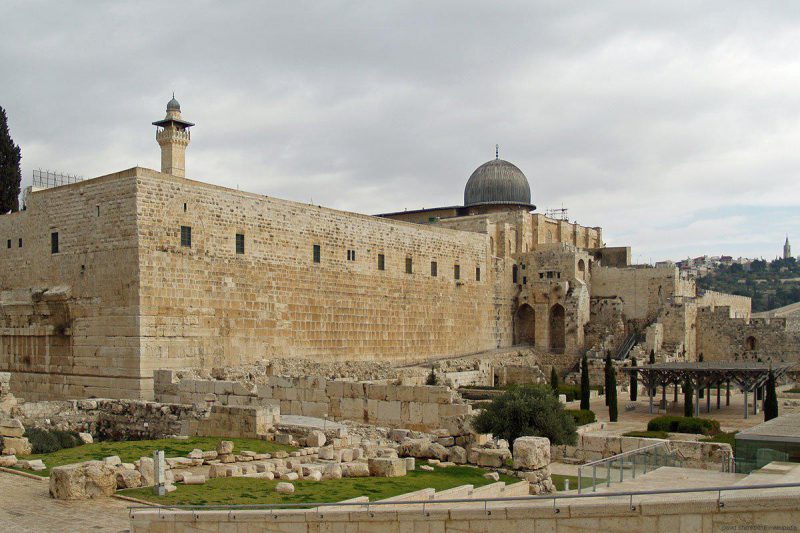
Qpress, a media centre specialising in Jerusalem and Al-Aqsa affairs, has been closed by Israeli authorities.
After being questioned and banned from entering Al-Aqsa Mosque last week, the head of the news organisation, Dr Hekmat Na’amna, was informed that Qpress was being shut down in accordance with a military decision issued early this month.
He was also informed that the use of the website has been banned, in addition to the use of the Facebook page. He was warned by the Israeli intelligence that any use of Qpress would result in prosecution.
These orders issued by the Israeli military and security forces indicate that the Qpress agency has been banned and completely shut down.
Commenting on this decision, Mahmoud Abu Ata, a journalist specialising in Jerusalem, Al-Aqsa and holy site affairs and a former employee of Qpress said that “this closure aims to silence the voice of Al-Aqsa Mosque, Jerusalem and the holy sites and to censor true facts and the true situation on the ground in occupied Jerusalem.”
“The occupation wants to cover up its crimes and plans against Jerusalem, Al-Aqsa and the Muslim and Christian holy sites in Jerusalem as well as across Palestine. Qpress has always exposed such crimes as part of its media duty in a professional and transparent manner. However, it seems that such objectivity and honourable professionalism that portrayed the events, pictures and videos exactly as they occurred did not please the Israeli administration.”
AL-KHALIL (HEBRON): A week in photos 4-10 October 2016
CPTnet | October 14, 2016
|

|
|
|
|

|
|
|
|

|
|
|
|

|
|
|
|

|
|
|
|

|
|
|
|

|
Jerusalemite activist sentenced to 20 months in Israeli prison
Samidoun Palestinian Prisoner Solidarity Network – October 10, 2016
 Israeli Magistrate’s Court in Jerusalem sentenced Palestinian Jerusalemite journalist and activist Samer Hussam Abu Aisha, 29, to 20 months in Israeli occupation prison. Abu Aisha has been imprisoned since 6 January 2016; he was attacked and abducted from inside the Jerusalem office of the International Committee of the Red Cross, where he and Hijazi Abu Sabih had erected a protest tent against the Israeli occupation’s order expelling them from their city of Jerusalem. They held evening events, lectures and cultural programs in rejection of deportation and in defense of the Palestinian identity of Jerusalem.
The two organizers were leaders of a campaign against Israeli occupation orders of expulsion from Al-Aqsa Mosque and from the city of Jerusalem. Their campaign included singing protests and other forms of cultural resistance and creative actions. On 16 December 2015, he and Abu Sbeih were delivered an order of expulsion from the city of Jerusalem for five months, citing “state security and order.” He had previously been arrested and harshly interrogated for 33 days, then released and banned from traveling outside Palestine. As soon as his house arrest ended, the Israeli occupation imposed the expulsion order upon them.
Abu Aisha went on hunger strike for 21 days in August in solidarity with Bilal Kayed’s demand for release from Israeli prison; he was part of a group of 35 prisoners from Gilboa prison who also demanded improved conditions inside the prison. Rawan Abu Aisha, Samer’s wife, said that the strike was in part prompted by ongoing denials of family visits.
Abu Aisha wrote earlier regarding the Israeli charges against him:
I was born in Jerusalem in 1987. I lived there all my life except for a few years during my studies in Egypt. As part of my work, I often travel to participate in conferences and youth exchanges in Arab countries and across the world.
Last August I travelled to Lebanon to participate in the 25th Arab Youth Camp. 28 hours after my return to Jerusalem on 17 August 2015, I was arrested by Israeli occupation forces and subjected to an interrogation that lasted 44 days. Eventually, I was conditionally released under open ended house arrest and accused of traveling to an “enemy state” in violation of the “Israeli” emergency regulations of 1952 which place a ban on travel to enemy state of the Zionist regime. These “laws” and policies are forced on us Palestinians despite the fact that we don’t recognize these laws, and the fact that Palestinians hold Lebanon to be a sister state which is naturally, geographically and culturally connected to Palestine.
The detention of Yasser Qous, Jerusalem director of the Palestinian Prisoners’ Society, was extended as well by Israeli occupation courts on 9 October; he had been assaulted and arrested by police forces in the Old City of Jerusalem and accused of “obstructing police work.”
Israel to build large new synagogue in Old City of Jerusalem
Palestinian Information Center – October 4, 2016
 OCCUPIED JERUSALEM – The Israeli occupation authority (IOA) has finished all preparations, in cooperation with unnamed Jewish groups, to build a big synagogue called the Jewel of Israel in the heart of the Old City of Jerusalem.
It will be located about 200 meters away from the western side of the Aqsa Mosque.
According to the Palestinian news website Qpress, the new synagogue project will cost around 48 million shekels, mostly from the Israeli government and the rest from wealthy Jews.
The synagogue will be composed of six floors, two underground, and will be built on the ruins of an Islamic historical site dating back to the Ottoman and Mamluk eras.
The project is part of a large-scale Israeli plan aimed at planting religious Jewish structures in the heart of Old Jerusalem to change the Islamic and Arab identity of the holy city.
It will be the second massive Jewish edifice in the Old City after the Hurva synagogue, which was built in 2010.
Nowhere to hide: New illegal observation tower in occupied Hebron
International Solidarity Movement | October 3, 2016
Hebron, Occupied Palestine – Israeli forces put up a CCTV observation tower in the Ibrahimi mosque area, further increasing not only their all-encompassing surveillance of Palestinians, but also their slow but steady illegal annexation of more and more Palestinian land in occupied al-Khalil (Hebron).
At the end of last week, Israeli forces in a ‘secret’ over-night action put up the observation tower, surrounded by dozens of cement blocks and barbed-wire. Located in a corner between Palestinian houses, the observation post with a container and all the surrounding paraphernalia is just another step in the illegal annexation of yet more land. In recent weeks, Israeli forces have increased their illegal annexations of the tiny strip of Shuhada Street still accessible to Palestinian pedestrians and stepped up the game of creating a coercive environment directly leading to forced displacement of Palestinians in the Tel Rumeida area.
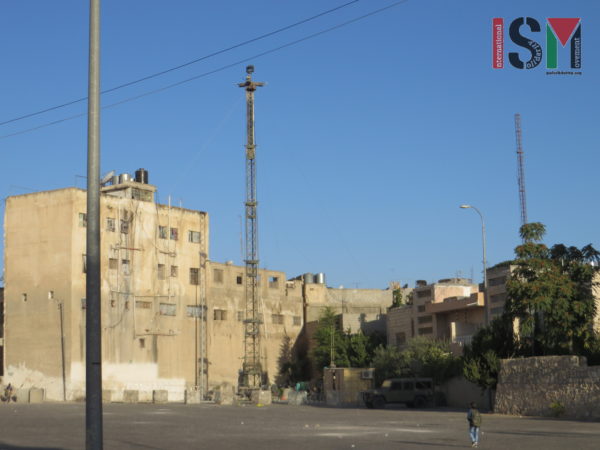
CCTV surveillance tower newly put up in Palestinian neighborhood
This observation tower is fitted with a camera that reaches high above the houses in the neighborhood, thus watching Palestinians constantly. This feeling of permanently being watched for Palestinians is combined with the ever present controls and humiliations at the more-and-more militarized checkpoints. Palestinians are watched, humiliated, numbered, deprived of their most basic human rights – occupied not only physically by the Israeli occupation forces, but also mentally. They can never tell whether they’ll be allowed through a checkpoint (something that solely depends on the respective soldiers whim), whether their children will be tear-gassed on their way to school or arrested, or even whether they’ll be gunned down by Israeli forces at a checkpoint and left to bleed to death. Any and all of these forms of collective punishment are enforced by the Israeli occupying forces on the entire population of civilians in complete disregard of any care for international law or humane treatment of the occupied indigenous Palestinian population.
The Tel Rumeida neighborhood, Shuhada Street, and the area around the Ibrahimi Mosque are already linked by a settler-only street that has been ethnically cleansed of Palestinians in the aftermath of the Ibrahimi Mosque massacre. Restrictions in the Tel Rumeida neighborhood (declared a ‘closed military zone’ solely enforced on Palestinian residents for almost a year now) and around the Ibrahimi Mosque (where Palestinians are often prevented from passing checkpoints on a age-limit between 15-30) have escalated in a very short amount of time, making life for the Palstinians as hard – or rather impossible – as possible, leaving them with no choice than to leave. The only and clear aim is the forcible transfer of all Palestinians in this area, thus geographically linking the illegal settlements in an area ethnically cleansed of any Palestinian presence.

CCTV camero on top of the surveillance tower
Israel closes Ibrahimi Mosque to Palestinian worshippers
Press TV – October 3, 2016
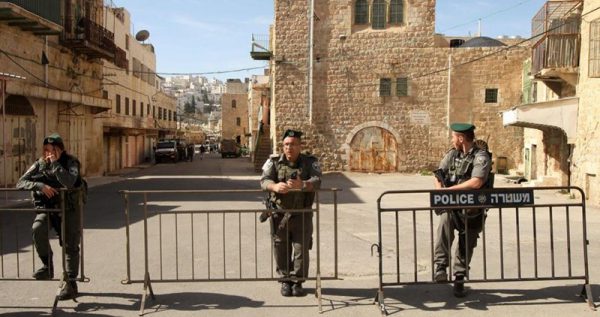
Israeli authorities have decided to close the Ibrahimi Mosque, in the heart of the occupied West Bank city of al-Khalil (Hebron), to Palestinians, Muslim worshipers and non-Jewish visitors for seven non-consecutive days.
Yousif Ideis, the Palestinian minister of endowment and religious affairs, said on Sunday that the sacred site will be closed to Palestinians and non-Jews on October 3, 4, 9, 12, 18, 19 and 26.
Israeli officials have said the shutdown is aimed at maintaining security in the wake of Rosh Hashanah (the Jewish New Year), Yom Kippur (The Day of Atonement), Sukkot (Feast of Booths) and Simchat Torah holidays.
Ideis added that dozens of illegal Israeli settlers broke into the mosque courtyard on Saturday night amid protection by Israeli troopers.
In the meantime, Israeli authorities are closing all passageways between the blockaded Gaza Strip and Israel, as well as between the occupied West Bank and Israel for Rosh Hashanah.
Israeli officials regularly impose stringent restrictions for Palestinians during Jewish holidays for alleged security purposes.
The constraints include denied access to the Ibrahimi Mosque, which is revered by Jews, Christians and Muslims and has been the site of violent tensions between Israelis and Palestinians for decades.
On February 25, 1994, at least 29 Palestinians were killed and 125 others wounded when American-Israeli Baruch Goldstein opened fire on a large number of Palestinian Muslims, who had gathered inside the Ibrahimi Mosque to say prayers during the holy fasting month of Ramadan.
The occupied territories have already been the scene of increased tensions ever since Israeli forces imposed restrictions on the entry of Palestinian worshipers into the al-Aqsa Mosque compound in East Jerusalem al-Quds in August 2015.
Nearly 250 Palestinians have lost their lives at the hands of Israeli forces since the beginning of last October.
Former hunger striker Malik al-Qadi released by Israel, transferred to Palestinian hospital
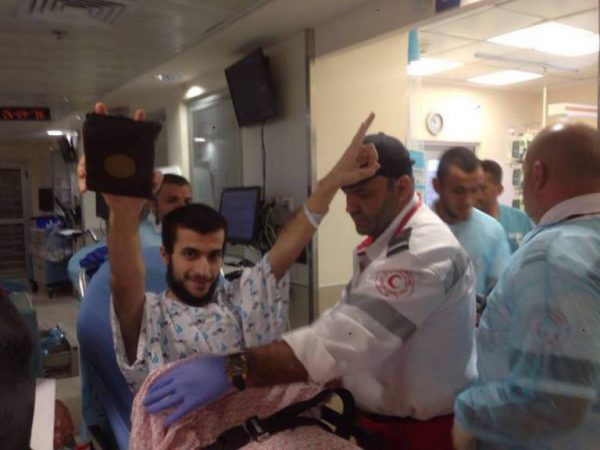
Al-Quds University journalism student Malik al-Qadi following his release from administrative detention
Ma’an – September 24, 2106
JERUSALEM – Israeli authorities released former hunger-striking prisoner Malik al-Qadi to Palestinian medics on Saturday to transfer him to a hospital in the occupied West Bank.
The Palestinian Red Crescent said on Saturday morning that its staff was transferring al-Qadi from the Israeli Wolfson Medical Center to the Istishari Arab Hospital in the city of Ramallah.
Al-Qadi is in a dire health condition after going without food for 68 days to protest being held in administrative detention — internment without trial or charges — by Israel.
Al-Qadi ended his hunger strike on Wednesday, along with fellow prisoners Muhammad and Mahmoud al-Balboul, after an agreement with the Israeli prisons services not to renew their administrative detentions.
Muhammad Balboul, 26, had refused food for 77 days since July 7, while his 23-year-old brother Mahmoud had been on hunger strike 79 days since July 5, and al-Qadi, 25, declared his hunger strike on July 16.
Qaraqe said in a statement on Wednesday that Muhammad and Mahmoud al-Balboul were set to be released on Dec. 8, while Malik al-Qadi would be released on Sep. 22, and that all three of their administrative detentions would not be renewed.
The three had initially launched their hunger strikes amid a mass movement across Israeli prisons in solidarity with hunger-striking prisoner Bilal Kayid, who after 71 days suspended his hunger strike after striking a deal with Israel to end his administrative detention sentence. He was reportedly set to be released on Dec. 12.
Kayid was one of the most high-profile hunger strikers since Palestinian journalist Muhammad al-Qiq came near death during a 94-day hunger strike protesting his administrative detention order, before he was finally released in May.
Rights groups have claimed that Israel’s administrative detention policy, which allows detention for three- to six-month renewable intervals based on undisclosed evidence, has been used as an attempt to disrupt Palestinian political processes, notably targeting Palestinian politicians, activists, students, and journalists.
Although Israeli authorities claim the withholding of evidence during administrative detention is essential for state security concerns, rights groups have instead claimed the policy allows Israeli authorities to hold Palestinians for an indefinite period of time without showing any evidence that could justify their detentions.
According to Addameer, as of August, 7,000 Palestinians were being held in Israeli prisons, 700 of whom were being held under administrative detention.
Israeli forces expand Beit Ummar military watchtower, narrowing main street
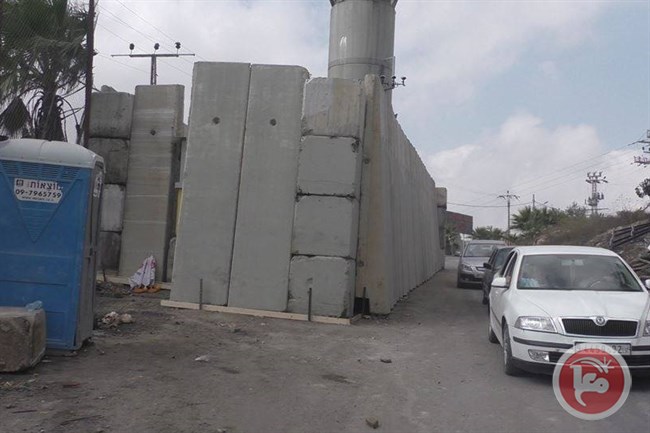
Ma’an – September 22, 2016
HEBRON – Israeli forces reopened the northern entrance to the village of Beit Ummar north of Hebron City on Thursday, after the road had been closed by Israeli authorities for four days to carry out maintenance work on an Israeli military watchtower stationed there.
Local activist Muhammad Ayad Awad said that the maintenance work expanded the military watchtower and narrowed the street, which is the main entrance to the village, to one lane instead of two lanes as before.
He said that the development will have a negative impact on the daily lives of Beit Ummar’s residents, forcing them to live under continuous Israeli surveillance and increase traffic congestion in the village.
Awad added that Israeli forces continued the closure of a sub-entrance near the village’s central vegetable market, which he said has been closed for five years.
The road was closed amid a heightened Israeli military presence in the Hebron district in the wake of a number of alleged attacks committed by Palestinians in the area, with the Israeli army adding an additional battalion to the district and setting up several road blocks throughout the district, while blocking off the village of Bani Naim and the Old City’s Tel Rumeida area entirely.
Israeli defense minister compares illegal Israeli outpost with native Palestinian villages
Ma’an – September 13, 2016
BETHLEHEM – Israeli Defense Minister Avigdor Lieberman compared the illegal Israeli Amona outpost to the indigenous Palestinian Bedouin village of Susiya and Palestinian land in Jerusalem on Monday in a speech at Ariel University in the occupied West Bank, according to Israeli media.
The Amona outpost was slated for demolition following a 2008 Israeli Supreme Court decision after eight Palestinians from neighboring villages — with the support of Israeli human rights organization Yesh Din — successfully petitioned the court to remove the outpost on grounds that the construction was carried out on privately-owned Palestinian land.
“There is no way that Amona can be left as it is built today, because most of the houses are built on private Palestinian land,” Lieberman reportedly said on Monday, referring to Amona, which was built in 1996.
After years of appeals from right-wing Israeli government officials, and attempts by Amona settlers to prove they had legally purchased the land, an Israeli police investigation in May 2014 found the entirety of the outpost to have been built on Private Palestinian lands, and that the documents used by Amona residents to try claim their “purchases” were in fact forged.
In December 2014, the Israeli Supreme Court ordered again that the outpost be demolished by December 2016.
According to Haaretz, Lieberman followed up on his comments about Amona on Monday with the stipulation that “all the rules that apply to Amona apply to every other place as well.”
Claiming that “there is only one law for both Israelis and Palestinians,” Lieberman reportedly told the audience that it was unacceptable that such rulings — as in the case of Amona, which along with every other settlement and outpost in the occupied West Bank is internationally recognized as being illegal — are unfairly enforced against Israelis but not against “other trespassers.”
The “trespassers” Lieberman was referring to were the Palestinian residents of Susiya in the southern West Bank, and the Palestinians of the area known as the “E1 corridor,” a contentious zone that the Israeli government has set up to link annexed East Jerusalem with the mega settlement of Maale Adumim, which would virtually cut the occupied West Bank in half, making the creation of a contiguous Palestinian State impossible.
“We are a nation based on law and we will honor court decisions in all circumstances,” Lieberman said, saying that “when it comes to enforcing rulings against other trespassers everyone stands up on their hind legs,” seemingly complaining about the international community’s harsh reactions to Israeli government attempts to demolish Susiya and replace it with an illegal Jewish settlement of the exact same name.
Susiya’s residents have been embroiled in a decades-long legal battle to legalize the village and have endured multiple demolitions enforced by Israeli authorities over the years, who say Palestinians lack the proper building permits to live on the land that lies between an Israeli settlement and Israel-controlled archaeological site.
The privately owned Palestinian land is located in Area C — the more than 60 percent of the occupied West Bank under full Israeli control — where building permits for Palestinians are nearly impossible to obtain.
Many of the villagers have ties to the land that predate the creation of the state of Israel, and Ottoman-era land documents to prove it.
Most recently, in mid-July, authorities from Israel’s Civil Administration abruptly halted months of dialog with Susiya’s residents over the possibility of legalizing the village, telling them that a future agreement on the village would now be the responsibility of Lieberman.
Lieberman postponed the announcement of his decision twice, first until November 2016, and then until December.
According to spokesperson for Rabbis for Human Rights (RHR) Yariv Mohar, who is assisting in Susiya’s legal battle, Lieberman’s decision on whether or not to continue the dialogue between the residents of Susiya and the Civil Administration is set to be announced on December 15, 2016.
Lieberman will be responsible for deciding whether to accept the state of Israel’s request to immediately and without prior notice demolish some 40 percent of the southern occupied West Bank village, where half of the some 200 village residents live according to RHR.
The lawyers of RHR have affirmed that there is no question as to whether the residents own the land they are on, also noting that “basic (Jewish) morality dictates it is wrong to demolish part of a village which has previously demolished without any plan or solution for the residents, while international law prohibits the forcible transfer of populations,” Mohar told Ma’an in August.
Though Lieberman has yet to formally announce a decision, his comments on Monday indicate that in his opinion, the residents of Susiya should be subject to the same treatment as the illegal settlers occupying privately owned Palestinian land in Amona.
Lieberman has previously advocated policies ranging from the overthrow of the Palestinian Authority to the deportation of Palestinian citizens of Israel into the occupied Palestinian territory, while promoting the transfer of towns in Israel that are heavily populated by Palestinians to a future Palestinian state in exchange for illegal Israeli settlements in the occupied West Bank.
Lieberman himself lives in the southern occupied West Bank Israeli settlement of Nokdim, in contravention of international law.
Since appointed as defense minister by Israeli Prime Minister Benjamin Netanyahu in May, the two have teamed up to approve hundreds of new housing units in illegal settlements in the West Bank and East Jerusalem.
Netanyahu’s Ethnic Cleansing Blood Libel
By Richard Silverstein | Tikun Olam | September 10, 2016
The pro-Israel crowd love to trot out anti-Semitic memes to smear their opponents. One of them, used widely by Alan Dershowitz and the like is the term “blood libel.” Accuse Israelis of killing Palestinians indiscriminately and it’s a blood libel because, of course, a Jew shedding non-Jewish blood is the same as Jews murdering Christian babies to use their blood in making matzah for Passover. Got that?
Bibi Netanyahu’s latest outrage is this video in which he ever so innocently professes bafflement that Palestinians would oppose Israeli settlements. Why, he asks, if 2-million “Arabs” (the actual number is 1.8-million) live in Israel proper, can’t Jews live in Palestine?
There is a wee-small problem with this analogy: approximately 600,000 Israeli Jews live in settlements. But they have lived in them for at best a generation, while Palestinians have lived in Israel for centuries. The vast bulk of settlers moved to Palestine since 1967, while Palestinians have lived in Israel over a vastly longer span. Nor have Palestinians displaced anyone over this period. While Israeli settlers have literally stolen the land out from under the Palestinian natives.

Ethnic cleansing Israel-style: yet another Palestinian home bulldozed
Bibi’s general argument is not new. He and his supporters have advanced it for years. But he added a new and even more outrageous twist this time: Palestinian opposition to Israeli settlements was akin to ethnic cleansing because it meant no Palestinian would ever accept any Jew living anywhere on Palestinian land.
There are numerous outrageous elements to this charge worth parsing. The first, and most obvious is that it’s Israel, rather than Palestine, that’s engaged in ethnic cleansing. Israel has destroyed a record number of Palestinian homes over the past year, leaving their inhabitants homeless. It has enacted draconian definitions of Palestinian residency which render tens of thousands of Palestinians stateless if they live outside areas like East Jerusalem for any length of time. Israel also depopulates Palestinian neighborhoods of East Jerusalem through forcible eviction and theft of homes. Israel maintains a stranglehold over the West Bank economy so that stifles innovation, independence and development that might sustain the population. The final coup de grâce is the siege of Gaza, which has forced thousands of Gazans to flee their imprisonment by any means possible.
So which Israeli Jew has ever been ethnically cleansed from Palestine? None. Further, the claim that Palestinians will never accept Jews living in Palestine is a hoax perpetrated by none other than Netanyahu himself and his followers. In fact, those like Rabbi Menachem Froman, who lived in the Tekoah settlement before his untimely death, denounced the idea of Israeli national sovereignty in the West Bank. He argued that he would happily live under Palestinian jurisdiction. What was important to him was not which nation owned the land on which he lived. Rather, he believed God owned the land and his allegiance was to Him and not to any particular nation.
Such an approach offered a way for Jews to remain in Palestine after a peace agreement was signed. Undoubtedly, the lion’s share of settlers would return to Israel, rather than remain under Palestinian sovereignty. But to those who really sought to uphold the vision of Abraham and the Bible to live in this Holy land, they could live there as Palestinian (or Israeli) citizens.
The final hypocrisy of Bibi’s video is his refusal to reciprocate with Palestinians regarding Jewish settlers in Palestine. If you truly believe that Jews must live there, then it’s self-evident that Palestinians should be permitted to return to their homes in pre-48 Israel. Jewish settlers see their return to their ancestral homeland as a fulfillment of sacred Biblical texts and a divine promise. The Palestinian return to their homelands from which they were expelled by Israel in 1948 is no less compelling to them. It is, to them, reparation for the Original Sin committed against them by Ben Gurion in the establishment of the State.
So if Bibi wants to argue that Jews who returned to ancient sites like Hebron or Tekoah or Bethlehem must be permitted to remain there, I say fine: then let’s talk about the return of the original refugees expelled in the Nakba and their direct descendants.
The U.S. government was none to happy with Bibi’s incitement against Palestinians. The State Department, in its typical milquetoast fashion, called the comments “inappropriate and unhelpful.” This sort of language is akin to taking a pebble to a gunfight. It’s one thing when David faces off against Goliath with a slingshot. But this is like David blowing bubbles at his well-armed nemesis. Indeed, the motto for U.S. policy toward Israel should be an inversion of the famous military slogan: “always outnumbered, always outgunned.”
NOTE: I’ve just published a new piece at Mint Press News, Israel Ramps Up Its War on BDS. It exposes an official Israeli campaign of death threats and intimidation against Palestinian activists and NGOs.
Featured Video
Bombing Iran Back Into the Stone Age /Lt Col Daniel Davis & Jim Jatras
or go to
Aletho News Archives – Video-Images
From the Archives
The Occupied Mentality Syndrome
Saudi Arabia on the American chessboard – Part 2
By B. J. Sabri | American Herald Tribune | April 19, 2016
Since the Korean War, but particularly since the Iranian Revolution of 1979 until today, the United States has been steadily escalating its military presence in the Persian Gulf. Taking advantage of many colossal events of the past 36 years, [1] the hyper-empire has institutionalized its massive presence on land and sea, and expanded its objectives to include the unambiguous physical control of the area, as well as the clear understanding that local Arab governments should abide by them. The pretext is always the same: in “defense” of the national interests and security of the United States. From observing how the United States has been interacting with the governments of the region, and by judging from the size of its expeditionary force, we could reach a basic conclusion. The United States is occupying, de facto, the entire Arabian Peninsula. (Yemen, devastated by Saudi and American jets is yet to be conquered. Oman? Britain returned not as colonial ruler but as a soft occupying power.)
Under this articulation, Saudi Arabia, Qatar, Kuwait, and the United Arab Emirates are virtually occupied countries. If we compare this type of occupation to the mandate and protectorate regimes of the past, the results might be identical—the nations affected by it lose sovereignty. When Arab governments comply with the objectives of a foreign power that station military forces on their national milieu, then that power controls them in multiple ways including how they react to policy deliberations and what decisions they intend to take on specific issues. A good method to verify the concept of effective occupation is this: take notice of what the United States says and wants, and then compare it to what the gulf rulers do in response. (I shall discuss this detail at some point in the upcoming parts.)
If the presence of US forces or other means of political pressure are a factor in Saudi Arabia’s interventionist Arab wars, then we need to debate this issue. However, from the history of resistance to colonialism, we learnt: if a powerful state imposes its order on a nation by military means or other forms of coercion, and if this nation does not resist that imposition, then a mental subordination to the powerful state will ensue. This is especially true in the case of Saudi Arabia. One single event, 9/11, has transformed it from a US “ally” into an instant political hostage of the American Empire. … continue
Blog Roll
 Aletho News
- Attack in the Bosphorus exposes NATO weaknesses and tensions among allies
- BREAKING: US JET SHOT DOWN OVER IRAN /Lt Col Daniel Davis & Nima Alkhorshid
- Now everyone is dumping US government bonds
- Brazilian Congressman seeks to bar Israeli military personnel from entering Brazil
- Official reveals evidence of Arab states’ involvement in US-Israeli war on Iran
- His Majesty’s head-chopper: Syria’s MI6-backed president bows to King Charles
- Forced to backtrack: ‘Israel’ drops Hezbollah disarmament goal
- Britain’s Lebanon surveillance network: A digital map for war
- Bahrain faces scrutiny for opposition crackdown after detainee killed
- Hegseth’s Pentagon Purge Designed to Prevent a Mutiny: Karen Kwiatkowski
- If Americans Knew
- Israel Is Blocking Palestinians from Easter at Church Where Jesus Resurrected
- Plot to assassinate Palestinian activist follows harassment campaign promoted by Zionist groups and elected officials
- Prominent New York synagogue hosts presentation on why U.S. Jews should support the ethnic cleansing of Gaza
- Tapper vs. Piker: Is the CNN Anchor Auditioning for David Ellison?
- Shouldn’t Democrats Be Able to Condemn Genocide?
- Israel-US kill negotiators, destroy civilian structures, but Iran’s military capabilities still largely intact – Daily Update
- ‘War crime’: Global condemnation as Israeli ministers celebrate death penalty law targeting Palestinian prisoners
- 7 Ways Israel Is Turning Lebanon Into Gaza
- World’s Leading Football Bodies Under Fire Over Israel Policies
- Experts warn of possible use of nukes against Iran
- No Tricks Zone
- Low Intensity Tornado Wrecks Major Solar Farm, Creating A Potential Toxic Dump
- New Study Finds Warming Saves Lives…Cold Temperatures 12 Times More Deadly Than Excess Heat
- German Science Blog Accuses PIK Climate Institute Of Hallucinating Climate Tipping Points
- Devastating Assessment Of Comirnaty Vaccine By Former Senior Pfizer Europe Toxicologist
- New Study: CO2 Is ‘Effectively Negligible’ As An Explanatory Climate Change Factor Since 2000
- Former Pfizer Toxicologist Dr. Helmut Sterz Tells Bundestag Hearing Pfizer Vaccine Should Have Never Been Approved
- Energy Expert: Germany’s Nuclear Phaseout Was A “500 Billion Euro Mistake”
- New Research: South Australia’s Mid-Holocene Sea Surface Temperatures Were 4°C Warmer Than Today
- Storing Green Energy To Last Germany 10 Days Would Require A 60-Million Tonne Battery
- New Studies: UK Sea Levels Were 4 Meters Higher Than Today During The Mid-Holocene
 Aletho News