Israeli forces carry out predawn raids, detain 2 students
Ma’an – April 8, 2016
 BETHLEHEM – Israeli forces detained six Palestinians including two university students from the occupied West Bank during predawn detention raids Friday, locals and Israel’s army said.
Locals told Ma’an that two members of Palestine Polytechnic University’s student council were detained in the raids, identified as Ibrahim Salhab from Doha and Salsabil Shalaldeh from Sair, both villages located near Bethlehem.
Locals added that Salsabil is the daughter of prisoner Sheikh Zawadi Shalaldeh who is currently held in Israeli prison.
Israeli forces also raided the town of Silwad in the Ramallah district and delivered an interrogation summons to former prisoner Malik Hamed.
Clashes erupted when Israeli military forces raided al-Duheisha refugee camp also near Bethlehem, with no initial injuries reported.
An Israeli army spokesperson told Ma’an that four Palestinians were detained from al-Arrub refugee camp, one of whom was a suspected Hamas operative.
One suspected Hamas operative was also detained from Qalqilya, the spokesperson said, adding that the Palestinian detained from Sair was suspected for “illegal activities.”
Around 7,000 Palestinians are currently held in Israeli prisons, according to prisoners’ rights group Addameer.
The majority were detained in predawn detention raids carried out by the Israeli military, including in areas under full Palestinian jurisdiction according to the Oslo Accords.
Such raids often lead to clashes between locals and Israeli military forces entering their communities, regularly resulting in injury and sometimes death of Palestinian residents.
UNRWA Condemns Today’s Large Scale Home Demolitions in the West Bank
IMEMC News & Agencies – April 6, 2016
Statement by UNRWA West Bank Director, Lance Bartholomuesz
Jerusalem 6 April 2016
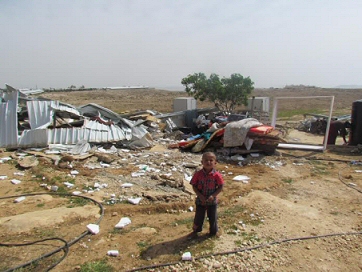 UNRWA condemns today’s large scale home demolitions by the Israeli Authorities in the Bedouin refugee community of Um al Khayr in the South Hebron Hills. As a result, 31 Palestine refugees, including 16 children, were made homeless.
This community has endured several rounds of demolitions and often faced harassment from the nearby illegal settlement of Karmel.
“I am appalled. Looking in the eyes of a young Bedouin boy in a red shirt standing amongst the crumpled ruins of his demolished home, how can anyone justify this? ” stated Lance Bartholomeusz, Director of UNRWA Operations in the West Bank.
Already this year, over 700 Palestinians have been displaced by Israeli demolitions in the West Bank.
This figure is approaching the total number of displaced for all of 2015.
UNRWA is gravely concerned about demolitions in violation of international law. Under the Fourth Geneva Convention destruction of private property is prohibited. As Occupying Power, Israel is obliged to administer the occupied territory for the welfare of the protected Palestinian population.
As the UN has said repeatedly, these demolitions must stop.
University rooms destroyed in early morning raid by Israeli forces
International Solidarity Movement | March 5, 2016
East Jerusalem, Occupied Palestine – In the early hours of Tuesday, 5th April, around 3am, an armed group of Israeli soldiers stormed the campus of Al Quds university in the area of Abu Dis, part of East Jerusalem. The soldiers terrorised security guards on duty and forcefully entered four rooms belonging to student political parties and confiscated equipment while completely destroying the rest of the rooms.

Destroyed items from the Tuesday morning raid gathered outside the rooms
During the early hours of the morning the only people present at the university campus were the campus security, they were rounded up and locked together in a room, they were given no reason from the soldiers as to why they were being locked in a room nor as to why the soldiers were entering the campus grounds. The soldiers proceeded to forcefully enter four rooms belonging to various political parties run by students of the university, cutting the locks and smashing their way in, completely destroying the doors. This is the fourth time in 2016 alone that soldiers have entered the campus, destroying and confiscating material while giving no reason for their actions.

One of the computers amongst other items destroyed in the raid
The rooms entered belong to varying student bodies who’s students work within the university and the local community. Among the varied groups they advocate student rights, create activities within the campus and surrounding neighbourhoods, hold discussions on the state of the middle east, volunteer within the community, offer services for students, hold workshops and meetings about young prisoners and host an array of solidarity activities for the Palestinian community.

Students cleaning up debris from Tuesday’s raid
During the raid the army took personal computers, laptops and cameras belonging to the Islamic party. Around one hundred and seventy flags were confiscated from the union party room and all of their stationary equipment for creative activities. Whatever was not taken was destroyed during the raid by the occupying forces.
The activities room for the ladies Islamic movement which works mainly with disadvantaged youths and students had the majority of their belongings destroyed, posters ripped from walls and electronic equipment confiscated.
The area of Abu Dis were the university is located was around thirty thousand hectares prior to 2002 and is now around four thousand hectares with 75% of the area now falling under area C and 25% under area B. This malicious land grab by the Israeli government has left students facing huge difficulties with their education. Many students within the faculty of medicine can’t reach Jerusalem where the main hospital for training is located and have been forced to go elsewhere for their practical while the media faculty faces new difficulties also. Since the beginning of what most would call the third intifada, checkpoints leading into the city of Ramallah, where the media students must go to complete their practical work have become extremely tightened and students are often denied access to the area or face long waits to enter.

The annexation wall surrounding the university
On the 2nd November, 2015, Israeli forces entered the campus around 4pm and began firing on students using tear gas, rubber coated steel bullets and even using live ammunition. Over two hundred students were injured and required medical care while two students were seriously injured, with access to Jerusalem hospital unavailable the students were forced to travel over an hour to the city of Ramallah for treatment.

One of the destroyed rooms
With the student elections to take place on April 19th, this attack falls into Israel’s wider policy of targeting political activity within student campuses and bodies as a means of repressing resistance to the occupation.
Four students of the university have been killed by Israeli forces since November, 2015.
Israeli occupation forces invade university, arrest 25 in night raids throughout occupied West Bank

samidoun – Palestinian Prisoner Solidarity Network | April 5, 2016
Israeli forces arrested 25 Palestinians in overnight raids by occupation forces, reported the Palestinian Prisoners’ Society on Tuesday morning, 5 April.
The mass arrests included storming the campus of Al-Quds Open University in Abu Dis, occupied Jerusalem, between 3 am and 5 am, according to Ma’an News. Campus security guards were locked in a room by the invading occupation forces, their radios broken. The soldiers stormed the offices of the Dean of Students and the Faculty of Islamic Studies, destroying an exhibition underway by students who are part of the Islamic Bloc, one of the student council blocs at the university. Israeli occupation officials claimed that they were stopping “incitement” by destroying student projects.

The attack on the university is one of several in recent months; Al-Quds University was attacked in January and the materials of the student union confiscated; Bir Zeit University was also invaded and its student union offices ransacked. In March, Khadoori University in Tulkarem was invaded twice in 18 hours, as was the Arab American University in Jenin. These attacks have focused especially on targeting student union offices and come alongside the arrest and imprisonment of student activists like Donya Musleh and Asmaa Qadah.
In Abu Dis, the occupation soldiers arrested Ahmad Jamil Dandan. In Deir Istiya, Salfit, Israeli occupation forces invaded and ransacked the home of Jihad Khalid, 30, arresting him. They also arrested Nazeeh Abu Oun of Jaba, Jenin; Adnan Khader al-Husari of Tulkarem refugee camp; Tamir Shawar Rimawi and Karim Rimawi of Beit Rima, and Ghassan Said Nasser of Bir Zeit, Ramallah; in al-Khalil area: Hossam Hureibat; Ali Abu Sel and Yazan Muqbil of al-Arroub refugee camp; Mahmoud Hmeidat of Surif; Mahmoud Fawzi Amr and Mahmoud Badwan Ibayush of Dura; and Wasim Jamal Bahar of Beit Umar; in Jerusalem: Iyad Atta Uweisat and Ahmad Azaz Uweisat of Jabal Mukabber; Abdel-Qader Dari and Mohammed Abu Riyala of Issawiya; Abdullah Abu Assab of the Old City; and Abdul Latif Awad, Adel Jumaa, Abed Rabbo Kanaan, Abed Faris Kanaan, Hamza Kanaan, Sufyan Kanaan and Odeh Abdullah Odeh of Hizma.
Photos: Al-Quds University
Israeli forces detain brother of Duma attack victim, 12 others

samidoun – Palestinian Prisoners Solidarity Network | April 4, 2016
Wissam Dawabsheh, the brother of Reham Dawabsheh, killed in her home with her husband and baby boy Ali when it was firebombed by Israeli settlers in July 2015, was arrested last night by Israeli occupation soldiers, who stormed the home of Wissam and Reham’s father in Duma, south of Nablus.
Five military jeeps entered Duma at 1:30 am early Monday, 4 April, and occupation soldiers raided the family home, taking Wissam with them. No explanation was given for his arrest by the occupation forces.
Wissam Dawabsheh was one of at least 13 Palestinians arrested in dawn raids by Israeli occupation forces, including Palestinian lecturer and Hamas leader Adnan Asfour, and his son Muntasser Asfour; Abdel Rahim Bassam Hammad in Silwad; Muhammad Rafat Abu Srour of Aida refugee camp, and Louay Habis al-Imour and Malid Jamil Abu Mfarreh of Tuqu, south of Bethlehem.
12-year-old Palestinian children imprisoned, pursued by Israeli occupation soldiers

samidoun – Palestinian Prisoners Solidarity Network | April 4, 2016
The family of 12-year-old Shadi Farrah, imprisoned in a detention center in Tamra, called for international attention and support from human rights organizations for the case of their son.
Farrah has been imprisoned, along with another Palestinian Jerusalemite child, Ahmad Zaatari, 13, since 30 December 2015. They were arrested by Israeli occupation forces and accused of being in possession of a knife and attempted murder based on possessing the knife.
Amjad Abu Asab, head of an East Jerusalem committee for prisoners’ families, said that both children were interrogated repeatedly without the presence of their parents or lawyers, in violation of law. Farrah’s parents noted that their son was in the seventh grade and an avid participant in dabkeh traditional dance.
Earlier, Ahmad’s mother had explained that he had been tortured and mistreated under interrogation, and that he had been threatened with harm to his family members.
 This comes amid the news of Ramzi Abu Ajamia, also 12 years old, a Palestinian refugee living in Dheisheh refugee camp near Bethlehem, currently in hiding from Israeli occupation forces. “I can’t explain why they want me, other than it’s my turn. Tomorrow it will be another kid’s [turn],” said Ramzi, in an interview with Middle East Eye. “Why should I give myself to someone who is going to hurt me. I know what they did to my brother and I won’t offer myself up for that,” he said. “I didn’t do anything, I don’t know what they want from me, and that means they will hurt me because I have nothing to tell them.”
A letter to her family from fellow 12-year-old Palestinian prisoner, Dima Wawi, 12-year-old Palestinian prisoner, was released on Sunday. Al-Wawi writes about the role of other Palestinian women prisoners in taking care of and supporting her. (Translation via Iris Bar.)
“Peace, mercy and blessings of God to you.
My beloved Mom, My dear Dad and brothers.
I miss you all. I want you to know that you are always with me. Do not worry about me, mother, I’m happy and don’t need anything except the knowledge that you are in good health.
Everybody here is taking care of me and helping me, I’m playing and studying, and the only thing I need from you is to know that you are OK.
I know that the prison gates can’t be closed forever
Mom — heart sticker — Dima
Say hello to Dad and my brothers, friends & relatives”
There are over 400 Palestinian children imprisoned in Israeli jails; Defence for Children International Palestine report that over 75% of them suffer mistreatment, torture and abuse under interrogation and imprisonment. The majority of Palestinian children are arrested in violent, late-night military raids that traumatize the targeted children and their entire families.
Israeli forces demolish 2 homes in Bethlehem

Ma’an – March 28, 2016
BETHLEHEM – Israeli forces on Monday morning demolished a number of buildings belonging to Palestinians, including two houses, in the southern occupied West Bank town of Bethlehem, their owner told Ma’an.
Khader al-Jirashi said Israeli forces demolished two homes, a large metal barn, and a multi-purpose playground he owns near the Israeli separation wall and military checkpoint known as “Checkpoint 300” in northern Bethlehem.
The two homes, he said, measured 350 square meters and 200 square meters, while the barn measured around 400 square meters.
Al-Jirashi added that after carrying out the demolition, the Israeli bulldozers and excavators, which were escorted by Israeli military vehicles, proceeded to level a tract of land measuring more than four acres.
He said the demolition was carried out without prior notice, and he only realized it was underway when a neighbor called to let him know.
He said the structures were built legally after obtaining the necessary permits from the Palestinian Authority, and that he has official ownership documents.
“This land has always been part of Bethlehem,” al-Jirashi said in a video showing the demolition.
While demolitions are frequent in Area C — the 62 percent of the occupied West Bank that comes under full Israeli military and civil control — demolitions in Area A, in which Bethlehem is located, are less common and are not permitted under the 1993 Oslo Accords.
The Coordinator of Government Activities in the Territories (COGAT), the Israeli authority in the Palestinian Territory, did not immediately respond to a request for comment.
As of mid-February, the number of Palestinians displaced due to Israeli demolitions in 2016 was already equivalent to over half of the total number displaced in all of 2015, a senior UN official said last month.


Two Palestinians shot and injured by Israeli forces in Qalqiliya
Ma’an – March 27, 2016
 QALQILIYA – Israeli forces shot and injured two Palestinians with rubber-coated steel bullets — one seriously injured — late Saturday in the al-Naqqar area of Qalqiliya in the northern occupied West Bank.
Palestinian Red Crescent head Munther Nazzal told Ma’an that Palestinian Red Crescent paramedics rushed Islam Shoaib, 22, to a hospital after he was shot in the chest.
Mohammed Majid Haj Hassan,19, was detained by Israeli forces for at least 15 minutes after being shot in the knee and thigh and suffered from severe bleeding without being given medical treatment. He was then released to paramedics who transferred him to the Qalqiliya hospital, where he has been in serious condition.
An Israeli army spokesperson told Ma’an that Israeli forces fired warning shots at the two Palestinians as they were “attempting to damage” the Israeli separation wall in Qalqiliya, and fired shots at the “lower extremities,” confirming at least one hit.
Over 1,300 Palestinians have been injured by Israeli forces since the start of this year, the majority during clashes that broke out with the Israeli military during protests in the occupied West Bank, according to the UN Office for the Coordination of Humanitarian Affairs.
UN rights monitor to the occupied Palestinian territory Makarim Wibisono last week condemned excessive use of force used by Israeli military forces and urged the Israeli authorities to comply with international law regarding the use of force and firearms.
Israel’s secret plan for migration of Indian Jews draws fire
Press TV – March 27, 2016
The Israeli regime is under fire for a secret plan to renew the permission for the immigration of members of a Jewish tribe in northeastern India to the occupied Palestinian territories.
Earlier this week, Ksenia Svetlova, an opposition member of the Knesset (Israeli parliament), wrote a letter to Immigrant Absorption Minister Zeev Elkin denouncing Tel Aviv’s recent decision to bring 700 Indian nationals to Israel.
Svetlova said the move contradicts the regime’s latest measure to prevent the immigration of members of the Ethiopian Jewish community over budgetary considerations.
“It turns out there is a budget. While the Ethiopian Jews are being left behind, quietly and secretly hundreds of members of the Bnei Menashe community, who identify as descendants of one of the 10 lost tribes, are being brought over,” she said.
While the Ethiopian citizens are living in dire conditions, the Indians “whose Jewishness has yet to be clarified, are being brought over with urgency,” she said.
The newcomers will be settled in illegal settler units in the occupied West Bank settlements, the Knesset member said, adding, “And all this is happening away from the public eye.”
The Bnei Menashe say they have descended from Jews banished to India in the eighth century B.C.
A senior Israeli rabbi recognized the community as a lost tribe in 2005 and about 1,700 moved to Israel over the next two years before the regime stopped giving them visas.
A private organization called Shavei Israel, headed by American-born Michael Freund, a former aide to Israeli Prime Minister Benjamin Netanyahu, runs the campaign for the Bnei Menashe relocation.
Last month, the Israeli regime halted plans to bring over another 9,000 members of the Falash Mura community from Ethiopia. This is while Ethiopians have repeatedly complained about discrimination by Israeli authorities against Jews of African descent.
Third of Palestinian village left homeless by demolitions this year
Ma’an – March 25, 2016
NABLUS – Mass Israeli demolitions in the Jordan Valley village of Khirbet Tana have left more than a third of its Palestinian residents homeless since the beginning of the year, the UN said Friday.
The UN Office for the Coordination of Humanitarian Affairs (OCHA) said 87 of the village’s 250 residents, including 35 children, had lost their homes in three separate demolitions since January.
The demolitions are part of one of the most extensive demolition campaigns in the occupied West Bank in the last seven years, which has left a total of more than 650 Palestinians homeless in less than three months, more than half of whom were children, OCHA said.
“These demolitions generate a coercive environment, exacerbating residents’ risk of forcible transfer, prohibited by international humanitarian law,” the body said.
In Khribet Tana, 53 structures have been destroyed, including 22 homes, 19 animal shelters, six latrine units, five traditional ovens, and a water reservoir.
The UN body said 18 of these structures had been donated as humanitarian aid by the international community, the majority after demolitions were carried out earlier this year.
Half of all Israeli demolitions across the occupied West Bank this year have taken place in areas declared by Israel as “firing zones,” or restricted military areas, which OCHA said constitute nearly 20 percent of the occupied West Bank.
Khirbet Tana is located in “Firing Zone 904A,” in a part of the Jordan Valley that rights groups say Israel intends to fully annex.
Thousands of Bedouins, who have lived there for decades, face the threat of forced displacement, a threat that rights groups say has become more acute in recent years, particularly with large numbers of resident forced to flee during Israeli military training exercises.
Israel’s Civil Administration demolished all structures in Khirbet Tana in 2012, leaving 152 Palestinian residents homeless, including 64 children, according to Israeli rights groups B’Tselem.
That was the fifth wave of demolitions the village had faced since 2005.
Israel’s Coordination of Government Activities in the Territories previously told Ma’an the demolitions were carried out in the village because they were built illegally and were endangered due to their situation inside the firing zone.
However, OCHA noted two illegal Israeli settlement outposts — recently established and built in the same firing zone — where the Israeli authorities have not carried out any demolitions, despite issuing demolition orders.
Israeli settlers threaten Palestinian who filmed Hebron ‘execution’

Ma’an – March 25, 2016
HEBRON – Israeli settlers on Friday gathered outside the home of a human rights worker in Hebron to hurl abuse at him, a day after he captured on camera an Israeli soldier’s killing of a wounded Palestinian that has sparked international outcry. Imad Abu Shamsiya, a staff member with Israeli human rights group B’Tselem, told Ma’an after settlers threatened him: “I now fear for my life and the life of my family. I’m afraid they might attack my house and do me harm.”
He added that he fears the possibility of suffering the same fate as the Dawabsha family, who were killed in an arson attack committed by settlers last year in the village of Duma in the occupied West Bank.
Palestinian residents of Hebron Abed al-Fattah Yusri al-Sharif and Ramzi Aziz al-Qasrawi, both 21 years old, were shot down Thursday after allegedly stabbing and moderately wounding an Israeli soldier near a military checkpoint in Hebron’s Old City.
Shamsiya recorded rare video footage of an Israeli soldier shooting al-Sharif in the head at point-blank range in plain view of the medical team after he had already been shot at least once and left motionless on the ground.
The incident has brought a barrage of condemnations from the Israeli leadership and led Israel’s army to detain the soldier responsible and launch an investigation.
The release of the graphic video has called attention to what rights groups, international leaders, and Palestinian officials call a policy of “extrajudicial executions” by Israel against Palestinians, since a wave of unrest swept the occupied Palestinian territory and Israel last October.
UN Special Coordinator for the Middle East Peace Process Nickolay Mladenov said Friday he strongly condemned the apparent “extrajudicial execution” of al-Sharif.
“This was a gruesome, immoral, and unjust act that can only fuel more violence and escalate an already volatile situation,” Mladenov said.
Tel Rumeida — where Shamsiya’s house is located and the site of the Thursday’s incident — has been a flashpoint for tensions between Palestinians and Israeli settlers and military, and is near the illegal settlement of Beit Yishai.
Mistreatment of Palestinians in the Hebron area has been common since the city was divided in the 1990s after a US-born settler, Baruch Goldstein, massacred 29 Palestinians inside the Ibrahimi Mosque.
The majority of the city was placed under the jurisdiction of the Palestinian Authority, while the Old City and surrounding areas were placed under Israeli military control in a sector known as H2.
The area is home to 30,000 Palestinians and around 800 Israeli settlers who live under the protection of Israeli forces. Hebron residents frequently report attacks and harassment by the settlers carried out in the presence of the forces.
UN set to establish database of businesses involved in Israeli settlements
MEMO | March 23, 2016
The United Nations Human Rights Council (UNHRC) is set to vote on Thursday on whether to establish a database of businesses involved in Israeli settlements.
The UNHRC, meeting in its 31st session, will be considering four resolutions under Item 7, which focuses on the impact of the Israeli occupation on human rights in Palestine and other occupied Arab territories. Such resolutions are routinely adopted.
A resolution on Israel’s illegal settlements in the Occupied Palestinian Territory, including East Jerusalem, and in the occupied Syrian Golan, however, has reportedly upset European Union member states, in particular by calling for “a database of all business enterprises involved” in illegal settlement activities, which will be updated annually.
The database is presented as a follow up to an earlier fact-finding mission, which investigated “the implications of the Israeli settlements on the civil, political, economic, social and cultural rights of the Palestinian people throughout the Occupied Palestinian Territory, including East Jerusalem.”
Middle East Monitor understands from sources familiar with the discussions taking place that European Union member states will either vote against, or abstain from, the resolution. The UK is reportedly expected to vote against, with significant pressure being applied on Palestinian officials to remove the paragraph establishing the database of businesses involved in settlement activities.
The resolution notes that “the settlement enterprise and the impunity associated with its persistence, expansion and related violence continue to be a root cause of many violations of the Palestinians’ human rights, and constitute the main factors perpetuating Israel’s belligerent occupation of the Palestinian Territory, including East Jerusalem, since 1967.”
The resolution goes on to express concern that “some business enterprises have, directly and indirectly, enabled, facilitated and profited from the construction and growth of the Israeli settlements in the Occupied Palestinian Territory.”
The UNHRC resolution also notes that “products wholly or partially produced in settlements have been labelled as originating from Israel”, and that “private individuals, associations and charities in third States” are “involved in providing funding to Israeli settlements and settlement-based entities, contributing to the maintenance and expansion of settlements.”
As well as the database, the draft text urges all states to “provide guidance to individuals and businesses on the financial, reputational and legal risks, including the possibility of liability for corporate involvement in gross human rights abuses as well as the abuses of the rights of individuals, of becoming involved in settlement-related activities.”
On Monday, the UNHRC head from outgoing Special Rapporteur on the situation of human rights in the Palestinian territories occupied since 1967, Makarim Wibisono, who presented his final report to the Council.
Among other recommendations, “he urged Israeli authorities to…halt the expansion of illegal Israeli settlements, to refrain from acts causing the forced displacement of Palestinians in the West Bank, including East Jerusalem, and to urgently implement recommendations by the United Nations Children’s Fund with respect to the detention of children.”
Featured Video

Rewriting the risk? Inside the government’s vaccine safety messaging
or go to
Aletho News Archives – Video-Images
Book Review
“Davos Can Really Replace the UN”
Inside the book that maps the architecture behind global governance — from the Epstein files to the Pact for the Future
Lies are Unbekoming | April 1, 2026
On June 13, 2019, the United Nations and the World Economic Forum signed a partnership deal to “accelerate the implementation of the 2030 Agenda for Sustainable Development.” That same evening, WEF president Börge Brende — Norway’s former Foreign Minister — had dinner with Jeffrey Epstein at Epstein’s Manhattan townhouse. The Epstein files, released January 2026, contain an exchange between the two from the previous year. Epstein to Brende: “Davos can really replace the UN. C21, cyber, crypto . genetics… intl coordination.” Brende back to Epstein: “Exactly — we need a new global architecture. World Economic Forum (Davos) is uniquely positioned — public private.”
The next day, the UN General Assembly adopted the framework for restructuring global governance.
That sequence — the partnership signing, the Epstein dinner, the candid admission about replacing the UN with a public-private architecture, and then the formal adoption — opens Jacob Nordangård’s The Digital World Brain. Pages two and three. Footnoted to the UN resolution number, the Epstein files, and the General Assembly record.
I keep coming back to it because it captures what this book does that almost nothing else in the independent research space manages. I’ve followed Jacob’s work for years now and interviewed him about his research. Each book peels back another layer of the same institutional architecture, and each time I think he’s reached the limit of what can be documented, the next one goes further. Nordangård doesn’t speculate. He doesn’t editorialize much. He lays institutional actions next to each other in chronological order and lets the pattern announce itself. … continue
Blog Roll
 Aletho News
- Iran Threatens Retaliatory Strike on Stargate AI Project in UAE
- US sent ‘a lot’ of arms to Iranian protesters – Trump
- Barak Ravid Launders Deception To Allow Trump To Back Off Of His Power Plant Threat – Again
- REWRITING THE RISK? INSIDE THE GOVERNMENT’S VACCINE SAFETY MESSAGING
- “Davos Can Really Replace the UN”
- NIAID/NIH and USDA Fund Bioengineered Chimeric Influenza Viruses Built Using Pandemic H1N1 Components: Journal ‘Science Advances’
- Hezbollah hits Israeli warship off Lebanon’s coast, sets it aflame
- Iran slams US strikes on B1 bridge, Mahshahr petrochemical plants as ‘blatant acts of state terrorism’
- In letter to UN chief, Araghchi warns of dire consequences of US-Israeli attacks on Iran’s nuclear facilities
- Why the CIA conspiracy to invade Iran with Kurdish militias failed
- If Americans Knew
- In Iran, Israel-US take aim at “reason, research, and freedom of thought” – Daily Update
- US loses planes over Iran, Israel downgrades Lebanon war goals – Daily Update
- Israel Is Blocking Palestinians from Easter at Church Where Jesus Resurrected
- Plot to assassinate Palestinian activist follows harassment campaign promoted by Zionist groups and elected officials
- Prominent New York synagogue hosts presentation on why U.S. Jews should support the ethnic cleansing of Gaza
- Tapper vs. Piker: Is the CNN Anchor Auditioning for David Ellison?
- Shouldn’t Democrats Be Able to Condemn Genocide?
- Israel-US kill negotiators, destroy civilian structures, but Iran’s military capabilities still largely intact – Daily Update
- ‘War crime’: Global condemnation as Israeli ministers celebrate death penalty law targeting Palestinian prisoners
- 7 Ways Israel Is Turning Lebanon Into Gaza
- No Tricks Zone
- An Inconvenient Tree: Uncovered In Alps… Europe Much Warmer Than Today 6000 Years Ago
- New Study Reports A 60% Slowdown In Greenland’s Ice Loss Rate In The Last Decade
- Low Intensity Tornado Wrecks Major Solar Farm, Creating A Potential Toxic Dump
- New Study Finds Warming Saves Lives…Cold Temperatures 12 Times More Deadly Than Excess Heat
- German Science Blog Accuses PIK Climate Institute Of Hallucinating Climate Tipping Points
- Devastating Assessment Of Comirnaty Vaccine By Former Senior Pfizer Europe Toxicologist
- New Study: CO2 Is ‘Effectively Negligible’ As An Explanatory Climate Change Factor Since 2000
- Former Pfizer Toxicologist Dr. Helmut Sterz Tells Bundestag Hearing Pfizer Vaccine Should Have Never Been Approved
- Energy Expert: Germany’s Nuclear Phaseout Was A “500 Billion Euro Mistake”
- New Research: South Australia’s Mid-Holocene Sea Surface Temperatures Were 4°C Warmer Than Today
 Aletho News