Israeli Minister of Culture says Soldiers Should Have Shot Nabi Saleh Women
Al Ray/ World Bulletin | September 3, 2015
 Israeli Minister of Culture, Miri Regev, has said that the Israeli army should have shot the Palestinian women who saved Mohammad al-Tamimi from abuse by an Israeli soldier. The incident took place during the Nabi Saleh village’s weekly demonstration against the illegal confiscation of their land, according to a report in Midde East Monitor.
In a Facebook statement, she said that the unarmed protesters should have been shot. Regev called on Defense Minister Moshe Ya’alon and Prime Minister Benjamin Netanyahu to change the army’s policy on the use of live-fire because of the “humiliation” the soldier endured.
“We need to decide immediately that a soldier that is attacked is permitted to return fire. Period. I call on the minister of security to put an end to the humiliation and change the open fire regulations immediately!”
“Anyone who tries to harm Israeli civilians and soldiers needs to know his blood is in his head,” Regev continued, using a Hebrew expression to convey that the Palestinians who assaulted the soldier are fair game for shooting.
Israeli forces took the parents of the boy into custody on Tuesday.
Parents of Tamimi Boy Jailed

All members of Al-Tamimi family, including parents, daughter and two sons. The two sons are in cast, one of them because of an assault by an Israeli settler.
IMEMC News & Agencies | September 3, 2015
Israeli forces took into custody, on Tuesday, the parents of Mohammad al-Tamimi, the Palestinian boy who was beaten by a masked Israeli soldier in Al-Nabi Saleh Village on Friday. The pictures of the boy went viral on internet.
“The Israeli army arrested Basil and his wife, Nariman, as they tried to cross an Israel military checkpoint at the entrance of Al-Nabi Saleh Village north of Ramallah,” Bassam al-Tamimi, a relative, said.
He further stated, according to Days of Palestine : “The Israeli soldiers arrested Basel and his wife and prevented all of the family members from communicating with them.”
Palestinian sources confirmed the arrest, noting that the parents were taken by the Israeli soldiers to an unknown place.
Regarding Mohammad, the Israeli soldier beat him savagely, claiming he had threw stones at him. However, this remains questionable, as the boy’s hand was broken and clearly in a cast.
Female family members pulled at the boy, as he refused to be led by the Israeli soldiers, who then released him.
After the incident, a request was reportedly submitted to the Israeli police for the arrest of the Al-Tamimi family, who were accused of “assaulting” the soldier.
Impunity for Jewish terrorism
When Israeli civilians try to kidnap a Palestinian child, the police do their best not to investigate
By Yossi Gurvitz | Yesh Din | September 2, 2015
The date is December 19, 2014. The Place: the AM/PM convenience store outside the West Bank village of Hawara. Majed Musa AbdAziz As’ous parks his vehicle across the road from the store, making certain the windows are open, and goes in for a quick purchase. In the front seat on his right sits five-and-a-half year old N.; two other children sit in the back seat.
As the father crosses the road, an Israeli vehicle — As’ous would later remember it being a red Subaru Justy, along with a few numbers from the license plate – with four young, Israeli men swerves into the scene. The Subaru parks near As’ous, with its back window adjacent to the windshield of As’ous’ car. The Israeli in the back seat of the Subaru leans across the window, seizes N., and tries to pull him into the Israeli vehicle.
Hearing N.’s terrified screams, As’ous runs back. He manages to see the Israeli vehicle escaping, only to catch a glimpse of the man who almost kidnapped his son. As’ous lodges a complaint with the Palestinian police the following day, which transfers it to the Israeli DCO.
In February 2015, two months after the incident, the complaint makes it to the Israeli police, which then pretend to investigate the case. They take As’ous’ testimony, who tells the cops he knows of another witness whom he can locate. In a second interview four days later, police investigator A.A. asks As’ous whether there are security cameras in the area — he says he thinks there are.
At this point, a reasonable man would assume A.A. would turn to the AM/PM shift manager, identify himself as a policeman, and ask for the relevant tapes. A.A. assumed that the chance that there is little chance these tapes exist (personally, I believe that his assumption was sound — too much time had indeed passed). Furthermore, wrote A.A. in a memo, it is not at all likely that the cameras actually covered the road area; from his rich experience, he believes they mainly cover the cash registers. Thus, A.A. decided not to look into the issue at all.
Rewind, slow motion: the crime – the attempted kidnapping of a child; the response of investigator A.A. – not to bother to even check whether evidence exists, or whether the cameras cover the road. He just assumes they don’t and closes the case under the ever-popular clause of Unknown Perpetrator.
Perhaps the cameras caught what had happened; perhaps they didn’t. Perhaps they did, but too much time had passed and the tapes were deleted. Or maybe, due to the whole mess of the kidnapping, the owners decided to keep the tapes for evidence. We’ll never know, because A.A. never bothered checking. He preferred to guess.
The negligence doesn’t end here. Leaving the tapes aside – the chance they still existed was indeed low – there were other, stronger leads. As’ous gave A.A. a fairly accurate description of the Israeli vehicle – but A.A. didn’t bother to cross that information with similar vehicles registered in the nearby outposts and settlements.
As’ous told him he knows of another witness – the police didn’t bother to summon him or take his statement. It’s just a Palestinian child, after all. As’ous says he thinks he may identify the kidnapper – but A.A., the SJPD’s Sherlock Holmes, doesn’t bother to ask him to look at the police felon photo book. In fact, A.A. doesn’t take any investigative action whatsoever; the entire case file is three pages long. When it comes to excuses, however, he’s a master.
All this information comes to us directly from the investigative files. Recently our attorneys, Noa Amrami and Michal Pasovsky, appealed the decision to close the case. Their demands are simple: carry out the aforementioned, minimalistic investigative actions, so that the life of a Palestinian child won’t be deemed negligible.
Our last post showed the Nationalistic Crime Section at its insufficient best; this time we show you the SJPD at its worst. It’s important to remember these days, when the SJPD and the Shin Bet tell you they’re doing everything they can to stop Jewish terrorists, that “all we can do” looks all too often like A.A.
Veolia sells its shares in the Jerusalem Light Rail and completes withdrawal from the Israeli market
Who Profits | August 2015
More than a decade after winning the tender for the construction and operation of the Jerusalem Light Rail (JLR), Veolia Environnement’s subsidiary, Transdev, has sold all of its holdings in the JLR to a group of Israeli investors.
The approval of the deal by the Israeli authorities and the completion of the ownership transfer, earlier this month, mark an end to Veolia’s operations in the Israeli market in general and to its involvement in the controversial JLR project in particular.
Israeli authorities’ approval and ownership transfer
Until August 2015, Trasndev, a Veolia Environnement subsidiary, held a minority interest (5%) in CityPass, a consortium tendered by the Israeli government to build the JLR, as well as full ownership (100%) of the train’s operator – Connex Jerusalem. The JLR was designed to connect the western part of Jerusalem with the illegal settlements surrounding the city. Operational since December 2011, the JLR crosses the Green Line and passes through the Palestinian neighborhoods of Shuafat and Beit Hanina.
On September 2nd 2014, Transdev (formerly: Veolia Transdev) signed a contract with the CityPass consortium for the sale of Connex Jerusalem and Transdev’s remaining 5% share in CityPass. The buyer, CityPass consortium, consists of three Israeli shareholders: The Ashtrom Group, IIF – Israel Infrastructure Fund and Harel Insurance.
Recent findings by Who Profits Research Center indicate that after almost a year- long negotiations between the companies, the Israeli authorities and the funding banks, the September deal was fulfilled and that the sale of Connex Jerusalem together with the 5% of CityPass shares reached completion.
On August 6th 2015, the Ashtrom Group – one of the buyers and a shareholder in CityPass, reported to the Israeli Stock Exchange that all conditions precedent in the JLR sale agreement with Transdev were fulfilled and that the agreement was completed. Ashtrom’s report also mentioned that on the same date, 1% of CityPass shares’ was passed into Ashtrom’s possession. For further information on the deal and necessary approvals, see Who Profits’ update from February 2014.
Later that month, on August 18th 2015, and according to the Israeli Companies’ Registrar, 100% of Connex Jerusalem shares’ were transferred from Transdev to an Israeli holding company jointly owned by the Ashtrom Group, IIF and Harel Insurance. According to the Registrar however, Transdev 5% share in CityPass still remained.
The Israeli financial newspaper – the Marker – has also confirmed the completion of the deal on August 2015. In an article (available in Hebrew), published on August 20th 2015, it was reported that Transdev received NIS 100 million for Connex Jerusalem. Contrary to Ashtrom’s report to the Israeli Stock Exchange and to the unaltered status of CityPass ownership in the Israeli Companies’ Registrar, The Marker reported that Trandev’s 5% share in CityPass was fully sold to IIF. Who Profits will continue to monitor the publications around the sale in order to determine which company is the current owner of Transdev’s former 5% share in CityPass.
Finally, Who Profits findings and analysis strongly suggest that the sale has been completed and that the formal ownership transfer of CityPass shares will soon show on public record.
The final step in a gradual withdrawal
The sale of the JLR is the final step in Veolia’s gradual withdrawal from the Israeli market and several illegal operations in the occupied Palestinian territory. Through its various Israeli subsidiaries, the company has engaged in multiple sectors of the local economy, including transportation, water, waste management and energy. Since the Israeli private sector, much like the Israeli government, considers the settlements as a legitimate part of Israel, Veolia’s Israeli subsidiaries operated freely beyond the Green Line. Their activities included the provision of public bus services to Israeli settlements in the West Bank, the operation of a landfill in the occupied Jordan Valley, wastewater treatment facility for settlements’ sewage, and finally the construction and operation of the controversial JLR.
In the last few years, Veolia Environnement sold its Israeli subsidiaries piecemeal. In September 2013, the company sold its local bus services subsidiary to Afikim Company and in April 2015, water, waste and energy activities in Israel were also sold to the US-based investment firm Oaktree Capital Management. At the same time, Veolia tried to distance itself from the JLR by decreasing its holdings in Veolia Transportation – the multinational’s transport services division. In 2011, Veolia Transportation was merged with Transdev UK, leaving Veolia with a 50% share in the new company. To further blur Veolia’s involvement in the JLR, the new subsidiary – Veolia Transdev, changed its name to Transdev.
Simultaneously, Veolia negotiated with the Israeli Ministry of Transportation its way out of Jerusalem. In 2010, the Ministry has effectively blocked Veolia’s attempts to sell its holdings in the light rail to the local Egged Company. It did so by demanding previous international experience form the replacing operator. Due to the controversy surrounding the light rail, it appeared that international companies were hesitant to take on Veolia’s role, additionally with an unexperienced local transportation sector, Veolia was unable to sell Connex Jerusalem and its minority share in CityPass for years. Apparently, negotiations have now ended with the removal of the Israeli government’s objection to an unexperienced buyer and the acceptance of the CityPass consortium as capable rail operator.
Aftermath
As of August 2015, Veolia Environnement is no longer active in the Israeli market and in the occupied Palestinian territory. Nevertheless, the company has left behind irreversible facts on the ground. The construction of the railway involved the expropriation of occupied land that was not done for the benefit of the occupied population, and hence contradicts international law and the Fourth Geneva Convention. The JLR continues to serve the Jewish settlement neighborhoods in occupied East Jerusalem and passes daily through the Palestinian neighborhoods of Beit Hanina and Shuafat, by doing so it will play a substantial role in the reinforcement of Israeli sovereignty over occupied East Jerusalem for years to come.
Only after a final determination of the owner of Transdev’s former 5% share in CityPass, Who Profits Research Center will remove the profiles of Veolia Environnement, Transdev and Caisse des Dépôts et Consignations(CDC) from its database.
International Outcry Over Demolitions of Palestinian Homes: Silence in The NY Times
By Barbara Erickson | TimesWarp | August 31, 2015
The United Nations has called for a freeze on Israeli demolitions of Palestinian homes, dozens of aid agencies and the European Union have joined in the protest, and even the U.S. State Department has voiced its dismay. Yet, even as the outcry has become an international issue and reached the highest ranks of our own government, we find a resounding silence at The New York Times.
Times readers are unlikely to know that 31 international organizations recently called on Israel to stop the “wanton destruction of Palestinian property,” including “basic humanitarian necessities,” such as solar panels, animal pens, latrines and tents supplied by the European Union. The groups asked world leaders to take “urgent action,” to hold Israel accountable for “grave breaches” of international law, and to demand reparations for the destruction of their charitable gifts.
The statement came shortly after the United Nations and representatives of the European Union in separate actions called on Israel to freeze demolitions in the West Bank.
The State Department joined both groups with statements made during a press briefing Aug. 19. When spokesman John Kirby was asked about the issue, he had a prepared declaration ready to hand.
The department was “deeply concerned” and “very troubled,” he said, calling the demolitions and evictions “harmful and provocative and indicative of a damaging trend.” He referred to the “destruction of dozens of structures and the displacement of over 150 people in the West Bank and East Jerusalem this month alone.”
His words got the attention of Israeli media, which published his comments at length, but they failed to arouse the interest of the Times.
In fact, Israel’s cruel (and illegal) policy of demolishing Palestinian property has been a constant story in alternative and Palestinian media outlets over the years, and the spate of international protests appearing this past month is not the first. Last February, for instance, some 400 rabbis from around the world urged Israel to halt demolitions in the West Bank.
Israeli forces have destroyed houses, tents, animal shelters, shops and farming structures throughout the West Bank at a steady clip, leaving 486 Palestinians displaced in 2015 as of Aug. 24. The destruction has hit the poorest and most vulnerable populations hardest, as Israel attempts to clear the land for Jewish settlers.
In the midst of this, the Times has seen fit to report on only one official demolition action this summer: the destruction of illegal Jewish settler homes in the West Bank. (This event was accompanied by Prime Minister Benjamin Netanyahu’s announcement of plans for 500 news settlement homes to replace them.)
When the demolitions have made their way into the pages of the Times, the reports have failed to reveal the full extent of the problem. This year, for instance, the paper took notice of the threatened destruction of the West Bank village Susiya, when international media attention made it impossible to ignore, but dozens of other actual demolitions found no mention in the newspaper.
Again, when bureau chief Jodi Rudoren wrote about East Jerusalem demolitions last year, she underreported the extent of the damage by omitting over 46,000 structures that have been destroyed over the years and mentioning only the 675 that took place for “punitive reasons” during the second intifada.
Although demolitions are a constant threat to thousands of Palestinians in the West Bank, the Times prefers to ignore this reality. Palestinian media, however, issue reports almost daily, and monitoring groups such as the United Nations and the Israeli organization B’Tselem struggle to keep tallies.
These groups also note that demolitions fly in the face of international rules. As the UN release states, they contravene “Israel’s obligations as an occupying power under humanitarian law and human rights law.”
Behind the numbers cited by the United Nations and other groups are thousands of individual stories: herders struggling to shelter their flocks as Israeli forces tear up sheds and corrals, children robbed of playgrounds and schools, communities forced to pay for water deliveries after bulldozers crush their pipelines, families pulling prized possessions out of the rubble of their homes.
These stories find little notice in the Times, even as aid organizations and governments from the European Union to the U.S. State Department have spoken out with alarm and dismay. On many levels, Israeli demolitions are eminently newsworthy, but this is not enough for the Times, which prefers to shield Israel above all.
Italian activist arrested and beaten in occupied Palestine
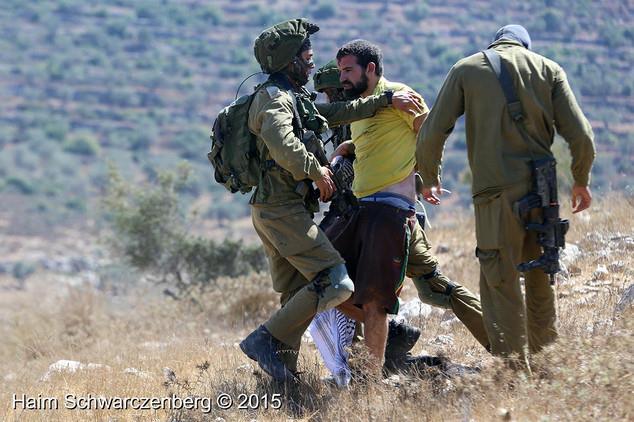
Vittorio Fera violently arrested. Photo credot – Haim Schwarczenberg
International Solidarity Movement | August 31, 2015
Occupied Palestine – Italian activist Vittorio Fera was violently arrested and beaten by soldiers at weekly demonstration in Nabi Saleh in occupied Palestine. The Italian activist, 31-year old Vittorio Fera, is falsely accused of throwing stones and attacking soldiers. His case will be taken to court the second time Monday 31st August between 9 and 11 am.
During a weekly demonstration in Nabi Saleh Israeli soldiers randomly arrested two protesters: one 18-year old Palestinian youth and the Italian activist Vittorio Fera. Fera went to the protest to document human rights violations by the Israeli army against Palestinians and became a victim of military violence himself.
While documenting an Israeli soldier strangling a 12-year old boy, Vittorio and the other activists were ambushed by Israeli forces. Vittorio was separated from the group and violently shoved to the ground. “We were shocked to see the boy being choked by a soldier, when suddenly soldiers came running at us and attacked Vittorio”, Josephine from Denmark explains.

Vittorio Fera with clear marks of military assault
Journalists witnessed soldiers kicking and beating him during the arrest, even though he did not resist or fight back. Vittorio, and the Palestinian youth, were forced into a military jeep where they were detained for almost nine hours by the Israeli army, before they were finally taken to a police station. Despite various demands of Fera’s lawyer to have him brought to a police station immediately, both he and the Palestinian were illegally kept in the military jeep until shortly before midnight.
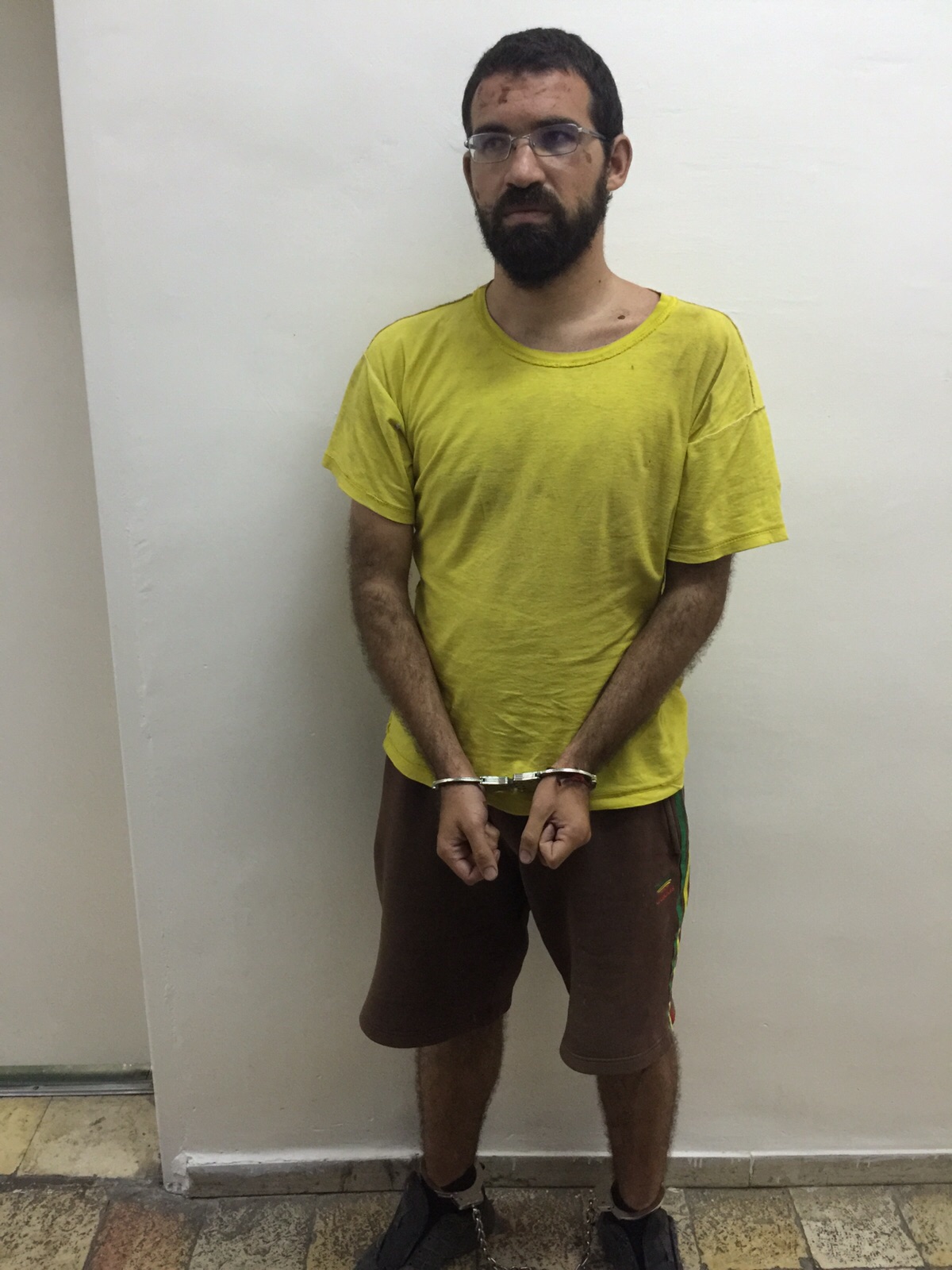
Vittorio Fera with clear marks of military assault
The military accuses Vittorio Fera of throwing stones and attacking the soldiers – an unfounded accusation. A first sentencing in court late Saturday night only resulted in the postponing of the sentencing until Monday morning. The hearing will take place in in Jerusalem Monday the 31st August 2015 between 9 and 11 am.
See the video of the arrest here
Violent arrest of Palestinian man in al-Khalil (Hebron)
International Solidarity Movement | August 29, 2015
Occupied Palestine – A 52-year old Palestinian man was arrested at Shuhada checkpoint in al-Khalil (Hebron) yesterday, for ‘not obeying soldiers’ orders. Israeli forces painfully handcuffed and blindfolded him.
Around 1:30 pm, Hisham Azzeh walked through Shuhada Checkpoint in order to reach his house that is located up the hill next to the illegal settlement in Tel Rumeida. At this first checkpoint on his way home, Hisham passed through the metal detector without it beeping to indicate he had to go back and pass again. Therefore, he continued on his way, but Israeli soldiers yelled at him to go back and pass through the checkpoint again for no reason.
When he did not immediately comply with the soldiers orders, they arrested him. Israeli soldiers painfully handcuffed him with his hands behind his back with plastic handcuffs, without any regard for a recent operation on his hand. The soldiers also blindfolded him, so he was unable to see what happened to him and where he was brought. On the way up the hill towards the military base, the pain, caused by the plastic handcuffs, was so intense, that Israeli soldiers had to allow Azzeh to sit down on the ground, as he was unable to continue walking.
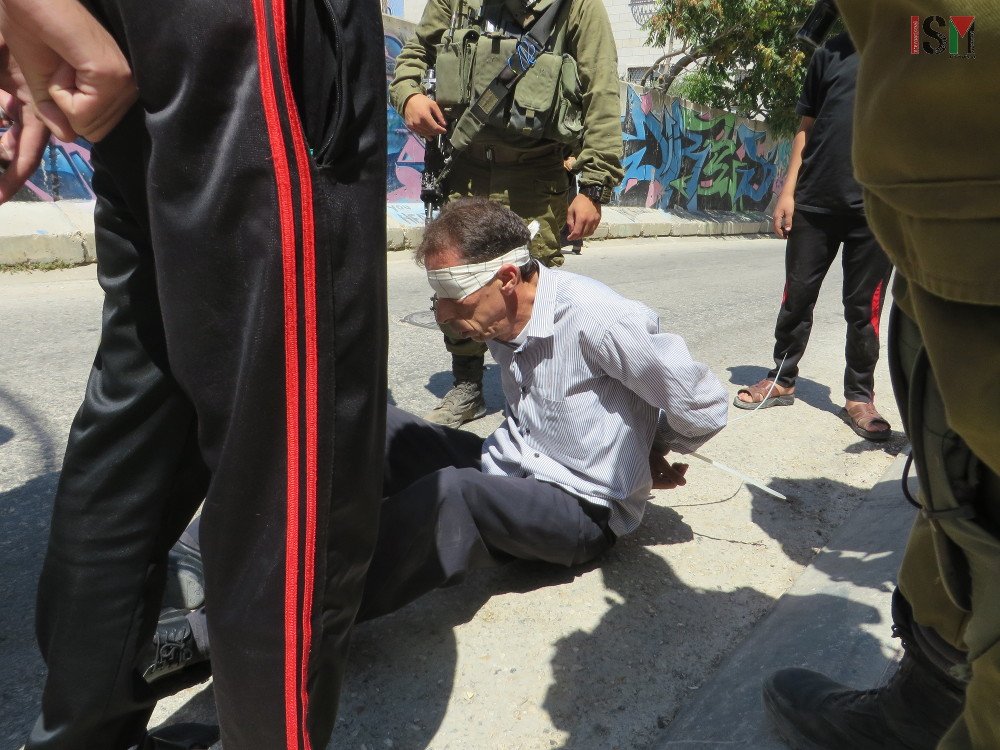
Palestinian man sitting on the ground in pain
Palestinians observing the arrest were continously telling soldiers about Azzeh’s recent operation on his hand and the plate that had to be inserted during this operation. Even though they were explaining the immense pain the plastic handcuffs were causing to Azzeh due to this operation, the Israeli soldiers shouted at them to leave the area and be quiet. Various requests to call an ambulance were denied. Only after Azzeh’s brother, who is a medical professional, arrived and reasoned with the soldiers, they attempted to cut the handcuffs. As the soldiers put the handcuffs too tight, they were struggling to cut the handcuffs without cutting Azzeh’s hands, making the procedure even longer and more painful, with Azzeh suffering immensely and crying out in pain.
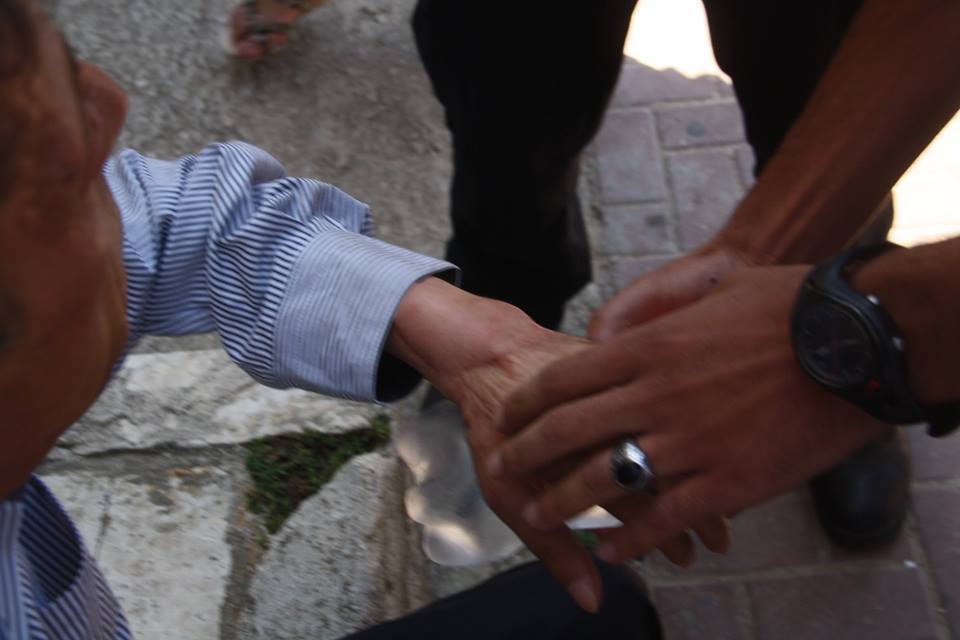
Hisham’s hand showing scars from the operation. Photo credit: Youth against settlement
In the meantime, a civil police car was driving past on a regular patrol and got stopped by the Palestinians in an attempt to alleviate the situation for Hisham. After the handcuffs were finally cut off, by-standers cooled his hand first with a bottle of cold water until an ice-pack was brought for him. The police took Hisham Azzeh to the police station after a long discussion. After about an hour, Azzeh was released. He is now doing okay, but is still suffering from pain in his hands.
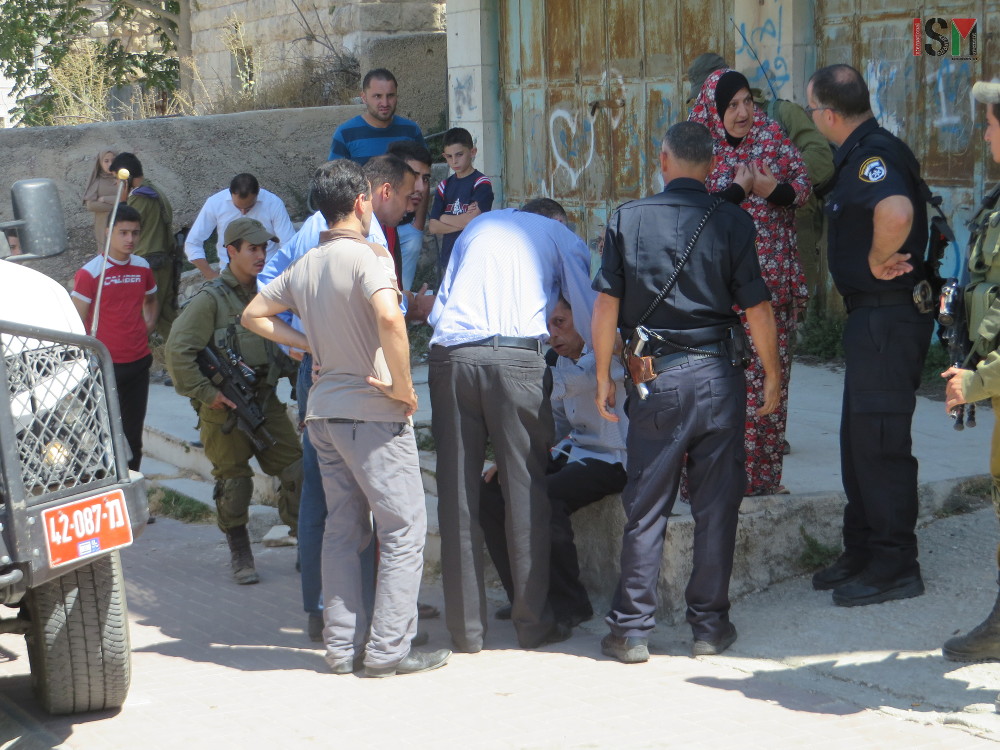
Police, bystanders and the soldiers standing around Hisham
Harassment like this in al-Khalil (Hebron) is not unusual. Palestinians have to pass through various checkpoints on their way home or to work and often get detained for long periods of time.
Israeli forces evacuate Palestinian families for military drill
Ma’an – August 30, 2015
TUBAS – Israeli troops on Sunday morning evacuated 14 Palestinian families from their houses in the al-Ras al-Ahmar area of Khirbet Atuf village east of Tubas in the northern Jordan Valley area of the West Bank, local sources said.
Local sources reported that the “Israeli occupation” told the 14 families that Israeli forces will be carrying out military drills in the area for five days.
During the five days of military exercises, Palestinian residents in the area will be evacuated for six hours every day, local sources told Ma’an.
The evacuation was done under the argument that evacuating protects residents.
Earlier this year military drills in Tubas resulted in a fire that swept across some 3,000 to 4,000 dunams (750 to 1,000 acres) of Jordan Valley farmland.
The majority of the Jordan Valley is under full Israeli military control, despite being within the West Bank.The district of Tubas is one of the occupied West Bank’s most important agricultural centers.
According to the Applied Research Institute of Jerusalem, more than 15,000 dunams (3,700 acres) of land in the Tubas district have been confiscated by Israel for military bases with a further 8,000 dunams (2,000 acres) seized for illegal Israeli settlements.
Two people violently arrested at peaceful demonstration in Nabi Saleh
International Solidarity Movement | August 28, 2015
Occupied Palestine – On Friday the 28th of August 2015, two peaceful demonstrators were violently arrested and a child viciously attacked by Israeli soldiers in the Palestinian village Nabi Saleh in occupied Palestine. Every Friday the people of Nabi Saleh protest against the illegal settlement build on the villages’ land.
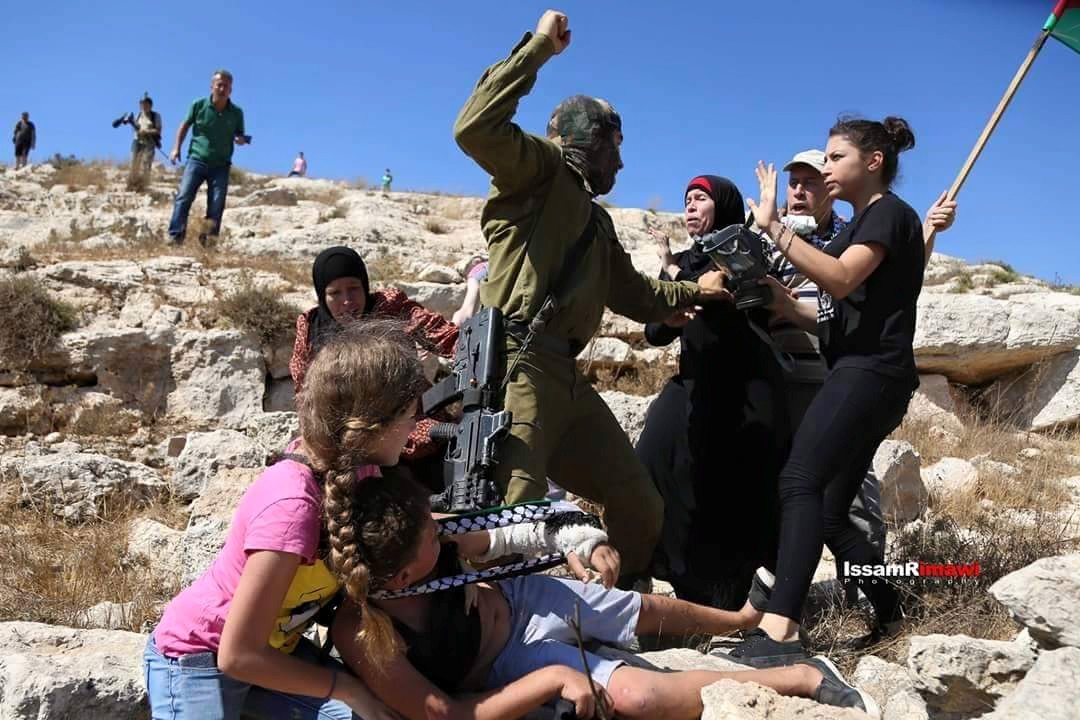
Israeli soldier threatening Palestinian women and children at non violent demonstration in Nabi Saleh. Photo credit: Karam
Today at around 3 pm one Palestinian male, Mahmoud Tamimi, and one international activist were arrested in the Palestinian village Nabi Saleh close to Ramallah. They were arrested during a Friday demonstration against the illegal settlements on the land belonging to the people of Nabi Saleh.
Only a few minutes after the protesters peacefully started their march towards the gate, which is regularly blocked by the military preventing any movement in- or outside of the village, the Israeli army began attacking the non-violent protesters with dozens of rounds of tear gas.
The soldiers then ambushed the demonstrators escaping the clouds of tear gas by surrounding them. They attacked and then arrested Mahmoud Tamimi, shoving him down the hill towards the illegal settlement, where he was forced to lie on the ground.
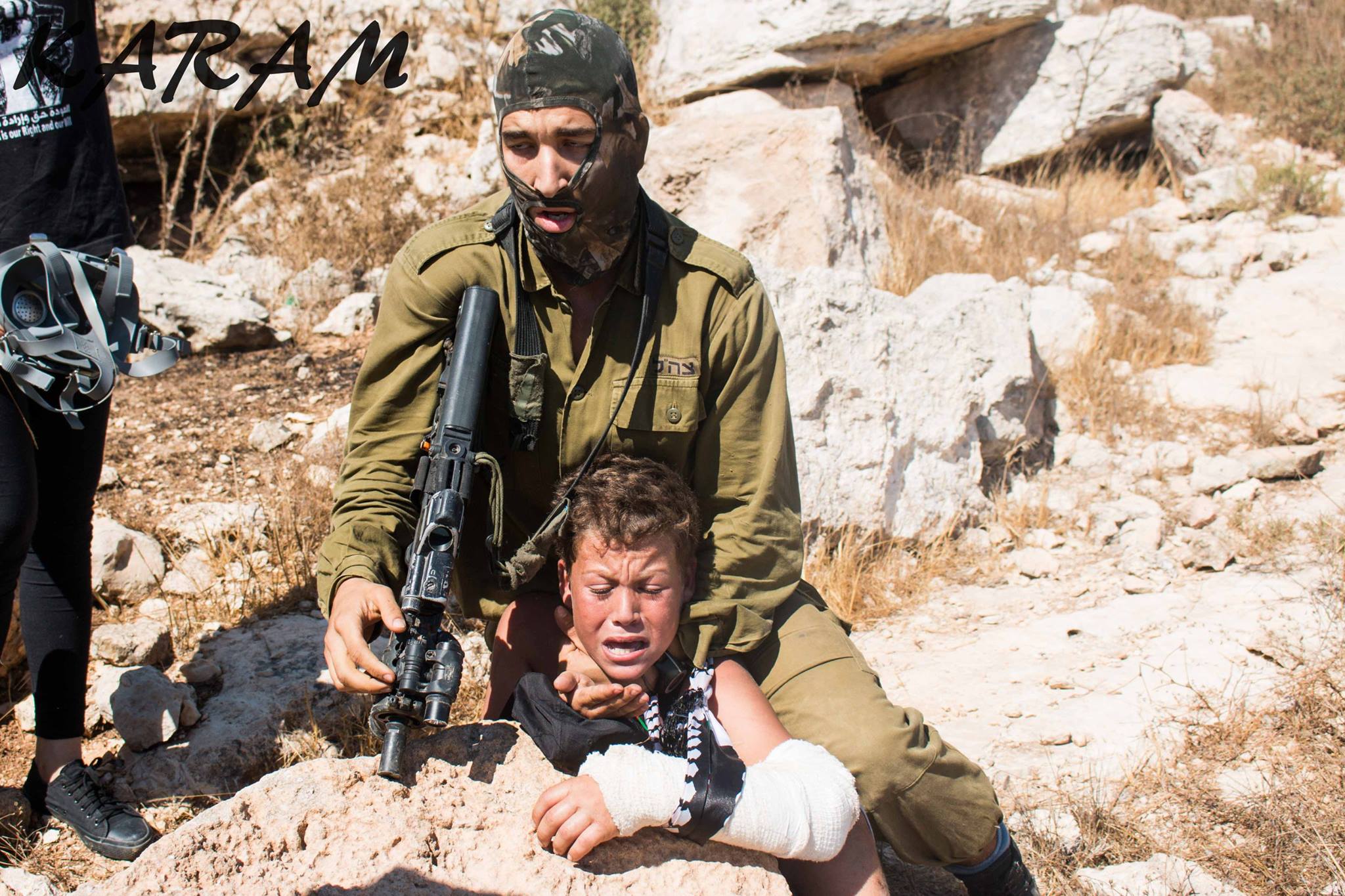
Israeli soldier strangling a Palestinian boy at non violent demonstration in Nabi Saleh. Photo credit: Karam
Around the same time, a Palestinian boy was violently attacked by a soldier throwing him to the ground, choking and almost suffocating him in the process. “While the boy was screaming in pain his family came to rescue him from the soldiers’ vicious assault”, Josephine, a Danish activist explains.
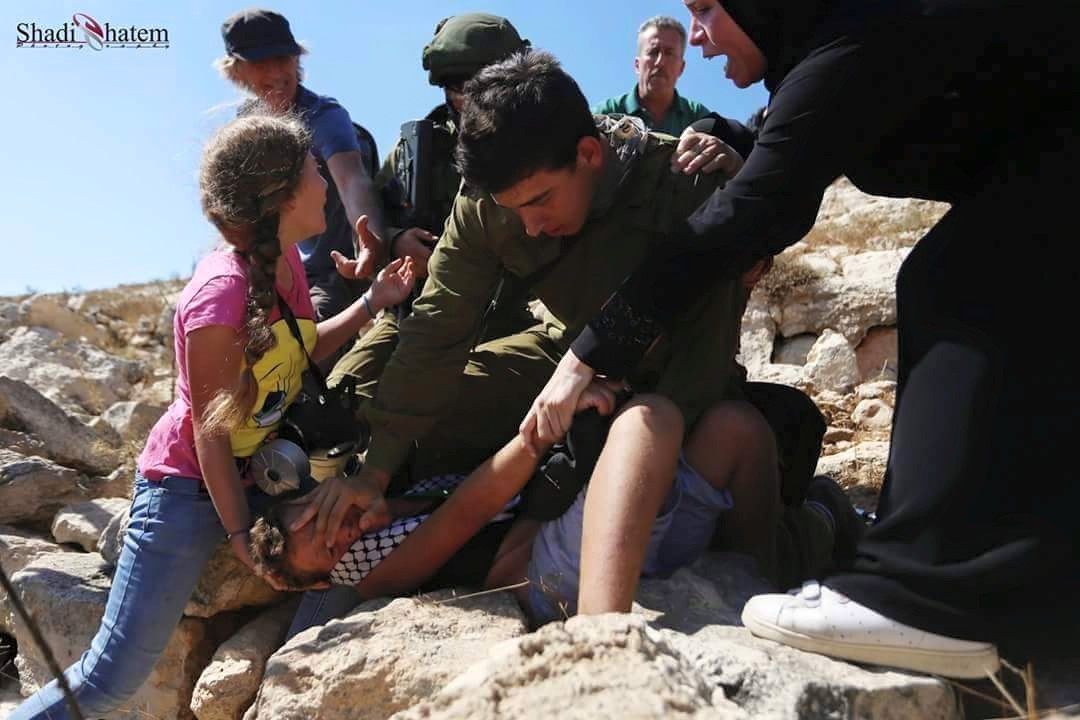
Israeli soldier attacking Palestinian boy at non violent demonstration in Nabi Saleh. Photo credit: Karam
A group of peaceful international demonstrators trying to document the attack on the boy, was ambushed by another group of soldiers, who violently pushed a 31-year old Italian man to the ground and proceeded to arrested him.
Both the Palestinian and the international were being held captive in a military jeep by the Israeli army for almost nine hours, before being brought to a police station.
Israel renews ’85 percent’ of administrative detention orders
Ma’an – August 28, 2015
JERUSALEM – Israeli authorities have renewed the administrative detention of 85 percent of Palestinians detainees held under the policy, a prisoner rights group said Friday.
The Prisoners’ Center for Studies said that at least 75 of the 480 Palestinians held under the detention without trial policy have had their sentences — which range from two to six months — renewed four times in a row.
The detention of 135 detainees has been renewed three times in a row while 190 Palestinians have had their sentences renewed twice, the center added.
Israeli military courts have issued 726 administrative detention orders in 2015 alone, including first time sentences and renewals, the group said, over 340 of which were issued to Palestinians from the Hebron district in the occupied West Bank.
Riyad al-Ashqar, a spokesperson of the Prisoners’ Center for Studies, said Israel is keeping Palestinians as political hostages through the policy of administrative detention.
Most detainees held under the policy, which dates back to the British Mandate, are held on secret evidence and are not aware of the reason for their detention, which can be renewed indefinitely in six-month periods.
In 2012, over 2,000 Palestinian prisoners went on hunger strike to protest administrative detention, one of the only means available to Palestinians to challenge the policy.
Last week, Palestinian detainee Muhammad Allan ended a two-month hunger strike which he began to protest his detention without trial. An Israeli court ruled to lift his administrative detention due to his deteriorating health.
While administrative detention is legal under international law in exceptional circumstances, the international community and rights organizations have condemned excessive use of the practice by Israel.
Israeli troops ‘steal money, jewelry’ during detention raid
Ma’an – August 26, 2015
NABLUS – A Palestinian father said Wednesday that Israeli soldiers stole money and jewelry from his family home when they detained his son in a predawn raid in the the northern West Bank village of Salem east of Nablus.
Nasim Hilmi Karaki, a lieutenant colonel in the Palestinian Authority national security forces, told Ma’an that Israeli special forces stormed his house around 1:00 a.m. after blowing up the main door.
Large numbers of troops ransacked the house as they inspected rooms using metal detectors and police dogs, Karaki said, adding that they blew up the doors of three rooms inside the house.
He said that the operation lasted until around 5:00 a.m., during which Karaki was cuffed and forced to stay with the rest of the family in one of the rooms.
The soldiers then detained Karaki’s 18-year-old son, Hilmi.
Karaki said that the troops were searching for firearms but were unable to find any.
However, after they left, he said he discovered that they had stolen 21,000 shekels and his wife’s jewelry, worth around 2,000 Jordanian Dinars (about $2,820).
An Israeli army spokeswoman said she was looking into the incident.
Karaki’s son was one of 31 Palestinians detained by Israeli forces across the occupied West Bank overnight Tuesday.
Israeli forces routinely detain Palestinians throughout the occupied West Bank and East Jerusalem, often on the pretext of perceived security threats.
Palestinians often report theft by Israeli forces during such raids. During a detention campaign Operation Brother’s Keeper in the summer of 2014, Israeli forces confiscated an estimated $2.9 million worth of cash and property from Palestinian homes, charities, and businesses according to a report by Geneva-based human rights organization Euro-Mid Observer.
Spokespeople for the Israeli government justified confiscations during this time by claiming their planned use to fund or support terrorism.
The Euro-Mid Observer reported, however, that Israeli authorities neither provided evidence nor judicial permission for the confiscations.
Are Zionist terrorist settlers backed by the Israeli regime?
Press TV
After the burning alive of 18-month-old Ali Dawabsheh by a fanatical Zionist settler, the world has reacted with outrage.
The attack was so horrendous that even Israeli leader Benjamin Netanyahu distanced himself from it, calling it an act of terrorism.
But on today’s show we will be asking to what extent Israel is responsible for the activities of its extremists. Are these fanatical terrorists really just a few bad apples, as Netanyahu would have us believe?
Or are they the product of decades of deliberate Zionist policy to colonize stolen land?
Featured Video
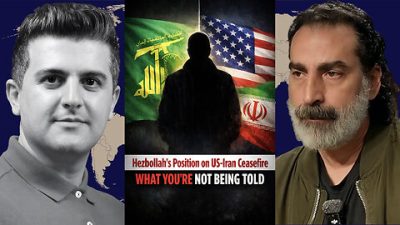
Laith Marouf: Hezbollah’s position on US-Iran ceasefire
or go to
Aletho News Archives – Video-Images
From the Archives
The Dirty Little Secret behind the “Global Terrorism Index”
The Omission of Israeli Terrorism in the Occupied Palestinian Territories
By Karin Brothers | Global Research | December 6, 2014
… The Israeli settlements — all of which are illegal – have been identified as a major impediment to peace. The refusal of a major “global” terrorism report to name the Israeli settlers as one of the groups most responsible for terrorism not only misrepresents a major source of regional violence but exposes the Global Terrorism Index as a propaganda tool that supports a U.S. agenda.
In recent years, governments have been attempting to thwart terrorism by blocking supportive fund-raising. When it comes to Israeli settlements, however, the US and Canada actually encourage fund-raising by giving organizations (such as Christian Friends of Israeli Communities (CFOIC) and the Jewish National Fund) financial support in the form of donor tax-deductions.
Charities which provide funds for the Israeli settlements should be regarded as terror-financing organizations. They should not only lose their tax-deductible status, but they should be banned because they support the violation of international humanitarian law. The terror-financing laws that are being strictly enforced for Muslim charities should be applied to Christian and Jewish charities as well. … Read full article
Blog Roll
 Aletho News
- Israel faces ‘unsustainable’ strategic crisis following 40-day war against Iran: Analyst
- Iran restricts Hormuz access to 15 vessels per day under ceasefire terms: Report
- The ‘Opposition Party’ Has Done Nothing to Stop the Iran War and Much to Goad Trump Into Continuing It
- Moscow backs Tehran on status of Lebanon in US-Iran deal
- How UK Regulator Ofcom Quietly Bypassed International Law to Police American Speech
- The Black Cube Files: How Former Mossad Operatives Flipped a Nation
- Laith Marouf: Hezbollah’s position on US-Iran ceasefire: What you’re not being told
- Israel’s priority lies in destroying chances of peace between Iran, US: Ex-UN nuclear chief
- Ceasefire for all or for none: Iran shuts Hormuz over Lebanon attacks
- Strait of Hormuz is Iran’s ‘nuclear weapon’ that forced US retreat: Medvedev
- If Americans Knew
- This is ceasefire? Israel’s biggest massacre yet in Lebanon, another journalist killed in Gaza – Daily Update
- Tucker Carlson on Israel: This Is the Behavior of an Ally? Really?
- Gazans face a triple crisis: severe shortages of water and bread, healthcare in tatters
- NY Times reports how Netanyahu took the US into Iran War
- A sigh of relief over Iran, but Gaza and Lebanon in dire straits – Daily Update
- Thousands dead and neighborhoods razed to the ground: Aid agencies fear southern Lebanon is becoming the new Gaza
- The war the US is fighting for Israel could cost trillions
- ‘Cigarette Burns, Nail Wounds’: Toddler Tortured in Gaza to Coerce Father
- Trump Says US Sent ‘a Lot of Guns’ to Protesters in Iran
- Israeli forces destroy 17 UN peacekeeper cameras in south Lebanon
- No Tricks Zone
- An Inconvenient Tree: Uncovered In Alps… Europe Much Warmer Than Today 6000 Years Ago
- New Study Reports A 60% Slowdown In Greenland’s Ice Loss Rate In The Last Decade
- Low Intensity Tornado Wrecks Major Solar Farm, Creating A Potential Toxic Dump
- New Study Finds Warming Saves Lives…Cold Temperatures 12 Times More Deadly Than Excess Heat
- German Science Blog Accuses PIK Climate Institute Of Hallucinating Climate Tipping Points
- Devastating Assessment Of Comirnaty Vaccine By Former Senior Pfizer Europe Toxicologist
- New Study: CO2 Is ‘Effectively Negligible’ As An Explanatory Climate Change Factor Since 2000
- Former Pfizer Toxicologist Dr. Helmut Sterz Tells Bundestag Hearing Pfizer Vaccine Should Have Never Been Approved
- Energy Expert: Germany’s Nuclear Phaseout Was A “500 Billion Euro Mistake”
- New Research: South Australia’s Mid-Holocene Sea Surface Temperatures Were 4°C Warmer Than Today
 Aletho News