‘Biggest West Bank massacre in decades’: Israel bombs crowded Tulkarem café
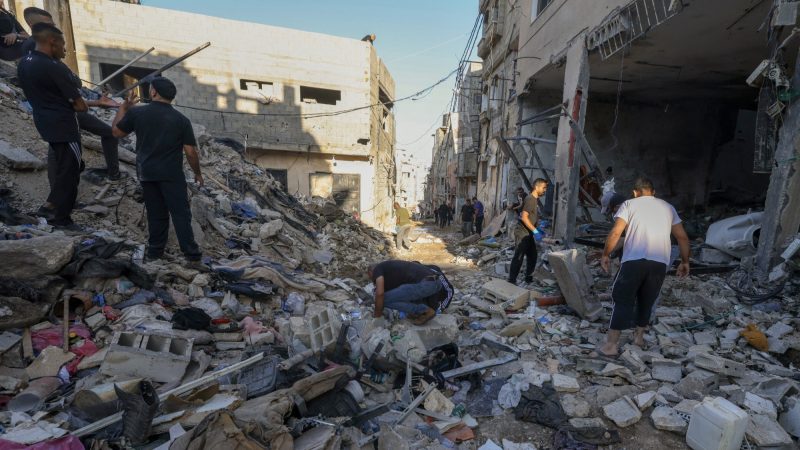
(Photo credit: AFP/Jaafar Ashtiyeh)
The Cradle | October 4, 2024
Israel bombed a café in the occupied West Bank city of Tulkarem late on 3 October, killing at least 20 in what is being described as the worst massacre in the territory since the Second Intifada.
Among those killed were a woman, her husband, and their child.
A Quds Brigades commander, Ghaith Radwan, and a member of Hamas’ Qassam Brigades, Zahi al-Aoufi, were killed in the indiscriminate attack on Tulkarem.
“In the attack, a number of key operatives who were also active in the terrorist infrastructure in Tulkarem were eliminated,” the Israeli army and Shin Bet security service said in a joint statement.
Aoufi was reportedly the head of Hamas’ organization structure in Tulkarem. “He provided weapons to terrorist operatives in the area and planned to carry out numerous attacks on settlements in the West Bank and deep inside Israel,” according to Yedioth Ahronoth.
Israeli warplanes fired at least one missile at the café in Tulkarem’s Hamam neighborhood on Thursday night as it was packed with civilians, according to WAFA news agency’s correspondent.
Civil defense teams and ambulances immediately rushed to transport the casualties to the city’s Thabet Thabet Government Hospital.
WAFA news agency referred to it as the biggest massacre in the occupied West Bank in over 24 years.
The Israeli army launched a massive operation against several West Bank cities on 28 August. The camps of the West Bank witnessed numerous military incursions, indiscriminate airstrikes and massacres, and assassinations.
Abu Shujaa, the late commander of the Quds Brigades’ Tulkarem branch, was assassinated by Israel on 29 August.
The latest massacre in Tulkarem comes as Israel continues its brutal assault across Lebanon, which has killed around 2,000 and displaced over a million.
Hours before the attack, the US State Department warned that Israeli escalation in Lebanon could lead to a tense situation in the occupied West Bank.
The more definitive the proof of Israeli atrocities, the less they get reported
By Jonathan Cook | September 20, 2024
The coverage of Israeli soldiers pushing three Palestinians off a roof in the West Bank town of Qabatiya – it’s unclear whether the men are dead or near-dead – is being barely reported by the western media, even though it was videoed from at least three different angles and a reporter from the main US news agency Associated Press witnessed it.
AP reported on this incident some nine hours ago. Its news feed is accessed by all western establishment media, so they all know.
Yet again, the media has chosen to ignore Israeli war crimes, even when there is definitive proof that they occurred. (Or perhaps more accurately: even more so when there is definitive proof they occurred.)
Remember, that same media never fails to highlight – or simply makes up – any crime Palestinians are accused of, such as those non-existent “beheaded babies”.
AP itself treats this latest atrocity in the West Bank as no big deal. It reports simply that it may be part of a “pattern of excessive force” by Israeli soldiers towards Palestinians.
That comment, without quote marks and ascribed to a human rights group, is almost certainly AP’s preferred characterisation of the group’s reference to a pattern not of “excessive force” but of war crimes, crimes against humanity and genocide.
AP makes sure to give Israel’s pretext for why it is committing war crimes: “Israel says the raids are necessary to stamp out militancy.”
But it forgets yet again to mention why that “militancy” exists: because Israel has been violently enforcing an illegal military occupation of the Palestinian territories for many decades, in which it – once again illegally – has drafted in an army of settler militias to drive out the native Palestinian population.
AP also forgets to mention that, under international law, the Palestinians have every right to resist Israel’s occupying soldiers, including “militantly”.
Western governments might characterise Palestinians shooting at Israeli soldiers as “terrorism”, but that’s not how it is seen in the international law codes that western states drafted decades ago and that they claim to uphold.
It’s also worth noting that the local Palestinian reporter who witnessed this crime had his report rewritten by “Julia Frankel, an Associated Press reporter in Jerusalem”.
As is true with many other western outlets, AP copy is editorially overseen from Jerusalem, where its office is staffed mostly with Israeli Jews.
Western news outlets doubtless privately rationalise this to themselves as a wise precaution, making sure copy is “sensitive” to Israel’s perspective and less likely to incur the wrath of the Israeli government and Israel lobby.
Which is precisely the problem. The bias in western reporting is baked in. It is designed not to upset Israel – in the midst of a “plausible genocide”, according to the World Court – which means it’s entirely skewed and completely untrustworthy.
It makes our media utterly complicit in Israel’s war crimes, including when Israeli soldiers throw Palestinians off a roof.
UPDATE:
Very belatedly, the BBC has reported this on one of its news channels. Note, it adds an entirely unnecessary disclaimer that the footage hasn’t been “independently verified” – whatever that means. There are now at least three separate videos, all taken from different angles, showing the same war crime. Even the Israeli military has confirmed the incident happened.
The BBC also assumes the three Palestinians are dead. There is absolutely no reason to make that assumption: it violates the most basic rules of reporting.
And the anchor, clearly nervous about how she should refer to the men being pushed off a roof, ends by observing that the footage is “another example of the tensions and the many fronts on which we see Israel fighting”. No, it’s another example of Israeli soldiers committing war crimes, and the media trying to deflect attention from that fact.
Israel Orders Demolition of 37 Homes, Commercial Structures in Silwan
IMEMC | September 17, 2024
On Monday, Israeli soldiers and City Council personnel invaded Silwan town, south of the Al-Aqsa Mosque in the occupied capital, Jerusalem, in the West Bank, and handed out demolition orders for 37 homes and commercial structures.
Media sources reported that the soldiers notified the town’s citizens of the demolition orders, and added that the demolitions are part of the municipality’s plans to remove Palestinian buildings to pave a road, dubbed the “American Road,” and infrastructure for the illegal colonizers.
The number of demolitions in the Jerusalem Governorate from the first of September until the eighth has now reached 307.
The Israeli occupation authorities generally justify the demolition of homes on the pretext of building without permits, despite the rarity of granting the necessary permits for building homes for Jerusalemites.
The “American Road” project, constructed over the ruins of Palestinian homes, demolished residences, and confiscated lands, stretches about 12 kilometers, devouring everything in its path to facilitate the lives of illegal colonizers and create segregated roads between the colonies.
While Israel continues to build and expand its illegal colonies, Palestinian communities and towns in occupied Jerusalem and various areas in the occupied West Bank continue to be denied the right to build homes and property under various allegations meant to prevent the expansion of Palestinian towns and neighborhoods.
All of Israel’s colonies in the occupied West Bank, including those in and around occupied East Jerusalem, are illegal under International Law, the Fourth Geneva Convention, in addition to various United Nations and Security Council resolutions. They also constitute war crimes under International Law.
Article 49 of the Fourth Geneva Convention states: “The Occupying Power shall not deport or transfer parts of its own civilian population into the territory it occupies.” It also prohibits the “individual or mass forcible transfers, as well as deportations of protected persons from occupied territory.”
Israeli forces restrict access to scene of Turkish-American activist’s killing
Press TV – September 13, 2024
The Israeli regime’s forces have restricted access to the murder scene of a Turkish-American activist, who was killed by the Israeli military last week while protesting the regime’s illegal settlement construction activities.
Reporting on Friday, the official Palestinian Wafa news agency said the forces had placed military checkpoints at intersections in the town of Beita, south of the city of Nablus, in the northern part of the occupied West Bank.
Mahmoud Barham, head of the Beita Municipal Council, said the troops would prevent Palestinians from crossing the intersections to reach Mount Sabih, where the atrocity had taken place.
The activist, Aysenur Ezgi Eygi, was killed last Friday while protesting alongside locals in Beita against the settlement of Evyatar.
An autopsy report confirmed that the 26-year-old had been killed by an Israeli sniper’s bullet to the head, Nablus Governor Ghassan Daghlas said on Saturday.
The Israeli military has alleged that Aysenur was killed during an effort by the forces to quell a “riot.”
Available footage of the protest as well as numerous witness accounts, however, contradict the claim.
The United Nations has called for an investigation of the crime.
“I can tell you that we would want to see a full investigation of the circumstances and that people should be held accountable,” UN spokesman Stephane Dujarric said at a news conference following the activist’s death.
According to Wafa, Aysenur is one of 17 people who have been killed since the Evyatar settlement’s emergence in 2021.
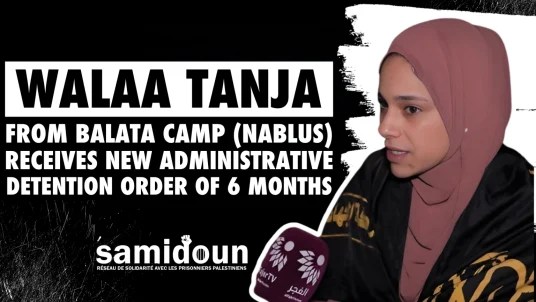
Walaa Tanja ordered to 6 more months of arbitrary imprisonment without charge or trial
Samidoun Palestinian Prisoner Solidarity Network | September 11, 2024
Walaa Khaled Tanja grew up in Balata refugee camp (Nablus), in a family with a strong history of resistance for Palestinian liberation. At the age of 15, she received her mother, Latifa Abu Dara, on Al-Quds Street near the Huwarra checkpoint, when she was released as part of the Wafaa Al-Ahrar prisoner exchange in 2011.
Her mother was later martyred due to cancer and her brother has also been repeatedly pursued, imprisoned and wounded by occupation soldiers.
Walaa was arrested on August 20th 2022, with Tahrir Abu Sariya and Maryam Arafat, and accused of attempting to carry out an armed operation in retaliation for the murder of Ibrahim Al Nabulsi. The occupation claimed that they opened fire on soldiers at the “Kedumim” illegal colonial settlement near the occupied Palestinian cities of Nablus and Qalqilya.
Walaa was released on November 24th 2023, as part of the first batch of the Al-Aqsa Flood prisoner exchange deal, in which 13 Israeli women and children were exchanged for 39 Palestinian women and children who were held hostage by the occupation.
This interrupted Walaa’s original 7-year sentence and she was welcomed home by her family. However, due to the heavy repression by the occupation, no big celebration was possible.
After her release, Walaa expressed her feelings about her liberation thanks to the Resistance in Gaza.
On March 12th 2024, while she was arriving to Tulkarem from Nablus together with her 16-year-old cousin, occupation special forces attacked the car with their guns pointed at them, and seized Walaa once again. She was taken to a military camp, then to Hasharon crossing and then to Damon prison.
Her abduction clearly broke the prisoner exchange agreement, which has now been done several times by the occupation.
Walaa was ordered to six months in “administrative detention” — arbitrary imprisonment without charge or trial, indefinitely renewable. On 11 September 2024, her detention was extended for another six months. We urge immediate liberation for Walaa Khaled Tanja, together with the liberation of all Palestinian prisoners and all of Palestine, from the river to the sea.
Follow the Dismantle Damon campaign for more updates on Palestinian women prisoners.
Buffer zones, new Israeli means of seizing control of West Bank
By Fayha’ Shalash | Al Mayadeen | September 10, 2024
In mid-August, Alaa Srouji was surprised when the Israeli army handed him a notice to remove his greenhouses near Tulkarm.
The official reason was that he did not have a permit for them, but when the other farmers in the area received similar notices at the same time, concerns were raised. Many now suspect that “Israel” may be planning to establish a buffer zone in the Shweika Plain area.
Israeli media reported that settlers have been calling for the establishment of buffer zones, under the pretext of preventing armed infiltration of Israeli-occupied territory, similar to what happened on October 7.
However, Palestinian human rights and research centers have confirmed that these allegations cover dangerous goals: seizing additional Palestinian land to further settlement expansion.
Will be demolished at any moment
Srouji is a member of the Sun Roots Agricultural Cooperative Society, which plays a major role in helping farmers in Tulkarm in the face of Israeli policies.
But these efforts became subject to restrictions after the Israeli army handed them notices to demolish two greenhouses in the Shweika Plain under the pretext that they were not licensed.
“Although the greenhouses have been there for 14 years and provide livelihoods for many farmers and locals, Israel now intends to remove them,” he told Al Mayadeen English.
At the same time, six other farmers were told to disassemble their greenhouses or refrain from accessing their cultivated lands in the same area, all under the same pretext.
The association submitted an objection but didn’t receive any response. With the deadline for objections passing in early September, the greenhouses now face the imminent threat of demolition at any moment.
“When we submitted the objection, we learned that the reason for the notice was the proximity of the facilities to the Beit Hefer settlement, even though it is about 400 meters away,” he added.
Forbidden lands
The establishment of buffer zones in the West Bank is divided into two parts: one separates the Palestinians from the apartheid wall that “Israel” erected in 2002, encircling the Palestinian lands, while the other surrounds the settlements scattered throughout the West Bank.
Last November, Israeli Finance Minister Bezalel Smotrich emphasized “the necessity of establishing buffer zones around West Bank settlements to protect them from any attack,” according to the Jerusalem Post.
In February, the Israeli army issued a decision to seize 18 dunams of land from the village of Deir Dibwan, east of Ramallah, citing “urgent military purposes” as the justification.
However, the villagers soon discovered that the decision was actually aimed at establishing a buffer zone around the Mitzpe Dani settlement, which was built on their lands.
The mayor of Deir Dibwan, Imad Musbih, told Al Mayadeen English that the seizure of these lands expresses the actual implementation of the buffer zone concept proposed by Smotrich last year.
The landowners were taken aback by this decision and tried to file objections, but to no avail, according to him. The Israeli goal, he said, is clear and resolute, and Palestinians are not allowed to stand against it.
“No one has been able to access the seized lands. They cannot cultivate them, nor graze livestock on them, nor even approach them under any circumstances”, he added.
In conjunction with the decision, the intensity of attacks by settlers coming from this settlement increased. They began to cross the seized lands and reach the village where they burned Palestinians’ vehicles, slaughtered their livestock, or destroyed their property.
All of this was done in front of the Israeli army and without any intervention to stop them. Rather, the soldiers attacked the Palestinians with gas and sound bombs and arrested them in case they tried to repel settler attacks.
New old policy
The sequence of events in the West Bank indicates that this policy is not new, but rather dates back to around three years, coinciding with the arrival of the current extremist Israeli government.
Raed Mukadi, a researcher at the Land Research Center, told Al Mayadeen English that about a year ago, an Israeli military decision was issued before the start of the olive harvest season, declaring certain areas off-limits to Palestinians. These restricted areas are concentrated south of Nablus, near Salfit, and parts of Tulkarm.
At the same time, there was another military decision in the al-Jalama area, north of Jenin, to stop building and removing facilities around the apartheid wall under the pretext of security reasons.
“It is an Israeli plan aiming to evacuate Palestinian lands close to the apartheid wall and settlements,” he explained.
According to him, the most dangerous thing is that preventing access to these lands might be a prelude to expanding settlements, constructing roads, or establishing military camps and army headquarters under security pretexts. This would effectively block their agricultural use or construction, leading to significant losses for the Palestinians.
“After the aggression on Gaza, many areas were closed off, including large tracts of land in the West Bank. For instance, access was blocked to 18,000 dunams in the Ya’bad Plain south of Jenin, with these areas being completely shut off. It remains unclear whether this closure is temporary or permanent, which complicates the ability to determine the total area of land that has been converted into buffer zones,” he said.
Coinciding with the aggression against Gaza, the Israeli government announced a state of emergency, which means giving full authority to the Israeli army to act and make unfair military decisions, according to the prevailing conditions.
The IOF actually began to seize vast areas near the settlements, settlement streets, military towers, and the apartheid wall, all of which were issued by senior Israeli authorities under the pretext of preventing Palestinian attacks, as he said.
Can Israel survive its new war in the West Bank?

By Eva Bartlett | RT | September 8, 2024
Having failed to eradicate Hamas in Gaza, Israel on August 28 began a war on the West Bank, dubbed ‘Operation Summer Camps’.
This Israeli assault on West Bank areas is the largest since 2002, with thousands of Israeli soldiers, supported by helicopters and drones, invading northern West Bank cities, particularly targeting the refugee camps of Jenin, Tubas, and Tulkarem.
The same day, the non-profit Euro-Med Human Rights Monitor reported: “Immediately after entering the West Bank, the Israeli army began besieging hospitals, ambulances, and emergency centres, replicating its horrifying and systematic policy of breaching and taking control of health institutions that it has employed in the Gaza Strip.
Simultaneously with the storming of these areas, raid and arrest campaigns were carried out in most cities in the West Bank amid gunfire that injured many Palestinians. Since last October, 660 Palestinians in the West Bank have been killed as a result of the Israeli military’s systematic, large-scale attacks.
Journalist Mariam Barghouti on August 31 wrote, “I was in Jenin and I cannot explain how ruthless the Israeli military is being. The city is like a ghost town and the refugee camp is a collective torture chamber. Israeli practices in Jenin include: mass arrests including minors, blowing up homes of civilians, denying entry of food, water, medics. The children that managed to escape are traumatized, they’re nothing but tears and shock. Everyone is unable to fully recognize this unprecedented violence and at such an intensity. Jenin is another Gaza in terms of violence being inflicted.”
According to the UN’s OCHA, between 27 August and 2 September, Israeli forces killed 30 Palestinians in the West Bank, including seven children, the highest weekly death toll since November 2023 (by September 6, the number had increased to 39 Palestinians killed, including eight children, and approximately 145 injured).
Those murdered, OCHA notes, include an 82-year-old Palestinian man, shot and killed while attempting to buy bread. Israeli forces also reportedly shot and killed two Palestinian boys, aged 13 and 16, “being chased by Israeli forces while attempting to distribute bread to besieged families near the eastern neighbourhood of Jenin city.” Israeli soldiers also abducted and tortured to death a 50-year-old civilian.
Further, OCHA reports that between October 7, 2023 and September 2 this year, “652 Palestinians were killed in the West Bank, including East Jerusalem.”
The brutality is not only from the Israeli military but also the illegal Jewish colonists who are given carte blanche to attack and kill, Palestinians, as they’ve done for decades, and as I’ve written about before.
According to OCHA, in the same timeframe there were “about 1,300 attacks by Israeli settlers against Palestinians, of which over 120 led to Palestinian fatalities and injuries.”
On top of all of this Israeli destruction and carnage are the continued abductions of Palestinian civilians (young and elderly). It has been widely reported from inside Israel, through leaked footage and in countless testimonies from Palestinian hostages, that Israel routinely tortures Palestinians via beatings, electric shocks to genitals, stress positions, psychological torture, near starvation, and also rape to the point of causing serious internal damage.
Palestine Chronicle reported on September 3, citing the Office of the United Nations High Commissioner for Human Rights (OHCHR), that “at least 53 Palestinian prisoners died in Israeli custody” between October 7, 2023, and July 31, 2024.
The article refers to a letter this June from Ronen Bar, head of the Israeli security agency, Shin Bet, to Benjamin Netanyahu this June, putting the number of detainees at 21,000. This is a shocking 11,000 higher than was known in April when I last wrote about the nearly 10,000 Palestinian hostages in Israeli prisons.
Israel wants West Bank wiped off the map
On the morning Israel started its current mini-Gaza bombardment and displacement campaign, Foreign Minister Israel Katz boasted of the destruction and killing to come, saying, “We must deal with the threat just as we deal with the terrorist infrastructure in Gaza, including the temporary evacuation of Palestinian residents and whatever steps are required. This is a war for everything and we must win it.”
Then, there was Prime Minister Netanyahu during a press conference pointing to his map with the West Bank erased.
In its report, the human rights organization Euromed cites Israeli newspaper Yedioth Ahronoth writing that, “an organised evacuation of the Palestinian civilian population will be carried out according to the… combat centres.”
The group notes, “This is a clear indication of Israel’s intention to commit genocide against Palestinians in the West Bank, just as it has done against those in the Gaza Strip.”
UN Special Rapporteur Francesca Albanese on September 2 stated, “There is mounting evidence that no Palestinian is safe under Israel’s unfettered control… The long-standing impunity granted to Israel is enabling the de-Palestinisation of the occupied territory, leaving Palestinians at the mercy of the forces pursuing their elimination as a national group.”
However, Palestinian resistance groups are putting up a fight. On X, accounts closely following events claim as of September 1, the Jenin Brigade, “Conducted over 15 IED operations, killing & wounding IOF [Israeli occupation forces], significantly damaging their vehicles,“ while the Tulkam Brigade “Conducted 6 IED operations, killing & wounding IOF.”
Al Mayadeen some days later reported similar events, noting, “Palestinian Resistance confronts IOF in Jenin, Tulkarm for 8th day The Al-Aqsa Martyrs Brigades – Jenin confirmed that its resistance fighters engaged in confrontations with Israeli forces in the al-Hadaf neighborhood using machine guns and IEDs.”
It’s worth remembering the words of Retired Israeli General Yitzhak Brick just a couple of weeks ago, when he stated, ”Israel is sinking deeper into the Gazan mud, losing more and more soldiers as they get killed or wounded, without any chance of achieving the war’s main goal: bringing down Hamas. The country really is galloping towards the edge of an abyss. If the war of attrition against Hamas and Hezbollah continues, Israel will collapse within no more than a year.”
After over ten months of Israel killing and starving the Palestinians of Gaza, it’s safe to say that if the general’s prediction comes true, that would be some slight justice for the Palestinian suffering both since October 7 and before.
EuroMed, in its above-mentioned report, calls on all nations to, “impose strong sanctions on Israel and halt all forms of military, political, and financial assistance. This includes immediately cutting off all arms transfers to Israel, including export permits and military aid; otherwise, these nations will be complicit in and partners in the Israeli crimes committed in the Gaza Strip, including the crime of genocide.”
Given that the so-called international community has colossally failed Palestinians in allowing Israel to slaughter, starve and torture them, halting arms supplies to Israel and imposing sanctions is the least countries could do.
Eva Bartlett is a Canadian independent journalist. She has spent years on the ground covering conflict zones in the Middle East, especially in Syria and Palestine (where she lived for nearly four years).
What is Happening in the Northern West Bank?
By Diana Khwaelid | International Solidarity Movement | September 4, 2024
Northern West Bank – The radical Israeli Minister of National Security, Itamar Ben-Gvir, has renewed his incitement to impose collective punishment on citizens in the occupied West Bank, including the killing of detainees in occupation prisons.
In the early hours of August 28, 2024, Israel announced the start of a large-scale military operation in the northern West Bank, specifically targeting three cities and their refugee camps: Jenin, Tulkarm, and Tubas. Israel has named this operation “The Summer Camps,” while the resistance factions in the West Bank, particularly the Jerusalem Brigades, have called it “The Terror of the Camps”. This Israeli operation is the largest since the “Protective Fence” operation in 2002. According to the *Yedioth Ahronoth* newspaper, a full military squad was mobilized after several weeks of preparation. Hebrew Channel 14 confirmed that the army had deployed thousands of soldiers from various special units, including the use of military helicopters and heavy weapons.
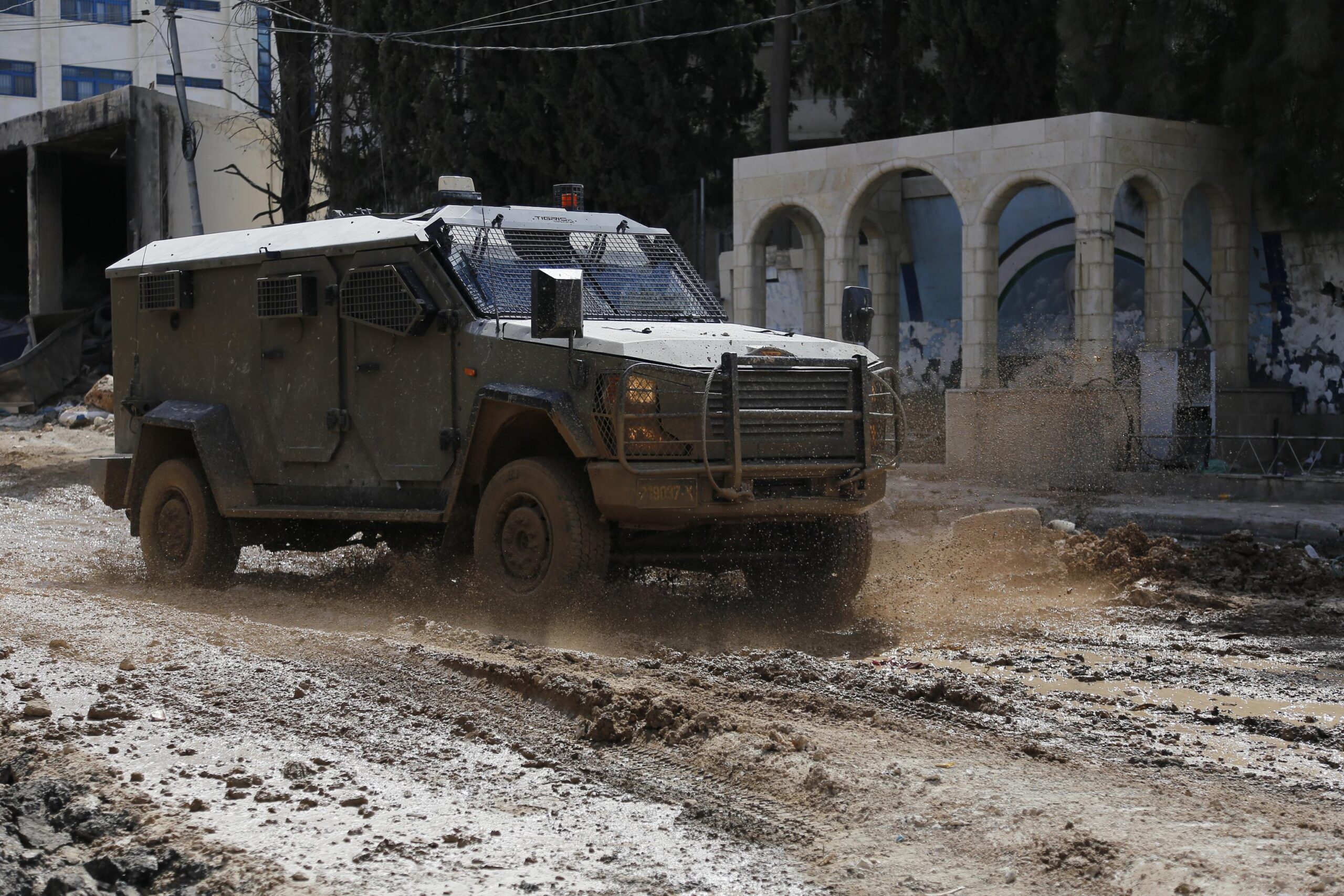
The operation began with a simultaneous Israeli incursion into the three cities, using huge bulldozers and air cover. The Israeli occupation forces closed all roads leading to the cities of Tulkarm and Jenin, but encountered armed resistance from fighters who attempted to prevent further advancement. In response to the armed clashes on the ground, Israel resorted to airstrikes, bombing three different locations: the Far’a refugee camp (Tubas), the Nour Shams refugee camp (Tulkarm), and a site near the Jenin refugee camp. These bombings killed several resistance fighters and wounded others. The first day ended with the assassination of nine resistance fighters, most of them from the Al-Quds Brigades and the Al-Qassam Brigades, and the wounding of an Israeli soldier amid massive destruction to the infrastructure of several targeted cities.
A week ago, the occupation forces began a large-scale operation in the northern West Bank under the pretext of dismantling resistance cells. Since then, resistance fighters have been confronting them with explosive devices and gunfire, resulting in the deaths and injuries of several Israeli soldiers.
The operation has so far resulted in the martyrdom of 33 Palestinians and the injury of 130 others, causing significant destruction to the infrastructure in the cities and camps of Jenin, Tulkarm, Nablus, and Tubas. The Israeli occupation forces have not only liquidated several resisters in the Nur Shams refugee camp, northeast of Tulkarm, Jenin Camp, Tubas, and Nablus but also renewed their incursion into the city of Tulkarm on the evening of Monday, September 2. This time, they stationed themselves in the Tulkarm refugee camp, where the military operation is still ongoing.
The residents of the camps in the northern West Bank, particularly in the Tulkarm and Jenin camps, are experiencing a state of fear and terror. On Monday evening, Israeli occupation snipers targeted a civilian and his 15-year-old son. The father was transferred to the hospital, but the child died while attempting to leave the camp.
Israeli special forces also surrounded a Palestinian house in the village of Dhnaba, east of Tulkarm, and demanded the surrender of two Palestinian youths. According to eyewitnesses, they used a Palestinian child, no older than 16, as a human shield. The forces subsequently killed the two Palestinians, seized their bodies, and confiscated their private vehicle.
The Israeli occupation forces are also obstructing the movement of medical crews in the northern West Bank cities, particularly Tulkarm and Jenin, preventing them from entering the camps, transporting the injured, and assisting Palestinian patients in humanitarian cases.
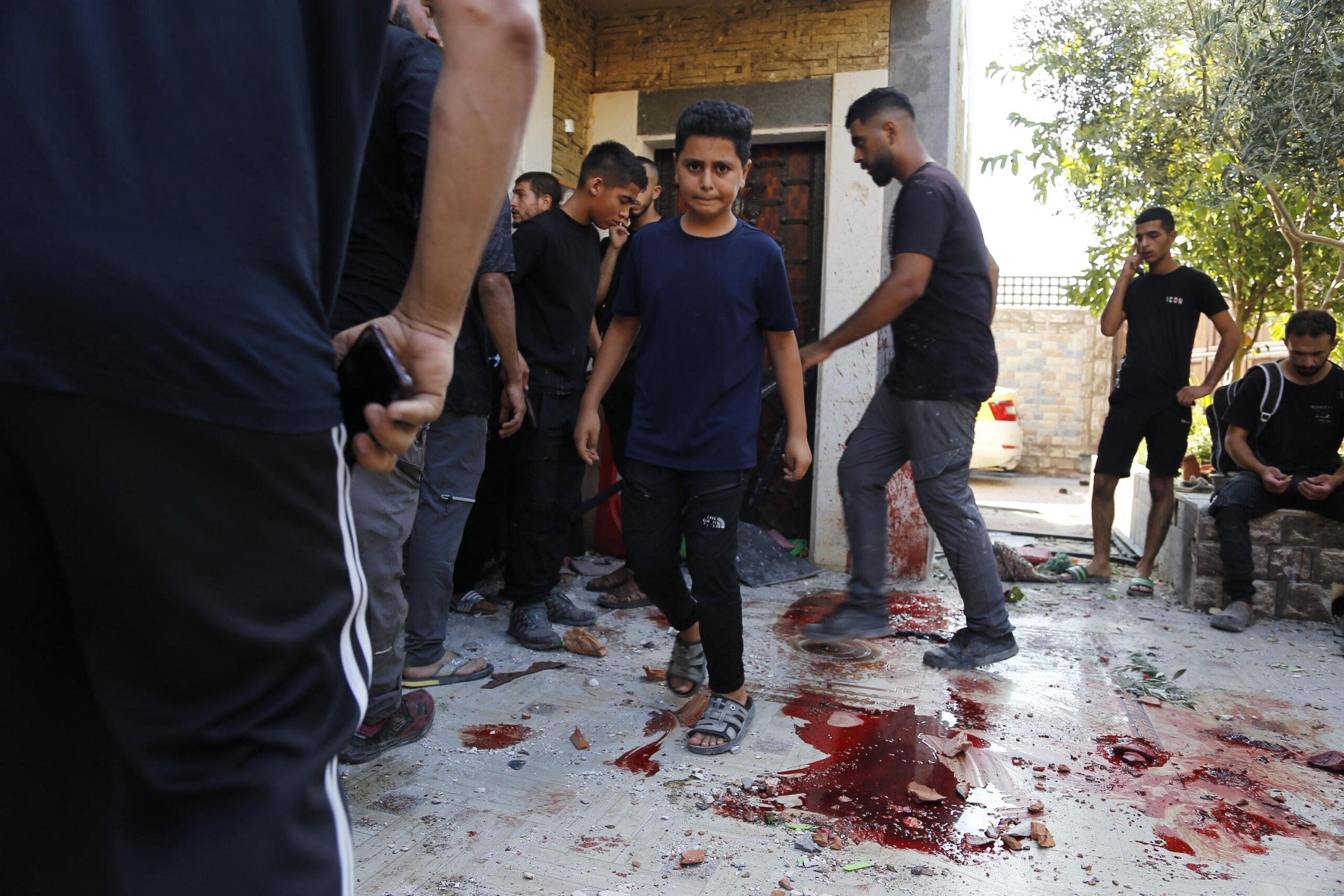
The house that was surrounded and two Palestinians were executed in the village of Dhnabu
4 journalists injured by Israel army fire in West Bank
MEMO | September 3, 2024
Four Palestinian journalists were injured by Israeli army fire in the occupied West Bank town of Kafr Dan, the Red Crescent Society said today.
The society said two journalists were treated on the spot by its medics while two others were transferred to hospital.
Jaraah Khalaf, one of the injured journalists, said he and other reporters were covering an Israeli siege on a house in Kafr Dan, in the Jenin Governorate, when they came under direct Israeli fire.
“We were all wearing vests that clearly had press identification labels in English (PRESS), and our vehicles carried the same insignia,” he said.
Israeli occupation forces raided the town early today and besieged a house, calling on its occupants to surrender via loudspeakers, according to witnesses.
The house was later demolished by Israeli military bulldozers, while a child and another Palestinian were injured during the raid, according to the Ministry of Health.
Israeli Forces Kill Three Palestinians in Tulkarem Camp
IMEMC | August 22, 2024
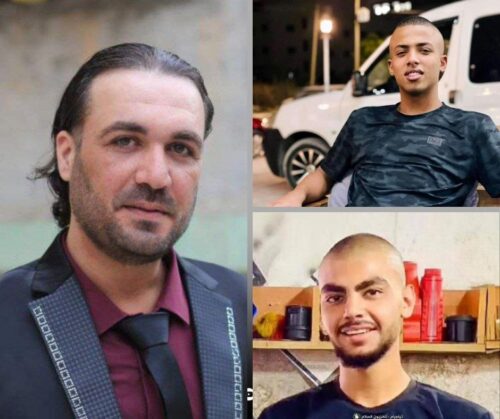
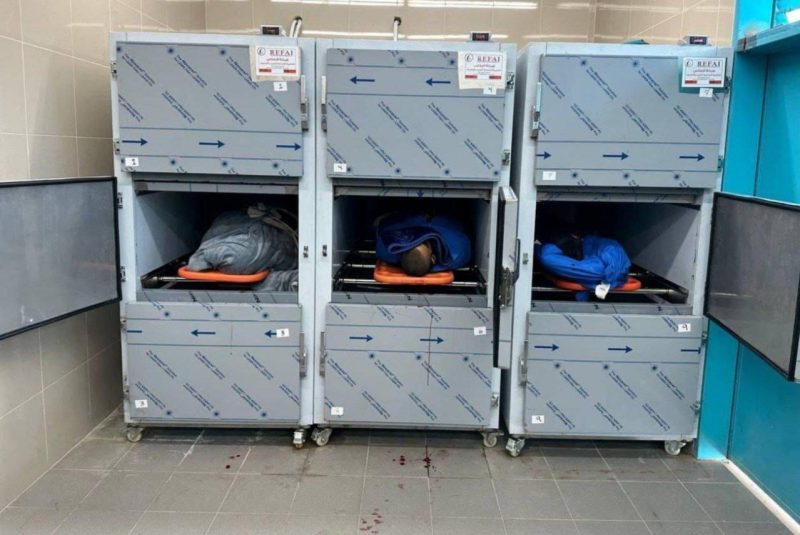
Israeli forces killed three Palestinian citizens, before dawn on Thursday, after soldiers bombed a home in the Tulkarem refugee camp in the northwestern part of the West Bank.
Media sources identified the three slain young men as Muawiyah Khaled Hajj Ahmad, 19, Wassim Saber Sobhi Anbar, 20, and Emad Taiser Yousef Shreim, 38.
Sources added that the army invaded the city of Tulkarem and besieged the Tulkarem refugee camp, before dawn on Thursday, accompanied by military bulldozers, sparking protests.
The army positioned sharpshooters on rooftops of citizen’s homes, while armed resistance fighters exchanged fire with the attacking army, before reinforcements arrived.
Soldiers fired light bombs into the sky, while reconnaissance drones circled the sky above and the sound of explosions were heard.
Military bulldozers caused destruction to streets, infrastructure and private property in the camp.
Later media sources said that occupation forces stormed the Iktaba suburb, east of the city, besieged a home, and fired an “Energa” anti-tank grenade at the home, causing severe destruction to the home and a vehicle; no injuries were reported.
Israeli forces have now killed 640 Palestinians, including 147 children, and injured 5,400 in the occupied West Bank since the beginning of the military onslaught against the Gaza Strip on October 7, 2023.
In the Gaza Strip, the Israeli military has killed 40,223 Palestinians, the majority of whom are women and children, and injured 92,981 since the beginning of its military onslaught on October 7, 2023, while thousands remain under the rubble.
A strategic shift: Will Palestinian groups return to ‘martyrdom attacks’ inside Israel?
By Ramzy Baroud | MEMO | August 20, 2024
Yesterday, the Palestinian Resistance Movement Hamas and the Palestinian Islamic Jihad warned Israel that they plan to return to ‘martyrdom attacks’ inside Israel.
“The Brigades affirm that martyrdom operations within the occupied territories will return to the forefront as long as the massacres by the occupation, the displacement of civilians and the assassination policy continue,” a joint statement by Al-Qassam Brigades and Al-Quds Brigades said.
Palestinian groups have refrained from using martyrdom attacks, or suicide bombings, as it is often called by mainstream media, as a central piece of their ongoing resistance against Israel.
The warning followed an explosion that rocked Tel Aviv on the evening of Sunday.
Initially, Israeli media conveyed a degree of confusion regarding what had transpired in the Israeli capital, before an Israeli police commander announced that there was a 99 per cent chance that the operation was “an attempted terror attack”.
Later, Israel said that the attacker may have originated from the Nablus area of the southern West Bank.
The attack and the announcement of responsibility by Hamas and the Islamic Jihad the following day are significant and could become the beginning of a strategic shift by Palestinians in their ongoing war against the Israeli occupation.
But why would Palestinians return to such operations?
Since 7 October, the Israeli war on Gaza has expanded to reach other domains, thus complicating the mission of the Israeli army, which has been overstretched to fight on several fronts.
While the war in Gaza itself remains the main battlefield, other war fronts began escalating with time, mainly the border war between the Lebanese Resistance Movement, Hezbollah, and the Israeli occupation army.
To prevent the West Bank from turning into a major front for the resistance, the Israeli army began carrying out bloody, but focused, attacks on Palestinian resistance brigades, which operate mostly in the northern West Bank.
Geographically isolated and operating mostly in small groups, Palestinian fighters underwent a bloody, disproportionate war against the Israeli army.
The Israeli occupation army’s confidence was buoyed by the fact that security forces and intelligence belonging to the Palestinian Authority openly cooperated with the Israeli military in their attempt to crush the resistance.
The degree of cooperation reached its zenith on 26 July, when PA security forces besieged the 26-year-old leader of the Tulkarm Brigades, and other fighters, in the Thabet Thabet Hospital in Tulkarm.
If it were not for hundreds of ordinary Palestinians who rushed to the hospital to rescue their youth, the fighters would have been apprehended, if not even worse.
But Israel’s military campaign to crush the resistance in the West Bank was hardly a success. According to Al Jazeera, 100 Palestinian operations were carried out in the last month alone.
Meanwhile, the resistance in Gaza has proved its durability, moving from the stage of defence to that of counter-attacks on more than one occasion. The operation by Hamas’s Al-Qassam fighters targeting Israeli forces inside the fortified Netzarim area in central Gaza, on Sunday, was a case in point.
These developments have been taking place in the larger context of the widening confrontation between Hezbollah and Israel, with the former extending its pinpointed operations to reach Nahariya, among other areas, in northern Israel.
Despite all the setbacks, Israeli Prime Minister Benjamin Netanyahu has managed to reverse his dwindling numbers among potential voters. According to a poll conducted by the Israeli newspaper Maariv on 9 August, the Likud Party, led by Netanyahu, would be the largest party in the Knesset if elections were held today. This is the first time such results have been seen since 7 October.
A combination of factors led to the resurgence of Netanyahu in opinion polls.
First, the Israeli leader’s main rival, Benny Gantz has failed to galvanize on the anti-Netanyahu and anti-government popular sentiments starting on 7 October.
Second, Netanyahu’s ability to guarantee US support for his aggressive regional policies helped reassure the Israeli public.
Third, the direct involvement of the US-British and other western navies in confronting Yemen’s Ansarallah – Houthis – in the Red Sea has partly downgraded the geopolitical threat of the Yemeni solidarity with the Palestinians.
Fourth, the daring assassination of top Hamas political leader Ismail Haniyeh in Tehran on 31 July, and the assassination of leading Hezbollah commander Fuad Shukr the day before, allowed Netanyahu to sell the idea, however temporary, that Israel has regained its so-called ‘deterrence’.
And, finally, despite the interception of occasional missiles beyond the Gaza Envelope or Israel’s northmost regions, Israeli society in the central areas of the country has learned to adapt to the new reality of the war.
While the Israeli army is losing an unprecedented number of soldiers and equipment on multiple fronts, not all Israelis are experiencing that loss in their everyday lives.
The opposite is true for Palestinians and Lebanese.
For the former, the genocide in Gaza has turned into a daily reality, and the Israeli occupation forces’s war on the West Bank has proved to be the most violent since the Second Intifada or Uprising of 2002.
Meanwhile, in Lebanon, Israel continues to target civilian areas as a matter of course, thus constantly challenging the rules of engagement that have governed the relationship between the Israeli army and the Lebanese resistance for years.
The new status quo may have assured Netanyahu that he might be able to carry on with his war in Gaza, reject any reasonable ceasefire proposal and maintain low-intensity warfare with Lebanon.
Netanyahu would also like to see the US-British war on Yemen escalate into an all-out war against Iran.
The Palestinian warning of their intention to return to striking deep inside Israel is meant to disturb Netanyahu’s calculations.
By denying Israelis any sense of security in major cities inside Israel, the Israeli public could, once more, turn against Netanyahu for failing to deliver on any of his lofty promises.
It remains unclear whether Sunday’s truck bombing was the exception or the start of a new norm. Either way, Netanyahu and his security apparatus must be aware of how such a move could prove equally costly to all of Israel’s losing wars, on all fronts.
Israeli forces run over, kill 15-year-old Palestinian boy injured in drone strike

Israeli forces killed 15-year-old Khatab Majdi Asad Abu Badawiya in Jenin on August 6, 2024. (Photo: Courtesy of the Abu Badawiya family)
Defense for Children International – Palestine | August 8, 2024
Ramallah, August 8, 2024—Israeli forces killed a 15-year-old Palestinian boy in Jenin during a military incursion on Tuesday morning.
Khatab Majdi Asad Abu Badawiya, 15, was struck by shrapnel from an Israeli drone-fired missile around 9:40 a.m. on August 6 during an Israeli military incursion into the eastern neighborhood of Jenin in the northern occupied West Bank, according to documentation collected by Defense for Children International – Palestine. Khatab allegedly threw a homemade explosive device toward a heavily armored Israeli military vehicle prior to the drone strike. The strike, which injured Khatab, killed three armed Palestinian men. After Khatab was injured in the strike, an ambulance attempted to reach him but Israeli soldiers in the military vehicle fired live ammunition toward the paramedics. The military vehicle then dragged a civilian vehicle parked nearby and attempted to push it onto the child lying on the ground. After failing to do so, the military vehicle advanced towards Khatab, who was still alive, and drove one of its wheels onto his abdomen. The military vehicle stayed near the bodies of the child and the other young men for about 40 minutes before withdrawing.
“Israeli forces continue showing contempt for Palestinian children’s lives as they carry out aerial attacks in densely populated civilian areas like Jenin,” said Ayed Abu Eqtaish, accountability program director at DCIP. “Israeli forces not only injured Khatab in a drone strike, but they shot at paramedics trying to provide aid, then parked their military vehicle on top of his torso while he bled out in a shocking act of cruelty. Countries need to enact an immediate arms embargo and sanctions on Israel to force accountability for Israeli forces who have been allowed to brutally kill Palestinian children with impunity for decades.”
Palestinian residents demolished a wall so paramedics could walk to the scene, since Israeli forces targeted the ambulance with live ammunition. Paramedics transported Khatab and the three Palestinian men to the ambulance, which was parked about 200 meters (656 feet) away. Doctors pronounced all four of them dead on arrival at Jenin Governmental Hospital.
Israeli forces stormed the center of Jenin on August 5 around 3:30 p.m. Soldiers raided the Gulf Exchange Company on Abu Bakr Street. During the incursion into the city center, Israeli military vehicles deliberately smashed many vehicles by crashing into them. The soldiers also fired heavily and indiscriminately while the area was crowded with vendors and shoppers.
Palestinian gunmen confronted the Israeli soldiers. During these confrontations, Israeli military reinforcements, accompanied by large military bulldozers, arrived in Jenin city and refugee camp. The bulldozers began destroying infrastructure, demolishing walls of several homes, and smashing and burning vendor stalls in the Jenin market.
After Israeli forces withdrew from Jenin, they entered the Palestinian village of Kafr Qud to the west and besieged a house, killing two young men and confiscating their bodies. Three others were injured in the besiegement and were subsequently arrested.
Israeli forces and settlers have killed 62 Palestinian children in the occupied West Bank in 2024, including two United States citizens, according to documentation collected by DCIP.
143 Palestinian children have been killed in the occupied West Bank since October 7, according to documentation collected by DCIP, when the Israeli military began a full-scale military offensive on the Gaza Strip.
In 2023, Israeli forces and settlers killed at least 121 Palestinian children in the occupied West Bank, according to documentation collected by DCIP. Israeli forces and settlers shot and killed 103 Palestinian children with live ammunition, 13 Palestinian children were killed in drone strikes, four Palestinian children were killed by missiles fired from a U.S.-sourced Apache attack helicopter, and one child was killed in an Israeli warplane airstrike.
Under international law, intentional lethal force is only justified in circumstances where a direct threat to life or of serious injury is present. However, investigations and evidence collected by DCIP regularly suggest that Israeli forces use lethal force against Palestinian children in circumstances that may amount to extrajudicial or wilful killings.
Featured Video
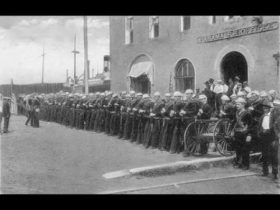
US Marines Seized Panama in 1903
or go to
Aletho News Archives – Video-Images
From the Archives
Precedents for Pizzagate
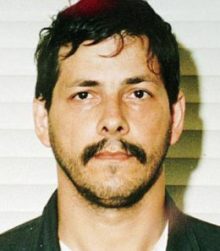
Marc Dutroux, Belgian pedophile, sadist, and serial killer with friends in high places
By Aedon Cassiel | Counter – Currents | December 23, 2016
To reiterate a point that should be clear to the more astute reader, my goal in this series (part 1, part 2) has not been to defend “Pizzagate” as such. My goal has been to defend the people who want to investigate it against specific accusations levied against them by people who think Pizzagate has revealed no intriguing information at all—for a specific reason, which I will be honing in and focusing on much more directly in this closing entry.
Whereas the mainstream critics of Pizzagate would have you believe that the dividing line is between paranoid conspiracy theorist followers of “fake news” and level-headed people who follow trustworthy news sources and rely on cold, hard reason to determine the truth, my goal has been to show that—whatever is or is not happening with Pizzagate itself—this framing of the issue is arrogant, insulting, and the product of extremely narrow tunnel vision. … continue
Blog Roll
 Aletho News
- Israeli firms transform cars into intelligence devices: Reports
- Zionist-controlled companies to surveil British citizens
- THE CHILDREN GAMBIT
- A note on comment posting at Alethonews
- Trump stalls over Iran strike plan, Iran holds all the aces
- Zelensky’s Ceasefire for Elections is Strategic Gambit, Not Democratic Move
- US and Dutch pilots flying F-16s for Ukraine – Western media
- West’s Claims of Non-Involvement in Ukraine Conflict ‘Epitome of Hypocrisy’ – Expert
- Putin aide urges retaliation to ‘Western piracy’
- The Depth Charge in the Womb
- If Americans Knew
- Israel’s Favorite American President
- Israel’s “Yellow Line” Is a Death Trap for Palestinians. We Drove Into It.
- Why Israel’s expanding occupation in Syria presents a critical legal test
- Gaza is not a natural disaster. It is the victim of genocide enabled by global inaction
- Netanyahu’s plan to “end” US aid to Israel is to give even more money under a different name
- Israel ceased firing on Gaza for just 15 days of the “ceasefire” – Not a ceasefire Day 130
- In Gaza, “rats run over our faces” – Not a ceasefire Day 129
- Israel-backed border guards, GHF-linked aid – Not a ceasefire Day 128
- Israel battles Palestinian right of return, one Palestinian at a time – Not a ceasefire Day 127
- Noor’s short life of unimaginable suffering
- No Tricks Zone
- New Study: A 4°C Warmer Beaufort Sea Had ‘No Sea Ice’ 11,700 – 8200 Years Ago
- Unfudging The Data: Dutch Meteorological Institute Reinstates Early 20th Centruy Heat Waves It Had Erased Earlier
- German Gas Crisis…Chancellor Merz Allegedly Bans Gas Debate Ahead of Elections!
- Pollen Reconstructions Show The Last Glacial’s Warming Events Were Global, 10x Greater Than Modern
- Germany’s Natural Gas Storage Level Dwindles To Just 28%… Increasingly Critical
- New Study Rebuts The Assumption That Anthropogenic CO2 Molecules Have ‘Special’ Properties
- Climate Scientist Who Predicted End Of “Heavy Frost And Snow” Now Refuses Media Inquiries
- Polar Bear Numbers Rising And Health Improving In Areas With The Most Rapid Sea Ice Decline
- One Reason Only For Germany’s Heating Gas Crisis: Its Hardcore-Dumbass Energy Policy
- 130 Years Later: The CO2 Greenhouse Effect Is Still Only An Imaginary-World Thought Experiment
 Aletho News