Israeli settler strikes 9-year old girl with his car, leaves her in ditch with head injuries
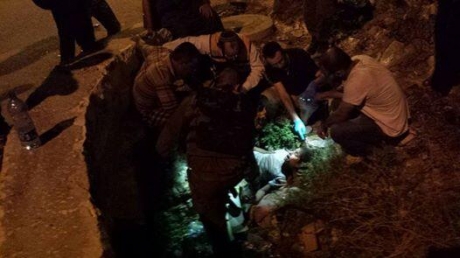
Child hit by settler car (image by Nasser @PAL_1948 )
IMEMC | July 1, 2014
A child was seriously wounded in the head when an Israeli settler ran her down Monday night as Israeli settlers marched through the city of Hebron demanding vengeance.
Sanabel Attous, 9, from Jab’a village southwest of Bethlehem was hit by an Israeli car which witnesses say deliberately ran her down.
She was taken to the Bethlehem Arab Society Hospital suffering serious fractures and bruises in the head, face and abdomen.
Eyewitnesses said the settler struck her intentionally, and left her in a ditch, on the side of the road without providing assistance to the wounded child, and left the scene.
Israeli troops closed all entrances to the city of Hebron and the village of Halhoul, near Hebron, where the bodies of three settlers were found on Monday.
Israeli extremists attacked two Palestinians in Jerusalem. A taxi driver was sprayed with pepper spray, and a second man was beaten by Israeli settlers in West Jerusalem.
Settlers across the West Bank have stepped up attacks on Palestinian civilians over the past 18 days, since 3 Israeli settlers disappeared.
When the bodies of the three settlers were found on Monday, Israeli settler leaders and Israeli government officials vowed revenge against the Palestinian people and particularly the Hamas party, though there has been no evidence linking the deaths of the three settlers to Hamas.
One former Israeli Knesset (Parliament) member posted a video Monday called Palestinian children “little terrorists”, and called for “Death to the enemy, evacuation, and wiping off of [their] smile”, according to a translation by the Electronic Intifada.
EI also quoted Tzachi Hanegbi, a former cabinet minister from the ruling Likud party, as saying, “I don’t know how many Hamas leaders will remain alive after tonight.”
Israeli forces blow up homes of Palestinian suspects’ families
Ma’an – 01/07/2014
HEBRON – Israeli forces in Hebron late Monday blew up the homes of two Palestinians Israel says are prime suspects in the kidnapping and killing of three teens who were found dead earlier that evening, witnesses said.
The two houses, which are both located in the same neighborhood in northwest Hebron, belong to the families of Marwan al-Qawasmeh, 29, and Amer Abu Eisha, 33.
After Israeli forces in Halhul north of Hebron found three bodies presumed to be those of three Israeli teens who went missing on June 12, soldiers surrounded the houses, forcibly removed the families, and declared the area a closed military zone, locals said.
Witnesses said the homes were then blown up by explosives.
Locals had told Ma’an earlier that soldiers were preparing to demolish the homes.
An Israeli army spokeswoman said that the homes “were not demolished,” but said Israeli forces searched the houses late Monday.
Military sources told Ma’an that soldiers used explosives to break down the doors of the houses, and that a fire caused by the one of the explosions “got a little out of control.”
Video footage, not independently verified by Ma’an, emerged showing an explosion in the Abu Eisha home as Israeli forces were stationed nearby.
Meanwhile, Palestinians clashed with Israeli forces, hurling empty bottles and stones at soldiers, who fired tear gas and stun grenades, locals said.
Entrances to Halhul and Hebron were shut down, witnesses added.
Israeli forces have killed six Palestinians in the West Bank military operation that followed the disappearance of three Israeli teenagers from the Gush Etzion settlement on June 12.
The Israeli army said on Thursday that it was still searching for Abu Eisha and al-Qawasmeh.
Abu Eisha’s family has denied the allegations.
Kafka on duty at Allenby Bridge Checkpoint
By Yossi Gurvitz | Yesh Din | June 30, 2014
About two weeks ago, we filed a petition to the HCJ, which is unusual even given the cases we regularly deal with; it deals with Kafkaesque behavior by the security forces. We are petitioning on behalf of Akhlas Sayel Mustafa A-Shatiyeh and her sister, Suhad Sayel Mustafa A-Shatiye.
The story of the sisters is unique. Akhlas was born blind, and their father – Sayel Jabara A-Shatiye – was killed in 2004 by a settler, Yehoshua Elizur, a resident of the settlement of Itamar. He was convicted of homicide, but – lo and behold – managed to escape Israel before he began serving his sentence.
Despite this background, Akhlas managed to finish a master’s degree in English and literature, and served as a counselor for female students suffering from disabilities, in the University of Beir Zeit. Presently she works as an investigator for the Stars of Hope Society, a Palestinian NGO promoting the rights of disabled women. She is often sent on behalf of the Society to conferences abroad; her sister Suhad accompanies her and aids her.
Last December, the sisters arrived at Allenby Checkpoint, after Akhlas represented the Society at a UN conference promoting the political rights of disabled women in Jordan. Arriving at the checkpoint, they found themselves under interrogation, which lasted eight hours. At the end of it, the army confiscated all of the money held by the sisters, refusing to leave them even enough money to return home, forcing them to spend the night outside, in the cold. In total, the army seized a sum of some 5,000 NIS. The sisters presented the soldiers with receipts, showing some of the money was travel expenditure they received, and that the rest was given to them by their mother in order to purchase gifts in Amman; but the army claims the money is of “an unallowed association,” and issued a confiscation order.
And here another problem came up. Until recently, a Palestinian whose property was confiscated by our troops, could turn to the military courts in the West Bank and demand it back. Since 2013, Amendment nr. 36 to the Order Regarding Security Provisions is in force, and it reads: “The decision of the Military Commander, according to Article 61, or the decision of the Military Commander to seize, sell or confiscate property, according to the Defense (Emergency) Regulations – 1945, cannot be appealed before the military court, and is final.” In other words, if the army decides to seize your property, there’s nothing you can do.
Hence, the A-Shatiye sisters had no choice but to petition the HCJ, demanding inter alia the cancellation of the draconian Amendment nr. 36. It’s important to note that in many cases, the cost of an appeal to the HCJ is greater than that of the confiscated sum, so this route is also Kafkaesque; you have to lose money to get yours. Furthermore, an appeal to the HCJ requires either an Israeli advocate, or an entrance permit into Israel. This is one more factor which may cause the prospective claimant to give up his property, where formerly he might just have appealed to the military court. Our petition against Amendment nr. 36, it should be mentioned, follows two previous petitions on this issue by the Center for the Defense of the Individual, also demanding its repeal.
When the A-Shatiye sisters tried to understand why their money was confiscated, the Legal Advisor to the territories of Judea and Samaria (LAJS) replied that it did so “in light of reliable, double-checked intelligence presented to him, which shows that these are funds belonging to an association that is not allowed,” and hence the confiscation was appropriate. This information, needless to say, was not presented to the A-Shatiye sisters.
As our petition states, “it was also noted that even when the petitioners were allegedly given the right to present their arguments in writing before the bureau of the LAJS, they were forced to do so without having any knowledge of what charges were alleged against them, and therefore could not defend themselves. The petitioners were not informed of any relevant information on which the intent to confiscate was based, a fact that fatally harmed their right to argue, and in fact, to this day they do not know why the respondent reached the conclusion that their money belongs to an unallowed association. […] the petitioners were asked to defend themselves against vague accusations, the nature of which was not detailed, and based on documents they were not allowed to review.”
If the government of Israel wants to confiscate the A-Shatiye sisters’ money, it should act as a civilized country, not as the heir to Kafka’s court: let it stand in open court and present its evidence. A person’s right to know what crime he is being punished for, and his right to defend himself against an accusation, is a fundamental right, without which you cannot speak of a trial, but at most of a kangaroo court. The same goes for Amendment nr. 36, which allows the Military Commander to confiscate property without being accountable to anyone.
As a human rights organization, we find ourselves in an unusual position: petitioning the Israeli Supreme Court so it might restore to the military courts, which are not known for doing justice to say the least, authorities stripped away from them. And yet, this new situation is considerably worse than its predecessor, and leaves us no choice.
Israeli forces invade Awarta, ransacking teacher’s home
International Solidarity Movement | June 28, 2014
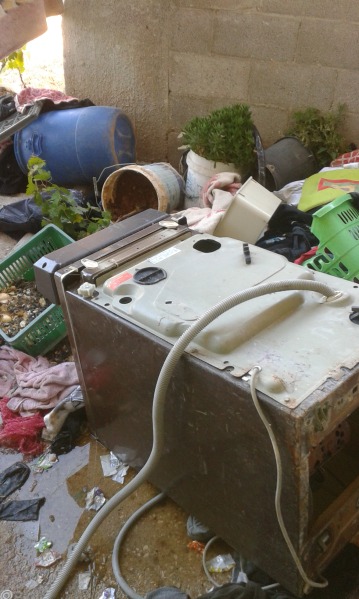 Awarta, Occupied Palestine – During the early morning hours of June 26, the Israeli army invaded the village of Awarta, 8 km south of Nablus in the northern part of the West Bank. According to witnesses, between 150 and 200 soldiers entered Awarta just after midnight and raided approximately 300 houses before leaving several hours later.
Some residents mentioned that the soldiers knocked on their doors and asked for identification, however this was not the case for Mahmud Awad, a local schoolteacher, and his family.
At midnight approximately 15 soldiers entered Awad’s home and demanded that Awad show them the location of his guns. Were he not to obey, he could be confident that the house would be destroyed. Awad replied that Israeli soldiers had already been to his house many times and had never found anything. He had no guns, he assured them.
The soldiers blindfolded and handcuffed Awad’s 20-year-old son and took him outside for an interrogation that lasted three hours. They herded the rest of the family, which included an eight-month old baby and several other children, into the living room. Again they asked Awad about his guns.
“Watch what we will do if you don’t give them to us!” An Israeli soldier yelled.
The children listened in terror as the soldiers proceeded to ransack the house. They ripped apart sofas and chairs, threw the contents of shelves on the floor, knocked over electrical appliances, destroyed two computers, and slashed the family’s water tank on the roof. Awad begged the soldiers to allow the baby a drink, but this request was denied.
Sometime during the night, Awad’s 13-year-old son was taken outside the living room and interrogated for half an hour. A soldier held his rifle to the boy’s face and demanded the location of the guns. He held a piece of cloth (chloroform, a family member assumed) to the boy’s mouth until he became dizzy.
The soldiers finished searching the house, having found no weapons. They released both of Awad’s sons and left the house at approximately 4 a.m.
‘We want to work without being treated as slaves’

By Tom Anderson and Therezia Cooper | Corporate Watch | June 27, 2014
During January 2013, Corporate Watch conducted interviews with Palestinians who work in the illegal Israeli settlements in the Jordan Valley. Part one to three of our findings can be read here, here and here.
We met 44 year old Rashid* and 38 year old Zaid* in their hometown of Tammoun in the northern West Bank. They both work in the illegal Israeli settlement of Beqa’ot. A colony with 171 residents situated close to the Palestinian community of Al Hadidya in the Jordan Valley.

Palestinian bedouin close to Beqa’ot are prevented from building permanent structures by the Israeli military, photo taken by Corporate Watch in February 2013
Tammoun is situated just outside the Jordan Valley. Like thousands of other Palestinian workers Zaid and Rashid travel into the Jordan Valley in search of work on a daily basis. To cross into the valley they have to pass through the Israeli military checkpoint at Tayasir or Al Hamra.
Rashid has worked in Beqa’ot since the early ’90s whereas Zaid worked in Israel until 5 years ago. Zaid tells us: “Now it is impossible for me to get a permit to work outside the West Bank.”
For Israeli companies, sourcing their goods from the settlements in the Jordan Valley allows them to circumvent workers rights and health and safety regulations. According to Zaid: “Inside Israel the workers have contracts and the conditions are better. This is because in Israel there are some controls on companies, unlike in the West Bank.”
Both men work all year round except for September-November when there is no work available. They have no contracts and tell us that none of their workmates do either. Their job is to plant grapes and tend to the vines, pruning them and spraying them with fertilisers and chemicals. At harvest time they cut and collect the grapes.

Grapevines in the settlement of Beqa’ot, photo taken by Corporate Watch, February 2013
Zaid and Rashid both work in the fields outside the boundaries of Beqa’ot. They do not have a permit to enter the settlement itself.
Paid below the minimum wage
Palestinian workers in Israeli settlements have been entitled to the Israeli minimum wage since an Israeli Supreme Court ruling in 2007 (see here). In 2010 Corporate Watch conducted over 40 interviews with settlement workers showing that Palestinians are consistently paid as little as half the minimum wage. These conditions remained largely unchanged when we returned in 2014.
The current hourly minimum wage is 23.12, NIS (New Israeli Shekels),the equivalent of 184.96 NIS for an eight hour working day, having risen from 20.70 NIS in 2009. However, for Palestinian workers on Israeli settlements in the Jordan Valley these conditions seem an impossible dream.
Zaid and Rashid are employed directly by the settlers in Beqa’ot and speak to them directly to arrange their work. Both get paid 82 New Israeli Shekels (NIS), 18 of which goes towards daily transport.
They have no insurance provided by their employer. Rashid explains: “Last year one of the workers died, but the settlers did not help his family at all.
The men do not receive any paid holiday, even for religious holidays. This is despite the fact that an Israeli government website advises that workers are entitled to 14 days paid holiday and must receive a written contract and payslips from their employer (see here).
Both men are members of the General Palestinian Workers Union (GPWU). However, they are unable to represent workers in Beqa’ot or negotiate with their bosses. According to Rashid: “We organise trainings for agricultural workers but we are not recognised by the settlers, we do not receive any representation from Histradrut”.
Histradrut is the Israeli trade union organisation. Many campaigners for boycott, divestment and sanctions against Israeli apartheid have called for a boycott of the Histradrut because of its failure to represent Palestinian workers and its overt support of Israeli state policies. For example, in 2010 the British University and College Union broke ties with the Histradrut; a UCU spokesperson said the Histradrut, “supported the Israeli assault on civilians in Gaza” and “did not deserve the name of a trade union”.
Companies sourcing produce from Beqa’ot

Mehadrin Tnuport boxes ready to be packed with grapes, photo taken by Corporate Watch in February 2013

Carmel Agrexco boxes ready to be packed with grapes, photo taken by Corporate Watch in February 2013

STM boxes ready to be packed with grapes, photo taken by Corporate Watch in February 2013

Export label on a box in Beqa’ot statying that these grapes are shipped by Carmel agrexco, Photo taken in Febuary 2013 by Corporate Watch
Rashid tells us: “We label the grapes ‘Made in the Jordan Valley’ and mark them with the name and phone number of the Israeli settler.
“Each of the settler has his own packing house. When we harvest the grapes they are taken first of all to packing houses in Beqa’ot owned by individual settler, then transported to a central refrigeration unit owned by the Moshav [a Hebrew word for a cooperative farm]. Then a refrigeration truck takes them to be exported.”
The men tell us that the majority of the grapes they harvest are exported through Mehadrin.
Corporate Watch visited Beqa’Ot in February 2013 and photographed several packing houses displaying Mehadrin signage. Israeli company Mehadrin Tnuport Export (MTEX) is a part of the huge Mehadrin Group which owns a 50% of STM Agricultural Exports Ltd – another Israeli company dealing in vegetables. MTEX export around 70% of all their produce to outside Israel and are one of the largest suppliers for the Jaffa brand world wide. Sainsburys confirmed to Corporate Watch in August 2013 that the supermarket sourced fresh vegetables from Mehadrin. Mehadrin is also certified to supply fresh produce to Tesco (see here).
Corporate Watch also photographed boxes and export labels for Carmel Agrexco in Beqa’ot. Carmel Agrexco was the Israeli state owned fresh produce export company. In 2011 the company went into liquidation, due in part to the international boycott movement. The brand has since been bought by Gideon Bickel of Israeli firm Bickel Flowers and has been fighting to regain lost contracts.
Working for poverty wages on land stolen from their families
Rashid and Zaid refer to Beqa’ot by its Palestinian name, Libqya. Rashid tells us: “Before the occupation in 1967 Libqya was owned by Palestinians who used it for planting crops and raising animals. All of the families around here owned land in Libqya.
“I remember when my mother passed Libqya when I was young she told us how she used to play there with her brothers and sisters. Our family owned 70 dunums of land there.
“This reality is too painful. When I was older I tried to reach the land my mother told me about. But a settler told me I was forbidden to go there.”
‘We will get back our land’
Both men are supportive of the call for a boycott of Israeli agricultural companies. When it was pointed out that if the boycott was successful then their employers would not be able to pay them a wage any longer Zaid responded: “We support the boycott even if we lose our work. We might lose our jobs but we will get back our land. We will be able to work without being treated as slaves.”
* Names have been changed at the authors’ discretion
Family of kidnap suspect deny Israeli accusations
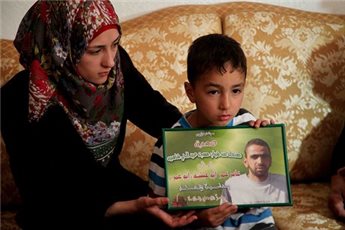
Ma’an – 27/06/2014
HEBRON – The father of one of the suspects named by Israel as being behind the disappearance of three Israeli youths has denied that his son was involved in the suspected kidnapping.
On Thursday, Israel named Marwan al-Qawasmeh, 29, and Amer Abu Eisha, 33, as the two main suspects behind the kidnapping of three Israeli youths on June 12.
Israel’s Shin Bet said they had been jailed in the past for taking part in “terrorist activity on behalf of Hamas.”
Speaking to Ma’an, Abu Eisha’s father denied the allegations and said the family is worried that he has been detained and is being tortured by Israeli security forces.
“The occupation kidnapped my son Amer and I’m afraid they will kill him and say that they killed the terrorist and saved the settlers,” Omar Abu Eisha said.
“I have not yet grasped that Amer and Marwan could kidnap three settlers from the most dangerous security square in Etzion. These are Israeli fabrications, whose goal could be is to strike Hamas in the West Bank and strike the national reconciliation,” he added.
Omar Abu Eisha said that he was with his son Amer at a social event the night the three Israelis went missing, but said that later on in the night he could not find his son and he has been missing ever since.
“He told his wife that he might be away for two days for work in al-Eizariya, but he has not called and I am certain that Israel has kidnapped and hid him,” he said.
Omar Abu Eisha told Ma’an that his son was “working hard and saving money” to build a new house.
The family of Marwan al-Qawasmeh refused to be interviewed or comment on the Israeli accusations.
Eisha was first arrested in Nov. 2005 and was held without trial or charge by Israeli forces until June 2006. He was re-arrested in April 2007 for a short period of time.
Eisha’s brother was shot dead by Israeli forces in Nov. 2005 while ostensibly trying to “throw an explosive” at them, and his father had been arrested by Israel multiple times.
After the Israeli teens disappeared while hitchhiking in the West Bank, the army launched a vast hunt for them focusing on the Hebron area.
Israeli forces initially accused Hamas of the kidnapping, which it vigorously denied, and authorities vowed to “crush” the Palestinian political and militant group.
More than 120 Palestinians have been injured in the military operation, which Israel dubbed “Brother’s Keeper,” and more than 1,350 homes and offices, including numerous universities, have been raided.
The Palestinian Prisoner’s Society said on Thursday that 566 Palestinians have been detained in the campaign, including 12 members of parliament.
Hamas: Israeli announcement of names of kidnappers an attempt to cover its failure
MEMO | June 27, 2014
Hamas has described Israel’s announcement of the names of some of those it accuses of kidnapping the three settlers in Hebron as “an attempt to cover up its utter failure in finding them”, Anadolu news agency reported a Hamas official as saying.
Spokesman for the movement Sami Abu-Zuhri said yesterday: “The Israeli announcement of some of the names it accuses of implementing the Hebron operation reflects its continued state of confusion and an attempt to cover up its utter failure in finding them.”
The Israeli General Security Service, Shin Bet accused two Hamas activists from Hebron, in the south of the West Bank, “of kidnapping three Israeli settlers two weeks ago”.
An Israeli military spokeswoman confirmed reports that troops were seeking Marwan Kawasme and Amar Abu Aysha, members of Hamas in Hebron, both of whom have served time in Israeli prisons in the past.
Israel’s Prime Minister, Benjamin Netanyahu said in a statement: “A short time after the kidnapping, I said that those who perpetrated this activity were terrorists of Hamas, and indeed today the security services of Israel published the names of two of the perpetrators of this heinous crime.”
He added: “I now expected President Abbas, who said important things in Saudi Arabia, to stand by those words and to break his pact with the Hamas terrorist organization that kidnaps children and calls for the destruction of Israel.”
Since the disappearance of three settlers from the south of the West Bank, the Israeli army has arrested nearly 571 Palestinians, mostly leaders and activists in the Hamas movement.
No Palestinian party has claimed responsibility for the abduction, but Netanyahu held Hamas responsible, an accusation the movement has rejected, without confirming or denying the charges.
Israeli forces invade Madama
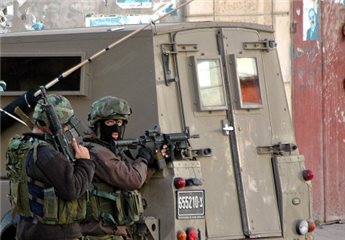
International Solidarity Movement | June 25, 2014
Madama, Occupied Palestine – At 12:30 a.m. on June 22, 2014, approximately 50 Israeli soldiers invaded the village of Madama.
Madama, which is located 10 km southwest of Nablus, in the northern part of the West Bank, has approximately 2000 residents. The soldiers raided close to 100 homes and took 80 men to the local elementary school, where they held them for several hours. The men were blindfolded, and their arms were tied behind their backs with handcuffs.
The soldiers released all of the men at 5 a.m.
At 1:00 a.m., the soldiers invaded the house of Nizar Abdullah Sadaq Ziyaada in Madama. They asked Ziyaada about the whereabouts of his money and proceeded to ransack the house. They drilled holes into the walls and threatened to destroy his home. They found a total of roughly 200,000 shekels underneath a cupboard and in various hiding places throughout the house. Finally, the soldiers took all of the money, two laptops, and several mobile phones before leaving.
The reasons for the theft of Ziyaada’s money are unclear.
Ziyaada had worked in Israel until the year 2000 and kept all of his earnings from that time in his house in Madama. It is likely that the Israelis knew about this money, as they asked him about it as soon as they entered his house.
Hany Ziyaada’s house was invaded by 15 Israeli soldiers the same night at 1 a.m. They broke down the door, but Hany asked them to wait a few minutes, so that the women of the house could get dressed. The soldiers swore at him, and he responded in kind. They proceeded to kick him in the back and stomach for several minutes and dragged him to their jeep, where they continued to beat him. They blindfolded and handcuffed him and took him to the school, where they held him by the throat, forced his arms back and drove their knees into his back. At 4 a.m. they allowed him to go home.
“Why do they not respect human rights?,” Hany asked an ISM activist. “I’m a policeman, and I know about human rights. Why don’t they?”
Palestinian prisoners assaulted before being detained

Ma’an – 24/06/2014
RAMALLAH – A Palestinian Prisoner’s Society lawyer reported Monday from Palestinian detainees at Etzion detention center that many of them were assaulted and beaten before they were detained.
Prisoner Faraj Ghaith, 57, told the lawyer that three settlers raided his house, assaulted him and his family before the Israeli police detained him and his two sons Ahmad and Omar.
Ghaith lives near the Israeli settlement of Kiryat Arbaa.
Jaclyn Fararjeh said that bruises were still clear on the prisoners’ bodies.
Prisoner Ashraf al-Jaaidi, 30, from Bethlehem, said that he threw up blood since he was detained, and that he was beaten with butts of the riffles when he was detained from his house in Duheisha refugee camp last Friday.
Farajeh highlighted that al-Jaaidi requested to be examined by a doctor but the prison service refused.
PPS’ lawyer Fararjeh visited prisoners Yasser Banat, Muhammad al-Hreini, Taha al-Hur, Bassam al-Natsheh, Ismail Jabariya, Muath Muhammad, Rabee Izriqat, Issa Shalaldeh, Yahya al-Huroub, Munthir al-Shurouf, Youssif Tartour, Tariq Gharib, Muhammad Hmeideh, Youssif Awawdeh and Murad Abu Muhye.
Jewish Settlers Attack Funeral Of Slain Palestinian In Ramallah

By Saed Bannoura | IMEMC & Agencies | June 22, 2014
Sunday evening a number of fanatic Israeli settlers attacked the funeral of a Palestinian, killed by the Israeli army in al-Biereh, near the central West Bank city of Ramallah, wounding one Palestinian.
The Palestinians were participating in the funeral procession of resident Mohammad at-Tareefi, 30, in Jabal at-Tawil neighborhood, when settlers of the Psagot illegitimate settlement opened fire on them, wounding one resident.
Several minutes later, dozens of soldiers arrived at the scene, and fired live ammunition at the residents, and several homes, in al-Biereh.
The Israeli military attack pushed dozens of residents to advance towards Psagot settlements, and hurl stones at it.
The soldiers chased the residents in Dahiat Jabal at-Tawil and al-Jinan area, while firing dozens of rounds of live ammunition, gas bombs, concussion grenades, and rubber-coated metal bullets.
The funeral procession started in front of the Palestine Medical Center in Ramallah, heading towards the home of the slain Palestinian in Betunia, before advancing towards the Jamal Abdul-Nasser Mosque in al-Biereh city.
At-Tareefy was shot by a live round in his chest during Sunday dawn clashes with Israeli soldiers invading Ramallah.
Israel’s military offensive in different parts of the occupied West Bank started ten days ago, following the disappearance of three Israeli settlers from Gush Etzion settlement, near Bethlehem.
Although Israel said Hamas is behind the “abduction”, Hamas denied the claim.
The ongoing Israeli military invasion led to the abduction of more than 400 Palestinians, many of them are children, and the soldiers invaded and searched more than 1000 areas in the West Bank.
The army alleged uncovering dozens of tunnels under Palestinian homes in the West Bank, and that the soldiers “located underground labs used for the production of explosives”.
The army said Israel had no prior information about the alleged labs and tunnels, but uncovered them during the extensive searches of homes and property.
In a Sunday report by the Palestinian Center for Human Rights, the center said Israeli soldiers shot and killed four Palestinians in the last ten days. Two of them were killed Sunday.
At least 38 Palestinians have been kidnapped by the Israeli army on Sunday, in different parts of the occupied West Bank.
The army also shot and wounded dozens of Palestinians in the ongoing offensive.
Israeli settlers shoot at Palestinians near Ramallah
Ma’an – 22/06/2014
RAMALLAH – Israeli settlers opened fire at Palestinians northwest of Ramallah late Sunday in the second such incident in hours, locals said.
Two settlers shot at nine men who were working in a quarry near the village of al-Mazraa al-Gharbiya, without causing injuries, the workers told Ma’an.
They said they noticed the settlers sneaking into the quarry and fled the scene as settlers opened fire with an automatic rifle.
After being chased for nearly two miles, the workers reached al-Mazraa al-Gharabiya unscathed, they told Ma’an.
The Palestinians identified themselves as Ismail al-Rajabi, 25, Momen Idriss, 24, Anas Idriss, 18, Yacoub Idriss, 20, Bilal Idriss, 20, Ahmad Jaber, 27, Wael al-Shalaldeh, 32, Mohammad Jaber, 23, and 10-year-old Abd al-Rahman Jaber.
An Israeli army spokeswoman did not immediately return calls seeking comment.
Earlier, a Ma’an reporter said that Israeli settlers opened fire at Palestinians in al-Bireh near Ramallah, injuring one as mourners gathered for the funeral of Muhammad Tarifi.
Tarifi was one of two Palestinians killed by Israeli forces early Sunday.
Featured Video

Chinese jet fuel and the myth of energy independence
or go to
Aletho News Archives – Video-Images
Book Review
Former Insiders Criticize Iran Policy as U.S. Hegemony
By GARETH PORTER | CounterPunch | February 27, 2013
“Going to Tehran” arguably represents the most important work on the subject of U.S.-Iran relations to be published thus far.
Flynt Leverett and Hillary Mann Leverett tackle not only U.S. policy toward Iran but the broader context of Middle East policy with a systematic analytical perspective informed by personal experience, as well as very extensive documentation.
More importantly, however, their exposé required a degree of courage that may be unparalleled in the writing of former U.S. national security officials about issues on which they worked. They have chosen not just to criticise U.S. policy toward Iran but to analyse that policy as a problem of U.S. hegemony. … continue
Blog Roll
 Aletho News
- What is fueling unrest across the EU?
- Why no power can undermine Iran’s eternal dominance over the Strait of Hormuz
- Is The War Against Iran Over?
- Iran war will leave long-term ‘scar’ on Wall Street, investors warn
- How Iran decimated US power projection in West Asia: Military lessons of 40-day war
- Iran’s report details US-Israeli war crimes in targeting schools, hospitals, livelihoods
- NATO’s Slow Fracture: How Trump’s Iran War Exposed the Instrument of Hegemony
- Chinese jet fuel and the myth of energy independence
- Ukraine Sea Drone Fired From Libya Hit Russian Tanker in Mediterranean
- IRGC: Iranian forces launched no attacks during ceasefire hours
- If Americans Knew
- Military aid to Israel emerges as the latest political litmus test for Democrats
- The only Palestinian children’s rights organization closes following years-long Israeli campaign against it
- ‘I Can’t Forget the Smell’: Lebanese Reel After Israel Kills Over 300 in Single Day
- DNC Shoots Down Resolutions Calling Out AIPAC and Limiting Arms to Israel
- TCN: Is Israel Blackmailing President Trump?
- Israel killed at least 303 Lebanese yesterday – who were they? Daily Update
- Amnesty: Urgent – Protect Lebanese civilians from brutal escalation in Israeli attacks
- Is The War Against Iran Over?
- Inside the Israeli army’s propaganda wing
- Hundreds of Gaza Amputees Stranded in Legal Limbo
- No Tricks Zone
- An Inconvenient Tree: Uncovered In Alps… Europe Much Warmer Than Today 6000 Years Ago
- New Study Reports A 60% Slowdown In Greenland’s Ice Loss Rate In The Last Decade
- Low Intensity Tornado Wrecks Major Solar Farm, Creating A Potential Toxic Dump
- New Study Finds Warming Saves Lives…Cold Temperatures 12 Times More Deadly Than Excess Heat
- German Science Blog Accuses PIK Climate Institute Of Hallucinating Climate Tipping Points
- Devastating Assessment Of Comirnaty Vaccine By Former Senior Pfizer Europe Toxicologist
- New Study: CO2 Is ‘Effectively Negligible’ As An Explanatory Climate Change Factor Since 2000
- Former Pfizer Toxicologist Dr. Helmut Sterz Tells Bundestag Hearing Pfizer Vaccine Should Have Never Been Approved
- Energy Expert: Germany’s Nuclear Phaseout Was A “500 Billion Euro Mistake”
- New Research: South Australia’s Mid-Holocene Sea Surface Temperatures Were 4°C Warmer Than Today
 Aletho News