Netanyahu: I did not commit to freeze settlement construction
MEMO | March 7, 2014
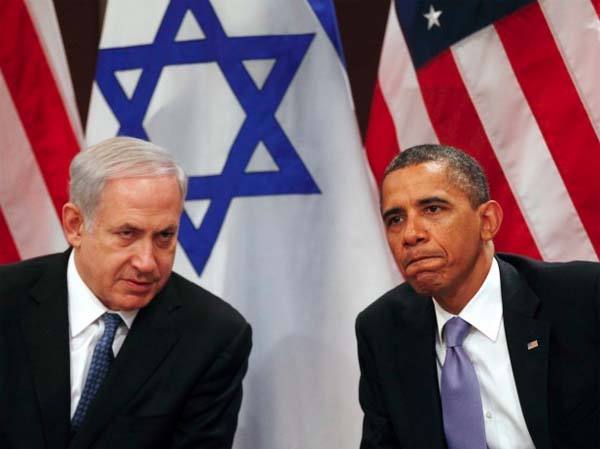 Israeli Prime Minister Benjamin Netanyahu said that he did not commit to freezing settlement construction during his meeting with US President Barack Obama and that he will reject any agreement with the Palestinians that does not meet Israel’s security needs.
Israel Radio quoted Netanyahu on Friday, on his way back to Israel, telling Israeli journalists that he considered extending the negotiating period between the Israelis and Palestinians in US Secretary of State John Kerry’s framework agreement unlikely to make a difference for the Israeli coalition government, as most of its members reject the idea of establishing a Palestinian state.
He added that he will reject any agreement with the Palestinians that “does not meet Israel’s needs and poses a threat to its security, even if there are attempts to impose such an agreement on Israel.”
Netanyahu refused the possibility of unilateral withdrawal from the West Bank territories if the negotiations fail, stating that he does not prefer this possibility and that “the unilateral withdrawals (from south Lebanon and the Gaza Strip) have not justified themselves nor did they provide security stability for Israel”.
Netanyahu returned to Israel today following his visit to the US which started on Sunday in which he met with Obama in the White House and gave a speech to the American Israel Public Affairs Committee (AIPAC) on Tuesday.
Palestinian President Mahmoud Abbas announced, while receiving a delegation from the Israeli left-wing party Meretz a few days ago, that he is not opposed to extending the negotiations period, but demands that settlement construction is suspended and prisoners are released.
Related article


US hires Israeli company to retrofit Mexico border wall
By Chloé Benoist | Al-Akhbar | March 5, 2014
An Israeli military contractor, whose surveillance technology is used along Israel’s apartheid wall constructed in the Palestinian West Bank, has been chosen by the United States to provide similar services on the southern border with Mexico, Israeli media reported on Wednesday.
Elbit Systems announced on Sunday that the US Department of Homeland Security Customs and Border Protection (CBP) had awarded its subsidiary a $145 million contract to deploy border surveillance technology in southern Arizona, Reuters reported.
But according to Bloomberg analyst Brian Friel, quoted by Israeli newspaper Haaretz, the one-year contract could expand to a broader $1 billion deal if the US Congress passes stringent immigration legislation.
Elbit Systems is set to install watch towers along the border with sensors for spotting, tracking, and classifying data, along with command and control centers.
Republican Senator John McCain of Arizona hailed the deal as a “step in the right direction.”
“Arizonans have been waiting more than a decade for the Department of Homeland Security to place the needed technology along our border to support the Border Patrol and fully secure our southern border,” he said in a statement.
“If this technology is developed, integrated and fielded correctly, these Integrated Fixed Towers in southern Arizona, coupled with the tremendous work of the Border Patrol, will give our agents the ability to detect, evaluate, and respond to all illegal entries crossing our border.”
A government contractor said the choice of an Israeli firm was justified by of its “advanced” experience in maintaining separation barriers.
“It is odd to go offshore for this work, but in extraordinary circumstances, one really wants to employ the best,” Haaretz quoted Mark Amtower, a partner at Amtower & Co, as saying.
Elbit Systems is one of the primary military suppliers of the Israel’s occupation forces. Its Hermes 450 attack drone has been used extensively in the besieged Gaza Strip, as well as in Lebanon during the 2006 war.
The company is also responsible for surveillance technology along the apartheid wall erected by Israel within the West Bank. Only 15 percent of the separation barrier is built along the so-called 1949 Green Line, which is recognized by the international community as the border of Israel proper, UN figures show, with most of it jutting into the occupied West Bank.
The 440-kilometer long barrier is considered illegal under international law.
Among its many international contracts, Elbit contributed in 2013 to a $40 million expansive Internet surveillance program for the Nigerian government.
Elbit Systems has officially pledged on its website to “contribute to the enhancement of quality of life and the environment of the communities in which we live and work.”
But this contribution mainly consists of supporting Israeli occupation forces through the “Adopt a Combat Unit” program.
Elbit is targeted by the pro-Palestinian boycott, divestment and sanctions (BDS) movement for “directly contribut[ing] to violations of international humanitarian law.”
The Stop the Wall campaign has called Elbit a “symbol” which“thrives on and fuels war, repression and control in Palestine and around the globe.”
“Elbit offers its experience in ghettoizing and killing Palestinians to repress other people,” the campaign wrote of the company’s international projects.
“Because Elbit Systems is knowingly participating in and aiding Israeli war crimes and Israeli occupation of the Palestinian people, investors in and partners of the security firm are, by extension, accessories to Israel’s many violations of international law and human rights standards.”
Israeli forces kill Palestinian man during Birzeit arrest raid
Ma’an – 27/02/2014
 RAMALLAH – Israeli forces killed a Palestinian man on Thursday after opening fire on a property in Birzeit, locals said.
Muatazz Washaha, 24, was found dead inside the house following a stand-off between Israeli military forces which lasted several hours.
Witnesses said that the victim was hit in the head by a rifle-fired Energa shell.
Israeli forces were reportedly trying to arrest Muatazz for being an activist with the Popular Front for the Liberation of Palestine.
During the dawn raid, Israeli forces stormed the house and detained his brother, Ramiz, and two other men. Earlier reports suggested Israeli forces were targeting another brother, Thaer.
Palestinian firefighters rushed to the scene after the house caught on fire as a result of Israeli artillery shelling.
Palestinian Authority Minister of Detainees, Issa Qaraqe, said Israeli troops raided Birzeit at around 3 a.m.
An Israeli army spokeswoman said that Israeli forces raided Birzeit to arrest a man suspected of “terror activity.”
“After the suspect was called to turn himself in, he barricaded himself inside his house, effectively resisting arrest. Under the premise that he had weapons in his possession, the forces used different means to complete the arrest, including live fire.”
An AK47 assault rifle was found in the house, but no shots were fired at any point towards Israeli forces.
Two Palestinian Human Rights Defenders Kidnapped In Nablus
By Saed Bannoura | IMEMC | February 25, 2014
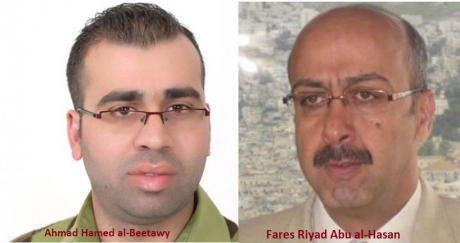 The Solidarity Foundation for Human Rights (SFHR) has reported that Israeli soldiers kidnapped, on Tuesday at dawn, its lawyer and its researcher, after the army violently invaded their homes in the northern West Bank city of Nablus.
The foundation said dozens of soldiers invaded the home of SFHR lawyer Abu al-Hasan, in the Rojeeb Housing Projects area, east of Nablus, and kidnapped him after violently searching his home causing property damage.
Soldiers detonated the door of Abu al-Hasan’s home, invading the place and terrifying the family.
They also interrogated Abu al-Hasan’s father for more than an hour, and confiscated documents and files. Abu al-Hasan was moved to the Petah Tikva interrogation facility.
It added that the soldiers also broke into several nearby homes, violently searched them and ransacked their property and belongings, and used their rooftops as monitoring towers during the invasion.
Meanwhile, soldiers also detonated the front door of the home of SFHR researcher Ahmad al-Beetawy, and invaded the property in the Dahia area, south of Nablus, searched it for more than an hour and kidnapped him.
His brother said the soldiers also invaded the home of their mother, in the same neighborhood, and violently searched it. Al-Beetway defends the rights of Palestinian political prisoners, illegally held by Israel.
The foundation said that the soldiers also invaded its office in al-Isra’ building, in the center of Nablus city, and confiscated computers and files after violently searching the property.
Related articles


Tide slowly turning at the New York Times
By Jonathon Cook | February 20, 2014
A decade ago, I wrote a commentary for the International Herald Tribune (now the International New York Times) arguing that Israel’s wall that was then just starting to be built in the West Bank was really a land grab. Difficult to believe now, but in those days that was a controversial opinion.
The paper then received the “largest postage in our history”, as an editor told me – possibly not surprising as the Anti-Defamation League, a Zionist organisation, had urged its followers to complain and had even published a template letter of condemnation on its website to help them. The result: the paper published a whole page of letters attacking me and dropped me as a writer.
So it is with some pleasure I see that the same paper has again been overwhelmed with letters following three recent articles on BDS in both the NYT and INYT : Omar Barghouti making the case, and Jodi Rudoren and Roger Cohen attacking it, the former implicitly and the latter explicitly.
What’s so different this time is that the INYT’s letters page is dominated by readers backing Barghouti and attacking Rudoren and Cohen. Not only that, but the arguments used to support BDS are intelligent and well-informed, while the few letters attacking BDS sound tired and formulaic.
The fact that the NYT has allowed the BDS debate into its pages is a triumph for the cause. That its international sister publication (and the NYT website) has then allowed its letters page to be dominated by BDS supporters is another small landmark.
We can mark a further victory when the NYT itself publishes a page of such letters. The time cannot be far off.
www.nytimes.com/2014/02/19/opinion/the-case-for-the-israel-boycott.html?_r=0
Analysis: EU aid to Palestinians — help or hindrance?
IRIN – 19/02/2014
JERUSALEM — The European Union has long been one of the most reliable foreign sources of humanitarian, economic and political aid in the Occupied Palestinian Territories (OPT), providing 426 million euros ($575 million) in 2013 alone.
In 2011, overall overseas development aid to the OPT was worth $2.5 billion, according to the Organization for Economic Co-operation and Development.
Much of this aid to the Palestinian people is focused on a single long-term objective, according to EU officials — the building up of the institutions of a future democratic, independent and viable Palestinian state, living side-by-side in peace and security with Israel.
But with limited progress so far in the current US-brokered peace talks and the wider aim of the realization of a Palestinian state, some in the more austerity-minded EU are starting to wonder if the aid is being well spent, when humanitarian crises in Syria and Mali are in need of greater funds.
“By now there is no Palestinian state. The point is: what are we funding here? Are we helping Israel to maintain the occupation, or are we actually helping Palestinians to build independence?” Caroline du Plessix, a French political scientist specialized on EU policy towards the two-state-solution, told IRIN.
“EU member states are today much more aware than before that their aid has not made possible the creation of an independent Palestinian state,” she said, adding: “The EU is trying to figure out what the best strategy may be. Member states need to show that their policy is reaching its ends and is effective. But if the main solution still is the two-state-solution and we are not really going in that direction, this policy is not sustainable and cannot go on for ever.”
Carrot and stick
A substantial reduction in EU aid seems unlikely at the moment. Such a move would have dramatic consequences for the Palestinian economy and the livelihoods of tens of thousands of families.
“There will be a price to pay if these negotiations falter,” the EU’s ambassador to Israel, Lars Faaborg-Andersen, said in late January. In December 2013, an EU official was cited in the Israeli newspaper Haaretz as saying that the EU may cut off financial aid to the Palestinian Authority if peace talks fail, while “some people suggested giving the money to other countries, like Syria, Mali and other places around the world.”
On the other hand, EU foreign ministers are making unprecedented offers, setting out a very substantial set of incentives designed to encourage both parties to finalize a peace agreement.
“These incentives aim at boosting prosperity for both Israelis and Palestinians by increasing access to European markets, facilitating trade and investment and deepening business and cultural ties,” EU-representative John Gatt-Rutter told IRIN, adding: “Therefore, at this stage our approach is one of encouraging both parties to seize this unique opportunity provided by the peace negotiations.”
“In spite of donor fatigue in Europe we will not see more than a limited gradual reduction — say 10 percent a year — in European aid if negotiations fail because European leaders do not want to trigger major instability or a humanitarian crisis,” Ofer Zalzberg, senior analyst at the International Crisis Group, told IRIN.
Building the state to come
Of the 426 million euros provided by the EU to Palestinians in 2013, 168 million was Direct Financial Support to the PA under the so-called PEGASE-mechanism.
PEGASE helps the PA to meet its recurrent expenses through paying salaries, pensions and social allowances to people in extreme poverty, and through supporting essential public services and revitalizing the private sector through policy reforms, institution-building and strengthening the relations between Palestinian enterprises and European counterparts.
The funds are transferred directly to individual beneficiaries like 55-year-old Nabila from the Qaddura refugee camp. “I get 750 shekels ($210) every three months, have a disabled son, and my husband died 10 years ago. How can I move on?” she told IRIN at the Ramallah district office of the PA’s Ministry of Social Affairs.
“There is poverty and we get tired of this situation,” she said, adding though that restrictions on movement (caused, for example, by the Barrier and numerous Israeli checkpoints allegedly set up for security reasons) highlighted a greater problem that aid would never solve.
“How do you want to solve this problem? Why do we have to be in this miserable situation?”
In addition to the direct financial support, humanitarian aid is provided through the European Commission Humanitarian Aid and Civil Protection Department (ECHO), which spent 35 million euros in 2013 on areas such as humanitarian coordination, legal assistance and emergency response to demolitions and evictions.
Propping up the status quo
EU aid faces the same challenges as non-governmental aid groups have faced — that by providing support they may inadvertently be playing a political role by helping prop up the status quo, giving life-support services that should normally be provided by Israel, as the occupying power.
“EU funding is strategic. Its main aim is to prevent instability. It is thus scared of the PA’s breakdown,” said Caroline Du Plessix.
For Sami Abu Roza, former economic policy adviser to the Palestinian president, this system of dependency has a bitter political aftertaste.
“If you take away the good intention behind the money, aid is a substitute for not having real remedies,” he told IRIN at the PA’s Ministry of Education, where he currently works.
The EU’s approach to solving the conflict, he says, is part of a larger trend he calls “peaceconomics”, the feeding of an illusionary idea that institution-building and economic aid can contribute to real progress, while the actual political causes behind the difficult situation are side-lined and remain unresolved.

Ashraf Azzam sits in the ruins of his house in eastern Gaza City in Jan. 2013 after it was destroyed in an Israeli attack in Nov. 2012. (Ahmed Dalloul/IRIN)
‘Patronizing’ attitude
“The EU’s attitude towards Palestinians is patronizing, as if money was the only thing Palestinians needed,” he said, adding: “They are sacrificing real solutions for economic aid, building a smoke screen around the real problems.”
“Palestinians know that any money coming to Palestinians is political. But they also know that the world won’t stop paying for Palestinians under occupation. That’s the strange kind of peace Palestinians live in.”
In an attempt to decrease the political dependence from aid, the Ministry of Education has implemented a new mechanism, the Joint Financing Agreement, which has been running for about three years.
With aid money flowing from the German KfW Development Bank, Finland, Ireland, Norway and Belgium, directly into a pool at the treasury of the PA’s Ministry of Finance, the Ministry of Education has full ownership of the money and decides how and where it is spent.
“It’s a small path to independence, towards political independence,” Abu Roza said.
But for one senior official in the Ministry, who asked to remain anonymous, the notion of independence remains unreal.
“We don’t have control of our own borders, no taxation, and all of Area C is under Israel’s control. What economic independence are we speaking of?” he said, adding that the PA was not created to become a social entity providing salaries and services to Palestinians. “Its aim was political, and so are our problems.”
‘Aid has not helped to fulfill Palestinians dreams’
Some anomalies in the EU’s funding to the PA emerged recently in a report of the European Court of Auditors (ECA), which criticized the EU’s paying of salaries to Palestinian civil servants in the Gaza Strip “who no longer work.” The report suggested financial assistance “be discontinued and redirected to the West Bank.” Hamas, which took control [won elections] of the Gaza Strip in 2007, is classified by the EU as a terrorist group.
So the EU continues to support the former PA structure in Gaza with salary payments even though the PA no longer has any control: The political cost of stopping funding is seen as too great.
From 2008 to 2012, the average number of civil servants and pensioners whose salaries were at least partly paid by the EU rose from 75,502 to 84,320, about half of the PA’s 170,000 civil servants and pensioners.
During the same period, the average monthly PA wage bill for EU-beneficiaries rose from 45.1 million euros to 62.9 million euros, an increase of 39 percent.
But at the same time, contributions to PEGASE for Civil Servants and Pensioners fell from 21.3 million euros (47 percent of total pay to eligible beneficiaries) in 2008 to 10.4 million euros (16 percent) in 2012, mainly due to reductions in contributions from donors, such as Spain.
These pressures point to a new funding environment in which the PA is finding it increasingly difficult to pay salaries and pensions on time.
The UN Works and Relief Agency for Palestinian Refugees (UNRWA) faces similar challenges. This year it has a deficit of $65 million in its core budget and struggles with declining international funding. The EU is UNRWA’s largest donor.
“Aid has not helped to fulfill Palestinians dreams, nor did it lead to sustainable development. Independence is today further away than 20 years ago,” Alaa Tartir, program director of the Palestinian Policy Network, told IRIN.
Despite the contradictions in EU aid policy, it is clear that without EU aid the humanitarian situation in OPT would worsen significantly.
“If we reach a condition where there is no more aid for PA employees, who will fill this gap? This will have a severe humanitarian impact,” said Tommaso Fabri, head of the Jerusalem office of Doctors Without Borders.
One beneficiary of the EU’s direct assistance to the PA is 49-year-old Said Samara, a teacher at the Secondary Boarding School in Ramallah.
“As a teacher, I hope that this aid will continue. But as a teacher, and for my students, I also need some hope for an independent Palestinian country,” he said.
Israeli forces use tear gas against schoolchildren in Hebron
International Solidarity Movement | February 17, 2014
Hebron, Occupied Palestine – On Sunday, the 16th of February, Israeli soldiers and border police in Hebron fired tear gas and sound grenades at children on their way to school. The border police also chased the children, attempting to arrest them.
At Checkpoint 29, around 7:30 a.m., a few children on their way to school (there are three schools near the checkpoint) were throwing stones at the soldiers stationed there. In response to this two border police and a soldier appeared from an alley and threw a sound grenade at the kids close to the United Nations school on Tareq Ben Ziyad Street.
This frightened not only the children who had thrown stones but all the children on their way to school, causing them to flee. When they did not catch any children the two border police and the soldier stood in front of the school blocking the entrance and started firing teargas at those who had fled.
As the border police and the soldier returned to the checkpoint, three new soldiers came out of an apartment across the street, preventing the children from entering their school. The soldiers continued firing teargas towards the crowd of upset and frightened children.
Tear gas is a nondiscriminatory nerve gas which affects all persons nearby. The gas often takes a long time to disperse, forcing children to go through the half-dispersed gas clouds on their way to school, leaving them crying and coughing. The use of tear gas against schoolchildren is common in Hebron.
In total, seven soldiers and two border police were involved in the incident, firing six tear gas grenades and two sound grenades at the children.
Related articles


Israeli troops shoot, injure Palestinian girl at flying checkpoint
Ma’an – 15/02/2014
NABLUS – Israeli forces on Saturday opened fire at a vehicle traveling on a main road near an Israeli settlement south of Nablus, injuring a 17-year-old Palestinian girl, security sources said.
Palestinian security sources told Ma’an that Israeli troops operating a flying checkpoint near the illegal settlement of Yitzhar fired at a Palestinian car that allegedly refused to stop at the soldiers’ request.
A bullet hit Nahad Kamal Aqil in the thigh, and she was taken to a nearby hospital, the sources said, adding that the teen is a resident of Kafr Qaddum in the northern West Bank.
Israeli troops detained the driver of the car, the sources said.
An army spokeswoman said that the Israeli border police was responsible for the area where the incident occurred.
A border police spokesman did not return calls seeking comment.
Israeli forces maintain severe restrictions on Palestinians’ freedom of movement in the West Bank through a combination of fixed checkpoints, flying checkpoints, roads forbidden to Palestinians but open to Jewish settlers, and various other physical obstructions.
At any given time there are about 100 permanent Israeli checkpoints in the West Bank, while surprise flying checkpoints often number into the hundreds.
The internationally recognized Palestinian territories of which the West Bank and East Jerusalem form a part have been occupied by the Israeli military since 1967.
Palestinian footballers shot by Israeli forces never to play again
Ma’an – February 14, 2014
BETHLEHEM – Two young Palestinian football players shot by Israeli forces last month have learned that they will never be able to play sports again due to their injuries, according to doctors.
Doctors at Ramallah governmental hospital said the pair will need six months of treatment before they can evaluate if the two will even be able to ever walk again, at best.
Jawhar Nasser Jawhar, 19, and Adam Abd al-Raouf Halabiya, 17, were shot by Israeli soldiers as they were walking home from a training session in the Faisal Hussein Stadium in al-Ram in the central West Bank on Jan. 31.
Israeli forces opened fire in their direction without warning as they were walking near a checkpoint.
Police dogs were subsequently unleashed on them before Israeli soldiers dragged them across the ground and beat them.
The pair was subsequently were taken to an Israeli hospital in Jerusalem, where they underwent a number of operations to remove the bullets.
Medical reports said that Jawhar was shot with 11 bullets, seven in his left foot, three in his right, and one in his left hand. Halabiya was shot once in each foot.
The two were taken to Ramallah governmental hospital before being transferred to King Hussein Medical Center in Amman.
Chairman of the Palestinian Football Association Jibril al-Rajoub condemned the shooting and said that “Israeli brutality against them emphasizes the occupation’s insistence on destroying Palestinian sport.”
Rajoub called for imposing penalties on the Israeli football association, and demanded its removal from the FIFA as it should not accept racist organizations that do not adhere to international law.
Related article
Ahava blockaders Supreme Court appeal fails, but campaign remains victorious
By Tom Anderson and Therezia Cooper | Corporate Watch | February 7, 2014
 An appeal to the Supreme Court by two campaigners against the Ahava store in London has been unsuccessful.
The campaign
Ahava manufactures its products at the Israeli settlement of Mitzpe Shalem in the occupied West Bank. The settlements of Mitzpe Shalem and Kibbutz Kalia are shareholders in the company (see here).
Ahava, a multinational Israeli Dead Sea products company, was forced to close its flagship store Monmouth Street, central London in 2011 after two years of concerted campaigning by grassroots groups.
The case
The two campaigners, Matt Richardson and Gwen Wilkinson, had locked themselves to a concrete barrel inside the Ahava store on Monmouth street with the aim of stopping the shop from doing business. The store closed for the day. Police arrived and cut them free. They were arrested for aggravated trespass under Section 68 of the Criminal Justice and Public Order Act.
In their defence they argued that the store’s business was unlawful on the basis that the shop was:
-
aiding and abetting a war crime by aiding the transfer of Israeli civilians into the Occupied Palestinian Territories
-
The products in the shop were criminal property as they were the proceeds of a war crime
-
The products had fraudulently claimed the benefits of the Eu-Israel Association Agreement
-
The products had been labelled Israeli when they were in fact from a settlement
In the Magistrate’s Court the defendants were not successful. They were given a conditional discharge and a fine. In an appeal to the High Court the judge upheld their conviction.
The campaigners were appealing against their conviction to the Supreme Court and on the following point of law: “Should the words ‘lawful activity’ in section 68 Criminal Justice and Public Order Act 1994 be limited to acts or events that are ‘integral’ to the activities at the premises in question?”
The court ruled that the answer to that question is “yes” and that the convictions should be upheld. Importantly the judgement says that for activists to use the defence that businesses are unlawful in aggravated trespass cases then the unlawful business must be integral to the business obstructed. Ie it might follow that if activists lock themselves to the gate of a pharmaceutical company that is involved in illegal animal testing then it is only a defence in court to argue that the company’s business isn’t lawful if the business you disrupt is ‘integrally’ involved in the unlawful activity.
The judgement can be viewed here, and here
The option of appealing to the European Court is still open to the defendants
Implications
The ruling is an example of the English court system attempting to close avenues for lawful resistance to corporate crime. In reality, corporations are multinational enterprises that commit crimes across continents. The defence that was the subject of the appeal has often been a chance for ordinary people to express their anger against these crimes.
Its important not to overestimate the importance of this ruling – it only actually adjudicated on the application of the defence in aggravated trespass case. It does not rule out the use of similar defences in criminal damage cases like those used by the Raytheon 9 and the EDO decommissioners, who were found not guilty after breaking into arms factories linked to the supply of arms to Israel and destroyed machinery and computers in order to stop war crimes.
Direct Action
Its also important to remember that the Ahava campaigners were successful in their campaign. The store closed down, not as a result of a court victory but as a result of a concerted grassroots campaign. The victory came after two years of regular demonstrations, blockades of the store, legal challenges as well as acts of direct action which included activists daubing slogans on the windows, super-gluing the locks during the night and throwing paint bombs at the shop front. This combination of public demonstrations, legal challenges and clandestine direct action proved a successful formula.
Featured Video

Chinese jet fuel and the myth of energy independence
or go to
Aletho News Archives – Video-Images
Book Review
Former Insiders Criticize Iran Policy as U.S. Hegemony
By GARETH PORTER | CounterPunch | February 27, 2013
“Going to Tehran” arguably represents the most important work on the subject of U.S.-Iran relations to be published thus far.
Flynt Leverett and Hillary Mann Leverett tackle not only U.S. policy toward Iran but the broader context of Middle East policy with a systematic analytical perspective informed by personal experience, as well as very extensive documentation.
More importantly, however, their exposé required a degree of courage that may be unparalleled in the writing of former U.S. national security officials about issues on which they worked. They have chosen not just to criticise U.S. policy toward Iran but to analyse that policy as a problem of U.S. hegemony. … continue
Blog Roll
 Aletho News
- What is fueling unrest across the EU?
- Why no power can undermine Iran’s eternal dominance over the Strait of Hormuz
- Is The War Against Iran Over?
- Iran war will leave long-term ‘scar’ on Wall Street, investors warn
- How Iran decimated US power projection in West Asia: Military lessons of 40-day war
- Iran’s report details US-Israeli war crimes in targeting schools, hospitals, livelihoods
- NATO’s Slow Fracture: How Trump’s Iran War Exposed the Instrument of Hegemony
- Chinese jet fuel and the myth of energy independence
- Ukraine Sea Drone Fired From Libya Hit Russian Tanker in Mediterranean
- IRGC: Iranian forces launched no attacks during ceasefire hours
- If Americans Knew
- Military aid to Israel emerges as the latest political litmus test for Democrats
- The only Palestinian children’s rights organization closes following years-long Israeli campaign against it
- ‘I Can’t Forget the Smell’: Lebanese Reel After Israel Kills Over 300 in Single Day
- DNC Shoots Down Resolutions Calling Out AIPAC and Limiting Arms to Israel
- TCN: Is Israel Blackmailing President Trump?
- Israel killed at least 303 Lebanese yesterday – who were they? Daily Update
- Amnesty: Urgent – Protect Lebanese civilians from brutal escalation in Israeli attacks
- Is The War Against Iran Over?
- Inside the Israeli army’s propaganda wing
- Hundreds of Gaza Amputees Stranded in Legal Limbo
- No Tricks Zone
- New Study: No Linear Warming Or Glacier Retreat Along Northern Antarctic Peninsula Since 1980s
- An Inconvenient Tree: Uncovered In Alps… Europe Much Warmer Than Today 6000 Years Ago
- New Study Reports A 60% Slowdown In Greenland’s Ice Loss Rate In The Last Decade
- Low Intensity Tornado Wrecks Major Solar Farm, Creating A Potential Toxic Dump
- New Study Finds Warming Saves Lives…Cold Temperatures 12 Times More Deadly Than Excess Heat
- German Science Blog Accuses PIK Climate Institute Of Hallucinating Climate Tipping Points
- Devastating Assessment Of Comirnaty Vaccine By Former Senior Pfizer Europe Toxicologist
- New Study: CO2 Is ‘Effectively Negligible’ As An Explanatory Climate Change Factor Since 2000
- Former Pfizer Toxicologist Dr. Helmut Sterz Tells Bundestag Hearing Pfizer Vaccine Should Have Never Been Approved
- Energy Expert: Germany’s Nuclear Phaseout Was A “500 Billion Euro Mistake”
 Aletho News