312 Palestinians Kidnapped By Israeli Army In April
By Saed Bannoura | IMEMC News | May 2, 2014
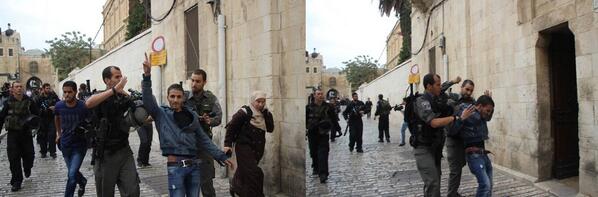
The Ahrar Center for Detainees Studies and Human Rights issued its monthly report, revealing that the Israeli army kidnapped 312 Palestinians in different parts of the occupied West Bank, occupied Jerusalem, and the besieged Gaza Strip.
Ahrar said the army carried out dozens of invasions into the occupied territories, kidnapping 312 Palestinians, mainly after breaking into their homes and properties, and violently searching them, causing excessive property damage.
Most of the arrests have been carried out in the Hebron District, as the soldiers kidnapped 94 Palestinians, followed by Jerusalem, 92, Nablus, 36, Bethlehem, 21, Jenin, 18, Ramallah, 16, Gaza Strip, 15 including 11 kidnapped near the border fence, Qalqilia, 10, Salfit, 7, Tulkarem, 2, and one in Tubas.
Ahrar added that the army kidnapped four Palestinian women in April, and released two of them later on.
Mariam Barghouthi, from Ramallah, and Samira al-‘Akel, from Hebron, are still imprisoned, while Tahani Abu Mayyala and Hanin Abu Aisha, from Hebron, were released.
“There are 21 Palestinian women who are still imprisoned by Israel,” Ahrar stated.
Head of the Ahrar Center, Fuad al-Khoffash, stated that April witnessed the beginning of one of the strongest hunger strikes by Administrative Detainees held with charge or trial, and that the detainees are determined to continue their strike.
Al-Khoffash added that the striking detainees are subject to constant attacks and harassment, in the attempt by authorities to force them to end their strike, while many have been moved into solitary confinement and are denied the right to family visits.
Israeli forces storm Aqsa compound, dozens injured and detained
File Photo
Ma’an – 20/04/2014
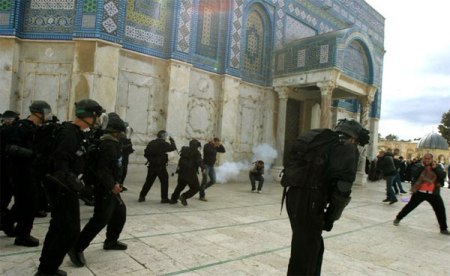
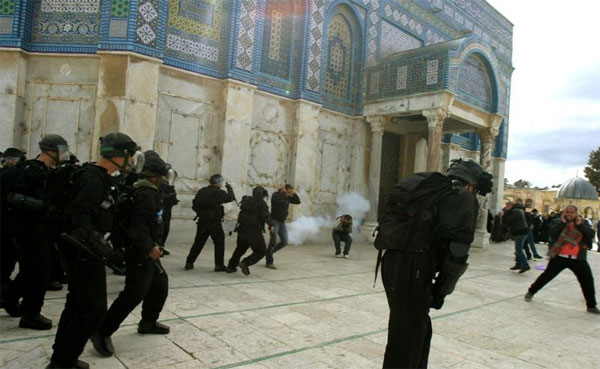
JERUSALEM – Dozens of Palestinian worshipers were wounded and dozens were detained after clashes broke in the Al-Aqsa Mosque compound on Sunday morning with Israeli forces who had stormed the courtyards firing stun grenades and rubber-coated bullets.
The raid comes amid frequent clashes in recent days after right-wing Jewish groups urged Jews to flock to the compound — which they believe is the site of a former Jewish temple — and conduct Passover rituals inside.
Director of Al-Aqsa Mosque Omar Kiswani told Ma’an that more than 400 police officers stormed the courtyard of the Al-Aqsa Mosque through the Moroccan Gate and the Chain Gate escorting Ultra-Orthodox Jews other Jewish visitors into the compound.
Israeli forces, Kiswani said, “besieged” worshipers in the southern mosque “attacking them with clubs and pepper spray,” after clashes broke out with Palestinian worshipers in the compound.
Dozens of Palestinians sustained injuries during the assault, while several others suffered from excessive tear gas inhalation. Twenty five young men were reportedly detained by Israeli forces.
Kiswani said that Likud member of Knesset Moshe Feiglin had also entered the compound during the raid, accompanied by special security units. Feiglin has visited the site frequently in recent months, and he has vocally supported the extension of Israeli sovereignty over the compound.
Earlier on Sunday morning, clashes erupted outside the Lions’ Gate (Bab al-Asbat) and Gate of Remission (Bab al-Hutta) of the Al-Aqsa compound when Israeli police denied hundreds of worshippers access to the compound.
Witnesses said that Israeli officers had denied all Palestinian residents of Jerusalem under the age of 60 access to the compound, including students who attend schools inside. Men and women were also attacked with clubs and pepper spray, witnesses said.
Israeli forces detained a young man after he was beaten brutally.
Israeli police spokesman said in a statement that police had detained 16 Palestinian “rioters,” adding that they were all detained “as they threw stones/blocks at officers at the scene this morning.”
He also said that two police officers lightly injured in the clashes, which broke out after the Palestinians threw stones as “tourists visited.”
About 100 Muslim worshipers have decided to stay inside the compound day and night throughout Passover after right-wing Jewish organizations called for Jewish worshipers to enter the area en masse for religious festivities.
Because of the sensitive nature of the Al-Aqsa compound, Israel maintains a compromise with the Islamic trust that controls it to not allow non-Muslim prayers in the area. Israeli forces regularly escort Jewish visitors to the site, leading to tension with Palestinian worshipers.
The compound, which sits just above the Western Wall plaza, houses both the Dome of the Rock and Al-Aqsa mosque and is the third holiest site in Islam.
It is also venerated as Judaism’s most holy place as it sits where Jews believe the First and Second Temples once stood. The Second Temple was destroyed by the Romans in 70 AD.
Al-Aqsa is located in East Jerusalem, a part of the internationally recognized Palestinian territories that have been occupied by the Israeli military since 1967.
‘Israel planning new Jewish temple near al-Aqsa Mosque’
Press TV – April 11, 2014
Israeli officials have unveiled the model of a Jewish temple near the al-Aqsa Mosque Compound in East al-Quds (Jerusalem).
Palestinian activists say the model of the so-called third Jewish temple has a big hall and can accommodate hundreds of visitors each day.
Israeli authorities hope the project could attract tens of thousands of local and foreign tourists every year.
The al-Aqsa Foundation for Endowment and heritage says the move is a direct threat to the mosque.
The organization argues that the project is aimed at building enough support to make a Jewish temple on al-Aqsa site.
Palestinian groups have already warned of large-scale Israeli excavations near al-Aqsa’s southern gate.
On February 25, the Israeli parliament, Knesset, discussed a plan to annex al-Aqsa Mosque Compound.
The Organization of Islamic Cooperation has condemned the debate as a “dangerous escalation,” calling it part of Israel’s goal to “Judaize Jerusalem.”
The Israeli Knesset is set to discuss a proposal later this week to place the so-called Temple Mount, where Al-Aqsa Mosque is located, under Israeli sovereignty.
Palestinians have denounced the plan as desecration. They say it is part of the Israeli regime’s ongoing attempts to distort Arab and Islamic history.
Over the past decades, Israel has tried to change the demographic makeup of al-Quds by constructing illegal settlements, destroying historical sites and expelling the local Palestinian population.
Israeli soldiers attack girl’s schools in Salfit
International Solidarity Movement | April 7, 2014
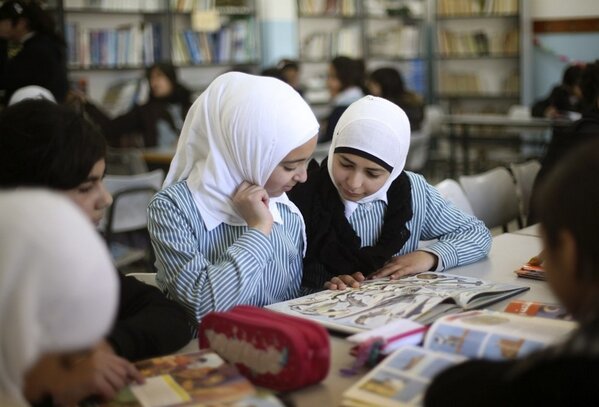
Salfit, Occupied Palestine – Two educational institutions were attacked with tear gas and stun grenades by the Israeli army yesterday morning in Salfit. At least ten female students required medical attention after suffering from excessive tear gas inhalation.
At 12:30 yesterday afternoon, Salfit’s female elementary school was empty. Only a few staff remained, attempting to clean the walls after Israeli soldiers threw tear gas and stun grenades in an attack earlier in the morning. According to the headmistress of the school, the attack took place at approximately 9:30 am. At this time, the classrooms were full of female students between the ages of six and 12-years-old. The soldiers shot the tear gas from the street and it landed in the playground, school corridors and on the roof, with the tear gas itself drifting into the classrooms.
Staff from the school reported that ten young students required medical attention on site; two of them temporarily lost consciousness due to the inhalation of tear gas. When the headmistress was reassured that the Israeli army had left Salfit, at approximately 11:30 am, she began evacuating the girls. Both the school psychologist and headmistress agree that the girls were in shock, many of them crying when the attack began and after were afraid of leaving the school by themselves. The girls were planning for tomorrows’ Childrens’ Day celebration, which has been delayed until next Thursday because of the attack. The school psychologist expects that at least half of the students will not attend the following day after this experience from the Israeli army.
A female secondary school is located just meters away from the elementary school. Fortunately, no one was injured in that institution despite some exposure to the gas, but it did eventually close early as a precaution.
Witnesses reported that Israeli forces have also harassed neighbours to the school who photographed the attack. That is the case with Ahmed Zubuydi, aged 21. He was working in a nearby shop when a military jeep stopped in front of him and interrogated him for 20 minutes. He was asked to show his ID and was thoroughly searched. The commander of the Israeli soldiers began asking personal questions, such as where Ahmed worked, where he studied, and where he spends the money he earns. Ahmed reports that this is not the first time he has been interrogated by the Israeli army.
The headmistress of the girl’s elementary school reported that this is the second time this year that this sort of attack has occurred, with the first taking place in January. The school fears that these attacks may become systematic and will therefore seek training from the Fire Department to help cope with future incidents.
Related articles
- Salfit’s rich agriculture threatened by factory development and settlers’ sewage (palsolidarity.org)
- PHOTOS | Israelis scrawl ‘Death to Arabs’ in Salfit (occupiedpalestine.wordpress.com)
- Soldiers Invade Salfit (imemc.org)

PA: Israel undermined peace process first with ‘unilateral moves’
Ma’an – 06/04/2014
BETHLEHEM – A spokesperson for Palestinian Authority president Mahmoud Abbas accused Israel on Sunday of undermining the peace process first, minutes after Israeli prime minister Benjamin Netanyahu accused the Palestinians of making “unilateral moves” that had harmed the talks.
Nabil Abu Rdeina told Ma’an on Sunday that “it was Israel who took unilateral steps to thwart the peace process,” pointing out that Israel precipitated the current impasse in the talks by refusing to release the fourth batch of veteran Palestinian prisoners jailed before the Oslo Accords as had been previously agreed upon.
Abu Rdeina added that Israel has continued to expand settlements in the West Bank throughout the peace process, which also constitutes a unilateral move to undermine hopes for peace.
The statements came immediately after Israeli prime minister Netanyahu responded to the growing negotiations crisis on Sunday, accusing Palestinians of undermining the talks through “empty declarations” and “unilateral actions” at the beginning of the weekly government cabinet meeting according to Israeli media.
Other Israeli officials also denounced the moves, with strategic affairs minister Yuval Steinitz going so far as to say that Palestinian Authority president Mahmoud Abbas was “spitting” in Israelis’ faces by trying to join international rights conventions.
“Unilateral steps by the Palestinians will be answered with unilateral steps on our part,” Netanyahu was quoted as saying by Israeli news site Ynet, in his first public comments on the deterioration of talks in recent days.
“The Palestinians will get a state only though direct negotiations, and not through empty declarations, nor through unilateral actions that will only keep the peace agreement further away,” he added during the meeting.
The comments come after the Palestinian Authority submitted letters to accede to a number of international conventions after Israel failed to release a group of Palestinian prisoners held in Israeli jails for more than two decades. Israeli leaders condemned the move, decrying Palestinian attempts at international recognition and potential intervention.
“Throughout these talks, we have taken tough steps and demonstrated willingness to continue executing difficult in the upcoming months as well to create a framework to allow ending the conflict.”
“Unfortunately, as we approached the talks’ deadline, the Palestinian leadership rushed to unilaterally join 14 international treaties. Thus the Palestinians significantly violated the agreements that were achieved. The threats to turn to the UN do not affect us. The Palestinians have plenty to lose in a unilateral step.”
Netanyahu’s comments followed remarks from other top Israeli politicians slamming the Palestinian Authority’s move.
Economy Minister and right-wing Jewish Home party chairman Naftali Bennett was quoted by Ynet as saying that the Palestinians “shut down the negotiations by unilaterally going to the UN against all agreements. This is a flagrant violation of the accords, including the Oslo Accords. The negotiations with the Palestinians, even though they only turned unilaterally to the UN, makes the State of Israel a shelter for extortion.”
“If the seller runs off with the merchandise, you don’t need to chase him — cash in hand — begging to buy his goods. In short, if they retract the UN application we’ll negotiate, and if they don’t the negotiations must stop.”
Strategic Affairs Minister Yuval Steinitz joined the critical remarks against the Palestinians, and said: “Truth be told, (Palestinian President) Mahmoud Abbas is spitting in our faces, he tells us he is not interested in peace, he is willing to recognize the existence of the Jewish people and its right to its own state, and now he shuts down the negotiations,” according to Ynet.
“This Palestinian Authority exists thanks to us. Not only because of the Oslo Accords, but because of the funds we transfer them, and the security we give them. Otherwise, Hamas and Islamic Jihad, as they control Gaza, would also taken down Abbas and take over Ramallah.”
The statements come amid a wider breakdown in negotiations between Israel and the Palestinian Authority that followed Israel’s refusal to release the fourth batch of veteran Palestinian prisoners as promised as part of a trust-building measure to restart US-backed peace talks.
Peace talks between Israelis and Palestinians were relaunched in July under the auspices of the United States after nearly three years of impasse, but over the course of the talks Israel has announced plans to build thousands of homes in illegal settlements across the West Bank, angering Palestinian and US officials.
Israeli officials now fear that the Palestinian Authority may attempt to appeal to international bodies against Israeli policies.
The internationally recognized Palestinian territories of which the West Bank and East Jerusalem form a part have been occupied by the Israeli military since 1967.
Israeli sniper shoots Palestinian cameraman at Ofer protest
Ma’an – 06/04/2014
BETHLEHEM – Video emerged on Sunday of the moment an Israeli sniper shot a Palestinian cameraman in the stomach while he was covering a protest at Ofer prison on Friday.
Israeli security forces shot and injured Mohammed Basman Yasin, a volunteer cameraman for the Israeli human rights organization B’tselem, while he was filming a protest in the West Bank city of Beitunia, according to Israeli website +972.
The video, which could not be independently verified, appears to show Palestinian protesters sitting on the road when Israel forces arrive and begin firing tear gas canisters at them.
At times, protesters are seen throwing rocks at Israeli forces, although in other scenes activists can be seen walking towards an ambulance when Israeli forces open fire without warning in their direction.
At 5:30, meanwhile, two activists can be seen throwing rocks at the heavily-armed Israeli soldiers, when the video cuts to a scene showing Yasin, who is at the back of a large crowd watching the scene, being shot in the stomach.
Israeli forces caused severe damage to his internal organs, and according to B’tselem, doctors have said they may be forced to remove his liver and kidneys.
Yasin is currently hospitalized in Ramallah.
The clashes took place near the Israeli Ofer prison, located in the occupied West Bank, in protest against the Israeli government’s refusal to release a fourth group of veteran Palestinian prisoners it had previously agreed to release as part of ongoing US-sponsored negotiations with the PLO.
13 were reported injured during the clashes, including seven with live bullets.
An Israeli army spokeswoman told Ma’an that Israeli forces fired at “rioters” who threw rocks and burning tires at security forces, “lightly injuring” five.
Related article
Activists and journalists injured in prisoner release protest outside Ofer prison
International Solidarity Movement | April 4, 2014
Ramallah, Occupied Palestine – This afternoon approximately 500 Palestinian, international and Israeli demonstrators gathered close to Ofer Prison in Ramallah to protest against the refusal of the Israeli state to release the fourth group of Palestinian prisoners. As part of the current round of talks between Fatah (the Palestinian government of the West Bank) and the Israeli government, a series of prisoner releases was promised by the state of Israel, and the fourth was due to be carried out by the end of March, the Israeli government has now refused to honor the final release.
The demonstration began at approximately 12pm, the protests’ aim was to march towards Ofer prison itself, but due to the large number of Israeli forces present, this was not possible. The demonstrators also twice attempted a prayer at the start of the protest, but were unable to due to the high level of aggression from Israeli forces.
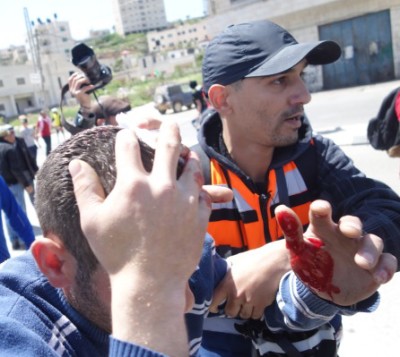 As the demonstration was beginning a 53-year-old Palestinian was shot at several times through the window of his car as he was driving away from Israeli forces. One of these rubber-coated steel bullets struck him in the head. The rubber-coated steel bullet broke several bones around his eye, a piece of the bullet was unable to be immediately removed and so he required surgery.
The level of violence escalated from this point as Palestinian youth threw stones at the Israeli military, while they (the military) fired hundreds of tear gas canisters, rubber-coated steel bullets and live ammunition, injuring many demonstrators. At several points during the demonstration, Israeli forces fired tear gas canisters directly at protesters, both highly dangerous and in contravention to Israeli military procedure, which is shooting them up into an arch to lower the impacted velocity.
A full list of all those injured is currently not available, however at least 10 people were transferred by ambulance to a local hospital in Ramallah to seek medical treatment for their injuries and Red Crescent medics at the demonstration treated many others for varying wounds.
Below is a list of specific injuries that were confirmed both at the demonstration and from ISM activists at the local Ramallah hospital:
- A 21-year-old Palestinian activist was injured after being shot from extremely close range with a sponge-tipped projectile in the back.
- Two ISM activists were also both shot from extremely close range with sponge-tipped projectiles in their backs.
- A 20-year-old Palestinian was shot with a rubber-coated steel bullet in the head.
- A 48-year-old Palestinian journalist was shot with a rubber-coated steel bullet in the left shoulder.
- A Palestinian activist was shot with a rubber-coated steel bullet in the foot.
- A 20-year-old Palestinian was shot with two .22 live ammunition bullets in his foot and in his knee.
- A 30-year-old Palestinian was shot with .22 live ammunition in his right hand.
- Another Palestinian was shot with .22 live ammunition in his left foot; the bullet was unable to be removed.
- 36-years-old Palestinian was shot with two .22 live ammunition bullets, both in his left foot.
- A 31-year-old Palestinian was shot in the left leg with .22 live ammunition.
- A 36-year-old Palestinian was shot with .22 live ammunition in the left foot.
- Mohammed Yasin, a photojournalist from Bi’lin who was wearing a press vest, was shot in his face with a rubber-coated steel bullet and also shot in his stomach with a .22 live ammunition bullet. He remains in hospital in serious condition, as the bullet may have destroyed parts of his liver.
An ISMer who was present at Ofer had this to say: “The Israeli forces present were really violent today. It was impossible to count the amount of tear gas canisters, rubber-coated steel bullets and live ammunition fired; it felt constant for several hours. It became clear many times during the protest that the soldiers were specifically aiming at people, they weren’t trying to ‘end’ the demo, they just wanted to injure as many people as possible. I just don’t understand how people can defend the Israeli state and its military when they use this much violence against unarmed protesters.”
Photo by ISM
Related articles
- PCHR Weekly Report: 3 Palestinians Killed, 34 Wounded by Israeli Troops (imemc.org)
- Week of protests cross the west bank in solidarity with Gaza (nilin-village.org)
Israel threatens annexation against Palestinian move to join UN agencies
Al-Akhbar | April 2, 2014
An Israeli minister threatened on Wednesday to annex further territory in the occupied West Bank in retaliation for renewed Palestinian action to join United Nations agencies and international treaties.
“If they are now threatening (to go to UN institutions), they must know something simple: they will pay a heavy price,” Tourism Minister Uzi Landau told public radio.
Palestinian Authority president Mahmoud Abbas on Tuesday said he had begun steps to join several UN agencies, abandoning a pledge to freeze such action for the duration of peace talks – which end in just four weeks.
Abbas announced a request to join “15 UN agencies and international treaties.”
“The demands (for membership) will be sent immediately” to the relevant agencies, he said.
The documents Abbas signed, officials said, included the Geneva Conventions – the key text of international law on the conduct of war and occupation.
Palestinians hope it will give them a stronger basis to appeal to the International Criminal Court and eventually lodge formal complaints against Israel for its continued occupation of lands seized in the 1967 war that they want for their state.
“This is not a move against America, or any other party – it is our right, and we agreed to suspend it for nine months,” Abbas said of the decision.
Hamas, the Gaza Strip’s ruling party, welcomed the move by Abbas,
The Palestinians had repeatedly warned that they could resume their action through international courts and the UN over Israel’s settlement expansion on occupied territory in the West Bank and in annexed east Jerusalem.
“One of the possible measures will be Israel applying sovereignty over areas which will clearly be part of the State of Israel in any future solution,” said Landau, a member of the hardline Yisrael Beitenu faction.
Landau’s remarks were referring to areas of the West Bank populated by Jewish settlers which Israel hopes to retain in any future peace deal.
Israeli settlements are illegal under international law.
An Israeli government official, who would not be named, said Abbas’s announcement had thrown everything up in the air.
“Is this Israel’s partner? Is this a partner for peace?” he asked.
“Everything has changed now, is there even a deal now? We don’t know,” he said, referring to the proposal which was being discussed with Kerry.
Israel could also hurt the Palestinians economically by acting “to block financial aid to them,” the minister added.
Abbas made his announcement just hours after Israel reissued tenders for hundreds of settler homes in east Jerusalem, as Washington was working around the clock to resolve a major dispute over Palestinian prisoners.
Israeli NGO Ir Amim described the tenders as “a poke in the eye of both the Palestinians and the Americans,” army radio said.
And Hagit Ofran, from Israeli’s Peace Now NGO, accused the housing ministry of “trying to forcefully undermine the peace process… and John Kerry’s efforts to promote it.”
Israel refused to free a fourth and final group of 26 veteran Palestinian prisoners on Saturday, which would have completed an agreement that had brought the sides back to the table.
On Monday, the Palestinian Authority gave Kerry a 24-hour deadline to come up with a solution to the prisoner row, warning that failure to do so would see them turning to UN bodies to press their claims for statehood.
“America must compel Israel now to follow through on its agreement to release the fourth group of prisoners. We will be watching these efforts and hope they don’t fail,” Palestinian Prisoners Affairs Minister Issa Qaraqe said.
“But our position is clear: we want the release of the fourth group according to the agreement, and without that we won’t accept any other obligations or conditions,” he said.
The standoff came soon after US Secretary of State John Kerry left Israel on Tuesday after a lightning visit.
He had been due to fly back to the region on Wednesday for talks in Ramallah with Abbas but he cancelled his visit following the Palestinian leader’s announcement, while attempting to remain optimistic.
“It is completely premature tonight to draw… any final judgement about today’s events and where things are,” he said in Brussels.
“My team is on the ground meeting with the parties even tonight,” he said. “We urge both parties to show restraint.”
US efforts have been focused recently on getting the parties to agree an extension to the end of the year.
A US proposal to continue talks was to include a limited “freeze” on settlement construction, with Israel adopting “a policy of restraint with (West Bank) government tenders” but would not include annexed east Jerusalem.
Sources close to the negotiations had said Washington was also mulling a proposal to free Jonathan Pollard, who was arrested in Washington in 1985 and sentenced to life in prison for spying on America on Israel’s behalf.
But White House Jay Carney said before the Tuesday afternoon developments that President Barack Obama had not made any decision on Pollard.
Separately, a spokesman for the US Justice Department said Pollard had waived his right to attend a meeting of a parole board that could have re-examined his ongoing detention.
(AFP, Reuters, Al-Akhbar)
How low will Israel stoop to win the propaganda war?
By Stuart Littlewood | September 15, 2009
“The Israel Project”, a US media advocacy group, has produced a revised training manual to help the worldwide Zionist movement win the propaganda war, keep their ill-gotten territorial gains and persuade international audiences to accept that their crimes are necessary and conform to “shared values” between Israel and the civilized West.
It’s a clever document.
The manual teaches how to justify the slaughter, the ethnic cleansing, the land-grabbing, the cruelty and the blatant disregard for international law and UN resolutions, and make it all smell sweeter with a liberal squirt of the aerosol of persuasive language. It is designed to hoodwink us ignorant and gullible Americans and Europeans into believing that we actually share values with the racist regime in Israel and that its abominable behaviour is therefore deserving of our support.
Israel is hoping for a public relations massacre. The other side – the Palestinian Authority and the Palestine Liberation Organization – don’t take communications seriously and have neglected to correct Israeli distortion. They are happy, it seems, for Israel’s one-sided definitions to prevail, which of course makes the task for Israel so much easier. This latest propaganda offensive is potentially the “coup de grace” to finish off the tormented Palestinians. See it here.
And the manual will no doubt serve as a communications primer for the army of cyber-scribblers that Israel’s Ministry of Dirty Tricks is recruiting to spread Zionism’s poison across the internet.
This quote at the beginning sets the tone: “Remember, it’s not what you say that counts. It’s what people hear.”
Top priority: demonize Hamas
The manual’s numerous messages are aimed at the mass of “persuadables”, primarily in America but also in the UK. The strategy from the start is to isolate the democratically-elected Hamas and to rob the resistance movement and the Palestinian population of their human rights.
- “Clearly differentiate between the Palestinian people and Hamas. There is an immediate and clear distinction between the empathy Americans feel for the Palestinians and the scorn they direct at Palestinian leadership. Hamas is a terrorist organization – Americans get that already. But if it sounds like you are attacking the Palestinian people (even though they elected Hamas) rather than their leadership, you will lose public support. Right now, many Americans sympathize with the plight of the Palestinians, and that sympathy will increase if you fail to differentiate the people from their leaders.”
The plight of the Palestinians under Israel’s heel was an international concern long before Hamas appeared on the scene.
But this is familiar ground. We scorned George Bush and Tony Blair and had to differentiate between them and their respective peoples. We now have to do the same with Barack Obama and Gordon Brown. We are tired of having to make that same differentiation between the Israeli people and the dreadful leaders they produce.
- “ISRAEL’S RIGHT TO DEFENSIBLE BORDERS: With more than three years of violent history since Israel’s agreement to withdraw from Gaza and portions of the West Bank [sic], Americans have had time to take stock of the situation and form opinions. The big picture: they believe that Hamas’s leadership of Gaza has made Israel and the region less safe, while some are more receptive to what they perceive as a moderate approach in the West Bank by Mahmoud Abbas. Based on these experiences, they are willing to grant Israel more leeway in resisting calls to give more land for more peace.”
Here we clearly see the motive for demonizing Hamas – Israel wants more leeway to continue its land-grabs and other criminal activities.
- “If… If… If… Then”: Put the burden on Hamas to make the first move for peace by using If’s (and don’t forget to finish with a hard then to show Israel is a willing peace partner). “If Hamas reforms… If Hamas recognize our right to exist… If Hamas renounces terrorism… If Hamas supports international peace agreements… then we are willing to make peace today.”
How one-sided and daft can you get? Substitute Israel for Hamas.
Words that work
The manual sets out numerous examples of “words that work” – supposedly.
- “We know that the Palestinians deserve leaders who will care about the well being of their people, and who do not simply take hundreds of millions of dollars in assistance from America and Europe, put them in Swiss bank accounts, and use them to support terror instead of peace.”
No mention here of the billions of tax dollars Israel takes from the US and spends on munitions to obliterate and vaporize its neighbours.
- “Peace can only be made with adversaries who want to make peace with you. Terrorist organizations like Iran-backed Hezbollah, Hamas, and Islamic Jihad are, by definition, opposed to peaceful co-existence, and determined to prevent reconciliation. I ask you, how do you negotiate with those who want you dead?”
Hamas and Hezbollah are only regarded as terrorists by the White House and Tel Aviv and by US-Israeli stooges and flag-wavers in Westminster and elsewhere.
In Executive Order 13224 – “BLOCKING PROPERTY AND PROHIBITING TRANSACTIONS WITH PERSONS WHO COMMIT, THREATEN TO COMMIT, OR SUPPORT TERRORISM” – Bush used this definition: “The term “terrorism” means an activity that –
(i) involves a violent act or an act dangerous to human life, property, or infrastructure; and
(ii) appears to be intended —
(A) to intimidate or coerce a civilian population;
(B) to influence the policy of a government by intimidation or coercion; or
(C) to affect the conduct of a government by mass destruction, assassination, kidnapping, or hostage-taking.”
It describes the antics of the US and Israel perfectly.
- “There is NEVER, EVER, any justification for the deliberate slaughter of innocent women and children. NEVER… there is one fundamental principle that all peoples from all parts of the globe will agree on: civilized people do not target innocent women and children for death.”
Quite so. Where does that leave Israel, which recently killed 320 children in Gaza and 773 civilians, including 109 women? From 2000 (the start of the second Intifada – the Palestinian urising against the Israeli occupation) up to the end of last year Israel had slaughtered 4,936 Palestinians in their homeland, including 952 children, according to the Israeli human rights organization B’Tselem. In the same period Palestinians killed 490 Israelis in Israel including only 84 children. So, Israel’s kill-rate is at least 10 to 1, and rising since the blitzkrieg on Gaza.
Iran-backed or US-backed – take your pick
- “Use humility. ‘I know that in trying to defend its children and citizens from terrorists that Israel has accidentally hurt innocent people. I know it, and I’m sorry for it. But what can Israel do to defend itself? If America had given up land for peace – and that land had been used for launching rockets at America, what would America do? Israel was attacked with thousands of rockets from Iran-backed Palestinian terrorists in Gaza. What should Israel have done to protect her children?’”
Palestinians too have a right to defend themselves. Hamas was the popular choice of Palestinians at the last election and is entitled under international law to take up arms against an illegal occupier and invader. If it is supported by Iran, so what? Israel is extravagantly funded and supplied by the US. Here’s part of their begging-bowl “Military Aid Speech”:
- “Israel makes the request for military assistance out of self-defense. As a democracy, they have the right and the responsibility to protect our borders. As a democracy, they have the right and the responsibility to protect their citizens.
- “Israel does not ask for US troops to protect itself. It does not ask for a single American soldier to protect its borders. It only asks for the funds for them to protect themselves. They need the equipment so that their own troops can ensure the safety of their civilian population through this gathering conflict with the enemies of democracy.
- “They didn’t ask to have our nation built in range of Iranian missiles. They didn’t ask that their nation be a focal point for religious extremists who have declared war on the West and on democracy.
- “But they are, and they need your help.”
And here’s the rationale behind it:
- “Americans fundamentally believe that a democracy has a right to protect its people and its borders. And while Americans don’t want to increase foreign aid in a time of significant budgetary deficits and painful spending cuts, there is one and only one argument that will work for Israel (in four easy steps):
(1) As a democracy, Israel has the right and the responsibility to defend its borders and protect its people.
(2) Terrorist groups, including Iran-backed Hezbollah and Hamas, continue to pose a direct threat to Israeli security and have repeatedly taken innocent Israeli lives.
(3) Israel is America’s one and only true ally in the region. In these particularly unstable and dangerous times, Israel should not be forced to go it alone.
(4) With America’s financial assistance, Israel can defend its borders, protect its people, and provide invaluable assistance to the American effort against the war against terrorism.”
It’s evident that Americans don’t believe in democracy enough to allow Palestinian democracy to flourish.
- “When the terror ends, Israel will no longer need to have challenging checkpoints to inspect goods and people. When the terror ends we will no longer need a security fence.”
There are no rockets coming out of the West Bank, so why is the security fence still there – and still being built? Why are the occupation troops still there? Why are hundreds of checkpoints still there? Why is Israel still stealing land, demolishing Palestinian homes and building settlements there?
- “Remind people – again and again – that Israel wants peace.
Reason One: If Americans see no hope for peace – if they only see a continuation of a 2,000-year-long episode of “Family Feud” – Americans will not want their government to spend tax dollars or their president’s clout on helping Israel.
Reason Two: The speaker that is perceived as being most for PEACE will win the debate. Every time someone makes the plea for peace, the reaction is positive. If you want to regain the public relations advantage, peace should be at the core of whatever message you wish to convey.”
Israel has never met its peace agreement obligations. It doesn’t want peace – every action is directed at keeping the conflict going until the Israelis have stolen enough land and established enough ‘facts on the ground’ – Jews-only settlements, highways, disconnected Palestinian bantustans – to enable them to redraw the map to suit their expansionist agenda and make the occupation PERMANENT.
Gaza in a vice
- “Israel made painful sacrifices and took a risk to give peace a chance. They voluntarily removed over 9,000 settlers from Gaza and parts of the West Bank, abandoning homes, schools, businesses and places of worship in the hopes of renewing the peace process. Despite making an overture for peace by withdrawing from Gaza, Israel continues to face terrorist attacks, including rocket attacks and drive-by shootings of innocent Israelis. Israel knows that for a lasting peace, they must be free from terrorism and live with defensible borders.”
Israel never left. It still occupies Gazan airspace, coastal waters and airwaves, and controls all borders except Rafah where it nevertheless exerts a veto. Israel has Gaza in a vice, which is crushing the tiny enclave’s economy, starving its 1.5 million citizens and creating a huge humanitarian crisis in an attempt to bring the elected government to its knees.
- “Draw direct parallels between Israel and America – including the need to defend against terrorism… The more you focus on the similarities between Israel and America, the more likely you are to win the support of those who are neutral. Indeed, Israel is an important American ally in the war against terrorism, and faces many of the same challenges as America in protecting their citizens.”
Note how Israel’s strategy is almost totally dependent on the false idea that they are victims of terror and Western nations need to huddle together with Israel for mutual protection. Fortunately, level-headed people are beginning to realize who the terrorists really are.
It must be blindingly obvious by now that allowing parallels to be drawn between Israel and America only serves to increase the world’s hatred of America. US citizens need to wake up to this, and British citizens should avoid falling into the same trap.
Inject with “core values” and repeat over and over again…
- “The language of Israel is the language of America: ‘democracy’, ‘freedom’, ‘security’, and ‘peace’. These four words are at the core of the American political, economic, social and cultural systems, and they should be repeated as often as possible because they resonate with virtually every American.”
If so fluent in this language, why doesn’t Israel acknowledge its neighbours’ rights to democracy, freedom, security and peace and end their military oppression?
- “A simple rule of thumb is that once you get to the point of repeating the same message over and over again so many times that you think you might get sick – that is just about the time the public will wake up and say ‘Hey – this person just might be saying something interesting to me!’ But don’t confuse messages with facts…”
Never let facts get in the way of a good message!
- “How can the current Palestinian leadership honestly say it will pursue peace when previous leaders rejected an offer to create a Palestinian state just a few short years ago and now refuse to live up to their responsibilities as outlined in the Road Map?”
This must be a reference to Ehud Barak’s so-called “generous offer”, another of the myths Israelis love to peddle. The West Bank and the Gaza Strip, seized by Israel in 1967 and occupied ever since, comprise just 22 per cent of pre-partition Palestine. When the Palestinians signed the Oslo Agreement in 1993 they agreed to accept the 22 per cent and to recognize Israel within “Green Line” borders (i.e. the 1949 armistice line established after the Arab-Israeli war). Conceding 78 per cent of the land that was originally theirs was an astonishing compromise on the part of the Palestinians.
But it wasn’t enough for greedy Barak. His “generous offer” required the inclusion of 69 Israeli settlements within the 22 per cent remnant. It was plain to see on the map that these settlement blocs created impossible borders and already severely disrupted Palestinian life in the West Bank. Barak also demanded the Palestinian territories be placed under “temporary Israeli control”, meaning Israeli military and administrative control indefinitely. The “generous offer” also gave Israel control over all the border crossings of the new Palestinian state. What nation in the world would accept that? The unacceptable reality of Barak’s offer, contained in the map, was hidden by propaganda spin.
Later, at Taba, Barak produced a revised map but withdrew it after his election defeat. Don’t take my word for it – the facts are well documented and explained by organizations such as Israel’s Gush Shalom.
- “Why is the world so silent about the written, vocal, stated aims of Hamas?”
And why is the world so silent about the written, stated aims of the racist regime and its political parties? Read their manifestos.
- “Successful communications is not about being able to recite every fact from the long history of the Arab-Israeli conflict. It is about pointing out a few core principles of shared values – such as democracy and freedom – and repeating them over and over again… You need to start with empathy for both sides, remind your audience that Israel wants peace and then repeat the messages of democracy, freedom, and peace over and over again… we need to repeat the message, on average, 10 times to be effective.”
Is democracy a shared value? Israel is an ethnocracy not a democracy. Is freedom a shared value? The world is still waiting for Israel to allow the Palestinians their freedom.
- “The situation in the Middle East may be complicated, but all parties should adopt a simple approach: peace first, political boundaries second.”
Renounce resistance while still under Israel’s jackboot? The correct approach is for the international community to insist first that Israel complies with international law and the many UN resolutions it has contemptuously ignored. The boundaries are already defined. Whatever issues remain to be decided, Palestinians should not have to negotiate under occupation or duress.
Rockets, bombs and atrocities: the language of peace
- “Bottom line: What will happen if we fail to get the world to care about the fact that Israeli parents in southern Israel need to literally dodge rockets when they drive their children to kindergarten in the morning? What will happen if the world allows Iran, the world’s largest state sponsor of terrorism, to get nuclear weapons? What will Israel do if bad press causes American citizens to ask [their] government to turn its back on Israel? Why do I care so much about the success of your communications efforts? I care because I never want our children to live through what my family and yours lived through in the Holocaust.”
Only one in 500 makeshift Qassam rockets causes a fatality, small beer compared to the devastation and carnage resulting from Israel’s state-of-the-art rocketry targeted on Gaza. How does it look when Palestinians are forced to pay the price for the Holocaust? And how much does Israel care about the Palestinian holocaust it has caused?
The manual then gives a long glossary of terms. Here’s a sample:
- “Deliberately firing rockets into civilian communities”: Combine terrorist motive with civilian visuals and you have the perfect illustration of what Israel faced in Gaza and Lebanon. Especially with regard to rocket attacks but useful for any kind of terrorist attack, deliberate is the right word to use to call out the intent behind the attacks. This is far more powerful than describing the attacks as “random”.
Israelis know all about bombarding civilian targets. And they are careful not to mention that Sderot, until recently the only Israeli township within range of Gazan rockets, is built on the ruins of an ethnically cleansed Palestinian village whose inhabitants were forced from their homes by Jewish terrorists.
- “Economic Diplomacy”: This is a much more embracing and popular term than the current lexicon of “sanctions”. It has appeal across the political spectrum: the tough economic approach appeals to Republicans, and the diplomacy component satisfies Democrats.
We can all play this game. Israel is now beginning to suffer “economic diplomacy” in the form of worldwide boycotts.
- “Economic Prosperity”: Whenever Israel talks about the “economic prosperity” of the Palestinians, it puts Israel in the most positive light possible. After all, who can disagree?
What sort of prosperity is it when nothing can be imported or exported without Israel’s approval and fisherman can’t even put to sea in their own waters without having their boats shot up by the Israeli navy?
- “Human to Human”: “We know that the average Palestinian and the average Israeli want to come together and make peace. They want to live in peace. Israeli leaders have come together with Arab leaders to make peace in the past. But how do you make peace with Hamas and Hezbollah?”
Simple. You get off their land and stay off. There can be no peace under occupation. You have to be very stupid not to understand that.
- “Humanize Rockets”: Paint a vivid picture of what life is like in Israeli communities that are vulnerable to attack. Yes, cite the number of rocket attacks that have occurred. But immediately follow that up with what it is like to make the nightly trek to the bomb shelter.
Would Israel care to tell the world how many bombs, rockets and shells (including the illegal and prohibited variety) its US-supplied F-16s, tanks, armed drones and navy gunboats have poured into the densely-packed humanity that is Gaza?
Still more advice…
- “Living together, side by side”. This is the best way to describe the ultimate vision of a two-state solution without using the phrase.
Sounds cute but is worn out. Who would want to live alongside bigots and extremists who have made your life a misery for 61 years?
- “When talking about a Palestinian partner, it is essential to distinguish between Hamas and everyone else. Only the most anti-Israel, pro-Palestinian American expects Israel to negotiate with Hamas, so you have to be clear that you are seeking a ‘moderate Palestinian partner’.”
Where are the moderate Israeli partners?
- “The fight is over IDEOLOGY – not land; terror, not territory. Thus, you must avoid using Israel’s religious claims to land as a reason why Israel should not give up land. Such claims only make Israel look extremist to people who are not religious Christians or Jews.”
If the fight isn’t about land, why did Israel steal it at gunpoint? And why won’t they give it back when told to by the UN?
- “Think PRO-PALESTINIAN. While I have spoken about Israeli casualties, I want to recognize those Palestinians that have been killed or wounded, because they are suffering as well. I particularly want to reach out to Palestinian mothers who have lost their children. No parent should have to bury their child.”
Israel won’t even allow cement into Gaza to build the graves.
- “And so I say to my Palestinian colleagues … you can stop the bloodshed. You can stop the suicide bombings and rocket attacks. If you really want to, you can put an end to this cycle of violence. If you won’t do it for our children, do it for your children.”
Effective Israeli sound bite. Speechless.
- “I want to see a future where the Palestinians govern themselves. Israel does not want to govern a single Palestinian. Not one. We want them to govern themselves. We want them to have complete self-determination.”
Is that why Israel tried to snuff out Palestine’s democracy – and the people’s right to self-determination – immediately after the 2006 elections?
- “The big picture approach is this: You must isolate Hamas as:
– A critical cause of the delay in achieving a two-state solution
– The biggest source of harm to the Palestinian people, and
– The reason why Israel must defend its people from living in terror.
Read from the Hamas Charter. Now, here’s how to attack Hamas: indict them with their own indoctrination materials. Yes, people know Hamas is a terrorist organization – but they don’t know just how terrifying Hamas can be. The absolute best way to heighten their awareness is to read from the Hamas Charter itself. Don’t just “quote” from it. Read it. Out loud. Again and again. Hand it out to everyone.”
At last Israel makes a good point. After three years of “government” Hamas must be mad to persist with its ill-advised charter. They have been severely tested. They have matured. They have earned credibility in many eyes. Israel’s behaviour makes Hamas look good. But all that will count for nothing if they don’t rewrite their charter as a matter of urgency.
Regev’s pearls of wisdom. But how safe is the region under the threat of Israel’s nukes?
- “It’s not just Israel who refuses to speak to Hamas. It’s the whole international community… Most of the democratic world refuses to have a relationship with Hamas because Hamas has refused to meet the most minimal benchmarks of international behaviour.” – Mark Regev
Isn’t that a little cheeky, Mr Regev, coming from a regime widely condemned for war crimes, piracy and mega-lawlessness?
- “It was the former UN secretary-general, Kofi Anan, that put four benchmarks on the table. And he said, speaking for the international community…
That if Hamas reforms itself …
If Hamas recognizes my country’s right to live in freedom…
If Hamas renounces terrorism against innocent civilians…
If Hamas supports international agreements that are being signed and agreed to concerning the peace process… then the door is open. But unfortunately – tragically – Hamas has failed to meet even one of those four benchmarks. And that’s why today Hamas is isolated internationally. Even the United Nations refuses to speak to Hamas. – Mark Regev
Which of those benchmarks has Israel met, Mr Regev?
- “Israel is very concerned about the Iranian nuclear programme. And for good reason. Iran’s president openly talks about wiping Israel off the map. We see them racing ahead on nuclear enrichment so they can have enough fissile material to build a bomb. We see them working on their ballistic missiles. We only saw, last week, shooting a rocket to launch a so-called satellite into outer space and so forth. The Iranian nuclear programme is a threat, not just to my country, but to the entire region. And it’s incumbent upon us all to do what needs to be done to keep from proliferating.” – Mark Regev
Why is Israel the only state in the region not to have signed the Nuclear Non-Proliferation Treaty, Mr Regev? Are we all supposed to believe that Israel’s 200 (or is it 400?) nuclear warheads pose no threat? Would you also like to comment on why Israel hasn’t signed the Biological and Toxin Weapons Convention, and why it has signed but not ratified the Comprehensive Nuclear Test-Ban Treaty, similarly the Chemical Weapons Convention? What proof do you have of Iran’s nuclear weapons plans?
And why do you persist in misquoting Mr Ahmadinejad?
The Holy City is not up for grabs
- “The toughest issue to communicate will be the final resolution of Jerusalem. Americans overwhelmingly want Israel to be in charge of the religious holy sites and are frankly afraid of the consequences should Israel turn over control to the Palestinians. Consider:
– 71 per cent of Americans trust Israel most to protect the holy sites in Jerusalem, compared to 6.1 per cent who trust the Palestinian authority most. 8.5 per cent per cent trust neither.
– 54 per cent of Americans believe that ‘Jerusalem must remain united under Israeli sovereignty’ while just 23.9 per cent believe that ‘Jerusalem should be divided into Israeli controlled and Palestinian controlled areas’.
Given the choice between the two, Americans of all political and demographic stripes trust Israel to protect and have sovereignty over Jerusalem.”
Israel is in control right now and prevents Muslims and Christians from outside the city visiting the holy places. No way can Israel be trusted. The UN’s partition plan decreed that Jerusalem should become a ”corpus separatum” under international management. It is unlikely that the UN would wish to see its resolutions torn up or international law rewritten for Israel’s sole benefit, regardless of America’s misinformed opinion.
Get the name-calling right
I’ll close with the following extract:
- “Many on the left see an ‘Israel vs. Palestinian’ crisis where Israel is Goliath and the Palestinians are David. It is critical that they understand that this is an Arab-Israeli crisis and that the force undermining peace is Iran and their proxies Hezbollah, Hamas and Islamic Jihad. You must not call Hamas just Hamas. Call them what they are: Iran-backed Hamas. Indeed, when they know that Iran is behind Hamas and Hezbollah, they are much more supportive of Israel.”
By the same token we must call the racist regime what it is – US-backed Israel.
Iran’s support for Hamas is difficult to quantify and probably less than we think. More funding has probably come from Sunni Arab countries such as Saudi Arabia and Qatar. In any case, it is peanuts compared to America’s support for Israel.
Hamas is an offshoot of Egypt’s Muslim Brotherhood and was founded in 1987 during the first Intifada. Hezbollah came into being in 1982 in response to US-backed Israel’s invasion of Lebanon. So, the territorial ambitions of US-backed Israel provoked the rise of both. Israel’s problem is entirely self-inflicted and shouldn’t concern the rest of us.
Hamas’s election manifesto in 2006 called for maintaining the armed struggle against US-backed Israel’s occupation of the Palestinian territories, which seems a perfectly valid aim.
Our obligation to respect and promote human rights
The Israel Project’s training manual is an unpleasant piece of work. It runs to 116 pages and I have only scratched the surface. It recycles many of the discredited techniques used by the advertising industry before standards of honesty, decency and truthfulness were brought in to protect the public.
And it serves to undermine with clever words the inalienable rights pledged by the UN and the world’s civilized nations to all peoples, including the Palestinians.
When you have to stoop this low you simply don’t have a case.
The Palestinian side urgently needs to strip away the deception and re-frame the Holy Land situation in truthful language. And it needs to debunk this Zionist handbook. If the PA and the PLO won’t do it, who will?
Everyone should bear in mind the following, written nearly 61 years ago:
“Now, Therefore THE GENERAL ASSEMBLY proclaims THIS UNIVERSAL DECLARATION OF HUMAN RIGHTS as a common standard of achievement for all peoples and all nations, to the end that every individual and every organ of society, keeping this Declaration constantly in mind, shall strive by teaching and education to promote respect for these rights and freedoms and by progressive measures, national and international, to secure their universal and effective recognition and observance, both among the peoples of Member States themselves and among the peoples of territories under their jurisdiction.”
It would seem that Israel has not read or understood the principles enshrined in the Universal Declaration of Human Rights, which all nations signed up to. Attempts to wipe out the rights of people who happen to be in the way of the Zionist vision of a “Greater Israel” deserve no support whatever.
AL-KHALIL (HEBRON): Settlers attempt construction of new access path at Tel Rumeida
CPTnet | March 27, 2014
 |
|
Attempt by settlers to begin construction of walking path on Tel Rumeida. The blue fence is on the |
On 24 March 2014, settlers attempted to begin construction of a walking path outside the fenced “archaeological” dig near the Abu Haikal home on Tel Rumeida. The settlers pounded in metal stakes in an area just below the fence erected by Israelis around what was once the orchard of the Abu Haikal family, and is now an archaeological site to which Palestinians, including Palestinian archaeological experts, are denied access. The stakes are a first step in an apparent attempt to link the settlement of Tel Rumeida to the fenced area of the archaeological dig.
Palestinians living in the building adjacent to the land on which the settlers were trespassing called the police, who ordered the settlers to stop. However, the following day, 25 March, soldiers arrived at the home of the Abu Haikal family and threatened them with arrest.
Feryal Abu Haikal had just finished hosting a group of neighbors, along with the Palestinian Liaison Officer and an officer from the Hebron Governor’s office, when soldiers arrived at her home and began to dispute the ownership of some of the land on Tel Rumeida, showing her a map that contained false information. The soldiers told Feryal Abu Haikal that no visitors are allowed on the land surrounding her home, and threatened to arrest and deport any internationals there, including members of the Abu Haikal family.
For background on the settler archaeological dig on Tel Rumeida click here
To see a map of multiple land-grab efforts by settlers in Hebron click here.
Related articles
Water Apartheid in Palestine – A Crime Against Humanity
By Ayman Rabi | The Ecologist | March 22, 2014
This week the UN celebrated World Water Day – a day to remember the billion people who are unable to meet their needs for safe, clean water due to drought, poverty and official neglect.
But it’s also a day to remember, and fight for, 2.1 million Palestinians who suffer something different – an artificial water scarcity deliberately created and sustained by Israel’s military occupation, and the private Israeli water company Mekorot.
Increased international pressure brings hope that the tide may be finally turning for Palestinians striving for water justice in the West Bank and Gaza – in particular, recent investment and partnership decisions against Mekarot, which runs Israel’s discriminatory water policy in the West Bank.
Waterless in Gaza and East Jerusalem
The situation in Gaza is especially dire. The tiny, densely populated territory relies entirely on its depleted, saltwater-contaminated and sewage-polluted aquifer, and the water it produces is unfit for consumption. Water has to be bought, expensively, in bottles or from mobile tanks.
Moreover restrictions on fuel imports mean that Gaza’s single power station spends most of its time idle – and so long as it’s not running water and sewage cannot be pumped. So the taps are dry, toilets are blocked, and sewage pollution gets worse.
Not that Palestinian residents of East Jerusalem have it a lot better. As reported on 17th March, the city suffered a long water cut beginning on 4th March leaving Ras Shehada, Ras Khamis, Dahyat A’salam and the Shuafat refugee camp – cut off from the rest of the city by the separation wall – with no running water.
The reason is simple – old and inadequate water infrastructure, which there are no plans to improve or renew.
Oslo II Accords – the Palestinians were shafted
For West Bank as a whole the facts speak for themselves. The Oslo II Accords dealt Palestinians a singularly poor hand – limiting the volume of water it could produce, as well as imposing severe restrictions on the development and maintenance of Palestinian water infrastructure.
The Accords allow Palestinians to abstract only 118 million cubic meters (mcm) per year from boreholes, wells, springs and precipitation in the West Bank. But Israel is allowed to take four times as much – 483 mcm per year – from the same Palestinian resources.
So not only does Israel now occupy 80% of the area of historic Palestine, but it – via the water company Mekarot – also takes 80% of the water resources from the 20% of the land that is left to the Palestinians.
Sold down the river
But it gets worse. Oslo II’s draconian restrictions on water development imposed by Israel mean that Palestinians can only actually abstract 87 mcm in the West Bank, of the 118 mcm they are allowed.
The acute water deficit is made up by the supply of piped water from Israel. Mekarot currently sells the Palestinian Water Authority some 60 mcm per year – at full price.
As reported by Amira Hass in Ha’aretz, “in that agreement Israel imposed a scandalously uneven, humiliating and infuriating division of the water resources”.
While Palestinian water is piped into Israel at no cost, a fraction of it is then piped back again, and paid for. In this way Israel is extracting from Palestinians both their water, and their money.
In some cases Palestinians are forced to pay ten times more for their water than the price in Tel Aviv – as in the village of Sussia on South Mount Hebron, where they have to drive to the nearby town to buy over-priced water (see photo), even though a water main passes directly through the village on its way to an Israeli settlement.
Water plenty, and water famine
According to the UN Human Rights Council, this all translates into a wide disparity between water use by Palestinians and by settlers in the West Bank. Settlers enjoy 400 litres per capita per day (l/c/d) while some Palestinians survive on a little as 10 l/c/d.
All Palestinian populations receive water volumes far below the level recommended by the World Health Organization of 100 – 250 l/c/d. According to the UNHRC:
“Settlements benefit from enough water to run farms and orchards, and for swimming pools and spas, while Palestinians often struggle to access the minimum water requirements.
“Some settlements consume around 400 l/c/d, whereas Palestinian consumption is 73 l/c/d, and as little as 10-20 l/c/d for Bedouin communities which depend on expensive and low quality tanker water.”
These very low levels of water provision fail to meet the water needs of many Palestinian communities – leaving them with often contaminated water, and not enough of it.
While Palestinian water use may just exceed 70 l/c/d in the relatively well served urban centers of the West Bank, it drops much lower in rural areas that have no access to piped water and depend on wells and rainwater collection.
An estimated 113,000 Palestinians in the West Bank have no piped water supply, while hundreds of thousands more have only intermittent supply, especially in the summer.
Additional restrictions
The restrictions and limitations imposed on Palestinians to access their own resources and develop them have exacerbated the already severe water shortages among Palestinian communities.
Among the restrictions are limits on the size of supply pipe, intended to limit flows as a form of rationing. Typically 30% of the water leaks from Palestinian supply pipes – because Israel refuses to allow their renewal
In ‘Area C’, which covers 60% of the area of the West Bank, Palestinian farmers and communities are not allowed to connect to the water network that serves the growing settlements – and are forbidden even to dig out cisterns.
The international community considers the establishment of Israeli settlements in the Israeli-occupied territories illegal under international law, as set out in the report of the fact finding mission of the United Nations Office of the High Commissioner for Human Rights.
Yet the construction of new illegal Israeli settlements and ‘outposts’, and the expansion of existing ones, is proceeding apace – and further reducing the quantity of water allocated to Palestinians.
Your water or your life
As reported by the UN in March 2012, another threat arises from settlers seizing springs by force: “Palestinians have increasingly lost access to water sources in the West Bank as a result of the takeover of springs by Israeli settlers, who have used threats, intimidation and fences to ensure control of water points close to the settlements.”
The UN Office for the Coordination of Humanitarian Affairs (OCHA) examined 60 springs on Palestinian land close to Israeli settlements. They found that:
“In 22 of the water sources, Palestinians have been deterred from accessing the springs by acts of intimidation, threats and violence perpetrated by Israeli settlers, while in the eight springs under full settler control, Palestinian access has been prevented by physical obstacles, including the fencing of the spring area, and its ‘de facto annexation’ to the settlement.”
Violence and destruction may also come directly from the occupation authorities. “Destruction of water infrastructure, including rainwater cisterns, by Israeli authorities has increased since the beginning of 2010; double in 2012 compared to 2011.
“The denial of water is used to trigger displacement, particularly in areas slated for settlement expansion, especially since these communities are mostly farmers and herders who depend on water for their livelihoods.
“A number of testimonies highlighted that the cutting off from water resources often precedes dispossession of lands for new settlement projects.”
Mekorot – at the heart of Israel’s water apartheid
All Israeli settlements in the West Bank are connected to piped water supplied by Israeli water company Mekorot, which took over responsibility for the water resources of the West Bank from the occupying forces in 1982.
Thus it Mekarot which is both the on-the-ground enforcer, and the economic beneficiary, of the West Bank’s ‘water apartheid’.
As the UN Human Rights Council reports: “In the Jordan Valley, deep water drillings by the Israeli national water company Mekorot and the agro-industrial company Mehadrin have caused Palestinian wells and springs to dry up. Eighty per cent of the total water resources drilled in the area is consumed by Israel and the settlements.”
“The lack of availability of Palestinian water resources has led to chronic shortages among Palestinian communities in Area C and a dependence on Mekorot … Mekorot supplies almost half the water consumed by Palestinian communities.
Restricted access
The UNHRC also reported that Palestinians do not have access to the cheaper ‘recycled water’ available to Israeli settlements, and have to buy more expensive drinking water even for irrigation purposes.
This injustice and inequity of access to water supply has always been a source of tension, especially when Palestinian villagers see water pipes leading to Israeli colonies passing through their land without supplying their village with water – as reported above at Sussia.
“The Mission heard of situations where villagers must travel several kilometres to get water when closer water resources serve neighbouring settlements”, reported UNHRC.
And even when they do get water, they receive second class treatment. “In the event of a water shortage, valves supplying Palestinian communities are turned off; this does not happen for settlements.
‘Week of Action Against Mekorot’
Mekorot violates international law and colludes in resource grabbing -including pillaging water resources in Palestine. It supplies this pillaged water to illegal Israeli settlements, and engages in systematic discrimination and denial of water to the Palestinian population.
For this reason Palestinian organizations including PENGON / Friends of the Earth Palestine have co-organised a ‘Stop Mekorot‘ week of action starting today, on World Water Day.
The campaign aims to intensify pressure on governments and companies to boycott Mekorot and hold the company accountable for its discriminatory water policies and practices in Palestine.
On March 20, the environmental federation Friends of the Earth International announced its support for the campaign against the discriminatory practices of Mekorot – joining the global call on governments, public and private utility companies and investors worldwide to avoid or terminate all contracts and cooperation agreements with Mekorot.
Campaign successes
In December 2013 the largest drinking water supplier in the Netherlands, Vitens, set a precedent when it decided that its commitment to international law meant it had to withdraw from a cooperation agreement with Mekorot. According to the company:
“Vitens attaches great importance to integrity and adhering to international laws and regulations. Following consultation with stakeholders, the company came to the realization that it is extremely difficult to continue joint work on projects, as they cannot be separated from the political environment.”
Mekorot suffered another blow this week when authorities in Buenos Aires, Argentina, suspended a proposed $170m water treatment plant deal.
The decision followed a campaign by local trade unions and human rights groups which highlighted Mekorot’s role in Israel’s theft of Palestinian water resources – and raised the prospect that Mekorot might export its discriminatory water policies to Argentina.
Palestinians must have their rightful share of available resources and be granted full authority to manage them properly. Equitable and wise use of available resources among all people is the only basis for lasting peace in the region.
And until then the deliberate, systematic, purposeful water discrimination and resource theft carried out in Occupied Palestine by the Occupation and Mekorot must be recognised for what they are – crimes against humanity. The perpetrators must be punished accordingly.
Featured Video

The Truth About the Trump Shootings with Ken Silva
or go to
Aletho News Archives – Video-Images
From the Archives
Trans ‘milk’ as good as the real thing – NHS
RT | February 18, 2024
The drug-induced nipple secretions of trans women are as good as mothers’ breast milk for babies, the University of Sussex Hospitals NHS Trust claimed in a letter to campaigners made public in a report by British think tank the Policy Exchange on Sunday.
The healthcare trust’s medical director, Rachel James, argued that the off-label prescription drug cocktail men transitioning to female take in order to produce milk was “similar to the natural hormones which encourage lactation to develop when the baby is newly born.”
“The evidence which is available demonstrates that the milk is comparable to that produced following the birth of a baby,” James wrote in the letter, sent to Children of Transitioners last August.
Biological men who wish to lactate must first take hormones to grow milk glands and then take high doses of either domperidone or metoclopramide to stimulate milk production. Neither drug is approved for this use, though they are occasionally prescribed off-label to biological women who have trouble lactating.
However, domperidone’s own manufacturer, Janssen, warns patients the drug “may cause unwanted side effects affecting the heart in a breastfed baby” and “should be used during breastfeeding only if your physician considers this clearly necessary.” … continue
Blog Roll
 Aletho News
- Anthrax Attacks Paved Way for COVID-Era ‘Junk Drugs and Vaccines’
- How Real Is the Impact of Western Sanctions on Israel?
- France, You Are Guilty: How Paris Turned Western Sahara into the Maghreb’s Powder Keg
- 2025 Nature Paper Claiming Worsening Global Drought Gets RETRACTED …Heavily Flawed
- Your Milk Is Not the Problem
- The Truth About the Trump Shootings with Ken Silva
- ARE PATIENTS BEING PROPERLY INFORMED ABOUT OZEMPIC?
- US lawmaker blocks $2.8 billion weapons sale to Israel: Report
- Yemeni army claims responsibility for strikes on sensitive sites in Saudi capital, Aramco facilities in Yanbu
- Iran Judiciary issues indictments against 159 US, Israeli officials for assassination of Leader, commanders
- If Americans Knew
- Salah Sarsour’s Legal Team Says DHS Has Not Met Its Burden to Prove He Is Deportable
- An analysis of tax forms by The Intercept show Kraft’s charity and LLC have donated to Friends of the IDF and AIPAC’s super PAC.
- Israeli attacks kill four Palestinians in Gaza – Daily Update
- Inside Gaza’s death trap of collapsing, bombed-out buildings
- The everyday items Israel bans from Gaza every day
- Inside the siege, the ruined buildings of Gaza – Daily Update
- Debunking The Claim That Macklemore Has A “History Of Antisemitism”
- CPJ demands release of arrested Palestinian-US journalist near Bethlehem
- Robert Kraft: The Billionaire Friend of Netanyahu Pulling The Strings Behind the Macklemore/Ed Sheeran Blow Up
- Columbia Administered Fund Gives Big Money to Pro-Israel Groups
- No Tricks Zone
- 2025 Nature Paper Claiming Worsening Global Drought Gets RETRACTED …Heavily Flawed
- New Study: ‘Global Drought Shows No Detectable Recent Acceleration Under Climate Warming’
- Economic Masterminds: German Socialists Suggest Taxing Productivity Gains Stemming From Using AI
- The South China Sea Has Not Been Cooperating With The Climate Change Narrative
- Energy Crisis: Germany Enters Heating Season With Historically Low Gas Reserve Fill Levels
- New Study: The Antarctic Ice Sheet Gained Mass From 2020-2024 Due To Staggering Snow And Ice Accumulation
- Study: Ocean Heating Rates From Thousands Of Years Ago ‘Dwarf’ Modern Ocean Heating Rates
- Climate Extremists Target, Attack Large-Scale Power Grid Infrastructure In Germany!
- New Study: Antarctic Ice Melt Has Contributed Less Than 1 Centimeter To Sea Level Rise In The Last 30 Years
- Fear Of Debate: Alarmist German Climate Scientist Calls On Mainstream Media To Discredit Skeptic Voices
 Aletho News