13 Palestinians Killed, 374 Kidnapped, In November
By Saed Bannoura | IMEMC | December 1, 2013
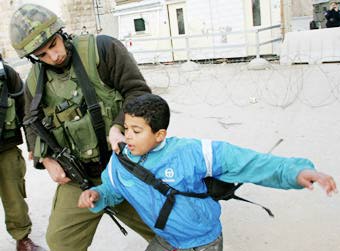
The Ahrar Center for Detainees Studies and Human Rights issued its monthly report Sunday revealing that Israel soldiers shot and killed 13 Palestinians in the West Bank and Gaza in November, while more than 374 Palestinians, including eight women, have been kidnapped.
Ahrar said that, similar to previous months, the southern West Bank district of Hebron witnessed the largest number of Israeli violations, while the army also kidnapped 95 Palestinians.
The Center stated that eight Palestinian women, including two teenagers, were among the kidnapped in Hebron. All kidnapped women, except the two young women, were released later on.
In occupied Jerusalem, soldiers kidnapped 85 Palestinians, including a journalist identified as Mohammad Abu Khdeir, who works for the Al-Quds daily; he was taken prisoner at the Ben Gurion Airport after concluding a visit to Egypt.
In Jenin, the army kidnapped 47 Palestinians, while 45 Palestinians were kidnapped in Nablus, 34 in Bethlehem, 30 in Ramallah, 18 in Qalqilia, 10 in Tulkarem, and one Palestinian has been kidnapped in Jericho.
Israeli soldiers also kidnapped nine Palestinians in the Gaza Strip, including three who allegedly tried to cross the border fence.
The Israeli Navy continued its attacks and assaults against the Palestinian fishermen in the Gaza Strip, and kidnapped four fishermen in Palestinian waters after the soldiers opened fire on them and their boats.
Soldiers also kidnapped a Palestinian patient from the Gaza Strip after he headed to the Erez terminal on his way for medical treatment at a hospital in Jerusalem. Israel granted him a permit to head to Jerusalem, but the soldiers still kidnapped him.
Ahrar added that soldiers also kidnapped a Palestinian from Gaza after he allegedly approached the border fence and “hurled a grenade” at an Israeli military vehicle.
In Jerusalem, soldiers kidnapped two Palestinian women, both teachers, and a young woman was kidnapped at an Israeli military roadblock near the northern West Bank city of Tulkarem. She is a college student from Nablus.
As for Palestinians killed by Israeli military fire in November, Ahrar said that Israeli soldiers shot and killed 13 Palestinians, including four from the Gaza Strip.
The four killed in Gaza have been identified as Rabee’ Baraka, 23, Khaled Mohammad Abu Bakra, 35, Mohammad Rashid Dawoud, 26, and Mohammad Issam Al-Qassam, 23; all were killed after the army bombarded Gaza on November 1st.
In the West Bank, detainee Hasan Toraby, 22, from the northern West Bank city of Nablus, died of cancer at the Al-‘Affoula Hospital after Israel failed to provide him with the needed medical treatment, and only moved him to hospital after having a very serious deterioration in his health condition.
On the night of November 7, resident Bashir Habaneen, 28, a university teacher from the northern West Bank city of Jenin, was shot and killed by soldiers at the Za’tara roadblock, south of the northern West Bank city of Nablus.
On the same night, Anas Al-Atrash, 22, from Hebron, was killed at the Container roadblock, near Bethlehem.
On November 26, soldiers assassinated three Palestinian from the southern West bank city of Hebron. The three have been identified as Mohammad Nairoukh, Mahmoud Najjar, and Mousa Fansha.
On November 28, Mahmoud Awwad, 24, from the central West Bank city of Ramallah, died of serious injuries he suffered in March. He was shot in the head and remained in a coma until his death.
On the same day, a Palestinian child identified as Nour Mohammad Affana, 14, died at an Israeli military roadblock as the soldiers closed the roadblock and prevented an ambulance, transporting her to a hospital in Bethlehem, from crossing.
On November 30, Israeli officers shot and killed Antar Al-Aqdra’, 24, from Qablan town, as he was working in the Petah Tikva area, north of historic Palestine. Twelve workers were taken prisoner.
Furthermore, Ahrar said that Israeli soldiers have escalated their attacks and assaults against Palestinian political prisoners, forced several detainees into solitary confinement, and denied family visits to dozens of detainees.
Palestinian researcher, former detainee and the head of the Ahrar Center, Fuad Al-khoffash, said that Israel’s violations, including deadly attacks and arrests, are ongoing, while extremist Israeli settlers carried out dozens of attacks, as part of organized assaults against the Palestinians, their lands and property, in the occupied West Bank, and occupied Jerusalem.
An unrelenting assault on the village of Deir Istiya’s farmland
International Solidarity Movement | November 28, 2013
Deir Istiya, Occupied Palestine – The village of Deir Istiya has encountered severe disruption to its agriculture and water supply since 1990 from the Israeli authorities and nearby illegal settlements. This has culminated in the Israeli army’s planned action to uproot nearly 2,500 olive trees in the very near future.
The army’s mandate to perform this action stems from a court ruling given in May 2013 that gave permission for them to cut down all olives trees in the Wadi Kana (a valley making up a large part of the village’s farmland) that are under two years old. However trees that were planted over five years ago have been included in the marking action over the last five months, a marking action typically precludes the actual uprooting process.
On the 26th of November, four men in civilian clothing marked 157 more trees across the village farmland. Before the army actually begins the action, under Israeli law, they have to inform lawyers representing the village of the date that this will commence. Although from past experience, villagers across the West Bank have not received such prior warning in similar cases. If the army succeeds with its plan, the destruction of more than 2,500 olive trees will decimate the village’s agriculture and economy, destroying the livelihoods of many of the 4,000 inhabitants of Deir Istiya.
This is the latest in a long line of aggressive acts that the Israeli government, army, courts and nearby illegal settlers have inflicted upon the people of this village. In 1990 nearby settlers deposited sewage from three separate illegal settlements into the 12 springs that provided water for the village. This water was crucial for the irrigation of the traditional crops of the village, lemon and orange trees. As water became scarce for the village, the farmers abandoned the orange and lemon crops, replacing them with olive trees due to the fact they require far less water. This is typical of the Israeli state to dramatically reduce the Palestinians methods for survival only to attempt to snatch away the small ray of hope that they have managed to build for themselves in the face of such adverse conditions.
Moreover, on the 23th of November, illegal settlers from a nearby settlement trespassed on Palestinian land in order to steal 100 meters of fencing material. The purpose of this fence was to protect a number of olive trees from pigs that have infested the area since Israeli settlers began releasing them for the exact purpose of disrupting Palestinian olive farming.
Cover not their blood
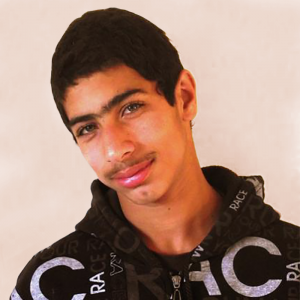
Yusuf Fahri Mussa Ahleil, 1995-2011
Yesh Din | November 24, 2013
Yusuf Fahri Mussa Ahleil, aged 16, was shot and killed on January 28th, 2011, probably by a settler. The prosecution took 14 months to appoint an attorney to the case, and eventually closed it due to lack of evidence.
Many of the posts in this blog deal with the incompetence of Israeli police investigations, and it’s possible that the death of Yusuf Fahri Mussa Ahleil, a 16-year old boy from Beit ‘Ummar, will be added to this list; but for the time being, it is a story of criminal negligence on behalf of the prosecution.
On January 28th, 2011, something happened in the village of Beit Ummar in the Hebron region. The testimonies describe an assault by Israeli civilians from two different directions simultaneously. Both incidents involved shooting; the second one ended in death. Witnesses describe a large group of Israeli civilians raiding the village, among whom three fired at the Palestinians using weapons, likely M-16 assault rifles. According to one of the witnesses, the Israelis were conducting some sort of ceremony, blew a shofar, and then opened fire. The witnesses agree that no military troops were present and that they arrived only after the shooting.
When it was all over, Yusuf Ahleil, who was on his way to help his father with his work in the field, lay dead on the ground. The testimony of the father, Fahri, is worth quoting: “I work in agriculture, and that is my main profession. During their vacations the children help me. Before I went to work [on the morning of the incident] I asked my son Yusuf to come with me to work later during the day. At some point I heard the sound of gunshots; I did not know what it was about and kept on working. And then, I don’t remember the time, some people from the village came with a vehicle and asked to take me home. I did not understand why – I refused but they insisted, took me with them and brought me back home. When we arrived, I saw that most of the village was gathered next to my house. I asked what happened? I was told, your son was shot. I said, how can that be? We agreed that he should join me at work. This is how I learned that my son, while on his way to work with me, had been wounded by the settlers.” Yusuf was shot in the head, and died.
The family filed a complaint with the police that same day. From that point onwards, our monitoring tells the story. On February 16th, 2011, the police informed us that the case was under investigation. On March 14th, 2011, it told us it received testimonies and photographs, and asked that we provide any further information we may come across. On May 2nd, 2011, the police informed us that the case had been transferred to the Jerusalem District Prosecution Office.
On June 5th, 2011, we called the Jerusalem District Attorney Office to ask which prosecuting attorney is handling the case. None had yet been appointed. We asked the same office again on August 24th, 2011, i.e. almost seven months after the incident, but the prosecution did not consider the violent death – this fact is not disputed – of a 16-year old boy as something requiring the immediate attention of an attorney. We repeated our query in September 25th, 2011. We might as well be speaking to the walls.
October 24th came and went, and the death of Yusuf still did not hinder the sleep of the prosecutors. We had reached December 15th, 2011, and the boy who had dropped dead from a bullet in his head still failed to arouse the interest of the prosecutors. On January 15th, 2012, almost a year since he had been killed, Yusuf’s prosecution file was still gathering dust. We kept on pestering, and on March 20th, 2012 – that is almost 14 months since the killing – we were informed that on this happy day a prosecutor had been assigned to the case. A week later, we tried to verify with her what steps she she had taken with the case so far. We were not dignified with an answer.
We repeated the question, to no avail, two months later. We are stubborn people, studied in the ways of banging our heads against the system’s wall, so we asked once again on July 30th, 2012 whether the prosecutors made any decision – four months since a prosecutor had been assigned to the case, and more than 18 months since the killing itself, but who’s counting. We did not receive a response.
On January 3rd, 2013, nearly two years after the killing and nine months after a prosecutor was assigned to the case, she still had no answer for us. Six months breezed by, and on August 4th, 2013, the prosecutor informed us that on July 30th, 2013, she had made the decision to close the case. The police had identified four suspects; the prosecutor closed the case against three of them for lack of evidence and against the fourth, for lack of criminal culpability.
That was the beginning of August. Since then we’ve been trying to get a hold of the investigative file so we can appeal the decision to close it. Until recently, the prosecution had failed in the rather simple job of providing us with it. There were contradictory claims as to what happened to it. The prosecution said it was sent back to the Hebron Police, which in turn said they never got it back. We are happy to report, however, that recently the file was found, photocopied, and will be reviewed by us soon.
Let’s conduct a mental experiment. Let’s say the victim is still 16 years old, still residing in the Occupied Palestinian Territories, but is not burdened with a foreign, Palestinian, name like Yussuf Alhleil; let’s say his name is something familiar, say Yossi Hebroni. Our hypothetical Yossi Hebroni was shot near a Palestinian village. Can anyone imagine that the prosecution would amble slowly to the case after 14 months? Or that it would need 16 more months to make up its mind?
The prosecution is entrusted, since Israel controls the Occupied Palestinian Territories, with protecting its residents from violence. When they are the victims of theft, it ought to bring the thief to justice. When they are killed, its duty is to bring justice for the dead.
The case of Yusuf Fahri Mussa Alhleil shows us how seriously the prosecution takes this duty. It removes another thin layer of the already crumbling patina of the claim that there is something you may refer to with a straight face as “rule of law” in the West Bank. Where the rule of law is absent, what we see is the law of nature, where the strong rule over the weak. The point of our social contract with the government is to overcome nature’s law, under which, to quote Hobbes, life is “nasty, brutish and short.” In the most gentle words possible, in Yusuf’s case – and, unfortunately, in far too many others – the prosecution has betrayed the social contract.
The result that there is the father who waits in vain for his son to return to him in the field, and killers who know that nothing will happen to them if they kill once more.
Related articles
- Israeli admits shooting at Palestinian children on TV game show (alethonews.wordpress.com)
- Nablus woman injured in hit and run vehicular assault by Jewish settler (alethonews.wordpress.com)
- Jewish Terrorism (alethonews.wordpress.com)
- Outrage as Palestinian child faces possible life prison sentence for throwing stones (gazasolidarity.blogspot.com)
- Israel to displace Palestinian community south of Hebron (altahrir.wordpress.com)
Israli admits, on game show, to shooting at Palestinian children

Zakusilo pictured on the television show (MaanImages)
By Alex Shams – Ma’an – 24/11/2013
BETHLEHEM — An Israeli soldier admitted that she shot and killed unknown numbers of Palestinian people, including children, on a Ukrainian television program that aired in early November.
Elena Zakusilo, a Ukrainian Jewish woman who moved to Israel in order to serve in the Israeli army, revealed on the Nov. 4 episode of the program “Lie Detector” that she had killed Palestinians and had shot at Palestinian children, but was unsure how many she managed to kill.
Zakusilo, who goes by the name Elena Gluzman in Israel, also explained that she trained army dogs to raid Palestinian villages and conducted video surveillance that she monitored from up to 10 kilometers away.
Zakusilo said on the show that one of the times when she shot Palestinians was during protests that broke out after Yasser Arafat died in 2004.
“It’s scary, especially when children run with Molotov cocktails, and they send children, to turn the attention to them, little kid, barely walking, 3-4 years old,” she added, explaining that she was unsure how many Palestinian children she had shot dead.
Although Zakusilo said that she was “not proud” of these acts, she blamed Palestinian mothers for sending their children to be “suicide bombers” and suggested that they did not care about their children’s lives.
Zakusilo also spoke about her work training dogs for reconnaissance missions into Palestinian villages, which involved placing headphones and cameras on them and directing them to attack Palestinians they encountered until soldiers could arrive.
“The doggy gets a little bag in teeth, it can be a video camera.”
“It has an electronic collar, and a camera that hangs on the collar, and the trainer has the remote control, and he, from a distance up to ten kilometers, can watch and give orders to the dog, to attack or not attack,” she added.
Zakusilo explained that she was a “senior trainer” and trained a total of 150 dogs, and for her work she was promoted to the rank of major.
‘Willing to go back to Israel and continue killing enemies’
Zakusilo’s mother was also present during the show’s filming, and when asked if she knew her daughter had killed people, said, “Of course, how can you be in the military without (killing).”
Zakusilo responded in the affirmative when asked by the game show host if she was “willing to go back to Israel and continue killing enemies” if she had financial difficulties in Ukraine, and said that she was unafraid of potential repercussions for revealing what she had done while in the Israeli forces.
She also explained that she goes by the name of Gluzman in Israel, “so that they won’t hear there our Ukrainian family name, and with the other name (Gluzman), with Jewish roots, they’d treat (me) differently.”
Zakusilo added that while at first she hesitated to kill people, she came to see her fellow soldiers as “family,” and they helped her come to terms with killing Palestinian children and other feelings she had.
Referring to her commander, she said, “He is a general, he tells you to go and shoot like this, so you go. But if you come to him and say, just for example, you know, I was walking down the road, and there was a kitten there, ran over by a car, or a person hit, and I feel bad.”
“He will sit with you for an hour to talk, and try to understand why you feel bad.”
The transcript of the television show was uploaded by Palestinian activist Abir Kopty on her blog, and although the video is freely available on the television show’s website, the translation could not be independently verified by Ma’an.
‘Because we’re human, we get shocked by people who kill’
Kopty, the Palestinian blogger who found the video and posted it, explained that she was “shocked,” but not surprised by Zakusilo’s comments.
“We see and hear this all the time and we know it first hand but it’s always shocking. Because we’re human, we get shocked by people when they talk about killing.”
She also explained that the “case represents a wider phenomenon,” and that it shows what “the military does this to people – it disconnects them from their own humanity, and makes it so easy to kill people and do not even remember the number.”
“The Israeli military will probably either discredit her, or justify her actions or say, as always, it’s an individual case” in order to explain it, she argued.
“This case represents the way they act.”
Kopty said that individual Israelis had responded or commented on the piece repeating the Israeli army’s “mantra” justifying what she says, in order to absolve the Israeli forces as a whole of responsibility.
“The machinery of propaganda always works, and they try to justify everything,” she said.
“I really hope, that one day all these criminals face trial.”
An Israeli army spokeswoman could not immediately confirm whether Zakusilo had served in the Israeli forces when contacted over the weekend.
Amnesty International’s 2013 report on Israel and the Occupied Palestinian Territories highlighted the lack of accountability for Israeli soldiers’ crimes against Palestinian civilians, pointing out that, “The authorities again failed to independently investigate killings of Palestinian civilians by Israeli soldiers in the West Bank and Gaza or to prosecute those responsible.”
The Israeli organization Breaking the Silence has collected 700 testimonies of Israeli army veterans, documenting a culture of widespread mistreatment and dehumanization of Palestinians among Israeli soldiers.
The internationally recognized Palestinian territories of which the West Bank and East Jerusalem form a part have been occupied by the Israeli military since 1967.
Related articles
- Report: Hundreds of European mercenaries in the ranks of the Israeli army (occupiedpalestine.wordpress.com)
- Israeli soldiers shoot, wound four Palestinians: medics (dailystar.com.lb)
Nablus woman injured in hit and run vehicular assault by Jewish settler
IMEMC & Agencies | November 20, 2013
Palestinian medical sources have reported that a Palestinian woman was wounded after being rammed by a speeding vehicle of an Israeli settler, near the northern West Bank city of Nablus on Tuesday.
The sources said that Shamsa Sharif, 60 years of age, was moved to the Rafidia Hospital in Nablus, suffering moderate but stable injuries.
Sharif is from Huwwara village, south of Nablus. The settler fled the scene after the incident.
There have been numerous similar hit-and-run incidents in different parts of the occupied West Bank, mainly in the Hebron district in the southern portion of the West Bank.
On November 19, 2013, a young woman identified as Zeina Omar Awad, 21, was injured after being rammed by a settler’s vehicle at the main entrance of Beit Ummar. She suffered cuts and bruises, while the settler fled the scene.
On October 16, 2013, an elderly Palestinian man was seriously injured after being hit by a settler’s vehicle in Al-Fondoq village, east of Qalqilia, in the northern part of the West Bank.
On September 29, 2013, a Palestinian worker was injured after being rammed by a settler’s vehicle, near Husan town, west of the West Bank city of Bethlehem.
On September 20, a Palestinian man was injured in a similar accident with an Israeli settler who fled the scene.
A week before the incident took place, Palestinian child was severely injured after being hit by a settlers’ vehicle as she was walking home from school in Teqoua’ village, near the West Bank city of Bethlehem.
The child Hayat Mohammad Suleiman, 8 years of age, was walking back home from school on the main road that is also utilized by Israeli settlers living in illegal Israeli settlements in the region.
Related articles
- Elderly man seriously injured by speeding Jewish settler in hit and run assault (alethonews.wordpress.com)
- Dozens injured after jewish terrorists attack Palestinian villagers nr. Nablus (uprootedpalestinians.wordpress.com)
Israeli forces destroy water tank, agricultural facility in West Bank village
Al-Akhbar | November 20, 2013
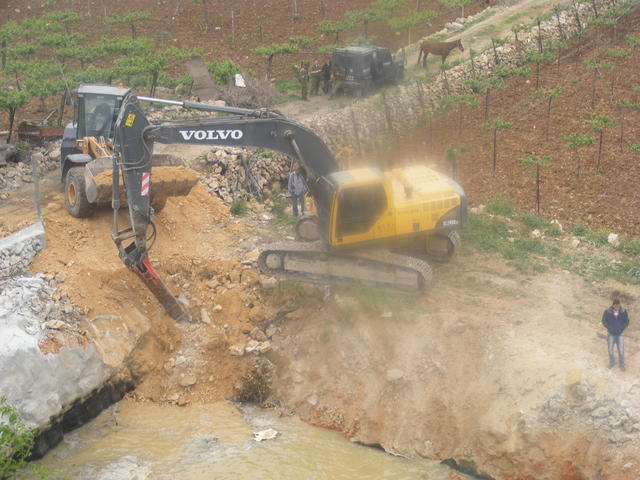
Israeli forces demolished a water tank and an agricultural structure in a West Bank village near Nablus on Wednesday, a local official said.
Deputy mayor of Aqraba Bilal Abdul-Hadi told Ma’an news agency that three bulldozers escorted by seven military vehicles stormed the neighborhood of al-Taweel and began demolishing the structures, claiming they were built without authorization.
Shaddad Attili, who heads the Palestinian Water Authority, said the World Bank, the United Nations and other international organizations have issued reports condemning Israel’s attacks on Palestinian water rights.
“Israel controls all the water resources in the occupied West Bank. It exploits these resources for near exclusive Israeli use, allocating a mere fraction of the available water supply to Palestinians,” Ma’an quoted Attili as saying. “While Israelis enjoy some of the highest water consumption rates in the world, Palestinians continue to face a series of crippling water shortages artificially engineered by Israel as a matter of policy.”
 The official added that Israel used water to target vulnerable Palestinian communities.
Israel has destroyed more than 558 Palestinian properties in the West Bank and East Jerusalem since the beginning of this year, displacing 919 people, according to the UN Office for the Coordination of Humanitarian Affairs.
Between 2009 and 2011, Israel’s military destroyed 173 water, sanitation and hygiene structures in the West Bank including 40 wells, 57 rainwater collection cisterns and at least 20 toilets and sinks, OCHA reported.
A 2012 report by the Emergency Water, Sanitation and Hygiene group slammed Israel’s policies towards water and sanitation facilities in the West Bank, saying their extensive destruction was in contravention of international law.
(Ma’an, Al-Akhbar)
Related articles
- Israel to displace Palestinian community south of Hebron (altahrir.wordpress.com)
- Israeli Forces Open Fire On West Bank Protests, Injuring Dozens (eurasiareview.com)
- LA Times – Israel’s policy of erasure (iajv99.wordpress.com)
Israeli military detains driver, confiscates vehicle donated for transport of schoolchildren in South Hebron Hills
CPTnet | November 19, 2013
On 18 November 2013 at 11:00, Mufid Abu Qbeita—the driver for the students who live in the South Hebron Hills area that the Israeli military has designated as “Firing Zone 918”—was driving children back to their homes from Al Fakheit school. Israeli Security Forces and representatives of the Israeli Civil Administration stopped him near Al-Sfai, one of the villages in the Firing Zone, while he had six children in the car.
Soldiers took his ID and detained him for thirty minutes; afterwards, they told him to follow them to Gush Etzion Police Station. Two soldiers accompanied Abu Qbeita in the car. He had to leave all six children in Al-Sfai.
Abu Qbeita informed the soldiers that the jeep belonged to the Palestinian Ministry of Education and was donated by Japan, but they still forced him to drive to the settlement of Gush Etzion. After several hours, they released him, but the jeep remains at the police station. When Abu Qbeita asked why the soldiers had confiscated the jeep, they answered, “Because you were driving in the firing zone of the South Hebron Hills which is not allowed.”
CPT, EAPPI and Operation Dove take turns accompanying Abu Qbeita and the SUV from the city of Yatta into the Firing Zone during the week, in order to prevent incidents like the above occurring, but until recently, once in the zone, he had not faced problems. On 27 October, eight Israeli soldiers detained him, verbally abused him, and then beat him on his abdomen, face, and back. Afterwards, they forced him drive over spikes used to stop vehicles at army checkpoints to puncture the SUV’s tires.
Related articles
- SOUTH HEBRON HILLS: Despite court order, Israeli military intimidates villagers in ‘Firing Zone 918′ (alethonews.wordpress.com)
- Israel to displace Palestinian community south of Hebron (altahrir.wordpress.com)
- Israeli forces assault Palestinian school bus driver near Hebron (altahrir.wordpress.com)
- Israeli military rules that mock attacks in Palestinian villages are acceptable (imemc.org)
- Military Training Amid Villages in South Hebron Hills (alethonews.wordpress.com)
Soldier killed in Occupied Palestine as Israel calls for “intelligent” settlements
Al-Akhbar | November 13, 2013
A 16-year-old Palestinian stabbed an Israeli soldier to death on a bus on Wednesday in an attack apparently motivated by the jailing of his relatives in Israel, police said.
The death came as Israel backtracked on an announced plan to expand illegal settlements in the West Bank, calling for “intelligent and coordinated” construction despite international condemnation.
The killing, in the town of Afula in Occupied Palestine, follows a surge in violence in the West Bank, where 10 Palestinians have been shot dead by Israeli troops and three Israelis killed since peace talks resumed in July.
Israel’s northern police commander, Ronny Attia, said the attacker was from the West Bank town of Jenin, and that he was in custody.
According to police, the Palestinian youth did not have a permit to be inside Israel.
“By his account, his uncles are in prison in Israel and this is the reason he decided to carry out the terrorist attack,” Attia said.
Israel refers to many acts of protest against the decades-long occupation – whether violent or non-violent – as terrorism.
Police spokesman Micky Rosenfeld said the soldier, aged 18, was pronounced dead in hospital.
The attack occurred a day before the one-year anniversary of the Israeli Pillar of Cloud offensive on Gaza, in which six Israelis and more than 100 Palestinian civilians were killed in eight days.
Peace talks orchestrated by US Secretary of State John Kerry have faced serious obstacles, including the high rate of Palestinians incarcerated in Israeli prisons, many in indefinite administrative detention, as well as extensive plans to expand Israeli settlements in the West Bank.
A report by British newspaper The Guardian on Tuesday revealed that Israeli troops conducted mock arrests and raids in the West Bank without informing the local population that their actions were drills, causing extreme distress to many Palestinians.
The attack came as Israel’s Intelligence Minister Yuval Steinitz urged “coordinated” settlement building, a day after a new plan for settler homes in the West Bank drew international condemnation.
Settlements in Israeli-annexed east Jerusalem and the West Bank “must be done in an intelligent and coordinated way,” Steinitz told Israeli public radio on Wednesday.
The settlements are deemed illegal under international law.
Israeli Prime Minister Benjamin Netanyahu late Tuesday cancelled plans to build 20,000 new settler homes in the West Bank, hours after their announcement sparked US and Palestinian criticism.
State Department spokeswoman Jennifer Psaki had said Washington was not only concerned by the initial announcement, but also “surprised” and sought an explanation from Israel.
She repeated the longstanding US position on settlements that “we do not accept the legitimacy of continued settlement activity.”
Netanyahu then ordered Israeli Housing Minister Uri Ariel “to reconsider all of the steps for evaluating planning potential (for the settler homes) that he distributed without any advance coordination,” the premier’s office said.
(Reuters, AFP, Al-Akhbar)
Related video
Two Broken Cameras
By Yossi Gurvitz | November 11, 2013

Israeli soldiers try to arrest Activestills photographer Yotam Ronen, as Palestinian and international activists block 443 highway, which connects Tel Aviv and Jerusalem through the West Bank, during a protest against the violence of the Israeli settlers, October 16, 2012.
One morning last September, Nadel Shafiq Taher Shatiya heard the loudspeakers of the mosque in his village, in the Nablus region, announce that settlers were approaching the village’s land. Shatiya, a photojournalist by trade, grabbed two cameras and raced to the scene.
Based on his account, it turns out that when he arrived, several tractors and settlers – who, according to the reports received by Shatiya, came from thenearby Elon Moreh settlement – were trying to plough the village’s lands while several dozen Palestinian farmers tried to expel them. A settlement security vehicle showed up, and two settlers stepped out of it (Shatiya believes he can identify them), and started shooting live ammo at the farmers. Some of them took cover; Shatiya kept taking photos. That’s his job.
About ten minutes later, a large IDF force arrived at the scene, and did what it usually does: joined the settlers. The soldiers fired tear gas canisters and stun grenades at the farmers, and as the area is full of dry thorns, a fire broke out. The Palestinian farmers tried to put it out, and the two armed settlers demanded that the troops stop them (Yours truly was present for another incident, in which IDF soldiers fired at Palestinians who tried to put out a fire which had erupted after a demonstration due to canister fire.) The soldiers confronted the Palestinians, and Shatiya saw – and documented – one of the soldiers pull out a knife and threaten one of the farmers.
Our brave troops don’t know how to deal with nonviolent resistance. Major General (res.) ‘Amon Gilad became famous abroad when he told the American embassy “we don’t do Ghandi very well.” In such cases, the IDF’s instinct is to use excessive force. It makes for bad publicity, and the soldiers know that – so they try to suppress the evidence.
Shortly after Shatiya photographed the knife-wielding soldier, other soldiers assaulted him and took his cameras and camera bag from him. He witnessed another soldier tearing a phone out of the hands of a farmer, who was using it to document the incident; the farmer was beaten and detained.
So far, no surprises. Anyone who has either served in the West Bank or demonstrated there is familiar with the loving care the soldiers lavish on photographers. But in Shatiya’s case, the story underwent an unusual twist: the soldiers took his cameras to an officer, who turned them over, along with his camera bag, to a settler. Shatiya protested to the officer, saying “you’re in charge of security, and if, as part of your duty, you want to confiscate the cameras, keep them; why do you give them to the settler?” In return, the officer blamed Shatiya for the fire. Later on, Shatiya saw a settler moving among the detained Palestinians, telling the soldiers who should be kept in detention.
Turning the cameras over to the settler caused some fuss, with Israeli DCO officers telling the army it had no authority to detain journalists or confiscate their cameras, that only policemen may do so. This is inaccurate, by the way: in the West Bank soldiers have the same authority as cops, until the latter reach the scene. The Military Commander is the sovereign in the West Bank, as it is legally considered to be held under belligerent occupation; the police only act in the West Bank because they have been delegated that authority by the Military Commander. In the end, several officials promised Shatiya he’d get his cameras back, but afterwards they simply ignored and then began avoiding him.
Some 12 days after the incident, the Israeli DCO contacted the Palestinian DCO, and informed the latter Shatiya could come and retrieve his cameras. He found them broken and rubbed with sand. The damage to the cameras is estimated at 21,000 NIS (about 6,000 USD). That’s what happens when you try to document the most moral army between the Jordan and the Mediterranean while it fails to move into Ghandi mode.
So, to sum it up, we’ve had settler violence, immediately backed up by the army; the destruction of evidence by soldiers, using a settler for this purpose; yet another example of problematic cooperation between soldiers and settlers, where a settler tells soldiers who to detain and they obey, and, finally, another example of the security forces in the West bank misunderstanding their role. There’s a strain of thinking in Israel, particularly among the center and on the left, which says that the problem in the West Bank is the settlers, and that the soldiers are not at fault.
But the soldiers know full well that they are at fault – Had they felt no guilt, they wouldn’t have felt the need to destroy evidence, and they would neither have broken the farmer’s cell phone nor given Shatiya’s cameras to a settler, in order to rid themselves of responsibility for taking the cameras away from him. In the West Bank, the soldiers and the settlers are part of the same pattern, the pattern of an occupation whose inner logic is annexation by a quiet population transfer of the Palestinians.
Yizhak Shamir, an Israeli prime minister, once said that one is allowed to lie for Eretz Israel (the ‘Land of Israel”). The IDF soldiers take this one step further: in the name of Eretz Israel, they destroy evidence and intimidate journalists and innocent civilians.
Related video
Featured Video

Deception – Submarines against Olof Palme
or go to
Aletho News Archives – Video-Images
From the Archives
Woolsey Fire started at Santa Susana Field Lab — where “radioactive materials released were never accurately measured”
By John Laforge | CounterPunch | November 30, 2018
In my Nov. 16 column, I reported on potential radiation risks posed by California’s Woolsey wildfire having burned over parts or all of the Santa Susana Field Laboratory—south of Simi Valley, Calif., 30 miles outside Los Angeles—site of at least four partial or total nuclear reactor meltdowns.
The field laboratory operated 10 experimental reactors and conducted rocket engine tests. In his 2014 book Atomic Accidents, researcher James Mahaffey writes, “The cores in four experimental reactors on site … melted.” Reactor core melts always result in the release of large amounts of radioactive gases and particles. Clean up of the deeply contaminated site has not been conducted in spite of a 2010 agreement.
Los Angeles’s KABC-7 TV reported Nov. 13 that the Santa Susana lab site “appears to be the origin of the Woolsey Fire” which has torched over 96,000 acres. Southern Calif. Public Radio said, “According to Cal Fire, the Woolsey Fire started on the afternoon of Thursday, Nov. 8 … on the Santa Susana site.” … continue
Blog Roll
 Aletho News
- Dr. Abu-Sitta: Beirut ‘felt like a day in Shifa Hospital’
- Iran Has Won the War, It Will Be Up to the US to Secure the Peace: Mohammad Marandi
- Iran condemns assassination threats against Iranian negotiators amid US talks
- Brussels cannot say where its own pipeline inspectors are as Hungary’s oil lifeline remains shut
- Israel’s Iran War: Myth and Reality
- Between war and industrial breakdown: The US-Israeli attrition crisis
- Pressure builds on Iran to ‘drop’ Lebanon ceasefire demand as Islamabad talks hang in balance
- In another clash report, US denies agreement to release Iran’s assets
- What is fueling unrest across the EU?
- Why no power can undermine Iran’s eternal dominance over the Strait of Hormuz
- If Americans Knew
- Pro-Israel ‘Thinktanks’ and Individuals who Influence U.S. Foreign Policy
- Mearsheimer reveals how Israel dictates US policies on Iran, Gaza – video
- After killing 350+, Israel still has a “score to settle” with Lebanon before ceasefire – Daily Update
- Military aid to Israel emerges as the latest political litmus test for Democrats
- The only Palestinian children’s rights organization closes following years-long Israeli campaign against it
- ‘I Can’t Forget the Smell’: Lebanese Reel After Israel Kills Over 300 in Single Day
- DNC Shoots Down Resolutions Calling Out AIPAC and Limiting Arms to Israel
- TCN: Is Israel Blackmailing President Trump?
- Israel killed at least 303 Lebanese yesterday – who were they? Daily Update
- Amnesty: Urgent – Protect Lebanese civilians from brutal escalation in Israeli attacks
- No Tricks Zone
- German Expert: Heat Dome Led To Record Temps In Western USA…Warmer In 1934, 1936
- New Study: No Linear Warming Or Glacier Retreat Along Northern Antarctic Peninsula Since 1980s
- An Inconvenient Tree: Uncovered In Alps… Europe Much Warmer Than Today 6000 Years Ago
- New Study Reports A 60% Slowdown In Greenland’s Ice Loss Rate In The Last Decade
- Low Intensity Tornado Wrecks Major Solar Farm, Creating A Potential Toxic Dump
- New Study Finds Warming Saves Lives…Cold Temperatures 12 Times More Deadly Than Excess Heat
- German Science Blog Accuses PIK Climate Institute Of Hallucinating Climate Tipping Points
- Devastating Assessment Of Comirnaty Vaccine By Former Senior Pfizer Europe Toxicologist
- New Study: CO2 Is ‘Effectively Negligible’ As An Explanatory Climate Change Factor Since 2000
- Former Pfizer Toxicologist Dr. Helmut Sterz Tells Bundestag Hearing Pfizer Vaccine Should Have Never Been Approved
 Aletho News