Latin American Revolutions Under Attack
By ANDRE VLTCHEK | CounterPunch | June 26, 2015
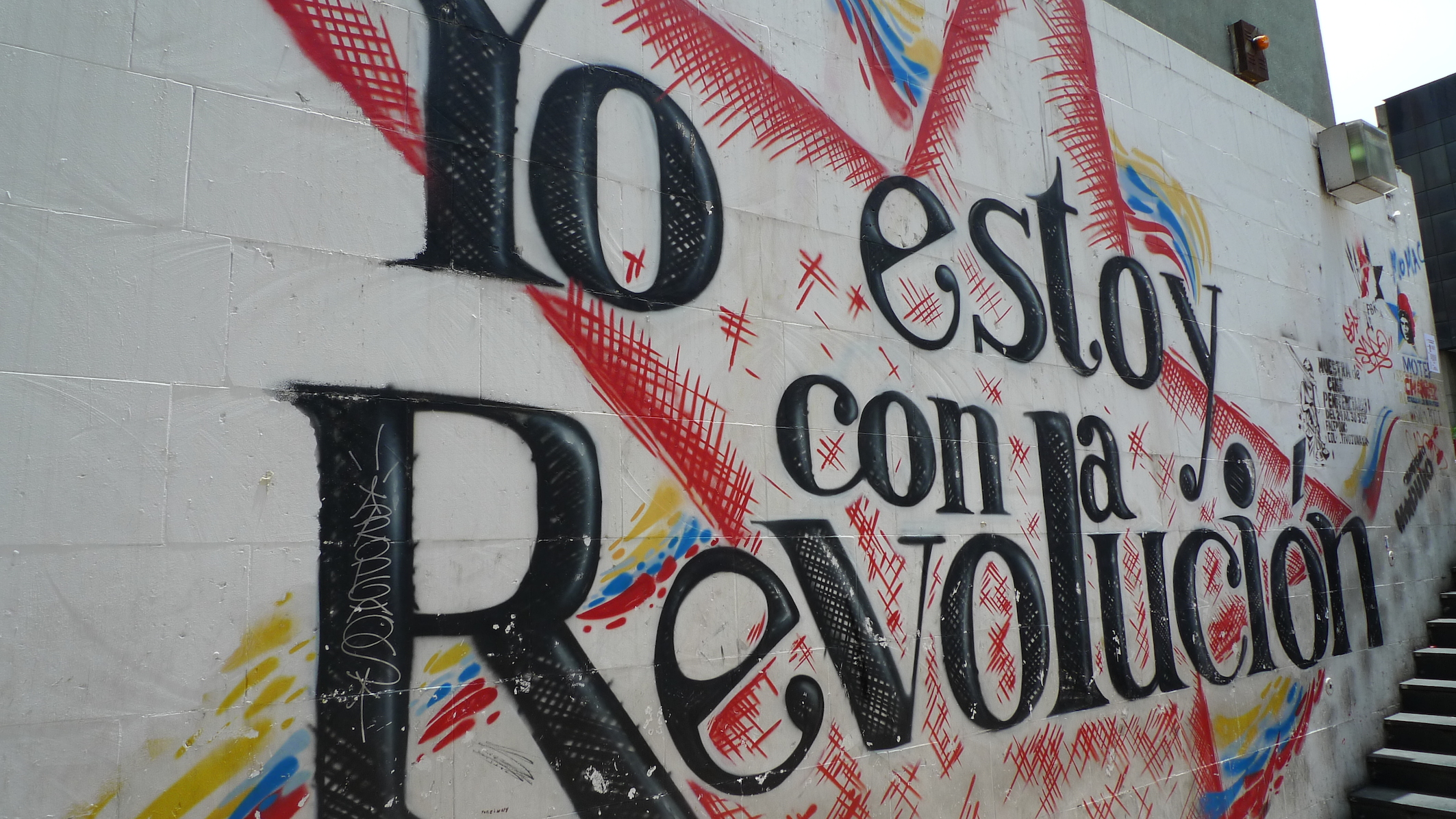
Do not take the Latin American revolutions for granted.
They inspired the entire Planet. They brought hope to every corner of our scarred Earth. But now they are themselves in need of our support.
If left alone, they would thrive for decades and centuries. But the Empire is once again on the offensive. It is shaking with fury. It is ready to invade, to smash, burn to ashes all the hopes, all that which had been achieved.
Don’t believe in the “common wisdom” which proclaims that the rulers of the world simply “closed their eyes” more than a decade ago; that George W. Bush was “too busy” ravishing the Middle East, therefore “allowing” most of the Latin American countries to “sneak away” from the iron grip of the Empire.
Such “analyses” are as patronizing as they are false. The Empire never sleeps! What Latin America now has was built on its daring, its sweat, its genius and its blood – it fought against the Empire, courageously, for decades, losing its best sons and daughters. It fought for freedom, for justice and socialism.
The Empire was not “looking the other way”. It was looking straight south, in fury, but for some time it was too confused, too astounded, too shocked at what it was witnessing. Its “slaves” had risen and taken power back into their own hands. They showed to the entire world what freedom really is.
For some time, the Empire was paralyzed by rage and unable to act.
The Empire’s undeniable property, Latin America, inhabited by “un-people” born only in order to supply cheap labor and raw materials to the rich part of the world, was suddenly, proudly and publicly, breaking its shackles, declaring itself free, demanding respect. Its natural resources were now used to feed its own people, to build social housing, create public transportation systems, construct hospitals, schools and public parks.
But after the first wave of panic, the Empire began to do what it does the best – it began the killings.
It attempted to overthrow Venezuelan government in 2002, but it failed. The Venezuelan people rose, and so did the Venezuelan military, defending then President Hugo Chavez. The Empire tried again and again, and it is trying until now. Trying and failing!
“We are at war”, I was told by one of the editors of Caracas-based television network, TeleSUR, for which I made several documentary films. “We are literally working under the barrel of cannon”.
***
Ms. Tamara Pearson, an Australian revolutionary journalist and activist, who recently moved from Venezuela to Ecuador, explained the difficult situation in Venezuela, a country that is under constant attack from both the US, and the local comprador elites:
“People are suffering a lot. Basic food prices are high, much medicine is unavailable, and various services aren’t working. On one level, people are used to this – the business owners would cause shortages and blame the government before each of the many elections. But usually it’s less intense and lasts just a few months. But this has been going on and getting worse, since Chavez died – over two years now. There is no doubt that the US, and more so, Venezuelan and Colombian elites and business owners are a huge or even the main factor…”
All of revolutionary Latin America is “screaming”.
As I described in two of my recent books, “Exposing Lies Of The Empire” and “Fighting Against Western Imperialism”, the Empire is using similar destabilization strategy against all countries that are resisting its deadly embrace.
Its propaganda is mighty and omnipresent. CNN and FOX TV are beamed into almost all major hotels and airports of Latin America, even in some revolutionary countries like Ecuador. Almost all major newspapers of the continent, including those in Venezuela, Ecuador, Chile and Argentina, are controlled by the right wing business elites. Almost all of the foreign news coverage comes from European and North American sources, making the Latin American public totally confused about Islam, China, Russia, South Africa, Iran, even about their own neighbors.
The local elites continue to serve foreign interests, their loyalties firmly with North America and Europe.
Every left wing Latin American government has been facing bizarre protests and subversion actions conducted by the elites. Destabilization tactics have been clearly designed in far away capitals. They were mass-produced and therefore almost identical to those the West has been using against China, Russia, South Africa, and other “rebellious” nations.
Propaganda, disinformation and spreading of confusion have been some of the mightiest tools of the fascist right wing.
“Economic uncertainty” is an extremely powerful weapon. It was used first in Chile, in the 1973 coup against socialist President Salvador Allende. Pro-Western Chilean elites and businessmen created food shortages, and then blamed it on the socialist government, using El Mercurio and other daily newspapers as their propaganda tools.
Peter Koenig, former World Bank economist and now prominent dissident and critic of the world neoliberal regime, wrote for this essay:
Today Madame Bachelet, the socialist President of Chile has a hard time fighting against the Mercurio inspired Chilean oligarchs. They will not let go. Recently they invited the World Bank to assess the school reform package proposed by Bachelet, basically to return universities to the public sector. Of course, the ‘upper class’ of Chileans knew that the World Bank would come up with nothing less than predicting an economic disaster if the reform is approved. As a result, Bachelet made concessions – which on the other hand are not accepted by professors and teachers. It’s the first step towards chaos – and chaos is what the empire attempts to implant in every country where they strive for ‘regime change’.
But one of the “dirtiest” of their weapons is the accusation of corruption. Corrupt pro-Western politicians and individuals who misused tens, even hundreds of millions of dollars of the peoples money and destroyed the economies of their countries by taking unserviceable loans that kept disappearing into their deep pockets, are now pointing their soiled fingers at relatively clean governments, in countries like Chile and Argentina. Everything in “Southern Cone” and in Brazil is now under scrutiny.
Peter Koenig (who co-authored a book “The World Order and Revolution!: Essays from the Resistance” with leading Canadian international lawyer Christopher Black and me) shows how important it is, for the Empire, destabilization of Brazil, one of the key members of BRICS:
Brazil being a member of the BRICS is particularly in the crosshairs of the empire – as the BRICS have to be destabilized, divided – they are becoming an economic threat to Washington. Brazil is key for the non-Asian part of the BRICS. A fall of Brazil would be a major blow to the cohesion of the BRICS.
There are totally different standards for pro-Western fascist politicians and for those from the Left. The Left can get away with nothing, while the Right has been getting away literally with mass murder and with the disappearance of tens of billions of dollars.
It is, of course, the common strategy in all the client states of the West. For instance, one of the most corrupt countries on earth, Indonesia, tolerates absolute sleaze and graft from former generals, but when progressive socialist Muslim leader, Abdurrahman Wahid, became the President, he was smeared and removed in a short time, on “corruption” charges.
After centuries of the Monroe Doctrine, after mass murder committed in “Latin” America first by Europeans and then by North Americans and their rich local butlers, it will take long decades to fully eradicate the corruption, because corruption comes with the moral collapse of the colonial powers and the local elites. Financial greed is only its byproduct.
The great pre-colonial cultures of what are now Peru, Ecuador and Bolivia did not have corruption. Corruption was injected by Western colonialism.
And now, corruption under left wing, revolutionary governments still exists, since it is difficult to root out all the rats at once, but it is incomparably smaller than under the previous fascist right wing cliques!
***
The rich in Latin America are heartless, servile (to the Empire) and greedy in the extreme. Latin America has still the most unequal distribution of wealth on earth. True, it is much richer (and even its poor are richer, with some exceptions of Central America, Peru or Paraguay) than Africa or even in Southeast Asia, but this cannot be used as an excuse.
Even the most progressive socialist governments now in power would ever dare to touch, to slap the private enterprises too hard. From this angle, China with its central planning and controlled economy is much more socialist than Ecuador or Bolivia.
A few days ago, as I was flying from Ecuador to Peru, I read that the number of multimillionaires in Latin America was actually increasing, and so is the social gap between the rich and the rest of the societies. The article was using some anecdotal evidence, saying that, for instance, in Chile alone, now, more Porsche sports cars are sold than in the entirety of Latin America few years ago. As if confirming it, I noticed a Porsche auto dealership next to my hotel in Asuncion, the capital of the second poorest country in South America. I asked for numbers, but the Porsche manager refused to supply them, still proudly claiming that his company was “doing very well”.
So what do they – the “elites” – really want? They have money, plenty of money. They have luxury cars, estates in their own countries, and condominiums abroad. What more?
As in Thailand, Philippines, Indonesia or Kenya, and all over the West, they want power. They want to feel unique. They want to be admired.
The Socialist governments allow them to stay rich. But they force them to share their wealth and above all, they shame them. They are also trying to minimize the gap – through education, free medical care and countless social projects.
That is, of course, unacceptable to the elites. They want it all, as they always had it. And to have it all, they are ready to murder, to side with the darkest foreign interests, even to commit treason.
***
Increasingly, the interests of the local elites are very closely linked to foreign interests – those of the Empire and those of the private sector.
As I was told in Ecuador, by Ms. Paola Pabón, Assembly Member representing Pichincha area:
Behind the involvement of the US, are some ex-bankers such as Isaiah brothers, who lost power here, escaped courts and went to live in the United States, but there are also huge economic powers such as Chevron. It means that there are not only political interests of the US, but also private, economic ones.
Predominantly, the local elites are using their countries as milking cows, with very little or zero interest in the well being of their people.
That is why their protests against Latin American revolutions are thoroughly hypocritical. They are not fighting for improvements in their countries, but for their own, selfish personal interests. Those shouts and the pathetic hunger strikes of the “opposition” in Venezuela may appear patriotic, but only thanks to propaganda abilities to the Western mass media.
The elites would do anything to make all revolutions, all over Latin America, fail and collapse. They are even spending their own money to make it happen.
They know that if they manage to remove progressive forces from power, they could rule once again, totally unopposed, as their counterparts do in all other client states of the West – in the Middle East, Africa, South and Southeast Asia, and Oceania.
The temptation is tremendous. Most of the elites in Latin America still remember well, how it feels, how it tastes – to control their countries unopposed, and with full support from the West.
***
Eduardo Galeano, the great Uruguayan writer and revolutionary thinker, once told me: “I keep repeating to all those new leaders of Latin America: “Comrades, do not play with poor people’s hopes! Hope is all they have.”
It appears that hope has finally been takes seriously, in Bolivia, Uruguay, Venezuela, Ecuador, Chile, Argentina, Brazil, Nicaragua and elsewhere.
It was also taken seriously in Honduras, but hope was crushed by the US-orchestrated coup. In Paraguay, under a semi-progressive priest who preached liberation theology, hope was taken semi-seriously, but even that was too much in the country that had been ruled, for decades, by fascist cliques. In 2012, a constitutional coup followed by an appalling massacre of predominantly indigenous people, and fascism returned.
After these two setbacks, Latin America shook, but kept moving forward. Hugo Chavez died, or was murdered by the North, depending which theory you subscribe to. His demise was a tremendous blow to the entire continent, but still, the continent kept moving. “Here, nobody surrenders!” Chavez shouted, dying, but proud.
“President Correa of Ecuador is one of very few leaders of the “original project””, said Paola Pabón. “Lula in Brazil will not be able to stand for reelection, anymore, mainly due to corruption scandals. Mujica is not in power, anymore, and Cristina Fernandez will be retiring. Evo Morales does not have regional influence, and even Maduro does not have… For this reason, Ecuador is so important, strategically. If ‘they’ hit us, if there is a successful coup, it would be tremendous victory for them, to destroy a President with regional importance; who speaks for the region… and also, because Ecuador is one country where the government actually functions well.”
Walter Bustos, who used to work for this government, is alarmed by developments in Ecuador and the entirety of Latin America. Both he and Paula Pabón realize how fragile the Latin American revolutions are. While driving with me to an indigenous area of Riobamba, Walter lamented:
In case there is a military coup in Ecuador, the difference between here and Venezuela would be enormous: while in Venezuela, Chavez incorporated the military into his revolution, in case of citizens revolution in Ecuador, we have no security; we cannot count on support of the military in case there is some armed, political or economic attack against us.
Hugo Chavez was not only a great revolutionary, but also a tremendous strategist. He knew that any great revolution has to be fought, won, and then defended. Winning the battle is never enough. One has to consolidate forces, and uphold the victory. Chavez was first thinker, and then soldier.
Correa, Morales, Fernandez go forward, brave, proud but unprotected. Under their governments, the lives of ordinary people improve tremendously. That is what matters to them. They are decent and honest beings, unwilling to dirty themselves with intrigues, speculations and conspiracy theories.
But their great success will not gain them any recognition from the Empire, or from their own elites. The success of socialism is the worst nightmare for rulers of the world and their local butlers.
This is how President Salvador Allende died in 1973. He dismissed all rumors, and then all warnings that the coup was coming. “I am not going to arrest people just because of some suspicion that they may do something”, he used to say. After the coup took place, he died proudly, a true hero, committing suicide by marching towards the helicopter gunships and fighter jets that were bombarding the Presidential Palace of La Moneda. But he was not the only victim. As a result of the coup, thousands of Chilean people died, and tens of thousands were savagely tortured and raped. Chile did not die, but went into a horrific coma, from which it only recently manages to recover.
Henry Kissinger summarized the moral corruption/collapse of his country’s regime when he uttered his memorable phrase:
I don’t see why we need to stand by and watch a country go communist due to the irresponsibility of its people. The issues are much too important for the Chilean voters to be left to decide for themselves.
Despite his great intentions, President Salvador Allende failed his people. He underestimated the bestiality of the Empire, and the result were millions of broken lives.
Since then, the Empire’s selfishness and brutality only evolved. The more successful leaders like Correa become, the more real is the danger of a coup – of a devastating, deadly attack from the North, and subversion from within.
The fragility of Latin American revolutions is obvious. The elites cannot be trusted. They showed on many occasions how far they are willing to go, committing treason, collaborating with the West against their own nations: in Chile, Peru, Colombia, Mexico, Honduras, Venezuela, Paraguay and Bolivia, to name just a few cases.
Appeasing both the elites and the Empire, while fighting for social justice and true independence, is impossible. The elites want to have full control of their countries, while the Empire demands full submission. No compromise could be reached. The history speaks clearly about that. And the Empire demonstrated on countless occasions that Latin American democracy would be respected only if the people vote the way that suits Washington.
Latin America has to learn how to defend itself, for the sake of its people.
Its closer and closer cooperation with China and Russia is essential. A coherent regional defense agreement should follow.
The next few years will be crucial. The revolutions have to be institutionalized; they cannot depend only on charisma of its leaders.
Constant sabotages and coup attempts, like those in Venezuela, should not be tolerated. They lead to chaos and to uncertainty. They break countries economically and socially.
It is clear what the Empire and its servants are doing: they are trying to push Latin American revolutionary countries against the wall, as they pushed, in the past, North Korea. They are trying to make them “react”, so they could say: “You see, this is true socialism, this defensive, hermitic and paranoid system.”
The path will not be easy. It will be dangerous and long.
Latin America can only survive through international cooperation and solidarity. It would also have to fight legally, at home and abroad. Those who are committing treason and those who are interrupting development of the country should face justice.
The left wing governments that are ruling South American countries won democratic elections: much more democratic than those in Europe and the United States. If the individuals and groups act against the expressed will of their own people, they should be taken to courts.
If a powerful country tortures other countries and shows total spite for their people, it should face an international legal system. The United States demonstrated, countless times, that it considers itself well above the law. It even forced several government in Latin America and elsewhere, to give its military personnel immunity. One of these countries is Paraguay, historically flooded with CIA, DEA and FBI agents.
In order to legally restrain the Empire, huge international pressure would have to be built. Like in the case of Managua, which legally sued the US for many acts of terror committed against Nicaragua. The Empire will most likely refuse to accept any guilty verdict. But the pressure has to be on!
All this would be meaningless without dedicated, constant coverage of the events by independent or opposition media, be they huge new state-funded networks like RT, TeleSur, CCTV or Press TV, of progressive independent media like Counterpunch, VNN, or ICH. It is essential that Latin Americans demand information from these sources, instead of consuming the toxic lies spread through CNN en Español, FOX, EFE and other right wing Western sources.
The battle for the Latin American people and for their freedom is on. Do not get fooled, it has been on for quite some time, and it is very tough fight.
Latin America is one of the fronts of the integrated fight for the survival of our Planet.
People who admire this part of the world, all those who have been inspired by Latin American revolutions, should participate in the struggle.
The best sons and daughters of this continent are now fighting in their own, quixotic way, as they always did: frontally, with exposed heart, totally unprotected. But their fight is just, and they are in this battle in order to defend the people.
Their opponents are rich, deceitful and brutal. But they are also selfish and they fight only for their own interests. They are not loved by their nations. If they lose, Latin America will win!
Those countries defending themselves against the Empire should unite, before it’s too late. Now as Latin America is rising from its knees, it becomes clear who are its foes and who are real friends, real brothers and sisters!
This scarred but stunning continent of courageous poets, of dreamers and revolutionaries should not be allowed to fall. In Caracas, Quito and La Paz, they are fighting for entire humanity.
Andre Vltchek is a philosopher, novelist, filmmaker and investigative journalist. He covered wars and conflicts in dozens of countries. His latest books are: “Exposing Lies Of The Empire” and “Fighting Against Western Imperialism”.
Uprooted & evicted: World Bank-funded projects force millions off their land
RT | April 17, 2015
World Bank ventures in less developed countries are hurting the people the organization has sworn to protect, with almost four million people across the globe left homeless, forcefully evicted and relocated as a result of World Bank-funded projects.
A probe by the International Consortium of Investigative Journalists (ICIJ), which examined World Bank’s records in 14 countries, discovered that some 3.4 million of the “most vulnerable people” were forced off their land in the last decade.
The World Bank “has regularly failed to live up to its own policies for protecting people harmed by projects it finances,” ICIJ states as one of its key findings.
The World Bank as well as the International Finance Corporation (IFC), which distributes the funds, have invested $455 billion in nearly 7,200 projects between 2004 and 2013 in the developing world, ICIJ says. More than 400 were confirmed to have caused the permanent displacement of local communities, while another 550 may have made locals homeless.
“An ICIJ analysis found that between 20 and 30 percent of all projects the bank funded from 2004 to 2013 were deemed likely to cause resettlement,” report’s summary reads.
The World Bank finances thousands of projects ranging from major oil pipelines and dams to small schools and clinics. In some countries the organization reportedly closed its eyes to numerous human rights violations. The ICIJ investigation was surprised to discover that in some instances, the World Bank continued to fund projects in “undemocratic” states even after evidence of abuses such as rape and torture emerged.
For instance in Ethiopia, former officials told journalists that the state used millions of dollars from health and education projects to fund a violent campaign of mass evictions of local populations. Yet despite numerous complaints from human rights groups and the indigenous Anuak population, the World Bank disputed claims that their money has been misused or misappropriated.
Kenyan forest conservation project using World Bank cash is claimed to be another example where funds were used to chase locals out of their ancestral homes.
The 11-month-long ICIJ investigation revealed that most of forced resettlement cases appear to take place in Asia and Africa. In Asia almost 3 million people were either left homeless or resettled, while in Africa that number stands at over 400,000.
The organization’s investment in China resulted in the resettlement of at least 1 million people, the investigation said.
In Vietnam alone some 1.2 million people were displaced during the construction of dams and power plants by the organization.
“Research has shown that millions of people have lost their livelihood and have been pushed into conditions of poverty because of large hydro-electric dams,” environmental and human rights activist and director of Right and Ecology, Annie Bird, told RT. “It is an investment which has not resulted in furthering the mandate of the World Bank, which is eliminating poverty.”
The full list of affected countries also include Albania, Brazil, China, Ethiopia, Honduras, Ghana, Guatemala, India, Kenya, Kosovo, Nigeria, Peru, Serbia, South Sudan and Uganda.
From 2009 to 2013, the study found, World Bank Group lenders “pumped $50 billion into projects graded highest risk for their “irreversible or unprecedented’” social or environmental impact. That numbers, the authors estimate, is twice as much as the previous five-year span.
ICIJ informed World Bank of their discoveries in March, warning of “systemic gaps”.
“We took a hard look at ourselves on resettlement and what we found caused me deep concern,” Jim Yong Kim, the World Bank’s president, said in a statement at the time. “One is that we haven’t done a good enough job in overseeing projects involving resettlement.”
The organization also compiled a five page “action plan” that it said would improve its programs.
“We must and will do better,” said David Theis, a World Bank spokesman, in response to the reporting team’s questions.
As the largest contributor to the Wold Bank, the US government is largely to blame for the organization’s shortcomings, Bird believes.
“The Bank could take measures to find alternatives for people who are losing their livelihoods to large infrastructure projects, it has just never been prioritized,” she says. “I think a lot of responsibility for that lies with the member nations, particularly with the United States government which has the largest share and voting power in the World Bank and therefore sets an important part of the Bank’s lending agenda.”
Free Trade, Corporate Plunder and the War on Working People
By COLIN TODHUNTER | CounterPunch | April 3, 2015
Prior to last year’s national elections in India, there were calls for a Thatcherite revolution to fast-track the country towards privatisation and neo-liberalism. Under successive Thatcher-led governments in the eighties, however, inequalities skyrocketed in Britain and economic growth was no better than in the seventies.
Traditional manufacturing was decimated and international finance became the bedrock of the ‘new’ economy. Jobs disappeared over the horizon to cheap labour economies, corporations bought up public utilities, the rich got richer and many of Britain’s towns and cities in its former industrial heartland became shadows of their former selves. Low paid, insecure, non-unionised labour is now the norm and unemployment and underemployment are rife. Destroying ordinary people’s livelihoods was done in the name of ‘the national interest’. Destroying industry was done in the name of ‘efficiency’.
In 2010, 28 percent of the UK workforce, some 10.6 million people, either did not have a job, or had stopped looking for one. And that figure was calculated before many public sector jobs were slashed under the lie of ‘austerity’.
Today, much of the mainstream political and media rhetoric revolves around the need to create jobs, facilitate ‘free’ trade, ensure growth and make ‘the nation’ competitive. The endless, tedious mantra says ordinary people have to be ‘flexible’, ‘tighten their belts, expect to do a ‘fair day’s work for a fair day’s pay’ and let the market decide. This creates jobs. This fuels ‘growth’. Unfortunately, it does neither. What we have is austerity. What we have is an on-going economic crisis, a huge national debt, rule by profligate bankers and corporate entities and mass surveillance to keep ordinary people in check.
So what might the future hold? Unfortunately, more of the same.
The Transatlantic Trade and Investment Partnership
The Transatlantic Trade and Investment Partnership being negotiated between the EU and US is intended to be the biggest trade deal in history. The EU and US together account for 40 percent of global economic output. The European Commission tries to sell the deal to the public by claiming that the agreement will increase GDP by one percent and will entail massive job creation.
However, these claims are not supported even by its own studies, which predict a growth rate of just 0.01 percent GDP over the next ten years and the potential loss of jobs in several sectors, including agriculture. Corporations are lobbying EU-US trade negotiators to use the deal to weaken food safety, labour, health and environmental standards and undermine digital rights. Negotiations are shrouded in secrecy and are being driven by corporate interests. And the outcome could entail the bypassing of any democratic processes in order to push through corporate-friendly policies. The proposed agreement represents little more than a corporate power grab.
It should come as little surprise that this is the case. Based on a recent report, the European Commission’s trade and investment policy reveals a bunch of unelected technocrats who care little about what ordinary people want and negotiate on behalf of big business. The Commission has eagerly pursued a corporate agenda and has pushed for policies in sync with the interests of big business. It is effectively a captive but willing servant of a corporate agenda. Big business has been able to translate its massive wealth into political influence to render the European Commission a “disgrace to the democratic traditions of Europe.”
This proposed trade agreement (and others like it being negotiated across the world) is based on a firm belief in ‘the market’ (a euphemism for subsidies for the rich, cronyism, rigged markets and cartels) and the intense dislike of state intervention and state provision of goods and services. The ‘free market’ doctrine that underpins this belief attempts to convince people that nations can prosper by having austerity imposed on them and by embracing neo-liberalism and ‘free’ trade. This is a smokescreen that the financial-corporate elites hide behind while continuing to enrich themselves and secure taxpayer handouts, whether in the form of bank bailouts or other huge amounts of corporate dole.
In much of the West, the actual reality of neo-liberalism and the market is stagnating or declining wages in real terms, high levels of personal debt and a permanent underclass, while the rich and their corporations to rake in record profits and salt away wealth in tax havens.
Corporate plunder in India
Thatcher was a handmaiden of the rich. Her role was to destroy ‘subversive’ or socialist tendencies within Britain and to shatter the post-1945 Keynesian consensus based on full employment, fairness and a robust welfare state. She tilted the balance of power in favour of elite interests by embarking on a pro-privatisation, anti-trade union/anti-welfare state policy agenda. Sections of the public regarded Thatcher as a strong leader who would get things done, where others before her had been too weak and dithered. In India, Narendra Modi has been portrayed in a similar light.
His government is attempting to move ahead with ‘reforms’ that others dragged their feet on. To date, India has experienced a brand of ‘neo-liberalism lite’. Yet what we have seen thus far has been state-backed violence and human rights abuses to ‘secure’ tribal areas for rich foreign and Indian corporations, increasing inequalities, more illicit money than ever pouring into Swiss bank accounts and massive corruption and cronyism.
Under Modi are we to witness an accelerated ‘restructuring’ of agriculture in favour of Western agribusiness? Will more farmers be forced from their land on behalf of commercial interests? Officialdom wants to depopulate rural areas by shifting over 600 million to cities. It begs the question: in an age of increasing automation, how will hundreds of millions of agriculture sector workers earn their livelihoods once they have left the land?
What type of already filthy and overburdened urban centres can play host to such a gigantic mass of humanity who were deemed ‘surplus to requirements’ in rural India and will possibly be (indeed, already are) deemed ‘surplus to requirements’ once in the cities?
Gandhi stated that the future of India lies in its villages. Rural society was regarded as India’s bedrock. But now that bedrock is being dug up. Global agritech companies have been granted license to influence key aspects of agriculture by controlling seeds and chemical inputs and by funding and thus distorting the biotech research agenda and aspects of overall development policy.
Part of that ‘development’ agenda is based on dismantling the Public Distribution System for food. Policy analyst Devinder Sharma notes that the government may eventually stop supporting farmers by doing away with the system of announcing the minimum support price for farmers and thereby reduce the subsidy outgo. He argues that farmers would be encouraged to grow cash crops for supermarkets and to ‘compete’ in a market based on trade policies that work in favour of big landowners and heavily subsidised Western agriculture.
By shifting towards a commercialised system that would also give the poor cash to buy food in the market place, rather than the almost half a million ‘ration shops’ that currently exist, the result will be what the WTO/ World Bank/IMF have been telling India to for a long time: to displace the farming population so that agribusiness can find a stronghold in India.
We need only look at what happened to the soy industry in India during the nineties, or last year’s report by GRAIN, to see how small farmers are forced from their land to benefit powerful global agritech. If it cannot be achieved by unfair trade policies and other duplicitous practices, it is achieved by repression and violence, as Helena Paul notes:
“Repression and displacement, often violent, of remaining rural populations, illness, falling local food production have all featured in this picture. Indigenous communities have been displaced and reduced to living on the capital’s rubbish dumps. This is a crime that we can rightly call genocide – the extinguishment of entire Peoples, their culture, their way of life and their environment.”
Although Helena Paul is referring to the situation in Paraguay, what she describes could well apply to India or elsewhere.
In addition, the secretive corporate-driven trade agreement being negotiated between the EU and India could fundamentally restructure Indian society in favour of Western corporate interests and adversely impact hundreds of millions and their livelihoods and traditional ways of living. And as with the proposed US-EU agreement, powerful transnational corporations would be able to by-pass national legislation that was implemented to safeguard the public’s rights. Governments could be sued by multinational companies for billions of dollars in private arbitration panels outside of national courts if laws, policies, court decisions or other actions are perceived to interfere with their investments.
A massive shift in global power and wealth from poor to rich
Current negotiations over ‘free’ trade agreements have little to do with free trade. They are more concerned with loosening regulatory barriers and bypassing any democratic processes to allow large corporations to destroy competition and siphon off wealth to the detriment of smaller, locally based firms and producers.
The planet’s super rich comprise a global elite. It is not a unified elite. But whether based in China, Russia or India, its members have to varying extents been incorporated into the Anglo-American system of trade and finance. For them, the ability to ‘do business’ is what matters, not national identity or the ability to empathise with someone toiling in a field who happened to be born on the same land mass. And in order ‘to do business’, government machinery has been corrupted and bent to serve their ends. In turn, organisations that were intended to be ‘by’ and ‘for’ ordinary working people have been successfully infiltrated and dealt with.
The increasing global takeover of agriculture by powerful agribusiness, the selling off of industrial developments built with public money and strategic assets and secretive corporate-driven trade agreements represent a massive corporate heist of wealth and power across the world. The world’s super rich regard ‘nations’ as population holding centres to be exploited whereby people are stripped of control of their livelihoods for personal gain. Whether it concerns rich oligarchs in the US or India’s billionaire business men, corporate profits and personal gain trump any notion of the ‘national interest’.
Still want a Thatcherite revolution?
Colin Todhunter is an extensively published independent writer and former social policy researcher based in the UK and India.
The Corporate Takeover of Ukrainian Agriculture
By Frédéric Mousseau | IPS | January 27, 2015
OAKLAND, CA – At the same time as the United States, Canada and the European Union announced a set of new sanctions against Russia in mid-December last year, Ukraine received 350 million dollars in U.S. military aid, coming on top of a one billion dollar aid package approved by the U.S. Congress in March 2014.
Western governments’ further involvement in the Ukraine conflict signals their confidence in the cabinet appointed by the new government earlier in December 2014. This new government is unique given that three of its most important ministries were granted to foreign-born individuals who received Ukrainian citizenship just hours before their appointment.
The Ministry of Finance went to Natalie Jaresko, a U.S.-born and educated businesswoman who has been working in Ukraine since the mid-1990s, overseeing a private equity fund established by the U.S. government to invest in the country. Jaresko is also the CEO of Horizon Capital, an investment firm that administers various Western investments in the country.
As unusual as it may seem, this appointment is consistent with what looks more like a takeover of the Ukrainian economy by Western interests. In two reports – The Corporate Takeover of Ukrainian Agriculture and Walking on the West Side: The World Bank and the IMF in the Ukraine Conflict – the Oakland Institute has documented this takeover, particularly in the agricultural sector.
A major factor in the crisis that led to deadly protests and eventually to president Viktor Yanukovych’s removal from office in February 2014 was his rejection of a European Union (EU) Association agreement aimed at expanding trade and integrating Ukraine with the EU – an agreement that was tied to a 17 billion dollar loan from the International Monetary Fund (IMF).
After the president’s departure and the installation of a pro-Western government, the IMF initiated a reform programme that was a condition of its loan with the goal of increasing private investment in the country.
The package of measures includes reforming the public provision of water and energy, and, more important, attempts to address what the World Bank identified as the “structural roots” of the current economic crisis in Ukraine, notably the high cost of doing business in the country.
The Ukrainian agricultural sector has been a prime target for foreign private investment and is logically seen by the IMF and World Bank as a priority sector for reform. Both institutions praise the new government’s readiness to follow their advice.
For example, the foreign-driven agricultural reform roadmap provided to Ukraine includes facilitating the acquisition of agricultural land, cutting food and plant regulations and controls, and reducing corporate taxes and custom duties.
The stakes around Ukraine’s vast agricultural sector – the world’s third largest exporter of corn and fifth largest exporter of wheat – could not be higher. Ukraine is known for its ample fields of rich black soil, and the country boasts more than 32 million hectares of fertile, arable land – the equivalent of one-third of the entire arable land in the European Union.
The manoeuvring for control over the country’s agricultural system is a pivotal factor in the struggle that has been taking place over the last year in the greatest East-West confrontation since the Cold War.
The presence of foreign corporations in Ukrainian agriculture is growing quickly, with more than 1.6 million hectares signed over to foreign companies for agricultural purposes in recent years. While Monsanto, Cargill, and DuPont have been in Ukraine for quite some time, their investments in the country have grown significantly over the past few years.
Cargill is involved in the sale of pesticides, seeds and fertilisers and has recently expanded its agricultural investments to include grain storage, animal nutrition and a stake in UkrLandFarming, the largest agribusiness in the country.
Similarly, Monsanto has been in Ukraine for years but has doubled the size of its team over the last three years. In March 2014, just weeks after Yanukovych was deposed, the company invested 140 million dollars in building a new seed plant in Ukraine.
DuPont has also expanded its investments and announced in June 2013 that it too would be investing in a new seed plant in the country.
Western corporations have not just taken control of certain profitable agribusinesses and agricultural activities, they have now initiated a vertical integration of the agricultural sector and extended their grip on infrastructure and shipping.
For instance, Cargill now owns at least four grain elevators and two sunflower seed processing plants used for the production of sunflower oil. In December 2013, the company bought a “25% +1 share” in a grain terminal at the Black Sea port of Novorossiysk with a capacity of 3.5 million tons of grain per year.
All aspects of Ukraine’s agricultural supply chain – from the production of seeds and other agricultural inputs to the actual shipment of commodities out of the country – are thus increasingly controlled by Western firms.
European institutions and the U.S. government have actively promoted this expansion. It started with the push for a change of government at a time when president Yanukovych was seen as pro-Russian interests. This was further pushed, starting in February 2014, through the promotion of a “pro-business” reform agenda, as described by the U.S. Secretary of Commerce Penny Pritzker when she met with Prime Minister Arsenly Yatsenyuk in October 2014.
The European Union and the United States are working hand in hand in the takeover of Ukrainian agriculture. Although Ukraine does not allow the production of genetically modified (GM) crops, the Association Agreement between Ukraine and the European Union, which ignited the conflict that ousted Yanukovych, includes a clause (Article 404) that commits both parties to cooperate to “extend the use of biotechnologies” within the country.
This clause is surprising given that most European consumers reject GM crops. However, it creates an opening to bring GM products into Europe, an opportunity sought after by large agro-seed companies such as Monsanto.
Opening up Ukraine to the cultivation of GM crops would go against the will of European citizens, and it is unclear how the change would benefit Ukrainians.
It is similarly unclear how Ukrainians will benefit from this wave of foreign investment in their agriculture, and what impact these investments will have on the seven million local farmers.
Once they eventually look away from the conflict in the Eastern “pro-Russian” part of the country, Ukrainians may wonder what remains of their country’s ability to control its food supply and manage the economy to their own benefit.
As for U.S. and European citizens, will they eventually awaken from the headlines and grand rhetoric about Russian aggression and human rights abuses and question their governments’ involvement in the Ukraine conflict?
Frédéric Mousseau is the Policy Director at the Oakland Institute.
BRICS create new Development Bank as well as a $100 billion foreign currency reserves pool
By Helmo Preuss | The BRICS Post | July 15, 2014
Fortaleza, Brazil – After some tough rounds of negotiations, BRICS nations (Brazil, Russia, India, China and South Africa) have created not only a new $100 billion Development Bank, but also a $100 billion foreign currency reserves pool.
The announcement was made after a plenary meet of the five BRICS heads of state in Fortaleza on Tuesday.
Shanghai finally won the bid to host the Bank while India will get the presidency of the Bank for the first six years. The Bank will have a rotating chair. The Bank will also have a regional office in Johannesburg, South Africa. All the five countries will have equal shareholding in the BRICS Bank.
The five Finance Ministers will constitute the Bank’s board which will be chaired by Brazil.
The Bank will initially be involved in infrastructure projects in the BRICS nations.
The authorized, dedicated and paid in capital will amount to $100 billion, $50 billion and $10 billion respectively.
The idea of the BRICS Bank was proposed by India during the 2012 Summit in New Delhi.
BRICS have long alleged that the IMF and World Bank impose belt-tightening policies in exchange for loans while giving them little say in deciding terms. Total trade between the countries is $6.14 trillion, or nearly 17 percent of the world’s total. The last decade saw the BRICS combined GDP grow more than 300 per cent, while that of the developed word grew 60 per cent.
Apart from the new development Bank, the group of five leading emerging economies also created a Contingency Reserve Arrangement on Tuesday.
BRICS central banks will keep their reserves in gold and foreign currencies.
China will fund $41 billion, Brazil, India and Russia $18 billion each and South Africa with $5 billion. The funds will be provided according to a multiple. China’s multiple is 0.5, which means that if needed, the country will get half of $41 billion. The multiple is 2 for South Africa and 1 for the rest.
BRICS Finance ministers or central banks’ governors will form a governing body to manage the CRA while it will be presided over by the BRICS President.
The BRICS CRA will not be open to outsiders.
Meanwhile, at the Summit in Fortaleza, Russian President Vladimir Putin said BRICS must form an energy alliance.
“We propose the establishment of the Energy Association of BRICS. Under this ‘umbrella’, a Fuel Reserve Bank and BRICS Energy Policy Institute could be set up,” Putin said on Tuesday.
Tired of World Bank, China to launch alternative
RT | June 26, 2014
China is moving forward with a plan to create its own version of the World Bank, which will rival institutions that are under the sway of the US and the West. The bank will start with $100 billion in capital.
The Asian Infrastructure Investment Bank (AIIB) will extend China’s financial reach and compete not only with the World Bank, but also with the Asian Development Bank, which is heavily dominated by Japan. The $100 billion in capital is double that originally proposed, the Financial Times (FT) reported.
A member of the World Bank, China has less voting power than countries like the US, Japan, and the UK. It is in the ‘Category II’ voting bloc, giving it less of a voice. In the Asian Development Bank, China only holds a 5.5 percent share, compared to America’s 15.7 percent share and Japan’s 15.6 share.
At the International Monetary Fund, China pays a 4 percent quota, whereas the US pays nearly 18 percent, and therefore has more influence within the organization and where loans go.
“China feels it can’t get anything done in the World Bank or the IMF so it wants to set up its own World Bank that it can control itself,” the FT quoted a source close to discussions as saying.
To date, 22 countries have expressed interest in the project, including oil-rich Middle Eastern nations, the US, India, Europe, and even Japan, the FT reported.
“There is a lot of interest from across Asia but China is going to go ahead with this even if nobody else joins it,” the FT source said.
Funding for the Asian Infrastructure Investment Bank will mostly be sourced from the People’s Republic of China and be used to pay for infrastructure projects.
The bank’s first project will be a reincarnation of the ancient Silk Road, the vast network of trade routes between China and its regional neighbors. Another proposed project is a railway from Beijing to Baghdad.
The idea for the bank was first floated in October 2013, when China unveiled plans to create the bank. Then it was initially to be funded with $50 billion in capital.
Separately, the BRICS nations plan to have a $100 billion development bank ready by 2015.
Funds will be reserved for emerging market members who are often bypassed by institutions like the IMF and World Bank.
Bank preparations will likely be finalized at the 6th annual BRICS summit on July 14-16, when the five world leaders convene in Brazil.
How to rob a bank: William Black
TEDx Talks | March 3, 2014
William Black is an associate professor of economics and law at UMKC. He has held many prestigious positions, including executive director for Fraud Prevention. He recently helped the World Bank develop anti-corruption initiatives and served as an expert for OFHEO in its enforcement action against Fannie Mae’s former senior management. He is a criminologist and former financial regulator.
KPFA interviews:
Guns and Butter | April 4, 2012
Download this clip (mp3, 10.28 megabytes)
Play this clip in your Computer’s media player
“Formula For Fraud” with William K. Black from the first Italian economic Summit on Modern Money Theory in Rimini, Italy. How to become a billionaire – the four necessary ingredients in the recipe for fraud; the three sure consequences of banking control fraud; gutting of the underwriting process; Gresham’s Law; The Business Roundtable; hyperinflation of a bubble. – link
~
Guns and Butter | February 29, 2012
Download this clip (mp3, 10.28 megabytes)
Play this clip in your Computer’s media player
“The Greatest Bank Robbery Ever” with William K. Black. Banks, intensifying financial crises; money manager capitalism; sovereign currency; crony capitalism; theoclassical economists; control fraud, Commodities Future Modernization Act of 2000; S&L Liars’ Loan Crisis of 1990-91; Reinventing Government Movement; deregulation, desupervision and defacto decriminalization; fraud incentives; looting; subprime; Enron; Parmalat; BofA; Citigroup; Ameriquest; Washington Mutual; systemically dangerous institutions; Financial Accounting Standards Board (FASB); faux stress tests; European austerity crisis; Mario Draghi, President of the ECB. – link

Pensions in Ukraine to be halved – sequestration draft
RT | March 6, 2014
The self-proclaimed government in Kiev is reportedly planning to cut pensions by 50 percent as part of unprecedented austerity measures to save Ukraine from default. With an “empty treasury”, reduction of payments might take place in March.
According to the draft document obtained by Kommersant-Ukraine, social payments will be the first to be reduced.
“The Finance Ministry has prepared a plan for optimizing budget expenditures, which implies budget sequestration is to be in force before the end of March. For this purpose, in particular, it has been proposed to reduce capital costs, eliminate tax schemes and preferences and to cut social benefits, for example, 50 percent of pensions to working pensioners,” Kommersant-Ukraine reported.
Ukraine’s Ministry of Social Policy reported on December 1, 2013, that an average pension in Ukraine is $160.
Right after the formation, the self-proclaimed government in Kiev announced that the “treasury is empty”.
Ukraine’s new prime minister, Arseny Yatsenyuk, promised the government would do its best to avoid a default, adding that he expects an EU/IMF economic stabilization package soon. The plan has been formulated in record time, with the government’s strategy ratified in the Ukrainian parliament on February 27, and the document being sent for evaluation to the Ministry of Economic Development and Trade on March 3.
The European Commission offered Ukraine an 11 billion euro loan if Kiev agrees a deal with the IMF, European Commission President Jose Barroso announced on Wednesday. As a rule, help from financial organizations such as the IMF or the World Bank normally includes drastic austerity measures.
Accepting IMF money will mean many sacrifices for Ukraine’s economy, which are likely to include increased gas bills, frozen government salaries, and all around budget cuts.
The government in Kiev has already announced sequestration plans from $6.8 to $8.4 billion in 2014.
Related article

Imperialism and NGOs in Latin America
By James Petras :: 12.18.1997
By the early 1980s the more perceptive sectors of the neoliberal ruling classes realized that their policies were polarizing the society and provoking large-scale social discontent.
Neoliberal politicians began to finance and promote a parallel strategy “from below,” the promotion of “grassroots” organization with an”anti-statist” ideology to intervene among potentially conflictory classes, to create a “social cushion.” These organizations were financially dependent on neoliberal sources and were directly involved in competing with socio-political movements for the allegiance of local leaders and activist communities. By the 1990s these organizations, described as “nongovernmental,” numbered in the thousands and were receiving close to four billion dollars world-wide.
Neoliberalism and the NGOs
The confusion concerning the political character of the nongovernmental organizations (NGOs) stems from their earlier history in the 1970s during the days of the dictatorships. In this period they were active in providing humanitarian support to the victims of the military dictatorship and denouncing human rights violations. The NGOs supported “soup kitchens” which allowed victimized families to survive the first wave of shock treatments administered by the neoliberal dictatorships. This period created a favorable image of NGOs even among the left. They were considered part of the “progressive camp.”
Even then, however, the limits of the NGOs were evident. While they attacked the human rights violations of local dictatorships, they rarely denounced the U.S. and European patrons who financed and advised them. Nor was there a serious effort to link the neoliberal economic policies and human rights violations to the new turn in the imperialist system. Obviously the external sources of funding limited the sphere of criticism and human rights action.
As opposition to neoliberalism grew in the early 1980s, the U.S. and European governments and the World Bank increased their funding ofNGOs. There is a direct relation between the growth of social movements challenging the neoliberal model and the effort to subvert them by creating alternative forms of social action through the NGOs. The basic point of convergence between the NGOs and the World Bank was their common opposition to”statism.” On the surface the NGOs criticized the state from a “left” perspective defending civil society, while the right did so in the name of the market. In reality, however, the World Bank, the neoliberal regimes, and western foundations co-opted and encouraged the NGOs to undermine the national welfare state by providing social services to compensate the victims of the multinational corporations (MNCs). In other words, as the neoliberal regimes at the top devastated communities by inundating the country with cheap imports, extracting external debt payment, abolishing labor legislation, and creating a growing mass of low-paid and unemployed workers, the NGOs were funded to provide “self-help” projects, “popular education,” and job training, to temporarily absorb small groups of poor, to co-opt local leaders, and to undermine anti-system struggles.
The NGOs became the “community face” of neoliberalism, intimately related to those at the top and complementing their destructive work with local projects. In effect the neoliberals organized a “pincer” operation or dual strategy. Unfortunately many on the left focused only on “neoliberalism” from above and the outside (International Monetary Fund, World Bank) and not on neoliberalism from below (NGOs, micro-enterprises). A major reason for this oversight was the conversion of many ex-Marxists to the NGO formula and practice. Anti-Statism was the ideological transit ticket from class politics to “community development,” from Marxism to the NGOs.
Typically, NGO ideologues counterpose “state” power to “local” power. State power is, they argue, distant from its citizens, autonomous, and arbitrary, and it tends to develop interests different from and opposed to those of its citizens, while local power is necessarily closer and more responsive to the people. But apart from historical cases where the reverse has also been true, this leaves out the essential relation between state and local power—the simple truth that state power wielded by a dominant, exploiting class will undermine progressive local initiatives, while that same power in the hands of progressive forces can reinforce such initiatives.
The counter position of state and local power has been used to justify the role of NGOs as brokers between local organizations, neoliberal foreign donors (World Bank, Europe, or the United States) and the local free market regimes. But the effect is to strengthen neoliberal regimes by severing the link between local struggles and organizations and national/international political movements. The emphasis on “local activity” serves the neoliberal regimes since it allows its foreign and domestic backers to dominate macro-socio-economic policy and to channel most of the state’s resources toward subsidies for export capitalists and financial institutions.
So while the neoliberals were transferring lucrative state properties to the private rich, the NGOs were not part of the trade union resistance. On the contrary they were active in local private projects, promoting the private enterprise discourse (self-help) in the local communities by focusing on micro-enterprises. The NGOs built ideological bridges between the small scale capitalists and the monopolies benefiting from privatization—all in the name of “anti-statism”and the building of civil societies. While the rich accumulated vast financial empires from the privatization, the NGO middle class professionals got small sums to finance offices, transportation, and small-scale economic activity.
The important political point is that the NGOs depoliticized sectors of the population, undermined their commitment to public employees, and co-opted potential leaders in small projects. NGOs abstain from public schoolteacher struggles, as the neoliberal regimes attack public education and public educators. Rarely if ever do NGOs support the strikes and protests against low wages and budget cuts. Since their educational funding comes from the neoliberal governments, they avoid solidarity with public educators in struggle. In practice, “non-governmental” translates into anti-public-spending activities, freeing the bulk of funds for neoliberals to subsidize export capitalists while small sums trickle from the government to NGOs.
In reality non-governmental organizations are not non-governmental. They receive funds from overseas governments or work as private subcontractors of local governments. Frequently they openly collaborate with governmental agencies at home or overseas. This “subcontracting”undermines professionals with fixed contracts, replacing them with contingent professionals. The NGOs cannot provide the long-term comprehensive programs that the welfare state can furnish. Instead they provide limited services to narrow groups of communities. More importantly, their programs are not accountable to the local people but to overseas donors. In that sense NGOs undermine democracy by taking social programs out of the hands of the local people and their elected officials to create dependence on non-elected, overseas officials and their locally anointed officials.
NGOs shift people’s attention and struggles away from the national budget and toward self-exploitation to secure local social services. This allows the neoliberals to cut social budgets and transfer state funds to subsidize bad debts of private banks, and provide loans to exporters. Self exploitation (self-help) means that, in addition to paying taxes to the state and not getting anything in return, working people have to work extra hours with marginal resources, and expend scarce energies to obtain services that the bourgeoisie continues to receive from the state. More fundamentally, the NGO ideology of “private voluntaristic activity” undermines the sense of the “public”: the idea that the government has an obligation to look after its citizens and provide them with life, liberty, and the pursuit of happiness; that the political responsibility of the state is essential for the well-being of citizens. Against this notion of public responsibility, the NGOs foster the neoliberal idea of private responsibility for social problems and the importance of private resources to solve these problems. In effect they impose a double burden on the poor who continue to pay taxes to finance the neoliberal state to serve the rich, but are left with private self-exploitation to take care of their own needs.
NGOs and Socio-political Movements
NGOs emphasize projects, not movements; they “mobilize” people to produce at the margins but not to struggle to control the basic means of production and wealth; they focus on technical financial assistance of projects, not on structural conditions that shape the everyday lives of people. The NGOs co-opt the language of the left: “popular power,” “empowerment,” “gender equality,” “sustainable development,” “bottom-up leadership.” The problem is that this language is linked to a framework of collaboration with donors and government agencies that subordinate practical activity to non-confrontational politics. The local nature of NGO activity means that “empowerment” never goes beyond influencing small areas of social life, with limited resources, and within the conditions permitted by the neoliberal state and macro-economy.
The NGOs and their post-Marxist professional staff directly compete with the socio-political movements for influence among the poor, women, and the racially excluded. Their ideology and practice diverts attention from the sources and solutions of poverty (looking downward and inward instead of upward and outward). To speak of micro-enterprises, instead of the elimination of exploitation by the overseas banks, as the solution, is based on the notion that the problem is one of individual initiative rather than the transference of income overseas. The NGO’s aid affects small sectors of the population, setting up competition between communities for scarce resources, generating insidious distinctions and inter- and intra-community rivalries, thus undermining class solidarity. The same is true among the professionals: each sets up its NGO to solicit overseas funds. They compete by presenting proposals more congenial to the overseas donors, while claiming to speak for their followers.
The net effect is a proliferation of NGOs that fragment poor communities into sectoral and sub-sectoral groupings unable to see the larger social picture that afflicts them and even less able to unite in struggle against the system. Recent experience also demonstrates that foreign donors finance projects during “crises”—political and social challenges to the status quo. Once the movements have ebbed they shift funding to NGO-style “collaboration,” fitting the NGO projects into the neoliberal agenda. Economic development compatible with the “free market” rather than social organization for social change becomes the dominant item on the funding agenda.
The structure and nature of NGOs, with their “apolitical” posture and their focus on self-help, depoliticizes and demobilizes the poor. They reinforce the electoral processes encouraged by the neoliberal parties and mass media. Political education about the nature of imperialism, and the class basis of neoliberalism, the class struggle between exporters and temporary workers, are avoided. Instead the NGOs discuss “the excluded,” the “powerless,” “extreme poverty,” “gender or racial discrimination,” without moving beyond the superficial symptom to the social system that produces these conditions. Incorporating the poor into the neoliberal economy through purely “private voluntary action,” the NGOs create a political world where the appearance of solidarity and social action cloaks a conservative conformity with the international and national structure of power.
It is no coincidence that as NGOs have become dominant in certain regions, independent class political action has declined, and neoliberalism goes uncontested. The bottom line is that the growth of NGOs coincides with increased funding under neoliberalism and the deepening of poverty everywhere. Despite the claims of many local successes, the overall power of neoliberalism stands unchallenged and the NGOs increasingly search for niches in the interstices of power.
The problem of formulating alternatives has been hindered in another way too. Many of the former leaders of guerrilla and social movements, trade union and popular women’s organizations have been co-opted by the NGOs. Some have undoubtedly been attracted by the hope—or the illusion—that this might give them access to levers of power which would allow them to do some good. But in any case, the offer is tempting: higher pay (occasionally in hard currency), prestige and recognition by overseas donors, overseas conferences and networks, office staff, and relative security from repression. In contrast, the socio-political movements offer few material benefits but greater respect and independence and, more importantly, the freedom to challenge the political and economic system. The NGOs and their overseas banking supporters (Inter-American Development Bank, the World Bank) publish newsletters featuring success stories of micro-enterprises and other self-help projects—without mentioning the high rates of failure as popular consumption declines, low-priced imports flood the market, and interest rates spiral, as in Mexico today.
Even the “successes” affect only a small fraction of the total poor and succeed only to the degree that others cannot enter the same market. The propaganda value of individual micro-enterprise success, however, is important in fostering the illusion that neoliberalism is a popular phenomenon. The frequent violent mass outbursts that take place in regions of micro-enterprise promotion suggests that the ideology is not hegemonic and the NGOs have not yet displaced independent class movements.
Finally NGOs foster a new type of cultural and economic colonialism and dependency. Projects are designed, or at least approved, based on the “guidelines” and priorities of the imperial centers and their institutions. They are administered and “sold” to communities. Evaluations are done by and for the imperial institutions. Shifts of funding priorities or bad evaluations result in the dumping of groups, communities, farms, and co-operatives. Everything and everybody is increasingly disciplined to comply with the donors and project evaluators’ demands. The new viceroys supervise and ensure conformity with the goals, values, and ideologies of the donor as well as the proper use of funds. Where “successes” occur they are heavily dependent on continued outside support, without which they could collapse.
In many ways the hierarchical structures and the forms of transmission of “aid” and “training” resemble nineteenth-century charity, and the promoters are not very different from Christian missionaries. The NGOs emphasize “self-help” in attacking “paternalism and dependence” on the state. In this competition among NGOs to capture the victims of neoliberals, they receive important subsidies from their counterparts in Europe and the United States. The self-help ideology emphasizes the replacement of public employees by volunteers, and upwardly mobile professionals contracted on a temporary basis. The basic philosophy of the NGO intellectuals is to transform “solidarity” into collaboration and subordination to the macro-economy of neoliberalism, by focusing attention away from state resources of the wealthy classes toward self-exploitation of the poor.
But, while the mass of NGOs are increasingly instruments of neoliberalism, there is a small minority which attempt to develop an alternative strategy that is supportive of anti-imperialist and class politics. None of them receive funds from the World Bank, European, or U.S. governmental agencies. They support efforts to link local power to struggles for state power. They link local projects to national socio-political movements: occupying large landed estates, defending public property and national ownership against multinationals. They provide political solidarity to social movements involved in struggles to expropriate land. They support women’s struggles linked to class perspectives. They recognize the importance of politics in defining local and immediate struggles. They believe that local organizations should fight at the national level and that national leaders must be accountable to local activists.
Some Examples
Let us examine some examples of the role of NGOs and their relation to neoliberalism and imperialism in specific countries:
Bolivia
In 1985 the Bolivian government launched its New Economic Policy (NEP) by decree: freezing wages for four months while inflation raged at a 15,000 percent annual rate. The NEP annulled all price controls and reduced or ended food and fuel subsidies. It also laid the basis for the privatization of most state enterprises and the firing of public-sector employees. Massive cutbacks in health and education programs eliminated most public services. These structural adjustment policies (SAP) were designed and dictated by the World Bank and the IMF and approved by the U.S. and European governments and banks. The number of poverty stricken Bolivians grew geometrically. Prolonged general strikes and violent confrontations followed. In response the World Bank, European, and U.S. governments provided massive aid to fund a “poverty alleviation program.” Most of the money was directed to a Bolivian government agency, the Emergency Social Fund (ESF), which channeled funds to the NGOs to implement its program. The funds were not insignificant: in 1990 foreign aid totaled $738 million.
The number of NGOs in Bolivia grew rapidly in response to international funding: prior to 1980 there were 100 NGOs; by 1992 there were 530 and growing. Almost all the NGOs are directed toward addressing social problems created by the World Bank and the Bolivian government’s free market policies, which the dismantled state institutions no longer can deal with. Of the tens of millions allocated to the NGOs, only 15 to 20 percent reached the poor. The rest was siphoned off to pay administrative costs and professional salaries. The Bolivian NGOs functioned as appendages of the state and served to consolidate its power. The absolute levels of poverty stayed the same and the long-term structural causes—the neoliberal policies—were cushioned by the NGOs. While not solving the poverty problem, the NGO-administered poverty programs strengthened the regime and weakened opposition to the SAP. The NGOs, with their big budgets, exploited vulnerable groups and were able to convince some leaders of the opposition that they could benefit from working with the government. According to one observer, commenting on the NGO role in the “poverty program”: “If this (NGO programs) did not create direct support, it at least reduced potential opposition to the government and its program.”
When the public school teachers of La Paz went on strike to protest $50-a-month wages and crowded classrooms, the NGOs ignored it; when cholera and yellow fever epidemics raged in the countryside, the NGO self-help programs were helpless where a comprehensive public health program would have been successful in preventing them. The NGOs did absorb many of Bolivia’s former leftist intellectuals and turned them into apologists for the neoliberal system. Their seminars about “civil society” and “globalization” obscured the fact that the worst exploiters (the private mine owners, new rich agro-exporters, and high paid consultants) were members of “civil society” and that the SAP was an imperial design to open the country’s mineral resources to unregulated pillage.
Chile
In Chile under the Pinochet dictatorship in 1973-1989, the NGOs played an important role denouncing human rights violations, preparing studies critical of the neoliberal model and sustaining soup kitchens and other poverty programs. Their numbers multiplied with the advent of the massive popular struggles between 1982 and 1986 that threatened to overthrow the dictatorship. To the extent that they expressed an ideology, it was oriented toward “democracy” and “development with equity.” Of the close to two hundred NGOs, fewer than five provided a clear critical analysis and exposition of the links between U.S. imperialism and the dictatorship, the ties between World Bank funded free market policies and the 47 percent level of poverty.
In July of 1986 there was a successful general strike—a guerrilla group almost succeeded in killing Pinochet—and the United States sent a representative (Gelbard) to broker an electoral transition between the more conservative sectors of the opposition and Pinochet. An electoral calendar was established, a plebiscite was organized, and the electoral parties re-emerged. An alliance between Christian Democrats and Socialists was forged and eventually won the plebiscite, ending Pinochet’s rule (but not his command of the armed forces and secret police); this alliance subsequently won the presidency.
The social movements which played a vital role in ending the dictatorships were marginalized. The NGOs turned from supporting the movements to collaborating with the government. The Socialist and Christian Democratic NGO professionals became government ministers. From critics of Pinochet’s free market policies they became its celebrants. Former President of CIEPLAN (a major research institute) Alejandro Foxley publicly promised to continue managing the macro-economic indicators in the same fashion as Pinochet’s minister. The NGOs were instructed by their foreign donors to end their support for independent grassroots movements and to collaborate with the new civilian neoliberal regime. Sur Profesionales, one of the best known research NGOs, carried out research on the “propensity for violence” in the shantytowns—information that was useful to the police and the new regime in repressing independent social movements. Two of its chief researchers (specialty: social movements) became government ministers administering economic policies that created the most lopsided income inequalities in recent Chilean history.
The NGOs’ external links and the professional ambitions of its leaders played a major role in undermining the burgeoning popular movement. Most of its leaders became government functionaries who co-opted local leaders, while undermining rank-and-file style community assemblies. Interviews with women active in the shantytown Lo Hermida revealed the shift in the post-electoral period. “The NGOs told us that because democracy has arrived there is no need to continue the (soup-kitchen) programs. You don’t need us.” Increasingly the NGOs conditioned their activities on supporting the “democratic” free market regime. The NGO functionaries continued to use their participatory rhetoric to hustle votes for their parties in the government and to secure government contracts.
One striking impact of the NGOs in Chile was its relationship to the “women’s movement.” What started as a promising activist group in the mid-1980s was gradually taken over by NGOs who published expensive newsletters from well-furnished offices. The “leaders” who lived in fashionable neighborhoods represented a shrinking number of women. During the Latin American Feminist Conference in Chile in 1997, a militant group of rank-and-file Chilean feminist (”the autonomists”) provided a radical critique of the NGO feminists as sellouts to government subsidies.
Brazil
The most dynamic social movement in Brazil is the Landless Rural Workers Movement (MST). With over five thousand organizers and several hundred thousand sympathizers and activists, it has been directly involved in hundreds of land occupations over the past few years. At a conference organized in May 1996, by the MST, at which I spoke, the role of NGOs was one of the subjects of debate. A representative from a Dutch NGO appeared on the scene and insisted on participating. When he was told the meeting was closed, he told them that he had a “proposal” for funding ($300 thousand) community development, and insisted on entering. In no uncertain terms the MST leaders told him that they were not for sale and that anyway, they, the MST, design their own “projects” according to their own needs and don’t need NGO tutors.
Later the women’s caucus of the MST discussed a recent meeting with rural-based feminist NGOs. The MST women pushed for a class struggle perspective, combining direct action (land occupations) and the struggle for agrarian reform with gender equality. The NGO professionals insisted that the MST women break with their organizations and support a minimalist program of strictly feminist reforms. The end result was a tactical agreement opposing domestic violence, registering women as heads of families, and encouraging gender equality. The MST women, mostly daughters of landless peasants, perceived the NGO professionals as divisive careerists, not willing to challenge the political and economic elite that oppressed all peasants. Despite their criticisms of their male comrades, they clearly felt greater affinity with the movement than with the class-collaborationist “feminist” NGOs.
In our discussion, the MST distinguished between NGOs that contribute to the movement (money, resources, etc.) to finance class struggle, and NGOs that are essentially missionary outfits that fragment and isolate peasants, as is the case with many pentecostal and USAID and World Bank sponsored NGO projects.
El Salvador
Throughout Latin America peasant militants have voiced serious criticisms of the role and politics of the vast majority of NGOs, particularly about the patronizing and domineering attitude that they display behind their ingratiating rhetoric of “popular empowerment” and participation. I encountered this directly during a recent visit to El Salvador, where I was giving a seminar for the Alianza Democratica Campesino (the ADC, or Democratic Peasant Alliance) which represents 26 peasant and landless workers’ organizations.
Part of our collaboration involved the joint development of a project to fund a peasant-directed research and training center. Together with the leaders of the ADC we visited a private Canadian agency, CRC SOGEMA, which was subcontracted by CIDA, the Canadian government’s foreign assistance agency. They administered a $25 million (Canadian) aid packet for El Salvador. Before our visit, one of the ADC leaders had held an informal discussion with one of the Salvadoran associates of CRC SOGEMA. He explained the proposal and its importance for stimulating peasant-based participatory research. The CRC SOGEMA representative proceeded to draw a figure of a person on a piece of paper. He pointed to the head. “That,” he said, “is the NGOs: they think, write, and prepare programs.” He then pointed to the hands and feet, “that’s the peasants: they provide data and implement the projects.”
This revealing episode was the background to our formal meeting with the head of CRC SOGEMA. The director told us that the money was already earmarked for a Salvadoran NGO: FUNDE (Fundacion Nacional para el Desarrollo, the National Foundation for Development), a consulting firm of upwardly mobile professionals. She encouraged the peasant leaders to co-operate and to become involved because, she said, it would be “empowering.” In the course of our conversation, it emerged that the Salvadoran associate of CRC SOGEMA who had expressed that outrageous view of the relation between NGOs (the head) and peasants (the hands and feet) was a “link” between FUNDE and SOGEMA. The ADC leaders responded that, while FUNDE was technically competent, their “courses” and research did not meet the needs of the peasants and that they had a very paternalistic attitude toward the peasants. When the Canadian director asked for an example, the ADC leaders related the incident of the “political drawing” and the role to which it relegated peasants.
This was, said the director of SOGEMA, a “very unfortunate incident,” but they were nonetheless committed to working with the FUNDE. If the ADC wished to have an impact they would best attend FUNDE meetings. The ADC leaders pointed out that the project’s design and goals were elaborated by middle class professionals, while peasants were invited to collaborate by providing data and attending their “seminars.” In a fit of annoyance, the director called the meeting to an end. The peasant leaders were furious. “Why were we led to believe that they (the Canadian agency) were interested in peasant participation, democracy, and all the other crap, when they are already plugged into the NGOs, who don’t represent a single peasant? That study will never be read by any peasant, nor will it be at all relevant to our struggle for land. It will be about “modernization” and how to swindle the peasants out of their land and turn them into commercial farms or tourist areas.”
The managers of NGOs have become skilled in designing projects. They transmit the new rhetoric of “identity” and “globalism” into the popular movements. Their activities and texts promote international cooperation, self-help, micro-enterprises, and forge ideological bonds with the neoliberals while forcing people into economic dependency on external donors. After a decade of NGO activity these professionals have “depoliticized” and de-radicalized whole areas of social life: women, neighborhoods, and youth organizations. In Peru and Chile, where the NGO’s have become firmly established, the radical social movements have declined.
Local struggles over immediate issues are the food and substance that nurture emerging movements. NGOs certainly emphasize the “local,” but the crucial question is what direction local actions will take: whether they will raise the larger issues of the social system and link up with other local forces to confront the state and its imperial backers, or whether they will turn inward, while looking to foreign donors and fragmenting into a series of competing supplicants for external subsidies. The ideology of NGOs encourages the latter.
NGO intellectuals frequently write about “co-operation” but without dwelling on the price and conditions for securing the co-operation of neoliberal regimes and overseas funding agencies. In their role as mediators and brokers, hustling funds overseas and matching the funds to projects acceptable to donors and local recipients, the “foundation entrepreneurs” are engaged in a new type of politics similar to the “labor contractors” (enganchadores) of the not too distant past: herding together women to be “trained”; setting up micro-firms subcontracted to larger producers or exporters employing cheap labor. The new politics of the NGOs is essentially the politics of compradores: they produce no national products; instead, they link foreign funders with local labor (self-help micro-enterprises) to facilitate the continuation of the neoliberal regime. The managers of NGOs are fundamentally political actors whose projects and training workshops do not make any significant economic impact in raising workers’ and peasants’ incomes. But their activities do make an impact in diverting people from the class struggle into forms of collaboration with their oppressors.
To justify this approach, NGO ideologies will often invoke “pragmatism” or “realism,” citing the decline of the revolutionary left, the triumph of capitalism in the East, the “crisis of Marxism,” the loss of alternatives, the strength of the United States, the coups and repression by the military. This “possibilism” is used to convince the left to work within the niches of the free market imposed by the World Bank and structural adjustment, and to confine politics to the electoral parameters imposed by the military.
The pessimistic “possibilism” of the NGO ideologues is necessarily one-sided. They focus on neoliberal electoral victories and not on the post-electoral mass protests and general strikes that mobilize large numbers of people in extra-parliamentary activity. They look at the demise of communism in the late eighties and not to the revival of radical social movements in the mid-nineties. They describe the constraints of the military on electoral politicians without looking at the challenges to the military by the Zapatista guerrillas, the urban rebellions in Caracas, the general strikes in Bolivia. In a word, the possibilists overlook the dynamics of struggles that begin at the sectoral or local level within the electoral parameters of the military, and then are propelled upward and beyond those limits by the failures of the possibilists to satisfy the elementary demands and needs of the people.
The pragmatism of the NGOs is matched by the extremism of the neoliberals. The 1990’s has witnessed a radicalization of neoliberal policies, designed to forestall crisis by handing over even more lucrative investment and speculative opportunities to overseas banks and multinationals: petroleum in Brazil, Argentina, Mexico, Venezuela; lower wages and less social security payments; greater tax exemption; and the elimination of all protective labor legislation. Contemporary Latin American class structure is more rigid and the state more directly tied to the ruling classes than ever. The irony is that the neoliberals are creating a polarized class structure much closer to the Marxist paradigm of society than to the NGO vision.
This is why Marxism offers a real alternative to NGOism. And in Latin America, there do exist Marxist intellectuals who write and speak for the social movements in struggle, committed to sharing the same political consequences. They are “organic” intellectuals who are basically part of the movement—the resource people providing analysis and education for class struggle, in contrast to the “post-Marxist” NGO intellectuals, who are embedded in the world of institutions, academic seminars, foreign foundations, international conferences and bureaucratic reports. These Marxist intellectuals recognize the centrality of local struggles, but they also acknowledge that the success of those struggles depends to a large extent on the outcome of the conflict between classes over state power at the national level.
What they offer is not the hierarchical “solidarity” of foreign aid and collaboration with neoliberalism, but class solidarity, and within the class, the solidarity of oppressed groups (women and people of color) against their foreign and domestic exploiters. The major focus is not on the donations that divide classes and pacify small groups for a limited time, but on the common action by members of the same class, sharing their common economic, predicament struggling for collective improvement.
The strength of the critical Marxist intellectuals resides in the fact that their ideas are in tune with changing social realities. The growing polarization of classes and the increasingly violent confrontations are apparent. So while the Marxists are numerically weak in the institutional sense, they are strategically strong as they begin to connect with a new generation of revolutionary militants, from the Zapatistas in Mexico to the MST in Brazil.
Roger Cohen Defecates On Argentina, Gets Many Things Wrong
By Mark Weisbrot | CEPR Americas Blog | February 28, 2014
Roger Cohen, what a disappointment. He is not Tom Friedman or David Brooks, and shouldn’t be insulting an entire nation based on a clump of tired old clichés and a lack of information. Argentina is “the child among nations that never grew up” he writes, and “not a whole lot has changed” since he was there 25 years ago. OK, let’s see what we can do to clean up this mess with a shovel and broom made of data.
For Cohen, Argentina since the government defaulted on its debt has been an economic failure. Tens of millions of Argentines might beg to differ.
For the vast majority of people in Argentina, as in most countries, being able to find a job is very important. According to the database of SEDLAC (which works in partnership with the World Bank), employment as a percentage of the labor force hit peak levels in 2012, and has remained close to there since. This is shown in Figure 1.
FIGURE 1
Argentina: Employment Rate, Percent of Total Population
 Source: SEDLAC (2014).
We can also look at unemployment data from the IMF (Figure 2). Of course the current level of 7.3 percent is far below the levels reached during the depression of 1998-2002, which was caused by the failed neoliberal experiment that the Kirchners did away with – it peaked at 22.5 percent in 2002. But it is also far below the level of the boom years of that experiment (1991-1997) when it averaged more than 13 percent.
FIGURE 2
Argentina: Unemployment Rate
 Source: IMF WEO (Oct 2013).
How about poverty? Here is data from SEDLAC (Figure 3), which does not use the official Argentine government’s inflation rate but rather a higher estimate for the years after 2007. It shows a 76.3 percent drop in the poverty rate from 2002-2013, and an 85.7 percent drop in extreme poverty.
FIGURE 3
Argentina: Poverty and Extreme Poverty
 Source: SEDLAC (2014).
Most of the drop in poverty was from the very high economic growth (back to that in a minute) and consequent employment. But the government also implemented one of the biggest anti-poverty programs in Latin America, a conditional cash transfer program.
Finally, there is economic growth. In a terribly flawed article today, the Wall Street Journal reported on a soon-to-be published study showing that Argentina’s real (inflation-adjusted) GDP is 12 percent less than the official figures indicate. (As the article noted, the government, in co-operation with the IMF, implemented a new measure of inflation in January, which should resolve this data problem that has existed since 2007). If we assume that the 12 percent figure is correct, then using IMF data Argentina from 2002-2013 still has real GDP growth rate of 81 percent, or 5.6 percent annually. That is the third highest of 32 countries in the region (after Peru and Panama). And incidentally, very little of this growth was driven by a “commodities boom,” or any exports for that matter.
Despite current economic problems, the country that Cohen ridicules has done extremely well by the most important economic and social indicators, since it defaulted on most of its foreign debt and sent the IMF packing at the end of 2002. This is true by any international comparison or in comparison with its past. Many foreign corporations and the business press, as well as right-wing ideologues, are upset with Argentina’s policies for various reasons. They don’t really like any of the left governments that now govern most of South America, and Washington would like to get rid of all of them and return to the world of 20 years ago when the U.S. was in the drivers’ seat. But there’s really no reason for Roger Cohen to be jumping on this bandwagon.
James Hansen’s Policies Are Shafting The Poor
By Willis Eschenbach | Watts Up With That? | March 15, 2013
I was reading an interview with Adrian Bejan (worth taking a look at), and I got to musing about his comments regarding the relationship between energy use and per capita income. So I pulled up GapMinder, the world’s best online visualization software. Here’s a first cut at the relationship between energy and income.
 Figure 1. Energy use per person (tons of oil equivalent, TOE) versus average income, by country. Colors show geographical regions. Size of the circle indicates population. The US is the large yellow circle at the top right. Canada is the overlapping yellow circle. China is the large red circle, India the large light blue circle. Here’s a link to the live Gapminder graph so you can experiment with it yourself.
Clearly, other than a few outliers, the relationship between energy use and income is quite straightforward. You can’t have one without the other. Well, that’s not quite true, you can have energy without income. You can have (relatively) high energy use without having the corresponding income, plenty of Africa is in that boat. But the reverse is not true—you can’t have high income without high energy use. You need the energy to make the income.
Now, James Hansen is the NASA guy who is leading the charge to stop all forms of cheap energy. Coal is bad, terrible stuff in his world. He calls trains of coal “death trains”. He wants to deny cheap energy to all of those folks in the bottom half of the graph above. Well, actually, he wants to deny access to cheap energy to everyone, but where it hurts is the bottom half of the graph. For example, the World Bank and other international funding agencies, at the urging of folks like Hansen, have been turning down loans for coal plants in developing countries.
But as you can see, if you deny energy to those folks, that is the same as denying them development. Because when there’s less energy, there’s less income. The two go hand in hand. So what James Hansen is advising is that we should take money from the poor … actually he wants to deny them cheap energy, but that means denying them income and the development that accompanies it.
A look at the history of some of the countries is instructive in that regard, to see how the income and the energy use have changed over time. Figure 2 shows the history of some selected countries.
 Figure 2. A history of selected countries. Colors now show crude birth rate (births per thousand)
Now, this is showing something very interesting. It may reveal why Hansen thinks he’s doing good. Notice that for countries where people make below say $20,000 of annual income, the only way up is up and to the right … which means that the only way to increase income is to increase energy use. Look at India and China and Brazil and Spain and the Netherlands as examples. (Note also that crude birth rate is tied to increasing income, and that the crude birth rate in the US has dropped by about half since 1960.)
Above that annual income level of ~ $20,000, however something different happens. The countries start to substitute increased energy efficiency for increased energy use. This is reflected in the vertical movement of say the US, where the 2011 per capita energy use is exactly the same as the 1968 per capita energy use. And Canada is using the same energy per person as in 1977 … so let’s take a closer look at the upper right section of the chart. Figure 3 shows an enlargement of just the top right of the chart, displaying more countries.
 Figure 3. A closeup of Figure 2, showing more countries. Start date is 1968 for clarity.
Now, this is interesting. Many, perhaps most of these countries show vertical or near vertical movement during the last twenty years or so. And the recent economic crash has caused people to be more conservative about energy use, squeezing more dollars out per ton of oil equivalent.
But that only happens up at the high end of the income spectrum, where people are making above about twenty or even twenty-five thousand dollars per year. You need to have really good technology to make that one work, to produce more income without using more energy. You need to be in what is called a “developed” nation.
When people think “development”, they often think “bulldozers”. But they should think “energy efficiency”, because that is the hallmark of each technological advance—it squeezes more stuff out of less energy. But you have to be in an industrialized, modern society to take advantage of that opportunity.
So this may be the reason for Hansen’s attitude toward energy use. He may not know that most of the world is not in the situation of the US. This may be the reason the he claims that we should curtail energy use by all means possible. He may not see that while the US and industrialized countries can get away with that, in part because we waste a lot of energy and have a lot of both money and technology, the poor and even the less well off of the world have little energy or money to waste.
For those poorer countries and individuals, which make up the overwhelming bulk of the world’s population, a reduction in energy use means a reduction in the standard of living. And the part Hansen and his adherents don’t seem to get is that for most of the world, the standard of living is “barely” … as in barely making ends meet.
As is usual in this world, the situation of the rich and the poor is different, and in this case the break line is high. Twenty grand of income per year is the line dividing those who can take advantage of technology to get more income with the same energy, and the rest, which is most of the world. Most of the world are still among those who must use more energy to increase their income. They don’t have the option the US and the developed nations have. They must increase energy use to increase income.
And when you start jacking up energy prices and discouraging the use of cheap energy sources around the planet, as Hansen and his adherents are doing, the poorest of the poor get shafted. James Hansen is making lots and lots of money. He’s comfortably in the top 1% of the world’s population by income, and he obviously doesn’t give much thought to the rest. We know this because if he thought about the poor he’d realize that while he is mouthing platitudes about how he’s doing his agitation and advocacy for his grandchildren’s world in fifty years, what he’s doing is shafting the poor today in the name of his grandchildren. Of course Hansen is not the first rich white guy to do that, so I suppose I really shouldn’t be surprised, but still …
Increased energy prices, often in the form of taxes and “cap-and-trade” and “renewable standards”, are THE WORLDS MOST REGRESSIVE TAX. Hansen proposes taxing the living daylights out of the poor, but he won’t feel the pain. He can stand a doubling of the gas prices, no problem. But when electricity and gas prices double around the planet, POOR PEOPLE DIE … and Hansen just keeps rolling, he has quarter-million-dollar awards from his friends and a fat government salary and a princely retirement pension you and I paid for, he could care less about increased energy prices. He’s one of the 1%, why should he pay attention to the poor?
Forgive the shouting, but the damn hypocrisy is infuriating, and I’m sick of being nice about it. James Hansen and Michael Mann and Gavin Schmidt and Phil Jones and Peter Gleick and the rest of the un-indicted co-conspirators are a bunch of rich arrogant 1%er jerkwagons who don’t care in the slightest about the poor. Not only that, but they’ve given the finger to the rest of the climate scientists and to the scientific establishment, most of whom have said nothing in protest, and far too many of whom have approved of their malfeasance.
Their patented combination of insolent arrogance and shabby science would be bad enough if that was all they were doing … but they are hurting poor people right now. Their policies are causing harder times for the poor today, as we speak … and they mouth platitudes about how they are saving the poor from some danger they won’t see for fifty years?
If you ask the poor whether they’d rather get shafted for sure today, or possibly get shafted in fifty years, I know what they’d tell you. To me, hurting the poor today under the rubric of saving them in half a century from an unsubstantiated and fanciful danger is moral dishonesty of the first order.
So let me say to all of you folks who claim the world is using too much energy, you have the stick by the wrong end. The world needs to use MORE energy, not less, because there is no other way to get the poor out of poverty. It can’t be done without cheap energy. We need to use more energy to lift people out of bone-crushing poverty, not use less and condemn them to brutal lives. And to do that, energy needs to be cheaper, not more expensive.
Let me be crystal clear, and speak directly to Hansen and other global warming alarmists. Any one of you who pushes for more expensive energy is hurting and impoverishing and killing the poor today. Whether through taxes or cap-and-trade or renewable subsidies or blocking drilling or any other way, increasing energy costs represent a highly regressive tax of the worst kind. And there is no escape at the bottom end, quite the opposite. The poorer you are, the harder it bites.
So please, don’t give us the holier-than-thou high moral ground stance. Spare us the “we’re noble because we are saving the world” BS. When a poor single mother of three living outside Las Vegas has her gas costs double, she has little choice other than to cut out some other essential item, food or doctor visits or whatever … because her budget doesn’t have any of the non-essential items that James Hansen’s budget contains, and she needs the gas to get to work, that’s not optional.
For her, all her money goes to essentials— so if gas costs go up, her kids get less of what they need. You’re not saving the world, far from it. You’re taking food out of kids’ mouths.
You are causing pain and suffering to the poor and acting like your excrement has no odor … but at least there is some good news. People are no longer buying your story. People are realizing that if someone argues for expensive energy, they are anti-human, anti-development, and most of all, without compassion for the poor. They are willing to put the most damaging, regressive, destructive tax imaginable on the poorest people of the planet.
Now those of you advocating for higher energy prices, after reading this, you might still fool the media about what you are doing to the poor. And it’s possible for you to not mention to your co-workers about the real results of your actions. And you could still deceive your friends about the question of the poor, or even your wife or husband.
But by god, you can no longer fool yourself about it. As of now, you know that agitating for more expensive energy for any reason hurts the poor. What you do with that information is up to you … but you can’t ignore it, it will haunt you at 3 AM, and hopefully, it will make you think about the less fortunate folk of our planet and seriously reconsider your actions. Because here’s the deal. Even if CO2 will damage the poor in 50 years, hurting the poor now only makes it worse. If you think there is a problem, then look for a no-regrets solution.
Because if you truly care about the poor, and you are afraid CO2 will increase the bad weather and harm the poor fifty years from now, you owe it to them to find a different response to your fears of CO2, a response that doesn’t hurt the poor today.
Related article

Featured Video

The 1964 Coup in Brazil
or go to
Aletho News Archives – Video-Images
Frlom the Archives
70 Neocons Petition Congress To Effectively Allow Israel To Say When The US Should Attack Iran
By Damian Lataan | January 10, 2014
Seventy senior Israeli-centric neoconservatives have written an open letter to Congress imploring them to do more to ensure Iran complies with the conditions of any agreement finally reached with the P5+1 over Iran’s nuclear program.
While the neocons are ostensibly asking Congress to ensure compliance, it is clear that their real aim is to convince members of Congress to support the bill currently passing through the Senate which calls for tighter sanctions against Iran in the event of any waywardness on Iran’s part.
The neocons are eager to see the bill currently passing through the Senate with enough support to make it veto-proof, not so much because they are concerned about Iran’s so-called nuclear weapons program – there’s still not a skerrick of hard evidence that Iran has a nuclear weapons program – but, rather, because embedded within the bill is this clause:
… if the Government of Israel is compelled to take military action in legitimate self-defense against Iran’s nuclear weapon program, the United States Government should stand with Israel and provide, in accordance with the law of the United States and the constitutional responsibility of Congress to authorize the use of military force, diplomatic, military, and economic support to the Government of Israel in its defense of its territory, people, and existence…
Essentially, the clause is an automatic trigger for the US to attack Iran at any time the Israelis choose to launch a first strike – regardless of whether President Obama is in favour or not.
Partial list… continue
Blog Roll
 Aletho News
- Trump Threatens to ‘Hit’ Iran ‘Twenty Times Harder’ Over Strait of Hormuz Oil Flows
- Spare the hypocrisy: Baghaei slams Ursula’s support for US
- Iran War Supporters Invent a New and Absurd Justification: It Is All About China
- Corporate Media Go All Out To Support The US-Israeli War on Iran
- Trump press conference reveals a man who wants out of war
- When Tel Aviv decides, Washington fights
- Top official: Iran ready for a long war with US, no more diplomacy
- How Iran’s Toxic Rain Reveals US-Israel Discord
- Trump Admits He Is Destroying Iran For Israel
- Iran’s latest move in the GCC countries was a stroke of genius
- If Americans Knew
- Lebanon: Israel’s White Phosphorous Use Risks Civilian Harm
- Corporate Media Go All Out To Support The US-Israeli War On Iran
- US-Israel war on Iran is creating a steady growing number of amputees
- Israel planned this war on Iran for 40 years. Everything else is a smoke screen
- The wrong question about the war in Iran
- ‘Your Tax Dollars Being Used to Raise Your Gas Prices’: US-Israel Bomb Major Iranian Oil Depots
- ‘Bogus Evidence’: Former Nuclear Watchdog Head Debunks US Justification for Iran War
- EXPLAINER – Dimona: What to know about Israel’s nuclear site
- Fires and toxic air in Iran (thanks, Israel) – Not a ceasefire Day 150
- At Israel’s hands, Iran is burning, Lebanon and Gaza are crumbling – Not a ceasefire Day 149
- No Tricks Zone
- Wake-up Call: Survey Shows Majority Of Germans Now Favor Postponing Climate Targets!
- Televised! Leading German Political Candidate Tells Schoolchildren CO2 Makes Sun Hotter!
- New Study: A Century Warming Of 1.1°C Is ‘Commonplace’ And ‘Not Unusual’ During This Interglacial
- New Study: ‘Internal Noise’ And Volcanic Forcing Can Trigger 10-15°C Warming Within Decades
- Glaciers Worldwide Are Suddendly Surging, Experts Blame Warming!
- Surprising Discovery: Sahara Is Greening…Billions Of Trees Where Once Thought To Be Barren
- New Research Reaffirms Clouds, Aerosols, And Surface Solar Radiation Are ‘Driving The Climate System’
- Germany: Electric Car Catches Fire At Charging Station, Sets Off Local “Inferno”, Widespread Damage
- New Study: Canada’s New Brunswick Was 1°C Warmer Than Today During The Medieval Warm Period
- Coal Power Back In Trend As Globe Tries To Keep Pace With Growing Demand For Power
 Aletho News