Qatar World Cup toll: ‘Hundreds’ of Indian migrant workers dead in two years
RT | February 17, 2014
More than 450 Indian migrant workers in Qatar have died in the last two years, media revealed on Monday. Another upcoming report will show that 400 Nepalese have lost their lives scrambling to get the Gulf state ready for the 2022 World cup.
At least 237 Indian migrants lost their lives in Qatar in 2012 and another 218 in 2013 up to December 5, AFP reported on Monday, citing figures received via a Right to Information request filed at the Indian embassy in Qatar.
On average, 20 Indian migrants die per month in Qatar. August last year was the most deadly month on record, with 27 fatalities being reported.
The Indian embassy did not provide information regarding the causes of death or where they occurred. It also declined to disclose any correspondence between the diplomatic mission and the Indian government regarding the treatment of its nationals in the Gulf state.
Meanwhile, figures set to be released later this week say that 400 Nepalese workers have died at building sites since construction for the World Cup 2022 got underway in 2010, the Guardian reports. The Guardian did not state when the deaths occurred, but said that the Pravasi Nepali Co-ordination Committee, a respected human rights organization, which reached its figure using official sources in Doha, would release more information in the coming days.
There were 500,000 Indians estimated to be in Qatar at the end of 2012 – roughly 26 percent of Qatar’s population. Nepalese workers comprise approximately 20 percent of Qatar’s migrant workforce and 16 percent of the total population. The total death toll stemming from the country’s World Cup scramble could in fact be higher, as other migrant groups are also present in the country.
As of January 2012, Bangladeshis, Pakistanis and Sri Lankans together accounted for 14 percent of the emirate’s population, according to US State Department figures.
On February 11, Qatar issued detailed guidelines intended to protect the country’s massive expatriate community from exploitation and stem the intensified international criticism on its human rights record.
Activists, however, believe the number of dead could swell to 4,000 by the time the 2022 World Cup kicks off.
On Thursday, FIFA said there was little it could do to alleviate the slave labor conditions migrants are toiling under in the country.
According to German paper Die Welt, however, a source identified as a “senior FIFA employee” said moving the World Cup to another country is “a serious option” despite public claims to the contrary. Last July, Theo Zwanziger, a current member of FIFA’s executive committee, said the decision to award Qatar the 2022 event was a “blatant mistake.”
In September, The United Nations condemned Qatar for failing to comply with an international convention banning the use of forced labor.
Related articles

400 Nepalese World Cup stadium construction workers die in Qatar
Press TV – February 16, 2014
A Nepal-based human rights organization says over 400 Nepalese workers have lost their lives on World Cup stadium construction sites in Qatar.
The Pravasi Nepali Coordination Committee (PNCC), which follows up on migrant workers deaths in Qatar, recently published lists of the dead using official sources in the Qatari capital, Doha.
The PNCC also warned that the death toll can reach 4,000 by 2022.
The report will pile new pressure on the Qatari authorities and FIFA to curb the mounting death toll of foreign workers on the building sites.
Nepalese workers make up only 20 percent of two million migrant workers in Qatar and the death toll can be much higher than this.
Migrants from other countries are also feared to have died, but there is no official data available.
Harsh working conditions for foreign laborers in Qatar first came to light last September and the deaths of at least 36 Nepalese construction workers were registered in the weeks following the September revelations.
The new death toll also sets alarm bells ringing for FIFA as it shows that global protests against the treatment of migrant workers in Qatar have fallen on deaf ears.
Last month, the PNCC said, “FIFA and the government of Qatar promised the world that they would take action to ensure the safety of workers building the stadiums and infrastructure for the 2022 World Cup. This horrendous roll call of the dead gives the lie to those reassurances.”
Migrant workers in Qatar live in extremely inhumane and sordid conditions and they are deprived of any workplace security.
Tide Begins to Turn against FIFA in Rio de Janeiro
By Brian Mier | CEPR Americas Blog | August 15, 2013
After two months of protests that started over price gouging in public transportation and spread to a variety of issues spanning the political spectrum, positive results are beginning to be seen in Rio de Janeiro, where governor Sérgio Cabral, once touted in the New York Times as a possible 2014 presidential candidate is now so unpopular that socialist former mayoral candidate Marcelo Freixo said that he doesn’t think he could even get elected as a condominium residents association secretary.
During the last week a series of measures was announced that seem to show a turning of the tide against the hegemony wielded by the Fédération Internationale de Football Association (FIFA) and the Rio de Janeiro state and municipal governments over local residents.
First, after spending over $500 million rehabbing the structurally sound Maracana stadium – its third multi-million rehab in a dozen years – the plan to privatize and sell it off to a group of cronies for a fraction of that value has been stalled. The landmark status for the neighboring high school and Indigenous museum buildings has been upheld by the court system, so they can no longer be destroyed to create a parking garage. Furthermore, the federal government has blocked destruction of the public swimming pool and athletic track that made up part of the stadium compound. According to the privatization agreement, these are deal killers. The original plan was to surround the stadium with parking garages and luxury shops for the white, middle-class patrons who would now be the only ones able to easily afford ticket prices. The consortium that was poised to take over management of the stadium announced that it was going to back out, then changed its mind but still hasn’t closed a deal. It appears that the new, expensive ticket prices are keeping fans away and this might prove to be a deciding factor in blocking privatization.
Meanwhile, last Friday, the mayor’s office announced that after years of protests and construction of an alternative participatory development plan by local residents together with social movements and the Universidade Federal de Rio de Janeiro planning department, it will no longer raze the neighborhood of Vila Autódromo, which was originally marked for destruction in order to “beautify” the neighborhood for the upcoming “mega-events.” Since 2008, the mayor’s office has evicted tens of thousands of people, but it is hoped that this too will mark a turning point against a government that, until its popularity plummeted last month, felt like it could do whatever it wanted.
The much hailed program for setting up police stations in favelas that were previously controlled by drug trafficking organizations and paramilitary militias, called UPP, is also coming under fire. Drug trafficking gangs continue to operate within the pacified favelas, albeit without carrying machine guns around on the street, and a recent study shows that disappearances of residents has increased by over 50 percent in favelas after the UPP Units have been put in place. The disappearance of a construction worker and father of four, last seen being forced into a UPP Police car in front of his house in Rocinha, has turned into a national issue, as people are holding up signs all over the country during protests asking, “Where is Amarildo?”
Across the nation, people are rising up against the planned “state of exception” that FIFA demands take place for two months before and after the World Cup in 2014, coded into Brazilian law as part of the “General Law of the World Cup” of June 5, 2012. This “state of exception” will enable the government to bypass public bidding laws, provide tax abatement on all official FIFA-sponsored products and hire private foreign security forces to replace the local police protecting players and FIFA officials. In accordance with the Brazilian constitution of 1989, a “state of exception” can only be called in cases of war or natural disasters, making the FIFA law technically illegal. But popular and legal challenges to the Brazilian general “Law of the Cup” are mounting. During the World Cup in South Africa FIFA was able to leave the country with $2.4 billion in profits, while South Africans were left footing the maintenance bill for “white elephant” stadiums in towns with no major sports teams. It will be interesting to see how much FIFA is able to get away with this time around, especially since 2014 is an election year in Brazil.
Brian Mier is a geographer and freelance journalist who lives in Brazil and works as a policy analyst at the Centro de Direitos Econômicos e Sociais. He has a podcast, focused on news reported in the Brazilian alternative media, at http://progressivebrazil.tumblr.com/
Related article
Protests in Brazil Reflect Ongoing Disparities
By Kyle Barron | NACLA | June 25 2013
Hundreds crammed into a room for over six hours, passing around the microphone so that everyone could weigh in. The protestors, mostly students, called the meeting in order to better articulate their message after Rio de Janeiro’s Mayor, Eduardo Paes, had requested to meet with one of the university groups. They emerged that Thursday night with five demands—”five points”—they felt would bring cohesion to the slogans splashed across the signs being waved in the street.
This meeting, or plenaria, took place on Tuesday, June 18, the day after the protests first surged and two days before over a million people took to the streets in over 100 cities across Brazil. While there is no uniformity to all the protests from city to city, and—as Kate Steiker-Ginzberg, a 23-year-old from Philadelphia who attended the plenaria insisted—there exists diversity among protestors within each city, the five points coming out of the plenaria address issues cutting across the various protests.
The first point addresses the 20-cent increase in transportation fare, what has been seen as the catalyst for the protests. While this may not sound like a significant fare hike, as Steiker-Ginzberg explains, it represents a “political miscalculation” on the part of the administration. The fare increase was implemented the same day as the Confederation Cup opened in Brazil. Since 2005, this international soccer tournament had served as a rehearsal for the World Cup, which will be held in Brazil next year. Many were frustrated that the price hike would go toward the extravagant sporting facilities instead of improving the dismal public transportation that is often slow, overcrowded, and dangerous—despite the relatively steep price Brazilians pay for their public transportation.
The fare hike was one among many contributing factors to these protests, and together with the other points addressed by the plenaria, reflects grievances that have been brewing across Brazil for quite some time. The second point concentrates specifically on the excessive spending on mega-events instead of on investment in health and education. Along with the World Cup, Brazil is slated to host the 2016 Olympics.
This taps into the broader question of who benefits from these mega-events. While the country is pouring massive amounts of public funds into the construction and improvement of stadiums, some people complain of the poor state of public infrastructure, hospital overcrowding, and low educational performance in Brazil. As soccer-player-turned-congressman Romário de Souza Faria criticizes, the money for the World Cup could have been used for “8,000 new schools, 39,000 school buses or 28,000 sports courts in the whole country.”
Cost benefit analysis of mega–events shows that these exorbitant affairs rarely deliver many of the economic outcomes promised. While it is estimated that Brazil will spend over $12.5 billion in preparation for the World Cup, it looks as though private interests are the ones poised to benefit most from these events. FIFA reported a profit of $202 million from the 2010 World Cup in South Africa. As their financial statement boasts, “The 2010 FIFA World Cup South Africa™ was a huge success, a fact that was reflected by its financial result.” Most of these profits are a result of selling broadcasting rights and sponsorships, with a smaller percentage coming from ticket prices. Similarly, the International Olympic Committee (IOC) garnered $250 million from the last Olympic games, the majority of those profits coming from television licensing.
Furthermore, Brazil has spent over $473 million in public funds on improvements to the Maracanã, Rio de Janeiro’s iconic soccer stadium, which will host the World Cup Final as well as stage the opening and closing ceremonies of the Olympic games. This investment was on top of the almost $300 million that had been spent on renovations to the stadium during the last 15 years. Earlier this year, after months of negotiations, Maracanã was privatized with the granting of a 35-year contract to a consortium of investors for a comparatively low price tag of $85 million. After public outcry over the deal, a judge reversed the ruling, citing irregularities and claiming that one of the companies involved in the deal had an unfair advantage in the process. Finally, on May 13, the judgment was reversed again, allowing the privatization to continue. Beyond the importance as the site for the most high-profile moments in the upcoming mega-events, the stadium has long been a cultural symbol for Brazil. According to Steiker-Ginzberg, “this major symbol of democracy and public space and class intermingling in the city is now being destroyed and privatized.”
The megalopolises of Rio and São Paulo are not the only places the public’s money is being spent. Throughout Brazil, $13.9 million will be put toward preparing for the World Cup and the Olympics. In many of these places, such as the northeastern city of Manaus, the excessive and over-budget spending does not seem justified. This is especially true considering that after the games are over, Manaus’s $246 million Amazonia Arena is predicted to be underutilized in the city of 2.3 million people. This could be true of other stadiums around Brazil as well—Brasília, Cuiabá, and Natal simply don’t have clubs with a following that would justify the investment over the long term.
The third concern of the plenaria focused on the criminalization of protests and the militarized response of the police to demonstrations. Social media has been rife with images of the riot police with Choque emblazoned on their shields, indicating they are “shock troops,” shooting rubber bullets, using pepper spray, and hurling seemingly endless canisters of tear gas at protestors. These crowd-control tactics have been so aggressive that some have termed this the Vinegar Revolution, in reference to the palliative effects the common kitchen staple has against tear gas. As Brazil and Security Policy expert Joseph Bateman explained in an interview with the Washington Office on Latin America, while other sectors throughout the government have opened up to civil participation since the end of the military dictatorship in 1985, the security sector has only just begun to do so, and “a lot of police still see their role as protecting the state, not protecting citizens.” This has been especially salient in São Paulo, where protests intensified in response to images of police brutality, particularly against journalists, that circulated on social media. Shock police shot a journalist, Juliana Vallone, at point-blank range in the face.
This violence against protestors is tied into the fourth point, which aims to democratize the media. There has been criticism that the major media networks, primarily O Globo, have been concentrating on the vandalism and violence of the protestors while largely ignoring the police brutality against the protestors. The fixation on the violent aspects of the protests is also at the expense of the reporting of the largely peaceful expression coming from the majority of protestors. As a university professor remarked after recently arriving for a visit to her native Rio de Janeiro, “it’s sad that some television stations only show the destruction and fail to show the people that want a better Brazil.”
The fifth point concerns the forced evictions and community removals resulting from the major urban transformation taking place in Brazil. In 2012 in São Paulo, 2,000 riot police were called in to suppress the uprising of more than 6,000 residents who refused eviction in the community of Pinheirinho. Many of these evictions throughout Brazil are being done in preparation for the World Cup and Olympics. Rio’s oldest favela, Providência, has lost its central square—the community’s only public space—to Olympic construction. Almost 5,000 residents are slated for eviction in this community alone. Altogether 170,000people throughout Brazil are facing removal or have already been evicted. The Popular Committee for the World Cup and the Olympics, a human rights group based in Rio, estimates that over 10,000 families will be affected in Rio de Janeiro alone because of these mega-events.
These forced evictions have been taking place amidst a major real estate boom throughout Brazil.
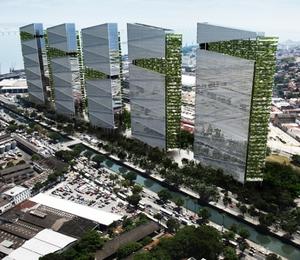
According to Forbes, Brazil is the country with the most rapidly increasing home prices in the world. In Rio, the rise in home prices has been four times greater than the rise in wages over the last five years. Donald Trump is investing in five skyscrapers in the city that, according to the developer’s website, will be the “largest urban office development in the BRIC [Brazil, Russia, India, and China] countries.”
Critics contend that many of these evictions are driven by economic incentives. The city of Rio de Janeiro has used a host of reasons to justify the demolition of the community of Vila Autódromo—from environmental and safety concerns to its use as a security or media zone for the Olympics. It is reported that the mayor of Rio de Janeiro, Eduardo Paes, entered into a partnership with private companies that will open up 75% of this site for private development after the Olympics. His reputation for these kinds of deals recently made headlines after a physical altercation with a constituent who accused him of catering to the interests of developers.
While the government does provide several forms of compensation to communities facing removal, the resettlement programs have systematically moved poor residents away from the high-value land and into peripheral areas of the city with little access to transportation or employment opportunities. Furthermore, O Estadão reported that the City of Rio de Janeiro paid $8.9 million for resettlement land to two companies—both contributors to Mayor Paes’s election campaign. After this was revealed, Paes revoked the deal.
On Saturday, June 15, communities affected by these evictions came together on the same day as the Confederation Cup opened, not far from Maracanã stadium for their own soccer tournament. The People’s Cup Against Removals was organized to “give a voice, to give time, to give space for those being excluded and for those being removed.” The stark contrast between the newly renovated stadium hosting the precursor to the World Cup and the small and humble field occupied by the People’s Cup players reflected the disparities at the heart of many of these protests. “I think that’s something that people woke up to,” remarked Steiker-Ginzberg, “the disparity between the investment in these stadiums and then people overflowing out of the public hospitals and ambulances not arriving on time . . . You can’t just reverse a 20 cent hike and expect everyone to get off the streets.”
Related
- Brazilian legend Romario questions 2014 World Cup (prosoccertalk.nbcsports.com)
- The Last Word: Mr Blatter, the party’s over (revoltadosvintecentavos.wordpress.com)
- Brazil: In The Eye Of The Storm – Video
Brazilian police clash with Confederations Cup protesters
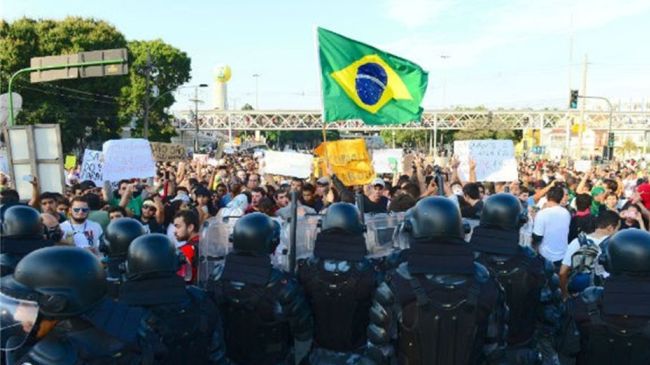
Brazilian police block protesters from entering Maracana soccer stadium in Rio on June 16, 2013
Press TV – June 17, 2013
Brazilian police have fired tear gas and rubber bullets to disperse a crowd of about 3,000 people protesting outside Rio de Janeiro’s Maracana stadium before a Confederation Cup soccer game.
The rally took place on Sunday in protest against the vast sums of public money spent on the organization of the tournament.
The protesters also opposed the huge cost of preparations to host next year’s World Cup, which is expected to reach USD 15 billion (about 11 billion euros).
“I don’t care about the World Cup – I want health and education!” shouted the protesters.
Initially, police stood in line as a barricade outside of the stadium.
However, as the crowd of protesters tried to pass the blockade riot police charged towards the group.
On June 15, police clashed with protesters in a similar demonstration during the opening of the Confederations Cup in the capital, Brasilia.
The clashes ended with 39 people injured after police fired tear gas and rubber bullets to disperse the crowd.
Related articles
Featured Video

Marandi: US attacked world’s largest gas field & Iran declares economic war
or go to
Aletho News Archives – Video-Images
Book Excerpt
US Axis of Aggression in Gulf
By Finian Cunningham | Strategic Culture Foundation | August 15, 2019
When Washington announced a few weeks ago the formation of a maritime “international coalition” to “protect shipping” in the Persian Gulf, many observers were skeptical. Now skepticism has rightly turned to alarm, as the proposed US-led “coalition” transpires to comprise a grand total of just three nations: the US, Britain and Israel.
The term “coalition” has always been a weasel word used by Washington to give its military operations around the world a veneer of international consensus and moral authority. If the US goes ahead with deploying forces in the Persian Gulf the guise of “coalition” is threadbare. It will be seen for what it is: naked aggression.
Iran promptly warned that if the US, Britain and Israel move on their intention to deploy in the Persian Gulf, it will not hesitate to defend itself from a “clear threat”. … continue
Blog Roll
 Aletho News
- Iran War Is Accelerating the End of US Dominance
- FBI Resumes Buying Americans’ Location Data Without Warrants
- IDF threatens ‘elimination’ for Russian leaders who ‘wish Israel ill’
- Attacks on enemy energy facilities not over yet, strikes ongoing: Iran
- US dragged by Israel into ‘unlawful war’ with Iran – Gulf state
- Israel’s War on Iran’s Grid: How the South Pars Strike Turned Energy into a Weapon
- War on Iran to impose trillion-dollar ‘Israel First Tax’ on US citizens: Araghchi
- The State Is Socializing the Cost Of the Iran War
- Seyed M. Marandi: U.S. Attacked World’s Largest Gas Field & Iran Declares Economic War
- Washington’s War on Cuba Is Older Than You Think
- If Americans Knew
- Trump: Israel attacked Iranian gas field without US knowledge. No more such attacks!
- America’s friends must help extricate it from an unlawful war
- Democratic Nat’l Committee’s Kneejerk Backing of Israel Is Political and Moral Failure
- Major revelations from former counterterrorism chief Joe Kent’s extensive interview
- More than half of Palestinian child detainees have no charges
- Grieving Parents in Iran Spend Every Night at the Graves of Their Children, Killed by U.S. Strike
- War on Iran spins out of control, Palestine struggles – Not a ceasefire Day 160
- How ignorance, misunderstanding and obfuscation ended Iran nuclear talks
- Israeli media reports grotesque settler attack in West Bank
- UK security adviser attended US-Iran talks and judged deal was within reach
- No Tricks Zone
- Energy Expert: Germany’s Nuclear Phaseout Was A “500 Billion Euro Mistake”
- New Research: South Australia’s Mid-Holocene Sea Surface Temperatures Were 4°C Warmer Than Today
- Storing Green Energy To Last Germany 10 Days Would Require A 60-Million Tonne Battery
- New Studies: UK Sea Levels Were 4 Meters Higher Than Today During The Mid-Holocene
- Destructive Green New Deal: German Energy And Metal Group Warns Of Drastic Crisis
- New Study Documents A 20-Year Pause In Arctic Sea Ice Decline – Driven By Internal Variability
- Wake-up Call: Survey Shows Majority Of Germans Now Favor Postponing Climate Targets!
- Televised! Leading German Political Candidate Tells Schoolchildren CO2 Makes Sun Hotter!
- New Study: A Century Warming Of 1.1°C Is ‘Commonplace’ And ‘Not Unusual’ During This Interglacial
- New Study: ‘Internal Noise’ And Volcanic Forcing Can Trigger 10-15°C Warming Within Decades
 Aletho News