PA Agrees to Exhume Body of Yasser Arafat After Evidence of Radiation Poisoning Alleged
IMEMC & Agencies | July 4, 2012
Following a report Tuesday by Al-Jazeera, and a request by President Yasser Arafat’s widow Suha, the Palestinian Authority announced its support Wednesday for an international investigation into the president’s death which would include the exhumation of his body.
After a nine month investigation by Al-Jazeera reported that the Institut de Radiophysique in Switzerland found abnormally high levels of a rare radioactive element called polonium-210 on Arafat’s personal belongings, his widow Suha called for the exhumation of his body.
There are conflicting reports about whether Arafat’s symptoms indicate polonium poisoning. Al-Jazeera stated that the president’s symptoms were consistent with polonium poisoning but Ha’aretz reports contradicted this.
While testing of the president’s bones could provide confirmation of radiation poisoning, it would not necessarily lead to who was behind the incident. However, polonium is a difficult element to produce and the signature found in the bones could provide evidence of who created it.
Questions have surrounded the circumstances of Arafat’s death since his sudden illness during the second intifada in 2004. PLO official Saeb Erekat said the Palestinian Authority is looking to form an international tribunal to investigate the case modeled after the one that looked into the death of former Lebanese prime minister Rafiq Al-Hariri. But the former head of Israeli domestic intelligence, Avi Dichter told Israel’s Army Radio that the Palestinians are responsible for the outcome. He asserted, “The body is in their hands. It is in Ramallah and really, all the keys are in their hands.”
Nativity Church deportees ‘did not sign agreement’ to be exiled
Ma’an – 26/05/2012
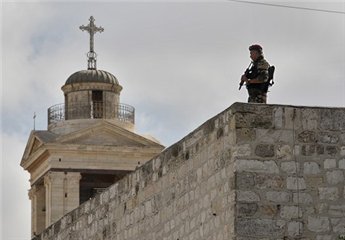
GAZA CITY – A group of Palestinians deported to Gaza after the Nativity Church siege in 2002 on Saturday disputed claims by a former economic adviser that they had signed an agreement to be exiled.
The 26 deportees told Israeli forces during the siege that only Yasser Arafat could negotiate on their behalf, denying claims that they themselves gave their approval to be deported, a statement said.
Muhammad Rashid, former presidential economic adviser to Arafat, on Friday told Al-Arabiya TV channel that the group had agreed to be deported and that he fully accepted responsibility for the agreement, which Arafat had authorized him to negotiate.
The committee appointed by Arafat to negotiate with the Israelis “almost reached an agreement to deport only 6 activists to the Gaza Strip, but other people were carrying out secret negotiations behind the scenes which ended in the deportation of 39 activists to the Gaza Strip and Europe,” the group of Gaza deportees said.
The official PA negotiating committee was headed by Salah Taamari, who was then governor of Bethlehem.
He told Ma’an TV in May that the deportation deal was reached without his knowledge and recalled his shock when Israeli officials told him Palestinians would be exiled.
The deportees urged the Palestinian Authority to expose all details of the 2002 deal, calling on the PA to prove whether there had been a written or verbal agreement between the two sides.
“If there was no written agreement, that would be a serious mistake by Muhammad Rashid, especially since the agreement was monitored by the US, the UK and the EU, and it was applauded by the Vatican,” the group said.
Former detainee and researcher Abdul Nasser Farwaneh said the deportation deal was a clear violation of international law and human rights.
The Palestinian leadership’s acceptance of the deal to send Palestinians into exile set a dangerous precedent and over the last decade Israel has deported hundreds more Palestinians, Farwaneh said in a statement.
On May 10, 2002, Israeli forces ended a 39-day siege on the church after striking a deal with Palestinian leaders to send 39 people given sanctuary in the church to Gaza and Europe.
When Israeli tanks surrounded Bethlehem on April 2, 2002, around 220 locals — including around 40 priests and nuns — took shelter in the church.
Over the next 39 days, eight Palestinians were killed inside the church and 27 others injured.
The siege on the site believed to be Jesus’ birthplace sparked outrage in the Vatican as monks sheltering inside pleaded for international assistance.
Related articles
- 10 years on from Nativity Church siege, deportees ‘forgotten’ (alethonews.wordpress.com)
- Deal reached to free Hana Shalabi (alethonews.wordpress.com)
- Israel arrests 800,000 Palestinians since 1948 (alethonews.wordpress.com)
Khalil al-Wazir: Paving the Way of Armed Struggle

Abu Jihad coordinates with fedayeen (Palestinian guerrilla fighters) during the siege of Beirut in 1982. (Photo: Archive)
By Mohamad Bdeir | Al Akhbar | April 17, 2012
It took Israeli intelligence over two decades and many assassination attempts before they managed to hunt down the PLO’s military mastermind Khalil al-Wazir. On the 24th anniversary of his death, Al-Akhbar recounts his story.
When Khalil al-Wazir (Abu Jihad) began his endeavor in the early 1950s, Israeli intelligence had no idea he existed. At the time, he was the twenty-something leader of the Palestinian al-Haq Brigade in Gaza. His family had been displaced from Ramleh in 1948.
Back then, the security establishment in Israel did not believe that Palestinians were capable of organizing a resistance movement. Operations by the fedayeen (Palestinian guerrilla fighters) were believed to be entirely orchestrated in Egypt.
It took Tel Aviv about 10 years to begin to know al-Wazir, who would go on to play a major role in establishing the first and largest Palestinian national liberation movement. Moreover, he would coin the idea of “armed struggle” as the only path to liberate Palestine.
News of Abu Jihad first reached Israel in 1964 through a secret Mossad unit named “Ulysses” whose mission was to spy on Palestinian refugee communities in Arab countries. Operatives spoke about the creation of a Palestinian national liberation movement led by Yasser Arafat and al-Wazir and sounded the alarm in Israeli security agencies.
According to the Israeli newspaper Yediot Aharonot– which pieced together the story of the assassination of Abu Jihad based on public and private sources – the Mossad formed a secret unit in 1965. Its prime directive was to investigate methods of countering “Palestinian terrorism” and approve assassinations. It immediately suggested two primary targets: Abu Ammar (Arafat) and Abu Jihad.
The first assassination attempt was in Damascus when a planned car bomb operation was not executed properly. It was carried out by an agent of Unit 504 of the military intelligence, responsible for recruiting and running operatives.
Abu Jihad’s role in pushing for armed struggle against Israel became apparent, especially in the period following the naksah (the defeat of Arab armies in 1967). In 1970, Israeli prime minister Golda Meir retaliated by issuing him a “Red Card,” essentially a direct assassination order.
The Israeli secret service was adamant to settle scores with Abu Jihad and put an end to his dossier. In 1975, the Israeli air force raided a building in Beirut based on information of a Fatah movement meeting taking place there. In addition to Abu Jihad, Fatah leaders Arafat, Faruq Qaddumi, and Mahmoud Abbas were supposedly attending.
The Ben Hur operation missed the target and encouraged an escalation of attacks on Israel, coordinated by Abu Jihad, who was now the deputy chief commander of the Palestinian revolution.
On 11 March 1978, he planned the Kamal Adwan operation (named after a Fatah leader assassinated in Beirut in 1973), which was carried out by the Deir Yassin group led by Dalal Mughrabi.
The operation led to the death of 35 Israelis, with dozens more injured. It created a shock wave inside Israel especially following Abu Jihad’s announcement that the operation “demonstrated the ability of the revolution to reach Israel and carry out operations anywhere it wants.”
Following the Israeli invasion of Lebanon and the PLO’s relocation to Tunisia, Abu Jihad attempted to reverse the setback in armed struggle.
He visited various Arab countries, exposing himself to three assassination attempts, according to the Israeli account.
Abu Jihad, for his part, was planning an “unprecedented” operation that would strengthen the PLO’s position and impose new conditions on the struggle with the Israelis.
Twenty resistance fighters were supposed to reach Yafa by rubber dinghies, hijack a bus, drive it to the defense ministry in Tel Aviv, and attack the entrance known as Gate Victor. But the Israeli navy surprised their ship and sank it on 20 April 1985.
Abu Jihad did not hesitate and pressed on with plans for another major operation. In 1988, he picked Dimona, the location of Israel’s nuclear reactor.
On March 7, three Palestinian commandos captured a bus carrying workers from the nuclear facility. The fighters were consequently killed along with three of the workers in an exchange of fire with an Israeli army unit.
The Mossad concentrated its resources on the pursuit of Abu Jihad, by now the number one wanted person in Israel. Defense minister at the time, Yitzhak Rabin, ordered a direct operation that would not resort to remote targeting such as an air raid. He wanted to send a message to the Palestinian movement that Israel can reach its enemies in their homes.
The Mossad surveilled al-Wazir’s home in Tunis, 4km from the beach. It began planning an assassination attempt and sent a unit from Sayeret Matkal (General Staff Reconnaissance Unit) to the Tunisian shores.
It was to repeat the same scenario used successfully 15 years earlier against three Palestinian leaders in Beirut (know as the “Verdun Operation”).
On 13 April 1988, the quarter century chase after al-Wazir was almost over. Mossad agents carrying Lebanese passports arrived in Tunis and split into two groups.
The first group rented cars to transport the assassination unit from the beach to the targeted house, which was being closely watched by the second group.
In the meantime, Israeli navy vessels carrying the assassins were waiting at sea. In the evening, a unit of 26 Israeli commandos reached the beach and took the rented cars to al-Wazir’s home. After 23 years, they finally managed to assassinate him.
The next day, Israeli Prime Minister Yitzhak Shamir was asked about Israel’s involvement in the assassination. Scowling, he replied, “I just heard about it on the radio.”
From Ramleh to Yarmouk
Omar Nashabe
Khalil al-Wazir was born in 1935 in Ramleh and was expelled from Palestine along with his family in 1948. He studied in Alexandria University and then moved to Saudi Arabia.
Later, he went to Kuwait where he met with Yasser Arafat and joined him in creating the Fatah movement.
Leaving Kuwait in 1963, he founded the first Fatah office in Algeria, where he was allowed to establish the first Palestinian military camp.
He then moved on to Damascus in 1965 to establish the military command headquarters and coordinate with fedayeen cells inside Palestine.
During the 1967 war, he planned and executed operations in Upper Galilee, then became the head of the western sector of Fatah until 1982.
Abu Jihad strived to develop military capabilities throughout his struggle, playing a leading role in defending Beirut against the 1982 Israeli invasion.
In his meetings with the fedayeen, he would focus on tactics and also on ethics, telling them to save ammunition and explosives, not to be zealots, and not to steal.
One time, when he was ordering the fedayeen to avoid killing children, one of them replied, “Our children in Shatila and Sabra were the first to die… I lost 12 members of my family.”
Abu Jihad’s reply was clear, “In spite of this, we will not become like those fascists. We are not fascists. [The Prophet Muhammad’s second successor] Omar Bin Khattab commands us not to cut down trees or kill children.”
Memory of Resistance
Qassem Qassem
Those who knew Abu Jihad speak of his special relationship with Imad Mughniyeh. At the end of 1978, a 16-year-old Mughniyeh joined the Fatah cell in Chiyah.
Bassem Haidar, who was in charge of the cell between 1977 and 1979, says that the boy was always with another young man, Ali Khodor Salama (Abu Hassan), assassinated by Israel in 1999 in Abra, near Sidon.
The newcomer soon caught the attention of the higher command of the Palestinian revolution, specifically Abu Jihad, due to his skill in planning ambushes in the area between Tayouneh and Asaad al-Asaad street (south of Beirut).
He was none other than Mughniyeh, Hezbollah’s military commander who was assassinated in Damascus in 2008.
“Mughniyeh was the only person able to provide the cell with the weapons they needed. He would go to the Fakhani neighborhood (PLO headquarters in Beirut) and get it,” Haidar remembers.
“Once, we needed 3.5 inch anti-tank missiles, so he was sent to get them.” Haidar continues, “Had Mughniyeh’s relationship with Abu Jihad not been good, he would not have been able to get them, since they pass directly through the leadership.”
In 1978, Mughniyeh left the Chiyah cell after “he was summoned by the leadership in Fakhani and began clandestine work in a secret security unit. We never saw him again.”
Related articles
- Marwan Barghouti: A Decade of Defiance (alethonews.wordpress.com)
- What Marwan Barghouti Really Means to Palestinians (alethonews.wordpress.com)
Featured Video
Prof. Ted Postol: Iran Already Achieved Nuclear Deterrence Against Israel
or go to
Aletho News Archives – Video-Images
From the Archives
How the occupied mentality syndrome works
Saudi Arabia on the American chessboard – Part 3
By B. J. Sabri | American Herald Tribune | June 27, 2016
Read part 2: “The occupied mentality Syndrome“
Previously I argued whether Saudi Arabia’s repeated involvements in U.S. interventions and wars stem from free national will or in response to a specific condition. For starters, in Saudi Arabia there is no national will. In Saudi Arabia, the national will is the will of the Al Saud clan. Still, when a major Arab state allies itself with a superpower that committed unspeakable crimes against humanity in almost every Arab country, then something is wrong. This fact alone should compel us to examine the U.S.-Saudi relation for one exceptional reason. As a result of the U.S.-Saudi wars, hundreds of thousands of people in Afghanistan, Iraq, Iran, Libya, Syria, Yemen, and Somalia have lost their lives. Millions became displaced in their own homelands. And millions more rendered refugees.
Attributing the Saudi policies to the bonds of “partnership” with the U.S. is frivolous. There are no bonds between these two thugs except those of business, military deals, secret plots, and wars. Proving this point, bonds such as these have no space for the American and Saudi peoples to share significant cultural or societal exchanges. If partnership is not the reason for the Saudi contribution to the U.S. strategy of empire and imperialism, then another reason must exist.
This leads to three possibilities. … continue
Blog Roll
 Aletho News
- Hezbollah hits Israeli warship off Lebanon’s coast, sets it aflame
- Iran slams US strikes on B1 bridge, Mahshahr petrochemical plants as ‘blatant acts of state terrorism’
- In letter to UN chief, Araghchi warns of dire consequences of US-Israeli attacks on Iran’s nuclear facilities
- Why the CIA conspiracy to invade Iran with Kurdish militias failed
- Why Are Upbeat US Claims About Mission to Rescue Pilot ‘Highly Questionable’?
- Aircraft destroyed during US ‘rescue’ of downed F-15 pilot cost more than $100 million each
- Washington University removes professor who condemned US-Israeli war on Iran
- Russia Warns of Retaliation as UK Authorizes Seizure of Vessels
- Serbia thwarts plot to bomb Russia-Hungary gas pipeline – Vucic
- Al Mayadeen voices solidarity with Dr. Marandi amid death threats
- If Americans Knew
- In Iran, Israel-US take aim at “reason, research, and freedom of thought” – Daily Update
- US loses planes over Iran, Israel downgrades Lebanon war goals – Daily Update
- Israel Is Blocking Palestinians from Easter at Church Where Jesus Resurrected
- Plot to assassinate Palestinian activist follows harassment campaign promoted by Zionist groups and elected officials
- Prominent New York synagogue hosts presentation on why U.S. Jews should support the ethnic cleansing of Gaza
- Tapper vs. Piker: Is the CNN Anchor Auditioning for David Ellison?
- Shouldn’t Democrats Be Able to Condemn Genocide?
- Israel-US kill negotiators, destroy civilian structures, but Iran’s military capabilities still largely intact – Daily Update
- ‘War crime’: Global condemnation as Israeli ministers celebrate death penalty law targeting Palestinian prisoners
- 7 Ways Israel Is Turning Lebanon Into Gaza
- No Tricks Zone
- An Inconvenient Tree: Uncovered In Alps… Europe Much Warmer Than Today 6000 Years Ago
- New Study Reports A 60% Slowdown In Greenland’s Ice Loss Rate In The Last Decade
- Low Intensity Tornado Wrecks Major Solar Farm, Creating A Potential Toxic Dump
- New Study Finds Warming Saves Lives…Cold Temperatures 12 Times More Deadly Than Excess Heat
- German Science Blog Accuses PIK Climate Institute Of Hallucinating Climate Tipping Points
- Devastating Assessment Of Comirnaty Vaccine By Former Senior Pfizer Europe Toxicologist
- New Study: CO2 Is ‘Effectively Negligible’ As An Explanatory Climate Change Factor Since 2000
- Former Pfizer Toxicologist Dr. Helmut Sterz Tells Bundestag Hearing Pfizer Vaccine Should Have Never Been Approved
- Energy Expert: Germany’s Nuclear Phaseout Was A “500 Billion Euro Mistake”
- New Research: South Australia’s Mid-Holocene Sea Surface Temperatures Were 4°C Warmer Than Today
 Aletho News