India gets a rude awakening in West Asia
BY M. K. BHADRAKUMAR | INDIAN PUNCHLINE | JANUARY 12, 2024
From the standpoint of affirming ‘solidarity’ with the regime of Prime Minister Benjamin Netanyahu over the October 7 attack, India has swung away to the far horizon and has unceremoniously dumped the US-Israeli axis, which provided beacon light to Delhi’s West Asian policies in the past few years.
From a strategic asset, the Israeli connection is becoming a liability for the Indian government. Delhi spurned Netanyahu’s repeated entreaties to brand Hamas as a terrorist organisation — by the way, India never pointed finger at Hamas for the October 7 attack. It has resumed the traditional stance of voting against Israel in the UN General Assembly resolutions on the Palestine problem. The Netanyahu-Modi pow-wows have become infrequent.
This is a far cry from the controversial gesture by PM Modi during his ‘historic’ five-day visit to Israel in 2017 to pay homage at the tomb of the founding father of Zionism Theodor Herzl in Haifa. It is doubtful if any Indian prime minister would repeat Modi’s feat in the future. With reasonable certainty, it can be said that the future of Zionism in West Asia itself looks rather bleak.
Again, for reasons that remain obscure even today, India decided to be a strong votary of the ill-fated Abraham Accords that purportedly aimed at ‘integrating’ Israel into the Arab fold but, in reality, to isolate Iran in its neighbourhood. Delhi never provided a rational explanation for such a dramatic shift in the traditional policy not to take sides in the intra-regional fratricidal strife in West Asia or identify with the US hegemony in that region.
Delhi followed up by enthusiastically lining up with a surreal venture called ‘I2U2’ which brought together India and the UAE with the US and Israel as a condominium to promote the spirit of the Abraham Accords. In an extravagant gesture, External Affairs Minister S. Jaishankar paid a 5-day visit to Israel to participate in ‘I2U2’.
Above all, Delhi, which hosted the G20 Summit last year and was supposedly highlighting the rise of the Global South in the world order, instead ended up arranging photo-ops for the visiting US President who hijacked the event and instead catapulted a phoney, laughable idea as the main outcome of that historic event — the so-called India-Middle East-Europe Economic Corridor (IMEEC).
The US apparently incentivised Delhi by planting the patently absurd thought that IMEEC would toll the death knell for China’s Belt and Road Initiative (BRI). China of course retaliated by just hoisting the BRI flag high all over the Maldives (population: 515,132 in the 2022 census) on India’s soft underbelly from where it is visible all over the subcontinent day and night.
However, Indian diplomats are quick learners and course corrections come naturally to them. Delhi has understood that such absurdities in its West Asian policy will do no good and may even be counterproductive as they raise hackles in the Arab Street. Thus, Qatar ticked off India recently by ordering the 15 Indian schools in Doha that cater to the needs of the largely-Hindu 700,000-strong Indian ex-patriate community to ignore Hindu holidays, especially Diwali.
Consistent with the championing of the Global South, India should have voiced support for South Africa’s brilliant initiative to petition the International Court of Justice (ICJ) to bring Israel to justice for its genocide of Palestinians in Gaza. After all, it was in South Africa that Mahatma Gandhi had finessed the concept of resistance to racialism. But, alas, India lacked the courage of conviction and the moral fibre to do so.
It is too much to expect the ICJ to put Netanyahu in a cage and try him in the Hague court for his abominable acts against humanity. But there is a strong likelihood that with tacit western support, the ICJ may issue in the coming weeks some sort of interim order for a ceasefire. And in the present atmosphere, that can prove to be a game changer.
All this makes India’s decision to stay clear of the US’ harebrained idea of disciplining Yemen’s Houthis a sensible step. The theatre of the absurd playing out in the Red Sea with the Five Eyes in the cockpit is incredibly complicated. One main vector there is about the phenomenon of the Houthi resistance as such.
An old friend and Beirut-based editor-in-chief of the Cradle, Sharmine Narwani tweeted about the quagmire in the Red Sea that awaits the Anglo-American attack on Yemen today:
“I honestly question whether the US or UK have carefully considered #Yemen‘s potential responses to this act of war. Ansarallah (Houthi) is an unusual member of the region’s Axis of Resistance. It marches to its own tune and its mindset is entirely devoid of western narrative grooming. There is no guessing at the full spectrum of its retaliatory palette, but I would not want to be an American or Brit in the Persian Gulf, Red Sea, or any of the neighbouring waterways right now.
“It may be that Washington misread the Russian and Chinese abstentions at the UNSC yesterday (on Red Sea). Or, perhaps Moscow and Beijing dangled that bait so the US would miscalculate this badly. The Americans are now militarily engaged, supplying, or bogged down on 5 separate fronts: Ukraine, Gaza-Israel, Yemen, Iraq, Syria. US adversaries can easily hold out until the fatigue sets in; they are nowhere near depleted.
“Bottom line is I think the entire Global South is going to be wearing Abdul Malik al-Houthi t-shirts by springtime.”
Indeed, it is such prescience that is often lacking in India’s West Asia strategy. This is not a region for one-dimensional men. It has been a strategic mistake to be aligned to the US and its allies in the Indian Ocean under the rubric of ‘maritime security’. The erstwhile colonial powers are innovating Neo-mercantile mechanisms to transfer wealth to their metropolis. Why should Indians act as ‘coolies’, as during British rule?
Most important, India should be seized of the Renaissance that is sweeping through the Muslim countries in West Asia. It is epochal in its sweep and has cultural, political and economic dimensions — and will inevitably have far-reaching geopolitical significance. That is why, it becomes imperative that Delhi stops viewing the region though Netanyahu’s Zionist eyes. It is important to terminate India’s collaboration with the US and colonial powers such as France and the UK to interfere in the region on the pretext of maritime security in the Indian Ocean.
India has no reason to have institutionalised partnerships with the US Naval Forces Central Command (NAVCENT). In a conceivable future, the curtain could well be descending on the western military bases in West Asia. Delhi should grasp the reality that something fundamentally changed post-October 7 in the geopolitics of West Asia.
It is in sync with what Germans call the zeitgeist (spirit of the times) that Saudi Arabia is demanding that the security of the Red Sea is an international responsibility in cooperation with the riparian countries and UN support. Since 2018, Saudi Arabia has called for the establishment of a Council of States bordering the Red Sea and the Gulf of Aden, and in 2020, eight countries signed the Council’s founding charter, who include, ironically, Yemen. Saudi Arabia plans to host a summit meeting of the Council of States.
Today’s Anglo-American missile strike against Yemen should come as a rude awakening to India messaging that the very same western powers who are backing Israel are also escalating the conflict in Gaza and step by step transforming it as a regional conflict — all in the name of freedom of navigation in the Red Sea. Unsurprisingly, Saudi Arabia, the regional superpower in the Red Sea, has called on the US to exercise restraint.
US, UK Trying to Distract From Genocide in Gaza by Strikes in Yemen – Ansar Allah Member
Sputnik – 12.01.2024
DOHA – The US and the UK are trying to divert attention from the genocide in the Gaza Strip with ill-conceived airstrikes against the Ansar Allah movement, also known as the Houthis, in Yemen, Hezam al-Asad, a member of the movement’s political bureau, said on Friday.
The US and the United Kingdom carried out overnight airstrikes against Houthi positions in four governorates of Yemen, including the capital Sanaa and the cities of Al Hudaydah, Saada and Taiz, provincial government officials told Sputnik. The US and UK officials confirmed the airstrikes, saying these were targeting Houthi military facilities and positions in Yemen in response to attacks on commercial ships in the Red Sea and not civilian population centers.
“Through these hostile and ill-conceived operations, Washington and London are trying to divert attention from the ongoing crimes of genocide. We will continue to defend our principled position on the key issue for us — Palestine — and neither the US nor the UK will be able to dissuade us from supporting our people in the Gaza Strip, whether in the Red or Arabian Seas,” al-Asad wrote on X.
The Red and Arabian Seas will remain closed to Israeli-associated ships until the conflict in the Gaza Strip ends, the political bureau member added.
“Our armed forces are well prepared and the aggressors will regret their aggression against the Yemeni people,” he said.
More Disregard for International Law: Moscow Hits Out at US-UK Attack on Yemen

Sputnik – 12.01.2024
MOSCOW – Strikes by the US and the UK on Yemen are another example of the distortion of UN Security Council resolutions and complete disregard for international law in the name of escalation in the region, Russian Foreign Ministry spokeswoman Maria Zakharova said on Friday.
The US and the UK carried out overnight airstrikes against Houthi positions in four governorates of Yemen, including the capital Sanaa and the cities of Al Hudaydah, Saada and Taiz, provincial government officials told Sputnik. The US and UK officials confirmed the airstrikes, saying these were targeting Houthi military facilities and positions in Yemen in response to attacks on commercial ships in the Red Sea and not civilian population centers.
“US airstrikes on Yemen are another example of the Anglo-Saxons’ distortion of UN Security Council resolutions and complete disregard for international law in the name of escalating the situation in the region for their own destructive purposes,” Zakharova wrote on Telegram.
Iran strongly condemns ‘arbitrary’ US, British attacks on Yemen
Press TV – January 12, 2024
Iran has strongly condemned US and British military attacks on Yemen, calling them an “arbitrary” action and a clear violation of the country’s sovereignty and territorial integrity, and a violation of international laws and regulations.
Yemen’s Ansarullah officials said explosions hit the cities of Sana’a, Hudaydah, Sa’ada and Dhamar early Friday, with a US official announcing that American and British attacks against Yemen were carried out by airplanes, ships and submarines.
In Iran’s first reaction to the aggression, Foreign Ministry spokesman Nasser Kan’ani stressed that the “arbitrary attacks will have no result other than fueling insecurity and instability in the region”.
“These military attacks are carried out in line with the continuation of the full support of the United States and the United Kingdom for the last hundred days of the Zionist regime’s war crimes against the Palestinian nation and the oppressed citizens under the complete siege of the Gaza Strip,” he said.
“While the Zionist regime continues its attacks and war crimes in the Gaza Strip and the West Bank in Palestine, the United States and England are trying to detract the attention of the people of the world from the crimes of this fake, criminal and aggressor regime against the people of Palestine by expanding their umbrella of support for the Zionist regime,” he said.
Kan’ani expressed his concern about the consequences of such arbitrary attacks for regional and international peace and security, calling on the international community to prevent the spread of war, instability and insecurity in the region with responsible reactions and actions.
Earlier, President Joe Biden said US and British forces launched airstrikes on Yemen, characterizing them a “defensive action” and pledging that he “will not hesitate” to order further attacks if needed.
The attacks come as Israel’s three months of a ferocious military campaign against the besieged people of Gaza is sputtering in the face of heroic resistance from Palestinian fighters.
The economic costs of the invasion are also beginning to mount as operations by Yemeni armed forces in the Red Sea against Israeli ships and vessels bound for Israeli ports in solidarity with the Palestinian people are having a mark.
Earlier, Iran’s Foreign Minister Hossein Amir-Abdollahian called Yemen a part of the reality and security of the West Asian region.
“Yemeni leaders, emphasizing the security of navigation, say that they will only stop the ships that are going to spread the war and send weapons to the occupied territories,” he told his Norwegian counterpart Espen Barth Eide.
The US-led aggression, however, came on the first of two days of hearings at the International Court of Justice (ICJ) in the Hague where Israel faced the charge of being involved in genocide in Gaza.
The ricochet from the case, observers say, will inevitably land at the doors of the West, especially the US and Britain which have supported the invasion with continued shipments of armament and ammunition.
“America’s entry into direct war against civilians, women and children of Gaza is a strategic mistake,” Amir-Abdollahian said in a phone conversation with Eide late Thursday.
“We have warned since the beginning of the bombing and genocide in Gaza that war is not the solution, but if the killing of civilians in Gaza and the West Bank continues, the scope of the war will expand. This warning is due to our understanding of the situation in support of Palestine in the region.”
The Norwegian foreign minister emphasized the need for an immediate ceasefire, the withdrawal of Israeli forces from Gaza, the sending of humanitarian aid to Gaza, and the start of a political process based on the formation of an independent Palestinian government, as he welcomed Iran’s constructive role in the region to reduce tensions.
Yemen slams UN Security Council resolution on Red Sea operations
Press TV – January 11, 2024
Yemen has condemned as a “political game” a resolution adopted by the United Nations Security Council on naval operations in the Red Sea, saying the US is the side that is violating international law.
In an X post on Thursday, Mohammed Ali al-Houthi, head of Yemen’s Supreme Revolutionary Committee, emphasized that the actions of the Yemeni armed forces in support of the Gaza Strip fall within the framework of legitimate defense.
The remarks came hours after the Security Council approved a resolution, backed by the US and Japan, which demanded an immediate end to attacks by Yemeni forces on Israeli-owned or Israeli-bound ships in the Red Sea.
The resolution, passed 11-0 with four abstentions, also called on Yemen to release the Galaxy Leader, an Israeli-linked cargo ship that was confiscated on November 19.
“We inform the people of the world that the decision adopted regarding the security of navigation in the Red Sea is a political game, and that the United States is the one violating international law,” Houthi said.
Any act the Yemeni armed forces face “will have a reaction, and any state that attacks bears the responsibility for aggression and the protection of the usurping entity which commits massacres under American and British protection,” he warned.
Houthi also urged the Security Council to immediately release 2.3 million people from the “Israeli-American siege” on Gaza.
‘Unjust resolution comes amid UN failure to stop Gaza war’
Meanwhile, the Palestinian Mujahideen resistance movement condemned the Security Council resolution and said that the Yemeni operations are aimed at reducing oppression against the people of Gaza and ending the Israeli genocide.
“This unjust resolution comes amidst the Council’s inability to issue a resolution condemning the brutal war against the Palestinian people in Gaza due to American hegemony, confirming the international system’s failure to protect human rights,” it said in a statement.
Israel waged the genocidal war on Gaza on October 7 following a historic operation by the Palestinian Hamas resistance group against the occupying entity. The US has offered untrammeled support for Israel during the devastating onslaught.
In solidarity with the Palestinians in blockaded Gaza, the Yemeni armed forces have targeted ships in the Red Sea with owners linked to Israel or those going to and from ports in the occupied territories.
In response, the US has formed a multinational military coalition against Yemeni forces in the Red Sea and endangered maritime navigation in the strategic waterway.
Oman seizes drones headed for ‘pro-UAE factions’ in Yemen
MEMO | January 10, 2024
The customs authorities in Oman intercepted a shipment of drones yesterday, which were concealed on a truck from the UAE heading for Yemen. The discovery was made at the Hafeet crossing on the border between the two Gulf states.
“The Directorate General of Customs seized a truck at the Hafeet crossing loaded with wireless drones coming by transit system from the United Arab Emirates heading to the Republic of Yemen,” said the customs authorities.
“Customs inspectors were able to discover the shipments that were hidden professionally in places specially prepared for smuggling them in the truck. The concerned authorities began investigating the case in order to complete the rest of the legal procedures against the suspects.”
According to the Sanaa-based Yemen Press Agency, citing informed sources, the drones were destined for UAE-backed factions in southern Yemen, most likely the separatist Southern Transitional Council (STC).
The outlet noted that some observers speculate that the US may be using the UAE-backed proxies to turn international public opinion against the Houthi-led Yemeni forces by targeting merchant ships. The latter have been targeting Israel-linked vessels, or those heading for the occupation state through the Red Sea, because of Israel’s genocide against the Palestinians in Gaza.
UAE-backed groups in Yemen plot ‘false-flag’ attacks in Red Sea: Sanaa
The Cradle | January 10, 2024
UAE-backed mercenary groups in Yemen are preparing to carry out false flag attacks against commercial vessels in order to implicate the Sanaa government and prompt further US militarization of the Red Sea, an official said on 9 January.
Fadl Abu Talib, a member of the political bureau of the Ansarallah resistance movement, said on Tuesday that “the UAE, through its mercenaries in Yemen, is making arrangements to target commercial ships that are not destined for the Zionist entity.”
Abu Dhabi and its proxy wish “to mix up the cards and give the Americans [the] justification for militarizing the Red Sea,” Abu Talib added. “But we tell it that its despicable behavior is exposed, as our operations in the Red and Arab seas have specific, clear objectives.”
Ansarallah and Yemen’s Armed Forces have carried out numerous naval operations against vessels linked to or bound for Israel. The attacks come in solidarity with the people of Gaza and the Palestinian resistance, and aim to prevent goods from reaching Israeli ports for as long as Gaza’s access to aid is hindered.
Sanaa has vowed that only Israeli-linked ships or those heading towards Israeli ports will be targeted, and nothing else. No deaths or injuries have resulted from Yemen’s attacks.
The US established a maritime task force last month in order to protect Israeli interests in the Red Sea. As part of the operations of this task force, on 31 December, US helicopters sank three Yemeni vessels and killed ten naval officers.
On 9 January, CENTCOM claimed that US and UK forces shot down 21 missiles and drones fired by Ansarallah towards Red Sea shipping lanes, calling it the 26th Yemeni attack. Sanaa has only confirmed 13 operations.
According to Arabic and Israeli media reports, officials in Yemen’s secessionist, UAE-backed Southern Transitional Council (STC) have expressed an interest in joining Washington’s task force and helping to protect Israeli shipping.
The STC has also reportedly discussed with Washington the possibility of mobilizing UAE-backed mercenary groups and STC-linked militias “against Israel’s opponents in Yemen,” Al-Akhbar newspaper reported last month.
“The STC in south Yemen wants to fight Houthi terrorism … If Israel recognizes our right to self-determination in southern Yemen, you will find an ally in the field against the Houthi threat,” Hebrew media cited a source close to STC leader Aidarous al-Zubaidi as saying.
US gives Spain ultimatum to ‘rectify its decision’ and join anti-Yemen alliance
The Cradle | January 10, 2024
Pentagon officials are pressuring Spain to “reconsider its refusal” to take part in the Red Sea Operation Prosperity Guardian (OPG) and have set an 11 January deadline for Madrid to “join with a ship or, at least, with personnel stationed in the area,” according to informed sources who spoke with Spanish daily El Confidencial.
As the US-led alliance struggles to make an impact against the pro-Palestine actions of the Yemeni armed forces, the Chairman of the Joint Chiefs of Staff, General Charles Brown, on Monday contacted his Spanish counterpart, Admiral Teodoro Lopez Calderon, to reiterate Washington’s “desire to work with all nations that share an interest in defending the principle of freedom of navigation and ensuring safe passage for global shipping.”
“Spain is a vital NATO ally and shares a long and strategic relationship with the US,” says the US navy readout of the phone call.
In parallel to this conversation, which was made public, a separate phone call took place between the US Secretary of the Navy, Carlos del Toro, and the Spanish ambassador in Washington, Santiago Cabanas, during which the Pentagon official “in much more direct language” pressed Madrid to take part in the naval coalition in support of Israel.
“[Del Toro] gave [Cabanas], at the end of the conversation, a kind of ultimatum: He wants to know, at the latest on Thursday the 11th, if Spain corrected its decision,” El Confidencial reports.
Spain has been the most vocal NATO member to reject being named part of this “coalition of the willing,” vetoing a vote at the EU that called for support of the coalition and making it clear that its forces committed to Operation Atalanta – a counter-piracy operation off the Horn of Africa and in the Western Indian Ocean – would not join OPG.
The veto by the Spanish mission to Brussels was a direct order from Prime Minister Pedro Sanchez, according to local reports.
This public pushback prompted US President Joe Biden to contact Sanchez in late December to discuss the crisis in Gaza and warn him about the “Houthi threat” in the Red Sea.
Nonetheless, Sanchez maintained his decision against joining OPG and also refused to join a statement that the US and its main European and Asian allies published on 3 January in which they issued a collective warning to Yemen. France did not subscribe to this text either.
While Madrid has not publicly explained their reasoning for refusing Washington’s demands, El Confidencial reports that authorities believe that, if Spain were to join OPG, this “would be … a way to relieve pressure on Israel and reduce the possibilities of reaching a definitive ceasefire in Gaza.”
China’s COSCO halts shipping to Israeli ports: Israeli media
The Cradle | January 7, 2024
Chinese state-owned shipping company COSCO, the fourth largest in the world, has halted sailing to Israeli ports, Israeli media outlet Globes reported on 7 January, in the wake of attacks and attempted seizures of vessels heading to Israel via the Red Sea by Yemeni armed forces.
The Israeli report indicated that the Chinese firm did not disclose a reason for the policy change. COSCO’s offices in Israel have refused to comment on the development.
The Globes report attributed the decision to the close ties between China and Iran, which sells 90 percent of its crude oil exports to Beijing. Iran is a supporter of the Yemeni government and opposes Israel’s ongoing war on Gaza.
In a similar development, the Hong Kong-based OOCL halted all cargo deliveries to Israel last month, citing “operational problems.”
In the same month, other major shipping firms, including the Mediterranean Shipping Company (MSC) and CMA CGM, announced their decision to halt shipments to Israel one day after the Yemeni Armed Forces attacked two Israel-bound vessels.
Yemeni forces have been attacking Israeli-bound vessels in the Red Sea in response to Israel’s war on Gaza, which the Sanaa government views as genocide.
Washington and its allies in turn formed the Prosperity Guardian naval coalition and issued an ultimatum to Yemen’s Ansarallah-led government to stop their Red Sea operations or suffer the “consequences.”
Yemen’s actions have forced numerous leading shipping companies to instead travel around the Cape of Good Hope at the southern tip of Africa to reach Europe, extending the shipping times by two weeks and increasing costs.
On 31 December, US naval forces sank three Yemeni boats in the Red Sea, killing ten Yemeni naval soldiers.
From the onset of the Gaza conflict on 7 October, Yemeni military forces have targeted a minimum of 15 merchant vessels either bound for Israeli harbors or owned by entities associated with Israel.
US military buildup in Red Sea ‘serious’ threat to intl. shipping: Yemen

Press TV – January 5, 2024
Yemen’s Ansarullah resistance movement has cautioned that the US militarization of the Red Sea in an attempt to serve the Israeli regime will pose a serious threat to international shipping in the strategic waterway.
Ansarullah made the statement on Friday after the United States, which has over the past weeks been spearheading a maritime coalition in the Red Sea under the pretext of safeguarding the transit of vessels in the area, claimed that the Yemeni forces and the popular resistance movement were targeting international ships and jeopardizing the security of the Red Sea.
The United States and the coalition members warned Yemen’s Armed Forces of “consequences” if they continued their missile and drone attacks against ships en route to Israeli ports in support of Palestinians in the besieged Gaza Strip.
Ansarullah said the Yemeni armed forces never attacked international ships and that the security and safety of international maritime transport in the Red Sea, the Arabian Sea and the Bab el-Mandeb Strait was guaranteed by them.
“The US claim and the statement of 12 countries regarding the [Yemeni] threat to international shipping is not true. This threat stems from the militarization of the Red Sea by the United States to serve the Israeli regime and encourage the regime to continue its crimes against Gaza,” the resistance movement said in a statement.
“The Israeli attacks on the Gaza Strip and its genocidal crimes against Palestinians, which has entered the fourth consecutive month, should have forced the so-called international community or the UN Security Council to stop such massacres by the Israeli regime,” it added.
Ansarullah categorically censured the Israeli aggression against the besieged territory and said it has so far killed more than 22,000 Palestinians, injured tens of thousands of others, and “destroyed everything in Gaza.”
“The bloody events that have been taking place in Gaza for the past three consecutive months would not have been possible without the support of the United States and the complicity of Western countries with the criminal Zionist regime and encouraging it to continue its crimes against civilians in the Gaza Strip,” Ansarullah said.
Underlining that the regional countries cannot remain idle in the face of Israel’s genocidal war in Gaza and its suffocating siege on the Palestinian territory, the resistance movement said, “The Yemeni armed forces have carried out their missile, drone and naval operations to target the ships of the Israeli regime or the ships that move towards the ports of occupied Palestine.”
The statement said the US and its allies should know that their “evil alliance” will not prevent Yemen from continuing to support the oppressed people of Gaza by carrying out military operations against the ships of the Israeli regime or the ships that move towards the occupied Palestinian ports.
“Any attack on Yemen calls for a large-scale response, and Yemen does not accept any threat to its security and stability, and rejects the claim of the United States and its allies that Yemen is a threat to international shipping in the Red Sea,” Ansarullah said.
“The alliance of the United States and its allies was formed to support the Israeli regime and protect the ships of this regime, which is a real threat to the security and safety of international shipping and the security of the entire region,” the movement added, stressing that the coalition should bear the consequences of its escalation in the strategic waterway.
Yemenis have declared their open support for Palestine’s struggle against the Israeli occupation since the regime launched a devastating war on Gaza on October 7 after the territory’s Palestinian resistance movements carried out a surprise retaliatory attack, dubbed Operation Al-Aqsa Storm, against the occupying entity.
The relentless Israeli military campaign against Gaza has killed at least 22,438 people, most of them women and children. More than 57,614 individuals have been wounded.
Reports revealed that Israeli shipping companies have already decided to reroute their vessels in fear of attacks by Yemeni forces.
Yemeni forces have also launched missile and drone attacks on targets in the Israeli-occupied territories after the regime’s aggression on Gaza.
Gaza destroys western divide-and-rule narratives
By Sharmine Narwani | The Cradle | January 4, 2024
It could be a clean sweep. Decades of western-led narratives crafted to exploit differences throughout West Asia, create strife amid the region’s myriad communities, and advance western foreign policy objectives over the heads of bickering natives are now in ruins.
The war in Gaza, it transpires, has blown a mile-wide hole in the falsehoods and fairytales that have kept West Asia distracted with internecine conflicts since at least the 1979 Islamic Revolution in Iran.
Shia versus Sunni, Iran versus Arabs, secular versus Islamist: these are three of the west’s most nefarious narrative ploys that sought to control and redirect the region and its populations, and have even drawn Arab rulers into an ungodly alliance with Israel.
Facts are destroying the fiction
It took a rare conflict – uncooked and uncontrolled by Washington – to liberate West Asian masses from their narrative trance. Israel’s genocidal assault on Gaza also brought instant clarity to the question of which Arabs and Muslims actually support Palestinian liberation – and which do not.
Iran, Hezbollah, Iraqi resistance factions, and Yemen’s Ansarallah – maligned by these western narratives – are now visibly the only regional players prepared to buttress the Gaza frontline, whether through funds, weapons, or armed clashes that aim to dilute and disperse Israeli military resources.
The so-called ‘moderate Arabs,’ a misnomer for the western-centric, authoritarian Arab dictatorships subservient to Washington’s interests, have offered little more than lip service to the carnage in Gaza.
The Saudis called for support by hosting Arab and Islamic summits that were allowed to do and say nothing. The Emiratis and Jordanians trucked supplies to Israel that Ansarallah blockaded by sea. The mighty Egypt hosted delegations when all it needed to have done was to open the Rafah Crossing so Palestinians can eat. Qatar – once a major Hamas donor – now negotiates for the freedom of Israeli captives, while hosting Hamas ‘moderates,’ who are at odds with Gaza’s freedom fighters. And Turkiye’s trade with the Israeli occupation state continues to skyrocket (exports increased 35 percent from November to December 2023).
Palestine, for the pro-west ‘moderate Arabs,’ is a carefully handled flag they occasionally wave publicly, but sabotage privately. So, they watch, transfixed and horrified today, at what social media and tens of millions of protesters have made crystal clear: Palestine remains the essential Arab and Muslim cause; it may ebb and flow, but nothing has the power to inflame the region’s masses like this particular fight between right and wrong.
The shift toward resistance
It is early days yet in the battle unfolding between the region’s Axis of Resistance and Israel’s alliances, but the polls already show a notable shift in public sentiment toward the former.
An Arab barometer poll taken over a six-week period – three weeks before and three weeks after the Al-Aqsa Flood operation – provides the first indication of shifting Arab perceptions. Although the survey was restricted to Tunisia, the pollsters argue that the country is “as close to a bellwether as one could imagine” and that it represents views similar to other Arab countries:
“Analysts and officials can safely assume that people’s views elsewhere in the region have shifted in ways similar to the recent changes that have taken place in Tunisia.”
The survey results should be of paramount concern to meddling western policymakers: “Since October 7, every country in the survey with positive or warming relations with Israel saw its favorability ratings decline among Tunisians.”
The US saw its favorability numbers plummet the most, followed by West Asian allies that have normalized relations with Israel. Russia and China, both neutral states, experienced little change, but Iran’s leadership saw its favorability figures rise. According to the Arab barometer:
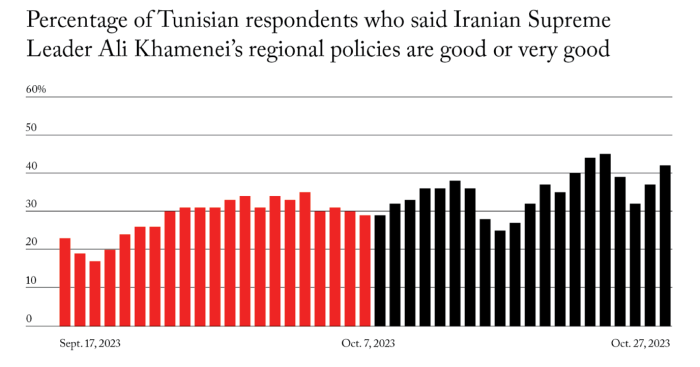
“Three weeks after the attacks, Iranian Supreme Leader Ali Khamenei has approval ratings that matched or even exceeded those of Saudi Crown Prince Mohammed bin Salman and Emirati President Mohammed bin Zayed.”
Before 7 October, just 29 percent of Tunisians held a favorable view of Khamenei’s foreign policies. This figure rose to 41 percent according to the conclusion of the survey, with Tunisian support most notable in the days following the Iranian leader’s 17 October reference to Israel’s actions in Gaza as a “genocide.”

The Saudi shift
Prior to the 7 October operation by the Palestinian resistance to destroy the Israeli army’s Gaza Division and take captives as leverage for a mass prisoner swap, the region’s main geopolitical focus was on the prospects of a groundbreaking Saudi normalization deal with Tel Aviv. The administration of US President Joe Biden flogged this horse at every opportunity; it was seen as a golden ticket for his upcoming presidential election.
But Operation Al-Aqsa Flood ruined any chance for Saudi Arabia – home to Islam’s holiest sites – to seal that political deal. And with Israeli airstrikes raining down daily on Palestinian civilians in Gaza, Riyadh’s options continue to shrink.
A Washington Institute poll conducted between 14 November and 6 December measures the seismic shift in Saudi public sentiment:
A whopping 96 percent agree with the statement that “Arab countries should immediately break all diplomatic, political, economic, and any other contacts with Israel, in protest against its military action in Gaza.”
Meanwhile, 91 percent believe that “despite the destruction and loss of life, this war in Gaza is a win for Palestinians, Arabs, and Muslims.” This is a shockingly unifying statement for a country that has adhered closely to western narratives that seek to divide Palestinians from Arabs, Arabs among themselves, and Muslims along sectarian lines – geographically, culturally, and politically.
Although Saudi Arabia constitutes one of the few Arab states to have designated Hamas as a terrorist organization, favorable views of Hamas have increased by 30 percent, from 10 percent in August to 40 percent in November, while most – 95 percent – do not believe the Palestinian resistance group killed civilians on 7 October.
Meanwhile, 87 percent of Saudis agree with the idea that “recent events show that Israel is so weak and internally divided that it can be defeated some day.” Ironically, this is a long-stated Resistance Axis refrain. Hezbollah Secretary General Hassan Nasrallah was famously quoted as saying “Israel is weaker than a spider’s web,” upon its defeat by the Lebanese resistance on 25 May, 2000.
Prior to 7 October, Saudis had strongly favored economic ties with Israel, but even that number dropped dramatically from 47 percent last year to 17 percent today. And while Saudi attitudes toward the Resistance Axis remain negative – Saudi Arabia, after all, has been the regional epicenter for anti-Iran and anti-Shia propaganda since the 1979 revolution – that may be largely because their media is heavily controlled.
Contrary to the observations of the Arab masses, 81 percent of Saudis still believe that the Axis is “reluctant to help Palestinians.”
The Palestinian shift
Equally important to the discussion of Arab perceptions is the shift seen among Palestinians themselves since 7 October. A poll conducted by the Palestinian Center for Policy and Survey Research (PSR) in both the occupied West Bank and Gaza Strip between 22 November and 2 December mirrors Arab views, but with some nuances.
Gazan respondents, understandably, displayed more skepticism for the ‘correctness’ of Hamas’ Operation Al-Aqsa Flood, which triggered Israel’s genocidal assault on the Strip in which over 22,000 civilians – mostly women and children – have so far been brutally killed. While support for Hamas increased only slightly in the Gaza Strip, it tripled in the West Bank, with both Palestinian territories expressing near equal disdain for the western-backed Palestinian Authority (PA), which governs from Ramallah.
Support for acting PA President Mahmoud Abbas and his Fatah party was hit hard. Demands for his resignation are at nearly 90 percent, while almost 60 percent (the highest number recorded in a PSR poll to date in relation to this matter) of those surveyed want a dissolution of the PA.
Over 60 percent of Palestinians polled (closer to 70 percent in the West Bank) believe armed struggle is the best means to end the occupation, with 72 percent agreeing with the statement that Hamas made a correct decision to launch its 7 October operation, and 70 percent agreeing that Israel will fail to eradicate the Palestinian resistance in Gaza.
Palestinians have strong views about regional and international players, who they largely feel have left Gaza unprotected from Israel’s unprecedented violations of international law.
By far the country most supported by respondents is Yemen, with approval ratings of 80 percent, followed by Qatar (56 percent), Hezbollah (49 percent), Iran (35 percent), Turkiye (34 percent), Jordan (24 percent), Egypt (23 percent), the UAE (8 percent), and Saudi Arabia (5 percent).

In this poll, the region’s Axis of Resistance dominates the favorability ratings, while pro-US Arab and Muslim nations with some degree of relations with Israel, fare poorly. It is notable that of the four most favorable countries and groups for mostly-Sunni Palestinians, three are core members of the “Shia” Axis, while five Sunni-led states rank lowest.
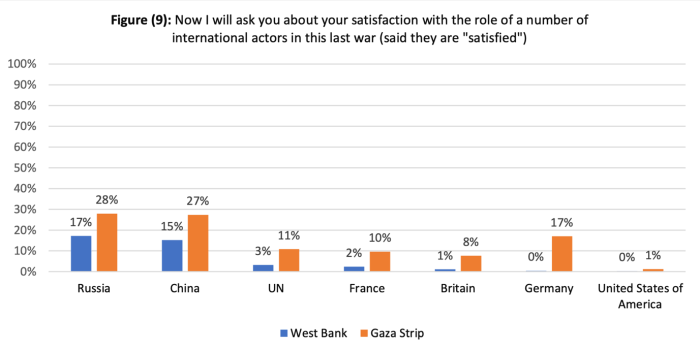
This Palestinian view extends to non-regional international states, with respondents most satisfied with Resistance Axis allies Russia (22 percent) and China (20 percent), while Israeli allies Germany (7 percent), France (5 percent), the UK (4 percent), and the US (1 percent) struggle to maintain traction among Palestinians.
The numbers depend on the war ahead
Three separate polls show that Arab perceptions have shifted dramatically over Israel’s war on Gaza, with popular sentiment gravitating to those states and actors perceived to be actively supporting Palestinian goals, and away from those who are perceived to support Israel.
The new year starts with two major events. The first is the drawdown of Israeli reservists from Gaza, whether because Washington demands it, or due to unsustainable loss of life and injury to occupation troops. The second is the shocking assassination of Hamas leader Saleh al-Arouri and six others in Beirut, Lebanon, on 2 January.
All indications are that Israel’s war will not only continue, but will expand regionally. The new US maritime construct in the Red Sea has drawn other international actors into the mix, and Tel Aviv has provoked Lebanon’s Hezbollah in a major way.
But if the confrontation between the two axes escalates, Arab perceptions will almost certainly continue to tilt away from the old hegemons toward those who are willing to resist this US-Israeli assault on the region.
There will be no relief for Washington and its allies as the war expands. The more they work to defeat Hamas and destroy Gaza, and the more they lob missiles at Yemen, Iraq, and Syria, and besiege the Resistance Axis, the more likely Arab populations are to shrug off the Sunni-versus-Shia, Iran-versus-Arab, and secular-versus-Islamist narratives that have kept the region divided and at odds for decades.
The swell of support that is mobilizing due to a righteous confrontation against the region’s biggest oppressors is unstoppable. Western decline is now a given in the region, but western discourse has been the first casualty of this war.
Houthi group says 10 fighters killed by US in spillover of Gaza crisis; ‘major escalation so far unlikely’
By Deng Xiaoci | Global Times | January 1, 2024
The Red Sea – one of the world’s most important shipping lanes that links markets in Europe with Asia – saw another bloody incident on Sunday with Yemen’s Houthi group stating that 10 of its fighters were killed by US naval forces while they were preventing Israel-related ships from passing through the Red Sea, in solidarity and support for the Palestinian people.
Analysts said the new clash in the waters of the Red Sea is a spillover of the ongoing Palestinian-Israeli conflict, and although it is unlikely to lead to a major escalation of tensions or the outbreak of a new war in the region, the US should understand that the key to fundamentally addressing the Red Sea issue lies in easing the Israeli-Palestinian conflict and the humanitarian crisis in the Gaza Strip.
According to the Xinhua News Agency on Sunday, Houthi military spokesman Yahya Sarea said that US forces attacked three boats belonging to the Houthi group. The spokesman said the US “bears the consequences of this crime,” and that the “military movements in the Red Sea to protect Israeli ships will not prevent Yemen (Houthi militia) from performing its humanitarian duty in support of Palestine and Gaza.”
According to Al Jazeera on Sunday, helicopters from two US warships – the USS Eisenhower and USS Gravely – shot at the “Iranian-backed Houthi small boats” in self-defense on Sunday morning while responding to an SOS call from the Singapore-flagged vessel Maersk Hangzhou, the US Central Command (CENTCOM) said.
The US helicopters sank three of the boats, killing several of their crew, it said.
Zhu Yongbiao, director of the Center for Afghanistan Studies in Lanzhou University, told the Global Times on Monday that after the Sunday turmoil, Houthi forces may continue to carry out small-scale actions, but it is unlikely that they will directly retaliate against or launch aggressive counterattacks on US forces.
The use of small boats for harassment may decrease, and more drones and missiles will be used for this purpose, while direct confrontations are very unlikely, the analyst said. “Such an event will not directly lead to an escalation, as the US military is still in a defensive mode and has not actively struck the Houthi forces. The Sunday event is a major one but not severe enough to become a turning point.”
The US on December 19 announced a global naval task force to safeguard shipping in the contentious waters, through which some 12 percent of global trade passes, according to reports from Al Jazeera.
Chinese observers pointed out that the clash in the Red Sea is actually a spillover of the Israeli-Palestinian conflict. “To fundamentally solve it, it is necessary for the Israeli-Palestinian issue to be significantly eased, including the humanitarian crisis in the Gaza Strip. Even if aggressive military strategies are adopted, the US may achieve good results in the short term, but they are not a permanent solution, as the root cause lies in the Israeli-Palestinian conflict,” they said.
The Sunday incident came shortly after UN Secretary-General António Guterres said in a statement via his spokesperson that he was gravely concerned about the further spillover of the conflict, which could have devastating consequences for the entire region, citing continuing attacks by armed groups in Iraq and Syria, as well as the Houthi attacks against vessels in the Red Sea, which have escalated in recent days, according to a transcript of the statement.
The Palestinian Central Bureau of Statistics said Sunday that more Palestinians were killed in conflicts in 2023 than in any other year since 1948. According to the bureau, 22,404 Palestinians died in 2023, and 22,141 of them were killed since the outbreak of the conflict between Israel and the Hamas on October 7, 2023.
Featured Video

Chinese jet fuel and the myth of energy independence
or go to
Aletho News Archives – Video-Images
Book Review
Former Insiders Criticize Iran Policy as U.S. Hegemony
By GARETH PORTER | CounterPunch | February 27, 2013
“Going to Tehran” arguably represents the most important work on the subject of U.S.-Iran relations to be published thus far.
Flynt Leverett and Hillary Mann Leverett tackle not only U.S. policy toward Iran but the broader context of Middle East policy with a systematic analytical perspective informed by personal experience, as well as very extensive documentation.
More importantly, however, their exposé required a degree of courage that may be unparalleled in the writing of former U.S. national security officials about issues on which they worked. They have chosen not just to criticise U.S. policy toward Iran but to analyse that policy as a problem of U.S. hegemony. … continue
Blog Roll
 Aletho News
- What is fueling unrest across the EU?
- Why no power can undermine Iran’s eternal dominance over the Strait of Hormuz
- Is The War Against Iran Over?
- Iran war will leave long-term ‘scar’ on Wall Street, investors warn
- How Iran decimated US power projection in West Asia: Military lessons of 40-day war
- Iran’s report details US-Israeli war crimes in targeting schools, hospitals, livelihoods
- NATO’s Slow Fracture: How Trump’s Iran War Exposed the Instrument of Hegemony
- Chinese jet fuel and the myth of energy independence
- Ukraine Sea Drone Fired From Libya Hit Russian Tanker in Mediterranean
- IRGC: Iranian forces launched no attacks during ceasefire hours
- If Americans Knew
- Military aid to Israel emerges as the latest political litmus test for Democrats
- The only Palestinian children’s rights organization closes following years-long Israeli campaign against it
- ‘I Can’t Forget the Smell’: Lebanese Reel After Israel Kills Over 300 in Single Day
- DNC Shoots Down Resolutions Calling Out AIPAC and Limiting Arms to Israel
- TCN: Is Israel Blackmailing President Trump?
- Israel killed at least 303 Lebanese yesterday – who were they? Daily Update
- Amnesty: Urgent – Protect Lebanese civilians from brutal escalation in Israeli attacks
- Is The War Against Iran Over?
- Inside the Israeli army’s propaganda wing
- Hundreds of Gaza Amputees Stranded in Legal Limbo
- No Tricks Zone
- An Inconvenient Tree: Uncovered In Alps… Europe Much Warmer Than Today 6000 Years Ago
- New Study Reports A 60% Slowdown In Greenland’s Ice Loss Rate In The Last Decade
- Low Intensity Tornado Wrecks Major Solar Farm, Creating A Potential Toxic Dump
- New Study Finds Warming Saves Lives…Cold Temperatures 12 Times More Deadly Than Excess Heat
- German Science Blog Accuses PIK Climate Institute Of Hallucinating Climate Tipping Points
- Devastating Assessment Of Comirnaty Vaccine By Former Senior Pfizer Europe Toxicologist
- New Study: CO2 Is ‘Effectively Negligible’ As An Explanatory Climate Change Factor Since 2000
- Former Pfizer Toxicologist Dr. Helmut Sterz Tells Bundestag Hearing Pfizer Vaccine Should Have Never Been Approved
- Energy Expert: Germany’s Nuclear Phaseout Was A “500 Billion Euro Mistake”
- New Research: South Australia’s Mid-Holocene Sea Surface Temperatures Were 4°C Warmer Than Today
 Aletho News