Rights group slams exclusion of Israel, Saudi-led coalition from UN’s children-in-conflict blacklist

Press TV – March 19, 2021
A group of child rights experts has strongly criticized the UN secretary-general for excluding eight parties, including the Israeli regime and the Saudi-led coalition, from a global blacklist of parties accountable for harming children during conflicts.
In a report, experts from Watchlist on Children, an international child rights group, said at least eight parties to conflicts were found responsible for killing and maiming more than 100 children in a single year but were excluded from the blacklist.
There were “numerous discrepancies and omissions in listing decisions, as well as unwarranted delisting decisions,” the report said, noting that the UN Security Council’s 2001 resolution establishing the list to protect children from the horrors of war “is being seriously undermined” and could result in “putting children at even greater risk.”
“The secretary-general’s 2015 annual report acknowledges that the number of children killed by Israel in 2014 was the third highest in the world and the number of schools damaged or destroyed was the highest anywhere in the world that year, and yet Israel has not been listed in the report’s annexes,” the report said.
It added that at the time the news media reported that Israel and the United States conducted intense lobbying to prevent the regime’s blacklisting.
The child rights experts also cited annual reports that have repeatedly found Israeli forces responsible for high levels of Palestinian child casualties, including over 1,525 killed and maimed in 2020 alone.
“Yet Israeli forces have yet to be included in the annexed list of violators,” they added.
According to the AP, co-author Yanghee Lee, former chair of the committee that monitors implementation of the UN Convention on the Rights of the Child, said: “We are calling on the secretary-general to urgently address these problems and commit to hold all countries and groups responsible for violations against children accountable without fear or favor.”
In response to the report, UN spokesman Stephane Dujarric said Secretary-General Antonio Guterres stands by the report’s conclusions, expressing willingness to engage with relevant partners in how to improve the system.
Benyam Dawit Mezmur, another co-author of the report urged the UN to ensure that the list of perpetrators it issues is “more credible, accurate, complete, and evidence-based, or risk pulling apart this unique tool for the protection of children caught in war.”
The report also said the Saudi-led war coalition against Yemen was delisted in 2020 for killing and maiming children in the Arab country, despite being responsible for a documented 222 child casualties during the reporting period.
“With this delisting, the Saudi-led coalition has been removed from the Secretary-General’s list altogether,” it noted.
Citing the Secretary-general’s reports that said the Saudi-led coalition was delisted due to a “sustained significant decrease” in the number of violations they committed, the rights experts said such argument runs counter to the established delisting criteria.
“This runs counter to the delisting criteria established in 2010 and the Security Council’s stated expectations that listing is based on whether or not grave violations against children took place in violation of international obligations,” they maintained.
According to the UN Office for the Coordination of Humanitarian Affairs (OCHA), the Saudi war on Yemen has killed a quarter of a million people, including women and children, since it was launched in March 2015 with the aim of restoring the Riyadh-friendly government of former President Abd Rabbuh Mansour Hadi.
Trade-Off ahead on Syria and Yemen
By Ghassan Kadi for the Saker Blog | March 16, 2021
In the past few weeks much has happened in the area of diplomacy on the part of Russia. Russia is forging ahead after stepping up its presence in the Middle East in the past decade, taking a strong pro-active political role. Moscow during this period has been intent on consolidating its efforts in re-establishing itself as the key player in any political settlements in the Middle East. Ever since Kissinger in the late 1970’s pulled the rug out from underneath the feet of the USSR, striking a deal between Israel and Egypt, excluding the USSR and the rest of the Arab World, the political influence of Russia in the Middle East significantly waned until it came back with deciding force when Russia responded to the Syrian Government’s request for help in September 2015.
Lately, the economic crisis has deepened in Syria following the drastic Western sanctions. And specifically after the implementation of the Caesar’s Act, the Syrian currency took a huge tumble and the cost of living has soared to unprecedented levels. This left many cynics wondering and pondering what was Russia going to do in the face of the collapsed Syrian economy after having achieved an impressive military victory, taking its troops outside its former USSR borders for the first time and heralding the end of the single super power status of the USA.
To this effect, and on the diplomatic side, Russian FM Lavrov has recently visited Saudi Arabia, Qatar and the UAE for talks pertaining to an array of issues. The agenda issues that transpired to the media include trade, the Russian Sputnik V vaccine, as well as issues of global and regional security, albeit vague in details as what ‘security issues’ mean.
It appears that in these meetings, discussions included the return of Syria to the Arab League and the cost of reconstruction of Syria after ten years of war, a bill touted to exceed $Bn200. Expectations have existed for some time that the Arab Gulf states will fork out a huge chunk of this cost. As mentioned above, the bottom line here is that Russia’s military success in its operation in Syria needs to be followed by political success. Partly, this is achieved within the Astana talks which include Turkey and Iran. However, the very same Arab States instrumental in the ‘War on Syria’ are also instrumental in facilitating the return of Syria to the Arab League, the reconstruction efforts in Syria and the easing of sanctions. The Gulf states have always reiterated that there will be no return of Syria to the Arab League for as long as Iranian forces remain on the ground. The UAE seemed more open than Saudi Arabia to the prospects of Syria’s return to the Arab League and financing the reconstruction process.
But why would the Gulf States, the same states that spent tens of billions of dollars in order to destroy Syria, be suddenly now interested in the reversal of the process? This is a fair question to ask.
Quite unexpectedly, and almost immediately after the return of Lavrov to Moscow, a top delegation of Hezbollah, headed by Mohamad Raad, was invited to Moscow for talks. Apparently, the visit was cloaked in a veil of secrecy in Russia and was not at all covered in Western media, even though it made news in Arabic mainstream media. It would be politically naïve to imagine that Lavrov’s visit to the Gulf has no relation to this. All issues in the Middle East are related to each other, including the war in Yemen.
To put it succinctly, the UAE had already stepped away from the Yemen war. However, Saudi Arabia remains bogged down in this travesty and seven years on, must have come to the humiliating and painful realization that it is a war it cannot win. This is where Iran and Hezbollah can have leverage in any direct or indirect negotiations with the Saudis, and Russia is the only arbitrator who is able to communicate with all parties involved.
All parties in the Middle East are looking for face-saving tradeoffs; at least partial and interim ones. The Saudis in particular are tired and exhausted.
In an interview given to Sputnik Arabic, one not widely reported in other media, not even Sputnik English, Raad praised the cooperation between Hezbollah and Russia, stating that ‘the invitation we received aims to reopen the dialogue about the next phase after having reached the achievements that serve the interests of the people of the region in the recent past’ .
This is Raad’s first visit to Moscow since 2011. Of that visit, I am not trying to speculate in hindsight of the purpose of it and the achievements of it. Furthermore, Hezbollah has not ever been party to any international dis-engagement or peace negotiations in the past, except for ones relating to exchange of prisoners. The economic demise of Syria and Lebanon, as well as the Saudi-Yemeni impasse, may well have placed Hezbollah in a position of participating in peace-deals negotiations this time.
I am neither referring to peace deals with Israel here, nor any deal involving disarmament. Hezbollah will not be prepared to negotiate disarming itself under any political settlement either today or in the foreseeable future, and Moscow is totally aware of this.
According to my analysis, the deal that Moscow is most likely to suggest is a mutual withdrawal of Iran and Hezbollah from Syria on one hand, and an end of the Saudi war on Yemen. It is simple, Saudi Arabia to leave Yemen and Iran/Hezbollah to leave Syria. I believe that Lavrov has already secured the Saudi acceptance of those terms, terms that will not only end the war in Yemen, but also the return of Syria to the Arab League and a possible easing of the Western economic sanctions on Syria. Had Lavrov not secured the Saudi assurance, he would not have invited Hezbollah for talks.
A deal of this nature can potentially end the criminal human tragedy in Yemen in a manner that will portray the Saudis as the real losers in the war, and this is where they need a face-saving trade-off in Syria. In Syria, they will be perceived as winners by securing an Iranian/Hezbollah exit. But most importantly perhaps for the Saudis, this will put an end to a very costly and humiliating war in Yemen, one which is beginning to draw criticism from some quarters of the international community, including alleged talk of America considering placing arms deal embargos on Saudi Arabia.
On the other hand, if Iran and Hezbollah end their presence in Syria, many sanctions are likely to be lifted and the severe economic pressure in Syria will be eased. Such a deal will be a humanitarian win for Syria and Yemen, a strategic win for Saudi Arabia and Iran, and a diplomatic win for Russia.
What will be in it for Hezbollah will largely depend on what Lavrov has put on the table, and it seems obvious that it is Hezbollah that will need more convincing than Iran, and this is why the talks are now with Hezbollah; not with Iranian officials. Perhaps the deal already has the tacit approval of Iranian officials.
It goes without saying; Israel will be watching these developments with keen interest. Israel wants Iran and Hezbollah out of Syria. But the trade-off deal I am talking about is not one in which Israel is a direct party.
What is known at this stage is that a meeting has already taken place between the Hezbollah delegation and Russian officials. As I write this, I am not aware if other meetings are to follow and or whether or not the Hezbollah delegation is back in Lebanon.
Was the 2011 Moscow visit of Raad a prelude for Hezbollah to enter Syria? Will the 2021 visit be prelude for Hezbollah to leave Syria? We don’t know. We may never find out the actual detailed outcome of the mysterious-but-not-so-mysterious current Hezbollah visit. It may not even end up with a press release, but in the next coming days, we will find out if a Syria-Yemen trade-off is indeed looming.
US ‘ceasefire plan’ meant to prolong Yemen’s descent into turmoil: Ansarullah
Press TV – March 13, 2021
The spokesman for Yemen’s popular Houthi Ansarullah movement has dismissed the US proposal for a nationwide ceasefire in the war-torn country, saying the plan would plunge Yemen further into turmoil.
“The US plan doesn’t include breaking the siege or ceasing fire. It is actually a detour which would lead to a resumption of a (Saudi) blockade diplomatically,” Mohammed Abdul-Salam said in an interview with Yemen’s al-Masirah television Friday evening.
“One of the conditions presented in the initiative is to determine the destinations of flights departing Sana’a airport, and for the coalition of aggression to issue flight permits. This means they are not licensed here in Sana’a,” he said.
“If they were serious to stop the aggression and siege, they would have declared a complete end to hostilities and blockade. We would then welcome the measure. Aggression and siege against Yemen have not stopped even for a single day over the past six years, so what is the US concept of ceasing fire or breaking the siege?” Abdul-Salam added.
The Ansarullah spokesman said the US presentation of Saudi conditions as a so-called peace plan once again proved that Washington explicitly supports the Saudi war and blockade against Yemen.
He further noted that what the US special envoy on Yemen, Tim Lenderking, presented was a plot to plunge the Arab state further into turmoil.
“It is unacceptable for an American envoy to present a plan which is inferior to that of the United Nations special envoy for Yemen (Martin Griffiths),” Abdul-Salam said.
He said there is no real change towards ending the Saudi war and lifting the siege, stressing that such matters lie in the hands of the other side.
“They want us to respond through dialogue to what they have not achieved by means of war and siege. Everyone must realize such a fact,” the senior Ansarullah official added.
Abdul-Salam also rejected as “a big lie” the US envoy’s allegations that humanitarian aid deliveries have not been distributed among the needy Yemenis, stating that the coalition of aggression illegally impounds Yemen-bound oil vessels irrespective of the fact they all have acquired international permits beforehand.
“We have accepted all conditions proposed by other parties to ensure the delivery of humanitarian assistance. Having found no excuse to continue the blockade, they are alleging aid deliveries have not reached those in need,” the Ansarullah spokesman said.
Houthi: Trust in US comes from actions, not words
A member of Yemen’s Supreme Political Council said Ansarullah is ready to return to the negotiating table with a serious goal of ending the conflict, but it must first see concrete steps from the administration of US President Joe Biden.
“Trust is built by actions, not words,” Mohammed Ali al-Houthi told CNN on Friday.
“Trust must be achieved through decision-making. So far, we have not seen any concrete decisions being made,” he added.
He noted that President Biden was a member of former US president Barack Obama’s administration, which declared at the time that Washington was joining the Saudi-led coalition against Yemen.
“They also gave the green light to the coalition to continue massacre in our country and agreed to it,” Houthi added.
‘Washington must drop Saudi conditions’
Abdul-Malik al-Ajri, a member of Ansarullah’s political bureau, said on Friday that his movement views the US ceasefire proposal in favor of Saudi Arabia, and would not accept it.
“The US special envoy on Yemen [Tim] Lenderking has presented proposals to end the war and has called on Ansarullah to respond,” Ajri wrote in a post published on his Twitter page.
“The truth is what he has offered is the same as Saudi Arabia’s conditions for a ceasefire. Linderking should know in case such suggestions were acceptable, we would have directly received them from Saudi Arabia. There was then no need for the US envoy to repeat Saudis’ narrative.”
Lenderking: Ansarullah’s ability is undeniable fact
The top US diplomat for Yemen on Friday touched on the role of Ansarullah and said its ability is a straightforward fact.
Lenderking said during a webinar with the Atlantic Council think tank that the movement is a “significant player” in Yemen and it needs to be acknowledged.
“I don’t think you can operate by denying that reality,” he said, claiming that the US “never said the Houthis have no role in Yemen.”
Lenderking, who recently returned from a three-week trip to the region, added that Washington is looking for the Ansarullah’s response to its peace plan.
“I will return immediately when the Houthis are prepared to talk,” Lenderking noted.
Red Cross: US adding Yemen’s Houthis to terrorist list will have ‘chilling effect’ on humanitarian aid
RT | January 14, 2021
The International Committee of the Red Cross (ICRC) has said it is worried that the US designating Yemen’s Houthi rebels as a terrorist group will severely hurt much-needed humanitarian aid to the war-torn country.
“In particular, the ICRC is concerned about the possible ‘chilling effect’ the designation may have on humanitarian action, leading to it being impeded or delayed,” the agency’s director of operations, Dominik Stillhart, said in a statement.
“Increased operational risks and possible de-risking from the banking and private sectors in response to the designation ultimately may constrain the humanitarian response in Yemen.”
Stillhart urged the US government to consider “humanitarian carve-outs” from their designation in order to mitigate any negative impact on the “affected population.”
On January 10, the US added the Houthis, the Iranian-backed rebel force which seized Yemen’s capital, Sanaa in 2014, to its list of foreign terrorist organizations. Three Houthi leaders were also separately designated as global terrorists.
US Secretary of State Mike Pompeo said the move is intended to hold the Houthi movement accountable for “its terrorist acts, including cross-border attacks threatening civilian populations, infrastructure, and commercial shipping.”
A Saudi Arabia-led coalition of Gulf states launched an intervention against the Houthis in 2015, carrying out a devastating aerial bombing campaign. The Houthis responded by launching missiles into Saudi Arabia.
Three ICRC workers were among the dozens killed in an ambush on Aden International Airport on December 30, as the newly-formed cabinet for the government-controlled parts of the country landed back in Yemen from Riyadh. The Houthis have been blamed for the attack, but denied responsibility.
In early December, the UN reported that at least 233,000 people have perished during the five years of war, including 131,000 who died from the lack of food, health services, and infrastructure. The UN’s humanitarian office in Yemen projected that 24.3 million people there will need some form of humanitarian aid this year.
Western animosity towards Iran due to its support for Palestinian cause, Yemeni PM says
Press TV | January 8, 2021
The prime minister of Yemen’s National Salvation Government has denounced attempts to form an anti-Iran front as part of a joint Israeli-Arab-US project, emphasizing that such bids aim to counter Tehran’s untrammelled support for the Palestinian cause and oppressed Palestinians.
“The normalization of relations between some regional rulers and the Zionist regime (Israel) is part of the Zionist-Arab-American scheme, and they are now seeking to form an alliance against Iran because it has stood with Palestine,” Abdulaziz bin Habtoor said on Thursday.
He added, “The project of partitioning Arab and Muslim world was drawn more than one hundred years ago in the service of the Zionist plan and the occupation of Palestine.”
Habtoor highlighted that any move that resists the Zionist project in the region will be met with fierce Western opposition.
He said Saudi Arabia and the United Arab Emirates (UAE) have a specific and shared goal to disintegrate Yemen, besides certain plots to cement their dominance and influence in Yemen.
“The UAE seeks to wrest control over a number of Yemeni cities, islands and bases, and Saudi Arabia wants to dominate other sectors,” Habtoor noted.
The Yemeni prime minister then dismissed attempts by the Saudi-led coalition member states to present a united front as “a big lie,” stating they will turn on each other and clash in the future due to profound differences existing among them.
‘Appointment of Iranian ambassador to Sana’a broke Saudi diplomatic siege’
Separately, a member of the Yemeni Supreme Political Council on Thursday welcomed the appointment of Iranian Ambassador to Sana’a, Hassan Irloo, stating that the step broke the diplomatic embargo that the Saudi-led coalition had imposed on the country.
Major General Sultan al-Samaei pointed to the deeply historical ties between Yemen and Iran, underlining that the Yemeni nation’s resistance embodies the axis of resistance that the Islamic Republic of Iran and Yemen are part of and their common stance against colonial powers, spearheaded by the Israeli regime and its allies.
Irloo, for his part, said Iran will not hesitate to support Yemeni people by transferring its capabilities in all fields.
The Iranian envoy stressed that relations between Tehran and Sana’a will witness broader cooperation in various spheres.
Irloo has recently been appointed as Iran’s ambassador to Yemen. In early November, he submitted his credentials to Mahdi al-Mashat, president of the Supreme Political Council of Yemen. Since then he was in the US and its regional allies’ crosshairs.
On December 8, the US slapped sanctions on the ambassador on allegations that Irloo was “linked” to Iran’s Islamic Revolution Guards Corps (IRGC), without providing any proof.
Yemen’s Houthis say Saudi pilots will only be exchanged for Palestinian prisoners
MEMO | December 31, 2020
An official in Yemen’s Houthi-led National Salvation Government (NSG) has reiterated that Saudi pilots currently being held captive will only be released in exchange for Palestinian prisoners in the kingdom.
In an interview yesterday with Al-Masirah TV, the head of the National Committee for Prisoners Affairs, Abdulqadir Al-Murtadha, stated: “We have assured the other party that the Saudi pilots will not be released from prison except in exchange for the Palestinian prisoners in Saudi Arabia.”
He added: “The negotiation rounds in the prisoners’ issue in 2020 were distinguished by the fact that they ended with implementation, unlike the previous rounds,” noting that 1,087 prisoners of the Houthi-allied Yemeni army and “popular committees” were freed earlier in the year; 670 prisoners through UN brokered agreements and 417 prisoners through local deals.
“The enemy thwarted 30 exchange deals during 2020, which were agreed upon through local parties to liberate more than 600 prisoners from both sides,” according to Al-Murtadha.
“We released 150 prisoners during 2020, including 64 children who were brought into the battles by the forces of aggression, while the rest were released for humanitarian reasons.”
Last year, Saudi Arabia incarcerated 68 Palestinians and Jordanians following a mass trial which has raised concerns by Human Rights Watch (HRW) over issues relating to due process. Some of the detainees had been held without charge for nearly two years.
Among the Palestinians detained is Mohammed Al-Khodari, who is over 80 years old and a high-ranking official from the Gaza-based resistance movement Hamas. Alike the other detainees he was charged on vague accusations relating to terrorism.
In March the leader of the Houthi movement known as the Ansarallah, Sayyid Abdulmalik Al-Houthi, extended an offer to the Saudis to release Hamas members held in Saudi in exchange for one of the captured Saudi coalition pilots held in Yemen along with four Saudi soldiers. The “much-appreciated initiative” was met with praise by Hamas who in a statement said it valued the “spirit of fraternity and sympathy” for the Palestinian people and their cause.
War-Weary Yemenis See Threat in Israel’s Increasingly Public Role in Their Country
By Ahmed Abdulkareem | MintPress News | October 30, 3030
Israeli battleships now sit side by side with Emirati corvettes ominously docked in Hodeida’s territorial waters in a blatant sign of Israel’s increasingly visibly role in the Saudi-led Coalition’s half a decade long war in Yemen. The ships also represent something else to residents in Western Yemen, where a Houthi-led commemoration of Prophet Muhammad’s birthday on Thursday turned into a demonstration against what many see as an imminent threat to the very identity and soul of Islam, their autonomy, security, and to their brethren in Palestine.
Despite an ongoing fuel crisis, the threat of COVID-19, and one of the bloodiest wars currently raging anywhere on the planet, massive rallies took place across most of Yemen’s provinces. Protesters shouted slogans against French President Emmanuel Macron, whose public defense of cartoons mocking Islam’s holiest figure, Prophet Muhammad, under the guise of free speech is seen as hypocritical coming from a country where questioning details of the Holocaust can land someone in jail. Demonstrators, and indeed many Muslims across the region, see the events in France as hiding a more nefarious goal of dehumanizing Muslims and gutting the identity of its adherents from within.
Demonstrators carried green flags, a symbol of the Prophet Muhammad, and banners emblazoned with slogans against Macron, the Saudi coalition, and its new Israeli partners. In Yemen’s capital city of Sana’a, where the largest demonstrations took place, hundreds of thousands gathered in the southern district of Al-Sabaean. Expats from 20 countries, including Sudan, Syria, Palestine, Egypt, and Bangladesh took part in the protest. A delegation from the southern Saudi province of Najran even joined.
The events were organized primarily by the Houthis and Houthi leader Abdulmalik Al-Houthi took to the podium to give a televised address to a massive audience in which he warned that western intelligence agencies in both the United States and France were involved in supporting the same extremist Salafi interpretation of Islam that is the widely practiced in Saudi Arabia, in part to tarnish the image of the religion and to justify wars in Muslim countries.
Al-Houthi also warned that distortion and misinterpretation of Islamic teachings had created a deep rift among Muslims. “Western [countries] have used such deviation to insult the Holy Qur’an and Islam. There is no mercy or sympathy whatsoever in Western civilization. They trample on human societies, deprive people of their freedom, plunder their wealth and occupy their lands, and then lecture others on human rights,” he said.
The massive demonstrations came despite threats of violence from the very same elements that Al-Houthi warned of. In the weeks leading up to Thursday’s rallies, police implemented special measures to ensure security during proceedings, including the banning of large trucks from central Sana’a and the establishment of additional checkpoints in the Yemeni capital and other provinces.
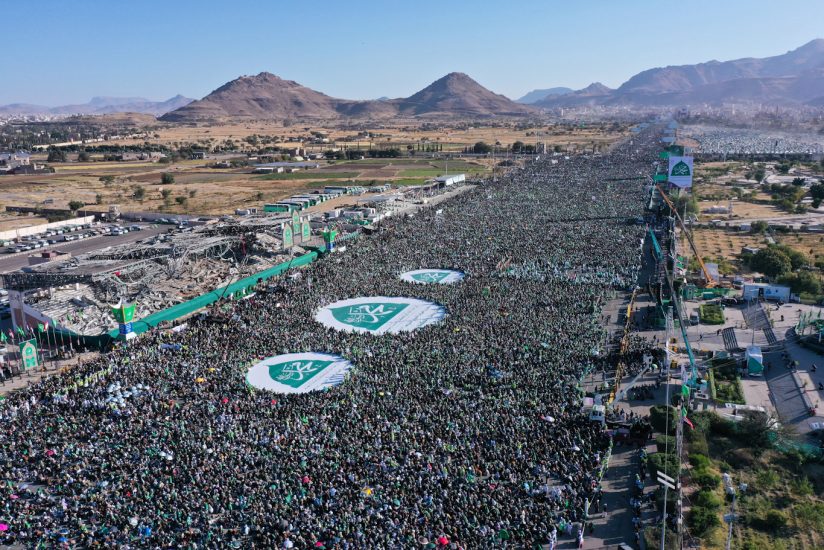
An aerial shot shows massive crowds at Thursday’s rally in Sana’a, Oct. 29, 2020. Hani Mohammed | AP
Despite the additional security measures, Hassan Zaid, the Houthi Minister for Youth and Sports, was assassinated on Tuesday as he drove his car through Sana’a. His 11-year-old daughter was seriously injured in the attack. Zaid was one of the most influential political opponents to Saudi Arabia and was wanted by the Kingdom, which offered a $10 million bounty for information leading to his capture. Houthi security forces said that they had also thwarted dozens of other planned attacks on Thursday’s demonstration.
Israeli settlements in Yemen?
The sheer scale of this week’s demonstrations dwarfed similar rallies that have taken place in previous years, not only due to Macron’s comments in France but because of fierce opposition to Israel’s new partnership with the UAE and other wealthy Gulf states, and its increasingly active presence in Yemen.
Yemenis fear that Israel not only seeks control of the strategic Bab-el-Mandeb strait, efforts that MintPress has covered in previous months, but also that it seeks a permanent footprint inside of Yemen and hopes to replace the original inhabitants of the islands and other coastal cities with Israeli settlers in a move reminiscent of the land grabs that led to the eventual annexation of land in what is now Israel.
In October, Houthi spokesman Yahya Saree warned that Israel was planning to naturalize tens of thousands of Yemeni-born Jews, emphasizing that such a scenario posed a grave threat to Yemen’s national security. Saree presented a number of National Security Agency documents that were seized when the Houthis took control from the government of former President Ali Abdullah Saleh, who ruled Yemen for 33 years.
Those documents detailed visits by Israeli officials to Yemen, facilitated by the UAE, in which a number of economic, cultural, and agricultural agreements were brokered alongside an agreement to open Yemeni airspace to Israeli aircraft. The most dangerous documents, according to Saree, relate to “the modernization of the Yemeni military forces.”
According to the documents, Israeli diplomat Bruce Kashdan arrived in Sana’a on an unannounced visit on July 14 of 2007, which lasted 48 hours. During that trip, Kashdan met with Yemeni military and security top brass who are relatives of Saleh. The Israeli official left Sana’a International Airport on July 16, 2007. The visit had been arranged by Yemeni officials in collaboration with the United Arab Emirates. Kashdan, who was also serving as a coordinator of relations between Tel Aviv and Dubai at that time, had also visited Yemen on February 2, 2005.
A delegation from the Israeli Knesset also visited Sana’a in March 1996 and received remarkable hospitality given the Yemeni government’s official stance towards Israel at the time. Knesset members met with several senior security and civilian officials headed by former president Saleh. Many Israeli delegations visited Yemen between 1995 and 2000 under the cover of tourism, commerce, and investment, according to the National Security Agency documents.
Saree accused the UAE and Israel of reviving a project that granted Israeli citizenship to more than 60,000 Yemenis. According to a memorandum to the UAE’s foreign minister in 2004 by Hamad Saeed Al-Zaabi, the Emirati ambassador in Sana’a, an Israeli delegation visited the Yemeni capital as part of normalization efforts and presented demands to build a museum celebrating Yemeni Jews in Sana’a among other moves that included naturalizing 45,000 Yemeni Jews as Israeli citizens. The Emirati ambassador described the move as part of a broader effort being pushed by the United States.
Ahmed AbdulKareem is a Yemeni journalist. He covers the war in Yemen for MintPress News as well as local Yemeni media
Saudi-led coalition, mercenaries working with al-Qaeda, Daesh in Yemen: Foreign Ministry
Press TV | October 25, 2020
The Foreign Ministry of Yemen’s National Salvation Government says the Saudi-led coalition engaged in a campaign against the country as well as the allied militiamen loyal to former Yemeni President Abd Rabbuh Mansur are closely working with al-Qaeda and the Daesh Takfiri terrorists.
The ministry, in two separate identical letters addressed to the United Nations and the UN Security Council on Saturday, elaborated on clean-up operations carried out by Yemeni armed forces and fighters from the Popular Committees against al-Qaeda and Daesh terror cells in the central province of Bayda.
The letters emphasized that there were foreign nationals, mostly Saudi citizens, among the militant commanders and combatants slain in the operations.
Large amounts of weapons, bombs and explosive belts were also seized.
The foreign ministry highlighted that the Saudi-led alliance has been providing al-Qaeda and Daesh with air cover as of ‘March 26, 2015,’ in addition to monetary, military and logistical support, medical care, and facilitation of their free movement.
The letters read that the Yemeni army forces and the Popular Committees fighters had recovered sophisticated weapons and military equipment ‘only in the inventory of countries such as Saudi Arabia and the United States.’
The Yemeni foreign ministry underlined that it has obtained documents that disclose Saudi Arabia’s support for al-Qaeda and Daesh terrorists, including monthly payrolls and military ID cards.
Documents have also been discovered proving a number of al-Qaeda and Daesh operatives were treated in hospitals in Saudi Arabia and the central Yemeni province of Ma’rib.
“Prior to and after the al-Bayda Operation, a number of al-Qaeda and Daesh elements fled to some occupied areas, including those in Ma’rib, and hid within the ranks of Saudi-sponsored Hadi loyalists,” the foreign ministry said.
It added, “The relationship between al-Qaeda and Daesh with the aggressors and traitors has reached a point where the leaders of these two groups hold high positions in Hadi’s ousted government. Some of these elements have been designated by the US Treasury Department as sponsors of terrorism, though.”
The letters said the Aden-based Yemeni administration had called for the release of 96 al-Qaeda and Daesh terrorists during negotiations on the exchange of prisoners being held by the National Salvation Government in Sana’a.
Saudi Arabia and a number of its regional allies launched the war on Yemen in March 2015, with the goal of bringing Hadi’s government back to power and crush the popular Houthi Ansarullah movement. Ansarullah, backed by armed forces, has been valorously defending Yemen against the alliance.
To Yemenis, it makes no difference who the next POTUS is
By Abdullatif al-Washali | Press TV | October 25, 2020
Sana’a – The US presidential election has failed to interest any Yemenis despite media hype about how a change in the Oval Office could change Washington’s policies around the world.
Many in Yemen say they are convinced that regardless of the outcome, nothing will change in terms of the White House’s support for the Saudi-led campaign against the impoverished country.
Since 2015, and through two totally different administrations, the United States has played a key role in the war on Yemen.
Today, more than five years into the conflict, it appears that a potential change of the US president would not be enough to satiate Washington’s thirst for more weapons sales to the Saudi-led coalition.
With the American November election occupying every newscast around the world, Yemenis still ask the same question, “Will it end the war?”
A US Congress condemning, expressing concern, and issuing endless useless resolutions; that is what Yemenis see as an effort by the Democrats to end the campaign. The majority of the Republicans, they believe, clearly see the war as no more than an opportunity to create more jobs in the United States in order to sell more arms.
War, famine, the coronavirus pandemic, cholera, and a shattered economy; the catastrophe is yet to grow deeper. With everything changing around the world, it looks like the only thing remaining the same is how the US’ role in Yemen will not be so different, even if a new president takes power in Washington.
US, Western intelligence services behind creation of Takfiri terrorist groups: Yemen leader
Press TV – October 19, 2020
The leader of Yemen’s Houthi Ansarullah movement has held the United States and Western intelligence services responsible for the creation of Takfiri terrorist groups, saying France’s external intelligence agency plays a significant role in this regard.
“Takfiris are supported by the US, France and Western countries. They are the parties that have stood by Takfiris to target Muslims as they massacre them. The United States and its allies in Syria, Yemen, and other countries are supporting Takfiris, because they are using the extremists to tarnish the image of Islam. Western intelligence agencies, including the one in France, are involved in monitoring and supporting them,” Abdul-Malik al-Houthi said at a televised speech broadcast live from the Yemeni capital of Sana’a on Monday evening.
Houthi also warned that distortion and misinterpretation of Islamic teachings have created a deep rift among Muslims and posed serious problems to them.
“Enemies have used such deviation to insult the Holy Qur’an and Islam. There is no mercy or sympathy whatsoever in the Western civilization. They trample on [the rights of] human societies, deprive people of their freedom, plunder their wealth and occupy their lands, and then lecture others on human rights,” he highlighted.
The Ansarullah chief then questioned Western states’ respect for human rights in Yemen, Palestine and other Arab and Muslim countries, saying US President Donald “Trump is proud that he is ready to give Arab lands to the [Israeli] enemy and expropriate them as he did in the Syrian Golan Heights. What sort of civilization is this?”
Houthi went on to say that insulting Islam is allowed while criticizing Zionists is prohibited in France and whoever does so will be brought to trial.
“In the West, on the other hand, you are allowed to insult Islam and prophets, become atheists and insult God. But you are not permitted to insult Zionists and stand up to them,” the Yemeni Ansarullah leader pointed out.
“In the world, there is a blatant and insulting attack on the Prophet [Muhammad (PBUH)], Islam and Muslims, and the campaign seeks to target our faith with the goal of cultural dominance,” Houthi noted.
The Ansarullah leader stressed that efforts are being made to turn Muslim nations into subordinates of the US, Western states and the Israeli regime.
“Plots aimed at enslaving and distancing us from our religious teachings and identity must not be accepted at all,” he said.
He then denounced French President Emmanuel Macron’s recent anti-Islam remarks as a form of hostility toward the Muslim world.
“France and the West are insulting Islam and the Prophet Muhammad (PBUH). At the same time, they are caring for Zionists and don’t stand any insults directed at them,” he said.
The Ansarullah leader finally held arrogant powers, led by the US and the Israeli regime, accountable for the sufferings of nations worldwide.
Britain selling arms to Saudi Arabia at unprecedented rate

Activists march with replica missiles bearing the message ‘Made in Britain’ in London, UK on March 2016
MEMO | October 12, 2020
Britain is issuing arms licences to Saudi Arabia at an unprecedented rate of almost one a day, making up for months of lost time after the appeal court banned the sale of arms to the Kingdom over allegations that British made weapons are used to target civilian populations.
Official figures released last week revealed Britain’s growing role in the dangerous flow of arms across the globe. The UK is holding its position as the second highest exporter of arms, despite last year’s ruling. Now more details have been uncovered about the trade, prompting allegations of British “complicity” in the humanitarian catastrophe unfolding in Yemen.
“By arming the brutal Saudi dictatorship the UK is making itself complicit in the atrocities and abuses inflicted on Yemen,” said Andrew Smith of Campaign Against the Arms Trade (CAAT). “A return to business as usual will only increase the suffering.” The war in Yemen is only possible because of military support provided by Britain and other governments, he added.
Eighty-seven export licences were granted between 20 June 2019 and last month. However, only 19 licences were issued in 11 of those months, for £15 million worth of “defensive” military equipment such as body armour and navigation systems. This means that most of the licences were issued in just 12 weeks.
Saudi Arabia tops the global table in terms of military expenditure as a proportion of GDP. The Kingdom reportedly has twice as many British-made warplanes as the Royal Air Force.
Featured Video

Deception – Submarines against Olof Palme
or go to
Aletho News Archives – Video-Images
From the Archives
Woolsey Fire started at Santa Susana Field Lab — where “radioactive materials released were never accurately measured”
By John Laforge | CounterPunch | November 30, 2018
In my Nov. 16 column, I reported on potential radiation risks posed by California’s Woolsey wildfire having burned over parts or all of the Santa Susana Field Laboratory—south of Simi Valley, Calif., 30 miles outside Los Angeles—site of at least four partial or total nuclear reactor meltdowns.
The field laboratory operated 10 experimental reactors and conducted rocket engine tests. In his 2014 book Atomic Accidents, researcher James Mahaffey writes, “The cores in four experimental reactors on site … melted.” Reactor core melts always result in the release of large amounts of radioactive gases and particles. Clean up of the deeply contaminated site has not been conducted in spite of a 2010 agreement.
Los Angeles’s KABC-7 TV reported Nov. 13 that the Santa Susana lab site “appears to be the origin of the Woolsey Fire” which has torched over 96,000 acres. Southern Calif. Public Radio said, “According to Cal Fire, the Woolsey Fire started on the afternoon of Thursday, Nov. 8 … on the Santa Susana site.” … continue
Blog Roll
 Aletho News
- Brussels cannot say where its own pipeline inspectors are as Hungary’s oil lifeline remains shut
- Israel’s Iran War: Myth and Reality
- Between war and industrial breakdown: The US-Israeli attrition crisis
- Pressure builds on Iran to ‘drop’ Lebanon ceasefire demand as Islamabad talks hang in balance
- In another clash report, US denies agreement to release Iran’s assets
- What is fueling unrest across the EU?
- Why no power can undermine Iran’s eternal dominance over the Strait of Hormuz
- Is The War Against Iran Over?
- Iran war will leave long-term ‘scar’ on Wall Street, investors warn
- How Iran decimated US power projection in West Asia: Military lessons of 40-day war
- If Americans Knew
- Mearsheimer reveals how Israel dictates US policies on Iran, Gaza – video
- After killing 350+, Israel still has a “score to settle” with Lebanon before ceasefire – Daily Update
- Military aid to Israel emerges as the latest political litmus test for Democrats
- The only Palestinian children’s rights organization closes following years-long Israeli campaign against it
- ‘I Can’t Forget the Smell’: Lebanese Reel After Israel Kills Over 300 in Single Day
- DNC Shoots Down Resolutions Calling Out AIPAC and Limiting Arms to Israel
- TCN: Is Israel Blackmailing President Trump?
- Israel killed at least 303 Lebanese yesterday – who were they? Daily Update
- Amnesty: Urgent – Protect Lebanese civilians from brutal escalation in Israeli attacks
- Is The War Against Iran Over?
- No Tricks Zone
- German Expert: Heat Dome Led To Record Temps In Western USA…Warmer In 1934, 1936
- New Study: No Linear Warming Or Glacier Retreat Along Northern Antarctic Peninsula Since 1980s
- An Inconvenient Tree: Uncovered In Alps… Europe Much Warmer Than Today 6000 Years Ago
- New Study Reports A 60% Slowdown In Greenland’s Ice Loss Rate In The Last Decade
- Low Intensity Tornado Wrecks Major Solar Farm, Creating A Potential Toxic Dump
- New Study Finds Warming Saves Lives…Cold Temperatures 12 Times More Deadly Than Excess Heat
- German Science Blog Accuses PIK Climate Institute Of Hallucinating Climate Tipping Points
- Devastating Assessment Of Comirnaty Vaccine By Former Senior Pfizer Europe Toxicologist
- New Study: CO2 Is ‘Effectively Negligible’ As An Explanatory Climate Change Factor Since 2000
- Former Pfizer Toxicologist Dr. Helmut Sterz Tells Bundestag Hearing Pfizer Vaccine Should Have Never Been Approved
 Aletho News