Yemen: Another Shameful US Defeat Looms
By Finian Cunningham | Strategic Culture Foundation | September 9, 2019
An official confirmation by the Trump administration of it holding discreet talks with Yemen’s Houthi rebels indicates a realization in Washington that its military intervention in the Arab country is an unsalvageable disaster requiring exit.
There are also reports of the Trump administration urging the Saudi rulers to engage with the Houthis, also known as Ansarullah, in order to patch up some kind of peace settlement to the more than four-year war. In short, the Americans want out of this quagmire.
Quite a turnaround. The US-backed Saudi coalition has up to now justified its aggression against the poorest country in the Arab region with claims that the rebels are Iranian proxies. Now, it seems, Washington deems the Houthi “terrorists” worthy of negotiations.
This follows a similar pattern in many other US foreign wars. First, the aggression is “justified” by moralistic claims of fighting “communists” or “terrorists” as in Vietnam and Afghanistan. Only for Washington, after much needless slaughter and destruction, to reach out to former villains for “talks” in order to extricate the Americans from their own self-made disaster.
Talks with the Houthis were confirmed last week by US Assistant Secretary of Near East Affairs David Schenker during a visit to Saudi Arabia.
“We are narrowly focused on trying to end the war in Yemen,” said Schenker. “We are also having talks to the extent possible with the Houthis to try and find a mutually accepted negotiated solution to the conflict.”
In response, a senior Houthi official Hamid Assem was quoted as saying: “That the United States says they are talking to us is a great victory for us and proves that we are right.” However, he declined to confirm or deny if negotiations were being held.
You have to almost admire the effrontery of the American government. Notice how the US diplomat says “we are focused on ending the war” and “a mutually acceptable solution”.
As if Washington is some kind of honest broker trying to bring peace to a country stricken by mysterious violence.
The war was launched by the US-backed Saudi coalition, including the United Arab Emirates, in March 2015, without any provocation from Yemen. The precipitating factor was that the Houthis, a mainly Shia rebel group aligned with Iran, had kicked out a corrupt Saudi-backed dictator at the end of 2014. When he tucked tail and fled to exile in Saudi capital Riyadh, that’s when the Saudis launched their aerial bombing campaign on Yemen.
The slaughter in Yemen over the past four years has been nothing short of a calamity for the population of nearly 28 million people. The UN estimates that nearly 80 per cent of the nation is teetering on hunger and disease.
A UN report published last week explicitly held the US, Britain and France liable for complicity in massive war crimes from their unstinting supply of warplanes, munitions and logistics to the Saudi and Emirati warplanes that have indiscriminately bombed civilians and public infrastructure. The UN report also blamed the Houthis for committing atrocities. That may be so, but the preponderance of deaths and destruction in Yemen is due to American, British and French military support to the Saudi-led coalition. Up to 100,ooo civilians may have been killed from the Western-backed blitzkrieg, while the Western media keep quoting a figure of “10,000”, which magically never seems to increase over the past four years.
Several factors are pressing the Trump administration to wind down the Yemen war.
The infernal humanitarian conditions and complicity in war crimes can no longer be concealed by Washington’s mendacity about allegedly combating “Iran subversion” in Yemen. The southern Arabian Peninsula country is an unmitigated PR disaster for official American pretensions of being a world leader in democratic and law-abiding virtue.
When the American Congress is united in calling for a ban on US arms to Saudi Arabia because of the atrocities in Yemen, then we should know that the PR war has been lost. President Trump over-ruled Congress earlier this year to continue arming the Saudis in Yemen. But even Trump must at last be realizing his government’s culpability for aiding and abetting genocide is no longer excusable, even for the most credulous consumers of American propaganda.
After four years of relentless air strikes, which have become financially ruinous for the Saudi monarchy and its precocious Crown Prince Mohammed bin Salman, who conceived the war, the Houthis still remain in control of the capital Sanaa and large swathes of the country. Barbaric bombardment and siege-starvation imposed on Yemen has not dislodged the rebels.
Not only that but the Houthis have begun to take the war into the heart of Saudi Arabia. Over the past year, the rebels have mounted increasingly sophisticated long-range drone and ballistic missile attacks on Saudi military bases and the capital Riyadh. From where the Houthis are receiving their more lethal weaponry is not clear. Maybe from Lebanon’s Hezbollah or from Iran. In any case, such supply if confirmed could be argued as legitimate support for a country facing aggression.
No doubt the Houthis striking deep into Saudi territory has given the pampered monarchs in Riyadh serious pause for thought.
When the UAE – the other main coalition partner – announced a month ago that it was scaling back its involvement in Yemen that must have rattled Washington and Riyadh that the war was indeed futile.
The defeat is further complicated by the open conflict which has broken out over recent weeks between rival militants sponsored by the Saudis and Emiratis in the southern port city of Aden. There are reports of UAE warplanes attacking Saudi-backed militants and of Saudi force build-up. A war of words has erupted between Riyadh and Abu Dhabi. There is strong possibility that the rival factions could blow up into a proxy war between Saudi Arabia and the UAE, supposed coalition allies.
Washington has doubtless taken note of the unstoppable disaster in Yemen and how its position is indefensible and infeasible.
Like so many other obscene American wars down through the decades, Washington is facing yet another ignominious defeat in Yemen. When the US starts to talk about “ending the war” with a spin about concern for “mutual peace”, then you know the sordid game is finally up.
Rights groups call for France to stop arms sales to Saudi Arabia and UAE
![A destroyed prison, in which Houthi Ansarullah movement members held its prisoners, is seen after coalition forces led by Saudi Arabia organised an airstrike over it in Dhamar, Yemen on September 01, 2019 [Mohammed Hamoud / Anadolu Agency]](https://i0.wp.com/www.middleeastmonitor.com/wp-content/uploads/2019/09/20190901_2_37999764_47216403.jpg?resize=1200%2C800&quality=75&strip=all&ssl=1)
A destroyed prison, in which the Ansarullah movement held prisoners, is seen after Saudi led coalition forces organised an airstrike on September 1, 2019
[Mohammed Hamoud / Anadolu Agency]
MEMO | September 7, 2019
Some 17 rights groups have renewed their call for France to immediately stop arms sales to Saudi Arabia and the UAE, after a new UN report confirmed their involvement in the killing of civilians in Yemen, Alkhaleejonline.net reported on Friday.
The 17 NGOs renewed their call for France to stop arming Saudi Arabia and the UAE, based on two incidents that took place last week.
“On Sunday, more than 100 inmates were killed in an airstrike in the west of Yemen,” the rights groups affirmed in a statement.
They also claimed that a reported issued by a group of UN experts found that Saudi Arabia and the UAE are carrying out violent attacks against civilian residents in Yemen.
The experts emphasised the importance of the countries selling arms to these two Arab states to stop their sales, in order to inhibit the encouragement of this conflict.
The group of UN experts which was formed in 2017, confirmed that there have been “many war crimes” throughout the year.
Bulgarian journalist reveals how US-purchased arms end up with ISIS in Yemen
‘It’s a tip of an iceberg’
RT | September 5, 2019
Mortar shells shown in an Islamic State propaganda video have put a Bulgarian journalist on the scent of an alleged US-run arms shipping network supplying militants in the Middle East, she told RT in an exclusive interview.
This story began back in June, when Islamic State (IS, formerly ISIS) terrorists in Yemen demonstrated several Serbian-made 82mm mortar shells in their propaganda video. Independent investigative journalist, Dilyana Gaytandzhieva, believes that the deadly munitions ended up with the jihadists after going through US hands.
Tracing origins
Clearly visible on one of the shells is a mark that reads ’82 mm M74HE mortar shells KV lot 04/18.’ The letters KV stand for the Serbian state arms manufacturer Krusik, located in the town of Valjevo, while the digits 04/18 refer to lot 04 produced in 2018. One should not jump to any conclusions, however, as it is not the Serbs who were responsible for the shells suddenly appearing in the hands of terrorists, according to Gaytandzhieva.
A trove of “explosive” leaked documents she said she received from an “anonymous source” shows that the lot in question was part of a deal between the Serbian arms factory and a Pentagon contractor, Alliant Techsystems LLC. It was part of a purchase of more than 100,000 such shells “for the needs of the US government.”
“In the shipping documentation and on the labels on the mortar shells’ containers, there is a name of… the importer… that purchases the weapons on behalf of the US government,” the journalist told RT, citing the documents.
“There are indications and information about a US federal contract, under which these weapons were purchased, and this is absolutely verifiable in the case of Alliant Techsystems LLC, the company, which purchased the mortar shells and this particular lot of weapons pictured in the ISIS video in Yemen.”
Some leaked documents published by Gaytandzhieva do indeed mention a contract between Alliant Techsystems LLC and the Pentagon, which was allegedly aimed at supplying the Afghan National Army. “This lot was purchased under a $50 million contract between Alliant Techsystems and the US DoD for the delivery of non-standard US weapons to Afghanistan,” the journalist said.
Gaytandzhieva believes, however, that this case is just the tip of the iceberg. It could be a part of a far-reaching arms supply scheme involving up to “three million pieces of weapons – rockets and mortar shells – that have been diverted either to Syria or to Yemen.”
‘Corporate international weapons shipment network’
The leaked documents, which include emails, internal memos, photos and correspondence between the American arms dealers and the Serbian arms factory Krusik, have helped Gaytandzhieva to “expose the existence of a secret US special command unit code-named “Task Force Smoking Gun.” That unit has allegedly operated an arms depo since at least 2017, which is used in shady arms shipping operations by the US and its allies.
“I found that four private American companies were US government contractors and they were commissioned by the Pentagon to deliver non-US standard weapons to different destinations. According to the other leaked documents, I found that one of these destinations was Syria.
“This is a whole international weapons shipment network,” the journalist explained to RT, adding that Saudi Arabia and the UAE are also using it for its operations alongside the US. “The scheme is using different routes and diplomatic flights diverting weapons via a third party to their final destination, which appears to be Syria or Yemen.”
Gaytandzhieva said that she investigated at least “350 diplomatic flights carrying weapons for the last three years” by the same Azeri state-run company that delivered the mortar shells to Afghanistan in 2018. “They made technical landings with stays varying from a few hours to up to a day in intermediary locations without any logical reasons such as needing to refuel the planes,” she wrote in a separate report investigating this particular issue.
“That means that this international weapons shipment network has never [ceased to exist] and continues [it operations] to this date.”
RT has managed to independently verify parts of Gaytandzhieva’s report by finding the contracts between Alliant Techsystems LLC and the Pentagon that she mentions in the US Federal Procurement Data System. It has also been established that the company has regularly worked for the US Department of Defense since at least 2016.
Also on rt.com:
Al Qaeda team plays on the same side as the US in Yemen
Weapons ending up with terrorists is OK, as long as Obama did it: The world according to CNN
US in talks with Yemeni rebels to end war – official
RT | September 5, 2019
Washington is in talks with the Houthi rebels in a bid to end Yemen’s war a top US official said on Thursday. “We are narrowly focused on trying to end the war in Yemen,” Assistant Secretary of Near Eastern Affairs David Schenker said during a visit to Saudi Arabia.
“We are also having talks to the extent possible with the Houthis to try and find a mutually accepted negotiated solution to the conflict,” AFP quoted the officials as saying.
The development marks the first contact between the administration of President Donald Trump and the Houthis in over four years.
Under the administration of former president Barack Obama, US officials held brief talks with Houthi leaders in June 2015, three months after the Saudi-led intervention began, to convince them to attend UN-sponsored peace talks in Geneva to resolve the crisis.
New U.N. Report Highlights Human Rights Violations and Abuses in Yemen since 2014
By Sarah Abed | September 5, 2019
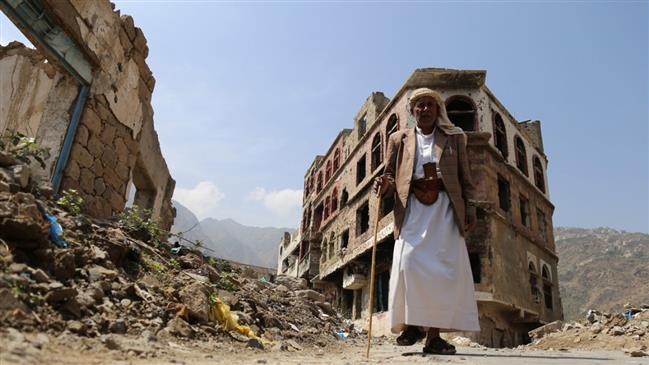
The second largest sovereign state in the Arabian Peninsula, Yemen, has been ravaged by war, deliberate starvation, and cholera for over four years. A 274 page U.N. report released on Tuesday, highlights the human rights situation including violations and abuses since September 2014.
According to the report, which took two years to complete, the United States, France, and Britain may be complicit in war crimes for their involvement in the war in Yemen by not only supplying the weapons being used by the Saudi and United Arab Emirate coalitions, but also providing them with intelligence and logistics support.
The report details the findings of the Group of Eminent International and Regional Experts on Yemen. It was submitted as a supplement to A/HR/42/17. U.N. investigators are recommending that all states impose a ban on arms transfers to the warring parties in order to prevent them from being used to commit serious violations and war crimes.
“It is clear that the continued supply of weapons to parties to the conflict is perpetuating the conflict and prolonging the suffering of the Yemeni people,” Melissa Parke, an expert on the independent U.N. panel, told a news conference. Parke continued, “That is why we are urging member states to no longer supply weapons to parties to the conflict.”
The report states, “The Group of Experts reiterates that steps required to address the human rights and international law violations in Yemen have been continually discussed, and there can no longer be any excuses made for failure to take meaningful steps to address them. The best way to protect the Yemeni population is to stop the fighting by reaching a political settlement which includes measures for accountability.”
Saudi Arabia and the United Arab Emirates are two of the largest purchasers of U.S. British and French weapons. These weapons are being used to fight against the homegrown Houthi movement which controls Yemen’s capital. The report states, “The legality of arms transfers by France, the United Kingdom, the United States and other States remains questionable, and is the subject of various domestic court proceedings.”
According to the U.N. report, Saudi and UAE coalitions are killing civilians in air strikes, and deliberately denying them food. The report put blame on all sides of the conflict, saying that no one has clean hands.
Kamel Jendoubi, chairperson of the Group of Experts on Yemen a creation of the U.N. Human Rights Council stated, “Five years into the conflict, violations against Yemeni civilians continue unabated, with total disregard for the plight of the people and a lack of international action to hold parties to the conflict accountable.” He also stated “This endemic impunity—for violations and abuses by all parties to the conflict—cannot be tolerated anymore.” Jendoubi concluded, “Impartial and independent inquiries must be empowered to hold accountable those who disrespect the rights of the Yemeni people. The international community must stop turning a blind eye to these violations and the intolerable humanitarian situation.”
Allegations of torture, rape, and murder of suspected political opponents detained in secret facilities by Emirati and affiliated forces have been received by the U.N. panel.
A secret list was sent by an independent panel to U.N. human rights chief, Michelle Bachelet, identifying “individuals who may be responsible for international crimes” the U.N. report states.
In the appendix, was a separate list identifying more than 160 “main actors” among Saudi, Emirati and Yemeni government and Houthi officials.
Concerns have been raised as to the impartiality and legitimacy of a Joint Incidents Assessment Team set up by Saudi Arabia to review alleged coalition violations, after it failed to hold anyone accountable for air strikes that killed civilians.
The U.N. report comes just a few days after a recent airstrike by the Saudi-led military coalition on a detention center in Yemen on Sunday, killed more than 100 people. The International Committee of the Red Cross (ICRC) said the attack may have amounted to a war crime. The coalition said it was targeting a drones and missiles facility but instead they leveled a building being used as a prison, in the city of Dhamar.
“The location that was hit has been visited by ICRC before,” Franz Rauchenstein, its head of delegation for Yemen, told AFP from Dhamar. “It’s a college building that has been empty and has been used as a detention facility for a while.” Rauchenstein continued, “What is most disturbing is that (the attack was) on a prison. To hit such a building is shocking and saddening – prisoners are protected by international law.” The remaining forty survivors are being treated in hospitals in the city south of the capital Sanaa for their injuries.
Last Thursday, airstrikes hit Yemeni government forces heading to Aden a southern port city, to fight UAE backed separatists. At least 30 troops were killed according to a government commander. The UAE has been known to arm and train separatist militias in southern Yemen. For weeks now, a rift between Saudi and UAE proxies has further complicated matters and civilians are paying the price.
A bipartisan group of lawmakers launched a new effort to end the U.S. government’s involvement in the Saudi-led assault on Yemen, shortly after the latest attacks. Lawmakers are also calling on the Senate to not remove an amendment to the annual defense policy legislation which would prohibit the U.S. from cooperating with Saudi airstrikes. Sanders stated, “We must use Congress’s power of the purse to block every nickel of taxpayer money from going to assist the Saudi dictatorship as it bombs and starves civilians in Yemen.”
Unfortunately, even with the release of this new U.N. report, the likelihood that nations perpetrating war crimes against innocent Yemeni civilians will be held accountable is highly unlikely.
Sarah Abed is an independent journalist and analyst.
UN calls out US, UK & France for complicity in Yemen war crimes
RT | September 4, 2019
The UN Human Rights Council slammed the US, UK and France for their complicity in alleged war crimes in Yemen by the Saudi-led coalition, warning that abetting such crimes by selling arms or other aid is also illegal.
“States that knowingly aid or assist parties to the conflict in Yemen in the commission of violations would be responsible for complicity in the relevant international humanitarian law violations,” the UNHRC’s Group of Eminent International and Regional Experts on Yemen declared in a lengthy report published on Tuesday.
“With the number of public reports alleging and often establishing serious violations of international humanitarian law no State can claim not to be aware of such violations being perpetrated in Yemen.”
The 274-page report enumerated possible war crimes committed by both sides in the conflict, including airstrikes and shelling, landmines, “siege-like tactics,” attacks on hospitals and other vital infrastructure, arbitrary arrests and executions, torture, and forced conscription of children into combat. The writers claimed to have forwarded the names of top military and political individuals from Saudi Arabia, the United Arab Emirates, Yemen, and the Houthi movement to the UN High Commissioner for Human Rights for further investigation and possible prosecution.
The UK and France fall under special scrutiny as signatories to the Arms Trade Treaty, which bars the sale of weapons if a country believes they will be used to commit “mass atrocities.” However, even non-parties to the ATT may face “criminal responsibility for aiding and abetting war crimes” since after five years of fighting “there can no longer be any excuses made for failure to take meaningful steps to address” the humanitarian crisis and international law violations taking place in Yemen.
The UK Court of Appeal ruled in June that the government had “made no attempt” to determine whether Saudi Arabia was using its weapons to violate international law, and while Secretary of State Liam Fox said he would suspend licenses for export to the Saudi coalition, the Department for International Trade said it would appeal the ruling. A rare bipartisan-supported bill to end weapons sales to Saudi Arabia by the US was vetoed in July by President Donald Trump, who complained it would “weaken America’s global competitiveness” and damage relationships with allies. And the French government hid the arms sales from its people entirely, then threatened the journalists who exposed the sales with arrest for publishing confidential information.
The UNHRC report also provided an update on the shocking scale of the humanitarian crisis, revealing that nearly a quarter of the Yemeni population was malnourished at the start of 2019, according to the Office of the Coordination of Humanitarian Affairs, with 230 of 333 districts at risk of famine and 24.1 million people in need of assistance merely to survive.
Also on rt.com:
‘Comical & tragic’ when US officials say arms sales to Saudis are about ‘exporting human rights’
Moratorium on US oil sanctions to open talks with Iran
By M. K. BHADRAKUMAR | Indian Punchline | September 2, 2019
The diplomatic manoeuvrings over the situation around Iran are entering a crucial phase with an Iranian delegation led by Deputy Foreign Minister Abbas Araqchi leaving from Tehran for Paris today to pick up the threads of the 3-way discussions involving France, Iran and the United States at Biarritz a week ago on the sidelines of the G7 summit.
Araqchi is Iran’s chief negotiator with the E3 — France, UK and Germany — on the nuclear issue. Interestingly, Araqchi openly acknowledged on Saturday that the US has “shown some flexibility on the licensing of Iranian oil sales.”
The formula that was tossed around in Biarritz that the US will not oppose income being generated for Iran through oil sales is being finessed and linked to the working of the European Union’s trade mechanism for legitimate trade with Iran known as INSTEX. In essence, the formula is based on the French proposal of “freeze for freeze” — US freezing oil sanctions against Iran while Iran will freeze its steady pullback from the JCPOA commitments.
Araqchi said Iran and its European partners in the nuclear deal faced “difficult and complex” talks towards salvaging the pact. But a note of cautious optimism is apparent in Foreign Minister Javad Zarif’s remark in Tehran following a meeting of the National Security and Foreign Policy Committee at the Iranian parliament on Sunday afternoon that Iran may review the decision to further reduce JCPOA commitments if the European countries take action on INSTEX to live up to their own obligations. Tehran expects the Europeans to take a final decision by Thursday.
In the above backdrop, Iranian President Hassan Rouhani telephoned French President Emmanuel Macron on Saturday to convey Tehran’s interest in resuming the discussions under the latter’s mediation. Macron welcomed the move. Rouhani also assured Macron that Iran is supportive of a political settlement in Yemen and is willing to guarantee the security of the shipping lanes in the Persian Gulf and the Strait of Hormuz.
Perhaps, in an indirect alert to the US President Trump, Rouhani conveyed to Macron Iran’s misgivings that Israel is pulling all stops to derail the current negotiations which are at a delicate stage. Rouhani specifically referred to the Israeli attempt to provoke a flare-up involving Iran somehow, as evident in its recent air attacks on Lebanon, Syria and Iraq successively. The Hezbollah retaliated on Sunday by attacking Israel’s military vehicles, leaving a number of Israeli forces reportedly dead or injured.
In a sure sign that a broad settlement of the situation around Iran is under discussion, Zarif has travelled to Moscow with a high-level delegation aimed at coordinating the Iranian and Russian positions. Iran’s special envoys for Afghanistan, Yemen, and Syria are accompanying him. (Interestingly, Zarif referred to “serious developments” in Afghanistan, hinting at imminent US-Taliban deal this week.) Indeed, Iran is across the board addressing the western disquiet over Iran’s role in the conflicts in Yemen, Syria and Afghanistan. Tehran’s diplomatic priority will be to underscore that it can be a factor of regional security and stability.
From all appearance, Macron is steering the negotiations along three parallel tracks: a) forestall any precipitate crisis in the implementation of the 2015 nuclear deal by enabling Tehran to generate income out of oil sales that helps alleviate the hardships in the Iranian economy; b) persuade the Trump administration to concede Iran’s prerogative to resume trade relations with Europe and generate income through oil sales; and, c) defuse and de-escalate the various ‘hotspots’ in the Middle East where Iran’s role is regarded as critical — principally, Yemen, Syria and Afghanistan.
A convergence of the three tracks can be expected to lead to a new understanding between Tehran and Washington, possibly even a near-future summit involving the US and Iranian presidents. The clock is ticking and there is urgency to generate momentum for Macron’s efforts, as Trump and Rouhani are due to attend the UN General Assembly in September. A meeting is entirely conceivable as things stand.
Indeed, a deeply troubled relationship such as the Iranian-American is bedeviled with a lot of signalling and grandstanding, especially on the part of Tehran where Rouhani has to overcome significant resistance to the very idea of engaging with the US. The Supreme Leader Ali Khamenei has not said a word so far on Zarif’s visit to Biarritz or the 3-way France-Iran-US discussions under way. Tehran keeps repeating the demand on the lifting of the US sanctions as a pre-requisite for a face-to-face meeting between Rouhani and Trump.
However, it is possible to discern that Tehran is open to negotiations without preconditions and to strive for a meaningful breakthrough by optimally resorting to creative and flexible diplomacy. This flexibility factors in the assessment that Washington too is in a chastened mood.
Trump will not brook disruption by “hardliners”. Several Israeli attempts to have a phone conversation between PM Benjamin Netanyahu and Trump at Biarritz failed to materialise. Trump understands that all attempts by the US to create an international coalition against Iran have failed.
The law of diminishing returns is at work. The maximum pressure strategy against Iran is opening the window for an unprecedented expansion of Russian and Chinese influence in Tehran which may damage American regional interests in the long-term. The planned first-ever naval exercises between Iran and Russia in the Persian Gulf has rattled the US.
All in all, we may expect a moratorium on US oil sanctions in exchange for Iran’s compliance with its JCPOA obligations, which would be followed by direct negotiations for a historic thaw in the US-Iran relations.
US and Israeli Collectors Buy Up What Remains of Yemen’s Ancient Heritage
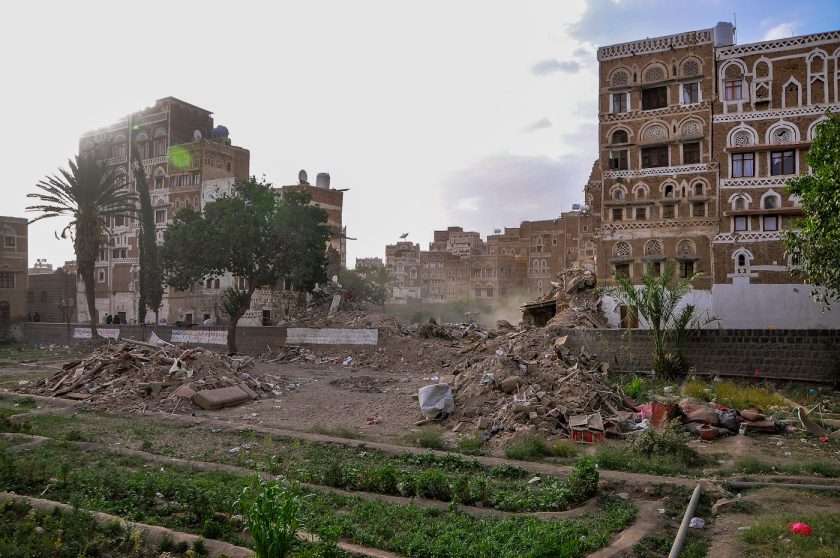
Four historic buildings in Sana’a’s old quarter, including the home of Saleh Ali al-Aeini, were destroyed by U.S. bombs dropped by Saudi warplanes in June, 2015. Photo – MintPress News
By Ahmed AbdulKareem – MintPress News – August 26, 2019
SANA’A, YEMEN — Yemen was once described as a living museum, but U.S. made bombs dropped by the Saudi-led Coalition’s jets have not only killed thousands of civilians and led to famine and the spread of disease but also pulverized the country’s rich architectural history and left its inimitable heritage at the mercy of the highest bidder.
“I remember how light filtered through the stained glass of the patterned crescent window (qamarias) onto the white gypsum plaster in the resting room (Deirmanah) on the top floor. At night, lights tossed dapples of color into the sky,” Saleh Ali al-Aeini recounted to MintPress from his partially destroyed high-rise apartment, continuing, “Now, only scattered glass remains amid a mound of dust and mud, thanks to American bombs.”
Saleh’s ancient tower-house was one of four historic buildings in the old quarter of Sana’a that were destroyed by U.S. bombs dropped from Saudi warplanes in June, 2015. The buildings’ many-storied tower-houses, three of them rising to 110 feet, were more than 2,500 years old. The newest of them was more than 1,000 years old, built long before the United States even existed as a nation.
The effects of airstrikes on the UNESCO-listed Old City, perched on a highland plateau more than 7,200 feet above sea level, can be noticed at a glance. Cracks show on the more than 1,975 densely-packed homes, threatening them with collapse. Labyrinths, hidden gardens, steam baths, busy markets and streets have all been affected by airstrikes on the city that was said to have been founded by Shem, the son of Noah. In fact, the ancient city has been targeted at least four times with over 30 airstrikes according to the General Authority for the Preservation of Historic Cities.
Yet Saudi airstrikes extend far beyond Sana’a’s historic sites — to Sadaa, Shibam Hadramout, Zabid in Hodeida, Shibam Kuban, east of Sana’a, Shabwa, Aden, Amran, Taiz, and other areas of the country’s history that have also fallen victim to coalition bombing. Airstrikes and shelling have destroyed at least 66 historic sites according to Muhannad al-Sayani, chairman of the Yemeni General Authority for Antiquities
Coalition raids have targeted ancient castles and forts, museums, religious shrines housing cultural treasures; and ancient dams, including the world-famous Great Marib Dam.
Al-Sayani told MintPress that targeting of the country’s historic sites by the Saudi-led Coalition is deliberate: “These are open sites, mostly in desert areas where weapons cannot be stored.” Following many of the attacks, the Coalition often accuses the Houthis of using archaeological sites as weapons depots; however, no evidence has been provided to substantiate these allegations.
The undersecretary of the General Authority for the Preservation of Historic Cities, Amat al-Razzaq Jahaf, told MintPress that most of the monuments or sites have been damaged or destroyed by Saudi airstrikes since the Saudi-led campaign began without any justification.
The United States says it does not make targeting decisions for the Coalition. But it does support Coalition operations through arms sales, the refueling of Saudi combat aircraft, and the sharing of intelligence. Just last Thursday, a U.S. MQ-9 Reaper drone was downed in the city of Dhamar near the historic Dhamar Museum, which was leveled by a direct Saudi airstrike in June 2015.
Nothing can bring these back
Al-Aeini’s wife, who told MintPress than an American-made bomb had destroyed her home and killed her sons, accused international aid organizations of neglecting their suffering. “Lots of organizations visited us and provided only [promises] without doing anything,” she went on, “We rebuilt a part of the house by ourselves, just to have shelter for me and my husband, without any help.” Yemen’s General Authority of Antiquities complained to MintPress that the country’s heritage has been neglected by international organizations and communities.
Now, the buildings — which have stood tall for thousands of years in the historic city that surrounds the remnants of al-Aeini family home — are subject to eroding foundations and ominous cracks that line their ancient walls built of mud and stone, as a result of repeated Saudi attacks and the inability of Yemen’s government to address the deterioration amid four years of Saudi bombardment.
To make matters worse, Yemen is in the midst of its rainy season, adding to the challenges in rebuilding archaeological sites that have been targeted. “Of course, what has been destroyed is still devastating and every day the dangers [to those sites] is multiplied due to our inability to carry out operations to reduce the aggravation of damage because of the costs of rebuilding,” Jahaf told MintPress. Al-Qasimi’s house in Sultan’s orchard in ancient Sana’a, which was destroyed in another Saudi airstrike, is an example of this.
“If peace is brought to Yemen — and with it, compensation is provided — infrastructure, roads, schools, and hospitals could all be rebuilt; but nothing can bring back the historic architecture that has been destroyed,” Mohaned al-Sayani, chairman of the Yemeni General Authority for Antiquities, told MintPress.
Centuries in building, seconds in destroying
“Here, generations of my grandparents lived; why is it that the Coalition can so easily destroy it?” Hashem Ali, who fled to Sana’a after airstrikes leveled his family home in the historic Rahban area of Saada, asked MintPress. “This is the first time in nearly 600 years that my family is without a home.”
The attack on ancient Sana’a was the first of many violent assaults on Yemen’s architectural history, but the worst hit historic area has been Yemen’s northern province of Saada, the hub of the ancient Minaean Kingdom of Ma’in, founded before the fourth century B.C.
Saada’s old city, which is among the world’s oldest human-carved landscapes, once consisted entirely of historic, centuries-old multi-story homes. Now, it has been wiped out, after Saudi Arabia declared it a military zone — even the city’s hand-carved wooden doors have been reduced to ashes.
Just hours after the Coalition issued a warning on May 10, 2015, dozens of airstrikes rained down on the historic city, including on the ancient al-Hadi Mosque, which was founded nearly 1,200 years ago and is the final resting place of Imam al-Hadi ila’l-Haqq Yahya, the Zaydi imam of Yemen.
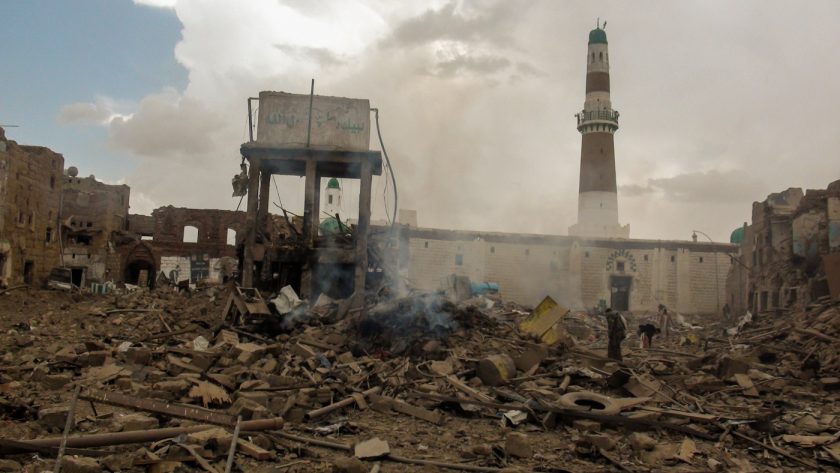
Built c. 897, al-Hadi Mosque is the final resting place of Imam al-Hadi ila’l-Haqq Yahya, the Zaydi imam of Yemen. It has been targeted several times. Ali al-Shurqbai – MintPress News
To understand Saudi Arabia’s motivation to essentially exterminate Yemen’s heritage, one must understand Yemen’s history as well as that of Saudi Arabia and the United Arab Emirates and the Saudi-based Wahhabi faith, which provides religious justification for targeting heritage sites under the guise of eradicating polytheism.
In ancient times, Yemen was home to several flourishing civilizations — including Ma’in, Qataban, Hadramaut, Ausan, Himyar and Saba (Sheba), which lasted for 11 centuries and was mentioned in the Quran and other ancient holy books. The Saban civilization was marked by its distinctive architecture, based almost entirely on local building materials, a style unique in the Middle East.
In contrast to Yemen’s rich and ancient history, civilization did not make its way to the Arabian Gulf until the 1930s. The United Arab Emirates, Saudi Arabia’s fellow coalition war partner, didn’t take root until 1971.
Many Yemenis, including Saleh Ali al-Aeini, believe that Saudi Arabia harbors severe jealousy over Yemen’s history and heritage and the unique role that it has played in human history. According to some historians, that history spans 60,000-70,000 years, when the country received its first Homo sapiens who migrated across the Red Sea from Africa to the Middle East before traveling west to Europe and east to Asia and Australia.
Moreover, Wahhabism — the official state religion of Saudi Arabia, based on a puritanical and widely rejected interpretation of Islam — sees the preservation of historic and religious sites as tantamount to idolatry. The Wahhabi establishment in Saudi Arabia has not even spared the Kingdom’s own tombs and monuments in Mecca and Medina and shows special disdain for Yemen’s historic sites, especially those located in northern Yemen, the seat of the Shia Zaydis for over a thousand years.
Looting what was not destroyed
Yemenis see their historic sites as a social-cultural fabric linking generations to their early ancestors. “I’ve lived here for dozens of years but now I have no house; there are no more gatherings of my ones-loved on the weekend,” al-Aeini said. He continued: “Another thing to worry about is our remaining legacy being looted.”
Destruction from the air is not the only threat to Yemen’s ancient legacy. During their war in Yemen, Saudi Arabia and the UAE have established smuggling networks in the country to loot historic sites.
A.M.M., who asked to be identified only by his initials, worked as an antiquities smuggler for a security outfit based in the UAE. A.M.M. told MintPress that his team sold four 2,500-year-old mummies, a gilded Torah scroll, and dozens of bejeweled daggers from the early Islamic era. “They always stressed the importance of keeping [the items] from being damaged so that they will be accepted by their American friends,” he said.
The smuggling of Yemeni antiquities is often carried out by diplomats operating out of Yemeni embassies from Saudi Arabia, the UAE, Bahrain and Egypt in return for lucrative sums of money allegedly provided by patrons from the United States and Israel. Yemen is the cradle to many civilizations and home to multiple faiths — particularly Judaism, Christianity and Islam, which all thrived in Yemen for millennia. For the Israelis, many of Yemen’s antiquities are seen as the rightful property of the Jewish people and there is reason to believe that Israel is also involved in the looting of Yemen’s heritage.
Officials in Sana’a say they have strong evidence that Yemeni artifacts are being sold off to American and Isreali buyers. “Artifacts featuring the Star of David or Jewish names are our priority; they often fetch a higher price than the other artifacts,” A.M.M told MintPress. “I sold one Hebrew manuscript to a UAE officer for $20,000,” he added.
Aden, in the eastern province of Marib, is favored by smugglers for shuttling stolen artifacts abroad. Here — according to the testimonies of a number of smugglers arrested by Houthi forces and now serving their sentences Sana’a’s Central Prison — smugglers are able to work in broad daylight in facilities provided to them by high-ranking officials in the ousted government of President Abdrabbuh Mansur Hadi, with direct coordination of both Emirati and Saudi officials.
More weapons to destroy what remains?
“We want compensation to rebuild our house again,” al-Aeini said, perched atop the stone rubble of his destroyed ancient home. “We should get compensation from the Americans. American bombs have killed more of us than were killed in the September 11 attacks.”
Al-Aeini was sardonically referring to the duality of moral attitudes in the United States, where on one hand Saudi Arabia is asked to pay compensation to the families of victims of the September 11 attacks, yet do nothing for victims of the war in Yemen, who are often killed with U.S. weapons sold to Saudi Arabia. “If there hadn’t been an American bomb, I would be at home now with my children and grandchildren, but they took everything,” al-Aeini said.
Many Yemenis are pessimistic about the future of their heritage. They say President Donald Trump’s recently-announced sales of U.S. weapons to Saudi Arabia and the United Arab Emirates will destroy what remains of their country’s legacy. The sale includes precision-guided missiles manufactured by Raytheon as well as precision guidance parts for Paveway IV bombs used on Eurofighter and Tornado warplanes — the same type that have been blamed for much of the destruction of Yemen’s historic sites and civilian casualties alike in the Saudi-UAE air campaign in Yemen.
An old Yemeni proverb used for generations to encourage the preservation of the country’s rich heritage reads Eli maluh awal maluh taley (Whoever has no first, has no second). Many Yemenis, al-Aeini among them, fear that Yemen is already losing its heritage, much like al-Aeini lost his home, to American weapons.
Ahmed AbdulKareem is a Yemeni journalist. He covers the war in Yemen for MintPress News as well as local Yemeni media.
Saudis failing to repel Yemeni drone strikes despite US-supplied Patriot system: UAE report
Press TV – August 23, 2019
Saudi Arabia has failed to repel Yemen’s retaliatory drone strikes despite relying on the US Patriot air defense system, a matter which has caused a slump in Saudi troop morale, according to a UAE intelligence report.
The UAE report revealed critical weaknesses in Saudi Arabia’s ability to thwart the retaliatory attacks, London-based Middle East Eye (MEE) news outlet reported.
The damning report, issued originally in May, had a limited publication intended for top Emirati leadership by the Emirates Policy Center (EPC), a think tank close to the Emirati government and its security services.
“Air defenses such as the Patriot are not capable of spotting these drones because the systems are designed to intercept long and medium range Scud missiles,” the report wrote.
The intelligence assessment highlighted an instance where Saudi Arabia’s southwestern Najran airport, which is used in Riyadh’s operations against Yemen, was hit by Yemeni drones despite the deployment of a Patriot battery.
Riyadh launched a devastating war on Yemen in March 2015, with the goal of bringing the government of former president Abd Rabbuh Mansur Hadi back to power and crushing Houthis.
Yemen’s resistance, however, has pushed the Saudi war to a stalemate, with Yemeni forces increasingly using sophisticated weaponry in retaliatory attacks against the Saudi-led coalition.
Referring possibly to a deadly Yemeni drone attack on a large air base occupied by Saudi mercenaries in the southwestern Lahij province in January, the EPC report highlighted the Saudi failure to thwart such attacks.
“The attack on the Lahij Military Base demonstrates a weakness in Saudi air defenses and the lack of capacity in electronic war if we take into account that these drones are basic and are not launched on tarmac,” it wrote.
The EPC reported that there had been as many as 155 Yemeni drone attacks against Saudi targets between January and May, a figure much higher than previously admitted.
Saudi attempts to destroy the drones have also failed, with the report noting that Riyadh has launched numerous airstrikes on caves allegedly used to store the drones, without any success.
Saudi ‘unprofessionalism’
The intelligence assessment also slammed what it described as a sign of Saudi “unprofessionalism”, as Riyadh quickly rushed to attribute attacks to Yemen’s Ansarullah movement without carrying out any investigation first.
The report compared Saudi Arabia’s “panicked” approach to that of Abu Dhabi which, according to the report, has a protocol of falsely denying the occurrence of such strikes when “serious” targets are attacked.
“This is a protocol which the Emiratis follow in time of serious attacks, such as the one that targeted Abu Dhabi airport (and claimed by the Houthis). It left the door open for the investigation to implicate Iran through evidence in these attacks,” the report read.
The July 2018 drone attack on the airport had been previously denied by UAE officials but was later corroborated by footage released by Yemeni forces this year.
Also referring to a mysterious and unclaimed attack on four oil tankers near the UAE’s port of Fujairah in May, the report said the “Emirati position emphasized the importance of completing investigations before taking any decision.”
“The Emiratis were careful not to give the Houthis any credit that may enhance their international status,” it added.
Despite the UAE report’s allegations, however, Saudi authorities are known to have covered and denied successful Yemeni retaliatory drone and missile strikes on numerous occasions.
‘Confused’ policies
The assessment said Riyadh had become extremely dependent on the United States’ “confused” policy with Iran.
Saudi Crown Prince Mohammed bin Salman, who threatened in 2017 to take the “fight” to Iran, has pushed to form an alliance with the UAE and Israel against Tehran.
The US administration, however, is acting quite timidly on its vows to “counter” Iran and the stance is worrying Saudi Arabia, according to the EPC.
American analyst Stephen Walt said the US policy towards Iran is in a “confused” state, swinging between abandoning Washington’s regional allies and pushing for regime change in Iran.
The UAE recently announced the gradual withdrawal of its troops from the Yemen war, largely because it believes the war appears to have become “unwinnable“, according to US reports.
The Yemen Tragedy Further Fueled by the West and Its Allies

By Viktor Mikhin – New Eastern Outlook – 31.07.2019
A most sophisticated demagogy, blatant falsifying of facts, impudent interpretation of events with everything going upside down, these are the thoughts that come to one’s mind when one reads another forgery concocted in the West. We mean the statement addressed to Iran calling for the termination of the actions which are allegedly destabilizing the situation in the Persian Gulf. The statement was made by the governments of the US, the UK and their satellites: the United Arab Emirates (UAE) and Saudi Arabia, on June 24, as reported by the US Department of State press service. In this manifesto, contrary to the obvious facts, the signatories held Iran responsible for the escalation of the situation in Yemen and the attacks on the oil tankers on May 12 and June 13, urging the Islamic Republic to start searching for a diplomatic solution. The intensity of this demagogy, as the saying goes, is beyond the scale.
Let us however, in a quiet fashion and on the basis of the obvious facts, consider the situation in the Persian Gulf area and ask several questions. Did Iran or the poor Yemen suffering a score of internal problems, indeed attack Saudi Arabia? Did the Houthis indeed create a so-called Arab coalition which has consistently bombed the Saudi cities and villages killing the civilians? By no means. It was the Saudis, namely the Crown Prince Mohammad bin Salman bin Abdulaziz Al Saud who took up the foreign policy responsibilities due to the old age and numerous diseases of his father, the King, and who gave the order sanctioning the rough intervention of Riyadh in internal affairs of the neighboring state of Yemen and the total bombing of the Yemen cities.
The leader of the Houthis and the President of the Supreme Revolutionary Committee (SRC) Mohammed Ali al-Houthi demanded the UN Secretary General to condemn the war crimes committed in Yemen. Among the crimes perpetrated by the coalition of the Arab countries (led by Saudi Arabia and supported by the countries of the West), the Houthi leader named the ruthless blockade of the Yemen people, the famine in the country, the ongoing air embargo, the blockade of the Red Sea ports, the mass murders (including those of children), the destruction of civil facilities targeted during the military attacks.
The UN strongly condemned the following Saudi air raid on the Yemen capital city of Sanaa which resulted in the death of many civilians, including five children; dozens of people were wounded. The head of the United Nations Children’s Fund (UNICEF) Henrietta Holsman Fore, speaking at the UN Security Council session, urged the international community to save the lives of the millions of Yemenite children. She emphasized that, since the beginning of the conflict in the country, according to official figures only, up to 10,000 children had been killed or wounded. According to the UN, the Saudi Air Force “aimed at the civilians systematically,” dropping bombs on hospitals, schools, weddings, funeral processions and even on the camps for the displaced persons escaping from bombing.
Representatives of the United Nations High Commissioner for Refugees (UNHCR) emphasized that the belligerents, Saudi Arabia in the first place, must respect the principles of international humanitarian law, which includes protecting the civilians during the hostilities. Millions of people in Yemen are currently on the verge of starvation, and the humanitarian organizations often have no opportunity to deliver the aid: food, medicines and fuel, to those in need. A major part of humanitarian cargo comes to Yemen through the ports of Al Hudaydah, As-Salif and Ras Issa, where the Houthis, following the Stockholm agreement, withdrew their troops from. However, representatives of the international organizations, whose activities have suffered consistent pressure exerted by the United States, for some reason or other, are not in a hurry to fulfill their obligations.
The international community’s condemnation of the Saudi crimes reached such a degree that the Deputy Minister of Defense of Saudi Arabia Khalid bin Salman bin Abdulaziz Al Saud had to hold a meeting with the special envoy of the UN Secretary General on Yemen Martin Griffiths. However, his stance was only limited to demagogical statements “about Riyadh‘s commitment to a political solution of the conflict in Yemen.”
And, probably, in order to ensure “the wellbeing of the Yemen people,” the Riyadh-led coalition declared the launch of a new attack on the positions of the Houthi insurgents in the province of Sanaa, in western Yemen. This information was made public by the Al Arabiya TV channel, referring to the military. The main targets for the new airstrikes include air defense facilities and missile warehouses belonging to the rebels. It is known that this province is densely inhabited; numerous cities and settlements are located there, and, therefore, the number of victims among the civilians will only increase. Such is the “commitment” of Saudi Arabia to the “wellbeing” of its neighbor and the “support” of a political solution of the ongoing conflict. Many politicians claim (for a good reason) that had there been no intervention of the Saudis in the internal affairs of Yemen, then this conflict would not have existed at all, nor would there have been all the numerous victims.
The international community does not pay due attention to the humanitarian crisis in Yemen, no sufficient financing is allocated for it, said the President of the International Federation of Red Cross and Red Crescent Societies (IFRC) Francesco Rocca: “The problem is not in providing more (help), but in receiving financing (to have an opportunity) to provide more (help). It is a vicious circle, the Yemen crisis lacks financing. It is forgotten, it is being ignored.”
More fuel to the long-lasting Yemen conflict fire was added by D. Trump who extended the sanctions against Yemen for another year. The White House website comments as follows: “The actions and policy of several former members of the Yemen government and other persons continue to threaten the peace, safety and stability of Yemen. Among other things, they interfere with the political process and the implementation of the peace treaty of November 23, 2011 between the government of Yemen and the opposition.” Let us remind the reader that the state of emergency concerning Yemen envisaging a number of restrictions was imposed in May 2012.
A faithful ally of the US, the UK has been actively partaking in this murderous war as well by delivering to the Saudis aviation bombs (for good money, too) which are used to kill the civilians of Yemen. On March 27, 2015 the day after the first British bombs fell on Yemen, the then Foreign and Commonwealth Secretary Philip Hammond told the reporters that the UK “will support the Saudis in every practical operation, by involvement in the fighting.” Since then, the British bombs which have been actively used by the Saudi pilots during the raids on the Yemen territory have been regularly manufactured in three British cities: Glenrothes in Scotland, and Harlow and Stevenage in Southeast England. The bombs which leave the production line for the Saudis on a daily basis belong to the Raytheon UK and ВАЕ Systems.
As soon as this weapon was bought by Saudi Arabia, the UK began to participate in the Yemen slaughter even more actively. The Saudi military lack experience to use this modern and lethal weapon. Therefore, for this air war to go on and for the British government to do good business on the blood of Yemenites, under another contract, London provides what is known as the “on-site military services.” In practical terms, it means that some 6,300 British experts have been deployed on the advanced operational bases in Saudi Arabia. It is them, not the Saudi pilots and technicians, who perform necessary repairs of the planes day and night so that they could fly across the Arabian Desert to their targets in Yemen again. They also control the Saudis loading bombs onto the planes and installing fuses on the bombs.
Thus, the West, which has been doing good business on the Yemen blood, will go on with its impudent demagogical statements that Iran, not Saudi Arabia, is responsible for the Yemen tragedy. Even more so, since Riyadh is buying arms amounting to hundreds of billions of dollars from the US alone, thus supporting the American military and industrial complex and giving Donald Trump a chance to create new jobs in the US. However, no one in the West seems to care at whose expense and on whose blood the US prospers.
During his recent trip to Yemen, the British conservative Member of Parliament Andrew Mitchell visited a school in the capital where he was “welcomed” by children who chanted slogans. The politician asked the accompanying Yemenite to interpret and learnt that they meant “death to the Saudis,” “death to the Americans,” and the third slogan remained untranslated, but it is easy to guess that it meant: “death to the British.”
Viktor Mikhin is a corresponding member of the Russian Academy of Natural Sciences.
As US Beefs Up Military Presence in the Gulf, Yemen’s Houthis Turn to Russia for Support
Houthi attempts to engage the UN to broker a peaceful solution to the war on Yemen have stalled. Now, out of options, the movement may have found a willing partner in Moscow.
By Ahmed Abdulkareem | Mint Press News | July 26, 2019
MOSCOW — Yemen’s Houthi movement has reacted with concern to an announcement by Washington that the U.S. is pursuing an increased military presence in the Persian Gulf. U.S. Central Command announced Operation Sentinel on July 19, claiming that a multinational maritime effort is needed to promote “maritime stability, ensure safe passage, and de-escalate tensions in international waters throughout the Bab el-Mandeb Strait, the Arabian [Persian] Gulf, Strait of Hormuz, and the Gulf of Oman.”
The Houthis’ Supreme Political Council, the highest political authority in Sana`a, held an emergency meeting on Monday to discuss the developments. After the meeting Houthi officials released a statement denouncing Operation Sentinel, saying that Yemen is keen on the security of the Red Sea and that any escalation by Coalition countries, including the United States, would be met with a response. The statement went on to say:
What makes waterways safe is an end to the war on Yemen, a lifting of the siege on the country and the end to [the Saudi-led Coalition] restricting access to food and commercial vessels in Yemeni ports, especially the port of Hodeida, not the presence of multinational forces there.”
Houthi officials also weighed in on the arrival of U.S. troops in Saudi Arabia as a part of a broader tranche of forces sent to the Gulf region over the past two months following increased tensions between Washington and Tehran. Mohammed Abdulsalam, the spokesman of Houthis and one of the most important decision-makers within the movement, told al-Mayadeen TV that the arrival of 500 U.S. troops to Saudi Arabia is “not welcome in the region.”
On Monday, Abdulsalam ridiculed Saudi Arabia’s celebration of the arrival of the U.S. troops, pointing to the Kingdom’s relying on U.S. and British protection while at the same time not knowing how to extricate itself from Yemen. “On one side, there are the Saudis seeking protection from others and on the other side, we have Yemen facing those superpowers with strength, rigidity and wisdom,” Abudlsalam said in a Facebook post. Abdulsalam also said that the deployment of U.S. troops to the Kingdom was aimed at boosting the morale of Saudi Arabia in the face of Yemen’s ballistic missile and drone attacks.
Abudlsalam’s comments were made during an official visit to Moscow, where a Houthi delegation was visiting at the invitation of the Russian government. The July 24 meeting with Russian Deputy Foreign Minister to the Middle East and North Africa Mikhail Bogdanov was held to discuss, among other things, U.S. military presence in the Gulf. Abdulsalam claimed during the meeting that U.S. and Western visions for a solution to the conflict in Yemen would be unsuccessful, telling his Russian counterpart that there won’t be security and safety in the region without an end to the aggression against Yemen. He went on to say that, “we [Houthis] have common interests with the Russians regarding peace in the region.”
Both Bogdanov and Abdulsalam expressed commitment to abiding by the UN-brokered Stockholm Agreement, which calls for a ceasefire in the Hodeida port in western Yemen. The Houthis also expressed support for Russia’s policy vision for security in the Gulf, which was presented by Bogdanov on Tuesday.
While Russian efforts may not necessarily produce peace in Yemen, they may give the Saudi-led Coalition a chance to see that all options for diplomacy have been fully explored. They will also provide the United Arab Emirates (UAE) — which recently pulled out a significant portion of their military forces from Yemen, amidst fears of Houthi retaliatory attacks on Dubai — a chance to jump on the Russian bandwagon. Saudi Arabia, which has made little progress in its more than four-year-long adventure in Yemen, could also use Russian efforts as a face-saving opportunity, according to Yemeni diplomats who spoke to MintPress.
According to well-informed sources in the Houthi movement, Russia is pushing hard to play a role in bringing an end to the war on Yemen, and Russian and Houthi interests are becoming more aligned, including opposition to an increased U.S. military presence in the region. Houthi officials are also hoping that Russia will use its position in the UN Security Council to veto resolutions adversely affecting the interests of Yemen. One Houthi official, who asked to remain anonymous because of the sensitivity of the issue, even told MintPress that Russia played a role in the recent withdrawal of the UAE forces from Yemen.
“No subordination to Iran”
Mehdi Al-Mashat, the Head of the Houthi Supreme Political Council, told delegates from the International Crisis Group on Wednesday that the Houthis are ready to stop drones and ballistic attacks on Saudi Arabia if the Kingdom stops its attacks on Yemen. He also expressed readiness to engage in dialogue with Saudi officials to “achieve a just peace for all,” but warned that the “U.S. must know Yemen is a country which has sovereignty and is not subject to anyone.”
Regarding Iran, Al-Mashat told members of the International Crisis Group, a Brussels-based NGO that works to resolve violent conflicts around the world, “with regard to the false claims that we are followers of Iran, which the Coalition countries know to be false, we confirm that there is no subordination to Iran.” Tehran’s support for the Houthis is limited to political, diplomatic and media support and the country’s influence in Yemen is marginal at best.
For its part, the United Nations says the years-long war in Yemen can be stopped and is eminently resolvable if the warring sides commit to the UN-brokered Stockholm peace agreement reached in Sweden late last year. Under the agreement, both the Houthis and Coalition forces agreed to withdraw their troops from the Yemeni ports of Hodeida, Salif, and Ras Issa, and to allow the deployment of UN monitors.
The UN Special Envoy for Yemen Martin Griffiths said on Tuesday, “I believe that this war in Yemen is eminently resolvable, both parties continue to insist that they want a political solution and the military solution is not available, they remain committed to the Stockholm agreement in all its different aspects.”
UAE “not leaving Yemen”
While the Houthis have had some success in forcing a dialogue with Coalition leaders through the United Nations, Russia, and various NGOs, it appears that their celebration over the recent announcement that the UAE is withdrawing its troops from Yemen may have been premature. In the Houthis’ first official statement since the UAE announced it was withdrawing its troops from Yemen, Houthi spokesman Mohammed Abdulsalam said on Wednesday that “the UAE has not withdrawn any its soldiers from Yemen, and instead has redeployed its forces from a number of areas in Yemen, including battlefields in Hodeida and Marib province in eastern Yemen.” Abdulsalam went on to encourage UAE leaders to pull out of Yemen, saying “the UAE getting out of Yemen is positive and natural and we encourage its leaders to do so.”
The UAE Minister of State for Foreign Affairs Anwar Mohammed Gargash, in an opinion piece published in The Washington Post on Monday, confirmed the UAE was not leaving Yemen, saying: “Just to be clear, the UAE and the rest of the Coalition are not leaving Yemen.”
He added, “While we will operate differently, our military presence will remain. In accordance with international law, we will continue to advise and assist local Yemen forces — referring to the myriad UAE-funded Yemeni rebel groups including the Shaban elite forces, the Mahri elite forces, and the Security Belt.
According to Mohammed Abdulsalam, the seemingly contradictory statement coming from the UAE may be a result of Saudi pressure.
Meanwhile, Turkey’s state news agency Anadolu, citing a spokesman for the UAE allies, reported on Wednesday that the Sudanese armed forces had partially withdrawn from parts of Yemen following the withdrawal of UAE troops from the same areas. Yemeni armed forces will replace the Sudanese troops around Hodeida, a Yemeni source told Anadolu.
The UAE and Sudan, parts of a Saudi-led military coalition, have been active members in the brutal Saudi-led Coalition’s war on Yemen since it began in 2015, which the United Nations says has produced the world’s worst humanitarian crisis, with millions on the brink of starvation
Ahmed AbdulKareem is a Yemeni journalist. He covers the war in Yemen for MintPress News as well as local Yemeni media
Despite talk of promoting democracy Trudeau in bed with repressive monarchy
By Yves Engler · July 8, 2019

UAE foreign minister Sheikh Abdullah bin Zayed with Justin Trudeau
Given his personal history perhaps it is no surprise that Justin Trudeau is fond of monarchies.
The United Arab Emirates is a repressive monarchy that pursues violent, anti-democratic, policies in its region. Despite this — or maybe because of it —Trudeau’s Liberal government has strengthened ties to the federation of seven Emirates. And unlike Canada’s claims to be promoting democracy in Venezuela or the Ukraine, there has been little mention of this in the media or scrutiny in Parliament.
The UAE has propped up the Transitional Military Council in Sudan that has faced massive protests calling for civilian rule. Two months ago the oil rich country put up half of a $3 billion package (with Saudi Arabia) to support Sudan’s military rulers and the head of the military council visited powerful Crown Prince Mohammed bin Zayed al-Nahyan in Abu Dhabi in late May. Many pro-democracy activists believe the UAE and Saudi Arabia pushed Sudan’s military to destroy a major protest site that left dozens dead at the start of June.
Abu Dhabi fears democracy in Sudan for various reasons. One immediate concern is the likelihood that a government in Khartoum representing the popular will would withdraw the 10,000 Sudanese soldiers in Yemen. The UAE has played a key role in the war in Yemen, which has left 100,000 dead, millions hungry and sparked a terrible cholera epidemic.
In Libya the UAE was recently caught delivering weapons to warlord Khalifa Haftar in violation of UN sanctions. Abu Dhabi has financed and supported Haftar’s bid to seize the Libyan capital by force. The Tripoli-based Government of National Accord said a UAE F-16 fighter jet was responsible for bombing a migrant detention centre that left some 50 people dead last week.
Elsewhere in the region the UAE has engaged in a two year blockade of Qatar designed to force Doha to heed their and close ally Saudi Arabia’s belligerent, anti-democratic, position towards Iran, Egypt and elsewhere. In recent years UAE helped crush Bahrain’s 2011 uprising, dispatched forces to Libya to support the NATO war and financed the return of military rule to Egypt in 2013. Abu Dhabi also plowed hundreds of millions of dollars of weaponry and other forms of support to Al Qaeda linked rebels in Syria.
Domestically, the UAE is a repressive monarchy that outlaws labour unions and hangs/stones individuals to death. The country heavily restricts religious freedoms and women’s rights. Recently, the wife (one of six) of Dubai’s ruler Sheikh Mohammed bin Rashid Al Maktoum sought asylum in the UK fearing for her life.
From what I could find the Trudeau government has stayed mum on Abu Dhabi’s efforts to derail democracy in Sudan. Nor have they made any comment on its violation of UN sanctions in Libya. Over four years they’ve barely made a peep about the UAE’s bombing and troops in Yemen. Instead of challenging the monarchy’s egregious policies, the Liberals have deepened ties to the Gulf Kingdom.
On July 1 officials from the two countries highlighted “the bond between Canada and the United Arab Emirates” by raising a Canadian flag-inspired display on Abu Dhabi’s Burj Khalifa, the world’s tallest building. Ten days ago, the government announced that Canada would participate in Expo 2020 Dubai. International trade minister Jim Carr declared, “our presence at Expo 2020 affirms the vitality of Canada-UAE relations.”
A UAE delegation led by Minister of Energy and Industry Suhail bin Mohammed Faraj Faris Al Mazrouei attended the International Economic Forum of the Americas in mid-June. At the Montréal conference Al Mazrouei met economic development minister Navdeep Bains and trade minister Jim Carr. During the opening of the last UN General Assembly session Trudeau met UAE foreign minister Sheikh Abdullah bin Zayed and he visited foreign minister Chrystia Freeland in Ottawa last May.
Despite their violence in Yemen, the Trudeau government has deepened military ties to the UAE. There are a small number of Canadian troops in the UAE and Royal Canadian Navy vessels in the region regularly coordinate with their Emirates counterparts. Last week Canada’s ambassador in Abu Dhabi, Masud Husain, met defence minister Mohammed bin Ahmed Al Bowardi. Canada’s Defence Minister Harjit Sajjan also met Al Bowardi there in April. According to Emirates News Agency, Canadian and UAE officials discussed “cooperation in the military and defence sectors” and “current regional and international developments.” In December 2017 Sajan traveled to the Gulf State to sign the Canada-UAE Defence Cooperation Arrangement.
According to Radio Canada International, the Canada–UAE defence accord “will make it easier for the Canadian defence industry to access one of the world’s most lucrative arms markets.” During the last four years the Trudeau government has promoted arm sales at the Abu Dhabi-based International Defence Exhibition and Conference (IDEX). With support from “15 trade commissioners and representatives from the Government of Ontario, National Defence, Global Affairs Canada, and the Canadian Commercial Corporation”, 50 Canadian arms companies flogged their wares at IDEX in February. To help the arms companies move their products, commander of the Bahrain-based Combined Task Force 150, Commodore Darren Garnier, led a Canadian military delegation to IDEX.
In February of last year Parliamentary Secretary to minister Bains, David Lametti, who is now Justice Minister, promoted Bombardier’s delivery of surveillance planes to the UAE. Montreal-based flight simulator company CAE trains UAE Air Force pilots at a facility in Abu Dhabi. Some UAE pilots bombing Yemen also likely trained at NATO’s Flying Training in Canada, which is run by CAE and the Canadian Forces.
As Anthony Fenton has documented in detail on his fantastic Canada-Gulf focused Twitter handle, armoured vehicles made by Canada’s Streit Group in the UAE have been repeatedly videoed in Yemen. At IDEX 2019 Streit Group officials were photographed pitching their Sherp All-terrain military vehicle to UAE officials.
After a high profile diplomatic spat with Saudi Arabia last August Canadian officials privately worried it would negatively impact relations with UAE. That didn’t happen, of course. In fact, the spat may have spurred closer ties to Saudi Arabia’s main regional ally.
It’s time for some mainstream journalists and parliamentarians to devote a little attention to the Trudeau’s government hypocritical embrace of the UAE monarchy.
Featured Video

US IRAN TALKS: Who Are the Crazy Ones Here? /Lt Col Daniel Davis
or go to
Aletho News Archives – Video-Images
From the Archives
Woolsey Fire started at Santa Susana Field Lab — where “radioactive materials released were never accurately measured”
By John Laforge | CounterPunch | November 30, 2018
In my Nov. 16 column, I reported on potential radiation risks posed by California’s Woolsey wildfire having burned over parts or all of the Santa Susana Field Laboratory—south of Simi Valley, Calif., 30 miles outside Los Angeles—site of at least four partial or total nuclear reactor meltdowns.
The field laboratory operated 10 experimental reactors and conducted rocket engine tests. In his 2014 book Atomic Accidents, researcher James Mahaffey writes, “The cores in four experimental reactors on site … melted.” Reactor core melts always result in the release of large amounts of radioactive gases and particles. Clean up of the deeply contaminated site has not been conducted in spite of a 2010 agreement.
Los Angeles’s KABC-7 TV reported Nov. 13 that the Santa Susana lab site “appears to be the origin of the Woolsey Fire” which has torched over 96,000 acres. Southern Calif. Public Radio said, “According to Cal Fire, the Woolsey Fire started on the afternoon of Thursday, Nov. 8 … on the Santa Susana site.” … continue
Blog Roll
 Aletho News
- US IRAN TALKS: Who Are the Crazy Ones Here? /Lt Col Daniel Davis
- Talks with the US end without a deal over excessive US demands: Iran
- Feeling Better, Getting Worse: How Psychiatric Drugs Create the Illusion They Cure
- ‘Nobody Told Me’: Former Mental Health Patient Calls Out Dangerous Side Effects of Psychiatric Drugs
- Dr. Abu-Sitta: Beirut ‘felt like a day in Shifa Hospital’
- Iran Has Won the War, It Will Be Up to the US to Secure the Peace: Mohammad Marandi
- Iran condemns assassination threats against Iranian negotiators amid US talks
- Brussels cannot say where its own pipeline inspectors are as Hungary’s oil lifeline remains shut
- Israel’s Iran War: Myth and Reality
- Between war and industrial breakdown: The US-Israeli attrition crisis
- If Americans Knew
- Pro-Israel ‘Thinktanks’ and Individuals who Influence U.S. Foreign Policy
- Mearsheimer reveals how Israel dictates US policies on Iran, Gaza – video
- After killing 350+, Israel still has a “score to settle” with Lebanon before ceasefire – Daily Update
- Military aid to Israel emerges as the latest political litmus test for Democrats
- The only Palestinian children’s rights organization closes following years-long Israeli campaign against it
- ‘I Can’t Forget the Smell’: Lebanese Reel After Israel Kills Over 300 in Single Day
- DNC Shoots Down Resolutions Calling Out AIPAC and Limiting Arms to Israel
- TCN: Is Israel Blackmailing President Trump?
- Israel killed at least 303 Lebanese yesterday – who were they? Daily Update
- Amnesty: Urgent – Protect Lebanese civilians from brutal escalation in Israeli attacks
- No Tricks Zone
- German Expert: Heat Dome Led To Record Temps In Western USA…Warmer In 1934, 1936
- New Study: No Linear Warming Or Glacier Retreat Along Northern Antarctic Peninsula Since 1980s
- An Inconvenient Tree: Uncovered In Alps… Europe Much Warmer Than Today 6000 Years Ago
- New Study Reports A 60% Slowdown In Greenland’s Ice Loss Rate In The Last Decade
- Low Intensity Tornado Wrecks Major Solar Farm, Creating A Potential Toxic Dump
- New Study Finds Warming Saves Lives…Cold Temperatures 12 Times More Deadly Than Excess Heat
- German Science Blog Accuses PIK Climate Institute Of Hallucinating Climate Tipping Points
- Devastating Assessment Of Comirnaty Vaccine By Former Senior Pfizer Europe Toxicologist
- New Study: CO2 Is ‘Effectively Negligible’ As An Explanatory Climate Change Factor Since 2000
- Former Pfizer Toxicologist Dr. Helmut Sterz Tells Bundestag Hearing Pfizer Vaccine Should Have Never Been Approved
 Aletho News