UK troops accused of training child soldiers in Yemen
Press TV – March 28, 2019
UK Foreign Office minister Mark Field has promised to get to the bottom of “very serious and well sourced” allegations that British special forces have been training child soldiers in the Saudi-led war against Yemen.
He was answering an urgent question asked in the Commons on Tuesday by the shadow foreign secretary, Emily Thornberry, who suggested the British troops may have been witnesses to war crimes.
She claimed as many as 40 percent of the soldiers in the Saudi coalition were children, a breach of international humanitarian law.
Field also said he would be making inquiries with the UK Ministry of Defence in light of a report that British Special Air Service (SAS) soldiers were injured in a firefight with the Houthi Ansarullah movement in Yemen.
The UK government has a general policy of not discussing the operations of its special forces but Field seemed determined to provide an explanation to members of Parliament.
There had been social media reports from Yemen in February suggesting that British soldiers had been injured in a firefight, and the Daily Express newspaper claimed two SAS members had been injured during a “humanitarian” operation.
However, it was claimed in The Mail on Sunday, a weekly newspaper, that UK special forces were not just involved in so-called humanitarian operations, but providing mentoring teams inside Yemen, including medics, translators and forward air controllers, whose job is to request air support from the Saudis. It claimed five special forces soldiers have been injured.
Conservative Party MP Andrew Mitchell said the allegations were so serious because they flew in the face of successive assurances given by ministers that the UK was not a participant in the Saudi war against Yemen, and was only providing general logistical support to Riyadh.
“These serious allegations that are authoritative and credible, and fly in the face of assurances that have been given from the despatch box on countless occasions,” Mitchell told the Commons.
The UK is known to be close to the Saudi military but denies it is involved in operations against the Houthis in Yemen.
A number of Western countries, the US and Britain in particular, are accused of being complicit in the ongoing aggression in Yemen as they supply the Riyadh regime with advanced weapons and military equipment as well as logistical and intelligence assistance.
The Saudi-led war has taken a heavy toll on the country’s infrastructure, destroying hospitals, schools, and factories. The UN has already said that over 22 million Yemenis are in dire need of food, while 8.4 million are threatened by severe hunger.
According to the world body, Yemen is suffering from the most severe famine in more than 100 years.
Saudi Arabia and a number of its regional allies launched the devastating campaign on March 26, 2015, with the aim of bringing a former government to power and crushing the Houthi Ansarullah movement. Riyadh has failed to fulfill its objectives.
British RAF servicing Saudi jets bombing civilians in Yemen – UK armed forces minister
RT | March 18, 2019
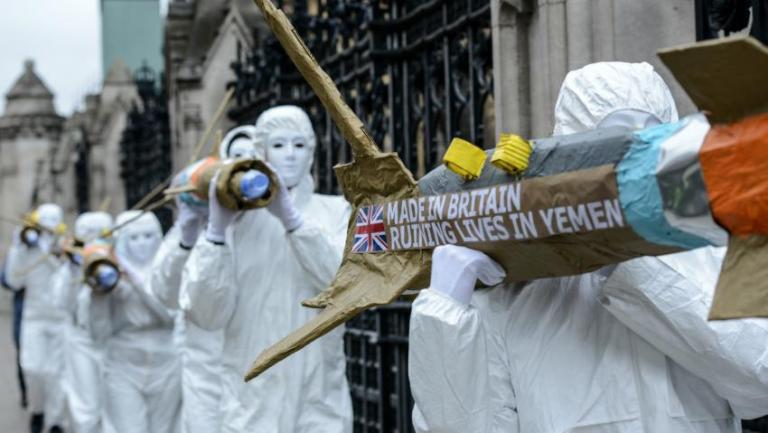
Britain is providing “engineering support” for UK-supplied aircraft operated by the Royal Saudi Air Force, responsible for killing innocent people in Yemen, a British government minister has revealed.
Armed Forces Minister Mark Lancaster was responding to a question in parliament from Labour MP Lloyd Russell-Moyle, on military personnel seconded to BAE Systems in Saudi Arabia, when he admitted that the RAF have provided engineering and “generic training” to the Saudi Air Force involved in the bombing of Yemen.
“RAF personnel on secondment to BAE Systems in Saudi Arabia have provided routine engineering support for UK-supplied aircraft operated by the Royal Saudi Air Force (RSAF), including aircraft engaged in military operations in Yemen.”
Lancaster insisted UK personnel were not involved in the loading of weapons for operational sorties, in response to Russell-Moyle’s claim that the “British support keeps Saudi’s air war going.”
Andrew Smith of Campaign Against the Arms Trade has branded the revelation “shocking but not surprising,” arguing that UK military personnel “should not be servicing Saudi jets or supporting the Saudi armed forces.”
It’s not just the UK that has been widely criticised for being party to the Saudi-led coalition’s bombardment of Yemen.
In December, the US Pentagon revealed that they were having to claw back $331 million of taxpayer-subsidized money gifted to Saudi Arabia and the UAE over a three-year period, when it ‘accidentally’ refueled their aircraft for free during their war on Yemen.
In November, Labour’s Shadow Foreign Secretary Emily Thornberry accused the UK government of having “blood on its hands” after admitting that the RAF had trained over a hundred Saudi pilots in the past ten years.
Coalition forces led by Saudi Arabia and the United Arab Emirates have relentlessly bombed Yemen since 2015 in an effort to oust the Houthi rebels controlling the capital city of Sanaa.
They have reportedly targeted hospitals and other civilian infrastructure, leading to a massive cholera outbreak, and upwards of 60,000 people are believed to have died in the conflict since 2016 – with a further 85,000 estimated dead from famine and malnutrition.
Half of Yemen’s population relies on food aid to survive, placing them in immediate danger of starving to death after coalition forces blockaded the port city of Hodeidah last year.
Arms Sales to Middle East Have Increased Dramatically: US Top Exporter
Al-Manar | February 11, 2019
Arms flows to the Middle East have increased by 87 percent over the past five years and now account for more than a third of the global trade, the Stockholm International Peace Research Institute (SIPRI) said in a report on Sunday.
The defense think-tank’s annual survey showed that Saudi Arabia became the world’s top arms importer in 2014-18, with an increase of 192 percent over the preceding five years. Egypt, Algeria, the United Arab Emirates and Iraq also ranked in the top 10 list of global arms buyers. Sipri measures the volume of deliveries of arms, not the dollar value of deals. The volume of deliveries to each country tends to fluctuate, so it presents data in five-year periods that offer a more stable indication of trends.
The new report shows how the United States and European nations sell jets, jeeps and other gear that is used in controversial wars in Yemen and beyond, SIPRI researcher Pieter Wezeman told Middle East Eye.
“Weapons from the US, the UK and France are in high demand in the Gulf, where conflicts and tensions are rife. Russia, France and Germany dramatically increased their arms sales to Egypt in the past five years,” Wezeman said.
The growth in Middle Eastern imports was in part driven by the need to replace military gear that was deployed and destroyed in Yemen, Syria, Iraq and Libya, he said, adding that it was also driven by political tensions and a regional arms race.
The UAE, Saudi Arabia and ‘Israel’ are readying for a potential conflict with Iran, the 12-page report said. Also, the UAE, Saudi Arabia and others have been involved in a diplomatic crisis with Qatar since 2017.
In 2014-18, Saudi Arabia received 94 combat jets fitted with cruise missiles and other guided weapons from the US and Britain.
Over the next five years, it is set to get 98 more jets, 83 tanks and defensive missile systems from the US, 737 armored vehicles from Canada, five frigates from Spain, and Ukrainian short-range ballistic missiles.
In 2014-18, the UAE received missile defense systems, short-range ballistic missiles and about 1,700 armored personnel carriers from the US as well as three Corvettes from France, the report says.
Qatari weapons imports increased by 225 percent over the period, including German tanks, French combat aircraft and Chinese short-range ballistic missiles. It is set to receive 93 combat aircraft from the US, France and Britain and four frigates from Italy.
Iran, which is under a UN arms embargo, accounted for just 0.9 percent of Middle Eastern imports.
For Wezeman, “the gap is widening” between Iran and its foes across the Gulf, which have obtained more advanced weapons.
US remains top arms seller
The US has retained its position as the world’s top arms seller. Its exports grew by 29 percent over the past five years, with more than half of its shipments (52 percent) going to customers in the Middle East.
British sales grew by 5.9 percent over the same period. A total of 59 percent of UK arms deliveries went to the Middle East – most of it combat aircraft destined for Saudi Arabia and Oman.
Arming governments in the turbulent Middle East is increasingly controversial in the West, said Patrick Wilcken, an arms control specialist with Amnesty International, a UK-based rights watchdog.
He pointed to cases where sales are merited – such as re-tooling Iraq’s army after it lost much of its hardware and territory in the ISIL group’s attack in 2014.
Still, Western arms more often end up being used in human rights abuses, he said, pointing to Egypt’s crackdown on political opponents, Israel’s occupation of Palestinian land and the Saudi-led war in Yemen.
He blasted the “hypocrisy” of Western governments not following their own rules by continuing to supply authoritarian leaders who commit wartime abuses or violations against their own people.
In addition, “a critical problem for the region is the emergence of armed groups like ISIL”, Wilcken told MEE.
Ansarullah: UK’s Hunt distorting terms of Hudaydah ceasefire deal
Press TV – March 5, 2019
Yemen’s Houthi Ansarullah movement has censured recent comments by British Foreign Secretary Jeremy Hunt on the control of Hudaydah, saying the top UK diplomat is distorting the terms of a UN-mediated ceasefire deal reached between the Yemeni warring sides in Sweden over the strategic Red Sea port city.
During a visit to Yemen on Sunday, Hunt — whose country has been a major supporter of the deadly Saudi-led war on Yemen — claimed that Hudaydah “was supposed to be cleared of militia and left under neutral control by the beginning of January.”
Mohammed Abdul-Salam, a spokesman for the Houthi movement, rejected the comments in a statement released on Monday, stressing that the Hudaydah truce had never mentioned handing over the port city to a “neutral” party.
The ceasefire, he added, had stipulated that after the withdrawal of the warring sides, Hudaydah would be patrolled by an unspecified “local force” with UN observers.
“We are prepared to carry out the redeployment in the first step, but the other party refused because they do not want to expose the aggression mercenaries and to lose the pretexts and justifications for continuing the aggression on the West Coast,” Abdul-Salam said.
Representatives from the Houthi movement and the Riyadh-sponsored government of the ex-president, Abd Rabbuh Mansur Hadi, agreed to cease fighting in Hudaydah during peace talks in Sweden last December.
Under the agreement, the rival parties also agreed to the withdrawal of their troops and the deployment of UN monitors to the port city, a lifeline for millions of Yemenis.
However, the Houthis – who control Hudaydah — have repeatedly complained about ceasefire breaches by the Saudi-backed side.
Elsewhere in his remarks, the Houthi spokesman said that the countries, which are involved in the bloody military campaign against Yemen, especially Britain are the ones violating the Hudaydah truce.
He also said the UN special envoy for Yemen – a British national — was relying on the UK in dealing with the Yemen issue.
“Martin Griffith appears not to be an envoy of the United Nations, but an English envoy representing Britain, especially after the British Foreign Office has made its objectives and position clear, which is in line with the obstruction of the agreement,” the Houthi official added.
“Britain has clearly revealed that it manages the process of blocking the agreement through its envoy to Yemen under the cover of the United Nations,” he pointed out.
Hudaydah, the entry point for most of Yemen’s commercial goods and vital aid, has seen some of the heaviest fighting in the four-year Saudi war.
Saudi Arabia and the UAE launched the offensive against Hudaydah in June 2018, but they have faced strong resistance put up by Yemeni armed forces – led by the Houthis — and the city’s residents.
The Saudi-led coalition claims that the Houthis are using the port for weapons delivery, an allegation rejected by the fighters.
The UK has licensed over £4.7 billion worth of arms exports, including missiles and fighter jets, to Riyadh since the Saudi regime and its allies launched a broader military campaign against Yemen in early 2015.
Britain has also been providing combat intelligence and target data to Saudi Arabia over the course of the war.
Sayyed Houthi: Arab Media Campaigns against Hezbollah Result of Normalization with ‘Israel’
Al-Manar | March 3, 2019
The leader of the Houthi Ansarullah revolutionary movement, Sayyed Abdul Malik al- Houthi, on Sunday stressed that the Warsaw conference was a mere announcement of normalizing ties between some Arab regimes and the Zionist entity at the expense of the Palestinian cause.
Sayyed Houthi stressed rejection of this normalization, considering that the Zionist occupation in any Arab area targets the entire Umma.
The Zion-American schemes aim at creating a new enemy for the Arabs he said, adding that media campaigns launched by some Arab regimes against Hezbollah and the Palestinian resistance is the direct result of normalizing ties with the Israeli entity.
Stressing that the Zionist entity is directly involved in the aggression on Yemen, Sayyed Al-Houthi reiterated the Yemeni’s support to the major causes of the Umma.
Yemen has been since March 25, 2015 under aggression by the Saudi-led coalition, which also includes UAE, Bahrain, Egypt, Morocco, Jordan, Sudan and Kuwait, in a bid to restore power to fugitive former president Abdrabbuh Mansour Hadi.
Tens of thousands of Yemenis have been injured and martyred in Saudi-led strikes, with the vast majority of them being civilians.
However, the allied forces of the Yemeni Army and popular committees established by Ansarullah revolutionaries have been heroically confronting the aggression with all means.
Forget Venezuela: 80% of Yemenis Require Urgent Humanitarian Aid, Up 30%
Geopolitics Alert – February 27, 2019
Sana’a – While the world focuses on Venezuela to validate coup threats, the manmade humanitarian situation in Yemen continues deteriorating. In fact, the very country claiming to help alleviate Venezuelan suffering, the United States, has played an active and intentional role in creating the crisis in Yemen.
According to a recent report from ReliefWeb, 80% of Yemen’s entire population require urgent humanitarian assistance. This figure is up 30% from last year. That means out of an estimated population of 30.5 million, 24.1 million require immediate aid for survival.
Facing starvation and famine due to the blockade, 20.1 million need urgent food assistance. Healthcare is also a vital concern. 19.7 million Yemenis lack basic access to doctors and lifesaving medicines. To top it off, 17.8 million don’t even have proper water, sanitation, and other supplies for keeping up with basic hygiene. By looking at these numbers, it’s easy to see that a majority of Yemenis need urgent assistance in all three areas.
This is a major problem because the lack of access to clean water and sanitation equipment is directly responsible for the fatal spread of cholera. The UN expects to record up to 350,000 cases of cholera in 2019. In 2017, one million were infected with the preventable illness while several thousand died.
Instead of putting forth any efforts to lift the US-enforced and Saudi-led blockade and siege of Yemen, the UN has appealed for $4.2 billion to meet humanitarian needs.
Famine and Disease as a Weapon of War
The blockade, which is technically illegal under international law, restricts all land, sea, and air imports and exports. It also prohibits the free flow of human movement — which has effectively turned Yemen into an open-air prison. This travel ban, combined with the country’s failing healthcare system, had contributed to the death of over 27 thousand civilians as of August of 2018. It has also caused the death of over 247,000 children who are particularly vulnerable to starvation and disease.
But the starvation, disease, and crumbling healthcare system aren’t merely a byproduct of the blockade: they’re an intentional consequence.
According to a report Geopolitics Alert received from the Republic of Yemen, the US-backed Saudi-led coalition has continued targeting civilian infrastructure vital for sustaining life.
During the month of December alone, Saudi coalition warplanes attacked 68 water tanks and pumps, 222 agricultural fields, four markets, 132 livestock, four food warehouses, and much more. To top it off, coalition airstrikes also targeted 190 businesses and factories as well as airports, seaports, boats, and gas stations.
These are direct attacks on Yemen’s food and water supply.
The report also states that hundreds of workers such as fishermen, farmers, and factory workers in Hodeidah province have become unemployed during the month of December due to such attacks on their source of income. The Saudi coalition also detonates cluster munitions and chemical weapons over agricultural fields to further contaminate the land.
The coalition airstrikes on vital civilian infrastructure make it clear that starvation and disease from the blockade are intended weapons of war.
This MintPress documentary examines the gruesome attacks on fishermen who recall horrors of rape and torture after being captured by Saudi coalition warships.
Telling Only Part of the Story of Jihad
By Daniel LAZARE | Consortium News | February 21, 2019
A recent CNN report about U.S. military materiel finding its way into Al Qaeda hands in Yemen might have been a valuable addition to Americans’ knowledge of terrorism.
Entitled “Sold to an ally, lost to an enemy,” the 10-minute segment, broadcast on Feb. 4, featured rising CNN star Nima Elbagir cruising past sand-colored “Mine-Resistant Ambush Protected” armored vehicles, or MRAPs, lining a Yemeni highway.
“It’s absolutely incredible,” she says. “And this is not under the control of [Saudi-led] coalition forces. This is in the command of militias, which is expressly forbidden by the arms sales agreements with the U.S.”
“That’s just the tip of the iceberg,” she adds. “CNN was told by coalition sources that a deadlier U.S. weapons system, the TOW missile, was airdropped in 2015 by Saudi Arabia to Yemeni fighters, an air drop that was proudly proclaimed across Saudi backed media channels.” The TOWs were dropped into Al Qaeda-controlled territory, according to CNN. But when Elbagir tries to find out more, the local coalition-backed government chases her and her crew out of town.
U.S.-made TOWs in the hands of Al Qaeda? Elbagir is an effective on-screen presence. But this is an old story, which the cable network has long soft-pedaled.
In the early days of the Syrian War, Western media was reluctant to acknowledge that the forces arrayed against the Assad regime included Al Qaeda. In those days, the opposition was widely portrayed as a belated ripple effect of the Arab Spring pro-democracy uprisings elsewhere in the region.
However, in April-May 2015, right around the time that the Saudis were air-dropping TOWs into Yemen, they were also supplying the same optically-guided, high-tech missiles to pro-Al Qaeda forces in Syria’s northern Idlib province. Rebel leaders were exultant as they drove back Syrian government troops. TOWs “flipped the balance,” one said, while another declared: “I would put the advances down to one word – TOW.”
CNN reported that story very differently. From rebel-held territory, CNN’s Nick Paton Walsh described the missiles as a “possible game-changer … that may finally be wearing down the less popular side of the Shia-Sunni divide.” He conceded it wasn’t all good news: “A major downside for Washington at least, is that the often-victorious rebels, the Nusra Front, are Al Qaeda. But while the winners for now are America’s enemies, the fast-changing ground in Syria may cause to happen what the Obama administration has long sought and preached, and that’s changing the calculus of the Assad regime.”
Foreign Policy, The Washington Post, The Guardian, and The New York Times all reacted the same way, furrowing their brows at the news that Al Qaeda was gaining, but expressing measured relief that Syrian President Bashar al-Assad was at last on the ropes.
But now that Elbagir is sounding the alarm about TOWs in Yemen, CNN would do well to acknowledge that it has been distinctly more blasé in the past about TOWs in the hands of al Qaeda.
The network appears unwilling to go where Washington’s pro-war foreign-policy establishment doesn’t want it to go. Elbagir shouldn’t be shocked to learn that U.S. allies are consorting with Yemeni terrorists.
U.S. History with Holy Warriors
What CNN producers and correspondents either don’t know or fail to mention is that Washington has a long history of supporting jihad. As Ian Johnson notes in “A Mosque in Munich” (2010), the policy was mentioned by President Dwight Eisenhower, who was eager, according to White House memos, “to stress the ‘holy war’ aspect” in his talks with Muslim leaders about the Cold War Communist menace.” [See “How U.S. Allies Aid Al Qaeda in Syria,” Consortium News, Aug. 4, 2015.]
Britain had been involved with Islamists at least as far back as 1925 when it helped establish the Muslim Brotherhood in Egypt, and both the U.S. and Britain worked with Islamists in the 1953 coup in Iran, according to Robert Dreyfus in “Devil’s Game” (2006).
By the 1980s a growing Islamist revolt against a left-leaning, pro-Soviet government in Afghanistan brought U.S. support. In mid-1979, President Jimmy Carter and his national security adviser, Zbigniew Brzezinski, armed the Afghan mujahideen — not at first to drive the Soviets out, but to lure them in. Brzezinski intended to deal Moscow a Vietnam-sized blow, as he put it in a 1998 interview.
Meanwhile, a few months after the U.S. armed the mujahideen, the Saudis were deeply shaken when Islamist extremists seized the Grand Mosque in Mecca and called for the overthrow of the royal family. While Saudi Arabia has been keen to repress jihadism at home, it has been a major supporter of Sunni extremists in the region, particularly to battle the Shi‘ite regime that came to power in Tehran, also in 1979.
Since then, the U.S. has made use of jihad, either directly or indirectly, with the Gulf oil monarchies or Pakistan’s notoriously pro-Islamist Inter-Services Intelligence agency. U.S. backing for the Afghan mujahideen helped turn Osama bin Laden into a hero for some young Saudis and other Sunnis, while the training camp he established in the Afghan countryside drew jihadists from across the region.
U.S. backing for Alija Izetbegovic’s Islamist government in Bosnia-Herzegovina brought al-Qaeda to the Balkans, while U.S.-Saudi support for Islamist militants in the Second Chechen War of 1999-2000 enabled it to establish a base of operations there.
Downplaying Al Qaeda
Just six years after 9/11, according to investigative reporter Seymour Hersh, the U.S. downplayed the fight against Al Qaeda to rein in Iran – a policy, Hersh wrote, that had the effect of “bolstering … Sunni extremist groups that espouse a militant vision of Islam and are hostile to America and sympathetic to Al Qaeda.”
Under Secretary of State Hillary Clinton, policy toward Al-Qaeda turned even more curious. In March 2011, she devoted nearly two weeks to persuading Qatar, the UAE and Jordan to join the air war against Libya’s Muammar Gaddafi, only to stand by and watch as Qatar then poured hundreds of millions of dollars of aid into the hands of Islamist militias that were spreading anarchy from one end of the country to the other. The Obama administration thought of remonstrating with Qatar, but didn’t in the end.
Much the same happened in Syria where, by early 2012, Clinton was organizing a “Friends of Syria” group that soon began channeling military aid to Islamist forces waging war against Christians, Alawites, secularists and others backing Assad. By August 2012, the Defense Intelligence Agency reported that “the Salafist, the Muslim Brotherhood, and AQI [Al Qaeda in Iraq] are the major forces driving the [anti-Assad] insurgency”; that the West, Turkey, and the Gulf states supported it regardless; that the rebels’ goal was to establish “a declared or undeclared Salafist principality in eastern Syria,” and that “this is exactly what the supporting powers want in order to isolate the Syrian regime….”
Biden Speaks Out
Two years after that, Vice President Joe Biden declared at Harvard’s Kennedy School:
“Our allies in the region were our largest problem in Syria… The Saudis, the Emiratis, etc. what were they doing? They were so determined to take down Assad and essentially have a proxy Sunni-Shia war, what did they do? They poured hundreds of millions of dollars and tens of thousands of tons of military weapons into anyone who would fight against Assad, except the people who were being supplied were al Nusra and al Qaeda and the extremist elements of jihadis coming from other parts of the world.” (Quote starts at 53:25.)
The fact that Obama ordered the vice president to apologize to the Saudis, the UAE and Turkey for his comments provided back-handed confirmation that they were true. When TOWs turned up in the hands of pro-Qaeda rebels in Syria the following spring, all a senior administration official would say was: “It’s not something we would refrain from raising with our partners.”
It was obvious that Al Qaeda would be a prime beneficiary of Saudi intervention in Yemen from the start. Tying down the Houthis — “Al Qaeda’s most determined foe,” according to the Times — gave it space to blossom and grow. Where the State Department said it had up to 4,000 members as of 2015, a UN report put its membership at between 6,000 and 7,000 three years later, an increase of 50 to 75 percent or more.
In early 2017, the International Crisis Group found that Al Qaeda was “thriving in an environment of state collapse, growing sectarianism, shifting alliances, security vacuums and a burgeoning war economy.”
In Yemen, Al Qaeda “has regularly fought alongside Saudi-led coalition forces in … Aden and other parts of the south, including Taiz, indirectly obtaining weapons from them,” the ICG added. “… In northern Yemen … the [Saudi-led] coalition has engaged in tacit alliances with AQAP fighters, or at least turned a blind eye to them, as long as they have assisted in attacking the common enemy.”
In May 2016, a PBS documentary showed Al Qaeda members fighting side by side with UAE forces near Taiz. (See “The Secret Behind the Yemen War,” Consortium News, May 7, 2016.)
Last August, an Associated Press investigative team found that the Saudi-led coalition had cut secret deals with Al Qaeda fighters, “paying some to leave key cities and towns and letting others retreat with weapons, equipment, and wads of looted cash.” Saudi-backed militias “actively recruit Al Qaeda militants,” the AP team added, “… because they’re considered exceptional fighters” and also supply them with armored trucks.
If it’s not news that U.S. allies are providing pro-Al Qaeda forces with U.S.-made equipment, why is CNN pretending that it is? One reason is that it feels free to criticize the war and all that goes with it now that the growing human catastrophe in Yemen is turning into a major embarrassment for the U.S. Another is that criticizing the U.S. for failing to rein in its allies earns it points with viewers by making it seem tough and independent, even though the opposite is the case.
Then there’s Trump, with whom CNN has been at war since the moment he was elected. Trump’s Dec. 19 decision to withdraw U.S. troops from Syria thus presented the network with a double win because it allowed it to rail against the pullout as “bizarre” and a “win for Moscow” while complaining at the same time about administration policy in Yemen. Trump is at fault, it seems, when he pulls out and when he stays in.
In either instance, CNN gets to ride the high horse as it blasts away at the chief executive that corporate outlets most love to hate. Maybe Elbagir should have given her exposé a different title: “Why arming homicidal maniacs is bad news in one country but OK in another.”
Walter Jones and the Vote to End US War on Yemen
By Ron Paul | February 18, 2019
In a fitting legacy for my friend Walter Jones, Jr. who passed away last week, the US House made history by voting in favor of H.J.Res. 37, a resolution “Directing the removal of United States Armed Forces from hostilities in the Republic of Yemen that have not been authorized by Congress.” As George O’Neill wrote in the American Conservative magazine this week, the historic 248-177 victory for a bill demanding the end of the US participation in the nearly five year Saudi war of aggression “reflects how many hearts and minds were influenced by the late Congressman’s tireless efforts.”
Walter Jones did not care who controlled Congress. He was happy to join forces with any Member to end the senseless US global military empire, which sends thousands of young men and women off to patrol foreign borders, overthrow foreign governments, and needlessly put themselves at risk in missions that have nothing to do with the safety and security of the United States.
US participation in the Saudi war on Yemen is a classic example of the abuse of the US military that made Walter Jones most angry. When the Saudis decided in 2015 that they wanted their puppet to be Yemen’s president, they launched a brutal and inhuman war that many call the worst humanitarian disaster of our time. Millions face starvation as Saudi bombs and US sanctions combine to create a hell on earth that is unrelated in any way to US national security.
Why this ongoing support for Saudi death and destruction in Yemen? Washington’s neocons have successfully promoted the lie that the Saudi attack on Yemen is all about preventing Iran from gaining more strength in the Middle East. Ironically it was the neocon-backed US attack on Iraq in 2003 that provided the biggest boost for Iranian influence in the region. Now, after Iraq’s “liberation,” Baghdad’s ties to Tehran are closer than ever.
Meanwhile, who exactly are we supporting in Yemen? Even CNN, normally a big backer of US military actions overseas, has noticed something funny about US participation in the Saudi war on Yemen. As a CNN investigation found this month, “Saudi Arabia and its coalition partners have transferred American-made weapons to al Qaeda-linked fighters, hardline Salafi militias, and other factions waging war in Yemen, in violation of their agreements with the United States.” Does that sound like we are on the side of the “good guys” in this battle? We are helping the Saudis arm al-Qaeda? Is this really a smart move?
So we should be encouraged that Walter Jones’ legacy is being honored in the House vote to end the US participation in the Yemen war. While US “humanitarian” aid is being used as a weapon for regime change in Venezuela, the warmongers in Washington have never lifted a finger to help those suffering from a real genocide in Yemen.
If the Yemen War Powers resolution passes the Senate, which is likely, Congress will have provoked the first veto from President Trump. Such a veto should not discourage us. Even the strongest army cannot stop an idea whose time has come. Ending senseless US wars is an idea whose time has come. We can thank Walter Jones for his role in making it so.
Israel training mercenaries for Yemen war in UAE camps in Negev: Haaretz
Press TV – February 16, 2019
Israel’s leading daily Haaretz says Tel Aviv is a partner to the Saudi war on Yemen and is “reaping the profits” from its partnership in the brutal aggression.
Haaretz revealed that Israeli officers are training foreign mercenaries, led by the Colombians and Nepalese, in UAE-funded camps situated in the Negev Desert.
Quoting sources in a US House Intelligence Committee, the report said the mercenaries have been recruited by Mohammed Dahlan, security adviser to Abu Dhabi Crown Prince Mohammed bin Zayed Al Nahyan.
Dahlan had “visited these camps on more than one occasion to check the progress of preparations and training received by mercenaries, under the personal supervision of the Israeli occupation army officers,” the report said.
The mercenaries, it added, later took part in the Saudi offensive against the port city of Hudaydah and other conflict zones in Yemen.
American sources were cited as saying that Israel has also sold bombs and missiles to Saudi Arabia, some of which are banned.
Saudi Arabia and the UAE launched the devastating military campaign against Yemen to bring the Riyadh-backed former government back to power. The invaders have, however, failed to achieve their objective in the face of Yemeni resistance.
“Israeli cyber companies, gun traders, terror-warfare instructors and even paid hit men operated by an Israeli-owned company are partners to the war in Yemen,” Haaretz said.
It further cited reports suggesting Israeli companies’ relations with Saudi Arabia and its allies.
Israeli software firm NSO Group is suspected of selling Riyadh Pegasus spyware accused of helping trace Saudi dissident journalist Jamal Khashoggi, who was killed by a hit squad inside kingdom’s Istanbul consulate last October.
Security firm AGT International, which is owned by an Israeli businessman, won in 2007 a $6 billion bid to set up surveillance systems in Abu Dhabi.
Spearhead Operations Group, another company set up by Israeli Avraham Golan, is also responsible for assassinations in Yemen.
Last October, Golan told BuzzFeed media company that there was a plan for targeted assassinations in Yemen. “I ran it. We did it. The plan was under the UAE auspices as part of the Arab coalition,” he said.
Haaretz also referred to some reports that say Israel has sold Saudi Arabia combat drones and intends to sell the kingdom Iron Dome missile systems following US-mediated secret meetings in Washington.
Israel has recently been working behind the scenes to establish formal contact with Saudi Arabia and its allies.
Critics say Saudi Arabia’s flirtation with Israel will undermine global efforts to isolate Tel Aviv and harm the Palestinian cause.
With 3.8 Million Yemenis Displaced Last Year, New Report Shows Country’s Crisis Growing Worse
By Whitney Webb | Mint Press News | February 11, 2019
SANA’A, YEMEN — A report from the Sana’a-based Yemeni government has revealed that the conflict in Yemen — sometimes called the “Forgotten War,” owing to sparse international media coverage — continues to grow more dire with each passing day.
Among the report’s most troubling findings are the staggering number of people who were displaced by fighting last year, with 3.8 million people forced to flee their homes, many of them from the still-besieged port of Hodeida, over the course of 2018. Many of these refugees have sought refuge in or near the Yemeni capital of Sana’a, whose international airport remains under blockade from the Saudi Arabia-led and U.S.-supported coalition.
Another highly troubling aspect of the situation in Yemen, as revealed by this recently released report, is the continued closure of key food warehouses – including those controlled by the World Food Program and the World Health Organization – that are storing food for as many 3.5 million people. While these facilities remain closed, an estimated 18 million Yemenis face severe food insecurity and starvation, including 5 million children. Worse still, the report noted that the Saudi-led coalition bombed four such food warehouses in addition to two trucks carrying food aid, just during the month of December.
The statistics released by the government in Sana’a also reveal the continuation of the Saudi-led coalition’s targeting of critical civilian infrastructure, such as farms and water pumps. According to government figures, during December 2018, the coalition razed 94 farms and damaged another 128 while destroying 68 water pumps and water storage tanks. One hundred and thirty two livestock were also killed by coalition bombs. The U.S. military intelligence has been “fine tuning” the coalition’s airstrike target list since last June, making the U.S. complicit in these crimes against Yemeni civilians.
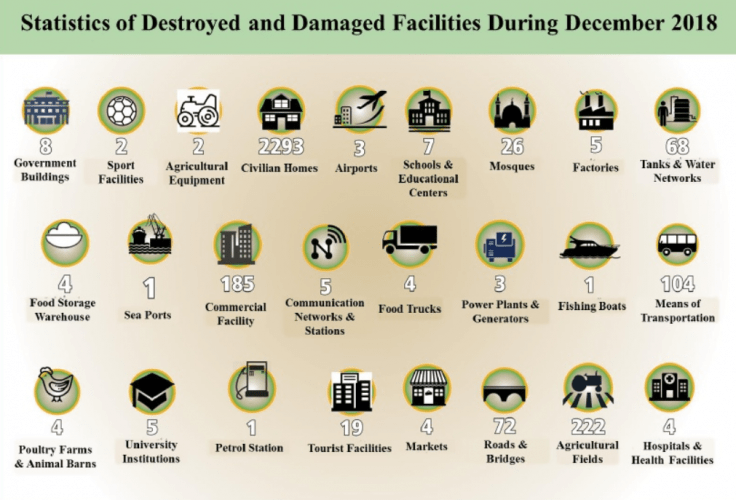
A graphic from the report shows Dec. 2018, targets of the Saudi Coalition in Yemen
What ceasefire?
These figures corroborate the findings of Martha Mundy, Professor Emeritus of Anthropology at the London School of Economics, who recently published a report that asserted that the coalition sought to halt Yemen’s remaining food production as well as its food distribution capacity. This claim is also supported by the fact that, despite the coalition publicly claiming that it has “lifted” the naval blockade of Yemen, 90 percent of importers cannot bring goods into the port of Hodeida, through which the majority of Yemen’s imported food and essential goods passes.
The coalition has justified its targeting of critical food production and water sanitation infrastructure by claiming that Yemeni resistance fighters were hiding weapons in those areas, but have never provided evidence of weapons being found in targeted installations.
The report also notes that the bombing campaign targeting Yemen continues to result in a dizzying number of airstrikes, with a total of 1,509 airstrikes in resistance-held Yemen during last December. The government in Sana’a had previously stated that Yemen, over the course of last year, suffered over 52,000 attacks — including airstrikes, naval bombardments and artillery operations, as well as an average of 50 airstrikes per day.
However, what makes the December figure so striking is the fact that “peace negotiations” took place early on in that month, which ostensibly led to a ceasefire that the Saudi coalition went on to violate over 800 times. During the month of peace negotiations and alleged ceasefire, 61 civilians were killed by coalition attacks, including 15 children. Another 109 civilians were wounded and 2,293 civilian homes — many likely unoccupied, with their former residents now displaced refugees — were destroyed or severely damaged.
While many continue to hope for a swift and peaceful outcome to the atrocious and genocidal war against Yemen, the Saudi-led coalition’s choice to continue raining bombs down on key civilian infrastructure — specifically areas involved in food production during a time of unprecedented famine — shows that these powerful governments and their allies remain determined, in their pursuit of regional geopolitical dominance, to push the Yemeni people to the brink of annihilation by starvation, preventable disease and bombs.
Read | The December 2018 Report on the Situation in the Republic of Yemen
Whitney Webb is a staff writer for MintPress News and has contributed to several other independent, alternative outlets. Her work has appeared on sites such as Global Research, the Ron Paul Institute and 21st Century Wire among others. She also makes guest appearances to discuss politics on radio and television. She currently lives with her family in southern Chile.
Yemen: Hodeida Truce in New Hands as UN Replaces Biased and Ineffective Monitor
By Ahmed Abdulkareem – MintPress News – February 5, 2019
SANA’A, YEMEN — The newly-appointed head of the United Nations mission to monitor Yemen’s truce agreement between the Houthis and the U.S.-backed Saudi coalition, Danish Lt. Gen. Michael Anker Lollesgaard, arrived in Yemen’s capital Sana’a on Tuesday, along with a five-member team, to assume his duty in the country’s Red Sea port city of Hodeida. Lollesgaard succeeds retired Maj. Gen. Patrick Cammaert.
The development comes after MintPress News revealed on January 24 that the United Nations promised to replace Cammaert, who was leading a UN joint committee tasked with overseeing the truce in Hodeida, a conduit for the delivery of desperately needed humanitarian aid. The replacement of the joint committee’s head was promised in order to save the fragile truce after the Houthis accused Cammaert of pursuing an agenda favoring the Saudi-led coalition, according to a high-ranking Houthi official.
Prior to his replacement, the Houthis boycotted a meeting chaired by Cammaert in Hodeida, accusing him of pushing the Saudi coalition’s agenda after he requested that Houthi forces withdraw eight kilometers outside of Hodeida while asking Saudi coalition forces to withdraw only half a kilometer — giving the coalition an opportunity to quickly occupy Hodeida unopposed, according to a source in the negotiating committee.
In an attempt not to portray the change as a victory for the Houthis, U.N. spokesman Stephane Dujarric, who announced Lollesgaard’s appointment on January 31, said Cammaert was on a temporary one-month contract and did not resign. However, the decision to appoint a new monitoring chief in Yemen’s key port may give UN envoy Martin Griffiths a chance to succeed, according to observers who spoke to MintPress.
Monday on a UN-hired ship off Hodeida, Cammaert held his final meeting between the Houthis and coalition representatives in an effort to end a month-long stalemate over the implementation of a mutual troop withdrawal from the port city.
Yemenis still see the agreements reached in Sweden as the best chance yet of ending the Saudi war against the poorest country the Middle East, a war that has killed thousands of people since it began in 2015 and pushed 14 million to the brink of famine, according to the United Nations.
In the view of Yemeni analysts who spoke to MintPress, if Saudi Arabia persists in its behavior, no UN envoy or monitor will be able to help reach a peace agreement in Yemen; and, without pressure on the Kingdom, the UN will go on playing a feeble role. Accordingly, the replacement of the head of the UN monitoring mission is regarded as effectively meaningless by many Yemenis.
The Saudi-led coalition appears willing to commit to war as a solution and further fighting will give rise to more disease, famine, and lack of access to humanitarian aid and food commodities. The repercussions will be fast and conspicuous across Yemen.
“Hanging in the balance”
Representatives of the Saudi coalition and the Houthis met in Jordan on Tuesday for a new round of UN-brokered talks on a troubled prisoner-swap deal that was initially agreed on in Stockholm last December. UN envoy Griffiths said the new talks aim to finalize the lists of prisoners and detainees to be released or exchanged.
A source on the negotiation committee told MintPress that the Houthis proposed releasing 400 prisoners from both sides as an initiative to get the talks going. There was no comment from Saudi Arabia on the proposal.
Last week, representatives from the coalition and the Houthis had held a round of UN-brokered negotiations in the Jordanian capital city of Amman to hammer out details of the prisoner exchange. The two sides met separately with the mediators and submitted lists of prisoners they wanted to be released.
Both sides have said repeatedly they remain committed to the agreement, which could see thousands of prisoners released by each side, including hundreds of al-Qaeda and ISIS members who were fighting on behalf of the coalition. So far, however, no breakthrough has been made.
Fears linger that failure of the prisoner exchange would have a knock-on effect on the next round of peace talks, owing to the nature of the list of prisoners made by both sides. Each side presented a list of up to 8,000 detainees to be freed, but many of those detainees on the list are not able to be accounted for, according to a senior official from the International Committee of the Red Cross. The prisoner swap would, therefore, involve a significantly lower number of prisoners, an outcome likely to draw the ire of both sides.
A senior International Committee of the Red Cross official, which will oversee the deal’s implementation, said on Monday that the prisoner exchange was “hanging in the balance,” with trust among the parties “insufficient.” He also indicated that “there is a lot of disappointment on both sides,” adding: “What we now see on both sides is that they don’t have them all [i.e., the listed prisoners] because a lot of them, they probably died during the conflict.”
There are positive signs, however. In a move that could boost ongoing UN-led efforts to save the deal, the Houthis released an ailing Saudi prisoner, Musa al-Awaji, on humanitarian grounds at the end of January. The Saudi coalition also released seven Houthi prisoners who were not part of the negotiated exchange.
Ahmed AbdulKareem is a Yemeni journalist. He covers the war in Yemen for MintPress News as well as local Yemeni media.
Weapons ending up with terrorists is OK, as long as Obama did it: The world according to CNN
RT | February 5, 2019
A “bombshell” CNN report has revealed that US-made weapons found their way to Al-Qaeda-linked fighters in Yemen. But is anyone surprised? And where was CNN when the Obama administration armed hardcore jihadists in Syria?
The CNN investigation revealed how American-made weapons ended up in the hands of “al Qaeda-linked fighters, hardline Salafi militias, and other factions waging war in Yemen,” vis-a-vis the US’ coalition partners Saudi Arabia and the UAE. Some of these weapons have also been seized by Iranian-backed militias, CNN claims.
The hardware, referred to as “Beautiful military equipment” by President Trump, was supplied to Saudi Arabia and the UAE, who have backed the embattled Yemeni government in its three-year civil war against Houthi rebels. However, CNN claims that Saudi Arabia and the UAE have funnelled the arms to pro-government factions, including the islamist Giants Brigade and the Al-Qaeda-linked Abu Abbas brigade.
The shifting frontlines in Yemen ensured that many of these weapons – including wire-guided TOW missiles and mine-resistant armored vehicles (MRAPs) – ended up seized by Houthi militants and Iranian proxy forces. More American weapons still ended up for sale in Yemen’s teeming arms bazaars, where they fetch a higher price than the rusted AK-47s more common to the region.
CNN lays responsibility squarely at the feet of Saudi Arabia, the UAE, and the Trump administration, which refused to cancel its multibillion dollar arms deals with the Saudis last year, for fear of losing “all of that investment being made into our country.”
The report paints a depressing, but familiar picture. Picking sides in foreign wars has historically proven disastrous for the United States, yet successive administrations have made the same mistakes again and again. The Reagan administration armed Saddam Hussein in his war with Iran, going as far as arranging the sale of anthrax to the Iraqi leader. Both Jimmy Сarter and Ronald Reagan propped up the Afghan mujahideen in their fight against the Soviets in the 1980s. In both cases, US forces would be shot at with the same weapons just two decades later.
Covering for Obama
More recently, in 2014 Barack Obama announced that the US would hand-select and arm ‘moderate rebels’ in Syria, stepping into the country’s bloody civil war. That too would prove disastrous, with troves of US arms ending up in the hands of Al-Nusra and ISIS.
But where was CNN when Obama asked Congress for $500 million to train, arm, and “empower the moderate Syrian opposition?”
CNN was reporting the news verbatim from Obama’s mouth, repeating the phrase “moderate rebels” without the ironic quotation marks that have become necessary since. Obama’s assertion that the rebels offered the “best alternative to terrorists and a brutal dictator” was not questioned, unlike Trump’s continuation of the longstanding US policy of arming the Saudis.
Obama called for funding in June 2014, but Syrian militias had already received support from the CIA for two years at that stage. CNN’s reporting on the covert arms pipeline was scant, didn’t question the credentials of the recipients, and mostly repeated the line of US intelligence officials: “That is something we are not going to dispute, but we are not going to publicly speak to it.”
Few questions were asked as Congress authorized the military support that September, and none were asked a year later as Obama resupplied his chosen rebels in Syria. Instead, Obama’s declaration of support for “the moderate Syrian opposition” was taken at face value and left unquestioned.
The reality in Syria
As CNN repeated the White House line on Syria, the network published just one report hinting that things might be amiss: an investigation by Amnesty International that found Islamic State (IS, formerly ISIS) militants were armed to the teeth with US-made weapons. The weapons were acquired by IS from local forces armed by the Obama administration, and then used to “relentlessly” target civilians with “small arms, artillery fire and huge quantities of improvised explosive devices.”
While CNN was assuaging the public, the situation on the ground in Syria was anything but moderate. US arms were quickly sold on the black market by ‘moderate rebels’ who either retired from the fight or wanted to turn a quick buck. With morale low, some of these fighters literally handed their weapons to Al-Nusra jihadists in exchange for safe passage away from the frontlines, while more were stolen by the Islamists.
Moreover, one Al-Nusra commander codenamed Abu Al Ezz told the German Koelner Stadt-Anzeiger newspaper that his group, and not so-called ‘moderate rebels’, received TOW missiles directly from the US. “The missiles were given to us directly,” he said, adding: “The Americans are on our side.” The commander went on to detail how his fighters had received training from US instructors, and financial support from Saudi Arabia and Israel for capturing specific objectives in Syria.
The Trump administration ended the arms supply program to the Syrian rebels in 2017, a decision that CNN called“a big win for Russia.” The idea that ending material support for terrorists might just be a good thing was not raised, and CNN described the program as “a lifeline” to anti-government forces.
CNN even stuck by its straight-faced use of the term ‘moderate rebels’, despite multiple other news outlets publishing reports of US weapons falling into terrorist hands.
Two months before the 2016 election, CNN absolved Obama of all his sins in Syria by publishing an interview in which the then-president said the situation there “haunts” him constantly. The network blamed external factors for the deteriorating situation in Syria, and ended with a quote from Obama’s press secretary, who said that every one of the former president’s decisions “was squarely within the national security interest of the United States and even advanced our national security interests.”
CNN’s latest exclusive report is a well-researched piece of journalism, fleshed out with on-the-ground reporting from war-torn Yemen. However, given the network’s history in reporting US arms programs, it was much more likely motivated by a desire to score points against Trump than the pursuit of cold truth, no matter who is in charge.
Featured Video
US IRAN TALKS: Who Are the Crazy Ones Here? /Lt Col Daniel Davis
or go to
Aletho News Archives – Video-Images
From the Archives
Woolsey Fire started at Santa Susana Field Lab — where “radioactive materials released were never accurately measured”
By John Laforge | CounterPunch | November 30, 2018
In my Nov. 16 column, I reported on potential radiation risks posed by California’s Woolsey wildfire having burned over parts or all of the Santa Susana Field Laboratory—south of Simi Valley, Calif., 30 miles outside Los Angeles—site of at least four partial or total nuclear reactor meltdowns.
The field laboratory operated 10 experimental reactors and conducted rocket engine tests. In his 2014 book Atomic Accidents, researcher James Mahaffey writes, “The cores in four experimental reactors on site … melted.” Reactor core melts always result in the release of large amounts of radioactive gases and particles. Clean up of the deeply contaminated site has not been conducted in spite of a 2010 agreement.
Los Angeles’s KABC-7 TV reported Nov. 13 that the Santa Susana lab site “appears to be the origin of the Woolsey Fire” which has torched over 96,000 acres. Southern Calif. Public Radio said, “According to Cal Fire, the Woolsey Fire started on the afternoon of Thursday, Nov. 8 … on the Santa Susana site.” … continue
Blog Roll
 Aletho News
- US IRAN TALKS: Who Are the Crazy Ones Here? /Lt Col Daniel Davis
- Talks with the US end without a deal over excessive US demands: Iran
- Feeling Better, Getting Worse: How Psychiatric Drugs Create the Illusion They Cure
- ‘Nobody Told Me’: Former Mental Health Patient Calls Out Dangerous Side Effects of Psychiatric Drugs
- Dr. Abu-Sitta: Beirut ‘felt like a day in Shifa Hospital’
- Iran Has Won the War, It Will Be Up to the US to Secure the Peace: Mohammad Marandi
- Iran condemns assassination threats against Iranian negotiators amid US talks
- Brussels cannot say where its own pipeline inspectors are as Hungary’s oil lifeline remains shut
- Israel’s Iran War: Myth and Reality
- Between war and industrial breakdown: The US-Israeli attrition crisis
- If Americans Knew
- Pro-Israel ‘Thinktanks’ and Individuals who Influence U.S. Foreign Policy
- Mearsheimer reveals how Israel dictates US policies on Iran, Gaza – video
- After killing 350+, Israel still has a “score to settle” with Lebanon before ceasefire – Daily Update
- Military aid to Israel emerges as the latest political litmus test for Democrats
- The only Palestinian children’s rights organization closes following years-long Israeli campaign against it
- ‘I Can’t Forget the Smell’: Lebanese Reel After Israel Kills Over 300 in Single Day
- DNC Shoots Down Resolutions Calling Out AIPAC and Limiting Arms to Israel
- TCN: Is Israel Blackmailing President Trump?
- Israel killed at least 303 Lebanese yesterday – who were they? Daily Update
- Amnesty: Urgent – Protect Lebanese civilians from brutal escalation in Israeli attacks
- No Tricks Zone
- German Expert: Heat Dome Led To Record Temps In Western USA…Warmer In 1934, 1936
- New Study: No Linear Warming Or Glacier Retreat Along Northern Antarctic Peninsula Since 1980s
- An Inconvenient Tree: Uncovered In Alps… Europe Much Warmer Than Today 6000 Years Ago
- New Study Reports A 60% Slowdown In Greenland’s Ice Loss Rate In The Last Decade
- Low Intensity Tornado Wrecks Major Solar Farm, Creating A Potential Toxic Dump
- New Study Finds Warming Saves Lives…Cold Temperatures 12 Times More Deadly Than Excess Heat
- German Science Blog Accuses PIK Climate Institute Of Hallucinating Climate Tipping Points
- Devastating Assessment Of Comirnaty Vaccine By Former Senior Pfizer Europe Toxicologist
- New Study: CO2 Is ‘Effectively Negligible’ As An Explanatory Climate Change Factor Since 2000
- Former Pfizer Toxicologist Dr. Helmut Sterz Tells Bundestag Hearing Pfizer Vaccine Should Have Never Been Approved
 Aletho News