Erasing evidence: Over 700 videos of Israeli crimes wiped off YouTube
Al Mayadeen | November 5, 2025
The Intercept on Wednesday revealed that YouTube has permanently removed the official channels of three major Palestinian human rights organizations, namely Al-Haq, Al Mezan Center for Human Rights, and the Palestinian Centre for Human Rights (PCHR), erasing hundreds of videos that documented Israeli war crimes in Gaza and the occupied West Bank.
The deletions, which took place in early October, wiped years of footage that included investigative reports on the killing of Palestinian civilians, “Israel’s” destruction of homes, and the murder of Palestinian American journalist Shireen Abu Akleh. YouTube confirmed to The Intercept that the decision followed a review prompted by US State Department sanctions against the three groups.
“Google is committed to compliance with applicable sanctions and trade compliance laws,” YouTube spokesperson Boot Bullwinkle said, noting that the platform enforces restrictions against any entities sanctioned under US law.
YouTube bows to pressure
The Trump administration imposed the sanctions in September, targeting the organizations for their collaboration with the International Criminal Court (ICC) in its investigations into Israeli officials, including Prime Minister Benjamin Netanyahu and former Security Minister Yoav Gallant, who were charged with war crimes in Gaza.
Human rights advocates denounced YouTube’s move as politically motivated censorship. “I’m pretty shocked that YouTube is showing such a little backbone,” said Sarah Leah Whitson, executive director of Democracy for the Arab World Now. “It’s really hard to imagine any serious argument that sharing information from these Palestinian human rights organizations would somehow violate sanctions. Succumbing to this arbitrary designation of these Palestinian organizations, to now censor them, is disappointing and pretty surprising.”
Katherine Gallagher, a senior staff attorney at the Center for Constitutional Rights, accused YouTube of advancing Washington’s efforts to suppress accountability. “It is outrageous that YouTube is furthering the Trump administration’s agenda to remove evidence of human rights violations and war crimes from public view,” she said. “Congress did not intend to allow the president to cut off the flow of information to the American public and the world, instead, information, including documents and videos, are specifically exempted under the statute that the president cited as his authority for issuing the ICC sanctions.”
YouTube silences Palestinian rights
The affected groups condemned the decision as a violation of free expression and an attempt to obstruct justice. Al Mezan said its channel was terminated abruptly on October 7, without warning. “Terminating the channel deprives us from reaching what we aspire to convey our message to, and fulfill our mission,” a spokesperson said, stressing that the move limits their ability to communicate with global audiences.
Al-Haq’s channel was deleted a few days earlier, on October 3, with YouTube claiming that its content “violates our guidelines.” The organization responded that “YouTube’s removal of a human rights organisation’s platform, carried out without prior warning, represents a serious failure of principle and an alarming setback for human rights and freedom of expression.” It warned that US sanctions are “being used to cripple accountability work on Palestine and silence Palestinian voices and victims.”
The Palestinian Centre for Human Rights, described by the United Nations as Gaza’s oldest human rights organization, said the deletion “protects perpetrators from accountability.” Its representative, Basel al-Sourani, noted that “YouTube said that we were not following their policy on Community Guidelines, when all our work was basically presenting factual and evidence-based reporting on the crimes committed against the Palestinian people, especially since the start of the ongoing genocide on 7 October.” He added, “By doing this, YouTube is being complicit in silencing the voices of Palestinian victims.”
Digital Censorship
The Intercept estimated that the deletions collectively erased more than 700 videos, ranging from field investigations to personal testimonies and short documentaries. Some of the content remains accessible on other platforms or through archived versions, but much of it has been lost. The organizations said they are now seeking alternatives outside the US to ensure their work remains available to the public.
The takedowns come amid broader efforts by the Trump administration and “Israel” to undermine the ICC and limit exposure of Israeli actions in Gaza. “They are basically allowing the Trump administration to dictate what information they share with the global audience,” Whitson warned. “It’s not going to end with Palestine.”
YouTube bans prominent Zelensky critic
RT | August 9, 2025
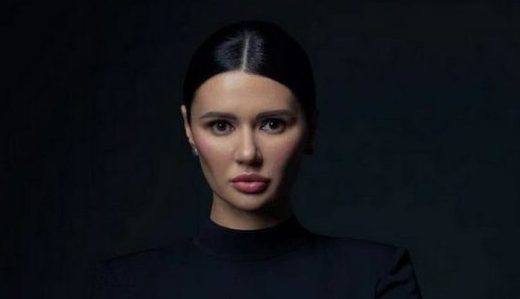
YouTube has removed the 2-million-subscriber account of exiled Ukrainian Journalist of the Year Diana Panchenko, a fierce critic of Vladimir Zelensky.
In 2023, Kiev imposed personal sanctions on the former TV presenter and started criminal proceedings against her for her alleged anti-Ukrainian reporting.
Panchenko has long criticized Zelensky for rampant corruption in Ukraine, as well as his clampdown on freedom of speech. She has also condemned Kiev’s military actions in Donbass since 2014, and later accused the former actor of dragging the nation into a “forever war.”
“Diana Panchenko @Panchenko_X is one of the most famous women in Ukraine, former Journalist of the Year and opponent of the grossly corrupt Zelensky regime,” Irish journalist Chay Bowes wrote on X on Friday.
“YouTube just banned her and erased her account. She had 2 million followers,” he wrote. “The most dangerous weapon is Truth.”
Panchenko’s YouTube account is deleted as of the time of writing, but an archived snapshot shows that at least 2.09 million people subscribed to her channel as of last month.
Youtube, which is owned by Google, has extensively cracked down on and banned Russian media channels, as well as large pro-Moscow private accounts since the escalation of the Ukraine conflict.
Panchenko has also routinely criticized Kiev’s crackdown on alternative narratives in Ukraine.
Soon after the escalation of the conflict in 2022, Zelensky shut down multiple television channels associated with his political opposition and consolidated some of the country’s largest networks into a single 24/7 broadcast called the United News TV Telemarathon.
Google helped Israel spread war propaganda to 45 million Europeans
By Alan MACLEOD | MintPress News | July 10, 2025
While it continues its conflict with its neighbors, Israel is fighting another war just as intensely, spending gigantic amounts of money bombarding Europe with messaging justifying their actions, and scaremongering Europeans that Iranian nuclear missiles will soon be turning their cities into rubble.
A MintPress study has found that, since it struck Iran on June 13, the Israeli Government Advertising Agency has paid for tens of millions of advertisements on YouTube alone. In clear breach of Google’s policies, these ads justify and lionize the attack as a necessary defense of Western civilization, and claim that Israel is carrying out “one of the largest humanitarian missions in the world” in Gaza.
The countries most targeted by this campaign include the United Kingdom, France, Italy, Germany, and Greece.
Information War
“A fanatical regime firing missiles at civilians, while racing towards nuclear weapons. While Iran deliberately targets cities, Israel acts with precision to dismantle this threat.” Thus starts one Israeli government ad that hundreds of thousands of YouTube viewers in Europe have been compelled to watch.
“Terror architects behind the elimination of Israel plan: eliminated. Israel targets only military and terror sites, not civilians. But the threat remains,” the voiceover continues, over ominous music and high-tech graphics. “We will finish the mission for our people, for humanity. Israel does what must be done,” it concludes.
“Iran’s ballistic missile program isn’t just a threat to Israel, it is a threat to Europe and the Western world,” another, seen by 1.5 million viewers in just three weeks, claims. “Iran is developing missiles with ranges of approximately 4000 km. That places Europe within the regime’s striking distance,” it adds, as graphics show virtually the entire continent turning blood red, signifying a nuclear attack. “This isn’t tomorrow’s threat. It is today’s reality. The threat posed by the Iranian regime must be stopped. Israel does what must be done.”
Ominous messages like these, translated into multiple languages, have reached tens of millions of people across Europe. Other Israeli government ads take a different tack, attempting to present Israel as a virtuous victim and an unwilling participant in war. As one commercial notes:
Imagine this: you are holding your newborn in a hospital room. Then the air raid sirens go off. Iran fires ballistic missiles at hospitals, at innocent Israelis. Patients, doctors, newborn babies: deliberately targeted. While Iran aims at families and children, Israel responds with precision, striking military sites. This is not a war of choice. Those who target civilians and hospitals become the target.”
The claims made in such videos are often highly questionable. For example, around 935 Iranians were killed in Israeli strikes, compared to just 28 Israelis, suggesting Israel is far less careful to avoid civilian deaths than its opponent. Indeed, since October 2023, Israel has repeatedly and deliberately targeted hospitals. The World Health Organization has documented at least 697 Israeli strikes on medical facilities.
Ninety-four percent of Gaza’s hospitals have been destroyed or damaged, and more than 1,400 medical personnel have been killed. This includes Dr. Adnan al-Bursh, head of orthopedics at al-Shifa Hospital, who was reportedly raped to death by Israeli prison guards. According to UNICEF, Israel has killed or injured over 50,000 Palestinian children. An American nurse who worked in Gaza told MintPress News that IDF soldiers regularly shoot boys in the genitals to prevent them from reproducing.
Despite this, Israeli advertising presents the country as the savior of the Palestinian people. One Ministry of Foreign Affairs video, set to epic, inspiring music, describes Israel as undertaking “One of the largest humanitarian operations in the world right now.” “This is what real aid looks like. Smiles don’t lie. Hamas does,” it concludes.
Francesca Albanese, the United Nations special rapporteur on the Occupied Palestinian Territories, called the commercial “scandalous” and directly challenged YouTube: “How can this be allowed?” The video has been translated into Italian, French, German, and Greek, and has been viewed by nearly seven million people on YouTube alone.
Transparently Inorganic
All referenced videos appear in the Google Ads Transparency Center as paid content from the Israeli Government Advertising Agency, and there is strong evidence that few, if any, of their millions of views are organic. The five versions of the “Gaza Humanitarian Aid” video, for example, collectively have only a few thousand “likes”—barely 1% of what would be generally expected of videos with this amount of views—and only two comments in total.
The difference between organic and paid content is clearer in videos that Israel has not promoted. Other videos on Israel’s Ministry of Foreign Affairs YouTube channel receive only tens of views per day, not millions, which strongly suggests that close to 100% of their traffic is paid advertising.
The scale of this public relations operation is difficult to overstate. Even as the Israeli government hikes taxes and slashes domestic spending, its foreign PR budget has grown by more than 2,000%, the Foreign Ministry receiving $150 million more for public diplomacy.
Much of that money is evidently being spent on ads. In the past month, the Israeli Ministry of Foreign Affairs has uploaded videos that have topped 45 million views on YouTube alone. The countries most targeted include the United Kingdom, France, Italy, Germany, and Greece.
Greece is a particularly noteworthy case. Over the past 12 months, the Israeli government advertising agency has funded 65 separate YouTube ad campaigns targeting the country.
The Greek version of a recent ad—titled “An efficient system is in place, delivering aid where it’s needed”—presents Israel as a benevolent bringer of life to Gaza and has garnered over 1 million views in just four days, equivalent to nearly 10% of Greece’s entire population. The video currently has no comments and fewer than 3,000 likes.
The Israeli Ministry of Foreign Affairs uploads its videos in English, French, German, Italian, and Greek. Countries that do not speak these languages—such as Slovakia, Denmark, and the Netherlands—are still targeted, though users there generally receive the English version.
Israel has avoided targeting nations whose governments have formally condemned its actions, such as Ireland or Spain, spending nothing to reach those populations. The Netanyahu administration, evidently, has decided to attempt to shore up support in allied countries, even as their populations increasingly turn against Israel.
While many of these figures might shock readers, this investigation only examined the advertising campaign of a single organization, the Israeli Government Advertising Agency, and on a single platform, YouTube. It does not include other Israeli government and non-governmental groups, nor the myriad organizations collectively comprising the pro-Israel lobby in the West.
Israel has also attempted to influence the debate on other platforms, including Facebook, Instagram, TikTok, and Twitter. What is presented here is merely the thinnest slice of a much broader operation.
Israel and Silicon Valley
Some videos the Israeli government has released attempt to portray Israel in a positive light, but instead perpetuate racist stereotypes about Western civilization and its supposed superiority. In one ad, Benjamin Netanyahu states (emphasis added):
I want to assure the civilized world, we will not let the world’s most dangerous regime get the world’s most dangerous weapons. The increasing range of Iran’s ballistic missiles would bring that nuclear nightmare to the cities of Europe and eventually to America.”
Thus, the Israeli prime minister implies that Iran’s threat matters only if it endangers the so-called “civilized world,” that is, Europe and North America. “Never again is now. Today, Israel has shown that we have learned the lessons of history,” Netanyahu continues, directly comparing the 12-Day War (which Israel started) to the Holocaust. “When enemies vow to destroy you, believe them. When enemies build weapons of mass death, stop them. As the Bible teaches us, when someone comes to kill you, rise and act first.”
Google’s advertising rules explicitly prohibit commercials that “display shocking content or promote hatred, intolerance, discrimination, or violence.” Yet many of the ads described here explicitly justify Israeli aggression.
MintPress News contacted Google to ask how much the Israeli government’s advertising agency spent on ads, how many impressions those ads generated, whether the company had a response to Albanese’s comments, and whether the videos violated its policies.
Google did not answer the first three questions and reiterated that it has “strict ad policies that govern the types of ads we allow on our platform.” “These policies are publicly available, and we enforce them consistently and without bias. If we find ads that violate those policies, we swiftly remove them,” the company added, implying that it does not consider the ads a violation of its standards.
Few who have studied Google’s connections to the Israeli government will be surprised that the Silicon Valley giant grants enormous leeway to the Netanyahu administration. Former CEO Eric Schmidt is known as one of Israel’s most vocal supporters. Google has been financially invested in Israel since at least 2006, when it opened its first offices in Tel Aviv. In 2012, at a meeting with Netanyahu himself, Schmidt declared that “the decision to invest in Israel was one of the best that Google has ever made.”
Company co-founder Sergey Brin has also come to the defense of Israel, denouncing the United Nations as “transparently anti-Semitic” and telling Google staff that using the word “genocide” to describe Israeli actions in Gaza is “deeply offensive to many Jewish people who have suffered actual genocides.”
Earlier this year, with the Israeli economy in dire straits following its 18-month campaign against its neighbors, Schmidt’s company came to the rescue, injecting billions into Israel in a record-setting acquisition. Google purchased local cybersecurity firm Wiz for $32 billion. The monumental sum paid—equivalent to 65 times Wiz’s annual revenue and boosting the Israeli economy by 0.6%—left some analysts wondering if the deal had more to do with underwriting the Israeli economy than making a shrewd business investment.
It also raises questions about the safety of Google users’ most sensitive personal data, given that Wiz was founded and continues to be staffed by former Israeli spies from the intelligence group, Unit 8200.
Among them is Gavriel Goidel, head of strategy and operations for Google Research. Goidel joined Google in 2022 after a six-year career in military intelligence, during which he rose to become Head of Learning at Unit 8200. There, he led a large team of operatives who sifted through intelligence data to “understand patterns of hostile activists,” according to his own account.
The Turning Tide
Google is far from the only tech giant recruiting Israeli spies to run their most politically sensitive departments. The same study found that hundreds of former Unit 8200 intelligence agents are employed at companies such as Meta (formerly Facebook), Microsoft, and Amazon. And a significant amount of what America reads about the Middle East is also written by ex-Israeli spies.
A MintPress investigation from earlier this year uncovered a network of Unit 8200 alums working in top newsrooms across America.
Wikipedia is another key theater of war for the Israeli state. A project overseen by future Prime Minister Naftali Bennett deployed thousands of young Israelis to monitor and edit the online encyclopedia, removing troublesome facts and framing articles more favorably in Israel’s favor. Those who made the most edits would receive rewards, including free hot air balloon rides.
The Ministry of Foreign Affairs has also launched a campaign to harass and intimidate American students, establishing a “task force” to carry out psychological operations aimed at, in its own words, “inflicting economic and employment consequences” against pro-Palestine protestors. While Foreign Minister Eli Cohen heads the task force, it stresses that its actions “should not have the signature of the State of Israel on it.”
Amid mounting criticism, the Israeli government has sought to turn the tide by inviting influencers for direct talks with Netanyahu. In April, the Israeli prime minister met face-to-face with conservative internet personalities, including Tim Pool; Dave Rubin; Sean Spicer; Bethany Mandel; David Harris Jr.; Jessica Krause; Seth Mandel; and Mollie Hemingway, where they discussed how best to sell war with Iran to Western publics, and how to counter anti-Zionist sentiment online.
Other social media personalities report having been offered large sums of money in exchange for a few words of support for Israel.
In terms of turning the tide of European public opinion, Israel has its work cut out for it. A recent YouGov survey found the country was widely reviled across the continent. More than 20 times as many Italians, for instance, hold “very unfavorable” (43%) views of Israel than “very favorable” ones (2%).
Even in Germany, where popular support for Israel is highest, only 21% said they hold favorable opinions of the state (including only 4% highly favorable), with 65% displaying open opposition (including 32% who strongly dislike it).
A massive plurality of Britons, meanwhile, agreed with the statement: “Israel treats the Palestinians like the Nazis treated the Jews.” Forty-eight percent answered in the affirmative, as opposed to just 13% who disagreed. This is despite European governments offering full-throated support to Israel, and even criminalizing pro-Palestine protests and persecuting journalists who oppose Western support for Tel Aviv.
The government of Israel is spending millions of dollars daily on gigantic advertising campaigns aimed at turning the tide of public opinion. To that end, it is developing a PR network as sophisticated as the advanced weapons systems it uses on its neighbors. On YouTube alone, its paid advertising, translated into five languages, has reached at least 45 million people in the past month. Whether this strategy will ultimately prove effective remains unclear. After all, it is difficult to convince the public to support a genocide.
YouTube Removes Barrister’s Legal Submission at Official UK Covid Inquiry Amid Censorship of Vaccine Injury Discussions
By Cindy Harper | Reclaim The Net | January 15, 2025
YouTube’s decision to remove a barrister’s legal submission from the UK Covid Inquiry has intensified concerns over widespread censorship of vaccine-related discussions on major social media platforms.
Anna Morris KC, who represents families claiming injury from Covid-19 vaccines, disclosed that YouTube deleted a video of her preliminary remarks to the inquiry in September 2023, citing violations of its medical “misinformation” policy. Although the platform later reinstated the video, it failed to provide a clear explanation, admitting only that “it sometimes makes mistakes.”
This act of censorship has been condemned as part of a larger pattern of silencing voices critical of vaccine safety and government health policies. As reported by The Telegraph, during the inquiry’s Module 4 session — focused on vaccines and pharmaceutical measures — Morris directly addressed this issue, stating, “The inquiry must understand the stigma and censorship for the vaccine injured and bereaved.”
She revealed that a poll of affected families found that 74% had been censored when discussing vaccine injuries on social media platforms.
Morris further criticized the suppression of information, noting that doctors were instructed to withhold concerns from both the public and their own patients. Her removed statement emphasized that “the treatment of the vaccine injured in this country has historically been a source of shame.”
Morris argued that those harmed by vaccines have been systematically “dismissed, ignored, censored,” and subjected to hostility when seeking acknowledgment and support.
She condemned the ongoing silencing of vaccine-injured individuals as a severe barrier to accountability and transparency, adding, “Unfortunately, this censorship has continued years after the pandemic and into our engagement with this inquiry.”
Despite repeated requests for a review, YouTube justified the video’s removal by citing its medical “misinformation” policies, a rationale that critics argue is increasingly being used to suppress legitimate concerns and experiences. This censorship has fueled calls for a reevaluation of how social media platforms regulate content related to public health, especially when it involves dissenting voices.
An emotional impact video shown during the inquiry highlighted the tragic story of pharmacist John Cross, who took his own life after suffering paralyzing complications from a Covid vaccine and being denied compensation. His story underscores the devastating consequences of dismissing those seeking recognition and support.
Dr. Drew Pinsky Criticizes YouTube for Video Removals and Mandatory Reeducation Training Over Vaccine Discussions
By Cindy Harper | Reclaim The Net | January 15, 2025
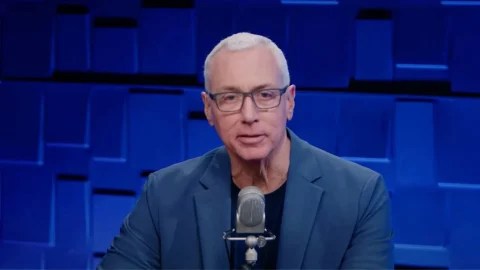
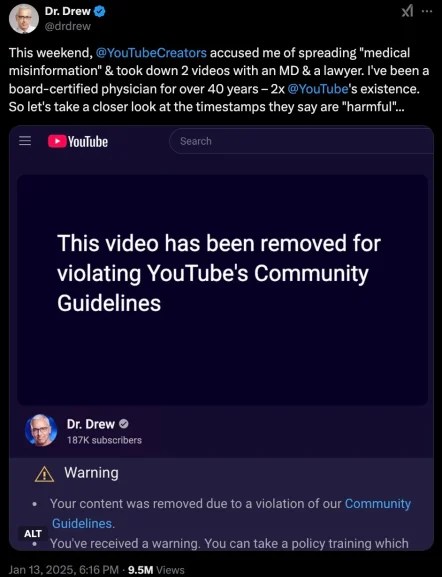
Dr. Drew Pinsky, widely known as Dr. Drew, has publicly criticized YouTube for removing two of his videos over alleged violations of the platform’s medical “misinformation” policy. On January 14, 2025, Pinsky took to X to challenge YouTube’s decision, highlighting concerns about free speech and the suppression of open dialogue on health-related topics.
In order to get the flags removed from his video, YouTube told Dr. Drew that he would have to attend a form of reeducation training and have no violations for 90 days, or else it would delete his entire channel and all of his videos. Pinsky has over 1,000 videos on the platform.
In one of his posts, Pinsky expressed frustration over the platform’s actions: “This weekend, @YouTubeCreators accused me of spreading ‘medical misinformation’ & took down 2 videos with an MD & a lawyer. I’ve been a board-certified physician for over 40 years – 2x @YouTube’s existence.”
The flagged videos featured discussions with Dr. Kelly Victory, a board-certified physician, and attorney Warner Mendenhall. Pinsky elaborated that these conversations centered around the side effects of mRNA vaccinations, a topic he argues warrants open discourse rather than censorship. In his discussion with Dr. Victory, she stated that the “vast majority of the people who have been injured are young, healthy people who were under the age of 50 who had fundamentally zero risk from COVID itself. They all got COVID. These are people who would have been fine if they were just left alone.”
Pinsky defended the content, asserting that sharing professional perspectives and personal beliefs in a public forum should not be equated with spreading misinformation. He emphasized that their dialogue was an exchange of viewpoints rather than a promotion of falsehoods.
In a separate video with Warner Mendenhall, the attorney discussed legal cases involving individuals who suffered severe reactions following vaccination. Pinsky highlighted that Mendenhall shared client experiences and expressed personal beliefs—not medical advice. Pinsky wrote, “It is not medical misinformation for someone to state their belief that a large number of people were harmed by a medical product or study.”
This isn’t the first time YouTube has targeted Dr. Drew’s content. He noted that previous strikes were resolved after discussions between his production team and YouTube officials. Despite the latest removals, Pinsky confirmed that the videos remain accessible on X, suggesting that alternative platforms may offer more space for unrestricted conversations.
A prominent internist and addiction medicine specialist, Dr. Drew Pinsky has been a notable media figure for decades. His career includes hosting television shows like Dr. Drew On Call on HLN and Lifechangers on The CW.
YouTube CEO Neal Mohan Says YouTube is a “Bastion of Free Speech”
By Christina Maas | Reclaim The Net | January 6, 2025
If you believe Neil Mohan, YouTube’s CEO, the platform is a modern-day Agora—a self-described “bastion of free speech” where the world’s most pressing debates thrive. Though, “just because it’s an open platform, it doesn’t mean that anything goes,” Mohan told The Financial Times in the last week. Translation: Free speech is alive and well—until it isn’t. Because on YouTube, the marketplace of ideas comes with a bouncer, a velvet rope, and an ever-expanding list of banned words and topics.
This month, YouTube is eager to remind everyone it’s “committed” to free expression, a sentiment as convincing as a fast-food chain promising “health-conscious dining.” Over the last five years, the platform has turbocharged its content moderation policies, leaning on AI overlords and human censors to police conversations ranging from vaccine skepticism to who gets to call a virus a “lab leak.”
It’s a delicate balance, they claim—one requiring the finesse of a trapeze artist. But if the past is any guide, the only thing YouTube’s balancing act reliably delivers is corporate doublespeak and a pile of censored creators.
Moderation or Muting?
Mohan, the relatively new captain of YouTube’s Titanic, insists that the company welcomes “broad views” but won’t tolerate “anything goes.” Consider their “community guidelines,” a vague, shape-shifting set of rules that could find your grandma’s knitting tutorial in violation if it dares question Big Pharma.
Behind this rhetoric is an algorithmic enforcement machine programmed to flag, demonetize, or outright remove content at lightning speed—accuracy be damned. And when the AI overlords fumble, the human moderators step in, wielding their own biases like blunt instruments.
Critics, including banned creators, point out that YouTube’s moderation seems to skew conveniently in one direction. Questioning the CDC? Misinformation. Broadcasting claims about ivermectin? Censored. But when a mainstream outlet gets caught peddling unverified or downright wrong information, it’s business as usual.
The COVID-19 Information Iron Curtain
Of course, nothing showcases YouTube’s free speech schizophrenia better than its pandemic policies. To combat “medical misinformation,” the platform instituted a strict purge of dissenting voices, silencing everyone from epidemiologists to concerned moms armed with anecdotal evidence and Facebook memes.
Let’s not forget the lab leak theory, a hypothesis once relegated to tinfoil hat territory. When early adopters of the theory dared to post about it, their content was struck down faster than you could say “gain-of-function research.” Fast forward a couple of years and the lab-leak theory is now a “credible hypothesis,” endorsed by experts and even government agencies.
Oops.
But don’t expect an apology or even acknowledgment from YouTube for playing arbiter of acceptable science. They’ve quietly updated policies and moved on, leaving censored creators wondering why their “misinformation” turned out to be, well, information.
Advertiser-Friendly Speech Only
The real driver of YouTube’s overzealous content policing, of course, is money. Back in 2017, a wave of advertiser boycotts over “hateful” and “controversial” content sent the platform scrambling. The solution? Stricter guidelines are needed to ensure that only the most sanitized, brand-safe content remains.
While no one would argue against booting child exploitation, the crackdown didn’t stop there. It extended into politically sensitive areas, conveniently targeting independent creators and smaller voices while leaving corporate media to do as they pleased.
What’s worse is the blatant double standard. Want to critique vaccine mandates or discuss alternative COVID treatments? Good luck. But if you’re a major network spouting unverified claims about weapons of mass destruction or “imminent threats,” go right ahead. After all, those ad dollars won’t chase themselves.
YouTube’s Legacy of Censorship
Mohan’s lofty rhetoric about fostering “broad views” might play well in interviews, but the reality on the ground is clear: YouTube’s commitment to free speech is as reliable as a politician’s campaign promise. The platform has repeatedly chosen corporate image over open discourse, advertisers over authenticity, and control over community.
And yet, it continues to parade as a defender of free expression. Perhaps Mohan and his team truly believe in their own doublespeak. Or maybe they’re banking on the fact that most users will never notice the glaring contradictions. Either way, YouTube’s hypocrisy isn’t an accident—it’s a business model.
The next time you hear Neil Mohan wax poetic about “free speech,” remember this: On YouTube, freedom comes with conditions, and the only real winners are the ones writing the checks.
Fearful of the Public, Western Leaders Turn to Censorship
By Ian DeMartino – Sputnik – 07.10.2024
On Saturday, former US First Lady Hillary Clinton called for increased federal regulation of the internet and repealing Section 230. “If the platforms… don’t moderate and monitor the content, we lose total control,” she said, raising the question of who “we” represents in that statement.
From the recent purge of YouTube accounts, including those from Mark Sleboda, Rachel Blevins, Glenn Diesen, DD Geopolitics, Fiorella Isabel, Larry Johnson, and Eva K. Bartlett, it is clear that the Western leaders are scared of their populations finding out the truth about their policies and actions.
“We are not afraid to entrust the American people with unpleasant facts, foreign ideas, alien philosophies, and competitive values. For a nation that is afraid to let its people judge the truth and falsehood in an open market is a nation that is afraid of its people,” Former US President John F. Kennedy.
“That’s what they’re afraid of,” Sleboda, an expert in geopolitical relations and a frequent guest on Sputnik Radio, told The Final Countdown. “They don’t trust you to hear an alternate view from the official US government narrative and come to what they consider the right political conclusions.”
Many Americans were taught that freedom was proof-positive that Western-style democracies were superior to other systems.
In separate interviews, Sleboda and Blevins both said that their channels were taken down without warning or strikes. Both were accused of violating YouTube’s policies on hate speech and said their appeals were denied within minutes.
“Just anyone who is critical of a US foreign policy, of hegemony, has had their YouTube channels deleted,” Sleboda contended.
While the censorship technically came from Alphabet, the mega-monolith tech company that owns both Google and YouTube, a comprehensive program between the US government and large social media companies has slowly been revealed over the past couple of years making the line one without distinction.
“My lawyer called that First Amendment censorship via proxy, or government censorship via proxy,” Political cartoonist and The Final Countdown co-host Ted Rall explained. “The US government has reached out to big tech companies, talked to people like [Meta CEO] Mark Zuckerberg and so on, and said, ‘we want you to control and squish what we call misinformation and disinformation.’”
With the internet practically ubiquitous in modern society, an expansion of the First Amendment to public and private sectors of the internet is needed to protect our speech rights.
“What does the First Amendment actually mean in today’s age when just about everyone is on social media or on the internet in some way, and it has become sort of the new public square?” asked Blevins, an independent journalist, and host of The Backstory on Radio Sputnik. “What are we okay with when it comes to the ongoing censorship? Because I don’t think it’s going away anytime soon.”
Even if the government were removed from the equation, and censorship came exclusively from the tech companies themselves they have become so powerful that acts of self-censorship would be indistinguishable from government-ordered censorship, especially during wartime.
In post-9/11 America, large media companies kept dissenting voices off the air, limiting the reach of those who, for example, opposed the war in Iraq.
“And you get that corporate mentality of what will the advertisers think?” legendary Gonzo journalist Hunter S Thompson argued in an August 2002 interview with Media Report.
“A kind of we’re all in this together thinking.” The consolidation of the internet from disparate groups of message boards and newsgroups into a handful of omnipresent tech companies raises that specter again.
“As we saw this weekend, YouTube can come in and just delete your channel and take your life’s work away from you,” decried Blevin, noting that her channel was backed up on the free speech platform Rumble.
The majority of the deleted accounts offered views that opposed the NATO-led proxy war in Ukraine and/or Western support of Israel. As the war drums beat ever louder in Europe, the Middle East, and the South Pacific, not to mention the US Presidential election next month, the crackdown is likely to increase.
“They haven’t really thrown out the term election interference just yet, but I have a feeling that’s coming in some way,” warned Blevins.
“We’ll tell our grandchildren about the golden age of a global internet,” before censorship took it over, predicted Sleboda. “I think we’re going to see our internet fractured into either individual states’ internets or geopolitical block’s internets. And I think the process has already begun,” he warned.
Facebook Gave CDC ‘Backdoor’ Access to Help Remove Millions of Social Media Posts
By Michael Nevradakis, Ph.D. | The Defender | September 30, 2024
Facebook provided the Centers for Disease Control and Prevention (CDC) “backdoor” access to its platform so the CDC could submit requests to remove COVID-19 “misinformation,” according to an internal Facebook document made public for the first time as part of an ongoing legal case.
America First Legal filed a Freedom of Information Act (FOIA) request in 2021, after then-White House Press Secretary Jen Psaki revealed the Biden administration was flagging purported “disinformation” on social media platforms, including content posted by members of the so-called “Disinformation Dozen.”
When the Biden administration didn’t comply with the FOIA request, America First Legal sued, leading to the release of the documents as part of the discovery process.
According to Reclaim the Net, in 2021, Facebook developed a “Content Request System” (see pages 54-72) — also called a “Government Reporting System” — accessible to CDC staff. The documents show Facebook “was operating as the de facto enforcement arm of the US government’s thought control initiative.”
The Facebook-CDC partnership helped Facebook remove millions of posts, the documents show.
Gene Hamilton, executive director of America First Legal, told The Defender, “These documents show precisely how one of the social media platforms facilitated the federal government’s engagement in unconstitutional censorship activities.”
“The federal government cannot violate the First Amendment by outsourcing censorship to the private sector, yet these documents clearly show that Facebook and the Biden-Harris administration collaborated and colluded on removing speech that did not comport with the federal government’s preferences,” Hamilton said.
Tim Hinchliffe, editor of The Sociable, told The Defender that following the release of the “Twitter Files,” it should not come as a surprise “that the government has been actively trying to censor citizens through back doors and loopholes.”
“This censorship effort is yet another example of a public-private collaboration that fuses corporation and state,” Hinchliffe said. “Where the government can’t legally censor, it has the private sector to do its bidding. The question here is how much coercion was needed for Facebook to provide the backdoor?”
These latest revelations come as other entities ramp up their own efforts to target purported “misinformation” and “disinformation.”
On Thursday, the World Health Organization (WHO) and TikTok announced a new partnership to promote “science-based information.” Meanwhile, the Pharmaceutical Research and Manufacturers of America (PhRMA), a Big Pharma lobbying group, this month urged the U.S. Food and Drug Administration (FDA) to “expand drug manufacturers’ powers to correct misinformation about their products.”
‘Red-carpet treatment’ for government to ‘silence critics and manage dissent’
Calling it a “fast lane for speech suppression,” Reclaim the Net reported that Facebook “built a slick ‘end-to-end workflow’ tailored to the White House’s censorship needs,” which provided CDC staff with a four-step process to flag COVID-19 “misinformation” for removal.
“This was the red-carpet treatment for anyone in the Biden Administration looking to silence critics and manage dissent,” Reclaim the Net reported. “The system could handle up to twenty censorship requests simultaneously.”
The Facebook document stated, “We empower and safeguard users with policies that are: Principled, Operable, Explicable.” These policies were aligned with Facebook’s “community standards” and adopted “a multi-pronged approach to combating COVID-19 and vaccine misinformation.”
The policies — aimed at “bringing 50 million people a step closer to vaccinations” — included the removal of “false information that has been debunked by public health experts.”
Other types of content Facebook explicitly targeted include claims that COVID-19 is no more dangerous to people than the common flu or cold, and content discouraging “good health practices” — such as wearing a face mask, social distancing, getting tested for COVID-19 and getting vaccinated against COVID-19.
Claims about the COVID-19 vaccines’ safety, side effects and efficacy also were targeted for removal, as were “widely debunked vaccine hoaxes” — including claims that vaccines cause autism.
The document also revealed that as of 2021, Facebook and Instagram had removed “more than 16 million pieces of content … for violating our COVID-19 and vaccine policies.”
Repeat offenders faced restrictions, including (but not limited to) reduced distribution, removal from recommendations, or “removal from our site.”
The platform also allowed government officials to bypass federal transparency laws.
“By using this specialized portal, and not email, the government could skirt those pesky federal record-keeping laws. FOIA requests? Public oversight? Forget about it. The new system made sure government actions were neatly tucked away in proprietary software,” Reclaim the Net reported.
‘The closest thing to a Ministry of Truth’
According to Reclaim the Net, Robert Flaherty, then-White House director of Digital Strategy and now a member of Kamala Harris’ presidential campaign, was “barking orders at Facebook to tighten the leash.”
“Twitter Files” documents have shown that Flaherty pressured social media platforms to censor the accounts of public figures such Robert F. Kennedy Jr., then-chairman and chief litigation counsel of Children’s Health Defense (now chairman on leave). Kennedy was one of the figures named in “The Disinformation Dozen” report.
“The bureaucratic whims of entrenched CDC personnel and leadership determined what Americans could and could not say — the closest thing to a Ministry of Truth you can imagine in the United States,” Hamilton said.
Author Naomi Wolf, Ph.D., co-founder and CEO of DailyClout, told The Defender, “This shocking new revelation of still more unlawful pressure by the U.S. government on social media companies to strip Americans of First Amendment rights, also fails to shock as it is evidence added to a mountain of documentation of such collusion.”
According to Hamilton, these and other documents may affect several ongoing lawsuits against the Biden administration on First Amendment grounds.
“As more records are uncovered through our lawsuit and other open records requests, as well as discovery in litigation, we are confident that courts will have the definitive links necessary to show the government’s facilitation of an unconstitutional censorship enterprise,” Hamilton said.
The latest revelations came just a month after Mark Zuckerberg, CEO of Meta — parent company of Facebook and Instagram — admitted that Biden administration officials pressured Meta to censor content related to COVID-19 during the pandemic.
“If the government can exert that much pressure on one of the largest platforms and its CEO, then it can do it to anybody,” Hinchliffe said.
In an interview earlier this month on “The Kim Iversen Show,” former U.S. State Department official Mike Benz, founder and executive director of the Foundation for Freedom Online, said the U.S. government coerced social media platforms to use “weapons of mass deletion” to censor content and as a workaround to the First Amendment.
According to Benz, this includes government coercion obliging these platforms to adopt automated censorship tools which employ artificial intelligence to sweep platforms for specific keywords or narratives. Benz said many of these tools were initially developed a decade ago for the fight against ISIS.
Benz said the U.S. government urged authorities in the United Kingdom and European Union (EU) to pass censorship laws, in order to then sidestep the First Amendment at home by obliging social media platforms to comply with more restrictive foreign laws.
Dutch attorney Meike Terhorst told The Defender the EU uses legislation such as the Digital Services Act (DSA) “to stop free speech outside EU borders.”
“According to the EU, the DSA prevents illegal and harmful activities online and protects fundamental rights,” Terhorst said. This means that the EU Commission can decide what is right and what is wrong, including ‘harmful disinformation.’”
TikTok ‘a propaganda arm’ of the United Nations?
TikTok and the WHO on Sept. 26 announced a new collaboration targeting health-related “misinformation.” The year-long partnership is “aimed at providing people with reliable, science-based health information.”
According to the WHO, the new collaboration will promote “evidence-based content and encourage positive health dialogues.”
The WHO quoted Chief Scientist Jeremy Farrar, who said, “This collaboration can prove to be an inflection point in how platforms can be more socially-responsible.”
Farrar collaborated with Dr. Anthony Fauci and key virologists to draft “The proximal origin of SARS-CoV-2,” published March 2020 in Nature Medicine. The paper has been used by media and the U.S. government to debunk the lab-leak theory of the COVID-19 outbreak and accuse its proponents of being “conspiracy theorists.”
According to public health physician Dr. David Bell, partnerships like the one between the WHO and TikTok are inappropriate. He told The Defender :
“WHO, as an organization subject to member states and with no direct standing over their citizens, should not be involved in such direct messaging. This is a clear infringement of the rights, role and sovereignty of the states themselves.
“WHO acts increasingly like a tool of colonialist corporate interests as it pushes their messages over the top of legitimate authorities and interferes in the running of health systems within countries.”
According to Hinchliffe, this is not the first TikTok partnership with the United Nations (U.N.). As part of a previous project, Team Halo, “the U.N. trained scientists and doctors on TikTok and worked with TikTok to boost their profiles in an effort to combat ‘misinformation’ while promoting ‘authoritative sources’ during the pandemic.”
“This latest partnership shows that TikTok is honored to once again be a propaganda arm for the U.N.,” Hinchliffe said.
The WHO previously established similar partnerships with other social media platforms, including YouTube, which last year revised its “medical misinformation” policy to allow for the deletion of content that contradicts WHO guidance.
The announcement of the TikTok partnership with the WHO — a U.N. agency — comes just days after U.N. member states passed the Pact for the Future.
The pact’s “Information Integrity on Digital Platforms” policy brief addresses “threats to information integrity,” such as so-called “misinformation” and “disinformation,” calling for the promotion of “empirically-backed consensus around facts, science and knowledge” — without clarifying how this “consensus” would be determined.
The TikTok partnership with the WHO also comes before the January 2025 legislative deadline for TikTok to divest its U.S. operations or face shutdown in the U.S.
Pharma wants expanded powers to ‘correct misinformation’
In another related development lobbyists for Big Pharma earlier this month asked the FDA “to expand drug manufacturers’ powers to correct misinformation about their products, including by allowing them to respond to opinions, value judgments or personal experiences and communications made offline,” Fierce Pharma reported.
The call was a response to the FDA’s draft guidance on “Addressing Misinformation About Medical Devices and Prescription Drugs.” Released in July and now open for public comment, the guidance would allow pharmaceutical companies to issue “tailored” responses to internet-based posts about their products, and “general medical product communications” that would address “misinformation.”
According to Fierce Pharma, “The FDA proposed prohibiting companies from posting tailored responsive communications in response to misinformation spread offline and in response to an individual’s posts about their own experience, opinion and value judgments. PhRMA wants the FDA to lift those restrictions.”
This article was originally published by The Defender — Children’s Health Defense’s News & Views Website under Creative Commons license CC BY-NC-ND 4.0. Please consider subscribing to The Defender or donating to Children’s Health Defense.
Social media platforms block Iran’s Al-Alam accounts over coverage of Gaza war
Press TV – March 5, 2024
In a new attack against freedom of expression, a number of American social media platforms have blocked the accounts of the Iranian Arabic-language news network Al-Alam without prior notice.
Al-Alam reported on Tuesday that video-sharing website YouTube, social media giants X and Instagram have blocked its pages and accounts over the network’s support for Gaza and publishing news related to the Israeli regime’s attacks on the besieged Palestinian territory.
The latest moves prove that CEOs of American social media giants, despite their claims about freedom of speech and human rights, do not allow the publication of facts, Al-Alam said in a statement.
These social media platforms are trying to cover up the Israeli oppression of the Palestinians by disabling the accounts of networks that reflect the occupying regime’s war crimes in Gaza.
The Arabic-language news network said it will continue to support the oppressed people of Palestine and reflect the reality on the ground by creating new pages.
This is not the first time that YouTube and other social medial platforms have deleted Al-Alam accounts or pages without any prior notice or justification.
Back in March 2022 and in a similar move, Facebook “permanently” removed the page of Al-Alam TV from its platform despite the fact that the network’s Facebook page had some 6,000,000 followers at the time.
Facebook claimed the Tehran-based network had not complied with its terms regarding the publication of photos of the flags and the leaders of Lebanese resistance movement Hezbollah, Yemen’s Ansarullah and Palestinian resistance groups.
Over the past years, Facebook — along with YouTube, X (formerly known as Twitter) and Google — have repeatedly targeted media outlets of Iran and the countries critical of the West and the Israeli regime’s occupation of Palestine.
Google Experiments With “Faster and More Adaptable” Censorship of “Harmful” Content Ahead of 2024 US Elections
By Tom Parker | Reclaim The Net | December 20, 2023
In the run-up to the 2020 US presidential election, Big Tech engaged in unprecedented levels of election censorship, most notably by censoring the New York Post’s bombshell Hunter Biden laptop story just a few weeks before voters went to the polls.
And with the 2024 US presidential election less than a year away, both Google and its video sharing platform, YouTube, have confirmed that they plan to censor content they deem to be “harmful” in the run-up to the election.
In its announcement, Google noted that it already censors content that it deems to be “manipulated media” or “hate and harassment” — two broad, subjective terms that have been used by tech giants to justify mass censorship.
However, ahead of 2024, the tech giant has started using large language models (LLMs) to experiment with “building faster and more adaptable” censorship systems that will allow it to “take action even more quickly when new threats emerge.”
Google will also be censoring election-related responses in Bard (its generative AI chatbot) and Search Generative Experience (its generative AI search results).
In addition to these censorship measures, Google will be continuing its long-standing practice of artificially boosting content that it deems to be “authoritative” in Google Search and Google News. While this tactic doesn’t result in the removal of content, it can result in disfavored narratives being suppressed and drowned out by these so-called authoritative sources, which are mostly pre-selected legacy media outlets.
Like Google, YouTube confirmed that it will enforce its existing censorship policies ahead of the 2024 elections, including those that apply to election “misinformation” and “harmful conspiracy theories.” These policies resulted in the censorship of tens of thousands of videos and many popular channels in the buildup to and aftermath of the 2020 presidential election.
The video sharing platform will also boost videos from authoritative sources — a policy that resulted in independent creators being 14x less likely to be recommended on election-related content after the 2020 elections.
Additionally, YouTube will demonetize videos that it deems to contain “demonstrably false claims that could undermine trust or participation in elections.”
Outside of these direct censorship tactics, YouTube will label “altered or synthetic election content” that doesn’t violate any of its rules. Although these labels won’t result in content suppression, similar labels on other platforms have confused users and resulted in them believing that real but selectively edited videos are fake. Plus, legacy media outlets often use these labels to bolster their censorship demands.
Collectively, these announcements from Google and YouTube signal an intention to supercharge the mass censorship playbook that was deployed during the 2020 election and resulted in a two-tiered system where independent creators that dared to have dissenting or alternative opinions about the election were censored while legacy media outlets had their election narrative boosted across Google’s platforms.
Related:
YouTube Boasts About Elevating “Quality” Content, Collaborating With the WHO, and Suppressing “Misinformation”
By Didi Rankovic | Reclaim The Net | November 15, 2023
YouTube (Google) is yet another in a series of tech behemoths that feel the need to declare their stance on content, including its effective algorithmic manipulation, just as US primaries are ushering the country into another year of presidential elections.
Beating around that bush – Google representatives now talk about processes, procedures, and tools of censorship of health-related information that, unfortunately, can easily be “repurposed” to serve other, for example, political ends.
Much of the conversation rests on what Google wants to portray as its laurels from “the previous epidemic” – which too many people and creators see from a diametrically opposed point of view, as a dark time of nearly unbridled censorship and suppression of free speech.
A video now published by Yahoo Finance reveals not only that Google has a “chief clinical officer,” but also how that officer, Michael Howell, sees the role of this super powerful tech corporation in determining what users are likely to see, see first, or see at all on a platform like YouTube.
Howell, naturally, sees nothing wrong with this and even, to all intents and purposes, brags that YouTube is working to make sure legacy media have advantage over independent creators, and that the latter may easily face censorship.
That’s the takeaway from his words, which he chose to phrase thus: YouTube works to “lift up high quality content, even as we work to lower, and make less prominent content that isn’t accurate or helpful to users.”
The whole interview is positioned as an exploration of how “misinformation grows and spreads” supposedly in sync with the amount of content and the number of users. There is even the assertion made by Yahoo that medical sector “misinformation” is not only very present among users but also “in the broader medical community.”
While this may or may not signal continued censorship of “disfavored” medical professionals, YouTube Head of Healthcare & Public Health (yes, that’s a YouTube job title these days, too) Dr. Garth Graham shared that the platform is the first to start “labeling health information that’s coming from licensed doctors, licensed nurses, licensed healthcare professionals.”
And even after all these years of sometimes completely arbitrary censorship YouTube is supposed to be taken as a “credible source of information (users) can trust” – as it works with the National Academy of Medicine and of course, the World Health Organization (WHO) to craft its definitions, and then “raise that up” – i.e., algorithmically promote, at the expense of other content.
Graham had more curious things to say, such as that while clearly committed to censoring what (or, whatever) Google decides is “delicate (sic) and dangerous information” – people are still supposed to view it as an “open platform”!
Either Graham doesn’t know what an open platform is, or he hopes YouTube/Google users don’t.
There’s also a good amount of patronizing toward those users, as in them needing to be hand-held (by Google) pretty much all the way in order to discern information from misinformation and make appropriate decisions.
“So, you know, we’re an open platform, but the real goal is how do you balance getting good information to people at the right time (…) while making sure that we remove delicate or dangerous information.”
Asked how Google has already managed (shocker) to get the government to participate in posting videos promoting their policies and what “conversations” preceded this, the Google exec said that “the entire healthcare eco-system” was already “energized” to get their message across.
And he counted the government as well as hospitals and physicians as part of this eco-system. One of them, last but not least, is the WHO.
What we know for certain from a great number of internal documents that have emerged over the past months both from Twitter and Facebook is that these two were being “led” to do certain things by the government and its agencies.
Google’s position in the interview is suggested to be the opposite – namely, at one point Howell is asked if the company basically instructed all these national and international healthcare players on what content to make, and have “trending” (mostly artificially, one might add.)
Howell dances around this question – or statement – by saying that the (pandemic) produced a community of creators from the health sector.
But as we know, many of them also got their voices silenced, however, that is not something anyone should expect Google to address.
Instead, the talk is obviously about the “approved” community of healthcare creators.
But, says Howell: “If there’s no good content out there that people want to watch, it’s very hard to show (that) content to users.”
And, cynics would say – then you write an algorithm that shoves that content into everybody’s “recommended” videos anyway.
But, Howell decided to claim that “people responded well to YouTube’s partnerships” – where that last word means, government and international bodies and institutions.
Israel targets journalists, kills their families as Big Tech & Biden admin silence Palestinians
BY WYATT REED · THE GRAYZONE · OCTOBER 27, 2023
With Israeli airstrikes on Gaza killing at least twenty Palestinian journalists—and the Biden administration working to muzzle others—Big Tech is quietly coordinating with Tel Aviv to muzzle Palestinian media outfits.
Israeli strikes on the Gaza Strip killed three Palestinian journalists on October 25 in one of the deadliest days for local reporters since the military’s bombing campaign began nearly three weeks before. As the hours passed, footage appeared showing the moment Ramallah-based journalist Mohammed Farra learned that his wife and children were all killed in an Israeli airstrike in Gaza’s Khan Younes neighborhood.
Similarly heart-rending scenes would play out more than once over the course of the day. Elsewhere in the besieged coastal enclave, an Israeli airstrike killed the wife, son, daughter and infant grandson of Al Jazeera Arabic’s Gaza bureau chief, Wael Dahdouh.
Israel’s attacks on Palestinian journalists came hours after US Secretary of State Antony Blinken assured “American Jewish community leaders” that he urged Qatar’s government “to tone down Al Jazeera’s rhetoric about the war in Gaza” during a recent trip to Doha.
Suspicions that Israeli forces deliberately targeted Dahdouh’s family were quickly bolstered by comments from News 13 journalist Zvi Yehezkeli.
“Generally we know the target,” Yehezkeli told audiences within hours of the strike, adding, “for example, today there was a target: the family of an Al Jazeera reporter.”
“In general, we know,” he concluded.
If true, it wouldn’t be the first time the Dahdouh’s outlet found itself in Israeli crosshairs. In 2021, the Israeli military leveled the Gaza tower that housed the officers of both the Associated Press and Al Jazeera. The following year, Israeli forces assassinated renowned Palestinian-American journalist Shireen Abu-Akleh, a veteran Jerusalem-based correspondent for Al Jazeera, in a shooting that drew international condemnation but was largely ignored by the US government, which echoes the Israeli government’s position that her killing was “unintentional.” Under Blinken, the State Department has distanced itself from its initial expressions of outrage and no longer calls for either an independent investigation or criminal charges for the perpetrators.
Big Tech censorship targets Palestinian journalists after Israel targets their homes
As the US and Israel rush to censor the voice of Palestinian journalists, Big Tech censorship has proven indispensable to Israel’s propaganda war. In the aftermath of October 7, multiple social media platforms have suspended or deactivated profiles belonging to numerous prominent journalists, human rights advocates, and Palestinian activists. The crackdown follows years of complaints alleging double standards when it comes to anti-Zionist content on social media.
Accounts operated by Eye On Palestine disappeared from Instagram, Facebook, and X on October 25, leaving more than 6 million followers unable to access one of the most popular resources providing firsthand footage of destruction in Gaza. A spokesman for Meta, the parent company of Instagram and Facebook, insisted the suspensions were not politically motivated, asserting “We did not disable these accounts because of any content they were sharing.”
Despite Meta’s denial, it is worth recalling the company’s record of complying with Israeli government censorship requests. Following the approval of a so-called “Facebook Bill” aimed at clamping down on digital “incitement” in 2016, fanatical former Israeli Justice Minister Ayelet Shaked bragged that Facebook, Twitter and Google were complying with 70 percent of their takedown orders.
Tamer Al Mishal, a Palestinian journalist who has served as a crucial Gaza-based news source for many years, put a face to that statistic. In September, Al Mishal made waves when he published an exposé on Al Jazeera illustrating how Meta coordinated with Israeli intelligence to stifle pro-Palestinian content. When he attempted to access his social media profile days later, the reporter made an alarming discovery: his Facebook page had completely ceased to exist.
He wasn’t the only one. The week before, Meta suspended the Instagram account of Palestinian influencer and photojournalist Motaz Azaiza after he shared footage of the remnants of his apartment building, where 15 of his family members were killed in an Israeli airstrikes.
“Palestinian journalists in Gaza are not just facing the Israeli occupation,” Shadi Abdelrahman, a local reporter with years of experience covering events in Gaza from the ground, explained to The Grayzone. “They also have to overcome a lot of censorship by Facebook, YouTube,” he told The Grayzone, adding: “anything on social media, they need to be very careful because they will get their accounts banned.”
“Working as a journalist in Gaza is not an easy job,” he says, not only “because you are being censored by social media, [but] also it can cause problems with Israeli authorities, especially if you’d like to leave through any crossing which is controlled by Israel.”
If you’re outspoken in your coverage, Abdelrahman says, Israeli authorities “will consider you as an enemy.”
During 2021’s Great March of Return, “those journalists who were attending the weekly marches and covering it were targeted deliberately by Israel.”
“Some of them were shot in the knees, some of them were shot in the legs. Some of them got killed,” Abdelrahman recalled.
On Instagram, meanwhile, users noted an apparent ‘glitch’ temporarily translated the Arabic word for “Palestinian” into “Palestinian terrorist.”
During an October 26 raid in Jenin, the Israeli army destroyed the memorial to Shireen Abu Akleh, the renowned Al Jazeera correspondent it killed there a year before.
Featured Video
No Threat Can Force Iran’s Surrender /Trita Parsi & Lt Cl Daniel Davis
or go to
Aletho News Archives – Video-Images
From the Archives
An Expert Military Analysis of War with China
Actually, None is Necessary
By Fred Reed • Unz Review • December 13, 2020
The Correlation of Armed Forces: U.S. goods and services trade with China totaled an estimated $634.8 billion in 2019. Exports were $163.0 billion; imports were $471.8 billion. The U.S. goods and services trade deficit with China was $308.8 billion in 2019. Trade in services with China (exports and imports) totaled an estimated $76.7 billion in 2019. Services exports were $56.5 billion; services imports were $20.1 billion. The U.S. services trade surplus with China was $36.4 billion in 2019.
There is talk within the Washingtoniat of a possible war with China. Steve Bannon, who apparently was dropped on his head as a child, actually favors such a war. We hear the usual shoo-the-boobs alarm about how the Chinese are doing something terrible and we must gird our loins and American values and show them what for, bow wow, woof. The danger is that the current game of who-blinks-first in Asian waters might actually provoke a shooting war. You know the kind of thing: One warship refuses to get out of the way of another, a collision ensues, some retard lieutenant who signed up on waivers opens fire, and we’re off and running. It is not a good idea to let children play with matches.
The said war is discussed either in emotional terms by idiots or in purely naval terms by those familiar with such things, so we hear of the First Island Chain and the Second Island Chain and whose missiles against the other’s missiles and so on. This would be appropriate if we were fighting World War Two again. Which we aren’t. Let’s take a quick-and-dirty look at how such a war might go.
To begin the war, America would overestimate itself and underestimate China. This is doctrine in the Pentagon. … continue
Blog Roll
 Aletho News
- Iran To Target Military Industrial-Tech Complex That Facilitated Gaza Genocide
- Collapsing Empire: The Resistance Disarms ‘Israel’
- Suicide Should Not Be a Government Service
- Rethinking America’s greatest threat: Iran vs. Israel-Firsters
- Iran accuses adversaries of false flags to strain Turkey ties
- Poland rules out sending Patriot missiles to US/Israel amid war on Iran
- Tehran approves new Hormuz plan with major restrictions
- No Threat Can Force Iran’s Surrender /Trita Parsi & Lt Cl Daniel Davis
- UK’s New Pandemic Plan Would Turn Big Tech Into a Mass Location Tracking Network
- Growing insecurity, soaring prices fuel protests in north as regime bans evacuation: Sources
- If Americans Knew
- Joe Kent Urges Americans To Call White House and Congress To Object To Sending Troops Into Iran
- DNC Resolution to Reject AIPAC Funding Puts Democratic Leaders in the Hot Seat
- Swedish foundation to build 400 schools as over 650,000 Gaza children remain without education for 2 years
- Israeli army admits photshopping image of slain Lebanese journalist
- This is how Israel is systematically killing health workers under the cover of war in Lebanon
- Carrying life under fire: Israeli invasion of Lebanon leaves pregnant women facing deadly risks
- Champagne all around for the new death penalty (for Palestinians) law – Not a ceasefire Day 172
- Why are Palestinian books struggling to be seen on Amazon?
- The Line Between Affinity and Conspiracy
- As Iran targets US military bases, will they be relocated to Israel? Not a ceasefire Day 171
- No Tricks Zone
- New Study Finds Warming Saves Lives…Cold Temperatures 12 Times More Deadly Than Excess Heat
- German Science Blog Accuses PIK Climate Institute Of Hallucinating Climate Tipping Points
- Devastating Assessment Of Comirnaty Vaccine By Former Senior Pfizer Europe Toxicologist
- New Study: CO2 Is ‘Effectively Negligible’ As An Explanatory Climate Change Factor Since 2000
- Former Pfizer Toxicologist Dr. Helmut Sterz Tells Bundestag Hearing Pfizer Vaccine Should Have Never Been Approved
- Energy Expert: Germany’s Nuclear Phaseout Was A “500 Billion Euro Mistake”
- New Research: South Australia’s Mid-Holocene Sea Surface Temperatures Were 4°C Warmer Than Today
- Storing Green Energy To Last Germany 10 Days Would Require A 60-Million Tonne Battery
- New Studies: UK Sea Levels Were 4 Meters Higher Than Today During The Mid-Holocene
- Destructive Green New Deal: German Energy And Metal Group Warns Of Drastic Crisis
 Aletho News