Election? What Election? EU Elite Will Censor Their Way Out of This Mess (or Die Trying)
By Helen Buyniski | Aletho News | June 7, 2019
The neoliberal establishment is wringing its hands in the wake of European elections that proved a resounding victory for populist parties across the continent, casting around for someone to blame but utterly incapable of realizing their own interference has doomed them. Doubling down on the censorship, they are determined to provoke the catastrophe they need to make free speech history.
The NGO-industrial complex was operating at maximum capacity in the weeks leading up to the election, shutting down hundreds of Facebook pages deemed “fake” or “hate speech” in the hope of controlling the messages reaching voters before they made the terrible mistake of voting for a candidate who represents their interests.
Led by Avaaz, which claims to be a “global citizens’ movement monitoring election freedom and disinformation,” this well-heeled fifth column whipped the press into paranoid frenzies with reports like “Fakewatch,” which breathlessly documented 500 “suspicious” pages and groups it claims are “spreading massive disinformation.” The groups have little in common other than their alleged “link[s] to right-wing and anti-EU organizations,” a capital offense for the promoters of “democracy,” which can only be permitted where it doesn’t stray from the center-left path of most #Resistance.
“Far-right and anti-EU groups are weaponizing social media at scale to spread false and hateful content,” the study warns, gloating that after sharing its findings with Facebook, the platform shut down an “unprecedented” number of pages on the eve of the election (77 out of the 500, according to VentureBeat, which has credulously signal-boosted every utterance of Avaaz as if it is divine truth from the Oracle of Delphi). Avaaz’s reports frame the problem as an affliction of the right wing only, even though disinformation is second nature to political operatives at both ends of the spectrum (and, more importantly, in the sanctified center).
The Computational Propaganda Project, an Oxford-based research group, made no secret of its elitist leanings, declaiming, “On Facebook, while many more users interact with mainstream content overall, individual junk news stories can still hugely outperform even the best, most important, professionally produced stories,” as if users have no choice but to consume “professionally-produced” Oxford-approved material or wallow in junk content. And Facebook’s own statistics bear out the hypothesis that coordinated inauthentic behavior has surged – the site removed almost 3.4 billion “fake” accounts from October 2018 to March 2019, more than the number of actual users.
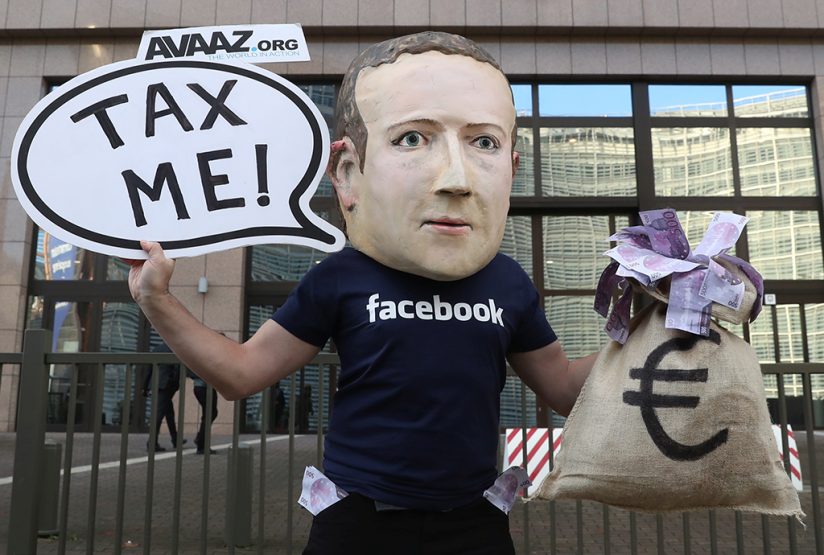
Activist wearing a mask depicting Facebook CEO Mark Zuckerberg demonstrates during the EU finance ministers meeting at EU headquarters in Brussels, Belgium, December 4, 2018. REUTERS/Yves Herman
But Facebook is not simply targeting fake accounts for takedown. Last Sunday, as Europeans prepared to head out to the polls, Facebook froze the largest group used by the Yellow Vests to organize protests and share information, silencing its 350,000+ members at a critical moment in French politics. More than one group member, reduced to commenting on existing posts, pointed out that President Emmanuel Macron met with Facebook chief executive android Mark Zuckerberg three weeks earlier to discuss a first-of-its-kind collaboration in which French government officials are being given access to material censored from users’ newsfeeds, essentially permitting them direct control of what the French are allowed to see on social media. Facebook, then, is providing France with the same techno-fascist services it provides the US government: Facebook will take on the burden of actually censoring dissent, thus skirting any pesky free-speech laws that might otherwise trip up a government that attempted to do the same.
Avaaz focused on the Yellow Vests in its coverage of the French elections, complaining RT France was getting huge quantities of views compared to native French media – perhaps because native French media have been doing Macron’s bidding and attempting to minimize the protests. By framing RT as a perpetrator of “information warfare,” the NGO was making a deliberate effort to have it deplatformed under one of Macron’s controversial police-state laws passed in 2018, by which any outlet spreading so-called “false information” can be gagged for three months leading up to an election. Yet Macron’s own interior minister, Christophe Castaner, lied on Twitter when he claimed the Yellow Vests had attacked the Pitié-Salpêtrière hospital in Paris, and RT was the first outlet to publish the truth about the incident. Who is the disinfo agent?
When the election results came in, Avaaz and its political allies in the neoliberal center could only gape in disbelief. Surely they had wiped La Liga and the Front National (now National Rally) from social media, salting the earth in their wake? How had they won? And what happened in Germany, where Angela Merkel’s CDU performed worse than ever in European election history? Merkel could blame YouTube – 70 influential video stars put out a call to their followers to shun her coalition – but the creators also called for shunning the far-right AfD, so the platform couldn’t be demonized as a tool of the ever-present Nazi Threat. That didn’t stop her party from trying, of course – CDU party leader Annegret Kramp-Karrenbauer complained about online “propaganda” and promised to “tackle this discussion quite aggressively.”
The populist parties won in large part because of the establishment’s unseemly embrace of fascist tactics, from the UK’s totalitarian information warfare disguised as “protecting citizens” or France’s visceral police violence, maiming protesters as if for sport. Europeans voted out of disgust with an establishment so insecure in its control of the narrative that it has sought to annihilate all signs of dissent, dismissing euroskepticism as Russian astroturfing and xenophobia and plugging its ears to the legitimate grievances of its subjects. The National Rally may have beat Macron’s jackbooted thugs, who in the past two months have hauled half a dozen journalists in for questioning by intelligence agencies for publishing stories that embarrassed the regime, but nearly half of French voters refused to vote for anyone at all, according to an Ipsos poll, and Germany’s Greens mopped the floor with Merkel’s coalition among young voters.

The triumph of Nigel Farage’s Brexit party in the UK is the product of a populace wrestling with cognitive dissonance, forced to realize that the “constitutional monarchy” they believed they lived in isn’t so constitutional after all, having jettisoned its democratic mask to cling to the EU under the guise of good old British pragmatism. Even passionate Remainers are happy to see Theresa Maybe go, though it remains to be seen whether her successor will be any more inclined to honor the result of 2016’s referendum. Meanwhile, the Guardian’s embarrassing attempt to shame Farage over a handful of appearances on the Alex Jones show – the paper claimed any reference to “globalists” and “new world order” were dog-whistles for the dreaded “antisemitic conspiracy theories” – proves the establishment media will never regain narrative primacy as long as alternatives exist. Jones, for all his flaws (and they are legion), has a massive audience; the Guardian, despite being propped up by the UK government’s Operation Mockingbird-esque “Integrity Initiative” (and the award for most ironic name ever goes to…), does not.
With the vast American election-fraud apparatus scrambling to prepare itself for 2020, now enabled by Pentagon-funded, Unit-8200-approved Microsoft “election security” software from the makers of the wrongthink-babysitter browser plugin NewsGuard, the US ruling class seems to be poised to make the same mistake as its global peers. Facebook, working hand in hand with the Atlantic Council, has banned and shadowbanned legions of anti-neoliberal activists over the past year, selectively applying (and inventing) new rules in an effort to keep popular content-creators jumping through hoops instead of influencing the discourse. Facebook has been allowed its place of privilege because as a “private corporation” it is legally permitted to violate users’ free speech rights in ways the US government cannot. But if Facebook can’t deliver a victory for the “right guys” this time around, it will be punished. Indeed, a massive anti-trust probe appears to be in the offing, 14 years of Zuckerberg apologies notwithstanding.
The site learned back when it tried to roll out a “disputed” tag for “wrongthink” stories that people were actually more likely to click on those stories; it learned the lesson again when its hugely expensive Facebook Watch news show featuring Anderson Cooper flopped last year. Zuckerberg is on the record begging for government regulation; will Facebook and Twitter use the outcome of this round of elections as a springboard for further crackdowns?
YouTube already has – thousands of creators found their channels demonetized and riddled with takedown notices this week in what has been dubbed the #VoxAdpocalypse after a pathologically whiny Vox blogger became the face of the mass deplatforming, but the censorship appears to be more of a response to Macron’s Orwellian “Christchurch call” to censor “extremism” – that ill-defined conveniently-variable catch-all whose borders are perpetually expanding to engulf all inconvenient speech – aided and abetted by the ADL than Google taking pity on a thin-skinned professional victim.
A sinister coalition of MEPs, “civil society” groups, and the Transatlantic Commission on Election Integrity – a who’s who of war criminals, psychopaths, and oligarchs that includes Michael Chertoff, John “death squad” Negroponte, Victor Pinchuk, and Anders Fogh Rasmussen – has already demanded “parliamentary inquiries into the impact of the use and abuse of technology platforms on democracy and elections.” It’s no coincidence that several of these “election integrity” enthusiasts sit on the board of NewsGuard, which is currently trying to weasel into the EU’s internet regulatory framework by playing up the “disinformation” threat.
The blue-check intelligentsia has been trying for years to convince the hoi polloi that “conspiratorial” thinking is somehow detrimental to democracy. Former Obama labor secretary Robert Reich told Buzzfeed exactly that – “If we become a conspiracy society, we all carry around a degree of paranoia and that’s not healthy for democracy.” But this divorces cause from effect, as if “conspiracy theorists” have formulated their theories out of whole cloth – as if there isn’t evidence for these theories piled knee-deep, as if once-trusted institutions haven’t proven themselves time and again to be as trustworthy as tabloid tales of Elvis risen from the grave. If paranoia is unhealthy for democracy, how is a media incentivized to lie, misdirect and obfuscate any better?
The populist wave has been conflated with an uptick in “hate” in an attempt to delegitimize and demonize it. Outside of groups like the ADL, whose statistics are easily debunked, there is no credible evidence bigotry is on the rise, but as an actual Nazi once said, tell a big enough lie often enough, and it might as well be real. Beginning around 2012, the establishment media began relentlessly flogging the “white privilege” narrative in an effort to fan the flames of interracial conflict. Political science doctoral student Zach Goldberg performed an analysis of several terms using the LexisNexis database and found evidence of heavy narrative manipulation – “whiteness” was mentioned in four times as many news articles in 2017 as in 2012, “white privilege” was mentioned ten times as often in 2017 as in 2012, and “racism” was mentioned ten times as often in the New York Times alone in 2017 as in 2012. Yet even as the media has seemingly talked of nothing else, actual prejudice – by whites against non-whites, at least – has declined since 2008, according to a University of Pennsylvania study published last month, and the FBI’s own statistics show hate crimes against most minority groups are on the decline. Because few European governments separate “hate crimes” from “normal” crime statistics, information on bigotry in Europe often comes solely from NGOs and “civil society” groups that rely for their funding on the perception that Hate is on the march. Populists are capable of prejudice like anyone else, but it is their defining characteristic – a “prejudice” against oligarchy – that motivates the smears churned out by the media.
Protest votes like Trump and Brexit are cries for help from a disenfranchised populace. The European elections boasted the highest turnout in decades, and the ruling class ignores the results at its peril. When the election ritual no longer satisfies a population’s need to feel it is exerting its free will on society, we get public hexings of political figures, people reasoning black magic is more likely to solve their problems than voting. This is the same desperation that leads people like Arnav Gupta to set themselves on fire in front of the White House. Europeans have demonstrated unequivocally that they are sick of unaccountable dictatorship from Brussels, where EC President Jean-Claude Juncker, never one for sympathy with the little guy, sneers at the “populist, nationalists, stupid nationalists” who are “in love with their own countries.” They are sick of being displaced from their homes by a seemingly endless tide of migrants, just as those migrants themselves are displaced from their homes by a seemingly endless tide of American wars. Both groups are victimized by the IMF’s neoliberal austerity policies, epitomized by Juncker, who has done more than perhaps any one person to help Europe’s corporate “citizens” dodge taxes while nickel-and-diming the humans.
Instead of addressing these legitimate grievances, those in power on both sides of the Atlantic tighten the screws on online discourse – out of sight, out of mind. YouTube declares conspiracy theorizing a form of hate speech and plays whack-a-mole with a documentary confirming everyone’s long-standing suspicions that “save-the-migrants” NGOs are cashing in on the desperate human tide. Big Tech promises to work even more closely with Big Brother to crack down on dissident speech, tarring its victims as Nazis while hoping no one will point out such collusion is one of the defining characteristics of fascism.
These measures are guaranteed to further radicalize the discontent. Deleting social media accounts does not delete the people behind them, and France has already proven that starving a protest movement of media attention only makes it angrier. The ruling class may welcome their rage, aiming to use the inevitable outbreak of violence to choke off the last avenues of free expression, but once the guillotines come out, it isn’t the masses’ heads that will be rolling in the streets.
As US Government Strangles Iran’s Economy, Google ‘Suffocates’ Iranian Media
Sputnik – April 25, 2019
The recent shutdown of PressTV and HispanTV’s YouTube and Gmail accounts are more examples of the continued effort by the US government to silence Iranian media outlets, Alex Rubinstein, a journalist for MintPress News, told Sputnik.
“I think that this is part of a larger trend of cracking down on Iranian media,” Rubinstein told Radio Sputnik’s By Any Means Necessary on Wednesday. “Just as this was happening, the United States was saying that we want to bring down Iranian oil exports to zero. Well, it seems like they’re also trying to bring down Iranian expression down to zero through these kinds of moves.”
“It’s a message which both strangles their economy and also suffocates their voice,” he added.
Google barred PressTV and HispanTV, an Iranian Spanish-language outlet, from accessing their respective YouTube and Gmail accounts without notice and without an explanation detailing what Google policies were violated, the outlets recently reported.
Although content from both outlets is still viewable, the organizations are unable to upload new content.
Israeli media outlets have speculated that the order was handed down by Google after HispanTV issued a report claiming imprisoned Palestinians were being used for medical experiments.
“On its face, that sounds like that could be questionable,” Rubinstein said of the speculation. “But there have been a number of other outlets to carry this report, and it wasn’t like they were pulling this information out of thin air — it came from a Palestinian politician in Israel… he made this allegation, and they were citing him properly.”
The journalist told hosts Eugene Puryear and Sean Blackmon that while it’s unclear what initiated Google’s action, it seems in line with the behavior of tech companies vying to “stifle Iranian media” at the behest of the US government.
“These tech companies are basically extensions of the US empire. You look at all that’s going on with NATO and the US government trying to push back on Chinese 5G — well, the point of that is that [the US] can’t spy so well if [the 5G grid is] Chinese,” Rubinstein said.
“The American government has a dominance over these companies, and we see that with the ban on PressTV, and we see that with the other countries that have been targeted, which are primarily Russia and Venezuela.”
“It’s hard to imagine that this is just a coincidence,” he added.
Earlier this month, after the US formally designated Iran’s Islamic Revolutionary Guard Corps a terrorist organization, popular photo and video-sharing platform Instagram began banning pages belonging to various Iranian military officials. The site later explained that the move was in line with the US’ designation.
“I understand to have a policy against spreading terrorist messages on a social media platform… but we didn’t see these crackdowns for terrorist organizations like the Free Syrian Army, or any of the other supposedly moderate rebels in Syria,” Rubinstein told Blackmon.
“We see them [crackdowns] for the supposed terrorist that are enemies of the United States… It seems like the tech companies are all too happy to follow in lockstep.”
See also:
Google’s Campaign Against Iranian Media Outlets Sets ‘Dangerous Precedent’
Facebook Takes Down Iranian Media Pages in Continued War on Alternative News
Google ‘disables’ Press TV’s YouTube account without prior warning
Press TV – April 19, 2019
Google has blocked Press TV and Hispan TV’s access to their official accounts on the technology company’s platforms, including YouTube and Gmail, without prior notice, citing “violation of policies”.
“Your Google Account was disabled and can’t be restored because it was used in a way that violates Google’s policies,” Google said in a message that appears after Press TV tries to log into its account.

The YouTube channels are open to public view for now, but the administrators cannot publish any new content.
Google has so far refused to provide any explanation for disabling Press TV’s account.
This is not the first time that Google is blocking Press TV’s YouTube channels.
The original YouTube channel was established in December 2009, and closed in September 2013. A new channel was then opened, but it was shut almost two months later.
Another channel was opened, but it suffered the same fate after five months.
The fourth channel, however, remained active with over 270,000 subscribers until it was closed today without any prior notice for what Google calls “violation” of its terms and policies.
Google Support says it may not provide any prior notice “in some urgent or extreme cases”. However, it has yet to explain for what “urgent” case it has “disabled” Press TV’s account.
Google has also deprived Press TV of its News service.
US pressure
The Google ban seems to be in line with the US government’s stepped-up pressure on Iran and an all-out propaganda campaign against the country, which includes targeting Iranian media.
In January, Press TV anchor Marzieh Hashemi was detained by the Federal Bureau of Investigation (FBI) at St. Louis Lambert International Airport in Missouri.
The journalist, a 59-year-old American-born Muslim convert who has lived in Iran for years, was jailed in the US for days and later released on January 23 after some 10 days of detention without charge.
A US federal court failed to indict the journalist, who was arrested as a material witness in an unspecified criminal proceeding, of any crime.
Hashemi’s detention prompted condemnation in the US and abroad, sparking rallies in several countries, including the United States.
While in detention, she was forced to remove her hijab and was only offered non-halal food.
How Online Users responded to YouTube’s termination of Middle East Observer – Facts & Figures
Middle East Observer | March 14, 2019
Hello fellow observers,
Just five days after YouTube’s termination of our channel, here’s some of the major developments that occurred in response to this decision:
a) the number of ‘Patrons’ supporting us financially on our Patreon page grew by an outstanding 70%, opening up much greater opportunities for MEO to not only become more sustainable but to increase its content production too (e.g. one more Patron and we will reach 30 total Patrons – which means we’ll be committing to producing at least 6 video translations/month, in line with our current stated goal on Patreon – a significant milestone indeed!).
b) the number of subscribers on our website mailing list grew by %170
c) the number of our Twitter followers grew by 200%
d) major spikes in the number of ‘likes’ and general engagement on our Facebook page
Many heartfelt thanks once again to everyone who supported us with a word of solidarity, a subscription to our website mailing list or social media, and/or crucially, a financial sponsorship of our project on our Patreon page!
Meanwhile, ALOT is going on behind the scenes, most notably:
1. We are gradually uploading some of the more than 250 videos that were taken down by YouTube on to our Daily Motion channel. We will embed every video that we upload on our Daily Motion channel on to our website aswell as stand alone posts.
2. We are replacing the ‘dead’ embedded video links on our website with the Daily Motion video links (this is a gradual process, but you may have noticed that we have already replaced many dead links with the functional Daily Motion versions).
3. We are working on a more detailed and rigorous long-term strategic plan for MEO which takes into consideration the relatively huge developments (both positive and negative) that MEO experienced over the past one week. We will share some details of this strategic vision with you in due time.
Thanks again to every single person who stood in solidarity with MEO and the freedom to express alternative news and views.
YouTube terminates Middle East Observer after almost 10 years online
Middle East Observer | March 9, 2019
After almost 10 years online, over 250 videos, almost 13,000 subscribers, and about 8 million total video views, YouTube has terminated the Middle East Observer (MEO) channel on its platform.
Although perhaps MEO became best known for its video translations of regional political actors such as Sayyed Hassan Nasrallah, its work was certainly not limited to that. Middle East Observer sought to provide its viewers with reliable English translations on politics, religion, and culture from the Middle East more broadly, with a particular focus on media from key states such as Lebanon, Syria, Iraq, Qatar, Saudi Arabia and Iran.
The termination of MEO’s channel came after several months of seemingly routine ‘violation’ emails sent to us by YouTube, the taking down of various videos of ours (most of which were uploaded several years ago) and the imposition of ‘channel strikes’ accompanied by emails about how we could better uphold its rather vague and in many ways hegemonic ‘Community Guidelines’. We gradually realised that no matter what measures we took, it would not satisfy YouTube’s ‘Guidelines’, as the platform’s architecture and policies increasingly moved towards the censorship of alternative news and views.
This censorship process against MEO began several years earlier, when YouTube deactivated our ability to monetise the absolute majority of our videos, classifying them as “Non-advertiser friendly”. Needless to say, this demonetisation regime has increasingly been criticised by many observers and major ‘YouTubers’ in recent years. They argued that the “Non-advertiser friendly” label was deeply ideological, as it worked to effectively censor (no funds = less ability to produce content) alternative and non-mainstream narratives while continuing to portray YouTube as a democratic and transparent media platform.
To bypass reliance on YouTube advertising revenue, we tried various options over the years, the last of which being an up-until-now successful experience on Patreon (here’s our page), where after only a few months 17 of our global viewers/readers joined the highly flexible crowd sourcing platform to fund our work and keep it going. Truly without their support we would not have been able to continue producing translations consistently (by all means support us to help us expand our work too).
Nevertheless, we believe that the termination of our channel today is a great blow to the coverage on YouTube of voices, news, and perspectives found on Arab and Islamic media that are rarely covered – or even purposefully silenced – by Western mainstream media.
YouTube’s message today is clear: the production, uploading, and viewing of genuinely critical and alternative ideas and viewpoints is not welcome.
Thankfully we at MiddleEastObserver.net have been anticipating this scenario for many years, and especially in the last 6 months. For now, these are the best ways to continue to follow and support our work:
– Support us financially (even with $1/month) on Patreon
– You won’t miss out on any content if you subscribe to our Website Mailing List
– We will now be uploading our video content on our Daily Motion channel
– Like our Facebook page
– Follow us on Twitter
Best wishes,
Middle East Observer
‘Soft child-porn’ or honest political debate? Take a guess which one YouTube failed to censor
By Robert Bridge | RT | February 25, 2019
Despite employing a small army of ‘anti-extremist’ flaggers, YouTube somehow overlooked an entire prison block of pedophiles on its platform. Is the video-sharing site wasting too many resources censoring political content?
Last week, a regular guy named Matt Watson, working at his home computer, shook the wired world to its very foundations by providing convincing evidence that YouTube supports – either wittingly or unwittingly – a pedophile ring that openly preys on the most vulnerable members of society, children.
As Watson demonstrated, not only are these bottom feeders free to comment on videos that feature minors, but they also provide time stamps, presumably for the benefit of the wider pedophile community, indicating exactly when the children can be seen in their most compromising positions. They also actively promote links to porn sites that cater for these twisted minds.
The discovery prompted some of the most popular corporate brands, including Disney and Nestle, to bolt for the emergency exits after it was discovered their ads were running alongside the work of sexually depraved deviants. Needless to say, not the best business model.
Aside from the lewd comments accompanying the videos, which is not overly surprising considering the planet’s high creep factor, one of the most disturbing revelations is how ‘user friendly’ YouTube has become for pedophiles. Watson showed how Google-owned YouTube, through no more than a couple mouse clicks, navigates users to a frolicking playground where the sidebar is loaded with nothing but children-themed videos, a virtual pedophile paradise. But it gets more disturbing.
Once a user has entered this “wormhole,” as Watson calls it, there are no alternative video options available for escaping from it. A user will not even find ‘awareness’ videos, for example, that discuss the threat of child predators. In other words, once the user makes it to YouTube’s children video section it is game over, so to speak, unless he or she physically activates a new search.
The reason that this scandal makes no sense is that YouTube has known about its pedophile problem for years. Back in 2017, advertisers were fleeing the platform for the very same reason they are today – their ads were being featured next to scantily clad girls, as well as the predictable depraved comments. Today, algorithm technology is so advanced that Google Maps, for example, is able to blur out the faces of every single person’s image that is captured by its Google Street View. Yet somehow YouTube appears to be technologically handicapped when it comes to finding ways to combat online pedophiles. Why is that?
One possible explanation is that Google and YouTube, as well as the majority of other IT companies, have become overly attentive to politics at the expense of everything else – and more so ever since Donald Trump ‘stole’ the White House from the Democratic darling Hillary Clinton.
First, it is important to state the obvious: Silicon Valley is to Liberals what Yankee Stadium is to the New York Yankees. In other words, the holy of the holies. To quote Mark Zuckerberg, the CEO of Facebook, Silicon Valley, the home to hundreds of IT companies, is an “extremely left-leaning place.” Twitter CEO Jack Dorsey, meanwhile, admitted that his company is so liberal that conservative employees “don’t feel safe to express their opinions” in the workplace.
Given this blatant liberal predilection within the industry, who do you think Google and YouTube teamed up with to police its content from ‘extremist’ (i.e. conservative) content? Certainly not far-right groups.
In 2017, YouTube doubled the size of its so-called ‘Trusted Flaggers’ program, which now partners with over 100 organizations, the full member list of the program remains confidential. Among the few members that have been made public, however, including the Anti-Defamation League (ADL), No Hate Speech and the Southern Poverty Law Center (SPLC), they could best be described as ‘extremist’ in their liberal ideology. Meanwhile, as the Wall Street Journal reported, “less than 10 of the slots are filled by government agencies.”
Ironically, given the nature of this discussion, several of those agencies deal with “child-safety” issues.
Conservatives argue that the glaring lack of transparency with regard to the secretive ‘Trusted Flaggers’ program, combined with the IT industry’s well-known liberal affections, explains why so many right-wing and alternative news sites are being either demonetized, downgraded, or outright banned. And since we are talking about private businesses, these organizations have no legal obligation to uphold the Constitution’s Second Amendment that guarantees ‘freedom of speech.’ They just casually shrug their shoulders and blame everything on the almighty algorithms. Yet, as even the most technologically handicapped person knows, algorithms were not magically conjured up out of thin air. Human beings, not robots (at least not yet), work tediously to develop them.
As just one example of the Orwellian atmosphere now pervading Planet Google, Jordan Peterson, a professor with a reputation for opposing political correctness, had one of his YouTube videos blocked in over two dozen countries last year. YouTube duly informed him that it had “received a legal complaint” about the video and decided to block it. Just like that!
Only after a major outcry on multiple social media platforms, which included Twitter user Ethan Klein and his one million followers, did YouTube finally back down, while portraying the event as some sort of fluke that was “fixed.”
This isn’t the first time YouTube users have experienced “glitches” with the platform. Last year, it was forced to explain the mass removal of right-wing video channels, calling it a “mistake.” What is so strange about these technological breakdowns is that they always seem to affect conservative users. This snafu happened shortly after YouTube CEO Susan Wojcicki announced she was bringing on board – in addition to the so-called ‘Trusted Flaggers’ – some 10,000 moderators to crack down on rising occurrences of hate speech and – wait for it – “child safety.”
Meanwhile, Google can take draconian measures to downgrade RT and Sputnik, for example, over totally unfounded charges related to ‘Russiagate’ hysteria, yet they seem incapable of micromanaging the comments section in kiddie videos.
What this is intended to show is that YouTube does not hesitate to take deliberate steps to intervene in issues that matter most to them, which overwhelmingly seem to be of a political nature. Yet, when the welfare of children is at stake, the mini-surveillance state that the platform has built always goes missing in action, as it has now for many years.
How is it possible that one young man, working alone and without pay, is able to weed out a viper’s den of pedophiles from YouTube’s dungeon? Yet YouTube, with its army of ‘flaggers’ and moderators and government agencies, has failed to filter these miscreants for several years?
The sad reality is that the world of IT is totally consumed with politics, and politics is totally consumed with the world of IT, to the point where society’s most vulnerable are left at risk.
Unfortunately, parents must assume a great deal of vigilance against pedophiles when their children use the video sharing platform because YouTube has obviously dropped the ball on the issue and simply cannot be trusted. Like the rest of the IT kingdom, their heart is in politics, and that is it.
YouTube Will Determine What ‘Conspiracy’ Is and Stop Recommending Such Videos

By Michael Krieger | Liberty BlitzKrieg | February 11, 2019
While the evolution of Google’s YouTube from a free expression platform into something entirely different has been underway for a while, it just took another step in a very short-sighted and restrictive direction. NBC News reports:
YouTube has announced that it will no longer recommend videos that “come close to” violating its community guidelines, such as conspiracy or medically inaccurate videos… Chaslot said that YouTube’s fix to its recommendations AI will have to include getting people to videos with truthful information and overhauling the current system it uses to recommend videos.
There’s a lot to unpack here so let’s get started. First, it appears YouTube has announced the creation of a new bucket when it comes to content uploaded to the site. It’s no longer just videos consistent with company guidelines and those that aren’t, but there’s now a category for “conspiracy or medically inaccurate videos.” This is a massive responsibility, which neither YouTube or anyone else seems fit to be judge and jury. In other words, YouTube is saying it’s comfortable deciding what is “conspiracy” and what isn’t. Which brings up a really important question.
So no videos of government officials lying the public into wars, or is that the Silicon Valley approved type conspiracy? https://t.co/mUEQGMlLyr
— Michael Krieger (@LibertyBlitz) February 11, 2019
“Conspiracy” and covering up conspiracies is a fundamental part of the human experience, and always has been. It demonstrates extreme hubris for a tech giant to claim it can differentiate between a legitimate conspiracy to explore, versus an illegitimate one. One person’s righteous investigation is another’s conspiracy theory, with Russiagate serving as an obvious contemporary example.
Going back to the early 21st century, we witnessed a major conspiracy to start a war in Iraq based on lies; lies which were endlessly repeated uncritically throughout the mass media. Even worse, General Wesley Clark described an even larger conspiracy which consisted of starting multiple additional wars in the aftermath of 9/11. This conspiracy is ongoing and has continued to move forward in the years since, through both Republican and Democratic administrations.
It’s pretty clear what will end up happening as a result of this tweaking to YouTube’s recommended videos AI. The “conspiracies” of your average person will be pushed aside and demoted, while government and mass media lies will remain unaffected. Google will assume mass media and government are honest, so government and billionaire approved propaganda will be increasingly promoted, while the perspectives of regular citizens will be pushed further to the margins. YouTube is simply not a platform anymore, but rather a self-proclaimed arbiter of what is ridiculous conspiracy and what is truth.
The most dangerous and consequential liars on planet earth are those in government, yet I guarantee YouTube will gladly recommend such liars and their lies.
— Michael Krieger (@LibertyBlitz) February 11, 2019
While YouTube says videos it deems conspiracy will still be available via search, it’s not a stretch to imagine this is just the first step and before you know it certain categories will be banned from the site entirely. Either way, I think there’s a silver lining to all of this.
As I outlined in a recent post, U.S. tech giants, particularly Facebook, Google and Amazon, aren’t simply private companies. They appear more akin to quasi-government entities that increasingly view themselves as instrumental gatekeepers for a discredited status quo. Moreover, their primary business models consist of mass surveillance and violating our privacy.
Ultimately, I think the increasingly nefarious and desperate behavior of these tech giants will lead to their demise. More and more of us have looked under the hood and seen the seedy and privacy-destroying nature of these entities. We’ve also seen what it’s like to have genuine free expression on the internet and we don’t want to turn the web into another cable news where Facebook, Google and Amazon become the new CBS, NBC and ABC. If we do, then the entire promise of the internet will have turned out to be a giant waste.
But I don’t think that’s going to happen. I think most of us have had a taste of what’s possible, and agree that free speech and expression on the internet, the good, the bad and the ugly, is better than an internet censored by tech companies and their billionaire executives, who will always be biased toward the status quo point of view. It’s still not clear which platforms will emerge to replace the tech giants, but it seems fairly clear to me the best days are over for these companies, and it cannot come a moment too soon.
Beyond Kafka: How Youtube & Facebook Keep Purging Alternative Media
Hassan Nasrallah is persona non grata on Social Networks, where Anti-Zionism is the ultimate thoughtcrime
By Sayed Hasan | Resistance news, unfiltered. | January 8, 2019
The guillotine’s blade fell again, one year later. On December 2017 already, my 5-years-old Youtube channel Sayed Hasan, mainly translating speeches from Hezbollah Secretary General Hassan Nasrallah, was completely removed by Youtube, along with its 10 000 subscribers, +6 millions views and +400 subtitled videos of anti-Zionist & anti-Imperialist content. I then denunced this censorship in detail in my article Kafka 2.0: How Youtube’s Political Censorship is Exercised. And just around New Year’s Eve 2019, the +6000 Subscribed Facebook Page Resistance News Unfiltered, along with all its similar content, got deleted without explanation. The only thing left online is a cache view of the page dating back from this summer, in French.
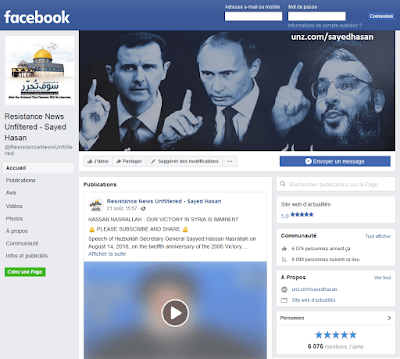
I had created this Page at the beginning of 2018, since no other place can compete with Youtube and its near-monopoly on video content, in order to reach a broader audience. But it was deleted without explanation by Facebook short of its first anniversary. I can’t even know the precise date of termination. Youtube did at least bother to send emails notifying of the removal of a video or of a whole channel, but Facebook has only internal notifications for posts removals. Here is how it happened.
I got two warnings from Facebook, dated December 24th and December 25th, 2018:
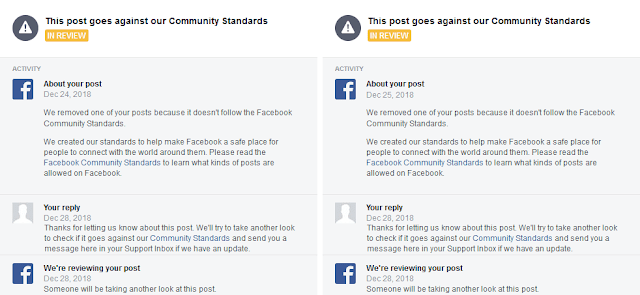
When I logged in on December 28th and saw these messages, I immediately appealed the decisions through the automated procedure, as shown above, though the specific posts alledgedly violating the Communnity Standards weren’t even accessible, since they had been removed. It means that I didn’t –and still don’t– even know which posts got me these “strikes”. At least, Youtube was specific about the videos alledgedly violating their rules –three speeches of Hassan Nasrallah–, though they didn’t say more than that. I don’t know if the whole Page was finally removed because of a third “strike” –Facebook does not even state how much “strikes” you can get before termination– or because of something else, like constant flagging and reports by cyber-IDF soldiers and Hasbara trolls. But I am positive it has to do with my anti-Zionist content. It is a blatant attempt to take down important speech and silence already marginalized voices, as stated by Vera Eidelman from the ACLU.
Of course, one should always protest and complain using the due procedures. After all, Facebook has been known to restore such Pages after the public outcry following their removal without proper reason (TeleSur, VenezuelAnalysis, etc.). I did protest, and I am still expecting an answer from them, without much hope, since earlier appeals as old as September 17th are still awaiting a response almost 4 months later, as shown below (screenshot dated January 4th, 2019).
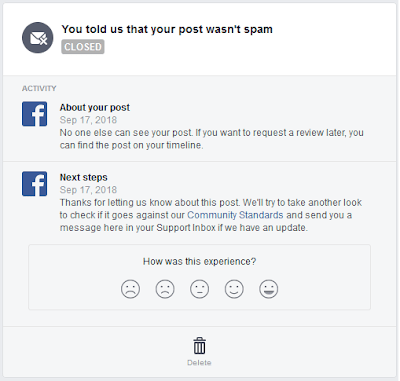
Appeals are not suspensive. Anyway, without any mention of a motive, corpus delicti and mere notification of removal of my page, not even in Facebook’s internal notifications on my personnal account, we are clearly beyond kafkaesque.
This witch-hunt against the voice of the Resistance Axis online, especially Hezbollah Secretary General Hassan Nasrallah (I am the main translator of his speeches in English and French, voluntary and non-affiliated), is not new. Over and over again –most often after Israeli-backed indictment campaigns–, in 2012, 2014, 2016 and June 2018, Facebook, Youtube and Twitter closed down all accounts affiliated to the Lebanese –and Palestinian– Resistance, including Al-Manar TV Channel, banned for good. In 2014 and 2016, Facebook was hunting down Nasrallah’s very picture and temporarily blocking the accounts that featured it, even though they were individuals having no link whatsoever with the organization: not only Hezbollah’s missiles and fighters, but the very voice and picture of its Secretary General are considered as an existential threat for Israel, whose paid trolls keep reporting his videos as terrorist hate-speech to ban mercilessly. The right to information, neutrality or equity is a chimera in the Internet Giants’ turf, where only alternative views, especially videos hostile to Zionism, are subject to censorship and banishment.
On January 8, 2019, Norman Finkelstein commented on the issue:
It is a scandal that the speeches of Hassan Nasrallah are banned on Youtube. Whatever one thinks of his politics, it cannot be doubted that Nasrallah is among the shrewdest and most serious political observers in the world today. Israeli leaders carefully scrutinize Nasrallah’s every word. Why are the rest of us denied this right? One cannot help but wonder whether Nasrallah’s speeches are censored because he doesn’t fit the stereotype of the degenerate, ignorant, blowhard Arab leader. It appears that Western social media aren’t yet ready for an Arab leader of dignified mind and person.
Thankfully, my first article got the attention of Ron Unz, who offered to safeguard my videos in his own website, and I published them back gradually in a new Dailymotion Channel from where they are automatically saved in The Unz Review’s internal storage system. Thus, even if they end up deleted by Dailymotion, they’ll still be accessible in one and same place without need to re-upload them again. I will keep posting my videos on Dailymotion –though it has its own, more subtle way of censorship: age-restricting videos, burying them in the search results… –, and I call on everyone to subscribe to my channel on the Unz Review (RSS feed) and on all those who can to donate to support this work. Whatever happens, the Electronic Intifada to which Hassan Nasrallah called will carry on.
Francis Fukuyama and the End of Social Media Freedoms
By Robert BRIDGE | Strategic Culture Foundation | 09.11.2018
The American political scientist known for promoting the “end of history” fish tale following the collapse of the Soviet Union and the spread of Liberal-capitalist values around the world now appears to be angling for ways – wittingly or unwittingly – to curtail the freedom of speech.
Writing in The American Interest as the virtual crackdown on Alex Jones was underway, Fukuyama argued that the usual suspects of the social media universe – Facebook, Twitter, YouTube, Apple, and all of their vast subterranean holdings – need to come clean by entering a two-step rehabilitation program where they must: (1.) “accept the fact that they are media companies with an obligation to curate information on their platforms,” and (2.) “accept the fact that they need to get smaller.”
I think we can safely skip the “need to get smaller” suggestion with a hearty chuckle and focus our attention instead on the question of social media being held to the same rules as those that regulate America’s squeaky clean media divas, like The Washington Post, CNN and MSNBC.

The social media monsters argue that since they do not create original content, but rather mindlessly provide the clean slate, as it were, for third-party developers to post their own thoughts, opinions, news and of course wild-eyed ‘conspiracy theories,’ they cannot be bound by the same rules and regulations as the mainstream media, which must bear ultimate responsibility for its increasingly damaged goods.
“We’re not a media company,” the late Steve Jobs of Apple fame told Esquire in a rough and tumble interview. “We don’t own media. We don’t own music. We don’t own films or television. We’re not a media company. We’re just Apple.” On that note, Jobs reached over and switched off the interviewer’s tape recorder, bringing an abrupt end to the strained conversation.
Thanks to the provisions laid out in Section 230 of the Communications Decency Act of 1996, the social media platforms are granted immunity from liability for users of an “interactive computer service” who publish information provided by third-party users.
The act was overwhelmingly supported by Congress following the verdict in the 1995 court case, Stratton Oakmont, Inc. v. Prodigy Services Co., which suggested that internet service providers that assumed an editorial role with regards to client content thus became publishers and legally vulnerable for any wrongdoing (libel and slander, for example) committed by their customers. At the time, when alternative voices on the social media frontier had not turned into actual competition for the legacy media, legislators deemed it more important to protect service providers from criminal proceedings than to nip freedom of speech in the bud. Honorable? Yes. But I wonder if they’d have made the same decision knowing the powerful forces they had unleashed.
At this point, Fukuyama summarizes the plight regarding the social media platforms with relation to their independent creators, who wish to express their freedom of speech.
“Section 230 was put in place both to protect freedom of speech and to promote growth and innovation in the tech sector. Both users and general publics were happy with this outcome for the next couple of decades, as social media appeared and masses of people gravitated to platforms like Facebook and Twitter for information and communication. But these views began to change dramatically following the 2016 elections in the United States and Britain, and subsequent revelations both of Russian meddling in the United States and other countries, and of the weaponization of social media by far-Right actors like Alex Jones.”
Despite being a learned and intelligent man, Fukuyama jumps headfirst into the shallow end of a pool known as ‘Blame Russia’, while, at the same time, blames the far-Right for the “weaponization” of social media, as though the Left isn’t equally up to the challenge of waging dirty tricks, in a crucial election year, no less.
Next, he genuflects before the Almighty Algorythm, the godhead of Silicon Valley’s Valhalla, which, as the argument goes, was responsible for attracting huge audiences to particular channels and their messages, instead of the other way around.
“Their business model was built on clicks and virality, which led them to tune their algorithms in ways that actively encouraged conspiracy theories, personal abuse, and other content that was most likely to generate user interaction,” Fukuyama surmises. “This was the opposite of the public broadcasting ideal, which (as defined, for example, by the Council of Europe) privileged material deemed in the broad public interest.”
In other words, had Mark Zuckerberg and friends not toggled their algorithmic settings to ‘conspiracy theories,’ then the easily manipulated masses would never have given a second thought to well-known catastrophes based on pure and unadulterated evil, like the Invasion of Iraq in 2003, which, as the tin-foil-hat crowd constantly crows, was made possible by the fake news of weapons of mass destruction.
Here, Fukuyama lays on thick his extra-nutty academic drivel: “This is the most important sense in which the big internet platforms like Facebook, Twitter, and YouTube have become media companies: They craft algorithms that determine what their users’ limited attention will focus on, driven (at least up to now) not by any broad vision of public responsibility but rather by profit maximization, which leads them to privilege virality.”
In other words, internet users are not inquisitive creatures by nature with fully functioning frontal lobe regions like the honorable Francis Fukuyama. They do not actively search out subjects of interest with critical reasoning skills and ponder cause and effect. And let’s not even mention the mainstream media’s disastrous coverage of current events, which led to the alienation of mainstream audiences in the first place. In Fukuyama’s matrix, otherwise normal people subscribe to ‘alternative facts’ or conspiracy theories because those damn algorithms kept popping up!
This ‘more righteous than thou’ attitude on the part of left-leaning Silicon Valley prompted hundreds of independent channels – the overwhelming majority from the right – to be swept away by a force known as ‘private ownership’ where brutal censorship has become the latest fad. Fukuyama, serving as the mouthpiece for both corporate and political interests, shrugs off this noxious phenomenon by arguing: “Private actors can and do censor material all the time, and the platforms in question are not acting on behalf of the U.S. government.”
Let’s give Fukuyama the benefit of the doubt. Maybe there really is no cooperation between the most powerful and influential industries for manipulating public opinion and the U.S. government. Yet we would do well to keep in mind some key facts that strongly suggest otherwise. During the two-term presidency of Barack Obama (2009-2016), Google executives met on average once a week in the White House with government officials. According to the Campaign for Accountability, 169 Google employees met with 182 government officials at least 427 times, a Beltway record for such chumminess. What is so potentially disastrous about such meetings is that Google, the chokepoint on news and information, which has the power to actually rewrite history, is fiercely Liberal in its political outlook as per some whistleblowers who escaped the well-manicured campus known for employee neck massages and free lunches. What was discussed in the White House? Nobody really knows. However, there is already a treasure trove of publicly available information detailing the intimate relationship between US intelligence and Google (as well as the other usual suspects).
Fukuyama tries to conclude with an upbeat, happy message by saying “private sector actors… have a responsibility to help maintain the health of [America’s democratic] political system.” However, judging by everything in the article that preceded that remark, I would have to guess Francis Fukuyama would fully support yet more intolerance in the world of social media as a means of preserving America’s freedom-squashing status quo.
Leaked Google Secret Memo Admits Abandonment of Free Speech for ‘Safety And Civility’
Russia Insider | October 18, 2018
Despite leaked video footage showing top executives declaring their intention to ensure that the rise of Trump and the populist movement is just a “blip” in history, Google has repeatedly denied that the political bias of its employees filter into its products.
But the 85-page briefing, titled “The Good Censor,” admits that Google and other tech platforms now “control the majority of online conversations” and have undertaken a “shift towards censorship” in response to unwelcome political events around the world.

Talk about Russian, er, Jewish, meddling in our ‘democracy’ … Sergey Brin, Billionaire founder of Google
Examples cited in the document include the 2016 election and the rise of Alternative for Deutschland (AfD) in Germany.
Responding to the leak, an official Google source said the document should be considered internal research, and not an official company position.
The briefing labels the ideal of unfettered free speech on the internet a “utopian narrative” that has been “undermined” by recent global events as well as “bad behavior” on the part of users. It can be read in full below.
It acknowledges that major tech platforms, including Google, Facebook and Twitter initially promised free speech to consumers. “This free speech ideal was instilled in the DNA of the Silicon Valley startups that now control the majority of our online conversations,” says the document.
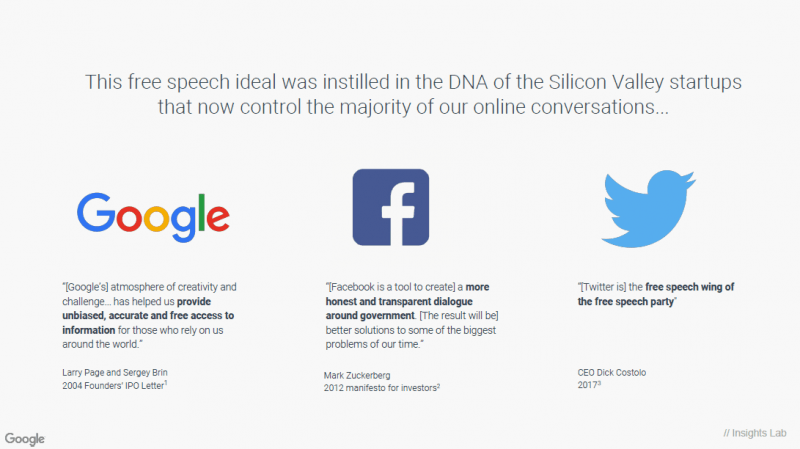
The briefing argues that Google, Facebook, YouTube and Twitter are caught between two incompatible positions, the “unmediated marketplace of ideas” vs. “well-ordered spaces for safety and civility.”
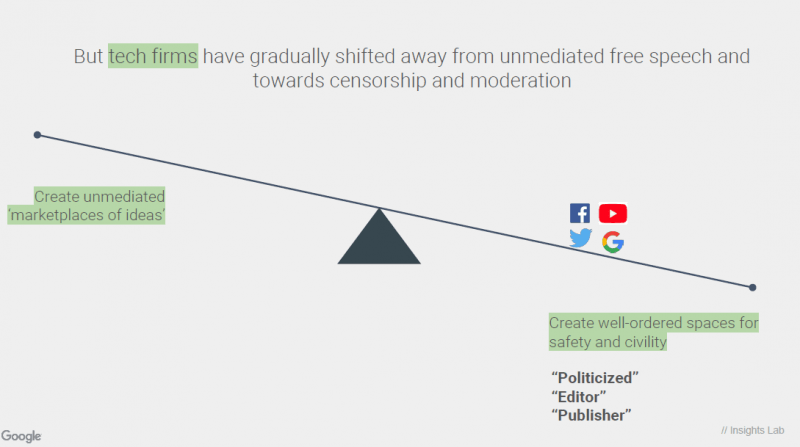
The first approach is described as a product of the “American tradition” which “prioritizes free speech for democracy, not civility.” The second is described as a product of the “European tradition,” which “favors dignity over liberty and civility over freedom.” The briefing claims that all tech platforms are now moving toward the European tradition.
The briefing associates Google’s new role as the guarantor of “civility” with the categories of “editor” and “publisher.” This is significant, given that Google, YouTube, and other tech giants publicly claim they are not publishers but rather neutral platforms — a categorization that grants them special legal immunities under Section 230 of the Communications Decency Act. Elsewhere in the document, Google admits that Section 230 was designed to ensure they can remain neutral platforms for free expression.
Trump, Conspiracy Theorist
One of the reasons Google identifies for allegedly widespread public disillusionment with internet free speech is that it “breeds conspiracy theories.” The example Google uses? A 2016 tweet from then-candidate Donald Trump, alleging that Google search suppressed negative results about Hillary Clinton.
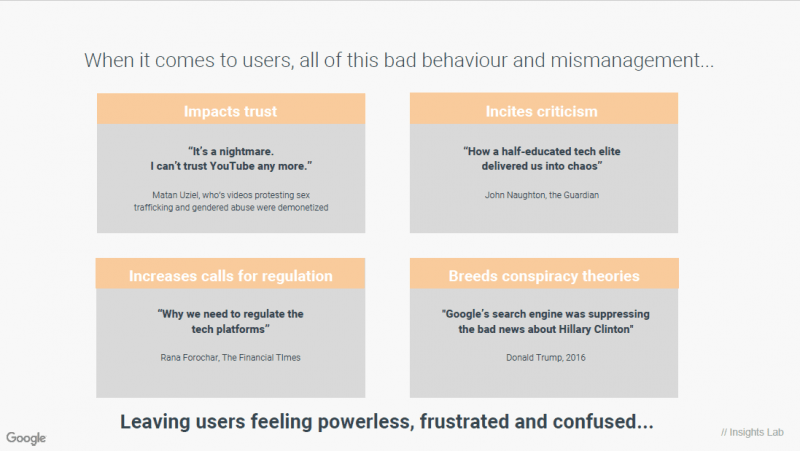
At the time, Google said that it suppressed negative autocomplete suggestions about everybody, not just Clinton. But it was comparatively easy to find such autocomplete results when searching for Bernie Sanders or Donald Trump. Independent research from psychologist Dr. Robert Epstein also shows that Google search results (if not autocomplete results) did indeed favor Clinton in 2016.
Twice in the document, Google juxtaposes a factoid about “Russian interference” in American elections with pictures of Donald Trump. At one point, the document admits that tech platforms are changing their policies to pre-empt congressional action on foreign interference.
The document did not address the fact that, according to leading psychologists, the impact of foreign “bots” and propaganda on social media has a negligible impact on voters.
From Suggestions to Company Policy
It is unclear for whom the “Good Censor” was intended. What is clear, however, is that Google spent (or paid someone to spend) significant time and effort to produce it.
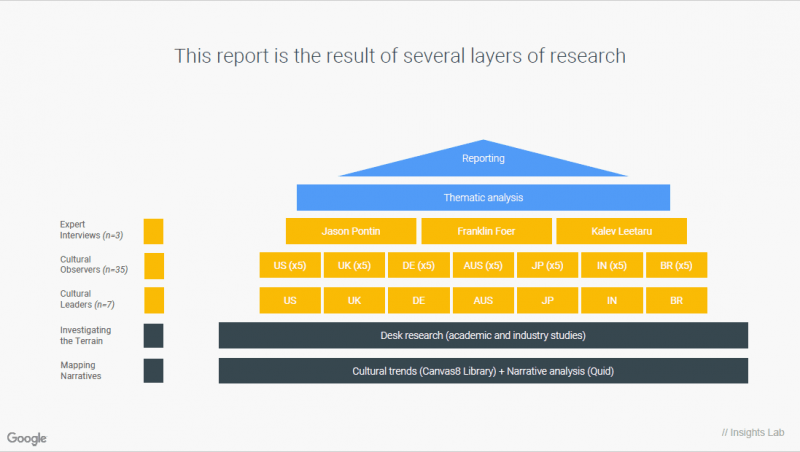
According to the briefing itself, it was the product of an extensive process involving “several layers of research,” including expert interviews with MIT Tech Review editor-in-chief Jason Pontin, Atlantic staff writer Franklin Foer, and academic Kalev Leetaru. 35 cultural observers and 7 cultural leaders from seven countries on five continents were also consulted to produce it.
What is also clear is that many of the briefing’s recommendations are now reflected in the policy of Google and its sibling companies.
For example, the briefing argues that tech companies will have to censor their platforms if they want to “expand globally.” Google is now constructing a censored search engine to gain access to the Chinese market.
The document also bemoans that the internet allows “have a go commenters” (in other words, ordinary people) to compete on a level playing field with “authoritative sources” like the New York Times. Google-owned YouTube now promotes so-called “authoritative sources” in its algorithm. The company did not specifically name which sources it would promote.
Key points in the briefing can be found at the following page numbers:
- P2 – The briefing states that “users are asking if the openness of the internet should be celebrated after all” and that “free speech has become a social, economic, and political weapon.”
- P11 – The briefing identifies Breitbart News as the media publication most interested in the topic of free speech.
- P12 – The briefing says the early free-speech ideals of the internet were “utopian.”
- P14 – The briefing admits that Google, along with Twitter and Facebook, now “control the majority of online conversations.”
- P15 – Section 230 of the Communications Decency Act is linked to Google’s position as a platform for free expression. Elsewhere in the document (p68), Google and other platforms’ move towards moderation and censorship is associated with the role of “publisher” – which would not be subject to Section 230’s legal protections.
- PP19-21 – The briefing identifies several factors that allegedly eroded faith in free speech. The election of Donald Trump and alleged Russian involvement is identified as one such factor. The rise of the populist Alternative fur Deutschland (Alternative for Germany) party in Germany – which the briefing falsely smears as “alt-right” – is another.
- PP26-34 – The briefing explains how “users behaving badly” undermines free speech on the internet and allows “crummy politicians to expand their influence.” The briefing bemoans that “racists, misogynists, and oppressors” are allowed a voice alongside “revolutionaries, whistleblowers, and campaigners.” It warns that users are “keener to transgress moral norms” behind the protection of anonymity.
- P37 – The briefing acknowledges that China – for which Google has developed a censored search engine – has the worst track record on internet freedom.
- P45 – After warning about the rise of online hate speech, the briefing approvingly cites Sarah Jeong, infamous for her hate speech against white males (Google is currently facing a lawsuit alleging it discriminates against white males, among other categories).
- P45 – The briefing bemoans the fact that the internet has until recently been a level playing field, warning that “rational debate is damaged when authoritative voices and ‘have a go’ commentators receive equal weighting.”
- P49 – The document accuses President Trump of spreading the “conspiracy theory” that Google autocomplete suggestions unfairly favored Hillary Clinton in 2016. (Trump’s suspicions were actually correct – independent research has shown that Google did favor Clinton in 2016).
- P53 – Free speech platform Gab is identified as a major destination for users who are dissatisfied with censorship on other platforms.
- P54 – After warning about “harassment” earlier in the document, the briefing approvingly describes a 27,000-strong left-wing social media campaign as a “digital flash mob” engaged in “friendly counter-commenting.”
- P57 – The document juxtaposes a factoid about Russian election interference with a picture of Donald Trump.
- P63 – The briefing admits that when Google, GoDaddy and CloudFlare simultaneously withdrew service from website The Daily Stormer, they were “effectively booting it off the internet,” a point also made by the Electronic Frontier Foundation and the FCC in their subsequent warnings about online censorship.
- P66-68 – The briefing argues that Google, Facebook, YouTube and Twitter are caught between two incompatible positions, the “unmediated marketplace of ideas” vs. “well-ordered spaces for safety and civility.” The first is described as a product of the “American tradition” which “prioritizes free speech for democracy, not civility.” The second is described as a product of the “European tradition,” which “favors dignity over liberty and civility over freedom.” The briefing claims that all tech platforms are now moving toward the European tradition.
- P70 – The briefing sums up the reasons for big tech’s “shift towards censorship,” including the need to respond to regulatory demands and “expand globally,” to “monetize content through its organization,” and to “protect advertisers from controversial content, [and] increase revenues.”
- P74-76 – The briefing warns that concerns about censorship from major tech platforms have spread beyond the right-wing media into the mainstream.
Read The Good Censor in full below. Alternative download option available here.
The Good Censor – GOOGLE LEAK by on Scribd.
American Pravda: The ADL in American Society
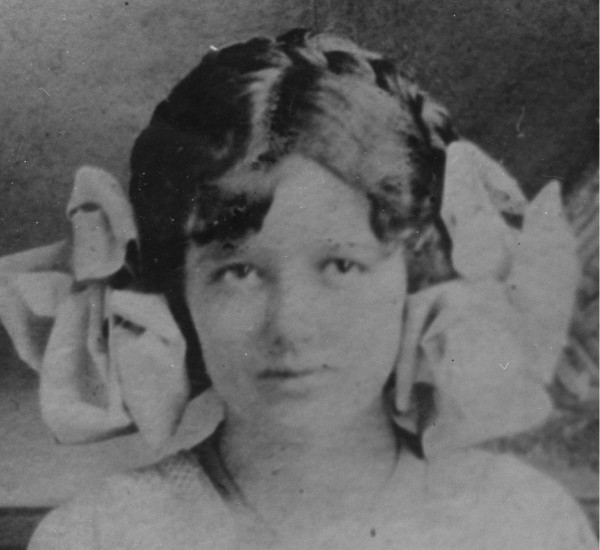
13-year-old Mary Phagan, the girl raped and murdered by Leo Frank, the founding hero of the ADL
By Ron Unz • Unz Review • October 15, 2018
In our modern era, there are surely few organizations that so terrify powerful Americans as the Anti-Defamation League (ADL) of B’nai B’rith, a central organ of the organized Jewish community.
Mel Gibson had long been one of the most popular stars in Hollywood and his 2004 film The Passion of the Christ became among the most profitable in world history, yet the ADL and its allies destroyed his career, and he eventually donated millions of dollars to Jewish groups in desperate hopes of regaining some of his public standing. When the ADL criticized a cartoon that had appeared in one of his newspapers, media titan Rupert Murdoch provided his personal apology to that organization, and the editors of The Economist quickly retracted a different cartoon once it came under ADL fire. Billionaire Tom Perkins, a famed Silicon Valley venture capitalist, was forced to issue a heartfelt apology after coming under ADL criticism for his choice of words in a Wall Street Journal column. These were all proud, powerful individuals, and they must have deeply resented being forced to seek such abject public forgiveness, but they did so nonetheless. The total list of ADL supplicants over the years is a very long one.
Given the fearsome reputation of the ADL and its notorious hair-trigger activists, there was a widespread belief that my small webzine would be completely annihilated when I first launched my recent series of controversial articles in early June by praising the works of historian David Irving, long demonized by the ADL. Yet absolutely nothing happened.
During the next three months my subsequent articles directly challenged nearly every hot-button issue normally so fiercely defended by the ADL and its lackies, so much so that a friendly journalist soon described me as the “Kamikaze from California.” Yet despite my 90,000 words of text and the 13,000 comments I had attracted, the continuing silence of the ADL was absolutely deafening. Meanwhile, my articles were read more than half a million times, with the following being a list of the most provocative pieces:
- The Remarkable Historiography of David Irving
June 4, 2018 • 1,700 Words • 570 Comments - American Pravda: The JFK Assassination, Part II – Who Did It?
June 25, 2018 • 8,000 Words • 985 Comments - American Pravda: Oddities of the Jewish Religion
July 16, 2018 • 7,800 Words • 1,637 Comments - American Pravda: The Bolshevik Revolution and Its Aftermath
July 23, 2018 • 6,900 Words • 913 Comments - American Pravda: The Nature of Anti-Semitism
July 30, 2018 • 5,500 Words • 666 Comments - American Pravda: Jews and Nazis
August 6, 2018 • 6,800 Words • 554 Comments - American Pravda: Holocaust Denial
August 27, 2018 • 17,600 Words • 2,323 Comments - American Pravda: 9/11 Conspiracy Theories
September 10, 2018 • 11,000 Words • 2,355 Comments
When divine wrath fails to smite the heretic and terrifying enforcers of official dogma seem to have suddenly lost their taste for battle, others gradually begin to take notice and may grow emboldened. Eventually leading pro-Russian and Libertarian websites such as Russia Insider and LewRockwell began republishing some of my most controversial American Pravda articles, thus bringing my factual claims to the attention of broader audiences. After the conclusion of the my series, I began directly ridiculing my strangely timorous ADL opponents, publishing a short column entitled “Has the ADL Gone Into Hiding?” which led the redoubtable Paul Craig Roberts to describe me as “the bravest man I know.”
Apparently the combination of all these factors at long last grew too worrisome for the ADL, and stirring from their secret hiding place, its activists have now finally released a short and rather milquetoast response to my material, one which hardly much impresses me. A few days ago, they Tweeted out their column, together with a photo of their new nemesis.
California businessman Ron Unz has long been funding anti-Israel activists. Now, he’s embracing hardcore #antiSemitism, denying the Holocaust & claiming Jews run the media & worship Satan. Learn more from our experts: https://t.co/KnngID3YCh
— ADL (@ADL_National) October 8, 2018
The ADL may boast an annual budget of $60 million and have many hundreds of full-time employees, but its research skills seem sorely lacking. I discovered that they opened their rebuke by denouncing me as a notorious “anti-immigrant activist.” This seems an extremely odd claim given that I have published perhaps a quarter-million words on that contentious topic over the last twenty-five years, nearly all of it online and fully searchable, and my views have never been characterized in that fashion. To cite just one example, my article “California and the End of White America” appeared as a 1999 cover-story in Commentary, the flagship publication of The American Jewish Committee, and surely anyone reading it would be greatly puzzled by the ADL’s description. Indeed, just a few years earlier, I had been a top featured speaker at the October 1994 pro-immigrant protest in downtown Los Angeles, a 70,000 strong political rally that was the largest such gathering in American history to that date.

Over the years, my political activities have been the subject of many thousands of articles in the mainstream media, including a half-dozen front-page stories in the New York Times, and these would provide a similar picture, as did the New Republic cover story chronicling my California successes. Moreover, my views on immigrants haven’t changed all that much over the years as demonstrated by my more recent articles such as “The Myth of Hispanic Crime,” “Immigration, Republicans, and the End of White America” and “A Grand Bargain on Immigration?” Perhaps the intrepid ADL investigators should acquaint themselves with a powerful new technological tool called “Google.”
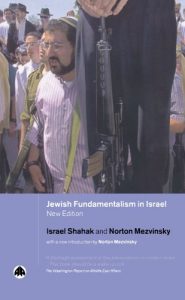
I was equally unimpressed that they so hotly denounced me for substantially relying upon the writings of Israel Shahak, whom they characterized as viciously “anti-Semitic.” As I had repeatedly emphasized, my own total lack of Aramaic and Hebrew necessarily forces me to rely upon the research of others, and the late Prof. Shahak, an award-winning Israeli academic, certainly seems a fine source to use. After all, famed linguist Noam Chomsky had lauded Shahak’s works for their “outstanding scholarship,” and numerous of our other most prominent public intellectuals such as Christopher Hitchens, Edward Said, and Gore Vidal had been similarly lavish in their praise. Furthermore, one of Shahak’s co-authors was Norton Mezvinsky, a prominent American academic specializing in Middle Eastern history, himself hardly an obscure figure given that both his brother and sister-in-law served in Congress and his nephew later married Chelsea Clinton. And as far as I’m aware almost none of Shahak’s explicit claims about the Talmud or traditional Judaism have ever been directly challenged, while the online availability of his first book allows those so interested to conveniently read it and decide for themselves.

The ADL similarly denounced me for taking seriously the theories of Ariel Toeff, another Israeli academic. But Prof. Toeff, son of the Chief Rabbi of Rome, certainly ranks as one of the world’s leading scholarly authorities on Medieval Jewry, and working together with his graduate students and other colleagues, he had devoted many years of effort to the research study in question, drawing upon extensive primary and secondary sources produced in eight different languages. I found his 500 page book quite persuasive, as did Israeli journalist Israel Shamir, and I have seen no credible rebuttals.
Now the work of all these prominent academics and intellectuals may not necessarily be correct, and perhaps I am mistaken in accepting their factual claims. But I would need to see something far more weighty than a casual dismissal in a few paragraphs contained within an anonymous ADL column, whose author for all I know might have been some ignorant young intern.
Those glaring flaws aside, most of the ADL’s remaining catalogue of my numerous heretical positions seemed reasonably accurate, though obviously presented in a somewhat hostile and derogatory fashion and sorely lacking any links to my original pieces. But even this desultory listing of my mortal transgressions was woefully incomplete, with the ADL strangely failing to include mention of some of my most controversial claims.

For example, the authors excluded all reference to my discussion of the thoroughly documented Nazi-Zionist economic partnership of the 1930s, which played such a crucial role in laying the basis for the State of Israel. And the ADL similarly avoided mentioning the nearly 20,000 words I had allocated to discussing the very considerable evidence that the Israeli Mossad had played a central role in both the JFK Assassination and the 9/11 Attacks. Surely this must be one of the few times that the ADL has deliberately avoided leveling the charge of “conspiracy theorist” against an opponent whom they might have so easily slurred in that fashion. Perhaps they felt the evidence I provided was too strong for them to effectively challenge.
The worrisome incompetence of ADL researchers becomes particularly alarming when we consider that over the last couple of years that organization has been elevated into a content gatekeeping role at America’s largest Internet companies, helping to determine what may or may not be said on the most important Social Media platforms such as Facebook, YouTube, and Twitter.
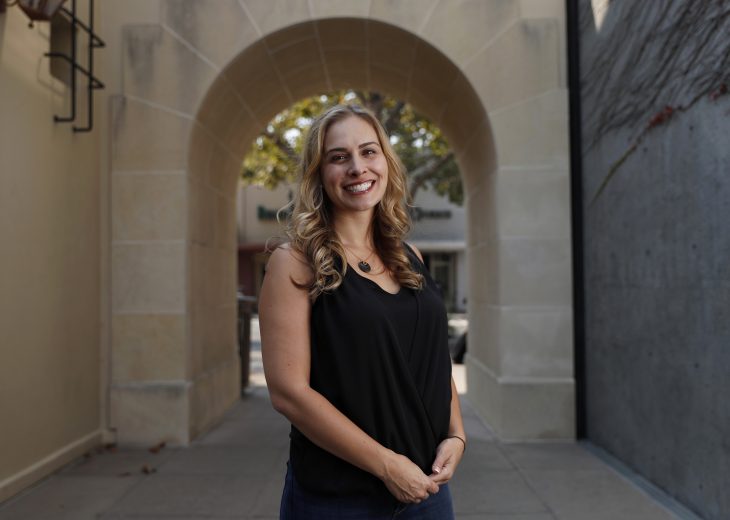
Brittan Heller, director of technology and society for the Anti-Defamation League, photographed in Palo Alto, Calif., on August 27, 2018. (Nhat V. Meyer/Bay Area News Group)
My local paper is the San Jose Mercury News and a couple of weeks ago it published a major profile interview with Brittan Heller, the ADL Director tasked with policing “hate speech” across the America-dominated portions of the Internet. She seemed like a perfectly pleasant young woman in her mid-thirties, a Stanford English major and a graduate of Yale Law, now living in Silicon Valley with her husband and her two cats, Luna and Stella. She emphasizes her own experience as a victim of cyber-harassment from a fellow college student whose romantic overtures she rejected and the later expertise she had gained as a Nazi-hunter for the U.S. government. But does that resume really provide her with the god-like knowledge suitable for overriding our traditional First Amendment rights and determining which views and which individuals should be allowed access to some two billion readers worldwide?
There is also a far more serious aspect to the situation. The choice of the ADL as the primary ideological overseer of America’s Internet may seem natural and appropriate to politically-ignorant Americans, a category that unfortunately includes the technology executives leading the companies involved. But this reflects the remarkable cowardice and dishonesty of the American media from which all these individuals derive their knowledge of our world. The true recent history of the ADL is a remarkably sordid and disreputable tale.
In January 1993, the San Francisco Police Department reported that it had recently raided the Northern California headquarters of the ADL based upon information provided by the FBI. The SFPD discovered that the organization had been keeping intelligence files on more than 600 civic organizations and 10,000 individuals, overwhelmingly of a liberal orientation, with the SFPD inspector estimating that 75% of the material had been illegally obtained, much of it by secret payments to police officials. This was merely the tip of the iceberg in what clearly amounted to the largest domestic spying operation by any private organization in American history, and according to some sources, ADL agents across the country had targeted over 1,000 political, religious, labor, and civil rights organizations, with the New York headquarters of the ADL maintaining active dossiers on more than a million Americans.
Not long afterward, an ACLU official who had previously held a high-ranking position with the ADL revealed in an interview that his organization had been the actual source of the highly controversial 1960s surveillance on Martin Luther King, Jr., which it had then provided to FBI Director J. Edgar Hoover. For many years Hoover had been furiously denounced in the national media headlines for his use of tapes and other secret information on King’s activities, but when a local San Francisco newspaper revealed that an ADL spying operation had actually been the source of all that sordid material, the bombshell revelation was totally ignored in the national media and only reported by fringe organizations, so that today almost no Americans are aware of that fact.
I am not aware of any other private organization in American history that has been involved in even a sliver of such illegal domestic espionage activity, which appears to have been directed against almost all groups and prominent individuals—Left, Right, and Center—suspected of being insufficiently aligned with Jewish and Israeli interests. Some of the illegal material found in ADL possession even raised dark suspicions that it had played a role in domestic terrorist attacks and political assassinations directed against foreign leaders. I am no legal expert, but given the massive scale of such illegal ADL activities, I wonder whether a plausible case might have been made to prosecute the entire organization under RICO statutes and sentence all of its leaders to long prison terms.
Instead, the resulting government charges were quickly settled with merely a trivial fine and a legal slap on the wrist, demonstrating the near-total impunity provided by massive Jewish political power in modern American society.
In effect, the ADL seems to have long operated as our country’s privatized secret political police, monitoring and enforcing its ideological doctrines on behalf of Jewish groups much as the Stasi did for the Communist rulers of East Germany. Given such a long history of criminal activity, allowing the ADL to extend its oversight to our largest Social Media platforms amounts to appointing the Mafia to supervise the FBI and the NSA, or taking a very large step towards implementing George Orwell’s Ministry of Truth on behalf of Jewish interests.
In his 1981 memoirs, the far right Classics scholar Revilo P. Oliver characterized the ADL as “the formidable organization of Jewish cowboys who ride herd on their American cattle” and this seems a reasonably apt description to me.
Although I had long recognized the power and influence of the ADL, a leading Jewish-activist organization whose leaders were so regularly quoted in my newspapers, until rather recently I had only the vaguest notions of its origins. I’m sure I’d heard the story mentioned at some points, but the account had never stuck in my mind.
Then perhaps a year or two ago, I happened to come across some discussion of the ADL’s 2013 centenary celebration, in which the leadership reaffirmed the principles of its 1913 founding. The initial impetus had been the vain national effort to save the life of Leo Frank, a young Jew unjustly accused of murder and eventually lynched. Not long before, Frank’s name and story would have been equally vague in my mind, with the man half-remembered from my introductory history textbooks as a notorious early KKK victim in the fiercely anti-Semitic Deep South of the early twentieth century. However, not long before seeing that piece on the ADL I’d read Albert Lindemann’s highly-regarded study The Jew Accused, and his short chapter on the notorious Frank case had completely exploded all my preconceptions.
First, Lindemann demonstrated that there was no evidence of any anti-Semitism behind Frank’s arrest and conviction, with Jews constituting a highly-valued element of the affluent Atlanta society of the day, and no references to Frank’s Jewish background, negative or otherwise, appearing in the media prior to the trial. Indeed, five of the Grand Jurors who voted to indict Frank for murder were themselves Jewish, and none of them ever voiced regret over their decision. In general, support for Frank seems to have been strongest among Jews from New York and other distant parts of the country and weakest among the Atlanta Jews with best knowledge of the local situation.
Furthermore, although Lindemann followed the secondary sources he relied upon in declaring that Frank was clearly innocent of the charges of rape and murder, the facts he recounted led me to the opposite conclusion, seeming to suggest strong evidence of Frank’s guilt. When I much more recently read Lindemann’s longer and more comprehensive historical study of anti-Semitism, Esau’s Tears, I noticed that his abbreviated treatment of the Frank case no longer made any claim of innocence, perhaps indicating that the author himself might have also had second thoughts about the weight of the evidence.
Based on this material, I voiced that opinion in my recent article on historical anti-Semitism, but my conclusions were necessarily quite tentative since they relied upon Lindermann’s summary of the information provided in the secondary sources he had used, and I had the impression that virtually all those who had closely investigated the Frank case had concluded that Frank was innocent. But after my piece appeared, someone pointed me to a 2016 book from an unexpected source arguing for Frank’s guilt. Now that I have ordered and read that volume, my understanding of the Frank case and its historical significance has been entirely transformed.
Mainstream publishers may often reject books that too sharply conflict with reigning dogma and sales of such works are unlikely to justify the extensive research required to produce the manuscript. Furthermore, both authors and publishers may face widespread vilification from a hostile media for taking such positions. For these reasons, those who publish such controversial material will often be acting from deep ideological motives rather than merely seeking professional advancement or monetary gain. As an example, it took a zealous Trotskyite leftist such as Lenni Brunner to brave the risk of widespread vilification and invest the time and effort to produce his remarkable study of the crucial Nazi-Zionist partnership of the 1930s. And for similar reasons, we should not be totally surprised that the leading book arguing for the guilt of Leo Frank appeared as a volume in the series on the pernicious aspects of Jewish-Black historical relations produced by Louis Farrakhan’s Nation of Islam (NOI), nor that the text lacked any identified author.
Anonymous works published by heavily-demonized religious-political movements naturally engender considerable caution, but once I began reading the 500 pages of The Leo Frank Case: The Lynching of a Guilty Man I was greatly impressed by the quality of the historical analysis. I think I have only very rarely encountered a research monograph on a controversial historical event that provided such an enormous wealth of carefully-argued analysis backed by such copious evidence. The authors seemed to display complete command of the major secondary literature of the last one hundred years while drawing very heavily upon the primary sources, including court records, personal correspondence, and contemporaneous publications, with the overwhelming majority of the 1200 footnotes referencing newspaper and magazine articles of that era. The case made for Frank’s guilt seemed absolutely overwhelming.
The basic outline of events is not disputed. In 1913 Georgia, a 13-year-old pencil company worker named Mary Phagan was last seen alive visiting the office of factory manager Leo Frank on a Saturday morning to collect her weekly paycheck, while her raped and murdered body was found in the basement early the next morning and Frank eventually arrested for the crime. As the wealthy young president of the Atlanta chapter of B’nai B’rith, Frank ranked as one of the most prominent Jewish men in the South, and great resources were deployed in his legal defense, but after the longest and most expensive trial in state history, he was quickly convicted and sentenced to death.
The facts of the case against Frank eventually became a remarkable tangle of complex and often conflicting evidence and eyewitness testimony, with sworn statements regularly being retracted and then counter-retracted. But the crucial point that the NOI authors emphasize for properly deciphering this confusing situation is the enormous scale of the financial resources that were deployed on Frank’s behalf, both prior to the trial and afterward, with virtually all of the funds coming from Jewish sources. Currency conversions are hardly precise, but relative to the American family incomes of the time, the total expenditures by Frank supporters may have been as high as $25 million in present-day dollars, quite possibly more than any other homicide defense in American history before or after, and an almost unimaginable sum for the impoverished Deep South of that period. Years later, a leading donor privately admitted that much of this money was spent on perjury and similar falsifications, something which is very readily apparent to anyone who closely studies the case. When we consider this vast ocean of pro-Frank funding and the sordid means for which it was often deployed, the details of the case become far less mysterious. There exists a mountain of demonstrably fabricated evidence and false testimony in favor of Frank, and no sign of anything similar on the other side.
The police initially suspected the black night watchman who found the girl’s body, and he was quickly arrested and harshly interrogated. Soon afterward, a bloody shirt was found at his home, and Frank made several statements that seemed to implicate his employee in the crime. At one point, this black suspect may have come close to being summarily lynched by a mob, which would have closed the case. But he stuck to his story of innocence with remarkable composure, in sharp contrast to Frank’s extremely nervous and suspicious behavior, and the police soon shifted their scrutiny toward the latter, culminating in his arrest. All researchers now recognize that the night watchman was entirely innocent, and the material against him planted.
The evidence against Frank steadily mounted. He was the last man known to have seen the young victim and he repeatedly changed important aspects of his story. Numerous former female employees reported his long history of sexually aggressive behavior toward them, especially directed towards the murdered girl herself. At the time of the murder, Frank claimed to have been working alone in his office, but a witness who went there reported he had been nowhere to be found. A vast amount of circumstantial evidence implicated Frank.
A black Frank family servant soon came forward with sworn testimony that Frank had confessed the murder to his wife on the morning after the killing, and this claim seemed supported by the latter’s strange refusal to visit her husband in jail for the first two weeks after the day of his arrest.
Two separate firms of experienced private detectives were hired by Frank’s lavishly-funded partisans, and the agents of both eventually came to the reluctant conclusion that Frank was guilty as charged.
As the investigation moved forward, a major break occurred as a certain Jim Conley, Frank’s black janitor, came forward and confessed to having been Frank’s accomplice in concealing the crime. At the trial he testified that Frank had regularly enlisted him as a lookout during his numerous sexual liaisons with his female employees, and after murdering Phagan, had then offered him a huge sum of money to help remove and hide the body in the basement so that the crime could be pinned upon someone else. But with the legal noose tightening around Frank, Conley had begun to fear that he might be made the new scapegoat, and went to the authorities in order to save his own neck. Despite Conley’s damning accusations, Frank repeatedly refused to confront him in the presence of the police, which was widely seen as further proof of Frank’s guilt.
By the time of the trial itself, all sides were agreed that the murderer was either Frank, the wealthy Jewish businessman, or Conley, the semi-literate black janitor with a first-grade education and a long history of public drunkenness and petty crime. Frank’s lawyers exploited this comparison to the fullest, emphasizing Frank’s Jewish background as evidence for his innocence and indulging in the crudest sort of racial invective against his black accuser, whom they claimed was obviously the true rapist and murderer due to his bestial nature.
Those attorneys were the best that money could buy and the lead counsel was known as the one of the most skilled courtroom interrogators in the South. But although he subjected Conley to a grueling sixteen hours of intense cross-examination over three days, the latter never wavered in the major details of his extremely vivid story, which deeply impressed the local media and the jury. Meanwhile, Frank refused to take the stand at his own trial, thereby avoiding any public cross-examination of his often changing account.
Two notes written in crude black English had been discovered alongside Phagan’s body, and everyone soon agreed that these were written by the murderer in hopes of misdirecting suspicion. So they were either written by a semi-literate black such as Conley or by an educated white attempting to imitate that style, and to my mind, the spelling and choice of words strongly suggests the latter, thereby implicating Frank.
Taking a broader overview, the theory advanced by Frank’s legion of posthumous advocates seems to defy rationality. These journalists and scholars uniformly argue that Conley, a semi-literate black menial, had brutally raped and murdered a young white girl, and the legal authorities soon became aware of this fact, but conspired to set him free by supporting a complex and risky scheme to instead frame an innocent white businessman. Can we really believe that the police officials and prosecutors of a city in the Old South would have violated their oath of office in order to knowingly protect a black rapist and killer from legal punishment and thereby turn him loose upon their city streets, presumably to prey on future young white girls? This implausible reconstruction is particularly bizarre in that nearly all its advocates across the decades have been the staunchest of Jewish liberals, who endlessly condemned the horrific racism of the Southern authorities of that era, but then unaccountably chose to make a special exception in this one particular case.
In many respects, the more important part of the Frank case began after his conviction and death sentence when many of America’s wealthiest and most influential Jewish leaders began mobilizing to save him from the hangman. They soon established the ADL as a new vehicle for that purpose and succeeded in making the Frank murder case one of the most famous in American history to that date.
Although his role was largely concealed at the time, the most important new backer whom Frank attracted was Albert Lasker of Chicago, the unchallenged monarch of American consumer advertising, which constituted the life’s blood of all of our mainstream newspapers and magazines. Not only did he ultimately provide the lion’s share of the funds for Frank’s defense, but he focused his energies upon shaping the media coverage surrounding the case. Given his dominant business influence in that sector, we should not be surprised that a huge wave of unremitting pro-Frank propaganda soon began appearing across the country in both local and national publications, extending to most of America’s most popular and highly-regarded media outlets, with scarcely a single word told on the other side of the story. This even included all of Atlanta’s own leading newspapers, which suddenly reversed their previous positions and became convinced of Frank’s innocence.
Lasker also enlisted other powerful Jewish figures in the Frank cause, including New York Times owner Adolph Ochs, American Jewish Committee president Louis Marshall, and leading Wall Street financier Jacob Schiff. The Times, in particular, began devoting enormous coverage to this previously-obscure Georgia murder case, and many of its articles were widely republished elsewhere. The NOI authors highlight this extraordinary national media attention: “The Black janitor whose testimony became central to Leo Frank’s conviction became the most quoted Black person in American history up to that time. More of his words appeared in print in the New York Times than those of W.E.B. Du Bois, Marcus Garvey, and Booker T. Washington—combined.”
Back a century ago just as today, our media creates our reality, and with Frank’s innocence being proclaimed nationwide in near-unanimous fashion, a long list of prominent public figures were soon persuaded to demand a new trial for the convicted murderer, including Thomas Edison, Henry Ford, and Jane Addams.
Ironically enough, Lasker himself plunged himself into this crusade despite apparently having very mixed personal feelings about man whose cause he was championing. His later biography reveals that upon his first personal meeting with Frank, he perceived him as “a pervert” and a “disgusting” individual, so much so that he even hoped that after he managed to free Frank, the latter would quickly perish in some accident. Furthermore, in his private correspondence he freely admitted that a large fraction of the massive funding that he and numerous other wealthy Jews from across the country were providing had been spent on perjured testimony and there are also strong hints that he explored bribing various judges. Given these facts, Lasker and Frank’s other major backers were clearly guilty of serious felonies, and could have received lengthy prison terms for their illegal conduct.
With the New York Times and the rest of the liberal Northern media now providing such massive coverage of the case, Frank’s defense team was forced to abandon the racially-inflammatory rhetoric aimed at his black accuser which had previously been the centerpiece of their trial strategy. Instead, they began concocting a tale of rampant local anti-Semitism, previously unnoticed by all observers, and adopted it as a major grounds for their appeal of the verdict.
The unprincipled legal methods pursued by Frank’s backers is illustrated by a single example. Georgia law normally required that a defendant be present in court to hear the reading of the verdict, but given the popular emotions in the case, the judge suggested that this provision be waived, and the prosecution assented only if the defense lawyers promised not to use this small irregularity as grounds for appeal. But after Frank was convicted, AJC President Marshall and his other backers orchestrated numerous unsuccessful state and federal appeals on exactly this minor technicality, merely hiring other lawyers to file the motion.
For almost two years, the nearly limitless funds deployed by Frank’s supporters covered the costs of thirteen separate appeals on the state and federal levels, including to the U.S. Supreme Court, while the national media was used to endlessly vilify Georgia’s system of justice in the harshest possible terms. Naturally, this soon generated a local reaction, and during this period outraged Georgians began denouncing the wealthy Jews who were spending such enormous sums to subvert their local criminal justice system.
One of the very few journalists willing to oppose Frank’s position was Georgia publisher Tom Watson, a populist firebrand, and in one of his editorials he reasonably declared “We cannot have… one law for the Jew, and another for the Gentile” while he also lamented that “It is a bad state of affairs when the idea gets abroad that the law is too weak to punish a man who has plenty of money.” A former Georgia governor indignantly inquired “Are we to understand that anybody except a Jew can be punished for a crime.” The clear facts indicate that there was indeed a massive miscarriage of justice in Frank’s case, but virtually all of it occurred in Frank’s favor.
All appeals were ultimately rejected and Frank’s execution date for the rape and murder of the young girl finally drew near. But just days before he was scheduled to leave office, Georgia’s outgoing governor commuted Frank’s sentence, provoking an enormous storm of popular protest, especially since he was the legal partner of Frank’s chief defense lawyer, an obvious conflict of interest. Given the enormous funds that Frank’s national supporters had been deploying on his behalf and the widespread past admissions of bribery in the case, there are obviously dark suspicions about what had prompted such a remarkably unpopular decision, which soon forced the former governor to exile himself from the state. A few weeks later, a group of Georgia citizens stormed Frank’s prison farm, abducting and hanging him, with Frank becoming the first and only Jew lynched in American history.
Naturally, Frank’s killing was roundly denounced in the national media that had long promoted his cause. But even in those quarters, there may have been a significant difference between public and private sentiments. No newspaper in country had more strongly championed Frank’s innocence than the New York Times of Adolph Ochs. Yet according to the personal diary of one of the Times editors, Ochs privately despised Frank, and perhaps even greeted his lynching with a sense of relief. No effort was ever made by any of Frank’s wealthy supporters to bring any of the lynching party to justice.
Although I have now come to regard the NOI volume as the most persuasive and definitive text on the Frank case, I naturally considered conflicting works before coming to this conclusion.
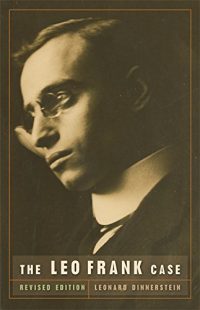
For nearly a half-century, the leading scholarly account of the incident had probably been Leonard Dinnerstein’s book The Leo Frank Case, first published in 1966, and Dinnerstein, a University of Arizona professor specializing in Jewish history, entirely supported Frank’s innocence. But although the work won a national award, carries glowing blurbs from several prestigious publications, and has surely graced the reading lists of endless college courses, I was not at all impressed. Among other things, the book appears to be the original source of some of the most lurid examples of alleged anti-Semitic public outbursts that apparently have no basis in reality and seem to have been simply fabricated by the author given his lack of any citations; the NOI authors note these stories have been quietly abandoned by all recent researchers. Even leaving aside such likely falsifications, which were widely cited by later writers and heavily contaminated the historical record, I found the short Dinnerstein work rather paltry and even pitiful when compared to that of its NOI counterpart.
A far longer and more substantial recent work was Steve Oney’s 2003 And the Dead Shall Rise, which runs nearly 750 pages and won the National Jewish Book Award, the Southern Book Critics Circle Prize, and the American Bar Association’s Silver Gavel, probably establishing itself as today’s canonical text on the historical incident. Oney had been a longtime Atlanta journalist and I was favorably impressed by his narrative skill, along with the numerous fascinating vignettes he provided to illustrate the Southern history of that general era. He also seemed a cautious researcher, drawing heavily upon the primary sources and avoiding much of the falsified history of the last century, while not entirely suppressing the massive evidence of bribery and perjury employed by the Frank forces.
But although Oney does mention much of this information, he strangely fails to connect the dots. For example, although he occasionally mentions some of the funds spent on Frank’s behalf, he never attempts to convert them into present-day equivalents, leaving a naive reader to assume that such trivial amounts could not possibly have been used to pervert the course of justice. Furthermore, his entire book is written in chronological narrative form, with no footnotes provided in the text, and a large portion of the content being entirely extraneous to any attempt to determine Frank’s guilt or innocence, contrasting very sharply with the more scholarly style of the NOI authors.
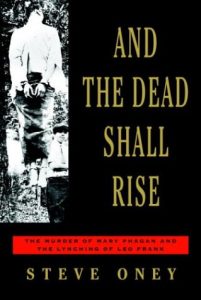
To my mind, a central element of the Frank case was the massive financial temptations being offered by Frank’s Jewish backers, and the huge number of Atlanta citizens, both high and low, who apparently shifted their positions on Frank’s guilt in eager hopes of capturing some of that largess. But although this obvious theme was heavily emphasized in the NOI book, Oney seems to mostly avoid this obvious factor, perhaps even for personal reasons. Print publications have suffered massive cutbacks in recent years and I noticed on the book flap that although Oney is described as a longtime Atlanta journalist, he had subsequently relocated to Los Angeles. Once I checked, I immediately discovered that Oney’s book had became the basis for an independent film entitled The People v. Leo Frank, and I wonder whether his hopes of capturing a sliver of Hollywood’s vast lucre may not have encouraged him to so strongly suggest Frank’s innocence. Would an account of Leo Frank as rapist and murderer ever be likely to reach the silver screen? The quiet influence of financial considerations today is no different today than they were a century ago, and this factor must be taken into account when evaluating historical events.
The NOI authors devote nearly all of their lengthy book to a careful analysis of the Frank case provided in suitably dispassionate form, but a sense of their justifiable outrage does occasionally poke through. In the years prior to Frank’s killing, many thousands of black men throughout the South had been lynched, often based on a slender thread of suspicion, with few of these incidents receiving more than a few sentences of coverage in a local newspaper, and large numbers of whites had also perished in similar circumstances. Meanwhile, Frank had received benefit of the longest trial in modern Southern history, backed by the finest trial lawyers that money could buy, and based on overwhelming evidence had been sentenced to death for the rape and murder of a young girl. But when Frank’s legal verdict was carried out by extra-judicial means, he immediately became the most famous lynching victim in American history, perhaps even attracting more media attention than all those thousands of other cases combined. Jewish money and Jewish media established him as a Jewish martyr who thereby effectively usurped the victimhood of the enormous number of innocent blacks who were killed both before and after him, none of whom were ever even recognized as individuals.
As Prof. Shahak has effectively demonstrated, traditional Talmudic Judaism regarded all non-Jews as being sub-human, with their lives possessing no value. Given that Frank’s backers were all followers of Reform Judaism, it seems quite unlikely that they followed this doctrine or were even aware of its existence. But religious traditions of a thousand years standing can easily become embedded within a culture, and such unrecognized cultural sentiments may have easily shaped their reaction to Frank’s legal predicament.
Influential historical accounts of the Frank case and its aftermath have contained lurid tales of the rampant public anti-Semitism visited upon Atlanta’s Jewish community in the wake of the trial, even claiming that a substantial portion of the population was forced to flee as a consequence. However, a careful examination of the primary source evidence, including the contemporaneous newspaper coverage, provides absolutely no evidence of this, and it appears to be entirely fictional.
The NOI authors note that prior to Frank’s trial American history had been virtually devoid of any evidence of significant anti-Semitism, with the previous most notable incident being the case of an extremely wealthy Jewish financier who was refused service at a fancy resort hotel. But by totally distorting the Frank case and focusing such massive national media coverage on the case, Jewish leaders around the country succeeded in fabricating a powerful ideological narrative despite its lack of reality, perhaps intending it to serve as a bonding experience to foster Jewish community cohesion.
As a further example of the widely promoted but apparently fraudulent history, the Jewish writers who have overwhelmingly dominated accounts of the Frank case have frequently claimed that it sparked the revival of the Ku Klux Klan soon afterward, with the group of citizens responsible for Frank’s 1915 lynching supposedly serving as the inspiration for William Simmons’ reestablishment of that organization a couple of years later. But there seems no evidence for this. Indeed, Simmons strongly emphasized the philo-Semitic nature of his new organization, which attracted considerable Jewish membership.
The primary factor behind the rebirth of the KKK was almost certainly D.W. Griffith’s overwhelmingly popular landmark 1917 film Birth of a Nation, which glorified the Klan of the Reconstruction Era. Given that the American film industry was so overwhelmingly Jewish at the time and the film’s financial backers and leading Southern distributors came from that same background, it could be plausibly argued that the Jewish contribution to the creation of the 1920s Klan was a very crucial one, while the revenue from the film’s distribution throughout the South actually financed Sam Goldwyn’s creation of MGM, Hollywood’s leading studio.
In their introduction, the NOI authors make the fascinating point that the larger historical meaning of the Frank case in American racial history has been entirely lost. Prior to that trial, it was unprecedented for Southern courts to allow black testimony against a white man, let alone against a wealthy man being tried on serious charges; but the horrific nature of the crime and Conley’s role as the sole witness required a break from that longstanding tradition. Thus, the authors argue not unreasonably, that the Frank case may have been as important to the history of black progress in America as such landmark legal verdicts as Plessy vs. Ferguson or Brown vs. Board. But since almost the entire historical narrative has been produced by fervent Jewish advocates, these facts have been completely obscured and the case entirely misrepresented as an example of anti-Semitic persecution and public murder.
Let us now summarize what seems to be the solidly established factual history of the Frank case, quite different than the traditional narrative. There is not the slightest evidence that Frank’s Jewish background was a factor behind his arrest and conviction, nor the death sentence he received. The case set a remarkable precedent in Southern courtroom history with the testimony of a black man playing a central role in a white man’s conviction. From the earliest stages of the murder investigation, Frank and his allies continually attempted to implicate a series of different innocent blacks by planting false evidence and using bribes to solicit perjured testimony, while the exceptionally harsh racial rhetoric that Frank and his attorneys directed towards those blacks was presumably intended to provoke their public lynching. Yet despite all these attempts by the Frank forces to play upon the notorious racial sentiments of the white Southerners of that era, the latter saw through these schemes and Frank was the one sentenced to hang for his rape and murder of that young girl.
Now suppose that all the facts of this famous case were exactly unchanged except that Frank had been a white Gentile. Surely the trial would be ranked as one of the greatest racial turning points in American history, perhaps even overshadowing Brown v. Board because of the extent of popular sentiment, and it would have been given a central place in all our modern textbooks. Meanwhile, Frank, his lawyers, and his heavy financial backers would probably be cast as among the vilest racial villains in all of American history for their repeated attempts to foment the lynching of various innocent blacks so that a wealthy white rapist and murderer could walk free. But because Frank was Jewish rather than Christian, this remarkable history has been completely inverted for over one hundred years by our Jewish-dominated media and historiography.
These are the important consequences that derive from control of the narrative and the flow of information, which allows murderers to be transmuted into martyrs and villains into heroes. The ADL was founded just over a century ago with the central goal of preventing a Jewish rapist and killer from being held legally accountable for his crimes, and over the decades, it eventually metastasized into a secret political police force not entirely dissimilar to the widely despised East German Stasi, but with its central goal seeming to be the maintenance of overwhelming Jewish control in a society that is 98% non-Jewish.
We should ask ourselves whether it is appropriate for an organization with such origins and such recent history to be granted enormous influence over the distribution of information across our Internet.
Featured Video
Prof. Ted Postol: Iran Already Achieved Nuclear Deterrence Against Israel
or go to
Aletho News Archives – Video-Images
From the Archives
How the occupied mentality syndrome works
Saudi Arabia on the American chessboard – Part 3
By B. J. Sabri | American Herald Tribune | June 27, 2016
Read part 2: “The occupied mentality Syndrome“
Previously I argued whether Saudi Arabia’s repeated involvements in U.S. interventions and wars stem from free national will or in response to a specific condition. For starters, in Saudi Arabia there is no national will. In Saudi Arabia, the national will is the will of the Al Saud clan. Still, when a major Arab state allies itself with a superpower that committed unspeakable crimes against humanity in almost every Arab country, then something is wrong. This fact alone should compel us to examine the U.S.-Saudi relation for one exceptional reason. As a result of the U.S.-Saudi wars, hundreds of thousands of people in Afghanistan, Iraq, Iran, Libya, Syria, Yemen, and Somalia have lost their lives. Millions became displaced in their own homelands. And millions more rendered refugees.
Attributing the Saudi policies to the bonds of “partnership” with the U.S. is frivolous. There are no bonds between these two thugs except those of business, military deals, secret plots, and wars. Proving this point, bonds such as these have no space for the American and Saudi peoples to share significant cultural or societal exchanges. If partnership is not the reason for the Saudi contribution to the U.S. strategy of empire and imperialism, then another reason must exist.
This leads to three possibilities. … continue
Blog Roll
 Aletho News
- NIAID/NIH and USDA Fund Bioengineered Chimeric Influenza Viruses Built Using Pandemic H1N1 Components: Journal ‘Science Advances’
- Hezbollah hits Israeli warship off Lebanon’s coast, sets it aflame
- Iran slams US strikes on B1 bridge, Mahshahr petrochemical plants as ‘blatant acts of state terrorism’
- In letter to UN chief, Araghchi warns of dire consequences of US-Israeli attacks on Iran’s nuclear facilities
- Why the CIA conspiracy to invade Iran with Kurdish militias failed
- Why Are Upbeat US Claims About Mission to Rescue Pilot ‘Highly Questionable’?
- Aircraft destroyed during US ‘rescue’ of downed F-15 pilot cost more than $100 million each
- Washington University removes professor who condemned US-Israeli war on Iran
- Russia Warns of Retaliation as UK Authorizes Seizure of Vessels
- Serbia thwarts plot to bomb Russia-Hungary gas pipeline – Vucic
- If Americans Knew
- In Iran, Israel-US take aim at “reason, research, and freedom of thought” – Daily Update
- US loses planes over Iran, Israel downgrades Lebanon war goals – Daily Update
- Israel Is Blocking Palestinians from Easter at Church Where Jesus Resurrected
- Plot to assassinate Palestinian activist follows harassment campaign promoted by Zionist groups and elected officials
- Prominent New York synagogue hosts presentation on why U.S. Jews should support the ethnic cleansing of Gaza
- Tapper vs. Piker: Is the CNN Anchor Auditioning for David Ellison?
- Shouldn’t Democrats Be Able to Condemn Genocide?
- Israel-US kill negotiators, destroy civilian structures, but Iran’s military capabilities still largely intact – Daily Update
- ‘War crime’: Global condemnation as Israeli ministers celebrate death penalty law targeting Palestinian prisoners
- 7 Ways Israel Is Turning Lebanon Into Gaza
- No Tricks Zone
- An Inconvenient Tree: Uncovered In Alps… Europe Much Warmer Than Today 6000 Years Ago
- New Study Reports A 60% Slowdown In Greenland’s Ice Loss Rate In The Last Decade
- Low Intensity Tornado Wrecks Major Solar Farm, Creating A Potential Toxic Dump
- New Study Finds Warming Saves Lives…Cold Temperatures 12 Times More Deadly Than Excess Heat
- German Science Blog Accuses PIK Climate Institute Of Hallucinating Climate Tipping Points
- Devastating Assessment Of Comirnaty Vaccine By Former Senior Pfizer Europe Toxicologist
- New Study: CO2 Is ‘Effectively Negligible’ As An Explanatory Climate Change Factor Since 2000
- Former Pfizer Toxicologist Dr. Helmut Sterz Tells Bundestag Hearing Pfizer Vaccine Should Have Never Been Approved
- Energy Expert: Germany’s Nuclear Phaseout Was A “500 Billion Euro Mistake”
- New Research: South Australia’s Mid-Holocene Sea Surface Temperatures Were 4°C Warmer Than Today
 Aletho News