His Majesty’s head-chopper: Syria’s MI6-backed president bows to King Charles
By Kit Klarenberg | The Grayzone | April 3, 2026
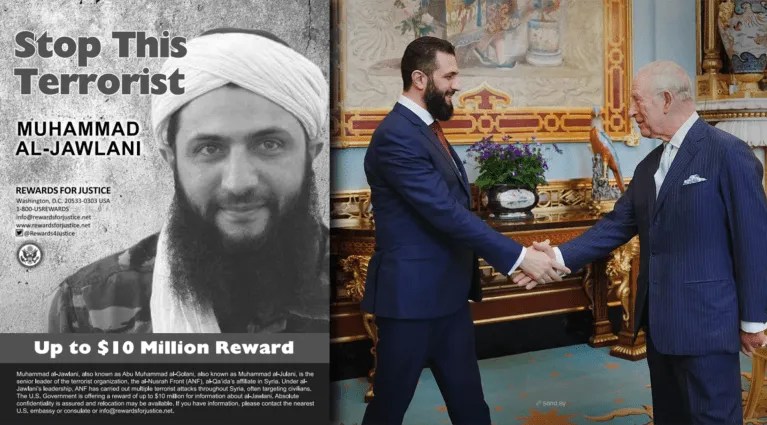
When Syria’s “interim” leader Ahmed al-Sharaa touched down in London on March 31, he was given a much warmer welcome than many once thought possible. As the longtime leader of Syria’s Al-Qaeda branch, the US had been offering a $10 million bounty for information on his location just 15 months prior. Yet here was Al-Sharaa, proudly posing for photo ops with King Charles and Prime Minister Keir Starmer.
British intelligence had been working towards this day for almost two decades. The path for al-Sharaa’s rule was cleared by MI6 after years of mentoring under Jonathan Powell, who now serves as National Security Advisor to Starmer. The time had come for Britain to formally anoint its Syrian puppet.
The ongoing US-Israeli war on Iran, and the Strait of Hormuz’s closure, were reportedly at the top of Starmer and al-Sharaa’s agenda. The British premier praised his counterpart’s supposed success in battling ISIS, while al-Sharaa thanked London for its assistance in pushing for sanctions on Syria’s ruined economy to be lifted. The pair have enjoyed warm relations since al-Sharaa’s seizure of power in December 2024, which Starmer publicly celebrated as a golden opportunity for London to “play a more present and consistent role throughout the region.”
Ever since, the British have systematically steered Damascus’ self-appointed government towards recognition and welcome by Western states. In May 2025, as al-Sharaa’s death squads massacred Alawites and other ethnic and religious minorities, US President Donald Trump received his Syrian counterpart in the oval office, where he gifted him a bottle of Trump-branded cologne. The BBC acknowledged this development would have been “unthinkable just months ago.”
Al-Sharaa took the next steps in January 2026, when he signed an unpopular US-brokered accord with Israel, which former Syrian President Bashar Assad had steadfastly refused to endorse for decades.
The impacts of the deal were immediately visible. As Al-Sharaa’s forces swept through Kurdish territory in north east Syria, the Kurds’ erstwhile Israeli backers refused to intervene, and US envoy Tom Barrack publicly declared that the American partnership with the Kurds had “expired.”
Within weeks, al-Sharaa’s forces wrested control of the country’s wheat and oil-producing areas, which had been under US-led occupation for years. Though Syria and Israel have yet to formally normalize relations, al-Sharaa describes relations between the countries as “good.” Today, Syria’s airspace and ground territory is routinely used by Israel and its Western sponsors to wage war on Iran.
Though the rapid transition took many by surprise, the campaign to re-establish Western control over Syria was actually set in motion years ago.
Starmer’s top advisor also groomed al-Sharaa for power
Among the most important vehicles for grooming the former Syrian Al Qaeda warlord known as Mohammed Jolani into the politician, Ahmad Al-Sharaa, was a supposed conflict resolution NGO known as Inter-Mediate. Founded by Jonathan Powell, a former advisor to PM Tony Blair who helped negotiate the Good Friday accords in Northern Ireland, works closely with the British Foreign Office and MI6.
Powell’s Inter Mediate cultivated al-Sharaa’s militant Hayat Tahrir al-Sham (HTS) faction for power for years before the December 2025 palace coup, and now boasts a dedicated office within the presidential palace in Damascus.
Coincidentally, Powell took up the post as Starmer’s advisor mere days before HTS declared themselves Syria’s government. As a confidant of Tony Blair, Powell was a key figure in the push for the criminal 2003 Anglo-American Iraq invasion, helping shape bogus intelligence claiming that Baghdad posed a biological and chemical weapons threat to justify the illegal intervention.
Despite his role in the destruction of Iraq, British media has reported that Powell “may have more influence over foreign policy than anyone in government after the Prime Minister himself.” Today, Powell is charged with “coordinating all UK foreign policy, security, defence, Europe, and international economic issues.”
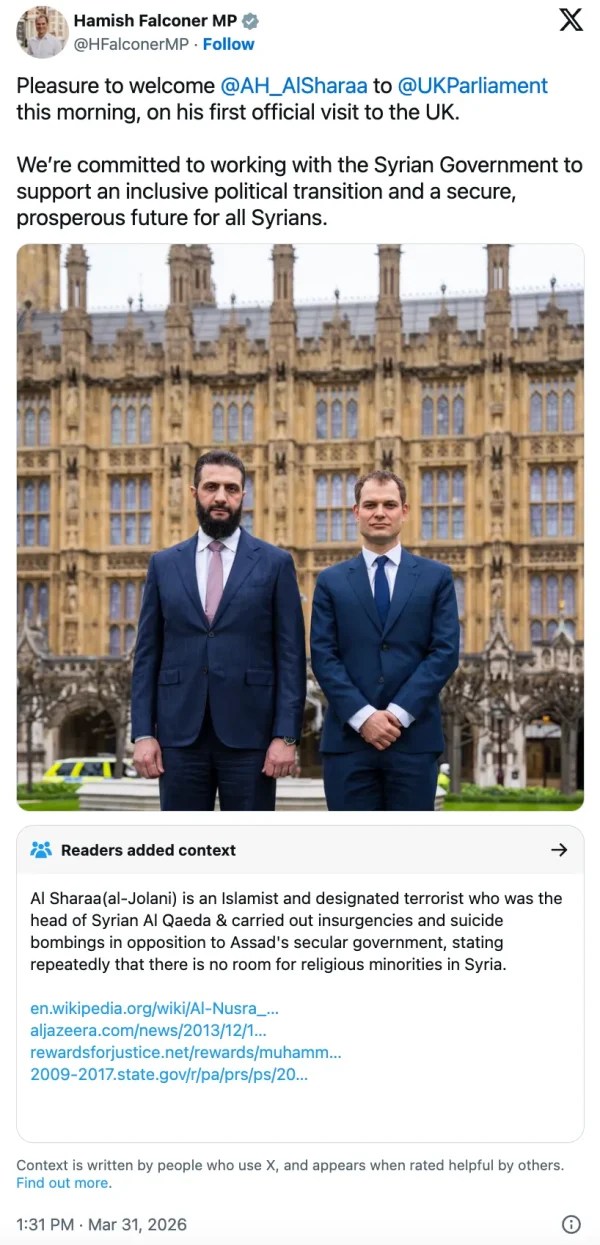
Al-Sharaa was also personally welcomed by Hamish Falconer, an intelligence-aligned Member of Parliament who spent years collaborating with MI6 as the British foreign office’s Terrorism Response Team leader and once served as a hostage negotiator in talks with the Taliban.
Falconer is a close associate of Amil Khan, a British intelligence contractor who worked obsessively to generate sympathetic coverage of HTS while plotting to undermine this outlet due to our critical reporting on Syrian jihadists and their friends in the British government.
Hamish’s father, Charlie Falconer, was a longtime friend and former roommate of former Tony Blair. Following Blair’s May 1997 election victory, Falconer senior was elevated to the unelected House of Lords, then served in a series of high-ranking government posts throughout his pal’s tenure, often coordinating with Jonathan Powell.
While there, the elder Falconer applied “huge pressure” to Attorney General Lord Goldsmith to change his conclusion that invading Iraq was completely illegal. This intervention may have played a decisive role in enabling the illegal war of aggression. Today, it’s been reported that many on Downing Street are “growing increasingly wary about the influence of… smooth Blairites.”
According to one British outlet, top officials in London are purportedly asking, “at what point… does ‘experience’ and ‘guidance’ become ‘control’?” The same question must be asked of MI6’s longstanding links to al-Sharaa.
British intel set up al-Sharaa’s civil apparatus
It is uncertain when British contact with HTS began. But Robert Ford, who served as the US ambassador to Syria from 2011 to 2014, disclosed that in 2023 Inter-Mediate sought his personal assistance in rebranding HTS from “terrorists” into politicians. Ford met repeatedly with al-Sharaa, who reportedly expressed no remorse about the massacres and atrocities he perpetrated in Iraq. Al-Sharaa had served five years in the US military’s notorious Camp Bucca jail for his involvement with Al Qaeda in Mesopotamia. He was released in 2011 – just in time for the Syrian dirty war.
In September 2025, former-MI6 chief Richard Moore admitted Britain’s foreign spying agency had been courting HTS long before its seizure of Damascus. “Having forged a relationship with HTS a year or two before they toppled Bashar, we forged a path for the UK Government to return to the country within weeks” of the fall of Assad, Moore boasted.
British psychological warfare operations and ‘aid’ efforts greatly assisted HTS’ consolidation of power in areas of Syria it occupied. As The Grayzone revealed in the immediate aftermath of Assad’s fall, leaked documents show MI6 was well-aware that reports of the group’s split from Al Qaeda were a fantasy.
Nevertheless, British propaganda efforts portrayed dangerous, chaotic HTS-occupied territory as a “moderate” success story, in order to demonstrate “a credible alternative to the [Assad] regime,” per the leaks. Central to these psy-ops were British-created assets including the Free Syrian Police (FSP) and White Helmets.
Framed by Western media as providing vital humanitarian services to local populations, these ostensibly independent agencies enjoyed fawning coverage in mainstream media. In reality, the pair collaborated closely with extremist groups, including HTS, and were complicit in hideous atrocities.
Whether intentional or not, HTS was “significantly less likely to attack opposition entities… receiving support” from the British government, a UK intelligence contractor stated. The work of the White Helmets and FSP greatly enhanced the terrorist group’s credibility as a governance actor and service provider among Syrians. When HTS took power outright in northwest Syria, the FSP became the territory’s formal police force. Since Assad’s ouster, the White Helmets have been tapped by British intelligence assets to run the country’s emergency services.
Despite al-Sharaa’s refusal to repudiate his extremist past, British diplomats initiated a series of meeting with him and other HTS warlords from December 2024 onwards. The public encounters continued even as legacy media outlets acknowledged these summits were completely illegal, as HTS was a proscribed terror group under British law. Starmer did not formally lift this designation initially, but nonetheless led calls for the removal of sanctions on Syria by all Western countries.
In March 2025, the UK terminated the majority of its Syria sanctions, and the rest of the EU followed shortly. With the revocation of US sanctions in July, Syria had effectively been welcomed back into the fold of the so-called international community.
While London’s man in Damascus appears eager to please Starmer and his counterparts in Western capitals, his sectarian politics remain a source of domestic credibility. In January, al-Sharaa’s forces overran northeastern Syria, and freed many ISIS fighters from Kurdish-run prisons, where MI6 had long-managed covert propaganda operations to influence inhabitants. Many freed ISIS brides reportedly refused repatriation to their home countries, “because their husbands are with” al-Sharaa.
Forced to backtrack: ‘Israel’ drops Hezbollah disarmament goal
Al Mayadeen | April 3, 2026
The Israeli occupation army has acknowledged that disarming Hezbollah is not among the objectives of the current war, marking a significant reversal from positions held just two weeks prior, and a tacit admission of the limits of its military options in Lebanon.
“Israel’s” Channel 12 first reported the shift, with Israel Hayom military correspondent Lilach Shoval confirming that dismantling Hezbollah’s weapons is “not on the agenda.”
Yedioth Ahronoth described it as a formal change in the army’s direction, especially as the reversal came only two weeks after the army had publicly insisted it would pursue the full dismantling of Hezbollah’s arsenal.
The army now defines its primary objectives against Hezbollah as significantly weakening the group, establishing “a deep defensive line”, and demolishing dozens of homes along the frontline villages, mirroring the “yellow line” model applied in Gaza.
On disarmament, Israeli army officials admitted that “we must be modest on this issue.”
A sharp reversal
The course reversal stands in stark contrast to the maximalist rhetoric that defined the aggression’s opening weeks. Israeli War Minister Israel Katz had vowed to “separate Lebanon from the Iranian arena and strip Hezbollah of its ability to threaten, changing once and for all the situation in Lebanon,” explicitly invoking the Gaza model.
Meanwhile, IOF Chief of Staff Eyal Zamir declared the campaign would end with “Hezbollah suffering a devastating blow,” while Finance Minister Bezalel Smotrich went further, calling for the Litani River to become the entity’s “new border with the Lebanese state.”
Katz had also announced on March 24 that the IOF would establish a permanent security zone inside Lebanon up to the Litani River. He stated that all homes in border-adjacent villages would be demolished and that the return of displaced Lebanese civilians would be “completely prevented.”
Where officials once spoke of transforming Lebanon’s strategic landscape, the occupation army now concedes that full disarmament would require “a full occupation of Lebanon and the systematic dismantling of military infrastructure in every village,” conditions it realizes are unrealistic.
Notably, Israeli officials maintained that only the IOF, not the Lebanese state or any other party, could disarm Hezbollah, while simultaneously acknowledging that the conditions to do so do not exist.
‘A complex arena’
Earlier in the week, Israeli Channel 11, citing former army and Mossad officials, reported that “the Lebanese arena differs entirely from any other in terms of its complexity and military entanglement.”
Retired Major General and former Mossad chief Danny Yatom said Hezbollah fighters in southern Lebanon “hold a relative advantage over the Israeli army due to their deep familiarity with the terrain,” adding that “every tree trunk and every small hill can serve as an ambush position.”
He cautioned that even controlling territory up to the Litani River “would not solve the problem of rockets and shells,” and stressed that the real challenge lies in adapting at the tactical level, not merely the strategic one.
Lieutenant Colonel (res.) Oren Leshem, a former senior Israeli Air Force officer, was equally candid, saying there is “no magic solution to the Lebanon issue” and that the army has tried every available approach over the past 18 years, including during the Second Lebanon War, yet the situation “remains complex and highly challenging.”
Channel 14 added that “the problem in Lebanon is that military forces are constantly on the move and exposed, while Hezbollah exploits the terrain to target them.”
Britain’s Lebanon surveillance network: A digital map for war
By Kit Klarenberg | The Cradle | April 3, 2026
On 7 March, the British government contractor Siren Associates unveiled Monitor Lebanon, a “real-time situational awareness platform” framed as a public safety tool “designed to help individuals and organizations understand and navigate Lebanon’s rapidly evolving security environment.”
The tool sifts vast swaths of “open-source information” from “news agencies, verified social media accounts, Telegram channels, conflict monitoring initiatives, and traffic data systems.”
Presented as a lifeline for journalists, humanitarian workers, businesses, and civilians during Israel’s ongoing war on Lebanon, the platform carries a far more operational intelligence function. Behind the humanitarian branding lies a sophisticated surveillance infrastructure embedded deep within the Lebanese state.
At the core of Monitor Lebanon is a live interactive incident map tracking “reported security events and key operational information.” The data is highly detailed, including information on “affected areas, road conditions, hospital locations, and other indicators that help users understand how developments may affect movement and access.”
A press release announcing the platform’s launch asserts Monitor Lebanon was initially constructed to provide Siren Associates staff with “a clearer view” of local events, before being rolled out for general public use.
“Already, team members displaced by the ongoing hostilities have been using it to check for reported strikes near their homes and to track evacuation orders. But many more people are navigating the same uncertainty, so we want to make this tool available to anyone who may benefit from clearer, real-time information.”
How did a British contractor produce such a detailed, nationwide surveillance platform instantly as the occupation state escalated its assault on Lebanon?
The answer lies in nearly two decades of British-backed penetration.
As The Cradle revealed in September 2021, Siren has received tens of millions of pounds from London to “professionalize” Lebanon’s Internal Security Forces (ISF). Staffed by former British military, intelligence, and policing officials, the company operates in Lebanon’s security sector in plain sight, yet largely beyond scrutiny.
Embedding control through ‘reform’
Siren’s footprint inside Lebanon’s state apparatus is extensive. The company maintains close ties with senior ISF officers, political figures, ministries, and intelligence branches. It has also cultivated future leadership within the ISF through training and recruitment programs.
In May 2019, Siren established Lebanon’s Command and Control Center with British funding. The installation provides the ISF with “state-of-the-art equipment, information and communication technology systems, [and] an analysis and planning room,” purportedly to strengthen the security forces’ intelligence capabilities.
In practice, it embedded a direct channel for British intelligence into Lebanon’s internal security infrastructure.
Such access grants London visibility over investigations, operations, and internal data flows. Over time, this has enabled the systematic accumulation of sensitive information on Lebanese citizens.
The scale of this data collection expanded dramatically during the COVID-19 pandemic. Siren quietly built COVAX, the digital backbone of the Lebanese government’s COVID19 vaccine rollout. Users could register, schedule appointments, and receive vaccine certificates. Over four million people used the service, logging extraordinary amounts of personal information in the process.
What appeared as public health infrastructure operated as a mass data capture system.
From welfare to surveillance architecture
COVAX became the foundation for broader digital penetration. In 2021, the World Bank allocated $246 million to Lebanon for social assistance. Siren used its existing infrastructure to launch DAEM, whereby citizens could apply for social assistance “in record time.”
Carole Alsharabati, Siren’s longtime research chief, has explained that “the idea [was] to deploy a system that was fully digitized from A to Z, just like we did for the vaccine.”
“The registration, the selection, then the payment, the cash transfer, the verification, the dashboard, etcetera. Everything was digitized. And we used the same framework, the same ecosystem, the same machines, the same security protection, the same data governance approach we used in the vaccine.”
Alsharabati described Lebanon at the time as a “very difficult environment,” with the experience of building DAEM “a wild journey.” After all, the country lacked a unique ID system, digital identification, or any established data governance rules, procedures, or even cybersecurity.
However, “nothing stood in the way of Siren’s determination to tackle these and many other challenges.” Evidently, the British and Lebanese governments were happy with the results. It was just the beginning of Siren’s new role in Beirut, constructing deeply intrusive databases on citizens.
This work has been replicated in multiple fields over the years, culminating in Monitor Lebanon’s recent launch. Much of this activity passed entirely under the public radar. It was not until December 2024 that Siren’s central COVAX role was openly admitted on the company’s official website, for example. That same month, Siren announced it had built a bespoke resource for the ISF, collating “operational data to inform decision making around mission planning, resourcing and management.”
Under the project’s auspices, British intelligence created a network of six separate Command and Control Centers across the country, linked digitally to 22 regional operation rooms. A “digital platform that enables the capture and analysis of crime and operational data” was also developed.
In December 2024, too, Siren disclosed how it had introduced “e-governance tools connecting more than 20 ministries, 1,000 municipalities and 1,500 mukhtars [local governments].” Unmentioned was a major scandal that erupted over this effort upon its rollout two years prior.
According to Lebanese daily Al-Akhbar, the platforms produced by Siren were not secure, and permitted the firm to harvest the data of millions of users. Dubbed IMPACT, the resource allowed citizens to access a variety of government services, including applying for welfare payments.
The British embassy in Beirut, which funded the platform to the tune of $3 million, denied any wrongdoing, as did Siren. Nonetheless, local digital rights group SMEX expressed grave concerns over the security of private information stored by IMPACT, which was highly sensitive in nature.
Mapping a society for war
That Siren hoards an enormous amount of invasive information as a result of its work for and with the ISF is underlined by an April 2025 study, funded by Britain’s International Development wing. It probed “irregular maritime migration from Lebanon over the past three years,” placing the phenomenon in the context of Beirut’s “ongoing political, socio-economic, and security crises.”
The research sought to ascertain “who is migrating, why they are choosing to leave by sea, and what risks they face – particularly across gender lines.”
In September 2025, London renewed Siren’s ISF contract, allocating £46.3 million (around $61.3 million) – a significant increase. The timing raises serious questions about how much of that funding went into building Monitor Lebanon ahead of renewed Israeli escalation.
Since Operation Al-Aqsa Flood in October 2023, British activity in West Asia has pointed toward deeper involvement in a wider war effort targeting Iran and its allies.
In November that year, London attempted to secure unrestricted military access to Lebanese territory under the pretext of “emergency missions.” The proposal would have allowed British forces to operate freely, armed and immune from prosecution.
Public backlash forced Beirut to reject the plan. But the infrastructure remained.
Through Siren, Britain has built a digital panopticon spanning Lebanon’s institutions and population. This system provides real-time intelligence with clear military applications.
From Tel Aviv’s perspective, the benefits are obvious. Such data can be used to identify, track, and target members of Hezbollah and their support networks. It can also map civilian environments in ways that facilitate precision strikes.
The parallel to Palantir’s predictive surveillance platforms is clear.
Targeting the Axis of Resistance
Siren’s projects consistently overlap with services provided by Hezbollah. This is not accidental.
For years, British intelligence has worked to undermine the resistance movement’s social base by constructing parallel state structures.
For example, under the terms of a Foreign Office-funded youth radicalization effort, London sought to create an alternative to Beirut’s Hezbollah-run Ministry of Youth and Sport. It was hoped that “young, talented students and graduates” would thus reject the group.
There is little sign of these initiatives having borne fruit. A promptly deleted 23 March Daily Telegraph report documented how Lebanese Christians wholeheartedly embrace Hezbollah, and are determined to resist western-inspired efforts by Beirut’s army to disarm the resistance faction. “How can we as Christians in this area not be with Hezbollah?” a local citizen asked the newspaper perplexedly.
“They protect our churches. They helped us fight ISIS. During COVID, they gave us free care in their hospitals. When there was no electricity, they gave us generators. They even put up a Christmas tree at Christmas. How can we not be with them now?”
Despite the practical impossibility of disarming Hezbollah, it is a fantasy long harbored by western powers, which has gained in ever-mounting urgency since Israel’s genocide of Palestinians in Gaza commenced.
A British parliamentary briefing in September 2025 expressed optimism that the election of former Lebanese Armed Forces (LAF) commander Joseph Aoun as president would weaken Hezbollah’s military wing.
That same month, US special envoy to Syria Tom Barrack openly proposed equipping the LAF “so they can fight their own people.”
He acknowledged that Israel’s aggression since October 2023 had only increased Hezbollah’s popularity, while offering “zero” incentive for disarmament.
Aoun’s presidency has not dismantled Hezbollah. Israeli military escalation continues, with mounting losses on the battlefield and rising civilian casualties across Lebanon.
While its catastrophic military losses accumulate daily, innocent Lebanese civilians are being killed in significant numbers. The line of responsibility for their deaths may lead directly back to London, courtesy of Siren Associates.
Hegseth’s Pentagon Purge Designed to Prevent a Mutiny: Karen Kwiatkowski
Sputnik – 03.04.2026
The secretary of war’s dismissal of Army Chief of Staff General Randy George and two other top generals signals intensifying rot in the Department amid the Iran war, former senior DoD insider-turned whistleblower Karen Kwiatkowski says.
General George represented “experience in Army battlefield operations,” while general David Hodne and major general William Greene Jr had “their pulse on the readiness, and more importantly the attitudes and thinking,” of younger soldiers, Kwiatkowski told Sputnik.
They see the Iran conflict as an “illegal and unneeded war,” driven by politics, ego and a foreign power (Israel), and understand “the real damage inflicted on US forces and installations” in the Middle East over the past month, the retired Air Force Lt. Col. added.
Hegseth’s “poor leadership skills,” disrespect for service members, and “religious invocations for slaughter,” have earned him “several degrees of contempt,” and Kwiatkowski suspects that sentiments of “no confidence and dislike” are “roiling throughout the ranks.”
“The reasons for the purges are Hegseth’s fear of organizational and political dissent of the leadership of the military,” stemming from “endless needless wars compounded by command mistakes” by recent administrations, from Covid vax mandates to the Iran crisis.
If this affects even 10-20% of the military, that’s a serious problem and the Pentagon will no longer have a fighting force it can rely on, no matter how many “yes men generals” are tapped to replace those who have been ousted, Kwiatkowski fears.
“Hegseth and the generals recognize there is no trust up or down the chain of command. Hegseth believes he can command that trust through sycophants; the generals very likely prefer a more structural approach of more and better training, and better civilian leadership… which is impossible at this time,” she summed up.
Trump and the debris of Iran war
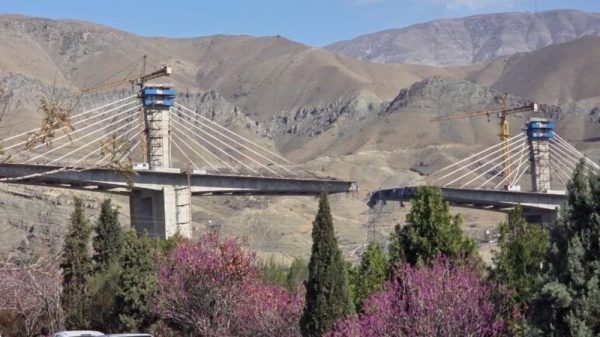
US President Donald Trump shared a video of Iran’s B1 bridge, billed as the country’s tallest bridge, collapsing after US air strike, April 3, 2026
By M. K. BHADRAKUMAR | Indian Punchline | April 3, 2026
The only clue the US President Donald Trump has given in his prime time televised speech on Wednesday at the White House regarding the ending of his war in Iran is that the core “objectives are nearing completion” and that he is “very close” to finishing the war.
The big question is whether Trump is any longer in command of the situation. For all practical purposes, the war seems set to cascade as the US is preparing for a potential ground operation in Iran and threatens to destroy “bridges next, then electric power plants”.
Revealing himself primarily as YHWH (Yahweh) in the Old Testament — the personal, holy, and covenant-making Creator who demands exclusive worship from Israel — Trump thundered, “Over the next two to three weeks, we are going to bring them [Iranians] back to the Stone Ages, where they belong” .
Yet, Iran is in no mood to surrender. Tehran has lost respect for Trump and instead sees him as a master craftsman of the art of deception. The Iranian statements underscore that the US intelligence lacks even the foggiest idea of its capabilities to retaliate.
Perhaps, the most vicious no-holds-barred phase of the war is about to begin, with a dynamics of its own — in particular, taking into account the Israel factor, which is a revisionist power seeking to alter the established international order, rules, territorial boundaries or distribution of power in the West Asian region to better serve the establishment of a Zionist state of Greater Israel.
Israel is keeping its options open to further territorial expansion, the latest evidence being the assault on Lebanon and its back-tracking from US-backed negotiations with Syria. Unsurprisingly, Iran insists that any peace deal must encompass all issues of regional stability and security.
Wars have consequences. They leave behind a lot of debris. But this is not about Iran’s reconstruction alone for which of course, it is legitimately seeking war reparations and a security guarantee.
The bottom line is, after creating new facts on the ground, Trump may simply walk away to the golf course. The most consequential new reality is that the Strait of Hormuz is transforming as a waterway.
By coincidence, the first reaction to Trump’s address on Wednesday came from the global oil market, as prices of rose to $105 per barrel. The Oil Price magazine which provides forward-looking intelligence for energy traders and investment professionals was spot on in its prognosis that “Long-suffering energy investors finally have a reason to smile, with the sector on track to outperform the broader market by its widest margin on record, driven by Middle East conflict … The energy sector’s 14-week winning streak far exceeds previous bull runs.
“Oil & Gas stocks have easily outpaced the erstwhile high-flying tech sector… Leading the charge are U.S. oil majors” — Exxon Mobil returned 33.1% YTD; Chevron Corp (28.5%); Occidental Petroleum (49.6%); ConocoPhillips (38.5%); Marathon Petroleum (43.8%). Wall Street must be feeling elated.
According to Financial Times:
“[US War Secretary] Pete Hegseth’s broker at Morgan Stanley contacted BlackRock in February to make a multimillion-dollar investment in a defence-focused Exchange-Traded Fund (ETF) called IDEF.
“This $3.2 billion fund is built around companies that benefit from increased military spending, including RTX, Lockheed Martin, Northrop Grumman, and Palantir — all major Pentagon contractors.
“The request came just weeks before the U.S.-Israeli strike on Iran, a campaign Hegseth helped shape and strongly supported within the Trump administration.”
Larry Johnson, who worked in the CIA and is by far one of the best American commentators on Trump’s war (and geopolitics in general), wrote a blog this week titled Who Else, Besides Pete Hegseth, is Trying to Use the War in Iran to Get Rich? To quote him, “If you do the analysis on the weapons expended so far in the month-long war with Iran, the opportunity for war profiteering is quite clear… The high expenditure rates, combined with historically low peacetime production [of weaponry] have created a serious “race of attrition” that cannot be quickly reversed.”
Johnson flagged as example that both Patriot and THAAD interceptors are primarily manufactured by Lockheed Martin. He adds, “Which means that Lockheed Martin can expect a major influx of cash to boost production and try to replenish exhausted missile air defence inventories. I wonder who else in the Trump administration and the US Congress are making money off this bloody war?”
Setting aside the sleaze and corruption endemic to America’s wars, like night follows the day, the single new fact on the ground today that has explosive potential and can bring the roof down on the international financial system is the terrible beauty about the Strait of Hormuz as Iran decided to control the use of the waterway by outsiders in war conditions, which is nothing unusual (eg., Straits of Bosphorus which Turkey and Russia control.)
Since the waterway passes through the territorial waters of Iran and Oman, these two countries are entitled to have a say in the regime of maritime traffic in war conditions. It’s a legitimate demand. Nonetheless, Iran is showing flexibility by allowing traffic by “benign” vessels not linked to the two enemy countries, US and Israel. It stands to reason that this flexibility will eventually transform in a post-war scenario into a rational, efficient, secure regime.
Meanwhile, the cascading price of oil has the potential to impact the world economy. Since petrodollar recycling is also involved, this will hit international finance as well — the western banking system in particular — unless it is resolved quickly, smoothly and peacefully with the consent of Iran and Oman. Trump has tactfully made it the concern of Europeans and the Gulf Arab states, the US’ partners in crime in petrodollar recycling who help prop up the dollar as “world currency.”
Hopefully, India’s stance, as articulated by Foreign Secretary Vikram Misri at a meeting hosted in London yesterday, provides a ramp that can be the basis of a permanent solution — namely, “the way out of the crisis consisted of de-escalation and a return to the path of diplomacy and dialogue among all concerned parties.”
Notably, India did not sign up to the meeting’s final statement which expressed readiness by participants to contribute to “appropriate efforts to ensure safe passage through the Strait.” Meanwhile, India’s direct talks with Tehran have been productive and yielded positive results.
IRGC hits US tech giant Oracle’s data center, computing site in UAE over new assassinations
Press TV – April 2, 2026
The Islamic Revolution Guards Corps (IRGC) announced on Thursday that it struck a data center and computing infrastructure belonging to the US tech giant Oracle, based in the United Arab Emirates, in response to the latest assassinations in Iran.
In a statement released by the IRGC public relations wing, it said the attack was a direct retaliation for what the enemy’s “terrorist operations” targeting Iranian individuals.
“Just as we had warned, in response to the assassination of Iranian individuals, we will target intelligence, information technology, and artificial intelligence spy companies that are pillars of the enemy’s terrorist operations,” the statement read.
The IRGC said the strike on Oracle followed a similar pattern of retaliation.
“Following the destruction of the cloud computing infrastructure of the American company Amazon in retaliation for the assassination of Commander Fathalizadeh, today, the data center and computing infrastructure of the American company Oracle, based in the Emirates, was struck in response to the assassination of Dr. Kamal Kharrazi and his wife.”
Dr. Kharazi, who serves as the head of Iran’s Strategic Council on Foreign Relations, previously served as the foreign minister of Iran from August 1997 to August 2005.
While he has been gravely injured in the attack, his wife was martyred.
The IRGC issued a clear warning to other companies it may view as complicit in future acts of aggression against Iranian nationals.
“If the crimes are repeated and another assassination occurs, the next company should be ready to receive a decisive response,” the statement noted.
What makes Oracle complicit in war against Iran?
Oracle is also one of the most deeply embedded technology companies in the US military and intelligence ecosystem.
Through its Oracle National Security Group (ONSG) and Oracle Cloud for Government and Defense programs, the company provides mission-critical database management, cloud infrastructure, enterprise software, and cybersecurity solutions to the Department of War, Pentagon, intelligence agencies, and federal civilian entities.
Oracle’s database technologies form the backbone of countless US military and intelligence systems, including personnel management, logistics, weapons inventory, signals intelligence (SIGINT) data processing, and geospatial intelligence (GEOINT) platforms.
The company’s software is used by the National Security Agency (NSA), Central Intelligence Agency (CIA), Defense Intelligence Agency (DIA), and all branches of the US military to manage vast datasets essential for intelligence analysis, targeting, and operational planning.
Oracle’s cloud infrastructure, including its dedicated Oracle Cloud for US Defense and Intelligence, has been accredited for classified workloads, enabling the company to provide secure cloud computing environments for the Department of War and the intelligence community.
The company is a key participant in the Pentagon’s Joint Warfighting Cloud Capability (JWCC) program, competing alongside other major cloud providers to deliver infrastructure for military operations globally.
Beyond software and cloud, Oracle has long-standing partnerships with US intelligence agencies on data analytics, artificial intelligence (AI), and machine learning (ML) applications for intelligence gathering, threat detection, and predictive analysis.
Oracle also maintains a significant and strategically important presence in the occupied Palestinian territories with deep ties to the Israeli regime, military, and military-industrial base.
The company operates major research and development centers in the occupied territories, including facilities in Herzliya, Petah Tikva, and Haifa.
The company’s technologies are used in military command-and-control systems, intelligence analysis platforms, logistics management, and secure communications infrastructure.
Oracle’s cloud services have been increasingly adopted by Israeli military entities seeking to modernize their IT infrastructure. It participates in joint projects with Israeli military and intelligence entities, contributing to the development of advanced data analytics, AI-driven intelligence tools, and secure enterprise platforms.
A New Resistance Front: How Does Syria Factor into the Regional War?
By Robert Inlakesh | The Palestine Chronicle | April 2, 2026
A new Syrian resistance group has emerged and is the only organization in the country currently carrying out offensive actions against both Israeli and US targets. This development comes as Israel uses the newly occupied territories in its ground assault on Lebanon, a move that could easily rope Tel Aviv into a new quagmire.
While a US allied leader now technically controls Damascus, the reality on the ground in Syria is that there is no functional State. This being the case, the outbreak of chaos is simply one miscalculation away.
In stark contrast to the regimented and tightly controlled Syria that existed under the rule of Bashar Al-Assad and his father Hafez al-Assad, the country today is divided between countless powers throughout the country, with the President functioning as less of a strongman and more of a symbolic figure that covers the explosive charges ready to detonate. Nowhere was this on clearer display than in the July 2025 clashes in southern Syria’s Sweida Province.
President Ahmed al-Shara’a, also known as Abu Mohammed al-Jolani, has allied himself with his Western backers and even gone as far as signing onto a normalization mechanism with Israel. Short of full normalization of ties with Tel Aviv, the “joint fusion mechanism” that was agreed upon by Syrian and Israeli officials seeks to “facilitate immediate and ongoing coordination on their intelligence sharing, military de-escalation, diplomatic engagement, and commercial opportunities under the supervision of the United States.”
Knowing this, it would therefore appear strange that the Israelis still persist with not only bombing Syrian civilian infrastructure across the country, but also Syria’s new military forces. Understanding why will help in unlocking what appears on the surface to be a difficult puzzle to solve.
The Syrian leadership is Hayat Tahrir al-Sham (HTS), infamous for being a rebrand of al-Nusra Front (Al-Qaeda in Syria). Although it is presented as if it were a real government, the group never had any experience in governance. Instead, they knew only how to rule over smaller militia factions and worked as the de facto leadership in Idlib, despite there having been a “Syrian Salvation Government” (SSG) who were technically in control of the territory.
Prior to the fall of Bashar al-Assad’s leadership in December of 2024, HTS had consented to the SSG’s existence in order to give the veneer of a professionally organized opposition. In reality, HTS held all the power cards, even running its own secret prisons, while leaving the administrative details to be hashed out by the professionals.
All of this is of great importance because Bashar al-Assad’s entire system was not overthrown in some kind of war of liberation; instead, it collapsed without any real fight. Therefore, when Ahmed al-Shara’a entered Damascus and declared himself leader, he was in a very difficult position.
Under the supervision of his foreign backers, chiefly the United States, the new Syrian leadership focused on symbolism rather than fundamentally changing the way the country functioned. Therefore, Damascus opened itself up to Washington and became a playground for Western and Israeli intelligence agents, as the new President attempted to impress Washington.
Meanwhile, many of the most corrupt elements belonging to the former regime, were permitted to continue on as if it was business as usual, all as the Syrian Arab Army (SAA) and former intelligence and police services were disbanded. What replaced the former security apparatus were simply militants belonging to the alphabet soup of Al-Qaeda affiliates that had been operating previously out of Idlib.
This being the case, the words of Ahmed al-Shara’a often have little to no bearing on what actually transpires on the ground. Meaning that corruption is rampant, every corner of the nation is filled with different armed forces who have their own territory when push comes to shove. In essence, all of Syria became a big Idlib.
Syria is no longer subjected to sanctions, has gained access to its most fertile agricultural lands, is no longer internationally isolated, while ruling over its own oil and gas fields. Despite all of this, the country’s economy is still in the toilet, and the long-promised prosperity has been reduced to vague future visions. This isn’t to say it’s impossible for things to change, but as it stands, this is Syria today.
Because of the state of Syria’s affairs, cross-border smuggling has exploded and this has evidently benefited Lebanese Hezbollah next door. Two sources familiar with the matter informed Palestine Chronicle that the quantity of weapons flowing through the Syrian-Lebanese border had even increased since the fall of Bashar al-Assad.
According to reports, the US has been applying pressure on Damascus to attack Lebanon in order to help Israel weaken Hezbollah in the Bekaa Valley region. In response, President al-Shara’a broke his silence this Tuesday and declared that Syria will not attack Lebanon, an announcement that came following a threat earlier that day from an Iraqi Popular Mobilization Units (PMU) spokesperson, threatening to attack if Damascus orders such a move.
This affirmed previous suspicions that such an equation could arise, whereby a Syrian invasion of Lebanon would trigger an Iraqi invasion. The PMU, when fully mobilized, can muster a force of around 250,000 fighters, a much more formidable force than what currently constitutes the Syrian Army.
Another possible equation that could be set is a Syria-Israel clash. Not only could armed resistance groups, aligned with the Iranian-led Axis of Resistance, end up creating such a reality, but others could also be roped in.
Israel’s recent bombing of Syrian military positions, coupled with Israeli Security Minister Itamar Ben Gvir’s calls to assassinate the Syrian President, both occurred following an alleged military buildup near the Sweida Province.
It is likely that Damascus was eyeing the opportunity presenting itself to finally deal with the Druze Separatist movement in the southern province. Led by one of the Druze minority group’s spiritual leaders, Hikmat al-Hijri, a unified command calling itself the “National Guard” formed in order to operate a semi-autonomous zone in Sweida.
The National Guard began receiving direct military, financial and logistical support from Israel, who have long sought to establish a Druze rump State in southern Syria, a goal that enables an even greater land grab, as well as opening up “David’s Corridor” [shown in blue below] spanning over to the Iraqi-Syrian border.
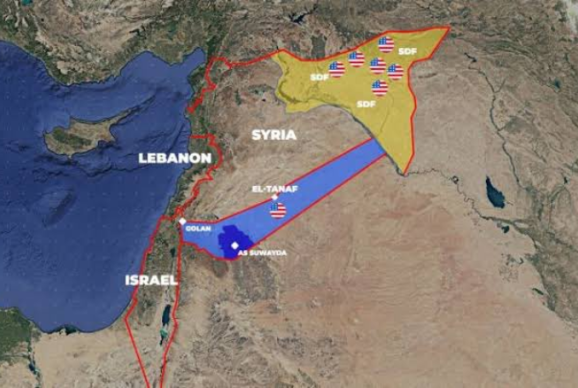
In the eyes of Syria’s leadership, the Druze issue is of great importance to solve for a range of reasons. One of which is that there is an enormous amount of sectarian tension, which various groups who form the new Syrian security apparatus, along with the Bedouin tribal forces, seek to punish following the bloodshed that began last July. It will also mean that technically, Syria will be one step closer to having one central government rule the entire country, which is a symbolic victory for Ahmed al-Shara’a.
However, the Israelis appear to have pre-empted such an offensive and committed a number of airstrikes as a warning to the Syrian leadership. There is clear anxiety over such a battle unfolding, because if it occurs, the Israeli military will be forced to intervene in order to save its Druze separatist allies.
As mentioned above, if things spiral out of control, the President himself cannot necessarily do much about it. That means that Syrian forces will likely begin to directly come into contact with the Israelis on the ground, something that could easily spiral.
Most of the fighters who have, for now, aligned themselves with the Syrian government are no fans of Israel, to say the least. This was on full display last December during the military parades conducted by Syria’s new armed forces, who openly chanted for Gaza, threatened Tel Aviv, and some even burned Israeli flags.
The alternative scenario for the Israelis in Syria may end up being worse, meaning that if they were to assassinate al-Shara’a, a power struggle would likely end up playing out on the streets of the Capital and throughout the country. So many different actors will seek to claim power.
Syria’s predicament has turned out to be less favourable to Tel Aviv, not because it poses an immediate strategic threat, but because almost anything is possible there. During the regional war between the Israeli-US alliance and the Iranian-led Axis of Resistance, one wrong misstep could prove fatal and open up yet another front, which will not only drain their resources but also weaken their ability to fight Hezbollah.
– Robert Inlakesh is a journalist, writer, and documentary filmmaker. He focuses on the Middle East, specializing in Palestine.
Gulf states weigh pipeline expansion plans, hoping to bypass Hormuz
Al Mayadeen | April 2, 2026
Gulf Arab states are increasingly reconsidering long-discussed pipeline projects aimed at bypassing the strategically vital Strait of Hormuz, as the war on Iran raises concerns among them over how Iran showed its capability to gain control over the waterway.
Officials and energy industry executives say the prospect of prolonged Iranian control over the strait has revived interest in alternative overland export routes, despite the high financial, political, and logistical barriers such projects entail.
The war on Iran and the subsequent defensive operations have revived the viability of Saudi Arabia’s East-West pipeline, a 1,200-kilometer network constructed in the 1980s following the Iran-Iraq “tanker war”. The pipeline, which carries up to 7 million barrels of crude oil per day to the Red Sea port of Yanbu, allows Saudi exports to bypass Hormuz entirely.
Saudi Aramco CEO Amin Nasser recently described the pipeline as the “main route” currently being utilized, highlighting its strategic value amid regional instability. The kingdom is now assessing options to expand the pipeline’s capacity or develop additional routes to transport a larger share of its daily oil production, estimated at over 10 million barrels, away from the Gulf.
Analysts note that Gulf policymakers are increasingly shifting from theoretical discussions to concrete planning. Maisoon Kafafy, a senior advisor at the Atlantic Council, a US-based think tank that received extensive funding from the United Arab Emirates, said regional actors are now converging on similar conclusions regarding the need for diversified export infrastructure.
Network approach under consideration
Rather than relying on a single alternative, experts suggest a network of interconnected pipelines. However, such an approach would require unprecedented coordination among Gulf states, potentially challenging longstanding energy strategies that often conflict.
In the longer term, these pipelines could form part of broader trade corridors linking Asia to Europe. Behind them is the Israeli-led, India-Middle East-Europe Economic Corridor (IMEC) proposal, a US-backed initiative that aims to funnel Asia-Europe trade through Israeli-controlled ports.
Despite renewed interest in the plan, major obstacles remain. Industry estimates suggest that replicating infrastructure similar to the East-West pipeline could cost at least $5 billion, while more complex multi-country routes, such as those extending from Iraq through Jordan, Syria, or Turkiye, could reach $15–20 billion.
Security concerns further complicate planning, particularly in countries of the region that are subject to US-Israeli aggression, where attacks on critical infrastructure remain highly possible. Geographical challenges also present difficulties, with proposed routes requiring construction across deserts and mountainous terrain.
Saudi Arabia is also reportedly evaluating the development of additional export terminals along its Red Sea coastline, including facilities linked to the NEOM megaproject.
What is actually feasible
Gulf states have moved beyond simple infrastructure expansion. By hosting and assisting US forces and directly supporting military attacks, countries like Saudi Arabia and the UAE have transitioned from neutral bystanders to active participants in the regional aggression. However, this alignment has come at a high cost; the strategy of relying on bypass routes like the East-West pipeline and the Habshan–Fujairah pipeline is failing to provide economic stability as Tehran proves capable of striking US interests in these zones with ease.
Questions surrounding ownership, control, and operational management of transnational pipelines could also hinder progress on these projects, particularly given the need for regional cooperation.
Efforts to seize control of the maritime route are ongoing, with the United Kingdom reportedly leading talks involving more than 30 countries on the Strait of Hormuz. Yet, a glaring question remains: why target the reaction, Iranian control over Hormuz, while the root cause, US-Israeli aggression, continues to be ignored?
Iran sets up ‘tollbooth’ system in Strait of Hormuz
The Cradle | April 2, 2026
Iran has formally started enforcing a controlled transit system in the Strait of Hormuz, requiring ships to undergo vetting and pay fees for safe passage, according to a report by Bloomberg on 1 April.
The report describes a system managed by Iran’s Islamic Revolutionary Guard Corps (IRGC), where vessels must submit their detailed information, including ownership, cargo, and crew, to an intermediary for review.
Ships are then screened for links to the US, Israel, or other states Tehran considers hostile, with only those cleared permitted to proceed under escort through a coastal corridor dubbed the “Iranian tollbooth.”
Once terms of passage are agreed, ships receive a permit code and designated route, which they must broadcast to Iranian patrol boats upon approach.
Iran’s parliament has already approved a draft law introducing transit fees and restrictions on vessels linked to the US, Israel, and sanctioning states, pending final ratification.
Negotiations over transit fees reportedly follow approval, with oil tankers typically charged from around $1 per barrel, and payments made in Chinese yuan or stablecoins – cryptocurrencies pegged to hard currency values.
With some tankers carrying up to or above two million barrels of crude, total costs can scale significantly, with at least one tanker having paid around $2 million to secure passage so far.
Iranian economist Hossein Raghfar projects Tehran could earn up to $60 billion annually by formalizing transit tariffs across the strait, describing control of the waterway as a “very powerful tool” that has shifted economic leverage in Iran’s favor.
Meanwhile, Iran’s oil sector is benefiting from the US-Israeli war, with revenues rising as global prices surge and exports continue largely uninterrupted.
Revenues from Iranian Light crude rose to about $139 million per day in March, while exports held near 1.6 million barrels per day (bpd), even as other Gulf producers face disruption.
Several governments, including India, Pakistan, Iraq, Malaysia, and China, are in direct talks with Tehran to coordinate vessel transits through the system
Wave 90: IRGC strikes US-linked industrial sites in Gulf
Al Mayadeen | April 2, 2026
Iran’s Islamic Revolution Guards Corps (IRGC) carried out a large-scale missile and drone operation targeting US-linked industrial and military sites across the Gulf, as part of the 90th wave of Operation True Promise 4.
The operation was launched by the IRGC Aerospace Force and the IRGC Navy in response to US aggression targeting Iran’s steel industry, which killed and injured multiple workers.
“We dedicate this operation to the families of the oppressed martyred workers and warn the delusional American president to refrain from repeating threats that could escalate the war beyond the region and make the world unsafe for America,” the IRGC underlined.
According to the statement, the operation targeted US steel and aluminum industries based in Abu Dhabi in the United Arab Emirates, as well as facilities in Bahrain.
The strikes also hit remaining operational sections of US aluminum facilities that had not been damaged in previous attacks, in addition to sites linked to the Israeli military industries company Rafael Advanced Defense Systems and a hideout of US forces near the Bahraini capital, Manama.
The statement confirmed that key sections of these sites were destroyed.
Casualties among US forces
The operation resulted in dozens of US personnel killed and wounded, according to the statement, with targeted areas immediately sealed off while ambulances continued evacuating casualties for hours.
The strikes unfolded in continuous waves, which began before dawn.
Iran stressed that the attack serves as a warning, affirming that any renewed aggression against its industrial sector will be met with a far more severe response. It warned that future operations could target critical infrastructure of the Israeli occupation and US economic interests across the region.
“These attacks are a warning, and if attacks on Iranian industries are repeated, the next response will be much more painful with attacks on the main infrastructure of the occupying regime (“Israel”) and American economic industries in the region,” the IRGC said.
Second phase of Wave 90
In an update released on Thursday afternoon, the IRGC said that its strikes also targeted major Israeli airbases, including the Tel Nof Airbase, the Palmachim Airbase, and the Ben Gurion Airport, a section of which is being used for aerial refueling operations.
The IRGC dedicated the second wave to Iranian citizens targeted by US-Israeli bombardment, saying that this set of strikes was in direct response to crimes committed by both regimes. The strikes also targeted Israeli occupation forces’ sites in Tel Aviv, Haifa, Eilat, al-Naqab, and Bir al-Sabe’. In the Gulf, the IRGC struck the Ahmad al-Jaber Airbase and the Ali al-Salem Airbases in Kuwait and the al-Kharj Airbase in Saudi Arabia.
Ballistic missiles, carrying heavy payloads, and one-way attack drones were utilized in the attacks.
According to the statement, another early warning radar, deployed in the al-Dhafra Airbase in the UAE, was also hit and destroyed.
Trump’s April Fools’ Address to the nation
By Kelley Beaucar Vlahos | Responsible Statecraft | April 1, 2026
Washington was literally sizzling Wednesday with expectations ahead of President Donald Trump’s evening address on Iran. Would he announce a ceasefire? Would he just declare the war over, wash his hands of the mess, and leave the Strait of Hormuz to the Persian Gulf and Europe? What about a full land invasion?
Turns out he did none of that — except maybe the part about the Strait, but we’ll get to that in a second.
Trump gave a speech that analyst Dan DePetris noted should have been delivered before launching the attacks on Iran on Feb. 28. He spent much of the approximately 15 minutes building a case for bombing the hell out of Tehran for the last 30 days. “The most violent and thuggish regime on Earth,” it “continued their relentless quest for nuclear weapons and rejected every attempt at an agreement.” The U.S. had no choice. “We took them out. We took them all out so that no one would really dare stop them. And their race for a nuclear bomb, a nuclear weapon, a nuclear weapon like nobody has ever seen before, they were right at the doorstep.” He went on:
“Our objectives are very simple and clear. We are systematically dismantling the regime’s ability to threaten America or project power outside of their borders. That means eliminating Iran’s Navy, which is now absolutely destroyed, hurting their air force and their missile program at levels never seen before, and annihilating their defense industrial base. We’ve done all of it. Their Navy is gone, their air force is gone. Their missiles are just about used up or beaten. Taken together. These actions will cripple Iran military, crush their ability to support terrorist proxies and deny them the ability to build a nuclear bomb. Our armed forces have been extraordinary. There’s never been anything like it. Militarily, everyone is talking about it, and tonight, I’m pleased to say that these core strategic objectives are nearing completion.”
So the war is over right? Wrong. According to Trump the U.S. military has “crushed” Iran, but it’s not finished. “Over the next two to three weeks, we’re going to bring them back to the stone ages, where they belong. In the meantime, discussions are ongoing.” (As they say on social media, tell us Iran is fighting back without telling us Iran is fighting back.)
Again, Trump erroneously noted that while he didn’t want regime change “they’re all dead” and the “the new group is less radical and much more reasonable.” He said in his “two to three week” timetable, “if during this period of time… If there is no deal, we are going to hit each and every one of their electric generating plants very hard and probably simultaneously. We have not hit their oil, even though that’s the easiest target of all, because it would not give them even a small chance of survival or rebuilding. But we could hit it and it would be gone. And there’s not a thing they could do about it.”
Iran can retaliate by hitting oil and energy plants in the region harder, but to mention that would say out loud that the Iranians can still fight and are not playing by our rules. Instead, he said not to worry about the high gasoline prices or the oil shortages; we don’t get our oil from the Persian Gulf, and we’ll get more from Venezuela anyway. As for all of the other global commerce which includes almost everything in our current supply chains, he was non-committal to opening up the Strait of Hormuz by force. In an auspicious twist, he put it on everyone else to open the Strait.
“So to those countries that can’t get fuel, many of which refused to get involved in the decapitation of Iran. We had to do it ourselves. I have a suggestion. Number one, buy oil from the United States of America. We have plenty. We have so much,” he said. “And number two, build up some delayed courage. Should have done it before. Should have done it with us, as we asked, go to the Strait and just take it, protect it, use it for yourselves. Iran has been essentially decimated. The hard part is done, so it should be easy, and in any event, when this conflict is over, the Strait will open up naturally.”
Comparing the 30-day war to the length of the Korean War, Iraq, and World War I, Trump reached for a way to scold Americans for getting antsy but it somehow came off as boasting as though he could completely destroy an enemy in a much lesser time. “(The world) just can’t believe what they’re seeing… the brilliance of the United States military.”
What the world is seeing is this “decimated” Iran hitting targets across the Persian Gulf and in Israel consistently, all the way through the speech, according to Al Jazeera news. The price of oil is up, partners across the region are curtailing energy use and anticipating food shortages. This will hit American households no matter what Trump says. The war is not over not because he says so but because Iran has not given Trump the clear victory he wants. Tonight he clearly threatened more escalation, but it was not as defined as an announced land invasion. He all but said the Strait was not worth it.
Nor did he unilaterally “declare victory” to save face. He did not mention Israel once, but one could sense its influence in every line. Trump says he is going to “finish it” and “fast.” Unrelenting, unspecified violence. Anyone looking for more than that turned out to be an April Fool.
The killing of three Indonesian soldiers in Lebanon should remind Jakarta that Israel does not want peace
By Dr. Muhammad Zulfikar Rakhmat | MEMO | April 1, 2026
Three Indonesian soldiers were killed in southern Lebanon in less than 48 hours. They were not fighters. They were part of a United Nations peacekeeping mission (UNIFIL). They were stationed in known positions. And still, they died.
This is not a tragic accident. It is a clear signal.
The sequence of events matters. On 29th March, a projectile struck a UN position near Adchit al-Qusayr, killing one Indonesian peacekeeper and critically injuring another. Hours later, a second incident—an explosion that destroyed a UN vehicle near Bani Hayyan—killed two more.
Three dead. In uniform. Under a UN flag.
The Israeli military says it is “reviewing” what happened and emphasises that these deaths occurred in an “active combat zone.” But that explanation is not convincing. UNIFIL positions are fixed, mapped, and communicated to all parties. Peacekeepers are not hidden actors. They are the most visible neutral presence in any conflict zone.
If they are being hit, it is not because they cannot be seen. It is because they are being disregarded.
That distinction matters. Because it speaks directly to intent.
Since early March, Israel has expanded its military campaign in Lebanon, pushing deeper into the south and openly pursuing a buffer zone up to the Litani River. This is not a limited operation. It is a widening one. It has already killed more than 1,200 people in Lebanon and displaced many more.
Peacekeepers are now operating inside a battlefield that is expanding by design.
And this is the point: states that are preparing for peace do not expand war zones. They do not normalize strikes in areas populated by international forces. They do not repeatedly hit locations that are clearly marked as neutral.
Israel’s conduct in Lebanon is not consistent with a state seeking de-escalation. It is consistent with one prioritizing military objectives over diplomatic constraints.
Indonesia’s response—condemnation, calls for investigation, appeals for restraint—is justified but insufficient. Because it avoids the larger conclusion that these events force upon us.
Indonesia continues to promote the two-state solution as the ultimate answer to the Palestinian issue. But that position now rests on assumptions that no longer hold.
A two-state solution requires, at minimum, that parties are moving toward coexistence. That territorial arrangements are negotiable. That violence is being contained, not expanded.
None of that is happening.
Instead, the conflict is widening geographically and intensifying militarily. What began as a confrontation involving Gaza has now spread across Lebanon and into a broader regional war involving Iran and the United States. The logic of escalation has overtaken the logic of negotiation.
And in that environment, the two-state solution is not a plan. It is a slogan.
The deaths of Indonesian soldiers should end the illusion.
These were not abstract victims. They were Indonesia’s direct contribution to international peacekeeping. They were deployed to uphold a system that depends on one basic principle: that neutral actors will be protected.
That principle is now collapsing.
UNIFIL itself has warned that attacks on peacekeepers may constitute war crimes. Yet such warnings have not altered behavior. Peacekeepers have been hit before in this conflict. They are being hit again. The pattern is clear.
At some point, repetition stops being accidental. It becomes structural.
Indonesia must respond accordingly.
Continuing to promote a two-state solution under these conditions is not principled diplomacy. It is a refusal to adapt. It ignores the fact that one side is actively reshaping the map through force while the other side lacks the capacity to negotiate from any meaningful position.
A policy built on outdated assumptions will not produce results. It will only produce more statements—more condemnations, more investigations, more funerals.
The government in Jakarta needs to abandon the illusion that those rights will be secured through a framework that no longer reflects reality.
The immediate priorities are clearer: enforce accountability for attacks on peacekeepers, push for enforceable ceasefires, and recognise that the current trajectory of Israeli military policy is not compatible with peace.
The deaths of three Indonesian soldiers are not a side effect of war. They are evidence of its direction.
And that direction is not toward peace.
Featured Video

Chinese jet fuel and the myth of energy independence
or go to
Aletho News Archives – Video-Images
From the Archives
The Dirty Little Secret behind the “Global Terrorism Index”
The Omission of Israeli Terrorism in the Occupied Palestinian Territories
By Karin Brothers | Global Research | December 6, 2014
… The Israeli settlements — all of which are illegal – have been identified as a major impediment to peace. The refusal of a major “global” terrorism report to name the Israeli settlers as one of the groups most responsible for terrorism not only misrepresents a major source of regional violence but exposes the Global Terrorism Index as a propaganda tool that supports a U.S. agenda.
In recent years, governments have been attempting to thwart terrorism by blocking supportive fund-raising. When it comes to Israeli settlements, however, the US and Canada actually encourage fund-raising by giving organizations (such as Christian Friends of Israeli Communities (CFOIC) and the Jewish National Fund) financial support in the form of donor tax-deductions.
Charities which provide funds for the Israeli settlements should be regarded as terror-financing organizations. They should not only lose their tax-deductible status, but they should be banned because they support the violation of international humanitarian law. The terror-financing laws that are being strictly enforced for Muslim charities should be applied to Christian and Jewish charities as well. … Read full article
Blog Roll
 Aletho News
- Chinese jet fuel and the myth of energy independence
- Ukraine Sea Drone Fired From Libya Hit Russian Tanker in Mediterranean
- IRGC: Iranian forces launched no attacks during ceasefire hours
- Trump Administration Moves To Automate U.S. Military Draft Registration
- Spain orders reopening of Tehran embassy, condemns Israel’s carpet bombing of Lebanon
- Israel faces ‘unsustainable’ strategic crisis following 40-day war against Iran: Analyst
- Iran restricts Hormuz access to 15 vessels per day under ceasefire terms: Report
- The ‘Opposition Party’ Has Done Nothing to Stop the Iran War and Much to Goad Trump Into Continuing It
- Moscow backs Tehran on status of Lebanon in US-Iran deal
- How UK Regulator Ofcom Quietly Bypassed International Law to Police American Speech
- If Americans Knew
- Amnesty: Urgent – Protect Lebanese civilians from brutal escalation in Israeli attacks
- Is The War Against Iran Over?
- Inside the Israeli army’s propaganda wing
- Hundreds of Gaza Amputees Stranded in Legal Limbo
- The gallows law: Israel moves toward executing Palestinian children
- Tucker Carlson: The Path to Peace requires ending ‘special alliance’ with Israel
- This is ceasefire? Israel’s biggest massacre yet in Lebanon, another journalist killed in Gaza – Daily Update
- Tucker Carlson on Israel: This Is the Behavior of an Ally? Really?
- Gazans face a triple crisis: severe shortages of water and bread, healthcare in tatters
- NY Times reports how Netanyahu took the US into Iran War
- No Tricks Zone
- An Inconvenient Tree: Uncovered In Alps… Europe Much Warmer Than Today 6000 Years Ago
- New Study Reports A 60% Slowdown In Greenland’s Ice Loss Rate In The Last Decade
- Low Intensity Tornado Wrecks Major Solar Farm, Creating A Potential Toxic Dump
- New Study Finds Warming Saves Lives…Cold Temperatures 12 Times More Deadly Than Excess Heat
- German Science Blog Accuses PIK Climate Institute Of Hallucinating Climate Tipping Points
- Devastating Assessment Of Comirnaty Vaccine By Former Senior Pfizer Europe Toxicologist
- New Study: CO2 Is ‘Effectively Negligible’ As An Explanatory Climate Change Factor Since 2000
- Former Pfizer Toxicologist Dr. Helmut Sterz Tells Bundestag Hearing Pfizer Vaccine Should Have Never Been Approved
- Energy Expert: Germany’s Nuclear Phaseout Was A “500 Billion Euro Mistake”
- New Research: South Australia’s Mid-Holocene Sea Surface Temperatures Were 4°C Warmer Than Today
 Aletho News