“Senators from Israel” Sabotaging Trump’s Iran Deal
By Kevin Barrett | American Free Press | May 27, 2025
Last month I warned in these pages that Donald Trump faces a stark choice regarding Iran: “Nuclear Deal II or World War III.” I pointed out that Iran is open to a deal, but that it won’t be much different from the JCPOA that Trump unilaterally canceled during his first term.
Failure to reach a nuclear agreement would make a catastrophic US war on Iran almost inevitable—not because Iran would quickly build nuclear weapons or threaten anyone, but because failed negotiations would embolden Israel to attack Iran, knowing that it would almost certainly be able to draw the US into the war. And if that happened, Iran could climb the escalation ladder by killing thousands of US soldiers, sinking US ships, and most importantly, destroying enough of the region’s oil production to completely collapse the global economy.
Iran doesn’t want nuclear weapons, which are banned by a decades-old religious edict renewed by the current Supreme Leader. But a growing minority of Iranians want to rethink that edict. They believe that Iran’s lack of nuclear weapons has allowed nuclear-armed Israel to repeatedly attack it, murder its scientists, perhaps even (deniably) assassinate its president, and commit genocide and other crimes with impunity. So even though nukes are ungodly, the minority claims, there is a “necessity doctrine” that allows people to do things that are ordinarily forbidden if survival requires it.
Israel, for its part, wants to completely dominate the region. Zionist extremists, who now represent about half the Israeli public, are committed to building “Greater Israel.” That would require genocide at industrial scale to eliminate regional populations so Yahweh’s supposedly chosen people can steal all the land and resources between the Nile and Euphrates rivers.
An ever-expanding Israel that continues invading and occupying its neighbors, stealing their land and resources, and murdering and expelling their populations cannot dream of doing such things unless it is the only nuclear weapons state in the region. So the possibility that one day Iran might “go nuclear” worries Israeli hardliners. If Iran continues developing its civilian nuclear program, Israelis believe, someday its leaders might change their minds and decide to build nuclear weapons. The Israelis apparently don’t understand that it is their own reckless criminality that is driving more and more Iranians toward considering the necessity of developing nukes for self-defense.
A Trump nuclear agreement would, like its predecessor, keep Iran in a position of needing about a year of “breakout time” to build nuclear weapons—as opposed to months or even weeks without a deal. But that’s not good enough for Netanyahu and other Israeli hardliners. They want to lay waste to Iran, even if it requires blowing up the global economy and with it Trump’s presidency.
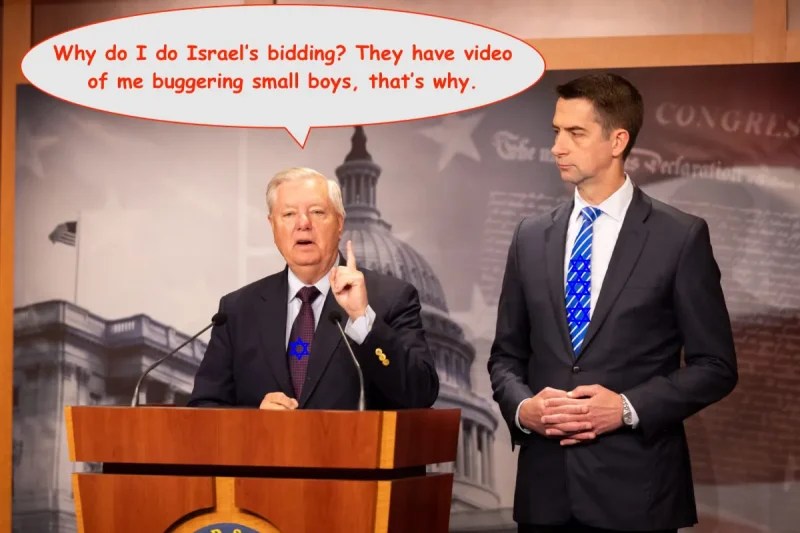
A group of “Senators from Israel” led by Tom Cotton (R-IS) and Lindsey Graham (R-IS) is trying to torpedo Trump’s nuclear negotiations with Iran. The treasonous Israeli-owned senators are pushing a resolution demanding that Iran completely dismantle its civilian nuclear program. That’s a non-starter. International law, beginning with the Nuclear Non-Proliferation Treaty (NPT) specifically allows Iran (like other non-nuclear-weapons states including Japan, Brazil, and the Netherlands) to enrich up to 5%. Under the 2015 JCPOA Iran agreed to limit enrichment to 3.67%, a significant concession representing roughly the minimum enrichment required for nuclear power and research.
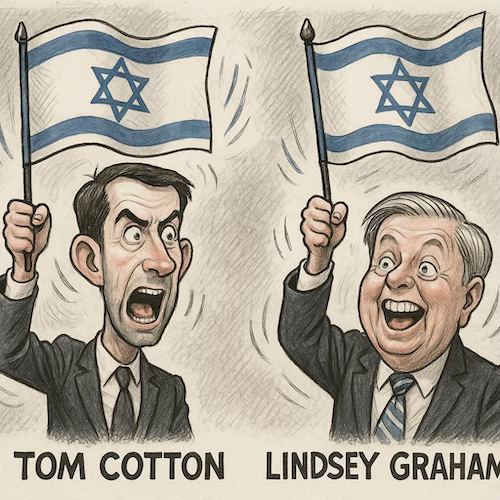
The “Senators from Israel” also want Iran to abandon its ballistic missiles—the core of its defense strategy—and stop cooperating with regional allies in Iraq, Lebanon, Yemen, and above all, Palestine. Those demands, too, are non-starters. Their only purpose is to destroy the possibility of any agreement, thereby opening the door for Israel to drag the US into a disastrous war on Iran.
Will the Trump Administration break free from the malign influence of the Israel lobby and its extremist leader, Benzion Mileikowsky, that Polish-born internationally-wanted criminal who operates under the alias “Benjamin Netanyahu”? Will Trump take the advice I offered last month and “terminate Bibi’s command…with extreme prejudice if necessary?”
There are encouraging signs that Trump may jettison Netanyahu in order to avoid the war-on-Iran-for-Israel trap that Bibi has set for him. By striking a separate peace with Yemen’s Houthis that allows them to continue targeting Israel, then triumphally visiting the region’s Arab capitals (including Hamas-funding Qatar) Trump has done everything but order Israel to stop its genocide in Gaza.
Trump needs to give that order ASAP—not only for humanitarian reasons, but also to create a fait accompli that will help bring down Netanyahu and forestall the Israeli hardliners’ efforts to trick the US into yet another disastrous war for Israel. If the Trump Administration does not act decisively, Netanyahu’s bought-and-paid-for “US” senators will keep pushing Bibi’s war plans, with potentially catastrophic results.
The Right Approach to the US-Iran Nuclear Negotiations
By Glenn Diesen | May 27, 2025
I recently attended a media festival in Tehran and also had the opportunity to explore Iran’s weapon systems and one of its nuclear facilities. Iran’s nuclear program is cited as the main reason for Israel and the US to threaten war with Iran. Such a war would likely escalate into a disastrous regional conflict, and perhaps even pull in the other great powers in a world war. Israel obviously needs to bring America on board to attack Iran, so the discussions between the US and Iran are of great importance. What do the Americans and Iranians want, and is there common ground that can be reached?
If the only demand by the US was for Iran to abstain from developing nuclear weapons, then an agreement could be reached, as Iran claims it does not intend to develop nuclear weapons and has accepted that inspectors are there to ensure compliance. Indeed, Iran agreed to the Joint Comprehensive Plan of Action (JCPOA) and honoured its obligations before the US unilaterally withdrew from the agreement. The US now demands a renegotiation and demands the complete dismantlement of Iran’s civilian nuclear energy program, which it is entitled to have as a signatory to the Non-Proliferation Treaty.
Furthermore, the US has linked its hegemonic policies in the region to the nuclear issue. The US demands that Iran limit the range of its ballistic missile program and also suspend its support for allies in the region – primarily Yemen, Lebanon and Hamas. From Tehran’s perspective, this represents a complete capitulation that would make its security dependent on the benign intentions of Israel and the US. This neglects that the US has had Iran in its crosshairs for the past 45 years, and Iran does have legitimate security concerns.
What can be considered a legitimate security concern by the US is that Iran has become a nuclear threshold state, with the knowledge and material to develop a nuclear weapon. Restricting the extent to which uranium is enriched and imposing strict inspections could possibly be negotiated.
However, threatening to bomb Iran would not eliminate its know-how or all of its material, and such an attack would only incentivise Iran to develop a nuclear deterrent. Even US threats to attack Iran unless it complies with US demands must be making the political leadership in Iran consider acquiring a nuclear weapon. So far, Iran is not developing nuclear weapons, because doing so would encourage other states, such as Saudi Arabia, to also pursue nuclear weapons. Recognising the security competition, the result would not be greater security for Iran.
In my opinion, another approach to negotiations would be to do what is rarely done anymore in Western diplomacy: to recognise and mitigate the security concerns of the other side for the purpose of reducing the security competition. Threatening and bullying Iran into making unilateral concessions has become the new normal in the unipolar era. The US offer to remove sanctions on Iran is merely an offer to stop punishing Iran. The point of departure in any diplomatic approach should be to address mutual security concerns and explore where an agreement that enhances security for both sides can be found. Threatening Iran with capitulation and linking nuclear issues to unrelated matters will only ensure the failure to reach an agreement.
Take the Deal, President Trump
By Ron Paul | May 26, 2025
Deal-making is said to be President Trump’s specialty, yet after five rounds of indirect talks with Iran – most recently just days ago – we seem as far away from an agreement as ever. The fifth round ended last Friday with no breakthrough, but at least no breakdown. However, each day that passes without a document signed on the table is another day for the neocons to maneuver the US president toward an attack on Iran.
One way the war party does this is to continuously move the goal posts and change the rules of the game. Trump envoy Steve Witkoff, under great pressure from the neocons, has himself signaled at least three position-shifts: from no enrichment at all, to low-level enrichment for civilian uses, back to no enrichment at all.
The neocons know that Iran will not give up its right to the civilian use of nuclear power and that is why they are applying maximum pressure to force Trump to officially adopt that position. They know if that becomes the US “red line” then they will win and they will get their war.
Israeli Prime Minister Netanyahu, in league with US neocons, has been warning us for 20 years that Iran is “months away” from a nuclear weapon – even though our own Intelligence Community recently re-affirmed that Iran is not working on a nuclear weapon at all.
Of course this is the same Netanyahu who promised Congress in 2002 if the US would just invade Iraq, peace and prosperity would break out in the Middle East. “If you take out Saddam, Saddam’s regime,” he told Congress in March of that year, “I guarantee you that it will have enormous positive reverberations on the region.”
We know how that worked out.
Poll after poll shows that the American people are tired of intervention and tired of Middle East wars. President Trump himself recognized this in his scathing rebuke of neocons and interventionists during a recent speech in Saudi Arabia.
But rebuke in a speech is not enough. President Trump must actively turn away from the neocons – many of whom are prominent in his own administration.
The recent US debacle in Yemen – where billions were wasted, civilians killed, and US military equipment destroyed – is just a taste of what the US would be in for if the neocons get their way and take us to war with Iran.
The Iranian foreign minister laid down in the simplest terms how the impasse could be solved, posting on X that, “Zero nuclear weapons = we DO have a deal; Zero enrichment = we do NOT have a deal.
My own preference is non-intervention and I do not believe Iran has the desire or the ability to militarily harm the United States. I share President Trump’s view that it would be far better to re-establish relations with Iran and begin mutually beneficial trade with the country. But if a mutually acceptable nuclear deal is the best way to take the neocon war with Iran off the table, then a deal is worth supporting.
President Trump should make his position clear to his negotiators: no more waffling or contradictions, get this agreement signed and put one in the “win” column.
Pakistan PM hails Iran’s diplomacy for regional peace ahead of visit
Press TV – May 26, 2025
Pakistani Prime Minister Shehbaz Sharif has hailed Iran’s peace diplomacy as commendable, underscoring his nation’s solidarity and support for the Islamic Republic.
Sharif, who will visit Tehran at the official invitation of Iranian President Masoud Pezeshkian on Monday, made the remarks in an interview with IRNA.
Sharif stated that the primary purpose of his visit to Tehran is to express gratitude to Iran for its support—specifically endorsing Iran’s peace-seeking positions in the region—during Pakistan’s recent tensions with India.
Tensions between India and Pakistan sharply escalated after the deadly Pahalgam attack. India blamed Pakistan for the attack, but Pakistan rejected the accusations.
“I wish to express gratitude to Iranian officials for their support of peace and their mediation proposal—which we accepted but India rejected,” he said, adding “I will also use this visit as an opportunity to discuss bilateral relations and matters of mutual interest.”
Sharif praised Iranian Foreign Minister Abbas Araghchi’s diplomatic skill, saying the Iranian top diplomat has demonstrated true statesmanship and wisdom in managing significant challenges during an exceptionally complex geopolitical era.
Sharif also stated that Pakistan firmly supports Iran’s condemnation of Israel’s genocide in Gaza, which has caused severe humanitarian devastation and regional instability.
“Islamabad and Tehran will continue to support one another on issues concerning the Muslim Ummah and to advance regional cooperation,” Sharif added.
A Holocaust in Gaza: Flames, Ash, and 30 Charred Remains

Al Mayadeen | May 26, 2025
The Israeli occupation has escalated its genocidal war on the Gaza Strip, intensifying its assaults on civilians and designated shelter sites in a relentless overnight campaign of destruction. In the early hours of today, as much of the world lay asleep, a devastating inferno engulfed the al-Daraj neighborhood in the heart of Gaza City.
What remains are the charred ruins of a school-turned-shelter, the scorched frames of homes, and a searing image too haunting to forget: a little girl, no older than six, stumbling barefoot through a corridor of flames, her skin scorched, her eyes wide with terror, searching, still alive, for a way out of the Israeli-made holocaust consuming everything around her.
The fire at her heels was no accident. It was born of “Israel’s” bunker-busting missiles, deliberately launched at what was clearly marked as a civilian refuge: Fahmi al-Jarjaoui School, packed with forcibly displaced families who had fled Israeli bombs, only to be massacred beneath them.
The school, situated in a densely populated neighborhood, was struck by missiles that pierced the upper floors and detonated on the lower levels, where dozens of displaced civilians had taken shelter, Al Mayadeen’s correspondent reported. Many of the victims were burned beyond recognition, with charred remains bearing witness to the intensity of the strike, our correspondent stressed.
By dawn, at least 51 Palestinians were confirmed killed. 30 of the bodies were charred. Among them were children, women, and the elderly, incinerated in a blaze so intense that, according to local officials, human flesh turned to ash. The school became the epicenter of horror: Dozens of lives erased in a single, calculated act of genocide.
A night of horror
In Jabalia, 19 Palestinians were also killed when another Israeli strike leveled a home, as per our correspondent.
Elsewhere in the besieged Strip, one Palestinian was martyred and others were wounded when Israeli forces struck a tent sheltering displaced families inside a kindergarten in al-Maghazi refugee camp in the central Gaza Strip.
The Israeli occupation also carried out a wave of home demolitions and airstrikes across various neighborhoods and towns, including:
- Beit Lahia
- al-Shujaiya
- al-Tuffah
- al-Qarara
Hamas senior official: The Movement agrees to US proposal for permanent ceasefire in Gaza
Palestinian Information Center – May 26, 2025
GAZA – A senior official in the Islamic Resistance Movement, Hamas, stated that the Movement has agreed to a proposal by US President Donald Trump’s envoy, Steve Witkoff, which stipulates a permanent ceasefire in the Gaza Strip. The first phase includes the release of 10 Israeli captives in exchange for a 70-day truce and a partial Israeli withdrawal from the Strip.
The senior official said in a press statement on Monday that the new offer approved by the Movement is a developed version of the path and vision proposed by Witkoff. It includes the release of 10 live Israeli captives held by the Al-Qassam Brigades, the armed wing of Hamas, in exchange for a 60-day truce, a partial Israeli withdrawal from the Gaza Strip, and the release of a number of Palestinian prisoners and detainees, including several hundred with high or life sentences.
The mechanism for releasing the Israeli captives will occur in two phases: five will be released on the first day of the agreement, and five more on the sixtieth day.
The source said that Hamas and the American envoy are finalizing a ceasefire agreement in Doha that would lead to a permanent ceasefire in the Gaza Strip.
The senior official clarified that the new offer approved by the Movement includes the partial withdrawal of the Israeli army from the Gaza Strip—especially from Salah al-Din Road, including the Nuseirat junction south of Gaza City, the Morag axis in northern Rafah, and from residential areas.
According to the source, indirect negotiations will begin regarding a long-term truce and its requirements, and an independent Community Support Committee will be empowered to govern the Gaza Strip.
Iran draws red line as Europe threatens nuclear ‘snapback’
As indirect US–Iran nuclear talks inch forward, Europe’s fear of marginalization prompts a risky diplomatic maneuver in Istanbul.
By Vali Kaleji | The Cradle | May 26, 2025
In the backdrop of indirect nuclear negotiations between Tehran and Washington, Iranian Deputy Foreign Ministers Majid Takht-Ravanchi and Kazem Gharibabadi met with their European counterparts from France, Germany, and Britain – the so-called E3 of the Joint Comprehensive Plan of Action (JCPOA) – on 16 May in Istanbul.
The meeting, held at Iran’s Consulate General and hosted by Turkiye, brought together EU Deputy Secretary-General for Political Affairs Enrique Mora and his colleague Olof Skoog, alongside Turkish Deputy Foreign Minister Abdullah Celik. The discussions focused on the future of the 2015 nuclear agreement, the status of indirect Iran–US negotiations, and collective efforts to avert further escalation through diplomacy.
Although three earlier rounds of consultations between Tehran and the E3 occurred on 29 November 2024, 13 January, and 24 February 2025, the Istanbul session marked a pivotal moment: the first engagement since the revival of the Iran–US indirect dialogue.
Europe cut out of nuclear talks
Crucially, the EU, much like in the Ukraine peace process, found itself bypassed by Washington. This diplomatic exclusion has intensified Brussels’s urgency to reclaim relevance within the nuclear negotiations framework, apparently even if this means acting as spoiler.
At the heart of the Istanbul summit lies the snapback mechanism – an instrument embedded in the JCPOA allowing any signatory to reimpose all UN sanctions that existed before the 2015 agreement. The clause, originally intended as a safeguard, now threatens to become a geopolitical cudgel.
With the JCPOA’s expiration looming in October 2025, Tehran fears that the E3 may invoke the mechanism as early as this summer, citing Iran’s alleged enrichment beyond 60 percent and its growing stockpile of enriched uranium.
French Foreign Minister Jean-Noel Barrot minced no words during a 28 April address to the UN Security Council, stating that if European security interests are compromised, France “will not hesitate for a single second to reapply all the sanctions that were lifted 10 years ago.” His statement, which reverberated through diplomatic circles, was widely interpreted in Tehran as a stark ultimatum.
Iran’s permanent representative to the UN responded forcefully, accusing France of hypocrisy and warning that Paris’s own breaches of the agreement render any activation of the snapback legally indefensible.
Iranian Foreign Minister Abbas Araghchi echoed this stance in an op-ed for Le Point, characterizing the Istanbul discussions as “a fragile but promising beginning” while cautioning that “time is running out.” He wrote:
“The decisions we make now will shape Iran–Europe relations in ways that go far beyond this agreement. Iran is prepared to move forward – we hope Europe is, too.”
Following the talks, Gharibabadi wrote on X: “We exchanged views and discussed the latest state of play on nuclear & sanctions lifting indirect negotiations. Iran and the E3 are determined to sustain and make best use of diplomacy. We will meet again, as appropriate, to continue our dialogue.”
British envoy Christian Turner echoed this sentiment, affirming the shared commitment to maintaining open channels of communication.
‘Trigger Plus’
Yet not all assessments of the Istanbul summit were diplomatic. Tehran-based daily Farhikhtegan, aligned with Iran’s conservative establishment, described the session as tense and combative.
According to its report, the E3 tabled severe threats, including a proposal for what they termed “trigger plus” – an augmentation of the original snapback mechanism that would allow preemptive punitive measures without requiring technical justification.
Iranian officials, the newspaper reported, dismissed this demand as not only illegal and baseless but also presented in an “inappropriate” tone. The Iranian side reiterated that while they remain open to EU participation in broader nuclear negotiations, any activation of the snapback mechanism would trigger an immediate Iranian withdrawal from the Nuclear Non-Proliferation Treaty (NPT).
Mohammad Ghaderi, former editor-in-chief of Nour News – a media outlet close to Iran’s Supreme National Security Council – summarized the stance bluntly on social media:
“In the tense talks with Iran on Friday, [the E3] while requesting to participate in Iran–US talks, made non-technical & illegal requests, calling it trigger plus. But Iran’s response: Emphasizing the activation of the Trigger Mechanism will lead to Iran’s withdrawal from the NPT.”
The Iranian Foreign Ministry, in characteristic fashion, neither confirmed nor denied these reports, opting for strategic ambiguity to maintain leverage over multiple negotiation tracks.
The October deadline: Strategic implications
As the October 2025 expiration date draws closer, Iran has accelerated efforts to engage the remaining members of the 4+1 framework – China, Russia, France, Britain, and Germany. Trilateral meetings with Moscow and Beijing have underscored Tehran’s strategy of building a multilateral diplomatic buffer against US-European pressure.
However, the snapback clause remains the most potent lever in the E3’s arsenal. According to Article 36 of the JCPOA, any signatory can escalate a compliance dispute to the UN Security Council. Once initiated, this process does not require a vote or consensus, meaning that Russian and Chinese vetoes are nullified.
Should the snapback be triggered, all seven UN Security Council sanctions previously lifted would automatically be reinstated – a scenario with grave consequences for Iran’s economy and its broader regional strategy.
Analysts suggest the E3 may push for this mechanism’s activation as early as July or August, thereby maximizing diplomatic pressure while allowing time to shape global opinion. If that happens, Tehran’s recourse to NPT withdrawal – a threat repeatedly made since 2019 – would likely materialize.
Deputy Foreign Minister Kazem Gharibabadi reinforced this red line in response to a recent International Atomic Energy Agency (IAEA) resolution: “If Europe implements snapback, our answer is to withdraw from the NPT.” As Araghchi, writing again in Le Point, stated unequivocally:
“Iran has officially warned all JCPOA signatories that abuse of the snapback mechanism will lead to consequences – not only the end of Europe’s role in the agreement but also an escalation of tensions that could become irreversible.”
Europe’s desperation for relevance
Europe’s insistence on asserting itself in the JCPOA talks stems from its declining influence across global affairs. From the Ukraine war to the Persian Gulf, the EU has been reduced to a secondary actor. In the Iran file, this marginalization is especially stark.
While Washington and Tehran inch closer to a bilateral formula, Brussels finds itself largely ignored. Nosratollah Tajik, a former Iranian diplomat, argues:
“Europe’s main concern is that Iran and the United States will reach a bilateral agreement without considering European interests. Many of the Middle East [West Asian] crises spill over into Europe.”
The lack of a coordinated EU Iran policy only compounds this anxiety. Theo Nencini, an Iran expert at Sciences Po Grenoble and Paris Catholic University, concurs:
“The E3 countries have not yet managed to define a coherent and relevant ‘Iran policy.’ From Trump 1.0 to Biden, they have always been accustomed to flatly following American positions.”
Nencini believes that unexpected US–Iran direct talks caught Europeans off guard, prompting them to scramble to get involved in the negotiation process despite the fact that “they have always maintained a very strict attitude towards Iran.”
Diplomacy or detonation?
The Istanbul talks, despite their challenges, represent one of the few remaining diplomatic lifelines between Tehran and the E3.
Should these efforts collapse, the consequences would be profound: Iran could withdraw from the NPT, revise its nuclear doctrine, and prompt potential military escalation involving the US and Israel.
Such a scenario would spell the total disintegration of the JCPOA framework and shatter the fragile architecture of non-proliferation diplomacy built over the past two decades.
With less than five months to avert this trajectory, the onus lies on both parties to preserve what little remains of mutual trust. Yet the margin for error continues to shrink by the day.
Do You Condemn October 7? China Says “No”

By Mike Whitney • Unz Review • May 25, 2025
China has never explicitly condemned the attacks of October 7. In China’s view, October 7 can’t be separated from the more than seven decades of Israeli brutality, apartheid and occupation. Naturally, this has drawn harsh criticism from Israel which expressed its “deep disappointment” over China’s refusal to repudiate Hamas. Even so, China has not caved in to Israeli pressure or softened its rhetoric. Quite the contrary, on February 22, 2024, Ma Xinmin—a legal advisor to China’s Foreign Ministry and a member of the International Law Commission—summarized China’s views of Hamas’ activities during a presentation to the International Court of Justice at The Hague. Here’s part of what he said:
The Palestinian-Israeli conflict stems from Israel’s prolonged occupation of Palestinian territory and Israel’s longstanding oppression of the Palestinian people. The Palestinian people fight against Israeli oppression and their struggle for completing the establishment of an independent state on the occupied territory are essentially just actions for restoring their legitimate rights. The right to self-determination served as the precise legal foundation for this struggle. MEMRI
The fact that China chose a legal scholar—who is a member of the International Law Commission—to argue their case, underscores the importance China places on the broader legal issue of whether the Hamas attack was justifiable under international law. Ma concludes that the attack was not only justifiable, but that the militants involved in the attack had an “inalienable right” to conduct operations that were aimed at ending the Israeli occupation. Here’s Ma:
“The Palestinian people’s use of force to resist foreign oppression and complete the establishment of an independent state is an inalienable right …. The struggle waged by peoples for their liberation, right to self-determination, including armed struggle against colonialism, occupation, aggression, domination against foreign forces should not be considered terrorism.” MEMRI
Ma’s statement should not be construed as support for the injuring or killing of innocent civilians. It is, however, a powerful defense of the right of persecuted people to participate in armed struggle against their oppressors.
Most readers don’t know that China resisted Israel’s coercion and defended international law as it relates to the October 7 attacks. They don’t know that China took a stand on a matter of principle and never flinched. Of course, most people don’t realize that of the 195 countries in the world, only 13 officially designate Hamas as a “terrorist organization”. Many believe that the terrorist moniker is applied universally and that the rest of humanity see the world through the same distorted lens as people in America. But they don’t. They see Hamas as a national liberation movement that was duly elected to govern Gaza in 2006 following “free and fair” elections that were forced on the Palestinians by the Bush administration. Now Hamas is being used as the pretext for the slaughter women and children in Gaza on an industrial scale. Most Western leaders have expressed their support for Israel’s 18-month bloodbath, while China has not only opposed it but also defended the Palestinians right to armed struggle. Here’s Professor Richard Falk, a leading scholar in international law and former UN Special Rapporteur for Palestine:
“The right of resistance was affirmed during the decolonization process in the 1980s and 1990s, and this included the right to armed resistance. However, this resistance is subject to compliance with international laws of war.”
Even the preamble to the Universal Declaration of Human Rights states that “whereas it is essential, if man is not to be compelled to have recourse, as a last resort, to rebellion against tyranny and oppression, that human rights should be protected by the rule of law”.
Israel does not comply with international laws of war—for example, the entire situation in Gaza is one of the most flagrant violations of Israel’s complete disregard, not only for the laws of war, but for the entire apparatus of international and humanitarian laws.
Palestinians, on the other hand, who are in a permanent state of self-defense, are driven by a different set of values than Israel. One is that they are fully aware of the need to maintain moral legitimacy in their methods of resistance….
“To the extent that there is real evidence of atrocities accompanying the October 7 attack, those would constitute violations, but the attack itself is something that, in context, appears entirely justifiable and long overdue,” Falk said. Palestine Chronicle
This is why Israel has fabricated so many stories about beheaded babies, mass rape and the killing of innocent civilians. The intention is to persuade the public that October 7 was not a legitimate expression of political resistance but a wanton act of terror aimed at ordinary people. Western analysts typically focus on fake atrocities that are used to drown out any reasonable discussion about historic oppression or political realities. Here’s Falk again:
One of the tactics used by the West and Israel has been to almost succeed in decontextualizing October 7 so that it appears to have come out of the blue... The UN Secretary-General was even defamed as an antisemite for merely pointing out the most obvious fact—that there had been a long history of abuse of the Palestinian people leading up to it,” he added, referring to Antonio Guterres’ simply stating that October 7 “did not happen in a vacuum”. (Palestine Chronicle)
“Decontextualizing October 7”?
Precisely. The case for genocide is made on the basis that October 7 can be removed from its broader historical “context” and seen as a “stand alone” event that requires a particularly violent response. But October 7 is not a stand-alone event; it is the unavoidable explosion of collective resistance to decades of ethnic hatred and brutality aimed at a particular people who have been stripped of their civil rights and left to languish in an apartheid state. Here’s Ma again:
“Our state is obliged to promote the realization of the right to self-determination and to refrain from any forceful action, which deprives people of that right. In pursuit of their right to self-determination, these people have the right to engage in struggles, seek and receive support on the basis of that right….
“Numerous UN General Assembly resolutions recognize the legitimacy of struggle by all available means, including armed struggle, by peoples under colonial domination or foreign occupation, to realize the right to self-determination.
MEMRI
Naturally, Ma’s speech has largely been blacked out in the western media where anything that doesn’t jibe with the Israeli narrative (that October 7 was an act of terrorism) winds up “on the cutting room floor”. We are confident that if Ma’s powerful moral statement was more widely circulated, Israel’s support in the US would crumble.

China Offers To Rebuild Gaza
China has supported every UN Resolution aimed at providing humanitarian relief to the people in Gaza. They have been staunch supporters of Palestinian statehood and the two-state solution from the beginning. They have repeatedly called for an end to the fighting and an immediate ceasefire. They have even met with leaders of Hamas and Fatah (in April and July 2024) to see if reconciliation between the two groups was possible in order to promote Palestinian unity. Finally, China has repeatedly offered to “rebuild Gaza” following the end of hostilities which underscores Beijing’s commitment to an independent Palestinian state living side-by-side with Israel.
At every opportunity, China has supported policies aimed at de-escalation, reconciliation and peace. They have exhibited the type of ‘moral clarity’ and moral leadership we would like to see from the United States but never do. It is China’s moral clarity that “guides its decisions, even in complex or ambiguous situations, without being swayed by competing interests or relativism. It’s about aligning actions with a consistent moral framework, often rooted in universal values like honesty, fairness, or compassion.”
Israel’s savagery in Gaza suggests that the West is in a state of irreversible moral collapse. We should be grateful that China is stepping in to fill the void and lead the world into the next century.
On one of the most consequential issues of our time, China has come down on the side of decency and humanity.
Israel’s deadly aid plan for Gaza delayed due to ‘logistical issues’
The Cradle | May 25, 2025
The Israeli and US-led aid distribution mechanism, which was meant to be launched on 25 May, has been delayed, as UN agencies continue to reject participation in the controversial plan.
Correspondent for Israel’s Channel 12, Tamir Morag, confirmed the new postponement of the Gaza Humanitarian Foundation (GHF). He also accused Hamas of looting humanitarian aid, a claim repeated by Israel, which the UN says there is no evidence for.
Security sources cited in other Hebrew media reports say the UN has doubled down on its rejection of the aid distribution plan, and that “logistical issues” have delayed its launch.
This comes after Israeli media cited suppliers as saying last week that nobody is able to fulfill the plan’s “huge” requirements.
GHF was conceived at the very start of Israel’s genocidal war on Gaza. While US ambassador to Israel Mike Huckabee said when the plan was unveiled this month that it would be “inaccurate” to call it an “Israeli plan,” the project has its roots in Tel Aviv.
According to the New York Times, the details of the plan were first discussed by a group of officials and businesspeople with ties to the Israeli government, called the Mikveh Yisrael Forum, who came up with an idea that aims to bypass the UN and all other humanitarian groups in Gaza.
The Washington Post reports that the initiative’s planning documents anticipated the widespread condemnation and likening of the plan’s distribution centers to “concentration camps with biometrics.”
Even some within the Israeli military establishment have questioned whether the plan could potentially lead to chaos, the report says.
GHF relies on the use of private US contractors who will be in charge of several distribution centers in south and central Gaza. Palestinians in other areas who have had their homes destroyed and have already been displaced multiple times will have to travel across the strip under bombardment to secure aid, while forfeiting the right to return home.
The UN has said the mechanism is designed to reinforce Israel’s plan to displace Gaza’s entire population southward.
It has also condemned Israel’s plan to employ facial recognition technology aimed at screening Palestinians in exchange for humanitarian aid.
“It appears the design of a plan presented by Israel to the humanitarian community will increase ongoing suffering of children and families in the Gaza Strip … The use of humanitarian aid as a bait to force displacement, especially from the north to the south, will create this impossible choice: a choice between displacement and death,” UNICEF spokesperson James Elder said earlier this month.
Gaza’s Government Media Office warned on Saturday that the levels of aid currently entering the strip are less than one percent of what the population needs.
Meanwhile, Israel continues to target Palestinian security officers guarding aid and preventing it from being looted by Israeli-backed gangs.
According to multiple reports, ISIS-linked gang leader Abu Shabab, responsible for the looting of aid under Israeli protection throughout the war, has now “established a fortified base in an Israeli-controlled zone in Rafah.”
From Betar to Shomrim, re-emergence of Zionist private militias in the West
By David Miller | Press TV | May 25, 2025
In April of this year, anti-Zionist Jewish writer Alon Mizrahi claimed that Israeli Prime Minister Benjamin Netanyahu and his network of international Zionists are working to establish a policing force with powers surpassing those of national law enforcement agencies.
Mizrahi described this as the beginning of overt Jewish-Zionist policing of Western societies.
He was referring specifically to the ever more egregious statements from Betar in the US, an ultra-Zionist group affiliated with the far-right Revisionist Zionist movement founded by Vladimir Jabotinsky.
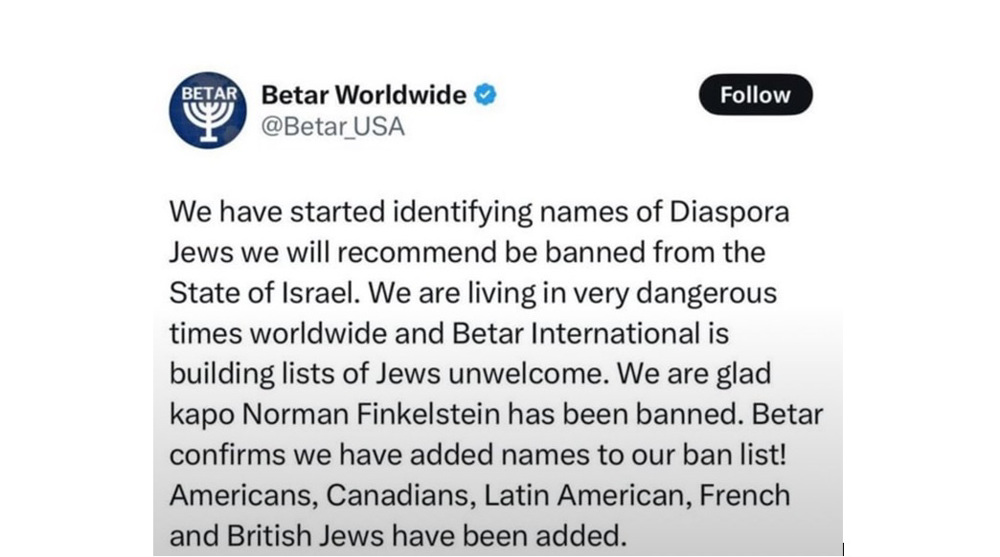
They have threatened to compile lists of Jews to be banned by the Zionist entity across North and South America, as well as Britain and France.
Mizrahi warned, “They start with Jews as a deception: all of you are next.”
However, the situation may already be far worse than what Mizrahi suggests.
Since its founding in 1923, Betar has trained as a paramilitary force. The photo below shows Menachem Begin wearing a Betar uniform in Poland in 1932.
Below it is another photo from Berlin in 1936, taken after the Nazis enacted laws outlawing other political groups in 1933.
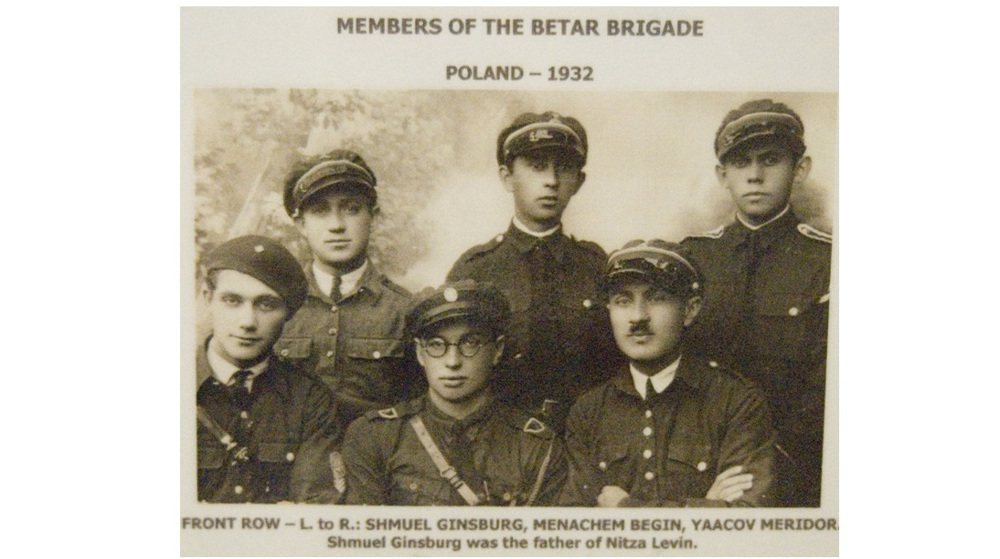
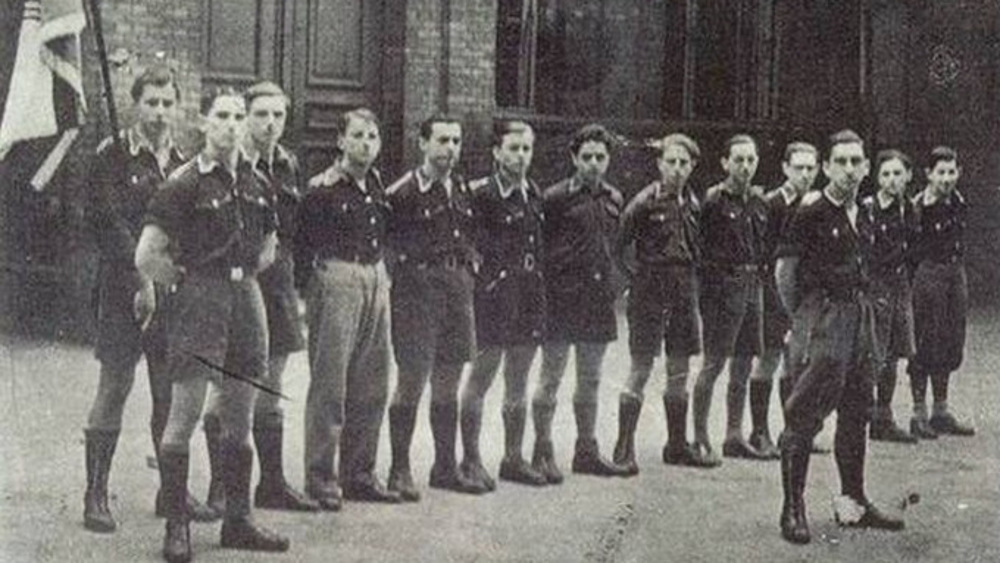
Betar was so closely aligned with the Nazis and Mussolini’s fascists that they were regarded as collaborators. By 1934, Jabotinsky and his Betar youth movement had reportedly “allied with Il Duce,” establishing a naval base north of Rome.
Late that year, Mussolini reportedly expressed support for Zionism and Jabotinsky in particular, stating: “For Zionism to succeed, you need to have a Jewish State with a Jewish flag, and Jewish language. The person who understands that is your fascist, Jabotinsky.”
This remark was made “during a private conversation with Nahum Goldman, founder of the World Jewish Congress, in November 1934,” as reported by Lenni Brenner in Zionism in the Age of Dictators.
Many senior Betar members served in the collaborationist police overseeing the Vilna Ghetto in Lithuania and were involved in betraying Jews in hiding to the Nazis.
One such member, Lotek Salzwasser, was eliminated by Jewish partisans in 1943 for his collaboration, according to Israeli press reports.
Betar and military training
One of the seven core principles of the Betar “Oath” is Magen, meaning “Protection.”
One of Betar’s ideological principles is military preparedness. Betar demands that all its members complete military seminars and know how to use weapons, in order to be ready at any time and to respond personally to a call for defense.
Betar has functioned as a militia since its inception. Here is a film of one of the French branches recorded in 2014 conducting paramilitary training exercises.
In the UK, Betar operated as a registered charity (Brit Tumbledor of Great Britain – Betar) between 1984 and 2004. It was closed down by the Charity Commission in 2004, on the grounds that it had been “Registered in error.”
In March 2025, Betar threatened to murder UN Special Rapporteur Francesca Albanese. On the very same day, the group relaunched its UK branch with a post on Instagram, claiming London “has become, with the time, an epicenter for radical Islam, for hate, for terror.” Their proposed solution?
Today, after more than 30 years, a bunch of strong young leaders stand up to say HERE WE ARE, to defend the Jewish population and to tell them that now we have a solution for the current situation, JEWS ARE NOT AFRAID ANYMORE!
Make no mistake – these threats are part of a deliberate effort to revive Jewish supremacist militias in the UK and the US.
Magen Am
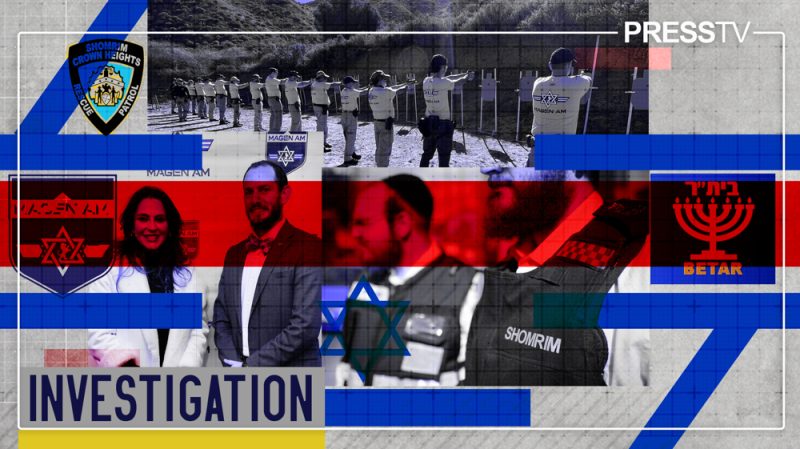
The term Magen also appears in the name of a US-based private Zionist militia called Magen Am, which is currently active in Los Angeles, Orange County, and Phoenix.
Magen Am played a notably violent role in attempts to dismantle the student encampment at UCLA. The group frequently boasts about its close ties to the LAPD, sharing numerous photos of friendly interactions with police officers.
Reports indicate that Magen Am has collaborated directly with law enforcement, including working closely with the LAPD to intimidate and attack student protesters on the UCLA campus.
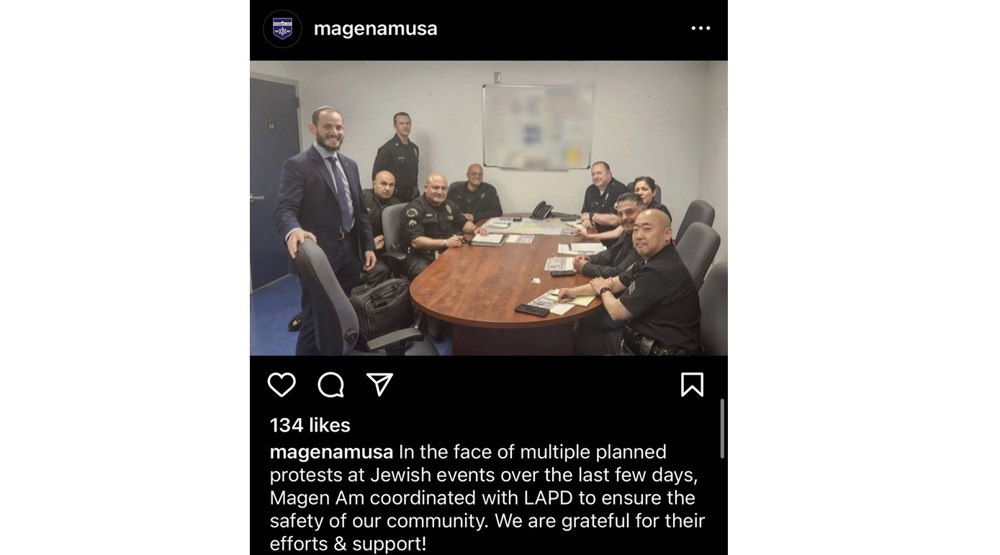
Magen Am, of course, recruits veterans of the occupation forces’ Lone Soldier programme and some then return to “serve” in the genocide as they proudly boast.
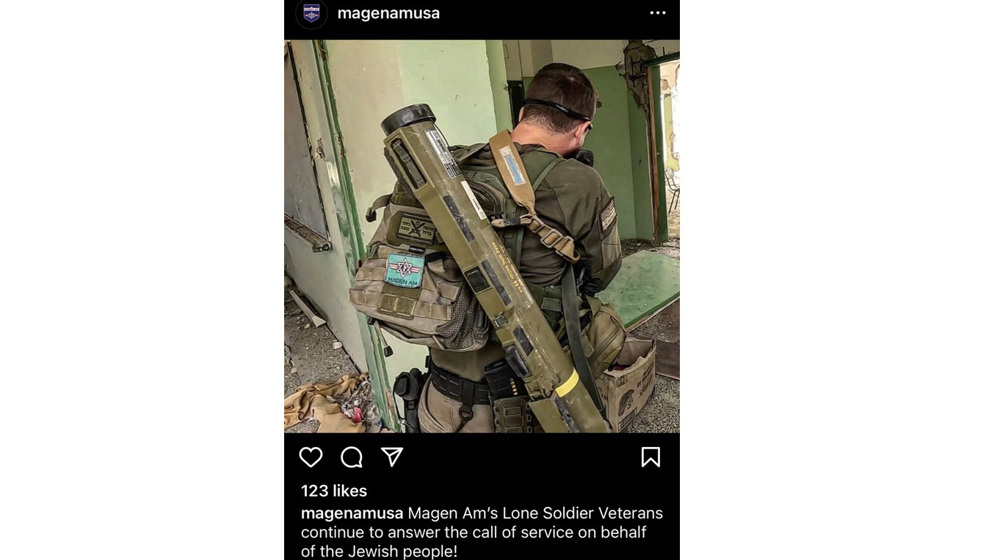
Magen Am was founded in 2017 by Yossi Eilfort, an MMA fighter-turned-Chabad rabbi. The flag of the genocidal Chabad cult was flown by the attackers on campus in Los Angeles.
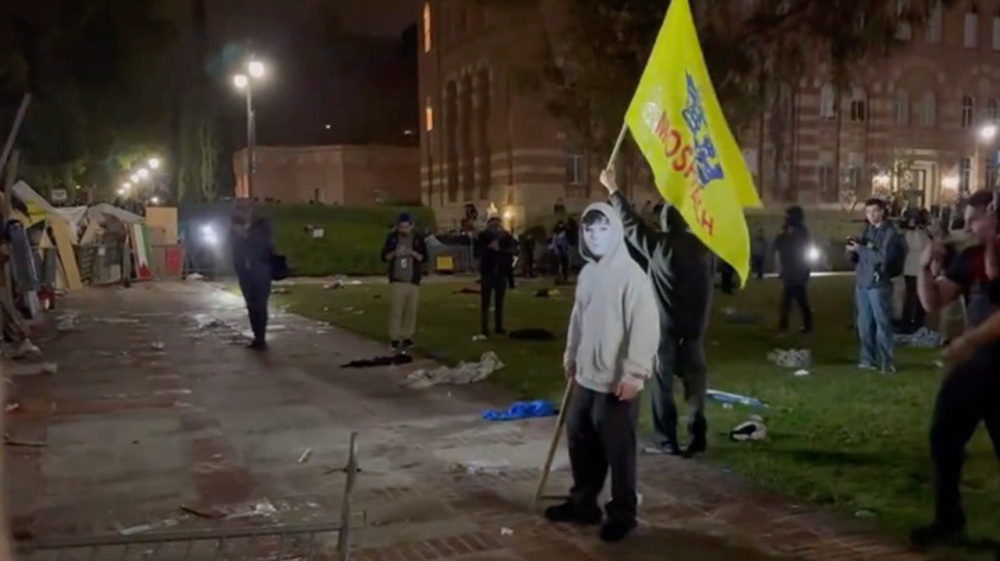
Chabad has many followers in the so-called Hilltop Youth in occupied Palestine, which the Zionist intelligence agency Shin Bet says are responsible for the overwhelming majority of so-called ‘price-tag’ revenge attacks on Palestinians.
The rise of Jewish supremacism in Western societies is becoming increasingly visible, though many continue to deny or downplay its existence.
While Zionist militias and private security firms openly collaborate to suppress student protests in the US, there is a more subtle infiltration of police forces by Zionist Jewish supremacists.
Shomrim: The Private Jewish Patrol
Shomrim is a private Jewish police force operating in parts of the US, UK, Australia, and Belgium. It is reported that “over 20 Shomrim organisations exist worldwide.”
In London, the Shomrim North West Community Patrol operates in the Borough of Barnet. Founded in 2008 by Gary Ost as a registered charity, it acts as a “mobile neighbourhood watch” and acts as eyes and ears for the Metropolitan Police.
Shomrim claims that all “Volunteers have completed training from the Metropolitan Police Counter Terrorism Command (SO15) in assisting to identify potential security threats and suspicious activity. “
One blogger notes that the genocidal cult Chabad also has a ‘nasty tendency to normalize sexual abuse and protect serial sexual predators in its ranks.” But it’s not only Chabad; there is a similar tendency throughout the Zionist movement.
No surprise, then, to find that the founder of Shomrim in London has been implicated in this.
In 2013 Police dropped their investigation into Ost, who had been arrested on suspicion of perverting the course of justice in relation to an investigation of an alleged child sexual abuser, Rabbi Chaim Halpern.
Indeed, charges against the alleged sexual predator were dropped back then, too. Yet new allegations against Rabbi Halpern have resurfaced a decade later, and the trial for these offences is still pending.
Shomrim abuses
In New York, Shomrim has faced criticism for “using excessive force against non-Jewish suspects.”
In 2014, two Shomrim members were charged as part of a group of five Hasidic men for assaulting 22-year-old Black student Taj Patterson as he walked home from a party.
Additionally, Shomrim organizers in New York have reportedly withheld information on suspected Jewish criminals. The NYPD has openly criticized the group for not always notifying police when calls come in, raising concerns about accountability and cooperation.
Given Shomrim’s protected status with law enforcement and the documented culture of sexual abuse in some ultra-Orthodox communities, credible allegations of abuse within these groups are unsurprising.
On October 11, 2023, the United States Department of Justice issued a press release that Jacob Daskal, former head of the Boro Park Shomrim Society—a private Orthodox Jewish crime-patrol group associated with the NYPD—was sentenced to 210 months in prison and fined $250,000 for transporting a minor with intent to engage in criminal sexual activity.
Daskal pleaded guilty to the charge in July 2023. As part of the sentence, Daskal is required to register as a sex offender.” The statement notes that Daskal was introduced to a 15 year old girl “as a result of his position with the Shomrim”, who he then “groomed” for sexual abuse. According to the Department of Justice statement:
“Throughout the abuse, Daskal instructed the victim to delete their communications and warned her not to tell anyone about their sexual relationship. He also used his position as a community leader to silence the victim, bragging about his law enforcement connections and warning her that disclosure would ruin her life. The victim was expelled from her religious school after revealing the relationship to the school principal.”
This case raises troubling questions: How many other abusive situations are currently unfolding within Shomrim and other Jewish militia groups?
Shomrim protects genocide
What is it that Shomrim are protecting? One illustrative example is the Crown Heights Shomrim branch, which in January this year provided security protection for the genocidal President of Israel, Yitzchak Herzog and for the leadership of the genocidal cult Chabad, as shown in the image below.

If Shomrim really wants to protect Jews in the US and UK, they should start by apprehending the entire leadership of Chabad and members of the genocidal Zionist regime.
Police reluctance toward Shomrim in the UK
Initially, UK police were resistant to Shomrim’s activities. In 2008, Chief Superintendent Steve Bending, then Hackney’s borough commander, stated, “I do not support the concept of any community having its own form of patrol service. There is a risk of other communities feeling intimidated by this course of action.”
As late as 2015, Metropolitan Police Commissioner Sir Bernard Hogan-Howe expressed his preference that Shomrim volunteers avoid uniforms resembling those of official officers.
Shomrim, however, rejected this, saying “its volunteers should not drive marked cars or wear uniforms similar to those of the police.” Gary Ost, chief executive of Shomrim in Golders Green, north-west London, stated, “Our uniforms look nothing like the police and are marked from every angle with clear wording saying ‘Shomrim’.”
Yet a glance at their uniforms and liveried vehicles often gives a very different impression.
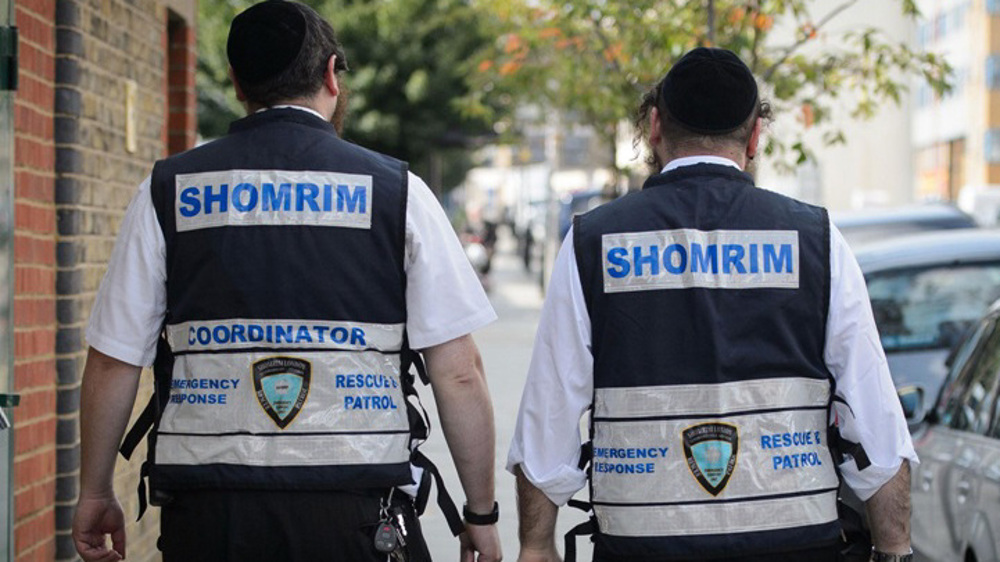

But the penetration of the police is now much more advanced and cooperation is the name of the game. There are numerous examples of apparent cordial relations between the two on the internet.
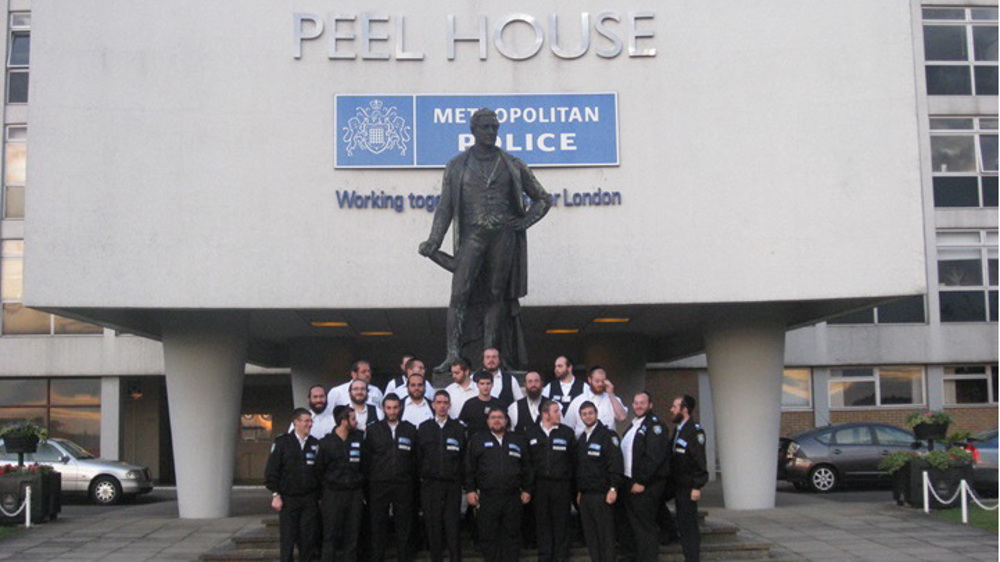
Shomrim members even posed outside Peel House, the headquarters of the Metropolitan Police.
Below is a photo of a prize giving for Shomrim members commended for their “bravery” and “exemplary service to the community” in 2020.
Shomrim chief executive Gary Ost, the one arrested in 2013, is one of the three.

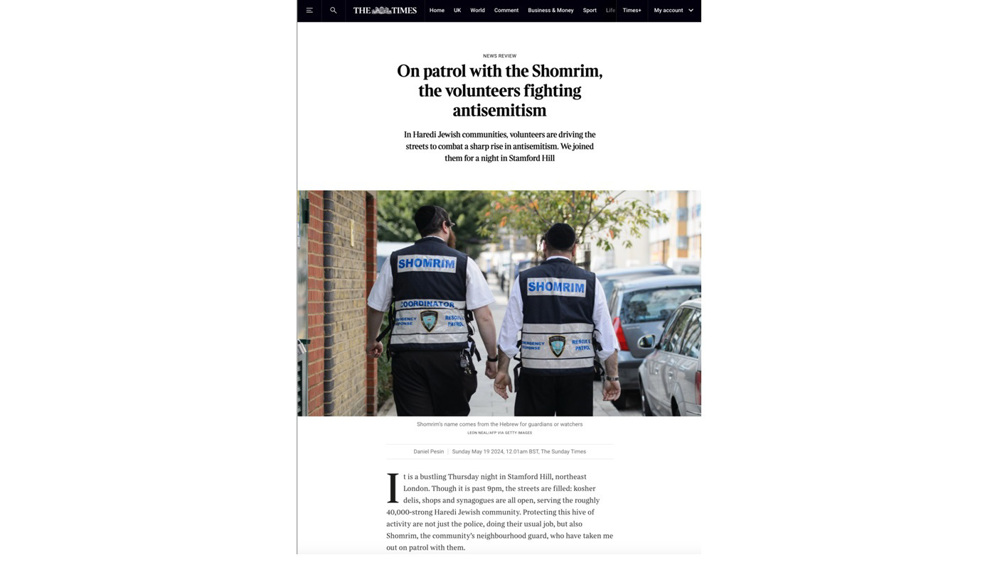
Shomrim plays a key role in shaping the narrative around the widespread antisemitism claims that Israel relies on to justify its genocidal actions.
The pressing question is: What happens when members of Shomrim break the law or commit wrongdoing? Would the police be able—or even willing—to enforce the law against them?
Alon Mizrahi, whom we cited earlier, shared his perspective in a conversation with me:
“They are pretending to be defending themselves in the most friendly country to Jews in history. While committing genocide. In a country that is so hateful of Jews that we need a private police force for Jews only in the US.
“And I have no doubt that if they can normalise this, with the kind of status that Zionist Jews have managed to create for themselves in the US; If this Jewish police force uses violence against black people, black organisers in communities who oppose the genocide, or other migrant groups or any other group, are American police going to be able to charge them?
“To use the law against them? I don’t think so. If you are in the American system, if you have a role in any part of the American system of government, in the police or any other agency, I think that at this point it is clear to you that Zionist Jews are above the law.
“The law doesn’t apply to them. So they don’t have the philosophical or legal means to deal with this. And the Zionists know this.”
Given the current climate, his assessment may well be accurate.
Israeli settlers escalate violence, forced displacement across occupied West Bank

Photo credit: AFP via Getty Images
The Cradle | May 25, 2025
The last few days have witnessed a dangerous escalation of violence, theft, and vandalism against Palestinians by illegal Israeli settlers in the occupied West Bank.
Settlers attacked Palestinians in the Al-Auja Waterfall area in Jericho on 25 May for the third time in one day, as part of ongoing efforts to displace families who have lived in the area for decades and establish a new illegal settlement outpost.
This came a day after settlers, under the protection of the Israeli army, cut off the water supply to the area.
In the Salim plain east of the occupied city of Nablus, settlers also continued to set fire to wheat fields on Sunday, coinciding with separate attacks on Palestinian livestock herders in the northern Jordan Valley area.
On Saturday, at least 40 dunams of wheat fields in the village of Sebastia near Nablus were set ablaze by illegal settlers.
“The colonists came from the Shavei Shomron settlement and a newly established outpost in the area. The arson targeted farmland in the village’s plain, destroying crops owned by local Palestinian residents,” Mohammad Azem, head of the Sebastia municipality, told WAFA news agency on 24 May.
Large amounts of crops were totally destroyed, decimating the livelihoods of the local Palestinian landowners.
At least 70 olive trees belonging to a Palestinian farmer in Hebron were uprooted by settlers on the same day.
The attacks on Saturday came as Israeli occupation troops carried out a large-scale arrest campaign across the West Bank.
Last week, around 150 Palestinians were forced by settlers to leave the village of Mughayyir al-Deir east of Ramallah, following the establishment of a new illegal outpost there and five days of attacks and intimidation.
Settlers harassed Palestinian men while they were dismantling the metal and wooden frameworks of their houses and preparing to evacuate. One of the attackers was Elisha Yered, a member of the extremist Hilltop Youth group who is subject to UK and EU sanctions for numerous crimes against Palestinians.
“This is what redemption looks like! This is a relatively large outpost that contained about 150 people from the enemy population, but it was broken,” he boasted.
Just four days ago, settlers under army protection attacked Palestinians and set fire to homes and vehicles in the town of Bruqin in the northern West Bank. Bruqin and the nearby village of Kafr al-Dik have been under a tight army siege and continuous attacks since the killing of a settler in a shooting on a settlement in the area earlier this month.
Illegal land grabs and expansion of settlements have continued brazenly by the Israeli government, in stark violation of international law.
The UN Human Rights Office noted in a report in March that there has been a significant expansion of illegal settlements in the occupied territory, citing reports from Israeli NGOs indicating that tens of thousands of new housing units are scheduled to be built in new or existing settlements.
Since the start of this year, Israeli occupation forces have been been carrying out a deadly military operation and siege against several West Bank cities. The operation began on 21 January and was dubbed Iron Wall.
According to the UN, at least 40,000 Palestinians have been displaced from their homes, as Israel continues to systematically demolish Palestinian houses in the refugee camps of Jenin and Tulkarem.
Will the international community rethink its support for Israel’s security narrative?
By Ramona Wadi | MEMO | May 24, 2025
Earlier this week, Israel fired warning shots at an international diplomatic delegation in the occupied West Bank. According to the Israeli military, the delegation “deviated from the approved route and entered an area where they were not authorised to be”. The delegation was visiting the Jenin refugee camp, which both Israel and the Palestinian Authority have targeted in a bid to extinguish the Palestinian anti-colonial resistance. Over 22,000 Palestinians have been displaced from Jenin.
The diplomatic delegation was targeted just a day after the EU said it would be reviewing the EU-Israel Association Agreement. In response to the Israeli military’s actions, several governments spoke up immediately, condemning the threat to the diplomats’ lives and asking for immediate investigations. Diplomats, after all, have diplomatic immunity, as UN spokesperson Stephanie Dujarric swiftly reminded. “Diplomats who are doing their work should never be shot at, attacked in any way, shape or form,” Dujarric stated.
But what governments and UN representatives are leaving out is the fact that diplomats witnessed Israel’s security narrative in action against them. Israel’s action was not a mere breach of diplomatic immunity. It was a taste of what the settler-colonial entity feels entitled to impart to anyone who oversteps its imagined boundaries.
The question is, therefore, how far has the international community normalised Israel’s security narrative? The answer will give an idea of how far reaching Israel perceives its security narrative to be.
When the international community upholds Israel’s purported right to defend itself, it automatically applies Israel’s security narrative against the Palestinians who have the right to resist colonisation by all means. The same warped politics was applied to the genocide in Gaza since October 2023.
But Israel internationalised its security narrative. It exported the narrative to all corners of the world, marketed it when the US embarked on its War on Terror, and consolidated the principle through the sales of military and surveillance technology. The UN endorsed it at a global level; individual countries followed suit. Diplomacy became beholden to Israel’s security narrative, as did the Palestinian right of return, the two-state paradigm and even mere symbolic recognition of a Palestinian state. The EU’s illusory state-building, associated with the PA and the occupied West Bank, was also controlled by Israel’s security narrative. As were the EU’s infrastructure and development projects, many of which were destroyed by Israel under the pretext of security. When diplomats and UN personnel were refused entry by Israel, international condemnation was softer than a lullaby. And when Israel’s targeted assassinations involved violating other nations’ sovereignty, Israel’s security narrative took precedence. After all, Israel had a reason that the international community pledged to support – the complete colonisation of Palestine.
Through complicity and silence, the international community enabled a colonial ideology to shape all political and humanitarian initiatives. By enabling and being complicit in colonisation, the international community assumed immunity from Israel’s bullets. But nothing and no one is immune in a colonial framework.
Of course, the countries whose diplomats were targeted in Jenin are expected to take care of their own. But have world leaders paused to realise that ignoring or normalising the consequences of Israel’s security narrative can spill out to endanger the entire world?
Unlike the limits within which Palestinian anti-colonial resistance fights its battle, Israel has embroiled the entire world in its colonial violence and genocide. Israel presented Palestinians as a threat to its colonial establishment that must be annihilated. To promote its security narrative, Israel equated the Palestinian people with international terror. It sold genocide in Gaza as moral and the world acquiesced. After Gaza, does the international community really think that Israel will shy away from firing at diplomats?
We must also take note of the fact that Israel fired warning shots at diplomats in the occupied West Bank, which is the international community’s playground when it comes to its donor funding schemes. Far removed from Gaza, the international community would have us believe, simply because of its investments which create an illusion of prosperity. It only took a few Israeli bullets targeting international diplomats for governments to shatter the illusion they promote.
Will the international community now pause to at least rethink who Israel considers an enemy? Alongside Palestinians, UN personnel have been killed in Gaza, as have humanitarian workers. Yet even in these cases, the international community was more concerned with enabling Israel to continue its genocide. Besides normalising Israel’s genocide of Palestinians in Gaza, the deliberate, targeted killing of international aid workers, despite the initial outcry, was also normalised as collateral damage.
Without safeguarding Palestinians from genocide and all forms of Israel colonial violence, the international community’s safety will be breached over and over again. And while international safety is gradually eroded, Palestinians are being murdered, forcibly displaced and ethnically cleansed, in the name of security.
Israel’s security narrative is a dangerous spectrum that must be seen as a whole. To see the entirety of it, the international community must turn its attention to the colonised Palestinian population, who have been beaten, shot at, detained, tortured and murdered, merely for inhabiting their own land. Not by sending delegations on exploitative tours that do nothing to end colonialism, but by protecting Palestinians and their anti-colonial resistance.
Can the international community at least acknowledge that, despite the support it has given to Israel, it finds itself in a position where power and vulnerability meet in a space that is still controlled by Israel and its colonial violence? How profitable is it to support the colonisation of Palestine and the genocide of its people, when Israel’s aggression against the international community remains unacknowledged except through stale condemnations?
A breach of diplomatic immunity is an offence. Genocide is a war crime. This is the spectrum that Israel’s security narrative dominates, financed by the same governments who paid money into colonisation and genocide. The only difference is that the international community endorses the illusion of a single enemy as fabricated by Israel – the Palestinians – even though Israel targets anything and anyone standing in its way. Israel is a threat to security, but unfortunately for Palestinians and the rest of the world, it doesn’t stand alone.
Featured Video
Epidemic of fake videos
or go to
Aletho News Archives – Video-Images
From the Archives
Inside Job? Inside What?
By Prof. Tony Hall | American Herald Tribune | July 28, 2016
The Kevin Barrett-Chomsky Dispute in Historical Perspective – Sixth part of the series titled “9/11 and the Zionist Question”
In his chapter on “Left Gatekeepers” and the “Shame of Noam Chomsky,” Barrie Zwicker refers to the the “New World Order” as the “diaboligarchy’s” directing agency. Less compelling is Zwicker’s reference to the “New World Order” as the “diaboligarchy’s” directing agency. To me this unfortunate choice of words is much too closely associated with the often crude and chauvinistic populism of Alex Jones and his Infowars media network. Many have come to see Jones’ lucrative media operation as a limited hangout set in place by handlers trying to hold the activities of the 9/11 Truth Movement within manageable constraints.
Due to the important findings over fifteen years of the citizens’ investigation into 9/11, the culprits most deeply implicated in the crime can be identified with much more specificity than an entity vaguely described as a “New World Order.” As Kevin Barrett and many others insist, the time has come to name the names of the probable culprits, Noam Chomsky prominent among them.
While Alex Jones ultimately serves the same masters as Chomsky, the former’s media product is often much closer to the mark of what is really going on than the content of Noam Chomsky’s more magisterial pronouncements. Jones goes at least part of the way into realities of the deep state politics of the twenty-first century. Chomsky, however, sacrificed his capacity to contribute cogently to sensible discourse on contemporary geopolitics by making himself a primary instrument of the most consequential deep state deception of recent times. As a leading agent of disinformation in the psychological trenches of the ongoing Global War of False Flag Terrorism, Chomsky has reduced himself to the level of skeptic pretender Michael Shermer. In the style of Shermer, the elder Chomsky has become an establishment TV professor readily available on Netflix. … continue
Blog Roll
Recent Comments
Coronistan on EU member to sue bloc over ‘su… loongtip on Vicious loongtip on EU turns to India for defense… Coronistan on Donald Trump Is No Peace … seversonebcfb985d9 on French court jails pro-Palesti… eddieb on Fourteen Incredible Facts Abou… Bill Francis on European leaders’ shift in the… seversonebcfb985d9 on Villains of Judea: Philip Esfo… loongtip on Report warns that ‘Jewish terr… Craig Nelms on New study shows that toxic gas… loongtip on A Funny Thing Happened on the… loongtip on EU free trade pact on hold as…


 Aletho News
- Exposed – How the UAE Became Central to Gaza’s Concentration Camp Plot
- How South Korea’s gas ambitions sustain the occupation of Gaza
- “Leaked document” exposes US blueprint for total control over Gaza
- Trump wanted to play peacemaker, Netanyahu made sure he failed
- Idea of limited, fast strike on Iran misjudges our capabilities: IRGC
- US Military Buildup on Land, Air, and Sea Raises Fears of Imminent Attack on Iran – Expert
- Russia reiterates demand to Germany over Nazi crimes
- France and EU clash over UK missiles for Ukraine – Telegraph
- EU member to sue bloc over ‘suicidal’ ban on Russian gas
- WEF Calls for ‘Cultural Revolution’ to Promote Lab-Grown Meat
- If Americans Knew
- Violence against hundreds of Gazan remains to find one Israeli – Not a ceasefire Day 109
- Greenpeace Demonstrator Exposes Folly of Protest Restrictions
- From CBS to TikTok, Pro-Israel Ellison is now in the driver’s seat
- Israel pays for UK advertisements attacking Doctors Without Borders
- Israel accused of extracting billions from Gazan people to pay for their own genocide
- ‘Deliberate Assassination’: 3 Journalists Among 11 Killed by Israeli Forces in Gaza
- In Gaza, We’re Struggling to Reintroduce Foods to Bodies Adjusted to Starvation
- Will Rafah crossing be opened at last? – Not a ceasefire Day 108
- Israeli drone strike kills two children collecting firewood in Gaza – Not a ceasefire Day 107
- Another Gaza baby freezes to death on Netanyahu’s watch – Not a ceasefire Day 106
- No Tricks Zone
- New Study Affirms Rising CO2’s Greening Impact Across India – A Region With No Net Warming In 75 Years
- Germany’s Natural Gas Crisis Escalates … One Storage Site Near Empty …Government Silent
- Polar Colding…Antarctica Saw Its Coldest October In 44 Years!
- New Study: Sea Levels Rose 20 Times The Modern Rate During The Roman Warm Period
- As German Gas Storage Dips Dangerously Low…Shortage Hardly Avoidable
- New Study: Brazil’s Relative Sea Level Was 2+ Meters Higher And SSTs 3-4°C Warmer 6000 Years Ago
- Philosopher Schopenhauer: Climate Science Certainty Stems From Stupidity, Ignorance
- New Study: Species Extinction Rates Declining Since 1980 – ‘Climate Change Is Not An Important Threat’
- Denmark Places Climate Protection Above Animal Welfare, Poisoning And Culling Cows
- New Study: Greenland Was 3-7°C Warmer And Far Less Glaciated Than Today 6000-8000 Years Ago
 Aletho News