The United Nations High Commissioner for Human Rights announced Tuesday that Israeli airstrikes have killed at least 71 civilians in Lebanon since the November 27 ceasefire came into effect, in what it described as an ongoing Israeli assault on Lebanese territory.
Among the victims were 14 women and 9 children, according to the UN rights office, which added that fear continues to grip the population, and over 92,000 people remain displaced from their homes.
UN human rights spokesperson Thameen al-Kheetan told reporters in Geneva that the southern suburb of Beirut was bombed in two separate incidents since the ceasefire was struck. He noted that both strikes targeted areas near schools.
On the morning of April 1, an Israeli airstrike hit a residential building in the area, killing two civilians and causing serious damage to nearby buildings, he said.
Just two days later, on April 3, Israeli airstrikes destroyed a newly constructed medical center operated by the Islamic Medical Association in the southern town of Naqoura. The strike also damaged two ambulances.
Deadly Israeli strikes
Between April 4 and 8, Israeli airstrikes reportedly killed at least six more people in various towns across southern Lebanon.
Al-Kheetan said Israeli strikes have repeatedly hit civilian infrastructure since the ceasefire was declared, including residential buildings, medical facilities, roads, and even a café in the town of Aita al-Shaab.
The latest report comes amid continued Israeli violations of the ceasefire agreement, with repeated attacks on southern Lebanon, the Bekaa region, and Beirut’s southern suburb, alongside the ongoing Israeli occupation of five disputed points along the border.
Targeting of civilians
Earlier today, one person was killed and three others, including a child, were injured in an Israeli airstrike targeting a vehicle in the town of Aitaroun, in the Bint Jbeil district of southern Lebanon.
On a related note, MP Hassan Fadlallah of the Loyalty to the Resistance bloc emphasized in parliament last week that expelling the Israeli occupation from Lebanese territory, liberating Lebanese prisoners, halting “Israel’s” aggression and violations of sovereignty, and rebuilding what it has destroyed are responsibilities that fall on all loyal Lebanese citizens, as well as on the state and its institutions.
He emphasized that the defensive strategy is a purely internal Lebanese matter to be agreed upon by those who believe in these principles and who recognize “Israel” as Lebanon’s enemy.
“As for those who do not view Israel as an enemy of Lebanon, who incite internal division, and who promote, justify, and market for the enemy — such individuals are unfit to take part in any internal dialogue focused on building the components of national strength to protect sovereignty,” Fadlallah indicated.
April 15, 2025
Posted by aletho |
Ethnic Cleansing, Racism, Zionism, Illegal Occupation, War Crimes | Israel, Lebanon, Zionism |
Leave a comment
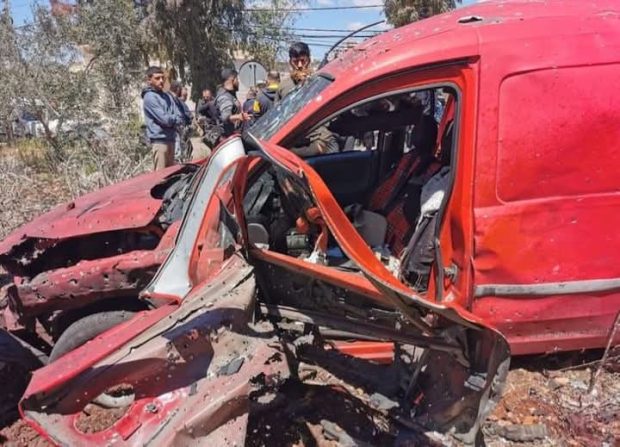
Al Mayadeen’s correspondent in southern Lebanon reported on Tuesday that an Israeli occupation drone targeted a car in the town of Aitaroun in the Bint Jbeil district of southern Lebanon, near the border with occupied Palestine.
The Lebanese National News Agency reported that the Israeli aggression was carried out with three guided missiles, while Lebanon’s Ministry of Health reported one martyr and three wounded, including a child.
Also, according to the National News Agency, the Israeli occupation forces opened fire with machine guns on the eastern neighborhood of Mays al-Jabal.
The occupation continues to breach the ceasefire agreement with Lebanon through repeated assaults on the South, the Bekaa, and Beirut’s southern suburbs, as well as by maintaining control over the five disputed points.
On a related note, MP Hassan Fadlallah of the Loyalty to the Resistance bloc emphasized in parliament last week that expelling the Israeli occupation from Lebanese territory, liberating Lebanese prisoners, halting “Israel’s” aggression and violations of sovereignty, and rebuilding what it has destroyed are responsibilities that fall on all loyal Lebanese citizens, as well as on the state and its institutions.
He emphasized that the defensive strategy is a purely internal Lebanese matter to be agreed upon by those who believe in these principles and who recognize “Israel” as Lebanon’s enemy.
“As for those who do not view Israel as an enemy of Lebanon, who incite internal division, and who promote, justify, and market for the enemy — such individuals are unfit to take part in any internal dialogue focused on building the components of national strength to protect sovereignty,” Fadlallah indicated.
April 15, 2025
Posted by aletho |
Ethnic Cleansing, Racism, Zionism, War Crimes | Israel, Lebanon, Zionism |
Leave a comment
The rhetoric surrounding a potential US–Israeli strike on Iran has intensified, fueled by veiled threats, media leaks, and what appeared to be an unofficial ultimatum from the Trump administration to Tehran. While no concrete consequences were outlined, the implication of direct military action looms large.
Since the 1979 Islamic Revolution – and especially after the Iran–Iraq War – Iran has lived under constant threat of US-led military intervention. These threats have fluctuated depending on regional dynamics and shifting US priorities.
In the aftermath of the illegal US invasion of Iraq in 2003, Iran and Syria appeared to be next in line for American-style regime-change. But the protracted insurgency in Iraq and the cost of occupation deterred further US military adventures – particularly against a civilization-state like Iran, whose size and geography pose significant challenges.
Republican leaders, and especially US President Donald Trump, have typically leaned toward employing open threats and economic strangulation policies against perceived US adversaries, rather than pursuing quiet diplomatic solutions. Today, they sense a unique opportunity to strike a deadly blow against Tehran given the recent weakening of Iran’s allies, particularly Hezbollah in Lebanon and the Syrian state, both of which have faced military setbacks and political isolation under western pressure and US-backed Israeli aggression.
Hezbollah, long viewed as Iran’s forward line of defense, now faces internal Lebanese constraints and sustained Israeli aggression, limiting its capacity to act preemptively should Iran be targeted. Meanwhile, Syria’s logistical value to the Axis of Resistance has diminished under sanctions, military exhaustion, and the toppling of former president Bashar al-Assad’s government by foreign-backed extremists under its self-appointed Al Qaeda-linked President Ahmad al-Sharaa.
Exploiting the regional moment
With the Axis of Resistance on the defensive, Washington and Tel Aviv see a fleeting opportunity to consolidate their gains. Yet despite their saber-rattling, Iran retains significant deterrence capabilities and appears prepared to retaliate if provoked.
Trump’s strategy, it must also be noted, extends well beyond Iran and its indigenous nuclear program. These foreign policy postures are part of a broader bid to isolate China, reset regional conflicts, distance Beijing from Moscow, and redirect global energy flows and prices, all while propping up Israel as Washington’s local enforcer.
In this context, West Asia becomes both a proving ground and a potential quagmire. Trump seeks to finalize the so-called “normalization” process between Israel and Arab states, neutralize Palestinian resistance, and pressure Iran to concede its regional role.
While he casts himself as a pragmatist open to deals, this posture serves a dual purpose: securing domestic political capital and forging a regional alliance rooted in US dependency.
Still, for such a deal to materialize, Iran would have to abandon core ideological and strategic pillars – namely, its regional alliances and missile deterrence. This is unlikely. Iran knows that surrendering these elements would strip the Islamic Republic not only of its ideological foundation but of any meaningful regional influence.
Iran’s multi-layered deterrence
Tehran’s defense strategy rests on several pillars. First is its alliance network stretching from Iraq to Yemen and Lebanon, forming a buffer against western hegemony. Second is its growing arsenal of precision missiles, drones, and domestically developed air defense systems. Third is geography: Iran’s control over key chokepoints in the Persian Gulf and its capacity to disrupt global oil supply grants it substantial leverage.
The final line of defense remains Iran’s nuclear program. While officially peaceful, there have been sporadic signals that suggest Tehran may recalibrate its doctrine in response to a major direct attack. Iran’s nuclear infrastructure, particularly at Fordow – a fortified facility deep beneath a mountain – underscores this strategic depth.
Despite recent blows, Hezbollah is unlikely to remain passive if Iran faces an existential threat. Likewise, US interests in Iraq and bases in the region, particularly Djibouti, could become targets for retaliatory strikes from Yemen’s Ansarallah movement.
Iran’s weapons development program has made extraordinary strides post-2011, with multiple lines of ballistic missiles like the Khyber Shakan and Fattah series, and more basic but highly producible systems like Imad and Radwan.
Meanwhile, Iran’s drones have proven effective in theaters from Ukraine to the Red Sea, while its layered air defenses – Khordad, Power-373, and Majid systems – make sustained air campaigns costly for adversaries. Its naval strategy hinges on asymmetric warfare and control of the Strait of Hormuz, a lifeline for global energy trade.
American options – and constraints
The US maintains around 60,000 troops across West Asia, mainly in Persian Gulf bases, and has shifted assets – including aircraft carriers and Patriot systems – from the Pacific to the region. Washington can certainly initiate a campaign to damage Iran’s infrastructure, but sustaining it would be difficult.
All regional US bases are within range of Iranian missiles, meaning any engagement could mark the first conventional war for the US with real counter-fire in decades.
Expect Washington to lean heavily on cyberwarfare and covert operations targeting civilian and military infrastructure alike to sow chaos inside Iran. Yet, a limited strike risks triggering a protracted conflict – something Iran is arguably more prepared for.
Iran’s strategy of attrition suits its asymmetric strengths and the fragility of US supply chains for munitions such as Patriots, SM-series interceptors, and cruise missiles.
The ongoing engagement in the Red Sea has already strained American resources. US aircraft carriers are operating from positions well beyond effective range, and stockpiles of precision munitions are running low – many earmarked for future conflict with China.
Manufacturing limitations, not cost, are the real bottleneck in sustaining a prolonged campaign. Despite these constraints, the US could still inflict serious initial damage. But sustaining such an operation, especially in the face of regional retaliation, would exact a high political and economic cost.
Between brinkmanship and bargaining
Both sides have much to lose – and much to bargain with. For Washington, a limited conflict could serve immediate strategic aims. For Tehran, dragging the US into a drawn-out war could shift pressure back onto American decision-makers already grappling with economic turbulence at home.
While the rhetoric of war dominates headlines, the path to direct conflict remains uncertain. Much depends on the outcome of indirect negotiations, particularly the recent round of indirect talks in Muscat, Oman.
Trump’s theatrics – threats, military build-up, and erratic messaging – are better understood as negotiating tactics than a clear march to war. Notably, Trump’s insistence that the occupation state should take the lead in any war on Iran reveals his reluctance to entangle the US in yet another West Asian quagmire.
His preference remains a deal, on his terms, allowing him to parade a foreign policy ‘win’ without bloodshed. In sum, war is neither inevitable nor necessarily decisive. The US needs a strategic pause in West Asia to refocus on other global priorities.
Iran, meanwhile, seeks time to rebuild internally and block Israel from exploiting current momentum. The coming weeks may decide whether this standoff ends in confrontation, or compromise.
April 15, 2025
Posted by aletho |
Wars for Israel | Iran, Israel, Middle East, United States, Zionism |
Leave a comment
Al Mayadeen has obtained a copy of the Israeli proposal submitted to mediators and subsequently conveyed to Hamas regarding negotiations for a permanent ceasefire in Gaza.
In March, “Israel” reneged on a ceasefire that brought two months of relative calm and resumed its war on the Gaza Strip.
The document outlines that Hamas would release captive Edan Alexander on the first day as a special gesture to the United States, signaling goodwill at the onset of the discussions.
The Israeli proposal includes a clear demand for the complete disarmament of the Gaza Strip, setting forth a framework for a 45-day temporary ceasefire. This ceasefire would encompass the cessation of military operations, the delivery of humanitarian aid, and the exchange of prisoners.
On the second day of the truce, Hamas would release five living captives in exchange for 66 Palestinian prisoners serving life sentences and 611 detainees from Gaza.
The proposal stipulates that any release of captives must occur without public displays or ceremonial proceedings.
Moreover, the proposal calls for the establishment of a mutually agreed-upon mechanism to ensure that humanitarian aid reaches civilians exclusively.
Following the release of the five captives, the document allows for the entry of humanitarian aid and necessary shelter equipment to assist displaced persons in Gaza.
Additionally, the Israeli military would begin its “redeployment” in the Rafah area and northern Gaza Strip following the release of the captives.
On the third day, negotiations are set to begin on “the day after,” which would center on disarmament efforts and the formal declaration of a permanent ceasefire.
By the seventh day, Hamas would release four captives in exchange for 54 Palestinian prisoners serving life sentences, as well as 500 detainees held since October 7, 2023.
The proposal specifies that after the seventh day, the Israeli military would begin “redeploying” east of Salah al-Din Street.
On the 10th day, Hamas would be required to provide comprehensive information about all remaining living captives in exchange for corresponding information on Palestinian detainees
On the 20th day, Hamas would release 16 dead captives in exchange for 160 Palestinians who have been killed, with both groups to be released simultaneously.
The Israeli proposal further outlines that negotiations for a permanent ceasefire must be finalized within 45 days. It also specifies that once a ceasefire agreement is reached, the remaining live and dead captives will be released.
If a temporary ceasefire is successfully agreed upon, the proposal indicates that it could be extended under mutually agreed-upon conditions and for a duration to be determined by both parties.
Finally, the document underscores that the guarantors of the deal—Egypt, Qatar, and the United States—would continue to exert efforts to ensure the continuation of negotiations and the eventual establishment of a permanent ceasefire agreement.
Resistance leader details Gaza proposal, Hamas’ stance
Earlier on Monday, a Palestinian Resistance leader speaking to Al Mayadeen outlined the key points of the latest Israeli proposal, which includes the redeployment of Israeli occupation forces to positions held before March 2, a 45-day term for halting military operations, the opening of crossings, and the entry of humanitarian aid—but all under Israeli-imposed conditions.
According to the source, the proposal fails to meet Hamas’ core demands of a permanent ceasefire and a complete Israeli withdrawal from Gaza, he added.
The leader further warned that the Israeli plan appears designed to gradually strip Hamas of its leverage by extracting captives without securing meaningful concessions.
He further told Al Mayadeen that the Israeli proposal seeks to disarm Hamas and ensure it does not return to power in Gaza.
April 14, 2025
Posted by aletho |
Ethnic Cleansing, Racism, Zionism | Hamas, Israel, Palestine, Zionism |
Leave a comment
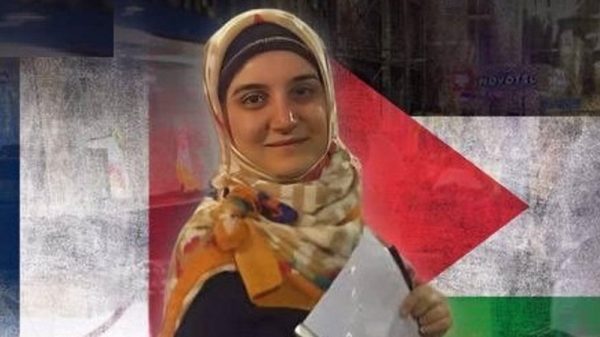
Mahdieh Esfandiari has lived in Lyon for eight years. Police have arrested her for pro-Palestine advocacy.
A female Iranian academic who denounced the Israeli genocidal campaign in the besieged Gaza Strip and expressed her solidarity with Palestinians has been arrested by the police in France.
The Iranian citizen was reportedly detained after publishing messages on a Telegram channel condemning the ongoing genocide in the blockaded Palestinian territory.
The French weekly Le Point identified the woman as Mahdieh Esfandiari, a 35-year-old French language graduate, who has lived in Lyon for eight years.
Her family, worried after losing contact, raised the alarm last month with Iranian authorities, who then contacted their French counterparts, Le Point reported, adding they have yet to hear back.
Iranian Foreign Ministry spokesman Esmaeil Baghaei said on Monday that France was unwilling to give an explanation on her situation.
“We hope that the French government will provide access to this case as soon as possible and clarify the reasons for the arrest of this Iranian citizen,” Baghaei was quoted as saying.
“Consular access has not been authorized” by French authorities, he told a news conference, adding that Iran was following the matter closely.
Her arrest came amid a crackdown in the US and other Western countries targeting scholars, students, and activists who oppose genocide and advocate for peace, both on campuses and in public spaces.
Her Iranian identity has further compounded this repression, as the Western countries escalate warmongering policies and economic sanctions against Iran while silencing dissent.
Pundits say these attacks aim to terrorize and silence the countless advocates who have courageously amplified Palestinian resistance and the call for freedom.
They say repression of freedom of speech will legitimize the Zionist child-killing forces and would undermine the principles of due process.
April 14, 2025
Posted by aletho |
Ethnic Cleansing, Racism, Zionism, Full Spectrum Dominance, Solidarity and Activism | France, Human rights, Zionism |
Leave a comment
A US attack on a ceramics factory near Yemen’s capital, Sanaa, late on 13 April has killed and injured dozens of civilians, with the toll expected to rise in the coming hours.
“Six citizens were martyred and 20 others were injured, including critical injuries. Civil defense and ambulance teams are working hard to search for victims and extinguish the fires,” a spokesman for the Yemeni Health Ministry, Dr Anis al-Asbahi, told SABA news agency.
Video footage showed heavy destruction and teams attempting to extinguish large fires at the Al-Sawari factory in the Sanaa governorate’s Bani Matar district.
US warplanes also “launched two raids on the Al-Yatmah area in the Khabb wal Shaaf district, northeast of Al-Jawf governorate,” according to Al Mayadeen’s correspondent.
Washington’s latest deadly attack comes as the Yemeni Armed Forces (YAF) and Ansarallah movement continue their operations despite a US campaign of daily airstrikes which aim to stifle Sanaa’s military capabilities – but have instead only taken a heavy toll on civilians.
The YAF announced on Sunday evening that it downed a US MQ-9 Reaper drone – worth tens of millions of US dollars – in the airspace of Yemen’s Hajjah governorate. This was the fourth MQ-9 shot down within two weeks and the 19th since the start of the war in Gaza.
“The Armed Forces reiterate that their military capabilities have not been affected and that the ongoing US aggression against our country will only bring more disappointment and failure,” the YAF said in a statement.
The US has been bombing Yemen every day since 15 March, when US President Donald Trump renewed – with severe intensity – the campaign which was started by the former administration of US president Joe Biden.
Dozens of people have been killed in the attacks, including women and children.
US Defense Secretary Pete Hegseth vowed last week that the campaign against Yemen is “about to get worse.”
The violent attacks come in response to Yemen’s reimposition of a ban on Israeli shipping in the Red Sea and elsewhere, as well as its renewal of drone and missile attacks on Israel after Tel Aviv restarted the war on Gaza last month.
The YAF has been responding to Washington’s attacks with operations targeting US warships in the Red Sea – including the USS Harry S. Truman aircraft carrier.
According to sources cited in US media recently, Washington has burned through massive amounts of munitions and has spent close to $1 billion, but has failed to significantly impact the YAF and Ansarallah – which are merged.
April 14, 2025
Posted by aletho |
Wars for Israel | Gaza, Israel, Palestine, United States, Yemen, Zionism |
Leave a comment
Somalia’s breakaway region of Somaliland wants to be recognized as an independent state by US President Donald Trump in exchange for leasing its Berbera port and airstrip to the US, media reported on Saturday.
In March, the Semafor daily newspaper reported that Somalian President Hassan Sheikh Mohamud had offered the US control over ports and airbases located in Somaliland and another breakaway region, Puntland, in an attempt to prevent Washington from recognizing them.
Somaliland, however, plans to strike a deal with Trump, offering the US to lease its airstrip and port, which will ensure smooth military and logistical access to the Gulf of Aden, in exchange for Washington’s recognition of its statehood, The New York Times reported.
The airstrip at the Berbera International Airport was built by the Soviet Union in the 1970s. Stretching for over 2.5 miles, it is the longest airstrip in Africa.
The Associated Press reported in mid-March, citing a US official, that the US was in talks with Somaliland to determine what it could offer in exchange for its recognition. The US is reportedly exploring options for resettling Palestinians from the Gaza Strip.
Somalia ceased to exist as a unified state in 1991 following the fall of dictator Siad Barre. The international community recognizes the federal government of Somalia, which controls Mogadishu and parts of the country.
April 13, 2025
Posted by aletho |
Ethnic Cleansing, Racism, Zionism, Militarism | Somalia, United States, Zionism |
Leave a comment
With the foreplay over and US-Iranian talks commencing in Muscat on Saturday, a constructive engagement has begun in right earnestness. The sure sign of it is that Iran’s currency rose nearly 6 percent on Sunday. The Tehran bazaar, the weathervane of Shia politics, has spoken.
Most important, the two key negotiators in Muscat Steve Witkoff and Abbas Araqchi have decided to return to the talks on April 19 in exactly a week’s time after reporting back to their principals in Washington and Tehran respectively and seeking fresh guidelines going forward.
The White House said the talks were positive and constructive and appreciated that “direct communication was a step forward in achieving a mutually beneficial outcome.” Witkoff described the talks as “very positive and constructive.”
Iran’s foreign ministry said the talks were held in “a constructive atmosphere based on mutual respect. Araqchi also described the negotiations as “promising and constructive.” Significantly, Araqchi told the Iranian national television that the talks brought the two sides closer to establishing “the basis of negotiations” for future discussions.
He added cryptically that while Oman will continue to act as mediator in the upcoming round on April 19, the venue for the next session may change.
Signalling to Witkoff and addressing the domestic audience, Araqchi gave an insightful perspective. He said the discussions aimed to create a structured agenda for the negotiations based on a timeline. The following remarks by Araqchi must be noted carefully:
- “We agreed to hold a second round next Saturday, and in the next session, we will delve into the overall framework that a deal can take to see how far this process can advance.”
- It is important to set a basis for the talks; “If we can finalise the basis in the next meeting… we can begin real discussions based on that basis.”
- The talks were conducted in a “calm and very respectful atmosphere. No inappropriate language was used. Both sides demonstrated their determination to advance the talks until an agreement is reached that is desirable for both parties and is based on an equal footing.”
- Neither Iran nor the US wants to “negotiate for the sake of negotiating” and does not favour protracted “attritional talks.” Both sides voiced their keenness to achieve an agreement “at the shortest time. This, however, will not be easy and requires full determination of the two sides.”
- “When leaving, the two delegations encountered each other, and we talked for a few minutes. This is a completely accepted issue. We have always observed diplomatic courtesy when dealing with American diplomats, and this time, too, an initial greeting was exchanged, and then we left the place. It was nothing extraordinary.”
Dr Mohammad Jafar Qaempanah, President Masoud Pezeshkian’s trusted chief of staff who holds the position of vice-president for executive affairs — and, incidentally, a medical doctor by profession with research papers and foreign citations to his credit — that the negotiations “were conducted well with dignity, prudence, expediency, and in line with the interests of the Iranian people.”
President Donald Trump reined himself in his early comments to the media from Air Force One, “Nothing matters until you get it done, so I don’t like talking about it, but it’s going OK. The Iran situation is going pretty good, I think.”
Elsewhere, Trump added, “I want Iran to be a wonderful, great, happy country, but they can’t have a nuclear weapon.” But that is Iran’s strategic choice, too.
That said, both in the US and in Iran, the hardliners are straining at the leash to throw stones. Then there are also the third parties with their own agenda. If the Iranians spurned the initial US attempt to have the UAE mediate, and instead also bypassed Qatar and opted for Oman as their preferred mediator for the talks, it tells a tale by itself of the complex regional alignments in the Gulf as well as Tehran’s need to keep Israelis miles away from messing around.
The crux of the matter is that the initial round of talks in Muscat represents a turning point in the challenging dynamics between Tehran and Washington. According to the Tehran grapevine, the talks focussed on two intertwined contentious issues — sanctions relief and the nuclear issue — as in the past negotiations.
Reaching a mutually agreeable framework for dialogue could pave the way for reducing tensions and returning to a diplomatic path. It is doable today from all indications. The game changer is that both sides have shown willingness to reduce tensions and seek a middle ground. Araqchi’s positive spin on the atmospherics at the Muscat talks signalled that the enduring mutual distrust notwithstanding, both sides acknowledge the necessity of continuing discussions, and are determined to avoid deadlock and explore new opportunities.
This is not to overlook that the path ahead remains challenging and fraught with obstacles. Sensitive issues need to be sorted out such as the the timing of sanctions relief, the scope of nuclear commitments, and verification mechanisms. Nonetheless, the bottom line is that the return to diplomacy after such high spiralling of tensions in recent months provides an opportunity to rebuild relative trust and recalibrate US-Iran relations—at least on technical and substantive levels.
Indeed, Witkoff and Araqchi are just the negotiators with the temperament not to succumb to the temptations of oneupmanship and grandstanding and instead proceed with precision, patience, and creativity in an all-out attempt to capitalise on the good start.
Witkoff already signalled an openness to compromise when he told Wall Street Journal that “our position today” starts with demanding that Iran completely dismantle its nuclear program. “That doesn’t mean, by the way, that at the margin we’re not going to find other ways to find compromise between the two countries.
“Where our red line will be, there can’t be weaponisation of your [Iran’s] nuclear capability,” Witkoff added underscoring that any deal must include extensive oversight measures to guarantee Iran is not developing an atomic weapon. Nuclear experts from the US state department are assisting Witkoff.
Iran has consistently denied seeking to acquire nuclear weapons. On Friday, foreign ministry spokesman Esmaeil Baqaei said in Tehran that Iran is “giving diplomacy a genuine chance in good faith and full vigilance. America should appreciate this decision, which was made despite their hostile rhetoric.”
READ MORE: Steve Witkoff’s Iran mission holds seamless possibilities, Indian Punchline, April 11, 2025
April 13, 2025
Posted by aletho |
Wars for Israel | Iran, Israel, United States, Zionism |
1 Comment
On Thursday, Israeli forces intensified bombing and shelling across the destroyed, besieged, and starved Gaza Strip, causing dozens of casualties, including women and children.
In Gaza City, a building in the city center was targeted, killing at least five Palestinians and injuring many others. Six more Palestinians lost their lives, and several were wounded when the army struck the Abu Al-Awn family’s home in the Shuja’iyya neighborhood.
Among the injured was a Palestinian infant whose arm had to be amputated following the attack.
In Deir Al-Balah, central Gaza, the army launched missiles at the Abu Al-Ajeen area, killing two Palestinians and wounding several others. Homes in Qizan Najjar, south of Khan Younis, were also shelled by Israeli forces.
Further south, in Khan Younis, a missile targeted the Abu Doqqa family’s home in the Shahayda area, north of Abasan town, killing two Palestinians, including a child.
In another incident, a displaced family sheltering near Nasser Hospital was struck by a missile fired from an Israeli helicopter, killing one Palestinian and injuring others.
Additional strikes in Khan Younis led to the death of a woman and injuries to several residents at the Al-Farra family’s home in the Sheikh Nasser area.
In Mawasi Rafah, the southernmost part of Gaza, a Palestinian was killed when soldiers fired live rounds at displaced residents in the Shakoush area.
On the political front, Israeli Channel 13 reported ongoing indirect discussions regarding a prisoner exchange deal, which include proposals for the release of more than five Israeli captives. Kan News stated that Israeli Prime Minister Benjamin Netanyahu conducted a situation assessment with military officials and negotiation teams about the Egyptian-mediated proposal.
According to reports, the Egyptian plan includes releasing eight captives alive, implementing a 50-day ceasefire, allowing humanitarian aid to enter Gaza, and commencing negotiations for a second phase aimed at ending the war and facilitating an Israeli withdrawal from Gaza.
Sources reveal that the proposal, considered “serious” by Arab media, includes the release of eight or nine Israeli captives, among them an American-Israeli soldier named Aidan Alexander, along with eight bodies. In return, Israel would release 300 Palestinian detainees, including 150 serving life sentences, and 2,200 detainees from Gaza.
The plan also outlines a 70-day extension of the ceasefire in Gaza, during which the second phase of negotiations would proceed. This phase includes facilitating the delivery of fuel and humanitarian aid to Gaza, reopening border crossings, and providing Hamas with detailed information about the status of remaining hostages.
Medical sources cited by Al Jazeera reported that Israeli attacks since dawn on Thursday have claimed the lives of at least 29 Palestinians, with additional casualties being reported amid ongoing strikes. Tedros Adhanom Ghebreyesus, Director-General of the World Health Organization (WHO), expressed alarm over the escalating humanitarian crisis. He warned of worsening health conditions and rising fatalities resulting from Israel’s blockade on aid shipments, emphasizing the urgent need for medical evacuations for over 10,000 individuals in Gaza.
To date, Israeli bombardments have claimed the lives of at least 50,886 Palestinians, including 12,365 women and 17,954 children. Approximately 11,000 individuals remain missing, largely believed to be under the rubble of bombed homes and buildings. The total number of wounded has now surpassed 115,875, primarily affecting children, women, and the elderly.
April 11, 2025
Posted by aletho |
Ethnic Cleansing, Racism, Zionism, War Crimes | Gaza, Israel, Palestine, Zionism |
Leave a comment
The rubric of the US-Iranian talks slated for Saturday in Muscat turned into a vanity fair of sorts — whether the talks should be called ‘indirect’ or ‘direct’. The US President Donald Trump sought direct talks and claimed that Iranians conveyed through back channel that they had no objection to it. Furthermore, Trump disclosed that indirect talks already started. While maintaining publicly that the talks will be ‘indirect’, Iranians didn’t call out Trump.
Accordingly, Trump nominated his trusted aide and longstanding friend Steve Witkoff to represent him at the talks. Tehran reciprocated with Abbas Araqchi, a veteran nuclear negotiator and brilliant diplomat, and currently the foreign minister.
Trump noted with satisfaction that Tehran has fielded a negotiator at the highest possible level. Interestingly, Trump made the announcement on the talks from the Oval Office in the presence of Israeli prime minister Benjamin Netanyahu.
Such hyper activism on the optics may create a surreal impression. After all, there is also a military build-up going on in the US base in Diego Garcia, including B-52 heavy bombers with a range of 10000 kms. But the Russian assessment is that the US’ mobilisation of military assets falls way short of the level of force strength required to start a war with Iran.
The presence of Araqchi and Witkoff at the talks in Muscat underscores that both sides are approaching the talks in all seriousness conscious of the real risk of a dangerous escalation of the present precarious situation around the Iran nuclear issue if concrete progress is not achieved in the negotiations by mid-2025.
The clock starts ticking for the E3 (France, Germany, and Britain) to move to restore the UN Security Council sanctions on Iran by invoking the JCPOA’s veto-proof ‘snapback’ mechanism for which the cutoff date is the month of October. Snapback also restores Security Council ban on uranium enrichment, further reactor development, and ballistic missile activities.
Tehran has warned that if the UN sanctions are restored, it may withdraw from the NPT in response and if that happens, it is no longer obligated to retain IAEA safeguards. But there is a gestation period of 3 months before Iran’s exit from NPT gets formalised.
Enter Russia. According to the 1992 nuclear cooperation agreement between Moscow and Tehran, “nuclear material, equipment, special non-nuclear-material, and related technology” as well as nuclear materials produced by the result of transferred technology “shall be under the International Atomic Energy Agency safeguards” during their “entire period” of stay in Iran.
The agreement further stipulates that these materials “shall be used only for declared purposes that are not connected with activities of manufacturing nuclear explosive devices” and “shall not be used to carry out activities in the field of nuclear fuel cycle” that are not under IAEA safeguards.
Suffice to say, at the very least, Iran’s nuclear cooperation agreement with Russia may obligate Tehran to retain some IAEA presence. Russia’s economic interests in nuclear cooperation with Iran will also play a part. Besides, the recent Russian-Iranian treaty on strategic cooperation explicitly affirms Tehran’s commitment to nuclear non-proliferation. Russia also tends to prioritise a constructive engagement of the US in its foreign policies and its moderating influence on Iran lest it goes the North Korean way will be a significant factor in the US-Iranian negotiations. The situation around Iran has already figured more than once in the recent US-Russia exchanges since February including at the highest level between Trump and Russian President Vladimir Putin.
During this week, against the backdrop of the talks in Muscat, President Masoud Pezeshkian made certain significant remarks. It is entirely conceivable that he was speaking for Supreme Leader Ayatollah Ali Khamenei.
First, Pezeshkian said Khamenei is “not opposed to US entities investing capital” in the Iranian economy. Succinctly put, this is a radical departure from Iran’s traditional stance.
Second, Pezeshkian said, “We are open to dialogue, but with dignity and pride, we will not compromise on our achievements and we will not make deals (on them).” In effect, Pezeshkian has notified that any suggestions that the only acceptable deal with Iran must include complete dismantlement of the country’s nuclear program will be a non-starter.
Third, Pezeshkian not only reiterated Iran’s rejection of nuclear weapons but stated its willingness to be subject to robust safeguards. As he put it, “We are not looking for an atomic bomb. Who is setting policy above the Leader of the Islamic Revolution who has officially announced that we are not looking for a nuclear bomb? Check it a thousand times. You can verify a thousand times that we don’t have atomic bombs, but we need nuclear science and nuclear energy.”
Fourth, Pezeshkian also had a message of sorts for Israel. He said, “We are not looking for war, but we will stand strong against any aggression with the knowledge and power that our scientists have created. The more they harm us, the more powerful we will become, and the stronger we will stand against any threat they pose to us.”
Taken together, these remarks by Pezeshkian would give a fair idea of what the contours of a possible settlement of the nuclear issue could be as the talks proceed.
Most importantly, Iran seeks an economic partnership with the US and implicit in it is the unspoken readiness for political and diplomatic ties. Iran’s approach bears an uncanny resemblance to what Russia has adopted in its nascent dialogue with the Trump administration. Trump’s choice of Witkoff as the negotiator for Iran can be seen as a signal that the US is open to explore opportunities of economic cooperation with Iran as an underpinning to the normalisation process. (By the way, the Washington Post has reported that Witkoff is willing to travel to Tehran, if invited.) Certainly, Tehran pins hopes on Witkoff bringing new thinking into the paradigm. Do not be surprised if he travels to Tehran in the near future.
That said, the Trump administration must appreciate that Iran lives in a tough security environment and is attempting to use its nuclear threshold status as a deterrent. Therefore, what is possible is a combination of limits and monitoring that can adequately reduce proliferation risks.
The onus is on Witkoff to articulate behind closed doors realistic US objectives for a nuclear deal, bearing in mind that politics is the art of the possible. This involves refraining from calls for the complete dismantlement of the Iranian nuclear program, and, equally, the projection of ideas as to how Tehran will benefit from an agreement with the United States.
When I visited Tehran last June to observe the presidential election, a topic that came up in almost all conversations and TV interviews was: What to expect from a Trump administration? What I could sense was that contrary to what Israeli media management strives to project to muddy waters, Tehran has no revenge mentality and instead senses that Trump’s priorities in a second term are not about projection of power but the regeneration of America. As a civilisational state that was never colonised through millennia, Iranian culture is highly pragmatic but it will never surrender its legitimate interests or compromise under pressure. In this respect, it is a unique country in the region. (See an outstanding policy brief by Washington-based Arms Control Association titled The Art of a New Iranian Nuclear Deal in 2025.)
Iran’s relevance to the regeneration of the American economy (MAGA) is self-evident. Apart from vast mineral resources, Iran’s human resources can give a solid underpinning to economic and technological partnership with American business and industry. An enduring nuclear deal with Iran is best achieved through an overarching relationship to reengage with Iran as a partner after over four decades.
April 11, 2025
Posted by aletho |
Economics, Wars for Israel | Iran, Israel, United States, Zionism |
Leave a comment
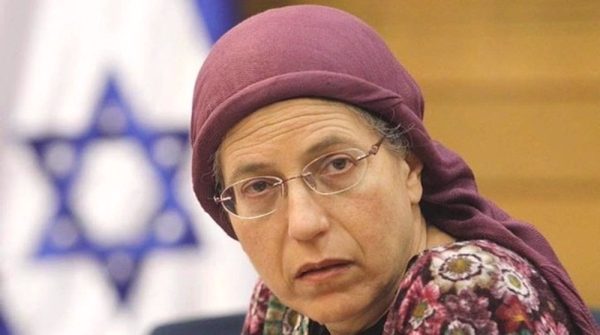
Shoshana’s mother, Orit Strook — the minister of settlements — is a staunch supporter of Israeli settlements in the occupied West Bank.
A hawkish Israeli minister known for her extreme right-wing politics and support for illegal settlements is facing serious allegations of sexual abuse by her daughter.
Shoshana Strook, the daughter of Israeli Minister Orit Strook, filed a police complaint in Italy alleging sexual assault by both of her parents and a brother.
She stated that resurfacing memories prompted her decision to report the abuse, which she hopes will help her heal from emotional trauma.
She made the allegations in a statement posted on social media, revealing that she had filed a formal complaint and was seeking justice and relief.
“I’m currently in Italy and recently filed a report with the police,” she said. “I hope to find a place where I can get some relief.”
“After a long period of doubt, extreme emotional states, and a lot of guilt, I wanted to share that I experienced sexual abuse by both of my parents and one of my brothers,” Shoshana wrote.
She also said that her parents physically harmed her three younger brothers, stating: “After years of beatings and guilt, I finally spoke out. The memories are overwhelming, but I need justice.”
Shoshana also said that the memories coming up to her lately are “becoming too overwhelming”, recalling one in which she hit three of her younger brothers.
She didn’t reveal which brother sexually assaulted her. However, one of her brothers, Zviki Strook, has been reportedly charged with kidnapping and torturing a Palestinian boy in 2007.
Shoshana’s mother, Orit Strook, is a staunch supporter of Israel’s settlements in the occupied West Bank.
Ironically, Orit relentlessly pushed prime minister Benjamin Netanyahu’s baseless narratives and unsubstantiated claims that Palestinian resistance group Hamas committed sexual assault on October 7, 2023.
She now faces grave allegations of having abused her own children.
The Strook family has been in the spotlight before. In 2007, Orit’s son, Zviki Strook, was reportedly charged with kidnapping and torturing a Palestinian minor.
The Palestinian boy was found severely beaten and bleeding after escaping an alleged torture session.
Orit was born into a Jewish family of Hungarian lawyers. She married Avraham Strook and the couple chose to live in illegal settlements on Palestinian land.
Their first home was in the settlement of Yamit in the Sinai Peninsula. However, following the 1982 evacuation of Yamit after the Sinai was returned to Egypt in 1979, the Strook family relocated to the occupied West Bank city of al-Khalil—again, settling illegally.
Since 2013, she has continued to live in the Avraham Avinu settlement in al-Khalil.
In 2024, Orit stated that Israel should maintain a “long-term military presence in Gaza and annex the occupied West Bank”. She also argued that there should be no exit strategy from Gaza.
Orit made headlines after posting a video to her X account from a Knesset session in which she argued that a Palestinian state would be an “existential threat” to Israel.”
In May 2024, she opposed a proposed ceasefire agreement in Israel’s war on Gaza. Orit also criticized the United States for its efforts to broker a ceasefire deal, stating that the US “doesn’t deserve to be called a friend of Israel.”
April 10, 2025
Posted by aletho |
Aletho News | Israel, Zionism |
2 Comments



 Aletho News