UK lawyers to charge 10 Britons for Gaza war crimes
The Cradle | April 7, 2025
A leading UK human rights lawyer is set to submit a war crimes complaint to the Metropolitan police against 10 British citizens who served with the Israeli army in Gaza.
Michael Mansfield KC will hand the 240-page complaint to the police department’s war crimes unit on 7 April. It cites Israel’s targeted killing of civilians and humanitarian aid workers, as well as airstrikes on hospitals and densely populated civilian neighborhoods. It also includes the targeting of religious sites and historic monuments.
The documents were prepared by British lawyers and researchers from The Hague. The names of the 10 Britons in question have not been made public.
“If one of our nationals is committing an offence, we ought to be doing something about it. Even if we can’t stop the government of foreign countries behaving badly, we can at least stop our nationals from behaving badly,” Mansfield said.
“British nationals are under a legal obligation not to collude with crimes committed in Palestine. No one is above the law,” he added.
The dossier is based on open-source evidence and testimonies from eyewitnesses. The crimes include an Israeli army bulldozer trampling a dead body in the courtyard of one of the several hospitals attacked by Israeli ground forces in Gaza.
“The public will be shocked, I would have thought, to hear that there’s credible evidence that Brits have been directly involved in committing some of those atrocities,” said Sean Summerfield, British barrister at Doughty Street Chambers – who helped put together the evidence which is to be submitted.
The complaint comes as Israeli soldiers are being increasingly pursued in international courts for their roles in the crimes committed against Palestinians in Gaza.
Pro-Palestine organizations have filed dozens of criminal complaints in courts around the world since the start of the year, targeting Israeli soldiers for their role in Tel Aviv’s ethnic cleansing campaign in Gaza.
Among these organizations is the Hind Rajab Foundation (HRF), named after the six-year-old Palestinian girl who was killed by the Israeli army along with her family in Gaza City last year.
“When genocide or crimes against humanity occur, there is a global need for justice and accountability, not only from victims but also from those in solidarity with them. Like many others, I was deeply impacted by witnessing the level of impunity displayed by the Israelis, who were not only committing these crimes but also recording and posting them on social media, acting as if they were above any legal framework,” HRF Chairman Dyab Abou Janjah told The Cradle’s Esteban Carillo in an exclusive interview in February.
HRF focuses its efforts on pursuing both dual-national Israeli soldiers and those who leave Israel for vacation.
In January, a Brazilian court ordered an investigation into a vacationing Israeli soldier who had been identified in a video of his participation in the destruction of civilian infrastructure in Gaza.
The soldier fled Brazil with help from the Israeli Foreign Ministry. Israel has warned active-duty soldiers not to travel over the risk of legal action, and has issued certain restrictions on media interviews with military personnel.
Martyrs and injured in Gaza journalists’ tent bombing

Al Mayadeen | April 7, 2025
The Israeli occupation persists in its attacks on the Gaza Strip, causing numerous deaths and injuries, while also committing a grave crime against journalists by bombing their tent in Khan Younis, in the southern part of the Strip.
A Palestinian journalist and a young man were killed, and several others injured, early Monday morning when Israeli aircraft targeted a tent for journalists near the Nasser Medical Complex in Khan Younis, southern Gaza.
Al Mayadeen’s correspondent reported that journalist Hilmi al-Faqawi and another young man, Yousef al-Khazindar, were martyred, while other journalists, including Ahmed Mansour, Hassan Islayh, Ahmed al-Agha, Mohammed Fayek, Abdullah al-Attar, Ihab al-Bardini, Mahmoud Awad, and Majed Qudaih, sustained injuries in the bombing of the tent.
Condemnations of the occupation’s crimes against journalists
The Palestinian Media Union condemned the Israeli bombing of a tent housing journalists in Khan Younis, mourning the loss of al-Faqawi, a correspondent for Palestine Today News Agency.
The Palestinian Center for Defending Journalists emphasized that these attacks on journalists are part of a systematic pattern of gross human rights violations by “Israel”, particularly against journalists who should be protected under international humanitarian law.
The press association expressed grief over the journalist’s martyrdom, saying he has joined the ranks of fallen journalists in the Palestinian media movement. It called for an end to the war crimes committed against Palestinian journalists and media professionals, urging immediate action to prosecute those responsible for these atrocities in international courts as war criminals.
The group also praised the dedication of journalists working tirelessly to document and expose “Israel’s” crimes of genocide and ethnic cleansing against the Palestinian people.
Meanwhile, the International Committee to Support the Rights of the Palestinian People (Hashed) stated that the targeting of journalists constitutes a war crime aimed at obstructing the coverage and documentation of Israeli genocide.
It highlighted that this act is a violation of the Rome Statute of the International Criminal Court and breaches international humanitarian law, as well as United Nations and Security Council resolutions that protect journalists during armed conflicts.
Martyrs and wounded as a result of ongoing Israeli attacks
Our correspondent reported that Israeli occupation aircraft targeted three homes belonging to the al-Hasanat, Abed, and Ghurab families in the northwestern area of Deir al-Balah in the central Gaza Strip early on Monday.
Two martyrs were initially recovered following the dawn attack, but due to the challenging conditions, medical and Civil Defense teams had to withdraw.
By morning, six martyrs from the Ghurab family were recovered, though several others remain missing under the rubble, with search operations ongoing.
Additionally, several martyrs, including women and children, were killed, and others injured in an Israeli airstrike that targeted the home of the al-Nafar family in central Khan Younis, in the southern Gaza Strip. In Gaza City, three more martyrs were killed by Israeli shelling on Wadi al-Arayes Street in the al-Zaytoun neighborhood, south of the city.
Our correspondent added that the bloodshed has continued unabated in recent hours, with the occupation targeting displaced Palestinians’ tents, even though the area had been declared a “safe zone.”
Collapsing Empire: Yemen shatters the illusion of US air power, yet again
By Kit Klarenberg | Press TV | April 7, 2025
Since March 15, Washington has repeatedly barraged Yemen from the sky, killing and injuring countless innocent civilians while destroying vital infrastructure.
For example, on April 2, US jets targeted a reservoir in western Yemen, cutting off access to water for over 50,000 people.
Only three days later, US President Donald Trump gloatingly posted a horrific video on social media of a tribal gathering being incinerated in a US airstrike. He falsely claimed the individuals were “Houthis gathered for instructions on an attack.”
In a chilling coincidence, the bloodcurdling clip was published on the 15th anniversary of the release of “Collateral Murder” by WikiLeaks, a notorious video filmed three years earlier of US Apache helicopter pilots firing indiscriminately at a group of Iraqi civilians and journalists while sickly cackling at the carnage they were inflicting.
While that disclosure contemporaneously caused international outcry and scandal and made WikiLeaks founder Julian Assange an internationally wanted man, openly advertising unconscionable war crimes is now apparently a formal US government policy.
US officials have pledged that renewed hostilities against Yemen will continue “indefinitely”, while Trump has bragged how “relentless strikes” have “decimated” the Ansarullah resistance movement.
Yet, on April 4, the New York Times reported Pentagon officials are “privately” briefing that while the current bombing campaign on Yemen “is consistently heavier than strikes conducted by the Biden administration”, the effort has achieved “only limited success in destroying the Houthis’ vast, largely underground arsenal of missiles, drones and launchers.”
Yemen’s anti-genocide Red Sea blockade thus endures untrammelled.
Moreover, “in just three weeks, the Pentagon has used $200 million worth of munitions, in addition to the immense operational and personnel costs to deploy two aircraft carriers, additional B-2 bombers and fighter jets, as well as Patriot and THAAD air defenses” to West Asia.
The total cost of the military adventure to date could exceed “well over $1 billion by next week.” This not only means “supplemental funds” for the operation need to be sought from US Congress, but there are grave anxieties about ammunition availability:
“So many precision munitions are being used, especially advanced long-range ones, that some Pentagon contingency planners are growing concerned about overall Navy stocks and implications for any situation in which the United States would have to ward off an attempted invasion of Taiwan by China.”
The New York Times also observed that the White House hasn’t indicated “why it thinks its campaign against the group will succeed”, after the Biden administration’s long-running Operation Prosperity Guardian embarrassingly failed to break the Red Sea’s blockade.
The answer is simple – for three decades, the Empire has been consumed by a dangerously self-deluded belief in the primacy of air power over all other forms of warfare. Ergo, the Trump administration believes that if only they intensify Yemen’s bombardment, Ansarullah will crumble.
‘Significantly damaged’
In April 1996, then USAF Chief of Staff Ronald R Fogleman boldly declared that a “new American way of war” was emerging.
While traditionally the Empire had “relied on large forces employing mass, concentration, and firepower to attrit enemy forces and defeat them,” now technological advances and “unique military advantages” – specifically in the field of air power – could be used “to compel an adversary to do our will at the least cost to the US in lives and resources.”
At the time, the Empire was riding high on the perceived success of NATO’s Operation Deliberate Force, an 11-day saturation bombing of Bosnia conducted the previous August/September.
Multiple US officials eagerly attributed the campaign to ending the three-year-long civil war in the former Yugoslav republic by precipitating negotiations. They omitted to mention that the airstrikes’ predominant military utility was allowing US-armed, trained, and directed Bosniak and Croat proxy forces to overrun Bosnian Serb positions without significant opposition, or their brazen sabotage of prior peace settlements.
Nonetheless, the narrative that wars could be won via airpower alone, and the US and its allies should invest in and structure their military machines accordingly, palpably percolated thereafter. The illegal March – June 1999 bombing of Yugoslavia provided the Empire with an opportunity to put this theory to the test. For 78 straight days, NATO relentlessly blitzed civilian, government, and industrial infrastructure throughout the country, killing untold numbers of innocent people – including children – and disrupting daily life for millions.
The purported purpose of this onslaught was to prevent a planned genocide of Kosovo’s Albanian population by Yugoslav forces. As a May 2000 British parliamentary committee concluded, however, it was only after the bombing began that Belgrade began assaulting the province.
Moreover, this effort was explicitly concerned with neutralising the CIA and MI6-backed Kosovo Liberation Army, an Al Qaeda-linked extremist group, not attacking [ethnic] Albanian citizens [of Yugoslavia]. Meanwhile, in September 2001, a UN court determined that Yugoslavia’s actions in Kosovo were not genocidal in nature or intent.
On June 3, 1999, Yugoslav leader Slobodan Milosevic folded under Russian pressure, agreeing to withdraw Belgrade’s forces from Kosovo. While Western officials celebrated a resounding victory for NATO and airpower more generally, the mainstream media – at least initially – told a very different story.
The LA Times observed that the Yugoslav army “still has 80% to 90% of its tanks, 75% of its most sophisticated surface-to-air missiles and 60% of its MIG fighter planes.” Meanwhile, its key barracks and ammunition depots weren’t damaged at all.
The New York Times reported that post-war Kosovo was bereft “of the scorched carcasses of tanks or other military equipment NATO officials had expected to find.”
While NATO and Pentagon apparatchiks stood “by their claims to have significantly damaged” Yugoslav forces, the outlet admitted Belgrade’s units withdrawing from Kosovo “seemed spirited and defiant rather than beaten.”
They took with them hundreds of tanks, personnel carriers, artillery batteries, vehicles, and “military equipment loaded on trucks” completely unscathed by the bombing campaign.
‘Campaign analysis’
Contemporary declassified British Ministry of Defence files amply underline the catastrophic failure of NATO’s blitzkrieg of Yugoslavia. Once Milosevic finally capitulated and NATO and UN ‘peacekeepers’ were granted unimpeded access to Kosovo, they struggled to find a single “burnt out tank” or other indications of vehicle or equipment losses on the ground.
A June 7 “campaign analysis” noted, “NATO took a lot longer, required a lot more effort and damaged less than perhaps we believed we could achieve at the start of the air campaign.”
It added that the Yugoslav “war-fighting doctrine” placed “great emphasis on dispersal, the use of camouflage, dummy targets, concealment and bunkers” to avoid detection, and “early assessments indicate that they appear to have applied this doctrine very successfully.”
Adverse weather conditions were also routinely exploited as cover for anti-KLA operations. The memo further recorded “there was no evidence… of disintegration of Serb forces in Kosovo,” with Yugoslav military operations continuing apace until Milosevic agreed to withdraw from the province, “and beyond”.
Yet, these damning observations remained secret. At a June 11, 1999 press conference, US Chairman of the Joint Chiefs General Henry Shelton proudly displayed a variety of colourful charts, boasting how hundreds of Yugoslav tanks, personnel carriers, and artillery pieces had been decimated by NATO, without the alliance suffering a single casualty.
His crooked accounting of the bombing remained universal mainstream gospel until a May 2000 Newsweek investigation exposed the wide-ranging “coverup” via which the Pentagon had spun the “ineffective” assault as a resounding success.
When NATO’s Supreme Allied Commander Wesley Clark, who oversaw the bombing, learned of the pronounced lack of damage to the Yugoslav military on the ground in Kosovo, he dispatched a dedicated team of USAF investigators to the province.
They “spent weeks combing Kosovo by helicopter and by foot” and turned up evidence of just 14 destroyed tanks. Meanwhile, of the 744 strikes on Yugoslav military equipment and installations claimed by Pentagon officials, just 58 were confirmed.
By contrast, USAF identified ample evidence of the Yugoslav military’s skill at deception. They found a key bridge had been protected from NATO bombers “by constructing, 300 yards upstream, a fake bridge made of polyethylene sheeting stretched over the river” – the military alliance “destroyed” the “phony bridge” many times.
Additionally, “artillery pieces were faked out of long black logs stuck on old truck wheels, and an anti-aircraft missile launcher was fabricated from the metal-lined paper used to make European milk cartons.”
Flummoxed, “Clark insisted that the Serbs had hidden their damaged equipment and that the team hadn’t looked hard enough.” So a new report was fabricated wholecloth, validating the fiction that NATO’s destruction of Yugoslav forces had been extensive. Newsweek noted its findings were “so devoid of hard data that Pentagon officials jokingly called it ‘fiber-free’.”
An official Department of Defense “After-Action Report to Congress” on the bombing campaign cited the report’s figures, although stressed no supporting evidence was forthcoming. With eerie prescience, Newsweek concluded:
“[This] distortion could badly mislead future policymakers… After the November 2000 presidential election, the Pentagon will go through one of its quadrennial reviews, assigning spending priorities. The Air Force will claim the lion’s share… The risk is policymakers and politicians will become even more wedded to myths like ‘surgical strikes’.”
“The lesson of Kosovo is civilian bombing works, though it raises moral qualms… Against military targets, high-altitude bombing is overrated. Any commander in chief who does not face up to those hard realities will be fooling himself.”
‘Incredibly different’
The “distortion” that NATO’s bombing of Yugoslavia was a military triumph has endured ever since. Not only has it served as justification for multiple subsequent calamitous Western “interventions”, such as the 2011 destruction of Libya, but USAF continues to claim “the lion’s share” of US defence spending.
According to 2024 figures, over a quarter of Washington’s total defence budget – $216.1 billion – is earmarked for the Air Force. Additionally, $202.6 billion is spent on the Navy, which typically operates in close tandem with USAF.
However large these figures may appear on paper, they do not translate into serious war-fighting capability, as Operation Prosperity Guardian in Yemen amply underscored.
A little-noticed July 2024 Associated Press report on the return home of US fighter pilots after nine months of failing to thwart Yemen’s Red Sea blockade noted that battling an enemy capable of fighting back “in the most intense running sea battle the Navy has faced since World War II” had been deeply psychologically ravaging for all concerned.
As a result, Pentagon officials were investigating how to tend to thousands of pilots and sailors adversely affected by their involvement in the bruising effort, “including counseling and treatment for possible post-traumatic stress.”
One pilot told Associated Press, “most of [us]… weren’t used to being fired on given the nation’s previous military engagements in recent decades.” He described the experience of Ansarullah’s retaliation as “incredibly different” and “traumatizing”, as getting shot at is “something that we don’t think about a lot.”
A new experience it may be – but it’s one that Washington needs to adapt to urgently. As a July 2024 RAND Corporation report found the US military was woefully ill-equipped sustain a major conflict with “peer-level competitors” such as China for any length of time, and faced significant threats from “relatively unsophisticated actors” such as Ansarullah, who have been “able to obtain and use modern technology (e.g., drones) to strategic effect.”
As Axios has reported, Pentagon weapons procurer Bill LaPlante – a journeyman engineer and physicist – has been awed by Yemen’s use of “increasingly sophisticated weapons,” including missiles that “can do things that are just amazing.”
He claims that Yemeni capabilities are “getting scary”. Once the US has exhausted itself yet again, failing to crush the Yemeni resistance, we could see yet more of its arsenal in play – and in turn, another historic defeat of the Empire, as inflicted over the course of Operation Prosperity Guardian.
Lebanon front: Why the US-Israeli war isn’t over
The Cradle | April 7, 2025
The Israeli war on Lebanon is far from over. Southern Lebanon, the Beqaa Valley, and Beirut’s southern suburbs remain open territory for Tel Aviv’s assassination operations targeting Hezbollah cadres. Barely a day goes by without an Israeli drone carrying out a targeted killing or detonation.
Israeli drones rarely leave the skies over the south or the Beqaa – whether engaged in intelligence gathering or circling for a kill. Alongside this, western diplomats warn the Lebanese government that Israel is preparing for another round of violence to pressure Hezbollah into disarmament – unless a specific timetable is set for handing its weapons to the Lebanese Armed Forces (LAF).
Disarmament by drone
As Tel Aviv’s key supporter on the global stage, Washington calculates that reigniting war will force Hezbollah’s support base to turn against it, pushing for disarmament once its weapons are seen as ineffective in deterring Israeli aggression.
This narrative is promoted through media outlets and social media influencers seeking to normalize this outcome. Even some Lebanese politicians have begun echoing these talking points in interviews.
In contrast, a counter-reading among security officials suggests the occupation state stands to gain little more than what it already has in the war. It can assassinate Hezbollah personnel at will, without prompting retaliation on settlements, given Hezbollah’s declared commitment to the ceasefire and its alignment with the Lebanese state.
Why, then, would Israel risk disrupting the truce and endangering its own population – especially when its stated goal of Hezbollah’s disarmament is far from guaranteed and the cost remains unknown?
A strategy without teeth
Two scenarios are being floated for the handover of arms. The first sees Hezbollah voluntarily relinquishing its weapons – something party officials call impossible. In fact, Hezbollah’s base has become even more entrenched in its support for the resistance’s weapons, particularly after the massacres they saw in Syria’s Alawite coastal villages.
There, extremist factions tied to Hayat Tahrir al-Sham (HTS) and the new Syrian intelligence forces slaughtered thousands of civilians based solely on their sectarian identity. Many now see existential threats emanating both from Israel and the extremist Islamist government in Syria.
The second scenario hinges on adopting a national defense strategy under Lebanese army leadership. This is a concept Lebanese President Joseph Aoun often brings up, with talk of Hezbollah transferring its arsenal to the army and integrating its fighters into the military institution to form a unified national defense force.
Yet here, a critical fact is omitted: the Lebanese army consistently destroys all missiles it seizes from Hezbollah positions south of the Litani River – particularly Almas and Kornet systems. Sources speaking to The Cradle reveal that international observers attend and sometimes film these destruction processes.
Ceasefire in name only
According to the sources, the army follows explicit US directives in destroying these capabilities. The aim is clear: keep Lebanon’s army weak and incapable of forming any real deterrent against its aggressive southern neighbor.
Washington has no intention of allowing Hezbollah’s military assets to be transferred to the national army. Lebanon’s compliance with this plan spells the death of any genuine defense strategy – and the country’s new US-backed president, fresh from his post as commander of the LAF, well knows this.
US dictates go further than just weapons destruction. Beirut also refuses to condemn Israel’s repeated breaches of the ceasefire. Since the truce was signed on 27 November 2024, Israel has racked up over a thousand violations and killed more than 100 Lebanese civilians and soldiers.
Diplomacy has failed to halt these aggressions or compel Tel Aviv to withdraw from five occupied sites inside Lebanese territory, nor has Israel complied with UN Secretary-General Antonio Guterres’s request to halt the use of warplanes and drones over Lebanon.
In response to these thousand-plus violations, only three incidents of rocket or missile fire have been recorded from Lebanese territory into Israel – yet Tel Aviv’s retaliation has been ferocious.
Following the latest rocket fire, Israel bombed Beirut’s southern suburbs. Israeli Prime Minister Benjamin Netanyahu is keen to impose a clear, new military equation on its northern neighbor: any rocket launched toward Israel will carry an exorbitant cost for Lebanon. Tel Aviv is using disproportionate violence to deter further attacks.
The US, meanwhile, has pinned responsibility on Lebanon for preventing rocket launches from its territory. In response, Lebanese security services carried out a series of arrests. Ten suspects were detained in total – seven by army intelligence (three Lebanese, two Syrians, and two Palestinians) and three by General Security (two Lebanese and one Syrian).
However, none of the 10 have any proven connection to the rocket launches – they were arrested solely for being near the launch sites, according to technical evidence. In other words, the detainees are all likely innocent of the so-called “crime” of rocket fire.
A manufactured pretext?
With Lebanese agencies unable to apprehend any of the actual perpetrators, two scenarios remain. One is that Israel, through its local collaborators, is staging these rocket attacks to create a pretext for military escalation – especially given its near-total aerial control over the south, which makes undetected launches virtually impossible.
Proponents of this theory argue that Tel Aviv sees an opportunity – perhaps its last – to eliminate Hezbollah once and for all, buoyed by the international climate’s indifference to mass violence, as seen in Gaza. The severing of Hezbollah’s supply lines after the fall of former president Bashar al-Assad’s government in Syria only reinforces this belief.
The second scenario is that Hezbollah or a Palestinian faction is indeed behind the launches. Some even suggest rogue elements acting without organizational approval. Given the known launch zones, only three actors are considered possible: Israel, Hezbollah, or a third group operating with Hezbollah’s awareness.
A war without end
If Israel’s complicity is ruled out, it means the southern front is unlikely to quiet down, regardless of how much violence Tel Aviv uses as deterrence. Any future war, no matter how destructive to Hezbollah’s arsenal, will not prevent southern Lebanon from becoming an open arena for all factions, organizations, and lone actors.
After all, despite the near-total destruction of Gaza following Operation Al-Aqsa Flood on 7 October 2023, Israel has failed to stop rocket fire from Palestinians continuing to resist the carnage. This very dynamic threatens the northern front, leaving Israeli settlers vulnerable and placing massive pressure on the Israeli government – now in its third year of a war, with no tangible victory in sight.
Tel Aviv has neither eliminated the threat nor secured its settlers close to the border areas – and it knows it cannot stop the rockets. Meanwhile, Hezbollah’s patience with Israeli violations is wearing thin. The resistance is steadily rebuilding its military capacity.
When it is ready – once diplomacy is dead, and the Lebanese resistance’s legitimacy is renewed by continued Israeli occupation and daily atrocities – Hezbollah will not hesitate to respond. That will happen once the US-backed Lebanese government and army show they have zero ability to counter aggression – ironically, an outcome created entirely by the US-backed Israeli attacks on Lebanon.
‘Break-a-Leg’ (that old Mafia warning) – Trump has threatened Iran over an ultimatum that likely cannot be met
By Alastair Crooke | Strategic Culture Foundation | April 7, 2025
Trump’s ultimatum to Iran? Colonel Doug Macgregor compares the Trump ultimatum to Iran to that which Austria-Hungary delivered to Serbia in 1914: An offer, in short, that ‘could not be refused’. Serbia accepted nine out of the ten demands. But it refused one – and Austria-Hungary immediately declared war.
On 4 February, shortly after his Inauguration, President Trump signed a National Security Presidential Memorandum (NSPM); that is to say, a legally binding directive requiring government agencies to carry out the specified actions precisely.
The demands are that Iran should be denied a nuclear weapon; denied inter-continental missiles, and denied too other asymmetric and conventional weapons capabilities. All these demands go beyond the NPT and the existing JCPOA. To this end, the NSPM directs maximum economic pressure be imposed; that the U.S. Treasury act to drive Iran’s oil exports to zero; that the U.S. work to trigger JCPOA Snapback of sanctions; and that Iran’s “malign influence abroad” – its “proxies” – be neutralised.
The UN sanctions snapback expires in October, so time is short to fulfil the procedural requirements to Snapback. All this suggests why Trump and Israeli officials give Spring as the deadline to a negotiated agreement.
Trump’s ultimatum to Iran appears to be moving the U.S. down a path to where war is the only outcome, as occurred in 1914 – an outcome which ultimately triggered WW1.
Might this just be Trump bluster? Possibly, but it does sound as if Trump is issuing legally binding demands such that he must expect cannot be met. Acceptance of Trump’s demands would leave Iran neutered and stripped of its sovereignty, at the very least. There is an implicit ‘tone’ to these demands too, that is one of threatening and expecting regime change in Iran as its outcome.
It may be Trump bluster, but the President has ‘form’ (past convictions) on this issue. He has unabashedly hewed to the Netanyahu line on Iran that the JCPOA (or any deal with Iran) was ‘bad’. In May 2014, Trump withdrew the U.S. from the JCPOA at Netanyahu’s behest and instead issued a new set of 12 demands to Iran – including permanently and verifiably abandoning its nuclear programme in perpetuity and ceasing all uranium enrichment.
What is the difference between those earlier Trump demands and those of this February? Essentially they are the same, except today he says: If Iran “doesn’t make a deal, there will be bombing. It will be bombing the likes of which they have never seen before”.
Thus, there is both history, and the fact that Trump is surrounded – on this issue at least – by a hostile cabal of Israeli Firsters and Super Hawks. Witkoff is there, but is poorly grounded on the issues. Trump too, has shown himself virtually totalitarian in terms of any and all criticism of Israel in American Academia. And in Gaza, Lebanon and Syria, he is fully supportive of Netanyahu’s far-right provocative and expansionist agenda.
These present demands regarding Iran also run counter to the 25 March 2025 latest annual U.S. Intelligence Threat Assessment that Iran is NOT building a nuclear weapon. This Intelligence Assessment is effectively disregarded. A few days before its release, Trump’s National Security Adviser, Mike Waltz clearly stated that the Trump Administration is seeking the “full dismantlement” of Iran’s nuclear energy program: “Iran has to give up its program in a way that the entire world can see”, Waltz said. “It is time for Iran to walk away completely from its desire to have a nuclear weapon”.
On the one hand, it seems that behind these ultimata stands a President made “pissed off and angry” at his inability to end the Ukraine war almost immediately – as he first mooted – together with pressures from a bitterly fractured Israel and a volatile Netanyahu to compress the timeline for the speedy ‘finishing off’ of the Iranian ‘regime’ (which, it is claimed, has never been weaker). All so that Israel can normalise with Lebanon –and even Syria. And with Iran supposedly ‘disabled’, pursue implementation of the Greater Israel project to be normalised across the Middle East.
Which, on the other hand, will enable Trump to pursue the ‘long-overdue’ grand pivot to China. (And China is energy-vulnerable – regime change in Tehran would be a calamity, from the Chinese perspective).
To be plain, Trump’s China strategy needs to be in place too, in order to advance Trump’s financial system re-balancing plans. For, should China feel itself besieged, it could well act as a spoiler to Trump’s re-working of the American and global financial system.
The Washington Post reports on a ‘secret’ Pentagon memo from Hegseth that “China [now] is the Department’s sole pacing threat, [together] with denial of a Chinese fait accompli seizure of Taiwan — while simultaneously defending the U.S. homeland”.
The ‘force planning construct’ (a concept of how the Pentagon will build and resource the armed services to take on perceived threats) will only consider conflict with Beijing when planning contingencies for a major power war, the Pentagon memo says, leaving the threat from Moscow largely to be attended by European allies.
Trump wants to be powerful enough credibly to threaten China militarily, and therefore wants Putin to agree speedily to a ceasefire in Ukraine, so that military resources can quickly be moved to the China theatre.
On his flight back to Washington last Sunday evening, Trump reiterated his annoyance toward Putin, but added “I don’t think he’s going to go back on his word, I’ve known him for a long time. We’ve always gotten along well”. Asked when he wanted Russia to agree to a ceasefire, Trump said there was a “psychological deadline” – “If I think they’re tapping us along, I will not be happy about it”.
Trump’s venting against Russia may, perhaps, have an element of reality-TV to it. For his domestic audience, he needs to be perceived as bringing ‘peace through strength’ – to keep up the Alpha-Male appearance, lest the truth of his lack of leverage over Putin becomes all too apparent for the American public and to the world.
Part of the reason for Trump’s frustration too, may be his cultural formation as a New York businessman; that a deal is about first dominating the negotiations, and then quickly ‘splitting the difference’. This, however, is not how diplomacy works. The transactional approach also reflects deep conceptual flaws.
The Ukraine ceasefire process is stalled, not because of Russian intransigence, but rather because Team Trump has determined that achieving a settlement in Ukraine comes firstly through insisting on a unilateral and immediate ceasefire – without introducing temporary governance to enable elections in Ukraine, nor addressing the root causes of the conflict. And secondly, because Trump rushed in, without listening to what the Russians were saying, and/or without hearing it.
Now that initial pleasantries are over, and Russia is saying flatly that current ‘ceasefire’ proposals simply are inadequate and unacceptable, Trump becomes angry and lashes out at Putin, saying that 25% tariffs on Russian oil could happen ANY moment.
Putin and Iran are both now under ‘deadlines’ (a ‘psychological’ one in Putin’s case), so as to enable Trump to proceed with credibly threatening China to come to a ‘deal’ soon – as the global economy is already wobbling.
Trump fumes and spits fire. He tries to hurry matters along by making a big show of bombing the Houthis, boasting that they have been hit hard, with many Houthi leaders killed. Yet, such callousness towards Yemeni civilian deaths sits awkwardly with his claimed heart-rendering empathy for the thousands of ‘handsome’ Ukrainian young men needlessly dying on the front lines.
It all becomes reality-TV.
Trump threatens Iran with “bombing [the] likes of which they have never seen before” over an ultimatum that likely cannot be met. Simply put, this threat (which includes the possible use of nuclear weapons) is not given because Iran poses a threat to the U.S. It does not. But it is given as an option. A plan; a ‘thing’ placed calmly on the geo-political table and intended to spread fear. “Cities full of children, women, and the elderly to be killed: Not morally wrong. Not a war crime”.
No. Just the ‘reality’ that Trump takes the Iranian nuclear programme to be an existential threat to Israel. And that the U.S. is committed to using military force to eliminate existential threats to Israel.
This is the heart to Trump’s ultimatum. It owes to the fact that it is Israel – not America, and not the U.S. intelligence community – that views Iran as an existential threat. Professor Hudson, speaking with direct knowledge of the background policy (see here and here) says, “it’s NOT just that Israel as we know it – must be safe and secure and free from terrorism”. That’s Trump and his Team’s ‘line’; that’s the Israeli and its supporters narrative too. “But the mentality [behind it] is different”, Hudson says.
There are some 2-3 million Israelis who see themselves as destined to control all of what we now call the Middle East, the Levant, what some call West Asia – and others call “Greater Israel”. These Zionists believe that they are mandated by God to take this land – and that all who oppose them are Amalek. They believe the Amalek to be consumed with an overwhelming desire to kill Jews, and who therefore should be annihilated.
The Torah records the story of Amalek: Parshat Ki Teitzei, when the Torah states, machoh timcheh et zecher Amalek—that we must erase Amalek’s memory. “Every year we [Jews] are obligated to read – not how God will destroy Amalek – but how we should destroy Amalek”. (Though many Jews puzzle how to reconcile this mitzvah with their ingrained contrarian values of compassion and mercy).
This commandment in the Torah is in fact one of the key factors that lies at the root of Israel’s obsession with Iran. Israelis perceive Iran as an Amalek tribe plotting to kill Jews. No deal, no compromise therefore is possible. It is also, of course, about Iran’s strategic challenge (albeit secular) to the Israeli state.
And what has made the Trump ultimatum so pressing in Washington’s view – apart from the China-pivot considerations – was the assassination of Sayyed Hassan Nasrallah. That assassination marked a big shift in U.S. thinking, because, before that, we inhabited an era of careful calculation; incremental moves up an escalator ladder. What is understood now is that ‘we’re no longer playing chess’. There are no rules anymore.
Israel (Netanyahu) is going hell-for-leather on all fronts to mitigate the divisions and turmoil at home in Israel through igniting the Iranian front – even though this course might well threaten Israel’s destruction.
This latter prospect marks the reddest of ‘red lines’ to ingrained Deep State structures.
Tehran rules out talks on US terms, says ‘Libya-style deal a dream’
Al Mayadeen | April 6, 2025
Iran has restated its refusal to hold direct talks with the United States over its nuclear program, instead demanding that all negotiations proceed through intermediaries. Foreign Minister Abbas Araghchi reaffirmed Tehran’s position on Sunday, saying that no discussions with Washington have occurred and none will take place without mediation.
“We have stated our position – we are in favor of the diplomatic path and negotiations, but via mediators. Of course, it should be emphasized that not a single round of such talks has been held yet,” Araghchi said in a statement posted on Telegram.
His comments came after US President Donald Trump threatened Iran with bombings if it refuses to accept his new ‘nuclear deal’. Araghchi firmly rejected the idea of Iran following the model imposed on Libya in 2003—when Libya abandoned its WMD program in exchange for sanctions relief, only to later be invaded and see its leader killed.
“The US can only dream” of such an outcome with Iran, he stated.
Araghchi’s reference to Libya alludes to the fate of former Libyan leader Muammar Gaddafi, who was captured and killed by NATO-backed rebel forces in 2011 after agreeing to disarm years earlier. Gaddafi, who had pushed for African unity and economic sovereignty through efforts like a gold-backed currency, was eliminated following a NATO airstrike on his convoy and extrajudicial execution by opposition forces. His death, seen by many as a betrayal of a disarmament deal, has deeply influenced how nations like Iran assess US diplomatic overtures under threat.
Regional Warning
Against this backdrop, Iran has also warned its neighbors—including Iraq, Kuwait, Qatar, the UAE, Turkey, and Bahrain—not to allow their airspace or territory to be used for any US military action.
“Such an act will have severe consequences for them,” a senior Iranian official said, confirming that Leader Sayyed Ali Khamenei has placed Iran’s armed forces on high alert.
The official also suggested that indirect talks could resume soon via Oman, a long-standing diplomatic channel, but stressed that progress will depend on Washington’s willingness to de-escalate. They warned that the process may be “rocky” and pointed to a narrow two-month window before potential Israeli military action or a reimposition of UN sanctions.
Iran insists its nuclear program is peaceful, but the International Atomic Energy Agency recently reported that enrichment has reached 60%—dangerously close to weapons-grade. Tehran has ruled out discussing its missile capabilities and continues to reject negotiations conducted under pressure or military threat.
IRGC commander Amirali Hajizadeh has warned that in the event of full-scale conflict, US military installations across the region will be treated as legitimate targets.
SABA source refutes Trump claim of killing Yemeni operatives in strike
Saba – April 5, 2025
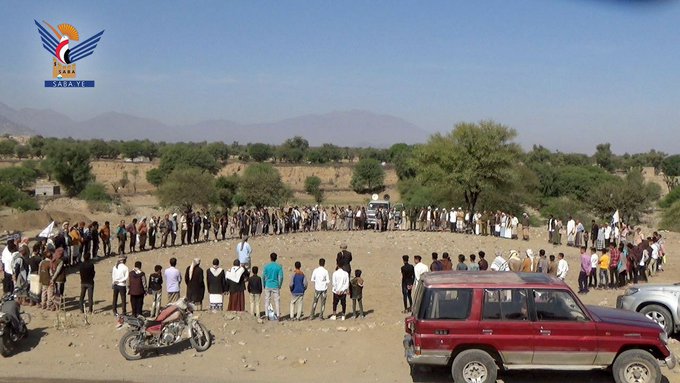
Sana’a – A private source to the Yemeni news agency, Saba, on Saturday denied the allegations made by the criminal US President Trump regarding what he described as the targeting of a secret meeting of military leaders preparing to carry out naval operations.
The source explained that the video clip published by the criminal Trump, claiming that it was a gathering of military leaders, was merely an event for a social Eid visit in Hodeida province. Similar events are held in various provinces on all holidays and occasions, and this is well known to all Yemeni people.
He emphasized that those present at that gathering had no connection to the operations carried out by the Yemeni Armed Forces, which are implementing the decision to ban navigation on ships linked to the American and Israeli enemy, as the criminal Trump claimed.
The source stated that this heinous American crime, which left dozens of martyrs and wounded, reflects the extent of America’s bankruptcy and failure in its aggression against Yemen, and that it is an extension of the genocide committed by the Israeli-American aggression in Gaza.
He stressed that this heinous crime will not be forgotten, and that the Yemeni armed forces, which stood up for the people of Gaza, will not let the blood of the Yemeni people go in vain.
Prof. JOHN MEARSHEIMER : ‘Ukraine Cannot Survive.’
Judge Napolitano – Judging Freedom | April 3, 2025
Video footage refutes IOF account of attack that killed 15 Gaza medics
Al Mayadeen | April 5, 2025
A video retrieved from the cell phone of a Palestinian paramedic, whose body was discovered alongside 14 other aid workers in a mass grave in Gaza in late March, shows clearly marked ambulances and a fire truck with emergency lights activated as they came under heavy Israeli gunfire, The New York Times reported on Friday.
During a press conference at the United Nations on Friday, officials from the Palestine Red Crescent Society (PRCS), moderated by the International Federation of Red Cross and Red Crescent Societies, said they had submitted the nearly seven-minute video to the UN Security Council.
Earlier in the week, Israeli military spokesperson Lt. Col. Nadav Shoshani denied that Israeli forces had “randomly” attacked an ambulance. He claimed that multiple vehicles had been seen “advancing suspiciously” without headlights or emergency signals toward Israeli troops, prompting the shooting. He also claimed that nine of the individuals killed were Palestinian Resistance fighters.
The Times acquired the footage from a senior UN diplomat who requested anonymity in order to share sensitive material. The location and time of the video, captured in Rafah in southern Gaza early on March 23, were verified by the newspaper.
Vehicles clearly marked
Shot from inside a moving vehicle, the footage depicts a convoy of ambulances and a fire truck, all clearly marked and displaying both headlights and flashing emergency lights, driving southward on a road north of Rafah just after sunrise.
The convoy halts when it comes across a damaged ambulance on the roadside—an earlier vehicle sent to aid injured civilians had reportedly come under attack. The new rescue vehicles move to the side of the road. At least two uniformed rescue workers are seen exiting the fire truck and ambulance, both bearing the Red Crescent emblem, and approaching the damaged vehicle.
Suddenly, intense gunfire erupts. The barrage of bullets can be seen and heard striking the convoy. The footage shakes and then goes dark, though the audio continues for five minutes with unrelenting gunfire. A man’s voice is heard in Arabic noting the presence of Israeli soldiers.
The paramedic filming the attack is repeatedly heard reciting the shahada, the Islamic declaration of faith typically spoken when facing death. He asks for forgiveness and expresses that he knows he is going to die.
“Forgive me, mother. This is the path I chose — to help people,” he says.
In the background, voices of distressed aid workers and shouted commands in Hebrew are audible, though the content of the Hebrew speech remains unclear.
According to PRCS spokesperson Nebal Farsakh, speaking from Ramallah, the paramedic who filmed the video was later found with a gunshot wound to the head in the mass grave. His identity has not been made public due to concerns for the safety of his family still living in Gaza, a UN diplomat confirmed.
‘Targeted from a very close range’
At the UN headquarters press conference, PRCS President Dr. Younis al-Khatib and Deputy Marwan Jilani said the evidence they had gathered—including the video, audio, and forensic analysis of the bodies—directly contradicts the Israeli military’s account.
The disappearance and subsequent discovery of the 15 aid workers, missing since March 23, have sparked global condemnation. Both the UN and PRCS maintain that the victims were unarmed and posed no threat.
“Their bodies have been targeted from a very close range,” indicated al-Khatib, criticizing “Israel’s” failure to provide information on the missing medics. “They knew exactly where they were because they killed them.”
“Their colleagues were in agony, their families were in agony. They kept us for eight days in the dark,” he said.
It took five days of negotiation between the UN, PRCS, and the Israeli military before safe access was granted to search for the missing. On Sunday, rescue teams recovered 15 bodies, mostly buried in a shallow mass grave, alongside crushed ambulances and a UN-marked vehicle.
Al-Khatib stated that one member of the Palestinian Red Crescent remains missing, and “Israel” has not clarified whether he is in custody or has been killed.
Dr. Ahmad Dhair, a forensic doctor at Nasser Hospital in Gaza, said he examined five of the aid workers’ bodies and found four had sustained multiple gunshot wounds, including to the head, chest, and joints.
“I think the scale of this crime should force, that it should oblige the international community to do more and not to accept that this would be another incident that goes in the files and be forgotten after a few days,” Jilani underscored.
According to the UN and PRCS, one Red Crescent paramedic in the convoy survived after being detained and later released by the Israeli military, and he provided a firsthand account confirming Israeli forces had opened fire on the medical convoy.
Dylan Winder, the International Federation of Red Cross and Red Crescent Societies’ representative to the UN, condemned the attack as an outrage, describing it as the deadliest incident involving Red Cross or Red Crescent workers worldwide since 2017.
Volker Turk, the UN High Commissioner for Human Rights, called for an independent investigation, warning that the incident raises “further concerns over the commission of war crimes by the Israeli military.”
US Bombing the Houthis is like Swatting at Buzzing Insects
By Seth Ferris – New Eastern Outlook – April 5, 2025
The U.S. bombing campaign against the Houthis is less about securing shipping routes and more about advancing broader geopolitical strategies tied to Israel, Iran, and U.S. domestic politics.
This headline is more than provocative, as it enshrines a critical analysis of what is going on, and this has little to do with the defense of shipping in the Red Sea and the Suez Canal, or how Houthis are trying to stand against the continuous genocide of Palestine. It has more to do with the Greater Israel project, keeping Netanyahu out of jail, and for Trump and Republicans to pay the piper for the campaign chest that secured the US election for Trump and his minions.
Attacking the Houthis is the preliminary step of a larger, interconnected geopolitical strategy that includes Greater Israel, shifting the focus from the disaster in Ukraine, and keeping the arms manufacturers as happy as hogs rolling in fresh crap.
On March 15th, too much fanfare from Trump, who promised to use “overwhelming lethal force” the US resumed bombing Houthi controlled Yemen, trying to defeat a movement that has been bombed by either the US or its regional allies such as Saudi Arabia and the Gulf states since 2014 when the Yemeni civil war broke out, with little real effect to date.
The ostensible cause of the attacks appears to have been the Houthi decision to reinstate its blockade of Red Sea traffic heading to Israel, in response to Israel reneging on its ceasefire commitments and blockading, and now, as of Tuesday, 18th March, bombing and invading the Gaza Strip, killing hundreds of civilians in the process.
American attacks on Yemen by the aircraft of the US Navy’s 5th fleet have certainly been spectacular, but their usefulness is seriously in doubt. Despite claims by the USN of strikes on military targets, the majority of casualties are seen to be civilians. US National Security Advisor Mike Waltz says that the Houthi blockade of Israel is causing 75% of US flagged ships to take the much longer route around Africa, and said about the US strikes:
“We’ve hit their headquarters,” Waltz said. “We’ve hit communications nodes, weapons factories and even some of their over-the-water drone production facilities.”
The Houthi leadership has strongly refuted these claims, with a spokesman saying:
“The pictures, scenes, evidence, types of victims, and testimonies of survivors from the targeted sites confirm that it is targeting residential neighbourhoods and innocent civilians, and provide conclusive evidence that the US is deliberately taking the lives of defenceless civilians and destroying the capabilities of our people.”
Given the horrendous rhetoric used by Trump in his posts on his Truthsocial site, where he accused the Houthis of being “barbarians” and went on to say:
“Watch how it will get progressively worse — It’s not even a fair fight, and never will be,” Trump added. “They will be completely annihilated!”
It seems pretty clear that the Houthis are right, and that the US is hitting civilian targets in frustration at not being able to identify legitimate military targets. Trump went on to threaten Iran, saying:
“Every shot fired by the Houthis will be looked upon, from this point forward, as being a shot fired from the weapons and leadership of IRAN, and IRAN will be held responsible, and suffer the consequences, and those consequences will be dire!”
Given Trump’s promises on the election campaign to stop wars, and bring peace, particularly to Ukraine, this rhetoric is rather an about-face. One can only come to the conclusion that Trump is trying to escape from the debacle in Ukraine by distracting the public with another war, this time against Yemen and, one fears, Iran, which also will benefit the real ruler of the US, Benjamin Netanyahu.
But how effective is this likely to be? I believe that in his hubris, egged on by the new Defense Secretary Pete Hesgith, a US Evangelical Christian and rabid Zionist, Trump is repeating the disastrous mistakes of a well-trodden US path of intervention and inevitable failure.
Firing drones and missiles at cargo ships bound for Israel, even without sinking any ships, is a victory for the Houthis, as it forces ships to take the long way around the Cape of Good Hope, and shows the world what the US can do in terms of air superiority is not enough, as to stop these attacks, you would need to send in ground troops, something the US administration would have to be mad to do, as the British could well attest to given their occupation of Yemen in the 19th and 20th centuries.
With regard to the intensity of US air attacks, as with any force of national liberation, like the Algerians, Vietnamese, Angolans, and many others in the 20th century, just surviving is already a form of victory for the Houthis. Every day they hold their ground, they rewrite the script a little. They’re showing that even without matching the U.S. or Saudi Arabia in terms of high-tech weaponry, they can still have massive strategic impact — like forcing global trade routes to detour thousands of miles. That’s asymmetrical warfare in full force.
As the US and its allies know only too well, U.S. air power, while impressive for breaking regular military formations, has a limit. It can punish, but it can’t control the terrain or win hearts and minds from 30,000 feet. Boots on the ground? That’s a whole different ballgame. Politically and militarily, there’s little appetite for another drawn-out Middle East quagmire. The U.S. knows how that ends, Israel knows too!
This whole horse and pony show is becoming a test of global logistics and willpower — not just firepower. The Houthis have leveraged a relatively small amount of resources to cause ripple effects across oil markets, insurance premiums, and shipping delays — even reshaping how the world thinks about “secure” sea lanes. Their damage to the economies of their enemy Israel, and its backers in the US and EU, is out of all proportion to the money spent by themselves.
This is also reflected in the weaponry used, with relatively cheap drones and ballistic missiles needing to be countered by vastly more expensive US air defense missiles and extremely expensive guided bombs. The previous, spectacularly unsuccessful, campaign “Operation Prosperity Guardian” to bring the Houthis to heel after they put a blockade on Israel in response to the genocidal campaign in Gaza, saw vast expenditure of hideously expensive US missiles which were used to shoot down drones that cost around US$ 20,000 per shot:
According to the Missile Defense Advocacy Alliance (as of 2022), the SM-2 costs $2.1 million per unit; the SM-6 costs $4.3 million; and the ESSM Sea Sparrows costs $1.7 million. The destroyers are also fitted with the Rolling Airframe missile, which cost $905,000 in 2022
Nothing of any note has been achieved in cost reduction since then, and the Houthis are repeatedly striking back, with at least four attacks on the USS Harry S Truman and its escorting vessels, forcing rapid expenditure of these expensive weapons, as well as disrupting US strikes. It is no surprise that their resistance is being downplayed by the US, but the reality is that the US is being forced to send a second carrier group, led by the USS Carl Vinson, to support the 5th Fleet strikes.
This does not bode well, with escalation looming, with a joint US strike on Iran likely. One can only think that, drunk with success regarding their overthrow of Assad in Syria, and forgetting their obvious failure to subdue either Hamas in Gaza, or Hezbollah in Lebanon, the US and Israel want to play the same game with Iran, using Yemen as the trigger, which is almost certainly a major miscalculation.
It as if they are the drunk guy in the casino, who rather than accept his losses, has taken one small win after a series of losses, and bet the house on the result. Iran is a major regional power, with a well-organized, equipped, and trained armed forces, backed by a much greater population than Iraq and Syria combined, and with its own fully developed and capable defense industry.
As for the Houthis, like all guerilla and national liberation forces, the case is that “If they are not losing, they are winning” but are they playing the smart long-term game, or are they at risk of overplaying their hand if this drags out too long? It might only take one incident of them attacking the wrong ship, hitting a neutral vessel and inflicting casualties, and the worldwide support they have garnered by their principled stand in support of the Palestinians, and their bravery in their David vs Goliath battle with Israel and the US, could disappear.
Seth Ferris, investigative journalist and political scientist, expert on Middle Eastern affairs
David’s Corridor: Israel’s shadow project to redraw the Levant
Through ‘David’s Corridor,’ Israel aims to forge a geopolitical artery stretching from occupied Golan to Iraqi Kurdistan, reshaping West Asia
By Mahdi Yaghi | The Cradle | April 4, 2025
In recent years, the Zionist idea of “David’s Corridor” has surfaced in Tel Aviv’s strategic and political discourse on the reshaping of its geopolitical influence in the Levant. Though the Israelis have made no official announcement, analysts have pointed to this corridor as a covert project aimed at linking Kurdish-controlled northern Syria – backed by the US – to Israel via a continuous land route.
The so-called David’s Corridor refers to an alleged Israeli project to establish a land corridor stretching from the occupied Syrian Golan Heights through southern Syria to the Euphrates River. This hypothetical route would traverse the governorates of Deraa, Suwayda, Al-Tanf, Deir Ezzor, and the Iraqi–Syrian border area of Albu Kamal, providing the occupation state with a strategic overland channel into the heart of West Asia.
A biblical blueprint
Ideologically, the project is rooted in the vision of “Greater Israel,” an expansionist concept attributed to Zionism’s founder, Theodor Herzl. The vision draws on a biblical map extending from Egypt’s Nile to Iraq’s Euphrates.
Dr Leila Nicola, professor of international relations at the Lebanese University, tells The Cradle that David’s Corridor embodies a theological vision requiring Israeli control over Syria, Iraq, and Egypt – a triad central to both biblical lore and regional dominance. Regional affairs scholar Dr Talal Atrissi echoes this view, believing that developments in Syria have lent new geopolitical realism to Israel’s historical ambitions.
Unsurprisingly, the proposed corridor is a lightning rod for controversy, seen by many as a strategic bid to expand Israeli hegemony. Yet significant barriers stand in its way. As Atrissi notes, the corridor cuts through volatile terrain, where actors like Iraq’s Popular Mobilization Forces (PMF) remain formidable spoilers. Even a minor act of sabotage could disrupt the project, particularly given the absence of a stable regional environment needed to sustain such a sensitive and expansive route.
Strategically, David’s Corridor aligns with Israel’s enduring policy of cultivating ties with regional minorities – Kurds, Druze, and others – to offset hostility from Arab states. This decades-old “peripheral alliance” strategy has underpinned Israeli support for Kurdish autonomy since the 1960s. The project’s biblical symbolism of expanding “Israel” to the Euphrates, and its strategic calculus, combine to make the corridor both a mythological promise and a geopolitical asset.
Nicola further contextualizes this within the framework of the “ocean doctrine,” a policy Israel pursued by courting non-Arab or peripheral powers like the Shah’s Iran and Turkiye, and forging alliances with ethnic and sectarian minorities in neighboring states.
The doctrine aimed to pierce the Arab wall encircling Israel and extend its geopolitical reach. David’s Corridor fits snugly within this paradigm, drawing on both spiritual mythology and strategic necessity.
Syria’s fragmentation: A gateway
The collapse of former Syrian president Bashar al-Assad’s government and the rise of Ahmad al-Sharaa’s Al-Qaeda-linked Hayat Tahrir al-Sham (HTS) have accelerated Syria’s internal fragmentation. Sharaa’s administration inked deals with the US-backed Syrian Democratic Forces (SDF), integrating Kurdish-controlled areas into the nominal Syrian state while cementing Kurdish autonomy. In Suwayda, a separate agreement preserved Druze administrative independence in exchange for nominal state integration.
But Atrissi warns that such sectarian autonomy, even if pragmatic for containing tensions in the short term, risks entrenching divisions and inviting foreign meddling. He notes that the trauma of massacres on Syria’s coast has left minorities, especially the Alawites, deeply skeptical of the central authority in Damascus, pushing them toward local power arrangements. Israel, with its historical penchant for minority alliances, sees an opportunity to entrench its influence under the guise of protection.
Israel’s longstanding partnership with Iraqi Kurdistan is a case in point – a strategic relationship that offers a blueprint for replication in Syria. David’s Corridor, in this reading, is less a logistical imperative and more a political ambition. Should conditions allow, the occupation state may leverage the corridor to encircle Iran and redraw regional fault lines.
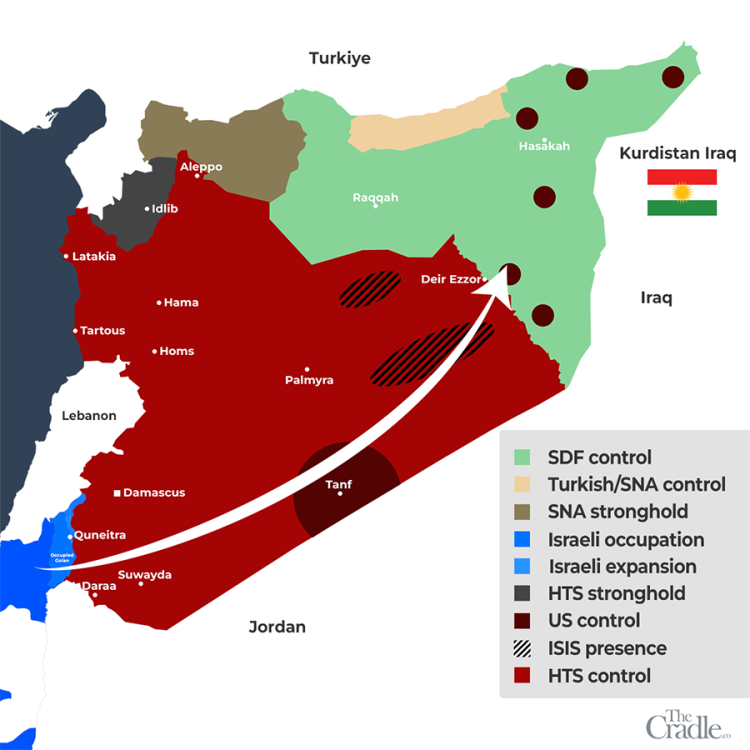
A map of the proposed David’s Corridor
A corridor of influence, not infrastructure
From Tel Aviv’s perspective, southern Syria is now a strategic vacuum: Syria’s army is weakened, Turkiye is entangled in its own Kurdish dilemmas, and Iran is overstretched. This power void offers fertile ground for Israel to assert dominance, particularly if regional dynamics continue to favor decentralized, weak governance.
Despite Washington’s reduced military footprint, the US remains committed to containing Iran. Key outposts like the Al-Tanf base on the Syrian–Iraqi border are instrumental in severing the so-called Iranian land bridge from Tehran to Beirut.
Nicola argues that while David’s Corridor is not an explicit US policy, Washington is likely to support Israeli initiatives that align with American strategic goals:
“The United States does not mind Israel implementing the project if it serves its interests, even though it is not part of its immediate strategy. It focuses on reducing Iran’s influence and dismantling its nuclear program, while supporting the path of regional normalization with Tel Aviv.”
The 2020 Abraham Accords, by easing Israel’s diplomatic isolation, have created additional maneuvering space. David’s Corridor – once a fantasy – now appears more plausible amid the regional flux.
Israeli leaders have sent unmistakable signals. On 23 February, Israeli Prime Minister Benjamin Netanyahu rejected any Syrian military presence south of Damascus, insisting on demilitarized zones in Quneitra, Deraa, and Suwayda under the pretext of protecting Syria’s Druze minority.
Israeli Foreign Minister Gideon Saar openly advocated for a federal Syria – a euphemism for fragmentation. Defense Minister Israel Katz vowed that Israeli troops would remain indefinitely in Mount Hermon and the Golan, and called for the dismantling of Syria into federal entities. Media leaks of corridor maps have only fueled speculation.
These moves have triggered outrage in southern Syria, with protests erupting in Khan Arnaba, Quneitra, Nawa, Busra al-Sham, and Suwayda. Yet, as Nicola notes, the new Syrian leadership appears remarkably disinterested in confronting Israel, and Arab states remain largely indifferent, even as the project edges toward realization. Turkiye, by contrast, stands firmly opposed to any Kurdish-led partition of Syria.
Geopolitical stakes and final frontiers
Ultimately, David’s Corridor signals a broader Israeli project to reengineer Syria’s geopolitics: isolate the south militarily, bind the Kurds in alliance, shift the balance of power, and carve a corridor of influence through fractured terrain.
Israel’s objectives are layered. Militarily, the corridor provides strategic depth and disrupts Iran’s land routes to Hezbollah. It enables the flow of arms and intelligence support to allies, especially Kurdish forces.
Economically, it opens a potential oil pipeline from Kirkuk or Erbil – Kurdish-majority, oil-rich areas – to Haifa, bypassing Turkish routes and maritime threats from actors like Yemen’s Ansarallah-allied army. Politically, it solidifies Israeli–Kurdish ties, undermines Syrian and Iraqi sovereignty, and advances the vision of Greater Israel, with the Euphrates as a symbolic frontier.
Yet the corridor is not without risk. It threatens to deepen the region’s instability, antagonize Syria, Turkiye, Iran, and Iraq, and trigger new fronts of resistance. Whether Israel can realize this project depends on the fluid regional calculus and its ability to maneuver within it.
David’s Corridor may still be a project in the shadows – but its implications are already casting a long one across the region.
Policy Reversal: Why Is the U.S. Softening Its Position on Iran?
By Viktor Mikhin – New Eastern Outlook – April 5, 2025
In Recent Days, the Trump Administration—Known for Its Hardline Stance on Iran—Has Shown Unexpected Shifts in Rhetoric.
U.S. Special Envoy for Middle East Affairs Steven Whitcoff, who previously advocated for a policy of “maximum pressure” on Tehran, now speaks of the need for “confidence-building” and “resolving disagreements.” This sharp turn in foreign policy strategy raises many questions: What exactly prompted Washington to change its approach? What factors influenced the decision to soften its stance? And most importantly—does the U.S. have a real plan of action, or is this just a temporary tactical maneuver?
An analysis of the situation suggests that the policy shift is tied to a combination of factors—from the failure of sanctions to the Trump administration’s domestic political calculations. Additionally, Iran’s response and that of the international community play a key role in determining how events will unfold.
The Failure of “Maximum Pressure”
In 2018, the U.S. unilaterally withdrew from the Joint Comprehensive Plan of Action (JCPOA), expecting that harsh sanctions would force Iran to make concessions. The Trump administration believed economic strangulation would either lead to regime change in Tehran or its surrender on the nuclear issue. However, these calculations proved wrong.
Instead of backing down, Iran responded by escalating its nuclear activities. According to the IAEA, Tehran has significantly increased its stockpile of enriched uranium and begun developing more advanced centrifuges. Moreover, the country strengthened ties with Russia and China, finding alternative ways to bypass sanctions. As a result, the “maximum pressure” policy not only failed to achieve its goals but, from Washington’s perspective, worsened the situation by bringing Iran closer to developing nuclear weapons.
Now, Washington seems to have realized that isolating Iran hasn’t worked and is attempting to shift to diplomatic methods. The question, however, is whether it’s too late—Tehran, hardened by bitter experience, is unlikely to agree to new negotiations without serious guarantees.
Another reason for the policy shift may be domestic U.S. issues. Facing economic challenges and a lack of clear successes, President Trump urgently needs a foreign policy win that can be framed as a major achievement of his so-called “new approach.” A full-scale war with Iran is too risky—a scenario that could spell disaster for both the region and the U.S. itself. Thus, the administration is likely betting on a temporary agreement that can be marketed as a “diplomatic breakthrough.” However, this approach risks new problems—if the deal proves short-lived, it will further erode international trust in the U.S.
Internal Divisions in U.S. Leadership
The rhetorical shift also reflects deep divisions within the American leadership. While some officials, like Steven Whitcoff, advocate for negotiations, others—including National Security Advisor Mike Waltz—continue to insist on Iran’s complete abandonment of its nuclear program. These contradictions indicate a lack of a unified strategy.
Part of the administration appears to recognize the futility of further pressure, while another faction remains committed to a hardline approach. This division makes any long-term U.S. strategy unstable—a change in administration or even a shift in Congressional power dynamics could undo any agreements reached. Such confusion weakens the effectiveness of U.S. policy and gives Iran additional leverage.
Iran’s Response: Why Tehran Doesn’t Trust the U.S.
Iranian leaders remain deeply skeptical of Washington’s new overtures. Supreme Leader Ayatollah Khamenei has repeatedly stated that “threats and bribes do not work on Iran.” The experience of the 2015 JCPOA showed that the U.S. could abandon the deal at any moment, even if Iran fully complied.
After Washington’s unilateral withdrawal, Tehran lost faith in American guarantees. Now, Iran’s leadership demands not only sanctions relief but also legally binding commitments to prevent the U.S. from reneging again.
The situation is further complicated by internal political struggles in Iran. Conservative factions, empowered after the JCPOA’s collapse, oppose any concessions to the West. Additionally, Iran has adapted to sanctions by finding alternative oil markets and deepening cooperation with China and Russia. This reduces the effectiveness of U.S. pressure and diminishes Tehran’s incentives to compromise.
Even Washington’s closest allies, like Israel, have expressed discontent with the policy shift. Prime Minister Benjamin Netanyahu stated he distrusts new negotiations with Iran and views any concessions as dangerous.
European nations, however, have long called for renewed dialogue. Germany, France, and the UK—who remained in the JCPOA after the U.S. exit—hope for de-escalation. Yet their influence is limited, as key decisions are made in Washington and Tehran.
Currently, negotiations remain at an impasse. The U.S. offers dialogue but maintains sanctions, while Iran refuses concessions without guarantees. Experts believe Trump is attempting a “good cop, bad cop” tactic, similar to his approach with North Korea. However, unlike in 2015, Tehran is no longer willing to negotiate under pressure. Iranian leaders recognize that time is on their side—the longer the U.S. fails to achieve its goals, the weaker its position becomes.
A Way Out?
An exit from the deadlock—which the U.S. created in its relations with Iran—was discussed during recent trilateral talks between China, Russia, and Iran in Beijing. The meeting produced a comprehensive initiative to resolve the Iranian nuclear issue, based on five principles:
- Peaceful Solutions Over Sanctions: All parties must reject coercive pressure and illegal restrictions, prioritizing dialogue. Conditions for renewed negotiations must be created while avoiding escalatory steps.
- Balancing Rights and Obligations: Iran must uphold its commitment against nuclear weapons development, while the international community recognizes its right to peaceful nuclear energy under the NPT.
- Returning to the JCPOA as a Foundation: The initiative calls for renewed focus on the JCPOA, urging the U.S. to demonstrate goodwill and rejoin the process.
- Dialogue Over UN Pressure: Premature involvement of the UN Security Council would undermine trust and stall progress. Confrontational mechanisms would negate years of diplomacy.
- Gradual Steps and Mutual Compromises: Forceful methods are ineffective—only equal consultations can produce a compromise respecting all parties’ interests and global demands.
The softening of U.S. rhetoric is a clear sign that “maximum pressure” has failed. Yet without real concessions and guarantees, negotiations are unlikely to yield a breakthrough. Iran has learned to play the long game, leaving Washington with a choice: serious, equal-footed dialogue or further escalation with unpredictable consequences. For now, the situation remains in limbo, with neither side willing to make the first move.
Viktor Mikhin, Corresponding Member of the Russian Academy of Natural Sciences (RAEN), Expert on Arab World Affairs
Featured Video
The Board For Peace – Whitewashing Ethnic Cleansing and Genocide
or go to
Aletho News Archives – Video-Images
Book Review
Conspiracy Denial

Lies are Unbekoming | January 27, 2026
In honour of Michael Parenti (1933–2026), who passed away on 24 January 2026 at the age of 92. He spent his life naming what power prefers to leave unnamed.
In 1837, Abraham Lincoln remarked: “These capitalists generally act harmoniously, and in concert, to fleece the people.”
Today, he would be dismissed as a conspiracy theorist.
That dismissal—reflexive, automatic, requiring no engagement with evidence—is not a mark of sophistication. It is a tell. The question worth asking is not whether conspiracies exist (they are a matter of public record and a recognised concept in law) but why acknowledging their existence provokes such reliable hostility. What work does the label “conspiracy theorist” actually do?
The late political scientist Michael Parenti spent decades answering that question. His conclusion was blunt: “’Conspiracy’ refers to something more than just illegal acts. It serves as a dismissive label applied to any acknowledgment of ruling-class power, both its legal and illegal operations.” The term functions not as a descriptor but as a weapon—a thought-terminating cliché that protects the powerful from scrutiny by pathologising those who scrutinise them.
Conspiracy denial, in Parenti’s analysis, is not skepticism. It is the opposite of skepticism. It is credulity toward power dressed up as critical thinking. As he wrote in Dirty Truths: “Just because some people have fantasies of conspiracies does not mean all conspiracies are imaginary.” … continue
Blog Roll
Recent Comments
eddieb on WEF Calls for ‘Cultural Revolu… loongtip on Trump wanted to play peacemake… Coronistan on EU member to sue bloc over ‘su… loongtip on Vicious loongtip on EU turns to India for defense… Coronistan on Donald Trump Is No Peace … seversonebcfb985d9 on French court jails pro-Palesti… eddieb on Fourteen Incredible Facts Abou… Bill Francis on European leaders’ shift in the… seversonebcfb985d9 on Villains of Judea: Philip Esfo… loongtip on Report warns that ‘Jewish terr… Craig Nelms on New study shows that toxic gas…


 Aletho News
- Davos and Abu Dhabi: How the Ukrainian Endgame Exposed Western Decline
- AfD co-leader states the obvious: Pouring money into the Ukraine war is killing the German economy
- Britain’s return to piracy to stop Russian ships – desperate attempt to demonstrate power
- Czech coalition rules out higher defense spending, says 2% of GDP is enough
- G7 Hands Ukraine $40Bln Generated From Frozen Russian Assets
- Conspiracy Denial
- Ukraine expects to join EU next year – Zelensky
- Here’s what’s behind the US shift on EU allies
- UN experts alarmed by prosecution of students protesting ETH Zurich’s Israel-linked research ties
- Exposed – How the UAE Became Central to Gaza’s Concentration Camp Plot
- If Americans Knew
- “The Gaza ceasefire is a minefield” – Not a ceasefire Day 110
- Israel to seek new security deal from US, official says
- Leaked “Board of Peace” Resolution Outlines U.S.-Led Plan to Rule Over Gaza
- Jonathan Greenblatt Rolls Out Plan to Activate Hispanic Evangelical Golems
- Violence against hundreds of Gazan remains to find one Israeli – Not a ceasefire Day 109
- Greenpeace Demonstrator Exposes Folly of Protest Restrictions
- From CBS to TikTok, Pro-Israel Ellison is now in the driver’s seat
- Israel pays for UK advertisements attacking Doctors Without Borders
- Israel accused of extracting billions from Gazan people to pay for their own genocide
- ‘Deliberate Assassination’: 3 Journalists Among 11 Killed by Israeli Forces in Gaza
- No Tricks Zone
- New Study Affirms Rising CO2’s Greening Impact Across India – A Region With No Net Warming In 75 Years
- Germany’s Natural Gas Crisis Escalates … One Storage Site Near Empty …Government Silent
- Polar Colding…Antarctica Saw Its Coldest October In 44 Years!
- New Study: Sea Levels Rose 20 Times The Modern Rate During The Roman Warm Period
- As German Gas Storage Dips Dangerously Low…Shortage Hardly Avoidable
- New Study: Brazil’s Relative Sea Level Was 2+ Meters Higher And SSTs 3-4°C Warmer 6000 Years Ago
- Philosopher Schopenhauer: Climate Science Certainty Stems From Stupidity, Ignorance
- New Study: Species Extinction Rates Declining Since 1980 – ‘Climate Change Is Not An Important Threat’
- Denmark Places Climate Protection Above Animal Welfare, Poisoning And Culling Cows
- New Study: Greenland Was 3-7°C Warmer And Far Less Glaciated Than Today 6000-8000 Years Ago
 Aletho News