Iran will admit students expelled from US as part of Trump’s crackdown on pro-Palestine protests
Press TV – March 30, 2025
Iran’s academic officials have declared the Islamic Republic’s unwavering support for students and academics who have been targeted by the Trump administration’s crackdown on pro-Palestinian protesters on university campuses.
Officials from Iran’s academic institutions said in a joint statement on Sunday that the country’s universities “take pride in extending their support” to students protesting “the crimes of the Zionist regime” in the US.
“The acts of global arrogance in suppressing justice-seeking students and expelling them from American universities after their peaceful protests against the atrocities committed by the Zionist regime against the oppressed people of Palestine have further unveiled the true nature of those who claim to advocate for human rights,” the statement read.
Iran’s universities, it said, are ready to accept students who are being expelled by US immigration officials for showing sympathy for the Palestinian cause.
Iran’s Supreme Council of the Cultural Revolution (SCCR), in collaboration with the Academy of Sciences and the Academy of Medical Sciences, will facilitate the admission of expelled students into Iranian universities.
President Donald Trump has begun following through on a threat to deport all non-citizen university activists with ties to the pro-Palestine protests, which rocked the US last spring, with students staging daily protests in college campuses across the country for weeks.
The crackdown intensified since US immigration agents arrested Mahmoud Kahlil, a graduate of Columbia University, on March 8. Kahlil, who is being held in an immigration detention center in Louisiana, faces deportation for his role in pro-Palestinian campus protests.
Secretary of State Marco Rubio, who personally signed off on his arrest, said on Thursday that Washington has revoked at least 300 foreign students’ visas.
“Maybe more than 300 at this point,” he said. “We do it every day, every time I find one of these lunatics.”
Trump officials have accused these students of being “adversarial to the foreign policy and national security interests” of the US.
Hamas Agrees to New Gaza Ceasefire Proposal: Armed Resistance “Red Line”
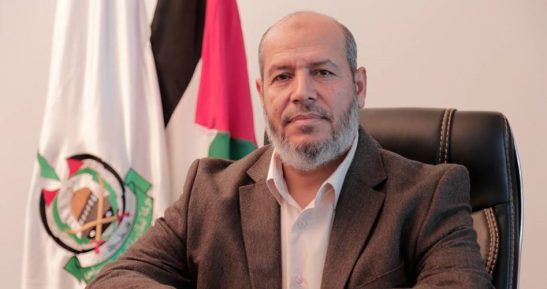
Head of Hamas in Gaza Khalil Al-Hayya
Al-Manar | March 30, 2025
Hamas said on Saturday it had approved a proposal from mediators for a ceasefire in the Gaza Strip, which it received two days earlier.
“In our commitment to our people and families, we have engaged with all proposals responsibly and positively, aiming to end the war,” Khalil Al-Hayya, head of Hamas in Gaza Khalil Al-Hayya, said in a statement.
“Two days ago, we received a proposal from our mediator brothers. We responded positively and approved it. We hope the occupation does not obstruct it or undermine the mediators’ efforts,” the statement added.
The statement also reaffirmed Hamas’ stance on armed resistance, calling it a “red line” and warning that “the weapon of resistance” will remain in the hands of the people and the state “if the Israeli occupation persists.”
“We will never accept humiliation or disgrace for our people. There will be no displacement or deportation,” it added.
Hamas further stated that, along with other factions, it had submitted to Egypt a list of independent professionals and experts to help form a committee to manage the enclave.
Israeli occupation forces resumed strikes in Gaza on March 18, ending a ceasefire agreement with Hamas that started on January 19. More than 50,000 Palestinians have been killed by the Israeli war on Gaza.
Hamas released on Saturday a video that shows one of the Israeli captives it is still holding on Gaza. The video showed him pleading the Zionist PM Netanyahu to approve an exchange deal in order to see his son.
Despite the intensive mediation efforts for a ceasefire, the Israeli Occupation Army said in a statement that its troops have begun new ground operations in the Al Janina area in Rafah, southern Gaza, aimed at expanding the security zone.
Anti-genocide activists exposed by pro-Israel groups using facial recognition tech
The Cradle | March 30, 2025
Foreign activists who took part in widespread campus protests against US support for the Israeli genocide of Palestinians in Gaza are being exposed by pro-Israel groups using facial recognition technology and tip lines, according to an investigation by AP.
Zionist organization Betar US has reportedly submitted a list of identified protesters to US federal officials. The list was compiled with the help of Eliyahu Hawila, a New York-based software engineer who built a facial recognition tool called NesherAI designed to identify masked protesters.
“It’s a very concerning practice,” said Abed Ayoub, National Executive Director of the American-Arab Anti-Discrimination Committee. “Essentially, the administration is outsourcing surveillance.”
Since the return of US President Donald Trump to power, the Immigration and Customs Enforcement (ICE) agency and the Department of Homeland Security (DHS) have detained or deported at least nine foreign university students for their activism in support of Palestine and against the US-Israeli genocide.
“Now they’re using tools of the state to actually go after people,” a Columbia graduate student from South Asia who has been active in protests told AP. “We suddenly feel like we’re being forced to think about our survival.”
“It might be more than 300 at this point. We do it every day. Every time I find one of these lunatics, I take away their visa,” State Secretary Marco Rubio said earlier this week when asked about the ongoing crackdown on pro-Palestinian students and academics.
“Please tell everyone you know who is at a university to file complaints about foreign students and faculty who support Hamas,” Elizabeth Rand, president of a group called Mothers Against Campus Antisemitism, said in a 21 January post to more than 60,000 followers on Facebook. It included a link to an ICE tip line.
In early February, messages from a chat group frequented by Israelis living in New York were published online. “Do you know students at Columbia or any other university who are here on a study visa and participated in demonstrations against Israel?” one message said in Hebrew. “If so, now is our time!” the message adds, accompanied by a link to the ICE hotline.
Earlier this week, Axios reported that the White House is threatening to block certain colleges from having any foreign students if it decides too many are involved in protests against Israel’s genocide in Gaza.
The war over war with Iran has just begun
By Sina Toossi | Responsible Statecraft | March 28, 2025
The war drums are getting louder in Washington.
In recent weeks, many of the same neoconservative voices who pushed the U.S. into Iraq are calling for strikes on Iran. Groups like the Foundation for Defense of Democracies and the Washington Institute for Near East Policy are once again promoting confrontation, claiming there may never be a better time to act. But this is a dangerous illusion that risks derailing what Donald Trump himself says he wants: a deal, not another disastrous war in the Middle East.
A war with Iran wouldn’t just risk another endless conflict. It would blow up Trump’s broader agenda at home and abroad.
A major conflict would drain U.S. resources and attention, distracting from domestic priorities and weakening America’s leverage on every front: China, Russia, Europe, and trade. Europe could seize the moment to prolong support for the war in Ukraine and resist Trump’s push to reset transatlantic ties. Trade partners like Mexico, Canada, India, and others could take advantage of America’s preoccupation to extract lop-sided concessions. And a unilateral strike would likely fracture the international community.
Russia and China, despite their own misgivings about Iran’s nuclear ambitions, would point to U.S. aggression as the real threat, undermining American credibility at the United Nations and beyond.
And the most dangerous consequence? A strike could backfire and push Iran to do exactly what Trump says he wants to prevent: build a bomb. Iran is already enriching uranium near weapons-grade. If it withdraws from the Nuclear Non-Proliferation Treaty, the last threads of international oversight would disappear. An attack would likely galvanize even more hardline elements in Iran and provide the political justification to sprint for a nuclear weapon.
Trump could go down in history, not as the president who solved the Iran crisis, but as the one under whose watch Iran finally became a nuclear weapons state. That’s not the legacy he wants, or one the country can afford.
Raising alarms, Trump recently declared, “Something will happen to Iran soon.” But he also made clear, “Hopefully, we can have a peace deal. I’m not speaking out of strength or weakness, I’m just saying I’d rather see a peace deal than the other.” These are not the words of a warmonger. They are the words of a negotiator, someone who still sees the value in diplomacy.
Trump is not alone. In a recent interview with Tucker Carlson, his foreign policy envoy Steven Witkoff offered a notably more restrained perspective on Iran than is typical from the foreign policy establishment. Witkoff emphasized pragmatism, verification, mutual respect, and, most importantly, avoiding conflict. His remarks reflected a grounded approach rooted in a clear understanding of both American interests and the region’s complex dynamics.
The problem is that many of the loudest voices shaping Iran policy — inside and outside the government — are actively working to sabotage any realistic path to diplomacy. They talk about wanting a “deal,” but what they’re actually demanding is Iran’s surrender: zero uranium enrichment, dismantling its nuclear program, cutting ties with all its regional allies, and fundamentally changing its foreign policy. No Iranian government — pragmatist or hardliner — could accept such terms. Even Masoud Pezeshkian, Iran’s newly elected president who ran on a platform of diplomacy and engagement, would have no political space to agree to that kind of ultimatum.
Let’s be clear: if you’re pushing for such maximalist demands under the guise of wanting a deal, you’re not working for peace. You’re laying the groundwork for war.
Iran is a complicated actor with a complicated history. But the lessons of the past decade are clear: when the U.S. engages Iran through diplomacy, it gets results. When it relies solely on pressure, it inches closer to conflict.
The point of pressure has always been to create leverage, not to impose costs for their own sake. That leverage now exists. The question is what to do with it.
The 2015 nuclear deal was far from perfect for any side, but it did succeed in placing tight constraints on Iran’s nuclear program and subjected it to unprecedented international inspections. The aim of withdrawing from that deal was to compel Iran to accept stronger terms. That hasn’t happened.
Instead, the result has been several years of Iranian nuclear expansion, regional instability, and growing alignment between Tehran, Moscow, and Beijing. Iran is now enriching uranium to 60% — dangerously close to weapons-grade — and stockpiling far more than before. Meanwhile, the international consensus that once backed U.S. efforts has frayed.
Now is the time to cash in on current U.S. pressure. Not by continuing on an escalatory path that leads to war, but by using the leverage that’s been built to strike a better deal — one that delivers strong constraints, more transparency, and greater long-term security for the United States.
Against this backdrop, hawkish voices are once again pushing the illusion that striking Iran would be quick and effective. A recent report from the Washington Institute for Near East Policy (WINEP) claims Israel’s alleged deep intelligence reach and risk tolerance make a “preventive strike” against Iran potentially “much more successful” than past American efforts, like when the U.S. attacked nuclear targets in Iraq in 1991 and 1993. But this dangerously downplays the risks. Even Trump’s allies are urging caution.
Vice President J.D. Vance, for example, rightly cautioned last October that “America’s interest is sometimes going to be distinct” from Israel’s — and made clear that avoiding war with Iran is in the U.S. interest. He warned such a conflict would be “massively expensive” and a “huge distraction of resources.” The reality is that a strike might at best delay Iran’s program while likely sparking a regional war, endangering U.S. troops, and pushing Iran to weaponize.
Indeed, even the same WINEP report that touts the feasibility of a strike quietly acknowledges the scale of what it would entail: “an open-ended, multiyear campaign to degrade Iran’s nuclear capabilities, influence its nuclear proliferation calculus, and shape its political and military responses.” In other words, this wouldn’t be a quick, surgical strike; it would be the beginning of another endless war in the Middle East.
Such a conflict would also carry steep economic costs, from skyrocketing oil prices to instability across the Middle East. And it would almost certainly backfire politically: Americans are war-weary, and polls show overwhelming support for diplomacy over conflict.
What’s needed now is a pragmatic strategy to de-escalate and reengage — one that offers Iran credible incentives in exchange for verifiable nuclear limits but doesn’t require dismantling its entire program.
The Iranian leadership has shown a consistent pattern in its dealings with the United States: pressure is met with pressure, while concessions are met with reciprocal steps. History has made clear that what moves the needle is not ultimatums, but a formula grounded in mutual respect, trust-building, and incremental, verifiable actions. Witkoff’s recent interview signaled a welcome openness to serious diplomacy, but rhetoric alone is not enough. To resonate in Tehran, it must be paired with credible, calibrated actions.
Modest, realistic steps — such as allowing a limited release of Iran’s frozen assets for humanitarian purposes or reviving President Emmanuel Macron’s 2019 proposal for a credit line backed by future oil revenues — would not require lifting core U.S. sanctions. Yet they could offer enough tangible benefit to bring Iran to the table. These measures should be linked to parallel Iranian concessions, such as slowing the accumulation of highly enriched uranium and enhancing IAEA access.
Another option is a negotiated “pause:” a fixed-duration agreement where the U.S. freezes further escalation of sanctions and refrains from imposing new pressure, while Iran halts key elements of its nuclear expansion. This mutual freeze could serve as a time-bound window for more comprehensive talks — buying time, lowering tensions, and creating space for diplomacy to succeed.
Critics will claim this approach “rewards bad behavior.” But the real question isn’t about rewarding anyone, it’s about results. What actually reduces the risk of Iran getting a nuclear weapon or dragging the U.S. into another endless war? The record speaks for itself: pressure detached from feasible diplomatic outcomes hasn’t delivered results. In fact, pressure for its own sake has backfired — driving Iran’s nuclear program forward and repeatedly bringing the U.S. to the brink of conflict.
Some will say Iran cannot be trusted. That’s precisely why inspections and verification are essential. When a deal was in place, international inspectors had access to Iran’s nuclear facilities, and the program was significantly constrained. Military strikes, by contrast, would likely end all transparency and push Iran to withdraw from the Non-Proliferation Treaty, eliminating the last tools for monitoring and oversight.
There’s no perfect deal. But the smart play is a deal that contains Iran’s nuclear program, avoids a war, and keeps the U.S. in the driver’s seat. That should be the goal of any serious policy, not wishful thinking or ideological crusades.
President Trump has always seen himself as a dealmaker. Now’s the moment to make one that matters. He should empower voices in his camp — like Steven Witkoff — who understand that diplomacy isn’t weakness, it’s strategy. Rejecting the tired playbook of regime change and endless escalation would show real leadership.
Sina Toossi is a non-resident fellow at the Center for International Politics. Previously he was senior research analyst at the National Iranian American Council, and a research specialist at Princeton University’s Woodrow Wilson School of Public and International Affairs.
From JFK to Donald Trump: How the USA Became Wedded to Zionist Israel
By Rick Sterling | Global Research | March 28, 2025
There are many contrasts between the 35th president, John F. Kennedy, and the 45th and 47th president, Donald J. Trump. One extreme example is regarding U.S. policy toward Israel.
JFK and Israel/Palestine
Unknown to many people today, JFK supported Palestinian rights and sought a sustainable peace in the region.
In 1960, when JFK was campaigning to be president, he spoke at the convention of the Zionists of America. In his speech, Kennedy was complimentary about Israel but frankly said,
“I cannot believe that Israel has any real desire to remain indefinitely a garrison state surrounded by fear and hate.”
That warning, issued when Israel had only existed for 12 years, was ignored. Israel continued to act in an aggressive zionist fashion.
Kennedy did not just issue warnings. To the chagrin of the Israelis, JFK established friendly relations with Egypt’s President Nasser. The Kennedy administration provided loans and aid to Egypt.
The JFK administration supported UN resolution 194 which called for the right of return for Palestinian refugees driven out of their homeland. Although Israel committed to abide by UN resolutions when it was admitted to the United Nations in 1949, the Israelis reneged on this commitment and were hostile to the resolution. The day before JFK was assassinated, the New York Times reported (p 19), “Israel Dissents as U.N. Group Backs U.S. on Arab Refugees” and “U.S. Stand Angers Israel.” The second item begins, “Premier Levi Eshkol expressed extreme distaste today for the United States’ position in the Palestinian-refugee debate.”
John Kennedy’s brother Robert was Attorney General and headed the Department of Justice. For two years, up until the end of 1963, the DOJ made increasingly strict demands that the American Zionist Council (AZC) register as agents of a foreign country. In response, the AZC stalled, delayed, and created the American Israel Public Affairs Committee (AIPAC).
The most intense disagreement between Tel Aviv and Washington was regarding the nuclear site under construction at Dimona. JFK was intent on stopping the expansion of countries which possessed nuclear weapons. Although IsraeliPrime Minister Ben-Gurion said the nuclear site was for peaceful purposes, JFK insisted that the US needed to inspect and confirm this. The inspection deadline was December 1963.
In each of these four areas of contention, US policy changed dramatically after JFK was assassinated and Lyndon Johnson became president. Dimona was never properly inspected, and LBJ did not object to Israeli acquisition of nuclear weapons. The demand that the American Zionist Council register as an agent of a foreign country was dropped. Over time, the US withdrew their support of UN resolution 194, and LBJ was hostile to Nasser and ended US loans and support. Details of this process are described in this article and this book.
Israel Policy Since JFK and Today
With few exceptions, US policy has been subservient to Israel’s wants ever since JFK. An extreme low point was the treachery of President Johnson in covering up the Israeli attack on the USS Liberty during the June 1967 “Six Day War”. News about the Israeli killing and injuring of over 200 US sailors was suppressed for decades.

Damaged USS Liberty on 9 June 1967, one day after attack (Public Domain)
Now we are in a new extreme low point. In his first presidency, Trump flouted international law and longstanding US policy by moving the US Embassy from Tel Aviv to Jerusalem. The significant move was driven by mega donor Sheldon Adelson who wanted it announced on Trump’s first day in office. Another prime concern of Adelson was to torpedo the Joint Comprehensive Plan of Action (JCPOA) with Iran. Trump responded as expected and withdrew the US from the agreement, effectively killing it.
Now President Trump’s administration is trampling on the right to free speech and aggressively suppressing critics of Israel. This repression on behalf of Israel was taking place under Biden but has escalated dramatically. Authorities have imprisoned a perfectly legal resident, Mahmoud Khalil. They have forced Columbia University to punish students without just cause and to impose obvious restrictions and prohibitions on speech and opinion. Why did they do this? It appears to follow the wishes of megadonor Miriam Adelson. She is president and chief funder of the Maccabee Task Force, which has campaigned on these issues for months.
As reported at Responsible Statecraft,
“Adelson’s support for the administration’s campaign to stifle criticism of Israel on college campuses isn’t a new focus but her alignment with the levers of state powers to implement her vision are unprecedented. In fact, tax documents reveal that she is directly overseeing a social media campaign targeting Khalil and Columbia University.”
In addition to suppressing free speech and punishing critics of Israel, the Trump administration has bombed and attacked an independent country (Yemen) in the service of Israel. They are doing this despite the fact that Yemen did NOT threaten U.S. ships in the region. The Houthi government only threatened Israeli ships after Israel unilaterally broke the ceasefire and prevented food and other necessary humanitarian aid getting into Gaza. Israel, with U.S. support, is blatantly defying the International Court of Justice which ordered Israel to “maintain open the Rafah crossing for unhindered provision at scale of urgently needed basic services and humanitarian assistance” and “immediately halt its military offensive, and any other action in the Rafah Governorate, which may inflict on the Palestinian group in Gaza conditions of life that could bring about its physical destruction in whole or in part.” Israel is in violation of this order and the US is complicit by providing most of the weapons.
President Trump, who campaigned and won election on the pledge to STOP needless wars, has started a new war with Yemen which is of no benefit to the US but serves the interests of Netanyahu’s Israel. Will he authorize attacks on Iran, in further subservience to Bibi?
Corruption of the Political Process
When Jewish donors to JFK’s 1960 campaign suggested they should determine his Mideast policy, JFK was shocked and definitively said NO. As reported by Seymour Hersh in “The Samson Option”, Kennedy talked with a friend who described what happened: “As an American citizen he (JFK) was outraged to have a zionist group come to him and say, ‘We know your campaign is in trouble. We’re willing to pay your bills if you’ll let us have control of your Middle East policy.” At that time, JFK vowed to change the US electoral system to prevent this corruption if he got elected. As president, he tried, but faced big hurdles and did not succeed.
Ever since JFK’s death, pro-Israel forces have had undue influence on U.S. policy. If the International Court of Justice decides that Israel is committing genocide, as seems likely, the U.S. will be the primary collaborator in the war crimes. The US is increasingly alone in supporting the zionist state as it practices apartheid within Israel, theft of land in the West Bank, and massacres in Gaza including attacks on hospitals, schools, and UN facilities. Fourteen countries now support South Africa’s charges of genocide against Israel.
Under Democratic President Joe Biden, U.S. policy to Israel was unwaveringly obsequious. Despite 70% of Democratic Party voters wanting the U.S. to get a ceasefire in Gaza, the Biden/Blinken team refused to do this. The Democratic Party leaders’ zionist ideology combined with zionist financial influence superseded their party members’ wishes. Netanyahu ignored Biden’s “red lines” with impunity.
Republican President Trump has taken this to a new level. His zionist donors determine his Israel policy. To protect Israel, Trump issued an executive order which weaponizes antisemitism. Universities are being compelled to implement a new definition of antisemitism which conflates criticism of Israel with ethnic discrimination. Trump’s campaign to “Make America Great Again” has evolved into “Miriam Adelson Gets All”.
It is a remarkable descent from the days when JFK did what was best for the U.S. as well as being best for Palestinians and non-zionist Jews.
Rick Sterling is an independent journalist based in the San Francisco Bay Area. He can be reached at rsterling1@gmail.com.
Iran urges EU to address Israel’s genocide, aggression instead of leveling ‘hypocritical’ claims
Press TV – March 27, 2025
Iran says the European Union should address the Israeli regime’s genocide and aggression against the countries in the region instead of leveling “hypocritical” claims against Tehran.
Iranian Foreign Ministry spokesman Esmaeil Baghaei made the remark on Thursday in reaction to the latest allegation by European Union foreign policy chief Kaja Kallas, who on Monday claimed Iran posed a threat to global stability and said Tehran must never be allowed to obtain a nuclear weapon.
Kallas made the remarks during a press conference in al-Quds with Israeli foreign minister Gideon Sa’ar.
She also accused Iran of supporting Russia in the war with Ukraine.
Baghaei condemned the EU’s double standard policies and said, “If Kallas is truly concerned about stability and security in the region, she should address the [Israeli] regime’s genocide in Gaza and its repeated acts of aggression against Lebanon and Syria as well as the military occupation of these two countries’ territories.”
He added that such baseless statements, illogical remarks and hypocritical claims against Iran lack credibility.
Unlike her predecessors, who tried a bit to consider the principles of international law in expressing the EU’s positions, Kallas “speaks recklessly”, the Iranian spokesperson emphasized, warning that even if the EU foreign policy chief’s remarks are rooted in her lack of experience, they would further undermine Europe’s credibility in the eyes of any impartial observer.
Iran has repeatedly rejected accusations that it has supplied weapons to Russia for direct use in the war in Ukraine.
Meanwhile, Russia has repeatedly warned that a flow of Western weapons to Ukraine will only prolong the conflict.
Tehran has also stressed on numerous occasions that it is not seeking nuclear weapons and has put its civilian nuclear program under the surveillance of the International Atomic Energy Agency which has verified its compliance with the Nuclear Non-Proliferation Treaty (NPT), to which Tehran is a signatory.
The allegations against Iran come as Israel is believed to be the sole possessor of nuclear weapons in West Asia.
Some New Tales from the Darkside
Beatings and arrests continue both in the US and the Middle East
By Philip Giraldi • Unz Review • March 27, 2025
The news cycle over the past week has been dominated by reports and analysis of the Signal group chat involving top national security officials discussing aspects of the recent air strikes which have been directed against the Houthis in Yemen. There are four basic issues that are being examined by both the media and by elected and appointed government officials. First is the apparent ignorance of ordering the strike at all since the panel appeared not to know very much about the target or why the US was escalating the conflict. Second, was the possibly accidental inclusion in the list of participants of a journalist who is closely connected to Zionist Israel, having voluntarily served in the Israeli Army as a prison guard, where he may have tortured Palestinians, and who plausibly is a dual national US-Israeli citizen. Third is the security of the Signal technology itself, which was reportedly initially created to permit such sharing of confidential views online for criminal purposes, but which might be vulnerable to penetration by any professional foreign intelligence service including those of Russia, China, the United Kingdom and, of course, Israel, which would have had a serious interest in what Washington was intending to do in Yemen. Fourth, is the question whether Donald Trump knew about the meeting and approved what was being discussed.
My own experience of secure communications enabling meetings goes back nearly fifty years when nearly every national security-linked facility, including Embassies and military bases, had a so called “bubble” which was enclosed and electronically sealed to prevent outside penetration to learn what was being discussed and by whom. Since that time, there have been huge advances in protecting communications but friends who are still in the intelligence community insist that what is being protected can be made vulnerable by the cyber agencies that exist in various competitive countries that spend billions of dollars to do just that.
The participants in the Signal meeting are now scrambling to make their case that they did nothing wrong, and Defense Secretary Pete Hegseth in particular is arguing that the discussion was not classified even though the issue related to sensitive intelligence regarding the United States plans for escalating a war against a country with which it was not technically at war. The deniers are certainly wrong in making that case, either that or they were incapable of understanding what was on the table. The presence of Jeffrey Goldberg of The Atlantic magazine is more difficult to comprehend as he is no friend of the Trump Administration, but it is now being argued that it was either done absentmindedly by Michael Waltz, the national security director who chaired the meeting, or it was caused by a fit of confusion due to the fact that the “Goldberg” who was supposed to be invited was someone else. In any event, Jeffrey Goldberg first surfaced the story of the Signal meeting and then followed up with a full transcript. Was it all some kind of clever ploy to push Trump into making the decision to go full throttle and attack Iran? It would not be above Netanyahu to arrange something that convoluted and flat out evil and we shall see about Iran soon enough, but certainly Goldberg could only have been there due to manipulation of a situation in which he was pursuing a pro-Israel agenda. Waltz is taking credit for the snafu at the moment but that position might change as he comes under more pressure to resign.
In any event, the Signal story will no doubt be discussed and both embellished and dismissed during the next few days, but one thing it does demonstrate is the relative lack of knowledge that comes across as incompetency on the part of the Trump national security team. And the role of Trump himself will also be hotly debated as he has personally been playing a key role in foreign policy decision making, though so far he is only speaking up to support the work of his subordinates.
Actually there are couple of other stories that surfaced last week that I much prefer. First is the ongoing battle to silence, imprison and actually deport anyone who is critical of Israel or of Jewish group behavior. This has been job number one for the Israel Lobby, which has been eminently successful under both the Joe Biden and Donald Trump administrations, so much so that the sentiment that Israel controls America has been growing among the US public to such an extent that it surfaces regularly.
The Justice Department has reportedly acted on President Trump’s Executive Order on Additional Measures to Combat Anti-Semitism, through the formation of a multi-agency Task Force to Combat Anti-Semitism. The Task Force’s first priority will be to root out anti-Semitic harassment in schools and on college campuses. It is currently on the prowl, visiting four cities (Chicago, New York, Los Angeles and Boston) where it will investigate ten elite universities. It has been suggested that Israeli investigators might well be part of the teams that will actually go into the classrooms, dormitories and administrative buildings on campus, all done without search warrants or probable cause. And the universities have basically surrendered over the issue of freedom of speech, guaranteed by the First Amendment to the Constitution of the United States and regarded by many as the “right” that is most vital if the people are to enjoy fundamental liberties.
A recent arrest of a foreign student took place in Somerville Massachusetts on Tuesday March 25th when Turkish graduate student Rumeysa Ozturk was on her way to meet friends at an Iftar dinner to break their Ramadan fast, but she never made it. Instead, the 30-year-old was arrested and physically restrained by six armed plainclothes immigration officers near her apartment, close to Tufts University’s campus where she was a PhD student. Surveillance cameras show how one officer wearing a hat and hoodie grabbed her arms, causing her to shriek in fear while another confiscated her cell phone. The officers reportedly only showed their badges after Ozturk was restrained with her hands cuffed behind her back. According to the University, she was enrolled in a doctorate program at Tufts University on a valid F-1 visa, which allows international students to pursue full time academic studies, in which she was in good standing. A Department of Homeland Security (DHS) spokesman issued a statement on Wednesday claiming that Ozturk “engaged in activities in support of Hamas, that relishes the killing of Americans” but didn’t specify what those alleged activities were. In fact, friends report that Ozturk has not even been active in pro-Palestinian demonstrations. The DHS spokesman never the less pressed on and explained “A visa is a privilege not a right. Glorifying and supporting terrorists who kill Americans is grounds for visa issuance to be terminated. This is commonsense security.” Nevertheless, no actual charges have been filed against Ozturk but the State Department has indicated that her visa has been terminated and she has been transferred to the Central Louisiana Immigration and Customs Enforcement (ICE) Processing Center in Basile, where other students are also being held.
It is believed that Ozturk’s actual “crime” consisted of having cowritten a March 2024 op-ed in the school’s newspaper where she criticized Tufts’ response to the pro-Palestinian movement, calling for the school to “acknowledge the Palestinian genocide” and also urging divestment of any holdings in Israeli companies and government. Ozturk was to a certain extent a victim of vigilante justice. Her photo and details appear on a website called Canary Mission, run by a Jewish extremist group that says it is dedicated to documenting individuals and organizations “that promote hatred of the USA, Israel and Jews on North American college campuses and beyond.” Tufts University officials said the school had no prior knowledge of the arrest and did not cooperate with it. Several professors, speaking off the record, were shocked and described how many on campus are fearing what comes next.
One final tale comes from a place formerly known as Palestine, where armed Israeli settlers descended upon the Palestinian village of Susiya in the Masafer Yatta region of the occupied West Bank and assaulted Hamdan Ballal. Ballal is the co-director of the film “No Other Land” which recently has been in the news since it won an Oscar in Hollywood for best documentary. As is always the case when Jews assault Arabs, Israeli soldiers were present at the scene and stood by as Ballal was attacked and beaten along with other local residents, only to then detain him and two other Palestinians overnight in a military base, where they endured further abuse from the “Most Moral Army in the World” before being released.
Of course, President Trump did not register a complaint at the treatment of Ballal. What happened to the Palestinian was not just a random encounter. As co-director of a film that documents the ethnic cleansing of Palestinians and the violent expansion of Israeli settlements in his region, he has used his platform to speak directly and unapologetically about Israeli apartheid and theft. Friends of Israel clearly see that as a threat and they have succeeded in blocking the showing of the documentary in the US, where it has been unable to obtain a distributor. Targeting Ballal is part of a broader strategy by the Israeli government and groups like the settlers of silencing Palestinian cultural figures and truth-tellers, especially those who succeed in establishing prominent narratives worldwide. The underlying message is that if even an award-winning filmmaker isn’t immune to state violence, then Palestinians should rightly walk in fear or get out. The sad part is that international media, which should have recognized something was wrong when Palestinians without global awards and credentials — students, farmers, mothers, teachers — have been arrested and beaten and tortured by Israeli forces every day, ignored their plight. Their stories do not make headlines. Their names are rarely known. In death, all they become is a number, like the tens of thousands who are buried under rubble in Gaza and who will never be commemorated.
Philip M. Giraldi, Ph.D., is Executive Director of the Council for the National Interest, a 501(c)3 tax deductible educational foundation (Federal ID Number #52-1739023) that seeks a more interests-based U.S. foreign policy in the Middle East. Website is councilforthenationalinterest.org, address is P.O. Box 2157, Purcellville VA 20134 and its email is inform@cnionline.org.
The First Amendment Protects Mahmoud Khalil
By Gary Chartier | The Libertarian Institute | March 26, 2025
One of Donald Trump’s first official actions as president was to sign an executive order designed to protect freedom of expression against government pressure. Soon after, Vice President J.D. Vance issued a vigorous challenge at the Munich Security Conference to speech restrictions in Europe. After years of government assaults on freedom of expression, people who cared about First Amendment values were cautiously optimistic.
Then came the administration’s attempted deportation of Mahmoud Khalil.
Khalil, a permanent legal resident of the United States who is married to an American citizen and who is soon to be a father, was detained by the government after he participated in protests focused on the plight of people in Gaza.
In a court filing supporting the decision to deport him, the administration maintained that his “presence or activities in the United States would have serious adverse foreign policy consequences for the United States.”
Obviously, this can’t mean that he was physically impeding the formulation or implementation of foreign policy. He threatened, if he did, to bring about “serious adverse foreign policy consequences for the United States” because what he did had the potential to change people’s minds. He was targeted because of the anticipated impact of his actual (and potential) expressive activity.
Secretary of State Marco Rubio offered a similar rationale for Khalil’s deportation. “And if you tell us, when you apply for a visa, ‘I’m coming to the U.S. to participate in pro-Hamas events,’ that runs counter to the foreign policy interest of the United States of America,” according to the Secretary. “If you had told us that you were going to do that, we never would have given you the visa.” (He makes a separate point about Khalil’s involvement in disruptive activities on the Columbia University campus, which I’ll bracket here.)
Rubio’s claim about “the foreign policy interest of the United States” makes sense only if, again, the worry is that the kind of protest in which Khalil was involved risked contributing to changes in policy, or at least signaled Khalil’s personal opposition to the that policy. (Rubio conveniently equates current U.S. foreign policy with “the foreign policy interest of the United States.” But let that slide.)
Khalil has been targeted because of core First Amendment activity: speech and assembly.
Rubio and other defenders of the administration’s position might argue for the legitimacy of Khalil’s deportation by arguing that, as a non-citizen, he’s not protected by the First Amendment. But the Constitution’s language makes no reference to citizens. And there are good reasons for treating it as applicable to Khalil.
The Bill of Rights appears to be intended to apply across the board to those affected by the actions of the U.S. government. Does anyone seriously think that the government could deny non-citizens the protection of the Seventh Amendment right to trial by jury in civil cases, or claim that the Eighth Amendment’s prohibition of excessive bail is inapplicable to non-citizens? Unless the Constitution explicitly limits a given safeguard to citizens, we should read it as protecting everyone the government can impact.
And permanent residents, like Khalil, seem especially worthy of constitutional protection. After all, they are not tourists or brief visitors. They have established substantial ties to the United States and have demonstrated that they are good neighbors. They are often on the road to citizenship.
Whatever we judge to be the primary focus of the First Amendment, singling our people for sanctions because of what they say is deeply problematic. When the government targets the nonviolent expression of particular ideas, on anyone’s part, it sends the message that those ideas are disfavored and that others expressing them can expect to be penalized. Deporting Khalil because of the potential impact of his expressive acts exerts a chilling effect on the expression of officially disapproved ideas about the Middle East—by citizens as well as non-citizens.
The content-focused rationale the government has offered for Khalil’s deportation is a rationale it could invoke to attack citizens for what they say, too. A U.S. citizen who writes an op-ed criticizing some aspect of current foreign policy and whose action the government believes could influence others to avoid supporting its position could be penalized in multiple ways. Citizens (probably) can’t be deported for political dissent. However, if the rationale the government has offered here is upheld, they could be denied other discretionary benefits.
The First Amendment should also be read as protecting Khalil from deportation for the content of his speech because it doesn’t primarily or exclusively serve the interests of speakers. At least as important is the protection it offers to listeners.
Restricting listeners’ access to information undermines democracy and the free formation of public opinion. The more people have the chance to encounter varied voices, the more they have the chance to weigh arguments, evaluate insights, and assess factual claims for themselves. A government that can filter what people hear can artificially insulate its policies against critical push-back and keep them from being altered in light of relevant facts and norms. (Consider, for instance, how frequently governments that rush to war try to censor not only stories about specific military actions or espionage techniques but also arguments for peace.)
There’s no Middle East exception to the First Amendment. The administration can underscore its commitment to freedom of expression by not acting as if there were. The Constitution weighs strongly against deporting Khalil on the basis of what he’s said. Freeing him will benefit not only him and his family but also all Americans.
Trump Revolution? Diplomacy Toward Yemen, Iran, Russia & China
Larry Johnson with Glenn Diesen
Glenn Diesen | March 26, 2025
Larry Johnson, a former CIA Intelligence Analyst, argues that Trump’s international diplomacy may be derailing. JD Vance recognised in private messages that bombing Yemen was a mistake and contradicted the America First platform, although the attacks nonetheless took place. Is America returning to its forever wars?
Oxford city council passes boycott divestment, sanctions motion
Press TV – March 26, 2025
The Oxford City Council has passed a motion supporting the Boycott, Divestment, and Sanctions (BDS) movement against Israel, in accordance with International Court of Justice (ICJ) rulings.
On Monday, the members of Oxford City Council unanimously voted for an “ethical investment and procurement” process against Israel.
The motion calls on the Oxford City Council to avoid cooperation and trade with entities complicit in human rights violations and international law.
In January 2024, the ICJ delivered an interim ruling that said it was plausible that Israel was committing genocide in Gaza. The court called on Israel to refrain from impeding the delivery of aid into Gaza
Amongst other orders, ICJ also ordered Israel to avoid acts of genocide in the besieged enclave and punish incitement to genocide.
The Israeli regime not only has continued to ignore the ICJ’s rulings but also has committed numerous acts of genocide against the people of Palestine, including the restriction of the delivery of international aid into the besieged enclave.
Given Israel’s disregard for the Court’s orders, Oxford councilor Hosnieh Djafari-Marbini said councilors had “unanimously passed a boycott and divestment motion citing the ICJ rulings on Palestine.”
One of the motion’s proponents, councilor Barbara Coyne, said in a press release, “I hope this motion will be thoroughly implemented, and that its passage may pave the way for other councils to take decisive action.”
In addition, the Council has called on the Oxfordshire Investment Fund to divest more than 157 million pounds from companies complicit in the Israeli regime’s apartheid, genocide, occupation, and settler colonialism.
The people of Palestine have long called for boycott, divestment, and sanctions, including an arms and energy embargo, against the occupying regime.
The BDS movement demands that Israel, under international law, withdraw from the occupied territories, remove the separation barrier in the West Bank, and respect the rights of Palestinian refugees to return to their homes and properties.
War, doublethink and the struggle for survival: the geopolitics of the Gaza Genocide
By Ramzy Baroud | MEMO | March 26, 2025
In a genocidal war that has spiralled into a struggle for political survival, Israeli Prime Minister Benjamin Netanyahu’s coalition and the global powers supporting him continue to sacrifice Palestinian lives for political gain. The sordid career of Israel’s extreme far-right National Security Minister, Itamar Ben-Gvir, epitomises this tragic reality.
Ben-Gvir joined Netanyahu’s government coalition following the December 2022 election. He remained in the coalition after 7 October, 2023, and the start of Israel’s war and the Gaza Genocide, with the understanding that any ceasefire in Gaza would force his withdrawal from the government. As long as the killing of Palestinians and the destruction of their cities continued, then Ben-Gvir stayed on board. Neither he nor Netanyahu had any real “next-day” plan, though, other than to carry out some of the most heinous massacres against a civilian population in recent history.
On 19 January, Ben-Gvir left the government immediately when a ceasefire agreement came into effect, which many argued would not last. Netanyahu’s untrustworthiness, along with the collapse of his government if the war ended completely, made the ceasefire unfeasible.
Ben-Gvir duly returned to the coalition when the genocide resumed on 18 March. “We are back, with all our might and power!” he tweeted.
Israel lacks a clear plan because it cannot defeat the Palestinians.
While the Israeli army has inflicted suffering on the Palestinian people like no other force has against a civilian population in modern times, the Gaza Genocide endures because the Palestinians refuse to surrender.
And yet, Israel’s military planners know that a military victory is no longer possible. Former Defence Minister Moshe Ya’alon added his voice to the growing chorus recently, saying during an interview on 15 March that, “Revenge is not a war plan.”
The Americans, who supported Netanyahu’s violation of the ceasefire — and gave the green light for the resumption of the killings — also understand that the war is almost entirely a political struggle, designed to keep extreme far-right figures like Ben-Gvir and Finance Minister Bezalel Smotrich in Netanyahu’s coalition.
Although “war is the continuation of politics by other means,” as Prussian General Carl von Clausewitz once surmised, in Israel’s case, the “politics” behind the war is not about Israel as a state, but about Netanyahu’s own political survival. He is sacrificing Palestinian children to stay in power, while his extremist ministers do the same to expand their support among right-wing, religious and ultra-nationalist constituencies.
This logic — that Israel’s war on Gaza reflects internal politics, ideological warfare and class infighting — extends to other political players as well. The Trump administration supports Israel as payback for the financial backing it received from Netanyahu’s supporters in the US during the past few presidential election campaigns. Britain, meanwhile, remains steadfast in its commitment to Tel Aviv, despite the political shifts in Westminster, thus continuing to align with US-Israeli interests while disregarding the wishes of its own population. Meanwhile, Germany, it’s said, is driven by the guilt of its past crimes, while other Western governments pay lip service to human rights, all the while acting in ways that contradict their stated foreign policies.
This mirrors the dystopian world of George Orwell’s book 1984, wherein perpetual war is waged based on cynical and false assumptions; where “war is peace… freedom is slavery… and ignorance is strength.”
These elements are indeed reflected in today’s equally dystopian reality.
However, Israel substitutes “peace” with “security” (its own; nobody else’s), the US is motivated by dominance and “stability”, and Europe continues to speak of “democracy”.
Another key difference is that Palestinians do not belong to any of these “super states”. They are treated as mere pawns, their deaths and enduring injustice used to create the illusion of “conflict” and to justify the ongoing prolongation of the war.
The number of Palestinians killed — now more than 50,000 — is reported widely by mainstream media outlets, yet rarely do they mention that this is not a war in the traditional sense, but a genocide, carried out, financed and defended by Israel and Western powers for domestic political reasons. Palestinians continue to resist because it is their only legitimate option in the face of utter destruction and extermination.
Netanyahu’s war, however, is not sustainable in the Orwellian sense either. For it to be sustainable, it would need infinite economic resources, which Israel, despite US generosity, cannot afford. It would also need an endless supply of soldiers, but reports indicate that at least half of Israel’s reserves are not rejoining the army.
Furthermore, Netanyahu does not merely seek to sustain the Gaza Genocide; he aims to expand it. This could shift regional and international dynamics in ways that neither Israeli leaders nor their allies fully understand.
Aware of this, Arab leaders met in Cairo on 4 March to propose an alternative to the Netanyahu-Trump plan to ethnically cleanse Palestinians from Gaza. However, they have yet to take meaningful action to hold Israel accountable if it continues to defy international and humanitarian laws, as it has since the Arab summit.
The Arab world must escalate its response beyond mere statements.
If they don’t, then the Middle East may endure further wars, all to prolong Netanyahu’s coalition of extremists a little longer.
As for the West, the crisis lies in its moral contradictions. The situation in Gaza embodies Orwell’s concept of “doublethink”, holding two contradictory beliefs in one’s mind simultaneously and accepting both. Western powers claim to support human rights while simultaneously backing genocide. Until this dilemma is resolved, the Middle East will continue to endure suffering for years to come.
How Syria’s HTS is quietly dismantling the Palestinian cause
The Cradle | March 25, 2025
Since the fall of the Syrian government on 8 December, the direction of the new interim administration, headed by Ahmad al-Sharaa, has become increasingly clear. Politically, militarily, and legally, Damascus now appears aligned with Washington’s long-standing vision of dismantling the Palestinian cause.
This alignment is taking shape on three key fronts: first is the Palestinian Authority (PA), resistance factions such as Hamas, the Palestinian Islamic Jihad (PIJ), and other factions splintered from the Palestine Liberation Organization (PLO). Second, is the UN Relief and Works Agency (UNRWA) tasked specifically to aid Palestinian refugees in the region, and third, are the camps housing Palestinian refugees and displaced Syrians.
Two developments underscore this shift. First, both Turkiye and Lebanon have blocked Palestinians holding Syrian documents from returning to Syria on the same basis as Syrian nationals. Second, US media has revealed ongoing talks between Washington and Damascus over the possibility of Syria absorbing tens of thousands of displaced Gazans, in exchange for sanctions relief or a broader political arrangement, particularly in the aftermath of the Coastal Massacres earlier this year.
Front 1: The PA and the resistance factions
More than four months into the transition to new governance, one thing is clear: former Al-Qaeda affiliate leader Ahmad al-Sharaa, now Syria’s president, is keeping Hamas at arm’s length. Despite repeated requests by Khaled Meshaal – head of Hamas’s political bureau abroad – to visit Damascus, the interim authorities have stalled, aiming to avoid direct confrontation with Israel or the US.
This new Syrian posture takes place in the midst of an ongoing genocide against the Palestinian people and the occupation state’s aim to eliminate their Islamic resistance.
The Cradle has learned that communication between Hamas and the new authorities is largely being channelled through Turkish intermediaries. Ankara is reportedly facilitating the relocation of several Hamas military officials to Idlib, the stronghold of Sharaa’s Hayat Tahrir al-Sham (HTS) militants.
In contrast, Sharaa – who met with Palestinian Prime Minister Mohammad Mustafa in January – has formally opened channels with the PA’s diplomatic mission in Damascus, recognizing it as the official representative of the Palestinian people.
The visiting delegation included senior officials from Fatah and the PLO, most notably Mahmoud Abbas’s son, who arrived to reclaim properties previously held by anti-Fatah factions under former Syrian president Bashar al-Assad’s government.
On the night the Assad government collapsed, Popular Front–General Command (PFLP-GC) Secretary-General Talal Naji and Palestine Liberation Army (PLA) Chief-of-Staff Akram al-Rifai sought refuge at the PA embassy. Palestinian ambassador Samir al-Rifai reportedly received a sharp rebuke from Abbas for granting them shelter. As for the rest of the faction leaders, each of them remained at home.
The day after HTS forces entered Damascus, they launched a wave of closures targeting Palestinian faction offices. Those belonging to Fatah al-Intifada, the Baath-aligned Al-Sa’iqa movement, and the PFLP-GC were shuttered, with their weapons, vehicles, and real estate seized.
The Democratic Front for the Liberation of Palestine (DFLP), which had maintained a lower profile during the Syrian war, was allowed to continue operating – though under observation.
On 11 and 12 December, several faction leaders convened at the Palestinian embassy in the presence of PLA leader Rifai to discuss their future. They attempted to arrange a formal meeting with Sharaa via Syria’s Foreign Ministry. Instead, a messenger from HTS – identified as Basil Ayoub – arrived at the embassy and demanded full disclosure of all faction-owned assets, including real estate, bank deposits, vehicles, and weapons. No political engagement would be possible, he said, until a comprehensive inventory had been submitted.
The factions complied by drafting a letter declaring that their holdings were lawfully acquired and that they were prepared to limit their activity to political and media outreach, in full alignment with Syria’s new posture. The fate of the letter to Sharaa and its response are unknown.
Decapitation campaign: arrests, confiscations, and settlements
What followed was a systematic decapitation of the Palestinian factional structure in Syria.
In early February, Fatah al-Intifada’s Secretary-General Abu Hazem Ziad al-Saghir was arrested at his home. After hours of interrogation and a raid on his office – where documents reportedly linked him to Iran’s Islamic Revolutionary Guard Corps (IRGC) – he was released.
A week later, he was re-arrested and held at a newly established detention site behind the Abbasid Stadium. A financial settlement was reached: $500,000 in exchange for his release and deportation to Lebanon. At the request of the committee, the movement’s Central Committee issued a statement terminating Saghir’s duties and dismissing him from the movement. However, Saghir issued a counterstatement from Lebanon, transferring the movement’s General Secretariat there and dismissing those who had made the decision to remove him.
The Palestinian Baathist faction, Al-Sa’iqa, fared no better. Its Secretary-General Muhammad Qais was interrogated and stripped of the group’s assets. Though he was not in command during the Battle of Yarmouk and thus escaped harsher punishment, HTS ordered the removal of the term “Baath” from all official materials. A statement soon emerged from within the occupied territories denouncing Qais as a “regime remnant,” suggesting a growing internal split.
HTS also clamped down hard on the PFLP-GC, whose Secretary-General, Talal Naji, was placed under house arrest and interrogated multiple times. All the group’s offices, vehicles, and weapons were confiscated, their headquarters shuttered, and its members beaten and humiliated. Their radio station, Al-Quds Radio, was seized, and their Umayyah Hospital is reportedly next in line.
The “Nidal Front” – a breakaway faction of the Palestinian Popular Struggle Front (PPSF), a left-wing group within the PLO – was the most controversial of its dealings. At the beginning of the events, Khaled Meshaal was able to mediate for the Front’s Secretary-General, Khaled Abdul Majeed, and protect him and his organization. However, in February, Abdul Majeed fled to the UAE.
His personal residence and vehicles – reportedly privately owned – were seized along with 50 million Syrian pounds (less than $5,000) in assets. Forced to resign by HTS, he handed over authority to a central committee operating out of Damascus and Beirut.
The DFLP has so far escaped the brunt of these purges, and its offices and vehicles remain untouched by the new administration, possibly because it had no ties to Iran or Hezbollah. The Popular Front for the Liberation of Palestine’s (PFLP – different from the PFLP-GC) main office in the Taliani area of Damascus remains open but inactive, while the rest of its offices have been shut down.
As of now, the PIJ, whose fighters have been on Gaza’s frontline battling Israel since 7 October 2023, remains in its Syrian offices. The faction’s representative has not been summoned for questioning, despite Israel bombing an apartment used by the group’s Secretary-General, Ziad al-Nakhala.
However, key PIJ military figures relocated to Baghdad on the night Damascus fell to HTS. Their activities inside Syria appear largely to have been reduced to conducting funerals for fighters who were killed in battle in southern Lebanon, albeit exclusively inside Palestinian refugee camps.
The Yarmouk camp in Damascus had already witnessed a series of protests in the first days of February, most notably gatherings demanding the closure of the headquarters of pro-regime organizations and the accountability of those involved in the arrest and killing of camp residents. The events escalated into an attempt to set fire to the headquarters of the PIJ’s Quds Brigades, with some youths and children throwing firecrackers at the building. Meanwhile, a demonstration erupted in protest against the decision to reopen the offices of the Al-Sa’iqa brigades in the Al-A’edin camp,
Front 2: Palestinian refugee camps in Syria
The crackdown on political groups has created a leadership vacuum in Syria’s Palestinian camps. Living conditions – already dire – have deteriorated further. In early February, protests erupted in several camps over Israel’s brutal attacks on the occupied West Bank’s Jenin Camp, following the PA delegation’s visit and the Syrian government’s formal recognition of Ramallah’s authority. Many feared this shift would accelerate plans for permanent resettlement of the refugees. At the same time, residents say they were coerced into public rallies in support of Sharaa’s self-declared presidency.
On 24 February, the Community Development Committee in Deraa began collecting detailed personal data from camp residents under the pretext of improving service delivery. A similar census was launched days earlier in Jaramana, but the purpose and funders of these efforts remain unclear.
Into this vacuum stepped Hamas. Through affiliated organizations like the Palestine Development Authority, Hamas began distributing food and financial aid, often via operatives embedded within HTS. This effort came as services once offered by the PIJ – including transportation, communal kitchens, and medical support – were halted. Even the Palestinian-Iranian Friendship Association’s headquarters in Yarmouk was taken over and repurposed by HTS elements.
Other actors, such as the Jafra Foundation and the Palestinian Red Crescent, continue to operate despite significant constraints. Their efforts have been insufficient to meet demand, particularly as the local economy continues to collapse. Most refugees rely on informal work, and with much of the economy paralyzed, daily survival has become precarious.
Of particular concern is a reported settlement proposal, conveyed through Turkish mediation. It allegedly offers Palestinians in Syria three options: Syrian naturalization, integration into a new PA-affiliated “community” under embassy supervision, or consular classification with annual residency renewals. The implicit fourth option is displacement, mirroring what happened to Palestinians in post-US invasion Iraq.
Front 3: UNRWA, sidelined and undermined
Though the new Syrian authorities have not openly targeted UNRWA, their lack of cooperation speaks volumes. UNRWA no longer appears to be viewed as the primary institution responsible for Palestinian affairs in Syria.
In Khan Eshieh Camp, a local committee working with the new administration petitioned the Damascus Governorate to prepare a municipal plan for rehabilitating the camp’s infrastructure. The implication was clear: Syrian authorities are preparing to take over camp management from UNRWA, following the Jordanian model.
Meanwhile, the Immigration and Passports Department resumed issuing travel documents for Palestinian refugees in January, a bureaucratic move that revealed the new government’s intention to reassert control. Around the same time, the Palestinian Arab Refugee Association in Damascus suspended its operations following a break-in that reportedly disrupted pension payments to retired refugees.
Despite limited resources, Hamas and the PIJI remain a point of concern for the occupation state. A recent Yedioth Ahronoth report claimed that both groups are attempting to rebuild military capacity inside Syria, with the intention of targeting settlements near the occupied Golan Heights and northern Galilee. While the report acknowledged no confirmed troop movements south of Damascus, it warned that operational planning is underway.
A close examination of Sharaa’s behavior and the new regime in Damascus reveals no apparent dissolution of these two organizations’ operations, as the Israelis claim. All that is taking place are temporary measures until a “big deal” is reached with the Americans, one of whose provisions will be the official and popular status of the Palestinians. Unless the country descends into chaos, one of the expected outcomes will be a clear Israeli ground military intervention under the pretext of removing the Palestinians from the border.
Featured Video
The Board For Peace – Whitewashing Ethnic Cleansing and Genocide
or go to
Aletho News Archives – Video-Images
Book Review
Conspiracy Denial

Lies are Unbekoming | January 27, 2026
In honour of Michael Parenti (1933–2026), who passed away on 24 January 2026 at the age of 92. He spent his life naming what power prefers to leave unnamed.
In 1837, Abraham Lincoln remarked: “These capitalists generally act harmoniously, and in concert, to fleece the people.”
Today, he would be dismissed as a conspiracy theorist.
That dismissal—reflexive, automatic, requiring no engagement with evidence—is not a mark of sophistication. It is a tell. The question worth asking is not whether conspiracies exist (they are a matter of public record and a recognised concept in law) but why acknowledging their existence provokes such reliable hostility. What work does the label “conspiracy theorist” actually do?
The late political scientist Michael Parenti spent decades answering that question. His conclusion was blunt: “’Conspiracy’ refers to something more than just illegal acts. It serves as a dismissive label applied to any acknowledgment of ruling-class power, both its legal and illegal operations.” The term functions not as a descriptor but as a weapon—a thought-terminating cliché that protects the powerful from scrutiny by pathologising those who scrutinise them.
Conspiracy denial, in Parenti’s analysis, is not skepticism. It is the opposite of skepticism. It is credulity toward power dressed up as critical thinking. As he wrote in Dirty Truths: “Just because some people have fantasies of conspiracies does not mean all conspiracies are imaginary.” … continue
Blog Roll
Recent Comments
eddieb on WEF Calls for ‘Cultural Revolu… loongtip on Trump wanted to play peacemake… Coronistan on EU member to sue bloc over ‘su… loongtip on Vicious loongtip on EU turns to India for defense… Coronistan on Donald Trump Is No Peace … seversonebcfb985d9 on French court jails pro-Palesti… eddieb on Fourteen Incredible Facts Abou… Bill Francis on European leaders’ shift in the… seversonebcfb985d9 on Villains of Judea: Philip Esfo… loongtip on Report warns that ‘Jewish terr… Craig Nelms on New study shows that toxic gas…


 Aletho News
- Attack on Iran would backfire, causing great losses for US, warns European think-tank
- Davos and Abu Dhabi: How the Ukrainian Endgame Exposed Western Decline
- AfD co-leader states the obvious: Pouring money into the Ukraine war is killing the German economy
- Britain’s return to piracy to stop Russian ships – desperate attempt to demonstrate power
- Czech coalition rules out higher defense spending, says 2% of GDP is enough
- G7 Hands Ukraine $40Bln Generated From Frozen Russian Assets
- Conspiracy Denial
- Ukraine expects to join EU next year – Zelensky
- Here’s what’s behind the US shift on EU allies
- UN experts alarmed by prosecution of students protesting ETH Zurich’s Israel-linked research ties
- If Americans Knew
- “The Gaza ceasefire is a minefield” – Not a ceasefire Day 110
- Israel to seek new security deal from US, official says
- Leaked “Board of Peace” Resolution Outlines U.S.-Led Plan to Rule Over Gaza
- Jonathan Greenblatt Rolls Out Plan to Activate Hispanic Evangelical Golems
- Violence against hundreds of Gazan remains to find one Israeli – Not a ceasefire Day 109
- Greenpeace Demonstrator Exposes Folly of Protest Restrictions
- From CBS to TikTok, Pro-Israel Ellison is now in the driver’s seat
- Israel pays for UK advertisements attacking Doctors Without Borders
- Israel accused of extracting billions from Gazan people to pay for their own genocide
- ‘Deliberate Assassination’: 3 Journalists Among 11 Killed by Israeli Forces in Gaza
- No Tricks Zone
- New Study Affirms Rising CO2’s Greening Impact Across India – A Region With No Net Warming In 75 Years
- Germany’s Natural Gas Crisis Escalates … One Storage Site Near Empty …Government Silent
- Polar Colding…Antarctica Saw Its Coldest October In 44 Years!
- New Study: Sea Levels Rose 20 Times The Modern Rate During The Roman Warm Period
- As German Gas Storage Dips Dangerously Low…Shortage Hardly Avoidable
- New Study: Brazil’s Relative Sea Level Was 2+ Meters Higher And SSTs 3-4°C Warmer 6000 Years Ago
- Philosopher Schopenhauer: Climate Science Certainty Stems From Stupidity, Ignorance
- New Study: Species Extinction Rates Declining Since 1980 – ‘Climate Change Is Not An Important Threat’
- Denmark Places Climate Protection Above Animal Welfare, Poisoning And Culling Cows
- New Study: Greenland Was 3-7°C Warmer And Far Less Glaciated Than Today 6000-8000 Years Ago
 Aletho News