Obama’s screwing of American workers and his and Hillary’s links to India
By Wayne Madsen | Online Journal | January 15, 2010
There is a reason why the corporate media focused on White House state dinner crashers Tareq and Michaele Salahi at last year’s gala honoring Indian Prime Minister Monmohan Singh. The media, which acts in lockstep with major corporate owners like Microsoft and General Electric in pushing for the import of low-wage Indian information technology and other high-technology workers into the United States on H1-B visas, did not want anyone focused on the deal worked out between President Obama and Singh.
Obama was cementing a deal on further Indian workers coming to the United States, a “deal” Obama announced during the height of the primary battle in early 2008 as he was raking in campaign contributions from wealthy Indians — citizens and non-citizens alike.
Obama stated, “I will support a temporary increase in the H-1B visa program as a stopgap measure until we can reform our immigration system comprehensively. I support comprehensive immigration reform that includes improvement in our visa programs, including our legal permanent resident visa programs and temporary programs, including the H-1B program, to attract some of the world’s most talented people to America. We should allow immigrants who earn their degrees in the U.S. to stay, work, and become Americans over time. As part of our comprehensive reform, we should examine our ability to replace a stopgap increase in the number of H1B visas with an increase in the number of permanent visas we issue to foreign skilled workers.”
However, Obama never intended to reform the H-1B system that robs educated and talented Americans of their jobs in the American economy and wage earning potential.
WMR has learned from a reliable Indian source that a majority of the Indian workers arriving in the United States graduated from 40,000 engineering colleges that opened in India between 1990 and 2000. Many of these Indian engineering colleges were never properly licensed or received their dubious accreditation courtesy of Indian politicians anxious to export Indian workers to the United States and, in return, see wage remittances pour into their constituencies from America, thus boosting India’s foreign reserve strength. Many of the engineering colleges that grant degrees to Indian engineers lack sufficient infrastructures and employ faculty with questionable credentials, according to WMR’s source.
In Chennai, for example, almost every street has an engineering college. There is also a direct pipeline between the dubious engineering schools’ job placement offices and the U.S. Embassy visa office in New Delhi.
The exodus of Indian graduates to the United States also involves an Indian Research and Analysis Wing (RAW) program to glean sensitive and classified technology from U.S. companies that employ the engineers and technicians. The mass migration of Indian labor has been linked directly to U.S. Secretary of State Hillary Clinton and other top officials in the Democratic Party. Mrs. Clinton and her husband, former President Bill Clinton, have substantial financial interests in India.
Part of the funding for Bill Clinton’s 1992 presidential campaign, WMR has learned, came from money scammed by Indian stockbroker Harshad Mehta who gamed the Bombay Stock Exchange into seeing a sharp rise in stock. Mehta raked off the profits from his “Ponzi scheme” but when banks called in their investments, the Bombay Stock Exchange collapsed. The Clintons continue to maintain a close financial arrangement with the multi-billionaire Tata family of India through the clan’s sizable donations to the Clinton Foundation.
In 2008, the Indian stock market saw a 50 percent decrease in value. WMR has learned that the earlier “bubble” in the market saw large amounts of money from Indian financial interests pour into the presidential campaign coffers of Barack Obama.
The program to introduce low-paid Indian engineers into the United States began in 1960 with a test population of graduates from the Indian Institutes of Technology (IIT). After the first engineers were placed in U.S. high-technology positions, the RAW and the Indian government built up the program. The Indians had noticed that Israel’s Mossad had successfully penetrated a number of American research and development centers using Jewish engineering graduates from Israel who were obtaining the technical know-how for Israel to build its nuclear arsenal.
Previously published in the Wayne Madsen Report.
Copyright © 2010 WayneMadenReport.com
Japan Ends Refueling Ships in Support of War in Afghanistan
By Sachiko Sakamaki and Takashi Hirokawa
Jan. 15 (Bloomberg) — Prime Minister Yukio Hatoyama said Japan today will end its refueling of ships in the Indian Ocean to aid U.S.-led operations in Afghanistan.
Hatoyama thanks navy personnel who provided fuel and water to ships from Pakistan, the U.S. and other countries, and said Japan will continue to participate in the international efforts against terrorism, according to a statement. Japan in November said it will provide as much as $5 billion over five years to help in the reconstruction of war-torn Afghanistan.
“I think more direct, civilian assistance is important for Afghanistan to secure economic stability and peace,” Hatoyama told reporters today in Tokyo.
Japan’s navy had refueled warships in the Indian Ocean since 2001. Hatoyama’s Democratic Party of Japan ousted the Liberal Democratic Party from 50 years of almost unbroken rule and vowed to end the operations.
To contact the reporter on this story: Sachiko Sakamaki in Tokyo at ssakamaki1@bloomberg.netTakashi Hirokawa in Tokyo at thirokawa@bloomberg.net
Filmmaker Loach urges cultural boycott of Israel
Press TV – January 15, 2010
The acclaimed British director and winner of Palme d’Or at the Cannes Film Festival, Ken Loach, has called for the boycott of Israeli movies at the international film festivals and cultural events.
“The massacres and state terrorism in Gaza make the showcasing of Israeli films in various sections of international film festivals unacceptable,” Loach was quoted as saying at a ceremony commemorating Israeli offensive on the besieged Gaza Strip by IRNA.
“Tel Aviv sponsors various international film festivals with the intention to open the way for Israeli films.”
He added the call for a boycott of Israeli cultural products comes from many writers, artists, journalists, lawyers, academics, trades unionists and teachers. They see it as “a contribution to the struggle to end Israel’s occupation, colonization and system of apartheid.”
Last July, Loach withdrew his film ”Looking for Eric” from the Melbourne International Film Festival in protest against the Israel’s sponsorship of another filmmaker. Tel Aviv provided airfare for Tatia Rosenthal, whose film ”9.99” is an Israeli-Australian co-production.
In May 2009, Loach as director of the Edinburgh International film festival returned a £300 gift from the Israeli embassy as a sign of his cultural boycott of Israel and in protest of Tel Aviv’s policies towards the Palestinian people.
The Toronto international film festival (TIFF) came under fire in September for selecting Tel Aviv as the subject of its inaugural City-to-City Spotlight strand. Renowned movie makers including Loach, Jane Fonda and David Byrne were among those who signed a statement supporting Canadian film-maker John Greyson, who withdrew his short film “Covered” from TIFF after learning of the program.
In a letter to the festival, Greyson cited Israeli action in Gaza and the expansion of illegal settlements as reasons for his withdrawal.
A United Nations inquiry led by former South African Judge Richard Goldstone details what investigators call Israeli actions “amounting to war crimes, possibly crimes against humanity” during Israel’s offensive against Gaza.
Tel Aviv is worried that charges could be lodged against politicians and army officers for war crimes committed during Israel’s 22-day offensive against blockaded Gaza Strip. Top officials who would be in the judicial cross-hairs could include former Prime Minister Ehud Olmert, former Foreign Minister Tzipi Livni as well as current Defense Minister Ehud Barak.
More than 1,400 Palestinians were killed during three weeks of Israel’s land, sea and air assault in the impoverished coastal sliver. The offensive also inflicted $ 1.6 billion damage to Gaza economy.
More than half the experts fighting the ‘pandemic’ have ties to drug firms
 By Fiona Macrae and Sophie Borland | The Daily Mail 14th January 2010
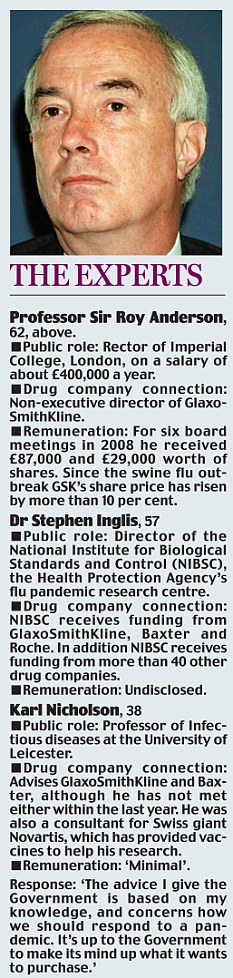
More than half the scientists on the swine flu taskforce advising the Government have ties to drug companies.
Eleven of the 20 members of the Scientific Advisory Group for Emergencies (SAGE) have done work for the pharmaceutical industry or are linked to it through their universities.
Many have declared interests in GlaxoSmithKline, the vaccine maker expected to be the biggest beneficiary of the pandemic.
The disclosure of the register of interests comes just days after a health expert branded the swine flu outbreak a ‘false pandemic’ driven by the drug companies which stood to profit.
The Government is now trying to offload up to £1billion worth of unwanted swine flu vaccine.
Last July, the Department of Health warned of up 65,000 deaths, with 350 a day at the pandemic’s peak. But the death toll now stands at just 251.
SAGE was created to give Ministers recommendations on how to control and treat the virus.
Official documents show some members are linked to vaccine manufacturer Baxter and to Roche, which makes Tamiflu.
GSK, Baxter and Roche stand to make up to £1.5billion between them from Government contracts related to swine flu.
The scientists declared the interests to the Department of Health.
They were not obliged to declare the amounts they earned but they are thought to range from around £500 for a lecture or presentation to more than £100,000 for a directorship of GSK.
Some will simply be heads of university research departments which received funding from companies… Full article
Remembering earlier massacres in Gaza: “This is life”
Eva Bartlett writing from occupied Gaza Strip, Live from Palestine, 14 January 2010
It’s a sunny day in the border region east of Beit Hanoun. Aside from a glaring absence of the citrus and olive trees which for decades abounded on this fertile land, finally razed by Israeli military bulldozers, all seems idyllic.
“This is the first time I’ve returned here since my friends were killed,” Ahmad Hammad says. He stands at the edge of a vacant plot and gestures to its far end which lies over 1 km from the border separating Israel and the Gaza Strip. “They were over there, I was standing here,” he explains.
Hammad, 24, recalls the day two years ago when three of his friends, all in their early twenties, were torn apart by an Israeli-fired surface-to-surface missile.
The Palestinian Centre for Human Rights reported that an Israeli military spokesman claimed that the Israeli army “targeted Palestinian gunmen accused of launching home-made rockets at Israeli towns.”
But Hammad remembers differently.
“They were all sitting over there, beside a small concrete hut. We used to come here all the time, to relax, drink tea, talk of our hopes and dreams. I was late that day.”
The date — 23 February 2008 — is etched in Hammad’s memory. His is a story of seeking a sanctuary where politics, occupation, siege and Israeli attacks didn’t exist. Just friends, tea, tobacco water pipe and talk.
“I left home around 2pm when they called me. They were already here, preparing the tea, relaxing. When I arrived to this spot, Muhammad stood up and began dancing around, joking, waving me to come over.”
He relives the next painful minutes in slow motion:
Then — it was exactly 2:28pm — there was a huge explosion and much smoke. I couldn’t see the area where they’d been standing, the smoke was so thick. When I finally got through the smoke and reached where they’d been standing, I found only pieces of my friends. I couldn’t even identify them by their faces, they were so destroyed.
I couldn’t think straight, couldn’t talk. I cried and cried, for maybe half an hour. Then I tried to call an ambulance, but I was still crying so hard the dispatcher couldn’t understand me. I called a friend instead and told him to bring a car and come here. He asked why, and I just told him to come here, still crying.
We collected my friends in pieces and took them to the hospital.
Hammad walks now, venturing to the site where his best friends were martyred. He sits near a water pipe leading from the ground and explains the area. “That was the hut, it was just a single room. We’d prepare tea and heat coals [for the water pipe] here.”
Pointing beyond the flat space where the hut stood, he notes a pile of rubble. “The room was destroyed in the last Israeli attacks on Gaza.”
The land is parched and cracked from want of rain or irrigation. “All the water pumps and wells in this area have been destroyed,” Hammad says, diverting to the troubles which now plague the region. “My own father’s well, over there, just 700 meters from the border, was destroyed. It must have cost him at least $10,000 to build, and now he can’t water his citrus trees.”
The Hammad family is not alone in repeatedly losing trees, crops and wells to Israeli bulldozers. Throughout the border region, wells, cisterns, piping, houses, farm equipment, and crops have been destroyed over the last decade, the most thorough destruction being during Israel’s invasion of Gaza last winter.
This dry, flat plot of land once sprouted onions. “Some of our other friends rented the land. They wanted to earn some money, so they planted onions and worked the land together. But they always let us come here to relax, whenever we wanted. That’s why we came here that day.”
He points up, over the border region where a fat white blimp hangs in the sky, surveying the land below with great accuracy. “These blimps are along the border. They can see everything with great detail, including my clothes and face.”
What the blimp misses, the drone hovering above sees. During Israel’s invasion, drones clouded Gaza’s skies and accounted for 519 of the 1,419 Palestinian civilians murdered during the Israeli massacre, according to the al-Mezan Centre for Human Rights. Often, the first drone-fired missile would be pointedly followed minutes later by a second or third, striking those who came to rescue the injured.
Earlier this day, Israeli warplanes leafleted the border regions, again declaring the 300 meters from the border mortally off-limits to anyone on the Gaza side. The Israeli-imposed “buffer zone” goes back a decade. And although the current limit is 300 meters, in practice Israeli soldiers target Palestinians up to nearly 2km away.
“They were young, were still dreaming and planning their lives,” says Hammad.
Muhammad al-Zaniin was from Beit Hanoun. He was still in school, studying business and English at al-Azhar University.
“He was an over-achiever, always wanted to get the highest marks possible. His goal was to be first in his class throughout university, and to finish early. He was always studying. Just before he was killed, he had learned the results of some of his exams: 97 percent, 95 percent. But he was killed before he knew the rest. He wasn’t asking for much from life, just to do well in school, get a job, and marry a girl he loved.”
Ibrahim Abu Jarrad was also from Beit Hanoun.
“He was the quietest of us all. He was very thoughtful and a mediator, always solving problems between people. His hopes were very simple: to build a home and marry the girl he loved.”
Muhammad Hassanain was from Jabaliya. His father was dead and Muhammed had taken on the role of providing for the family.
“He dreamed of building a new home, large enough to house the family comfortably. He was such a responsible guy — as paying the university tuition of his younger brother. He just wanted to marry and take care of his family.”
It was the same week that the Israeli military killed another six civilians in Gaza and wounded 16. Among the martyred were an elderly shepherd and a farmer in his thirties, both nearly 3 km from the border when shelled by an Israeli surface-to-surface missile east of Gaza City. A 12-year-old and two 10-year-olds were killed later the same day west of Jabaliya, targeted by Israeli air strikes. An infant was killed by shrapnel to his head and chest after Israeli aircraft bombed a government building surrounded by houses in the center of Gaza City. A 31-year-old in the east Khan Younis region was killed by indiscriminate Israeli fire the day earlier.
“After I saw my friends torn to pieces, I kept thinking, ‘I wish I had been with them.’ I saw part of the missile that looked like it hadn’t exploded, and I wished that it would now explode with me,” Hammad says. “It was the end of the life I had, the end of my dreams.”
The killing of Hammad’s three friends wasn’t his first personal loss, but it hit him the hardest.
“I’d seen my cousins killed, in 2004. But that was nothing. This was the most difficult thing for me, it still haunts me.”
While Hammad no longer visits places that remind him of his martyred friends, he does still regularly visit their families.
“Of course, they are like my own families. But even though I know they love me, I always feel that they blame me, think I was the reason their sons were killed. I see it in their eyes.”
Like most Palestinians who’ve suffered the loss of their loved ones, or suffer from the grinding, nearly four-year-long siege on Gaza, Hammad hides his pain behind smiles and laughter.
“I told my friends that I’d never laugh again after my best friends were killed. But we go on. And my laughter is hollow.”
Fluent in English, Hebrew and his native Arabic, Hammad is educated and employed. But not happy.
“I also had many dreams. I used to dream of doing a Masters degree abroad. Now I just live day to day, continue because everyone tells me I must. This is life. It comes and takes everything you want.”
Eva Bartlett is a Canadian human rights advocate and freelancer who arrived in Gaza in November 2008 on the third Free Gaza Movement boat. She has been volunteering with the International Solidarity Movement and documenting Israel’s ongoing attacks on Palestinians in Gaza. During Israel’s recent assault on Gaza, she and other ISM volunteers accompanied ambulances and documenting the Israeli attacks on the Gaza Strip.
Jewish settlers burn Palestinian property, IOF damage land and detain citizens
 14/01/2010 – 11:09 AM
QALQILIA, (PIC)– Jewish armed settlers wreaked havoc in the village of Ematin, Qalqilia district, in a pre dawn raid on Thursday that complemented their sabotage acts in the same village over the past two weeks.
Eyewitnesses said that the settlers from a nearby settlement burnt four vehicles in the village while people were asleep before swiftly withdrawing.
Villagers said that the vehicles were three cars and a tractor.
Meanwhile, the Israeli occupation forces (IOF) rounded up 12 Palestinians in various West Bank areas at an early hour on Thursday during which they searched homes and harassed civilians.
The IOF soldiers on Wednesday night bulldozed four dunums of cultivated land lots in Safa north of Beit Ummar village, Al-Khalil district.
Local sources said that the IOF troops commenced their destruction without prior notice, noting that the land was cultivated with fruitful trees.
In the Gaza Strip, the IOF troops advanced into northeast of Rafah city for a few hours on Wednesday afternoon amidst intensified firing at civilian neighborhoods.
PIC reporter said that the soldiers mounting three armored vehicles escorted bulldozers that damaged cultivated fields.
The troops stationed east of Rafah fired at citizens’ homes and IOF artillery fired at agricultural areas east of Jabalia north of the Gaza Strip inflicting material damage but no casualties.
IOF F-16 warplanes flew at low altitudes over the Strip on Wednesday and penetrated the sound barrier spreading fear among civilians especially children.
The United States, Israel and the retreat of freedom
Ali Abunimah, The Electronic Intifada, 14 January 2010
The world is suffering from a “freedom recession” according to a new report from the American think tank Freedom House (“Freedom in the World 2010,” 12 January 2010).
Established in 1941, Freedom House markets itself as “an independent watchdog organization that supports democratic change, monitors the status of freedom around the world, and advocates for democracy and human rights.” Its board of directors, chaired by a former US deputy secretary of defense, is a who’s who of Democratic and Republican former US government officials, prominent neoconservatives and Israel lobby stalwarts such as Tom Dine, former executive director of AIPAC. In 2007, more than two-thirds of its $16 million budget came directly from the United States government.
Not surprisingly then, Freedom House’s report reveals more about the groupthink of the US establishment — especially with respect to its continued efforts to dominate the Middle East and ensure Israel’s supremacy — than it does about the countries surveyed.
Focusing on two categories of “freedom” — “civil liberties” and “political rights” — the report divides the world’s 194 countries into three groups: “free” (89), “partly free” (58), and “not free” (47).
Interestingly, Freedom House records “declines in freedom” in “countries that had registered positive trends in previous years, including Bahrain, Jordan, Kenya and Kyrgyzstan.” Jordan was one of only six countries to move from the “partly free” category to “not free.” What does it say about US “democracy promotion” that Jordan, Bahrain and Kyrgyzstan — major political and military operating bases for the “war on terror” and US-led occupations in Iraq and Afghanistan — have become less free as their dependence on the US has increased?
Sadly, while the report frets that “the most powerful authoritarian regimes [such as Russia and China] have become more repressive, more influential in the international arena, and more uncompromising,” it has nothing at all to say about the US role in restricting freedom and spreading mayhem around the world. Sometimes this is truly absurd as the report points to “continued terrorist and insurgent violence in Pakistan, Afghanistan, Iraq, Somalia and Yemen,” but fails to note that two of these countries are under direct US military occupation (Afghanistan and Iraq) while the US is intervening militarily in the other three. (The report presents a mixed picture for the US-occupied countries; both are “Not Free” but Iraq allegedly became more free during 2009 and Afghanistan less free.)
Rather than offer any introspection on the inverse relationship between US efforts at global domination on the one hand, and the spread of freedom on the other, the report’s overview essay concludes with a call for more vigorous intervention: “The United States and other democracies should take the initiative to meet the authoritarian challenge …”
Freedom House’s approach to Israel provides the starkest example of the abyss into which liberal thinking has fallen on the relationship between colonialism and freedom. Israel, we are told, “remains the only country in the [Middle East] region to hold a Freedom in the World designation of Free.” We are informed euphemistically that “The beginning of the year [2009] was marred by fierce fighting between the Israeli military and the Hamas movement in the Gaza Strip.”
There is no mention of the deliberate targeting by Israel of Gaza’s civilian infrastructure and the resulting massive destruction, and death and injury to thousands of Palestinian civilians. Nothing is said of the denial of fundamental political, civil and human rights, or freedom of movement, association and education to four million Palestinians living under Israeli military occupation and siege in the West Bank and Gaza Strip. There is no mention of the systematic discrimination, and social and political exclusion faced by 1.5 million Palestinian citizens of Israel, nor of the denial of the right of return of millions of Palestinian refugees.
There is an acknowledgment that “Hundreds of people were arrested during demonstrations against the Gaza conflict, and the parliamentary elections committee passed a measure banning two political parties from national elections, though the ban was quickly overturned by the Supreme Court.”
Despite this, on the tables accompanying the report, “Israel” receives the highest score of “1” for political rights, and a very respectable “2” for civil liberties — on a par with Italy and Japan. The overall impression is of minor glitches that could occur in any exemplary “Western” democracy.
Then on a separate table of “Disputed Territories” we find “Israeli-occupied territories” and “Palestinian Authority-administered territories” both listed. Both are given the designation “Not Free” and nearly the lowest scores for political rights and civil liberties. There is no narrative to explain who is responsible for this dire state of affairs. This convenient separation allows for all the ugly realities of what “free” Israel does in the occupied territories to be pushed out of sight and ignored.
But in what scheme can Israel be awarded freest of the free status when for two-thirds of its existence, since 1967, it has ruled directly over millions of disenfranchised Palestinians through violence and repression? The idea that the political regime in Israel’s pre-1967 boundaries can be looked at as a “democracy” even while the situation in the occupied territories can be criticized as undemocratic is very widespread among Israelis and American liberals.
Former US President Jimmy Carter has been excoriated (and recently forced to apologize) by the Israel lobby for calling the situation in the West Bank and Gaza Strip “apartheid.” Yet even he had simultaneously claimed that within its pre-1967 boundaries, “Israel is a wonderful democracy with equal treatment of all citizens whether Arab or Jew.” True, Palestinian citizens of Israel can vote and are accorded civil rights far wider than their Palestinian counterparts in the West Bank and Gaza Strip. But even Israeli Jews commonly concede that Palestinian citizens suffer systematic and severe disadvantage and total exclusion from key political decisions about the country.
Israeli Jewish leftists (a rapidly dwindling group) and Western liberal sympathizers tend to view Israel within its 1967 boundaries as a flawed democracy — perfectible with a reallocation of resources and less discrimination against non-Jews, even as they remain fully invested in maintaining Israel as a “Jewish state” with a Jewish demographic majority.
They view the 1967 occupation of the West Bank and Gaza Strip as the original sin that corrupted a purer Zionist vision, and thus remain fixated on the chimera of “ending the occupation” through a “two-state solution.” Once this nirvana is reached, so they believe, Israel can resume its destiny as a liberal democratic state among others.
But it is not just the discrimination and limited rights of Palestinian citizens and other non-Jews that undermine the claim that Israel — considered separately from the West Bank and Gaza Strip — is a democracy. Nor is it even that Israeli settler-citizens in the West Bank have full voting rights for the Israeli parliament while Palestinians in the same territory have none. It is that “Israel” and the “occupied territories” are two sides of the same coin.
Israel’s 1948 and subsequent ethnic cleansing of Palestinians, and ongoing repressive rule in the West Bank and Gaza Strip are not exceptional or temporary conditions. They are constitutive of the situation that allows Israeli Jews to currently claim they live in a (flawed) liberal democracy.
To be clear, the argument is not that conditions in Israel and the occupied territories are indistinguishable; rather it is that they form a single interdependent system. Israeli Jews can “freely” elect a Jewish government in Israel only because most Palestinians have already been ethnically cleansed. Thus the maintenance of this “liberal democratic” Jewish space depends directly on the permanent denial of fundamental rights to Palestinians.
Palestinian citizens of Israel — who form 20 percent of the population within Israel’s pre-1967 boundaries — are, as noted, accorded limited liberal rights. This helps boost Israel’s external image as a “wonderful democracy,” but if the exercise of these rights ever threatens Jewish domination, they are curtailed. Examples include the constant legal harassment of Palestinian members of the Knesset, and various legislative projects for loyalty oaths or to ban commemoration of the Nakba, the 1948 ethnic cleansing of 750,000 Palestinians. Overwhelming Israeli Jewish opposition to calls by Palestinians in Israel for the country to be a “state of all its citizens” is an indication that Israeli Jews value their own supremacy over democracy.
Israel has sometimes been described as an “ethnocracy” — a state where one ethnic group dominates and enjoys a wide range of liberal rights which are denied to others. But these liberal rights depend directly on the successful repression of the non-privileged ethnic group(s). As rebellions by the disenfranchised require ever greater levels of repression and violence to control, the repression must also be turned inwards.
In recent days, Israel extended for six months a ban on Sheikh Raed Salah, an Israeli citizen, and leader of the Northern Branch of the Islamic Movement in Israel, from traveling to Jerusalem, Israel’s ostensible capital, where he had been exercising his civil rights to campaign against Israeli efforts to “Judaize” the city. (Separately Salah was also sentenced to nine months in prison for allegedly assaulting a police officer during a 2007 demonstration; a conviction condemned as political persecution by other Palestinian leaders inside Israel.)
Such repression does not only affect non-Jews. The United Nations-commissioned Goldstone report noted “that actions of the Israeli government” within Israel, during and after Israel’s invasion of Gaza last winter, “including interrogation of political activists, repression of criticism and sources of potential criticism of Israeli military actions, in particular nongovernmental organizations, have contributed significantly to a political climate in which dissent with the government and its actions in the Occupied Territories is not tolerated.”
These means of “internal” repression resemble the movement bans, censorship and other forms of harassment that the South African apartheid regime began to deploy in its late stages against dissenting whites, eroding the “liberal democratic” space they had for so long enjoyed at the expense of the country’s black majority.
Maintaining a Jewish-controlled “liberal democratic” regime in Palestine/Israel is incompatible with the exercise of the inalienable rights of Palestinians. It emphatically depends on their permanent violation, especially the right of return. But the exercise of the inalienable rights of Palestinians — an end to discrimination against Palestinian citizens, dismantling the 1967 occupation regime, and the right of return for refugees — is fully compatible with Israeli Jews exercising the human, civil, political and cultural rights to which they are unquestionably entitled.
As a first step toward imagining and creating such a framework, we have to ditch the absurd idea reproduced by Freedom House, that Israeli Jews can epitomize perfect freedom while imposing perfect tyranny and dispossession on a greater number of human beings who belong to the same country.
Ali Abunimah is co-founder of The Electronic Intifada and author of One Country: A Bold Proposal to End the Israeli-Palestinian Impasse.
Turkish FM: We oppose Iran sanctions
Press TV – January 14, 2010 07:17:58 GMT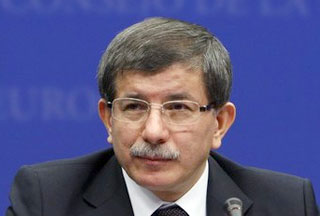
Turkish Foreign Minister Ahmet Davutoglu says Ankara is against imposing further sanctions on Iran over the country’s nuclear program.
“Every country has the right to pursue nuclear power for peaceful purposes,” Davutoglu told the Guardian newspaper during his recent visit to London.
“We also don’t want more sanctions [on Iran]. Sanctions hurt ordinary people and neighboring countries,” he added, repeating a former Turkish offer to mediate negotiations between Tehran and the West.
The Turkish Foreign Minister stressed that the current standoff could only be overcome through diplomatic efforts.
“We don’t forget the very bad experience in Iraq. We would advise intensified negotiations through diplomacy. An absence of mutual trust is the problem,” he said.
Davutoglu reiterated that Turkey was against any kind of nuclear proliferation in the Middle East, whether in Iran, Israel or anywhere else.
Israel, the US and their European allies claim that Iran is pursuing a nuclear weapon. This is while the International Atomic Energy Agency (IAEA) reports and US National Intelligence Estimates issued so far point to the contrary.
Although the published reports by the UN nuclear watchdog and the main American intelligence authority confirm Iran’s stance that it does not have a military nuclear program, Washington and Tel Aviv have not backed down from their stance.
While Iran is a signatory to the nuclear Non-Proliferation Treaty (NPT), Israel remains one of the only three regimes in the world that has not signed the international pact.
Tehran has repeatedly called for the removal of all weapons of mass destruction from across the globe.
Israel, however, is the Middle East’s sole nuclear-armed power with a stockpile that is reported to include over 200 ready-to-launch atomic warheads.
Turkish organization: Arrest Barak for War Crimes When He Arrives Here
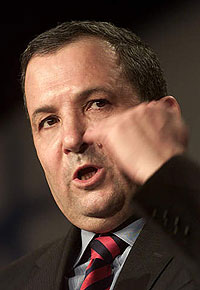 AL – MANAR TV 14/01/2010 – Despite the intensifying crisis between Israel and Turkey, Israeli Defense Minister Ehud Barak is insisting to follow through with his scheduled plans to visit Turkey next week. However, on Thursday it became clear that an arrest warrant may await him there.
One of the major human rights organizations in Turkey, Mazlumder, requested from the Turkish state prosecution to order that Barak be arrested upon landing in the country for what they call “his responsibility for war crimes during Operation Cast Lead.”
A statement published Wednesday night by the Istanbul branch of Mazlumder said that the request is rooted in the right of universal jurisdiction and Article CMK98 of Turkish law.
“Israel perpetrated genocide and crimes against humanity. Israeli army forces bombed the UN building, hospitals, and schools. As was proven by lab tests performed by Turkish universities, they also used phosphorous bombs, which are forbidden. It is known that Israel used an assortment of ammunitions that caused physiological and psychological diseases among the Gazan population.”
The organization’s statement also asserted that a request was made in the past to Turkish prosecution to arrest senior Israeli officials, but then Justice Minister Mehmet Ali Shahin rejected it. The organization hopes that this time around, given the crisis in the relations between the two countries and the precedent provided by efforts in Britain to issue an arrest warrant against former minister Tzipi Livni, the Turkish prosecutor will decide to act differently.
“We know that Barak will arrive in Turkey on the 17th of the month,” said the organization. “(We) need to put him trial and prevent every other Israeli who is responsible for war crimes from entering Turkey freely. We remind the Turkish prosecution of its role. We remind them that Britain has already decided to arrest Tzipi Livni when she was slated to arrive in the country. We remind them that Shimon Peres and Ehud Olmert must also be arrested according to Article CMK-98 of the Turkish law, which grants us the right to try them.”
Mazlumder is an independent organization that was founded in 1991 by a group of 54 lawyers, businessmen, and media correspondents. It has many branches throughout Turkey. The group defines itself as apolitical and promoting human rights regardless of race, religion, or gender and “without double standards for humanity.”
Chairman of the Istanbul branch Attorney Jihad Gokdimar is signed on the current request for an arrest warrant.
This is the not the first time an attempt has been made in Turkey to issue an arrest warrant against senior Israeli officials. In February 2009, a pro-Palestinian organization asked that then Israeli Prime Minister Ehud Olmert, his Foreign Minister Tzipi Livni, Defense Minister Ehud Barak, and President Shimon Peres be put on trial. The general prosecutor in Ankara rejected their request.
Latin American nations send aid to Haiti
Press TV – January 14, 2010
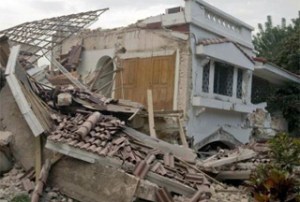 A destroyed building in Port-au-Prince after the earthquake

Latin American nations have scrambled to deploy rescue workers, doctors and supplies to the earthquake-hit island of Haiti.
Rescue efforts stepped up as Haiti’s prime minister warned the death toll may top 100,000 from Tuesday’s brutal 7.0-magnitude earthquake that flattened much of the capital, Port-au-Prince.
Neighboring Cuba which also felt the quake and evacuated some 30,000 people following a brief tsunami alert, sent 30 doctors on Wednesday, according to Cuban media.
Some 400 Cuban medical staff already in Haiti were largely unharmed and two Cuban field hospitals in the capital, Port-au-Prince, had dealt with almost 700 wounded by early Wednesday, said Foreign Minister Bruno Rodriguez.
Brazil said it was sending 10 million dollars in immediate disaster aid, including 28 tons of drinking water and food.
Peru will send two planes with 50 metric tons of humanitarian aid, mainly food, and 18 doctors and nurses and two field hospitals, the health minister said Wednesday afternoon, adding that Peruvian President Alan Garcia may accompany the mission.
Venezuelan President Hugo Chavez promised more aid after the departure of a first group of 50 doctors, firefighters and rescue workers from Venezuela early Wednesday.
Mexico, Colombia and Guatemala also promised to send rescue workers and aid as soon as possible.
Bolivian Defense Minister Walker San Miguel said none of Bolivia’s estimated 200 soldiers in Haiti had been killed, and that the impoverished Andean nation was offering to help UN rescue operations.
A second Gaza war around the corner?
 Hasan Abu Nimah, The Electronic Intifada, 13 January 2010
Israel is once again complaining that its “security” is being threatened by new eruptions of violence along the border with Gaza. About two dozen Qassam rockets were fired at Israel from Gaza in recent days. Although they fell in (and may have been deliberately targeted at) open areas, causing no damage or injuries, Israel took revenge with destructive air raids that did cause damage and killed several people, including a 15-year-old boy.
Before asking who should stop first, one should recall who started the latest ugly round of violence.
On 26 December, Israel carried out double attacks in the West Bank city of Nablus and in Gaza, murdering three people in each place. In Nablus, Israeli death squads carried out cold-blooded extrajudicial executions in revenge for the killing of a West Bank settler several days before. According to the wife of one of the Nablus victims, her husband was at home in his living room, completely unarmed when the death squad burst in and shot him in the face. Neither he nor the other victims of these state-sponsored terrorists had been accused, tried or convicted of any crime in a court of law.
In Gaza, the three victims were reportedly workers scavenging near the border fence to salvage building supplies from the rubble of previous destruction.
Since late December, Israeli attacks have killed more than a dozen Palestinians, routine violence which is ignored by the “international community” and for which Israel is never held accountable. On the contrary, Israel’s Western friends continue to justify this terrorism as “self-defense.”
Israel’s recent aggressions look ominously like the 4 November 2008 attack on Gaza, which killed six persons and shattered the four-month-long truce meticulously respected by Hamas. Predictably, Hamas and other factions retaliated for that Israeli provocation and then Israel used their response to justify its massacre of 1,400 people in Gaza this time last year.
It seems that whenever there is relative calm on the Gaza front, Israel is keen to destroy it. Prior to the November 2008 attack, the Gaza situation, despite the siege and the intense international pressure on Hamas, was stable — that was the last thing Israel wanted. And despite the truth that Israel sabotaged the truce and then refused to renew it even though Hamas wanted to, the Ramallah-based Palestinian Authority, some Arab states and the so-called international community led by the United States blamed Israel’s attack on Gaza on Hamas rockets, and claimed that Hamas — not Israel — had rejected renewing the truce.
When Israel ended “Operation Cast Lead” last year, it refused to enter into a new formal truce with Hamas. Nevertheless, Hamas has observed a unilateral ceasefire, only using force occasionally in retaliation for Israeli attacks, say, on tunnels that bring vital supplies into Gaza from Egypt, circumventing the siege. Moreover, Hamas — in the face of much local criticism — has enforced the truce on other Palestinian factions.
Could Israel be following the same pattern again now with its escalating violence against Gaza? Neither last year’s war nor the tightening blockade that has prevented any meaningful reconstruction have succeeded in their clear but unstated goal of toppling Hamas.
Is Israel then preparing to do again what it does best: use wanton murder and destruction to try to achieve its political goals?
It is hard to say, but this is an alarming possibility, especially as senior Israeli officials have been dropping hints about preparations for a “second Gaza war.”
Israel, which does not act according to any normal or civilized standards, could have several motives for this; not least, another “small war” could give Israel a welcome distraction from the continuing diplomatic impasse or any threat of a renewed American-led peace initiative, no matter how timid.
Up to this point, it looks like Israel has been in the diplomatic driver’s seat. Israeli Prime Minister Benjamin Netanyahu easily dismissed US President Barack Obama’s initial demand for a freeze on construction of Israeli settlements in the occupied West Bank. The Obama Administration not only backed down, it also fully adopted Israeli positions and has been continuously putting pressure on the moribund Palestinian Authority to return to negotiations without “preconditions.” (Of course “without preconditions” means only that Israel is not obligated to meet any conditions; Palestinians are always presented with lengthy lists of Israeli preconditions.)
But if this seems like a diplomatic victory for Israel, it may only be temporary. If, as expected, the Palestinian Authority eventually succumbs to pressure and returns to “negotiations,” it will become instantly apparent that, given Israeli intransigence and expansionism, there is absolutely nothing to discuss and not even an infinitesimal prospect of any sort of peace deal.
It is doubtful that the bankruptcy of the Israeli and American positions can simply be covered up with more empty process, and expect the situation on the ground to remain quiet and stable. Bringing the crisis closer, on its own terms, and once again blaming Hamas, may be the “ideal” way out for Israel.
Hasan Abu Nimah is the former permanent representative of Jordan at the United Nations. This essay first appeared in The Jordan Times.
Meritocracy and Jewish kinship networks
By Philip Weiss | January 13, 2010
A lot of people are talking about David Brooks’s distastefully-smug column in the Times yesterday about Jewish achievement, in which he says that we are 2 percent of the U.S. population and 25 percent of this and that. And that we get all the patents in the Middle East while the Arabs smoke hookahs.
He asks how this can be, and talks about our incredible culture. I agree: it’s a helluva bookish culture. Though that same intellectual culture is going out the window now that the chief occupation of Jewish leadership is saying, Repeat after us, apartheid is democracy.
But I’d like to inject a realistic note here. How much of Jewish achievement reflects the fact that Jews look out for one another? When I had to get a partner on this website to keep it going, I was most comfortable getting another Jew. Years ago when I was at the Harvard Crimson newspaper, my Irish-Catholic friend Mary Ridge informed me that it was a “Jewish club”–we selected for our own kind; and the Crimson produced a lot of professional journalism talent. I have gotten most of my journalism work from Jewish bosses.
Jews have kinship networks as strong as other people’s, maybe more strong. All that Hollywood talent– producers are always aware of who is a Jew, and I am sure they feel more comfortable hiring Jews. Landsman. My parents liked the idea of my marrying a Jew because Jews are gemutlich, as my mom always says– family, kin. We know all the social cues, can finish one another’s sentences, etc.
And look at the New York Times, where Brooks works. Is it an expression of Jewish genius that most of the political columnists are Jewish? Tom Friedman, Nick Kristof, Paul Krugman, Frank Rich, David Brooks et al. Or does it maybe reflect the fact that a Jewish family has majority ownership of the newspaper and that most of the big editors have been Jewish and at some level, unconscious or otherwise, they favor Jews?
So I think some of the amazing record of Jewish achievement reflects discrimination; and Jews are powerful enough in this society that we ought to be conscious of that. Brooks has often praised the late sociologist E. Digby Baltzell, and Baltzell said as much about the last establishment; he said that WASPs favor other WASPs, and that it was hurting the American establishment.
I venture that the same thing is happening today in the Jewish portion of the establishment. We discriminate in favor of our own; and it’s doing a number on foreign policy.
What should be done about this? Jews in powerful positions should be aware of this, and seek greater diversity in their hiring.
Featured Video
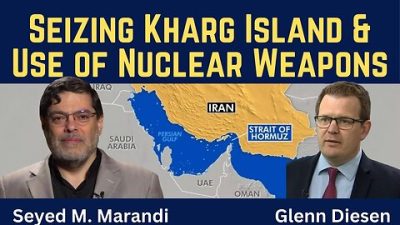
Marandi: Threat of Seizing Kharg Island & the Use of Nuclear Weapons
or go to
Aletho News Archives – Video-Images
Frlom the Archives
Iran War: United States Military Versus Israel Firsters
By James Petras | November 27, 2007
Why must Jewish organizations be and be seen as the loudest drum-beaters of all? Why can we not bring ourselves to say that military intervention is not on the table at all? Why not stash it under the table, out of sight and mount instead a diplomatic assault? – Leonard Fein, Forward
Introduction
As the White House and Congress escalate their economic sanctions and military threats against Iran, top military commanders and Pentagon officials have launched a counter-offensive, opposing a new Middle East War. While some commentators and journalists, like Chris Hedges (Truthdig, November 13, 2007), privy to this high stakes inter-elite conflict, attribute this to a White House cabal led by Vice President Cheney, a more stringent and accurate assessment puts the Zionist Power Configuration (ZPC) in the center of the Iran war debate.
There is a great deal riding in this conflict – the future of the American empire as well as the balance of power in the Middle East. Equally important is the future of the US military and our already heavily constrained democratic freedoms. The outcome of the continuous and deepening confrontation between top US military officials and the Israel Firsters over US foreign policy in the Middle East has raised fundamental questions over self-determination, colonization, civilian primacy and military political intervention, empire or republic. These and related issues are far from being of academic interest only; they concern the future of the United States. … continue
Blog Roll
 Aletho News
- Who Is closer to collapse?
- A War that Backfired: Why the US-Israeli Campaign Is Strengthening Iran
- How Zionist Control Is Hurting US Interests
- Iran warns it may target US missile launch sites in UAE cities
- American Military Failure in Afghanistan
- Friendly Skies of Georgia: Are Israeli-Linked Drones Launching False Flags from Georgian Territory?
- The Three Big Lies about Mammography Screening
- Ukrainian Embassy in Beirut sheltering top Mossad agent
- Palestinian family displaced after settlers violently attack them in Humsa, Jordan Valley
- The EU never learns – except for the wrong lessons
- If Americans Knew
- No let-up in attacks on Gaza as Israel takes on Iran, Lebanon – Not a ceasefire Day 155
- ‘Of Course’: IDF Drops Case Against Soldiers Accused of Raping Palestinian Prisoner
- Don’t Fall for the Regime Change Talk. Israel Is ‘Mowing the Lawn’ in Iran
- Will Israel and the US wreck the Gulf States along with Iran?
- US so far burned through ‘years’ of munitions in Iran war: Report
- How the Israeli Tail Wags the American Dog
- Outdated intel likely led to deadly U.S. strike on Iranian elementary school, sources say
- Pentagon insider says high U.S official Douglas Feith reported to Netanyahu
- In fond memory of Walid Khalidi, the historian of Palestine
- 6 more Americans killed, as Israel ‘mows the lawn’ in Iran – Not a ceasefire Day 154
- No Tricks Zone
- Storing Green Energy To Last Germany 10 Days Would Require A 60-Million Tonne Battery
- New Studies: UK Sea Levels Were 4 Meters Higher Than Today During The Mid-Holocene
- Destructive Green New Deal: German Energy And Metal Group Warns Of Drastic Crisis
- New Study Documents A 20-Year Pause In Arctic Sea Ice Decline – Driven By Internal Variability
- Wake-up Call: Survey Shows Majority Of Germans Now Favor Postponing Climate Targets!
- Televised! Leading German Political Candidate Tells Schoolchildren CO2 Makes Sun Hotter!
- New Study: A Century Warming Of 1.1°C Is ‘Commonplace’ And ‘Not Unusual’ During This Interglacial
- New Study: ‘Internal Noise’ And Volcanic Forcing Can Trigger 10-15°C Warming Within Decades
- Glaciers Worldwide Are Suddendly Surging, Experts Blame Warming!
- Surprising Discovery: Sahara Is Greening…Billions Of Trees Where Once Thought To Be Barren
 Aletho News