“No army, no prison and no wall can stop us”
Abdallah Abu Rahmah, The Electronic Intifada, 7 January 2010
To all our friends,
I mark the beginning of the new decade imprisoned in a military detention camp. Nevertheless, from within the occupation′s holding cell I meet the New Year with determination and hope.
I know that Israel’s military campaign to imprison the leadership of the Palestinian popular struggle shows that our nonviolent struggle is effective. The occupation is threatened by our growing movement and is therefore trying to shut us down. What Israel’s leaders do not understand is that popular struggle cannot be stopped by our imprisonment.
Whether we are confined in the open-air prison that Gaza has been transformed into, in military prisons in the West Bank, or in our own villages surrounded by the apartheid wall, arrests and persecution do not weaken us. They only strengthen our commitment to turning 2010 into a year of liberation through unarmed grassroots resistance to the occupation.
The price I and many others pay in freedom does not deter us. I wish that my two young daughters and baby son would not have to pay this price together with me. But for my son and daughters, for their future, we must continue our struggle for freedom.
This year, the Popular Struggle Coordination Committee will expand on the achievements of 2009, a year in which you amplified our popular demonstrations in Palestine with international boycott campaigns and international legal actions under universal jurisdiction.
In my village, Bilin, Israeli tycoon, Lev Leviev and Africa-Israel, the corporation he controls, are implicated in illegal construction of settlements on our stolen land, as well as the lands of many other Palestinian villages and cities. Adalah-NY is leading an international campaign to show Leviev that war crimes have their price.
Our village has sued two Canadian companies for their role in the construction and marketing of new settlement units on village land cut off by Israel’s Apartheid Wall. The legal proceedings in this precedent-setting case began in the Canadian courts last summer and are ongoing.
Bilin has become the graveyard of Israeli real estate empires. One after another, these companies are approaching bankruptcy as the costs of building on stolen Palestinian land are driven higher than the profits.
Unlike Israel, we have no nuclear weapons or army, but we do not need them. The justness of our cause earns us your support. No army, no prison and no wall can stop us.
Yours,
Abdallah Abu Rahmah
From the Ofer Military Detention Camp
Abdallah is a schoolteacher and nonviolent activist from Bilin. He is currently being held in an Israeli prison after he was arrested on International Human Rights Day, at 2am on 10 December 2009, by Israeli occupation forces.
Israel to raze 28 buildings in Nablus area
Nablus – Ma’an – Twenty-eight homes and agricultural buildings were issued demolition orders by Israeli military personnel on Wednesday, all located on the outskirts of Aqraba village southeast of Nablus, a Palestinian official said.
Ghassan Doughlas, who holds the Palestinian Authority’s settlement portfolio for the northern West Bank, said Israeli forces gave the farmers only 48 hours to evacuate their houses, clear out their farms and sheds before the orders were implemented.
Dozens of Palestinian farmers and their families live in the area, about five kilometers from the Gittit settlement and three kilometers from the Mekhora settlement, raising sheep and cattle as well as planting crops. The crops help sustain the local community, Doughlas said.
“Israeli forces issued this decision to protect the settlers only without taking into consideration the families who will be rendered homeless,” Doughlas added.
Among the families who received orders to evacuate their buildings were Zaid Mahmud Qassem Beni Manna, Hani Jameel Abdullah Beni Jaber, and Feras Khalil Beni Jaber.
Another Iranian Revolution? Not Likely
By Flynt Leverett and Hillary Mann Leverett | New York Times | January 5, 2010
THE Islamic Republic of Iran is not about to implode. Nevertheless, the misguided idea that it may do so is becoming enshrined as conventional wisdom in Washington.
For President Obama, this misconception provides a bit of cover; it helps obscure his failure to follow up on his campaign promises about engaging Iran with any serious, strategically grounded proposals. Meanwhile, those who have never supported diplomatic engagement with Iran are now pushing the idea that the Tehran government might collapse to support their arguments for military strikes against Iranian nuclear targets and adopting “regime change” as the ultimate goal of America’s Iran policy.
Let’s start with the most recent events. On Dec. 27, large crowds poured into the streets of cities across Iran to commemorate the Shiite holy day of Ashura; this coincided with mourning observances for a revered cleric, Grand Ayatollah Hossein Ali Montazeri, who had died a week earlier. Protesters used the occasion to gather in Tehran and elsewhere, setting off clashes with security forces.
Important events, no doubt. But assertions that the Islamic Republic is now imploding in the fashion of the shah’s regime in 1979 do not hold up to even the most minimal scrutiny. Antigovernment Iranian Web sites claim there were “tens of thousands” of Ashura protesters; others in Iran say there were 2,000 to 4,000. Whichever estimate is more accurate, one thing we do know is that much of Iranian society was upset by the protesters using a sacred day to make a political statement.
Vastly more Iranians took to the streets on Dec. 30, in demonstrations organized by the government to show support for the Islamic Republic (one Web site that opposed President Mahmoud Ahmadinejad’s re-election in June estimated the crowds at one million people). Photographs and video clips lend considerable plausibility to this estimate — meaning this was possibly the largest crowd in the streets of Tehran since Ayatollah Ruhollah Khomeini’s funeral in 1989. In its wake, even President Ahmadinejad’s principal challenger in last June’s presidential election, Mir Hossein Mousavi, felt compelled to acknowledge the “unacceptable radicalism” of some Ashura protesters.
The focus in the West on the antigovernment demonstrations has blinded many to an inconvenient but inescapable truth: the Iranians who used Ashura to make a political protest do not represent anything close to a majority. Those who talk so confidently about an “opposition” in Iran as the vanguard for a new revolution should be made to answer three tough questions: First, what does this opposition want? Second, who leads it? Third, through what process will this opposition displace the government in Tehran?
In the case of the 1979 revolutionaries, the answers to these questions were clear. They wanted to oust the American-backed regime of Shah Mohammed Reza Pahlavi and to replace it with an Islamic republic. Everyone knew who led the revolution: Ayatollah Ruhollah Khomeini, who despite living in exile in Paris could mobilize huge crowds in Iran simply by sending cassette tapes into the country. While supporters disagreed about the revolution’s long-term agenda, Khomeini’s ideas were well known from his writings and public statements. After the shah’s departure, Khomeini returned to Iran with a draft constitution for the new political order in hand. As a result, the basic structure of the Islamic Republic was set up remarkably quickly.
Beyond expressing inchoate discontent, what does the current “opposition” want? It is no longer championing Mr. Mousavi’s presidential candidacy; Mr. Mousavi himself has now redefined his agenda as “national reconciliation.” Some protesters seem to want expanded personal freedoms and interaction with the rest of the world, but have no comprehensive agenda. Others — who have received considerable Western press coverage — have taken to calling for the Islamic Republic’s replacement with an (ostensibly secular) “Iranian Republic.” But University of Maryland polling after the election and popular reaction to the Ashura protests suggest that most Iranians are unmoved, if not repelled, by calls for the Islamic Republic’s abolition.
With Mr. Mousavi increasingly marginalized, who else might lead this supposed revolution? Surely not Ali Akbar Hashemi Rafsanjani, the former president who became a leading figure in the protests after last summer’s election. Yes, he is an accomplished political actor, is considered a “founding father” of the state and heads the Assembly of Experts, a body that can replace the Islamic Republic’s supreme leader. But Mr. Rafsanjani lost his 2005 bid to regain the presidency in a landslide to Mr. Ahmadinejad, and has shown no inclination to spur the masses to bring down the system he helped create.
Nor will Mohammad Khatami, the reformist elected president in 1997, lead the charge; in 1999, at the height of his popularity, he publicly disowned widespread student demonstrations protesting the closing of a newspaper that had supported his administration… Full article
Iran Running Out of Life-Saving Isotopes
By Thomas Erdbrink in Tehran | Spiegel Online | January 6, 2010
Trade sanctions imposed on Iran over its nuclear program are affecting treatment of people suffering from heart and kidney disease and various cancers. Some 850,000 patients are at risk because the country is running out of radioactive isotopes essential to radiotherapy.
Ruhollah Solook, 78, was dying before a donated kidney and complex radiotherapy saved his life. Recovering in an isolation room in Tehran’s oldest hospital, he expressed his joy in a telephone interview. “They saved my life already. I hope they will be able to cure me entirely now.”
But Solook’s treatment has become a race against time, as has that of 850,000 other Iranians suffering from heart and kidney disease and various cancers. Sometime after March 2010, the country will run out of technetium-99, a radioisotope crucial to the treatment of these diseases. Technetium-99 is currently produced locally in Iran.
“We recommend treatment with these products to hundreds of patients every month in our hospital alone,” said Dr. Gholamreza Pourmand, Solook’s physician. Technetium-99 is essential to radiotherapy, Pourmand said: “If we cannot help these people, some will die. It’s as simple as that.”
Rare and Precious
The impending shortage of technetium-99 is caused by the controversy surrounding the Iranian nuclear program. The sanctions imposed by the UN Security Council, aimed at moving Iran to halt its uranium enrichment program, are supposed to leave medical practice unaffected. In reality, however, Iran has become unable to procure a wide range of medical products. Body scanners cannot be imported from the US or the EU, since parts in these machines could also be useful to Iran’s nuclear program. An embargo on medical isotopes was introduced in 2007, in defiance of the medical exception clause touted as part of the trade sanctions, Iranian leaders said.
Isotopes are a rare commodity produced at only five sites worldwide. One of these, the High Flux Reactor in the Dutch town of Petten, currently accounts for 30 to 40 percent of worldwide production, but it is scheduled for retirement soon. Apart from the UN sanctions, so many restrictions — particularly American — on trade with Iran exist, that in practice nobody is willing to supply Iran with medical isotopes any longer.
Out of dire necessity, Iran now uses its 41-year-old research reactor in Tehran — originally constructed by the US — exclusively for isotope production, a job which used to take only a day a week. However, the reactor’s fuel, provided by Argentina in 1993, is quickly running out, the scientists said.
‘We Will Make Our Own’
Iranian leaders, including President Mahmoud Ahmadinejad, say that Iran might produce new fuel itself, which would prove a sensitive issue. Iran would need to enrich uranium up to 19.75 percent purity, which would not only be a gross violation of UN sanctions — it would also bring the country one step closer to the militarization of its nuclear program.
“We would prefer to buy the fuel as quickly as possible,” said Mohammad Ghannadi, vice-president of the Atomic Energy Organization of Iran (AEOI), sitting in his office in downtown Tehran. At his desk, Ghannadi had a bird’s-eye view of the experimental nuclear facility, the only functional reactor in Iran. Two chimneys on the facility belt out white smoke. “We can enrich on our own,” he said. “But we will run into technical difficulties. We also won’t be ready in time to help our patients.”
Iran’s dire need for the special fuel has led the UN International Atomic Energy Agency to put forward an unusual proposal, which might, if successful, build trust between Iran and other nations.
According to this proposal, the US would upgrade Iran’s old research reactor, and Russia and France would send the Persian nation 116 kilograms (256 pounds) of fuel. The IAEA, which already has the reactor under strict surveillance, would ensure it is not used for the production of nuclear armaments. In return, Iran would have to move most of its low-grade enriched uranium beyond its borders, leaving it with an insufficient stockpile for the production of weapons-grade uranium. Iran, however, has demanded firmer assurances that the promised fuel will actually be delivered. It also finds the time it would take to actually deliver the fuel — a year, according to the Iranians — too long.
“Every nuclear scientist understands that research reactors and medical isotopes have nothing to do with nuclear weapons,” Ghannadi said. One of his own family members recovered from breast cancer only recently with the help of medical isotopes generated in his reactor. “We’re talking about people here,” he noted. “If somebody falls ill, you give them medicine. Give us the fuel, and then we will cure the people.”
Desperate Phone Calls
It is not the first time Iran has fallen short of medical isotopes. When foreign imports came to an abrupt halt in 2007, the Iranians also tried to make their own. “But we were late,” one of Ghannadi’s assistants recalled. Patients went untreated for two months. “We got hundreds of phone calls a day. Government officials, hospitals and even patients called us asking for help,” he said.
In Tehran’s Shariati hospital, one of 120 medical facilities in Iran where nuclear technology is employed, patients are lined up waiting to use a decrepit German body scanner. In 2007, dozens of people would also wait here for treatment that didn’t come, recalled Moshen Saghari, a nuclear science professor.
“When the West talks of human rights in Iran, it should not forget about our patients,” said the doctor, a graduate of a prestigious American university. “The country that taught me everything I know is now preventing me from using that knowledge in Iran. Quite ironic.”
Israel leveled More than 23,000 Homes Since 1967
 By SAED BANNOURA – IMEMC – January 6, 2010
The Palestinian Ministry of Information issued a report stating that Israel leveled more than 23.000 homes in the occupied territories since its occupied the West Bank, the Gaza Strip and East Jerusalem in the 1967 six-day war.
The Israeli Authorities leveled more than 700 homes and buildings owned by the Palestinians in Jerusalem.
Demolishing Palestinian homes in East Jerusalem witnessed a significant increase in 2009 as Israel leveled 103 Palestinian homes, while 89 homes were leveled in 2008.
23 out of the 103 homes leveled in Jerusalem in 2009 were demolished by their Palestinian owners who were forced to level them in order to avoid the high fines and expenses imposed by Israel should the Jerusalem municipality demolish the homes.
600 residents, half of them children, were rendered homeless in 2009 due to the illegal Israeli policies in Jerusalem.
Israel also issued orders against 1500 Palestinian homes in occupied East Jerusalem in 2009.
The so-called Absentee Property Department occupied 200 Palestinian homes in East Jerusalem and handed most of them to settler organizations.
A year after losing a father and sons, a Gaza family copes
Rami Almeghari writing from the occupied Gaza Strip, Live from Palestine, 6 January 2010
 |
Khaled Abu Jbarah with baby Lina and Jihad, whose father was killed in an Israeli missile strike on their Gaza home. (Rami Almeghari) |
“Four months after the martyrdom of my husband and two of my sons, my granddaughter Lina was born — the daughter of my martyred son Basel,” said Fathiya Abu Jbarah. Fathiya is the widow of Jihad Abu Jbarah and mother of Basil, 30, and Usama, 21 who were killed on 4 January 2009 by an Israeli missile that struck their home in al-Bureij refugee camp in the central Gaza Strip. Their home was hit during Israel’s 22-day air and land attack that killed more than 1,400 persons and wounded thousands of others.
The Electronic Intifada visited the family a few days after the attack (see “Targeting a cup of tea in Gaza,” 12 January 2009) and came back one year later to see how they are coping.
Reflecting on the birth of Basel’s daughter Lina, Fathiya Abu Jbarah said, “My heart almost popped. What did this innocent baby do to be born without a father?”
“We Palestinian mothers like any other mothers, never want to see our children and grandchildren become orphans or for wives to become widows,” Fathiya who is in her mid-50s, said as she carried Lina in her arms. “We want to live in peace as any other nation in this world. Yet, the Israeli occupation never leaves us alone, they have continued to attack us regularly for decades now. Isn’t it time for us to live normally?”
In addition to the killings of Jihad and his two sons, a fourth family member, Khaled, 19, suffered severe shrapnel wounds to his abdomen and arms, and was transferred to a hospital in Saudi Arabia for treatment.
Khaled recalled the moment, just before 10:30pm on 4 January 2009, when the missiles struck the house. He had been sitting outside with his father and brothers. However, Khaled said, “The weather was cold, so I went in my room, while my brothers and father were keeping warm outside in front of a wood stove.”
Khaled then heard missiles striking near the home and rushed out of his room to see what happened. “I saw the three [Jihad, Basel and Usama] dismembered by the strike, but I did not know I was also hit.” Khaled recalled going out of the house to a nearby hospital.
The family’s rented home was badly damaged in the Israeli attack, but now they live in a newly-built three-room house. Khaled now lives there along with his brother Muhammad and other family members including a teenage brother, his mother, his sister-in-law, the widow of Basil and other nieces and nephews.
The Abu Jbarah home is one of the very few to be built in the past year, as thousands of homes damaged or destroyed in the Israeli attack remain unrepaired. Virtually no building supplies have come in due to the ongoing Israeli blockade, but the Abu Jbarahs built the house with the help of friends and family, and using building supplies smuggled in through tunnels from Egypt, and sold at inflated prices.
Muhammad Abu Jbarah, 24, explained that his late father had decided to build a family home in 2006, but due to the blockade he could never get the raw materials, which is why he rented the home that was attacked by Israel last year. After the attack, the family lived for months at the home of a relative, but with their needs, they decided to build the new house. It has been an enormous struggle.
“We have been building this new house for almost eight months, trying to get use of any raw building material available in local markets,” Muhammad explained. The cost has been enormous — about $70,000, much of which was borrowed from relatives or friends. “We owe about 70 percent of that amount,” said Muhammad,” and it will take us at least six or seven years to pay it off, but we have no choice.”
Despite the agony he has endured during the past year, Khaled Abu Jbarah sounded hopeful and looked forward to a better life in the new year. “I do look forward to a better situation, not only for me but also for these little children. We Palestinians want to live in peace and tranquility for generations to come, but unfortunately, every generation of us experiences the same suffering at the hands of this occupation, which never abides by ceasefire declarations, peace agreements, or any other international resolutions.”
Although the situation has been generally calm, Khaled pointed out that the “Israeli army continues to open fire from time to time [and] some people have been killed and wounded recently.”
The home provides some comfort now, but Fathiya Abu Jbarah said, “what you see can never compensate me for my loss. During Ramadan I cried a lot for my dear husband and children, while serving iftar [the fast-breaking meal] to the rest of my family.” As she spoke, the memory brought the tears back to her eyes.
Rami Almeghari is a journalist and university lecturer based in the Gaza Strip.
Obama Flubs His First Bay Of Pigs Moment As Terror Moles Escape Purge
Webster G. Tarpley
January 5, 2010
Washington DC , January 5, 2010 — Obama’s speech this afternoon was an incongruous performance. On the one hand, he angrily detailed a catastrophic breakdown in US intelligence procedures leading to the near-massacre of hundreds of airline passengers in the skies over Detroit on Christmas Day. On the other hand, there was no purge of the corrupt, complicit, and incompetent officials who had made this incident possible. No firings were announced. No heads rolled. The rogue network or invisible government of treasonous and subversive moles inside the US government which is behind the Detroit incident, and so many other incidents, remained untouched once again.
Wolffe on MSNBC: “Cock-Up Or Conspiracy?”
The expectation that Obama might actually do something to combat the rogue network across US government institutions which inflicts terrorism on the American people and the world had been raised the night before in an interview by Washington journalist Richard Wolffe on Keith Olbermann’s MSNBC Countdown program. Wolffe, citing high-level White House officials, had reported that there was an investigation into whether the security lapses leading to the Detroit Christmas incident had been intentional and deliberate, and thus the products of conscious sabotage. Wolffe had stated: “It seems that the president is leaning very much towards thinking this was a systemic failure by individuals who maybe had an alternative agenda.The question there is again, cock up or conspiracy. Was there a reason these agencies were at war with each other that prevented that intelligence from being shared?” The goal, summarized Olbermann, was either a “turf war” or else the desire “to make somebody [Obama] look bad.” In reality, the goals involve a domestic police state and foreign geopolitical adventures.
Wolffe’s report had suggested that at least some firings were in the offing for officials responsible for the failure to stop Umar Farouk Mutallab from boarding his flight from Amsterdam to Detroit , despite the cascade of red flags associated with this particular patsy. But in his speech, Obama did not lay a glove on the invisible government forces which stage false flag terror incidents to manipulate public opinion and politics in the direction of increased totalitarianism at home and aggression abroad. Obama talked about what he would not tolerate, and about accountability in the abstract, but did not provide any concrete retribution to make moles think twice about future actions. Even David Gergen, the former White House official who faithfully represents the oligarchical point of view, told Wolf Blitzer on CNN that he considered it virtually inconceivable for Obama to make such a speech without firing some failed officials.
The Bay Of Pigs, 1961 – A Distant Mirror For Obama
Obama’s situation offers certain parallels to the experience of John F. Kennedy in the Bay of Pigs invasion of April 1961. Upon entering office, Kennedy had been convinced by Allen Dulles and Richard Bissell of the CIA to support an invasion of Cuba , which the CIA promised would lead immediately to an insurrection throughout the island and thus to the overthrow of Fidel Castro. Instead, the invasion was a catastrophic failure and humiliation for the United States and for Kennedy personally. When Kennedy came into office, he had been inclined to work closely with operatives like Allen Dulles and Bissell, who personified the rogue network in its then-current form. Helped along — according to some accounts — by General Douglas MacArthur, Kennedy realized that the geopolitical forces behind and above the presidency which were seeking to use him for their own ends were also more than willing to ruin him politically and to cast him aside as an expendable puppet at the first opportunity. Over time, this led to Kennedy’s deep and abiding mistrust of the rogue elements dominating the Pentagon, the CIA, the FBI, and other elements of the US government — a mistrust which allowed Kennedy to resist the lunatic proposals for general war advanced by the rogue elements during the Cuban missile crisis. In the short run, Kennedy’s Bay of Pigs experience impelled him to fire Allen Dulles, Richard Bissell, and CIA deputy director Charles Cabell within less than a year after the failed invasion. Obama needs to imitate Kennedy’s response, on the fast track.
Today, the breakdown crisis of the Anglo-American world system is far more acute than anything Kennedy had to face. Obama needs to muster something more than mere impotent rage about what is happening to himself. If Obama wants to avoid the disastrous outcomes for himself and the country which are now clearly delineated, he will need to mount an ambitious purge of subversive and treasonous moles inside the federal bureaucracy, along with the incompetents, time servers, and bunglers who are happy to play along with the rogues.
Who Obama Should Fire
Almost any of the twenty-odd officials who attended Obama’s special meeting in the White House today could be candidates for ouster for reasons of incompetence or worse. One obvious choice would be Michael E. Leiter, the head of the National Counter-Terrorism Center , which has the responsibility of integrating all the information from 16 agencies which was so obviously not integrated in the Mutallab case. Another might be Leiter’s boss Dennis C. Blair, the Director of National Intelligence or intelligence czar created after 9/11. Homeland Security Secretary Janet Napolitano is widely discredited, and has lost the confidence of the American people through her interviews if nothing else. Napolitano is also the keeper of the no-fly list, on which Mutallab needed to be listed, but was not. Hillary Clinton’s State Department failed to revoke Mutallab’s US entry visa after the Nigerian’s father warned the US Embassy in Nigeria about his son’s visit to Yemen — an outrageous lapse, or a deliberate sabotage. Leon Panetta’s CIA also had that information, and failed to make sure it was acted on. Gen. James Jones, the head of the National Security Council, is responsible for the overall coordination of the government, which in this case was substandard. FBI Director Robert Muller’s agents are up to their usual tricks of suppressing evidence in regard to the well-dressed Indian and the man in orange on the Detroit flight reported by an eyewitness, the Detroit attorney Kurt Haskell. (See http://www.mlive.com/news/detroit/index.ssf/2009/12/flight_253_passenger_kurt_hask.html) Firing any of these failed or complicit officials would be a good start.
If Obama continues to punt on real accountability, the rogue network will conclude that he is indeed the weakling and pushover which French President Sarkozy and others have suspected him to be. In that case, the handwriting will be on the wall for new world catastrophes.
What does the US really face in Yemen?
By Ein Katzenfreund | Aletho News | January 6, 2010
It is widely known that Al Qaeda is a subsidiary brand under the control of CIA, MI6 and Mossad with the purpose of spreading fear and terror. When the Western media use “Al Qaeda” to produce war sentiments in the population, then it should be immediately clear to everyone that there is something very suspicious happening. Currently, the mass media are scaremongering using the label “Al Qaeda” to persuade the population of the western world to join a US war in Yemen. But the US is not at war in Yemen against Al Qaeda. It is against the Shia Houthis whose strict anti-Americanism has already been a thorn in the US’s and its lackeys in the Arabian peninsula’s flesh.
Since August 11th 2009 the Shia Houthis have resisted being “eradicated” by the presidents’ “Operation Scorched Earth” and are defending the area around Sadah against Yemeni government troops, Saudi artillery and aircraft, Moroccan and Jordanian special forces and the US. It has been admitted in the Western press that the US has used “Special Operations Forces“ and “specialists from the CIA” for over a year, and more recently, cruise missiles. General David Patraeus has declared that the US Navy on the coast of Yemen is there to prevent arms smuggling to the Houthis. According to information provided by Houthis the United States also operates a top secret airfield in northern Yemen, from where, almost daily, deadly bomb attacks are launched against the population in the area controlled by the Houthis.
According to the Yemeni government the Houthis only have about 3,000 fighters, but they managed to repulse an offensive of 30,000 Yemeni soldiers from their territory. This is the reason the US is currently planning to extend the secret war in Yemen against the Houthis so severely that it couldn’t any longer be hidden from the public.
What the war of annihilation against the Houthis is all about is as far as possible concealed. In the region of Qatif in eastern Saudi Arabia the world has witnessed violent protests in recent months by the local Shia majority against the oppression, economic disadvantage and discrimination by the US supported dictators from the Saudi capital Riyadh. The Wahhabi Saudi dictators and its backers in the US have shown naked panic of an armed revolt in Qatif by the Shia majority. The Houthis have responded to attacks from Saudi Arabia by repeatedly capturing border posts inside Saudi Arabia, gaining completely free access to heavy weapons and know-how for serious Shia resistance in Qatif.
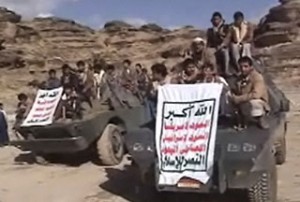
If it comes to an anti-American revolution in Saudi Arabia, that would be a massive economic problem for the U.S. mafia state and it’s empire of global dominance. While the warfare state was busy assaulting Afghanistan and Iraq, they thought they dominated the Arabian Peninsula safely, but they have now got a resistance movement there.
The US war to eradicate the Houthis is fought to secure the Saudi dictatorship. The Western population is lied to about who the enemy is in Yemen, what is at stake in the war and what kind of crimes the United States are responsible for there. The population is to be sold the war to eradicate Houthis by the mass media as an operation against Al Qaeda. Therefore Al Qaeda in Yemen is made by the mass media larger and larger.
The first mass media revelation of US involvement was that the U.S. had carried out two bombing raids with cruise missiles against “Al-Qaida in Yemen”. That was the beginning of a PR campaign, that presented Al Qaeda as the enemy of the US in Yemen. The population was signaled by the US government with the information it gave, that Al Qaeda in Yemen is a great danger. In fact, the US has massacred with their rockets many more innocent people, but who’s interested in such small details when you have mass media. This was followed by another incident for the propaganda needs of the U.S. government. A young man tried supposedly to blow up a US civilian aircraft by lighting his underwear. Given the systematic way, that US security organizations have failed to notice all information before the bomb attempt, it seems reasonable to conjecture that the attack of the underwear bomber was planned by the CIA and was intended as a false-flag operation to make Al Qaeda in Yemen look more dangerous.
Let’s go to the core facts. What is actually the strength of Al Qaeda in Yemen? The German security services mouthpiece “Die Zeit” explained to its readers last week that in Yemen 100 to 200 Al Qaeda fighters might be found. For the transatlantic propaganda leaflet for would-be intellectuals, “Der Spiegel”, this number was too small, and so it said two days later, that in Yemen there are “up to 300″ Al-Qaeda people hiding. For the state run German news programm Tagesschau, which is very well known for it’s stories from 1001 nights about Yemen, this number also was too little, and so they told their audience about the strength of Al Qaeda in Yemen “according to Western Intelligence, 1500 and numbers growing”. There one should agree completely. A tenfold increase of fighters of such an obscure organization as Al Qaeda in a week would be a remarkable growth. But nothing of this is true. It is pure war propaganda from the German media. In an interview with the Austrian paper “Die Presse” Mustafa Alani from the Gulf Research Center from Dubai confesses that all this western propaganda is pure nonsense. He says just 50 Al Qaeda people are on the watch list of Yemenite security services. So, in conclusion, Al Qaeda in Yemen is barely more than a fiction.
Western media is trying to build up fear with photos of Al Qaeda trainees, who are armed with old rifles. While doing this the mass media are quiet about the fact that in Yemen all males are, by tradition, armed. If people knew that, they would understand that pictures of armed Al Qaeda trainees in Yemen are just a circus, photographed by people as a souvenir to take home. If you have a look in comparison to just a few videos from Houthis, you will quickly understand that the Al Qaeda in Yemen stories are ridiculous nonsense.
It is also striking that there have recently been a lot of reports of hijacked ships in the Gulf of Aden. The pirate attacks fit very well into the concept of the U.S. propaganda, because David Patraeus may get more warships then to try to enforce the naval blockade against the Houthis. Gordon Brown and Barack Obama have just announced that at the end of the month, on the brink of a long-planned conference on Afghanistan, they will hold a key international meeting on security in Yemen. By then the public will probably be so filled with fear that they swallow the propaganda for the US-led war in Yemen. The failure of any anti-war movement challenge to the propaganda campaign bodes ill in this regard.
But even if Barack Obama manages to fool the public with the Al-Qaeda nonsense about the war against Houthis, that does not mean that the U.S. and their puppets are winning the war. Al Jazeera has just broadcast a message from a commander from the anti-American resistance group Al-Shabaab in Somalia, that appeared, contrary to the Rita Katz Al Qaeda theatre, very real. Sheikh Mukhtar Robow is calling on Somali fighters in Yemen to enter in the fight “against the enemies of Allah”. In the light of such horrific images of the atrocities of the United States everyone can imagine how much anger the US-colonialists will face. In Yemen the U.S. should be prepared to face legions of experienced resistance fighters and an almost entirely armed population. The US has just declared another dirty global war to conquer the world, but this time they are going to lose it.
The author manages a German language news blog at – http://www.mein-parteibuch.com/
‘Flaws’ in key Lockerbie evidence
“I do find it quite it extraordinary and I think highly improbable and most unlikely that you would find a fragment like that – it is unbelievable”
– UN European consultant on explosives, John Wyatt
BBC | January 6, 2010
An investigation by BBC’s Newsnight has cast doubts on the key piece of evidence which convicted the Lockerbie bomber, Abdelbaset Ali al-Megrahi.
Tests aimed at reproducing the blast appear to undermine the case’s central forensic link, based on a tiny fragment identified as part of a bomb timer.
The tests suggest the fragment, which linked the attack to Megrahi, would not have survived the mid-air explosion.
Two hundred and seventy people died in the 1988 attack on Pan Am flight 103.
Megrahi was jailed for the attack in 2001, but he was controversially released from prison in Scotland by Scottish Justice Secretary Kenny MacAskill in August 2009 on compassionate grounds.
Megrahi is said to be dying from terminal cancer and, according to reports from Libya, his condition continues to deteriorate.
But his release also scuppered Megrahi’s planned appeal and any hopes of challenging the evidence on which he had been jailed.
Newsnight has been reviewing that evidence, and has exposed serious doubts about the forensics used to identify the fragment as being part of a trigger circuit board.
The fragment was found three weeks after the attack. For months it remained unnoticed and unremarked, but eventually it was to shape the entire investigation.
Malta link
The fragment was embedded in a charred piece of clothing, which was marked with a label saying it was made in Malta.
So the focus turned to Malta and the question of who had bought the clothes.
A shopkeeper on the island identified Megrahi, but this came only years later after he saw him pictured in a magazine as a Lockerbie suspect.
Newsnight has discovered that the fragment – crucial to the conviction – was never subjected to chemical analysis or swabbing to establish whether it had in fact been involved in any explosion.
And the UN’s European consultant on explosives, John Wyatt, has told Newsnight that there are further doubts over the whether the fragment could have come from the trigger of the Lockerbie bomb.
Obliterated
He has recreated the suitcase bomb which it is said destroyed Pan Am 103, using the type of radio in which the explosive and the timer circuit board were supposedly placed, and the same kind of clothes on which the fragment was found.
In each test the timer and its circuit board were obliterated, prompting Mr Wyatt to question whether such a fragment could have survived the mid-air explosion.
He told Newsnight: “I do find it quite it extraordinary and I think highly improbable and most unlikely that you would find a fragment like that – it is unbelievable.
“We carried out 20 tests, we didn’t carry out 100 or 1,000, but in those 20 tests we found absolutely nothing at all – so I found it highly improbable that you would find anything like that, particularly at 10,000 feet when bits are dropping into long wet grass over hundreds of miles.
Background –
The Lockerbie Bombing Seen as an Expression of a “Strenuous Disagreement”
Related
Israel orders Hamas legislator held for six more months
06/01/2010
Salfit- Ma’an – Israel has extended the detention of Abdul Jaber Fuqaha, a Hamas-affiliated member of the Palestinian Legislative Council from Ramallah first arrested in 2006.
Hamas PLC members issued a statement condemning the order to hold Fuqaha in administrative detention for another six months.
The order was the third such order, according to Hamas.
The lawmakers said Fuqaha was not charged with any crime. Fourteen Hamas legislators are still in Israeli prisons, including seven in administrative detention.
Israel seized dozens of Hamas officials in June 2006 following the capture of Isreali soldier Gilad Shalit.
In March Israel detained ten more top Hamas officials, including lawmakers, from the West Bank.
Also on Wednesday Hamas said that the Fatah-dominated Palestinian Authority arrested three members of the Islamist movement in the West Bank.
European organizations, Turkish masses protest Egyptian assault
| 06/01/2010 |
 |
|
LONDON, (PIC)– An alliance of solidarity with the Palestinian people in Europe has called for demonstrations in front of the Egyptian embassies in a number of European capitals to protest the Egyptian security authorities’ assault on members of the international aid convoy Lifeline-3 in El-Arish on Tuesday night. The alliance, grouping 14 European organizations, said that the rallies would take place at the same time in a bid to pressure Cairo into halting the blackmail against the Lifeline convoy and to protest the savage assault on its members. The alliance, in a press release, predicted that thousands would attend the sit-ins including Palestinian and Arab communities in addition to foreign sympathizers and human rights groups. Meanwhile, hundreds of Turkish people gathered in front of the Egyptian consulate in Istanbul after midnight Tuesday to denounce the Egyptian assault, which injured many of the international solidarity activists. A number of angry protestors threw stones at the consulate building and threatened to storm the premises in the event the Egyptian authorities attacked the convoy anew. The convoy includes five Turkish lawmakers and tens of Turkish trucks. |
Featured Video
American Military Failure in Afghanistan
or go to
Aletho News Archives – Video-Images
Frlom the Archives
Iran War: United States Military Versus Israel Firsters
By James Petras | November 27, 2007
Why must Jewish organizations be and be seen as the loudest drum-beaters of all? Why can we not bring ourselves to say that military intervention is not on the table at all? Why not stash it under the table, out of sight and mount instead a diplomatic assault? – Leonard Fein, Forward
Introduction
As the White House and Congress escalate their economic sanctions and military threats against Iran, top military commanders and Pentagon officials have launched a counter-offensive, opposing a new Middle East War. While some commentators and journalists, like Chris Hedges (Truthdig, November 13, 2007), privy to this high stakes inter-elite conflict, attribute this to a White House cabal led by Vice President Cheney, a more stringent and accurate assessment puts the Zionist Power Configuration (ZPC) in the center of the Iran war debate.
There is a great deal riding in this conflict – the future of the American empire as well as the balance of power in the Middle East. Equally important is the future of the US military and our already heavily constrained democratic freedoms. The outcome of the continuous and deepening confrontation between top US military officials and the Israel Firsters over US foreign policy in the Middle East has raised fundamental questions over self-determination, colonization, civilian primacy and military political intervention, empire or republic. These and related issues are far from being of academic interest only; they concern the future of the United States. … continue
Blog Roll
 Aletho News
- Hezbollah Returns: It Didn’t Start a War, It Is Ending One
- EU states seek ‘talks’ with Iran for access to Strait of Hormuz: Report
- Trump on Hormuz: “Others must take care of it” after US falters
- Who Is closer to collapse?
- A War that Backfired: Why the US-Israeli Campaign Is Strengthening Iran
- How Zionist Control Is Hurting US Interests
- Iran warns it may target US missile launch sites in UAE cities
- American Military Failure in Afghanistan
- Friendly Skies of Georgia: Are Israeli-Linked Drones Launching False Flags from Georgian Territory?
- The Three Big Lies about Mammography Screening
- If Americans Knew
- No let-up in attacks on Gaza as Israel takes on Iran, Lebanon – Not a ceasefire Day 155
- ‘Of Course’: IDF Drops Case Against Soldiers Accused of Raping Palestinian Prisoner
- Don’t Fall for the Regime Change Talk. Israel Is ‘Mowing the Lawn’ in Iran
- Will Israel and the US wreck the Gulf States along with Iran?
- US so far burned through ‘years’ of munitions in Iran war: Report
- How the Israeli Tail Wags the American Dog
- Outdated intel likely led to deadly U.S. strike on Iranian elementary school, sources say
- Pentagon insider says high U.S official Douglas Feith reported to Netanyahu
- In fond memory of Walid Khalidi, the historian of Palestine
- 6 more Americans killed, as Israel ‘mows the lawn’ in Iran – Not a ceasefire Day 154
- No Tricks Zone
- Storing Green Energy To Last Germany 10 Days Would Require A 60-Million Tonne Battery
- New Studies: UK Sea Levels Were 4 Meters Higher Than Today During The Mid-Holocene
- Destructive Green New Deal: German Energy And Metal Group Warns Of Drastic Crisis
- New Study Documents A 20-Year Pause In Arctic Sea Ice Decline – Driven By Internal Variability
- Wake-up Call: Survey Shows Majority Of Germans Now Favor Postponing Climate Targets!
- Televised! Leading German Political Candidate Tells Schoolchildren CO2 Makes Sun Hotter!
- New Study: A Century Warming Of 1.1°C Is ‘Commonplace’ And ‘Not Unusual’ During This Interglacial
- New Study: ‘Internal Noise’ And Volcanic Forcing Can Trigger 10-15°C Warming Within Decades
- Glaciers Worldwide Are Suddendly Surging, Experts Blame Warming!
- Surprising Discovery: Sahara Is Greening…Billions Of Trees Where Once Thought To Be Barren
 Aletho News