State mandated “green” energy devastates ecosystem

Until recent decades the Eel river ran clear and cool throughout California’s five month dry season and offered world renowned sport fishing. This swimming hole, cold, large and beautiful lies above the area called Bloody Rock (What the white man did in this watershed is memorialized in the naming of places). These waters are being diverted into a different watershed leaving the lower river only a trickle. – Photo source link
Conservation group challenges PG&E, seeks more water for Eel River
By John Driscoll – The Times-Standard – 03/04/2010
A conservation group is looking to the state to significantly cut back on the diversion of Eel River water to the Russian River in what it says is a last-ditch effort to save crashing salmon and steelhead runs.
The damage to Eel River fisheries is hardly worth the tiny amount of electrical power produced by the Potter Valley Project owned by Pacific Gas and Electric Co., according to Friends of the Eel River’s recent filing with the State Water Resources Control Board. The group wants the state to modify the utility’s water rights, because they allow an “unreasonable use of water.”
The Friends say that a 15-percent reduction in the diversion — ordered by the National Marine Fisheries Service in 2002 as part of PG&E’s license requirements through the Federal Energy Regulatory Commission — has done nothing to stop the decline of protected coho and chinook salmon and steelhead populations. But NMFS has also concluded that flows in the much smaller Russian River, boosted by water from the Eel, are too high to support salmon and steelhead there.
”Given the (Potter Valley Project’s) toll on threatened and endangered fish in the Eel and Russian rivers,” the petition reads, “and the relatively small amount of electricity it produces, the water rights for the project must be modified in order to protect the public trust resources and prevent the unreasonable use of water.”
The Potter Valley Project was started in 1908 with the building of Cape Horn Diversion Dam, which created Van Arsdale Reservoir, tunnels and a powerhouse. Scott Dam was built about a decade later, creating Lake Pillsbury. The project generates 9.4 megawatts by diverting water in Van Arsdale Reservoir through the powerhouse at the start of the East Branch of the Russian River. A typical commercial windmill produces about 2 mw.
Cities, farms and vineyards in Sonoma, Mendocino and Marin counties rely in part on diversions from the Eel River to the Russian River, mixed with releases from Lake Sonoma and Lake Mendocino, but they have no clear right to Eel River water released through the project. That water right belongs to PG&E, and is up for renewal in 2022.
Sonoma County supervisors in September withdrew a long-studied project to take more water from the Russian River, citing poor economic and shifting environmental conditions. City officials from Santa Rosa and Marin County criticized the decision, which they claimed would sacrifice water rights and impede growth.
The Friends’ petition said that the Russian River should be a self-contained water system, and can be supported by other sources without the diversion of billions of gallons from the Eel River each year. A weighing of various water uses should be undertaken, the petition reads.
Friends Executive Director Nadananda said that time is of the essence, as salmon and steelhead runs are at very low levels, having declined from about 500,000 fish prior to the project to only 15,000 today.
”The river is in really serious trouble,” Nadananda said.
A reduction in the diversion would reduce the amount of power PG&E can generate, and would likely make the project uneconomical, she said.
PG&E spokesman Paul Moreno said that the company has not fully reviewed the petition, but said that the project is operated under strict guidelines developed through the federal relicensing process.
”It is inevitable that different stakeholders have different views,” Moreno said.
He said the hydropower project helps meet state demands for clean, renewable power that is available during peak demand, unlike solar and wind projects.
Spokeswoman Ann DuBay of the Sonoma County Water Agency, which provides water to about 600,000 residents in Sonoma, Mendocino and Marin counties, said only that the agency’s attorneys are reviewing the petition.
Alderon Laird with the Association of California Water Agencies — and board member of the Humboldt Bay Municipal Water District — said that any third party can challenge another’s water right in California. The state water board must decide whether to entertain a petition, he said, and it’s possible that could trigger a process to determine the needs of a particular watershed.
Recently passed state law prompted the state water board to begin a “needs assessment” for the massive Sacramento River delta project, Laird said. That is supposed to determine how much water is needed in the delta region for various uses before any water can be exported outside the delta, he said.
”If that’s the philosophy of the state board … it kind of sets a precedent for anywhere else in California,” Laird said.
John Driscoll covers natural resources/industry. He can be reached at 441-0504 or jdriscoll@times-standard.com.
###

The actual diversion tunnel, looking ever so sinister as the machine that turns fish into fertilizer for the Potter Valley farmers delivered on tap. We call Potter Valley fish emulsion green for good reason. It is only in recent years that PG&E was forced to put in screens to stop the fish from entering the tunnel and turbines. Originally eels by the thousands interfered with the turbines so they were electrocuted and hauled away in hay wagons.

Note the shades of yellow and green that identify algae that is a plague to this system. It is hard to believe so lovely a river could change so much and have so much algae in such a short period of time.
 |
| Cumulative impact of all diversions, little water and lots of algae dramatically impact California’s third largest river system. |


| This photo of logging on steep slopes tells the tail of why the Eel River has moved from one of the most pristine rivers in the world, as written up in a 1940’s sportsman magazine, to now carrying a silt tonnage fifteen times greater than the Mississippi. This is our top soil washing off the slopes, filling the river.This area was held together by redwoods with their root network and ability to turn fog into drip contributing water at the end of the long dry summer. |
 |
| Down river from the confluence with the South Fork Eel. Lots of silt and not enough water to move it. This is what the 90% diversion of headwaters looks like in the summer and fall before the rains. Not enough water for a fish to run on. |
 |
| Algae abounds even in the fog cooled lower river near Scotia. |
A superpower and “the world’s sickest warrior state”
By Paul J. Balles | March 8, 2010
Living through five or six major wars has hardened me to what I thought were the extremes of inhuman cruelty and brutality.
Two things made those extremes almost bearable: the brutality always revealed – at least according to the media coverage – the viciousness of the enemy. It was therefore quite understandable when our “brave men and women” pulverized the enemy.
Films of Japanese torturing captive Americans somehow justified holding over 7,000 Japanese Americans in internment camps during World War II; and only a small percentage of Americans found the bombing of Hiroshima and Nagasaki unreasonably vengeful at best, at worst, depraved.
The media giants in America portrayed the North Koreans as barbaric beasts with their captives, quite unlike their southern counterpoints – our allies during the Korean War. No one ever felt the need to explain how the South Koreans were a civilized breed while the North Koreans were absolute savages, at least according to the official line.
In Vietnam, our warriors justifiably (or so the media made us believe) dropped napalm on the North Vietnamese who had the gall to hide in villages and tunnels to ravage our invaders. At least it was accepted practice until some rogue photojournalist filmed a young girl screaming down a Vietnamese road in flames.
One of our lieutenants also got caught commanding his troops to open fire on an entire village of civilians – women and children. We had obviously – to some – gone too far. If those few torturous incidents hadn’t been filmed, we might have carried on and won the war in Vietnam (or so the thinking goes) with our napalm and wanton village massacres.
Then, when the Iraqi troops ran (literally) fleeing Kuwait in 1991, our bloodthirsty aviators annihilated them on the road north, bombing their retreat to “melted glass” (as one Lockheed acquaintance put it). That feast for hungry slaughterers received little attention. The bombers and strafers felt no guilt after Saddam’s troops had blown up Kuwait’s oil wells.
The nagging memory of non-avenged defeat in Vietnam somehow allowed members of the clergy to ignore the devastating inhuman cost to children in Iraq during 10 years of sanctions. Only a few humanitarians among academics spoke out. Congress completely ignored it. The public didn’t care. Why should they? Our leaders spoke of everything but the brutality of our enforcers.
We have now reached a stage where our extreme horrors of brutality and cruelty have exceeded our past records. We no longer have the rationale of moral righteousness of the earlier wars.
There were no excuses for Abu-Ghraib, but our interest in that inhuman travesty dried up and blew away. We have little concern about our violations of human rights in Guantanamo. We care less about ill-treatment of Arabs and Arab Americans in the USA.
But the most extremes – the real horrors – of this war come with the primitive killer mentality developed in our youth. I’ve now seen a half dozen documentary films and read eyewitness accounts that reveal troops or pilots gloating over the massacres of civilians who just happened to be available targets.
Without doubt, the US has not only become the world’s major power, it has become the world’s sickest warrior state. Neither conscience nor empathy for others defines the qualities of the sociopath.
It’s past time for humanitarians to reject the double standards set by warmongers and supported by arms-makers and the mainstream media. The clergy needs to stop preaching sanctimonious sermons. Finally, educators should adopt and teach a zero tolerance policy for self-righteous warriors.
And yes, those who would dismiss my criticism as vitriolic should join a chorus with a conscience.
Paul J. Balles is a retired American university professor and freelance writer who has lived in the Middle East for many years.
Liberal Richard Cohen Advocates Craziness in an Israel First War Policy
By Stephen Sniegoski
While we are explicitly told by anti-war commentators such as Juan Cole that the only type of American Jews pushing for war on Iran are right-wing ones, it is apparent that Jewish liberals such as Richard Cohen are also in the pro-war camp. (See: http://tinyurl.com/JuanColeonIsraelLobby )
Now Cohen, just like a number of rightist neocons, does not directly call for an attack on Iran, but rather advocates a policy that certainly would lead in that direction. Specifically, he says that it is time for Obama to start acting “crazy” toward Iran because of the alleged failure of diplomacy. (Iran and the Crazy Factor, Washington Post, February 23, 2010)
Such a recommendation of craziness is predicated on Cohen’s belief that Ahmadinejad and the Iranian leadership in general are crazy and that the only way to fight crazy people is by likewise acting crazy: “fight crazy with crazy.”
Cohen writes: “I have no idea whether Ahmadinejad merely acts crazy or is crazy. I do know, though, that Iran seems intent on getting nuclear weapons and the missiles to deliver them. I also know that nothing the United States and its allies have done has dissuaded Ahmadinejad (or the mullahs or the Revolutionary Guard Corps) from his goal. It may be time for Barack Obama, ever the soul of moderation, to borrow a tactic from Richard Nixon and fight crazy with crazy. The way things are going, it would be crazy not to.”
It is rather odd that Cohen would pick Nixon’s advocacy of madness as a model for emulation, since Nixon, and especially his bellicosity, were hardly admired by liberals such as Cohen during his presidency. Moreover, Cohen acknowledges that Nixon’s crazy strategy “while cunning, didn’t work on the North Vietnamese.” Desiring the adoption of a previously failed strategy is hard to fathom.
Furthermore, Nixon’s rationale for acting crazy would not seem to apply in the milieu depicted by Cohen. Nixon actually predicated his madman strategy on the rationality of his adversaries. The rational person, presumably, would make some concessions to the madman to avoid destruction. However, Cohen claims that the Iranians are irrational. There is no reason to think that acting crazy would cause them to turn rational, but rather that it would cause them to act out their craziness, which in the particular situation that exists in the Middle East today would mean an all-out war.
To try to put Cohen’s argument in a rational context, this must mean that he sees a war with Iran at the current time to be preferable to one in the future when Iran would have nuclear weapons and which would likely involve Israel.
The reasons Cohen gives for taking a “crazy” stance toward Iran have little to do with any threat Iran poses to the United States, but actually seem to revolve around Israel and Jews. Cohen cites Ahmadinejad’s “Holocaust denial” and his call for Zionism to be “wiped out.” Cohen acknowledges that these words might have nothing to do with the launching of war-” On the face of it, these statements could be nothing more than the ranting of a demagogue intent on appeasing the mob.” But then he points out that Israel, having experienced Hitler’s anti-Semitic words leading to the Holocaust, would naturally think otherwise. “Israel, of all countries,” he asserts, “has little faith in the rationality of mankind. It simply knows better. So the question of whether Ahmadinejad is playing the madman or really is a madman is not an academic exercise. It has a real and frightening immediacy that too often, in too many precincts, gets belittled as a form of paranoia.”
So it might be understandable for Israel to be terrified of a nuclear Iran, at least according to Cohen, but what about a threat to the United States?
“An Iranian bomb,” Cohen contends, “is not a matter that concerns only Israel. It would upend the balance of power throughout the Middle East and encourage radical/terrorist organizations such as Hezbollah and Hamas to ratchet up their war against Israel. Other Middle East nations, not content to rely on an American nuclear umbrella, would seek their own bombs. An unstable region would go nuclear.” It is telling that even in purportedly dealing with threats to countries other than Israel, Cohen almost immediately gets back to threats to Israel by writing that a nuclear Iran would “encourage radical/terrorist organizations such as Hezbollah and Hamas to ratchet up their war against Israel.” For Cohen, Israel’s safety is certainly on his mind, first and foremost.
But regarding the US, the dangers presumably consist of countries in the unstable Middle East obtaining nuclear weapons. These developments, while undesirable, are hardly dire threats to American national security. And we are only dealing with the chance of Iran developing actual nuclear weapons, though it is more likely that it will develop nuclear capability. And in the most extreme case with all major countries in the Middle East obtaining nuclear weapons, it is not even clear whether such a development would lead to a terrible war or whether it might actually enhance regional stability.
Certainly, the existence of nuclear weapons served to prevent a major war between the US and the Soviet Union during the Cold War. And the possession of nuclear weapons have not caused India and Pakistan to be more aggressive toward each other. Of course, the loss of its nuclear monopoly would weaken Israel’s position in the Middle East.
What Cohen does not even make an attempt to show is that in regard to American security the danger of not attacking Iran outweighs the terrible impact of a war in the Middle East, which would be a likely result from his recommendation that Obama act crazy. It would seem to be a general consensus that a war on Iran at the present time would have terrible consequences for the already-battered world economy, which would certainly affect the US. It should be pointed out that the chairman of the Joint Chiefs of Staff, Admiral Michael Mullen, reflecting what has been the consensus view of the American military leadership, has expressed strong opposition to any military strike on Iran and desires the continuation of peaceful diplomacy.
In sum, it would appear that the liberal Richard Cohen does not differ substantially from his co-religionists on the Right in his militant position toward Iran. And there is nothing particularly new about this. Cohen had supported the war on Iraq and only later recanted, after the war had become unpopular, but included Israel in his explanation for his earlier pro-war position: “Saddam Hussein was a beast who had twice invaded his neighbors, had killed his own people with abandon and posed a threat – and not just a theoretical one – to Israel.” (“The Lingo Of Vietnam,” Washington Post, November 21, 2006, p. A-27) It would seem therefore that the safety of Israel always looms very large in the minds of even liberal Jews.
More Fictitious Hurricane Predictions
Lack of experience diminishes our power of taking a comprehensive view of the admitted facts. Hence those who dwell intimate association with nature and its phenomenon are more able to lay down principles such as to admit of a wide and coherent development; while those whom devotion to abstract discussions has rendered unobservant of facts are too ready to dogmatize on the basis of a few observations. – Aristotle, On Generation and Corruption
By Doug L. Hoffman – 02/24/2010
 According to the AP, top researchers now agree that the world is likely to get stronger but fewer hurricanes in the future because of global warming, seeming to settle a scientific debate on the subject. But they say there’s not enough evidence yet to tell whether that effect has already begun. Despite warnings by scientists that identifying an actual trend in storm variability is impossible due to a lack of reliable historical data, a new report in Nature Geoscience is being cited as a solid prediction of future trends in tropical cyclone activity. The other thing not mentioned is that this research is based on models of questionable accuracy.
The review article by Thomas R. Knutson et al., entitled “Tropical cyclones and climate change,” was published online on Sunday, February 12, 2010. In it, the authors warn that there is precious little that can be predicted from past data. But this does not stop them from blithely predicting the future based on new “high-resolution” models. Here is part of the paper’s abstract:
Large amplitude fluctuations in the frequency and intensity of tropical cyclones greatly complicate both the detection of long-term trends and their attribution to rising levels of atmospheric greenhouse gases. Trend detection is further impeded by substantial limitations in the availability and quality of global historical records of tropical cyclones. Therefore, it remains uncertain whether past changes in tropical cyclone activity have exceeded the variability expected from natural causes. However, future projections based on theory and high-resolution dynamical models consistently indicate that greenhouse warming will cause the globally averaged intensity of tropical cyclones to shift towards stronger storms, with intensity increases of 2–11% by 2100.
Once again, climate scientists are predicting future climate behavior based, not on emperical data, but on computer models. They go on to state that confidence in some of their predictions is low “owing to uncertainties in the large-scale patterns of future tropical climate change, as evident in the lack of agreement between the model projections of patterns of tropical SST changes.” Their approach is to combine a number of different models into an “ensemble,” manipulating the output until it converges on what historical observations we have. In the end they predict fewer but stronger storms because of global warming, though “the actual intensity level of these strong model cyclones varies between the models, depending on model resolution and other factors.”
Modeling and the Search for Scientific Truth
I have repeatedly stated that models can be a useful tool in any number of fields. Understand that there are different kinds of computer models. Some are quite exact and can be used for such things as aerodynamics and structural analysis. Those types of quantitative models are based in well understood natural laws and are relatively tractable. They give answers that engineers can use as actual guidance. But even then they are not always right. Recently Boeing had to reinforce the wing root attachment points on their new 787 airliner because the computer model simulations were not born out in actual testing.
Moreover, not all models are blessed with such passing verisimilitude with respect to nature. Most models are approximations for the systems being modeled. They are pressed into service when the system being studied is too complex for human intuition to predict system behavior. Computer models of this kind—which includes GCM climate models—should be used to provide insight, but instead are used to make authoritative predictions of things to come. This brings us to the philosophy of Sir Karl Popper.
 Karl Popper was one of the most influential philosophers of the 20th Century and a tremendous influence on modern scientific thought. One TRE reader, Peter Foster, pointed out to me that the 2007 IPCC report cites Popper’s 1934 book, The Logic of Scientific Discovery. Peter is the second person with a connection to Canterbury University in Christchurch, New Zealand, to contact me this month. Unsurprisingly, both mentioned Popper. In 1937, the rise of Nazism and the threat of the Anschluss led the Austrian born Popper to emigrate to New Zealand. There he became a lecturer in philosophy at Canterbury University where he had a strong influence that evidently persists to this day.
According to Popper “the criterion of the scientific status of a theory is its falsifiability, or refutability, or testability.” By falsifiability he did not mean that a theory was false but that there exists a way to prove the theory false (for more see Popper’s essay “Science as Falsification”). A theory has to be testable. There have to be defined properties which can be predicted by theory and checked by measurement. It would appear that the IPCC authors agree, as shown in this quote from the AR4 section entitled “The Nature of Earth Science”:
Science generally advances through formulating hypotheses clearly and testing them objectively. This testing is the key to science. It is not the belief or opinion of the scientists that is important, but rather the results of this testing. Scientific theories are ways of explaining phenomena and providing insights that can be evaluated by comparison with physical reality. Each successful prediction adds to the weight of evidence supporting the theory, and any unsuccessful prediction demonstrates that the underlying theory is imperfect and requires improvement or abandonment.
Popper was among the first to state that discovering truth is the aim of scientific inquiry while acknowledging that most of the greatest scientific theories in the history of science are, strictly speaking, false. Scientists’ theories represent their current understanding of nature. As that understanding improves old theories are discarded and new ones formulated. Popper’s philosophy of science defined progress as the process of moving from one false theory to another, still false theory that is nonetheless closer to the truth.
Climate models are analogous to those false yet useful theories—models try to encapsulate science’s understanding of how the Earth system works. This has led many, including another friend of mine from Canterbury University, to make the argument that the models we have may not be perfect but they are at least usable. The question becomes, how much faith are you willing to place in a model’s results, starting from the acknowledgment that all such models are by definition wrong. Having spent many years modeling large, nonlinear systems I am not willing to base potentially world changing decisions on the output of current climate models.
This is because of how the models are constructed and how they are calibrated. In short, the models are tuned to produce a specific amount of temperature increase for a doubling of CO2 levels. It is unsurprising that the researchers then get the answers they expected. It is also unsurprising that, when faced with an unexpected response from the natural system like the recent leveling and possible decline in global temperatures, the models fail miserably. Worse than that, secondary predictions are often made based on the predictions of models or even models that use the output of other models as their starting data.
A New Hurricane Model
One of the references cited by the Nature Geoscienc hurricane modeling report was a recent paper in Science that can help fill in some of the technical details of how the modeling research was performed. In it, researchers did, indeed, report that fewer but stronger hurricanes will sweep the Atlantic Basin in the 21st century. This new modeling study by US government researchers from NOAA is predicated on climate change “continuing.” As explained in an accompanying perspective by Science writer Richard A. Kerr:
What makes the new study more realistic is its sharper picture of the atmosphere. In low-resolution models such as global climate models, the fuzzy rendition of the atmosphere can’t generate any hurricanes, much less the intense ones that account for most of the damage hurricanes cause. The high-resolution models used by the U.S. National Weather Service to forecast hurricane growth and movement do produce a realistic mix of both weak and strong storms, but those models can’t simulate global warming.
So, as a compromise the researchers took the output of some of those “fuzzy” GCM and used their projections for global environment at the end of the century as the starting point for the new “high-resolution” models.
Climate modeler Morris Bender of the National Oceanic and Atmospheric Administration’s Geophysical Fluid Dynamics Laboratory in Princeton, New Jersey, and his colleagues used a technique sometimes called “double-downscaling.” The group started with the average of atmospheric and oceanic conditions forecast for the end of the century by 18 global climate models. They transferred those averaged conditions into a North Atlantic regional model detailed enough to generate a realistic number of hurricanes, although still too sketchy to get their intensities right. Finally, the team transferred the regional model’s storms to an even higher-resolution hurricane forecast model capable of simulating which ones would develop into category 3, 4, and 5 storms.
Naturally this has led to a number of reports in the popular media that we are to expect fewer but stronger hurricanes in the future and those hurricanes are going to be caused by global warming. It should be noted that this study actually contradicts some reports that the recent “anomalous” rise in hurricane activity is linked to climate change. No consensus here.

Model tracks for all storms that eventually reached category 4 or 5 intensity. Bender et al./Science.
Given that the model predictions for 2100 are not testable except in the fullness of time, there is no convenient way to test to the new models future accuracy. As the researchers themselves state, “these findings are dependent on the global climate models used to provide the environmental conditions for our downscaling experiments.” It is, however, possible to run the model on known data taken over the past quarter of a century. The new modeling study attempted to reproduce recent conditions and they found:
The researchers note that the new modeling offers no support for claims that global warming has already noticeably affected hurricane activity. In the real world, the number of Atlantic hurricanes observed during the past 25 years has doubled; in the model, global warming would cause a slight decline in the number over the same period. Given that the mid-resolution model used by the group duplicates the observed rising trend, it may be natural.
So the fuzzier mid-resolution model, presumably less accurate than the new one, gets the recent trend correct, which the researchers interpret as an indication that any rising trend is purely natural. The new high-resolution model doesn’t correctly predict current conditions. Here we have low-resolution models known to be inexact providing the hypothetical starting point data for other models—models which fail to correctly predict trends even based on real data—yet we are asked to uncritically accept the projections for hurricanes 90 years from now. It is to be expected that, if you start with wonky data input, you end up with wonky data output, but this carries the process a step further. Believing the results of this exercise seems more an act of faith than science. Is it any wonder that I mentioned the greatest sin of a modeler: believing that the model is the thing being modeled.
Computer simulation of the most intense hurricanes shows an increase from today (top) to a warmer world at the end of the century (bottom). Adapted from Bender et al./Science.

Rather amazingly, an earlier study in Nature stated that current climate conditions resemble those that led to peak Atlantic hurricane activity about 1000 years ago. I say amazingly because this study based on examining ocean sediments, included Pennsylvania State University meteorologist Michael Mann of hockey stick fame—a global warming true believer in anyone’s book. The paper states: “The short nature of the historical record and potential issues with its reliability in earlier decades, however, has prompted an ongoing debate regarding the reality and significance of the recent rise.”
Good modelers, like all cautious scientists, always use conditional phrases and qualifiers when writing of their work. “In the absence of a detectable change, we are dependent on a combination of observational, theoretical and modeling studies to assess future climate changes in tropical cyclone activity,” concludes the review by Knutson et al. “These studies are growing progressively more credible, but still have many limitations.” We have consensus and that consensus is “we don’t really know.” Unfortunately, such reservations do not make it into the news headlines.
What usually happens is more a sin of omission rather than commission. Climate modelers, and the climate science community in general, have not gone out of their way to stress the inherent unreliability of their predictions to the lay public. In the public forum, climate science has been happy to let overly excitable reporters and fringe eco-activists spin the GCM results into predictions of future catastrophe. This is disingenuous at best and can lead to the types of backlash recently visited on CRU and other research organizations over mishandling and manipulation of data. Sure, the IPCC calls them scenarios and projections, not predictions, as if that gives them deniability when the projections do not come to pass.
In 2007, the IPCC said it was “more likely than not” that man-made greenhouse gases had already altered storm activity, but the authors of the review said more recent evidence muddies the issue. “The evidence is not strong enough that we could make some kind of statement” along those lines, Knutson said. It doesn’t mean the IPCC report was wrong; it was just based on science done by 2006 and recent research has changed a bit, said Knutson and the other researchers.
The fact is, climate scientists have continued to use models to make predictions about future climatic conditions, and by attaching those predictions to the AGW theory they have weakened the very theory they are at pains to defend. Fortunately, Popper provides us with a way to filter truth from falsehood. The IPCC and other global warming alarmists have a choice—they can either say that AGW makes no predictions and is therefore not a scientific theory by definition, or they can stand by their model generated predictions and admit that their theory has been proven false time and again.
Be safe, enjoy the interglacial and stay skeptical.
Aletho News will be posting more on Karl Popper’s philosophy of science within the week.
Chagossians face sinister “environmental” ban from homeland
By Catherine Philp | The Times | March 6, 2010
(John Parker/Corbis)
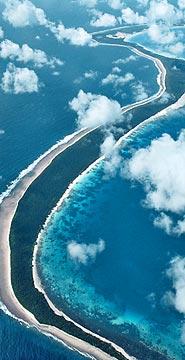
If ever there was an oceanic treasure worthy of conservation, the Chagos archipelago, with its crystal-clear waters and jewelled reefs, is it. Yet the British Government’s plans have split the gentle world of marine conservation, created a diplomatic row with Indian Ocean states and turned the spotlight on to the archipelago’s place in Britain’s darker colonial history.
The British Indian Ocean Territory, as it is officially known, is the ancestral home of the Chagossians, the 2,000 people and their descendents that Britain removed forcibly from the islands in the Seventies to make way for a US air and naval base on the main island, Diego Garcia. Despite Britain repeatedly overruling court judgments in their favour, the exiled Chagossians have continued their struggle. This summer their case will be heard at the European Court of Human Rights in Strasbourg. By then, however — if David Miliband, the Foreign Secretary, gets his way — the Chagos will have been designated a marine protected area (MPA), where activities such as fishing and construction are banned, denying them any legal means to sustain their lives.
It is, depending on your view, a sinister trick to prevent the Chagossians returning; an easy piece of environmental legacy building by a Government about to lose power; or an act of arrogant imperialism to rob the territory’s true owners of any say in its future.
Perhaps the most compelling case against the plan, however, is made by the swelling cadre of environmentalists opposing the project in the belief that — far from protecting this pristine paradise — it could hasten its destruction. “Even if I didn’t care about human rights, I would say this is a terrible mistake,” said Dr Mark Spalding, one of the world’s foremost experts on reef conservation.
“The world of conservation is littered with failures where the people involved were not consulted. If the Chagossians win the right to return, why should they want to co-operate with the conservation groups running roughshod over them?”
The Government’s proposal acknowledges that the entire plan may have to be scrapped if the Chagossians are allowed to return. “That would make it the shortest-lived protection area in the world,” Dr Spalding said. “So you have to ask: what’s the rush to get this done before [the Strasbourg ruling and] a general election?”
Mr Miliband will begin to examine the cases for and against the reserve next week, after public consultations ended yesterday. A decision is expected within weeks, but the Foreign Secretary already sounds convinced. “This is a remarkable opportunity for the UK to create one of the world’s largest marine protected areas, and double the global coverage of the world’s oceans benefiting from full protection,” he wrote.
Many of the world’s leading conservation groups have thrown their weight behind the proposal, which emphasises the advantage of the islands being “uninhabited”. They are not: the original islanders were removed from Diego Garcia to make way for a military base that houses 1,500 US service personnel, 1,700 civilian contractors and 50 British sailors. The island, which constitutes 90 per cent of the landmass of the Chagos, is, in effect, to be exempt from the protection order.
Peter Sand, a British environmental lawyer who has investigated the US base’s impact, has documented four jet fuel spills totalling 1.3 million gallons since it was built and has lobbied unsuccessfully for information on radiation leakage from nuclear-powered vessels there. “To say that a small group of Chagossians could have a greater impact than the base is just crazy,” Dr Spalding said.
The plan has also sparked a diplomatic row with Mauritius and the Seychelles, from whom the Chagos Islands were taken and to whom Britain has agreed to cede them when they are no longer needed by the US military. Britain faces further embarrassment over allegations that Diego Garcia was used to moor US prison ships where “ghost” prisoners were tortured.
The Prime Minister of Mauritius said last week that he was “appalled” by the decision to press ahead with plans for the reserve, “It is unacceptable that the British claim to protect marine fauna and flora when they insist on denying Chagos-born Mauritians the right to return to their islands all the while,” Navin Chandra Ramgoolam said at the inauguration of a building for Chagossian refugees in the Mauritian capital. “How can you say you will protect coral and fish when you continue to violate the rights of Chagos’s former inhabitants?”
Britain originally offered the US the Aldabra atoll for its base but backed down after uproar from environmentalists. Aldabra, now a World Heritage Site, was uninhabited by humans but home to hundreds of thousands of giant tortoises. “The British had refused to create a base on Aldabra in the Seychelles not to harm its tortoise population,” marvelled Olivier Bancoult, head of the Chagos Refugees Group. “Now they are trying to create a protected area to prevent Chagossians from returning to their native islands.”
Shifting sands
1960s The Chagos archipelago, originally part of Mauritius, is secretly leased to Britain. Together with the Aldabra archipelago, taken from the Seychelles, they become the British Indian Ocean Territory
1970 Britain and the US agree to set up a military base on Diego Garcia, and Britain begins deporting the 2,000 Chagossians to Seychelles and Mauritius
1983 £1m compensation is paid to the refugees on Mauritius
2000 British High Court rules in favour of Chagossians demanding the right to return
2004 Government issues a royal prerogative striking down the court’s decision
2006 The Court of Appeal dismisses the Government’s appeal, saying its methods are unlawful and “an abuse of power”; 102 Chagossians are permitted to visit Diego Garcia for a day to tend relatives’ graves
2008 Law lords vote 3-2 in favour of Government, overruling High Court
2009 Foreign Office launches public consultation on the creation of a protected marine area
2010 The European Court of Human Rights is set to hear the Chagossians’ petition to return this summer
‘US running international network of secret detentions’
Press TV – March 7, 2010
A United Nations report on the existence of secret detention facilities in countries around the world puts most of the blame on the US and its Central Intelligence Agency.
The report says that the CIA, under the pretext of fighting terrorism, runs scores of secret prisons in foreign countries where suspected terrorists are held, a Deutsche Welle article read on Saturday.
The UN report charges that the United States has created an “international network” to keep in detention anyone it deems as potential enemies.
According to Deutsche Welle, the secret prisons exist in more than 66 countries.
These countries include Algeria, Egypt, India, Russia, Sudan and Zimbabwe where suspects and dissidents are kept in secret facilities.
Poland and Romania are accused of hosting the CIA secret prisons on their soils.
The report further suggests that the US transfers its prisoners to countries like Ethiopia, Djibouti, Egypt, Jordan, Morocco, Pakistan, Syria and even Thailand for interrogation.
According to the UN report, in Israel Palestinian prisoners are kept in secret detention under the “illegal fighter” law.
The UN report says while the existence of the secret prisons around the world violates the human and international rights they introduce a “serious problem on a global scale.”
“If resorted to in a widespread or systematic manner, secret detention might reach the threshold of a crime against humanity,” suggests the report.
Four UN Special Rapporteurs Martin Scheinin, Manfred Nowak, Shaheen Sardar Ali, and Jeremy Sarkin, have contributed to the report.
The report was due to be examined in Geneva this month; however, the resistance shown by some countries postponed the process until June.
Iceland Rejects Icesave Bill in Referendum, Early Results Show
By Omar R. Valdimarsson | Bloomberg | March 6, 2010
Icelanders overwhelmingly rejected a bill that would saddle each citizen with $16,400 of debt in protest at U.K. and Dutch demands that they cover losses triggered by the failure of a private bank, first results show.
Ninety-three percent voted against the so-called Icesave bill, according to preliminary results on national broadcaster RUV. Final results may be published tomorrow morning.
The bill would have obliged the island to take on $5.3 billion, or 45 percent of last year’s economic output, in loans from the U.K. and the Netherlands to compensate the two countries for depositor losses stemming from the collapse of Landsbanki Islands hf more than a year ago.
“Ordinary people, farmers and fishermen, taxpayers, doctors, nurses, teachers, are being asked to shoulder through their taxes a burden that was created by irresponsible greedy bankers,” said President Olafur R. Grimsson, whose rejection of the bill resulted in the plebiscite, in a Bloomberg Television interview yesterday.
Failure to reach an agreement on the bill has left Iceland’s International Monetary Fund-led loan in limbo and prompted Fitch Ratings to cut its credit grade to junk. Moody’s Investors Service and Standard & Poor’s have signaled they may follow suit if no settlement is reached.
‘Obsolete’
Political leaders have already moved on and are trying to negotiate a new deal with the U.K. and the Dutch, making the bill in today’s vote “obsolete,” Prime Minister Johanna Sigurdardottir said on March 4.
“This referendum is very peculiar and without any parallel in Iceland’s history,” said Gunnar Helgi Kristinsson, a professor of political science at the University of Iceland, in an interview.
The Icesave deal passed through parliament with a 33 to 30 vote majority. Grimsson blocked it after receiving a petition from a quarter of the population urging him to do so. The government has said it’s determined any new deal must have broader political backing to avoid meeting a similar fate.
Even so, signs of disunity across the political divide have emerged, prompting concerns that the government may be forging ahead without the backing of opposition parties.
“It’s extremely important that we try in full to complete the negotiations in harmony with the opposition,” Sigurdardottir said. “If that’s not possible, we will have to try to resolve this by ourselves.”
Outrage
Icelanders used the referendum to express their outrage at being asked to take on the obligations of bankers who allowed the island’s financial system to create a debt burden more than 10 times the size of the economy.
The nation’s three biggest banks, which were placed under state control in October 2008, had enjoyed a decade of market freedoms following the government’s privatizations through the end of the 1990s and the beginning of this decade.
Protesters have gathered every week, with regular numbers swelling to about 2,000, according to police estimates. The last time the island saw demonstrations on a similar scale was before the government of former Prime Minister Geir Haarde was toppled.
Icelanders have thrown red paint over house facades and cars of key employees at the failed banks, Kaupthing Bank hf, Landsbanki and Glitnir Bank hf, to vent their anger. The government has appointed a special commission to investigate financial malpractice and has identified more than 20 cases that will result in prosecution.
Economic Impact
The island’s economy shrank an annual 9.1 percent in the fourth quarter of last year, the statistics office said yesterday, and contracted 6.5 percent in 2009 as a whole.
Household debt with major credit institutions has doubled in the past five years and reached about 1.8 trillion kronur ($14 billion) in 2009, compared with the island’s $12 billion gross domestic product, according to the central bank.
Icelanders, the world’s fifth-richest per capita as recently as 2007, ended 2009 18 percent poorer and will see their disposable incomes decline a further 10 percent this year, the central bank estimates.
Grimsson, who has described his decision to put the depositor bill to a referendum as the “pinnacle of democracy,” says he’s not concerned about the economic fallout of his decision.
“The referendum has drawn back the curtain and people see on the stage the matter in a new perspective,” he said in an interview. “That has strengthened our position and our cause.”
To contact the reporter on this story: Omar Valdimarsson in London at valdimarsson@bloomberg.net
Twilight zone / Unanswered questions
By Gideon Levy | Haaretz | March 4, 2010
Musa Abu Hashhash could not hold back his tears. We have worked with this devoted field worker from B’Tselem, the Israeli Information Center for Human Rights in the Occupied Territories, for years. Never before had we seen him cry. But this week he broke down and wept after a visit to the widow of Fayez Faraj, his aged, broken-hearted mother, and his 10 distraught orphans, aged 2 to 18.
Fayez Faraj was the last person who might have been expected to attack Israel Defense Forces soldiers. He had a permit to enter and sleep over in Israel, which few Palestinians are given – and then only after a thorough security check. He had worked for 15 years for Kriza, a footwear company in Tel Aviv, crafting soles for the women’s shoes. Aged 41, he spoke Hebrew fluently, hung out in Tel Aviv, had Israeli friends, was well-off economically and lived in a relatively spacious stone home.
No one in Hebron believes that Faraj attacked the soldiers. One of his Tel Aviv employers, who asked to remain anonymous, also refuses to believe it. A., the Israeli, spoke to Faraj by phone three hours before he was killed, an ordinary business conversation.
“I don’t believe he went to stab a soldier,” A. told Haaretz this week. “I have worked with him for 15 years. I know he was a good guy. Someone who loved life. He wasn’t embittered. I can’t understand how he got into a situation where soldiers killed him. It’s a kind of fate, a screwed-up fate. It’s true that he was slightly depressed lately, because he was in a financial crisis, but the whole story is puzzling, very puzzling.”
A. is not the only one who’s puzzled. It’s strange that the soldiers fired no fewer than seven bullets into Fayez from short range, three into his leg, three into his stomach and one into his left hand, in three volleys; that they went on shooting him after he lay on the ground, blood streaming from his leg, in which a major artery was hit; and that they pulled him – still alive – out of a Palestinian ambulance, and transferred him into an army Jeep and then into an Israeli Magen David Adom ambulance. And above all, there is the question of whether Faraj attacked the soldiers with a knife, as the IDF claims, or whether we should believe the testimony of a young woman who watched the incident from the roof of her house and says the soldiers took the knife from their Jeep in order to incriminate Faraj.
These are all serious, unsettling questions. A Military Police investigation is under way.
The Israeli media barely reported the killing of a Palestinian civilian by IDF soldiers in the heart of Hebron exactly three weeks ago today. A dead Palestinian is a non-story. This week we visited the meager home of his brother Samir, a policeman in the Palestinian Authority, a few dozen meters from the family workshop and from the site of the killing. There we heard about Fayez’s last day and about the circumstances of his death.
At about 12:30 P.M. that Friday, Fayez visited his brother and asked Samir to help out in the workshop. Samir said he was expecting guests and would come to work after they left. Fayez went on to their mother’s home, had lunch there and hurried to the workshop at the corner of the street below Samir’s house.
At about 4 P.M., Samir heard gunshots from the street and rushed down to see what had happened. He encountered a group of soldiers who threatened him with their rifles and ordered him to move off. He tried to approach from a different lane, but again soldiers stopped him. In the meantime, he heard that a wounded man was lying on the road, bleeding.
Samir phoned Tarek Watan, whose barbershop is opposite the scene of the incident, and learned that the wounded man was his brother Fayez. Watan told Samir that the soldiers were continuing to shoot Fayez every time he tried to lift his head. In the meantime, more IDF troops rushed to the scene in Jeeps and fired tear-gas and stun grenades to disperse the crowd that had gathered. Samir shouted to the soldiers that he wanted to see his brother, but to no avail.
A few minutes later, a Palestinian Red Crescent ambulance arrived and Samir saw Fayez being placed in it, still alive. As the ambulance started to pull away, soldiers ordered the driver to stop. The Palestinian paramedic Eid Abu Munshar stated in his testimony to two B’Tselem field workers who arrived on the scene, that the soldiers entered the ambulance and pulled the IV from Fayez’s arm. He said Fayez was suffering from a massive loss of blood and time was critical.
Aliya Hospital lies a few hundred meters from the scene of the incident, and the paramedic wanted to rush Fayez there. But an IDF officer who arrived at the scene ordered him taken out of the ambulance, the paramedic said. The dying Fayez, with seven bullets in his body, was transferred to an IDF jeep and then placed in an intensive care ambulance of Magen David Adom. According to Palestinian testimony, the ambulance waited there for half an hour. At 5:25 P.M., the Red Crescent received a call from the District Coordination and Liaison Office: Fayez had died in the ambulance; they should send a vehicle to pick up the body at the checkpoint at the northern entrance to Hebron.
What actually happened on the street corner between Tarek’s barbershop and Fayez’s footwear workshop? According to the testimonies compiled by Samir and B’Tselem field workers, the following sequence of events emerges: While Fayez was walking from his mother’s house to the workshop, he ran into a group of men celebrating the engagement ceremony of a neighborhood girl. He stopped to congratulate them just as a group of six soldiers walked by. (The IDF sometimes enters the neighborhood, even though it is in area H1, which is supposedly under Palestinian control.) About half an hour earlier, some people had thrown stones at these soldiers in a different neighborhood, and local residents testified that they seemed tense. The soldiers were coming up one of the lanes and people warned Fayez about them. But Fayez, who was considered a proud man who also spoke Hebrew and interacted with Israelis, replied, “So what if there are soldiers?”
One witness reported that shouts were suddenly heard from up the lane. He saw one of the soldiers slip and fall, apparently because of the steepness of the street. Immediately afterward he saw the soldier get up and shoot Fayez in the leg. Maybe Fayez attacked him, or maybe the soldier thought Fayez had attacked him. He heard Fayez curse the soldiers after being wounded and saw him get up. The soldiers then shot him again. People who had gathered on the street shouted to Fayez not to move, because the soldiers might shoot him again – and they indeed shot him a third time, according to the testimonies.
After Fayez was taken away, Samir asked an officer what had happened. The officer, known as “Captain Moshe,” said his brother had tried to stab one of the soldiers, and showed him a knife. Samir told the officer that this made no sense – if Fayez had wanted to stab an Israeli he could have done so in Tel Aviv. Moreover, he had not taken a knife from the house. The officer told Samir that Fayez was in serious condition and had been taken to Hadassah Medical Center in Jerusalem.
Shortly afterward, an officer who identified himself as “Captain Rafi,” possibly from the Military Police investigations unit, arrived, and asked Samir about his brother’s mental state. Samir told him that “Fayez’s intelligence is bigger than both of ours” and that he had never had mental problems. Together, they questioned the eyewitnesses at the site, all of whom said they had seen no knife in Fayez’s hand. A young woman of 19, Bian Julani, who was on the roof of her home when the incident occurred, told Samir – and, he says, also Captain Rafi – that she saw the soldiers shoot Fayez three times. She also claimed that she saw a soldier wearing gloves take a knife out of the army jeep.
In the meantime, the soldiers confiscated the camera of Abu Hashhash, who arrived on the scene, and returned it to him with all the photos deleted. “As a police officer,” says Samir, “I can tell you that in any event, six soldiers could have subdued Fayez without killing him. It was murder in cold blood.”
Soldiers tore down the posters hung in Fayez’s memory on walls at the scene of the incident. At the entrance to his home, located in another part of the city, a large parrot whistles – Fayez bought it in Tel Aviv. Ten children wander about the house, and their grandmother, Maisar, bursts into tears. “Will someone with 10 children go with a knife?” she asks, and the question echoes through the room. Ibtisam, the widow, is due to give birth any day now. She is carrying a boy. His name will be Fayez, of course.
No comment from the IDF Spokesman was received by press time.
West Softens Stance on Iran Nuclear Sanctions
Al-Manar – 06/03/2010
A Western proposal for fresh UN sanctions on Iran includes a call for restricting new Iranian banks abroad and urges “vigilance” against the Islamic Republic’s central bank, diplomats told Reuters on Friday.
Speaking on condition of anonymity, Western diplomats familiar with negotiations on the draft proposal – which Washington worked on with Britain, France and Germany – said they were no longer pushing for an official UN blacklisting of the central bank. The draft also calls for restrictions on new Iranian banks abroad.
“We will be looking for a tightening of restrictions of new Iranian bank activity overseas,” Reuters quoted one diplomat as saying.
The UN Security Council has imposed three rounds of sanctions on Iran. Tehran rejects Western charges that its nuclear program is aimed at developing bombs and says it will only be used to generate electricity.
Another diplomat said urging vigilance about Iran’s central bank in the U.S.-drafted proposal should be more acceptable to Russia and China than blacklisting it, which would have made it difficult for anyone to invest in Iran.
“The idea is to call for strengthened vigilance regarding transactions linked to the Iranian central bank, which the European Union and United States and others can then use as the basis for implementing their own tougher restrictions on (such) transactions,” a second diplomat said.
Only one Iranian bank — Bank Sepah — is blacklisted under an array of UN sanctions spelled out in three resolutions adopted by the Security Council in 2006, 2007 and 2008.
The council has issued warnings about two others — Bank Melli and Bank Saderat — but has not blacklisted them.
The new draft also targets Iranian shipping firms and the Islamic Revolutionary Guard Corps and firms linked to it. The measures would restrict insurance and reinsurance coverage of cargo shipments in and out of Iran, diplomats said.
The diplomats said Russia’s initial reaction was negative. “Russia says the draft does not correspond to their idea of what the sanctions should be and they reject many of the measures in the latest draft,” a diplomat said.
China has not reacted and has so far refused to engage in “substantive negotiations” on a fourth round of UN sanctions against Tehran. The four Western powers hope to organize a conference call with officials from all six countries to discuss the draft but have been unable to do so due to China’s refusal.
Russia and China, like the United States, Britain and France, have veto powers on the UN Security Council. Western diplomats hope to present a formal draft resolution to the full 15-nation Security Council in the coming weeks so it can be adopted sometime next month at the latest.
The right kind of bigotry
By Glenn Greenwald | March 6, 2010

From the long-time Editor-in-Chief and owner of The New Republic, this morning:
There were moments–long moments–during the Iraq war when I had my doubts. Even deep doubts. Frankly, I couldn’t quite imagine any venture requiring trust with Arabs turning out especially well. This is, you will say, my prejudice. But some prejudices are built on real facts, and history generally proves me right. Go ahead, prove me wrong.
The point here is so obvious that it makes itself. In the bolded sentence, replace the word “Arabs” with “Jews” and ask yourself: how much time would elapse before the author of such a sentence would be vehemently scorned and shunned by all decent people, formally condemned by a litany of organizations, and have his livelihood placed in jeopardy? Or replace the word “Arabs” in that sentence with “Jews” or “blacks” or “Latinos” or even “whites” or virtually any other identifiable demographic group and ask yourself this: how many people would treat a magazine edited and owned by such a person as a remotely respectable or mainstream publication (notwithstanding the several decent journalists employed there)? Yet Marty Peretz spits out the most bigoted sentiments of this type — and he’s been doing this for years, as is well known — and very little happens, because, for multiple reasons, this specific type of hate-mongering remains basically permitted in American political discourse. The double standard at play here is as extreme and self-evident as it is pernicious, but it doesn’t matter. And we’ll all wait with bated breath for the next installment of The New Republic‘s righteous, accusatory attacks on the entirely fictitious manifestations of the one strain of bigotry that bothers them, because they’re such credible arbiters and opponents of prejudice.
The Southern Poverty Law Center bunches in WeAreChange with “Hate” groups
WeAreChange | March 4, 2010
This list of Active Patriot groups is an appendix to the SPLC and ADLs list of active Hate groups. Patriot and constitutionalist groups (Constitution party, John Birch Society, InfoWars, GCNLive, AmericanFreePress, Militias etc and now WeAreChange) are being listed by the Southern Poverty Law Center and Anti-Defamation League as non racist “hate” groups, along side the Ku Klux Klan and Neo-Nazis!
It is not so surprising that WeAreChange has been added to the updated list of Active Patriot Groups in the Southern Poverty Law Center’s special issue of their magazine “Intelligence Report”. I say this because last year’s list of active patriot groups, which was an appendix to the list of active “hate groups,” included WeAreChange allies and affiliates like InfoWars, GCN Live, John Birch Society, Constitution Party, AFP, militias, and other patriot-constitutionalist organizations. The special report also contains a “hate group” map, where patriot groups are shown alongside the KKK and neo-Nazis.
All of this makes up a sophisticated smear campaign of propaganda, which influences the minds of the ordinary public to associate anti-New World Order and 9/11 Truth organizations with racist groups. It is extremely unjust to equate patriotic activists with racism, especially WeAreChange, because our charter explicitly states:
We Are Change is a pacifist organization and is tolerant of all regardless of racial, religious, ethnic or sexual orientation.
The Southern Poverty Law Center has been rumored to have been implicated in the OKC bombing and as an intelligence arm, gathering information for the FBI, CIA and other law enforcement agencies on socalled “extremist” groups. The SPLC and ADL are the authors of the MIAC report and the older federal law enforcement manuals about domestic terrorist groups. That claim citing the constitution is a sign of a potential domestic terrorism.
Southern Poverty Law Center’s special issue of their magazine “Intelligence Report”– both 2009 and 2010 — claims that although the patriot movement is not racist, its beliefs are still “Hate”. This has everything to do with the classification of certain types of speech as “Hate” speech, under the new “hate crime” laws certain elites want passed.
Therefore, this defamation is not just an issue for WeAreChange – it sets the pretext for violating every American’s first amendment rights.
Would the ‘NY Review of Books’ have printed an article on George Wallace in Alabama without talking to any black people?
By Philip Weiss | March 6, 2010
Josh Hammer has a pretty-good piece in the NY Review of Books about Avigdor Lieberman, called “I’m a Realist.” Any knowledge Americans get about this racist politician is to the good, but the piece is marred by the usual problem: American Jews are afraid to convey the blunt truths that leftwing Israeli Jews convey about their society, let alone what Palestinians say about that society. Israel comes off as a healthy democracy that is struggling with the devilishly charming Lieberman, who has a “controversial” belief in “transferral” of Palestinians, rather than as a society in crisis because of the continuing dispossession of minorities (as Bradley Burston would tell you, or Noam Sheizaf, or Mustafa Barghouti, or Ali Abunimah).
This limitation is typical of the New York Review of Books. The editors can’t give up on the ideals of Zionism, and so they publish Michael Walzer and Avishai Margalit, and keep Tony Judt in the back room, and refuse to review The Israel Lobby. The clearest indication of this bias in the NYRB’s Lieberman piece is the list of people Hammer quotes:
Lieberman
Yossi Beilin
Mikhail Philippov
Gideon Levy
One of Lieberman’s aides
Yair Tzaban
Alex Magidov
Danny Ayalon
Misha from Uzbekistan
Natasha from Siberia
Lily Gallili, reporter for Haaretz
Michal Kupinsky
There is not one Palestinian on the list. The only Palestinian even mentioned in the piece is Azmi Bishara. It doesn’t seem like Hammer tried to talk to him. So a racist politician rises, and a leftwing NY publication makes no effort to talk to the victims of the racism. Huh.
I admit it: I’m an ethnocentric Jew; and in Israel I recognize my tribe, and when I went to Israel and Palestine recently, I talked mostly to Jews. Still, I am stretching, I talked to Mustafa and Omar Barghouti and to Adnan Mahamid; it is essential for Jews to get out of their comfort zone; I try on this site to have Palestinian and other Asian voices. The New York Review of Books is sticking right in that Jewish comfort zone.
Featured Video
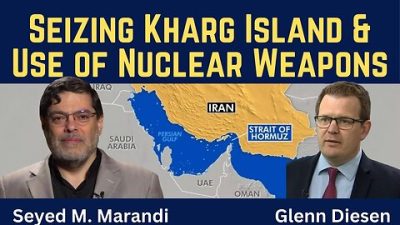
Marandi: Threat of Seizing Kharg Island & the Use of Nuclear Weapons
or go to
Aletho News Archives – Video-Images
Frlom the Archives
Iran War: United States Military Versus Israel Firsters
By James Petras | November 27, 2007
Why must Jewish organizations be and be seen as the loudest drum-beaters of all? Why can we not bring ourselves to say that military intervention is not on the table at all? Why not stash it under the table, out of sight and mount instead a diplomatic assault? – Leonard Fein, Forward
Introduction
As the White House and Congress escalate their economic sanctions and military threats against Iran, top military commanders and Pentagon officials have launched a counter-offensive, opposing a new Middle East War. While some commentators and journalists, like Chris Hedges (Truthdig, November 13, 2007), privy to this high stakes inter-elite conflict, attribute this to a White House cabal led by Vice President Cheney, a more stringent and accurate assessment puts the Zionist Power Configuration (ZPC) in the center of the Iran war debate.
There is a great deal riding in this conflict – the future of the American empire as well as the balance of power in the Middle East. Equally important is the future of the US military and our already heavily constrained democratic freedoms. The outcome of the continuous and deepening confrontation between top US military officials and the Israel Firsters over US foreign policy in the Middle East has raised fundamental questions over self-determination, colonization, civilian primacy and military political intervention, empire or republic. These and related issues are far from being of academic interest only; they concern the future of the United States. … continue
Blog Roll
 Aletho News
- How Zionist Control Is Hurting US Interests
- Iran warns it may target US missile launch sites in UAE cities
- American Military Failure in Afghanistan
- Friendly Skies of Georgia: Are Israeli-Linked Drones Launching False Flags from Georgian Territory?
- The Three Big Lies about Mammography Screening
- Ukrainian Embassy in Beirut sheltering top Mossad agent
- Palestinian family displaced after settlers violently attack them in Humsa, Jordan Valley
- The EU never learns – except for the wrong lessons
- Iran attacks on UAE leaves RSF militia high and dry
- Hosting Washington’s war: Bahrain faces the consequences
- If Americans Knew
- ‘Of Course’: IDF Drops Case Against Soldiers Accused of Raping Palestinian Prisoner
- Don’t Fall for the Regime Change Talk. Israel Is ‘Mowing the Lawn’ in Iran
- Will Israel and the US wreck the Gulf States along with Iran?
- US so far burned through ‘years’ of munitions in Iran war: Report
- How the Israeli Tail Wags the American Dog
- Outdated intel likely led to deadly U.S. strike on Iranian elementary school, sources say
- Pentagon insider says high U.S official Douglas Feith reported to Netanyahu
- In fond memory of Walid Khalidi, the historian of Palestine
- 6 more Americans killed, as Israel ‘mows the lawn’ in Iran – Not a ceasefire Day 154
- Are we on the precipice of World War III?
- No Tricks Zone
- New Studies: UK Sea Levels Were 4 Meters Higher Than Today During The Mid-Holocene
- Destructive Green New Deal: German Energy And Metal Group Warns Of Drastic Crisis
- New Study Documents A 20-Year Pause In Arctic Sea Ice Decline – Driven By Internal Variability
- Wake-up Call: Survey Shows Majority Of Germans Now Favor Postponing Climate Targets!
- Televised! Leading German Political Candidate Tells Schoolchildren CO2 Makes Sun Hotter!
- New Study: A Century Warming Of 1.1°C Is ‘Commonplace’ And ‘Not Unusual’ During This Interglacial
- New Study: ‘Internal Noise’ And Volcanic Forcing Can Trigger 10-15°C Warming Within Decades
- Glaciers Worldwide Are Suddendly Surging, Experts Blame Warming!
- Surprising Discovery: Sahara Is Greening…Billions Of Trees Where Once Thought To Be Barren
- New Research Reaffirms Clouds, Aerosols, And Surface Solar Radiation Are ‘Driving The Climate System’
 Aletho News