The Zionist Strategy of Demonizing Islam
By Anait Brutian | Between the Lines | August 18th, 2010
On August 4, 2010, Rabbi Michael Lerner, editor of Tikkun Magazine and chair of the Interfaith Network of Spiritual Progressives, published an article in Sabbah Report, entitled “Shame on ADL for Opposing Mosque 2 Blocks from Ground Zero.”
Rabbi Lerner’s position on the ADL’s (Anti-Defamation League) objection to building an Islamic Community Center in Manhattan, near Ground Zero is praiseworthy. But his interpretation of ADL’s reasons for resisting such a project lacks insight. ADL leader Abe Foxman’s statement: “In our judgment, building an Islamic Center in the shadow of the World Trade Center will cause some victims more pain – unnecessarily – and that is not right,” spells out the real reasons behind the decision. That decision cunningly reinforces the notion that Muslim fundamentalists were behind the attacks of 9/11 – a position also perpetrated by the architects of those attacks.
Rabbi Lerner’s statement: “It was not ‘Muslims’ or Islam that attacked the World Trade Center, but some Muslims who held extreme versions of Islam and twisted what is a holy and peace-oriented tradition to justify their acts and their hatred,” echoes George W. Bush’s address to a joint session of Congress on Thursday, September 20, 2001, whereby the blame for 9/11 was put on “a fringe form of Islamic extremism … that perverts the peaceful teachings of Islam.” Unfortunately, both positions – the first, explicitly, the second, apologetically – demonize Islam.
As rightly noted by Jack G. Shaheen in his book Reel Bad Arabs: How Hollywood Vilified a People (see also, Reel Bad Arabs – Part 1, Part 2, Part 3, Part 4, Part 5), a consistent stereotype of Arabs and their religion existed since the earliest, most obscure days of Hollywood. Perhaps, this was the continuation of European fascination with Orientalism. However, in the hands of Hollywood, it acquired a new malicious bend that increased proportionally with the number of Jewish entrepreneurs in Hollywood. Arabs were typically presented as rich and stupid, and their Western captives as victims of prejudice, manipulation and oppression. This pattern was further exploited by Zionists to include violence and acts of terrorism.
In 1993 Foreign Affairs published an article by Harvard Professor Samuel P. Huntington entitled: “The Clash of Civilizations?” that expanded into a book with the same title in 1996. The article endorsed the idea that “during the Cold War, the world was divided into the First, Second and Third Worlds.” According to Huntington, “those divisions … [were] no longer relevant”: “It is far more meaningful now to group countries not in terms of their political or economic systems or in terms of their level of economic development but rather in terms of their culture and civilization.” “It is my hypothesis that the fundamental source of conflict in this new world will not be primarily ideological or primarily economic. The great divisions among humankind and the dominating source of conflict will be cultural. Nation states will remain the most powerful actors in world affairs, but the principal conflicts of global politics will occur between nations and groups of different civilizations.”
Amplifying the “differences among civilizations,” Huntington emphasized the role played by history, language, culture and tradition. According to Huntington, differences of religion are the most important among cultural discrepancies: “Even more than ethnicity, religion discriminates sharply and exclusively among people. A person can be half-French and half-Arab and simultaneously even a citizen of two countries. It is more difficult to be half-Catholic and half-Muslim.” Huntington identified seven or eight major civilizations including “Western, Confucian, Japanese, Islamic, Hindu, Slavic-Orthodox, Latin American and possibly African,” predicting that the most important conflict will occur “along the cultural fault lines separating these civilizations from one another”: “The fault lines between civilizations will be the battle lines of the future.”
According to Huntington, the same “fault lines” will replace the “political and ideological boundaries of the Cold War as the flash points for crisis and bloodshed”: “… Conflicts between groups in different civilizations will be more frequent, more sustained and more violent than conflicts between groups in the same civilization.” Huntington identifies these conflicts as “the most likely and most dangerous source of escalation that could lead to global wars.” “The West and the Rest” in Huntington’s prediction of future clashes amounts to a conflict between “the West and several Islamic-Confucian states.” Islam is not identified as the single source of conflict; rather it appears in juxtaposition with Confucian civilization. Yet, Huntington’s reliance on the opinions of Indian Muslim author M. J. Akbar – “The West’s ‘next confrontation’ … ‘is definitely going to come from the Muslim world” – allows him to ignore the advice of Bernard Lewis, whose article “The Roots of Muslim Rage” inspired his title.
Bernard Lewis’ statement: “We are facing a mood and a movement far transcending the level of issues and policies and the governments that pursue them. This is no less than a clash of civilizations – the perhaps irrational but surely historic reaction of an ancient rival against our Judeo-Christian heritage, our secular present, and the worldwide expansion of both,” quoted by Huntington, had a continuation: “It is crucially important that we on our side should not be provoked into an equally historic but also equally irrational reaction against that rival” – that was perhaps more relevant for the argument than the emphasis on the clash of civilizations. This statement and the embedded advice were ignored by Huntington. Instead, Huntington sites historical and modern factors to promote the idea that a “bloody” clash between Western and Islamic civilizations is imminent: “Conflict along the fault line between Western and Islamic civilizations has been going on for 1,300 years.”
A superficial overview of history allows him to state that “Islam has bloody borders.” This statement, notoriously emphasizing a civilizational conflict between “Islam and the West,” became the credo of Zionists like Steven Emerson, whose crusade against Muslims conveniently took yet another turn – anti-Muslim attitudes were camouflaged as anti-terrorist sentiments. Emerson’s 1994 PBS video, Jihad in America “was faulted for bigotry and misrepresentations.” Robert Friedman accused Emerson of “creating mass hysteria against American Arabs.” Emerson accused Bill Clinton for “legitimizing self-declared ‘civil rights’ and ‘mainstream’ Islamic organizations that in fact operated as propaganda and political arms of Islamic fundamentalist movements.” He went as far as to declare that “Muslim terrorist sympathizers were hanging out at the White House.”
Conveniently ignoring the growing problem of Jewish fundamentalism in Israel and the United States (see, “The Ugly Face of the Zionist Jihad: The Halachic Guide for the Killing of Gentiles”), and typically prefacing his “diatribes” by stating that there are good Muslims and bad Muslims, Emerson blacklisted Islam by espousing in a deliberate assault against it: “The level of vitriol against Jews and Christianity within contemporary Islam, unfortunately, is something that we are not totally cognizant of, or that we don’t want to accept. We don’t want to accept it because to do so would be to acknowledge that one of the world’s great religions – which has more than 1.4 billion adherents – somehow sanctions genocide, planned genocide, as part of its religious doctrine.”
After the events of 9/11, a few of Emerson’s earlier comments acquired the status of “prophesy.” In 1994 he claimed that radical Muslims in the United States were plotting the “mass murder of all Jews, Christians and moderate Muslims.” In 1996 he attacked the Council on Foreign Relations for including “Muslim points of views” in its newsletter. And finally, in1997 he warned that “the U.S. has become occupied fundamentalist territory.”
The anti-Muslim rhetoric of the “grand inquisitor” acquires a new meaning, when one considers Emerson’s “friends.” Yigal Carmon, “a right-wing Israeli intelligence commander, who endorsed the use of torture” stayed in Emerson’s Washington apartment during his trips “to lobby Congress against Middle East peace initiatives.” A retired CIA counterterrorism specialist Vince Cannistraro said that Emerson’s allies, Pomerantz, Revell and Carmon were “Israeli-funded.” “How do I know that?” Cannistraro explained – “Because they tried to recruit me.” Cannistraro’s assertions were vehemently denied, but others suspected Israeli backing as well. Jerusalem Post of September 17, 1994 noted that Emerson had “close ties to Israeli intelligence,” Mossad, whose director reported only to the Israeli Prime Minister.
Hollywood’s groundwork was certainly useful to all that planned on instigating a clash of civilization between Muslims and non-Muslims. Huntington’s civilizational conflict between “Islam and the West” became the cornerstone of Zionist propaganda. But long before the establishment of Israel, the Zionist intellectual Maurice Samuel in his You Gentiles of 1924 polarized the Gentile and the Jewish worlds: “There are two life-forces in the world I know: Jewish and Gentile, ours and yours … Your outlook on life, your dominant reactions, are the same to-day as they were two thousand years ago. All that has changed is the instrument of expression” (pp. 19-20). Samuel admits that the “surface credo of a Jewish faith” imposed on a Gentile way of life did not make a fundamental difference: “But in the end your true nature works itself into the pattern of the borrowed faith, and expresses itself undeniably” (p. 22).
According to Samuel there is a “clear and fateful division of life – Jewish and Gentile,” with an “unsounded abyss between” them. Gentiles have a “way of living and thinking” that is distinctly different from Jews: “I do not believe that this primal difference between gentile and Jew is reconcilable. You and we may come to an understanding, never to a reconciliation. There will be irritation between us as long as we are in intimate contact. For nature and constitution and vision divide us from all of you forever…” (pp. 22-23).
Samuel’s description provides a classic example of a real “clash of civilizations.” The notion of a clash also fits Samuel’s final solution, based on the destruction of the existing world order: “A century of partial tolerance gave us Jews access to your world. In that period the great attempt was made, by advance guards of reconciliation, to bring our two worlds together. It was a century of failure. … We Jews, we, the destroyers, will remain the destroyers forever. Nothing that you will do will meet our needs and demands. We will forever destroy because we need a world of our own, a God-world, which it is not in your nature to build” (p. 155).
The modern equivalent of Samuel’s “God-world” and “destroyers” is religiously motivated terrorism – the accusation conveniently hurled at Muslims. After 9/11 – a false flag operation, no doubt – every Mossad-induced terrorist hoax, from shoe-bombers to crotch-bombers, is blamed on Muslims. Meanwhile, terrorist attacks on civilians of a humanitarian aid ship are dubbed as self-defence. There certainly is a clash of civilizations, witnessed by its concomitant double standard. But the clash is not between Muslims and non-Muslims, as the Zionists claim. Rather, the real clash, as Samuel described so promptly, is between Jews and Gentiles. The bogus clash, conveniently induced through tags like “Islam has bloody borders,” is of Zionist origin. It fits the Zionist strategy of demonizing Islam, and is an expedient cover for the real clash between Jews and Gentiles.
American public opinion and the special relationship with Israel
By John Mearsheimer | Mondoweiss | September 18, 2010
There is no question that the United States has a relationship with Israel that has no parallel in modern history. Washington gives Israel consistent, almost unconditional diplomatic backing and more foreign aid than any other country. In other words, Israel gets this aid even when it does things that the United States opposes, like building settlements. Furthermore, Israel is rarely criticized by American officials and certainly not by anyone who aspires to high office. Recall what happened last year to Charles Freeman, who was forced to withdraw as head of the National Intelligence Council because he had criticized certain Israeli policies and questioned the merits of the special relationship.
Steve Walt and I argue that there is no good strategic or moral rationale for this special relationship, and that it is largely due to the enormous influence of the Israel lobby. Critics of our claim maintain that the extremely tight bond between the two countries is the result of the fact that most Americans feel a special attachment to Israel. The American people, so the argument goes, are so deeply committed to supporting Israel generously and unreservedly that politicians of all persuasions have no choice but to support the special relationship.
The Chicago Council on Global Affairs has just released a major study of how the American public thinks about foreign policy. It is based on a survey of 2500 Americans, who were asked a wide variety of questions, some of which have bearing on Israel. Their answers make clear that most Americans are not deeply committed to Israel in any meaningful way. There is no love affair between the American people and Israel.
This is not to say that they are hostile to Israel, because they are not. But there is no evidence to support the claim that Americans feel a bond with Israel that is so strong that it leaves their leaders with little choice but to forge a special relationship with Israel. If anything the evidence indicates that if the American people had their way, the United States would treat Israel like a normal country, much the way it treats other democracies like Britain, Germany, India, and Japan.
Consider some of the study’s main findings:
“Contrary to the long-standing, official U.S. position, fewer than half of Americans show a readiness to defend Israel even against an unprovoked attack by a neighbor. Asked whether they would favor using U.S. troops in the event that Israel were attacked by a neighbor, only 47 percent say they would favor doing so, while 50 percent say they would oppose it …This question was also asked with a slightly different wording in surveys from 1990 to 2004 (if Arab forces invaded Israel). In none of these surveys was there majority support for an implicitly unilateral use of U.S. troops.”
Americans “also appear to be very wary of being dragged into a conflict prompted by an Israeli strike on Iran’s nuclear facilities. In this survey, conducted in June 2010, a clear majority of Americans (56%) say that if Israel were to bomb Iran’s nuclear facilities, Iran were to retaliate against Israel, and the two were to go to war, the United States should not bring its military forces into the war on the side of Israel and against Iran”
“While Americans have strongly negative feelings toward the Palestinian Authority … a strong majority of Americans (66%) prefer to ‘not take either side’ in the conflict.”
“There is some tangible worry regarding the direction of relations with Israel. Although 44 per-cent say that relations with Israel are “staying about the same,” a very high 38 percent think relations are ‘worsening,’ and only 12 percent think they are ‘improving’.”
“Americans are not in favor of Israeli settlements in the West Bank, a major sticking point in the conflict, with 62 percent saying Israel ‘should not build’ these settlements.”
Finally, only 33 percent of those surveyed feel that Israel is “very important” to the United States, while 41 percent said it was “somewhat important.” It is also worth noting that on the list of countries that were said to be “very important” to the United States, Israel ranked fifth behind China, Great Britain, Canada, and Japan. Of course, all of those countries have a normal relationship with the United States, not a special relationship like the one Israel has with Washington.
The data in the Chicago Council’s study is consistent with the data that Steve and I presented in our book and in countless public talks. The story remains the same.
The bottom line is that the lobby is largely responsible for America’s special relationship with Israel, which is harmful to both countries. Alan Dershowitz was spot on when he said, “My generation of Jews … became part of what is perhaps the most effective lobbying and fund-raising effort in the history of democracy.”
The Occupation’s Many Faces
By Joharah Baker for MIFTAH | September 14, 2010
There is an overriding reality that cannot be dismissed here in Palestine. Israel controls just about every aspect of our lives. No matter how we try to turn it around, candy coat it or look at it from a “different perspective” this is the truth and the main reason why no partial agreement will ever hold.
One only has to travel in the occupied Palestinian territories to know this to be true. Over the Eid Al Fitr – the Muslim holiday following the month of Ramadan – the Qalandiya checkpoint between Ramallah and Jerusalem (itself only a recent reality) was jam packed to kingdom come. People spent literally two, three and four hours trying to make their way out of a one-kilometer area because the Israelis had decided to block all traffic going out of Ramallah towards Jerusalem. It did not matter that people had plans, needed to get back to their children and parents or in the worst case scenario, get to a hospital. As the iron gate opened in the separation wall at Qalandiya, a group of young Israeli soldiers stood with their weapons cocked and smirks across their faces as they watched desperate Palestinians trying to inch their way out of the mess. Rather than the [Israeli] authority responsible for the chaos trying to alleviate the situation, instead young Palestinian men exited their cars and tried to direct traffic.
It is not only the traffic and checkpoints Israel controls. Palestinians across the West Bank are plagued by water shortages. In my Ramallah-area village, the water is cut off four of the seven days a week. Families have to ration out the water usage because if tanks are emptied there is absolutely no way to fill them again until the water comes back on. This is not because there is no water in the West Bank, contrary to common belief. According to a report issued by the Israeli human rights organization B’Tselem, Israel controls and exploits 80 percent of ground water from the Mountain Aquifer, which is the largest water source in the region. The remaining 20 percent is basically leftovers distributed among the Palestinian population.
To give a more concrete idea of just how much Israel controls the water resources and distributes it to its own people’s benefit, according to the World Health Organization in 2008, the minimal daily consumption per capita should be 100 liters. In Israel, the per capita consumption reaches 242 liters while the Palestinians consume an average of 73 liters a day. In some places, the WHO says, Palestinian consumption is as low as 37 liters.
Settlers illegally living on Palestinian land have no shortage of water. Just pass by a Jewish settlement, past the lush greenery and the swimming pools and it’s more than obvious that Jewish settlers never have to think about whether they will have enough water to shower or not. Reports have indicated that in places like the Jordan Valley, Jewish settlers use up to six times more water than Palestinians living in the same place.
So, when the Palestinians say they are not continuing with peace talks if Israel continues building in settlements, this is hardly an unreasonable demand. On the contrary, this is the least of the least they can demand given the detrimental effects settlements have had and continue to have on the Palestinians.
Right now, as the negotiating parties head to Sharm Al Sheikh for the second round of peace talks launched in Washington on September 2, Israel is already casting blame on the other side. It is calling the Palestinians’ demand that Israel renew it settlement freeze – already severely riddled with flaws – an “all or nothing strategy” which could ultimately derail any peace efforts. Israel is portraying the Palestinians as the intransigent party for their very legitimate demand of halting settlement construction. Many Palestinians even see this as way too little and a lot too late, saying the leadership should demand nothing less than a complete halt to settlement construction and a dismantlement of settlement structures in accordance with international law.
However, Israel has no plans of relinquishing its settlement enterprise in the West Bank for one reason, which is its control of the land and consequently of the oppressed people living on it. Since its occupation of the West Bank in 1967 Israeli governments have encouraged settlement growth by offering enticing economic incentives such as subsidized housing and reduced utility expenses. By keeping a presence in the West Bank through its settlements, the bypass roads, separation wall and the checkpoints such as Qalandiya, it maintains complete control over the populace, all under the false guise of its own security.
While Israel continues its rants about how the Palestinians are unreasonable and are placing obstacles in the way of peace, it is worthwhile to remind the world what it is like to live under occupation. Control and oppression is multi-faceted. Israel’s military presence and confrontations with the occupying army are definitely important features of Israel’s occupation of the West Bank, Gaza and east Jerusalem but they are not the only ones. The overall control Israel wields over Palestinian lives is suffocating because it is so comprehensive. Leaving and entering the country is controlled by Israel, entering Jerusalem, working inside the Green Line, exporting and importing goods, building a house, tending to your land (if you have access to it) and even the amount of water you are allowed to consume are all controlled by the mighty hand of Israel’s occupying power.
So, before blame is laid or the world judges us too quickly, let us all remember the overriding reason we are at the negotiating table at all. Then after the occupation is duly mentioned, just imagine spending four hours trying to get home from a 45 minute trip only to find no water for your shower.
Joharah Baker is a Writer for the Media and Information Department at the Palestinian Initiative for the Promotion of Global Dialogue and Democracy (MIFTAH). She can be contacted at mid@miftah.org.
The Hate Mongers Among Us
By Jeff Gates | September 13, 2010
Hate is a harsh word. As the counterpoint to love, hate reigns supreme among those emotions that the faith traditions seek to expunge from the human heart.
Hate we’re told is the face of evil seen in plumes of smoke and ash on 911. Yet hate also serves a purpose for those adept at catalyzing conflicts.
In the aftermath of that horrific event, hate we’re assured is a desired emotional state. Yet induced hate led us into two unwinnable wars. Hate may yet take us into Iran. Or Pakistan.
That hate is also bankrupting us both financially and psychologically.
This article identifies those who induce us to hate-and describes how.
As the “how” of hate mongering becomes transparent, its common source will become apparent. With transparency comes accountability. That’s when you can watch for hate to emerge yet again to shield those who hide behind the toxic charge of “anti-Semitism.”
With the shared knowledge of how hate is evoked and sustained, those provoked to hate can say with confidence “Never Again” to those complicit in inducing this evil.
Hate can be personal or geopolitical. Those who induced us to war in the Middle East made it personal. The murderous provocation of 911 was emotionally wrenching and intensely personal. As a people, our gut reaction ensured that support for the war would become widespread.
In the aftermath of that mass murder on U.S. soil, Martin Peretz, editor of The New Republic, summed up the situation: “We are all Israelis now.”
So now we can all be persuaded to hate Muslims-even if we’ve never met one.
The shared mental environment was flooded with what then seemed like plausible justifications for the invasion of Iraq: Iraqi WMD; Iraqi ties to Al Qaeda; Iraqi meetings with Al Qaeda in Prague; Iraqi mobile biological weapons laboratories; Iraqi purchases of yellowcake uranium from Niger.
We now know that all those rationales were fixed around a preset agenda. Yet a critical mass of false beliefs sufficed to take us to war. For those skilled at inducing hate, consensus beliefs need not be true, they need only be credible-and only for a limited time.
With a corrupt consensus ruling the day, anyone offering proof that Iraq was not a threat was dismissed as unpatriotic or soft on terrorism.
This 911-prompted hate fest started with Iraq, a former ally, as a U.S.-led invasion kicked off The Clash of Civilizations. The bravado of “bring ’em on” quickly became “shock and awe” as a vicious invasion was pursued with a relaxed “Aw Shucks” attitude supported with a media campaign comprised of photo ops of a commander-in-chief nonchalantly clearing brush at his home in Crawford, Texas.
Brand America became “We’re still the world’s biggest and baddest in the war-waging business. Just you watch.”
And watch us go broke as America led an Atlantic coalition that, like Israel, alienated much of the Muslim world.
An Invalid War
Plus there’s another strategic problem: our reason for invading Iraq was “invalid.” That’s the assessment of Defense Secretary Robert Gates. He should know. After the invasion, the invalid storyline quickly shifted to “Saddam the Evil Doer” as our rationale.
How can the rationale be invalid? If we’re all Israelis now, surely that entitles us to invade lands belonging to Muslims, kill them, transform them into refugees and, with impunity, create widespread outrage among the broader Muslim population.
Let’s fast-forward to nine years after a high-profile slaughter in Manhattan and survey our success in the stark light of hindsight. Are we more secure? Are we more prosperous? Are Americans facing a brighter future? Are our children proud of the outcome?
Israel has occupied Palestinian land for more than six decades. The September 13th issue of Time magazine captured the Israeli sentiment: “Why Israel Doesn’t Care About Peace.”
Israelis are too busy prospering to care. Outraged Muslims are a nuisance but they’re now largely marginalized and, for the most part, manageable. Is that what happened to us? Have Americans become Israelis?
Not long ago an internal poll of friendly foreign intelligence agencies ranked our best and worst allies-those who behave as friends to the U.S. versus those who are clearly foes. Israel ranked dead last as a reliable ally. Though their brazen theft of technical and industrial secrets is well known among those in the know, the broader U.S. public remains deceived or in denial.
Most Americans still see Israel as an ally. The facts confirm that’s a dangerous delusion.
Meanwhile Mossad agents are recruiting Arab-Americans to spy on their neighbors in the U.S. Though Tel Aviv is called on the carpet three times as often as other nations, Israel still ranks third in the aggressiveness of its U.S. operations, behind only China and Russia.
That ranking may well be out of date with Israel now first in foreign operations on U.S. soil.
Other Telling Signs
Zionist Jews deployed terror and intimidation to occupy Muslim lands long before Harry Truman was induced in 1948 to recognize an extremist enclave as a legitimate nation state. Disputes over land remain at the heart of the expansionist agenda for Greater Israel.
On September 7th, Palestinian leader Mahmoud Abbas asked that the U.S. settle a dispute over the Israeli expansion of settlements that threaten to derail Mideast peace talks. Those talks have dragged on since 1967. Settling those disputes would disrupt the Zionist agenda.
In a telling rebuke, on September 12th, Tel Aviv rejected a proposed visit to Israel by the foreign ministers of France, Spain, Britain, Germany and Italy. Why? These senior diplomats sought a remedy to that dispute in order to achieve a long-evasive peace.
Therein lies Israel’s strategic strength. Absent this sustained provocation (43 years and counting), hatred might subside and peace may become a possibility. That’s a danger Tel Aviv works hard to avoid.
September 12th also saw the release of a new report indicating that 2,066 new homes would be constructed in the West Bank as soon as the temporary freeze expires September 26th.
Meanwhile back in the U.S., Americans remain unaware of how many contracts for Homeland Security were awarded to Israeli firms or to firms owned by pro-Israelis. Nor do Americans realize how many Homeland Security outlays have been directed to Jewish community centers.
That’s all the more reason for Zionists-both Jewish and Christian-to create an uproar about an Islamic Community Center planned for construction two blocks from the 911 site in Manhattan.
And all the more reason for a Christian-Zionist preacher to designate the ninth anniversary of 911 as “International Burn a Koran Day” at his 50-member church.
The Koran gambit gained global attention, stoked by a media dominated by Jewish Zionists. High profile political personalities ensured that this hate-mongering stunt was kept in the forefront of international news coverage in the lead-up to the anniversary of modern history’s best-known hate-mongering provocation.
Signs of a rift between U.S. politicians and U.S. national security
Even with the media support required to sustain hate in plain sight, today’s background chatter suggests that those worried about U.S. national security are at work in the shadows to counter the influence of the Israel lobby.
If so, that is good news-for the United States.
When Israeli-American writer Jeff Goldberg appeared again in the news, you knew psy-ops were underway. In March 2002, Goldberg published in The New Yorker a lengthy story alleging an alliance between the religious jihadists of Al Qaeda and the secular Baathists of Iraq.
Though a nonsensical premise, his account made such an alliance appear plausible to a public lacking in knowledge of the Middle East. Goldberg’s storyline made it easier for Saddam Hussein to be portrayed as both an Evil Doer and a threat to the U.S.
Goldberg’s collaborator was James Woolsey, a former Director of the CIA and an avid Zionist. Woolsey assured us that Iraqi intelligence officials met in Prague with Al Qaeda. By association, his stature in intelligence lent credibility to phony intelligence fixed around an Israeli agenda.
Goldberg reemerged in July to promote Evil Doer status for Iran. Writing in the July 22nd issue of The Atlantic, he argued the Israeli case for bombing Iran and urged that the U.S. again join the fray. No one in mainstream media mentioned his earlier manipulation.
Based on the consistency of his “journalism,” it came as no surprise to see Goldberg reemerge just in time for the ninth anniversary of 911. Aided by an array of false intelligence reported by a complicit media, that murderous provocation helped persuade the U.S. to invade Iraq to remove Evil Doer Saddam Hussein.
That March 2003 agenda was first promoted in 1996 in A Clean Break, a strategy paper written for Benjamin Netanyahu by an Israeli-American team led by Richard Perle. This Jewish-Zionist operative re-emerged in July 2001 to chair the Pentagon’s Defense Policy Board where he was joined by Woolsey and others supportive of this Israeli agenda.
Advancing the Narrative
Fast-forward to September 2010 and we find Goldberg back at work promoting his interview with Fidel Castro. Emerging fact patterns suggest it came as no surprise to our national security apparatus that the theme of this latest well-timed Goldberg article was the Cuban leader’s concern that Iranian president Mahmoud Ahmadinejad is “anti-Semitic.”
The timing of this report came as a surprise to those aware that Castro has long been critical of Israel’s treatment of the Palestinians.
Goldberg reports he was “summoned” to Havana to discuss Castro’s fears of a global nuclear war. After conceding in the interview that the 1962 Cuban Missile Crisis “wasn’t worth it,” Castro turned to a theme of topical importance to Tel Aviv, insisting that the Iranian government must understand that Jews “were expelled from their land, persecuted and mistreated all over the world.”
Knowing Cuba’s pre-revolution alliance with Meyer Lansky and other kingpins in Jewish organized crime, one must wonder if this “journalist” was dispatched to commence negotiations for gambling concessions as a means to fill the Castro government’s depleted coffers.
The recent relaxation of restrictions on travel to Cuba may signal a pending return to Cuba’s “glory days” as a nearby haven for organized crime.
Castro’s well-timed comments about persecuted Jews may have been a signal that Cuba is again open for business-any business. At the very least, his comments were like a healing balm to nationalist Zionist settlers who have plans to construct another 19,000 home in the West Bank.
So much for those who seek to quell Israel’s long-running land dispute with the Palestinians in order to keep peace talks on track.
Within two days of the release of the Goldberg interview, vandals in Sacramento, California used a swastika to deface an image of Israeli basketball star Omri Casspi. The identity of the vandals has not been confirmed.
This much has been confirmed: timing is everything when seeking to sustain a storyline. Casting Castro as pro-Israeli was a stroke of genius.
Here’s where it starts of get interesting as Americans wake up to find themselves unwitting combatants in the first real Information Age War. When waging modern-day warfare in the shared field of consciousness, media is routinely deployed to displace facts with false beliefs.
Thus the need for substantial and sustained influence in that domain by those determined to shape the political narrative. No one does that better than those who induced the world’s greatest super power to wage a war on their behalf.
Recent developments suggest that the dynamics may be shifting in the “field” where political narratives are advanced and where today’s wars are either won or lost. That field is the shared field of consciousness where consensus beliefs are created and sustained.
In news reported from the Middle East on September 10, Washington took a surprising stance in support of Iranian claims that Tehran was not building a new uranium enrichment facility. That statement came after an Iranian dissident group, in a well-timed release, charged that Iran had a new secret nuclear site 120 kilometers north of Tehran.
That disclaimer preempted a lead editorial in The New York Times published in the U.S. later that same day-just before the ninth anniversary of 911. That editorial sought to give credence to a report that had already been dismissed as not credible.
Was this an example of U.S. national security attempting to reclaim the narrative? Does this signal a new aggressiveness by the U.S. in waging field-based warfare against those whose successful deceptions led us to war in the Middle East?
Two days prior, Secretary of State Hillary Clinton gave a speech stating “there may not be another chance” for Mideast peace. That statement came the same day that a senior Palestinian negotiator confirmed they would not recognize Israel as a Jewish state. Clinton said nothing.
Could these developments signal a crack in the Zionist agenda that has shaped U.S. foreign policy for more than six decades? Are Zionists losing their chokehold on the White House?
If so, will the Israel lobby again rally Congress to Israel’s defense?
Will we see another “unbreakable bond” resolution urging that U.S. interests continue to take second place to Tel Aviv’s agenda for the region?
Will the national security interests of the U.S. prevail or will Zionist goals again triumph?
Timing is Everything
While these events were unfolding, The New York Times continued to stoke the controversy surrounding “International Burn A Koran Day.”
The nation’s “newspaper of record” conceded that this well-timed controversy began with local coverage by The Gainesville Sun (owned by The New York Times) when pastor Terry Jones posted a sign outside his small church that read “Islam is of the devil.”
By August 26th, The Times was prepared to publish a major article on Jones and the anti-Islam views of his 50-member congregation. By September 9th, Iranian Foreign Minister Manouchehr Mottaki was prepared to say with confidence that Zionists were responsible for the Jones plan to burn a Koran on 911.
In a fortuitous case of timing, recordings played in a federal courtroom on September 8th showed how a government informer induced a 2009 synagogue bomb plot in New York. The recordings made it clear that those on trial as “homegrown terrorists bent on jihad” were not even modestly well versed in Islam. To make a plausible case for later use in the courtroom, the informer prompted comments consistent with the hate-mongering motivation at the heart of the prosecution’s case.
Do these small chinks in the Zionist armor suggest that Israeli dominance of U.S. foreign policy may be drawing to a close?
The Use of Pliable and Reliable Assets to Advance a Narrative
Many of America’s most prominent political leaders were induced to comment on “International Burn A Koran Day”-a high profile provocation proposed by a Christian-Zionist preacher with a small congregation in a small town in Florida.
When U.S. General David Petraeus spoke out against the proposal, the issue immediately gained an international profile as did Pastor Terry Jones who quickly became an international celebrity.
One need not dig deep to identify who may have advised General Petraeus to grant a global profile to a provocation consistent with Israeli goals for the region.
In March, as head of Central Command, Petraeus offered testimony to the Senate Armed Services Committee confirming facts that have long been obvious but are seldom mentioned: our “special relationship” with Israel and its oppressive occupation of Palestine undermine U.S. interests in the Middle East and endanger American personnel. Read it for yourself:
“The enduring hostilities between Israel and some of its neighbors present distinct challenges to our ability to advance our interests… Israeli-Palestinian tensions often flare into violence and large-scale armed confrontations. The conflict foments anti-American sentiment due to a perception of U.S. favoritism for Israel. Arab anger over the Palestinian question limits the strength and depth of U.S. partnerships with governments and peoples in the [region] and weakens the legitimacy of moderate regimes in the Arab world. Meanwhile, al-Qaeda and other militant groups exploit that anger to mobilize support. The conflict also gives Iran influence in the Arab world through its clients, Lebanese Hizballah and Hamas….”
Petraeus is often spoken of as a potential Republican presidential candidate. Thus the chagrin among some in Washington when this high profile military leader appeared to curry favor with Max Boot, a former Wall Street Journal op-ed editor and outspoken Zionist. In an apparent attempt to soften the candor of his written testimony before the Senate, he wrote to Boot:
“Does it help if folks know that I hosted Elie Wiesel and his wife at our quarters last Sun night?! And that I will be the speaker at?the 65th anniversary of the liberation of the concentration camps in mid-Apr at the Capitol Dome…”
Boot wrote back to assure him that those comments were not necessary as Petraeus had not been described as anti-Semitic. Boot then posted a pro-Petraeus piece on the website for Commentary, a neoconservative publication, assuring readers that the general is not anti-Israel and dismissing his anti-Israel comments as inserted by staff in his statement-that Petraeus reviewed.
The Supporting Cast
After General Petraeus, now senior commander in Afghanistan, created a high profile for the Burn-A-Koran controversy, comments were offered by Attorney General Eric Holder, Secretary of State Hillary Clinton and President Barack Obama. With that, the provocation went viral.
These fuel-the-fire comments were followed by a personal appeal to Pastor Jones in a phone call from Defense Secretary Robert Gates that also went viral.
As any game theorist could predict, even the possibility of such a psy-ops (a Koran book burning) was guaranteed to galvanize anti-American sentiments and catalyze anti-American demonstrations. As the book burning gained steadily more profile, this provocation increased the probability of catalyzing long-lasting anti-American sentiments.
This stunt bears a remarkable resemblance to a Newsweek story alleging that a U.S. soldier flushed a Koran down the toilet. Though that May 2005 account by Michael Isikoff was later withdrawn in substantial part, its publication provoked an earlier well-timed response by setting off anti-American demonstrations in Muslim countries worldwide.
At first, the story gained only scant attention. That muted response changed dramatically when Pakistani cricket star Imran Khan gave Isikoff’s story an international profile by announcing from Islamabad that American military personnel had desecrated a holy Islamic text.
That’s when this Clash of Civilizations-catalyzing, U.S.-discrediting account went viral. In practical effect, Khan’s celebrity was appropriated to associate the U.S. military with conduct similar in its psy-ops effect to the profile given an American proposing to burn a Koran.
Newsweek was recently acquired by Sidney Harman, the husband of California Congresswoman Jane Harman, the Jewish Zionist chair of the Intelligence Subcommittee of the House Committee on Homeland Security. At the time of this provocation, Newsweek was a magazine affiliate of The Washington Post newspaper, an influential opinion-shaping newspaper based in the nation’s capital.
In the annals of “field-based warfare,” the Koran-flushing story will go down in history as a classic psy-ops for its success in targeting the minds of a built-in audience outside the U.S.-cricket fans-as a vulnerable and receptive shared field of consciousness.
When the high-profile Imran Khan described the alleged incident as factual, this operation transcended the literacy barrier as it provoked Muslims who did not even need to read in order to be reached-and provoked.
And because the story targeted cricket fans, its impact was disastrous to Americans while also remaining invisible to America where cricket is neither a well known activity nor a widely played sport.
In what passes for mainstream American media, the Isikoff story was called news. In national security parlance, the well-timed launch of that provocative storyline is called tactical psy-ops. So far, the Koran-burning story is being attributed solely to the whims of a southern preacher.
Stay tuned. It may be only a coincidence that Jones was a high school classmate of Rush Limbaugh, America’s most provocative radio talk show host.
Information Age Warfare
If this sounds familiar, it should. You may recall when the wartime role played by global media became apparent in the Clash-catalyzing “cartoon riots” that swept the world in February 2006. That reaction followed the publication in France, Germany, Italy and Spain of graphic images of the prophet Muhammad that first appeared in a Danish newspaper in September 2005.
Citing free speech as the rationale, cultural editor Flemming Rose published a compilation of cartoons certain to be seen by Muslims as blasphemous, including one featuring Muhammad with a bomb in place of a turban.
An Ashkenazi native of Ukraine, Rose worked as a reporter for five years in Moscow during the oligarchi-zation of Russia. As his contribution to that nationwide fraud, he translated into Danish a fawning 1990 autobiography (Against the Stream) of presidential candidate Boris Yeltsin whose administration enabled the wildly successful financial pillaging of Russia.
Six of the top seven Russian oligarchs were Ashkenazim who qualified for Israeli citizenship.
Rose’s career tracks the trajectory of a typical media asset. After Russia, he relocated to Washington, D.C. Again employed as a journalist, he traveled to China with Bill Clinton before returning to Moscow to work for Jyllands-Posten, a rightwing Danish publication known for its anti-immigrant news fare.
Before catalyzing the cartoon crisis, Rose published a flattering interview with the Islam-bashing Daniel Pipes who heads Campus Watch. This organization monitors, disrupts and seeks to intimidate pro-Palestinian speakers when they accept invitations to speak at U.S. colleges.
Pipes is the neoconservative, Jewish-Zionist son of “Team B” leader Richard Pipes a Polish emigre. Team B was a 1976 alternative intelligence assessment whose success with phony intelligence during the presidency of Gerald Ford (when G.H.W. Bush was C.I.A. Director) informed those who fixed the intelligence that enabled the U.S. to segue seamlessly from the Cold War to the War on Terrorism during the presidency of G.W. Bush.
After the promotion of Rose to cultural editor and publication of the provocative cartoons, CNN anchor Wolf Blitzer featured Pipes on The Situation Room. By showcasing Pipes, Blitzer ensured the airwaves would carry his anti-Islam interpretation of the Rose-catalyzed, media-fueled crisis.
Blitzer elected not to inform the viewers of CNN (“the most trusted name in news”) that he (Blitzer) served as an editor of Near East Report, the Israel lobby’s in-house journal, or that he spent 17 years with The Jerusalem Post, or that he published a sympathetic book on Israeli super-spy Jonathan Pollard who did more than anyone in history to damage U.S. national security.
The ensuing crisis cost many lives while the reaction to that provocation consumed the public’s attention and polarized public opinion internationally. Appearing on television, Secretary of State Condoleezza Rice used the crisis to criticize Iran and Syria, adding American credibility and military authority to stoke The Clash of Civilizations as the post-Cold War narrative.
Overall, the response heightened tensions and made an attack on Iran appear more reasonable as scenes of widespread outrage by Muslims fueled Islamo-phobia in the West. To escape the media scrutiny, Rose fled to the U.S. where he vacationed in Miami.
Timing is Everything
The usual suspects stepped into the fray in support of Pastor Terry Jones’ First Amendment right to further outrage an already outraged Muslim population for whom the Koran is a sacred text.
Supporting cast for the Jones stunt included New York Mayor Michael Bloomberg who chose an annual Iftar dinner at Gracie Mansion to cite the U.S. Constitution in support of this provocation. Likewise for New York Times columnist Charles Blow whose prominently placed op-ed on September 11th urged that “great American debates” should not be “tempered for terrorists.”
National security may (at long last) be catching on to how those complicit in these psy-ops use our guaranteed freedoms (of speech, press, religion, etc.) to undermine our freedom. It’s no coincidence that those most concerned about domestic eavesdropping by national security are drawn from the same ranks as those complicit in this ongoing manipulation of public opinion.
The high profile nature of this latest 911 anniversary ensured that agent provocateurs would use the event to keep hate alive. The day prior, President Obama urged that Israel extend its “temporary partial freeze” on settlements for the sake of sustaining the peace talks.
Meanwhile Jewish Zionist Pamela Geller sponsored a speech at Ground Zero by Dutch politician Geert Wilders who likens the Koran to Mein Kampf. A staunch supporter of Israel, Wilders is known for his incendiary speeches with a strong anti-Islam theme.
Geller, a disciple of Russian philosopher Ayn Rand (Alisa Rosenbaum), advocates measures to “Stop Islamization of America.” She emphasizes the role of Barack Obama in doing the bidding of “Islamic overlords” in what she calls “The Obama Administration’s War on America.”
An outspoken Jewish Zionist, Geller urges that Israel “give up nothing.” A regular commentator on Zionist-dominated media outlets (CNN, Fox News, The Washington Post, The New York Times), she insists that Israel should “take back Gaza” and “secure Judea and Samaria”-better known as the West Bank, the key area of contention on expansion of the settlements.
Geller is also a driving force behind anti-Islam hate groups working to scuttle plans for an Islamic Cultural Center two blocks from the 911 site. Allied with others in the hate campaign, she was among the first in November 2009 to describe the shootings on Fort Hood, Texas as a “Muslim terror attack.”
Staying on message to advance the narrative
Keeping the “anti-Semitism” theme front-and-center remains essential to advance the hate-monger’s narrative with the assistance of mainstream media.
Thus the Anti-Defamation League criticized the current cover of Time magazine for what ADL President Abe Foxman suggested was a portrayal of Israelis as more interested in making money than in striking a peace accord with the Palestinians.
The article highlighted Israel’s booming real estate market and the pleasure Israelis are taking in late-Summer vacations.
Nevertheless, according to Foxman: “The insidious subtext of Israeli Jews being obsessed with money echoes the age-old anti-Semitic falsehood that Jews care about money above any other interest, in this case achieving peace with the Palestinians.”
Foxman insisted that Managing Editor Richard Stengel issue an apology to readers both for the timing of the article and for calling up old anti-Semitic stereotypes about Jews and money.
As if right on cue, the next day filmmaker Michael Moore jumped into the Islamic Cultural Center debate, arguing that the center should not be near the 911 site but inside it as a way for Muslims to recover their religion from Islamic extremists.
In his branded controversial style, Moore could have left it at that. Instead, he used his assured media profile to relate an account of George Washington’s wish to see Jews receive equal rights.
Impressionistic Warfare
From a psy-ops perspective, the subject matter is secondary to the impressions left with the public. The imbedding of imagery and emotion is the strategic purpose of much of what you see.
For instance, Imam Feisal Abdul Rauf, speaking to ABC’s “This Week,” said on September 12th that the controversy over the site of an Islamic Cultural Center has heightened concerns among Muslims of rising anti-Muslim sentiment, saying he felt there was “growing Islamophobia in this country.”
That’s a foreseeable result of creating widely shared impressions that foster and sustain widely shared beliefs that, in turn, are kept intact with emotional triggers. That’s how the hate-monger narrative progresses in plain sight.
When waging war in the shared field of consciousness, the most powerful weapon is often the power of association. Michael Moore’s film success shows how it’s done.
In his popular Fahrenheit 911, he deployed impressionistic “weaponry” to associate the war in Iraq with “Bush Oil.” How was that done? He showed on film that one of the several dozen siblings of Osama bin Laden served on the board of advisers to the Carlyle Group, an investment banking firm in Washington, D.C.
Also serving on that board was former president George H.W. Bush, the father of George W. Bush. Therefore, by the power of association, the war in Iraq was for “Bush Oil.” Storylines don’t need to true, just plausible. The point of psy-ops is not reality but credibility.
Impressions gain the traction required to advance a storyline-in plain sight.
Consensus beliefs create and sustain a narrative-in plain sight.
Psy-ops succeed when they attract enough eyeballs to misdirect the public’s attention-in plain sight.
Fahrenheit 911 was produced by Miramax, a Disney subsidiary. Miramax co-chairman Harvey Weinstein loudly claimed that Disney reneged on its promise to distribute Moore’s film. Disney chief executive Michael Eisner objected-just as loudly.
The high profile sparing between these two Hollywood titans dragged on for months in mainstream media. By the time the film was released, the interest generated by this “dispute” ensured that Moore’s film opened on a record number of screens for a “documentary.”
At virtually no cost, that public relations ploy helped ensure an international audience for a film that discredited not only the U.S. but also the office of the president. In its practical effect, the Moore film helped ensure there was virtually no mention of how key Zionist goals were advanced by this war-in plain sight.
Real-time Terror
Meanwhile, September 12th news reports highlighted the extradition to France from Egypt of a terrorist who reportedly planned to bomb an Israel Defense Forces event in Paris. Noticeably absent were facts about the timeframe of this threat or even when the arrest was made.
That account provided an opportunity for the chief of French intelligence to make a high profile announcement that the risk of a terrorist attack on France “has never been higher.” This week, the French Senate is scheduled to vote a ban on wearing Islamic veils known as burgas, a vote certain to reinforce The Clash of Civilizations as the consensus narrative
Also on September 12th, the leader of Shin Bet announced in Tel Aviv: “Hamas forces in Gaza and the West Bank are engaged in an effort to foil peace talks.” Israel’s domestic security chief told cabinet ministers “threats are due to increase in the near future, as diplomatic developments occur…This isn’t just an estimate but is supported by real intelligence.”
Unmentioned in this volatile mix is the psychology of the hate monger. The purveyors of hate routinely project onto their opponents both their own personality traits (hatred) and, as here, their anticipated agenda. This announcement is far more likely to mean that Shin Bet will stage provocations designed to make it appear that Hamas is the instigator of violence.
For the Zionist agenda to continue in plain sight, peace must be avoided no matter what the cost. Disruption of the peace process, in turn, must plausibly be the work of others. The hate monger must appear to be hated; the aggressor must plausibly appear to be the victim.
Thus the need to portray as anti-Semitic (a hater) those who document the dynamics of how hate-mongers induce hate-in plain sight.
The Assassination of Bibi Netanyahu
Should we see a revival of the U.S. national security apparatus, we will also see a push back against the right-wing extremist coalitions that have long ruled Israel. However, any resistance to the Zionist agenda runs the risk that Israel’s masters of game theory warfare will collapse another government.
That’s how Tel Aviv responded when in June 1963, President John F. Kennedy pressured David Ben-Gurion for inspections of Israel’s nuclear facility at Dimona. This young president sought to ensure that the Zionists of that era did not start a nuclear arms race in the Middle East. He foresaw what we now see.
Before JFK’s strongly worded letter could be physically delivered, Ben-Gurion resigned citing undisclosed personal reasons. By the time a replacement governing coalition was in place and fully functional, the Kennedy problem had been handled.
In the parlance of national security, that’s called an entropy strategy.
Fast-emerging circumstances suggest the likelihood of a similar strategy, particularly should there emerge any prospect of peace with the Palestinians. As Israeli Foreign Minister Avigdor Lieberman candidly put it, peace is impossible: “not next year and not for the next generation.”
Should “Bibi” pressure his fragile governing coalition for an extension of the “temporary partial freeze” on settlements, members of his nationalist government could withdraw, collapsing the government. Key members of the coalition signaled their intentions on September 12th by announcing that any extension of the freeze will end the Netanyahu government.
On September 13th, four Likud Party members threatened to withdraw budget support if the freeze is extended. That threat was issued as Netanyahu departed for peace talks in Sharm el-Sheikh with Palestinian leaders and U.S. Secretary of State Clinton.
The recurring possibility of governmental collapse has long given Tel Aviv leverage over peace talks sought by the U.S. That era may soon draw to a close if our national security apparatus is now guiding U.S. foreign policy. To date, our elected officials have proven themselves unable to navigate through the manipulations often deployed by Israel to stymie agreement on the terms of a peace accord.
Tel Aviv knows the power that the perception of political vulnerability offers in negotiations. When the game theory dynamics of Israeli psy-ops are fully grasped, that leverage will quickly dissipate as negotiators realize they have long been manipulated. That makes the duplicity personal.
The key barrier to realization is the fast-fading belief among policy-makers in the U.S. and the E.U. that Israel is an ally and a friend rather than a sophisticated foe skilled at using deception to leverage its small numbers to great effect.
Though collapse is one possible strategy, Bibi may instead be assassinated.
The threads of a plausible storyline were laid in a September 9th article on Haaretz.com where he was compared to French president Charles de Gaulle against whom French nationalists staged numerous assassination attempts.
Either approach would inject enough entropy into the peace process to sustain the Palestinian conflict and extend the occupation yet again.
Either strategy would strengthen the hand of the hate-mongers as settlers build another 19,000 homes and U.S. legislators continue to pretend that the Zionist state is a victim of anti-Semitism rather than a serial agent provocateur.
* Jeff Gates is a widely acclaimed author, attorney, investment banker, educator and consultant to government, corporate and union leaders worldwide, Jeff Gates’ latest book is Guilt by Association


Canada Colludes in Suppressing Palestinians
By Yves Engler / Dissident Voice / September 17th, 2010
Current peace negotiations between Israeli and Palestinian officials are unlikely to end, let alone reverse, Palestinian dispossession. The power imbalance between the sides is simply too great. While Canada could be part of the solution, so far it has been part of the problem.
The largest Palestinian political force, Hamas, has been excluded from these U.S.-sponsored talks, while the electoral mandate of the Palestinian representative, Mahmoud Abbas, expired 20 months ago. Abbas, who arbitrarily extended his term as Palestinian Authority President, is heavily dependent on countries such as the U.S. and Canada, and this has undermined his negotiating position.
After Hamas won Canadian-monitored and facilitated legislative elections in early 2006, Stephen Harper made Canada the first country to cut its assistance to the Palestinian Authority. The goal was to sow division among Palestinians, and it worked. Immediately after the Palestinian unity government collapsed in mid 2007, the Canadian International Development Agency contributed $8 million “in direct support to the new [Abbas-led] government.”
Ottawa pumped millions of dollars into training a Palestinian security force “to ensure that the PA [Palestinian Authority] maintains control of the West Bank against Hamas,” as Canadian ambassador to Israel, Jon Allen, was quoted as saying by the Canadian Jewish News.
U.S. Lt.-Gen. Keith Dayton, in charge of organizing the 10,000-member Palestinian force supported by Canada, never admitted that he was strengthening Mahmoud Abbas’ Fatah against Hamas, but to justify his program Dayton argued that Iran and Syria funded and armed Hamas. Bolstering Fatah to counteract the growing strength of Hamas was the impetus for Dayton’s mission, yet the broader aim was, and is, to build a force to patrol Israel’s occupation.
“We don’t provide anything to the Palestinians,” noted Dayton, “unless it has been thoroughly coordinated with the state of Israel and they agree to it.” For instance, Israel’s internal intelligence agency, the Shin-Bet, vets all of the Palestinian recruits.
Brigadier-General Michael Herzog, chief of staff to Defence Minister Ehud Barak, explained the Israeli military’s position: “We’re very happy with what he’s [Dayton] doing.”
The Israelis support Dayton’s force because it keeps the population in the West Bank under control. On August 25, Abbas’s security force suppressed a demonstration in Ramallah against the current negotiations, which are taking place without preconditions and while Israel continues to build the wall as well as Jewish settlements in the West Bank and East Jerusalem. Similarly, 20 months ago, “Dayton’s men” (as they are derisively called by Palestinians) disrupted demonstrations in the West Bank against Israel’s 22-day assault on Gaza that left 1,400 dead.
The new Palestinian security forces are primarily trained in Jordan at the U.S.- built International Police Training Center (created to train Iraqi security). In October 2009 the Wall Street Journal reported, “[Palestinian] recruits are trained in Jordan by Jordanian police, under the supervision of American, Canadian, and British officers.”
In the West Bank, 18 Canadian troops work with six British and 10 U.S. soldiers under Dayton’s command. “The Canadian contribution is invaluable,” explained Dayton. Canadians are particularly useful because “U.S. personnel have travel restrictions when operating in the West Bank. But, our British and Canadian members do not.” Calling them his “eyes and ears” Dayton said, “The Canadians … are organized in teams we call road warriors, and they move around the West Bank daily visiting Palestinian security leaders, gauging local conditions.”
Ottawa has invested heavily in Dayton’s mission. In January 2007, then foreign affairs minister, Peter MacKay, offered an immediate $1.2-million for Dayton’s mission, and during a joint press conference in Jerusalem, then U.S. secretary of state, Condoleezza Rice, said Dayton “has a Canadian counterpart with whom he works very closely.” When Foreign Affairs Minister, Maxime Bernier, traveled to Israel in January 2008, he met Dayton, and last October Canada’s chief of defence, Walt Naynczyk, visited Canada’s “road warriors” during a trip to meet Israeli military officials.
Part of the U.S. Security Coordinator office in Jerusalem, the Canadian military mission in the West Bank (dubbed Operation PROTEUS) now includes RCMP officers as well as officials from Foreign Affairs, Justice Canada and the Canadian Border Services Agency. According to deputy Foreign Affairs Minister, Peter Kent, Operation PROTEUS is Canada’s “second largest deployment after Afghanistan” and it receives “most of the money” from a five-year $300 million Canadian “aid” program to support the security apparatus of Abbas’ Palestinian Authority.
As the weaker side, Palestinians need countries like the U.S. and Canada to pressure Israel to return land it occupies against international law. Unfortunately, the current negotiations have begun with Canada and the U.S. undermining Palestinian unity and strengthening the long-suffering population’s most compliant leaders.
Yves Engler is the author of The Black Book of Canadian Foreign Policy
Novel gets to truth of Sabra and Shatila
Matthew Cassel, The Electronic Intifada, 17 September 2010
 |
Israel’s invasion of Lebanon and subsequent 22-year-long occupation has been the focus of three acclaimed Israeli films in recent years: Lebanon, Waltz with Bashir and Beaufort tell the story of this era from the perspective of the occupiers. All young men serving in the Israeli army, the films’ protagonists question their roles in Lebanon. However, this narrative perspective leads the viewer to empathize with the occupier and thus do little other than reinforce a simplistic falsification of Israel’s history as a country always conflicted when waging necessary wars of self-defense. This is the narrative that continues to dominate the Western media.
Not one of these films makes the slightest attempt to humanize Israel’s victims or tell the story from their perspective. In contrast, UK author Mischa Hiller’s first novel, Sabra Zoo is told through the eyes of a young man named Ivan. Sabra Zoo follows the adventures of this son of a Dutch mother and Palestinian father who serves as an officer in the Palestine Liberation Organization (PLO) in Beirut during the most intense period of Israel’s invasion of Lebanon.
Ivan’s thrilling story starts in the weeks following the evacuation of the PLO after more than a decade of being based in Lebanon and ends soon after the Israeli invasion of Beirut. The evacuation of the PLO was followed by the infamous massacres at the Sabra and Shatila Palestinian refugee camps in southern Beirut committed 28 years ago this week by right-wing militias allied with Israel. Because of his multicultural background and European passport, Ivan acts as an interpreter for foreign nongovernmental organization (NGO) workers in Sabra and Shatila and also runs packages and undertakes other menial yet dangerous tasks for a presumed PLO operative working covertly in West Beirut.
Sabra Zoo leads the reader through various aspects of Israel’s 1982 invasion of Lebanon in the midst of the country’s 15-year-long civil war. Yet Hiller attempts to ground the story through its protagonist. As an 18-year-old, Ivan acts like many other young men, constantly preoccupied with thoughts of sex and alcohol. At points throughout the story, however, Ivan’s character comes across as insensitive and unbelievable for the way he jumps from the horrors faced by people in the camps to his more immediate obsession with getting laid.
Yet, like most who witness war at a young age, Ivan shows a wisdom that others only get much later in life, if ever at all. He’s deeply disturbed through his exposure to Palestinian children and families affected by cluster bombs and other ordnance and is distraught when he has to translate the doctors’ unfortunate prognoses to patients and their families. But he never shies away. Ivan shows incredible courage, learning to deal with the siege and attack while continuing his various jobs.
Ivan’s character is also able to offer readers a glimpse of Western perception of the war through the eyes of foreign NGO workers and journalists with whom he collaborates throughout the story.
A foreign cameraperson covering the war tells Ivan while editing video of cluster bomb victims that doing so is a “‘waste of time.'” He explains: “‘People in the West don’t want to see too much reality over dinner. All the gory stuff gets edited out in London or New York … I think if they showed the real effects of war we wouldn’t have it anymore.'” Through this character, Hiller presents a universality that any Western journalist who has covered conflict in this region is aware of: the horrific effects of war as seen on the ground are much different than the sanitized imagery the media sells in the West.
However, throughout the book Hiller leaves the reader frustrated by not narrating who fired the cluster bombs, even making it difficult to understand who is laying siege to Beirut. The most problematic part comes when Hiller introduces the reader to the Nakba, or “the catastrophe” as Ivan translates it while working with refugees in the camp, with no mention of the ethnic cleansing that took place by Zionist militias who forced 750,000 Palestinians to leave their homes in what is today considered Israel. Sure to mention that “back home was Palestine,” the story goes no further to describe the circumstances in which Palestinians, soon to be massacred in refugee camps, had to leave their homes in the first place. While a reader familiar with the history of this region can easily deduce that Israel is responsible for the Nakba, firing cluster bombs and laying siege to Beirut, others might be left wondering. This is a novel and not a history text book, but as an historical novel, such context is important.
Despite this, Sabra Zoo makes viscerally clear the brutality of Israel’s invasion, unlike the skewed history presented in Waltz with Bashir, which also focuses on the massacres. Waltz’s portrayal of mostly benign Israeli soldiers who merely fired a few shots on their way to Beirut and then lit flares over the camp, mostly oblivious to the massacring happening below, is contradictory to both history and Hiller’s narrative. When Israel finally entered Beirut after a brutal assault that killed nearly 20,000 Lebanese and Palestinians and injured many more, the PLO had already left and thus the invading army faced practically no resistance at the Lebanese capital. “‘Who will resist them now?'” asks Ivan’s PLO friend, frightened after the fighters had left and turned their weapons over to the Lebanese authorities. Hiller’s narrative exposes the utter cowardice of Israel’s invasion of a city unable to defend itself as well as its responsibility for one of the most gruesome events of recent decades.
Retelling the story of an event that took place 28 years ago may seem trivial to some who want to remain focused on the present and future, rather than with events of the past. But before Beirut — now one of the world’s most popular tourist destinations — becomes a city that can be enjoyed by foreigners and its inhabitants alike, those who have devastated it before with impunity and are threatening to do so again must first be brought to justice. Sabra Zoo is recommended reading for anyone hoping to better understand Israel’s invasion of Beirut and Palestinian refugees’ long struggle for justice that continues to this day.
Matthew Cassel is based in Beirut, Lebanon and is Assistant Editor of The Electronic Intifada. His website is http://justimage.org.
“Forget the ‘peace process’” and Bomb Iran Already
By Ali Gharib | Lobe Log | September 16th, 2010
In September 2008, The Bipartisan Policy Center issued a report analyzing the Iranian nuclear program and offering recommendations for the U.S. strategic response. This neoconservative “roadmap to war,” as Jim Lobe referred to the report authored by numerous neocons and (troublesomely) Barack Obama’s National Security Council Mid East expert Dennis Ross, argued that diplomatic wrangling over Iran’s nuclear program is useless from the start. They laid out the U.S. preconditions that Iran can not enrich uranium on its soil — knowing enrichment on Iranian soil is a central tenet of that nation’s program. Likewise, they saw sanctions meant to pressure Iran into this position were unlikely to be accepted. So from the neocon perspective, diplomacy and sanctions appear to be mere checklist items on the real agenda of a campaign to bomb Iranian nuclear sites and, perhaps not that much further down the list, a wider campaign aimed at regime change.
Well, Jennifer Rubin, perhaps the most passionate blogger at Commentary’s Contentions blog, is ready to tick those items off the list and move into the final agenda. This is not news, since she has been making essentially this proclamation for some time.
In “Keep Our Eye on the Ball — Iran,” Rubin picks up a New York Post editorial which accuses the UN of bashing Israel while soft-pedaling IAEA accusations by Iran. Rubin naturally agrees. In her mind, no one is harsh enough on Iran and everyone is too harsh on Israel.
Calling the “‘peace process’” — which is always in quotes — “a giant and dangerous distraction,” Rubin writes that “much of the media have lost track of what’s important: Iran and the mounting evidence that the sanctions have been, as conservatives predicted, useless.” She goes on to deride the UN as ineffective, before declaring it’s “[n]o wonder Obama loves the place.”
Then, she finally gets to the point:
[I]t might be a good idea for Jewish organizations to show the same focus as the Post. Forget the “peace process” sideshow and give up the fantasy that the UN or the IAEA will solve our national-security problem for us. The options boil down to : 1) The U.S. uses force; 2.) Israel uses force; or 3.) the Iranians get the bomb. The first is the best of the disagreeable options. It would be swell if American Jewish leaders started making that point.
In her overly-simplistic neoconservative worldview (recalling Dick Cheney’s 2003 proclamation “we will, in fact, be greeted as liberators“), there are only three options: U.S. bombs, Israel bombs, or Iran gets the bomb.
Most notable is her shot at Jewish organizations for being insufficiently hawkish. Rubin’s seeming disdain for Jewish group fits with her recent meme that American Jewish liberalism and its uncrititcal support of Democrats is a “sick addiction.” The phrase is borrowed from a blog post by Rachel Abrams, which Rubin has quoted at least three times. Yet the problem is while Jews have supported Democrats and Obama with overwhelming numbers, many mainstream Jewish organizations are not on board with this sentiment of liberalism. That was exactly the debate raised by Peter Beinart this summer in his New York Review of Books essay — “The Failure of the Jewish Establishment.”
Many Jewish organizations, particularly those with clout in Washington, indeed have a hawkish bent. Consider the Jewish Institute for National Security Affairs (JINSA), which releases among the most bellicose newsletters one can get in their inbox. Just this month, in fact, JINSA called on Obama to do almost exactly what Rubin prescribes — to “blunt Iran first.” To be fair, JINSA called for a “peace process” after that; Rubin obviously does not.
AIPAC, Washington’s more powerful and somewhat less neoconservative Jewish organization, takes on Iran on a near daily basis, devoting an entire section of its website to the topic. Rubin has been known to call out organizations and individuals, most recently Hilary Clinton, when the the buzz words she finds in others’ comments aren’t repeated in a way she finds acceptable. A few of those phrased: that an Iran with nuclear weapons is “unacceptable” and that “all options remain on the table” (a wink at U.S. military strikes on Iran). Interestingly, AIPAC uses exactly this language in two policy briefings on Iran.
So Rubin’s criticisms of Jewish organizations seem less sound than her haranguing of Jews in general. But the takeaway here is important: She is ready to call out anyone who is not for the immediate bombing of Iran as the way to go, the only way to go. If Commentary is a bellwether of the neoconservative movement — and it is — then their intentions are laid bare by Jennifer Rubin.
Israeli army assassinates Hamas leader
TULKAREM — Israeli forces entered the home of a Hamas leader in Tulkarem on Friday morning and shot him three times in the neck and chest before withdrawing, family members said.
Medics at the Thabit Thabit Hospital in Tulkarem confirmed that 38-year-old Iyad As’ad Shelbaya, a known Hamas leader, was dead, killed by three bullets to the neck and chest.
Shelbaya lived in the Nur Shams refugee camp east of Tulkarem. Security sources said he was assassinated during a raid on his home at 2:30 a.m. on Friday morning.
Officials said several armored vehicles entered the area to carry out the assassination. Palestinian forces were said to have coordinated with the Israeli military in getting Shelbaya’s body from his home to the hospital.
Accounts from family members say Shelbaya’s brother Mohammed was abducted by soldiers earlier in the morning, and forced to show officers the way to Iyad’s home.
Once at the home, witnesses said soldiers placed explosives at the main door, destroying the entry way and entering the home.
Several soldiers were then described entering the home, at which point three gunshots were heard. Medics confirmed three shots killed the man, one in the neck and two in the chest.
Shelbaya’s body was then removed from the home.
Mohammed told Ma’an that he heard his brother Iyad calling from his bedroom when the soldiers entered the home, asking “Who is it? Who is it? Who is it?”
“He asked the question three times, and that was followed by three bullets. He was alone sleeping in the house, his wife was visiting family in Jenin,” he said.
See photos of the scene of the assassination here.
An Israeli military spokesman confirmed the death, but gave a different version of events.
“During an arrest raid in the Palestinian village of Nur Shams, one suspect began running for the force,” the spokesman said. “He did not comply with soldiers who requested that he halt.”
The spokesman said that soldiers “felt threatened” by the behavior of the man, and “fired on the suspect.”
Israeli rights group says military report not likely
A field worker for the Israeli human rights organization B’Tselem who investigated the scene called the slaying “unjustified.”
Speaking with Ma’an less than 12 hours after the attack, Eid As-Sa’di said Israeli statements as to how the death occurred were implausible.
“It would have been possible to arrest him, or just as easily to injure him,” he said.
The rights worker said that the room where Iyad was shot was no more than three meters by three meters, and expressed skepticism over the report that the known Hamas leader had come running at troops, that soldiers had had time to warn him to stop, and then shoot.
As-Sa’di said that an investigation by B’Tselem was ongoing, and said details of the event were still emerging.
Dozens detained overnight
During the raid on the camp, nine other Hamas affiliates were detained from their homes.
Security sources identified those detained as: Mohmmad Abu Al-Kheir, Kamal Masharqah, Tayseer Jaber, Sheikh Mahmoud Al-Ghoul, Ashraf Fouda, Nedal Abu Helal, Nedal Abu Tharefah, Mohammad Abu Deiyah and Ahmad A’sa’s.
Fourth assassination in nine months
On 26 December 2009, Israeli forces entered the city of Nablus, proceeded toward the homes of Raed Sakarji, 38, Anan Subih, 33, and Ghassan Abu Sharkh, 40, in two cases entered the homes and shot the men, and in a third, executed Abu Sharkh in front of his home.
A statement from the Israeli military said soldiers “entered Nablus in an attempt to locate and arrest the men suspected of involvement in the murder of Meir Avshalom Hai this past Thursday.” The statement said the deaths were provoked by the suspects.
Testimony from witnesses, and blood evidence in hallways and bedrooms, showed the men were shot in their homes.
“We were sleeping in our bedroom, not bigger than six square meters, when Israeli soldiers began yelling ‘get out, get out.’ I thought I was dreaming. When I heard the Israeli soldiers and their police dogs outside the room, that was when I realized it was real,” Tahani, the wife of Raed Sarakji told Ma’an at the time.
Tahani said her husband told soldiers he would get out of the house, so they started shooting through the door and the windows. “He fell between my hands bleeding. I started crying ‘they killed him, they killed him.’ Then soldiers broke the door and got in. He was already dead, but they continued to riddle his body with bullets to make sure he was killed.”
A similar account was given by the cousin of Ghassan Abu Sharkh, “Everything happened very quickly… when we opened the door and saw the soldiers, two masked collaborators pointed to my brother Ghassan who was walking down the stairs. Before I knew it he was being shot. I couldn’t really make sense of what was going on at all. Then an Israeli officer asked me whether the dead man was Ghassan, and I said yes. ‘Good, then ask everybody to leave the house,’ the officer said.”
“I was standing close to Ghassan when they killed him. They could have detained him very easily. He passed to join my brother Nayif who was killed by Israeli forces a few years ago [2004].”
The third account was given by Farid Subih, 45, whose younger brother, Anan Subih, 33 was killed.
“At 3 a.m., dozens of Israeli troops surrounded our four-storey building. They blew open the the main gate then started shooting randomly and throwing grenades in all directions. Anan was inside, and he asked everybody to leave the building to avoid being hurt.”
He continued, “We headed to the nearby house of the Al-‘Amoudi family. Then soldiers entered the house with police dogs, and they started throwing more grenades, and a fire erupted in the warehouse full of plastic chairs and sponge material.
“My brother was not armed, but we could see soldiers continue to ransack the house. For three hours, we didn’t know what was going on. After the soldiers left, we found Anan dead … bullets tore all his body and bones.”
According to the Israeli military, “When he was killed, Annan Tzubach [Subih] was armed with a handgun and hiding two M16 assault rifles, an additional handgun, and ammunition.” The same statement, however, said that “During an attempt to arrest him tonight [Saturday], Annan was killed after an exchange of fire with the IDF while he was found in a hiding place along with weapons and ammunition.”
Non-Aligned Movement: IAEA could die saving Israel
Press TV – September 16, 2010
The Non-Aligned Movement (NAM) warns that the International Atomic Energy Agency (IAEA) should not protect nuclear-armed Israel at the organization’s own cost.
The movement, which dissociates itself from major superpowers, used the final day of an IAEA meeting in Vienna to highlight Israel’s possession of nuclear weapons, a Press TV’s correspondent reported on Thursday.
The 118-member movement expressed its “grave concern over the selective approach of the IAEA towards the issue of the Israeli nuclear capabilities.”
This attitude “puts at stake the viability of the IAEA as an independent technical body,” NAM said.
Tel Aviv is believed to have manufactured scores of nuclear warheads since 1958, a year after IAEA’s inception.
The organization, however, has so far refused to ratify a resolution against Israel’s nuclear activities and has simply sufficed to call on Tel Aviv to join the Nuclear Non-Proliferation Treaty (NPT) and to “place all its nuclear facilities under comprehensive IAEA safeguards.”
Former US President Jimmy Carter has attested to the existence of the Israeli nuclear arsenal, which he said includes between 200 to 300 warheads. Decades of recurrent reporting and aerial footage have also confirmed the possession.
NAM also underlined that “stability and security cannot be achieved in a region, where a massive imbalance of military capabilities is maintained systematically.”
The disproportionate distribution of armed power “allows one party in the region…to threaten” others, it added, referring to Israel.
Nam referred to the situation as “unacceptable” and urged that it be addressed “very seriously” so an end can be put to it.
Israel maintains a policy of “nuclear ambiguity,” in line with which it neither confirms nor denies having nuclear armaments.
Israel, backed by the US, has also so far evaded punitive measures.
Efforts by Arab states and other countries caused an NPT review conference in May to issue a statement, highlighting the importance of Tel Aviv’s acceding to the treaty and its allowing the IAEA to fully inspect its nuclear sites.
In the closing chapters of the IAEA meeting, the European Union staged support for Washington’s stance and asked the Arab countries not to table any further such resolutions.
Terror In The Village That Became A Minefield
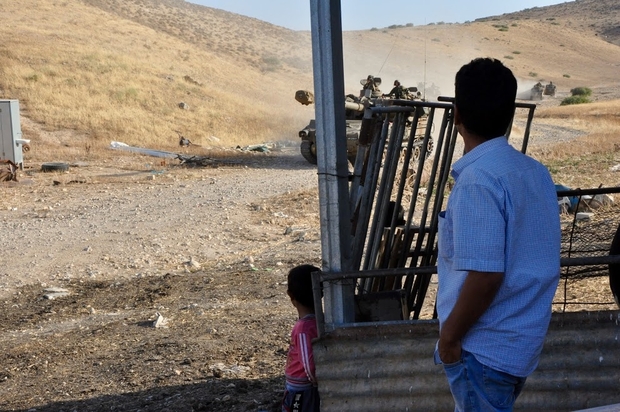
A father and son in Khirbet el alHama stand by as military tanks pummel through their small community (MEE/Emily Mulder)
Palestine Monitor – 15 September 2010
For many villages in Area C, landmines have become a regular feature of daily life. Israeli military training zones occupy nearly 30% of the land, often based around civilian areas, leaving unexploded ordnance (UXO) that cause horrific injuries to local residents. We spent a few days with the victims to see how they live with the constant terror.
Rafat Al-Rushayida is 24, he has lived his whole life in the bedouin village east of Bethlehem that shares his name. Al-Rushayida has played host to a military training zone since 1967, which has now expanded into 50% of the village’s land. He and four young friends showed us what the soldiers left behind.
If children find a bomb it is custom to surround it with rocks as a warning to others.
Awad Al-Rushayida, father of Rafat, was crippled by a landmine last year and has been unable to work since. “They (Israeli army) don’t make it safe because they want the land. They want us to leave”, he says.
Seven civilians killed in US raid near Fallujah
Al-Manar TV – 16/09/2010
At least seven Iraqi civilians were killed during a joint US-Iraqi raid in the outskirts of Fallujah on Wednesday, in the deadliest incident involving U.S. occupation troops since the United States declared an end to its combat operations in Iraq on Aug. 31.
Iraqi officials said eight civilians were killed, while the U.S. occupation military claimed four suspected members of al-Qaeda in Iraq and two civilians died in a firefight that erupted as forces tried to capture a presumed member of the group who allegedly was responsible for attacks in the region.
Despite the official end of the U.S. combat mission, about 4,500 U.S. Special Operations forces remain in Iraq.
Iraqi officials in Anbar province said U.S. and Iraqi troops began raiding houses at 3 a.m. in Jubil, about 30 miles west of Baghdad. Among the dead, they said, were a 70-year-old man and three of his sons, who were all asleep in their yard when they were killed by a grenade. A fourth son died at a hospital, the Iraqi officials said.
Troops also entered a second house in the area and killed Yaseen Kassar, a former Iraqi military commander, Iraqi officials said, as well as two people in a third house.
It was not immediately clear whether the troops had been looking for Kassar or any of the other people killed.
“The security situation in Fallujah may deteriorate because of what happened today,” said Abdulfattah Izghear, a local city council member. “We asked U.S. troops and the Iraqi government to explain this unjustified action and this naked aggression against civilians.”
Iraqi Prime Minister Nouri al-Maliki, who is in charge of the Iraqi Special Forces, ordered an investigation into the incident, the state-run network al-Iraqiya reported.
Featured Video
Prof. Ted Postol: Iran Already Achieved Nuclear Deterrence Against Israel
or go to
Aletho News Archives – Video-Images
From the Archives
How the occupied mentality syndrome works
Saudi Arabia on the American chessboard – Part 3
By B. J. Sabri | American Herald Tribune | June 27, 2016
Read part 2: “The occupied mentality Syndrome“
Previously I argued whether Saudi Arabia’s repeated involvements in U.S. interventions and wars stem from free national will or in response to a specific condition. For starters, in Saudi Arabia there is no national will. In Saudi Arabia, the national will is the will of the Al Saud clan. Still, when a major Arab state allies itself with a superpower that committed unspeakable crimes against humanity in almost every Arab country, then something is wrong. This fact alone should compel us to examine the U.S.-Saudi relation for one exceptional reason. As a result of the U.S.-Saudi wars, hundreds of thousands of people in Afghanistan, Iraq, Iran, Libya, Syria, Yemen, and Somalia have lost their lives. Millions became displaced in their own homelands. And millions more rendered refugees.
Attributing the Saudi policies to the bonds of “partnership” with the U.S. is frivolous. There are no bonds between these two thugs except those of business, military deals, secret plots, and wars. Proving this point, bonds such as these have no space for the American and Saudi peoples to share significant cultural or societal exchanges. If partnership is not the reason for the Saudi contribution to the U.S. strategy of empire and imperialism, then another reason must exist.
This leads to three possibilities. … continue
Blog Roll
 Aletho News
- NIAID/NIH and USDA Fund Bioengineered Chimeric Influenza Viruses Built Using Pandemic H1N1 Components: Journal ‘Science Advances’
- Hezbollah hits Israeli warship off Lebanon’s coast, sets it aflame
- Iran slams US strikes on B1 bridge, Mahshahr petrochemical plants as ‘blatant acts of state terrorism’
- In letter to UN chief, Araghchi warns of dire consequences of US-Israeli attacks on Iran’s nuclear facilities
- Why the CIA conspiracy to invade Iran with Kurdish militias failed
- Why Are Upbeat US Claims About Mission to Rescue Pilot ‘Highly Questionable’?
- Aircraft destroyed during US ‘rescue’ of downed F-15 pilot cost more than $100 million each
- Washington University removes professor who condemned US-Israeli war on Iran
- Russia Warns of Retaliation as UK Authorizes Seizure of Vessels
- Serbia thwarts plot to bomb Russia-Hungary gas pipeline – Vucic
- If Americans Knew
- In Iran, Israel-US take aim at “reason, research, and freedom of thought” – Daily Update
- US loses planes over Iran, Israel downgrades Lebanon war goals – Daily Update
- Israel Is Blocking Palestinians from Easter at Church Where Jesus Resurrected
- Plot to assassinate Palestinian activist follows harassment campaign promoted by Zionist groups and elected officials
- Prominent New York synagogue hosts presentation on why U.S. Jews should support the ethnic cleansing of Gaza
- Tapper vs. Piker: Is the CNN Anchor Auditioning for David Ellison?
- Shouldn’t Democrats Be Able to Condemn Genocide?
- Israel-US kill negotiators, destroy civilian structures, but Iran’s military capabilities still largely intact – Daily Update
- ‘War crime’: Global condemnation as Israeli ministers celebrate death penalty law targeting Palestinian prisoners
- 7 Ways Israel Is Turning Lebanon Into Gaza
- No Tricks Zone
- An Inconvenient Tree: Uncovered In Alps… Europe Much Warmer Than Today 6000 Years Ago
- New Study Reports A 60% Slowdown In Greenland’s Ice Loss Rate In The Last Decade
- Low Intensity Tornado Wrecks Major Solar Farm, Creating A Potential Toxic Dump
- New Study Finds Warming Saves Lives…Cold Temperatures 12 Times More Deadly Than Excess Heat
- German Science Blog Accuses PIK Climate Institute Of Hallucinating Climate Tipping Points
- Devastating Assessment Of Comirnaty Vaccine By Former Senior Pfizer Europe Toxicologist
- New Study: CO2 Is ‘Effectively Negligible’ As An Explanatory Climate Change Factor Since 2000
- Former Pfizer Toxicologist Dr. Helmut Sterz Tells Bundestag Hearing Pfizer Vaccine Should Have Never Been Approved
- Energy Expert: Germany’s Nuclear Phaseout Was A “500 Billion Euro Mistake”
- New Research: South Australia’s Mid-Holocene Sea Surface Temperatures Were 4°C Warmer Than Today
 Aletho News