FT: “Seoul finds new way to finance Iran trade”
This past September, The Wall Street Journal Asia’s editorial board heralded the Japanese and South Korean enforcement of UN sanctions against Iran as “worth cheering” and a sign that South Korea was “growing up as a democracy.”
But the news today that South Korea has appointed two state-run banks to finance trade with Iran, might make the WSJ editorial board rethink their premature exuberance over the effectiveness of the sanctions regime.
Christian Oliver, Song Jung-a and Anna Fifield write in the Financial Times:
The US had pressured South Korea to cut out trade with Iran following the imposition of sanctions in September. Washington praised Seoul when South Korea announced its own measures.
Soon after the sanctions announcement, however, South Korea quietly reached a financing agreement with the Iranian central bank to buttress trade.
Seoul says that from this month Woori Bank and the Industrial Bank of Korea can finance legitimate trade with Iran in sectors unaffected by sanctions.
South Korea has a $10 billion annual trade relationship with Iran and is clearly eager to retain what commerce they can with the Islamic Republic.
Seoul’s effort to find ways of maintaining its commercial relationships with Iran is yet another example of the challenge of imposing a sanctions regime on Iran, which has a diverse and well established set of trading relationships in the increasingly globalized and interconnected economy.
The FT article says:
But in Washington officials said the South Korean move would increase transparency in dealings with Iran. “This is a measure to ensure that some of the shadier private banks in Iran are not involved [in business transactions],” said a state department spokesman.
The Iranian central bank will deposit proceeds from oil sales in South Korea at Woori and IBK. The funds will be used to ensure payments for South Korean exporters that had been retreating from Iran.
America’s Third World Economy
The Great Transformation
By PAUL CRAIG ROBERTS | October 8, 2010
For a number of years I reported on the monthly non-farm payroll jobs data. The data did not support the praises economists were singing to the “New Economy.” The “New Economy” consisted, allegedly, of financial services, innovation, and high-tech services.
This economy was taking the place of the old “dirty fingernail” economy of industry and manufacturing. Education would retrain the workforce, and we would move on to a higher level of prosperity.
Time after time I reported that there was no sign of the “New Economy” jobs, but that the old economy jobs were disappearing. The only net new jobs were in lowly paid domestic services such as waitresses and bartenders, retail clerks, health care and social assistance (mainly ambulatory health care services), and, before the bubble burst, construction.
The facts, issued monthly by the US Bureau of Labor Statistics, had no impact on the ”New Economy” propaganda. Economists continued to wax eloquently about how globalism was a boon for our future.
The millions of unemployed today are blamed on the popped real estate bubble and the sub-prime derivative financial crisis. However, the US economy has been losing jobs for a decade. As manufacturing, information technology, software engineering, research, development, and tradable professional services have been moved offshore, the American middle class has shriveled. The ladders of upward mobility that made American an “opportunity society” have been dismantled.
The wage and salary cost savings obtained by giving Americans’ jobs to Chinese and Indians have enriched corporate CEOs, shareholders, and Wall Street at the expense of the middle class and America’s consumer economy.
The loss of middle class jobs and incomes was covered up for years by the expansion of consumer debt to substitute for the lack of income growth. Americans refinanced their homes and spent the equity, and they maxed out their credit cards.
Consumer debt expansion has run its course, and there is no possibility of continuing to drive the economy with additions to consumer debt.
Economists and policymakers continue to ignore the fact that all employment in tradable goods and services can be moved offshore (or filled by foreigners brought in on H-1b and L-1 visas). The only replacement jobs are in nontradable domestic services, that is, those jobs that require “hands-on” activity, such as ambulatory health services, barbers, cleaning services, waitresses and bartenders–jobs that describe the labor force of a third world country. Even many of these jobs are now filed with foreigners brought in on R-1 type visas from Russia, Ukraine, Thailand, Romania, and elsewhere.
The loss of American jobs and the compression of consumer income by low wages has removed consumer demand as the driving force of the economy. This is the reason expansionary monetary and fiscal policies are having no effect.
The latest jobs report issued today shows that America’s transformation into a third world economy continues. The economy lost 95,000 jobs in September, mainly due to cuts in local education and federal employment. Part of the loss of 159,000 government jobs was offset by 64,000 new private sector jobs.
Where are the new jobs? They are in nontradable lowly paid domestic services: 32,000 were in health care and social services, and 33,900 were in food services and drinking places.
There you have it. That is America’s “New Economy.”
Paul Craig Roberts was an editor of the Wall Street Journal and an Assistant Secretary of the U.S. Treasury. His latest book, HOW THE ECONOMY WAS LOST, has been published by CounterPunch/AK Press. He can be reached at: PaulCraigRoberts@yahoo.com
Related article
- The Offshore Outsourcing of American Jobs: A Greater Threat Than Terrorism (blacklistednews.com)
Debtors’ prisons rise again in the South
By Sue Sturgis | Institute for Southern Studies Online Magazine | October 6, 2010
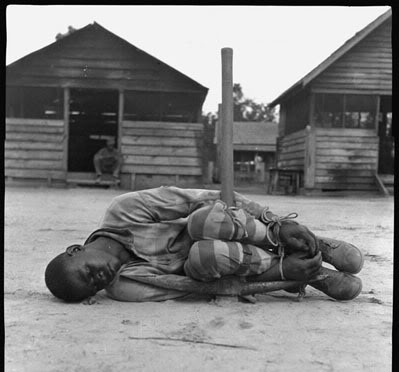 Forced Labor Camp, Georgia, 1930s
The Brennan Center for Justice and the American Civil Liberties Union released reports this week documenting the growing problem of criminal justice debt and the considerable costs it’s imposing on communities, taxpayers and indigent people convicted of crimes. The following figures come from those reports, titled respectively “Criminal Justice Debt: A Barrier to Reentry” and “In for a Penny: The Rise of America’s New Debtor Prisons.” Click on the figure to go the specific source.
Of the 15 states with the highest prison populations examined in a recent report on “user fees” imposed on people with criminal convictions, number in the South: 7
Number of those 15 states that utilize “poverty penalties” against convicts such as late fees, payment plan fees and interest: 14
Number that charge poor people public defender fees for exercising their constitutional right to counsel: 13
Number that suspend driving privileges for missed debt payments, hurting people’s job opportunities: 8
Number that require individuals to pay off criminal justice fees before reinstating their eligibility to vote: 7
Number that have attempted to measure the impact of criminal justice debt on offenders, their families or communities: 0
Collection fee charged by Alabama for court-related costs: 30 percent
Surcharge Florida allows private debt collectors to tack on to a convicted person’s debt: 40 percent
Amount North Carolina charges for failure to pay a fine or court cost on time: $25
Amount it charges to set up an installment payment plan: $20
Amount it charges for a failure to appear: $200
Amount it charges defendants for crime lab fees: $600
Amount it can assess a person convicted of a DUI for the use of a continuous alcohol monitoring system: up to $1,000
Number of people jailed in North Carolina’s Mecklenburg County in 2009 for failing to pay court-related debt: 246
Amount of money the county made from those jailings: $0
Amount that people released to parole in Texas typically owe in offense-related debt: $500 to $2,000
Amount that defendants in Virginia may be charged per count for certain felonies: $1,235
Percent of felony cases before the New Orleans courts that relate to debt collection issues: over 6
Value of food that Gregory White, a homeless resident of New Orleans, was convicted of stealing: $39
Amount White was assessed in fines and fees for his crime: $339
Number of days White spent in jail because he was unable to pay his debt and couldn’t afford the bus fare to complete community service: 198
Cost of his incarceration for the city: over $3,500
Year in which the Orleans Parish, La. municipal court system settled a lawsuit by agreeing to put a stop to “fines or time” sentencing: 2007
Number of such sentences handed down by that same court in March 2010 alone: at least 32
Estimated percent of people charged with criminal offenses in the U.S. who qualify for indigent defense: 80 to 90 percent
Percentage by which African-American defendants are more likely than white defendants to rely on indigent defense counsel: almost 500
Decade through which many Southern states were still using criminal justice debt collection to effectively re-enslave African-Americans by allowing landowners and companies to “lease” black convicts unable to pay on their own: 1930s
Year in which the U.S. Supreme Court held that imprisoning someone merely because of his inability to pay a fine or restitution was fundamentally unfair: 1983
Thieves Planting Flags, Murderers Carrying Crosses
A book review of – King Leopold’s Ghost: A Story of Greed, Terror, and Heroism in Colonial Africa
By Brian Hurrel | December 3, 2009
When reading Hochschild’s “King Leopold’s Ghost”, one is struck not only by the enormity of the crimes committed in the Belgian Congo, but also with the puzzling and somewhat uncomfortable realization that this should not be news. It seems incredible that such events could be relegated to the ash heap of forgotten history. In the case of Leopold’s Congo, the ash heap was more than metaphorical. Officials destroyed as much evidence as they could before the Congo was turned over the Belgian government, and according to Hochschild, “the furnaces burned for eight days, turning most of the Congo state records to ash and smoke in the sky over Brussels.”

English: “In The Rubber Coils. Scene – The Congo ‘Free’ State” Linley Sambourne depicts King Leopold II of Belgium as a snake entangling a congolese rubber collector. (Photo credit: Wikipedia)
While there has been a growing acknowledgment over the past few decades of the whitewash given to much of Western history, there has also been much criticism of “revisionist history”. To acknowledge that ones country has blood on its hands in the past is seen as being unpatriotic or anti-Western. At best, such history is dismissed as “ancient” or simply lived by people who were “a product of their times”. It is difficult, however, to dismiss Leopold’s Congo as such. This is not “ancient history”. Those who participated are not far removed from today’s young generation, and were contemporaries of our grandparents and great grandparents. As for such men being products of their times, this is hard to reconcile with those living a generation or two after slavery ended in the United States, and more than a century after slavery had been outlawed in much of Europe.
And for what did these atrocities take place? What was the driving force behind such barbarism? Ivory at first, but what really turned the Congo into a slaughterhouse seems almost trivial when looked at in comparison to the murderous lengths undertaken to exploit the resource in question: Rubber. For this millions died and countless others were mutilated.
This is a good example of the laws of unintended consequences. Certainly Scotsman James Dunlop had no idea of the misery that would result from his invention of the pneumatic rubber tire. The Congo just happened to have the right resource at the right time in its abundant supply of rubber vines. “The industrial world rapidly developed an appetite not just for rubber tires, but for hoses, tubing, gaskets, and the like, and for rubber insulation for the telegraph, telephone, and electrical wiring now rapidly encompassing the globe. Suddenly factories could not get enough of the magical commodity…” As with oil in later decades, rubber, a resource that the world had little use or need for a few short years earlier, suddenly became essential to the economies of the industrialized world. Even if the Congo had had any chance of relatively benign treatment by the West, the rubber boom would have sealed its fate regardless. Also, Leopold, with undeniable business acumen, knew that cultivated rubber, from trees rather than vines, would eventually cause a drop in price when rubber plantations in South America and Asia reached maturity. In the meantime, he decided to squeeze the Congo for every last drop before this happened, and “voraciously demanded ever greater quantities of wild rubber from the Congo…”
One might have expected Leopold’s agents to pay Congolese natives a pittance to gather rubber, and still reap huge profits, but the reality was that human greed knew no bounds in the Congo. The natives were not paid at all. In fact, they were not even allowed to handle money. Instead they were forced to gather rubber by a variety of means, most of them violent or terroristic. In most cases, women and children were held hostage until the men met their rubber quotas. Those who resisted were simply killed. Even many who didn’t resist were killed for not meeting quotas. Others died of disease and starvation, especially those in detention. Some died in the dangerous job of harvesting the rubber vines high in the trees. Those caught cheating by cutting the vine open, which yielded more rubber but killed the vine, were killed as well.
In other cases, Force Publique forces simply rampaged through entire regions, wiping out villages and massacring men, women, and children alike without distinction. In many instances, to prove that they hadn’t wasted ammunition hunting, they were required to show a left hand to their commanders for every round of ammunition used. Uprisings, of which there were many, were dealt with quickly and severely. Huge areas were left depopulated through a combination of punitive massacres, terrified villagers abandoning the area, or communities that could not remain viable because the men spent so much time gathering rubber while their women and children were interned.
An English explorer at the time, crossing a huge 3,000 square mile area of the northeast Congo, was horrified at the “depopulated and devastated” wasteland he witnessed: “Every village has been burnt to the ground, and as I fled from the country I saw skeletons, skeletons everywhere; and such postures — what tales of horror they told!”
If any one object symbolized the brutal cruelty of the Congo State, it would be the chicotte. “…a whip of raw, sun-dried hippopotamus hide, cut into a long sharp-edged corkscrew strip. Usually the chicotte was applied to the victim’s bare buttocks. Its blows would leave permanent scars; more than twenty-five strokes could mean unconsciousness; and a hundred or more — not an uncommon punishment — were often fatal.” Chicotte beatings were meted out for every offense imaginable — and often for no offense at all or for something as trivial as native children laughing in the presence of a white man.
As for these Force Publique men enforcing Leopold’s will in the Congo, they were not soldiers or officers, at least not officially, but called, in rather bland corporate terminology, “agents”. Such a mild and businesslike title hardly fits someone having the power of life and death over virtually every native in his area of operations. Not only did these men have such power at their disposal, but were more than willing to use it. Some did so because it fit their notion of necessary discipline. Others used such fear and intimidation to increase their profits. And still others seemed cut from a different cloth — the kind of men who seemed to actually enjoy killing for its own sake. Among the most notorious of these was Captain Léon Rom, who displayed the severed heads of natives in his garden. He and several other Force Publique agents who went far beyond the bounds of an already cruel and brutal regime were the inspiration for “Mr. Kurtz” in Joseph Conrad’s Heart of Darkness. Another, Léon Fiévez, was still clearly remembered in local oral histories some fifty years after the “rubber terror”. Said one local named Tswambi:
All the blacks saw this man as the Devil of the Equator… From all the bodies killed in the field, you had to cut off the hands. He wanted to see the number of hands cut off by each soldier, who had to bring them in baskets… A village which refused to provide rubber would be completely swept clean. As a young man, I saw [Fiévez’s] soldier Molili, then guarding the village of Boyeka, take a big net, put ten arrested natives in it, attach big stones to the net, and make it tumble into the river….Rubber caused these torments; that’s why we no longer want to hear its name spoken.
These were not aberrations. Nor were they were isolated instances of excess by a handful of agents. Such inhuman viciousness was widespread and accepted company policy. Few Europeans were ever held accountable for their actions in the Congo, and the few instances of punishment amounted to a show hearing and a slap on the wrist for those charged.
There is one man who is, if not ultimately responsible for the devastation of the Congo, the one person who set the stage for Leopold to carve out his personal African fiefdom, and he deserves mention: Henry Morton Stanley. Best known for finding Dr. David Livingstone, whom had been missing for years deep inside the continent, he was one of the most celebrated adventurers of his time, and even today most who have heard of him would simply say he was a great explorer. However, regardless of his feats in Africa, he held the people of that continent in utter contempt. He boasted about shooting anyone who got in the way of his expeditions, which were practically small armies tearing through the countryside. General Sherman, of American Civil War fame, likened Stanley’s journeys in Africa to his own scorched-earth march through the South. Explorer and writer Richard Burton noted that Stanley “shoots negroes as if they were monkeys.”
Much of what is “great” about Stanley comes straight from Stanley himself. There were few corroborating witnesses to many of his exploits, though by his own words it is clear that he, like many Europeans, saw native Africans as little more than beasts of burden rather than as participants in his expeditions. The native porter, a familiar icon when one thinks of African exploration, was not the healthy, well muscled black extra seen in countless Tarzan films, but a broken, suffering native driven like a team horse, often given inadequate food and rest, and often simply left on the side of the trail to die when he reached the end of his endurance.
The use and abuse of native porters, while not as graphically cruel as other excesses in the Congo, was nonetheless a brutal and destructive practice. Perhaps portage does not get the attention of other atrocities by its sheer “ordinariness”—in addition to being a relatively slow and subtle road to death, it was a practice simply accepted and expected in Africa. And as was the case in so many other aspects of exploitation in the Congo, porters were rarely paid employees selling their services, but forced labor with little choice in the matter. As just one example, “Of the three hundred porters conscripted … for a forced march of more than six hundred miles to set up a new post, not one returned. Stanley made extensive use of these men, and left a string of dead across half the continent. This in addition to those who were encountered and shot along the way—one imagines a native was just as likely to be shot approaching the expedition out of curiosity as he was with hostile intentions.
Admirers of Stanley would hardly think he could be compared to those who later raped and devastated the Congo, but it was men like Stanley who paved the way; not just by cutting out paths through the jungle, but by doing so with the mind-set that these lands were theirs for the taking and its inhabitants fit only to serve their ends, be it gold or glory—or ivory and rubber. Rather than being venerated, Stanley should be relegated to the ranks of those explorers and colonizers whom Peter S. Beagle invoked when he wrote “We are raised to honor all the wrong explorers and discoverers—thieves planting flags, murderers carrying crosses.”
“King Leopold’s Ghost” is a shocking, often gut-wrenching, and horrifying read. It is also a story that needs to be told, and more importantly, remembered.
Related articles


In the jungles of northern Okinawa, protests against planned US helipads reach a crisis point
By Jon Mitchell · IPS · October 5, 2010
 The residents of Takae, a small village in the hills of northern Okinawa, are no strangers to the American military. Since 1957, they’ve been living next to the world’s largest jungle warfare training center – and many of them are old enough to remember the days when the U.S. Marine Corps hired locals to dress up as Vietcong for its war games.
The 1996 Special Action Committee on Okinawa was supposed to reduce the U.S. presence in the area. Convened to quell public fury over the rape of a 12-year old girl, it pledged to return large swathes of military land to Okinawan residents – including over half of the jungle training center. As the months passed, however, the promise failed to materialize. Even when a Marine helicopter crashed near Takae’s elementary school in 1999, the daily bombing runs and roof-high helicopter sorties continued unabated.
Then, in 2006, the U.S. military made an announcement. Before returning the territory, it first wanted to build six new helipads on the land it was retaining on the outskirts of the village. The residents repeatedly lodged complaints with the prefectural and national governments, but they were ignored. In 2007, construction crews from the Okinawa Defense Bureau arrived to start laying the foundations for the 250-foot helipads. Takae’s villagers were waiting for them. They linked arms to block the gates to the worksite, they surrounded the trucks and appealed to the builders to stop their work. When they refused to listen, the protesters sat in the way of their heavy machinery. But the crews continued to unload bags of cement over their heads. Only when the police arrived did construction stop out of concern for public safety.
Since that day, over 10,000 locals, mainland Japanese, and foreign nationals have participated in a non-stop sit-in outside the planned helipad sites. So far, they’ve managed to thwart any further construction attempts. At small marquee tents, the villagers greet visitors with cups of tea and talk them through their campaign, highlighting their message with hand-written leaflets and water-stained maps.
“We’re just ordinary people wanting to lead ordinary lives,” explains Takae resident, Isa Ikuko. In a quiet voice almost drowned out by the click and whir of late summer insects, she talks of the area’s 180 species of endangered wildlife and her pride in its broccoli-shaped trees, the nearby rivers that supply the island with most of its drinking water, and the recent disclosure that the U.S. military tested Agent Orange here in the 1960s. “But what particularly scares me is the Marine Corps plan to bring in the Ospreys,” says Isa, holding up a U.S. military image of the accident-prone aircraft flying over a river suspiciously similar to one near the village.
Equally frightening are the recent tactics deployed by the Tokyo government. In November 2008, it filed an injunction against 15 of the protesters, accusing them of obstructing traffic in the area. Hoping that the three-hour road trips to the capital’s courthouse would wear down the villagers’ resolve, it also included an 8-year old child on the roster of defendants to intimidate other potential participants. The ploy backfired and the ensuing public outcry forced prosecutors to drop 13 of the cases. Two still remain, though, and with the next hearing scheduled for later in the year, a dangerous precedent is at stake. If the government wins, it will open the door for suits against similar protests – including in nearby Henoko bay where for the past six-and-a-half years, sit-in protesters have successfully prevented construction of an on-sea air base.
As long as the cases meander through the courts, the Okinawa Defense Bureau crews stay away from Takae. But with verdicts due soon, Isa and her fellow protesters are steeling themselves for the showdown sure to come to this little-known corner of northern Okinawa.
Featured Video

Pentagon insider says high US official Douglas Feith reported to Netanyahu
or go to
Aletho News Archives – Video-Images
Frlom the Archives
The Fiction of the Jewish History in Palestine
By Hasan Afif El-Hasan | The Palestine Chronicle | April 8, 2011
Prime Minister Benjamin Netanyahu told NNC Pierce Morgan on March 18, 2011 that he might agree to a Palestinian state through negotiations. And he added, “We will make territorial concessions although it is very painful to do that in our ancestral land.” Netanyahu was not talking about Poland where his ancestors lived. He was talking about Palestine where generations of its indigenous population ancestors lived, cultivated the land and are buried.
By the end of the nineteenth century, Zionism created a new Jewish identity of blood and soil. To mobilize their followers and supporters and appeal to their emotions, the Zionists created myths. Zionism started as a tribal religion without god, but in order to fulfill its function as a unifying force, Zionism required external religious and race symbols, not inner content. Its leaders regarded metaphysical religious belief and purity of race as having value in itself. They created a divine paradisiacal state of merger with the gods. Despite his non-religious ideology, Herzl’s writings were replete with religious references. The Jews should settle in Palestine because, in his words, “the Temple will be visible from long distance, for it is only our ancient faith that has kept us together”.
The Zionists and their supporters have invested tremendous financial and scholarly resources to work within the Hebrew Bible historical narratives to affirm the links between the intrusive Zionist population and the ancient Israelite past, and by doing so assert the right of that population to the land. The political end-game shaped the investigation and the outcome. Tracing the roots of Israel’s ethnic state in biblical antiquity is effectively to silence the indigenous Palestinian claim to the past and therefore to the land. The Biblical scholarship employs a bewildering array of terms for the region: “the Holy Land”, “the Land of the Bible”, “Eretz Israel”, “the Land of Israel”, or “Judah and Samaria.” To the casual reader these names appear interchangeable, but they all imply connection to ancient Israel.
Biblical narratives or poems that cannot be supported by archeology and common sense are treated by the Zionists and their supporters as historical language. … continue
Blog Roll
 Aletho News
- Pentagon insider says high US official Douglas Feith reported to Netanyahu
- The Sludging of Rural America
- Lawyers’ groups demand end to British military bases in Cyprus
- CIA Assessment: The Resistance Cannot Be Crushed
- Hezbollah Returns: It Didn’t Start a War, It Is Ending One
- EU states seek ‘talks’ with Iran for access to Strait of Hormuz: Report
- Trump on Hormuz: “Others must take care of it” after US falters
- Who Is closer to collapse?
- A War that Backfired: Why the US-Israeli Campaign Is Strengthening Iran
- How Zionist Control Is Hurting US Interests
- If Americans Knew
- As US-Israel war on Iran rages, Gaza faces massive dust storm – Not a ceasefire Day 156
- No let-up in attacks on Gaza as Israel takes on Iran, Lebanon – Not a ceasefire Day 155
- ‘Of Course’: IDF Drops Case Against Soldiers Accused of Raping Palestinian Prisoner
- Don’t Fall for the Regime Change Talk. Israel Is ‘Mowing the Lawn’ in Iran
- Will Israel and the US wreck the Gulf States along with Iran?
- US so far burned through ‘years’ of munitions in Iran war: Report
- How the Israeli Tail Wags the American Dog
- Outdated intel likely led to deadly U.S. strike on Iranian elementary school, sources say
- Pentagon insider says high U.S official Douglas Feith reported to Netanyahu
- In fond memory of Walid Khalidi, the historian of Palestine
- No Tricks Zone
- Storing Green Energy To Last Germany 10 Days Would Require A 60-Million Tonne Battery
- New Studies: UK Sea Levels Were 4 Meters Higher Than Today During The Mid-Holocene
- Destructive Green New Deal: German Energy And Metal Group Warns Of Drastic Crisis
- New Study Documents A 20-Year Pause In Arctic Sea Ice Decline – Driven By Internal Variability
- Wake-up Call: Survey Shows Majority Of Germans Now Favor Postponing Climate Targets!
- Televised! Leading German Political Candidate Tells Schoolchildren CO2 Makes Sun Hotter!
- New Study: A Century Warming Of 1.1°C Is ‘Commonplace’ And ‘Not Unusual’ During This Interglacial
- New Study: ‘Internal Noise’ And Volcanic Forcing Can Trigger 10-15°C Warming Within Decades
- Glaciers Worldwide Are Suddendly Surging, Experts Blame Warming!
- Surprising Discovery: Sahara Is Greening…Billions Of Trees Where Once Thought To Be Barren
 Aletho News